With Walt Whitman in Camden (vol. 4)
Note (): Hitherto unpublished photograph, undated and unsigned Return to text. Note (): From the collection of Anne Montgomery Traubel Return to text.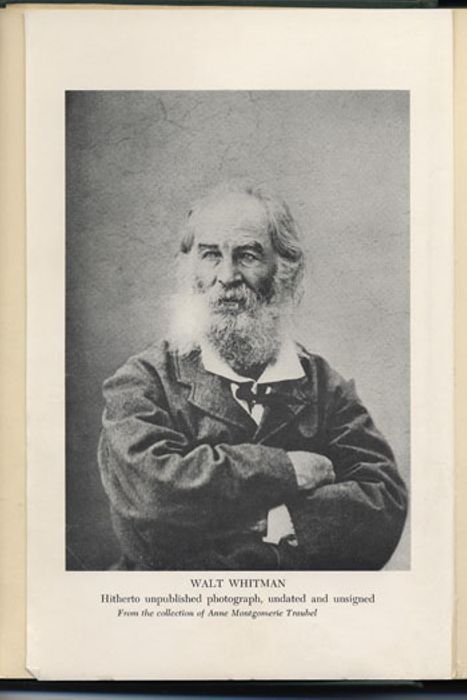
Edited by Sculley Bradley Philadelphia University of Pennsylvania Press London: Geoffrey Cumberlege Oxford University Press 1953 [Begin page iv]
Copyright 1953
Anne M. Traubel
Manufactured in the United States of America
CONTENTS
| page | |
| Introduction...................................... | ix |
| Sculley Bradley | |
| To Readers........................................ | xv |
| Horace Traubel's introduction to Volume I, 1906 | |
| Editorial Note.................................... | xvii |
| Sculley Bradley | |
| Conversations: January 21 to April 7, 1889........ | 1 |
| Index............................................. | 515 |
ILLUSTRATIONS
| Walt Whitman | Frontispiece |
| Hitherto unpublished photograph, undated and unsigned From the collection of Anne Montgomerie Traubel | |
| Facing page | |
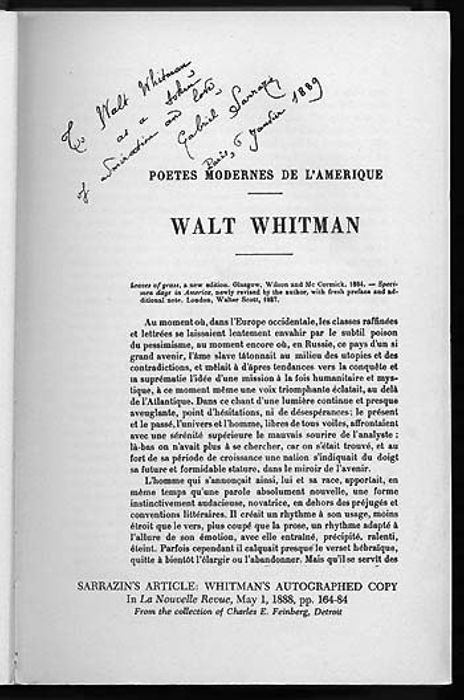
| "Poetes Modernes de L'Amerique: Walt Whitman"--Sarrazin's Autograph | 2 |
| Gabriel Sarrazin's review-article in La Nouvelle Revue, May 1, 1888, pp. 164-84 From the collection of Charles E. Feinberg, Detroit | |
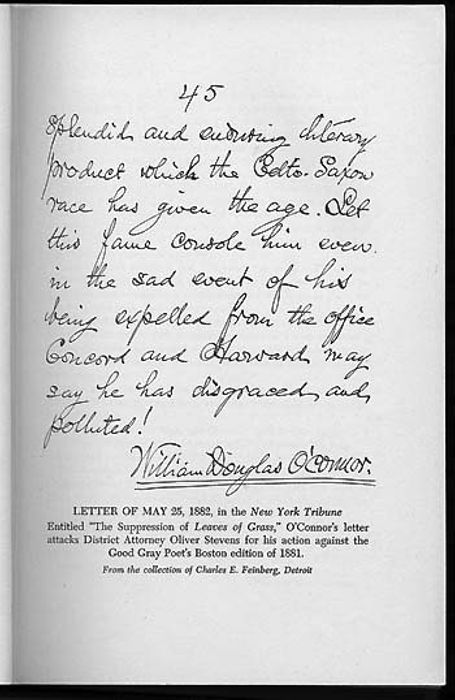
| Last Page of "The Suppression of Leaves of Grass" | 20 |
| W.D. O'Connor's letter of May 25, 1882, published in the New York Tribune, attacking Oliver Stevens, District Attorney of Boston, who forced the withdrawal of the 1881 edition by Osgood and Company From the collection of Charles E. Feinberg, Detroit | |
| Emerson to Whitman, July 21, 1885 | 152 |
| The famous letter in which Emerson wrote, "I greet you at the beginning of a great career," here for the first time published in complete facsimile. In actual size, with envelopes From the collection of Anne Montgomerie Traubel | |
| Whitman's Royalty Income, 1889 | 440 |
| Autograph receipt to David McKay for royalty, March 28, 1889 From the collection of Charles E. Feinberg, Detroit Matching entry, dated March 26, 1889, in David McKay's account book From the collection of the University of Pennsylvania Library |
INTRODUCTION
The conversations recorded in this volume took place sixty-five years ago, yet they have an immediate interest and value, both for the general reader and the literary scholar. In 1906, when Horace Traubel published the first volume of these discourses, With Walt Whitman in Camden, only a few enthusiasts and far-sighted librarians recognized its value, and preserved it for readers of future generations. It now seems impossible that a book reporting Whitman warmly and truly should have experienced neglect even later, in 1914, when the third volume was published. When Horace Traubel died in 1919, he had been unable to secure a publisher for his fourth volume, and it appears here for the first time.
With the passing years, there has been a mounting recognition of Whitman. Today he towers among the unquestioned great interpreters of America. A new generation of poets found that he had been their pioneer, enlarging their horizons, and giving a new freedom to their craft. Readers in many lands, during these troubled decades, have taken comfort from Whitman's faith in democracy, his serene individualism, his vision of "inseparable cities with their arms about each other's necks" in a universe whose "kelson" is love. The postponed approval of Whitman caused scholars and critics, somewhat belatedly, to discover the values in Traubel's volumes, so that today they are widely sought by literary specialists and libraries. Except for the writings of the poet himself, there has been no source so clearly indispensable as the three volumes of With Walt Whitman in Camden. Every good biographer and critic of Whitman has used this work as a source, and many serious readers have enjoyed it.
Each of Traubel's volumes may stand alone, the present no less than the three that preceded it. You may open it anywhere and begin reading, for this work needs no such logical or chronological sequence as is customary in a work of formal interpretation or biographical narrative. Its logic is the delightful and limber illogic [Begin page x] of conversation, in which one thing by chance recalls another in the daily meeting of two friends with a storehouse of memories. It is Whitman, the man himself, there in the cluttered Camden house, fully aware, at seventy, of the adventure of each new day; but talking, endlessly talking, of remembered yesterdays. He is an old man now, turning the kaleidoscope of recollection, and reviewing his colorful life; but he is also still very much alive, reading the news and the books, concerned for all his friends, firm in his opinions.
All this Traubel transferred quickly to his notes, almost with the fidelity of a modern wire recorder. Like a good reporter he made no effort to "improve" Whitman; he impartially recorded both the old invalid, peevish with constipation, and the lofty thinker; both the angry partisan and the magnanimous forgiver of trespasses; he reproduced the trite, the common, even the vulgar remark as cheerfully as the sublime idea. Without the reporter's formal training, Traubel apparently had the reporter's instinct, and the eyes and ears of a television camera. The present writer is indebted to Mrs. Traubel for the following account of her husband's method of work: "The notes of the visits to Whitman were written on small bits of paper to fit into the pocket of his jacket, and were written in what he called 'condensed longhand,' in the dim light of Whitman's room. Within the hour of the words spoken, the material was put into the complete form with which you are familiar in the three published volumes. There was no vacuum of time or emotion, thus preserving the vitality of the original conversation." The idea, one gathers, was to transcribe not only the words, but the very inflection of the poet's voice. The young scribe often read it back to his future bride to check the sound of it.
Does Whitman know that young Traubel, making notes as they talk, will soon be back in his room, transcribing his "story", as it were, before the midnight deadline? In any case, the old poet knows, by journalistic experience, that eventually it will serve a good purpose. John Burroughs and Dr. Bucke have already published their accounts, authorized and supervised, in part, by the poet himself, but Whitman seems here to be making an effort not to define the book that Traubel might write, not indeed to imply that he is obligated to write any book at all. Yet the two continue endlessly to recall the moments of life, homely or lofty, dark or luminous, that [Begin page xi] the old man might want to winnow from the chaff, while retrieving from the piled debris, the litter of papers that always surrounded him, the precious documents and letters that substantiated his memory. These he gave to Traubel, with only one command concerning their possible use: "Whatever you do do not prettify me." Traubel's understanding of his commission, and his method of fulfilling it, were precisely stated in his address to the readers of his first volume, in 1906. In order to avoid the presumption of restating it here, we have reprinted it, under its original title, "To Readers," immediately following this introduction.
Horace Logo Traubel (1858-1919) was well suited for the mission which came to him unsought. Mrs. Traubel believes that her husband had no particular plan to write a book on Whitman when he began to record his conversations. He had known Whitman from his boyhood; he found the poet an exhaustless source of interest and life, and responded naturally to the impulse to set down his conversation. The rest followed as a matter of course. Actually, Traubel had known Whitman for fifteen years or more before the first recorded conversations. In 1873, when Traubel was a boy of fifteen, and Whitman fifty-four, the poet, stricken with paralysis, secured a deputy for his small clerkship in Washington and took lodging with his brother, George, in Camden, New Jersey. The Traubels lived nearby, and were already acquainted with the Whitmans. A couple of years earlier, they had heard that Whitman's mother, on a visit with his brother George, had been stricken with illness, and like good neighbors of an earlier time, they had gone to see her. From that time young Traubel was a familiar at the Whitmans'. The father, Maurice Henry Traubel, a German by birth, came at twenty-one to Philadelphia from Frankfurt-am-Main, where he had received a liberal education in the arts. A lithographer by occupation, he provided for his son the environment of books, music, and ideas. In time, Whitman's young admirer became the mature friend.
During the earlier years of their association the poet wrote his last great poems, although he recovered somewhat from the paralysis that at first threatened his life. He prepared the Centennial Edition of his works for the celebration of 1876. Still later, he brought Leaves of Grass into its final organization for the edition of 1881, suppressed in Boston and transferred to a publisher in Philadelphia, [Begin page xii] Rees Welsh, soon to be succeeded by David McKay. He published a prose volume, the Specimen Days of 1882. In 1884, he was able to move into the first house that he ever called his own, and the last, the simple wooden dwelling at 330 Mickle Street, Camden, where these conversations took place, and where the poet died. In all these enterprises after 1876, Traubel became increasingly the companion and the bearer of burdens for the physically handicapped poet. In 1888 appeared November Boughs (containing the fundamental essay, "A Backward Glance O'er Travel'd Roads"); in the same year came what they called "the big book"—Complete Poems and Prose. This was followed within a year, in 1889, by the charming pocket edition, with its limp, black leather cover, published to commemorate the poet's seventieth birthday.
In these later publications, Traubel became truly the poet's literary adviser and critic, as well as his agent with the publisher, the printers, and the bookbinders; for Whitman, to the end, arranged for the printing and binding of his books, for which McKay was sales agent. These events, as contemporary with the present conversations, are vividly portrayed in their daily occurrence, in this scrupulous account of Traubel's regular visits to Whitman in 1888 and 1889. References to present visitors jostle with the memories of old friends. In this house, during the years to come, Horace Traubel was to assist the poet with his very last books, Good-Bye My Fancy (1891), and the last Leaves of Grass (1892), dubbed the "deathbed edition" because Traubel brought one of the first copies, in its brown paper cover, to the dying poet's bedside.
To the little house in Camden came many literary admirers—American and foreign visitors, great and small—while correspondence poured in from every quarter. Through the years, Traubel became one of the band of somewhat older men—the "Whitman circle"—who came and went continuously in thought and often in person: such as Burroughs, from his farm in New York; or Dr. Bucke from Canada, where he was Superintendent of a mental hospital; or William Douglas O'Connor (superintendent, in Washington, of the United States Life Saving Service), the author, in 1866, of The Good Gray Poet; and William Sloane Kennedy, man of letters, who, like all these others, wrote authoritative books about Whitman. In addition, there were the Philadelphia friends—Harned, the Smiths, Harrison [Begin page xiii] Morris, Herbert Gilchrist the painter, temporarily transplanted from England, and numerous others. Traubel knew them all personally; and he had also picked up a full knowledge of Whitman's associations with the great figures of the past—Emerson, Thoreau, Carlyle, Rossetti, Lincoln, Ingersoll, and many more. When the time came for Whitman to make a final recapitulation of his story, Traubel knew what questions to ask, and by instinct he knew what questions posterity would want to have answered. From 1890 until 1919, when he died, Traubel issued his monthly Conservator, supporting a mild form of socialism, and publishing many articles on Whitman. With Bucke and Harned he edited the authorized Complete Writings in ten volumes in 1902.
Not the least contribution of the present volume is the portrayal of the living man, Whitman, in the mellow fruition of his seventieth year. Anyone interested will read the record for himself, but a few illustrations at random may not be out of place here. One notes the remarkable clarity of the poet's mind and memory, and his touching sense of peace with a world which, as might have been thought, had rewarded him but little. No doubt he meant from the heart what he had declared in "A Backward Glance" the year before—that he had fared on the whole better than he had any right to expect, in that, after all, he "had fully arrived" within his own lifetime. There was still the poverty and privation: the payment from his publisher was "fifty-five dollars for six months' royalties—God save us from starvation!" But Gabriel Sarrazin had just written a notable critique for a French review, even if Whitman had to get Dr. Bucke and Kennedy to translate it for him; German translations by Rolleston and Knortz were bearing fruit in the increasing European reputation of Leaves of Grass. The old poet is fully alive to the stirring life of the present; he delights in the daily pageant. The Haymarket riots in Chicago are still in litigation; this reminds him of the high social purposes of his new friend, Hamlin Garland, just then emerging as a leading figure; and Garland's name recalls the hard blows for social justice struck by his early friend, William Cullen Bryant, and by Stedman, and even by Howells, who had not always been a friend to him. Whitman is interested in the painting of Millet, and among his own contemporaries prophetically picks Thomas Eakins for highest praise. He knows what Laforgue has been writing, while recalling [Begin page xiv] the earlier Whittier with discerning fairness. He thinks of Emerson—the historic episodes of 1855-56, and the later meetings in 1860 and 1881. The attempted expurgation of his own work is of a piece with the recent activities of Comstock, and with other censorship injurious to moral health. The new furor about "birth control" does not escape his observation or his wit. One of the rewards of this book for the general reader, certainly, is the mirroring of the events of the late 1880's on the quick intelligence of the old prophet, who daily gave thanks for the survival of a clear mind in his infirm body.
The body with its ills will intrude, of course, from time to time. Whitman is immensely human, an old man beset by infirmities, sometimes goaded by Traubel's sharp questions into momentary vehemence, even anger; but quickly subsiding into a sense of humor much richer than that revealed in his writings. The afflictions of his body, like the foibles of friends, are inevitable conditions of life, both alike to be accepted with a grim amusement that makes the best of all things. He can laugh at the impending frustration that Bucke is predictably destined to experience with his money-making invention, while loving the man dearly; he can recall the tempestuous earlier associations with the Irish O'Connor while being daily concerned by ominous reports of his present illness; he can reflect upon the growing eccentricities of John Burroughs, yet cherish undiminished the tenderness of an undying comradeship. It may after all prove that Traubel, in setting down the facts so faithfully for scholarship, has also accomplished the more difficult literary creation by which the living reality of a man is preserved for posterity.
Sculley Bradley University of PennsylvaniaNovember 12, 1952
TO READERS
My story is left as it was originally written. I have made no attempt to improve it. I have taken nothing off and put nothing on. I know that it has defects. I am not ashamed of defects. I know that it has virtues. I am not proud of virtues. Here is the record as it virginally came from my hands in the quick of the struggle it describes. It might have been made more literary. It might have been made more precise. Its loose joints might have been tightened. Some commas might have been put where colons are. Phrases might have been swung about. The formal grace of the recital might have been improved. I have preferred to respect its integrity. To let it remain untouched by a censorship. To let it continue, for good or bad, in its then native atmosphere. I do not want to reshape those years. I want them left as they were. I keep them forever contemporary. I trust in the spontaneity of their first inspirations.
Did Whitman know I was keeping such a record? No. Yet he knew I would write of our experiences together. Every now and then he charged me with immortal commissions. He would say: "I want you to speak for me when I am dead." On several occasions I read him my reports. They were very satisfactory. "You do the thing just as I should wish it to be done." He always imposed it upon me to tell the truth about him. The worst truth no less than the best truth. He did not ask to have his failings paraded but he did ask that they should not be hid. He knew that imperfection is a part of perfection. He knew that our blood runs black as well as red. He did not like evil talked about as if it was fatal. But he knew that a place must be provided for it in any portrait of a person or in any portrayal of an event. So I have let Whitman alone. I have let him remain the chief figure in his own story. This book is more his book than my book. It talks his words. It reflects his manner. It is the utterance of his faith. That is why I have not fooled with its text. Why I have chosen to leave it in its unpremeditated arrangement of light and shade. Why I have not attempted to make it conform to any arbitrary[Begin page xvi]humors of the bookmaker. It was not my purpose to produce a work to dazzle the scholar but to tell a simple story. Or, rather, in the main, to let a certain story tell itself. I have done nothing negatively to disguise any poverty in the portrait and nothing affirmatively to falsely enrich it. I have had only one anxiety. To set down the record. Then to get out of the way myself. To give the observer every privilege of vision. I do not come to conclusions. I provide that which may lead to conclusions. I provoke conclusions.
A number of the collateral documents quoted are from Whitman himself. These are printed without repair. They are kept to his own text without elision and without change. The same thing may be said of the letters from others to Whitman. Nothing has been done to sophisticate the text. It occurs here in the rude dress natural to the incidents that produced it. I had no time then to polish. I have had no disposition since to do what I had no time to do then. The record begs no questions. Never makes worse of better or better of worse. Tries to explain away no sin. Tries to lug in no virtue. Whitman was not afraid of the man who would make too little of him. He was afraid of the man who would make too much of him. He knew that it was easier to survive some kinds of enemies than to survive some kinds of friends. Whitman did not insist upon his faults. But he wanted them all counted in. The last fault with the first fault. He would rather have been thought too little of than too much of. I have never lost sight of his command of commands: "Whatever you do do not prettify me."
HORACE TRAUBEL Camden, February, 1906EDITORIAL NOTE
Three previous volumes of these conversations were published by Horace Traubel:
- With Walt Whitman in Camden
- Vol. I: Conversations, March 28 to July 14, 1888 (Boston: Small, Maynard and Company, 1906)
- Vol. II: Conversations, July 16 to October 31, 1888 (New York: D. Appleton and Company, 1908)
- Vol. III: Conversations, November 1, 1888, to January 20, 1889 (New York: Mitchell Kennerley, 1914)
At the time of his death in 1919, Horace Traubel had transcribed and arranged the material for a fourth volume, represented in the present text. This was a typescript, which Traubel corrected in ink. Although the manuscript was then considered by a publisher who declined the venture, there is no final indication as to whether Traubel regarded it as fully ready for the printer.
Therefore, certain editorial decisions had to be made in the present edition. We have here reproduced Horace Traubel's typescript unaltered, except for the silent correction of obvious errors or inconsistencies. Wherever error is suspected but not obvious the text has been allowed to stand, followed by [sic]. The copied of documents and letters quoted in the text bear Traubel's corrections, attesting to his scrupulous attention to accuracy. The present editor has not altered any document or letter for any reason. Letters of foreign correspondents, sometimes in crabbed idiom, have of course been left as Traubel reproduced them. "I'll not doctor," he wrote, "Schmidt's English."
In the previous volumes Traubel established certain practices and conventions which he also followed in the present typescript. These we have retained, except for the placing of quotation marks, where for clarity we have followed modern practice in placing commas and periods inside quotes. In the taste of the day, Traubel [Begin page xviii] made considerable use of the hyphen, which we have not altered. He also made an individualistic use of the colon to punctuate the informal phrases of a running conversation, where logical punctuation was not always possible in any case, and we allowed it to stand wherever it occurred. We followed Traubel's style, also, in printing all titles in Roman, and without quotation marks. Actual errors in spelling, including proper names, were silently corrected, but older spellings, then accepted, were not modernized unless Traubel himself was inconsistent in the spelling of a given word. Mrs. Ellen O'Connor used both "Nelly" and "Nellie," and so, accordingly, we followed the text. Traubel was inconsistent in the italicizing of foreign words; we have used italics wherever modern practice calls for them. Traubel did not attempt to regularize the valedictory lines at the conclusions of letters, and we followed his text exactly in this respect.
The editor expresses his deep gratitude to Mrs. Anne Montgomerie Traubel for her constant faith that her husband's record would finally be published in its entirety; for her agency in preserving the manuscript and valuable illustrative materials; and for conversations, through the years, which furnished a first-hand insight into Whitman's Camden period, beyond the scope of the printed records. Gertrude Traubel has also proved a patient and most valuable friend and adviser. I am grateful also to my friend, Charles E. Feinberg of Detroit, whose faith in the value of this publication, and whose practical generosity, provided the conditions necessary to bring this book to press. Mr. Feinberg also enthusiastically put at the editor's disposal a number of illustrative items from his own Whitman collection, and made his time and his special knowledge available for the consideration of a number of problems presented by the text. To the staff of the Rare Book Room of the University of Pennsylvania Library, and its Whitman Collection, I am very much indebted for the use of supporting documents, manuscripts, and rare volumes; and to Neda M. Westlake, of the Rare Book Room Staff, for assistance with difficult identifications, and in making a comprehensive topical index. Finally, the editorial staff of the University of Pennsylvania Press, especially Mary M. Wildermuth, furnished unusual and painstaking editorial assistance, which I acknowledge with appreciation.
S.B.
WITH WALT WHITMAN IN CAMDEN
Monday, January 21, 1889
8.15 P.M. Harned stopped in to see me at home, so when I got in at W.'s it was a little late. W. sitting in chair—light turned down, evidently dozing. I stirred him up when I entered. He exclaimed heartily: "Ah Horace! I had almost given you up!" at the same time extending his hand. Spoke of his health at once, I having asked how he was. "Another day of the late usual kind but no grip: no pain, either—no prospect of getting off this low plane!" Very often refers to his "low plane" of present living—to the "weight that bears" him "down." And though not discouraged—as he never will be to the last—he is disposed to acknowledge that he "can never be better than" he is "today." Visitors are few. The few who come see him but for a minute. "I seem to need yet cannot receive visitors." He said tonight, "I'm crazy for that which I have no right to." And he added: "See how isolated I am, shut off irrevocably as I am from freedom—from the world." He picked up my hand and pressed it. "You are my one vital means of connection with the world—the one live wire left. I sit here some days and wonder what would become of me if you were removed—if something happened to you or if you got disgusted with me." I said: "You know, of course, that something might happen to me, but you should also know that nothing could disgust me." He asked: "Why not disgust you? Couldn't I do something that would disgust you?" I shook my head. "No?" "No. Can't you believe that a man's love when it's whole gets beyond being either pleased or disgusted." He was quiet for a few seconds. He looked towards the window. Then he looked down at his hands, feeling one [Begin page 2] hand with the other. Then he looked me in the face and smiled. "Yes: I see what you mean: you are right: you make me feel secure." I laughed and said: "Why, Walt, even if you told me the great secret it'd make no difference to me!" He grew serious at once. "Oh yes: the great secret: it might test you: but I believe what you say." But he added nothing. Did not seem disposed to talk more on that line. I was hoping he'd talk out at last on that long postponed mystery.
W. picked up a newspaper piece on November Boughs. "Some one sent this to me: it has the usual echoey character." Then he added: "These newspaper things while not weighty still say as much as could be expected from such casual sources. The newspaper is so fleeting: is so like a thing gone as quick as come: has no life, so to speak: its birth and death are almost coterminous." He thought "on the whole" he was being "far more generously treated as a penman by newspapers and magazines than formerly." "Why," he added: "if it keeps on like this, some day they may even forgive me for having written Leaves of Grass." He went on: "The gentle Emerson said to me in Boston that time when we had the long walk together: 'We must always remember, Mr. Whitman, that the world will make amends for all this some day.' I asked him: 'For all what?' He looked at me placidly and said: 'I know why you ask, For all what? and I will answer by saying: For everything.' "
Morse had sent me a copy of the Chicago Mail containing a full text of the decision in the Anarchist case. W. looked it over. "Sidney felt that I didn't quite realize the exceptionalness of that incident. Maybe he was right. I seem to be weak on the protagonist side." And he added: "Leave the paper: it may be more important to me than to you: it may remove my prejudices." I asked: "What prejudices have you?" "Prejudices against bombs, for one thing." "It seems to me you have some prejudices against courts and jails and policemen and soldiers too." He took this up sharply: "So I have: prejudices: not against persons: no: against the institutions that require them—that are built on, are perpetuated by, are shamed by, them."
W. called my attention to a copy of a French review containing a Whitman essay by Gabriel Sarrazin. "I suppose it will eventually go to Bucke: I thought I might send it to him by way of Kennedy: perhaps I shall: they can tell me what it comes to. I can't read a word of it. I see Dr. Bucke and John Burroughs referred to but just how,
[Begin page figure-001]
 [Begin page 3] God knows: French or Greek, they are one to me. If I only had my old French friend here—if he was living now—the job could easily be done: he would sit down right here, casually—give it to us viva voce." I said: "Perhaps my father can do it: I'll ask him."
"Evidently it went through without being proof-read by Sarrazin," W. remarked quietly: "it is full of emendations—changes: besides, he says in his letter—did I tell you he sent a letter along with it?—that this is not the whole matter—that he will use it in full in some volume he is to bring out." W. handed me the letter. It was written in English. S. speaks of former W.W. translations into the French: alludes to Griffin's work. W. said: "I have seen Laforgue's work: I am told it is brilliant—sparkles. These odds and ends of attention so to speak all get to me sometime or other from somebody: some of them, most of them, are about the house somewhere—or should be: it's my intention to turn them over to you when they show up." Sarrazin has addressed the letter to "Middle" Street. W. enjoyed this. "I suppose he had never been told where he was taught that 'many a mickle makes a muckle' as we were: so he would never have guessed either a mickle or a muckle street. But letters come to me all ways: even the letters addressed by some people more daring than others to 'Walt Whitman, America.' " I put in: "Some day they'll know where to find you if a letter is just addressed to 'Walt Whitman, World'!" He didn't take this up but pointed towards my coat. "What's that you've got in your pocket? Something to show me?" It was a copy of the Bazar. I handed it to him. "Yes! something for you to see: look at this picture: it's by Julien Dupré: it's your sort of a picture: what you call a Leaves of Grass picture." He put on his glasses and held the paper away from him as he looked. The picture was called The Haymaker. "You are sure I'll like it? I do like it: more and more: the more I see of it: Oh! it sinks into me deep. It is Millet: he has studied Millet: subject, treatment, atmosphere: but Millet would not have done that"—pointing to the face—"he would not have made her beautiful, a Maud Muller: no: he would rather have made her heavy, commonplace, almost sullen." But this was "only a minor drawback."
"The picture as a whole is certainly vital—stirring, generic." He reached forward picking up the French review again. "See this"—opening it after some search at a sketch of a man at a table eating: "Don't you think it's superb?—quick, natural, good,
[Begin page 4] conclusive?" Then he got back to the Dupré. "But this is more spacious—is rather more amply conceived." And he added: "I care nothing at all for some of the brazen art: the mere exhibitions of skilful painting: they rather horrify than attract me—are something like treason. I think of art as something to serve the people—the mass: when it fails to do that it's false to its promises: just as if a man would issue a note which from the first he has no intention of paying."
[Begin page 3] God knows: French or Greek, they are one to me. If I only had my old French friend here—if he was living now—the job could easily be done: he would sit down right here, casually—give it to us viva voce." I said: "Perhaps my father can do it: I'll ask him."
"Evidently it went through without being proof-read by Sarrazin," W. remarked quietly: "it is full of emendations—changes: besides, he says in his letter—did I tell you he sent a letter along with it?—that this is not the whole matter—that he will use it in full in some volume he is to bring out." W. handed me the letter. It was written in English. S. speaks of former W.W. translations into the French: alludes to Griffin's work. W. said: "I have seen Laforgue's work: I am told it is brilliant—sparkles. These odds and ends of attention so to speak all get to me sometime or other from somebody: some of them, most of them, are about the house somewhere—or should be: it's my intention to turn them over to you when they show up." Sarrazin has addressed the letter to "Middle" Street. W. enjoyed this. "I suppose he had never been told where he was taught that 'many a mickle makes a muckle' as we were: so he would never have guessed either a mickle or a muckle street. But letters come to me all ways: even the letters addressed by some people more daring than others to 'Walt Whitman, America.' " I put in: "Some day they'll know where to find you if a letter is just addressed to 'Walt Whitman, World'!" He didn't take this up but pointed towards my coat. "What's that you've got in your pocket? Something to show me?" It was a copy of the Bazar. I handed it to him. "Yes! something for you to see: look at this picture: it's by Julien Dupré: it's your sort of a picture: what you call a Leaves of Grass picture." He put on his glasses and held the paper away from him as he looked. The picture was called The Haymaker. "You are sure I'll like it? I do like it: more and more: the more I see of it: Oh! it sinks into me deep. It is Millet: he has studied Millet: subject, treatment, atmosphere: but Millet would not have done that"—pointing to the face—"he would not have made her beautiful, a Maud Muller: no: he would rather have made her heavy, commonplace, almost sullen." But this was "only a minor drawback."
"The picture as a whole is certainly vital—stirring, generic." He reached forward picking up the French review again. "See this"—opening it after some search at a sketch of a man at a table eating: "Don't you think it's superb?—quick, natural, good,
[Begin page 4] conclusive?" Then he got back to the Dupré. "But this is more spacious—is rather more amply conceived." And he added: "I care nothing at all for some of the brazen art: the mere exhibitions of skilful painting: they rather horrify than attract me—are something like treason. I think of art as something to serve the people—the mass: when it fails to do that it's false to its promises: just as if a man would issue a note which from the first he has no intention of paying."
James West, who edits The New Ideal in Boston, wrote me this in a letter I received today:
"I am glad you know Whitman. When next you call on him say, perhaps, if he cares to hear, that for years I have desired to make a pilgrimage to his building. In his writings I have found as much strength, hope, inspiration for my work of teaching, as in any others I know. In the West I quoted him so often in my sermons that some shallow ones began to look on me too as 'bad.' O saving badness! O glorious weakness!"
I read this to W. who was moved. "That men, women, we never meet, have not even heard of, except in the accidental way, should respond to our work—that is a thing to be pondered. It's a waft of something, a scent, a flavor, some indefinable entity, that must not be carelessly regarded or passed by." And he said further: "This is the precious return: personal love: the precious return." Also: "John Hay in one of our talks said: 'Whitman, no man who has been so successful with the prophetic few should lament his failure with the respectable many.' And I must bear that in mind. I don't think I ever felt sore on my enemies: I rather included them as of the first importance. I was surprised to find in Emerson an occasional asperity from which I think I have been exempt: in fact the dear Emerson said to me himself there in the Astor House: 'I find you agreeably gentle with those who have been cruel to you.' And he called it—thought it—my 'policy': which I disavowed with the statement that if it was true it was rather for temperamental than conscious reasons."
Oldach takes his own time with the cover. W. ordinarily says: "I don't care: I'm in no hurry." But tonight he expressed some impatience: "I get to want to see it: Oldach is very elephantine." I said: [Begin page 5] "That's just the way he's described you: he said the other day that you were as slow as a Dutch frigate turning a corner." This made W. laugh. "God knows I'm no doubt deliberate enough: I'm so slow I get tired of my own pace: yes, he's right: but what has that to do with his own procrastination? A fellow always gets worst mad seeing his sins in other people." And he went on: "There's this excuse for me: I'm walking daily in the shadow of death: I need to hurry if I'm to get certain things done: I don't like to take any chances with time: tell the old man, yes, I'm so: but tell him I should be humored, like a convict who's to be hung tomorrow." He got a good laugh out of this for himself.
W. produced a letter from England which he spoke of to me. "Read it to me," he said: "it is from a woman: a Mary Ashley: the name has a Quakerish sound: I don't know that she's famous for anything: but that's all the better: I shrink from the celebrated and the famous: read it." So I read:
16 New King Street, Bath, England, January 7, 1889. Dear Sir:I have very often felt that I should like to write to you and tell you how much pleasure and instruction your books have given me, and now I have determined that I will do so, because I have just read November Boughs and am so much pleased with it.
I have been watching for it to be published for some time, ever since I saw in The Pall Mall Gazette that you were engaged on it. Some of the poetical pieces in it please me greatly.
I have long cared for Leaves of Grass and Specimen Days. I love nature so much myself that there is much in Specimen Days that appeals to me. I have often experienced the feeling of absorbing into myself, physically and spiritually, the very life and spirit of nature. It is a thing that must be felt to be understood. The other papers in that book are interesting to me too. The broad and deep views you take of the future of democracy in America—everything connected with America—is a most interesting study to me. Your poems touch me very deeply as all true poetry that comes from the heart must do.
Please accept my best wishes that the year we have entered upon may bring to you much calm peacefulness, and that you may experience [Begin page 6] much comfort and sympathy in return for that which you have so generously given to others during your life.
I hope you will not think that I shall expect any reply to this, for I know how weak you are, and that you are not able to reply to all the letters that you receive.
I am, my dear sir, yours very truly and gratefully, Mary Ashley.W. said: "I wonder who she is? I haven't the least idea. Take it along. I get many curious things: some adulation—a little (a little's enough): some cussing: now and then somebody goes for me—gives me hell. If I had made a collection of such documents I'd have had some queer stuff for you to preserve. Look at this for instance." He handed me the annual message of the Mayor of Brooklyn. Laughed. "Now ain't that real literature for you? I want to be generous: I'll share my possessions with you." Also gave me Bucke's letter of the 18th: "Take that too: but I don't think you'll find anything in it to excite you. Bucke's almost ready to come: that's the best news." Then: "You'll never thoroughly know, comprehend, Bucke, till you have spent a summer with him at the Asylum—on the farm: till you meet the doctors, the patients, the nurses, there: till you see Bucke at his work." Referred to Mary Ashley again. "What is there in her note to move me so? I confess it moved me. Was it something in the letter or something in me? I find myself emotionally much more readily stirred some times than others. These days I seem to need something: seem to be looking for something—feeling towards it: something my illness makes me crave: God knows what it is: something there seemed to be a hint of in the gentle Mary's letter."
I wrote Burroughs today. W. has heard from Rolleston. "He's my Irish friend," W. explained: "the real thing, I may say: well favored intellectually: fervent with native faith. There's black round the paper and envelope: I wonder who's dead? What a funny custom that is—to publish such a fact: a death in the family: insist on it: but it's going out: gone out, in fact, except with the old families—except, too, with the new families who want to cut a dash. Over there in England they take their forms seriously—observe them: all of them: from king down, from the slums up: observe them all: forms we on this side for the most part never knew or have dismissed."
[Begin page 7]What had Rolleston written? "It's not a long letter: it's about his German edition: Rolleston is anxious to have me pushed in Germany: he says I'm a German requisite—that they'll 'adopt' me. I don't flatter myself: I don't believe in requisites—in chosen people, in chosen peoples, all that—it seems quite like nonsense to me. But I acquiesce in Rolleston as a beautiful friend: yes, I do that: wonderful he is, surely: but as to the 'requisite'—well, I have no opinion on that: though as for Rolleston in the end, it's not me but the idea we stand for that he's really after: the idea: the immortal idea."
As I was leaving W. said: "I had one of the curios here for you: a letter: but it seems to have got hid away again." He rammed his fingers into several piles of stuff on the table and then dropped tiredly back in his chair. "No: I don't see it: it'll maybe show up tomorrow again: I'll not let it get away if it does: they sort of take to cover when you come"—laughing—"knowing your ruthless appetite." And he admonished me: "Keep both your eyes on the book: I'm absolutely in your keeping."
Tuesday, January 22, 1889
7.45 P.M. W. reading paper. Appeared exhausted. Yet was willing to talk. Had had trouble with his eyes the past week or so, too. Has to shade his eyes as he reads. Stops often. He said: "I sent the New Revue—Revue Nouvelle—off today. I am altogether in the dark: don't know what the fellow says." Was Kennedy a French scholar? "I don't know: that's what I want to find out: he'll translate it for me if he is: if he can't do it Bucke can—Doctor: either Kennedy or Doctor will do it: at any rate give me the purport of it so I may at least understand what it's all about." I noticed the rocker of his chair had caught up the strings of a couple of bundles of his manuscript: advised him of it. First he said: "Well—never mind: I'm tired"—but when I suggested that if he'd move his chair forward I'd straighten the stuff out he acquiesced, saying: "They are all disturbed: I got them in that shape looking up some scraps today." These "scraps," he informed me, were "Whitmanesque bits of which" he "made up a little package and sent off to the French fellow." He wanted to know if I remembered the man's name: asked: What is it? and when I said, "Sarrazin," repeated it, adding: "That's it: and by and by we'll know what it's all about."
[Begin page 8]Says he's feeling "fairly." No signs, outwardly, of any change. Suffers some from indigestion for which he is taking Friedrichsthal Waters again. "There are always devils lurking in the darkness to destroy us: we have to fight for our lives." Talked of a Rhys letter. I quoted a passage. W. exclaimed: "That's it! and splendid it is, too! It ought to be printed broadcast: we should have it printed." And he added: "Did you notice in these phlegmatic people—Rhys is one of them—that when stirred they are the fieriest of all? that when they let go all hell's in it: hell and damnation: the horriblest flames of perdition? Haven't you noticed it? Take me for example. You don't often see me mad: I don't dare get mad: I get so damned mad when I get mad that it shakes me up too much—leaves ugly results: so I hold myself in sternly: have to: yes, must."
I sent today for copy of San Francisco Chronicle of 13th for Bucke. Received Boston Traveller. Criticism adverse. W. read it while I looked over his shoulder. "Well—that's all right: I'm entitled to it: only, I wish they would print me correctly—use the right marks—not misrepresent: I hate commas in wrong places: I want my i's dotted, my t's crossed." He had a couple of deaf and dumb visitors today. He was "considerably interested and amused to have them come." "We got along pretty well together—though silently!"
W. talked about Garland. "He's greatly interested in the George movement: is strongly impulsive: is maybe a little one-idea'd—though as to that I don't feel quite sure: is wonderfully human: gets at the simple truths—the everyday truths: is not professional." I said: "You speak of one-idea'd men as though you rather discredited them." "Do I? I don't mean to: they certainly have a place—a vast big vital place: they can't be skipped—escaped." I said again: "You may think you're not, but you're a little one-idea'd yourself—and every man is." He nodded. "No doubt: I have never heard it put quite in that way: Jesus was one-idea'd, I admit, for instance."
I asked him: "Well—have you some objections to Jesus?" "Yes: why not? Emerson had too: the dear Emerson: he felt that Jesus lacked humor, for one thing: a man who lacks humor is likely to concentrate on one idea." I parried him again. "Why, that's a familiar charge against you, Walt: didn't even Ruskin say that? and I hear it every now and then from somebody or other." He retorted a little hotly: "Well—you've rather got me: I'm not that much good in an [Begin page 9] argument. But on that Jesus matter: take that: I've heard it discussed often: some of the bright fellows have been saying it for a long time: not Emerson alone: others: radical fellows—the strong men: thinkers. Yet I confess I'm not altogether clear in the matter." He used the phrase at one point: "Whether genius needs to be funny"—but caught himself short over it: "I should not say that: that is unjust to Emerson: to all of them: when they say humor they don't mean fun in the narrow sense of that word—they don't mean what we call joking, badinage—anything like that." Spoke of Emerson himself as "not what you would call a funny man: he was something better than that: he would not cut up—make a great noise: but for cheer, quiet sweet cheer—good humor, a habit of pouring oil on waters—I have never known his equal. Emerson was in no sense priggified—solemnfied: he was not even stately, if that means to be stiff." The word "humor," he said, always "mystified" him. "I think Shakespeare had it—had it to the full: but there have been others—great men, too—who had little or none of it. The question is, was Shakespeare's humor good natured? Good nature is the important equation in humor. Look at Heine, for example: I'm not sure of his place: but look at him—consider him: ask yourself whether he was not a mocker as well as a humorist. They do charge me, as you say, with lacking humor: it never seemed to me it could be true: but I don't dispute it: I only see myself from the inside—with the ordinary prejudice a fellow has in favor of himself: but O'Connor—oh! how he used to boil when he heard me accused of that defect: he'd boil, he'd boil—he'd boil over! The idea that anybody imagines I can't appreciate a joke or even make jokes seems preposterous. Do you find me as infernally impossible as that, Horace? Bryant said to me in one of our chats: 'The most humorous men I have met have been the lightest laughers.' You can't always tell by a man's guffaws whether he is a real humorist or not."
W. gave me Bucke's letter of day before yesterday. Also a postcard from Garland. "Here's a slip too: Democracy in Literature: my own: it's yours if you want it: file it away: I have a few copies left." He had me read an old Conway letter to him. "It has to do with the publishing end of things: it should go among your documents: but let me hear it again."
[Begin page 10] 14 Milborne Grove, Brompton, London, May 9, 1868. My dear Walt,I regret to say I was unable to do anything with the proof of Personalism. I tried several magazines, but they were already made up for their May numbers. It is the habit of literary folk to leave London during Easter, and in order that they might do so this year the editors had their magazines for May fixed early in April. But in any case I could hardly hope to get an article in here unless I had it three months beforehand—for it takes so much time to get it from one editor to another before it gets to the man who wants it. I shall be very glad to serve you always, and regret that I have failed in this case.
The Reviews have not got hold of you fairly yet; but the good discussion will surely come.
A member of Parliament who once read some quoted passage from Leaves of Grass is now reading Rosetti's volume with great interest and fast changing his opinion.
But in the last mentioned matters I hope to write you more at length hereafter.
Cordially your friend, M.D. Conway.W. speaks of Conway affectionately. But he said today: "Moncure was not always discreet: was apt to say things to put himself in a hole: and me, too—once or twice: did it: talked rather wildly over there about my poverty: they got an idea that I was starving to death." W. quoted that line from Conway's letter: "The Reviews have not got hold of you fairly yet." "That was in sixty-eight—twenty years ago: it may still be said that they have not got hold of me." I put in irreverently: "Maybe there's nothing to get hold of." He took this pleasantly. "That's so: no one could have more doubts of me than I have of myself: I'm not sure of anything except my intentions." W. picked up an envelope from the table. "It's from England," he said: "it's for an autograph: some days they come in thick: I practically never answer them." I said: "Except—." And he smiling said it after me: "Yes: except—." W. added: "Emerson asked me: 'What do you do with the autograph hunter?' I said: 'Nothing: I don't hurt him: neither do I spoil him with favors.' Emerson spoke [Begin page 11] of this as 'very excellent' and left the subject. I was going to ask him what he did with them but didn't: something came between."
W. asked me to get him from McKay a copy of Bucke's book "simply stitched—not bound." Oldach again disappointed us. W. impatient. "But he's German," W. said: "and so we must wait upon his pleasure: he's the immovable rock." He said: "Give my love to your mother." And he picked up a big apple from the table. "Ain't it a beauty? Give her this." And he spoke of Sam Loag, my friend and his: a printer: "Drop this in on him tomorrow as you go by"—handing me a paper with a string round it: "Sam was here: asked me for it."
Wednesday, January 23, 1889
8 P.M. Mrs. Davis admitted me: said: "Mr. Whitman is feeling pretty good now"—by which I understood that he had not been as well as usual today. I passed upstairs. W. sitting over by the window under the lamp reading. When I first asked W. how he was he said: "Well—I can say I'm here"—and added: "And you?" "I also can say I am here!" I exclaimed. "And the book?" "That's here, too!" He laughed. I picked the book off the bed and gave it to him. Oldach had done the job at last. W. greatly pleased. Fondled it. Inspected it from cover to cover. Turned it over and over. "I can only express myself in my old phrase: I thank God it's no worse! And then I can go on and say it's better—far, far better—than the best I looked for." Pointing to the stamping. "That part of it does not overwhelm me—I am not overwhelmed by it." I asked: "Are you ever overwhelmed?" "Yes, I think I am: that simple back put on the other book was extremely fine—was a stroke of genius." After a pause and further examination: "Still—I like this, too—in spite of all I like it: the other was very well in its place but maybe I'd get tired if I had a house full of 'em!" He suggested to me that if I found myself anywhere near Oldach's I should "go in and tell him" for W. that "the cover was a great joy to us: we like it: we think we will accept it." Had I found out the name of the fellow who did the work? "Even the letterpress comes out as never before: it seems like a new venture: it's fresh—verdant." Eyeing the book from all angles. "I ought to be proud of it: I am proud of it: I think you should be too: it's yours as well as mine: it's our joint product: the complete work of Walt [Begin page 12] Whitman and Horace Traubel: how'd that sound? I feel I have very much to be grateful for: no one can know—perhaps no one but you and me can know—through what doubts, difficulties, chagrins, this came safely at last. It's like a ship, at last got into port after many storms, trials, losses—after a long painful voyage."
I said: "We had to go slow—proceed with deliberation." W. nodded to me. "That's just it: deliberation. Some of my best friends—my own people—accuse me (have always accused me) of procrastination—the most provoking in all private annals!" He threw up his hands: "I couldn't reply to that: I am slow: I could only say with Sidney Morse's nigger, who would go off on fearful sprees, have a high old time of it: 'I am so because I was meant to be so!' But after a pause, while indulging a half-audible laugh, W. said further: "But while that is a good story they would probably meet it with another, perhaps a better, story: the story told by one of the Greek writers: the story of a master beating a slave: the slave protesting: 'I was ordained to do this thing: therefore, why whip me?' the reply being 'And I was ordained to give you a hell of a thrashing!' That might apply wonderfully well to my case."
He was silent. I waited till he began to talk again, saying nothing myself: "Despite everything the book is here: we have finished the journey: that is our answer: procrastination or no procrastination, the perfect result is in our hands: the book: our book: your book, my book: beautifully done except with one except." He pointed to the lettering: "That's not Leaves of Grass: that's a bit feeble: but I have no doubt it's about as good as the case will allow. If we could control everything—do everything we please: get a first class man here from New York, Paris, London, anywhere: pay five dollars for that: pay men for winking and bowing and scraping: we might have our way absolutely. But—well, we have had no such choice: we should be glad we've done decently well: you, indefatigable as you are: I, loafing round: Oldach, with his man or two. Oh! I'm satisfied: say so for me."
I said to W.: "Mary intimated that you've not had such a good day." He exclaimed: "How dared she! But as a fact I have spent a dull leaden time of it since I got up this morning: up to four or half-past four it was very bad: then Mary brought me in a big mug of hot coffee: it was very nice: I drank it all. Whether from [Begin page 13] that or because the time for it had come I don't know, but somehow I have ever since been comfortable. It was simply more of my infernal indigestion: I seem to be passing through such a stage: it is almost periodical: constipation to start with: then the violent reaction." Then he hauled himself in. "But what's the sense talking about my belly? Let's get away to something else." And yet he added: "My physical disabilities don't affect my power to think: no: not at all: but they increase my inertia: they paralyze my fingers, for instance, so I don't want to write: but my brain keeps on buzzing all the time just the same: and talk—well, talk comes easily enough mostly (don't they say talk's cheap?). Oh! I feel that I'll go on this way to the end, keeping my headpiece together whatever happens to the rest of me. But I said we should discuss something else: yes, let us do it."
I reminded W. of Bucke's allusion to Wilson, over there in Scotland, who is to bring out Kennedy's W. W. "You haven't spoken of it to me," I said. He replied: "I certainly thought I had shown you Wilson's letter. I don't know whether I sent it to Bucke or whether it's here yet." What had Kennedy said about it? "Nothing: he enclosed it in an envelope without a word of his own. Wilson's note was short but very definite: almost vehement, one may say: a business man's note. It looks as if Wilson, after unaccountable delays, is about to proceed at last. You see, we appear to have quite a clientage in Scotland. You remember Alexander Gardner's purchase of an edition of November Boughs? Wilson is evidently scared: he has heard of that: he knows what it means: he sees us slipping through his fingers: so he writes to Kennedy: 'If you are ready with the copy I am ready to go on with it: I have had it in hand eight months: it's about time we should do something conclusive—emphatic.' Of course that is my surmise about clientage, the scare: but it's a surmise from a man not given to surmising: I rarely risk myself in guesses." He stopped before he added: "As to the book itself: well, I mean no disrespect to Sloane when I say I attach much less significance to the book than you fellows do: Kennedy himself, Bucke, Tom, you. I get humors—they come over me—when I resent being discussed at all, whether for good or bad—almost resent the good more than the bad: such emotional revolts: against you all, against myself: against words—God damn them, words: [Begin page 14] even the words I myself utter: wondering if anything was ever done worth while except in the final silences." He laughed after this outbreak. "Then you say something to please me: Bucke writes something: I think something to please myself: then I'm back where I was again."
McKay wants to know what W. will sell him the complete W. W. for. He says he'll be sure to be applied to for copies—especially abroad. I asked W. He said: "I'll think it over: I'll tell you tomorrow." I put in: "Always tomorrow—always tomorrow: you're a tomorrow sort of a man!" "I suppose I am: I want to be: even if at the cost of some procrastination." McKay didn't have sheets of Bucke's W. W. handy today. He'll get me a set for W. Oldach will charge us a dollar and twenty-four per copy for big book bound in leather. W. for an instant seemed staggered by the price. Then he recovered himself. "I guess it's worth that much," he quietly said. No letter from Bucke. "In fact no letter from anybody." How about O'Connor? "Oh! did I tell you I had a postcard from Nellie a day or two ago? She said she was fagged out—was too tired to enter into particulars: William a week or ten days ago took to his bed: he has not been about since. The outlook is dismal if not dangerous: it's hard on Nellie: she's frail though resolute: O'Connor himself has great courage—besides, is very optimistic: Nellie being rather the contrary of all that: is a bit pessimistic—sees the bad side." But determined? "Yes! I did not mean to question her force: I only wanted to say she was inclined to take the gloomy view." And yet wasn't she full of faith about things in general? "Yes: this strain is temperamental in her: she can't escape it."
We talked of Bradley's conviction in the Philadelphia courts yesterday. "Yes, I have read the story: Bradley was monstrous—monstrous: but would you not think him abnormal: I see no other way to account for it: certainly he can't be explained by the ordinary process of reasoning. In the present condition of our criminal laws—of crime—as in affairs like this—these extra sex developments—abnormality is the only word that will cover the case. Then we must remember that such individual abnormality comes from the abnormality of society at large. I think any judge would admit that—perhaps express it almost in my words: it seems to me to arise—so much of it, who knows but all of it?—in an absence of simplicity— [Begin page 15] in a lack of what I may call natural morality. Perhaps that's not the exact word for it, but as I said, any judge would correctly diagnose the case I have no doubt." "Speaking of judges," said W. the minute after, "would you not like to take the paper along?—Sidney's paper?" Handed me the mail from the table. Had he read it? "O yes: every word of it: with great care: with as much interest as care: I say amen to it all, too: amen, amen: if I found it possible I should tell him about this feeling in me. If you write to Sidney—to any of the fellows out there—say this—say it for me: in my name if you choose. I feel like thanking the man from myself, for America, for Americans." It had appeared to him "rare among rare decisions."
"I know that in regard to these Anarchists there are contending impulses drawing us two ways, but for liberty, abstract, concrete—the broad question of liberty—there is no doubt at all. I look ahead seeing for America a bad day—a dark if not stormy day—in which this policy, this restriction, this attempt to draw a line against free speech, free printing, free assembly, will become a weapon of menace to our future." He thought this decision not only "good as legal decisions go" but "good practically, as a workable hypothesis." "I like that the judge—Sully, or whatever (Tuley)—faces the question objectively: that he's not theoretic merely but makes his statement to meet other possible cases: like a surgeon—one of the genuine surgeons—who takes a fever for what it is, not what it might be, as developed in everyday John or somebody." I asked him: "You speak of liberty: do you mean every and any liberty? or do you too set limits?" He said: "I can't set limits even if there should be limits: of course we can't do as we please—every man can't do as he pleases: but short of that why shouldn't liberty prevail?" Read W. portions of a letter I have from Bucke.
London, Ontario, January 21, 1889. My dear Horace:Yours of 18th just to hand. I agree with all you say and with all you have done about the will. I have no doubt W. understands perfectly well what has become of it and is satisfied that it should be taken care of. All quiet here and all sound with meter and everything else. Thanks for the German paper though it is a stupid little piece. What he means is that W. "though a living writer belongs to [Begin page 16] an elder race (Hebrew prophets, authors of Eddas, &c.) of humanitarianism, poetical, inspired eccentrics. The contents of his work is poetic (an art rhapsody) but (as regards execution) he is innocent of rhyme, rhythm or form. Freiligrath's translations of him (W. W.) are better than the original." Evidently a critic of heavy caliber (Herr Siller)—heavy in the sense of dumm!
R.M. Bucke.W. laughed over the reference to Freiligrath. "I'll bet that made the Doctor mad: he'd fire up at such a comparison: but then—who knows? A translation is often enough worse but it may well be better than the original." I quoted another of Bucke's notes in which Doctor speaks of probably being here early in February. W. said of the meter: "Doctor sets such store by it: he's hot for it: somehow I have my doubts: wouldn't wonder if the whole scheme went to smash. I don't know but it would be better for Doctor if it did: yes, better: I shudder when I think of him, of anyone, you, anyone I love, making money—getting on what they call easy street: easy street has killed many a man who was worth keeping alive." W. said as I left: "You are doing everything for me now: I know it: you are more to me than my right hand: but you'll do more for me after I'm dead—way into the future. I'll haunt you after you've buried me: you'll feel me taking part with you in many a great undertaking. Take my word for it—and wait: you'll find that I'm not mistaken."
Thursday, January 24, 1889
8 P.M. W. considerably better tonight than he had himself expected to be, he said. "Yet I do not feel very well or very ill—neither the one nor the other." "Ever since Mary's cup of coffee yesterday I have felt like myself again." Did coffee agree with him? "I can't say yes or no: Mary's cup yesterday was the first cup for two weeks: it tasted delicious: coffee carries with it decided esthetic satisfactions. Bucke has decided objections to my coffee: he includes coffee and tea with the alcoholic drinks: advises abstention altogether: believes these drinks impede or accelerate digestion—both being bad—instead of leaving it to its natural course. Bucke did not come to this conclusion bigotedly—oh no—but as a doctor, a thinking man of science, a dispassionate observer. The cause of all [Begin page 17] my woes is indigestion: Bucke realizes that—advises me accordingly: I have no doubt he is right—wholly right: he rarely talks in the air: he has no professional doctoriness: is too profound for that: which makes it natural for me to observe the precautions he suggests."
W. was reading Laurence Hutton's Literary Notes in Harper's when I entered. "Some one sent me the magazine: who could it have been?" Then he handed me the envelope. "Was it Howells?" he asked: adding: "Probably Howells' suggestion." It had come addressed to "Mr. Walter Whitman." In the Editor's Study this issue H. starts off with a section about November Boughs. W. called it "so-so" and "friendly" but didn't in the least warm up over it. "Take it along," he said: "see what you can make of it yourself." He had read some other things in the magazine. "You will find the first article very interesting in spite of its title—The Hôtel Drouot: Theodore Child." Had also read and "found very good" Verestchagin's A Russian Village: but The Work of John Ruskin by Charles Waldstein "I tried to read but found so dull I had to drop it." Frontispiece portrait of Ruskin "very vital": indeed, W. felt that "all the illustrations" were "fine, convincing, conclusive." Still, he was not "a wholesale Ruskin man": rather "take my Ruskin with some qualifications": though insisting still that Ruskin "is not to be made little of: is of unquestionable genius and nobility." He wanted to know about Waldstein, he listening to what I said as if he really wished to know. "My first feeling about Howells' piece," he said, "is wholly indifference." Then he asked: "Don't you find Howells tame? I think tame is the word: yes, tame." And he added: "He's not exactly colorless: only, he rather seems to be afraid of color."
"You know Thorndike Rice?" W. asked. "I had a note from him here today saying that he proposes having another symposium in the Review: the influence of novels on life—of English novels on American life: then he goes on to invite me to take a hand in it." "Will you do it?" "That depends: I am not at all settled in my own notions on the subject as yet." But "take the letter," he said, handing it over: "take it home: I shall not want it at once—can wait till you bring it back."
[Begin page 18] New York, January 18th, 1889. Dear Mr. Whitman:One frequently hears it said in connection with the agitation for international copyright that the enactment of the proposed law is desirable not only as a matter of justice to the foreign author, and of protection to the native, but also because the flood of English literature, especially of English fiction, which piracy lets loose sets ideals before our young readers which are contrary to the spirit of American life. I do not quite understand how the English ideal of life differs from the American, but a discussion of the subject which I propose to have in The North American Review will, no doubt, be a source of enlightenment. Will you be one of the symposium and send me your views in an article of two thousand words, or less, for which, of course, I will pay you? The American Ideal in Fiction—that will be the title; and each contributor will be expected to point out everything which he considers objectionable in the habit of reading foreign stories.
I am, dear Mr. Whitman, Allen Thorndike Rice."He is very explicit," W. said: "the letter is quite long for such a thing: he is friendly to me: I should acknowledge it in some way: but as to writing about the novelists, novels, English, American, any other—God help me: I can't see my way to it." "Have you answered the note?" "No: I want to—mean to: Rice is serious: I take him so: but what he proposes is rather out of my line." I said: "Nonsense." This stirred W. up. "Why do you say that? Nonsense? Why nonsense?" I said: "I didn't know you had a line: you speak of your line: what is your line? Ain't novels as much your line as history or anything else that's human as well as literary?" W. replied a bit testily: "You always come at me like a lawyer, shaking your fist in my face. If I say it's not in my line then it's not in my line: that's the end of it: that settles it: do you hear? that settles it." Once in a while he gets a little that way. I fired back at him: "Walt, you're guilty: you wouldn't get mad if you wasn't guilty." He still held his own. "Perhaps I would: perhaps I wouldn't: not my line: that's my say: let's stop right there." This made me stubborn too: "Walt: what in hell's the matter with you? I never knew you to fly off on so little provocation." This got at him. He quieted down at [Begin page 19] once. "It is a damned trifle, to be sure," he said: and he added: "Let's call it off." A minute later he said calmly: "Sure enough why shouldn't I write about novels too if I am of the mind to? though I hardly imagine that I shall do so in this instance."
Bucke (22d) wrote me as to The Critic review: "The piece is (as you say) 'astonishingly enthusiastic,' but its enthusiasm somehow offends me, as if it were not genuine. How is it? What is the matter with it?" I referred this to W., who said: "Yes: he wrote to the same effect to me: made the same remark about The Critic: said he liked Sanborn's column better." Gave me letter in which Bucke says: "It has a smack of unrealness, want of sincerity (but perhaps I do the writer injustice)." Had he felt such a thing himself? "Not at all: not anything that could be called even a tinge, suspicion, of it." Then he didn't agree with Bucke? "Oh no! no! I consider the objection gratuitous: have not experienced the slightest reason for such a criticism of the piece: I am even inclined to rate it above all the other things so far said of the book." W. again said: "Doctor is inclined to make impossible claims for me: he is too much disposed to wipe out the other fellows in my interest: which, of course, is an injustice to me as well as to them."
Harrison Morris writes me about W.'s "fierce" piece in The Critic. "Fierce" is Bucke's word, too. W. repeated the word "fierce—fierce," then said: "Well, what of it? If Morris was to ask me I should have to ask: Sure enough, what does it mean?" I said: "That's one way to get rid of a question, Walt: but sometimes there's another way—a better way." "Sometimes: that's so: but not this time." Then he went on half jesting, half mad: "God Almighty how I hate to be catechized!" He does, you bet. Again, upon a reference to Rice: "Not Rice—Jim Redpath was my very good friend in the Review. Redpath has been sick: is now better: has gone to Ireland: visiting, I think, somebody or other. He is a vehement Home Ruler: fiery, flaming: is an Irish sympathizer of the intensest sort." I asked W. how he stood on Home Rule. "Home Rule? I want home rule for everybody—every section: home rule: for races, persons: liberty, freedom: as little politics as possible: as little: as much goodwill, as much fraternity, as possible: that's how it presents itself to me."
W. discussed the big book. "I have turned it into all sorts of disadvantageous positions today: it always turned up well: I'll have [Begin page 20] fifty copies bound at once." Then he asked: "Isn't it dear?" and when I said "no" he added: "I guess you are right: you and Dave ought to know if anyone knows." After a slight pause: "There is an emendation—'edition 1889' must be more conspicuous: conspicuous, plain, are the two words. We want a letter that can be readily grasped as you pass the shelves." I said: "Walt: do you like the William Morris books?" He replied: "I may say yes: I may also say no: they are wonderful books, I'm told: but they are not books for the people: they are books for collectors. I want a beautiful book, too, but I want that beautiful book cheap: that is, I want it to be within the reach of the average buyer. I don't find that I'm interested in any other kind of book." I alluded to the medieval illuminated books. Didn't they appeal to him? He said: "Yes and no again: they are pathetic to me: they stand for some one's life—the labor of a whole life, all in one little book which you can hold in your hand: like the exquisite coverings I have seen brought from the East: yes, I can sense them: but they are exclusive: they are made by slaves for masters: I find myself always looking for something different: for simple things made by simple people for simple people."
I told W. that Frothingham (Octavius Brooks) would speak at the Ethical Convention tomorrow evening. "He has been very cordially my friend first and last," W. said: "I suppose he is so still: though as for that he may have shifted his point of view: they do it sometimes. I met Frothingham several years ago: talked with him: we got along together famously: he was expansive, sympathetic: he was of latitudinal longitudinal dimensions." It was curious after this that W. should have given me an old O'Connor letter in which Frothingham was alluded to. He had me read it to him.
Washington, Sept. 20, 1882. Dear Walt:I have your postals of the 3d and the 17th.
Comstock takes the dare! He cowers, like a kicked spaniel, and does not venture to carry out his threat. I thought my letter would have the effect of making him cautious.
Now for Tobey. Look out for the Tribune—I have sent (last Saturday) an elaborate vivisection of the Boston postmaster and Oliver
[Begin page figure-002]
 [Begin page 21] Stevens together, which, if the Tribune publishes, will certainly make a big row. I think you will like it as well as my first letter. It is gay and stinging until near the close, when it rises and darkens into righteous anger. The Boston Journal will surely respond to it, and Tobey will rue the day. Old orthodox rascal!
Glad to hear your other book is near the launch. I got the programme—very attractive and picturesque. I only regretted that you had included your paper on Poe, which I think all mistaken. Everyone flings a stone at poor Edgar—Stedman's the worst of all. No such man as you fancy ever got and held the love of such a woman as Helen Whitman. I know so much about him through her, and through much reading of what he wrote, that I cannot help deploring all adverse criticisms upon him.
Frothingham's article is fair, but unworthy of him. The arrière pensée is evident. He thinks better of your book than he dares to write. But such cowardice is simply shameful. A scholar ought to be a soldier, and face the batteries proudly.
I will send the Modern Thought to Bucke soon. Hurrah for Molloy! I read his article with gratification. Apropos, I wish you would tell me just what Ruskin said about L. of G., for I discover that it was to you, or some near friend of yours, that he wrote. I want to know very much.
Is there any chance of Rees Welsh printing Bucke's book? I wish it might be done. It would help, and now is the time, while public interest is alive.
I will try to get the American Queen ("spell it with an A," as I once heard Horace Mann say sarcastically) and peruse the fury.
I am glad you liked the way I cooked Comstock.
The weather here is very oppressive, and "the weight of the superincumbent hour is hard to bear, together with the load of office work and the lassitude and illness that afflict the subscriber. But October will soon be here, with healing in its wings.
My Jeannie has been very ill this summer, but is getting better, and will go to Providence on Friday. She can scarcely walk with weakness, but is on the mend. It has made life heavy for me.
Good bye. Faithfully,
William D. O'Connor. [Begin page 22]W. quoted the line: "A scholar ought to be a soldier, and face the batteries proudly." "That sounds like a call to battle: no one could do that more wonderfully than William." And he added: "In spite of what may in that incident have looked like timidity in Frothingham he has steadfastly been my friend." I said: "You and William evidently run afoul of each other over Poe." He smiled: "Yes—some: William takes a polemic interest in Poe: won't have any heresy at all with regard to him: has always made the whole demand, which I am by no means convinced of. William is a vehement expounder, propounder: won't let a fellow off with compromises, half measures." W. spoke of Comstock as "the anomaly of the age." I said: "The age supports him—allows him: how is he an anomaly?" W. assented to this. "That may be said, too: I rather suspect that we have Anthony in spite of, not because of, the age." Left at 9:30.
Friday, January 25, 1889
7.40 P.M. W. reading the papers. Sat under the light. Not looking any too well. Voice, however, clear and strong. Ed said he was "all right" but W. himself said: "I am only so-so: not very good, not very bad." Gave W. the Harper's. "Well, how do you like Waldstein?" he asked. I shook my head. "Not at all." He laughed gently. "Dry as hell, wasn't it? He evidently tried to see how dull, dead, he could make it." Talking of Howells' piece on W. he said: "I don't know just how to take it: I have been questioning myself: what do I think it signifies? I do not know: to me it's neither here nor there." I put in: "And how about the future expurgator and his pencil?" He flashed out: "Yes: how about him? That's a devil of a note, ain't it?" continuing: "As I said, I don't know how to take it: whether as Howells himself, whether as a sincere avowal, or whether as the Howells with his traditionary cap on—with his deference for Mrs. Grundy, for magazine orthodoxies, for this or that particular reader." I had said Howells had not got on very far. W. quoted this with assent. "He hasn't: he's fine, cute, subtle, but not revolutionary: he goes a certain distance—then hauls himself in with a shock: that's enough—quite enough, he is saying to himself." But I said: "Howells has certainly had humors at least in which he was outright. When he wrote the letter about the Anarchists he certainly showed some grit: didn't you thinks so?" W. didn't deny it. But he thought that "on [Begin page 23] the whole" Howells having "so little virility" was "unable to follow up radically the lead of his rather remarkable intellect."
Then W. said: "Look at Dick Stoddard: he's not only weak but malignant." I said: "Not only afraid to love but given to hate." W. smiled. "Exactly: look at that Poe thing: it's a fair sample: it was a cowardly attack: it was dirty, indeed: but that's the man—the certain size, style, shape of the man: a false note in it all—though true for Stoddard I suppose: more a picture of Dick himself than of poor Poe: an awful self-exposure, too: worthy of Billy Winter in his palmiest days: which is about as low as you can get." After continued general talk of Poe, W. said: "I have seen Poe—met him: he impressed me very favorably: was dark, quiet, handsome—Southern from top to toe: languid, tired out, it is true, but altogether ingratiating." Was that in New York? "Oh yes: there: we had only a brief visit: he was frankly conciliatory: I left him with no doubts left, if I ever had any." Poe was "curiously a victim of history—like Paine." "The disposition to parade, to magnify, his defects has grown into a habit: every literary, every moralistic, jackanapes who comes along has to give him an additional kick. His weaknesses were obvious enough to anybody: but what do they amount to after all? Paine is defamed in the same way: poor Paine: rich Paine: they spare him nothing."
I said: "You should write about Paine." He nodded. "So I should: I don't think there's anybody living—anybody at all—(I don't think there ever was anybody, living or dead)—more able than I am to depict, to picture, Paine, in the right way. I have told you of my old friend Colonel Fellows: he was an uncommon man both in what he looked like and in what he was: nobly formed, with thick white hair—white as milk: beard: striking characteristics everyhow."
W. asked: "Does this interest you?" I said: "You bet: don't stop." He proceeded: "We had many talks together in the back room of the City Hall. The instant he saw I was interested in Paine he became communicative—frankly unbosomed himself. His Paine story amounted to a resurrection of Paine out of the horrible calumnies, infamies, under which orthodox hatred had buried him. Paine was old, alone, poor: it's that, it's what accrues from that, that his slanderers have made the most of: anything lower, meaner, more contemptible, I cannot imagine: to take an aged man—a man tired to [Begin page 24] death after a complicated life of toil, struggle, anxiety—weak, dragged down, at death's door: poor: with perhaps habits that may come with such distress: then to pull him into the mud, distort everything he does and says: oh! it's infamous. There seems to be this hyena disposition, some exceptional (thank God, rare) venom, in some men which is never satisfied except it is engaged in some work of vandalism. I can forgive anything but that. I feel the same way about the Secession fellows: the Southerners—Rebels: I forgive, condone, overlook, everything except that last, that greatest, that almost incredible fact, that they starved our soldiers—starved them in insufferable prison-pens: the average helpless prisoners: that, I never, never, never can forget. The orthodox use it as the sign, the certificate, the credential, of their orthodoxy, to exercise a becoming horror of Paine—sneer at, to denounce, him: yet the skepticism of Paine—and it was for his theological skepticism that he was primarily hated—was mild, was nothing, compared to the skepticism of men who have lived since, who live now, who are almost universally honored." I called it "historic bugaboo." W. said: "That puts it very well: you start a prejudice against a man: it lasts, lasts: it seems impossible to break it down."
I gave W. Rice's letter. He said: "I have been thinking over it today: I am seriously minded to attempt something." I chuckled a trifle over this. He caught my idea. "After all it's in your line," I said. He showed no fight today. Only said: "Yes: after." I said: "I'm curious to see what you will say about the bad influence of English ideals on American life." W. said: "I am curious myself to see what I will say: I don't know myself: haven't the least idea." The "two thousand words, however," he said, "don't either inspire me or scare me"—laughing—"I will say my say irrespective of limits big or little: but I am not all agreed upon it yet: we shall see."
I picked up a pen card from the floor. There were still four mammoth falcons in it. W. said: "That's a present from Jim Redpath: I have made good use of it." And he added: "I find I get to like the vast pens: they give me something to take real hold of: they encourage me to write spacious things." He laughed. "There's a spiritual side of the simplest physical phenomena: not only a spiritual side: more than that: a spiritual outcome."
Walsh, in Notes of a Philistine, classes W. W. with "famous past [Begin page 25] men not accepted by their contemporary generation." Said W.: "It's not a new thought: Carlyle makes much of it in many places: puts it powerfully: that they are scorned, hated, rejected: that they are in fact not understood: but Walsh takes many chances when he includes me in that category."
Met Adler in Philadelphia after yesterday's session in the Ethical Convention. He sent W. a bunch of flowers. W. undid the box, held the flowers up in his fist, shoved his nose into them, and said delightedly: "They're beautiful: they bring me a whole garden right into this room: beautiful." Handing them to Ed: "Take them down to Mary: tell her to put them in a pitcher: I will let her have them the rest of the evening: they'll be mine tomorrow: I'll have them here tomorrow." After Ed had gone: "Tell the Professor they are a joy to me: give him my love: tell him I will have them here with me for days—tomorrow, next day, next, next"—then in a lower key: "Tell him, too, that I am still in my room: still cribbed here: still as I have been now for months, months: not absolutely laid up: yet almost: never in any way free any more: only tantalized with memories of liberty." Then asked me: "You Ethicals are having a convention? What is it about?" I cited something Adler said yesterday in a speech about the soundness of the body. W. said: "That sounds good: how far do you suppose he means that? Is he with us? or does he only go part way? I find that there are very few who are out and out: very few: they talk what looks like sense but don't back it up." W.'s talk very clear. Deliberate. He never seems mixed. Steadies himself in his own effective style. No matter how sick he gets, he holds on to himself. Bucke wrote me this a few days ago:
London, Ontario,January 16, 1889. My dear Horace:I have yours of the 14th this morning. All quiet. Meter jogging along towards a state of readiness. We shall certainly be ready to go east 4 Feb. unless our N. Y. lawyer delays us, and we don't think he will. It is wonderful how W. keeps on week after week and month after month. But, my dear fellow, the end has got to come—we must keep that steadily before us else we shall be knocked useless when it does come. I look for a sudden breakdown some day when least expected. Of course you will repeat this to no one. We [Begin page 26] must make up our minds to lose W. What I pray for is that his mind may remain clear as at present to the end. If this be granted us we may bear what comes as we can. But it seems as if I could not bear it if his mind failed. It is too terrible to think about. It is wonderful how clear and serene his mental vision is at present. All well here.
Affectionately, R. M. Bucke.W. said coincidently tonight: "I am always confident that whatever happens to me nothing will happen to my head: that my head will stand by me to the last." It seemed almost uncanny. I had Bucke's letter in my pocket. "How do you come to that conclusion?" I asked. He answered: "I don't know how: I'm there: that's all I know: but the conviction is firm within me: gives me a certain measure of comfort: I'll die head up: I say that to myself many times every day: I never question the idea: it's fixed: it fortifies me."
W. said: "See what I've found for you." He reached out a roll of paper. "It's a Rossetti letter: my letter to Rossetti: very old: 1867: you have all those other Rossetti documents: I want you to have this: stick it in your pocket; take it along." And he added: "Read it at your leisure: if there's anything to ask about bring it up tomorrow: I'm a bit tired now." After a pause: "You can never make too much of Rossetti: of the fellows over there in England: when the time comes for it don't be afraid to put the paint on."
In Philadelphia. Met a Johns Hopkins student. I didn't get his name. He said: "I hear that you know Walt Whitman. I should like to talk with you about him. Some of the fellows over there have long wanted to see him—wanted him to come down and lecture, or something of that sort"—adding as he left me: "We'll see each other again: then we can talk about it; you might tentatively submit it to Whitman."
W. said to me tonight: "Always tell me the bad things people say of me." I asked: "Why?" He laughed. "If you do not someone will. It's astonishing how much more anxious most people are that I should hear the bad than that I should hear the good things." "What induced you to say that, Walt?" "I got two anonymous letters in my mail today." "Where are they now?" He smiled. Pointed to the stove. "Gone up in smoke."
Saturday, January 26, 1889
7.30 P.M. W. reading Harper's! "Rather—looking at the pictures," he said. Said he had spent one of his "usual days." Very cheerful. Talked freely. "I've been speechifying nearly all day to anybody who would listen to me." Adler's flowers on the table. "And more than Adler's too: somebody else sent me in an addition." Then: "My room is like out-of-doors today: these flowers civilize it: almost make me content to stay here." Asked his usual questions: "How is the weather? tell me. Is it foggy? can you see the stars? what does it look like on the river? They say the fog of the other day was for two or three hours the thickest ever known: they had it in New York harbor, too: I know what fogs are there: mariners dread fogs: nothing else so gets their nerve, as we say: they have superstitions about fogs, too." W. suddenly asked: "What about that letter of mine to Rossetti? Did you read it?" "Rather." "Have you got it with you?" "Yes." "Read it to me before you take it away for good." Funny notion he has of having me do this with letters. He does everything equably, cautiously, as well as with decision. I read. W. had marginaled the letter: "Went in steamer Dec. 4—ought to arrive Dec. 16 or 17." "to Mr. Rossetti—sent Dec. 3 1867 (Dec. 7 from N.Y.)"
December 3, 1867. My dear Mr. Rossetti.I have just received and have considered your letter of Nov. 17.
In order that there be the frankest understanding with respect to my position, I hasten to write you that the authorization, in my letter of Nov. 1st to Mr. Conway for you to make verbal alterations, substitute words, &c. was meant to be construed as an answer to the case presented in Mr. Conway's letter of Oct. 12. Mr. Conway stated the case of a volume of selections, in which it had been decided that the poems reprinted in London should appear verbatim, and asking my authority to change certain words in the Preface to first edition of poems, &c.
I will be candid with you, and say I had not the slightest idea of applying my authorization to a reprint of the full volume of my poems. As such a volume was not proposed, and as your courteous [Begin page 28] and honorable course and attitude called and call for no niggardly or hesitating response from me, I penned that authorization and did not feel to set limits to it. But abstractly, and standing alone, and not read in connection with Mr. C.'s letter of Oct. 12 I see now it is far too loose and needs distinct guarding. I cannot and will not consent of my own volition to countenance an expurgated edition of my pieces. I have steadily refused to do so here in my own country, even under seductive offers; and must not do so in another country.
I feel it due to myself to write you explicitly thus, my dear Mr. Rossetti, though it may seem harsh and perhaps ungenerous. Yet I rely upon you to absolve me sooner or later. Could you see Mr. Conway's letter Oct. 12 you would I think more fully comprehend the integrity of my explanation.
I have to add that the points made in that letter in relation to the proposed reprint, as originally designed, exactly correspond with those on the same subject in your own late letter—that the kind and appreciative tone of both letters is in the highest degree gratifying and is most cordially and affectionately responded to by me; and that the fault of sending the loose authorization has surely been to a large degree my own.
And now, my friend, having set myself right on that matter I proceed to say on the other hand, for you and Mr. Hotten, that if, before the arrival of this letter, you have practically invested in, and accomplished or partially accomplished, any plan, even contrary to this letter, I do not expect you to abandon it at loss of outlay, but shall bona fide consider you blameless if [you] let it go on and be carried out as you may have arranged. It is the question of the authorization of an expurgated edition proceeding from me that deepest engages me. The facts of the different ways, one way or another way, in which the Book may appear in England out of influences not under the shelter of my umbrage are of much less importance to me.
After making the foregoing explanation I shall, I think, accept kindly whatever happens. For I feel, indeed know, I am in the hands of a friend, that my pieces will receive that truest brightest of light and perception coming from love. In that, all other and lesser requisites become pale.
[Begin page 29]It would be better, in any introduction, to make no allusion to me as authorizing, or not prohibiting, &c.
The whole affair is somewhat mixed, and I write offhand, to catch tomorrow's New York steamer,—but I guess you will pick out my meaning. Probably, indeed, Mr. Hotten has preferred to go on after the original plan, which, if so, saves all trouble.
I have to add that I only wish you could know how deeply the beautiful tones and passages of your letter of Nov. 17, have penetrated and touched me. It is such things that go to our hearts and reward us and make up for all else for years. Permit me to offer you my friendship.
I sent you hence Nov. 23d a letter, through Mr. Conway. Also a copy of Mr. Burroughs' Notes, Mr. O'Connor's pamphlet and some papers containing criticisms of Leaves of Grass. Also, later, a prose article of mine named Democracy, in a magazine.
Let me know how the work goes on, what shape it takes, &c. Finally, I charge you to construe all I have written through my declared and fervid realization of your goodness toward me, nobleness of intention, and, I am prone to hope, personal, as, surely, literary and moral sympathy and attachment. And so, for the present,
Farewell Walt Whitman.W. listened to this with attention. "It's as interesting to me as if I didn't write it myself and never heard of it before," he said. I asked: "Walt, is that the last thing you feel like saying on the subject of expurgation?" He replied: "It's a nasty word: I do not like it: I don't think I ever thought expurgation in my life: Rossetti wished to cut out or change a few words: only a few words: I said, yes, do it: that was long ago: if the question came up today I would say, no, do not do it: I think as time has passed I have got an increased horror of expurgation: would not think of such a thing as the exclusion or the alteration of a single word now: it seems so false: to do it at all seems like beginning to do it altogether. Horace, take my advice—though I have always advised you not to take advice: if such a problem should in any way at any time in your own career present itself to you, be obdurate, yield nothing, insist upon your unmitigated self." I said: "Walt, I never heard you talk so vehemently before on expurgation." He said: "Maybe I never [Begin page 30] felt so vehemently: maybe I never before so realized its dangers: censorship: I don't like it: even the censorship of a man who is his own victim: it's all bad, all wrong, all corrupt: it reduces a fellow to a cipher: seems just like an apology, a confession: it's a sort of suicide. Much as I love Rossetti I would not today if the affair was opened up ever again consent to have anything whatever done with the text of the poems: I'd say even to dear Rossetti, all or nothing: not wishing to be ugly: only determined to be firm. Even the gentle Emerson so far forgot who I was and who he was as to suggest that I should expurgate, cut out, eliminate: which is as if I was to hide some of myself away: was to win a success by false pretences: which God forbid: I'd rather go to eternal ruin than climb to glory by such humbug." I asked: "Emerson didn't call it humbug when he gave you that counsel, did he?" "Oh no: it wasn't humbug to him: he was anxious to have people read me: he thought it was better to have the people read some of me, even the worst of me, than not to read me at all: that's the way he put it himself."
W. spoke of a Bucke letter. "Doctor devotes most of his time to the Howells piece, which was, after all, inconsequential. Doctor asks: 'You don't like it, do you? I rather guess not': Doctor probably takes it for about what it is worth. Howells always seems to stop short of what is possible for him: he never goes his own full gait." W. then got talking of Canada. Said I should take a Canadian trip. "You should see the Doctor there: it is not a long trip: not expensive: you should see the Doctor in his own environment. It is much easier to manage a trip now than when I went: there are less of what I call the infernalities, interferences: less tariff obstructions. You could take an easy trip: off today at nine, arrive tomorrow at one: the Doctor would meet you with his carriage at London: the rest is easy. Or you could stop off at Niagara—take a day there: then pass on. We can never truly know a man till we have seen him in his habitat. Bucke and you will understand each other better under such intimate conditions." Back then to the Howells piece. "When I heard that he was to do it I anticipated a better result: though the literary formalists, even the gifted ones, go to pieces somewhere almost inevitably before they finish a job. Howells seems equipped: seems competent, adequate, every way: but who can say he fulfils himself?" Referred to something about W. W. in the San Francisco Chronicle. [Begin page 31] "You said it was not favorable? What does that matter? I like to see, to hear, all that is said provided it is serious—presents a point of view: I don't care what side it looks at me from so it looks honestly."
I met the Johns Hopkins man again today. We had a talk. He spoke of some W. W. dispute that had occurred in the University a few years ago: "a quarrel between some students and a professor." I asked W. if he knew of that incident? "Yes—in a dim way: yes: someone wrote me at the time saying I had become a bone of contention for some reason or other." They seemed to be still suggesting that W. should go to Baltimore and lecture. "I received an intimation: someone wanted me to come: I had to decline: it was a long trip: I was not in condition. But it did—it does—me good to hear the kind words: they are from the young men: the young: they are the future America." I quoted Adler. "We must not count: we must weigh." W. said: "That's so: when we do that, we have some reason to feel that we have moved on a bit: by that test Leaves of Grass gains a little in plausibility."
W. said again: "You circulate among the boys and girls, the radicals, the adventurers, the all-alive people: you are next to, in, the deepest currents, the strong-flowing tides: you can sense the world: you know its surfaces, its underpinnings: you are abreast the newest life." He said youth was "prone to fly off the handle" but "just as likely to take, justify, the most preposterous, magnificent, chances." I asked W.: "You always seem to be equable. Don't you ever get mad?" This warmed him up. "Mad? I boil: burn up: but often I keep my mouth shut: I am a slow mover: I don't hurry even in my tantrums: my passions are all ready for action but—well, there are many buts." He referred to Lincoln's "Noble control" which was "induced greatly by the times—by his recognition of their gravity."
Going to Lincoln got him also to Hay and Nicolay. "I never really knew Nicolay: I saw him: he was secretary there contemporaneously with Hay, but was more sedentary—an indoors man: less frank: more reticent. Hay I knew well: we met often: Hay at that time was younger I think than Nicolay: he was a very handsome fellow: good body, open face, easy manners. Hay was made a colonel at a time Lincoln wished him to make advance negotiations South—needed to invest him with a show of authority, with credentials. Hay married a millionairess: a girl whose father was worth several [Begin page 32] millions: I don't know just who, where: he has, however, remained simple, himself, unaffected—and is still my friend. I cannot swear to all these details: what I give you is the residuum." As to the rich girl—he laughed. "I don't mean to say John did not marry for love, did not marry as the other men marry: only, as we read of it in Tennyson's Northern Farmer, the rest given, stocks, bonds, bank accounts, are no bar." "Hell of a lot you care for the surpluses, Walt!" "Well—have it so: but I must be fair to John: hell of a lot he cares for surpluses for themselves: but a surplus, while an incident, may have its pleasant sides, too." Amused. Laughed. "John went up to New York: by and by the father died: they came into several hundred thousand." I asked: "And now you don't think John wrote that piece in the Tribune?" "Oh no! no! John is not treacherous: not a drop in his blood: on the contrary he is punctiliously loyal: I have every right to call him my friend: not deep, not enthusiastic, but, in his average light, cordial, cheery, hospitable, unequivocal: he does not see all, but what he takes in he holds on to. Besides, Hay is a hearty good fellow: sound all through: has ingratiating personal qualities: is manly: was much liked by all grades of people in Washington."
W. has a peculiar way of sitting with his glasses stuck on the thumb of his left hand while he uses his right hand for playing with his paper knife, resting both elbows on the arms of his big chair as he does so and talking straight on in the best of humors. This he did all this evening. In other moods, when not feeling well, when depressed, he never drops into this playful physical demonstration but is curiously impassive.
Had he written the N. A. Review piece yet? "Not a word: I don't know what to write—how to start." Did he read much current or any fiction anyhow? I knew he did not. Scarcely any of it outside of Scott and Cooper and George Sand (and then only her Consuelo): none at all, in fact. "No—not much: but I get a look in on it now and then, here, there: a taste of it in the magazines: sometimes even a whole book. I can say this: that I am not worried by tendencies: I accept the situation: let all the forces have their way: all of them: in art, science, writing: the eyes that look back as well as the eyes that look ahead: Presbyterians, Mormons, Anarchists: the point with us in this country is the removal of impedimenta, the throwing [Begin page 33] off of restrictions: what we most need, must always demand, is a clear road to freedom. I'll probably write in this strain if I write at all: applying my principle to fiction, American, English, French, any fiction, as I would on any other field."
I said to W.: "I've got a long letter from Bucke about the meter. Shall I read it to you?" W. said at once: "For God's sake, spare me! That infernal damned meter's getting on my nerves. It'll never mean a damned thing to Doctor but trouble: it'll never come to anything." [1913. It never did.] I asked: "How can you know?" He laughed. Tapped his nose and his instep with his paper knife. "My head and my heels tell me so." In an envelope which he had endorsed "printer's proofs short poems Walt Whitman 1888 (autographic)" he had laid aside for me a printed sheet containing Old Age's Lambent Peaks, A Carol Closing Sixty-nine, To Get the Final Lilt of Songs—the Curtz slips. Gave me a letter he endorsed with red ink: "from Miss A. T. Smith Washington intr. by John Swinton Sept: 77." Said: "You can throw the stuff away if it's a nuisance." Laughed. Knew I wouldn't. Had cut a picture of Madame Récamier from a paper: called my attention to it with some remark about her beauty. "I have also sent some scraps and portraits to Sarrazin." "Very few visitors for a week," he said. I was to hear Thomas Davidson recite Scotch poems tonight at the Ethical Society. W. asked me to tell him about Davidson. "I seem to know of him vaguely: we have never met." Then: "I like the idea of his Scotch ancestry: it is good stock: none better anywhere." Also: "Well—listen for me as well as yourself." After a pause: "See how you are getting to be my representative as well as your own: how you go about these days with doubled responsibilities. Don't be discouraged: don't resent it: you'll come to your reward some day: in the future, far in the future, after I am gone, will come to your doubled reward."
Sunday, January 27, 1889
7.15 P.M. W. reading Bucke's W. W. Spoke more cheerfully than usual of his condition. No visitors. "I ate two good meals: breakfast, dinner, enjoyed them both: realize no bad results." I said: "Your life is all spent in that chair." He smiled. Was grave too. "Yes: that seems to be my life: from the bed to the chair: back to the bed again. I have got so I'm reasonably patient with it all: other days I [Begin page 34] want to go somewhere, anywhere, just to live down this routine of invalidism." I asked him: "You say invalidism: are you ever really conscious of being an invalid?" to which he said at once: "I'm never in fact conscious of it: I've never been so bad but my sickness seemed only incidental to something else: I don't think sickness any more than I have to: you know that as well as I do." Raining. Chilly. "Tom was in for awhile: brought me the Tribune: I have read it: also the Press. Can you tell me why I ever read the Press?" Spoke of the Boulanger election in Paris today. "What will come of it?" Adding: "I suppose no one knows yet: it's too early: though perhaps they are beginning to get news to New York—are probably putting it in type this minute." W. had read the story that Ingersoll, proposed for membership in the Players' Club, was rejected. W. said: "Ingersoll is not hurt by such asinine conduct as that: he would gain nothing by joining the Club: the Club would gain everything by having him join: Bob is rather of another ilk: does not belong to the traditionists—to the academists: is to be classified altogether with the go-your-own-way kind of men. Bob would enrich any environment he fell into but I can't see what some environments can do for him: I congratulate him: he's more at home outside than inside institutions anyway: that's where we are, too: that's our common ground. I am surprised to have this occur in the Players' Club, however: I should have expected them to be more capacious."
I took sheets for fifty copies of the complete W. W. to Oldach today. W. said his "good opinion of the cover persists": "I am fully satisfied with it: it serves the purpose: has, too, its own, my own, characteristics: enjoys a recognizable identity. The bookish people agree that the book won't do. Of course it don't do for their purposes but it'll do for ours." W. talked of the meter. "It looks to me like a mistake, not like a meter." I asked him if he ever said that to Bucke. "No: I shut up when the Doctor's here: I know his heart's in it: but it's a fool's paradise." Talked of Bucke in general. "He's not a man with a few commissions, responsibilities, but with twenty, forty. I have come to learn the Doctor's true inwardness: I was there with him—on the ground. He has an immense institution on his shoulders: he answers all its challenges: has indeed made discoveries which have been vastly important in the study of the insane. He is eternally vigilant: for instance, will get up at four or five in the morning, [Begin page 35] at the delivery of the meat: will go over to the commissary building—himself inspect: taste, smell, examine: himself make sure that all is au fait—that the great sides, halves, quarters, are what they should be: do it on the principle that to have a thing rightly done there is no way but to do it yourself or have it done right under your own eyes." But Bucke is "no bigot." "He allows great latitude: he has doctors there with him: a staff, corps: four or five or more of them: doctors who are at liberty to pursue their own best judgment in the treatment of patients." He illustrated this. "For instance, Doctor opposes the use of alcohol: yet if any one of his assistants felt he should use it in some peculiar cases he would not interfere." I objected: "That was once so but in Doctor's pamphlet he tells of his change of view." W. said at once: "That is true: it was years ago when I was there: that was the method then."
This talk led on to talk of drink in general. W. said: "I have no doubt Bucke is right in his theory against drink: it justifies itself, in fact: but in certain cases of fevers—in some critical cases—a resort to stimulants, to almost anything, is not only advisable but necessary: I have seen many, many such cases in the hospitals in Washington: my punches alone sustained many who otherwise seemed doomed: nothing else was possible: they would go a week without food, perhaps: the patient could not, would not, eat: what else could be done?" Was abstinence advisable? "Never start, I say," said W. "It's nonsense to say it's necessary: it's not vital: it's a habit: like using tobacco, which is filthy enough. I am living now without any spur in food or drink: not venturing off my very conservative plane." W. said finally: "We're a sober tribe: not one of us was ever seen drunk: that seems like a fearful reputation which we'll find it hard to live down." Laughing over his little joke. W. gave me a Burroughs letter, which he asked me to read aloud to him, and then said I might take away with me.
Sunday, Nov. 18, 1883. Dear Walt:Dr. Bucke says you talk of going home with him: if you do be sure you stop and see me on the way. We have a girl now and are well fixed for the winter. Why not come on and stay here till Dr. Bucke is ready to go back?
[Begin page 36]I was in New York a couple of weeks ago and saw Arnold at Gilder's house—liked him better than I expected, looks coarse and strong and healthy, has a sort of husky voice like a sea captain, looked as if he came from a bigger stronger race than the other persons in the room, no pride, or "manners," or "culture" visible in him. I found he knew of me and was very cordial in meeting me. Liked him much better than the other Englishmen I have seen. Wish you could see him and have a good setdown talk with him. I think he is honest and sincere and not too sure about things in this country. The idea of his lecture on numbers, namely, that the majority is unsound, is to be taken with many qualifications and I wish some one would answer it in a mild friendly way. From some points of view the majority may appear in the wrong, but from other very important ones they are in the right, especially modern majorities. The mass of men are no longer capable of being gulled and duped and victimized as they were once. A shrewd common sense that extends to big things as well as to little is characteristic of the people in this age. If the masses were essentially unsound the prophet and the wise man would have only a barren soil to work on. I wish you would feel moved to write a short essay in The Critic on the subject. I enjoyed much your paper in this week's number. I think that both Arnold and Carlyle detach and see out of its due relations this idea of the unsoundness of the masses. I have written a short sketch as the result of my sea-shore sojourn for the Boston Wheelman—a new magazine of outdoor literature. I will send you the proof for suggestion and revision, especially the part that relates to you.
Eldridge writes me that O'Connor is ill and at the Sulphur Springs of Va. What do you know about him? Eldridge thinks that my publishers are dealing honestly with me. I have asked to see their accounts, and they are willing, but probably I shall not go over these. When one of my books was published they sold the first six months 733 copies. When the next book came out they sold in the same time 733 copies. Of another volume they sold 131 copies in six months: the next six months they sold 131 copies of the vol. published next. These coincidences seem almost incredible. I called their attention to them, and they reply that they are merely coincidences. Osgood would gladly undertake my books; so would Dodd, Mead & Co., of N.Y.
[Begin page 37]Fine day here today, but have had a cold windy week. Out home in Roxbury I tramped over the mountains in blinding snow and cold. I hope you keep well. Send me the Scottish Review article if you have it and I will return it. With much love
John Burroughs.W. listened with great attention as I read. He was particularly interested in the passage concerning Arnold. "John will have it that I don't do Arnold justice; he thinks there's a place for Arnold—that I don't acknowledge it: that if we could in some way be brought together or if I could somehow read Arnold right, the impossible might be achieved. I'm afraid I'm hopelessly heretical: there seems to be a temperamental reason why I can't know Matthew, why he can't know me: I'm not disposed to exaggerate it: I don't force myself to or not to: it's simply there: I have to recognize it. Arnold is as inveterately one thing as I am another: we can't be remade: no doubt we both belong in the world: there's no use trying to make oil and water mix." And W. also said: "Arnold was weak on the democratic side: he had some intellectual perception of democracy but he didn't have the feel of the thing: all his antecedents, training, the schools he went to, were against it: he was first of all the superior, the leader, the teacher: he has a theory about the saving remnant: he is that salvation, that remnant. John describes Arnold in a way to make you wonder whether his life as he lived it was not inconsistent with his life as he wrote of it. The long and short of it is that Arnold happens to be one sort of a man while I am another sort of a man: that we are opposites (though John may deny it): that a reconciliation would be out of the question."
Adler talks today on the teaching of morals to children. W. said: "It's a profound problem: teaching morals: they should be taught—yet also not taught: sometimes I say one shouldn't teach morals to anybody: when I see the harm that morals do I almost hate seeing people good: then there's another side to it: then I see how necessary it is that we should have a code, live with it, die for it."
The floor stuff about W. was extra upset. "What have you been up to, Walt?" I asked. He said: "I've been looking for something—God knows what." I asked again: "Why do you say, God knows what? I guess you know what." He shook his head: "I mean that I was not looking for anything in particular: was looking for half a [Begin page 38] dozen things at once." "Did you find what you wanted?" "No: I didn't." "But you found this, I suppose," I said, picking up a portrait of himself from the chair. "Yes: that turned up: but it can't be said to be worth while: it's empty: lacks any positive characteristics." Was I to take it? He didn't invite me to. "It has no value: I think we'd best dismiss it." But near it was a bundle of manuscript which he did give me. It contained the first notes, several drafts and Curtz proof slips of With Husky-Haughty Lips, O Sea. W. exclaimed: "Oh! that is a curio: take it along if you wish: I wrote it six years ago: I was up the Jersey coast, in the Ocean Grove district: John, Burroughs, was along: it was a rare event: I made the most of it every way, in body, in all the rest of me. It is something of a study: gives a little item indicating whys, wherefores, contingencies, what not: shows how hard I work, however easy the result may look. I have had people say to me: 'Walt, you write as if it was no effort whatever for you to do so.' That may be how it looks but that's not how it is."
W. said: "I want to send a little keepsake to Adler: what shall it be?" I stood before him hat in hand. He commenced to poke about among the papers at his feet. Fished up Song of the Universal: newspaper clipping: yellow, old: 1874. "I was hoping I'd put my hand on something more significant. This—oh, this is only a small affair, I was invited by some of 'em up there to write a poem: was sick at the time—could not go: thought I would say something: now you see what the agitation came to. I sent it up: guess it amounted to nothing: guess they wondered what it was. At any rate it was read and paid for." W. addressed an envelope to Adler and enclosed the slip. "I don't want to send this: it's not what I was looking for: but it'll serve to show our feeling." Took the Curtz copy of To the Year 1889. "Take that too," he said. I asked: "The fierce poem?" he, laughing roundly: "Yes, that: the fierce poem: the haughty humble poem."
Adler told me today that a sister of Emma Lazarus had offered to assist with the W. fund. I told W. of her offer without specifying the fund. He was touched. "Tell Adler that my love, affection, responds to his own: that I need no help, but, needing to be helped, would find it a joy to be helped by him." And again: "Tell him I meet him in the same spirit."
Monday, January 28, 1889
7.50 P.M. W. reading. Cheerful. "I am still just as I was." Further: "That report may sound monotonous but I have about given up all notion of improving: it seems settled that I am to be as I am or worse." Spoke of Boulanger. "He went through: astonishing, wasn't it? It seems to have been a surprise to everybody. How do you account for it? I am puzzled: I notice all the aristocrats pulled together for him: but I suppose it is as you say: we must wait if we want to learn what it signifies: there is no other resource: we must give it time to settle down into a definition. What can be the elements in such a phenomenon heaven only knows: why such a cheap jack can be elevated into eminence, given political power, by the vote of the people—why the people do not see through him—beats hell. I may know some things but I do not know that: I give it up." W. said further: "I wonder when the people will get past the tomfoolery of having masters, rulers, bosses, guides, superiors? It's more than time: it makes me sick when I think of it: how they are outraged, robbed, tyrannized over, without suspecting it themselves, or, even if suspecting it, without knowing how to get rid of the slimy load."
W. had a letter from Bucke. "It looks as if he might be here by the middle of the month: then anyhow, if not before: Doctor seems to be in an anxious frame of mind: why do you suppose that is? Is the Doctor beginning to be fussy? He seems lately to be lacking in patience: seems to be getting in the mood of the folks who feel that the world will go to smash if they are not on hand to take care of it. I had a friend in New York years ago, a member of a firm, a big firm, one of four, who got sick, had to take a furlough. He was one of the sort who think nothing can be done unless they are on the spot: that things would fall to pieces, go to pot, if they let go a single second. He stuck to his job as long as he could: at last he had to go anyhow: was away three or four weeks: came back: yes, came back, and found everything taken care of, the world jogging serenely on at the usual pace. He said to me: 'Walt, that taught me a lesson: I saw that I might miss the world if I lost it but that the world wouldn't miss me if it lost me.' " I said: "But Bucke: you don't set him down at that sort of a fellow, do you?" "Not exactly: not [Begin page 40] usually: he seems, however, of late, to have been drifting off in that direction. Primarily it's a want of faith." And he said again suspiciously: "There's something on Bucke's mind that has thrown him off his balance: something: what is it?"
W. had a letter from Carpenter today. Gave me proof sheets of C.'s review of N. Boughs for Scottish Art Review to read. I asked: "Is it good?" He replied: "Oh, well—read it: take it home, read it—then you tell me." I picked up a John Russell Young letter. W. described Young as "lymphatic—of course not thin: rather stout, brisk, compact—it might be said, a strong man." W. said further of Young: "I knew him pretty well: did you never meet him? He came often to see me in Washington: not during the War: after: I can fix the date: he was not a youth then: must now be a man pretty well along." "Was he friendly to Leaves of Grass?" "Yes, I think heartily: he seemed to find a good deal in it—seemed to gather something from it, but in his own way, probably not enthusiastically. Young was of the Gosse type—is still, I suppose: combed, cleaned, polished, brushed, exact." Did W. mean that Young lacked in finish, finesse? "Hardly: I had reference to the outer man—the social man. Gosse is eminently scholar—all scholar: the university man: all refined, bookish, made up. Young was not so developed: not in that direction: had more native grit."
Saw Oldach. Took him some sheets. Promises books next week. Also saw McKay. Oldach said: "I'm getting quite a liking for your old man." W. laughed: "Tell Oldach I'm getting quite a liking for him, too." Last night Mann again spoke to me of the Johns Hopkins students who are interested in W. One of them "clean gone" on W. Talk of literary criticism, student life, &c. W. asked: "Did I ever tell you?—oh yes! I must have told you—the story of the Georgetown student? No? It was always curious, always illustrative: O'Connor always greatly enjoyed it: told it with great unction—great éclat." "What is your story, Walt?" "I'll tell you. There was a young boy, seventeen or eighteen, who went over to the Georgetown University—studied there: the University is Catholic—is run by priests, men of learning, of great learning, oh! very great: by men who esteem themselves great punkins. The boy attended a class in English literature—a class of a hundred and fifty, perhaps two hundred—with a very wise professor. The professor was one day lecturing on the [Begin page 41] English poets: towards the close he incidentally, not extensively, mentioned Walt Whitman: briefly but very contemptuously. Walt Whitman: what was he? What could he do? A man to whom trope, rhythm, rhyme, figure, whatever, was impossible?"
W. repeated this with great vehemence. "There was a rule in the class, a recognized procedure, that students might ask questions, even express doubts: a sort of talking back process. The boy heard what was said of Walt Whitman: sort of lifted his head in protest as it was uttered: whereat the professor went at him without gloves. 'Well, my young smithkin, you don't believe that? you dissent from that?' 'Yes, I do.' 'Ah! and why and how and what do you know about it anyhow.' The young man stoutly persisted: the professor was up in arms: the scholar all on qui vive. 'If you doubt why do you doubt? Give us examples: show us line for line what you mean.' The boy was not abashed: said he did not know that he could give the lines: but he had pretty clear and emphatic impressions that they existed: but the professor could not yield: he must have, say, at least a few examples, one example. Driven that way the boy gave an instance"—here W. stopped, trying to think of the words—"ah! this: 'the crunching cow, with head depressed' "—then seemed in doubt—"something of that sort, anyhow: at any rate the line answered the requisites: then there came others: another, another: the boy ready every time: the professor confused." W. concluded: "In the end it was the complete knock-down of the Englishman—the professor: the triumph of the boy. I am told the class greatly enjoyed it: I had the story from a woman who got it from a student who was present but did not share in the discussion."
W. said: "The great function of the critic is to say bright things—sparkle, effervesce: probably three-quarters, perhaps even more, of them do not take the trouble to examine what they start out to criticize—to judge a man from his own standpoint, to even find out what that standpoint is. I sometimes ask myself: 'Am I not too one of the worst of those offenders? have not I too said this, that, where silence would have been better, honester?' I have asked myself in the face of criticism of my own work: 'Should I reply—should I expose, denounce, explain?' But my final conviction has always been that there is no better reply than silence. Besides, I am conscious that I have peculiarly laid myself open to ridicule—to the shafts of critics, [Begin page 42] readers, glittering paragraphers: yet I am profoundly sure of one thing: that never, never, has even calumny deflected me from the course I had determined to pursue." He stopped here a bit. Then: "Perhaps it is the function of critics, even the dull critics, to bring the gods, the high ones, down from their great conceit: drag them down, down into the mud, into the gutter: the difficulty is, the whole world seems now bitten with the idea that to criticize, to pick to pieces, to expose, is the all in all of life—the whole story: but is it? Take that Repplier woman, for instance: she's one of them: she, with her shining emptiness—with her smart vacuums."
W. handed me a stained letter which he wished me to read back to him. Up in the corner of the note he had written in red ink: "No hurry about sending them to Dr. Bucke—your postal of Oct. 5 rec'd." I asked: "Who was that memorandum for?" He said: "Probably William: I have passed many of my letters around, as you know—from one to the other: sometimes starting with Bucke, sometimes with William: now and then with Kennedy." I read.
Oakenholt Hall near Flint, North Wales, Eng. Nov. 19, 1880. Dear Walt Whitman:I had a nice letter the other day from Mr. Ruskin and among other things he says he is very much absorbed in your volumes just now, and is receiving good inspiring thoughts from them. You will I am sure be glad to hear this—that the "smut-charged muzzle" is doing such good work with such a good and pure man, the most Christlike in his daily life—not to speak of his thought (printed)—of his age. In minor matters he says good things of the binding, pronouncing it "most satisfactory."
A very pleasing thing happened to me the other week. A workingman—a jointer—to whom I had lent your books, called upon me and thanked me, as I have never been thanked before, for the loan. "I never read such wonderful live words. I am regularly possessed with them. While I am working in my shop the very wood seems written all over with them. How he knows the life of us working men! And what a love for us!" These were as nearly as I remember his words: and on my promising to tell you of them, he was very [Begin page 43] pleased, and added that he only hoped you would not think it presuming. I told him no, that these were the things that best repaid you—if such a thought ever indeed occurs to you.
Your friends here are all talking about Stedman's generous words about you in Scribner's. Will you let me tell you that I think he hits you well and directly in that passage about the Underside of Nature? It is the first time in literature that such a view has been made a concrete thought, and at present the general verdict is that it is just. Will it be out of order if I ask what you think of it?—for myself alone and not with any ulterior designs of printing what you say.
I have been wondering how your health is progressing. I heartily hope your stay with Doctor Bucke in London has been a thoroughly good time for you. He seems to be very genuine.
I send you my last essay—on Ouida. Have you read her Tricotrin? It is a grand book.
With love to yourself and hoping for a line or two ere long I remain
Yours affectionately Herbert J. Bathgate.W.'s running comments as I read were shrewd. "I get many asides from Ruskin but nothing direct." "No doubt he's a good and pure man, but why make so much of it? I'm afraid of too much goodness, too much purity: ain't you?" "Yes: I hope they're live words: if anybody knows it the workingman should: live words: the workingman is the average man: if Leaves of Grass is not for the average man it is for nobody: not the average bad man or average good man: no: the average bad good man: if I have failed to make that clear then I've missed my mission for certain." "So he thought he might be 'presuming.' How English that is! As if his idea passed to me by another might be resented by me! Don't you suppose that may illustrate one of the distinctions between the English and American psychology?" "Stedman is fine: I say so too: but why say 'generous'? If what he said is true then it is not generous: if it is only generous and not true, then what do we want with it?" "Bathgate writes genuinely, considerately: he has no affectations: I answer him in his own spirit."
As I left, W. said: "I'm doing all I can from day to day to put you [Begin page 44] in possession of papers, data, which will fortify you for any biographical undertakings, if any, you may be drawn into concerning me, us, in the future."
Tuesday, January 29, 1889
7.30 P.M. W. reading the paper. Was cheerful. Ready to talk. "The good spell," he said, "still persists." A little indigestion. Some coughing from a slight cold. As usual first asked me about myself. Then: I had a letter today from Bucke—Doctor: we may look for him to be here about the close of next week, though he does not fix a definite date. He writes that they had a fire in one of the cottages the day before yesterday—perhaps the day before that: no one was hurt: they have a number of cottages there: you know, that is Doctor's favorite method of treating some of the lunatics: sort of domesticating them: trying out his peculiar theories of freedom: Doctor believes in liberty even for the insane."
Laid his hand on a pile of letters on the table. "I have had more letters: one from Nellie O'Connor: she does not write very hopeful news: William is still mainly as he was: she says towards the close of her letter that he is up—is reading—but that he is silent, very silent, saying little: says nothing of any account: which she regards as a bad sign—very bad. Nellie says also that for the first time William is himself despondent—thinks the outlook a poor, a hopeless, one indeed." W. was quite silent for a few minutes. Then he started again without any prompting from me. "I have no reason myself for feeling hopeful: he is no doubt near the jumping-off place: the prospect is gloomy for him, for us—more for us than for him." He thought the O'Connor of old "had a wonderfully evolved body." "He was not as tall as I am: was short, perhaps even chunky: there seemed to be nothing the matter with him—not the least: too little, in fact. I am a little sorry for Nellie: she is physically of the delicate intellectual type: William is heavy—now helpless: she must have a hard time of it: but she is true blue—has a heroic temperament, grit: will not yield, is full of fight." After all it looks as if Walt and O'C. were nipping and tucking it towards the grave. I asked about O'C.'s eyes. Were they still bothering him? "Oh! I had forgotten all about that: till just this minute it had not struck me that Nellie said nothing in her letter with regard to it: that may be a good sign. He [Begin page 45] still seems to read—read some: not voraciously, as he used to: she says, however, that he does not write at all. At the best it is sad: at the worst—well, I don't like to think of it at the worst."
W. wrote to O'Connor today. "Just a short message." Also: "I have written quite a long message to Maurice, besides sending him some papers." Just here Ed came in. W. handed him a letter, a postal and a bundle of papers. After he had gone W. said: "Ed does everything nicely: he is very faithful—is always about: in fact, too much about: stays too much at home. I often tell him he should go off and take long walks: in the streets: see the people: off into the country: long, long walks, hours at a time." After a pause: "He is a splendid lad—that Ed boy: I'm afraid he feels isolated here: I wonder sometimes if he's not a bit unhappy: we all love him: I'm glad knowing too that you and Ed get on so famously together."
W. talked of his Washington life. "William was truly a temperance man: in the real sense so: he used to enjoy wine—an occasional glass, as I do, but no more." Did O'C. smoke? "No: nor do I—nor did I ever: and John the same: we were a no-smoking crowd." I said: "You don't object when the smokers who come here commiserate with you over what you have lost by not smoking. You keep still. You don't have any regrets in the matter, do you?" "Not one regret: only satisfaction: sometime there will be a change: now most men smoke—then most men will not smoke: the tobacco habit may have its joys but it also has other integers that are neither glad nor beautiful: it's one of the avenues through which people today get rid of some of their nerve surplus: it goes with things as they are: but it is so filthy a practice taken for all in all that I can't see but people must inevitably grow away from it."
W. went on talking about Burroughs. "In those early Washington days John had such a poor squeamish stomach, he had to be physically on his guard all the time. He is hearty now compared with what he was twenty or thirty years ago: he was then a poor stick: no belly—sort of gutless: why, my God, Horace, he seemed to have no grit at all." W. first met B. in the early years of the War in Washington. Was B. then already a Whitmanite? "I think he had read Leaves of Grass: it had been out some years then: yes, I guess he must have been friendly at the start." Stopped talking. Closed his eyes. Seemed to be trying to recall something. "I cannot fix the details all [Begin page 46] accurately in my mind: I get a little rusty sometimes." Then asked: "You have John's book? his book on me? Yes: I remember you have one." Pause. "John published that against my persuasions—O'Connor's too: our strong objections: but now I know, we both know, we were mistaken: John was right: I can now see what I could not see then: why it should have been done: also why it should have been done in the way John did it."
I said to W.: "Bucke says he doubts if Kennedy wrote that Critic piece. He says Kennedy 'would have done better.'" W. said: "I am not prepared to say Maurice is wrong, but if he thinks the piece was badly written I do not agree with him." Then he added: "Doctor is not a stylist: he is more noteworthy for his vigor, his insight, his pure and simple intellect, than for any special esthetic sensitiveness: indeed, I feel that he is quite decisively lacking in that direction." W. reached forward and picked up what proved to be two Rhys letters without envelopes pinned together. "Take them," he said, shoving them to me: "They may have some biographical value: do what you think best with them." "Which means—what?" I asked. "Which means that if you consider them at all significant, file them away: that if they seem to you to be useless put them in the fire." I started to read them to myself. W. broke in. "Let me hear them, too: you might just as well."
St. Botolph Club, Boston, Mar. 7, 1888. Dear Walt Whitman:I believe you told me sometime ago that you had a friend at Los Angeles, Cal. If you have, I wish you would give me a line of introduction to him for my brother Bertie (Albert) who has just left hospital after a month's illness with typhoid fever, and who at such a distance from home and friends feels (I'm afraid) homesick and possibly despondent. If I had known earlier I would have gone on to Los Angeles myself, to nurse the lad; but this seems unnecessary now that he is able to get about again. You will easily understand, however, that I feel pretty anxious, and if you can let me have a line as I suggest, it will be a great help.
Down here I've been talking again about the New Poetry—on Monday in Boston, and last night before the Harvard students who [Begin page 47] gave me a very hearty reception—the best I've had so far. I find there is quite an earnest feeling for Leaves of Grass among a great many of them. You have no doubt got their invitation to lecture by this time—which I told you sometime ago they were preparing to send.
Next week (as you will see by my enclosed circular) I am to speak in Chickering Hall on Literary London—rather a rash adventure, I'm afraid.
Has Dr. Bucke returned yet? I must write and ask him whether he can arrange a talk at London, Ontario, or not.
With remembrances to Mrs. Davis. Yours affectionately
Ernest Rhys. Orange, New Jersey, Jan. 26, 1888.I am here again with Thomas Davidson. He came to Boston on Monday, to lecture there, but caught cold en route and lost his voice, and so I came back with him to New York the same night, by Providence route—my first experience of sleeping cars. We reached New York about 7 A.M.
Twelve hours later I lectured for him, and said something about Leaves of Grass, among other things, to an audience chiefly made up of cultured women, of whom I felt rather afraid. However, they seemed to be pleased, and two of them who were not too cultured to look charming came up afterwards and thanked me so gracefully that I fell in love with them on the spot. (As I always do fall in love for the time being with every pretty girl I see, this is not a very fatal case!)
Next morning I made a round of calls upon various editors, Alden of Harper's and others, and felt again the mighty stream of life in Broadway as a high stimulus. In the evening I went to Wagner's Götterdämmerung (Dusk of the Gods!) at the Metropolitan Opera House—a sublime experience. The last act would delight you. The entrance of a great band of brawny hunters, who feast out of doors in a forest, and sing a strident and virile chorus in snatches while Siegfried relates to them one of the old myths in an irregular ballad of singular beauty; all this is most impressive. Then follows Siegfried's death, and the stupendously conceived funeral march—more [Begin page 48] heroic, more profound, I think, than any funeral march I have heard. Today I feel full of incitements to all that is heroic and ideal, as phrases of this music haunt my ears.
I sadly want all the stimulus I can get in this and other ways, for the fortnight at Boston was too full of small social distractions to let me get any writing done, and I am all in arrears with work. If it had not been for the need of getting through some of this work I should like to have come back to Camden this week. But I must wait till my lecture to the Nineteenth Century Club, on Feb. 7, is past.
Dr. Bucke wrote a few days ago to say he would be in New York this week end, and I hope to see him tomorrow or Saturday. It does not seem likely that I shall be able to reach Ontario this visit.
I am sorry you have been feeling so dull of late. I look forward to coming again and doing what little I can to make things brighter. With love.
Ernest Rhys."No," said W., "Harvard never wanted me: that was one of Rhys' little illusions: I am not quite the sort: I need toning down or up or something to get me in presentable form for the ceremonials of seats of learning. You must understand that I never blame anybody or any organization or any university for discovering my cloven hoof. I am like the diplomatists who are non grata: I can't be tolerated by the kings, lords, lackeys, of culture: in the verbal courts of the mighty. I am mostly outlawed—and no wonder." W. thought Rhys "a precisionist." "He writes a forceful more or less inductile letter: is up to his ears in things—literary things (most of it, I'm afraid, ephemera of the usual character)—but underneath all of that to which I object in Rhys is a man whose qualities I respect." He added: "You will of course take these documents: use them if you think to: exclude them if they are worthless." He also said: "When a man goes on that way about Wagner I am again consumed with regret for knowing I have never had a chance to hear the wonderful operas. I say 'wonderful' because I feel that they are constructed on my lines—attach themselves to the same theories of art that have been responsible for Leaves of Grass."
Asked me if I had a copy of the Ethical Record containing the Adler article in which he is quoted. Looked it over (I pointing it out) [Begin page 49] and then put a wrapper round it and addressed it to Bucke. "Doctor has a belly for everything," said W.: "he never seems to be overfed." Spoke of Boulanger. "He's a shrewd rascal: will he do up France or will France do him up? I don't want anything to happen to the republic: Boulanger is a sword—a threat: I would like to see France spew him out." Wanted to know how Oldach was getting on with the book. I laughed: "We must be humble: Oldach can't be hurried." W. laughed too. "I know: don't you see me on my knees? I admire his I'll do as I damned please ways."
Wednesday, January 30, 1889
7.45 P.M. Harned there. He and W. animately talking. W. said to me instantly as we shook hands: "Ah! you came in to verify the saying about a man whose name we dare not mention: we have just been talking about you and you step in on us." Harned said: "Walt, you're not exactly a jolly joker but you're not as solemn as your critics say you are." W.: "Do you say that, Tom? Why, I pride myself on being a real humorist underneath everything else. There are some people who look upon Leaves of Grass as a funny book: my brother George has often asked me with a wink in his eye: 'I say, Walt, what's the game you're up to, anyway?' So I may go down into history, if I go at all, as a merrymaker wearing the cap and bells rather than as a prophet or what the Germans call a philosoph." He seemed to get a lot of comfort out of this sally. Harned said: "I didn't know you could do that trick so well, Walt: after all you may end up as a comedian." "I might easily end up worse," said W. Then he added: "I have heard from Bucke again: he says that he has a Whitman lecture for anyone here who wants it: that he considers it very good—thought he ought to be the last man to say so." W. then turned to Harned and asked: "I wonder who'll want it? Perhaps nobody"—ending in a laugh. W. gave me two Bucke letters of 25th and 26th, saying: "Take them both: then you'll be sure you have it." Bucke's sentence was: "If those friends of yours down there want a lecture on W.W. from me I trust to be prepared to give them a good one 'though I say it as shouldn't.' " In the letter of the 26th Bucke said:
"I am glad that the binding is settled, and I think from your description that it will do very well, though nothing to become especially [Begin page 50] enthusiastic about. I shall be glad to see it. Will not the price of binding cut into the price of the book a good deal? One dollar twenty-four is a big slice off six dollars. The price of the book should have been more than six dollars. I would not have put it a cent below ten dollars if I had had my way. I predict that a copy of that book will be worth fifty dollars in ten years and one hundred dollars in twenty-five years. But I suppose you will say 'we are living in '89 not '99 or '14.'
"So Rice wants you to write for his review. I wouldn't mind if he would print some pieces written by your friends and leave out such miserable trash as that written by Kennedy a few years ago. Do you remember when Pearsall Smith brought it home and read extracts from it at the tea table?"
I read this passage aloud as I sat there. W. and Harned both broke in on my reading vigorously. W. said: "No doubt everything would have been different, Maurice, if you had had your way: but thank God you didn't have your way. We're not making this book for faddists, collectors, curio hunters: no: we're making it for people, readers: nor are we making it for nineteen hundred and twenty-five: nineteen hundred and twenty-five will take care of itself: we're making it for eighteen eighty-nine: that's as far as we've got—maybe as far as we'll ever get." W. said again: "Yes: I remember that day at Pearsall's: they were the days when Pearsall had other notions about me: Pearsall has been gradually receding ever since then." Harned said: "Walt: ain't Bucke a trifle extreme?" W. said at once: "No doubt: so was everybody I ever liked: why, you're extreme yourself, Tom—and sometimes more than a trifle." W. shook his hand over towards me. "And as for Horace: well, he's the extreme of extremes: he's the craziest of the whole lot of us." Harned said: "If I'm extreme, Walt, I never saw it." W. replied: "No doubt: no man ever does discover it in himself." W. asked me: "Have you got the Scottish Art Review along?" We both got copies last night. "I should have sent it to Doctor." He asked me how it hit me. I said: "Not at all." He nodded approval. "So say I: it is not profound: has not depth: never mind, it'll do." Dr. Furness (William Henry) spoke at Unity Church Sunday. W. said: "The brave good old man: he still holds out to burn."
[Begin page 51]W. showed Harned the model of the big book. T. had asked for a set of sheets to bind in his own way. Turning this book over in his hands he said: "I don't think I could do better than that." W. broke in: "I doubt if you'd do as well: that is a handsome book: it was a discovery"—adding: "I mean to give you one to take home with you when they are finished." Was suspicious of a couple things in the cover that looked like "finesse," but still he said: "Let it go: on the whole it's about right." Asked Harned about the baby. "I am quite curious about it: you should have it photographed: it's a good-luck baby: with you and its mother and then with Herbert Spencer to boot: if he does not come to a good end it'll not be because he didn't have a good start." "When I get out again my first visit will be to that baby."
Inscribed for me the copy of Specimen Days which he gave me in the summer and was too sick to write in. Showed him Scribner's containing Professor Woodruff's article on Walter Scott at Work. Commented on frontispiece W. S. "It's very good but I have a better." Then after a pause: "Probably I say that because I have become accustomed to mine." Looking further and minutely: "This is fine, though, I admit: beautifully conceived: engraved: printed. The truth is, it takes many whacks at a fellow to get him all: each portrait contributes to the result." As to the article he said: "I am sure it will interest me: I know it: and tomorrow—no, next day—I shall have something here for you that will interest you." I don't know what he means.
W. needs a mammoth pen holder. He showed me the big pen squeezed into a little holder. "Get me a holder: I've lost mine in the mess here: I like the mammoth pens: they are easy to write with." He acknowledged that "it makes a great difference what sort of a pen" he has. "I am sensitive—I especially hate the little bits of pens—the dwarf ladylike pens: I don't seem to be able to do anything fullsized with them: they interfere with my ideas—break my spirit." Harned said he wrote with a stub. W. said no. "I don't seem to take to the stub: I like my vast pen with its sharp point better: you see I'm like everybody a creature of prejudice."
I picked up his yellowed copy of Richard II from under my feet. Handed it to him. He looked at it. "That's the copy I used to take to the play with me—in my pocket: carried along in my walks: kept [Begin page 52] with me down on the Jersey shore: such pieces of books made up in that way by me out of whole books for my own convenience." He spoke of the Richard as "a favorite play" of his. "It is typical: the most likely, conclusive of the Shakespeare plays." Harned referred to his facsimile copy of the First Folio. Who wrote the Plays? W. very vehement. Harned said this book kept him a Shakespearean. W. dissented. "That by no means closes the case, Tom: contemporary evidence is not necessarily the best evidence: look at Mirabeau, in France: undoubtedly in many ways a noble man: always esteemed as a friend of the people: in fact, one of the people: yet undoubtedly, as it is now conclusively proven, the paid stipendiary of the court. To have said this at the time or even fifty years ago—even twenty or thirty years ago—would have been taken as the rankest blasphemy: yet there is now no more doubt of it than of the fact that you are this moment spread out there on the lounge listening to me talk."
Then was Mirabeau wholly false? Was history altogether mistaken in him? "I should not like to say that: do not say it: only that he was paid by the court: got pockets of money in that way. He was a wonderful man: in many respects was the most wonderful man of his time: a democrat, probably"—here W. paused: "Perhaps not that, not a democrat in any sense that would be acceptable to us, but still inclined to hear, even argue, the cause of the people." He specified one of the Greek "masters" similarly reputed in his time, "yet now acknowledged to have been corrupt." "We talk of the necessary accuracy of contemporary evidence: that's poppycock: I do believe, for instance, that for truth, for what is positive concerning the great masters, this book here, this book written by Addington Symonds, written in our own day, is better, more to be relied upon, than any record kept at the time, than anything written since, in all the ages between." He "would not be at all surprised" if "some day there should appear absolute authentic data establishing the origin of the Shakespeare plays," and in that time "I am confident that it will be shown that many men, not one man merely, had a hand in the work." In that age "it was not considered becoming for noble lads to have anything to do with writing plays: with playhouses: with receiving twenty-five or fifty or a hundred dollars, as we moderns do, taking it as a matter of course." "But the group of bright fellows [Begin page 53] there in London—Sir Walter Raleigh, the Earl of Pembroke, the Earl of Southampton, Lord Bacon—are known to have accepted Shakespeare—to have been cheek by jowl with him, in fact." Out of this the authorship must have grown. "Shakespeare was under contract with one of the London theatres to produce two new plays a year: a contract much like mine with the Herald: so many pieces, large or small, a month: if less, then the full sum to be made up the next month, beyond default."
Then Shakespeare was to palm the plays off as his own? Was that the idea? "In the rough—yes: and I know how that would be described by the orthodox: how it was that Shakespeare was a plagiarist, a thief—all that: but I should hesitate to pronounce judgment so cavalierly. Shakespeare took it all as grist to his mill: accepted all: kept his counsel—and his contract." He did not think Shakespeare was the chucklehead O'Connor had called him? "Oh no, no: I never believed that: besides that's not O'Connor's to start with: he repeated it jocularly: it didn't originate with him. It was Delia Bacon who was most severe on that point: handed out the most contemptuous terms: rarely referred to Shakespeare except lightly: called him 'the butcher of Stratford': always applied phrases of that character to him."
W.'s own skepticism had "preceded Donnelly's book"—even preceded his O'Connor experiences—"though William is easily the greatest, while the most vehement, of living men, of any who have lived I may say—certainly of any Baconian we know of." But as to Shakespeare: "Instead of being a chucklehead I should say he was one of the sweetest, wisest men who ever lived. Hume says of Queen Elizabeth that she is charged with being a trivial creature, though surrounded with wisest counsellors, but he insists that it must have been greatness of a sort which summoned such counsellors—which recognized, made use of, accepted such personalities as the aids and abettors of her policies." So with Shakespeare. "He was no fool, no butcher: his, too, was no contemptible greatness: he chose well: he was circumspect: he knew what he was about." W. said he had no idea that the Plays all came from the same source: "There are evidences that various influences were at work there: a group, a cluster of the Plays seem to show signs of the same craftsmanship." But "it's not necessary to infer that all the Plays came from the same hand." [Begin page 54] He thought the Plays indicated "a great taste for glitter: a desire to surpass, overawe: a resolve to overdo: to create the fiercest emphases: to succeed by the very force of the flood—a literal inundation of power."
Harned said: "The Plays are so great won't they stand alone for all time?" W. objected: "I know that is the orthodox view but I don't accept it. Wilson Barrett here—here in this house—has said the same thing: has said an actor dares not question it: but I question it: question it fundamentally. It has come to be with Shakespeare as with the Bible: we are born to it: we have sucked it in with our mother's milk: the schools, colleges, writers, drive it at you: one can't get away from it: the man who denies the claim is queered." W. threw himself forward in his chair, pointed upward as if to the heavens, and said with intense earnestness: "It is wrong! wrong! wrong! It is as if we should fix our eyes on one of the stars there: should say: Let that be the only star: let that stand alone in glory, purpose, sacredness: let all the rest be wiped out: let that alone be declared legitimate: let that alone be our guide. Yet there are millions of other stars in the heavens: millions: some as great, some greater: perhaps some we do not see surpassing the best we see: so there are writers—countless writers: some swept away, lost forever: some neglected: some yet to be recognized for what they are."
Harned said: "Walt, you're hitting a lot of nails on the head today: you almost weaken my faith in Shakespeare." W. said: "Shakespeare stood for the glory of feudalism: Shakespeare, whoever he was, whoever they were: he had his place: I have never doubted his vastness, space: in fact, Homer and Shakespeare are good enough for me—if I can by saying that be understood as not closing out any others. Look at Emerson: he was not only possibly the greatest of our land, our time, but great with the greatness of any land, any time, all worlds: so I could name galaxy after galaxy." Harned asked: "You have decided feelings about the defects of Shakespeare?" "Yes: it is not well for us to forget what Shakespeare stands for: we are overawed, overfed: it may seem extreme, ungracious, to say so, but Shakespeare appears to me to do much towards effeminacy: towards taking the fiber, the blood, out of our civilization: his gospel was of the medieval—the gospel of the grand, the luxurious: great lords, ladies: plate, hangings, glitter, ostentation, hypocritical chivalry, [Begin page 55] dress, trimmings"—going on with the strange long catalogue "of social and caste humbuggery" pronounced with the highest contempt. "I can say I am one of the few—unfortunately, of the few—who care nothing for all that, who spit all that out, who reject all that miserable paraphernalia of arrogance, unrighteousness, oppression: who care nothing for your carpet, curtains, uniformed lackeys. I am an animal: I require to eat, to drink, to live: but to put any emphasis whatever on the trapperies, luxuries, that were the stock in trade of the thought of our great-grandfathers—oh! that I could never, never do!" Then suddenly he fired out with more heat than ever: "And now that I think of it I can say this fact more than any other fact lends weight to the Baconian authorship: I have never written, never said, indeed I have never thought of it as forcibly as at just this moment sitting here with you two fellows: but the emphasis that the author of the Plays places upon the fripperies points an unmistakable finger towards Bacon. Bacon himself loved all this show, this fustian: dressed handsomely: tunic: fine high boots: brooches: liked a purse well filled with gold money: the feel of it in his pocket: would tinsel his clothes: oh! was fond of rich, gay apparel: affected the company of ladies, gents, lords, courts: favored noble hallways, laces, cuffs, gorgeous service—even the hauteur of feudalism." W. then added: "Feudalism has had its day: it has no message for us: it's an empty vessel: all its contents have been spilled: it's foolish for us to look back to some anterior period for leadership: feudalism is gone—well gone: peace to its dung: may my nostrils never know its stink again. One mustn't forget, Tom, and you, Horace, that thankful as we have a right to be and should be to the past our business is ahead with what is to come: the dead must be left in their graves."
Were the Shakespeare plays the best acting plays? W. said: "That's a superstition—an exaggeration." Harned said something which induced W. to add: "If O'Connor was here and heard you say that he'd quarrel with you." As to Shakespeare as actor W. said: "Even if he never got beyond the ghost, as has been said, we must acknowledge that to do the ghost right is a man's not a ghost's job: few actors ever realized the possibilities of the ghost." W. said: "William speaks of Winter as Littlebillwinter—all one word: I often think of Ben Jonson as Littlebenjonson—all one word: I remember [Begin page 56] what Emerson said of Jonson: 'He thought himself a good deal greater man than Shakespeare.' " The "Shakespeare personality" was "very mystifying, baffling." "Yet there are some things we can say of it." "Whoever Shakespeare was not he was equal in refinement to the wits of his age: he was a gentleman: he was not a man of the streets—rather of the courts, of the study: he was not vulgar. As for the Plays, they do not seem to me spontaneous: they seem laboredly built up: I have always felt their feudal bias: they are rich to satiety: overdone with words." I never saw W. more vigorous. He finally said: "I am so sure the orthodox notion of Shakespeare is not correct that I enter fully into the discussion of those who are trying to get at the truth." Harned said as we left together: "You can't stand up against his splendid power when he talks in that way."
Thursday, January 31, 1889
7.20 P.M. W. reading the Press. Greeted me heartily. Laid paper down. No visitors today. "I've discouraged the visitors so they don't come now: except the far-off ones: they don't know." Feeling "serenely composed," he said. "I can call this one of my most peaceful days—one of the very best: I have indeed been in luck so far this year—especially the last three or four weeks: yet there seems to have been no access of strength. Sometimes the long confinement involves me in a restlessness that is absolutely painful: still I must laugh that down: I ought to thank God it's no worse, as well it might be." He again said: "You must be sick having me talk sickness every day: yet you must also know I hate myself for doing so." I said: "Carlyle said in substance that though Schiller was always a sick man he was never a sick writer." W. nodded: "That's beautiful, whether Carlyle's or yours—though I suspect it's yours." "Didn't someone in the Chinese say the man's belly was the man?" W. laughed: "I don't know who said it: anyway, it's mostly true: there's some sort of intimate association between a man's belly and his soul that no amount of spirituality can get rid of."
W. very wide awake. Talked with real swing: with great comfort of manner. "I wrote a postal to O'Connor today: just sent it off with Ed: there was nothing on it: there was nothing to say, in fact: I only felt it well to write if for nothing else than to break the dreadful sameness of his days—the harrowing routine of his sickroom. Think [Begin page 57] of him sitting there: the long, long sit: never a thing to do: confined: perhaps himself hopeless. It would be hard to know what to write him: yet I never have him out of my mind." W. was sure that O'C. had been at least until recently wholly unaware of the nature of his trouble. Had he yet been told of its ramifications? "I don't know: I hear nothing as I have said, I never allude to it in writing to him: I know he is in wretched shape: he's not likely to last much beyond the next month or two or three: his condition is hopeless. It looks now as if it would be for him a steady downhill trot: I see no better, I see only worse, things ahead. It often happens that locomotor ataxia is very lingering: yet I have the feeling that in this case there'll be no prolongation of the story. Why do I get that impression? God knows: I can't say: only I have it very strong." He asked me: "You have not so far met William? You must: I wish you might arrange to do so soon: do not put it off: the delay might be fatal: you two should meet." He was grave. "I suppose we'll never see each other again. When he was here a year and a half ago, when he came, I was out, or something—I don't know just where, for what: but Mary Davis talked with him: she knows much about that peculiar disease, having nursed Captain Fritzinger through a long siege: she told me afterwards she gathered from what she saw then, heard from him, what was the matter: she felt the seriousness of his condition: but she said that William himself betrayed no such consciousness: could see nothing threatening: was perfectly cheerful, witty: talked without stint, effort: gaily: went off in his carriage defiantly, almost: impudently, impertinently: ready to joke his anxieties away if he had any: determined, if he knew the truth, to die game, with no whimpering or complaints." I asked: "Wouldn't he rather lie than weep in that sort of a crisis?" "A thousand times rather: I should say so: his wit, his courage, are constitutional: he is what he is because he has what he has: there are profound reasons for him: he baffles me, he's so large, he's so various: I try to explain him: I can't do it." But W. added: "The future can have little in store for him: I have fought my distress but it comes back: I sit here, read, think, doze, dream, simmer, but he is with me always."
Found that W. had another letter from Bucke. "There is nothing special in it: this, maybe: that the fire put so much extra work of one kind and another on him he is compelled to postpone his coming [Begin page 58] for another week—from the 4th to the 11th. It does seem as if the fates were sworn against him: first one thing occurs, then another: fires, floods, draughts. I wrote him today." Then he asked suddenly: "Have you anything to return today?" answering himself: "Oh no! I remember: I sent Doctor the Scottish Art Review"—and then, as he regarded my dubious face: "Oh I know that it's not deep, not great, but it'll do—it'll do!" Further said: "The Ethical Record is still here: I shall include that in the first bundle I send to London." He asked:"Do you read the Ethical fol-de-rol? I make an effort occasionally to grapple with it: it can't be said to work: I find it tiresome, dry, sawdusty."
W. gave me his draft of a letter to Rossetti. "Went on a steamer N. Y. 31st Jan. '72," was his pencilled memorandum. W. said: "You put away the letter I gave you the other day: here's a note for it: keep them together: but before you go, read it to me: I may have something to say to you about it."
Washington, January 30, 1872.I send you my piece in a magazine, lately started away off in Kansas, fifteen or eighteen hundred miles inland—and also improve the occasion to write you a too long delayed letter. Your letters of July 9 last, and Oct. 8 were welcomed. Since which last nothing from you has reached me.
John Burroughs returned with glowing accounts of England, and heartiest satisfaction from his visit to you and talks &c. I saw him day before yesterday. He is well and flourishing. [W. broke in as I read: "God knows, John's first visit threatened to be a mess but something better happened next time!"]
I still remain living here as clerk in a Government Department—find it not unpleasant—find it allows a free margin—working hours from 9 to 3—work at present easy—my pay $1600 a year (paper). Washington is a broad, magnificent place naturally—avenues, spaces, vistas, environing hills, rivers, &c. all so ample, stretching out with plenty of room, plenty of distance,—and then as you get towards the lines, fine, hard, wide roads (made by military engineers in the war), leading far away, through dale and over hill, many and many a mile. Often of full moonlight nights, I go on long walks with some companion, six, eight miles away, into Virginia or Maryland, over these [Begin page 59] roads. It is wonderfully inspiring, novel, with such new . . . . We have spells here, night or day, of surely the finest weather and atmosphere in the world. The nights especially are sometimes miracles of clearness and purity—the air dry and exhilarating. In fact, night or day, the whole District affords an inexhaustible mine for explorations—soothing sane hours. It is indeed to these mostly my habits are adjusted. I have good health. Am fortunate enough to almost always get out of bed in the morning with a light heart and good appetite—read and study very little—spend two or three hours every day on the streets or in the frequented public places—come in passing contact with all sorts of persons, sufficiently—go little, almost not at all, into "society"—have, however, the blessing of some first-rate women friends—life upon the whole dim, flowing calm, democratic, sufficiently cheerful, on a cheap scale, suitable and occupied, enjoying a good deal, flecked of course with some clouds and shadows. I still keep in good flesh and weight.
The photos I sent you last fall are faithful physiological likenesses. I still have yours, carte, among a little special cluster before me on my desk door.
My poetry remains yet in substance quite unrecognized here in the land for which it was written—the best established magazines, and literary personages, quite ignore me and it. It has to this day failed to find an American publisher (as you perhaps know, I have myself printed the successive editions). And though there is a small minority of approval, the result to the great majority continues to bring me sneers, contempt, and official coolness. My dismissal from employment in 1865, by the Secretary of the Interior, Mr. Harlan, for the sole reason of my being the author of Leaves of Grass, only affords too true a specimen of the high conventional feeling about it still. The journals are many of them inveterately spiteful. For example, in a letter in the correspondence of one of the principal New York papers lately (the N.Y. Tribune) from a lady tourist, an authoress of repute, an allusion in the letter to mountain scenery was illustrated by an innocent quotation from and passing complimentary allusion to me. The letter was all and conspicuously published, except that the editor carefully cut out the lines quoting from and alluding to me, mutilating the text, and stultifying the authoress to her great vexation. This to give you a clearer notion of the state of [Begin page 60] the case here. I desire my friends in England writing about me to not be afraid of publishing this state of the case.
Of general matters here, I can only say that the country seems to have entirely recuperated from the war. Everything is teeming and busy—more so than ever. Productiveness, wealth, population, material activity and results, here, far beyond all measure, all precedent—and then over such an area, three to four millions of square miles!—Great debits and offsets, of course—but such oceanic floods and masses of common domestic plenty and comfort, universal supplies of eating and drinking, houses to live in, farms, clothes, plenty of money, copious travelling, intense activity, &c. &c. There is something meteoric about it, I know very well—but altogether it is Kosmic—and real enough.
It is not without glow and enjoyment to me, living and moving in the midst of the national whirl, din—intensity of material success—(as I am myself naturally sufficiently sluggish and ballasted to stand it) I find myself enjoying it all thoroughly, but in the best with reference to its foundations for and bearing on the future (as you doubtless see in my book).
But I will turn to more special personal topics.
Prof. Dowden's Westminster Review article last fall made us all pleased and proud. He and I have since had some correspondence and I have come to consider him, like yourself, fully as near to me in personal as literary relations. I have just written to him.
I have received word direct from Mrs. Gilchrist. Nothing in my life, or my literary fortunes, has brought me more comfort and support every way—nothing has more spiritually soothed me—than the warm appreciation and friendship of that true full woman (I still use the broad, grand, grown Saxon word, our highest need).
I have twice received letters from Tennyson—and very cordial and hearty letters. He sends me an invitation to visit him.
I deeply appreciate Swinburne's kindness and approbation. I ought to have written him to acknowledge the very great compliment of his poem addressed to me in Songs before Sunrise, but am just the most wretched and procrastinating letter writer alive. If I should indeed come to England, I will call upon him among the first, and personally thank him.
I received some three months since a generous, impulsive, affectionate [Begin page 61] letter from Joaquin Miller. I hear he is now in faroff Oregon, amid the grand scenery there, studying and writing. I saw in the papers that he was writing a play.
Wm. O'Connor, wife and daughter, have just gone on a pleasure trip of a month to Cuba.
I received some time since a most frank and kind letter and brief printed poem from John Addington Symonds, of Bristol, England. The Love and Death I read and reread with admiration. I have just written to Mr. Symonds.
I received Roden Noel's Study, in Dark Blue for October, and November last, and appreciate it—and also a letter from himself. I have sent him a copy of my last edition, and intend to write him.
I proposed by letter not long since to Ellis and Green, of London, to publish my poems complete and verbatim. Mr. Ellis wrote me a good friendly letter, but declined the proposition.
I shall be thankful to receive a copy of your Vol. of selections from American poets when ready—and always, always, glad my friend, to hear from you—hope, indeed, you will not punish me for my own delay, but write me fully and freely, soon as convenient.
Walt Whitman.W. stopped me every now and then as I read to say something. I asked W.: "Walt, don't you sometimes put that American neglect business a bit too strong?" He said: "No: I don't think so: do you?" I said: "You were face to face with your enemies here: in England you were only face to face with your friends: Wouldn't that make a difference? confuse the situation somewhat?" W. said: "That's a new point of view: maybe: there was hell to pay." I said: "Suppose you had made your fight in England or Germany: wouldn't there have been hell to pay?" He was very quiet. "You're driving me hard along an unusual track: I never put it to myself that way." I said again: "After all you only had a few friends in England: a few in Scotland, Ireland, Germany, Denmark, France; so far as you know only a hundred or two: didn't you have a hundred or two here?" He was very calm over my questions but said: "You've certainly aroused in me surprising reflections. I have no doubt the immediacy of the apparition here may have dictated an extreme contrast. The general fact still remains: I was not welcomed: I was tabooed: the [Begin page 62] main thing I met with was opposition." I acknowledged that was true. But I said: "Wasn't the main thing you met with on the other side also opposition? Symonds, Dowden, Rossetti, those others, were exceptional and few." He was not inclined to quarrel over my protest. "You've given me quite a meal to chew over." I asked W. too about his prosperity talk. "Don't you think you were too optimistic?" He wanted to know "how." I said: "Was the prosperity you spoke of general or special? Wasn't it rather a class than a universal prosperity?" W. said at once: "If I had known then what I know now I should have modified my emphases: I should have made a few distinctions that I didn't apprehend then but fully realize now." I dissented from W.'s peculiar comment on what he called Swinburne's "approbation." "It looks, Walt, as if you was rather hungry for it." He said: "I admit I would not have used the word now: maybe I was then more sensitively appreciative of personal assent than I am now: certainly Swinburne has reneged on it all since then: John could never brook Swinburne's approval: resented it: said to me, you've no right to rejoice in it: I thought John extravagant then: now I know he knew then what I didn't." W. was "very willing to be convinced," he said: and he also said: "The tussle has been a severe one: perhaps that's the reason some of the elements may have been misjudged." Added: "I've been so misjudged myself, God knows I don't want to misjudge others."
Read Scribner's today. "Also a bit of Cooper: Fenimore: about Natty Bumppo." Somehow he thought "Natty peculiarly a Leaves of Grass man." Cooper didn't live to know W., but W. said: "There were reasons why he and I should have fraternized: I look upon Cooper as new rather than old—as belonging to our era, as cultivating our graces."
Reference to something W. wrote about freedom in his Collect. W. said it was "a fruitful subject," asking me: "Is it clear to you? perfectly clear?" "Freedom under law: there's no fact deeper, more engrossing, than that." I called it freedom "except to jump out of your skin"—he laughing gently: "Yes." He spoke of "metaphysical debates": also of the "free will and necessity asininities": "how little" they "contained, amounted to." Then referred to "preachers and their capacity for stirring up a fight about nothing." He also [Begin page 63] said: "It does seem as if they spent their lives dawdling with trifles." To him there was "nothing more diabolically sickly than the staple of ministerial debates."
I happened to refer to W.'s Specimen Days piece called A New York Soldier. W. said: "As I read over even my own story, it all vividly comes back to me: I see all that over again: I often read the Bible: read anything: my point was to please the boys: to do for them just what they most wished done: if I had any rule at all that I observed it was just this: satisfy the boys themselves, at whatever sacrifice: always: except in rare cases humoring them. There were cases in which good reasons obliged me to run counter to them: I hated to do it: I did it with some pain. The doctors would most times leave the boys absolutely in my hands: sometimes, however, their mandates especially concerning diet were imperative." He took all sorts of "useless and useful tidbits" into the hospitals. "Many Bibles: oh! many of them: fruit, tobacco: heaven only knows what not. I read to them: from the Bible if they wished it: from anything else if they preferred: always seriously, always happily." Had he given them his own books? "No: I don't think so: I can't recall a single case in which I gave away Leaves of Grass. Now and then some individuals would ask for something from my pen—something wholly mine; then I would hunt up a magazine or newspaper article somewhere; some slip: give them that." Was he the only one of his bunch who went into the hospitals? He made a leisurely reply. "Yes: I think there was no other: they were all busy: all at work: had their occupations: did not feel called." I said: "Higginson's got your measure, Walt: he says if you hadn't been a coward you'd gone to the front instead of sneaking back into the hospitals." W. exclaimed: "Good for the Colonel! And he has a companion in that: my dear enemy Dick: Richard Henry Stoddard. I know the work I did was commonly considered more fit for preachers, cadets, women: that was the average notion of it: but the boys themselves didn't look at it that way: they saw it in other aspects: related it to other emotionalistic backgrounds.
Friday, February 1, 1889
7.45 P.M. W. cleaning his pen. Working about the table when I entered. Was cordial as usual: more than ordinarily vivacious. Had [Begin page 64] spent "a very good day"—"exceedingly good." Then said: "I'm having some good luck: may it last!" No visitors. "I'm not sorry they don't come: I can't entertain them: yet this jail sentence I'm serving is no joke." Said Ed had been "chief cook and bottle-washer" all day: "we've sort of lived in princely style today." Mrs. Davis had been absent. "We have been alone: you know the lawsuit, don't you? You knew she was after Bill Duckett for his board, didn't you?" W. looked at me. I knew nothing of it. He shook his head. "Yes: and what a scamp he is, too—the young scoundrel, indeed!" Upon which W. entered upon a vehement recapitulation of the story. "Mary has been much exercised by it all: was in the city yesterday: the case was not called: she was for giving it up; was tired, disgusted, frightened: she had a lawyer, a young lawyer, here in Camden: what a rascal he was, too: a two-faced villain. She found that he was a distant relative of Bill's—a friend: was playing her face right along: using her for Bill's advantage. Then Mary hunted up another lawyer—Waln was his name: Philadelphia: a German I guess: he seems to have been perfectly upright, fair, frank, with her. When she spoke to him in her disgust yesterday he said: "You won't do anything of the kind: won't retreat an inch: I will get the money: the case is too good a one to be abandoned." W. expressed his gratification. "So they persisted: the case was up today: she got a verdict."
W. paused. Then, laughing, said: "I suppose the delicate point now will be to get the money!" I asked W. what defense Bill put up. He replied indignantly: "You never would believe it: never: he went on the stand, took the oath, and deliberately swore then—think of it!—that I invited him here, that he was my guest!—the young scamp that he is! Why, that is downright perjury, outrageous lying: why, he lays himself open there to criminal action." Then he had never given such an invitation? "I should say not: on the contrary I resented his presence here from the start. Mary has lived with me now for some years: three or four years: we have never even had any misunderstanding: no words: yet the nearest we ever came to quarrel was just about Bill: this young rascal who's now trying to evade his obligations. You know, my friends tell me I am very slow to get mad: very slow: I rarely get mad but when I do I'm the devil." He laughed heartily. "I have never seen you mad, Walt." He said: "You needn't want to." After closing his eyes as if in thought: "It is [Begin page 65] astounding: and on Mary, too, who is so good to 'em all—all the boys! Mary stood it long after I warned her that it would not do. Bill lived at the corner with an aunt: he wanted to leave: asked to come here. We talked together about it: agreed that it would not do—that we did not want him. By and by the boy's grandmother died: on her deathbed she pleaded with Mary to receive, trust, care for, the boy. That brought the question up again: I left the matter with Mary entirely for her to do with as she thought best."
Bill then came, with W. voting against it. "But Mary respected the death-wish: the situation grew worse and worse: I had my carriage then: Bill rode about with me: drove sometimes." Did he formally engage Bill? "Never: neither formally nor informally: he went as much because he wanted to go as because I wanted him: he was often with me: we went to Gloucester together: one trip was to New York: went up on a Thursday, came back Saturday: then to Sea Isle City once: I stayed there at the hotel two or three days—so on: we were quite thick then: thick: when I had money it was as freely Bill's as my own: I paid him well for all he did for me." Here W. paused a moment. Then continued warmly: "And now let me tell you, Horace, that makes it all the worse: this young jackanapes has an income: one of the big trusts in the city—the Fidelity—has an estate which his father left him: he draws a sort of quarterly dividend: think of it: and then to victimize Mary so damnably: make her wait, then only pay her half! Horace, it's sad, sad: I say it: I ought to know: poor boy! poor boy! I pity him: I would receive him today if he needed me: would help him: I am sure I would be the first to help him. I liked Bill: he had good points: is bright—very bright." Time wore on. "Bill showed no signs of improving: on the contrary took every advantage of us: of Mary, of me: he paid probably fifty dollars in all: then stopped: not another cent."
It got so before long that W. "did not like to have Bill around": W. in fact "told Mary so." "A number of things happened here: not directly traced to Bill but attached to him without a doubt: serious offences: very serious. I argued with Mary: more than that, argued with Bill: told him he must not stay. Bill would swear by all that was holy that he would by and by make all this right: would almost literally get down on his knees: then I would weaken." W. asked: "Does it interest you? I want you to know about it." Proceeded: "It [Begin page 66] is the disposition of old people to overlook, to weaken, to yield, to spare themselves severity: so I gave in. Nevertheless, Bill was finally got to go: he became unendurable. I showed him all the confidence I could: I was favorably inclined towards him. Do you know, Horace, it has come to me as a conviction out of long experience that there seem to be some men, some natures, that must develop, must display, the bad, just as the snake gives its poison, just as the tiger exercises its ferocity."
W. was always breaking in upon his own narrative with "poor boy! poor boy!" The picture of Bill standing in court and perjuring himself was what "most nettled" W. "I asked Mary how it happened that my name was brought into the case: she said, 'only as Bill brought it in': the counsel were very respectful: very little was said." W. said Bucke had always declared that Duckett was "a moral imbecile." W. was not willing to "repeat the Doctor's classification." But: "It is wonderful how keen the Doctor is on all that: no one would suspect, seeing him—quiet, lowtoned, modest, seemingly crude, almost rustic—that he had one of the sharpest, most penetrating, minds in the world for touching the keynote of character. I have in fact found Doctor to be of all the men I know the most marked in that respect."
W. got on a new track. "Do you know much about the transportation men?—the railroad men, the boatmen? It seems to me that of all modern men the transportation men most nearly parallel the ancients in ease, poise, simplicity, average nature, robust instinct, firsthandedness: are next the very a b c of real life." Pointed out the letter carriers. "Those we find in the cities: New York, Washington, Philadelphia, here: simple, honest, bright, satisfying." They had "so many of the positive virtues." "I am," he continued, "au fait always with wharfmen, deckhands, train workers." I said it wasn't one section of it but the whole working class which could come under this head: W. acquiesced. "I suppose that's true: no one has more respect for them than I do: I wish them all the luck: freedom: all that: but somehow I've come closer to the transportation men."
W. spoke of Freiligrath. "A noble man indeed: you know, I suppose, that he wrote about me, criticized me, translated me?" Was Leaves of Grass likely to take any hold on Germany? W. doubtful. "It is like predicting the weather fifty years hence: one knows there [Begin page 67] will be weather, but what that weather will be it's safest not to worry over—safest not to attempt to forecast." Laughed over "the real good fellows in Philadelphia. They are like the real good fellows everywhere: they seem in a crust: a thick impenetrable crust: a crust of tradition, custom, all that: and when you get through said crust there is something, something—but!" "But as for whether Leaves of Grass will ever penetrate the Continental countries, and to what effect, whether deeply, I should not dare think about, much less foretell."
No letter from Bucke today. Century for February received. W. read Walter Scott piece in Scribner's. "It will please you," he said: "I read it with zest: everything about Scott attracts me: he was one man among many men: Scott, Cooper: I go back to them, some things in Homer, Aeschylus: then the Bible: Byron: Epictetus: they are my daily food: a few others, maybe, added."
W. said: "I have found you another of William's rare letters." He asked me to read it. I looked it over. "It's pretty long," I said. He repeated the phrase after me: "It's pretty long: so it is." Then asked me: "It's not too long for me to listen to: is it too long for you to read?" I said no. Then I went at it.
Washington, D.C., July 25, 1885. Dear Walt:I hope your stroke of exhaustion from the heat was not as serious as the newspaper made it seem. I always make allowance for the reporter. The weather here for ten days past has been as bad as the Soudan. Torrid. At this moment (Sunday afternoon) the clouds have gathered heavily and the thunder is rumbling—so I suppose relief is coming.
I have had a strange illness lately, but hope I am getting better. It took the form of utter weakness, and for a fortnight I barely had the use of my legs, and tumbled down on the slightest provocation. ["Poor William, poor all of us: this was the beginning of your end!" W. exclaimed.] I began to wonder whether I was going to match you. The doctor, however, says it will pass if I take great care of myself, requiring me to keep as quiet as possible. I suppose it comes from my being much run down.
I am glad you liked the photo. It is a good likeness, and quite [Begin page 68] powerful as a picture. That Bacon is a great success. If I could only get a steel engraving! This is only a wood cut, and probably does small justice to Vandyke's portrait. The resemblance to the ideal portraits of Shakespeare is remarkable—I think prophetic. Donnelly writes me that the cipher is coming out gloriously. It is a complete narrative of Bacon's life and times, regularly underlying the text of the plays, and settles the Bacon-Shakespeare question conclusively. ["I wish it did, William," interrupted W., "but I'm afraid it does not."] William will have to step down and out for good. ["Good-bye, William!" W. cried with a laugh: "Now don't let me see you again!"] I laugh when I think of the chagrin of the Shakespeareans, who have been so insolent and intolerant, and suppressed evidence with a high hand. ["A very low hand, William, if we tell the truth: a damned low hand!"] Donnelly, when he was here, got quite intimate with me, explained the law of the cipher, and read me a good deal of the translation. The cipher is by regular rule, which will stop the mouth of any caviller. ["The cavillers we have with us always: they're not so readily gagged."] It is as simple and indisputable as twice two are four, but terribly laborious to decipher, the process being one continual counting of words. I am amazed at the revolutionary daring of the device on the part of Bacon. ["Here's where I get dizzy and leave you, William: figgers is no doubt figgers: but so is Walt Walt: I'm no good trying to make sense out of ciphers"] You will be surprised to see how the corruption of the text is accounted for. In every case, so far, where the sense is in doubt, it is explained by the sacrifice of some word to the exigencies of the cipher. Doubtless the cipher will end by telling us where the original true manuscripts are hidden, which I will bet are in the Shakespeare monument (not grave) at Stratford. The scene in the cipher where Bacon to save the life of his servant, Henry Percy, acknowledges to Queen Elizabeth his own authorship of Richard Second and the other plays up to that date, is tremendously striking. She calls him, "Thou damned beast," clutches him by the beard and beats him with her crutch. No wonder that Essex meant to stab the old termagant (as Bacon calls her in the cipher) with his own hand—habitually inflicting such indignities on the great men around her. Essex himself got a blow in the face from her. All the account of Shakespeare's raid on Sir Thomas [Begin page 69] Lucy's park; his flight to London; his appearance, ragged and bare-footed, in front of the Red Bull theatre, bawling for horses to hold, where Bacon first saw him is quite rich. "A good-tempered ragged wretch," is Bacon's description of him. ["It all sounds good enough to be true: can it be true? William handles that better than anyone else. Yet I confess these multiplied evidences confuse me: I don't seem to need so many proofs: in a multitude of testimonies there may be chaos."]
The bit from the Journal of Commerce which young Johann sent you, shows that we still live. There was quite a blast for me lately in the Berlin Advertiser—very friendly, but full of the oddest errors, as, for example, where he makes me very finicky about spelling my name with only one n (!!) and has me as librarian of the Department, &c. C. W. E. sent the Journal of Commerce a list of the poems written about you, requested by its correspondent.
I got the papers you sent, including the Tribune with Smalley's letter about Victor Hugo, written with his usual admirable talent and deformed, as usual, by his meanness. He is the meanest man living. I always used to say he could be parsed—positive Small, comparative Smaller, superlative Smalley! ["I enjoy William's epithets without always agreeing with him. Still, I think he's put Smalley about where he belongs."]
Victor Hugo's death much weakened my appetite for life. ["Queer, that sort of reaction: I always reach towards rather than away from life, no matter what happens."] I read with interest what he said about Shakespeare, but the criticism about his indifference to the lower classes does not touch me as true. [W. broke in: "I'm sorry, William, but it's true: Hugo's surer than you are at that point."] It never appears to be remarked that of all the wise, compassionate, sympathetic men of that age, not one spoke up for the poor and downtrodden. Why? Because they could not! Victor Hugo in that age would have had to be silent. One single line in a scene expressing even latent sympathy with the Jack Cades or Wat Tylers, would have sent its author at once to the block, and the play itself would have been suppressed even before it had appeared, so watchful and relentless was the censorship. To realize the bloody, brassy, wanton vigor of the military despotism then in power, one has only to note the treatment Raleigh got. The government was simply infernal— [Begin page 70] almost inconceivable. The only thing the illuminati of that day could do was to set about the slow sap of the monarchy. This was the only way they could rehabilitate the commons. To alter your sense a little—"the indirect is as great and real as the direct"—and the indirect was their only weapon or implement. ["Very fine, William: every word of it: but I still believe Shakespeare was essentially an aristocrat: they all were: the scholars, then: the lords dallying with the court: they were all distrusters of the people."]
I too heard lately from Dr. Bucke, urging me to visit him. I wish you could go up there but have no doubt you are prudent to stay near home.
Mrs. Gilchrist sent me a copy of the To-day. I have really not had the strength of mind to read what she has written—I have been so ill and feeble—but intend to soon. I have no doubt her article is good, and when I have read it, I mean to write her my thanks. I have an awful pile of unanswered letters.
Decapitation, of which you ask, seems impending, and I am anxiously thinking what field will be open to me when I am shoved out of here. There have been several people after my position already.
I wish you could get stronger in your legs. It would be such a comfort to be able to move about freely.
I wrote an article defending Mrs. Pott's book from Richard Grant White, and bringing out several vital points in the Bacon-Shakespeare controversy. It was rejected by several magazines, but finally accepted by the Manhattan, the editor, Forman, being immensely taken with it. He held it a long time, hoping the magazine would resume, and surrendered it with evident reluctance and regret. Now I propose to bring it out in a book or brochure, and have written to McKay offering it to him. If you are in the way of seeing him, give me a boost. I think, considering the general interest just now in the question, it might really have some sale.
Since I began the change has come. Last night we had a tremendous rain, and today it continues, though moderately. It is a blessed relief. (Today means Monday the 27th.) Goodbye. With best wishes and hopes,
Yours always faithfully, W. D. O'Connor.W. said: "William would talk alive with a dagger in his heart: it's [Begin page 71] impossible to minimize him: he's always all of him to the fore: I can't conceive of anything that would dethrone his buoyant cheer." And he added: "Other men are more famous than William but no man is greater than he is: it often occurs that the noisy reputations go far ahead: but they lose out in the end: the genuine article finally wins." I asked: "Don't you think history may sometimes permanently obscure its superior people?" He added: "I have asked myself the same question: there is more than a probability on your side." As I was about leaving, while he held my hand, I said: "That secret that you were to divulge: you haven't told it to me: is it still too soon?" He became serious. "No—it's never too soon: but I'm still not in the mood to talk."
Saturday, February 2, 1889
8 P.M W. sitting ruminatively in his chair by the window. Cordial. Disposed to talk. Asked me about the weather. Had it changed? "I thought that either the weather had grown mild or I had." Then he said: "I have been resenting the fact that I am denied seeing the new moon: have been reading an account of it: and of Mars and Jupiter and Venus: I never used to miss them: often spend my evenings on the river here: the beautiful evenings: the great stars: the little stars: the calmness, the silence. I would sometimes try my eyes on the most distant visible stars—the familiar stars." He shook his head: "Nothing is more indicative of the closet existence I lead than my isolation from outdoors: that's the worst aspect of my confinement." And he added: "I don't seem to be a hospital person: I rebel against the idea of being nursed, cared for: but it's of no avail: here I am, tied up to the wharf, rotting in the sun." I said: "Walt, you should be ashamed to talk such stuff: you say, By God you shall not go down, to other people: why don't you say it to yourself?" He laughed gently. "Licked again," he said.
Referred to Bucke. "I had two letters from him today." First he said, "there was nothing in them"—then, after a pause: "yes there was, too"—reaching for them among some papers on the table. "He writes about the French magazine: he has it: he has read the article: thinks it grand: listen"—reading from one of the letters. "He will send me some sort of abstract: I shall be glad to have it." W. said again: "Doctor at last speaks almost positively of the meter [Begin page 72] —of his trip: sets a date at last: the 11th, thereabouts: Parliament is in session: he has had his fire: he rambles about writing of all sorts and conditions of experience: the good Doctor. Well—we'll be glad to see him any time, early or late."
As we talked Ed entered with a large flat package from the p.o. Proved to be a picture from Bucke. W. asked: "Another picture?" Ed retired. Harned entered. W. greeted H. with his "howdy, howdy"—then turned his attention to the package. W. held the picture up to survey it. "Here he is again, better than ever." The picture was cracked. W. said laughingly: "Which same can't be said of Maurice save by his enemies." And he said further: "What can't, what don't a man's enemies say about a man?" Regarded the picture affectionately. "I'd like to have pictures of William, John, you fellows, as good as this: it would make quite a gallery: I'd like to hang you all up here before my eyes so I could enjoy you."
W. asked:"Well, Horace, what have you heard in town today?" Saw Oldach. Was sure he could give us books next week. He is having trouble getting leather of the right shade and quality. W. said: "He's a great slow-coach, isn't he?" I said: "Slow-coaches are often the best coaches: you're something of a slow-coach yourself." He seemed to be a trifle irritated. "You don't mind saying impertinent things, do you, if they occur to you?" He made me smile, I said: "No: I don't." This restored his good nature. "I suppose I am a snaily creature, take me for all in all." I said: "And maybe that's why you hate the snail in Oldach." "Yes: yes." Told him I saw Dave. He gave me three W.W. lines for W. to transcribe with signature for a facsimile page in Elizabeth P.G.'s book. These: "Of life immense in passion, pulse, and power, cheerful, for freest action form'd under the laws divine, the Modern Man I sing." I said: "Dave once said he wished you had sat down on the Gems at the start." W. aroused at once. "God knows I wished to! Consent? How did I consent? I let it be known to all of them that I was not favorable to it. I was only not vehemently against it. The only thing I really promised was that I would not raise a hell of an objection to it. When a man gets old he is more pliant on that side: is more ready to be affirmative, lenient: is not so likely to be a damned hog. That is about all my assent amounted to: I didn't want to continue to be the hog I had been: If I would not applaud, neither would I sneer. [Begin page 73] He seemed considerably amused with his own reflections. "Well: we ought to thank God we are out of danger: that the worst they can put upon us in our old age can do us no harm." As to the Gems: "I think Dave wholly right: in fact, I know Leaves of Grass cannot be plausibly presented in so detached a manner: still we must, we can, stand it: we have had other afflictions: this is only one more added to the rest."
McKay told me he had sold five hundred copies of November Boughs: that he was shortly to take a trip to New York and Boston and would carry a sample big book along. W. said: "I don't expect the book to be a go in the bookstores." Further: "I don't regard Dave as just the man to do anything with special editions et cetera: he's more at home with the everyday thing: he's built for the usual not the unusual." W. added anent Dave: "He's the type that gets rich if it has the slightest chance: Dave would leave no stone unturned if he thought there was a per cent anywhere under it." I asked him: "Do you think Dave circuitous? He shook his head. "Not at all: only canny: only Scotch—very Scotch. I have no reason for saying anything sharp about Dave." I quoted something Emerson or Longfellow is reported as having said to Clough: "That was built of the blood of authors"—pointing out the Ticknor and Fields house in Boston. W. said: "That's striking: moreover, it's about the truth: still, a fellow hardly feels like pushing the accusation too far: there may be, must be, exceptions: I always am tenderly disposed towards the exceptions." Would he say of the McKay house what was said of T. and F.? "No: Dave is not worse or better: he's one like the rest; fair to middling of his kind: I like him. Of course his house is built of the blood of authors: how could it be otherwise?" I said: "Walt, you must see that all properties are built upon the blood of somebody: there would be no sense in particularizing with publishers." W. nodded. "Exactly: that's what I meant in what I said of Dave: I say you are right: all the vast fortunes, all fortunes, all accumulation, is built upon an injustice somewhere: I don't see just where it is: you have looked into it more profoundly than I have: but I acquiesce in your general supposition." I said: "Do you call it a supposition, Walt?" "I do: what do you call it?" "I call it an axiom." W. hesitated an instant before responding. "Have it an axiom, then, if you will: I say axiom, too."
[Begin page 74]Had he heard anything from Kennedy lately? "Oh yes! but not newsily: about nothing of great consequence. I have in fact had a letter this very week." K. spoke of the French piece. "He puts it very high: up, up: thinks it the best ever." But W. was "not so sure of it." W. said: "We should have a full translation by somebody." W. said: "William's the one I want most to hear from but he is as still as the grave." Then he asked: "Have you seen the afternoon papers? In the afternoon papers there's an item about Dick Stoddard: he has undergone an operation for cataract: it was successful." I asked W. if S. wasn't suffering from some sort of cataract when he wrote about Poe. W. laughed heartily: "Probably: I think Dick must have had a dozen cataracts to interrupt the equitable exercise of his emotional, his intellectual, nature." And he added, after some little colloquy with Harned: "Stoddard is not all bad: he has done some good work: has qualities that are almost lofty: but he is soured: he has grown gray: his sight is nearly gone: he stands in his high place, waves his hand superciliously across the multitude of literary fellows: 'God damn you all: what right have you, with your fripperies, poems, proses, to catch the public eye, to play for applause: while I, Dick Stoddard, am disdained, forgotten!'" How did he account for Stoddard's vitriolic nature? "I don't account for it: I only see it: he has toiled, moiled, these forty years on a great variety of things: the result has been small: he has made no impression on his time: maybe he's conscious of it: this may serve to explain him."
Harned spoke of Lowell's visit to Philadelphia: dinners are to be given him: Weir Mitchell is to give one, Doctor Pepper another. W. said: "Lowell is one kind: I'm another: he'll not come here: Lowell is one of my real enemies: he has never relaxed in his opposition: Lowell never even tolerated me as a man: he not only objected to my book: he objected to me." This seemed to remind him of something: "I have a friend here—Mrs. Garrison"—the preacher's wife? "yes": then: "She comes in sometimes: was in the other day: took four copies of November Boughs: said she wanted a dozen more: I didn't see her: Ed attended to her." I asked: "But what's that got to do with Lowell." He answered: "Nothing: but I thought it was about time to drop Lowell." This made me laugh. "Now what's the matter?" he inquired. I said: "You always think it's about time to [Begin page 75] drop Lowell." I asked him if he had enough books to supply Mrs. Garrison. He asked me to look the books up. I found twenty-five on the floor. He was relieved. "Mrs. Garrison started out years ago as a most violent antagonizer, criticiser, despiser, of your uncle: by and by she melted some: then melted more: till two years ago she came completely over: I don't say to Leaves of Grass, but certainly to me."
W. then said: "It looks to me as if November Boughs would be the best read, accepted, of all my books: it seems to offend least." Harned dissented vigorously. W. asked mockingly: "What have I done to deserve this applause?" Then: "I begin to doubt myself when others flatter me." He said people who come here often buy L. of G. "There's quite a sale of it from this house." He said he was not entirely satisfied with November Boughs. "If I had it to do over again I should change its form somewhat: I should cut off the margin at least half. It should be more in the form of Rolleston's book." I asked him why he always resented margins in books. The question puzzled him. "Do I?" And he asked me: "Don't you?" I said no. I liked open-spaced leaded liberal margined books. "Why?" he inquired. "For the same reason maybe that I like lots of windows in a house: they let the air in and the light. So they let the air and light into a book." W. said: "It's a picturesque argument even if it fails to convince me." I told him I didn't present it as an argument but as an impression. I couldn't prove it. I could only feel it. To this he said: "I admit that feeling goes way beyond proving most of the time."
Harned wants to bring his wife in. "Are you open to the ladies nowadays?" he asked W. "Oh yes! and glad to have 'em!—especially Mrs. Harned." H. said they "might be down tomorrow." W. asked him to "give my love" to Mrs. H "and give it to the baby, too—Herbert Spencer—though it'll do him no good." H. said: "It'll do him good twenty years from now when he is told that Walt Whitman remembered him in that way." W. shook his forefinger at H. "Tom, you're a flatterer: I would not have believed it of you."
Returned me the Holmes Emerson. "I read it all: the whole thing: it's more like a picture of Oliver Wendell than of Ralph Waldo." I said: "Walt: that's exactly what Sidney Morse said when he read the book." W.: "Is it so? then I've a good man on my side, haven't [Begin page 76] I?" Picked up the Bucke portrait again. "Thank God the crack didn't hit the face: it stopped at the border: it was a considerate crack."
W. handed me an old Carpenter letter. "Carpenter was never a voluminous correspondent: he has never written me merely letters: he writes when he has something to say: for the rest he holds off. I don't know but that's the best system: I would get along quite as well if some of my other correspondents held off occasionally." Harned had gone. W. said: "It's a short note: read it before you leave."
Millthorpe near Chesterfield, March 2, 1884. Dear Walt:Just a line to give you my changed address. I have been here since October last—very busy all last summer getting a little homestead built, and this winter digging and planting—have about seven acres altogether—we are gardening about two acres; fruit, flowers and vegetables; have about two and a half acres grass and about the same quantity part wheat for ourselves and part oats for the horse. My friends the Fearnehoughs have come with me, and we are employing one or two extra hands beside, just now. It is a beautiful valley right up against the Derbyshire moors, but warm; we are about eight miles from Sheffield and five and a half from Chesterfield—three and a half from the nearest station.
I got your bit about the American aborigines. Thanks.
There is a quite old flour mill here, from which the place no doubt takes its name; very quaint old wooden wheels and cogs—the stream which feeds it runs at the bottom of my three fields—lots of wood and water all about the valley. Millthorpe itself is a small hamlet of a dozen houses or so.
Have not seen the Gilchrists for some time, but I heard from Grace the other day.
I was reading Rolleston's translation into German of your Answerer this morning. It is as far as I can judge very exact and natural.
[Begin page 77]I hope you are well and enjoying yourself. I often think about you. Best remembrances to the Staffords when you see them.
Your affectionate Edward Carpenter.W. said: "I don't spend much of my time with regrets for anything: yet sometimes I regret that I never went to Europe: other times I regret that I never learned to read German and French. No doubt it's all just as well as it is: it all came about according to what they used to describe as 'the ordinances of God': there's no chance in it: maybe I'd have been modified if I had ever broken loose from my accustomed ways—become a traveller, become a linguist: that might have meant harm to the Leaves: my destiny seems to have been to live my whole life here in America without any untoward interruption." That word "exact" describing the translation of The Answerer stuck in W.'s craw. "It's like saying he was loyal to the one two three of the poem: yet a poem in ones twos threes is no poem at all."
W. gave me what he called "a publisherial memorandum" to add to my records.
Office of The Atlantic Monthly Boston, March 6, 1860. Mr. Walt Whitman,Sir.
We enclose our check for thirty dollars finding your note to be quite correct.
Yours truly, Ticknor & FieldsI asked W.: "What poem does that refer to?" He said: "I can't just say now." He paused. "I thought I could say: it does not come to me." The letter was addressed to W. in Brooklyn. I said: "Walt: you made your point every now and then with the editors. Why do you say they all rejected you?" He asked: "Did I say 'all'?" I said: "You certainly do in some moods: you remember that question I raised the other night." He acknowledged it. "I do: it has given me considerable concern, too: I don't want to give out any distorted conclusions: I am giving you the data: you will have to balance them up for yourself."
Sunday, February 3, 1889
1.40 P.M. W. reading. Looked well. First time in several weeks that I've seen him by daylight. "Tom was in—came an hour or so ago—and your sister, too: Mrs. Harned. I was so glad she came up. It has been nine months since I have seen her: a long spell for her as well as for me." Then he paused a minute. "Yes: there were other visitors, too: Billings, or somebody: he came with a couple of young fellows." I asked: "You mean Bilstein?" he responding: "Yes, yes: Bilstein—the printer: that's the man. He did not stay long: paid simply one of the in and out visits: we talked a little bit about printing—plate printing: he appeared to be an adept—know his business. I liked him: like 'em all: he was very quiet: I get on so well with plain people."
W. said: "I'm feeling mostly well these days: but I chafe with being kept indoors." I said: "Why don't you let us take you out?" He shook his head. "I don't have any ambitions that way: I want the air, the stars: yet I don't want to go to get them. If I could bring the Delaware River into this room I'd be wholly satisfied. I'm in a strange perplexity of impulse: I am drawn God knows where: I want and don't want the same thing: I want and don't want to be both outdoors and indoors: a certain element of irresponsibility is mixed with my routine these days." W. handed me a letter in a blue envelope. "It's from Garland: read it: then take it along." "Do you mean, read it to you?" "Yes."
Boston, January 10, 1889. Dear Mr. Whitman:I have word occasionally from you and it gives me great pleasure to know you are so comfortable. I get a card from Kennedy semi-occasionally. He seems to be very busy. I passed a pleasant evening with Mrs. Louise Chandler Moulton the present week, and we had some considerable talk of you. She is an appreciative admirer of your work and prizes the chat she had with you last year. She writes a literary letter to the Herald each Sunday and gets in a telling touch once in a while on your work. She is a very charming and able woman. Your stalwart supporter. Judge Chamberlain, of the Public Library, I see frequently: a very thoughtful and fearlessly [Begin page 79] outspoken man. He does some valuable historical lecturing and often says some inspiringly good things about our artificiality in poetry and the drama. I wonder if it ever occurred to you that our novel and drama is now slowly changing base, coming round to the "realization of the real." The whole outlook to me is full of hope. I think I see in what our aristocratic friends are pleased to call "vulgarity in fiction and the drama" the sure sign of the native indigenous literature we have waited for. If I should ever get to see you I should take pleasure in enlarging upon this. It forms the staple for a number of my lectures on the literature of Democracy.
Our friend Baxter had an extended notice of the Complete Works in the Herald. You saw it, of course. Fillially yours,
Hamlin GarlandW. said: "Mrs. Moulton is no doubt all he says she is: she seems to me, however, of the gushing sort: I shrink from that thing: it may be honest: I do not like it: often it's man, often it's a woman: the gusher, effuser, may be of either sex. Horace, you know how I am: no man has a better right, call, for saying what I am than you: yet you know, must know, see, that I am not inclined to overdo or to be overdone: I can stand for a certain normal expression of the fraternal—even for more than the fraternal, if that is possible: yet anything like sickly emotionality, whether personal or general, drives me away, makes me sick. Every now and then someone goes away after a visit here telling the most monstrous stories of my being overcome or of having overcome them: I need not say to you that such stories are false—either invented by liars or imagined by the foolish. When Wilde was here, after our talk, he expressed some surprise: he said: 'You are not exactly as I pictured you.' I asked him: 'Worse or better?' He said: 'Better-and different.' He told Donaldson afterwards what he referred to. Tom asked him. He said: 'His poise: that was what surprised me.'" W. laughed gently: "So when you talk about it you may call it poise, Horace, though I don't stickle for that word: call it anything you please: only make it plain that I have no tearbaggy manners." Then he added: "We should leave slobbering to idiots: they are the only ones who don't know any better." He also said: "I must not be mistaken: I don't like hauteur any better than I do gush: what they call dignity, pride [Begin page 80] of past, gentlemen John or gentlemen Jim: I'm not for that, either—for the superior person: such nonsense."
W. said further: "I'd like to have Hamlin come here: I'd like to hear what he has to say about the drama—about the novel: he's probably about right: the old theories hardly comport with the new spirit: we're coming nearer the divine facts all the time: the Arabella Sir John stuff is gone forever from our art: even our symbolisms have to be based more or less on palpable foundations." W. said to me: "You write a lot, don't you? That's right: keep it up: I don't say publish: that's not so essential: you will be our historian some day." He had read "that some nincompoop preacher has challenged the Colonel to a public debate." Had the Colonel accepted? W. laughed. "Why should he? Bob's worth at least a cardinal, a pope: he's entitled to the biggest champion, not the littlest: a victory over a nobody wouldn't help our or hurt their cause." I said: "You still seem to tie fast to the Colonel." He added: "As long as the Colonel's the Colonel I'll continue to be what I am: we look to him to do certain things: we are never fooled in him: he's always at least what we expect him to be—then something over: the Lord gave us good measure when he made Bob."
W. had been reading the Tribune. "Tom brought it." The Press was on the floor under his feet. I asked him: "Have you read the Why Are You a Bachelor symposium?" "No: not a word of it—have not seen it. I suppose the time has come for some of 'em to go on record on that, so here it is and they talk like a congregation of sillyheads. It's like the Blue Glass craze that whirled about us seven or eight years ago—took everybody in. I myself went under blue glass at that time." I laughed and W. joined me. "It was at Esopus, John Burroughs' place: there they tried it on me." Did B. assent to the theory? "I don't know: I could not say: but he had some of the glass there—some panes. I sat there—the sun shone through." Was the result good or bad? He smiled again: "I am sure I couldn't say: I forget: the theory was that it must be good. The thing started with the idea that the sun's rays were in themselves beneficial: all that: that much I could assent to myself. Haven't I always gone into the sun myself: didn't I do it through that long dreary period after seventy-three? One of the worst features of my confinement here is that fact that I am in the north room, obliged to stay here, away from [Begin page 81] the sun altogether: I miss the sun as I miss nothing else." Why shouldn't he swap with Mary for her room at the back of the house? "That would hardly mend matters: the sun's only there for an hour or two a day." He had often discussed the problem with himself. "At one time, I thought of putting another story on the house: I have not abandoned it yet: there I could have windows all around me: I suppose it's too late to push such a plan through: I should have carried it out five years ago." I said: "A man needs light, not only in but on his head: and pure air—not only about him but in him." "That's so," said W.: "I amen every word of that: it's more to a man than anything else. I lack the vim, energy, to see such a project through." He was quite still for awhile. Then he added: "I sit here, simmer, hug the windows in summer, hug the fire in winter, letting everything else take its chances." Suddenly W. asked: "Did you know John was in Poughkeepsie? Well—he is: he didn't write me saying so, but Kennedy has referred to it."
W. wrote Bucke today. Sent a bundle of papers to O'Connor. Had he written anything on the N.A. Review fiction piece? "Not a word: I seem to be almost afraid to start it: I have some things to say, yet fear to try to say them. That's characteristic of me these days in anything that involves the expenditure of physical energy: my thinking apparatus seems to be O.K.: it's the rest of me that gets tired. If I could talk into a machine—if I didn't have to use a pen—my troubles would be over." I said: "No doubt we will speak into machines some day and out of them too." W. asked: "Do you mean the telephone? We have that already." I said: "No: I mean a machine with a voice." W. looked at me quizically: "Well—who knows: having gone as far as we have with these wonders why shouldn't other wonders follow?"
McKay is about to go on the road. He asks W. two questions. 1st: will the six-dollar books be numbered? 2d: will the six-hundred edition be the limit—no more being issued under any circumstances? I said to W.: "You must answer the questions: I'll have to say something to Dave one way or the other." W. said: "I shall do whatever you fellows think best on that point: I want to please you—to please Dave, too—to act fairly, so that you may both be satisfied. You lay more stress on the importance of that numbering business than I do: whether the buyer buying a book bearing my signature would think [Begin page 82] the book had more value if there was a figure somewhere up in the corner I don't know: perhaps he would: you fellows are more likely to know about that than I am. It would be quite a little job: you or Dave could do it as well as or better than I could." But he was shy about promising to limit the edition. "There's no danger that a further edition will ever be called for. You can tell Dave the edition is really only four hundred and fifty: that I have kept a hundred and fifty here for my own use." And he added: "I should not care to make any pledges: to engage as to what should be done in the future: to say, this I shall do, this not. If I should live—I do not think I shall, it is scarcely possible—but if I should live, and this edition was exhausted, I should not like to say more would not be issued: but under all ordinary circumstances, probabilities, it may be said to be morally certain that this printing will be the last—that nothing beyond this will ever be attempted by me. Dave must be very optimistic to suppose he can sell the books anyway: I have no similar confidence in the book myself: the market is more likely to shrink from than embrace it. Dave can go out to his trade—he can say: here is so and so: say, an edition of such and such a size: a book of such and such a quality: it is certain now that there are but so many: they are all authenticated—cover, portraits, all that: all is absolutely as represented: now, what can be done for that? I said: "Walt, you could drum for your own books, sure." He laughed. "I have drummed: I have had to: I have had nobody to do it for me." Then deliberately: "Anyhow, you will see Dave: say these things to him just as I have said them to you: consult with him: put your heads together: then let me know the conclusions you come to. I want to acquiesce wherever I can: I am never a wilful disturber of the peace."
W. wanted to know whether the river was frozen across. He said: "I once hobbled about half way over with my cane: the ice got unreliable then: I had to turn back." Said of Burroughs: "John is not so wonderful about people as about bugs: he sees some things with wonderful clarity of comprehension: there are other things which he sees rather dimly. My feeling about people, about the universe, becomes more and more superphysical—is more and more emphatic in its mystical intimations. In reading John of late I have felt that his studies were drawing him the other way. Perhaps I'm [Begin page 83] getting mixed: I may not interpret him fairly: so I do not offer my impression as final. It always amazes me when a man of science drifts off into materialism: I look to every man of science to maintain the assertion of omnipresent unmitigated never terminable life: when he does anything else I suspect him of being false to his standards of truth. This may sound like inexcusable dogmatism, though I offer it in any but a dogmatic spirit."
Monday, February 4, 1889
7.45 P.M. W. reading Century. "It's a strong weak diet," he said. "How do you make that out?" "I mean that it is strong of its kind but a damn weak kind." He laughed. "It belongs in the category of the non-virile beautiful." Said he had "spent one of" his "common uninteresting days." Then he said half amusedly, half grave: "I spend all my life now trying to dawdle life away—to kill time, to have the days pass: and they do pass, somehow, one after another." Just then Ed came in with a big armload of wood. W. said: "Thank God we won't freeze to death tonight: Ed there will save my body whatever becomes of my soul." Then he jokingly added: "Ed, they tell me it's always summer in that Canada country you came from." Ed turned a laughing face to W. "Always summer? they ought to try it: this weather you have here ain't a circumstance to it." W. said: "You mean to say it's colder there?" Ed in a fiery way: "Mean to say? I know: our zero days would scare the life out of the tender-feet down here." W. enjoyed this hugely. "Ed says they have better winters, better summers, better all seasons, up there than we do in New Jersey, for instance: poor New Jersey." Ed banged the door of the stove shut and stood up. "I didn't quite say that," he protested, "though I do say the weather up home has its points." W. exclaimed: "That's delicious, Ed: so it has: I say as one having a right to: I've been there."
No visitors today. Letter from Bucke? "No—not a word, not a word." But he thought B. was "about ready to start south." "I expect him certainly within ten days." "Had no idea" how long Bucke intended to stay. "But while down here he may take a run to Washington: I want him to do it: indeed, Nellie herself desires it. He should see William: see what he makes of it all: report to us. We may come to know many things then that it's impossible for us to [Begin page 84] know now. William's in a bad way: Bucke could examine him candidly: in medicine Doctor is a wonderful diagnoser: not a drug giver—rather doubts, denies, the efficacy of drugs: and he is more than that: he is frank, wholesale, unostentatious, without the slightest tinge, taint, of professionalism, as doctors rarely are. Most doctors—though it may seem harsh to adopt the word, it stands to me as a fact—most doctors appear to reason that it belongs with the necessary ethics of their business to be more or less jesuitical—to obscure facts, the why of medicines, the wherefores of applications. Bucke has nothing of that in his composition: not an atom of it: he'll tell anybody anything: he has no reserves, mysteries.
I said: "The priest in medicine is just as objectionable as the priest in religion." W. said. "Exactly: that's the case in a nutshell: there's nothing of the priest in Maurice." Then W. after a pause said: "But we must be cautious in our criticisms: we should not be too general—too all-inclusive. There are doctors and doctors." I said: "There are doctors who are only doctors and doctors who are not only doctors: is that what you mean?" At once: "Yes: doctors after all seem of all professional men to be the most in accord with the givings-out of science: more in line with the new truths, new spirit: less given to professional dead-headery, foppery: more interested in fundamentals. In all the other professions men lag behind. The doctor is certainly better than the lawyer—oh! far better: the lawyer is buried deep in red-taperies, dead phraseologies, antique precedents: not in what is right now but in what has been done before: a species of stagnation overcomes him. The doctors are way ahead—far beyond all that." I said: "Walt, shouldn't you rather say some lawyers and some doctors?" "What do you mean?" "Don't you think it true that doctors too—probably most doctors—live in the past, in their antecedents, in what has been rather than in what is to be done?" "You think I mistake the exception for the rule?" "I don't exactly say that: only you yourself are constantly drawing lines between doctors and doctors: you have said a case like Bucke's is rare." W. laughed. "As an arguer I can't keep up with you: you are almost getting the habit of making me appear foolish to myself. I go on thinking my assumptions indisputably true till you ask me a few of your questions: then I'm at the end of my tether." I protested: "I think what [Begin page 85] you say is in the main correct: I have only wondered if you didn't make your statement too rigidly."
I then asked: "You've said nothing about the parsons: where do you put them?" He put on a mock air of gravity. "I wish it was different: I have to say it: I think they come in at the tail of the procession: they bring up the rear." And he didn't stop there. "And the ministers are practically done for," he said: "the stars in their courses are against them: however they struggle, whatever front they maintain, the universe is against their impossible explications: their methods have passed out for good." Here he laughed gaily. "I have a couple of friends, old men, who don't think so, don't think them harmless—who argue that we are all in danger of being gobbled up by Catholicism—that the Catholic church is the great menace against our civilization." W. couldn't "stomach this bosh." "I remember one of them: it was a year ago and more, while I was still down stairs: he asked me if I was not afraid, if I didn't see the danger—shrink from it. I replied: 'No, not in the least: I am not in the least afraid of it.' But he still believes it: he says I'm criminally optimistic—that the time is near at hand when our neglect to appreciate this crisis may destroy us. Don't think he's a fool: he's not: he's gone on this subject but sane enough on the whole. W. added: "For the church as an institution, I have the profoundest contempt: I know what the church as an institution, Catholic or Protestant, would do with us if it possessed the power: my point is that it hasn't, will never again have, the power."
Moulton's Magazine of Poetry has turned up at last. While W. was looking for it I found it. "Oh!" he said: "you have it." Two Whitman cuts. The first, Frank Fowler's—the second, the November Boughs frontispiece. I dissented from the Fowler picture. W. said: "Never mind: if it isn't a likeness it is a good picture: it was that he was after: the magazines always go for that." How was Bucke's biographical summary? "Oh! very good indeed: very good—even fine: I liked it very much." The magazine contained a number of portraits. W. said: "They are not celebrities: it's a great mixture, to be sure: he gives me a whole string of selections." I pointed out a portrait of Boyle O'Reilly. Said W.: "That is very poor of Boyle: it gives no sort of suggestion as to what he looked like." I remarked the "bullet bead." W. assented: "Yes—that part of it is accurate [Begin page 86] enough: but the rest of it is way below par." He said he knew O'Reilly. "He is a handsome man: have you ever seen, pictured to yourself, one of the great Spanish noblemen—duke, gentleman, fine figure, dignified, lofty in port, autocratic, dark, closecropped hair? That would be Boyle O'Reilly. It is a style, a character, that often fits to the high type of the Irishman. The Irish blood is of course mixed with the Spanish: there was a sort of Spanish invasion at one time: the two strains seem to commingle amiably: but I do not attach final importance to this phenomenon: it seems to me a good deal like the case of the Bible in the hands of the preachers: nearly anything can be proved from it: there's no assumption so preposterous but that it can be bolstered by some text, some chapter, from somewhere in the book. When the verbalism does not seem to fit they force it without scruple this way or that till it looks to be right in shape and size. I would rather account for Boyle by some more natural appeal."
He asked me if I had gone much into Irish history? "Years ago I fell in with early Irish poetry: Ferguson collected, brought it out: did you ever read him? Dead now, I think." Pausing. "No—I won't be sure about the death: I can't say surely that he's dead." I said: "Well." He started again. "The poetry was deeply fascinating: there was something even wild, even barbaric, in it: it attracted me, fascinated me, like the border minstrelsy—Scott's—seeming to contain the same elements of virile emotionalism. You will find traces of this influence everywhere in the Irish character—especially in the strong fellows like Boyle." Why do we revert and get such joy out of the archaic poetry of a race? Was it because that poetry was closest to nature? "I do not explain it in that way. Take this border minstrelsy we have been talking about—or any other." Had I read in any life of Jefferson about his collection of aboriginal poetry? "It may have been neglected in the emphasis put on other things but to me it is rarely significant. Jefferson was capacious: he had many inlets, outlets: this was one of them. Get a Jefferson: maybe you can hit one at Dave's: it'll cost you fifteen or twenty cents: look that up. In that poetry, as in the Irish poetry, you'll find the snack of something—the flavor, odor, tone, vision of something—not perhaps to be stated, elusive, yet undeniably magnetizing you."
Here W. suddenly got back to an earlier track. "Oh! I talked [Begin page 87] awhile ago of my old man who was afraid of Catholicism. I remembered I told him again: 'I am not afraid of conservatism, not afraid of going too slow, of being held back: rather, I often wonder if we are not going ahead too swiftly—whether it's not good to have the radicalities, progresses, reforms, restrained.'" I broke in: "What nonsense, Walt: you don't believe anything of the kind except when you have the bellyache!" He put a question to me: "Don't you think it possible for us to go too fast?" I answered: "Yes, possible but not likely." And I added: "Don't you see, Walt, that there are a hundred dragging back for every one pulling forward?" "That may be said, too: yet the fact remains that we've got to hold our horses—that we must not rush aimlessly ahead." Which was true enough. But I had not said aimlessly. I said: "When I said going ahead I of course meant going ahead by design not by accident." W. only said: "I can't discuss the matter: I seem to be right, you seem to be right: do you regard that as being impossible?"
I saw McKay today. Said I should say to W. for him that he was strongly in favor of having the edition strictly limited. But W. is inexorable. "I want to please Dave, but I say to hell with all strictly limited editions: my final decision must be against making any such pledge. I do not regard anything in the universe as more morally certain than that I shall not add to the edition we now have out: but to make the kind of promise Dave wants to exact—that is impossible." He did "wish to sell the books." Said: "I would close out the edition today if I could find a purchaser." But still, "while desiring to make" himself "whole" he was "willing not to sell a book" if "conditions hampering" his "freedom" were "laid down to" him. Then he asked me: "You tired of this everlasting subject?" "No: go on." "Very well: I was only going to say the book is there, has its shape, is autographed, is illustrated with four engravings, is for sale: that is the whole story." He spoke of the price of the book. "I am wondering if it's not too dear: Bucke says it should be dearer." Said yes as to numbering book.
W. said: "What about Weir Mitchell? He seems to be home again: he gives a swell dinner tonight to Lowell: I did not know he was back: his son came here a number of times in the summer." I asked: "Were you invited to that dinner?" He laughed outright. "What! to a dinner to James Russell? I guess not. My presence would spoil [Begin page 88] the soup." W. also said: "Weir puts on some of the lingo of authorship: does more or less in a small way: stands for refinements, proprieties, the code, all that: he seems to be more ambitious for fame as a writer than as a doctor, but I have my doubts whether he'll acquire an immortality in either direction." I asked: "He is your friend?" "Yes, I think so: I like him: he is cordial, easy-going, demonstrative: I realize emotions for him as a man that I do not realize for him as an author." I said: "I suspect Mitchell might repeat the sentence back to you. I doubt if he ranks you high as an artist." W. said without any hesitation: "I doubt it myself: indeed, I know it: know it, not because of what he has but because of what he has not said."
W. was saying something to me about "the days when you may have to write about me." He said: "Whatever you do don't make a saint out of me." I replied: "No danger, Walt: I don't like saints well enough." This made him laugh. "You know," he said, "that I always want you to remember what people say against me even if you must forget the things they say for me. If you write about me observe that rule." I said: "I swear!" He smiled: "Yes, swear! swear!" I said my good night and left.
Tuesday, February 5, 1889
7.15 P.M. W. reading the papers. Sat in his usual place. "I am like a sentinel on the watch," he said: "nailed to a spot, tethered to an obligation." Says he "naps it" every evening before I come. "I want to be ready for you: you are the oasis in my desert." I asked him: "Do you really feel that way about my coming? I never flattered myself that I am vital to you. I have felt that maybe I was rather the desert in your oasis." He laughed. "That's witty but there's not a damn bit of truth in it." Then he added: "Let us not talk of that: we must not quibble over such a thing: we must take each other for granted." Later he also said: "I was in dead earnest when I said I prepared for your coming: I do: I would not like to miss our talks: they are the one thing I look forward to all day."
W.'s ways are regular. He says: "I keep myself down: I don't worry the strength out of my body: my one word is conservation." After I go in the evening, after our talk, he reads some: "often an hour": then he is helped to bed. Through the day he simply, as he [Begin page 89] says himself, "dawdles" the time away: "but I am mostly up, except when I am under the weather." He adds: "I have to subject all my rebellious moods to the necessities of my corporeal self." When I asked him a question concerning his cold he said: "I am as I was: I have not so far suffered as I had apprehended by the cold in the head I caught a day or two ago. Still, I can't tell. These things, all things, go so slow with me: as I told you long ago, everything in me proceeds by degrees—a sort of calm steady undeviating procrastination: things which come to a head in some people at once require time in me. So I am not certain about the cold." I said: "You're not courting it, are you?" "God knows, I don't want it: I keep cheerful—was born with it: I am sure I've got stock enough of it to last to the finish." He spoke calmly of "kicking the bucket"—a most frequent phrase. He discusses his death without despair. "Death is like being invited out to a good dinner," he said.
"I had a letter from Bucke today," W. said, swinging his arm towards the table: "he says there are so many things to do he has had to set his date further off again—now to the 18th: he seems to be confident about the 18th." W. said he was "disappointed." Yet he laughed. "The good Doctor has been coming every week since September," he said. W. held Bucke's letter in his hand. "Doctor speaks of sleighing: sleighing is one of his fads—one of his few fads (he only has a few): he likes to get off in a sleigh, daily, if possible. His gauge of the weather is like this: is it cold? has it snowed? does the snow lay? are the roads hard? is the sleighing first class? If all that is so, then the weather's good: if it's not so, then the weather's bad. Doctor takes to sleighing like some men take to rum: he gets drunk with it—he goes on sleighing orgies."
W. picked up a dust-stained letter from the table in front of him. "See this," he said. I took it from him. "It's O'Connor almost at his best," he added. "Do you mean it for me?" I asked. He said "yes" at once. But he also said: "Read it before you take it away: I'd like to hear it once again." I spoke up: "Stedman said to me in a letter that William was the most brilliant letterwriter in the English language today." W. was pleased. "I do not see how he could know that but I am willing to believe it to be true." I asked him: "And ain't you more than willing?" He wasn't slow in saying: "I suppose I am: [Begin page 90] William is certainly the brilliantest man who ever came within my horizon: he staggers me with his vehement magnificence." Then W. said "Read."
Washington, D.C., April 17, 1883. Dear Walt:I got your letter of the 14th yesterday.
I had the misfortune to catch a heavy cold on the chilly Sound boat in returning from Providence, which increased seriously after my return, and developed into a bad attack of erysipelas, with which my head and face were well covered. Being very ill, and a sorry object to behold with the eruption, I have been forced to absent myself from the office for several days, and keep in bed as much as possible. I am better now, and hope to get out tomorrow, when I will at once attend to the copyright business.
I need not say how grieved I am at Dr. Bucke's withdrawal of the lines of Lucretius from the title page. He was so pleased with the epigraph and so particularly pleased, as it seemed, with my enthusiastic enjoyment of it, that his change of mind is unaccountable to me. The withdrawal is an error, which I believe he will yet be sorry for. There are words, Luther says, which are half battles, and these of Lucretius are among them. They appealed directly to educated men, and gave the title page dignity, winning the reader thus from the start, and reinforced by all the following contents of the book, they gave it a powerful hold upon the respect of thinking and enquiring people. Their omission loses us an advantage—one more considerable than may at first sight appear.
Ill as I was when I got your letter, and with but a sort of dying interest in anything, this bit of news startled me, and I felt dashed, I assure you.
However, it can't be helped now, and I will at once proceed to get copyright for the despoiled title page.
I am obliged to Mr. McKay for his offer, and will let him know in due time how many copies I desire. There are several persons with whom I wish to place copies, with a view to doing the book good.
The news of Comstock's disaster came to me in a letter from Dr. [Begin page 91] Channing at a time when I was illest, and I wanted to write to you at once, but was not able. It gave me the greatest relief and exultation, and did me positive good. When I get out, I will search the papers for details. It is manifestly a crushing defeat for Comstock, and shows that he is on the descending plane, down which I hope, and indeed heard, that my Tribune letter materially contributed to send him. He took my dare beautifully meek, I must say. The only newspaper item I have seen on the Heywood matter, was a little editorial in last Friday's Star, from which it appears that the Judge's ruling—I mean, charge—to the jury was terribly against Comstock on the ground of his treacherous methods in working up his cases. His "decoy" business is what damns him, and this has thoroughly got into the public mind. He never again can make head against it. When you bear in mind that Heywood had really in the syringe matter, flatly broken a statute, his acquittal by the jury in the very face of the evidence against him, shows the prejudice against Comstock, and makes the victory remarkable.
Something ought to be written now to fix the triumph, and as a keynote for press comment. If I were well, I would certainly attempt it, but so far as I am concerned, the opportunity must be lost, for I am hors de combat for the present. Nothing is more dangerous than the operations of an official wretch like Comstock, backed as he is by eminent clergymen like Chancellor Crosby, Dr. Hall, Newman, &c., of whose displeasure great journals even, like the Tribune, are afraid, and whose tool they either support or will not censure. The instance is, the peril—the terrible peril—in which he placed your book, when he got Oliver Stevens to move against it, for I have found that he, through his man Friday, Brittain, was at the bottom of that matter. He ought to be crushed, signally, publicly, in the interest of free letters and the rights of thought; he ought to be nailed up, like a skunk to a barn-door, as an example to deter. Above all things, he ought to be snaked out of his position as a special agent of the United States Post Office Department, which would be irretrievable disgrace for him, and irremediable overthrow. This the press ought to demand. It is nothing less than a public-national-infamy, that an infamous dog like this, convicted of such practices—a decoy duck, a dirty stool pigeon—should be in the employ of the United States, [Begin page 92] and derive his power for mischief from the status his official rank gives him.
I hear that the North American is getting up an article about you. Do you know anything about it?
I am glad you are off for the spring woods.
Wish I could go too!
"For only those who in sad cities dwell,
Are of the green fields fully sensible."
Goodbye for this time. Faithfully W.D. O'Connor.W. said: "I'm glad I don't deserve the lambasting William gives Saint Anthony. The psychology of that man would baffle devils: he haunts the purlieus of heaven with his crude philosophy: he makes the worse the better reason: he never yet has discovered the difference between virtues and vice: he's not so much knave as ass: he goes stumbling about like a bull in a china shop. They say sometimes that he's incompetent for his job: I go farther than that: I say there should be no such job: no one is competent to fill such a job: we want no censors, monitors, inquisitors." "A man has to be pretty mean to take such a job," I said, "and the longer he keeps it the meaner he gets." "That's the state of the case," W. answered: "I'd say that, too. At the same time we must credit Saint Anthony with convictions, damnably as they exhibit themselves." I suggested: "With the courage of his cowardice?" "Yes,"said W., in a rollicking spirit: "with that, if you please." I said, "William calls him skunk, but I don't see why the skunk's one amiable fault should subject him to such a classification." W. laughed till the tears rolled down his cheeks. "That's the best yet: we must repeat that to William."
I read a Cornhill paper today on slang. A writer calls it "the great American language." I took it to W. "I am glad you brought it: it will interest me, I know. Every now and then the doctor alludes in his letters to my piece on Slang: he thinks it great guns." Did W. himself care so much for it? "I can hardly say I do. I did it: I stand by it: that's all. Doctor, however, regards it as having extreme importance. Brinton's the man who should best appreciate it—best realize its ramifications: it's right in his line." Brinton is abroad again. W. asked: "How can he afford to go?" I said: "By having the [Begin page 93] money: I think Brinton is well fixed." W. said: "Probably if he wasn't he could never go on with that archaeological work, which brings in practically no returns." Gave me the Magazine of Poetry. "You should look it through: then I will send it up to Kennedy—not give it to him, only have him look at it and send it back. Then it can be passed on to Bucke."
W. asked me: "What's the speech about tonight?" I was to speak in Philadelphia. "Idealism," I said. "That's almost too much of a mouthful for one speech," he said: "I tackle big themes myself but I'm always afraid of them." I quoted one of my sentences: "There are linear and atmospheric philosophers." W. said: "There are indeed: that's a fair way to express it. A splendid somebody—who was it? I don't remember—went to see Carlyle, or Carlyle went to see him. Carlyle asked: 'What is your system?' The man replied sharply at once: 'System? I have no systems: I just live.' That always seemed to me very deep—unplummeted. Carlyle was delighted with it. But I think Mrs. Gilchrist would have disagreed with it: she would have said: 'You can have it best by knowing it: in fact you can truly apprehend it in no other way?'" Huxley said he hoped his children would have such good bodies that they would never know they had bodies. I spoke of this. W. said: "That is very good: that is about what the Carlyle man said." I thought so too. But I also felt that H. would have essentially approved of Mrs. G.'s contention. "Yes, that's the other side of the shield: probably that is even implied. Still, Mrs. Gilchrist's statement would seem too severe, too literal, for me." W. went on talking of Mrs. G. "She was always abreast of the times: as to science she would be classified with the extreme radicals if anywhere: indeed, I imagine she'd take the logic of science and follow it out to the full, even beyond the adventurous limits of the savant himself." We talked of women we had known. W. had some things to say about my mother. He spoke of his own mother. "I cleave to the mothers of children—particularly the older mothers." Back to Mrs. G. "She was the mother of a number of children: she had done justice to her children: she had lived a real life with her husband: that was the substratum—a noble substratum, base: then on top of this she built the greatest scientific, intellectual, esthetic superstructure as the sort of crown to all. She was harmonic, orbic: she was a woman—then more than a woman."
[Begin page 94]I told W. I had been asked to read a W. W. paper. He said in a merrily playful tone: "I don't know: that is a subject not to be tackled lightly: it has to be done in the right mood to be done right: you've got to tap yourself when you're ready to give—when you're in a fecund mood." But when I got up to go he added: "Well—if you must: I wish you success of your speech." W. read the article on Gérôme in the Century. "It did not hit me: Gérôme has not much for me: he's not our man."
Wednesday, February 6, 1889
7.45 P.M. W. talking with Mrs. Davis, who sat on the sofa. He was very vivacious. In good voice. He asked me how I was. I said: "Very well." I asked him how he was. He said: "Very well," too. Then Mary and he went on with their talk, which was about Herbert's picture, now in the Academy exhibition. Mary asked W. if the picture was the one H. painted here. W. said: "No: but he worked from that: this is the London picture." Then, after a brief pause: "Old Mr. Ingram has been here: he told me that his daughter, or somebody, had been in the Academy Sunday: that there was a great crowd of people there—many, many: that she, in going about, was attracted to one spot by a thick group of visitors: found they were looking at Herbert's picture." W. also said: "Herbert himself says the picture is well-hung—is in a first rate position just on the line." Mrs. Davis here got up to go. W protested. "Why, Mary, what are you going for?" She said: "Oh, I haven't paid my visit: now I'll say goodnight: I'll not see you again tonight." W. responded: "Well, then good night! good night!" Mrs. Davis gave me H.G.'s Contemporary Club money left here by him for me last night. "Then Herbert was here? I passed him down the street." W.: "Yes, he came in: as he got up to go, was arranging his cloak, he said something about calling on you: I told him he wouldn't find you at home—that you had gone over the river again. I suppose it was that money matter that he wanted most to see you about." Had he brought any news? "Oh no: hardly that: but we had quite a talk: he stayed quite a while. He is very cheery—well, busy, satisfied with the outlook. Put all that with youth: what more could a man want?"
Intensely cold today. The first severe day of the winter. W. asked me about it. "I envy you who can sally forth and breathe it in." Had [Begin page 95] he felt it? "No—not in the slightest degree: first, I have some fat left: then Ed has kept a ruddy fire going." Sat with the big robe on the back of his chair, the lap robe over his legs. Mostly sits about not putting on his breeches at all. W. said: "I call this extreme négligé—but it's comfortable." And he also said: "According to all prescriptions I should be freezing when it gets nearly down to zero—but here I am feeling as springtimey as the lark."
I had a letter from Morse, dated the 4th. W. said: "Read it." I sent Morse the Whitman busts he left here. He had this to say about them: "They fail to impress people so far. Blake failed to enthuse. The lady in the house said if she should see one in the night she would faint away. That was the impression she got." W. took the humoristic report rather seriously. "Was it only the Whitman busts you sent, and the Cleveland? Is it those he refers to?" and when I answered him "yes" he remarked dubiously: "Well, well: but what more does he say?" Morse went on: "But I shall take them to the Art Institute when I go—my lecture is postponed on account of the exhibit of paintings by the Russian artist that fill all the available space." I half stopped. W. said instantly: "Oh go on, go on: let me hear it all!" And so: "These paintings I have not yet seen. People who have seen them seem dazed, and don't know whether or not to say they're great." W. interrupted: "But they are great: they are among the greatest: they are very deep, subtle, powerful, pathetic." I proceeded: "The critics write them up and write them down." W.: "How's that?" I repeated. He said: "Of course they do: that's what they think they're here for." I again went on: "Verestchagin is the name. The critics handle him as though they knew. Hoothoo! what definite ideas these unfledged mortals have!" W. laughed heartily: "Oh Sidney, Sidney! as though they knew! How significant, how profound, how cute, that is: as though they knew!" He again said: "But go on." Sidney wrote: "The papers here din din at the Anarchists all the while. The effect is, that people begin to wonder if there isn't something genuine underneath what they have misjudged after all. The police captains kicked vigorously against that judge's decision, but have finally quieted down." W. then: "They did well to do so—to quiet down: that's what police captains, policemen, soldiers, secret service men, everywhere, should always do: quiet down—quiet down: yet, disappear."
[Begin page 96]Took W. Andrew Lang's Bobs and Pinches—Murray paper on American-English courtesies, &c. W. pleased. "Yes, I like to see all such things—to look through them, if for nothing else than to find there's nothing in 'em!—and I often enough—oftener than enough—find there is nothing in them." Then: "I shall lay it aside for tomorrow with the other thing you brought"—San Francisco Chronicle with adverse review of November Boughs. W. asked: "Does the review amount to much?—to anything?" Spoke of the paper on slang I left with him yesterday. Had he read it? "I could hardly say yes to that: I have looked it through. I can tell very soon after dipping into a book or what not whether there's anything in it for me: a few sentences in this piece convinced me that the writer knew nothing at all about his subject. It sounds like the case of the editor who goes to one of his staff—says: 'Here, you: I want five pages, or six, on such and such a theme—on American slang, for instance': or perhaps he would put it in this way: 'I have such and such space to fill up: you must exercise your ingenuity in filling it': the chosen man straightway sitting down, going to work, grinding it out. This article seems to illustrate such a supposition."
W. said: "Slang is too stubborn a subject to answer the beck and call of every incidental scribbler." I spoke of it as "the beginnings of language." W. said: "It is more that than people generally imagine: but all slang is not equally good: there are slang words, phrases, which carry no meaning with them—out of which a meaning cannot even by investigation be extracted. I could instance cases. The other day I hit upon the expression, 'in the soup': I could not make a meaning for it or out of it." I said a man drunk was described as "full of soup." W. said: "That's better: I get more out of that." Then he added: "In the old days—maybe still, but in the old days—down in the Bowery there was much slang. It was all sorts: derived from all tongues and no tongue: the French call it argot, patois—we call it slang. There were many fine examples of it current, particularly among the theatrical people, the actors: argot." He half remembered one of their words—"a very common often used word." His memory wouldn't work. "I knew it well: it was a word signifying a hit, a take, a fetch—as when an actor had made a point, was applauded, brought down the house, as we say." W. smiled: "Not getting that word tantalizes me: I've got plenty of words: but [Begin page 97] where is the word?" He said "clever" was a word much in use among actors "long ago as well as today," "but that is a legitimate word"; "has its authenticated papa and mama," I said. "It carries its own lexicographical origin with it: a clean fellow—able, equal to emergencies, with some initiative. You hear that word very often if you loaf in New England farming places: they use it, the farmers use it, to indicate honesty, straight-forwardness, amiability—a sort of all round social man according to the ideals generally accepted." The argot in New York "has the most curious ramifications." "No roundaboutness—everything direct. Take a case: counterfeit money: a fellow wants to pass it: he uses every word through a substitute: he don't 'pass' it—he 'shoves' it: it is not 'counterfeit'— it is 'queer': he therefore 'shoves the queer.' That is argot. Strange to say argot found it hard to get into the lingo of the soldier class. The average soldier in the War was from the back-country: honest, honorable, totally illiterate, of good instincts, hearty, friendly to a degree: he took slowly—very slowly—to the slanginess so common almost everywhere else." But finally "it crept in even there." The boys got so "they demanded a vocabulary that could be called their own."
Talking of the army brought out another matter. W. called my attention to a pamphlet: A Glimpse of the United States Military Telegraph Corps and of Abraham Lincoln. "It was sent me by this man"—pointing to the author's name, William B. Wilson—"and I would advise you, if you can, to get a copy." He wants to use his copy. "I may write something with it as my text." W. also said: "It is a curious pamphlet: it has unusual interest: more odd than its fascination is the fact that so many years have passed and no one has attempted to do justice to these men—young men, boys, as they were—whom Wilson writes about." I had never hit upon such a story. "No, you have not: you could not—how could you? there has been none." He had himself "thought to while away some of the tedious hours in this room" by "autobiographying" over such facts as far as he could recall them. "There were three classes who served nobly during the War to whom justice has never been done—the telegraph boys, the cadet physicians, the nurses in the hospitals. Some day somebody will write all that down circumstantially. The trouble is that it looks now as if the thing would be delayed till all the actors are dead. The telegraph boys were a remarkable body: [Begin page 98] picked up here and there—often waifs, mechanics, sometimes boys of well-to-do families: they were wonderfully sharp-witted—distinguished so, as a body: alert, active, bright, noble, industrious, temperate." W. had "met hundreds of them: there were hundreds, thousands": and he thought "perhaps the most remarkable feature of the whole case" was the fact that "though they lived at the very heart of affairs there in the army and were necessarily admitted to confidences, secrecies, of an almost unparalleled character," there had "never been one—not one—who had violated the faith of the service." This should "be emphasized above all else" in the story. "Indeed if I should write of this, I should say what I have so often said before—always insisted upon: that this loyalty penetrated the whole service, top to bottom—every man in it: as I have put it of the Presidents—every man, whatever may have been his antecedents, whatever he had been before—what his origins, associations—the instant he takes the Presidential chair does his damnedest best, his damnedest best, to justify those who elevated him to the office. I believe this even of Andy Johnson—in many respects the least likeable of the lot: I was near him: my position in the Attorney General's Office placed me in almost daily contact with those who were close to him: even Johnson went according to his light, though his light flickered enough and was often near to going out, to be sure. As with the Presidents, so with all."
W. generally flouts The Path. But this time he found something in it to read—a piece on Tennyson's Idylls of the King. I showed him a newspaper account of what Longfellow is reported to have said in reply to the charges of plagiarism in connection with Hiawatha. W. adjusted his glasses. Started to read. Then handed the slip to me. "You read it to me." He settled back in his chair.
"A New York paper, in some pleasant gossip about Mr. Longfellow, tells a story of the way he treated the charges of plagiarism against the Indian poem Hiawatha, in following closely both the form and substance of The Kalevala, the national epic of Finland. When they began to appear, he showed a profound indifference on the subject; but before long his publisher thought best to call his attention to them, and suggested that a reply from the poet be written. 'Well, I'll think about it,' said Mr. Longfellow, and there the matter dropped. The press continued to echo and re-echo the charge; [Begin page 99] the publisher again called on the poet, saying, 'Really, Mr. Longfellow, I think it is high time this charge was answered.' Again Longfellow said: 'I'll see about it,' adding quietly, 'How is the book selling?' 'Oh, wonderfully well,' said the publisher.' Better than my other books?' 'Oh, much better,' and he named the figures. Shortly after this interview (Mr. Longfellow still keeping silence) the Tribune came out with almost a page of broadsides on the subject. The publisher was now really excited. He called on the poet again. 'It will not do,' he said, very decidedly, 'to let this thing go on any longer.' 'How does the book sell?' asked Longfellow. 'Amazingly: the sale is already equal to the combined sales of your other books.' 'Then,' said Longfellow, 'I think we ought to be thankful to these critics. Let them talk. Seems to me they are giving us a large amount of gratuitous advertising. Better let them alone.' And let alone they were."
When I had finished W. said: "It makes a very good story," and he said: "but—." I laughed. "Then you don't believe the story?" He said: "I can't say it's not true: it sounds very fishy to me: I can hardly think of Longfellow as meeting the charge just in that way: I imagine he'd meet it with entire silence or with some graver statement: that smart version sounds more like another type of man—the smart aleck kind."
Saw McKay today. Also Oldach. Dave is still talking of the limited edition. W. still says: "I said no: I meant no: can't you get that into Dave's stubborn skull?" Traces of irritation. "I've said it over and over again, Walt." "Don't he understand you, then?" "He understands but he thinks you're making a damn fool of yourself." "He does, does he? Well—you tell Dave that Walt Whitman has a right to make a damn fool of himself any time he pleases." This made me scream, "Walt, you're certainly whimsical sometimes: a few days ago you said you wanted to please Dave: now you get mad because he differs from you about something that's of no importance whatever. I think you're right but I don't think Dave has committed any crime." This mollified W. He said: "No doubt all that's as you say it is: only, I hate to have anyone attempt to drive me." I suggested: "Walt: Dave has his eye on the market: you have your eye on yourself: that's why you don't agree." W. retorted: "Then to hell with the market, I say: when the market asks me to give up some principle I [Begin page 100] deem precious, I say, to hell with it," "I say so, too," I said. W. quietly wound up by saying: "Tell this all to Dave: he may then understand."
Oldach is having trouble getting leather for the books. W. is impatient. W. says: "I think we should sell a lot of books in England if we get introduced there right." I renewed our insurance for three months.
W. spoke of literary style. Said "high wrought" expression was "distasteful" to him, though "some of the Elizabethan fellows did the job rather handsomely." "They particularly studied, affected, worked it: the higher the better: were never satisfied with the direct word." Even in Scott "the finest of most fine souls," "one of the most pure, lofty, excellent" men in literature, "we find this appetite for tropes." "The mother of the milky herd, for instance," he said: "not 'cow' but the sublimated term." I referred to Kenilworth. W. thought that "one of the very best—but not the best." He said Quentin Durward and Ivanhoe were "just as wonderful." He felt Scott to be "perennial." "I can always go back to him and find him fresh." W. said anent something quoted from Morse's letter: "New York's the place! If you wish the profound, generous, encompassing things, New York is your natural center of gravity."
Thursday, February 7, 1889
7.25 P.M. W. reading papers. He had half a dozen of the day's papers on the table near which he sat. Very cold still. I ask him if he had suffered any from it. "No—not at all: I have been snuggled up all day: kept the fire going—the fire within as well as the fire without." Pointed to the stove. "All the prospect's sweet and fair—only man is vile." He seemed to enjoy his own fun. Talked brightly though deliberately. He never talks in a hurry.
W. again spoke of the telegraph boys in the War. "There were clusters of them—clusters of clusters of them: every general with some, every high officer with many: they did most valiant service: yet no one has ever raised a voice for them: oh! if I had but the power to do it! I wasted many of my own opportunities." Then he said: "That fiction article with its two thousand words don't inspire me at all, but this—ah!"
W. is after all getting anxious to see the bound book. Annoyed [Begin page 101] with Oldach. I defended him. W. then said: "No, no: I do not accept his excuses: I am not inclined to smile on Oldach's dilly-dallying: I am not to be imposed upon by it: I know what it means: I don't cotton to the delayers, the postponers: had I the use of my legs, my feet, today, I have no doubt I could hustle about town and in an hour, in a little time, get the leather we want—if not the exact shade, then a shade just as well adapted to our purposes. I have no doubt you could do it in half an hour, active as you are. I have great faith in Dave for such emergencies: he is the fellow who beats up the bush till the game is found." I was surprised to find him so moved for such a reason. He would not permit my defense of Oldach. "No—no: I am all broken up, sitting in my room here—helpless: I am dependent upon the good faith of others." Paused: "I met much that instructed me profoundly on that point during the War—among the soldiers, the generals. When something of a major character was to be done—something prompt, decisive, resolute—it was Sheridan they summoned, the Sheridans, the man who sort of recreated circumstances—not McClellan, the McClellans, the inert." I said: "And an awful exposure of McClellan it is in that last issue of The Century." He said instantly: "Indeed it is awful: but every word of it is true—not a word of it is unjust: I have long felt what is said, proven, there: felt it at the time: it seems more and more confirmed. In all our history, in all the history of these times, indeed of any time, I never knew a man intrusted with as great responsibilities, opportunities, who was as inert—dead, dead, with inertia." Then he cried: "Oh! I think there is no more important, valuable, necessary, class of men than the men who are under all conditions, all shifts of weather, all play of incident, unbaffled, undeviating, irrevocable." Poor Oldach. This would wither him. But after the books are here and W. is relieved W. will say: "I kind o'like that Oldach: he's a gem." W. is never harsh. He gets tantrums now and then which immediately dissipate. His wrath has no venom in it.
I returned W. the Magazine of Poetry. Said I liked Bucke's little note on W. W. himself said: "It is very strong, compact, solid: it reads like a bit of pure Greek work: not a sentence out of place, superfluous." I said: "It's as good as anything Bucke ever wrote." W. agreed. "It is! it is! I know of nothing better from him: I doubt if he could do better." He had said, shortly after my arrival: "No word [Begin page 102] at all from Bucke today." But while I sat there Ed came in with such a letter, which W. opened and read aloud, B. speaking of Sarrazin's essay, of B.'s own W. W. lecture, of the weather, &c. W. interested. Handed me then a package containing Chronicle (of which he didn't say a word), Slang, Bobs and Pinches, and finally a Curtz printed sheet of Kennedy's English abstract of the Sarrazin piece. This was the "pleasant" thing he promised me from last week and has not since alluded to. As to Sarrazin he said: "I've nothing to say yet: I want to wait and see what you have to say." Gave me another stained dusty O'Connor letter. "It should go with the letter I gave you the other day: they are related." Then he added: "What a difference there is between William's and Maurice's letters! Maurice is literal, concrete, styleless, though vigorous: William, not less vigorous, indeed more vigorous, is lambent, startling, fervent, magnificent. Maurice has no distinct talent that way: William seems to have every talent." I was putting the letter in my pocket. W. said: "No, let me hear it first. You will see it was not written to me but to Maurice. Read it to me."
Washington D.C., April 17, 1883. Dear R.M.:I have two letters from you, which I will soon read again, and answer. I caught a bad cold returning from Providence, the Sound boats being badly warmed and the staterooms so many refrigerators, and this ended in an attack of erysipelas, which made my head and face look like a cranberry pudding for the devil's dinner table. So I was forced to leave the office and take to bed, letting all things, including letters, go by for the nonce. You see why I have not written.
I hope to be out by tomorrow, and will at once get your copyright, a letter from Walt, received yesterday, asking me to do so.
I was taken allaback and grieved at your dropping the Lucretian lines from the title page. Of course you are the judge. But I am sure this is a serious error. There are words, Luther said, which are half battles, and these words on your title page were armory of the invincible knights of old for the forefront of the struggle on which the book enters. Nowhere else in the volume could they have such a [Begin page 103] force, and they won for you from the start. You'll be sorry yet that you gave up this advantage. Good bye. More anon when I get well. Affectionately,
W. D. O'Connor.W. said: "William's imagination is copious: he can make heavy of the lightest thing—yes, and light of the heaviest. That erysipelas face is immortal. He took the Lucretian matter sorely to heart: you remember his allusions to it in the other letter. It was the sort of fight I didn't want to, had no business to, get mixed up in. William is rather cuter in all that than Maurice: his great talents all lay in that direction: but as William himself says there, it was a thing for Maurice to finally decide for himself." W. had laid aside another letter for me. Was I to keep it? "Yes: poke it into your pigeon hole." Then he laughed. "I'm commencing to think that pigeon hole is bulging all round, Horace." I'll not doctor Schmidt's English.
Copenhagen, January 5, 1872. Walt Whitman, Esq., Dear Sir!I will postpone no longer to thank you for your kind letter of 7 Dec. It was in my hands two days before the beginning of the new year. Your Leaves of Grass Clausen had already sent me; but the other papers—especially your Democratic Vistas—shall be very welcome. I wonder that they have not arrived yet, and hope that they have not miscarried on the way. This unexpected delay makes me very sorry; my mind is full of your poems, but naturally I won't begin to write before having in my hands as complete materials as possibly.
Hans Christian Andersen would perhaps not make you very great joy, if you did know him personally. Björnson would be your man, he is a dear friend of mine and coeditor of the periodical. At present he is living in Christiania.
The enclosed portrait is no bad photography, but a photographical portrait is never truly a good one.
Most truly yours, Rudolf Schmidt.Schmidt addded a marginal note. "In this moment the papers received. All right. Heartfully thanks!" W. said: "Later—indeed, from [Begin page 104] this time on—Schmidt became more and more intimately associated: I have always felt peculiarly appealed to by him: his Danish renderings are, I am told, done with rare genius. Schmidt has had a checkered career: domestically he's gone through the most agonizing experiences."
W. had read Lang's article. "Read it all through. It did not impress me as being profound—even competent: it's rather good natured, though it seems to say all the way through—we are nebulous, still, and only nebulous: only preparing—not yet started: that seems to be the prevailing spirit: no doubt it's in some measure exact: but Lang fishes with a short line: it's the best he has but it'll never do any formidable execution."
W. quickly said as if it had just come to him: "I want you to do something when you are in town: something for me." What? "This: some day, when you are in the neighborhood of the Academy, go in and take a look at Herbert's picture." I interrupted him. "I intended doing so—intended going Sunday." His face lighted up. "Well—Sunday: that's better still: if I could move around, could go at all, I should go Sunday: Sunday is the democratic day." I suggested: "And to see the people as much as the pictures." "Yes—that too: you are right there: to see the people, who beat all the pictures ever painted—indeed, who paint all the pictures. But go anyhow: and take the girls with you: tell Aggie: tell Anne: tell any of them: I place a very high value upon the impressions of women: they are cute, instant, unequivocal: even when they seem to go wrong (seem so to us—to men) they are lightning-like—crowd you with opulent emotional verities." Finally he said: "Now don't forget: I caution you: go yourself—but have the girls go, too: if not with you, then sometime anyway, so we may get the benefit of their report."
Something brought up the Eakins portrait. I yesterday saw another fine Eakins canvas—the portrait of a bank president. W. said: "I never get over wondering that no one except two or three of us seem to like or even tolerate the Eakins picture of me. For myself I always say I am not only contented but gratified." As to Eakins' work in general: "I should suppose it to be high-tide product: his best canvas, his crowning canvas, so far seems to have been the Gross picture in Jefferson College." Had he seen the original? He has a reproduction of it downstairs given him by Eakins. "No: I have not [Begin page 105] seen it—have never been there: but I realize its manifold adequacies—its severe face: the counterfeit, much as it necessarily must have lost, is convincing." He quizzed me. Wanted to know about other pictures. "You make a good interpreter," he said: "I know by your nouns and adjectives that you've got your finger on the nerve."
I quoted a newspaper which said: "Leaves of Grass is dead already." W. ejaculated: "He may be right—who knows?" I put in: "Stop where you are: I know." He asked: "How in hell could you know?" I put my hand over my heart. "From in here." He wanted to know: "Have you a safe guide in there?" I replied: "I wish I was as sure of my future as I am of the future of Leaves of Grass." W. looked surprised. "I thought you always felt sure of your future." I explained: "I don't mean my future beyond this life but my future here." W.'s face lighted up. "Oh! you mean what is called worldly success? getting along? Yes, I see!" Then he added quietly: "Well, the only thing I can say as to that is, that it does not do any good to worry in either case. It is the glory of Emersonism—the Emersonian spirit—that it seems to say, 'Let come what will, what comes is right: accept today, tomorrow, just as they come, with just what they bring: all is as it should be: courage, peace!'" I interjected: "And certainly Leaves of Grass more than reinforces that same glorious trumpet call"—he crying back to me: "I hope it does! I hope it does!"
W. used the word "shenanigan" with reference to someone's style: "That's argot: that's the word direct." W. again quoted Bucke's Magazine of Poetry piece as "a good example of a more virile embodiment of the new principles of composition." He said W. "is always admirably alive" even when "not preserving his literary impeccability." W. said: "I want simple narrative: no furbelows: no frills: just as in Tom's portraits, which the formalists, the academic people, won't have at any price: not show, not dressiness, not a remaking of nature, but life, its manifests, just as it is, as they are." He was very ready. "I knew an artist, a painter, who had portraitized N.P. Willis: can you imagine what that meant? It was fix this, fix that: it was a curl wrong here, a curl wrong there: now a wrinkle out of place—or one too many: and so on, so on, through a whole catalogue of should-be's: and so finally the artist was sick of his job. This method is an abandonment of fact, a surrender to ceremony, a [Begin page 106] treacherous appeal to the false, to the meretricious, which no circumstances can excuse." W. poked his thumb up before my eyes. He said: "'It's as if I said I don't like the way God made my thumb: I think thumbs should be different: besides, thumbs and forefingers would be better off if they changed places: presto! I'll do what God neglected to do. That's no sort of sense at all. We must have the cares, the diseases, the dyspepticisms, all expressed along with the joy, the health, the wholesome inertia, that round out every representative personality." "Walt," I said: "you've talked better than a book tonight." He asked: "Why shouldn't I?" I said: "That's so, why shouldn't you? A man's always a man whatever happens, but a book's not always a book whatever happens." W. exclaimed: "A thousand amens to that!"
Friday, February 8, 1889
7.45 P.M. W. was sitting in his room in his big chair. The light was down. His door was wide open. It was rather cool. His head was dropt to his breast, ruminatively. He was not asleep. He started up instantly on my quiet entrance. "Oh!" he exclaimed, extending his hand—"it is Horace: and how do you do?" Then: "I will get you to close the door: I was alone in the house: I thought I would leave the door open." And after another of the usual preliminaries—"how's the weather?"—and the brief reference to his own health, which he called "still good," he asked me quickly: "And how about Sarrazin? did you tackle him?" I expressed my pleasure, adding: "But it is only enough to whet the appetite: I want to see the whole article." W. agreed. "It is so: what we have there are a few specimen bricks: we should have it in its entirety." After reflecting: "But Doctor writes that he is waiting for Kennedy's abstract—will then himself go through it thoroughly." Here something seemed suddenly to occur to him. "I had no news from Doctor today but bad news, very bad news, from O'Connor." I must have looked the serious twinge this gave me. "Oh!" he went on, in observing it: "it was not a long letter—only a postal—from Nellie: I hurried it off to Doctor Bucke: she wished it so: she knew he wanted to know." Ed says W. was very serious all day: had sent the postal north as soon as it was received. W. continued: "O'Connor appears to be sinking—slowly: he cannot write: he is in bed—broken down, [Begin page 107] disabled." W.'s tone pathetic. "The worst of it is not in Nellie's despair: she tells me O'Connor himself regards his condition as probably fatal: that is bad, bad, bad." But he would "still hope": would "bear in mind" Nellie's "peculiar constitution": "she is of the nervous makeup—so candid she becomes pessimistic: sees too much. That so frequently happens: the differences between people are remarkable: Nellie is somber, overgrave: William generally the opposite, taking the bright view." He "never failed to recall Carlyle" in "this connection." "He was much the same: every whit honest: in all his sourness, dyspepticism, straightforward: yet Carlyle took the dark view—as I say it, had the pessimistic trend, drift: saw too greatly or too emphatically the bad side of things: but no man was ever more candid."
Ed here entered with a letter. W. took it eagerly. Then relaxed. "Oh! I was hoping it was from O'Connor," he said: "I have been sitting here all day thinking of him." Only a letter asking for an autograph.
Return to Carlyle: discussion of his status. I was warm pro. "We must take the balance of quality in a man." W. acknowledged. "All that is to be said: I think it only right to allow for all that—to take it into account, give it a large margin. But that was not all: there was a local flavor in Carlyle—a flavor of bitterness that was not wholesome, not generous. I should say that something in the same vein is found in our own Dick Stoddard—in his assaults on Poe, others." I protested: "But Carlyle makes up grandly for all this: he has another side." He admitted it. "That is true—and Stoddard has not." Pausing. "Indeed no one would be more ready to stick up for that than I. Carlyle refrained from assaulting Burns—forgave his peccadilloes." W. further: "I do not know why: Burns was not Carlyle's man: Carlyle probably overlooked the sins because Burns was a Scotchman." If that was so how can we account for his defense of Byron? "Did he ever defend Byron? I did not know it." I quoted Froude—that Carlyle would freely criticise Byron himself but not allow it from another. W. said: "That is good to hear. Strangely, too, my own attitude towards Carlyle has always been the same. Mary Costelloe—Mary Smith—would often say: 'You won't hear anything said against Carlyle, will you?' It was a day in the city there: everybody was against Carlyle: there at Smith's, everybody: I stormed like the devil: I would not have it." I asked him [Begin page 108] if he didn't think the Carlyles necessary at certain periods? "Yes: I would not deny that—would stoutly defend it in fact." But then he amusedly added: "Carlyle was a great bear, too: hard to live with: not essentially a fraternal spirit."
I quoted Warden Brush as saying to Chadwick of the Sing Sing prisoners: "They sustain my faith in human nature. They are a big-hearted set: very kind to one another." W. visibly touched. "Yes, yes: I am very amenable on that side—very amenable to the story, the appeal. Indeed, Horace," his voice dropping lower: "indeed, there's not a word you have said—not a word—that I do not myself applaud: not a word. You have touched a chord that always induces my sympathy."
At this point the talk floated back to O'Connor again. At last things wore "a disastrous outlook." And, as W. said: "All the worse that we cannot go to him—see him." Further talk then of Sarrazin. I asked: "Have you written him?" W. said: "No, but I sent him a copy of the big book—sent him a package of pictures." I judged a picture of S. himself would be welcome to W.? "Yes, indeed: he must be quite a fellow." He had no way of "knowing whether Sarrazin is young or old, rich or poor": "in fact, I know nothing at all about him." "Doctor writes me that he has written to Sarrazin or will write." Here W. laughed heartily. "And what a mess that will be, too! I try to imagine Sarrazin trying to get over the Doctor's handwriting: I confess that is one of the things in the Doctor which I can never become reconciled to. If it had not been that I have become accustomed to it through years—have long struggled with it—I would not be able to make much out of it even now: Doctor has a pernicious habit of stringing his words together—sometimes a whole line: it is hard to puzzle it out. Why in heaven's name a man will write a hell of a hand—good people, too, often the best people (especially the English: they are the worst offenders)—I can't say: an insufferable affectation, negligence, carelessness." Especially was this "the offence of the literary classes." "I feel that I am a great sufferer from it: so many of the fellows write me that way."
To Sarrazin again. "I showed you his letter, didn't I? You know he said there he would print the article in full, in a book—that part of it was cut out of the magazine. Even as it stands it must make five or six pages. Could you make much of it in the French?" Was Bucke [Begin page 109] to return the magazine? "That was not stipulated in the bond: he probably does not expect to: but I shall take care to get the book: give instructions for it in New York or Boston—perhaps in London: or perhaps Sarrazin himself will think to send me the book." At any rate, when the book comes "we must get a full and strong translation." He has sent out a number of sheets containing Kennedy's abstract. I alluded to the S. piece as "superior to most anything our fellows have done." He responded: "It is indeed: it is among the strongest pieces of work which Leaves of Grass has drawn out. I think Kennedy's sentences there read as if they were pretty genuine—pretty well followed the original. If it reads so well translated, how wonderfully more vivid it must be in the French—the clear quick flow of its first gush." He didn't think this essay "written in the French style closely": it was not "in the order of the French essayists, polite writers—of Daudet and such: rather like—oh! who is that great fellow?"—here poking the fire with the tongs—bent inquiringly towards me—answering himself: "I have him—Renan! And then there's another, greater still, I think: no, not Hugo: Hugo is vast but not in this direction." I asked, after hesitating myself: "Is it Taine?" He was at it with a flash. "Taine: he's the man: the writer of English Literature! Sarrazin writes more like him—has his solidity, breadth." Then Taine struck him? "Oh my yes: I think his history one of the greatest books of our time: most genuine, most subtle, most profound." Better than it had been or could be done by an Englishman? "No Englishman could have done it: it has a quality no Englishman could have imparted to it." Arnold was "superficial compared with Taine." "Even Grote, the greatest of the Englishmen in that line, could not equal it." Yet Grote's History of Greek Literature "is very profound: rather dull, heavy—yet not heavy: elaborate, plodding." It was "monumental"—a "monumental job" to one who undertakes to read it. He (W.) had "accomplished the whole task." Still: "Taine, too, is a long story: we cannot approach it or depart from it in haste." W. took "no interest in" Arnold's "charge of lubricity against French literature." "Does he use lubricity in the sense of oiliness?" asked W.: "of making things move smoothly?—of furthering grace of motion? I should say, in these of all things the French writers excel: there are no others within range of them."
[Begin page 110]W. received a copy of Liberty today. He had not noticed that it contained Carpenter's essay on Customs reprinted from The Fortnightly. "I looked over it: I did not see that: certainly I must lay it aside and read Carpenter." Then he explained: "You know Edward is a great Socialist: in fact, all the young fellows over there seem to be Socialists: even Rhys, if not Socialistic himself, breathes the air of Socialism—absorbs it." In fact, "even Costelloe, Mary Smith's husband," had lately been "elevated through some sort of Socialistic victory" to a position "on the Town Council—something or other—Board, or what not." W. motioned towards the table. "There's a note from Mary—I want to send it to Doctor Bucke—in which she speaks of it." He could not make clear to himself the "precise nature of Costelloe's position"—how "elevated thereto"—but "it came out by some Home Rule and"—here a word lost: "a common word in England" which he could not "recover": "a political combination of some kind, however." It was evidently an important position. "A man so fixed is a distinguished personage." And he exclaimed: "London, with its five or six millions of people: the greatest city in the world: it almost thrills you merely to think of it!"
W. gave me a copy of the Sarrazin sheet for Clifford: also three dollars for insurance. Saw Oldach. Told him of W.'s anxiety. Promised copies of book tomorrow. McKay goes Monday evening. W. greatly relieved. As to numbering books he said: "You do it, won't you? Do it, too, just in the way you think best: I am afraid to undertake it: the worry of getting the numbers right I must not subject myself to: I want to please you—to do what you and Dave advise: but I think you could manage the numbering better than I." First he thought: "Let us keep all the early numbers for our copies here." Then: "I am not so impressed as you and Doctor and Dave with the necessity of this but I am willing it should be done." San Francisco Chronicle review "very light—not worth considering: I sent it to Doctor today." He also said: "Doctor must have his Sarrazin slip by this time: we'll see what he says of it."
Just as I was about to leave, W. handed me two Rolleston notes pinned together and asked me to read them to him. I looked at my watch. He asked: "Haven't you time?" I said: "Yes: I was only wondering whether it wasn't too late for you." This seemed to [Begin page 111] tickle him. "Staying up late is your specialty, Horace, but I don't see why it should be your monopoly." I sat down again and read.
Dresden, Nov. 22, 1883. My dear friend and master—I am at last able to send on the lecture, which I have now got published together with another by a friend of mine here, delivered before the same society. I hope it may do something, however little, towards making the L. of G. known here. If any American bookseller would like it, which is not, I suppose, very probable, he must write to the publisher, Tittman. We are selling it for one mark—which I think a quarter of a dollar, about. I have sent a copy to Doctor Bucke. Would you kindly transmit one to W.D. O'Connor, whose address I don't know? As to Doctor Knortz, I fear it would be quite impossible to carry on the work of translation with him at such a distance. I have appended to my lecture a translation of the Song of the Answerer, and in getting this translation into final form, I was astonished at the amount of discussion it gave rise to between myself and a German friend who looked over my proofs, showing that it would be quite impossible to carry on the work of translation with another person across the Atlantic. Besides, I greatly doubt if he would go into it. His admiration for the L. of G. is decidedly qualified by objection to your system of punctuation, use of participles, &c., which matters seem to bother him more than they ought. His translations are sympathetic and effective for the poetic passages—but when he comes to a word whose meaning is a little remote or unusual, he evades this difficulty. For instance, here is his rendering of a passage from The Mystic Trumpeter:
Blow again, Trumpeter! Take for thy theme The All-encloser, the Redeemer and Orderer— Love, pulse of the All, of sorrows and of joys, The heart of man and woman; No other theme than love—immortalizing, all-embracing, self-surrendering Love.On the whole I begin to fear that a complete translation is not feasible, at present. But I might possibly reckon on assistance [Begin page 112] enough to produce good rendering of, say, eight or ten of the longer poems, which might then be published in a small book, and perhaps pave the way for something more. What would you think of this?
I am sending McKay a copy of the lectures and am asking him to let me have a copy of the L. of G. with broad margins, if he has got one. The 1882 reprint is not very satisfactory in this way, to me at least, as I like to make notes and references in the book.
Things are going badly in Ireland. The government is putting down meetings (of the National party) right and left, for no reason, and the people are getting very exasperated. I had hoped great things from Gladstone's government, but that accursed Egyptian war opened my eyes finally to the mixture of hypocrisy and injustice which lie at the root of English policy. If you could only live in Ireland for awhile, and see this sensitive, keen-sighted, but helpless nation dragged about in the clumsy lurches of English opportunism—seeing it all, knowing its own mind and ideal, but condemned to incapacity for realizing it—you would wish us Godspeed. ["I do wish you, I did wish you, Godspeed, God knows, Rolleston: yes I did, do, out of my whole body and soul!" ejaculated W.] and yet I did not always see my way to these views myself.
Now I must close. I was glad to hear of your health and pleasant circumstances, &c., in your last letter. May this one find it all unchanged.
Yours always, T. W. Rolleston.Before I started the second letter W. had something to say. "That 'master' business at the beginning would make me sick if I didn't know its honorable origin. The last fate I'd wish for myself anywhere anytime would be to be 'mastered.'" I said: "On the ground that a master always implies a slave?" He cried: "Good! you hit the nail on the head the first lick!" He went on: "It's a way some of the English fellows have: it's in the grain: they don't mean to be obsequious. You'll notice that in the second letter Rolleston drops the 'master' for 'Walt,' which sounds much better." W. said of the translating episode: "Rolleston and Knortz, who started out at odds, finally got effectively together, with the result you know. It's a detail of which you should be informed—you who have become [Begin page 113] or will become our historian in chief." I said: "Yes: the chief cook and bottle washer of the administration!" W. settled himself in his chair once more. "Read the second letter," he said.
Dresden, Aug. 7, 1884. My dear Walt:I write to tell you how things are going now about the translation, &c. It is nearly through its last stage. Our way of working is this. First I translated all I am going to give as well as I could out of my own unassisted resources and handed over the manuscript to my colleague. He then read it over carefully with the English text and made such notes and corrections as occurred to him. Then he handed the notes and MS back to me. All this is now done, and at present I spend the evening in reading a portion of the translation with his notes, and considering all carefully. Next morning I visit my colleague and we go over what I prepared the previous night, everything, every sentence, and give final shape to the translation. In the afternoon I write out for the printer what we have done in the morning.
I have now ready for print the Song of Myself, Starting from Paumanok, I Sing the Body Electric, Song of the Open Road, Crossing Brooklyn Ferry, and a dozen or two of the shorter poems. We were at work this morning on Salut au Monde! As to publishing, I am trying to get a Dresden man, Heinrich Minden, to take it upon commission. He is now away in Moskow, on business, but returns in a few days. I have written to broach the matter. Curious fact, illustrative of rule in Russia. I wanted to send Minden my translation of Starting from Paumanok, with my preface to the work and Freiligrath's article from the Allg. Zeitung. But they told me at his office that if I ever wished to see these things again I had better not despatch them—as this highly revolutionary and explosive literature would assuredly be confiscated on the frontier by the Russian police! So I left them in the office, where I suppose they will label them "dangerous," and put them on an upper shelf till Minden comes back.
The German colleague I alluded to is not a partner in the strict sense and takes no part in the publication of the work, nor has legal responsibility for it. His name is Gustav Adolf Israel—he is Master [Begin page 114] for German literature in a school here. I have known him for long, and knowing his capacities engaged him for a fixed sum of money to revise my MSS. You must not let his name be known. It would have serious consequences for him if he were known to have taken any part in the production of the L. of G. No one supposes that the book will be much of a success financially speaking. [W. blurted in: "Neither now nor never! Much of a success? No success at all. God save us from success forever more! Amen."] A bookseller told me the other day that no one reads poetry now in Germany, or buys it, except to give pretty books as presents to young ladies on their confirmation. But then as the leading critical organ here, anent my lecture, asserted that the L. of G. are not poetry, perhaps there is a chance for them.
I have not gone into detailed criticism in my preface. Said that if anyone didn't see his way to calling the book "poetry," he might call it by any other earthly name he liked, if he would only begin to listen to it. Gave a sketch of your life, in which I have corrected some mistakes I made in my lecture, and gave your letter, i.e., the portion you wrote for this purpose. I mean to give the English text, but not on alternate pages—underneath in smaller type, on the bottom one third of the page, so as to give the idea that it is there for reference, making the German rendering the main thing, as it should be for German readers. But this is a good deal dependent on the publisher's own opinion.
We are thinking of leaving Germany about the middle of September. My address then will be Glasshouse, Shincone, Ireland. This indeed is always sure to find me. I shall be glad to get among my own people again, and to have a bit of a holiday too, for I have been working pretty hard all this summer. I hope you are well and prospering.
As soon as there is further definite news about the L. of G. translation I'll let you know. Meantime goodbye.
T.W. Rolleston.W said: "Rolleston is a sort of republican: has no notion for kings: looks ahead: sees the Empire crumbling: all that. Then he is for a free Ireland: so am I and for a free every country. If I had my way I would break down the last barrier between nations—abolish the last separatist law. Rolleston has the Irish spirit: is fiery, [Begin page 115] strong, vehement, uncompromising. I always enjoy him: he always imparts to me something of his own intractable spirit. That's very good, what he says in the second letter about calling the Leaves poetry or not: that German critic is not isolated: he has many agreeing compatriots: Rolleston's reply is the only reply—except that we might say that the best reply is silence. I find that the best thing for me to say even under the worst provocation is to say nothing. They talk about form: poetic form: this tradition for sculpture, that for painting, another for the written word: form: complying to the dicta of professors, pedagogue, stylists, grammarians. Well—a man can do that and be crowned: then he can not do it and take his chances: I have had to take my chances: after I had once started there was no turning back." W. spoke of R.'s criticism of K.'s translating. "I am interested in the question he raises but am not in a position to answer it yes or no: that's all outside my province. I find myself also largely indifferent, which perhaps I should not say—which is probably censurable."
Saturday, February 9, 1889
7.20 P.M. W. reading the Magazine of Poetry. Was not yet ready to send it to Kennedy. No word from or about O'Connor today. "I had been hoping something would come: I have written: wrote last evening." He had "not abandoned hope." "O'Connor has great tenacity of life: I look to see him make a powerful fight: he may stay a great while just as he is now: this disease is not necessarily rapidly fatal. William can sit up: he can read: but it seems he cannot write: some forms of paralysis affect the nerves of the head: this does not seem to." Said he had been thinking of O'C. all day. "I try to be cheerful: yet I am haunted with fears." Then he added: "But I have had word from Bucke: see here: here are two letters: I see by one of them they propose to list you with the meter: I don't know but that will be a good thing for you—also a better thing for the meter. Doctor seems pretty firmly bent on the 18th: it will not be long now before we see him." W. much interested in both letters—3d, 7th: in what they say of the Sarrazin piece. W. said: "Maurice says the new leaves and flowers will be my best medicine when spring comes. That sounds something like: but will the spring be something like? You'll see a few lines there too about Sarrazin: [Begin page 116]Doctor gives no opinion: he says he'll do something with the thing if Kennedy's abstract is not satisfactory." I put in: "But in his second note he says: 'I have made a rough and ready abstract of Sarrazin's piece (do you know that Sarrazin means "buckwheat?") Will probably get it copied out and mailed tomorrow. If you have not yet sent Kennedy's abstract to the printer wait till you get mine. Perhaps you will combine them.'" W. said: "That's so: I forgot: but although Doctor says he has abstracted it he does not say whether he likes it or not. If it is what it would seem to be we should have it all Englished. There's nothing to do but wait and see what the Doctor makes of it."
W. said: "Gurd is Scotch, to be sure. The Scotch: they are masterful stuff: a little too austere, not enough demonstrative, yet steadfast, inexorable:" Said good things of Thomas Davidson. "He's Scotchy of the Scotch: wonderfully human, too: vast in scholarship, all that, which I make least of: I have great respect for what he is." W. wondered if the scholars "ever really achieve a vital, virile, uncompromising style." Added: "The great French writer Legouvé says this is the final, the supreme, test, after all else is tried—how will a poem read, recite, deliver: with what effect? How will it hold its own when repeated? That is the court in which it must justify itself." W. didn't feel "like giving this a radical endorsement." Yet he regarded it as "a theory not to be rejected scornfully."
I quoted Ingersoll, who has said to me: "Style should lend itself to the lips." This struck W. "It is profound—true: style should lend itself to the lips: it's so scant in words but means so much!" He added: "And Bob has every right to talk of style: he has achieved an undoubtable style of his own." I said to W.: "I like styles out of school not styles out of the schools." He looked at me quizzically. "Say it over again," he said. After I had done so: "That tops the whole thing: styles out of school! The two should be put together: style should lend itself to the lips: styles out of school: why, Horace, it's the style out of school that lends itself best to the lips." W. then broke into quiet laughter. "I'm thinking of the eminent German critic so-so Rolleston spoke about who said Leaves of Grass was not poetry: I was wondering what he would say if Rolleston replied: 'Maybe not—but what is it then?' Even Leaves of Grass might get [Begin page 117] benefit of clergy—benefit of professors, critics—by a liberal construction of the traditions: but I suppose it would have to be damn liberal: Leaves of Grass does not defy all the traditions though it does defy some of the main offenders!" W. again said: "I know all is for law: yet I also say 'to hell with all laws!'" I put in: "No man can be lawful who's not first of all lawless." W. nodded: "That's the point precisely: yet when you say this to people they think you're a fool or a knave or both." He reverted to the idea again after a little silence. "What you say about law applies especially to style."
W. said he had felt "almost quarrelsomely well" today. "I count today one more added to the store of average days: no change, no event, to give it a distinct identity." Had he read Carpenter's Custom, which Bucke had alluded to in one of his letters? "Yes, I went through it today—the whole of it. It is not new to me: I have not thought it out just in that way: not made a special study of custom: yet I have ordinarily hit upon the same train of reasoning. It means evolution—says evolution: isn't that the gist of it?" I alluded to its compactness. "Yes—that: it is closely thought out—cubic, solid." If he was done with it I proposed sending the paper to Bucke. W.: "Do you think he would be interested? I did not think of it. Send it then." Asked him whether he had read Ingersoll's address at the funeral of Mary Fiske the other day. "Yes: and it greatly moved me: its tenderness, its force, cuts into a fellow like a knife: it's one of the best of Bob's little speeches. Did you see yesterday's Record? It aroused my ire: has a scurrilous little paragraph on the Colonel: a mean, dirty little paragraph: entirely uncalled for, too: it dealt with his speech, which I consider not only unobjectionable but wholly affirmatively beautiful and consoling." I suggested: "Some people are on general principles shocked by Ingersoll's appearance at a funeral anyway." W. said "yes" and proceeded: "Some people are asses, some people are not asses: then there are others of the overdelicate, overfussy, kind: they too are afraid of the Colonel: I'm always glad when something occurs to tumble them over. I liked what Bob said in this case so much I feel inclined to write him about it: the speech was worthy of the woman who inspired it." He thought "the devils are still at the Colonel's heels." "He is cursed for what he does say, cursed for what he does not say: cursed [Begin page 118] for what he is and isn't: when the world has it in for a man he does not have to do anything to furnish it with pretexts for vituperation, slander, persecution."
Ed came in for mail. He goes to the post office every evening towards eight. "There's nothing—nothing at all," said W. As Ed was going out the door W. laughingly continued: "And nothing's not hard to carry, is it, Ed?" adding, however: "But don't take nothing for a precedent, Ed: be sure you bring something back!" Then turned to me: "Why is it everybody delights in letters?" I said: "Every letter is a surprise: the best of life is in its surprises." W. declared: "That seems reasonable: there seems to be the spice of the gambler in all of us: we'd do anything to get out of the beaten track—even commit crimes!"
I got five copies of the book from Oldach. Left one with McKay on the way home. Gave W. the other four. W. was pleased as a kid with a new toy. Turned the first book he picked up over and over. Looked at it from all sides. "A handsome book indeed I should call it!" he exclaimed. After a pause: "It hits me in general, in particular." Continuing to examine it. "All except this 'edition 1889,' which is still not big enough." I asked: "You won't send Doctor's copy up to him?" "No: he can get it when he comes: I shall be very careful how I send them in the mails: forty cents and more a book is rather a strong pull on a weak purse. Besides, at four dollars, taking out a dollar twenty-four for the cover, I'm not making a great deal." W. felt that "Dave may sell some" but he had "no great expectations." D. already has orders for two copies. W. said: "You can take them over to him Monday." I was to keep the manuscript. Oldach told me "the story of" his "life" today in brief. I repeated it to W., who said: "It's a vivid document: I'm glad to turn over a leaf or two of it." And he was genial this time about O. "He's slow—that's sure: he's stubborn as hell—that's sure too: but after that is said the worst is said: for the rest he pleases me perfectly." I said: "Walt, that would make a great description of you, too: it fits your psychology to a t." He asked: "Do you say that?" and then: "I'm willing." Oldach had spoken of the common demand for cheap meretricious bindings. "They won't let me do things right." W. said: "That is a characteristic which runs wild these times everywhere—in goods, in architecture, in art: showiness, gaudiness, blare." Anyway, he added, "we'll [Begin page 119] make our book right even if it costs every cent." Before I left, W. said: "I shall certainly dedicate a copy to you at once."
Insurance today one dollar and eighty instead of three dollars. W. laughed as I handed him the change. "I'll send you again," he said. Endorsed envelope containing policy and receipt. Ingersoll Lockwood wrote W. notifying him of his election "to membership in something or other" and soliciting "some encouraging words." Had he sent them? He laughed. "That would be almost unheard of." W. referred to Gilder. Then to Stoddard. He exclaimed: "God bless Watson!" Then he stopped. I said: "I don't hear you say: God bless Dick." He laughed. "I'm not averse to it: I wouldn't say God damn Dick!" Then he said: "By the way, Dick's eye operation must have been painful"—adding: "It may help him to see some things he never saw before." De Long, from Medford, who preached for Clifford last Sunday, sent his "regrets and affection" to W. W. said: "I am always glad to take these unexpected handshakes." I told him of Emma Lazarus. She wants to do something "to help make" W. "comfortable." W. said: "It is very companionlike of her to say that: I thank her deeply: such goodwill serves to appease my great hunger." I told W. he seemed a bit below par. He acknowledged it: "I am brooding over William: I can't shake the cloud off: I want to go to him: yet I'm almost as impossible as he is. It's sort of eating into me."
W. handed me a letter nearly falling to pieces. "What do you think of that? he asked. "It's certainly a curio if no more," he said. There was no envelope for it. "It has always been a puzzle to me why people think that because I wrote Children of Adam, Leaves of Grass, I must perforce be interested in all the literature of rape, all the pornograph of vile minds. I have not only been made a target by those who despised me but a victim of violent interpretation by those who condoned me. You know the sort of stuff that's sent to me here." By this time I had read the letter. "You don't put this in the same category, do you?" He disclaimed it. "No: that fellow Matt Carpenter was a brilliant of the first water, looked at from the point of view of the conventional: he gemmed around about there in Congress for some years: he had a reputation more or less outré—whether deservedly or not, I couldn't say." C. used purple ink and marked his letter "confidential."
[Begin page 120] United States Senate Chamber, Washington, Jan. 31, 1872. Mr. Walt Whitman: Dear Sir:Examining some old papers, the other day, I found an extract from an argument of the late Hon. A. D. Smith, a Judge of the Sup. Ct. of Wisconsin, delivered by him when practising before that Court about twenty years ago, in a case about alleged rape, followed by conception; maintaining that the fact of conception was conclusive evidence of consent on the part of the prosecutrix. This argument was quite famous in Wisconsin at the time, and the extract may possibly interest you. Here it is:
"Conception, may it please Your Honors, is no reluctant throe of nature. Its production costs no pang, save when pleasure, from excess, is turning to pain: but it follows an embrace in which the heart, the lip, the entire humanity must participate; an embrace in which the mental, moral, and physical powers and susceptibilities are wrought to such an intensity of orgasm, mutual and reciprocal, that Nature crowns her beatitude with the production and endowment of a new identity. And wisely has she ordained that every faculty of mind or body which might thwart or counteract her purpose, should for the moment be wrapt in bewilderment of bliss."
This is, in its way, I think a very fine thing: and the intimate friends of the author more than suspect that he had been there and knew.
Truly yours Matt H. Carpenter.I asked W.: "Shall I take the letter?" "Yes, certainly: it goes with the story." I folded it and put it away in my pocket. W. asked: "Well: have you any thoughts about it?" I wanted to know if W. had ever put the physiological or psychological question raised by the letter up to himself. He answered: "I have taken the thing seriously at times: then again I have a suspicion of Carpenter's flippant impertinence: I have talked with Doctor Gross there across the river—the great Doctor: he would have taken the stand of the attorney who made the plea. I understand that the question has always been moot among physiologists, psychologists, legalists, jurists. I just half remember some Spanish story—was it in Don [Begin page 121] Quixote?—that involved the same problem." "Then you don't think Carpenter sent this note to you from any sneering or necessarily ugly motive?" "No: why should he? he had a dare-devil streak in him, I'm informed, but I can't see it in this incident. Anyway, what ever his intention may have been, I take the story for what it seems to mean. There need be no dirt in it if we don't put it there. The letter turned up today: I at once thought of you—its natural custodian. Now you may do as you wish with it."
Sunday, February 10, 1889
5.45 P.M. W. sitting by the middle window. "I've been looking at the sky," he said. Cold yellow and gold northwest. The sun was gone. This was only the afterglow. He was easy and cordial. Ready to talk. No visitors today. Big fire in the city. I described it to him. He asked many questions. Hunter was up at the house. Left word with my father for me to say to W. his feet were too bad for him to try to get to Mickle street. W. said: "I should have been glad to see him: he's always a tonic." Hunter is doing German translations. Consults with my father concerning these. "That is just like him," W. said: "that stamps the man: I knew he did it. Hunter is very literary but always literarily honest, straight-forward: he comes over to see your father when he has doubts: the ordinary literary fellow would wash them over, mystify the text, put on the show of knowledge, then let the thing go. Hunter is too honest: has too much conscience for that: he must have the truth." He continued: "The trouble is that writers are too literary—too damned literary. There has grown up—Swinburne I think an apostle of it—the doctrine (you have heard of it? it is dinned everywhere), art for art's sake: think of it—art for art's sake. Let a man really accept that—let that really be his ruling thought—and he is lost." I suggested: "If we say politics for politics' sake they get mad." W.: "So they do: that is very good: it's true: politics for politics' sake, church for church's sake, talk for talk's sake, government for government's sake: state it any way you choose it becomes offensive: it's all out of the same pit. Instead of regarding literature as only a weapon, an instrument, in the service of something larger than itself, it looks upon itself as an end—as a fact to be finally worshipped, adored. To me that's all a horrible blasphemy—a bad-smelling apostasy."
[Begin page 122]Nothing new from O'Connor. "I looked in the mail for a letter from him: there was none—no word at all: things are ominously quiet: I have great hope that he will linger on for some time, perhaps as he is now." Here W. paused. Then: "But that's poor wishing indeed: it seems cruel to make such a wish: I have had enough experience in the hospitals to know what it means to linger on, in helpless pain, through agonies of body and spirit, sometimes with even the consciousness of the man departed. Poor William—poor me: I want him to live, I want him to die: "I can't think of being left in the world without him." I asked: "How could you be, Walt?" "That's so: how could I be? But the body is stubborn: it craves bodily presences: it has its own peculiar tenacities—we might say aspirations as well as desires." Then he spoke of his own condition. "I may say through you to anybody who wishes to know about me that I am still resolute, cheery, though badly whacked: I'm like a tree with the chief limbs gone: I may be even getting worse: we have to get something: I don't see how I'm getting better: so I must be worse: still, I'm not worrying about that. My life from my bed to my chair, from my chair to my bed again, is tedious, but endurable." I said: "Your troubles are local—physical: you are all right every other way." But he shook his head. "I don't know: it is true I feel pretty comfortable: am having a spell of good weather now: but I'm like the remains of myself physically—no more." But he admitted: "I can write, read, work: I find I can laugh, cry, be myself, still, in most ways: I suppose I shouldn't kick because I can't climb mountains."
I spoke of Clifford. "He didn't see anything strained in that Critic review." W. said: "No: nor do I: Clifford is right. I don't think Doctor has done half justice to that piece: it deserves a great deal more—oh! a great deal more—than he has been willing to give it: I myself think it among the best things recently said in our favor." Then as he poked away at the fire: "The Doctor runs off that way at times: I can't explain it." Sarrazin was mentioned. W. said: "Of course that's a heavier gun: I know the Critic stuff is light weight brought up against anything so formidable, inclusive, as Sarrazin's study." I asked W. how he liked having S. consider him as a Yankee. He took that good-naturedly. "I have not the slightest objection in the world: as he uses the word I am willing to accept it: Kennedy shied over it: I haven't yet written Sloane to say I am unperturbed [Begin page 123] but shall do so." "To Europe we are all Yankees," I said. W.: "Yes: that tells the tale: just as we are all Christians in a Christian country—though the Christianity of you and me, Horace, wouldn't make anybody rich, eh?" Amused.
I described a flight of crows I had seen an hour before on the river—"a perfect line of at least eighteen," I said: W. putting in, "like a file of soldiers, I suppose?" I spoke of how as the birds got farther away south they swung and swayed at last like one bird and disappeared. W. said: "I never knew crows to fly like that: I have seen them in groups, clusters, but not in lines: but the gulls and hawks often form so." I went into more detail. Then he said: "They undoubtedly were crows: it was, must have been, a fine spectacle." I asked him about the gulls. "They are the most wonderful of all the birds on the river," I said. He said: "So they are, the gull makes its big stroke—then it is still: floats, floats, across long sweeps of space, without any apparent motion: it is indeed a great sight. The crow never flies that way: he flaps his wings incessantly: is nervous, without inertia." Then he said: "You make me mad for outdoors when you bring in such reports: yet I can't go out: so your reports are the next best thing: they bring outdoors in here a bit: it's only a borrowed satisfaction: yet it helps some."
I said: "I dropped in at the Academy today." He was all attention at once. "And saw the picture?" "Yes." "And what of it?" I didn't say much of it. "Mrs. Burleigh came up while I stood there." "What did she say?" "She said it failed to give you personality: that made it you only usual: that you are not a usual man." He reflected: "That's interesting—maybe significant: I don't know. But the main thing is, how did it hit you?" I said: "I don't see that that's the main thing—but I don't mind saying it didn't hit me." "Do you mean hit you for good?" "No: I mean that it left me indifferent." Then he asked me: "Might you not get more out of it if you studied it longer?" I could not deny that. He then asked: "What is the cardinal fault? there must be one: otherwise you would not have been left indifferent: could you put it into a word?" The picture is at the head of the stairs. People who passed it as I stood round asked each other: "Who is that old man?" W. finally said: "I see that you don't want to be quizzed: that's more significant to me than if you said something."
In the meantime it had grown quite dark. With my help W. closed [Begin page 124] the blinds, shoved the chairs about into position and lighted the gas. "What do you think of this?" he asked, handing me a big portrait endorsed "John Addington Symonds 1889—to Walt Whitman." He said: "Don't you think our fellows will have to look to their laurels when we get such work as this from abroad—from Switzerland? Look at that: look at the Bucke picture, too: we can't beat it: we have bragged some and there was some reason for it: but here these other people come along with a challenge. It only goes to show how things go round the earth—talents, trades, everything: how what one has another gets: we are getting so close together the world over no one can have any secrets from the rest." W. saw "an Emersonian something or other" in the brow and eyes of Symonds. Then he asked me: "Do you remember Gilder—Watson Gilder? Well—this is in Gilder's style—Symonds and Gilder have some look in common." But he added: "Symonds is the profounder, subtler man by far." "Taking Symonds' knowledge of Greek literature, life, and what he knows of the Italians four or five centuries ago, I don't think his equal can be found in modern criticism—never has been, in fact, so far." I asked W.: "Do you regard Symonds as a thick and thin friend of Leaves of Grass." "Yes I do: and that makes it all the more remarkable that his reply to Swinburne—you knew he had replied to Swinburne?—was such a milk and water affair: I never knew him to do anything so shallow." Then he handed me an envelope: "The picture came with this note: take this with you: then you will see how he stands: he is off in Switzerland somewhere, writing, it appears: but the letter will tell you." I asked: "Didn't Roden Noel also score Swinburne?" W.: "Yes: but they wouldn't print it." But I had seen it in one of the English quarterlies at Harned's. "Oh yes: I do remember now, I think: someone did print it."
Discussed photographs again. I remarked, picking up the Symonds: "A portrait painter having only technical proficiency, lacking spiritual insight, is beaten out completely by a photograph like this." W. said: "I endorse that: endorse it to the echo: taking the run of paintings: leaving out the very worst, not considering them at all: I think forty out of every fifty would be entitled to be set aside for a picture such as this. I say so knowing that photograph involves a mechanism—is, as some might say it, without soul, spirit: think how much chemicals have to do with it all!" He took up the [Begin page 125] picture: pointed to it here and there: "See these lines—how faithful they are, how undoubtedly true! perhaps a little too chemically definitive now and then: so full, so adequate, yet so damned simple, too." He added: "The photograph has this advantage: it lets nature have its way: the botheration with the painters is that they don't want to let nature have its way: they want to make nature let them have their way." He suggested that I take the Symonds and Bucke pictures along "and show them to people, so it may be seen that we have in America here rivals for photographic honors." I said Bucke was a good subject for a painter. W. thought so too. "I wonder that he was not nabbed long ago." Then as he slowly wrapped the pictures together: "I see the Emerson look in Symonds." I suggested: "And yet it's not the look of prophecy, is it?" "No: the Emerson in Symonds is not the seer Emerson but the scholar Emerson—not the Emerson that foresees but the Emerson that sees." Then he asked me: "Did you read the Symonds letter? He says some real things: he's on our side: perhaps not hotly, drastically, vehemently with us, but inclined our way with a few reservations." I said: "I'll read the letter now while I'm here." Sat down.
Am Hof, Dasos Platz, Jan. 29, 1889. Switzerland. Dear Mr. Whitman:I have to thank you for many mementoes in the shape of newspapers. One which lately reached me, of Dec. 28, 1888, contains the welcome news that you are recovering from your last severe and tedious attack of illness.
Your November Boughs has been my companion during the last week. I have read it with the deepest interest, finding the autobiographical passages regarding your early life and the development of your great scheme particularly valuable. Rejoicing also in the delightful vigour of your critical notes.
Now I am eager to get the nine hundred page volume of your Complete Works, and do not know where it is published. I shall try to obtain it through my London bookseller.
I have long wished to write about your views regarding the literature of the future. Each time I have attempted to do so, I have [Begin page 126] quailed before my own inadequacy to grapple with the theme. But I have in preparation a collection of essays on speculative and critical problems, one of which will be called Democratic Art and will be based upon your Democratic Vistas and Leaves of Grass. This I have been working at during the last month; and however imperfect it may be, I have contrived to state in it a portion of what I think the world owes to you both for your suggestions and for the illustrations you have given in your poems—not only by asserting the necessity of a new literature adequate to the people and pregnant with the modern scientific spirit, but also by projecting and to a large extent realizing that literature in your own work.
Meanwhile I am able to echo the words of your friend Dr. Bucke in his "impromptu criticism," and to congratulate you now in the autumn of your life upon the achievement of a monument "more enduring than brass or marble."
Believe me, dear master, to be, though a silent and uncommunicative friend, your true respectful and loving disciple
John Addington Symonds.I said: "There's 'master' again, Walt: does it sound any better to you there than in Rolleston's letter?" He said "no" at once. "It does not sound good to me anywhere: I appreciate the reasons why but I can't condone them. I have an idea that if we sat here together and they called me 'master' I'd feel like a fool." I said: "Suppose I called you master, or Bucke came and did it, or Tom, or O'Connor, how would you take it?" He broke loose vehemently: "I couldn't conceive of such a thing: I guess I'd send you home till you learned better manners: maybe I'd give you hell right then and there!" But he said: "We have to consider where they are, where we are: what is back of them, what is back of us: how innocent the thing might be in them, how guilty it would be in us: all that: not that I want to make light of it even in them—even in them it's a term, has connotations, I hate." I asked W.: "How about that monument?" He smiled: "I have my doubts about monuments: I'm afraid Symonds is anticipating or thinking about somebody else." W. summed up: "The fact remains that this letter on the whole places Symonds radically with us—places us radically with him: we are of one [Begin page 127] substance: he is not a flamboyant spouter: yet he leaves us in no doubt as to his essential loyalty. Symonds is a man whose range of production is extraordinary: he is a critic scholar of the first international all-time rank."
On my way to Philadelphia this forenoon early I left a little note for W. suggesting that he should "dedicate" my book. Also that he should answer Dave's question about copies for review. He had acquiesced. "Here is the book, just as you wished it: it's your conquest as well as mine: as I have said, I should always consider it our common book."
As to Dave's question: "I have no plans, no prejudices, in that matter: I want to do mainly what you fellows agree should be done: I have no plans to give out—no plans not to give out: no plans of any kind. Perhaps a copy for the Herald—for James Gordon Bennett: perhaps a copy for the Century, for Gilder." Did he feel to extend that free list? "No indeed: that is not in the program: a few of them only. You know that is one way to pay debts—to recognize kindnesses, acts of goodwill: give people your handiwork: as everybody seems to agree that we have a handsome book, we would not be ashamed to send it out among our friends." Would he send a copy to Howells? "Why not? Howells has not done so bad: I think we ought to be very much interested in what he did have there in Harper's—that he was willing to go even that far: it was certainly a great advance to take that step: rather than complaining that it is not more we ought to be glad it is not less." He thought it "very significant" that Dave found "no fault with the book." He laughed. "No doubt Dave thought we blundered into the good result: nevertheless, we got there: he could approve of the result." Salter is to go with me to see W. Tuesday at four. W. approved. He said: "I'm willing you should tote anybody here you've a mind to: I know you will not overdo it: we must always remember as I used to say to Tom when he threatened to overdose me with champagne: 'Remember I only hold a pint.' Nothing would better please me than to entertain my friends: it would relieve me: I am house-fast: but nothing exhausts me more: except for you, Tom, one or two others, a stranger occasionally, I have to keep myself in executive session—sit with closed doors."
Monday, February 11, 1889
7.20 P.M. W. reading an old copy of the Atlantic. Sat in his usual place under the light. Fire lively. Odor of wood in the room. "I am a prisoner," he said, smilingly, "but you are not my jailer." Then after a pause: "Indeed, far from that: you are in fact my deliverer." He said right off: "I've got a couple of old soldiers for you: I put them aside: here they are. In William's letter you will find premonitory allusions to the trouble that is killing him today." He handed me what proved to be two notes pinned (without envelopes) together—one from O'Connor and one from Burroughs. He settled in his chair and said: "Would you mind reading them to me?" Of course I didn't mind, so I unpinned the sheets and got to work. He interrupted me every now and then with some exclamation or remark.
Washington, D. C., Dec. 10, 1886. Dear Walt:It has been a great trouble to me not to be able to write to you. The difficulty of managing pen and ink is indescribable, and only equalled by the difficulty of putting even the simplest expressions together. I begin to fear that paralysis is not far off. [W. broke in: "Oh, William, William! it wasn't, it wasn't! God help us!"] I move about with slowness and difficulty. But worst of all is the horrible deadness of the mind. I put in an appearance every day at the office, but it is a long time since I have been able to do anything.
I got two postal cards from you in August, and recently yours of the 19th ultimo. It saddens me to know of your condition, and I wish it could be otherwise. ["Oh William! and it saddens me today to know of your condition and I wish it could be otherwise!"]
You mention having got a German paper (in August) with a long notice of L. of G. Did you see a pamphlet by Karl Knortz—a lecture about you delivered in New York to a large audience, I heard with great applause? He sent me a copy, and I undertook to get it translated, but the young lady I trust hung fire when just near the close, and I have not got the translation quite yet! I hope to have [Begin page 129] it before long. A German friend who glanced over the article, told me the language was very powerful.
You remember the article from the Nation in review of the New Zealand professor's book about you? Since then Charley Eldridge has sent me the book, which I will forward to you, if you would like to see it. It is remarkable and good, though I don't always see as he does, and wish he were more comprehensive. But it is most significant, and he is flat-footed for you, and from a background of theory which compels respect, and must make the Apaches of criticism pause to think.
What is most significant, however, is the article called American Poets in the October number of the British Quarterly Review. C.W.E. has just sent it to me, and I want to run it over once more, when I will send it to you. It is disfigured by a few lines, but as a whole it is a glorious tribute, and full of splendid and wholehearted ardor. He reviews all our poets—Lowell, Whittier, Bryant, Longfellow, etc.,—and then puts you far above them all ["Above them all? does he say that?"] giving you the larger part of the reviewing space besides. ["Sometimes it looks as if we should be more successful than we are."] Now when you reflect that the London Quarterly is the great High Tory and aristocratic organ in Great Britain—the very essence of patrician respectability—you will realise where we are ["Well—where are we?"], and the advance we have made! the article is a bad blow for the enemy! This is evident by the silence of the Tribune, the Nation, &c., in regard to it. They are mum! ["They were mum then but God knows they've said enough since!"]
I have your article on Burns and am going to read it carefully when I am a little better. The scan I have given it, made me feel that it was admirable. I look with interest for all the others.
If you are writing again to Dr. Bucke tell him how badly off I am, and that I will answer his letters as soon as I can. At present my brain is just mud—I have a heap of letters unanswered. ["I know what that muddy, marshy, sticky, gummy, tarry feeling is myself: didn't I go through hell with it last year?"]
No matter what the venal press may say, there is no doubt that Julian Hawthorne told the truth about his interview with Lowell, and that Lowell lied. ["Lied? William? that's a fighting word!" [Begin page 130] laughing.] Julian got him into an awful scrape, no doubt, by the publication. 'Tis joy to see a bird like Lowell come to grief with his foreign friends, to whom he toadied so basely. ["He did toady, Horace: there seems to be no mistake about that: but that goes along with being very literary, very scholarly: toadying: whether to traditions or people—what's the difference?"]
I hope to write you a better letter next time ["No one ever writes me as good letters!"], and that your locomotion and general health may improve. I am always deeply glad to hear from you. ["And I to hear from you, William! Yet see how cruelly separated and inadequate we both are today!"]
Affectionately, W.D. O'Connor.As I paused between the two letters W. said: "If that is William at his worst what is he at his best? He's like the Mississippi pilot: if William can do such wonders asleep what couldn't he do awake?" He laughed in a gentle way. Then he added gravely: "But the fact remains that there we find the first intimations of William's deathstroke." I picked up Burroughs' letter and read.
West Park, N. Y., Dec. 21, 1886. Dear Walt:I received your card yesterday and also the English paper. This morning Doctor Bucke sends me William's letter. It makes me groan in spirit to think of William's condition. ["Yes! and now he's near the end!"] But he evidently exaggerates it somewhat, for this letter shows streaks of the old fire. ["It certainly does that: but then William will die aflame not frozen."] 'Tis a pity he sits down and lets this thing creep over him. He could do much to fight it off or keep it at bay, if he would make the effort you have made, or if he would take a sea voyage. I think I must go to W. this winter and see him. I have some notion of going south to get a glimpse of the tropics. ["John is not all wrong about that: William is not of the despondent but of the hypochondriac turn: he hasn't made the fight just as I have: John is correct in that: but we are temperamentally so different: the natural thing for me is not the natural thing for him: I do have great faith in what a man's will can do for a man: but this [Begin page 131] is no time for going back to all that: what is done can't be undone." I said: "Nor can what is undone be done!" W. said: "That's too sorrowfully true. Poor William! poor all of us!" I said again: "Rich all of us, too! Rich William! rich Walt!"]
I like your Lippincott paper; it is very dignified and impressive, and contains many very effective sentences. [W. exclaimed: "I hate effective sentences, brilliants, such like baubles! Yet—God bless John! I know what he means."] I am so glad you are writing again. My own health is pretty good. I think I have been much benefited the past fall by drinking vichy water. It has reduced my weight about ten per cent. My belly has gone away as if I had been confined. It might be good for you. It is good for those who make too much blood and fat. It reduces and thins the blood, and, with me, it corrects the too much uric acid. I am eating but two meals a day, the last at two-thirty p.m. I sleep much better for it.
The Quarterly Review article to which O'Connor refers I have read. It is very fine. Many strong and penetrating things are said about you. I should like to know who wrote it. It is in the same number that poor Gosse gets such a terrible cutting up. The New Zealander's book I had not heard of. ["It's queer about Gosse: William never mentions him but to say 'poor Gosse': and I find myself always thinking of 'poor Gosse': and here John says 'poor Gosse.' A man as poor as that must be in a mighty bad way!"]
Your book will doubtless have a checkered career in the future as it has had in the past, but I have no more doubt that it is one of the few immortal books than I have of my own existence. The world can never long pass it by. If it suffers centuries of eclipse and neglect it is bound to come up again. ["Don't you think you are very brazen, John, to go so far? to claim so much? Be bold, be bold, be not too damned bold, John!"]
Study into the causes of your bad spells and I believe you may master them or mitigate them. The bowels are the seat of the difficulty with you, I believe. Doctor Bucke says he is well and lecturing on insanity to medical students. I enclose O'C.'s letter. With much love
John Burroughs.I asked W.: "Was it Frederick the Great who said: 'Keep your bowels open and keep your powder dry'?" W. laughed. "I don't [Begin page 132] know: it's just as good if he didn't say it." Then he added: "John was then, is now, about right in saying the bowels are the seat of the difficulty, but he was, he is wrong, if he says the bowels are the origin of the difficulty. There's something back of all that in my history, physiology, accounting for the hole I've got myself into. I have lived along pretty conservative lines now for years, but in spite of that I'm slowly slipping to the foot of the hill: it seems as though nothing would stay, however some things might or do delay, my descent."
I returned W. the pictures. Then he talked of Symonds again. "That photograph is the very top, culmination, crest of the art: it is the crowning product of the camera: I have never seen anything to equal it." He held the picture up before him. "What does this face most suggest?" He answered his own question: "Symonds is no joker: no notion of the jolly dog could be suggested by anything in his physiognomy: to me he expresses the scholastic—the profound, the fervent, not the ephemeral, scholastic: he is a bookish man—lives with books, in books—yet I don't know but that he goes for the meat, the philosophy, the principle, in literature, regarding these, with lesser factors, as of prime importance: but bookish he is: it's in every line of his face as well as in every line that he writes." Yet he had every reason for believing that Symonds "is of that higher type of the man of culture to whom literarishness is not an obstruction to life."
Naturally turned to O'Connor. "I am greatly disappointed," he said: "I have been looking for some word all day: waiting, remembering, hoping. I wrote today: I write every day—something: but Nellie is silent. It has been four or five days since I have heard: by and by something will come: I am praying that it may be favorable—a break in the clouds—though I suppose really ameliorating news is not to be expected." He said: "Nellie must be having a bad time of it: they live alone: she has nobody to help her. William is not entirely stranded: he has a position—a good one, I imagine: I don't know what his salary is—not less than two hundred dollars a month: they continue to pay him that: they are very decent in that sort of thing in Washington." He wound up saying: "After all, there's nothing makes up for the body: when the body gives out a man's about ready to pass in his checks: whatever's to happen hereafter, [Begin page 133] a man minus a body is of no use here." Then again: "That's why the art preservative of all the arts of living is the conservation of the body."
W. said: "I got nothing from Bucke today: did you?" But he had had letters: "One was from my German friend, Knortz—Karl Knortz: he says the book is out—that he has not yet had or seen a copy but has come across advertisements of it in the German newspapers." I asked W. what Knortz was: had he a profession? "I hardly know what you would call his occupation: I think he makes his living by hacking for the newspapers—writing, doing odds and ends: seeing good stories—making the most of them: all that. He started out with being a Presbyterian preacher: when he came from Germany had a church—I think here in South Jersey. By and by he gave that up—he saw it would not do: that he was not built for it: then he went to jobbing it on the newspapers. He is a cute wide-awake man. You have never met him? I think Doctor has seen him, talked with him—I don't know but liked him very well."
Talked of young Emperor William. "I find I can't think of him patiently: he rubs my fur the wrong way: I had great hopes of his father: they may have been based on nothing, but I had them: but this boy only excites my distrust. I never cease wondering how a people so enlightened as the Germans can tolerate the king, emperor, business anyway. The Hohenzollerns are a diseased mess, taking them all in all: there seems to be a corrupt physical strain in the family: what does it come from? can it be syphilis?" He was silent for awhile. Resumed: "I am aware that that is often said of Frederick: it is the pet theory of doctors—their staple explanation: but the question is, is it true? how much of it can be true? I am not easily convinced in such matters: I call for absolute testimony—and that no one outside has got in this case. Doctors put all the iniquities of courts, palaces, high society, down at this one door—but do they belong there? I listen to the stories—yet am not convinced: I am not willing to contradict them or ready to acquiesce. Victoria, in England, comes in for the same muck. I know Englishmen—young, radical, republican Englishmen—(the great point being that they are very cute, intelligent, cultured, noble)—who can never allude to the Queen but with foul epithets: the Queen, who, if I accepted the estimate of these boys, I would have to set down as a low, dirty, [Begin page 134] sneaking, stingy drab—a sluttish drab!" But his idea of it all was wholly contrary. "Even Mrs. Gilchrist, splendid as she always was—fair, discriminating—could never speak of the Queen but with contempt—the heartiest disdain." I asked: "Weren't these scornful negations rather for the queen than for the woman?" He did not answer directly. I waited. Finally he said: "You may be right but they didn't sound as impersonal as that: as negations of the queen I would have assented to them." Had Bucke ever said anything on the subject of Frederick?—anything pathological? "I hardly think so: not to me: I have no doubt he has opinions: Bucke is slow to commit himself on professional problems. It's easy to put on an air of mystery before cases you don't understand and say 'syphilis' in a hushed voice and impress listeners with the idea that you're a big gun: but causes, effects, what was before, what comes after, heredity, such elements, are not to be so readily put together, taken apart, brushed aside in a generalization."
W. spoke of the complete W.W. "It is valuable if at all not for extraneous qualities but for something interior: something personal, having to do with me, with my past, with what is to come—if that is worth while. I would hardly expect Dave to compass that: it goes rather with the psychological, even the metaphysical, than with book-selling: we must not demand too much of people: if we demand enough—that's sufficient!"
Tuesday, February 12, 1889
4.35 P.M. Met Salter at the ferry. To W.'s as we had arranged. I went up and told W. Salter was there. W. said: "I'll see him for a few minutes." Near his dinner time. W. hospitably at ease. Salter took off his overcoat. Found a chair. I sat on the sofa. W. asked S. a few questions about his work. Then, turning to me: "Who has been writing about us in the Chicago News?" addressing Salter, too: "Do you know? Last Saturday's paper contained a long story." S. said he didn't know the literary man on the News. W.: "No? it's by some person—some outsider, so to speak: it is not by anyone familiar with our propositions." Salter asked W. about his health. W. said: "I am pretty thoroughly whacked up." S. asked: "How is your head?" W. replied: "Considering the condition of the rest of my body the immunity enjoyed by my topknot is marvellous—even surprises me." [Begin page 135] But he said: "You must not think I am wholly exempt mentally: any long stretch of reading, writing, talking, exhausts me."
Salter and W. got talking of the West. S. asked W. if he had been in Chicago. W.: "I only passed through it—not to stay: Chicago, then down to Cincinnati: I have been to St. Louis—lived there for some time": spoke of his "favorable impression" of Missouri. "I think I must have struck it at a happy time, under favorable circumstances: went in across the center—then north. It is a great State—a great State: sometimes I think the greatest (if there is a greatest)." Then after a laugh: "You see I am a brevet Missourian: I reckon I'm a Westerner in spirit." Had gone farther along to Denver: "I was very contented there: I can't say what it was that hit me: something in the air: Denver itself is not at all attractive: yet there's something magnetic in the come and go of the life there: I have always felt as if had I been detained there I should not have growled." Salter spoke of a German student who had gone off into that country and grown from a shriveled up sick man to an athlete. W. said: "Eakins did that: you know Eakins? the painter: he was sick, run down, out of sorts: he went right among the cowboys: herded: built up miraculously just in the same way." I asked W.: "Don't you suppose this episode helped to make Eakins the painter he is?" "Undoubtedly: it must have done much towards giving him or confirming his theory of painting: he has a sort of cowboy bronco method: he could not have got that wholly or even mainly in the studios of Paris—he needed the converting, confirming, uncompromising touch of the plains." Salter was born in Iowa, where his father settled forty-three years ago. Still preaching there: orthodox. W. thought it "remarkable" to hear of anyone "born in Iowa forty years ago": adding: "That State was a wilderness forty years ago." Looked at Salter as if he was a curio. It amused us all.
As we sat talking Mary came in with tray: W.'s dinner: panned oysters, toast, coffee. We at once got ready to go. S. offered some excuse. W. said: "It is one of the admonitions of my Doctor not to see people—not to talk: but then I am a disobedient subject: I only regard professional advice so far—not farther: I decide limits for myself after all." I asked W. to hand me the Symonds picture. Salter took it from me. "Yes," he said: "the author of The Greek Poets." W. nodded. "That's the man." Salter said: "He's an invalid." W.: [Begin page 136] "Say was, not is: he was sick: he has brushed that away: you can see by the picture that he has become quite rugged, ruddy, bronzed: he looks weather beaten, yet serene. He lives in Geneva: went there to Switzerland looking for health: he has means, fortune—can go where he pleases. I am sorry I have put his letter up to send to Doctor Bucke: you could have seen that: a letter I got Sunday: he has written me often: he beats the other scholars over there at their own trade."
Salter picked up his coat and hat. We shook hands with W. We got near the door. W. said: "One minute." Reached to the table and got S. a copy of the Sarrazin sheet. "There," he said: "take that with you: make the worst or the best of it: that is the latest: I give it out to those who come here." And as S. folded it up to put into his pocket: "You are doing me more favor than yourself by accepting it." And then as we passed out: "Good-bye, both:" and to me personally: "I'll see you again, Horace." Showed S. the Eakins portrait downstairs. Then strolled about the streets some. S. questioned me concerning W.'s ideas. Seemed to be still as formerly dubious about W.W. on the whole. Yet said: "He was beautiful as he sat there, and his talking was very fine—the whole manner of it." Salter also said: "I wanted to hear more, yet was, as I told you, very much uncertain about going there at all. I seemed to have no excuse for a visit. You thought differently and I'm glad that you did, otherwise I shouldn't have had this treasurable experience. The brief call, the informal entrance, the exit as he said good-bye to us—oh! I shall never forget it. I acknowledge that meeting Whitman personally has determined me to look carefully into his work again."
7.15 P.M. Stopped in to see W. again. Had he anything from Bucke? "No word at all: let me see: this is Tuesday and he said next Monday. Well, he has so often set his Mondays I am skeptical." Had he received Bucke's abstract of the Sarrazin? "Yes: didn't I tell you? I meant to." Was it more elaborate than Kennedy's?" "It adds nothing to Kennedy." He asked me to tell him about Salter. "I enjoyed our Western talk." I said: "He is still having trouble with your mystification of virtue and vice." W. laughed. "Is that too hard a nut for him to crack?" "Yes," I said: "but he can't get reconciled to you when you ask, what is this blurt about virtue and about vice?" I haven't heard Walt laugh for a long time so heartily as he did about [Begin page 137] that. "That would be a hard thing to make plain to any man who could not make it plain to himself." W. asked: "He's of the pro-ethical sort, didn't you say? They are in a net from which they are not easily disentangled: the Ethical people have more botheration getting under way than the Trinitarians: they've got rid of one mixup and adopted another: so far as dogmatism is concerned I can't see but good and bad may be as objectionable as heaven and hell."
W. has something to say about the beauty of the Symonds picture every time he looks at it. Harry Wright in this evening. Stayed an hour. After he was gone W. said to Ed: "Why didn't you come in and take him away: he stayed too long: next time give him a pointer." Sent off a big mail—papers and letters. Salter told me of a Chicago library in which there was no copy of Leaves of Grass. Some one he knew had a tilt with the librarian over the matter. W. said: "We're tabooed in many places: this counts only one more place: I am never surprised whatever happens to the books good or bad." Just as I was about to leave he said: "The best word I have had today is from abroad—from Rolleston: a few lines, brief lines, very happy lines—very much the kind of letter I most enjoy and am most encouraged by receiving." He paused. "He has got the big book: I am gratified at that: Wicklow must be in an out-of-the-way country. I feared a little for the book: it's big, bulky, weighs considerable: but there it is. And Rolleston appears thoroughly to accept it: I was very much enlightened with what he said of it." "What did he say?" "He said he liked the idea of having the books together in one cover: he said the volume seemed like a great land which you enter and find overflowing with riches—a land in which everybody has enough room: fine, grand vistas: vegetation, strata, everything laid out on a conclusive scale." I said: "What he says you have done sounds like you saying what you intend or would like to do." W. said he wrote to Bucke quoting R. He gave me R.'s letter to look over. After reading it I said: "It's not as forceful as your description of it." W. answered: "Perhaps I gave what it meant, not what it said." W. handed me a poem pamphlet. "Look at that," he said: "That's a sample of the things I get—must endure: read the letter: it explains." The poems were called Cherries from a Young Tree. W. said: "The letter is better than the poems." Then: "I never feel like making [Begin page 138] light of this sort of effusion: it means something to the fellow who does it." He said he got "all sorts of poems and proses from all sorts of people." He never knows "what to do with such fodder." Harned said: "You should use it for bumwad." W. retorted: "You're too severe, Tom: we have to look at these things from the standpoint of the other fellow, too." He asked me: "What right have I to say it's not poetry? Any number of people agree that what I write is not poetry."
W. gave me what he called "another tidbit" for my "archeeves." "It belongs with the story: helps along its continuity: some day if you arrange your documents in order you'll have quite an explicit narrative: you'll be able to clean up many questions having to do with the history of Leaves of Grass." Then he added: "But as for that maybe nobody'll ever care what its history was." Giving me a letter from O'Connor induced him to say: "But oh! what wouldn't I give to be near enough to William now to see him occasionally." I said: "You do feel him?" "I do: I do: every inch of me: all the time: yet I crave his bodily presence." The letter:
Washington, D.C., April 9, 1883. Dear Walt:Here you are! Good, too! I managed to get down to the Congressional this morning, and copied the enclosed from the Areopagitica. I think it makes a capital epigraph.
It will add force to the argument to print it as I have copied it, with the full title of the treatise appended, since "unlicensed printing" is the subject of our story. I think you will agree that the passage fits the case also in other ways, and I hope you will like it.
Winter has a characteristic dirty squib in today's Tribune anent of Doctor Bucke's book. I hope the dose I have given him in the Introductory may be appreciated by him. Goodbye. Faithfully
W. D. O'Connor.[Enclosure] "As good almost kill a man as kill a good book; who kills a man kills a reasonable creature, God's image; but he who destroys a good book, kills reason itself, kills the image of God, as it were in the eye. Many a man lives a burden to the earth, but a good book is the precious lifeblood of a master-spirit embalmed and treasured [Begin page 139] up on purpose, to a life beyond life. 'Tis true no age can restore a life, whereof perhaps there is no great loss; but revolutions of ages do not oft recover the loss of a rejected truth, for the want of which all nations fare the worse. We should be wary, therefore, what persecution we raise against the living labors of public men; how we spill that seasoned life of man preserved and stored up in books, since we see a kind of homicide may be thus committed, sometimes a martyrdom."
W. exclaimed: "That should be carved over the door of every library, every publishing house, every public place whatsoever: children should be taught it: grown-up people should be forced to remember it: it is precious, sacred, everlasting: William was right: it fits our case, our struggles against adversity: few people know what we have had to go through to get even where we are today—which is none too far. Horace, read it again before you stick it in your pocket." I did so. He exclaimed "Amen! Amen!" when I was through.
Wednesday, February 13, 1889
4 P.M. As I entered, World reporter passed me at the door. Ed said: "He was up but a minute." I went to W.'s room: found him poking the fire—complaining somewhat of the cold. Very raw out today—a strong wind, strangely, from the S.W.
W.: "Sit down—sit down." Then: "How are you today?" I said something about the reporter. W.: "Yes—he was here—he came from my good friend, Julius Chambers, now on the World. The World folks are getting up a collection of opinions from various men—opinions on the question, what is the foremost problem or problems with which the forthcoming administration will have to deal? I was to give an opinion on that!" "Did you do it?" "Yes, in a way: I said I knew little about the problems ordinarily uppermost—the tariff, civil service—but that it seemed to me the great question for the new administration to tackle would be, how to bring the South back into the Union—bring it back sympathetically, emotionally, spiritually—not merely as a share-holder of political aggregates, but as a living, acting, coöperating factor: words to that end." "Did he take them down that way?" "He listened—wrote—sat there: I said no more—had nothing to add: indeed, I am surprised I said that much: [Begin page 140] I didn't know I had anything to say." This Southern matter, he said, had always been near to his heart—"overtopped all others."
He did not feel well today. "I have a bad cold—have had it for some time: a sort of headache—yet not hardly that: rather a severe cold in the head that sets my head in a whirl—so and so"—indicating with a gyrating motion of the hand.
W. had no word from Bucke today. But I had heard. In a postal dated the 11th B. said: "It looks well for a start East next Monday, the 18th." W. laughed. "It tickles me to hear that: but the question is still, will he come? I will believe it when I see him here." He stopped short. Looked over towards me meaningly: "I have something to tell you: I have had a note from Washington, from Nellie O'Connor: it is not very satisfactory—not the note I had hoped for: it does not relieve me at all. There is no change in William: he remains just as he was." I suggested: "Perhaps no change for the worse means a change for the better." But he was dubious. "No—no: I'm afraid not: O'Connor is near gone: the clouds thicken: I try to think not but can't get away from the figures: I read more in Nellie's silences than in what she says." He was sorry "Nellie is so reticent." Said Bucke would "go to Washington as 'his' ambassador" and "report the real state of the case." He looked towards the fire and poked into it a little getting the logs into position. "I sit here doing things, reading, seeing the sky, dawdling along, always with my mind fixed on William."
"Something new," W. said: "I received a letter from The Critic this morning—from Joe Gilder: he says they are to have a Lowell issue—that of the 22d: invites me to some criticisms, some elucidations." Well: was he going to comply? He laughed outright. "Give them? On Lowell? I rather guess not: no indeed: I never reply to such requests. I took the letter—enclosed it to Bucke: let him make out of it what he can." "Then you have no opinion of Lowell?" He said quickly: "Yes I have: a very decided opinion: but not for print." "What is it, anyhow?" "My opinion is that I have no opinion! I recall a little matter that comes up with the end man of Christy's Minstrels: it seems to me very good—very fit, cute: a question is given him: what does he think of this or this? or, was this so? that so? and then the end man—oh! I have always thought it so funny, so deep, so like my own experiences often: the end man exclaims, so helplessly, [Begin page 141] so niggerly: 'I'll not answer it: I'll not refuse to answer it: I'll not give it up: I'll have nothing to do with it!'" W. most animated, gesticulatory. "Such words, only in the nigger lingo: he wouldn't touch the question: he wouldn't say no, nor yes, nor no-yes. That's how I feel about Lowell: I'll not touch him." He asked me: "Is it true that Lowell is to make some speech at the dedication of a statue to Marlowe?" Then, before I answered, said: "He is in great demand in all well-dressed literary circles: he turns up in all the moves on the board."
A box of books—twenty-one copies—came over today. Oldach charged more than his estimate. I had to see him about it. First he said: "You men are quarrelsome." Later he said: "I guess I'm a fool." When I repeated this to W. he laughed heartily and said: "I guess I'm a fool, too: tell him I said so." I am to start numbering the books. But W. will confuse it. He'll give copies away on his own hook and destroy the count. I am only doing it for Dave's sake. W. said: "Let us please Dave wherever we can consistently with our own principles." McKay is now doing New York and Boston. Returns Friday. I instructed Oldach to send McKay twenty-four books. W. said: "That will make twenty-five Dave will owe us for. My God! we'll be lousy with money if this thing keeps on!" Returned W. the Cherry poems. He said: "The first piece is best: it's called The Answered Prayer: it contains some genuine stuff." He asked: "This E.T. Kirschbaum: who is he? He says he's a workingman." He has not read much today. "There's a little something the matter with my head," he exclaimed: "it's the first warning I've had since December: I'll have to watch myself." He has sent out no copies of the leather bound book yet. "There they are in the pile just as you left them the other day." W. gave me a letter from Richard Colles, Dublin. I asked: "Who is Richard Colles?" He hates to have anyone fire a fast question at him. So he said: "That's so: who is he?" I said: "You know who he is: who is he?" W. said: "Read what he says: then you'll know." I read.
Dublin, Feb. 12, 1888. My dear Sir,Yours of 27 January, and Leaves of Grass, received. Please accept my sincere thanks for your kindness in sending me the book and for [Begin page 142] the gratification you have given me by writing in it as I requested. I beg to enclose P.O. order in your favor for One Pound—No. 2044.
I hope that you did not consider my request for your photograph impertinent. My only intimation that you had had one recently taken was the published letter to you from Tennyson and therefore my allusion to it. It was a very deep disappointment to me that I failed so signally in my endeavor to prove to you how many in Ireland would gladly avail themselves of an opportunity to show their gratitude for such a gift as Leaves of Grass. But the reason is readily given. The chief men in connection with the University had contributed through Mr. H.H. Gilchrist, and such men as the Lord Chancellor and Sir E.C. Guinness resemble Gallio in that they care for none of these things. Professor Edward Dowden I have the honor of knowing for the past eighteen months—indeed, it is to my love of Leaves of Grass that I am indebted for my acquaintance with so lovable a man—and he is aware that I did my best—however—perhaps I soared too high—in addressing Barbarians. I had told Dowden of my not having received any reply to my cards or letters and my apprehension that you might be ill, and I have therefore all the greater pleasure in conveying (to him at least) your "best regards."
The two volumes I mentioned as having been sold by me were purchased by the National Library for one pound.
With every sincere wish that you may enjoy health, which is happiness, I am, dear sir, yours very gratefully,
Richard Colles.After I was through W. said: "Now you know who, what, Colles is." I said: "Walt, you often make light of my determination to preserve these records. I don't wonder. I don't expect you to know yourself. But it's my theory that the world will want to know all it can about you after you're dead and I'm going to do what I can to help it do so. That's all there is to my hoarding up these records—as you call it. I don't have any sycophantic regard for you. I don't worship the ground you tread on or kiss the hem of your garment or discover something oracular in everything you say. But I think I know how you are bound to be regarded in the future—not as a man above other men but as one of the spokesmen of a new movement of the spirit." When I stopped W. laughed approvingly: "Why, Horace, [Begin page 143] that was quite a speech: I like what you say: I am willing you should have your way: be sure you don't 'master' me—but I need not advise you on that score."
Thursday, February 14, 1889
In and out W.'s all day till about four. Numbered such copies of the Complete book as he had there. About a hundred and seventy-five. Numbered them by letter in red ink. Worked in the lower front room. Took them from W.'s bedroom down. Then returned them to the box in his room where they now are. W. said: "It does me good to see you working round." He spoke of "not feeling in the pink of condition." Every time I entered with some books he would make some pleasant remark. "And how do you progress?" "It must be a nuisance." "It's quite a job." "I wish I could help you." "Well—God be with you!" After I had brought back the last book he said: "I feel almost as good as if I had done it myself." Looked pale and thin. "I should like to: I am no longer physiologically so fixed that these ailments are matters of a day: I cannot shake them off: I have to let them wear themselves out—I can't drive them out." His head was "in a whirl." "Not precisely headachy but with a jellylike feeling." I saw him first at breakfast at 9:30. He then said: "I must not allow myself to know how I feel." W. tried to make up a copy of the big book. Got it half done. Then said to me: "I'll let you finish it." It was for Knortz. Book eighty-six. I expressed it. The copies so far gone out were unnumbered. W. laughed. "It's just as well: but don't say so to Dave: it might worry him." Had letters from Bucke and Kennedy. "Instead of writing to Kennedy I'll send him Bucke's letter: instead of writing to Bucke I'll send him Kennedy's letter: that'll kill about half a dozen birds with one stone." Read the morning papers.
7:30 P.M. Gave W. express receipt for Knortz's book. He talked freely but said he was "feeling below par." I asked him: "What does Kennedy mean when he says, 'I wish the good J.A. Symonds had the courage of his opinion?'" W. answered: "I do not know what he refers to unless it be the Fortnightly piece, which was very flat indeed [Begin page 144]—very flat—a surprising performance for Symonds. Symonds' piece reminded me, reminds me, of Captain Cuttle—the queer Captain Cuttle." W. here laughed quietly. "The Captain would say in his own inimitable style: 'If the ship has gone down then she has gone down—if she has been wrecked then she has been wrecked—that's all there is about it.' That is Symonds as he shows up in the Fortnightly." Kennedy also said something in his note about "a contrast" between W.W. and Browning, whom he is now systematically reading. "I will put in a footnote." W. exclaimed: "May heaven forefend!" Then he said: "I have no doubt that is all a chimera, project from his own personality—his own inner consciousness. There is nothing to contrast." I protested: "He don't say 'compare' or 'parallel' but 'contrast.'" W. was stubborn. "Well—even for that! Have you ever read much of Browning? Some years ago I went all through the Ring and the Book and other poems—two or three thick volumes: they were very interesting." But he did not "feel free" to go into "the detail of" his "impressions." Finally: "In short, we do not seem to belong together any way you've a mind to put it: we are occupied in totally different spheres: even a contrast would be hopelessly inopportune."
Kennedy's book was mentioned. Someone had said to W.: "It will be like a scrapheap." W. said: "That is extreme: I have seen it—seen parts of it I should rather say. I am willing to wait and see what comes out of it: I stake no high expectations upon its fate: certainly do not rate it as highly as Bucke does or even as highly as you do. My hope is, as the boys say, that it 'gets its roots in': you have heard that expression, eh? But whatever it proves to be it will do good: all these things do good—at least, I believe they do." But as to "enthusiasm?" No—he didn't feel it. "Sloane's book is yet a problem that I'm afraid will never be solved by me. If I lived a hundred years I do not suppose I would be as well pleased with anything else that could be said, that will be said, as I am with Doctor Bucke's book. I do not refer to its explanations, abstractions, explications, but to its general make-up—the book as it stands: enclosing, enfolding, as it does, O'Connor's two marvellous letters—all followed by, including, the Appendix. The whole arrangement satisfies me the more I dwell upon it." But wouldn't K.'s book have peculiar force as coming from the literary group? "You speak of the scholastic? do you [Begin page 145] think Kennedy scholastic? Probably he is: I had not taken it in from that angle: I admit that it's a pertinent suggestion." Then: "No doubt the literary, professional, fellows may take hold of us if we last, but I confess I shrink from it with horror. Sloane is semi, half and half, literary some, quite human too." I asked: "Did you come to no thoroughgoing conclusion when you examined the manuscript?" "I can't say I did: it's a hodge-podgy book—begins nowhere, ends nowhere: yet I can see that it might prove to be tantalizingly spicy to the curiosity seeker."
We spoke briefly of Specimen days—I of its "many snatches of thought, for any mood, as we turn over the pages." He considered it "interesting" to follow "non-methodical reading." "I can easily see that is one way—indeed, not only a good way, but who knows but the way?—as, for one to take a walk—allured by a tree, a bush, a stream, a mountain, a sky: just feely, when and as the spirit dictates, not as I put it, by malice prepense. My friends could never understand me, that I would start out so evidently without design for nowhere and stay long and long." Books so made "become a part of nature."
W. sent quite a mail to P.O. with Ed—seven pieces, including letters, postals, packages. Ed returned in about ten minutes with a letter from Bucke, which W. read aloud as I sat there. Leave of absence not yet received—had telegraphed for it. Was all ready to come otherwise. I said: "I wrote Bucke just this morning about the Washington trip." Said W.: "Yes, and I have written him too about that—more than once, I think: I asked him if it would not facilitate matters if he went direct to Washington, then came here: but he writes no: speaks of it in this letter: says his leave will be but a short one, that he won't be here for many days, that he has other arrangements to follow out, but fully expects to make the trip to Washington, going from Philadelphia. These trips are very matter of fact now—a few hours: much shortened since that time I took them so often. Well, I have no doubt Doctor will be with us early next week, anyhow."
He had given Ed a five-cent piece for matches on going out. "I don't know how much they are: get a box like that." Ed returned with two boxes which he got for four cents. W. gave him one box: "You use that—I will keep this. Mary has given me matches several [Begin page 146] times—I should return her a box. But I'll wait now till we buy a larger quantity." I interposed (to Ed): "Why didn't you get three for five?" W. laughed: "That's so Ed: why didn't you? You're not up to business!" It is one of his diversions now to watch the fire, poke it, do the few little things he can from his chair. Standing seems to grow more and more difficult for him. He laughed over "the trivial incident of the matches." "All my life here," he said, "is made up of pathetically little things: yet I don't know but all life is more or less like that—made dear or cheap to us in the proportion that we can accommodate ourselves to the kind of people we must meet, the kind of meals we must eat, the kind of clothes we must wear, the kind of pleasures we must have. We may make an adventure abroad occasionally, but for the main part the little motives become the big forces in existence."
I told W. of Oldach's irascibility. W. said: "Well, if he is mainly right, if his tendency is in our direction, if he finally comes round, we can forget the rest—the little tempests: at least I should: should go about (if I could at all) treating these as matters of course to be expected, laughed over."
After a silence of some minutes, both of us regarding the fire, W. said: "I have something new for you to do. I have been thinking of a pocket edition: something small, in leather: morocco, probably, with a flap: sort of diary style. Do you think Oldach does that work? I should print Leaves of Grass in full—including, at the end, A Backward Glance. The project is in a nebulous condition—not defined, not certain, not determined upon, yet seriously thought about." W. had even thought out its detail. "I shall have very narrow margins—shaved close: thin paper—not too thin—probably like this"—placing his hand on a copy of the Complete book which was on the edge of the table. "The edition would be small: probably two hundred and fifty: not more than three hundred: well printed." He advised me "to go and see an expert—consult with him: experts often put you in the way of your own—give shape to your own unformed desires." He asked: "Can we do the book? I'll need your assistance: if I can't calculate on you the book should not be started." I said: "You know well enough, Walt, that you can count on me for this or anything." Then he said: "You make me feel better—though [Begin page 147] I might have known it." He then said: "Before going ahead we must find what the penalty may be for going ahead. I must, of course, as usual, impose much of the routine going with the job on your shoulders." I am to see Oldach tomorrow. Also Dave if he has returned. W said: "we should not less the grass grow under our feet." When W. is sickest he always wants to hurry things. When he's well he wants to take his time.
W. did some more house cleaning today. Among other things he turned up his draft of a Herald letter. He gave it to me to put away. "It's quite significantly valuable," he said: "it belongs rather with you than with me now." W. had written at the top of the sheet: "Sent to Mr. Chambers, Herald, March 7, 1884." After the note came a memorandum to this effect: "proposal accepted by letter from H. March 8." This is the note:
Mr. Browning has just been here and says you wish something more specific, defined, in my relations and pay— If you want the little pieces continued, I would like to continue them for forty dollars a month, and will furnish you with say ten pieces a month—of the character and length as hitherto—this bargain to commence with the current month—
Walt Whitman.W. called this note "a curio." Told me he had thrown "a great mass of papers" away—"burned them up." "A heap of old receipts." Said he was "not afraid of being swindled." Adding: "If anybody can afford to swindle me." I said: "That's very Tolstoyan." He nodded: "Probably: but that won't hurt it any." I quoted: "The murder is to the murderer and comes back most to him." W.: "Yes: that's it. I may escape most things but I can't escape myself: what I am I am committed to: nothing else enslaves me—no outside bond." As to the Herald: "I do not fail to see that Julius Cambers tried to throw a life-rope my way: that the Herald, taken all in all, had no interest in me—the main functionaries: Julius was where he could do a little on his own account and did it: his personal disposition towards me was always friendly in the extreme. From the newspaper point of view my appearance in the paper could not have been better than merely formal." I said: "Bucke thinks you are never fooled." W. laughed: "That's where Doctor is fooled."
Friday, February 15, 1889
7.30 P.M. W. reading. His cold not much if any better, "though not actively disagreeable." Still, talked better: always does when I bring him welcome intelligence and many things for him to look over as I did tonight.
McKay has returned. He sold twenty-seven copies. I found Oldach still delayed because of the leather. I had to promise McKay we'd send him over the twenty-four copies we had in Camden. W. highly gratified. I said: "That gives us back over a hundred dollars on our expenses." He thought for an instant. "No—you remember I only get two seventy-six out of each copy." But I said: "I did not speak of profit but of return." He nodded: "I see: you are right. We will welcome all that comes: but my satisfaction anyhow is not is not in selling the books, though I'm glad enough to sell them: not the least of my satisfactions is in having lasted to produce the book at all. After all the doubts, anxieties, horrible badnesses of the summer—after the threat, often and often, of being completely chopped off, completely—to have got the book out definitively in this shape would be victory enough if it stood alone—great victory indeed. But it does not stand alone: I still maintain myself. I think it is still more wonderful, when I face it frankly—cooped up, imprisoned, here, for nearly nine months now, surviving, as I have, beating off the storms, assaults, hacked away at right, left, everywhere—still more wonderful that even today, disabled as you see me, hardly able to stand on my pins (not able, in fact), I still remain comparatively comfortable—have not yet given over all hope. To me that is the wonder of wonders." He could not fully account for it: there was evidently "some factor missed by us in the inventory of my resources." What was it? "I think Doctor reckons for all of it: Doctor Bucke: he knows, sees: I have no doubt he saw in the summer when affairs were darkest." Here W. turned to me inquiringly: "But what is it? How can we explain it?" I said: "You are serene: you are almost prosaically poised: then you have faith." He assented, "Yes: perhaps it's the serenity most of all." He laughed over my phrase "prosaically poised." But there's a reason for that, he said: "I dare not be otherwise: if I let myself go I'd wear out my resources at once." Again: "I do not worry: I determine not to worry—let come what [Begin page 149] may come. Resignation, I may call it: peace in spite of fate." I broke in:"Peace at any price?" Laughed. "Almost that: what the religious people call resignation: the feeling that whatever comes is just the thing that ought to come—ought to be welcomed." But this element in him "is not explained" by his "occidental origins." His vision drew him into the past. "Somewhere, back, back thousands of years ago, in my fathers, mothers, there must have been an oriental strain, element, introduced—a dreamy languor, calm, content: the germ, seed of it, somehow—of this quality which now turns up in me, to my benefit, salvation." Had this anything to do with fatalism? The Mohammedan temperament? "No: it antedates all that: we find it in Hindustan, Palestine, all over the East: rich, suffused with the glow of peace: in nations of men: before what we call civilization."
Through all this the book had come. "And now that it is done, out," his "joy" was not in the "sale of the book" but "in the consciousness that a long-cherished thought had found successful embodiment." "I am more gratified by such things as the few words from Rolleston than by anything else that could come of the book. I spoke to you of this last night"—he meant some nights ago. "That is my sufficient reward. After having put the books together as we have done—built them, welded them, with the notes, with the final touches—nothing more reassuring could have occurred than Rolleston's simple amen." W. was very gentle about this. Rather reflected than talked it out. "That is what I wanted the book to be: to stand for in some sense, to testify to, the multifariousness of the universe—to include, combine, celebrate, all: all: not the least jot missed: not the mouthpiece of classes, select cliques, parts, details—the choiceries of literature: no: but all, all: to utter the bad as well as the good—to participate in the common, the outcast, along with the high, the elect: to see care, oversight, everywhere: the divine working through it all: never an ending of intention: the purpose vital, evident, inveterate, to the end." Had he always done that? "I often ask myself." Rolleston had been a great comfort to him. "To go as if into a great land: does not that sound significant?" Not to "celebrate parlors, proprieties, traditions, dresseries," but "nature as she is." "I don't believe we'll ever get deeper than the saying attributed to Machiavelli, the Italian fellow, to some prince or other—some one: you have seen it? Machiavelli said: 'I shall chastise you by picturing [Begin page 150] you'—or something to that effect. How profound that is! I approach nature not to explain but to picture. Who can explain?" I asked W.: "Does that come anywhere near art for art's sake?" W.: "No—not unless I misunderstand it." I quoted John Morley's challenge to the priests. "That is the same thing," W. said: "probably he got it from Machiavelli." W. thought "most people" take up the theory "hesitatingly, doubtingly." He said: "I doubt if the masses, the body, of men and women, would understand it—accept it. The literary fellows, the scholastics, the bookish goody-goodies, will not have it—declaim against it: but nevertheless it stands, will stand—I see no escape from it."
McKay had hit upon a couple of Whitman portraits in New York—one of them the Hollyer etching—another a large card, twenty-two by sixteen—a large photo—almost full figure in négligé: new to me: fine face, beyond words. I asked McKay: "Did they charge you much for it?" He answered: "I paid two dollars for it." Showed him the Hollyer portrait first. W. looked at it curiously again. "It is not bad, taken as a whole: it's not a likeness, to be sure, but a good piece of work, judged from the artist's standpoint, the etcher's: probably fine line work." After awhile, picking it up again, he said: "The worst thing about this is, that I look so damned flamboyant—as if I was hurling bolts at somebody—full of mad oaths—saying defiantly, to hell with you!" The autograph below he looked at sharply: "I guess it's a copy from a genuine signature—done with a finer pen."
Here I suddenly exposed the big picture—put it into his hands. He seemed literally astounded. "Hullo! Hullo! Hullo! Where did that come from—where was that unearthed from?—Me, as I live!" And he regarded it long, with intense interest. "How shaggy! looks like a returned Californian, out of the mines, or Coloradoan: perhaps with too much benignity for that—not just the expression usual with such men." And again, after a pause: "And just that benignity—it puzzles me: the whole figure very like: the clothes: how natural the clothes!—the pants, vest, coat, tie: but the benignity: how does that come?" I said: "It is there—it is you, too." But he shook his head: "No—that is a mistake: such benignity, such sweetness, such satisfiedness—it does not belong. I know it often appears—but that's the trick of the camera, the photographer." Had he any remembrance of [Begin page 151] the picture at all? "Not the slightest—not the suspicion of a memory. It is new to me—perfectly new—and authentic, beyond a doubt: every line signifies that." All so unstudied, I suggested. W. then: "Yes, and that's the charm of it. When it could have been taken—by whom—where—I cannot even guess." Before the War, did he suppose? "Certainly then—before the War: probably in Brooklyn." Did he remember the dress, the striped trousers, vest, heavy coat? "No more than if I had never seen them. I am sure I never saw a copy of the picture. I have often and often and often sat, and passed out, away—never been shown the results." He spoke of the apparent age of the face. "That must not deceive you—when did I not look old? At twenty-five or twenty-six they used already to remark it." Just then Ed came into the room with mail. W. asked: "What do you think of that, Ed?" So on, remarking its detail: "The realism of it is unmistakable: I accept all that beyond a doubt: but where did it come from? where? that is the mystery. There must be others in existence: where are they?" I said: "Perhaps not: at that time the same value was not put on your existence." He laughed. "That is so: I was just in my beginnings then—just coming out." "How Doctor would like to have a copy of that!"—turning it over and over. "And it has had rough usage, too, though it is not broken at any vital place." How would it do to have it photo-engraved? He caught at this idea instantly. "That's an idea—what do you think? Even this size, if may be!" I was to inquire: he was fully set upon it. Then he spoke again of its "authenticity." "Certainly I will sign it"—for McKay: then commented on the art: "even the creases of the pants are fine." "Oh! there is no doubt of it—it's your uncle, and it's Walt Whitman! but how the devil it turns up in this fashion at this late day—that beats me!"
Dave told me today of a W. letter which sold in N.Y. for sixty dollars—a letter in which W. speaks of having set type on the first edition. First W. said he couldn't remember such a letter. Then he said: "I have the faintest, fadingest, dimmest, suspicion of such an inquiry and response: still, I can't be sure of it now: too much has come between for me to go far back into such minutiae." Spoke of "that first edition—the quarto." "They are very rare: I have only one copy—a single copy: not bound: I don't know where it is: I mean for you to have it when it reappears." I asked: "Are you dead sure [Begin page 152] it's here?" W. said: "As sure as that I am. The edition was one thousand: we got several hundred of them out in paper covers: I have one of them—the one destined for you. Years ago I made every effort to get some copies—secured high and low, but with no result. I think Doctor has one—scoured one after three or four years of persistent agitation everywhere in the bookstores." Here he paused. "But I must not be positive about that: it may have been another book. Some of them turned up in London—a few: I wish I had half a dozen: where can they have gone?" Destroyed? "No: I don't explain it that way: put by in various places, no doubt: books have their own way of disappearing without being visibly despatched." I said: "According to your letter to Emerson you sold all the first edition: according to your stories to me you sold practically none of them at all." He said: "How do you make that out?" I replied: "You told Emerson that they 'readily sold.' Do you say to me now that they 'readily sold?'" "No—I do not." "Well, why did you say it then?" "At that time I thought the books were selling: a lot of them were consigned, right and left: there were no sales: they came back: then booksellers bought some that buyers would not take off their hands."
I laughed rather heartily. W. asked me why. I said: "I was wondering whether you were not bluffing Emerson."
"You mean bragging? Well—maybe there was something of that sort in it." I said: "I can't forget, either, that in that same letter you call Emerson 'master.' Now you repudiate the word. What did you mean by it then?" He answered: "They were salad days: I had many undeveloped angles at that time: I don't imagine I was guiltless: someone had to speak for me: no one would: I spoke for myself." I said: "You didn't need to play Emerson: he was on your side without it." W. said in a fiery voice: "Who the hell talked about playing anybody?" I said: "You haven't made out a very good case for 'master' and 'readily sold.' I believe what you say because you say it but it hardly sounds plausible to me."
"Do you mean to say I'm a liar?"
"No: I mean to say I'd like to know the real reason for 'readily sold' and 'master.'" He ended the quiz half petulantly, half jocularly: "Maybe if you look long enough in the right place you'll find what you're looking for." W. said of Sanborn: "He's in luck: he has two copies of the first edition: he has the advantage of me: they seem to bring almost any crazy price nowadays." I told him Dave
[Begin page figure-003.1]
![EMERSON TO WHITMAN: "I greet you at the beginning of a great career" The entire letter here for the first time in facsimile. Actual size, with Emerson's envelope to Whitman, and Whitman's envelope to Traubel From the collection of Anne Montgomerie Traubel [See seven pages following]](https://whitmanarchive.org/iiif/2/whitman-traubel%2Fmed.00004.f04.jpg/full/!700,700/0/default.jpg) [Begin page figure-003.2]
[Begin page figure-003.2]
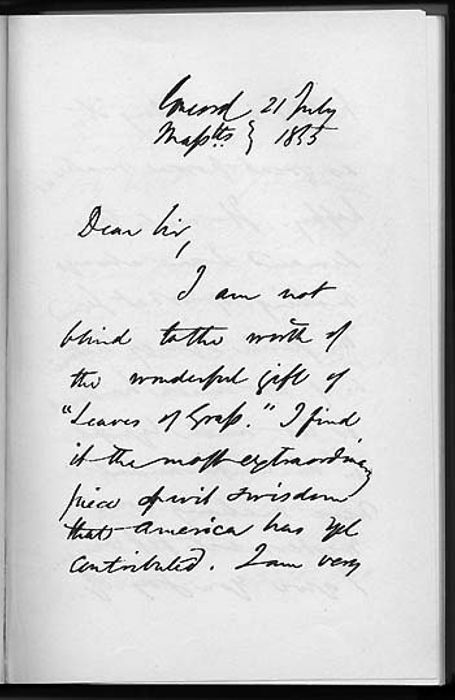 [Begin page figure-003.3]
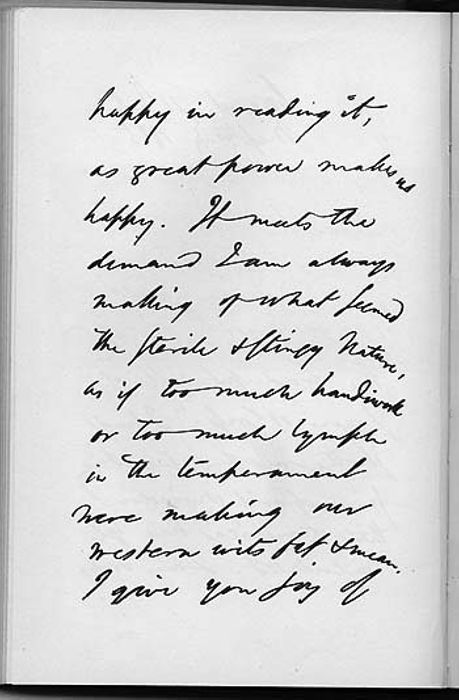 [Begin page figure-003.4]
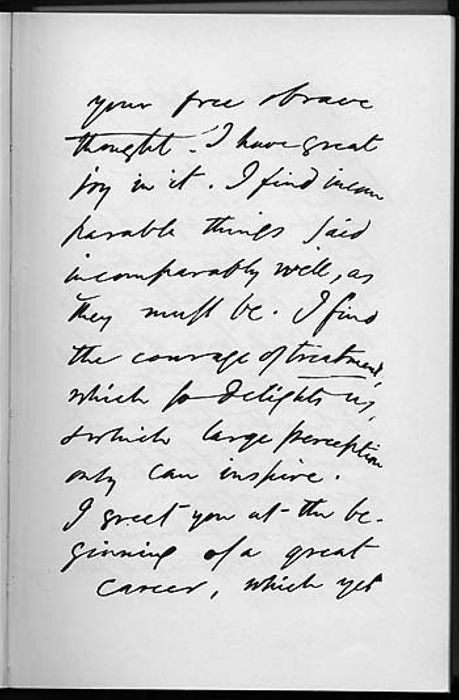 [Begin page figure-003.5]
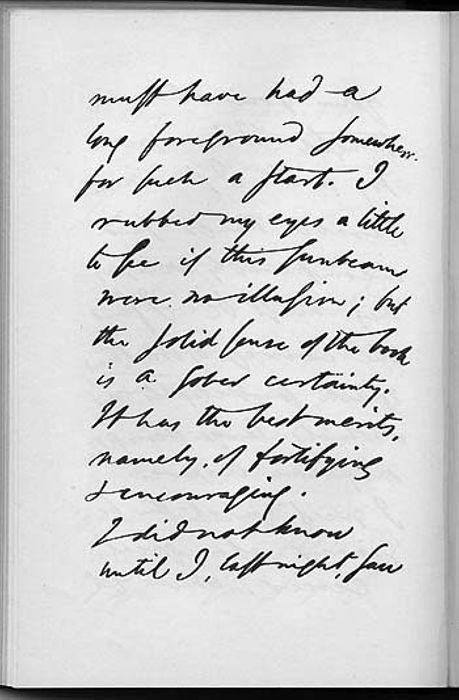 [Begin page figure-003.6]
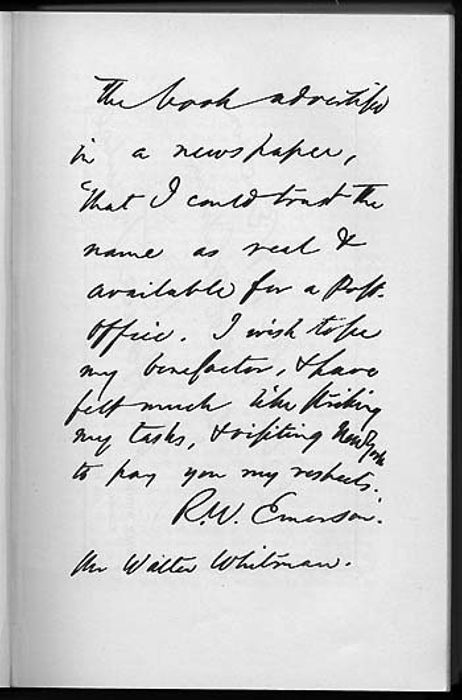 [Begin page figure-003.7]
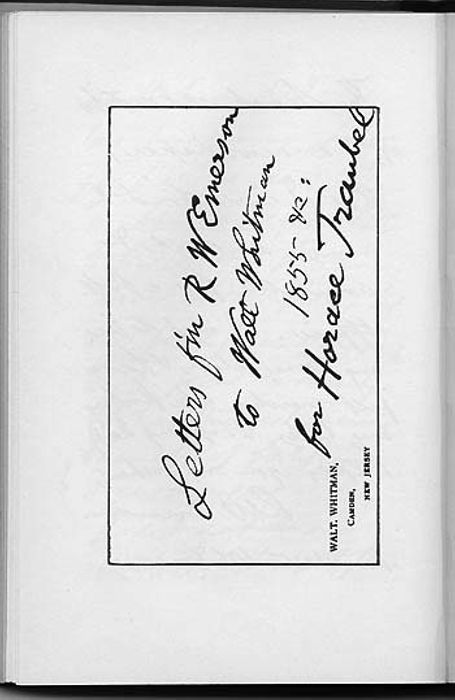 [Begin page 153]
had a copy of the second edition. W. said: "Oh! you mean the chunky fat book!"
[Begin page 153]
had a copy of the second edition. W. said: "Oh! you mean the chunky fat book!"
W. asked me: "Did I tell you I had sent a copy of the big book to Knortz?" Then: "Oh yes! to be sure: you took it to the express office yourself: he must have received it today." Had a copy yet gone to Burroughs? "No, but I mean him to have one. Do you think John is still in Poughkeepsie or has he gone home to West Park?" Should I write B.? "Yes, do so: tell him we have a copy for him which we will send the first chance that offers." W. shrugged his shoulders: "The truth is, Horace, I shy from that forty cents postage: it knocks the wind out of me." Why not express them? "That is so: we might do that: but with John I have waited for not knowing just where to address it. You write him: I'll then send it immediately." There were "several copies" to go to New York. "I think I would like to send a copy to Gilder—Watson Gilder. I don't believe Gilder goes crazy over me: I certainly know I don't go crazy over him: yet he should have a copy: he has every title to it: I honor, love him." Further: "One copy I should like to present to Julius Chambers, who has gone on the World: he has been very good to me." Had O'Connor's copy yet been sent? "No: and for the same reason as with John: the postage. I have been thinking that if Doctor took the trip to Washington he could put the book in his grip." I asked: "Couldn't you send the copies to New York the same way—by Tom? Tom seems to go over frequently." He responded: "Perhaps, but I've always had an idea Tom did not enjoy commissions of that sort—did not care to carry bundles, what not. Is it so?" I persisted: "He might like to call on those fellows." W.: "That might be: but I am still doubtful." Added: "There are still several more copies I should like to send to New York"—and after another pause: "One to Andrew Carnegie, I think." I may have looked dubious as to this. W. took it up. "He has been very kind to me—has helped me, tried to further me. I remember that once he wrote me almost a fulsome letter: full of warm words, thoughts." I must have still worn a doubtful aspect. "More than that, at the New York lecture, in 1887, he paid three hundred and fifty dollars for his seat—more than all the rest put together." I said: "But he has more money than all the rest put together, fifty or a hundred times over." "Damn your logical brain!" But he said: "It is significant that his help was unsolicited: he volunteered, nobody, [Begin page 154] so I understand it, said a word to him by way of appeal. There were many men present of very large incomes—of immense, princely, fortunes." I asked W.: "Why do you specify them? what do you care about them?" "Does it sound suspicious for me to pick them out?" "Yes—a little: I'd rather you didn't." W. said sharply: "You're quite a detective." I owned up to my suspicions of Carnegie. "I don't like the kinds of quarrels he has with workingmen." "Oh! that's the idea, is it?" W. persisted for C. Asked me: "Hasn't he got partners?" "Yes." "Well—all those partners must have specified, particularized, defined duties: such that is done by one may not be known about by the others: no doubt Carnegie stands apart from, does not realize, most that goes on." And at any rate "Carnegie showed himself so warm, generous, lavish, towards me, I must recognize it, would recognize it in anyone, notwithstanding your workingmen." I said: "Walt, that sounds like treason: the knowledge of what he did for you is one thing—the consciousness of what he or his partners did with their workingmen is another thing. I don't think his generosity to you or any individual makes up for his greed as towards the people from whom he derives all his money." "There's your logical faculty buzzing again: you're unbearable when you get going on that tack." He stopped. I waited wondering if he wouldn't say more. "Though when you put it that way, Horace, I acknowledge that you shake me a little."
Who else are to have books? "Probably Howells: no doubt James Gordon Bennett." I said: "Walt, you are one of Bennett's pensioners." He finished it: "One of his paupers? is that what you imply?" I had a letter from Bucke today fixing Monday for his start. He has his leave of absence. Read B.'s note to W. He said: "When we see Maurice face to face then we'll believe he's here."
Discussed pocket edition. Oldach says yes—he does that and any other thing in the binding line. He asked me: "What does the old man think I am? a mere dilly-dallier?" W. laughed himself into tears when I repeated this. "He's certainly an entertaining character: I'd give a good deal if I could meet him myself." Brought W. a sample volume over. It had no tongue. W. said: "I prefer to have the tongue." He wanted a book that would "go into any reasonable pocket." Suddenly started poking about the floor with his cane. [Begin page 155] "What are you after?" I asked. "The Bible: my black book—the English Bible." We found it. He showed me the very narrow page margins. "The English are beyond us in that: our fellows always demand thick paper, wide margins—show. This is nice, if merely to look at: I often take it up with no other object."
Showed him a copy of Harper's Bazaar. Among the pictures was a reproduction of Courtois' Motherhood. He took a great fancy to it. "You will leave this paper with me for a day? do: I should like to see more of that picture: absorb it." Turning a few pages further on he hit upon a picture, After the Opera, which was so unlike the other as to make him laugh. "Well: that strikes a key way down the board." But another picture, Packing Oranges at Seville, excited his approval. "That would hit Tom Eakins: Seville: Eakins' town—one of his towns—I believe." I asked: "Does Eakins wear well? Is he a good comrade?" W.: "He does: he is: he has seen a great deal; is not too ready to tell it: but is full, rich, when he is drawn upon: has a dry, quiet manner that is very impressive to me, knowing, as I do, its background." I asked: "Did you find him to lack the social gifts? he is accused of being uncouth, unchary, boorish." "Perhaps: I could hardly say: 'lacking social gifts' is vague: what are social gifts?" Then after further cogitation: "The parlor puts quite its own measure upon social gifts: I should say, Tom Eakins lacks them as, for instance, it would be said I lack them: not that they are forgotten, despised, but that they enter secondarily upon the affairs of my life. Eakins might put it this way: first there is this thing to do, then this other thing, then maybe his third thing, or this fourth: these done, got out of the way, now the social graces. You see, he does not dismiss them: he only gives them their place." He "remembered well" his first meeting with Eakins. "He came over with Talcott Williams: seemed careless, negligent, indifferent, quiet: you would not say retiring, but amounting to that." They left. Nothing was heard from them for two or three weeks. "Then Eakins turned up again—came alone: carried a black canvas under his arm: said he had understood I was willing he should paint me: he had come to start the job. I laughed: told him I was content to have him go ahead: so he set to: painted like fury. After that he came often—at intervals, for short sketches." I interrupted: "And that is the result"— [Begin page 156] motioning downstairs. W. at once: "Yes: and that is the result." Eakins was "no usual man," but he did "not lack the graces of friendship." He had "no parlor gallantries" but "something vastly better." At first sight "he might be taken to be negative in quality, manner, intuition" but that surface impression "wears off after a few meetings."
The old limp complete W.W. sent back by Oldach had been badly slashed at the bindery. W. had tied it up today with this curious memorandum pasted on the wrapper under the string:
Mr. Oldach, Bookbinder 1215 Filbert St. Phila.Please put a plain strong binding on this Vol: will cost me ab't 50 or 60 cts—want something will last hard usage, especially a good durable back—No particular fancy or beauty expected. I leave it to you what style. The label for back-lettering will be found pinn'd enclosed in front of the Vol:
W.W. 328 Mickle Street CamdenW. said: "Will you take care of it for me? They played the devil with it over there. I want it made so I can rough-handle it without being afraid that it'll fall apart. I want to go through it making marginal notes of an autobiographic nature for you fellows to make use of if there's occasion for it in the future." I removed the box for McKay from the room so the expressmen could get it early in the morning without disturbing W. Only twenty would go in the box. I have to carry four. As I was leaving he picked up a newspaper. "I'll read a bit till I get tired: then I'll call Ed and turn in." Referred to the mysterious W.W. picture. "I've taken it today in great gulps: I'm full of it: but I'm still wholly in the dark concerning its origin: they say it's a wise slut that knows its own father: this is a search in which I am completely baffled." W. was livelier than for some days. Animated in matter and manner. Nothing from O'Connor to either of us. W. said: "I write often—even send papers: practically every day: Washington is as silent as a grave: alas! seems to be digging a grave for our William. I wish Nellie wrote us more frequently: yet I suppose she has nothing to say: we must not tax her even with our love: she has enough to endure."
Saturday, February 16, 1889
7.30 P.M. W. reading paper. Asked: "The weather outside is pretty bad, isn't it? Is it still raining?" as indeed it was. Rain all day. Could not take the picture with me to Philadelphia. W. said about himself: "I still have trouble with my head but it is no worse." I delivered McKay the twenty-four books. He expected to ship them today to New York and Boston. I rendered him two bills—one for four and the other for ninety-six dollars. W. said: "I like the idea that it has started off so: but now I haven't a book here for myself—not a copy." I looked towards the table: knew he had left a copy there. He divined me. "Yes, there was one, but I sent that up to Tom." Then suddenly: "Let me see: suppose we send a dozen of what are left with Oldach to Dave: that will leave me how many?" "A dozen." "Well, that will do for the present. I want one copy by Wednesday for Doctor Bucke: you will see that I get it?" Personal item in Press about Burroughs. W. asked: "Where is he? in Poughkeepsie or at the farm?" Said I should write B. for him. "Tell him I still remain imprisoned, in health much as I have been: tell him I am reasonably comfortable—that I am always minded of him, John." Letters from Nellie O'Connor and Bucke. No change in William. "Doctor writes that he will positively start Monday and will be here Tuesday; says he will see me Tuesday afternoon or evening. Evidently he intends getting that meter thing under way before he comes over to Camden. He calls this a business trip." He said Bucke thought he might have trouble getting leave of absence. But W. thought that "nonsense." "The government there must respect a man of Doctor's quality—would not refuse him."
W. asked me to follow up on Dave's idea about books for abroad. "I guess I'll have you get eight or ten sets of sheets folded—unbound." I asked: "What for?" W. seemed surprised. "Didn't you say he wished 'em?" "No: I only said he supposed the copies sent abroad, if any, would have to be sent in sheets." "Oh! then we'll not push this." I said: "I wish some of the fellows over there could see your cover." W. wished so himself. "I don't think they would do better: yet I don't know: they are doing wonderful work: they have great binders: it would be hard to beat—even to equal—them." He got to searching the paper-piled table for something. "I had a slip here," [Begin page 158] he explained, "from one of the Boston papers—an advertisement of some scrapbook for photographs: I intended that you should look it up for me." After his fruitless hunt: "Well it's gone: anyhow, you can keep on the qui vive for such a thing: I should like to find out more about it." He added: "I remember being told by somebody that anything that can be bought anywhere in the world can be bought in Philadelphia." Here he laughed. "That must be true: ergo, you will find my photograph book in one of the Chestnut Street stores if you don't forget to look for it."
Harned came in. W. & T. greatly animated. W. immediately opened up. "Did you get the book, Tom?" T. enthusiastic. W. again: "Are you satisfied with it? Isn't that as good binding as you could have got for yourself?" T. had asked for a copy in sheets. "We were just talking of it as you came in—Horace and I: Horace said our cover should be seen abroad." Harned "liked the idea" of "putting the two books together" so as to get a powerful immediate result. W. said: "I like you to like that idea, Tom: for that idea is the idea." Continuing: "The thing that has tickled me more than any other is, that I sent a copy clear across the sea into the wilds of Ireland—clapped forty cents of postage on it (the only copy sent abroad except the Frenchman, Sarrazin's)—half dubious as to how it would carry: to a friend: you know him, Tom: Rolleston? I did not know how it would fare: but here a week ago comes an acknowledgement, not only saying that it arrived safely but that it arrived promptly, also." "You know I sent a copy to Sarrazin." "Before you had his piece?" "No: after: Walt never heard of him before that." W. saying: "Nor did I: not even his name." Harned said S.'s essay was the best thing that had so far been done on W. Then W. said: "I believe it is." W. turned to me. "You observed what Kennedy dilated on in his note, didn't you? how he found a copy in the Boston Public Library where he works—I don't mean works—goes?" Then to Tom: "Yes—it's cut short as it appears in the magazine. You read the letter he wrote me: I showed it to you, didn't I? Something had to be abbreviated, dismembered, and like the true courteous Frenchman, he suggested that it should be his."
W. is full of thought of one kind or another about the big book. "The only trouble with the big book is that you can't put it into your pocket, but then a fellow can't eat his cake and have it too: [Begin page 159] each thing in its place." I said: "It makes no difference about people's pockets: if you can get the big book into their hearts your victory will be sure." He said: "Yes! yes! we will pray for that." Picked up the tongs. Commenced playing with the fire. Talked as he worked. "But never mind: the pocket edition will come: I shall never be satisfied till I have had it—brought it out: not only a book that will go in the pocket but a book that is made for the pocket—one that will stand pocket wear and tear."
Bucke says they will be here Tuesday, at eight in the morning. Will stay at Dooner's. Wants Harned and me to meet them at ten. I wrote yes. Tom now says he will have to be in court in Trenton that day till afternoon. W. said: "You must meet them, Tom: meet the Doctor Tuesday sometime."
I said to Harned: "Tom, you haven't seen the wonderful new picture we have discovered." W. chiming in: "No, Tom, you haven't—and it is wonderful: it belongs to Dave: Dave ran afoul of it in a shop in New York—nipped it. It is a curio—certainly a curio: I should call it that." It was a "young man" picture. "I can take an interest in it which no other could—no living person: it is me, me, unformed, undeveloped—hits off phases not common in my photos." Harned spoke of W.'s "always mature look." W. said: "Yes, that was one me, even then: even at that day I had a full beard, almost like this now"—stroking his beard so—"and even then bits of grey in it." He was sure the picture "was from twenty-six to thirty." Yet he "had no clue" to its origin. "I have not thought of it today—but even if I had, nothing would have come of it: I am as certain as I sit here that the picture is as new to me as to you." I described the figure to Tom. W. explained: "I was very much slenderer then: weighed from one hundred and fifty-five to one hundred and sixty-five pounds: had kept that weight for about thirty years: then got heavier." Here he burst into a hearty laugh: "What bothers me worst of all, piques me, tantalizes me, is the expression of benignity"—more pointedly to Tom: "There is an undoubted expression of benignity in the face, which does not belong there"—and after my protestations, with another laugh: "Nevertheless I don't believe it is there—don't believe it ever was there." And he explained to Tom: "We intend getting it processed if we can—processed, I call it,"—and in a sort of counselling manner to me—"and this size if it [Begin page 160] is possible—if it does not cost too much: and, Horace, I want you to see Brown: talk strongly to him, talk to him like a Dutch uncle—have him give us the best thing possible."
W. gave me back the Bazar. "I have enjoyed it thoroughly." Harned had Bryce's American Commonwealth under his arm. W. asked: "What's the book, Tom?" Tom told him and said: "You should read it, Walt." W. said: "I would like to." Harned talked of Bryce's purpose. W. said: "That is a great thing: can he do it? has he done it?" He also said: "I know it is praised up to the seventh heaven: but then I am not so sure myself of books that are so unanimously adopted by the critical upperdogs."
Announcement in today's Press of tomorrow's publication of letter from Donnelly on the Cipher. W. said: "I have no doubt I'll take a great deal of interest in that." Tom was doubtful of O'Connor: "he's too flighty." Then to W.: "Now, your point of view on the question is a sensible one." W. said: "But my point of view is also O'Connor's—or, rather, his is mine." Harned said: "No: O'Connor is too spasmodic." W. protestingly: "No, Tom: you are wrong, wrong, wrong: William is hot: he is a giant—like other giants: he is like Hugo, like Castelar: no, not like Castelar, but like Hugo—full of fire, vision, vocalism—spasmodic, perhaps: I should not use that word—it does not answer for me—yet I don't know but as you mean it, it is as good as any other. O'Connor takes the view that there is something behind the Shakespeare plays—that the play's not the thing—not the thing alone: that something more was intended than the story."
Further talk on the same line. Then W. said: "My regret is, that this tomorrow is by Donnelly instead of O'Connor: just before he was taken sick O'Connor put together a long essay, piece, rigmarole, what not, examining this whole question, but he had not found a publisher when he was taken sick: now he is down—disabled completely."
Harned asked: "Did you know Harry Bonsall had lost his wife, Walt?" "Yes, Tom: I read of it just this evening in the paper. What a lot of shadow we have to go through in life—eh, Tom, don't you think? I had no idea Harry's wife was in such a bad way." Tom said: "Harry is to be pitied." "Why?" W. asked. "He sold out bag and baggage when he went into the last combination on the Post." [Begin page 161] W. asked: "How was that?" Harned remarked: "He was a victim of his poverty." W. said: "So are all the poor: so am I." Harned kicked. "But you never sold out, Walt: you've suffered but you haven't given in." W. was still for a few minutes. We said nothing. Then: "I'm afraid what you say of Harry is part true: he does not resist enough: he permits himself to be fooled, driven." Harned said: "You have stuck it out to the finish." W. laughed heartily. He turned his hands round as if gesturing towards himself. "Yes, and here I am today, a living witness to failure—the taboo of all the Russell Lowells of creation, the laughing stock of the damned as well as of the saved"—and after a slight pause, merrily again: "Yes, and—as some said who came to see me years ago—proud that I am!" But then Tom must be lenient. "Don't press your argument too far: it breaks down: we are all in limbo, Tom: all of us, all of us." W. and T. went on for some time on this tack. Then W. said: "We have to hold our horses: it looks easy to regulate a man from the outside: but every life has to be lived from the inside after all: then one's specifics fail."
W. got reminiscing. "Years and years and years ago Emerson spoke in an anti-slavery course in New York: He was the last in the course: read his essay on Slavery: I remember it very well: how, after he had finished the talk, had gathered the sheets of his manuscript together, so"—indicating, throwing his head aside, his voice emotional and powerful—"he asked in his deliberate way: 'Slavery? and why do I speak of slavery? what right have I to speak of slavery? are we not all slaves': and then said no more: passed off the stage." Harned exclaimed: "How dramatic and beautiful!" W. said fervently: "It was, Tom: it was: oh! I think I did not then realize how profound that was coming at such a moment applied to such a situation: how very simple, yet how very subtle, it was. You must take it along with his wonderful composure, the sweetness of his demeanor: I myself was stirred to the bottom by it: I said to myself: 'You, man, you are the vastest of us all!'" Then W. also said: "He was vast: that's the word for him: he was so spacious he welcomed, accommodated, everything: yes and we are all, all of us, slaves!"
Clifford wrote today: "My love to Walt. 'Dear Walt Whitman!' Hilda calls him and asks to see his picture often." W. exclaimed: [Begin page 162] "The children are the key to all the rest." And he said again: "Before you go put this into your pocket." I asked: "What is it?" I found it to be another old O'Connor letter. "As William's letters all have more or less to contribute to the story of the ups and downs of the Leaves I think you should file them away for reference." As Tom was there he didn't ask me to read it. But he said: "If it suggests any questions ask them tomorrow." This is the letter:
Washington, D.C., June 13, 1883. Dear Walt:I have yours of the 13th and am rejoiced. Today is the 15th—the day the book is to appear.
I am getting better, and hope soon to be myself again. A bandaged hand prevents my writing, and everything is in arrears with me.
W.S.K.'s notice is very gratifying. As soon as I get the free use of my hand, I will write to him, as you suggest. I read some time ago his article on you in the San Francisco Magazine.
Nothing will ever please me like knowing that my Bucke letter stands as it does with you. This is the King's signet. Your compare of it to '93 is magnificent and happy. Yet the retribution is only partial. As Willie Winter says, there is "a Himalayan stock" left—little he knows how Himalayan. Little beast!
The more I think of the recent Tribune review the more I am amused. It betrays the writer's sense of having been spanked, so thoroughly. There is a kind of surprised meekness in the tone of it. His plea that I ought to hear with patience his "frankness" is particularly good. It reminds me of a story Henry Peterson told me. At school a boy came up, and said, "Say Peterson, do you like frankness?" "Yes," replied Henry, "I do." "Well, then," rejoined the other, "I think your sister is the ugliest girl I ever saw in my life." This seems to be the Tribune idea of "frankness" also! More anon.
Faithfully William D. O'Connor.Harned said: "Walt will last many a day yet." I asked: "Do you feel encouraged by his appearance?" "I certainly do: he surprised me by his mental alertness." Harned also said: "Tom Donaldson [Begin page 163] told me the other day that he considered Walt a good deal of a fraud and humbug." I said: "He palavers Walt enough when he comes here." Harned laughed. "Certainly: that's a part of his game." "What game?" Harned said: "I guess you know."
Sunday, February 17, 1889
8 P.M. W. making up a package of papers for O'Connor: quite a fat bundle. No word from Washington. Had made up a package for me, too, containing a copy of the Chicago News—"I sent for some of them," he said—and letters from Bucke (15th) and Rhys (from South Wales, 2d). I asked: "Does the New Review amount to anything?" He evaded answering. "I have given you a paper: see if it does: tell me!"
Bucke wrote W.: "O'Connor's condition is infernal, and there's only one way out of it. It seems too devilish bad that such a man should have to go through such a bad time, but there is no use growling at it. We must grin and bear it. It cannot last long: that is the only consolation." W. says: "I'm always asking myself: What's the use of the fight? There's no hope of a change for the better: why then should we try so hard to postpone the inevitable?" I asked W.: "How do you know there's no hope? If the door's got to be closed all right: but why should we close it?" And I added: "I didn't know it was according to Leaves of Grass to say anything was hopeless." W. replied: "You're right and you're wrong: you're right where you're general and wrong where you're literal."
Bucke followed up his reference to O'C. with this: "I wish you could have a little better time yourself than you are having, but it is impossible that you should feel half yourself while you are constantly shut up in one room: no air, no change, no exercise, no amusement, no nothing but a weary dull routine. We must try to rouse you out when the birds and leaves come again." He has several times written W. similarly. W. himself indulges such fancies. He frequently tells us where he'll go, what he'll do, when he gets out again. "One of the first things to do will be to see the boy," he says: "to see Herbert Spencer Harned." As to the Doctor's coming: "I am not staking anything on seeing him Tuesday or even Wednesday: I expect to see him the coming week sometime: that's the most I can say." But he was sure Bucke would not "waste many days in [Begin page 164] London when the time came." "His leave of absence is doubtless from a certain day to a certain day: that's the way they were arranged for in the departments at Washington. We could always get our furlough extended—within reason." Did he spend his vacations in New York, Brooklyn? "Hardly—rather here." He came to this place to live "because of" his "mother." "Then my displacement occurred: then I came to grief: there's nothing but my old hulk left."
W. had "no idea" who wrote the News piece. "I do not know even who sent me the paper." He said: "Tom was in today—after church time, about—and Mrs. Harned. They brought me the Tribune. I was glad to see them—to see her." He had spent one of his "usual days"—"not better, not worse, than the average." He spoke again of a scrap book for photos. "Don't go out of your way to get it but see to it when you can: then I'll know where I stand." These little things were not important, but "to a man in jail they are a whole world—the only world he knows." Said I should return him the Rhys letter so the Doctor could see it. I asked him: "Have you written any postals today?" He looked at me. "Yes—some, several: one to O'Connor: one or two others. Why?" I handed him the following from today's Philadelphia Times:
"Walt Whitman's partiality for postal cards is well known to his correspondents and of late he rarely uses paper and envelopes. This the poet does principally to simplify his letter writing to the greatest degree. His mail would not be considered large to a younger man, but to the gray old poet it is more than a burden. He answers only business letters and those from friends; notes of any other character are unnoticed. To the autograph collector Walt Whitman is a well-known terror, and his persistent refusals of his signature make such few letters as he writes the more valuable in the open market. Even the most urgent business propositions he will answer on a postal card. A well-known literary gentleman the other day, exceedingly fastidious in his tastes, recently had occasion to write to Walt Whitman. In a few days an answer came, courteous and explicit, but written on a postal card and in red ink. A more disgusted man one never saw. But this is a little eccentricity of the old poet. To him the postal card is a luxury; it confines him to brief writing and, with eyes that are no longer of the best and fingers not as supple as they were fifty years ago, surely we may grant the old man this trifling breach of epistolary etiquette."
[Begin page 165]
He put on his glasses: read it carefully. "Who has been guilty of this?" he asked, turning the paper over: "what a lot of stuff: this fellow was yawning for a paragraph—so I became the victim. The 'fastidious gentleman' was a fiction. He was created to order to give spice to this story." And: "As for the red ink—I never use it—I have none." Then he proceeded: "That's the devil with these smart newspaper writers: they are not especially scrupulous: a thing true, a thing false, may be one thing to them: what they want to know is whether their tale is readable—sounds well: whether it will bait the hurried reader: that is enough. And that is Conway, too—Moncure Conway: he has a touch of the same vice—the sin of smartness, of verbal thimble-rigging: but for that Conway would be quite a man to reckon with: with that he has in effect nullified his work." W. also said: "We can't trifle with ourselves spiritually any better than physically: we have to pay the penalty on the one side as well as the other." I said: "Ingersoll said to me he's willing to be considered a fool or be a fool but he'd hate to be looked upon as a liar or be a liar." W.: "That's thunderation splendid!"
"Where have you been all day?" W. asked. "What have you been doing? Have you met people? Who?" I walked to Germantown with Kemper and May. To Clifford's Church. In at the Emerson circle. Met Clifford: also Mrs. Baldwin. W. still asking his questions: "How was the temperature for walking? is the moon full tonight?" I told W. the Emerson circle was discussing Emerson's "speechifying manners." This made him laugh. "If ever there was a man who didn't have any, Emerson was that man." Did he find Emerson's stage demeanor impressive? "I can't say that I did: not especially so: and yet it had certain features that transcended description." How was that? "There was no rhetoric in him in the formal sense of that term: he was probably the least rhetorical man who ever dared go on a platform: I might say it in this way: that his don't-care-a-damnativeness was sublime. And, Horace, that seems to be the first requisite: to get out of your own shoes, so to speak: to become disembodied: to give your audience the feel of your virgin impulse: that is to say, have them realize that you come there fresh, buoyant, just for them: Emerson threw out that personal effluence: his very port was a compliment to his audience."
Continuing re Emerson: "I have seen him come on the platform, [Begin page 166] arrange his papers deliberately, look about over his audience—so"—indicating—"then proceed. After a bit, a point would come: he would strike a deliberate pause: probably a minute and a half, which is a long time to make an audience wait: yet he would do it as if it was the most natural thing in the world—as if people had come there understanding, desiring, that he should follow out his own ways wholly." Further: "Yes, Horace: he was altogether unlike any other speaker: he had his own peculiar ways and means of arriving at his conclusions." I said to W.: "You deliver your Lincoln lecture with much the same unstudied ease: at least what looks like unstudied ease." He smiled over my latest skepticism. "Well—have it as you will: I'm not conscious of trying to put on any frills: no doubt there is a little something in your comparison." He got right back to Emerson: "Emerson felt on his own side that he had certain things he wished to say, that these things were worth saying (of course he felt they were worth saying: he would not have said them otherwise): that certain conditions of language, audience, manner, were required to get them said as they should be said: hence his style—its personal flavor. I should liken his manner to the finest, rarest, plate glass: I often liken style—its highest extensions, its most subtle evolutions—to the most exquisite French plate glass: I think Emerson's bearing on the platform peculiarly open to that comparison."
I asked: "Is this the way you felt about Emerson at the time?" He answered: "You know, Horace, none of us put Emerson where he belonged in those early years—none of us, not one: indeed, I think that not till the late years, the very latest, of his life did we commence to realize his grand build—how vast his measure really had to be. We knew he was great: we realized that there was something above the usual in his whole port—spiritual, physical: but for the rest, we were blind." W. again instanced "his platform style which we have been speaking of" as "not being impressive in the usual oratorical understanding of effect" but as being "supremely natural—natural, Emerson's: not half rated as it should have been: like a cup of pure cold water, plain, simple, honest grub: everyday matters, than which nothing could be more sound, important: not immediately apprehended, yet buried away in the normal course of things." Such "delicious precision and beauty" yet also such "childlike [Begin page 167] spontaneity." W. said: "These points were always so obvious in Emerson." I asked if in their talks E. would discuss his own ego at all? "Not much: hardly touch it: if something led too close to it he'd shrink back into the general again: he refused to lug himself, his work, what he wrote, into the center of the stage: even if referred to he would drop them the first chance."
I said: "Walt, you seem to hate to leave the subject." "I do: I never get tired of talking of him." Then he resumed. "I think everybody was fascinated by his personality—everybody who came within reach of him: young, old, everybody. Take Alcott: he was an opposite man: always insisted upon his personal affairs—all sorts of pettinesses, trifles: transcendentally, of course, always transcendentally—but in a manner that to me was intolerable: he imposed them on you: he did not ask: you had to listen." But the notion sometimes given out by those who met Alcott that he thought himself superior to Emerson, W. "never was conscious of." If A. had "any such conceit" he "never intimated it in any way" in W.'s hearing. "If I say his personality fell short of Emerson's I do not wish to be understood as wishing to make less of him: not at all: but I always am aware that Emerson's personality was the most nearly perfect I ever came into contact with—perhaps the most nearly ideal the world has ever known." I asked: "What about Jesus? what about many others?" He shook his finger in my face. "There you are with your damned interrogation points again." I asked W.: "Did Sidney tell you how Emerson once said to someone that though Alcott maybe couldn't write he could talk and how Alcott who heard of it got even by saying that while Emerson maybe couldn't talk he could write?" W. said: "No: but how rich it is! and there's a grain of truth in it both ways!" Emerson had been the chosen one in The Critic's symposium about American poets. Did W. think the choice just? W.: "It was very significant: almost every fellow named him: I don't know but it's final."
Had he read Donnelly's Shakespeare piece in the Press? "I did not read it all: started it: read considerable: it did not interest me, so I gave it up as a bad job." He said he was "surprised" at himself. "I was sure I would be interested: certainly, the subject interests me: I find myself bothered by the minutiae of the problem. As you [Begin page 168] know, I am mainly with them—with Donnelly, with William: but ciphers, three and two make five, six from twelve leaves six—that is too much for me."
Referring to the Times story: "It's a fabrication." In the News, his copy, next the W.W. piece, he had marked a poem, Jim, by George Bosely. "It's worth looking at—once," he said. W. very cool. Some blazing splinters blew out of the stove among his papers. He calmly extinguished them with the poker. I quoted O'Connor's: "It is the king's signet." I said: "Walt, it's more than that: it's the man's love!" W. was very responsive: "Yes: whatever else it may be, back of it is the man's love: Horace, you are right."
As I got up to leave he said: "And now, by the way, you must take this Carpenter letter—from Ed Carpenter—as closing out that unfortunate draft matter. I certainly fell over my own feet that time. As you have heard the rest of the story—have been a party to it—you should codicil it with this memorandum. Carpenter has been wondering, but what could be his wonder to mine? My memory never played me such a mean trick: I've had horrible experiences to meet, endure—but my memory has always been loyal. This was almost its only offense: I forgive it this time but if it ever behaves so badly again I'll discharge it." I broke in upon his quiet laugh: "But if your memory fails to remember, it discharges itself!" W. said: "What a logic-chopper you are! you won't let me have any fun with myself." Then he added: "But read the letter." I asked: "To you?" "Yes—if you will." I said: "I will, to be sure: but I'd rather hear you read it to me." "That wouldn't do," he answered: "that wouldn't serve my purpose."
Millthorpe near Chesterfield, January 27, 1889. Dear Walt Whitman.Yours of 11 Jan. received. It is a bother about that draft—as I think probably it has been cashed already, and that you won't get the money. However, please send a line saying what happens. The original was posted about the 25th May last (I may have a note of exact date somewhere, but am away from home just now). I got no answer from you, but news came about that time that you were much out of sorts, and then later appeared a paragraph in the papers [Begin page 169] from you saying you had been ill and thanking friends for birthday letters remaining unanswered—so I supposed it was all right. If the original letter has merely been lost, the duplicate draft will of course be cashed: but if it has been, as I guess, intercepted, there is no practical remedy. I am almost certain that I registered the letter, which perhaps is an unwise thing to do in these cases, as it's like showing one's hand—and I may have the p.o. receipt for the letter at home, but of that I am not sure. Anyhow, let me know by p.c. how matters stand, but don't worry about it—as the letter (if necessary) would have to be traced from this end. The sum in question was from the Miss Fords, R.D. Roberts, W. Thompson and friends, Frank Deas, and myself:—as a little birthday remembrance—and we shall only be sorry at your receipt of it having been so delayed.
I saw Ernest Rhys a day or two back in London—seems pretty well—told me a good bit about you. I am glad from this present letter that you seem a bit better, Walt. Shall be glad to see the 900-pounder edition! a fine literary cannonball.
The Fords' address is Adel Grange, near Leeds.
I am lecturing around a bit, in London and neighborhood, enjoying life well—a wonderful feeling of new social life in the air—though the days are foggy and we see no sun.
Greetings to Henry and to yourself.
Edward Carpenter.I folded the letter up and put it into my pocket. W. said: "Carpenter knows the truth by now: no doubt it was my terrible crisis of last June that was responsible for this break as well as for other breaks in the consecutiveness of my life. It was only for a day or two but it was a real disaster. There's no use nursing the memory of it: it's best forgotten. But that note, now: I have wished to ask you something about it." I took the note out of my pocket again and offered it to W. He shook his head: "No: not that: I don't want it: I only want to ask you a question about it." "What question?" "This," W. said: "whether you do not feel a certain aloofness, withdrawnness, in the letter: as when he starts saying 'dear Walt Whitman' instead of 'dear Walt': and at the end, where he sends me 'greetings.' I may be mistaken, but I seem to sense some sort of reserve there that I had not noticed formerly in Edward. What's the truth of it? Does it denote a change of attitude? or is that reserve [Begin page 170] only the English of it? You see, the English way is somehow very different from our own: not quite so easy-going, not nearly so out and out: we have possibly developed a little farther in personal democracy—in the ability to forego castes, classes, social lines: I find the American more immediately capable of unbending, of meeting those he meets simply as a man meets a man, without any extraneous quibbles. The English are more likely to ask: who are you? what do you want? why should I? Do you not scent such a distinction in Carpenter's letter? I never quite suspected it before, but it does certainly seem to be here."
Monday, February 18, 1889
8 P.M. W. was searching on the floor when I entered. He did not hear me. When finally he looked up and saw me standing in front of him he laughed happily, offered his hand, and said: "You are a dangerous man to have around, your movements are so mysterious, baffling." Raining all day. Could not take the pictures to Brown. But I went to Oldach's, where I numbered the twenty-four books (not quite finished) for McKay. Two of Oldach's binders off drunk today. We will not get more books till Thursday anyhow. W. said: "It seems to be taken as one of the inalienable prerogatives of some of the best mechanics to get drunk: you know how true this is of the printers: often of the very best of them: then there are the hatters: they too I am told are tremendously addicted to the cup: there must be something in these confining occupations which induces thirst: though soldiers, sailors, are great drunkards, too, and they certainly are not victims of the factory. I remember that a doctor said to me once down in Virginia, when I shook my head: 'What? a poet and no whiskey? Not a drop? That'll never do—never, never!' And he was a surgeon, too—a good one: belonged to Virginia though in the Northern army. I suppose we can't hurry the matter: we'll just patiently wait till the drunks sober up." I returned him the Bucke and Rhys letters. "I shall send both to Kennedy: he is hungry for bits, details, about us: it saves me writing a letter."
Bucke up. I said: "Doctor takes a gloomy view of O'Connor's case." W.: "He does indeed: a very gloomy view: but Doctor is inclined to do that." Did not B. differ from doctors generally in his frankness with patients? "Yes, he does: radically: Doctor believes in [Begin page 171] telling the truth at all times: he is more moralistic than I am: if I thought it would help a sick man I'd lie the top of my head off." Laughed. "Wouldn't Doctor?" "I am afraid not: we'll have to put it up to him when he comes." Then again: "I am quite conscious of the difference: it will interest me very much—oh! very much—by and by to have you discover how severe the Doctor is on all those points." Had he heard from Bucke today? "I don't know: let me see"—closing his eyes: "I think not: none later than this you bring back: Doctor's letters are so frequent I can't keep track of them." I showed him my letter of the 16th, received today. Bucke there says he won't start till Tuesday or Wednesday. W. exclaimed: "Another day and another day! that's the way it has gone for a month!" Nothing from Washington."They are almost ignoring us." McKay wished to know whether W. intended sending out any copies of the big book to the press? Was one copy, for instance, to go to some Boston paper? I said I thought not. Several had already gone to individuals. W. assented to my view: "The Herald has noticed us: the Transcript: then Sanborn in the Springfield Republican: I don't think I shall go any farther with the journalists up there in New England. But I have several copies to distribute in New York: one for Bennett, one for Julius Chambers, one (perhaps) for Howells: and for Gilder: I must not forget Gilder." The Century would not review the book: "it prints us reviews": but Gilder "is personally entitled to the compliment, if we may egotistically call it such." "But as the lawyers say, irrespective of the fact herein contained, Gilder shall have a copy, if for no more than to show I appreciate his individual kindness to me—recognize that he has treated me fairly if not handsomely." I asked W.: "Do you say that without any reservations?" "Quite! think of it: I have sent him my pieces, put my price on them, been paid that price: an important item enough even taken alone: but, added to that, Gilder takes what I offer unhesitatingly without question, never interjecting a single word of petty criticism." He paused. Then he asked me: "Do you realize that that is treatment no other magazine editor in America has accorded us?" He then enlarged on this situation. "For the last three or four years Harper's has practically closed me out—would have none of me." Not because of Alden, he said, however. "I think it was the house—that Alden would be free enough if let alone—only, they put the [Begin page 172] screws on him." Was Curtis inimical? "About as much inimical as he could be without active inimicality." Spoke of the Schuylers: a little doubtful how Eugene looked upon him: "but Montgomery, I believe, is distinctly favorable—even strongly so"—then, after a moment's reflection: "That is my impression, but I must not swear to it."
I spoke enthusiastically of the Chicago News review. W. said: "It is quite a review, isn't it? It is evidently written by a man who knows about us, but who I haven't the slightest notion." There were "no earmarks." W. said: "I should not like to write asking who." I asked: "Why shouldn't I do it?" "I won't encourage or discourage you," he said. McKay has sent copies of November Boughs to McClurg. W. was interested in the name. "McClurg? did you read in the papers about the new publishing house to start there? colossal? nine stories high? Rand, McClurg—some combination like that? Maybe the Rand who has just failed in Boston." News mentioned again. "If I was out there, happened around, I should not hesitate to ask, but to write a formal inquiry—that would not do: besides, newspaper etiquette generally imposes a secrecy upon such anonymous writing." But the News man "wrote so much like one of the heretics, outlaws, I can't quiet my curiosity."
W. then talked of The Critic review, saying: "After it appeared, I wrote a postal to Joe Gilder telling him I appreciated it—that I was grateful to have these things so well said: something like that: requesting that my postal should be forwarded to the writer. Gilder replied telling me who had written it. A few days following, came a letter from Harrison—you know him: Prof. W. H. or W. M. Harrison—of the State College of Virginia. I should have answered this—intended to—but did not: I did not like the tone of the letter: Harrison took good care to tell me in the note that he did not accept me in toto—did not endorse me—all I am, have done: he admitted that November Boughs had carried him along with it. I could not tell in terms just what it was that repelled me—an indistinct something: you know how that is often—you must have realized it yourself: a something in the atmosphere, in things unsaid as well as said, a taste of something—it might be most subtle: as sometimes we know it in food—a merest suspicion, no one could say of what, but sufficient and of the sort to destroy the broth." I said: "Then, after all, Doctor's [Begin page 173] distrust of the criticism was subtle—is confirmed?" The only reply he would make to that was:"You think so, eh?"
Talk of critics in general. W. said: "You have Doctor's book, haven't you? Do you remember the Appleton's Journal piece there at the end? Well, that is Dick Stoddard's: read it again. To anyone who knew Stoddard as well as some of the older heads, this article does not need his name. If you read it again, you will see for yourself that it is the same hand that penned the Lippincott piece on poor Poe—the same venom, hatedness." I spoke of reference I had seen to "the amiable Stoddard." W.: "Dick is anything but amiable—anything." And further: "But why should I say poor Poe? Rather, poor Stoddard! With critics of the Stoddard order the picture they conjure is not of another but their own." He felt that if he wrote "of Poe, Burns, Madame Dudevant (George Sand), Byron—even Carlyle," he would "pass over the sins, idiosyncrasies, many of them, and make for the subtle benefiting powers." "I should not lay this down as law for everyone—not at all: I can well see how necessary it should seem to some to indicate the significance of the bad as well as the good"—but "whether this is done with venom or in kindness—here is the important fact." I argued: "The fatal weakness of Stoddard's Poe piece is, that he gives himself away in it—that he makes Poe's moral status contingent upon an imagined offense committed against Richard Henry." W. said at once: "That's the rub of it: that's the motive within the motive by which our Humpty Dumpty has his great fall." And again: "That's a fatal weakness—that alone: but there is more than that: his whole temper, his prevailing temper, unfits him for any discussion of the subject." Here he spoke with fervent fluency—rather more rapidly than usual: "But do you know, Horace, there's a great deal more in this case than is generally known, than you could know, than anyone could know who had not been in the thick of the fray. John Burroughs knows—John could tell you: the mortal offense which this New York crowd can never forgive Poe for is that he is famous—is held in great esteem wherever he is known. There were several in that group—fool Willie Winter was one—poor ass he is, too!—Stoddard—then Briggs—Charles V. Briggs. These fellows had enough quality to enter the match, name themselves for the race: just as in a walking match, men who know [Begin page 174] they have no winning chance, yet have enough quality to enter: but anything more serious than this would not be expected of them."
I asked: "But you rank Stoddard higher than Winter?" "Oh yes! yes! very much: fool Willie Winter has no standing at all." He said he had no "sore feeling" against his "enemies": "but I know I will never be tolerated: they have always had it in for me: what right had I not to be forgotten? That's their shibboleth. Sure enough, what right had I? But as I had nothing to do with being forgotten or being remembered I don't attach any great guilt to myself in this controversy." But he did not think I would ever "fully appreciate the intensity of the opposition as it was in those first days of the fight." I would "have had to be there." He said: "The thing was like a fever: one day hot, one day cold: there were spurts of silence, then spurts of noisy venom." I said: "Someone told me that Winter takes the ground that no Italian has any right to play Shakespeare: that Shakespeare belongs to the English-speaking races: that the English-speaking races can alone interpret him fairly. I don't know whether the quotation is authentic or not." W. said: "It sounds like him, whether authentic or not: it's worthy of him: it's asinine enough to be his: it's just like the little jackanapes: to judge everything by the schoolbooks, traditions, boundary lines—the tape measure of his puny inner self. Willie always set up for two things—to be a critic, to be a poet: he never went far, even got fairly started, in either direction."
W. said he had been doing his best to locate Dave's "photographic find." "We must never be too certain of things: that picture shows it: after all these years, no one even suspecting it, there, in an obscure out-of-the-way place, this turns up to accuse us." I said: "Lucky that the find credits rather than discredits you!" "Yes indeed: therein we're lucky: the conditions could easily have been reversed!" He tried to fix the date. "It must have been taken between 1845 and 1850—probably in '46 or '47: I can't seem to do any more towards accounting for its origin. As a work of art the portrait is extra good: we should get it processed and let the boys see it: no one can know as I know how really precious it is—what a current of reminiscence sweeps into me out of it from those past years."
Postcard from Knortz acknowledging the big book. I had consulted with McKay about review copies for abroad. W. gave me a [Begin page 175] copy to send to Gardner, in Scotland, who was to pass it on to the periodical Dave named as being desirable. "You must use your own judgment about that: if you need another, take it." W. endorsed Harned's copy of the leather-bound big book in this way:
Thomas B. Harned Dear friend & Sir:I send this book to you not merely as a collection of my own poems, thoughts, descriptions, of our day and time—but as a special personal memento of our friendship and of many meetings and festivals at your house. And I wish to put in my best greeting to Mrs. Harned and to Anna, Tom, and little Herbert—sending love and prayers herewith for you all.
Walt WhitmanCamden New Jersey
Feb: 15 1889.
As I sat there Ed brought him in a black-edged letter. W. opened it hesitatingly: said painfully: "Oh!" but no more. I did not ask for what. I knew. W. asked me about "the little man in the store—Dave's father"—adding: "I am sure I should like him though we have never had much to do with each other." And again: "I like the simple folk: they get nearest my heart: I get nearest their hearts." He had been reading about the disappearance of Bessie MacIntosh, in Philadelphia, whose father I knew well. "It's an insoluble, deepening, tragic mystery," Walt said: "Do you realize, Horace, the number of people who in one way or another simply disappear from the world, God knows when, where, how? I have thought I must some day put that into a poem in some way or other." "Horace," he said again: "I wonder if Sarrazin has yet got the big book? I shall be a little anxious till I hear that the book is in his hands." I said: "Kennedy seemed a little sensitive about 'errors' in that sheet." W.: "Yes: so it seems: he said something to that effect in his letters: but I don't know why he should be—don't know what errors there were." "But in writing to Kennedy you said something yourself about his overlooking the errors." W.: "Perhaps I did, in a general way: not indicating anything, however—only saying I regretted little slips: but there really is nothing—nothing to attract the criticism of a reader: I don't believe Sarrazin himself would take exception to anything [Begin page 176] found on that sheet." Then he added: "In Doctor's case I'll be very careful." "Ah!" I said: "then you have sent his abstract to the printer?" Yes, today: he has it now: Curtz: I meant to tell you. I did not hurry him: in fact, let him know he could take his time with it: I intended sending a proof to the Doctor but as he is about to come on he can take care of it when he arrives." I had a letter from Blauvelt. Read it to W.
Hagaman's Mills, N.Y., Feb. 15, 1889. My Dear Sir.Some time ago, you may remember, you were kind enough to send me an engraved portrait of Walt Whitman, to be used in illustrating Stedman's Poets of America. Now, I understand there has been a new portrait of Mr. W. published recently, which I would like to have, if it be procurable. I believe it is in Mr. W.'s November Boughs. I am located in a place where information in regard to much that is going on in the literary world is hard to get, and I therefore take the liberty of troubling you in regard to this. Should there be such a portrait as I mention I will esteem it a favor if you will drop me a line at this place, stating the fact, and also price of portrait, so that I may remit the necessary amounts. My usual address is Richfield Springs, N.Y., but I am to be here for a few days yet.
I saw in a recent paper that Mr. Whitman was still confined to his room. Please say to him that I hope soon to hear of his complete restoration to health.
I expected to have the pleasure of sending him another partridge or two before the weather changed, but we had several early falls of snow, and after this happens the birds are not in good condition for eating, owing to the food—certain sorts of birds, usually—to which they are restricted. Our other game is only ordinary—principally rabbits and squirrels.
Again apologizing for thus troubling you, I am
Yours Sincerely, William H. Blauvelt.W. said: "I suppose he wants the sitting picture: we must give him one: we must never refuse to gratify anyone so kind who is so easily pleased. He seems honest: to mean well—mean us well: is [Begin page 177] bitten with the idea: let him have it." Picked up a pile of papers: began his search: found the picture without much trouble: gave me one. "Send that to him." I saw a picture in the pile that I had never seen before. He noticed my interest. "Do you like it? then take it along." He wrote on it: "Walt Whitman in 1864." Photo: half figure. W. also said: "Blauvelt has a benevolent side: he not only pays but throws something in: that's how it should be all around: I am always inclined to treat with people that way myself: some day we may have a world in which the ways and means of life will be quite different from now." I broke in: "Yes: when everything instead of being for value received will be for value given." W. paused as if thinking something out, as he was. Then he said: "That sounded silly to me when you first said it but when I turned it over in my noodle I began to see how subtle it is."
Tuesday, February 19, 1889
4 P.M. W. not doing anything in particular. "I am tied up to the wharf today: not trying out my sails any." Did not look very well. "What have you got there? what's the big book?" he asked. I handed it to him. Johnson's China. "I should be interested to look through it," he said. Read title page aloud. Passed the pages quietly through his fingers. Stopped at the section, Poetry. "Ah! this! I must see this!" and so on. "It's about the East—that wonderland." Asked me about the fire in Philadelphia: in the yarn district. Extensive. "They have been telling me of it: it is quite near the river, isn't it?" What had I done in town today? "Who have you seen?" Told him about Brown, who says he couldn't probably give us a picture bigger than six by nine: that this would cost twenty-four fifty. W. said quietly: "I'm trying to make out what that size would be. "Let's measure it." W. laughed: "That's what I say: but where's the measure? I had a measure here once, but"—swinging his hand towards the piles of papers everywhere—"God knows where it's hidden away." But he added: "Let it be six by nine: that sounds big enough to handle." I left the original with Dave. "Perhaps our wise course would be to have it made small, so we can use it in the book—the new edition we are going to get out for the pocket." Still, his caution intervened. He resents having to make prompt decisions. "Anyhow, let me consider it: I will let you know tomorrow just [Begin page 178] about what I deem the best thing to have done." He seemed to divine me. "Yes: I know I'm slow: I was built slow: I seem to be made on the Dutch plan."
"I have had a short note from Doctor today," he said, reaching towards the table: "here it is: take it along: he will not be here till Thursday." I put in: "Or later." W.: "Yes: or later: we won't believe him till we see him." Brown thought the photo would reproduce well. W.: "Glad to hear it"—adding: "Some of 'em seem to go straight to hell in the process." Made up a bundle of newspapers to send to O'Connor. Wrote him a postal. Ed says W. woke up feeling rocky. Face decidedly swollen. Now improved. From a tooth? W. said: "I am ballooned one side: look at me: ain't I likely to go up?" And laughingly: "We're a gassy lot: we can never tell to what dizzy flights our loquacities will lift us." Was rather disposed to fun. But still said: "I'm way below par."
He picked papers up from the table. "Look at these! They are the papers you brought me from Dave yesterday: both contain reviews of November Boughs: one is the Pall Mall Gazette, the other is the London Echo: the Gazette goes into the matter quite liberally." I asked: "Who wrote the pieces?" "It does not say: in neither case is there any signature." "What shall I do with them?" "Perhaps for one thing you had better take the papers over and let Dave see them: he may find sentences to quote: besides, you will want to read them yourself: take them in your pocket: but don't leave them with Dave: I must on no account lose them." I said: "I thought you didn't care a fig for reviews." "I don't: but think what would happen if Bucke came along and found them gone!" While we were talking, Mrs. Davis brought in his dinner. W. said: "Here's Mary with the grub: won't you sit down and have a bite?" And then he added as he started buttering a slice of bread: "That's the round of my life: got up, ate my meals, went to bed again: not getting up very far, either, nor eating much, nor even sleeping enough to brag about!"
I went home. Was held up by a messenger at the door. The telegram was from Bucke. "Cannot get away before Monday. Tell W. and write." Which confirmed our uncertainties.
7 P.M. Stopped in at W.'s again. Showed him Bucke's telegram. Disappointed. But he said: "Well—there's nothing imminent." Then, [Begin page 179] as to writing: "Let me see: have I anything to say? I guess not: I shall not write tonight." Did not feel, did not look well. Yet he said: "I have eaten a decently hearty dinner." He explained: "The trouble with me today is not so much in what I do as in what I do not feel." I said: "Discomfort is worse than pain. He said: "Yes: much worse: I've had more than one of the poor boys in the hospitals say to me: God, Walt, I wish I felt some pain!" "Pain may mean life: the absence of pain may mean death." "Precisely: who had more right than I have to say that? Not only from what I have seen in others who suffered but from what I have suffered myself."
I said to W.: "You don't feel like talking tonight: I'll skip off." He said: "I'm not spry, to be sure, but then you are always a tonic to me: don't hurry off just yet." Then he put on his glasses. "I've got something for you to do anyhow: after you do that you may go if you feel so disposed." After turning over a lot of papers on the table he handed me some stuff pinned together. "Look at it: look it over: I rooted it out of a hole today while I was after something else." "It looks tasty," I said. He was very jolly over it. "From your point of view it is tasty." I examined it. W. said: "I can easily tell you what it is: I want you to read it all to me: there are three letters: you have heard of Bram Stoker—Irving's man: he took a shine to me over there in Ireland when he was in college: wrote me from there—but was afraid to mail the letter: the second letter tells about it: he has been here: I value his good will highly: he seems to have remained of the same mind, mainly in substance, as at first." I continued turning it over. "Am I to read it?" I asked. "If you will," he said. There were two Stoker letters and the draft of a letter from W. acknowledging them. "It's a rather long story," I said: "there are several chapters to it." I also asked him: "Did you read them over today when you found them?" He said: "No: I left that job for you: I haven't read them since they came in '76: when I sit here, when you read to me, when I have nothing to do but listen, I feel composed, at peace, more than usually impressionable: I take things in without any effort, then—moreover, retain them." I said: "I am willing enough to read." W.: "You see—there's method in my laziness: I'm doing the best I can in the littlest ways as well as the biggest to conserve the few dribbles of vitality that are left to me. John is always giving me advice about that: and Doctor: [Begin page 180] but God knows, Horace, and you know, too, that I need no advice on that score—that I anticipate them." Then I read. Stoker's last letter first, then his first letter, then Walt's reply.
Dublin, Feb. 14, 1876. My dear Mr. Whitman.I hope you will not consider this letter from an utter stranger a liberty. Indeed, I hardly feel a stranger to you, nor is this the first letter that I have written to you. My friend Edward Dowden has told me often that you like new acquaintances or I should rather say friends. And as an old friend I send you an enclosure which may interest you. Four years ago I wrote the enclosed draft of a letter which I intended to copy out and send to you—it has lain in my desk since then—when I heard that you were addressed as Mr. Whitman. It speaks for itself and needs no comment. It is as truly what I wanted to say as that light is light. The four years which have elapsed have made me love your work fourfold, and I can truly say that I have ever spoken as your friend. You know what hostile criticism your work sometimes evokes here, and I wage a perpetual war with many friends on your behalf. But I am glad to say that I have been the means of making your work known to many who were scoffers at first. The years which have passed have not been uneventful to me, and I have felt and thought and suffered much in them, and I can truly say that from you I have had much pleasure and much consolation—and I do believe that your open earnest speech has not been thrown away on me or that my life and thought fail to be marked with its impress. I write this openly because I feel that with you one must be open. We have just had tonight a hot debate on your genius at the Fortnightly Club in which I had the privilege of putting forward my views—I think with success. Do not think me cheeky for writing this. I only hope we may sometime meet and I shall be able perhaps to say what I cannot write. Dowden promised to get me a copy of your new edition and I hope that for any other work which you may have you will let me always be an early subscriber. I am sorry that you're not strong. Many of us are hoping to see you in Ireland. We had arranged to have a meeting for you. I do not know if you like getting letters. If you do I shall only be too happy to send you news [Begin page 181] of how thought goes among the men I know. With truest wishes for your health and happiness believe me
Your friend Bram Stoker.After going this far I waited for W. to say something. He was not disposed to talk. "He was just about a boy back in those days: now it was fifteen years ago: he has been here: I think the man Stoker repeats, fulfils, the boy: I never quite think of myself as being the subject of such utterances. There's one sentence in his letter which hit me hard." I said: "I'll bet I know which one it is." He nodded. "I'm rather persuaded that you do: which?" I quoted: "I write this openly—." W. interrupted me. "That's it: that's me, as I hope I am: it's Leaves of Grass if Leaves of Grass is anything: 'I feel that with you one must be open': that explains Children of Adam, everything." I thought he might say more. He didn't. I gave him time. Then I read Stoker's first letter.
Dublin, Ireland, Feb. 18, 1872.If you are the man I take you to be you will like to get this letter. [W. exclaimed: "I don't know that I'm the man he takes me to be, but I did like to get his letter—and I like to get it today again as you read it to me!"] If you are not I don't care whether you like it or not and only ask you to put it into the fire without reading any farther. ["It has been here quite half a lifetime without getting into the fire!"] But I believe you will like it. ["I did, I do, like it!"] I don't think there is a man living, even you who are above the prejudices of the class of small-minded men, who wouldn't like to get a letter from a younger man, a stranger, across the world—a man living in an atmosphere prejudiced to the truths you sing and your manner of singing them. The idea that arises in my mind is whether there is a man living who would have the pluck to burn a letter in which he felt the smallest atom of interest without reading it. I believe you would and that you believe you would yourself. ["I don't know about that: I'm only about as weak and as strong as other people!"] You can burn this now and test yourself, and all I will ask for my trouble of writing this letter, which for all I can tell you may light your pipe with or apply to some more ignoble purpose—is that you will in some manner let me know that my words [Begin page 182] have tested your impatience. Put it in the fire if you like—but if you do you will miss the pleasure of this next sentence, which ought to be that you have conquered an unworthy impulse. A man who is uncertain of his own strength might try to encourage himself by a piece of bravo, but a man who can write, as you have written, the most candid words that ever fell from the lips of mortal man—a man to whose candor Rousseau's Confessions is reticence—can have no fear for his own strength. If you have gone this far you may read the letter and I feel in writing now that I am talking to you. If I were before your face I would like to shake hands with you, for I feel that I would like you. I would like to call you Comrade and to talk to you as men who are not poets do not often talk. ["He was a sassy youngster: as to burning the epistle up or not—it never occurred to me to do anything at all: what the hell did I care whether he was pertinent or impertinent? he was fresh, breezy, Irish: that was the price paid for admission—and enough: he was welcome!"] I think that at first a man would be ashamed, for a man cannot in a moment break the habit of comparative reticence that has become a second nature to him; but I know I would not long be ashamed to be natural before you. ["I hope not: Stoker or anybody else!"] You are a true man, and I would like to be one myself, and so I would be towards you as a brother and as a pupil to his master. ["There's 'master' again!"] In this age no man becomes worthy of the name without an effort. You have shaken off the shackles and your wings are free. ["My wings may be free but the same can't be said of my backside!"] I have the shackles on my shoulders still—but I have no wings. If you are going to read this letter any further I should tell you that I am not prepared to "give up all else" so far as words go. The only thing I am prepared to give up is prejudice, and before I knew you I had begun to throw overboard my cargo, but it is not all gone yet. I do not know how you will take this letter. I have not addressed you in any form as I hear that you dislike to a certain degree the conventional forms in letters. ["Not to a certain degree but altogether! and not only in letters: everywhere!"] I am writing to you because you are different from other men. If you were the same as the mass I would not write at all. As it is I must either call you Walt Whitman or not call you at all—and I have chosen the latter course. [Begin page 183] ["The boy fires off a hell of a big prologue—eh? Horace? He does not know how indifferent I am whether to terms or no terms!"] I don't know whether it is usual for you to get letters from utter strangers who have not even the claim of literary brotherhood to write you. If it is you must be frightfully tormented with letters and I am sorry to have written this. I have, however, the claim of liking you—for your words are your own soul and even if you do not read my letter it is no less a pleasure to me to write it. ["Come, Bram, Mr. Stoker: get down to business: this is all only preliminary!" and: "How little he realizes how little I have to do with the literary brotherhood!"] Shelley wrote to William Godwin and they became friends. I am not Shelley and you are not Godwin and so I will only hope that sometime I may meet you face to face and perhaps shake hands with you. If I ever do it will be one of the greatest pleasures of my life. If you care to know who it is that writes this, my name is Abraham Stoker (Junior). My friends call me Bram. I live at 43 Harcourt St., Dublin. I am a clerk in the service of the Crown on a small salary. ["How did I get the impression that he was still in college?"] I am twenty-four years old. Have been champion at our athletic sports (Trinity College, Dublin) and have won about a dozen cups. I have also been President of the College Philosophical Society and an art and theatrical critic of a daily paper. I am six feet two inches high and twelve stone weight naked and used to be forty-one or forty-two inches round the chest. I am ugly but strong and determined and have a large bump over my eyebrows. I have a heavy jaw and a big mouth and thick lips—sensitive nostrils—a snubnose and straight hair. I am equal in temper and cool in disposition and have a large amount of self control and am naturally secretive to the world. I take a delight in letting people I don't like—people of mean or cruel or sneaking or cowardly disposition—see the worst side of me. I have a large number of acquaintances and some five or six friends—all of which latter body care much for me. Now I have told you all I know about myself. ["And a mighty graphic picture it is too: I seem to see you not as in a glass darkly but as in the broad day lightly: I do, I do!"] I know you from your works and your photograph, and if I know anything about you I think you would like to know of the personal appearance of your correspondents. You are I know a keen physiognomist. [Begin page 184] I am a believer of the science myself and am in an humble way a practicer of it. I was not disappointed when I saw your photograph—your late one especially. The way I came to like you was this. ["More analysis? I'm almost afraid of it! But go on: may the good Lord have mercy on my soul!"] A notice of your poems appeared some two years ago or more in the Temple Bar magazine. I glanced at it and took its dictum as final, and laughed at you among my friends. I say it to my own shame but not to my regret for it has taught me a lesson to last my life out—without ever having seen your poems. More than a year after I heard two men in College talking of you. One of them had your book (Rossetti's edition) and was reading aloud some passages at which both laughed. They chose only those passages which are most foreign to British ears and made fun of them. Something struck me that I had judged you hastily. I took home the volume and read it far into the night. Since then I have to thank you for many happy hours, for I have read your poems with my door locked late at night, and I have read them on the seashore where I could look all round me and see no more sign of human life than the ships out at sea: and here I often found myself waking up from a reverie with the book lying open before me. I love all poetry, and high generous thoughts make the tears rush to my eyes, but sometimes a word or a phrase of yours takes me away from the world around me and places me in an ideal land surrounded by realities more than any poem I ever read. ["Autobiography is the only real biography, Walt," I stopped to say, W. adding his "amen" and saying: "It's absorbingly interesting, eh, Horace?"] Last year I was sitting on the beach on a summer's day reading your preface to the Leaves of Grass as printed in Rossetti's edition (for Rossetti is all I have got till I get the complete set of your works which I have ordered from America). One thought struck me and I pondered over it for several hours—"the weather-beaten vessels entering new ports," you who wrote the words know them better than I do: and to you who sing of your own land of progress the words have a meaning that I can only imagine. But be assured of this, Walt Whitman—that a man of less than half your own age, reared a conservative in a conservative country, and who has always heard your name cried down by the great mass of people who mention it, here felt his heart leap towards [Begin page 185] you across the Atlantic and his soul swelling at the words or rather the thoughts. It is vain for me to try to quote any instances ["Yes: don't quote: we can get along very well without quotations."] of what thoughts of yours I like best—for I like them all and you must feel that you are reading the true words of one who feels with you. You see, I have called you by your name. I have been more candid with you—have said more about myself to you than I have ever said to any one before. You will not be angry with me if you have read so far. You will not laugh at me for writing this to you. It was with no small effort that I began to write and I feel reluctant to stop, but I must not tire you any more. ["Beautiful! but all of it from the inside: almost painfully so: he is youthfully self-conscious: sees things in their exaggerations!"] If you ever would care to have more you can imagine, for you have a great heart, how much pleasure it would be to me to write more to you. How sweet a thing it is for a strong healthy man with a woman's eyes and a child's wishes to feel that he can speak so to a man who can be if he wishes father, and brother and wife to his soul. ["How sweet, indeed! where there is love, why not? why not?"] I don't think you will laugh, Walt Whitman, nor despise me, but at all events I thank you for all the love and sympathy you have given me in common with my kind.
Bram Stoker.W. said: "Horace, I call that an extraordinary occurrence: that he should have let himself go in that style: or do you argue that it's all studied out—even the spontaneity? It all sounds easy and informal to me—not verbally stiff in the joints anywhere: I was, I am, inclined to accept it for just what it pretends to be. I may be gullible, deceived, fooled: yet I am confident I have made no mistake." I said: "There's still your letter to Stoker to read. Shall I read it? or do you know it well enough to not have it repeated?" He replied: "Read it, Horace: I want to get it tucked securely away in my noddle before I say good-bye to it." This is the letter:
March 6, '76. My dear young man,Your letters have been most welcome to me—welcome to me as Person and as Author—I don't know which most—You did well to [Begin page 186] write me so unconventionally, so fresh, so manly, and so affectionately, too. I too hope (though it is not probable) that we shall one day meet each other. Meantime I send you my friendship and thanks.
Edward Dowden's letter containing among others your subscription for a copy of my new edition has just been received. I shall send the books very soon by express in a package to his address. I have just written E. D.
My physique is entirely shattered—doubtless permanently, from paralysis and other ailments. But I am up and dressed, and get out every day a little. Live here quite lonesome, but hearty, and good spirits. Write to me again.
Walt Whitman.I got up, put the letters into my pocket and started off. "Good night, Walt." He called me: "I say good night, too. I wonder whether you understand at all the functions you have come to fulfil here! that you're the only thing between me and death?—that but for your readiness to abet me I'd be stranded beyond rescue? I want you to understand."
Wednesday, February 20, 1889
7.45 P.M. W. reading Lippincott's. Had been well. I told W. I had left Gazette and Echo with McKay who wished to copy off some quotable lines. W. satisfied. I spoke warmly about the Gazette piece. He said: "The Pall Mall Gazette has always been favorable: Stead has always shown an inclination to stand by me: and more than Stead: an attache of the paper there—oh! let me think of his name!"—but he could not, and went on: "Did you not read in the papers, about a famous telephoning incident—wasn't it that?—between Stead and some one of his men here in America?" No: I didn't. W. then: "That other man was my friend: he was in Canada, Stead in England: curious, wasn't it?" W. then: "Stead is gathering round him on the Gazette a strong staff." As to the Echo paragraph: "I did not go far into that—did not read it carefully: it was of quite another character: stereotyped, perfunctory."
No letter from Bucke. "But I wrote him this evening: I hardly expected to hear from him: probably the others who are to come with him are responsible for the delays." Just then he looked at me [Begin page 187] quizzically. "Why! I guess Eddy's forgot: he has not gone to the post office yet." Took up his cane. Knocked on the floor. Ed up instantly. "Oh!" said W.: "Did you forget the mail?" Handed Ed one letter and four postals. "You haven't any time to spare, Ed." Ed hustled off. I had a letter from Bucke, written on the 18th, before the telegram. Wrote Burroughs today asking him where we should send the big book. "Where did you address him? at Poughkeepsie? Well, I am glad you wrote: John is quite a gadder-about in the winter." Who had written Boston Herald piece quoted by Bucke in Appendix? "That's Baxter's: Baxter jumped right in: was enthusiastic from the start—was what they have called a Whitmaniac." Reference also to Appleton's Journal criticism. W. at once:"Well—does it not satisfy you? Do you not see Stoddard peeping out of it all over?—the Poe piece there in another dress?" Stoddard "is a curious combination." "There seem to be two Stoddards," he added: "they puzzle me: yet both are genuine. We may well ask: Can this man have compassion for prostitutes—the common woman of the town, the low, the vile? the man who on the other hand writes with such devilish venom? Certainly in this one poem—The Woman of the Town—he is sympathetic, generous, to the core: it is certain on the other hand that there is another Stoddard—the snaky, sneaky, poisonous, backbiting, venomous, skunky Stoddard. Can both be genuine? Can such contradictory qualities inhere to the same personality?" I said: "In The Book of the East, Stoddard always sounds true." W. assented: "I'd say that, too, hard as it is to believe."
I asked him: "Did you see John Sartain's paper in Sunday's Press?" Sartain replying to Stoddard on Poe. "Sartain knocks the spalpeen into a cocked hat!" Stoddard said Poe sold The Bells several times over. Sartain said no: only sold it a second or third time after extensive additions. W.: "Yes, I think Sartain is right: and I think more than that: I think anything Stoddard would say about Poe would be open to suspicion." I know Sartain well. W. wished me to talk about him—his ways, his ideas, &c. Then: "A wonderful, a beautiful, old man he is, too: I have met him: he's a man of knowledge, ideals." W. did not know Emily, Sartain's daughter.
Stead came up again. "He is a marvel: enterprising: seems to have an instinct for good heads." Who wrote the W. W. piece in the Gazette? We're still guessing. W. said: "It was able—but where [Begin page 188] is the author? Mary Costelloe has several times contributed pieces: I considered them very fine, too." What were her subjects? "Oh! some of the women matters: you know, Mary is deeply interested in all that pertains to progress, suffrage, such things." He "classed" her "as very radical indeed—almost along with the Anarchists." Said: "I am surprised, in the first place, that Mary should have gone to England to live: then I am further surprised at the extent to which she has thrown herself into public life there—almost swallowed the whole camel." But then "that should not be puzzling, either: it is just like Mary: just what might have been expected of her impetuosity, ardor, which is of a high order."
Arthur Stevenson just back from Europe. Full of English politics. Repeated some things to W. Then: "You know, Horace, they have recently made a change in governmental affairs there in London? a sort of Home Rule issue bringing about marked changes. Mary Costelloe has a good friend there: they call her Lady Bathurst: this lady whoever she is floated in on the top of the wave. The conservatives, however, will resist the result: don't like the idea of having a woman in such a place: they are protesting: oh! what do we call it when they take office? what's the word for it? anyhow, they claim fraud in the election—will try to throw her out. Mary's husband enters heart and soul into it—is one of the Lady's counsel." Then Costelloe was a lawyer? "Yes, and, I have heard, a markedly good one: he has a large clientage: Mary herself says in writing me that he hardly knows which most engages him—his private business or his political life: he, too, is radical: and, more's the surprise—you will be surprised when I tell you—he is a Catholic." A Catholic in fact or formally? "I think a real Catholic: his mother was one, anyhow: a strict, strong, bigoted Catholic, they inform me—a devotee, in fact. But Costelloe has got rid of the severest elements—has dismissed them." I said: "Every Catholic almost does the same thing these days." W.: "That is so: we are getting beyond some of the old asininities—all of us, Catholics, Protestants, Jews, alike: we can't hold the world any longer to the old weights and measures." Mary Smith, for instance, was "likewise much more advanced than her father: quite a great woman in her way—a true woman of the new aggressive type: though going so devotedly, whole-heartedly into public work she does so abrogating nothing of her wifeliness, sisterliness, motherliness, [Begin page 189] womanliness: all these remain not less, rather, more richly demonstrated than before. Mary is much like Mrs. Gilchrist—much that style of woman." What was the nature of the political revolution in London? "I don't know: I could not tell you: I know nothing of these matters: what little I have picked up I am repeating to you now out of Mary's letters: I have frequently forwarded her letters to Doctor Bucke: he says they are illuminating even to him—that they are really very clever, throwing significant light on London matters, evolutions, political and social struggles, not made clear to him from any other source.
W. said: "I see Tom has been making a speech: did you read it? last night, I think: there are good reports of it here both in the Courier and the Post. It is clear—very vigorous and clear: I enjoyed reading it: anti-Pratt"—Pratt, the present Mayor, up for re-election—"it will surely do good." And again: "Tom seems to be made—constitutionally formed—for one thing: for a thing perhaps the most necessary, most important, of all: to be in the opposition: he has the genius of antagonism. I should say Tom has not half used his gifts: they are of the positive sort: set free in the right field they would win him distinction—more than that, would do a vast public service. As I read Tom's speech, I found myself saying all through: Good for Tom! Good for Tom!" I said:"Tom might also have said: Good for the people!" "That's so," he said: "Good for the people, too!"
Told W. I wrote to Morse suggesting that he might find out for us who wrote the Chicago News piece. W. said: "It is a noble piece indeed: that man knows, understands!" I wrote Bucke today saying he must surely come by Tuesday as I wished to have him go with me to hear Lawrence Barrett talk about Charlotte Cushman. Told W. "Oh! Cushman! She was a great fellow—a noble fellow!" Had he known her personally? "No—never her: but her acting—oh yes! well: everything probably that she ever did." I put in: "You should have liked her: she acted Scott." W.: "I see: you mean Meg Merrilies? But I did not care much for that: it was too muchly much, as the boys say: her Meg Merrilies made me think of Byron's rum they tell us of: he wanted rum like vitriol that would burn his throat on the way down—not the God damned French stuff for twenty-five dollars a gallon! This was the sort of horror reflected in Cushman's Meg Merrilies: it did not attract me—was not pleasant. Much of [Begin page 190] Charlotte Cushman's great acting was done in her earlier days before she was famous—some of her very highest flights: but she was a great woman—always a great woman: a genius: do not understand me as wishing to deny that."
His ignorance of the local turn in London politics tantalizes him. "I ought to know: I know nothing: what is the change? That's so or so—what, God knows. They must have a sort of imperium in imperium there—the present new form." Asked me: "Did you see the process man today?" "No: why should I? I am waiting for your decision." "That's so: it went by default today: that's like me: Tomorrow, then: ask me tomorrow." He had "got into Johnson" but "not far." Wished especially "to read the chapter on Chinese poetry." Said: "I looked through quite a budget of papers today: Press, Record, Boston Transcript, Cambridge Tribune." W. had me take this old letter in his own hand. "It's another publisherial item: you have a lot of them: some day, if you put them all together, in order, date for date, you'll have a complete story."
Washington, Feb. 19, 1868. Messrs. Routledge: Publishers Broadway Dear Sirs:By your note of 18th, from New York, just received, I find that Mr. Edmund Routledge, editor, would like to keep and use an original poem I wrote—three page poem [Whispers of Heavenly Death] sent him from me, but demurs to my first-asked price—that he directs you to offer me 10 pounds—which you can send me, $50: in gold—and that, (the terms being settled, &c.) he will advertise it very largely.
I accept the terms offered—$50 in gold—and you can forward me the amount as soon as convenient. I repeat, that I distinctly reserve the right of printing the piece in a future edition of my poems.
[Passage marked out: Allow me to say to Mr. E. Routledge—I profoundly approve your idea and enterprise of a Magazine interlinking the two English-speaking nations, and, persevered in, I have no doubt it will be a triumphant success.]
Sending best wishes and respects to editor and publishers, I remain,
Walt Whitman. [Begin page 191]W. had memorandized the envelope: "Letter to Routledge and Sons, (accepting terms), sent Feb. 19th '68 probably left N. Y. in steamer Feb. 22." I said: "Walt, the paragraph you marked out is the most interesting passage in the letter." He replied: "I think so myself, but when I looked it back it seemed a trifle out of place." And he added: "You know how any moves looking towards a completer understanding, rapport, between them over there and us here appeals to me: not only as with England alone, but with the others just as well." I found myself kicking a little O'Connor letter round the floor. I said: "It seems a shame to waste this." He said: "Why do you say waste it? What is it? let me see." Put on his glasses. Looked. "Oh! William: maybe it's something that belongs in your treasure box: you have too much stuff, nonsense, in that box, but nothing of William's comes within such a category. Read the letter to me: let's see what it is." I read.
Life Saving Service, September 22, 1883. Dear Walt:I got your last, enclosing MS, on the 20th, and at once, as you suggested, sent the document to the Sun, copying your draft of note to the editor, &c. Let us see if tomorrow's Sun will have it.
I infer from your suggestion that you think the article not so bad. Bad or good, its publication by the Sun will make Fra Diavolo Godkin howl.
I return your Salt Lake City letter about Bacon and Shakespeare, having carefully read it thrice. It seems quite crazy—though maybe only crude—yet has some good points in it, which I took in.
I am in great mourning that I can't get my reply to Richard Grant White on the Bacon-Shakespeare matter, printed. It was certainly brilliant, though I say it as shouldn't. The North American man called it "so very valuable a manuscript," apologizing for declining it on the ground that too much MS has already been accepted—which is all gammon. Fanatical prejudice in favor of Shakespeare, unwilling to allow discussion, is at the bottom of the matter.
I was in hope that Charley Eldridge would get to publishing, so that we might start a magazine, and make it pleasant for the bats and owls and literary carrion generally, but he appears to have [Begin page 192] abandoned the idea, and gone into law and claims in Boston.
Good bye. Faithfully
W. D. O'Connor."Well," exclaimed W., when I laid the letter down on my knee and looked at him: "Well—that is a fusillade, a volley, a charge on the run—William at his vehementest: a nugget too: God knows what not: when he goes on in that mood William is simply overwhelming: he could upset mountains." Then he laughed. "Your right foot became a divining rod that time!"
Thursday, February 21, 1889
7.45 P.M. W. reading Lippincott's, which he put down on my entrance. Did not look spry though he said he was "about as well as usual." Voice not vigorous. I had seen a box of books in the hall below. From Oldach. W. said: "I know: Mary said they had come." Twelve were for him. I had twelve sent to McKay. Oldach made his charge one twenty-eight. Said he could not do them cheaper. Had W. heard from Bucke? "Not a word, not a word: neither did I write him—though I wrote others yesterday." Again: "My day has been entirely uneventful—but I always might say that. My sister was here: George's wife, I mean—my sister-in-law: she did not stay long: she is a comforting woman." I said: "You get more out of her than out of George." W.: "I get nothing out of George or absolutely nothing: I get much out of her."
His brother Jeff "happened in yesterday." "His visit was quite a short one: he came in the forenoon: then I thought he would come back again before going off but he did not: he goes straight West again, I think." I said: "You must have been overjoyed to see him." His reply was a quiet one: "I don't say overjoyed: but Jeff and I are actual as well as accidental brothers." Then: "You know, he is not connected with the Water Department at St. Louis anymore: he is a topographical engineer: most of his work now lies north of St. Louis—in Milwaukee, Detroit, thereabouts. He is investigating theories of sewage, drainage." But not working by the French plan of running the sewage into the land? "No: Wisconsin, Michigan, have not got as far along as that yet: Wisconsin is not France—nor Michigan—nor any American State: there are individuals, institutions, doing that sort of wise thing this side but not communities, [Begin page 193] not States." But it was "a great subject"—one that seemed to involve investigations, experiments, on a vast scale. He gave Jeff a copy of the big book
I returned W. Pall Mall Gazette and Echo. McKay is through with them. W. still likes the Gazette piece, but says as to the Dante Rossetti quotations in it: "I don't quite understand them myself." Then suddenly broke out: "The nudity business appears to be growing—don't you think?—don't you notice that it is?—with the artists, writers, everywhere? And the artists are getting more bold, daring: more apt to stand by their guns. Did you see that Comstock pounced down on a fellow the other day there in New York: a statue of Hermes seems to have been the basis for Anthony's discontent: but they defied him: they are going to fight it out." I said: "William calls Comstock an unmitigated ass." W. laughed most heartily. "So he does—and so Anthony is: that is true, true, true: and there are back of him more unmitigated asses, if I may so say it." And he continued: "And the worst of it is Comstock exercises a sort of censorship over the mails—occupies an anomalous position that gives him that power." I quoted him a strong paragraph from Julian Hawthorne. But W. said: "I am not afraid of censorship, not afraid that we will be brought to that degradation." He thought Comstock "had an essentially dirty mind: nothing else will explain him." I said: "When you say you are not afraid of the censorship you mean that you don't believe a rigid censorship will ever come to pass not that you are indifferent about such incidents as we have spoken of?" "Yes, that's the lay of the land: why, I hate all censorships, big and little: I'd rather have everything rotten than everything hypocritical or puritanical, if that was the alternative, as it is not. I'd dismiss all monitors, guardians, without any ceremony whatsoever."
Parnell Commission in session investigating the charge of the London Times. W. said: "It's uncannily complicated: I can't make head or tail of it: do you read the story? I skip it." He had been "trying to read" Sartain's Poe article in Lippincott's. "Looking into it, cursorily," he said: "I intend reading it all: it's significant." Any word from O'Connor? "Not a suspicion of a word: I sit here seeing William thousands-wise: he presents himself to me persistently, in all ways, old, new: I can't shake the haunting image [Begin page 194] off—nor can I say I want to. Nellie keeps us in unnecessary suspense: she probably does not realize that it's a sort of dead watch to us as well as to her."
W. still has not decided concerning the halftone. "You will have to give me a day or two more for that." I said: "If it's not Bucke it's you: Bucks puts off: you put off: you are a couple of procrastinators." W. asked: "Is there any reason for hurrying?" Laughed. "There may be reasons for hurrying but I can't hurry anyway: I'm no hurrier: I couldn't hurry if the house was on fire." I asked: "Were you always as stubbornly deliberate over trifles as you are today?" "I'm afraid I was: William said to me more than once: 'Walt, you're as fast as frozen molasses!'" Inquired today about scrap book for photos: eleven by fourteen at three dollars and a half. W. asked: "You have informed yourself of its eligibilities?" I laughed. "Well: now what the hell is it?" he asked. I said: "Eligibilities struck me, that's all." He laughed himself. "It is a rather formidable word: if I had received it instead of giving it I've an idea I'd been struck too." He said he had many pictures. He wished a book that would contain them all. "There's only one thing to do: get one: that's the only thing to do: I shouldn't wonder but I'll have to commission you to proceed." He added: "I am obliged to brush up things to do to ease the monotony of these dilatory days."
He spoke of his visitors. "When they come they question me—pester me: they insist on talking of things about which I care nothing: some about things that I should not worry myself over even if I did care." He went on: "Visitors are a problem: the doctors say, bar them all out: I can't do that: I don't want to do that: but if we begin admitting visitors where will we end? It's not that I don't want them: I do want them: but they wear me out. It never occurs to a visitor to come here, sit down, say nothing: yet these inarticulate visits are often the most precious: certainly we know it: many's the hour we have spent in this room together, Horace—you and I—without saying a word. Mary admitted a man the other day (it wasn't her fault: it was mine), who said as soon as he got into the room: 'I came to have a little debate with you about your Children of Adam poems.' I was scarified: I threw up my hands deprecatingly: I said: 'You'll have to adjourn that little debate, my friend, till you [Begin page 195] can have it with Horace Traubel or Tom Harned or Doctor Bucke: they are the debaters of our household: especially Tom: Tom has the belt!'" I asked: "Did the man leave?" "Yes: he said: 'that's funny': we exchanged a few inane remarks both sides: then he withdrew."
W. said: "Today I told Ed to shut all the visitors out, without exception." Miss Stafford and a newspaper man were turned away. "I have been more on my bed than on my chair today." Little reading. "I only skimmed the papers." Indigestion: headache: still laboring with the cold. No alarming symptoms. W. said he was glad to hear that Gardner had a London agency. "That will put Symonds and others in the way of getting the big book." McKay says that the "great sellers" in London will not handle it. W. said: "You like personal confessions: I've laid aside three of them here: they may be put away among your data: you must be getting quite a pile of stuff between what you collect yourself and what I pass over to you. These letters represent three nations—Scotland, England, the United States. I've always told you it is essential for you to know about Henry Clapp if you want to really know me: he was one of the earlier fellows: he was literary but he was not shackled (except by debts): he gave me more than one lift: contended for me against odds." I asked W. if he felt like hearing the letters or whether I should take them away without reading them. He said: "I'd rather have you read them to me: then if I have any comments to make I can make them without your questions." I said: "Walt: you do hate questions: you'd rather be hung than catechized." He replied very quietly: "Yes, I do hate questions: still, some questions are vital and necessary." I read Clapp's letter first. W. had endorsed the envelope: "Henry Clapp to me in Boston."
New York, May 12, 1860. My dear Walt,The books are duly delivered. The publishers and printers deserve high praise for the superb manner in which they have done their work. For the poet, he shall hear from me next week. Meanwhile I am up to my eyes—and over my eyes even to blindness—in the slough of a fearful road to that great castle "success" which looms up in the dim religious distance, and from which white-winged[Begin page 196] angels, peopling every turret, beckon me with many colored banners. In plainer English I am fighting like a thousand Humans to establish the Saturday Press, and have for my almost only encouragement the cheering words of warm and appreciating friends who alas (as in such cases made and provided) have nothing but words to give, and also the printer will not be paid in words though they are "like apples of gold in pictures of silver." As for you, success is certain. It is written all over the book. There is an aroma about it that goes right to the soul.
What I can do for it, in the way of bringing it before the public, over and over again, I shall do, and do thoroughly—if the S.P. is kept alive another month. We have more literary influence than any other paper in the land, and as your poems are not new to me, I can say it will all be used for the book—in the interest of poetry.
My brother George will deliver this. He is of the right stamp.
In haste Henry Clapp.W. said: "Henry was always in financial difficulties: the Press never had anything but a hand to mouth existence: it was always at the point of passing in its checks. Henry was my friend: he would have done anything for me: in spite of being mostly academic himself he vehemently espoused my revolt: what he said there about sticking to his guns was true: he knew the difficulties I was laboring under: how but for the merest handful I was ignored or despised: nor was this from pity: there was no maudlin emotionalism in his acceptance of Leaves of Grass: he didn't take me wholesale anyhow: first of all he said he wished me to have a fair show: 'With half a fair show, Walt,' he used to say, 'I know you can take care of yourself.' I felt sorrowful a bit as you were reading: I was reminded of Henry's heroic struggle, how he went confidently on in spite of reverses: how finally he was backed to the wall and slaughtered. There was a woman up there, a marvelous woman, who did some writing for the Press: she wrote about Leaves of Grass: there was quite a stew over it: some day I'll have to unbosom so you may know the ins and outs of the incident." Here W. hauled up and looked at me. "What a lot of blabbing I'm doing: there are other letters: read them."
[Begin page 197] S. S. Anchoria, Anchor Line, New York, Nov. 17, 1883. Dear Poet.I have been home and back again since I called upon you in Philadelphia last month. I often think of you and wish I could stay near you, that I might see and speak to you sometimes. However, I often read your poems, and, as Shelley has said, "poetry is the record of the greatest and happiest moments of our greatest and best minds." Therefore, in reading your book, I feel that I have that which is greatest in you, but the heart will often rebel against the most logical conclusion, and thus with me I would like to be near you sometimes. I have only one other friend who has the same power over me, and that is he of whom I told you, in Halifax. I was rather amused (when I told some of my friends at home that I had seen you) at the idea they seemed to have of my object in calling on you. Some thought it was simply because you were a great man, and they gave me the addresses of several well-known men in literature &c. However, I told them those other men were not Walt Whitman ["Nor is Walt Whitman those other men!" exclaimed W.] and that the only others I would have crossed the Atlantic to see would have been Emerson and Thoreau, both of whom are very, very dear to me. ["And to me too! to me too!"]
You may have forgotten all about me. ["But I haven't!"] Indeed, it would be surprising to find it otherwise. But it was not that you should know me that I came. No. I both knew and loved you before, but I wanted to see and speak to you. It might have been my friend as well as myself who called, but I had the opportunity.
I send you a book that a friend in Glasgow, who is greatly taken with your Leaves of Grass, asked me to send to you or take. I cannot very well leave my ship just now, so I post it to you. He would have liked to have sent a more valuable book but he cannot afford it. I thought it very kind of him. I know he is a dear, soft-hearted fellow, and a splendid critic of English literature. I will be here for eight days, and I would like very much to know if you are well.
I am glad to be able to tell you that your number of readers in Scotland is greatly increased. They are beginning to understand your teaching much better.
[Begin page 198]I heard that Swinburne ranks you third of living men. ["Not now: that was once upon a time!"] Victor Hugo, I know, is his great hero. ["And one of my heroes, too! and one of the world's heroes!"] With best wishes,
Yours affectionately, T. F. Macdonald. (Surgeon S.S. Anchoria)."He's a surgeon, Horace, you notice: you remember what I've always said: surgeons, mothers, nurses—they should understand me best of all: they do not always do so, but they should: Macdonald, he's Scotch: he thought I forgot him: no indeed—I am not that sort: besides, I'd had too many enemies to forget my friends." He again said before I started the third letter: "Do you feel some subtle psychical difference between the American and the Scotch letter? a little more man to man I'm as good as you are attitude in Henry? the little more deferential tone of Macdonald? It has its own long reasons for being—that difference: it's no accident: after all we've developed a little farther in the direction of personal democracy on this side: that much we have done. When you read Angus you will see still better what I am trying to say." Before I read the third letter I said: "Why, Walt: you said this was from an Englishman: he's Scotch, I think: Angus is his name—he writes from Glasgow: what made you think he was English?" He said: "Let me see it." I handed it to him. He looked it over. Handed it back. "I guess you're right: I wonder how I got the other notion? It's remarkable how stubborn false impressions get to be." And reflectively: "Angus: yes, that's Scotch: I must have had some other letter in mind when I spoke of this: no matter: let me hear it.
Glasgow, October 26, 1888. Walt Whitman, Dear Sir—I am glad to see by the Pall Mall Budget of yesterday that you are in fairly good health. Were I near you I should like to have the honor of paying my personal respects to you. I am your debtor. When a young man I read your Leaves of Grass 1855 edition. It revealed a new world to me—the world within myself. Your Specimen Days I regard as the most humane book of the present century. ["Poor Leaves of Grass! where does that put Leaves of Grass?"]
[Begin page 199]While breathing the spirit of freedom it bears no feeling of ill will against those who wished to keep chains on men because their skins were black. ["Don't carry that inference too far, Angus: I may not hate anybody, but the chains—God damn the chains, I say, no matter where!"]
I might say more, but enough to satisfy you that I have a real sympathy with your life's work, and that I regard your Leaves of Grass as being the most original of American books. ["Ah! there's Leaves of Grass: I was wondering what he was going to do with Leaves of Grass."
If you would write your name upon my 1855 edition, which I intend to present to a public library, I should send it to you. I should like the book to represent your penmanship as well as your skill as a printer. Hoping you will be willing to render me this service, I am, dear Poet, yours truly,
W. C. AngusI said: "There's your Englishman!" He said: "I don't remember when the letter came but when I picked it up off the table here the other day I said: 'There's that Englishman's letter again.' I was thinking as you read it how many angles I am received from—with what different results. Sumner said to William once: 'Whitman would have been all right if he'd only written Democratic Vistas.' Phillips, too, it seems, told somebody that Leaves of Grass was a mistake. The public seems to look at things the other way about: people buy Leaves of Grass—they don't buy Specimen Days: to many people Specimen Days is the mistake." I asked him. "To most people, Walt, both books are a mistake, and you yourself are the biggest mistake of all!" He nodded: "It's fair to say that, too: I'm not sure it's wrong. I am not prepared to put up an argument against it." I said: "Walt, you never put up an argument against anything: when they growl you say 'yes, yes' when you mean 'no, no,' and go on doing just as you please. Laughed. "I am not prepared to put up an argument against you." Laughed again.
Friday, February 22, 1889
5.45 P.M. Dusk. W. sat by the middle window. No light. Looking out at the darkening northern sky. Hair rather confused. Hands clasped across his belly. Big, ample, impressive. Tired in aspect. [Begin page 200] Clouded and chilly all day. He had felt it. I remember my call this day a year ago. He gave me a copy of Passage to India. A year hence! Will he still be here? I hardly look for it. And yet—. W. greeted me in his usual way. "Ah! Horace!" His meal still on the table, half eaten. But he said he was through. "I started late." Bad day. "No relief from the deadening routine." Was "not conscious of any deterioration." W. never hides anything from himself. Neither does he worry over any anticipated evils. W. said: "I guess he has nothing more to say by letter—is saving the news up—will tell us when he comes." But he went on: "I had a postal from O'Connor—Nellie O'Connor: William is still in a very sad state: but she gives no details—writes only a few lines, unsatisfactorily, tantalizingly." But he thought that Bucke would get to Washington next week. "That consoles me." He pointed to the table: "I had a letter from John—John Burroughs—too." I asked: "Was it in answer to mine?" "I don't know"—but after a moment, reflecting: "I don't know but it was, too: he remembered you in it: he said I should tell you the essays he is now preparing for a volume are old ones, collected from the magazines, periodicals, papers." How was his letter? cheerful? "I don't think you would call his letter bright: it is not chipper: John is not chipper, optimistic: he seems to be laboring under some depression, moral as well as physiological." I asked: "Do you feel so sure about that streak in him?" W. answered: "Well—it is there: John seems unaccountably in the clouds—in the blackness: he is serene but serious—shadowy: there seems to be very little of the dawn left in his composition." Did he say where we were to send the book? "Yes, to West Park: he is going back to his farm." W. says his friends just now, like himself, "seem to be passing through a period of crisis: the news all around is bad, saddening—we might almost say disheartening," though "disheartenment in any usual understanding of that term is foreign to my inclinations." He says he "braces up against the O'Connor fatality." If he experiences any despair it is not so much logical as atmospheric. He says he has sense enough to expect "the worst, as the world calls it": that which, in William's case, as we know it, "will be the best."
I told W. I was going to Germantown this evening and wished three Sarrazin sheets to take with me. He wheeled about his chair, took up several out of the pile on the table (it was too dark for him [Begin page 201] to count) and passed them on to me. "How many are there? Take your three." There were four. "Well, take four: I think Bucke's abstract would be a better one to circulate, to pass around, but that is not ready yet: I am going on with it leisurely: it is still in the printer's hands." But after appearing to think it over he said: "Perhaps it should not be said that Bucke's is better: rather, not better but complemental. Give your people these: then we will send the other—let it follow, when the printing is done." Wished to know about Mrs. Coates. Had I seen her lately? She had been ill: was not physically strong. W. said: "I thought just the opposite of her: she was so cheerful." I said: "Bonsall said the other day that except for the fact that you said and he knew you were sick he wouldn't have known it from your face or your talk." "Yes, it often goes that way: the growlers are not the worst off by any means."
I asked W. what he thought of Harrison's prospective cabinet—particularly of Blaine as Secretary of State. W. said: "Yes: I see it means him: that is a demonstration: it demonstrates the policy: I expected it"—stopped for a moment: "And I say, damn it, too!" Here he turned to the window, looked out again, locked his hands in the old way: "But the most welcome news to me, the most satisfying news altogether, coming the last three or four days, is the story of the admission of the new States—four of them: that is a glorious evolution: I appreciate it: no one realizes the fullness of its meaning better than I do." I said: "The Press glories in their admission because they will be Republican States." W. first laughed—then became quite grave: "Yes: I suppose that is their reason: but I have other reasons: I approve fully, wholly, entirely: more than approving—glory in it, in fact it even falls short of what I should have preferred to have done: while we were at it I should have said, include New Mexico—oh! New Mexico is a great territory!—even Utah!" "But," I said, "they could not stomach the Mormonism." W.: "I suppose not: though what that has to do with admitting Utah I can't see." "You evidently have no objection to Mormonism yourself, Walt." "I haven't—not a bit: I don't make it my business: I said Utah, too: I meant it: with or without Mormonism. I meant it." I said: "The West seems to be the Great West to you, Walt." He exclaimed: "Great indeed! no one can tell how great, either, till he has been there, breathed in—known its vast, I might almost say limitless, [Begin page 202] expanses—the prairies, the infinite spaces." He was immensely stirred: "It is the great, great, great stretches in the West, there beyond the Mississippi, which are so awe-inspiring: take the stretch say from Kansas, one of the Eastern cities, even Kansas City, on the edge of the Missouri: start off on the ride to Denver, a matter of seven or eight hundred miles: everywhere you are pervaded with the sense of the interminability of things: scarcely a dot, a sign, of life, the whole long way: the land on every side virginal, untouched." He added: "And yet all this was appointed." "The West is filling in: think of the twenty of thirty years to come! what will they not disclose?" He said: "It is such thoughts as these which drive in upon me the importance, significance, of the admission of the new States."
I met Florence Burleigh's brother. He is just back from Alaska. He brought some wonderful photographs along. W. had me tell all I could about them. "I can see them: their dramatic power: their charm: trees, mountains, the rolling sea, the clouds overhead, long lays of land, the faraway shore, the workmen moving round." He said: "The mere thought of it as you talked fascinated me: I think of myself: my prison life here: then of the wonders of the north: all that." He said some critic had said of his own work that it evinced "a painful fidelity to life." Was it true? "I ask myself that question: perhaps it is true: absolute realism: and yet how can we desert life? I don't say the case is one-sided: it must be considered both ways." I received this note today:
66 Broadway, New York, Feb. 21, 1889. My dear Traubel.Thanks for your note. I enclose ten dollars—i.e., two dollars and a half to the first of June, which is about all I can spare, I am sorry to say. How much of a regular (pledged) fund—monthly—have you got established? Give my love to W.W. There is a nice article on him in the London Hobby Horse, the art journal.
Sincerely yours, E. C. Stedman.I read the Hobby Horse sentence to W. He said in his queer way: "Oh! thanks—thanks!—and then as to the article: "I do have a faint echo of suspicion of a remembrance of it—but one that's too dim [Begin page 203] to make anything of it: I think it was the January issue: it was specifically on November Boughs: very fair, considering: but what can I say beyond that? Have I spoken to you of it before? I shouldn't like to have to swear to anything pro or con concerning it. Sometimes I get the impulse to run away—to get beyond all the seeing and hearing of criticism: to just write, to perhaps publish, but to refuse to have anything further to do with what happens or does not happen." He admonished me:"When you write to Stedman say the right things to him for me: tell him about, describe to him, the hell of a hole I'm in at last: say there's very little if any hope of a deliverance: make it clear to him that we're not despondent but facing the facts frankly, calmly: then give him my love."
An after-reference to Mary Costelloe. He asked me: "Have you read much of Montaigne?" Had he? "I don't say I have: I suppose I have not: but I've read him some: he is precious stuff." He paused: "Off towards the end of the book there is a woman—oh! what is her name?"—but he couldn't get it: "Well, it is a woman, just of Mary's type: you will see it some day: I want you to look it up. Read Montaigne for his own sake: after a while you'll come to that place: study it well: then you'll be introduced to Mary—then you'll know her: though you have never met her you'll know what she is like. Asked me for Stedman's address. "Is it still East Fourteenth Street? I want to write him: I have things I want to say to him: he deserves more than the passing compliment from me: I don't always pay these courtesy and these love debts, in words, especially these recent turbulent days, but I want to do so—I feel guilty when months slip past after months and I have been obliged to forego my duty." I said: "You used to discredit duty, Walt: you substituted 'living impulse' for it: don't forget that." He answered: "Call it 'living impulse' then if you prefer: 'living impulse' is better, to be sure."
W. has not yet decided the scale for the picture. He is "hopelessly dilatory," as he himself says, in such things. Now he says: "Let it go till Monday—yes—even to Tuesday, when the Doctor comes." Not reading a great deal these days. But he has "dipped into" the Johnson. "I see it as an author's copy: Clifford and Johnson appear to have been friends." Review in an old copy of Christian Union of a volume of poems by a Canadian, Cameron, who quotes W's "Who touches this touches a man." W. said: Leave it with me: I should [Begin page 204] like much to read it all." W. had "turned up" another Carpenter letter. Would I read it? Certainly.
Brighton, Sept. 17, 1877. Dear Walt,I am sending you a P.O. order for ten pounds. Some of my friends want your books and are forwarding the money through me. I also want one or two copies to give away.
You had better, I think, send the books direct to the following: Both vols (Leaves of Grass and Two Rivulets) to E. Seymer Thompson, Christ's Church, Cambridge: ditto to Clement Templeton, Abernathy House, Mount Vernon, Hampstead, London: one vol (Two Rivulets) to J. J. Harris, Teall, University Extension lecturer, Nottingham.
The rest you had better send to me. But do not send them immediately. I will write again when I know my address at Sheffield (where I am going shortly) and when I know which volumes are wanted.
I have not seen (or heard) anything of Buchanan since I have been in England: but I shall bear in mind your message if ever I come across him. I looked at Augusta Webster's poems the other day at the library: but they seemed to me commonplace—rather inclining to be intellectual—and I don't think you would care about them. They were not miscellaneous poems but one vol: a drama and the other a Chinese story. I have made inquiries but I cannot hear of any other vol. If however by any chance you want to have one of these vols write and tell me and I will send it.
I had a letter from Arunachalaen—my Bengalese friend—whose photo you have, not long ago. Speaking about you he says: "I have for some time been seriously thinking of writing to him to express my love and reverence." He also says: "Do send me a photograph of him. I know of no means of getting it. I want if possible also a big one that I could frame and hang up." I have sent him one of the small photographs that I have.
By the bye, I wish very much that you would not have that photograph on the fly leaf of Two Rivulets. I do not like it at all. I don't think it is like you. Could you not put there, instead, the head of 1871, or that of 1872 (which I admire much?) I have been showing [Begin page 205] the photographs you gave me to my sister Dora—whose likeness you have. She is very much impressed with particularly the last mentioned, and wants to make a painting after it in oils. She is getting on finely, I think, and if I can get it I shall send you a photograph of one of her last—a couple of dogs, a pug and a King Charles.
I am finishing up my preparations for my winter course of lectures. I have got a whole lot of apparatus down here to illustrate "sound"—organ pipes and tuning forks, and speaking tubes, and piano wires stretched on sound boards, &c—and am practising experiments on them much to the delight of a small helper who understands everything at once in the most alarming way.
Remember me to Harry. I would like to know what he is doing.
Yours Edward Carpenter."That was a practical letter," said W.: "it was a hand offering even more than it was a money offering: '76 and '77 were memorable years to me, especially when regarded from the point of view of the English help-fund." There was a postcard pinned to the letter. This card Carpenter wrote three days after the letter had left. The card read: "Please also send two vols (Leaves and Two Rivulets) to Revd H. R. Haweis, 16 Welbeek Street, Cavendish Square, London, W. He orders them through me. The remaining three vols keep till I write again." Also a portrait of Dora Carpenter. W. said: "These edges, bits, margins, cuttings, what not, all serve to fill in the gaps in the story: I don't know what use you can ever make of them: perhaps no use: but you will be equipped—you will have the data if for any reason it is called for or is in order." W. said: "I can't see much of Ed in Dora—of Dora in Ed—but they are brother and sister: take them for that: I was glad to have the picture: the little counterfeit faces are faulty, yet precious: they are friends in need—especially to a fellow housed up as I am, isolated, sidetracked, waiting God knows for what."
Saturday, February 23, 1889
7.45 P.M. Ed says W. said he was "only middling" on getting up. All day long he has manifested this depression. Physical. Inclined to be cheerful otherwise. "I have been only half and half," he said: "with a leaning on the good side to less than half." This really signifies [Begin page 206] that he has been feeling quite bad. I know what his words mean. "Bitter cold outdoors: I know by the way the fire was burning, by the crackling of the wood, that there was a big wind blowing down the chimney: I've been sitting here thinking of the river—hoping somehow to escape the deadening four walls of this room. Read a little this evening but nothing otherwise all day. "I did not write to Doctor today—nor yesterday: but by this time he must have received what I sent the day before: that was Thursday: I sent a letter and a paper." But had he heard from Bucke? "Yes, there's a letter here somewhere"—proceeding to search the table. He finally found it. "Ah! here it is!" Then: "Bucke seems at last absolutely set upon his time: Monday: he says he will see us Tuesday: then there's a message for you in it—something about the meter." He asked: "The meter? what of the meter? Is it everything or nothing? I incline to nothing—though I don't want to be a prophet of evil, either. I seem to never be of any other mind about the meter: I only see it failing: I never see it succeeding." "Are you going to tell the Doctor that?" "Hardly: not unless he invites it: not even then, perhaps."
W. thinks it's about time he had heard from Sarrazin. "And Griffin? I wonder what has become of him?" G. has never sent W. a single word acknowledging the Leaves of Grass that was sent to him last year. "Was it Griffin Sarrazin said was dead? Didn't Sarrazin say something in his letter about it? You read the letter, didn't you?" I did not think so. W. added: "I appear to be confused." Agnes Repplier has a piece in Unity on The Ethics of Lord Tennyson's Poetry. She quotes something from "a recent lecturer" which I called W.'s attention to: "Browning is the only English poet, living or dead, who has any message for the men of the nineteenth century." W. asked: "What does she know about all the men or all the women either?" I said: "She don't say it: she only quotes it." W. again: "Well, anyhow—what does she know?" I spoke of her as "brilliant." W. assented. "Yes, brilliant—too brilliant: she is one of the great cluster of intellectualists in which Doctor Johnson was a shining light—an illustrious luminary: the polishers of language: learned, esoteric: sparkling wits: above all, erudite—oh! too damned erudite!" I put in: "And last of all, often, lovers of truth!" W.: "That is God's truth—though I don't know that that just expresses it (the whole of it): it is an evasive though contemptible quality. We meet people— [Begin page 207]men, women—not intellectual, not literary, to whom we are drawn, who are drawn towards us: we do not know what draws us—could not tell why we are drawn: yet the fact is indisputable—the bond is unseverable. This quality, whatever it is, the intellectualists, as such, lack: they are as humans to be avoided. The world in our time seems full of intellectual people: full: you meet them everywhere: the professions particularly are overweighted with them: but literature suffers worst of all from their invasion: the mal-development there is the most marked—is there most repulsive, most painful."
W. read the Christian Union piece on the Canadian poet "with great interest." "There's nothing at all in it from which I should dissent. I weighed it carefully. Shall I put it here with the budget?" He's piling things up against the Doctor's arrival. W. said: "Tom was in last night: when he left I gave him the Pall Mall Gazette criticism and the Lippincott containing the story, Bella Demona: I wish you would get both for me in a day or two. Tom quite understands that I want them back: often he don't step in for a week: I shall want them within that time." He spoke of the Gazette piece as "scholarly in the extreme." He said: "The scholar can't hide himself: he gives himself away every time." I said: "The thicker he makes his verbal veil the easier he is seen!" "Admirable! splendid!" W. exclaimed: "Say that again." Which I did. Still harping on my daughter. Spoke of the News piece again. Again said: "I am tantalized in not knowing who its author can be." Told me he "had an envelope" from Morse. It contained an address by Adler—another address by Swing: newspaper reports: but there was no letter included. I asked Morse to hunt up the News man. No word on that subject yet. W. asked: "Do you want to read the sermons?" I asked a question in return: "Have you read them?" "Hardly: sermons are hardly my specialty." But he added: "Down in another column of that copy of the News—I think on the same page—there was a dialect poem, Jim: did you read it? I marked it: it seemed to me very strong, very efficient, indeed." He spoke of this the other day. "In the Harteian manner?" I asked. W.: "Yes: no doubt with the touch of Bret Harte, but except for three or four of his best, better than anything Harte has ever written." Had I seen Bill Nye and Riley when they lectured in Philadelphia the other day? W.: "As a general thing I don't enjoy dialect literature: it's rather troublesome stuff to handle: yet Jim took a [Begin page 208] powerful hold on me: but though I don't care much for the dialect writers myself I acknowledge their validity, value, pertinence: that some of them are remarkably gifted: they indicate, stand for, exemplify, an important phase in our literary development." He had "particularly in mind" one of Bret Harte's "lesser quoted" poems. "It is mighty fine. I have regarded it as his most eminently splendid bit of work: what the locomotive from the Pacific says to the locomotive from the Atlantic when they meet: have you read that? Oh! it's capital: it's a perfect creation." Had he any objections to The Outcasts of Poker Flat? "Not a single objection: I like it—more than like it: all of it." Where did he rank Bret Harte? "I hardly know what to say to that." Above Mark Twain? "The English have taken to Harte: they seem to understand him." What was his idea of Mark Twain. "I think he mainly misses fire: I think his life misses fire: he might have been something: he comes near to being something: but he never arrives." I quoted Brander Matthews. W. asked at once: "Who is he? Where is he from? I have neither met nor read him."
When I asked W. about the portrait, he said again: "I've done nothing with it: I thought we were going to put it aside till Bucke came?" I said: "Dave sets great store by that picture: he says we mustn't let anything happen to it." W. replied: "He sets no higher value on it than we do: I believe I see in it, through it, around it, better than anyone else: I'd be more robbed than anyone else if anything happened to it." Asked me: "Have you any idea whether Oldach has got along any with that correction, annotation, volume for me? I'd like you to see if he's gone too far with it to insert half a dozen blank pages for notes front or back or both front and back: will you take care of that for me? Sometimes he's slow: if slow this time we'll be the gainers and not the losers."
W. had laid aside for me what he called "a Rossetti document." He smiled. "It will give you some actual figures for what might otherwise be pure theory." He said I should "never forget how whole-heartedly Rossetti had always stood by his guns." He admonished me: "You will stand for me far into the future: Rossetti is one of the few: you must always keep him well up towards the head of the list." Several memorandums were pinned to the letter. W. said: "They all go with the story: they all help to unravel the mystery: for it is a mystery, eh? how things get started, stop, win, lose, in this world." [Begin page 209] I started reading. W. lapsed into his chair. "I'm at ease," he said: "this is nice."
London, October 4th, 1885. Dear Whitman,I received with great gratification your post card of 8 September acknowledging a previous missive of mine.
I now endorse a list of some further sums. These are all that have reached my hands up to date: there may possibly be something besides in the hands of the Gilchrists, but I have no particular reason for supposing so. I had been expecting for some weeks past to see a circular in print, Herbert Gilchrist having ordered one, but have not yet seen it. When it comes we may expect to come to closer quarters with your admirers and adherents, who are certainly neither scanty nor lukewarm in this country.
I shall now without delay proceed to pay the £37.12 into the Post Office, so that it shall reach you in like manner with the former sums. As soon as I have actually done this, I will send you a brief letter of advice.
Some of the names on the enclosed list are unknown to me: to others I have put a brief note of explanation. The last person on the list, R.B.C., is Earl Russell: he writes me: "I do not wish my name to be published," so I have not given details on the list itself. This youthful Earl is now twenty years of age, and is grandson of the (in England at least) celebrated Lord John Russell, who was a prime agent in passing the Parliamentary Reform Bill of 1832, was afterwards Premier more than once, and was created a Peer as Earl Russell. His son, Viscount Amberley, died while the father was still alive: the Viscount was a very liberal thinker on matters of religion, &c., and published one or two books. Lord R. writes to me as "a recent but more or less ardent admirer of Walt Whitman"—and he subscribes "with the warmest feelings of thanks and reverence for the Good Grey Poet." I am no devotee of titled people as such (would on the contrary abolish all titles if it lay with me to do so), but would have thought that you might like to know these few particulars about R.B.C.
Yours with affection, William M. Rossetti. [Begin page 210]W. made a pencil memo on R.'s letter: "£37.12 sent by letter from W.M.R. of Oct. 6 '85." Three lists of contributors accompanied the letter. These were the names on the lists: G.T. Glover, John Wallace, John Fraser, G.R. Rogerson, Charles Rowley, Jr., W.A. Turner, H. Boddington, C. Sheldon, E.R. Pease, Miss Hamilton, Miss Riley, Rev. Lewis Campbell, W.H. Coffin, J.A. Symonds, A. Crompton, R.B.C., Amy Levy, Oliver Elton, Shadworth Hodgson, Henry James, Charles Pratt, J.F. Molloy, J.R. Williamson, John Todhunter, Miss Gibson, L.W., G.R. Benson, R.G. Totton, T.G. Leathes, L.A.J., Miss Pease, J. Johnston, Oscar Gridley, T.H.C., G.H.M., M.E. Dakyns, G.C. Macaulay, Ernest Myers, R. Louis Stevenson, Rob. Hannah, A. Sidgwick, R.E. Powell, Helen Zimmern, Leonard M. Brown, Mr. and Mrs. Francis Darwin, Miss Gerstenberg. One of the sheets is mutilated, cutting off three or four of the names. I said to W.: "I call that a roll of honor." W. said: "I am precluded from repeating your phrase but I may well call it a roll of love."
Sunday, February 24, 1889
8 P.M. Found Baker in the parlor. He wondered if it would be all right for him to go upstairs and see W. I had him go with me. W. greeted us both heartily. Chatted briefly with B. who left us alone in a few minutes. In reply to B.'s question: "How are you?" W. said: "Well, here as you see, still in chains." And to the question: "Do you ever get down stairs?" he answered: "No—not once in a month"—in fact not since last October. When W. gets these colds he seems to have a little difficulty in hearing. Baker said he had been in the Academy earlier today. He had seen Gilchrist's picture. W. asked: "How did you like it?" Baker's impression "was a favorable one." It seems that Baker saw a picture of Mrs. Gilchrist by H. there also. This appealed to W. He asked B. several questions concerning it. Baker asked: "And what is your opinion of the picture, Mr. Whitman?" W. said: "I have no opinion, Doctor: it's safer for me not to have an opinion." W. said: "No word from Bucke today: the day as usual has been uneventful: Tom stopped at the door: left the Tribune, which I read." But he said there was "no news." He thought: "Bucke's silence is significant: he will come: I have not the slightest doubt of it: he starts tomorrow morning: gets here so that we can see him Tuesday and Wednesday."
[Begin page 211]Asked me what I had been doing all day. I told him of my walk to Germantown. The air was very cold and bracing. He said: "You must walk these days for both of us." And again: "You are required to be double hearted as well as double footed: I find myself expecting you to stand for me, represent me, say things for me: after I am gone you'll find yourself involved in situations which will not only test your loyalty to me but test your loyalty to yourself." Said he had read Unity. "But Agnes Repplier doesn't interest me: we seem to belong to different planes." I made a move as if to throw the paper into the wood box. W. asked: "What are you doing? You won't throw it away?" "Why not?" and then: "Keep it: send it to somebody: send it to Eldridge: he likes these half and half things." Explained: "All such papers of the liberal cast I send or give to some one: indeed, I mail papers daily, north, south, east and west: bundles, packages, single copies: to Tom, Dick, Harry: to my friends: they are sort of brevet letters: lately, in my disablement, I've had the paper stand in place of letters." Was "trying again" as he said, to read Boswell: "The more I see of the book the more I realize what a roaring bull the Doctor was and what a braying ass Boswell was." He handed me some papers tied up in a string. "They are papers of the mystic esoteric sort," he said: "I can't go them: they tell me I am a mystic myself: maybe that's the reason I don't like mystics."
W. was under the weather. "I woke up this morning a little worse than for some days past: I've since rallied a bit." Had complained to Ed and Mary of "stitches" in his side, which sometimes wake him in the night. "I am anxious to have Bucke come: I want to ask him some questions about these things: I don't want professional opinions: I want to go deeper than that." Returned him P.M. Gazette and Greg pamphlet. Delivered him a letter from Harned. "I shall put them in the Doctor's budget." Said: "You must stand between me and those who push me: I need to have you do it: you have no idea what a comfort it is these days to know that you are sure to do what I neglect to do, haven't had the vigor to do: that you are like a sentinel everlastingly on guard shielding me from dangers on every side." I said: "Dave wants to know how much time you will give him on the big book." W. said: "I don't know: Dave never hurries anyhow: he has not made the December settlement yet in the regular [Begin page 212] account." Had he any news from Washington? "None whatever: not a word from anyone: I can't tell you how as this anxiety drags on I become more impatient, restless: I have tried to have Nellie understand how much I need to know about William from time to time: I hardly think she appreciates this—or my superadded helplessness."
I will be glad when Bucke comes and can take the Washington trip. W. is looking eagerly forward to it. He reached out to the table, picked up a couple of folded sheets of paper and handed them to me. He said: "I have wondered what you can make out of that." I opened the sheets. They were closely written over. "Is this something new?" I asked. "No: it's something already old: turn to the last page there: you'll find a date: 1884." I asked: "Do you mean for me to read this long thing back to you?" "Yes." "But I thought you said you felt tuckered out tonight?" "I did say so: it's true I don't want to talk: but I can listen: that won't tire me." I started to look the thing over. "It's one of the confessions," he said: "I get confessions every now and then: from women, from men: they seem to inure to the kind of work I do: I don't as a rule know what to do with them: they mainly amaze me. This letter is very much like Stoker's in character." I appeared to him to be hesitating. "If you'd rather not bother about it, all right," he said: "I haven't read it myself for years: take it along, anyhow: I want you to have it: it belongs with the other riff-raff you have." "Riff-raff, you call it, do you, Walt? That's a fine word to apply to the good-will offerings of your best friends!" He exclaimed: "Guilty: I plead guilty: I know it is: what I really had in mind was the curio, not the human or historic element, that plays in the hunger of the collector, in the hoardings of collections." I then said: "Walt—I'll read now if you don't object: I want to go as soon as I've finished." W. interrupted me at a few points as I proceeded but for the most part was perfectly still, though wide awake.
O Walt!
Take this Calamus leaf at the hands of him thou hast sought for. Lo! I am he.
What shall I say, or how shall I utter, the radiant feelings that gush from my heart at the magical words thou hast sung to the unknown? [Begin page 213] Like as the waters at Moses' command gushed out from the rock in the desert.
Long had I wandered alone in the earth nor met with a friend or a lover. And wonder not that my tongue now stutters and falters, for never before have I been allowed to express my love to a living soul. And none can comprehend the extent of ecstasy who hath not passed like Dante from hell to the light.
'Twas at midnight and we lay alone (remember thy words) when we first met, and O the flush of overwhelming joy that shot through my heart and set my pulses throbbing with a wild exaltation that hath not faded away.
I need not demand thy love, for that has been given. I have embraced thee and thou hast returned my embrace. Utterly thine am I and thou art mine own, and no one in all the world is like to us twain. Nor need I repeat again what thou hast depicted, nor add any silver words to thine of redeemed gold.
O thou hast not written in vain! We didn't then know an echo would somewhere be found, fearing only (didst thou not fear?) that it would not reach thine ears in the day of our sojourn here.
But now thou wantst myself. Then listen, brother and lover. Let me unroll the extensive panorama of my own personality.
1.
First for the account of its growth up till now (for it has not and never will have done growing): At fourteen I was a freethinker, at fifteen a Buddhist, at sixteen a Mohammedan, at seventeen a follower of Carlyle, at eighteen a Darwinian, at nineteen a skeptic and almost materialist, at twenty a human universalist: these are but rough landmarks. I have been an atheist and a pantheist. I have been a Stoic and an Epicurean, a follower of Plato, and of Diogenes. I have been an admirer of the man Jesus and of the Struggle for Existence, an idealist and a materialist, a misanthrope and a philanthropist. I have been a Liberal and a Radical, a Socialist and an Anarchist. And I am still all these and much moreover.
I glory in my mutability and my vast receptivity. I glory in having no unalterable opinions. I glory in my invincible supremacy over prejudice, my superb contempt for custom. Finality is the only thing [Begin page 214] that is impossible to me. The only idea I fight against is the idea of fixed principles: against the possession of such I revolt and stand on my guard, for I know that, as necessary as is its perfect poise to the magnet, unswerving endeavor coupled with inexhaustible liberty is the only price of truth.
I have pondered on Life and Death and the Universe more than anyone else that is alive: but now I am no more troubled about them. If I am to be immortal, it does not trouble me; and if I am to be annihilated, that does not trouble me. For I have so diminished the separateness of my identity that I have already partly ceased to exist, and I have so transfused my essence with the Universe around me that while it lasts I cannot be altogether annihilated.
I have accepted the Universe. Wherefore it has come to pass that I am as Godlike as God is, for God cannot cause anything to happen that I have not agreed to and willed beforehand.
Also, I laugh at the smallness of this little earth; with thumb at the North Pole and finger at the South Pole I can grasp it and pinch it together. And the Solar System is absurd in mine eyes, the sun and all of his planets are so small.
(A word is written on externals.)
Although I am not of thine in birth, yet that may perhaps be forgiven, for what is a country, or what is a world, in the depths of the All? And is even Identity or Separation so beautiful as Nothing or Cohesion? And anyway can Sentiment stand in the place of Truth?
Easy to me was thy paradox. I answer it by this riddle of mine own, for thee to read: The segment is as circular as the circle, but it is not half so beautiful.
2.
Love alone is my master, to him I succumb and surrender. He is the author of all my suffering, but he hath redeemed my soul. And alas! for the blasphemous scruples of prudish harlots, I have not seen the loving entire of thee; only thine English presentment reached me last week, selected too by a mild, well-meaning soul who "admits" thy "boundless self-assertion" a "serious fault."—For me, who love thee, thou canst not assert thyself enough.
Love is my lord and king and only god, and yet I know not what [Begin page 215] it is to be loved—did not, let me say, till I met thyself. For when I was but fifteen I loved in vain, loved with a holy, yearning, obstinate love, loved a being too weak for me to reproach. Pardon me that the flesh-wielded pen returns with a sad delight to the thought of bygone loves. And O how joyfully now can I look again at the sorrowful, sorrowful times I have left behind.
I assure thee that from that time to the present there has never elapsed one moment in which I would not have welcomed death. I assure thee that when I was but seventeen I bore poison constantly about with me, meditating the example of Chatterton. I assure thee that when Carlyle died I almost shed tears, I, who since my childhood have never wept.
I assure thee that I wrote letters at midnight to an imaginary friend! To him I said this: "I feel a large fountain of love running waste in my heart, and I want someone to partake of it; I thirst for someone to love and to be loved by. And will a merciful God let me thirst in vain forever? Surely not. O my friend, mayst thou never feel such heaviness of heart as I sometimes feel. O wherefore did I not meet thee then?" And elsewhere I wrote: "O could our souls together climb Above this realm of earthly clods And soar aloft like demigods, To watch the travail throes of Time!" All these were meant for thee, and more I need not now extract.
Hast thou had experience such as I speak of? Hast thou known what it is to live unloved?
With parents whose affection is no boon to me (for without it be accompanied by understanding, what is such affection, after all, than the beast's?) with relations not even friendly, without a single lover, or friend, or intimate, or companion.
Such is the curse of the Truth-seeker; but the Universe is his reward.
And I had steeled my heart to desertion, and they that marked me said: "This mortal has never loved, a selfish satirical cynic is he, whose heart is only a palpitating stone." Yet knew I that somewhere, far in the Universe, there dwelt a spirit in pure accord with mine, strong and weak and high and tender and large and true.
Now dost thou know as much, perhaps more, of me than I know of myself, for these blunt words to thee will be subtle directions. [Begin page 216] (And of what account are words except for the impression produced? And no words ever yet produced quite the same impression on two different personalities.)
And if thou wouldst inquire of evil qualities and vices, I have all thine evil qualities and vices, but I do not acknowledge them to be evil and vicious. (I have expunged the word "SIN" from my writings.) And I take pleasure in what men would call my personal defects for I can, standing by as it were an outsider, perceive them working together to influence my identity for good.
And if thou wouldst know me, as I write, even to the innermost core, go forth at night and gaze for a silent hour into the mighty deeps of the far-off stars.
3.
My soul and heart hast thou seen, and now my mental directions.
I am a singer or writer of verses or perhaps—but I do not yet appraise myself. I have written plays, comedy and tragedy, allegory, satire, and biting political pieces, a few of them printed, also a multitude of sonnets, with other pieces, serious and pleasant, too numerous to be mentioned.
I have written prose treaties on the constitution of the Universe and contributions in several comic papers.
I am an orator and a demagogue (I prefer the name demagogue for myself). I have delivered speeches on behalf of free thought and democracy. I have gone, a Saxon, among the embittered children of Erin, and they will not report unfavorably of me.
Now am I less than equal on account of my years. I hold that youth has its own high wisdom, that it is fully as wise as age. For youth can be easiest touched and taught and won and converted.
4.
On externals.
Here I have recently come as a clerk in a government office. But meanwhile I secretly prepare myself for the task of aiding the people to reject the yoke of my own (I do not mean bloodshed). This thou wilt surely deem a not unworthy object. Yet for its better advancement I have to play the part of a grateful citizen—part repugnant! Such am I known, a respectable good young man, with perhaps a [Begin page 217] taste for rhyme, a radical too, and tainted, alas! with some slight touch of freethought!
Yet to no two persons am I known quite the same, and there is not one who has seen one-tenth part of what I am showing thee. (For I have not succeeded in publishing aught yet, though even now I am trying.)
Here too my fate of unfortunate love has followed me still, for thou art an ocean away. Now if thou wilt summon me, I will take courage and leave all, although without a penny I reach thy side (for I am not rich). But without thy word I dare not forestall the course of events. Nor dare I summon thee here, for it is my place to go to thee. And if it were possible, I know thou wouldst come.
Yet it shall come to pass somehow, soon or late. I must behold thee. And no so much to listen or talk, as to grasp thine own warm strong right hand, and take a long look down thine eyes.
This is the Calamus leaf which the Englishman Allen Upward (Upward, ought I not to be proud of the name?) plucked from the soil of his inmost bosom to send to Walt Whitman, the American, poet, writer and lover.
From 11 Great Charles Street, Dublin, Ireland. Written on the 12th March, 1884.
WALT See, I kiss this, am I too bold?
I said to W.: "That's about the biggest job you've ever given me in the reading line." "Yes," said W.: "I suppose it is." After a pause: "Well, Horace: what do you make of it?" I replied: "That wouldn't interest me: I'd rather know what you make of it." W. was momentarily still. Then he said: "You answer one question by another. What do I make of it? Nothing: taking it as a whole, nothing definite: I have feelings about it but no conclusions: it's so youthful, so green, so little, so big, so spontaneous, so stagy, so bulging with vanity, so crowded with affection, I can only listen to it, read it, like it as if I was eating something I was sure I liked and wondered if I liked, both. Do you see something in the letter that makes you think of Stoker? The same impertinence, and pertinence, too? the same crude boy confidence, the same mix-up of instincts, magnetisms, revolts? In both cases there's the curious, beautiful self-deception of youth: Stoker, this boy: it's the same: they thought [Begin page 218] they were writing to me: so they were, incidentally: but they were really writing more definitely to themselves. I could not but warmly respond to that which is actually personal: I do it with my whole heart."
Monday, February 25, 1889
7.45 P.M. W. again reading Boswell. "He's the champion brayer in literature," said W. laughing. "I swear I'll never try to read him again." I met Ed at the door. He had an armful of mail to take to the post office. Thought W. a little better than yesterday, though still not back to normal. W. himself said: "I am doing fairly." I repeated what Ed had said. W.: "I'll never be back to normal." Asked about the weather. "It must be milder: my body tells me so." Letter from Bucke, he said. Searched for it. Everything gets sort of lost. Found it. Read it to me. "No doubt he will be here tomorrow: I am full of it: it encourages me with the liveliest anticipations." I said: "I propose having him come over to see you in the morning: we can't meet Harned till afternoon: you won't want him here all day anyhow." "That is true," he said: "I might want him but I couldn't stand him: even from Doctor a half hour's visit would be best."
Discussed the mysterious picture. W. said: "We'll talk it over with the Doctor: three heads are better than two." "Even if two are cabbage heads," I said. He laughed: "Yours and mine, you mean!" I said: "No: mine and some one else's!" He laughed again. "Oh! you want Maurice and me to fight for the honor: I see!" Then he stopped fooling. "I think we must get the picture reproduced with reference to use in the new book: the book we now have in view." But that meant reducing it to the size of the November Boughs page. He said: "Yes: but I would rather have it large: in fact, I had contemplated something quite other: contemplated having it done in facsimile: if we were in Paris I have no doubt a way would be devised: their resources in such directions over in Europe—particularly Paris—seem unbounded. Gutekunst has a process: we might [have] recourse to that: what does he call it? phototype—something like that." But if G. did that he would own the negative and do as he pleased with the prints, no doubt putting them on the market. W. said: "That probably would be the case; we could have no protection against that"—here he paused, then went on: "Except that we are [Begin page 219] our own protection: we may argue that we are not famous enough to create a market for the pictures, which would mean that it would not pay Gutekunst to proceed." After another stop: "There might be another way: the thing is now in our own hands—at least in Dave's." I put in: "Dave says we may make whatever use of it we choose." W. exclaimed: "Good! good! and thanks to Dave! Well, then: we have it in our own hands—can make our own conditions." We "need the picture for the book." But he could not "spare" himself "the desire to have it made on the present scale." But that, probably, was "out of the question even by the Gutekunst method." "It might be made large by the Ives process, to cover two pages, bound in on slips," I suggested. But W. was afraid. "That seems like choosing the elaborate way to an end," he objected: "I have no desire to court trouble: if I was to live fifty years yet, knew it, felt husky, I might declare for that: but under the present circumstances I must not consider it." I said: "I don't see what fifty years or being husky has to do with it: but have your own way: it's your funeral." He laughed heartily: "That's what I was just saying: it's my funeral that's in the way!" I said: "Walt you're a grim joker." He replied: "We can't cut out our fun even at the edge of our grave." I asked: "You mean that a joke says to a grave: where is thy victory?" Then he said: "You're joking yourself now! Just the same I think the fun is entitled to its innings even with death." I said: "If we live again then the joke's on death anyway!" "So it is: we must, will, can't help, living again: death can't have the last word."
W. said: "I have been thinking of what Rossetti said in that letter about titled people—about being a republican: the earth will be covered with republics by and by." I put in: "or communes." He didn't object. "They may be the same thing," he said. I asked him if he didn't think Rolleston was also a republican? "Yes, he must be: it is made inevitable by his attitude towards the Empire." I also asked him if he thought the governmental development of the world would end with the republican form? "I don't say that at all: how could I see so far?" "Well—what of the anarchistic idea—no government at all?" He gave me a question for my question. "How can it be done? is there a way it can be done?" "The anarchists say so." He shook his head: "I know they do: but can it be done?"
W., asking me what was the literal translation of "Grashalme," [Begin page 220] said: "I think it one of the splendid facts of our time that we insist upon the short way of things if there is a short way—and there always is a short way!" I told him I had caught the book in time at Oldach's. The twelve extra blank leaves would be put in and twelve yards ("stubs," W.: calls them). W.: "So that is the binder's word for it? I am glad to know it: I like "stub" too: it's a good word: terse, direct: I like any word which sharply defines its object: I prefer the ugly to the beautiful words if the ugly word says more: ugly words you'll often find drive more immediately to their purpose." He added: "The usefulness of speech all goes with that: on its promptitude, its inevitableness—hitting the nail on the head without circumlocution." I heard a lecture by Tom Davidson yesterday. W. had me tell him about it. He questioned me. Listened. Finally he said: "Yes: I can see what Davidson was after: I too respect science—the scientific point of view—surely the scientific spirit: but I do not feel myself to be ready to say that I go with it wholly, unmitigatedly—for I do not. I can see what science sees—what it says can be seen: but there is much beyond that: I see that too." I said: "I'd like to hear you say more about that, Walt." He went on I could see rather because of his own impulse than of my suggestion. "I should be inclined to say the supreme value, the highest service, science is rendering to thought, today, in our world, is in clearing the way, pioneering, opening roads: untilling, in fact, some things instead of tilling them: sweeping away, destroying, burning, the underbrush. Oh! think of what it has done in untilling alone—what a precious force exerted in untilling! Take the instance of what is called the theological, what people call the religious world—the world of belief so-called: think of it: of what it has swept away there: the slag, the waste, the filth: the loathsome prisons, bitternesses, barbarisms! Even today its task is not done: see how much lingers still in some places: the cruel anathema not only of words but of deeds: how the traditions are still harped on, made much of, in pulpits—even in the press: how they threaten, slander, browbeat." Here we find that science may "get in its leveling touches—clearing, cleaning, heaven and earth for what may come."
Had he heard from O'Connor? "No: not a word: but I got a letter from Sarrazin—a short letter: he has received the book." I asked: "Does he make no comment?" W. replied: "He does not enlarge: he [Begin page 221] says he will remember me when his fall work appears: it seems he is preparing a volume, a book, which he will call 'second series': it will contain other essays as well as this." Didn't he specify the big book at all? "No: but his letter was in general very encomiumistic: if I ever blushed (I never do) I would blush at that—blushed to be talked of, talked to, in that way: but whatever about that there's no mistake about the essay itself: I don't think anything nobler has been anywhere said about Leaves of Grass." Shouldn't we proceed offhand and get a full translation from somebody? "Yes: we should have that done: but who can do it? there is no one in our group who can translate it as it should be translated: there are several who can give us its spirit, import—indicate its drift: I am happy enough, grateful enough, for that: but one needs someone who can take it up elaborately: of course there is a good deal—four or five out of the thirteen pages—made up of quotations, which will not need to be translated." I said I knew a fellow who might do the job. W. asked: "Is he thoroughly equipped? It is important that if we have it done it should be done accurately, in the right way, in complete understanding of its spirit as well as of its letter." He added that "in justice to Sarrazin" it should be given to the English speaking world. I asked: "How about justice to you?" He laughed: "That's not so important: that can wait: some people say that I've had more than my due already—that from now on I'll be a vanishing quantity: so we'd best leave that with time, which relentlessly settles all things, both for bad and good." Still kept on the same tack: "It is curious enough: I have hit upon an interesting fact: Doctor in his translation nabbed many passages not made use of by Kennedy: the two abstracts happily complement each other." W. relapsed for a few minutes during which I said nothing. Then he reached to the table and said: "But why shouldn't you have the Sarrazin letter itself? we've talked a lot about it: here—take the letter." Handing it to me—I read it to myself.
Paris, February 14, 1889. Dear Mr. Whitman,Accept my thanks for the "Works complete" I received some days ago; it is a very dear gift to me, and I shall peruse the new pages with the same admiration I bore to the ancient ones, with all my [Begin page 222] love for the one I considered, from my first reading of him, as one of the best and the greatest men of the time. The proofs, too, photographs, and newspapers, reached me safely.
I am very glad to hear you are better and I am sure you will live long yet; besides, as Doctor Bucke rightly says, "here or elsewhere you will live and be honored always, Dear Walt, yes and loved always."
As soon as my second series appears in book form (very likely in the last week of the next month) I shall send you a copy.
Gabriel Sarrazin.After I had read the letter W. said: "Now you have the first hand of it. Sarrazin does not seem to be able to do much with the English, but he can do enough: does much better than Rudolf Schmidt, who, in spite of the fact that he is a translator, writes an English letter like an Irish Indian." I laughed. W. then said: "I didn't mean that to be laughed at." I said: "I was thinking you had been rather hard on Schmidt." W. said: "I did not mean to be that either: I know he must know English very well, because I am told by knowing people that his translations from me into the Danish are superb: I have, however, always been surprised that his direct personal control of the English was so slight." Asked me if I did not think the postal business "in a sense a miracle, a marvel—something almost staggering?" And explained: "I am tickled when I learn how immaculately so big a book is carried, no matter where to, how far, whatever the difficulties: even into the wilds of Ireland: even into the equal densities of Paris." "I put forty cents on such a package: it goes into France—across seas: without a shock, apparently: I have sent papers way off to Symonds, in Switzerland, for a cent—one stinking little penny stamp: I can girdle the earth for a nickel."
Then again he said to me: "I got something more today: the German copy came today." Reaching forward, "I have a copy for your father: is that right?"—pointing to transcription on front leaf: "M.H. Traubel from W. W. with best regards." Again asked: "That is right, isn't it?"—adding: "I have wished him to have it: and see here, Horace—if he has time, perhaps he would make me a rough draft of a translation of the preface: don't push him too hard: I am not particular about Knortz's but Rolleston's I should like." And while I was not to "urge" my father should "find out" what is his [Begin page 223] "impression of the translation." He knew Bucke and some others could give him an idea—"some notion"—but not enough: "I know nothing about the German—nothing whatever: I want to find out how the translations touch one who is au fait to the German: who has sucked it in with his mother's milk: lived in it—is a German." He was interested in my account of my father's extensive reading of the German classics and of his great weakness for Leaves of Grass.
We spoke of Goethe, Schiller—finally of Heine, whose "raillery is rarely understood." W. said: "I am given to assigning a good deal of the weakness of Heine to his translators: some translators make, other translators destroy, a book: Heine has been translated out of court." I inquired: "You would not say that with Leland's Reisebilder in mind, would you?" W. said: "Perhaps not: that might be going too far: I don't know, of course: that is the way I put it: besides, I do not think the English lends itself to the translation of Heine's peculiar German: the French would be a much better medium—would be a readier vehicle." I said: "Some would say too ready: I never sympathized with the charge that the French lack, as it has been said, solidity and the moral qualities." W. warmly: "Nor have I—never: O'Connor would fire up mad, blazing mad, if anyone even hinted of such a thing in his presence: I am aware of what our puritans think of the French: it counts for very little with me: I'd rather be any kind of a horrible example than a model: the main difference between us and the French in sex directions is in their frankness as opposed to our hypocrisy."
Gave W. Bucke's letter of the 22d to me. W. read it himself. Laughed merrily. Bucke spoke of some social functionings he was asked to do. "Could not get out of them," he said. "Damn all such nonsense," he said. W. shook his head. "That's a little of Maurice's stage-play," he said: "he will go: Bucke knows, as we all know, that the things which take us out of our reckonings now and then, our routines—the clubs, the meetings, even soirees (I hate 'em too!)—may of all things be important, refreshing, not to be dispensed with."
W. had read a baseball story in a paper. Said to me: "I still find my interest in the game unabated: I suppose it's so with you, too: I can't forget the games we used to go to together: they are precious memories." I said I considered my playdays quite as valuable for[Begin page 224] life-making as my workdays: did he? He said at once: "At least as potential: at least, at least: there may be more reasons some days for playing than for working." He smiled sadly: "I'd give a lot to be able to play a game of foot and a half with you this minute."
Tuesday, February 26, 1889
Met Bucke at ten at Dooner's, as appointed. Then to McKay's, where he at once looked at and was captured by the mysterious portrait. Then to Camden, reaching W.'s about 11. W.'s room thrown wide open: one of the doors, one of the windows: W. himself in the bathroom. Bucke stopped in the doorway. Finally W. came toilsomely from the back hall, Ed supporting him. He sees the Doctor. Ed was saying: "Be careful." W. said: "I will! ah! there is Doctor Bucke!" and as they met at the doorway: "Ah! Doctor, how goes it?" Greetings all around. Ed and Bucke shook hands. W. said: "Well—the family is reunited at last!" Bucke and W. said little at the start. They gazed at each other. They both looked serene. Doctor dropped into the second big chair. W. looked out of the window. Grave. Motioned to Ed, who closed the window. W. said: "Well, Maurice: we've had a long wait for you: now you're here: this is our reward—to have you here at last!" Bucke said: "Walt, if you had half the fun waiting that I've had having to wait you must be fully repaid." W. said: "Do you call it fun, Doctor? I'd call it something else if I had to give it a word."
Bucke thought W. looked "rather well after all." Better than he had expected to find him. B. always candid: "Yes, Walt: you're not in any condition to brag of: you've gone off a lot: but you may last a long while on this stage." W. asked quietly: "Then you find me still a little chirpy?" B. replied: "You can put it that way if you've a mind to." W.: "Wouldn't you put it that way?" "Hardly: I'll be honest with you, Walt: I know I couldn't deceive you if I wanted to—and I don't want to: I don't think your status anything to brag of." W. very calm. "I wanted you to say that, Maurice: I wanted you to tell me the truth as you see the truth: I'm not willing to be humbugged by professional sugar-baiting: I knew you would say what you felt." B. then asked: "And how are you faring just now, Walt? at this minute? is there anything you wish to say, to ask me about?" W. spoke up at once: "The past three or four days have been in the [Begin page 225] minor key: I have suffered a lot of discomfort." Then exposed his side. Bucke examined. Said: "It's only an enlargement of the spleen." Was it serious? He smiled: "Not a bit: it can easily be relieved." He would provide for that.
O'Connor talked of. Bucke said: "William does not boost himself enough: he helps everybody but himself." W. nodded his approval. "That's what John says: that's what Horace and I have talked over here more than once." "What do you see ahead for William?" W. asked. Bucke replied: "Nothing but death: and it's not far off, either." W. said: "You spare us nothing, Maurice." B. asked: "You don't want me to spare the truth, do you, Walt?" "No I don't," said Walt: "I want to know the worst: that's why your appearance here has helped me instanter." Much desultory conversation. W. gave Bucke the pile of papers he had been saving the last week or ten days. Bucke looked over the Sarrazin proof. W. listened with keen ears as Bucke read certain passages aloud. I said: "Doctor's abstract seems to me stronger than Kennedy's." W. asked: "Does it appear so to you?" I said "yes." He said: "Ah!" He wouldn't take sides even with Bucke there. "I think of the two abstracts as the two sides of the shield," he said. That was all. At the point where Sarrazin discusses evil as interpreted by W. he exclaimed: "Yes: that is a part of it—tells a part of it, indeed, a good part of it: but that is not all." He told B. he had Sarrazin's acknowledgment of the big book. "Only a short note—not going fully into anything." W. said: "And not too French! that tickled me!"
W. asked: "Maurice: tell us about the big book: did it convince you?" Bucke said: "I can say the book did: also that the board cover did: but the last experiment seemed to me to be a failure: it can't be said to look like you at all." "But it suits the publisher," protested W. Bucke said in a boisterous way: "It looks too much like a bound volume of Scribner's to suit me." W. again: "But it is not to be judged by that standard alone." W. asked: "And what about the meter, Maurice?" B. was fervent at once: "Oh Walt! we've got a big vast thing there: no one can tell what it will not do for us: we'll all be millionaires quicker'n it takes you to say Jack Robinson!" W. looked at Bucke quizzically: "Do you say that, Maurice, because you don't believe it or because you do believe it?" B. replied: "I believe nothing, Walt: I know!" I broke in with a laugh. "What's [Begin page 226] up?" I replied: "I was only thinking that you, Walt, would have said that thing the other way about: you would have said: 'I know nothing, Maurice: I believe!'" W. said: "You see, Doctor, Horace is trying to humble us both with his transcendental epigrams!"
But B. seemed to be a trifle piqued by W.'s apparent skepticism. He fired the question at W. straight: "Walt, I don't believe you want the meter to go, damn if I do." W. was good-natured, yet emphatic: "I don't want you to make a million dollars, Maurice, damn if I do!" We all laughed. Bucke said: "You'd rather see me poor than rich." W. assented. "If you have to be either I'd rather you were poor." And though B. started to say something replying to this last remark W. went on: "I'm afraid to have anyone I love make money: I'd rather he'd make anything else than money: I don't want to see you rich, Maurice: I'd rather see you mostly as you are: I'm simply afraid—yes afraid: you sort of scare me when you come here and talk of millions, millions: though as for that"—here he laughed quietly and put his hand gently on Bucke's knee—"as for that I don't think there's any danger impending: I feel it in my bones that you are never to be tested." Bucke cried: "Do you mean that you feel in your darned bones that the thing'll all go to smash?" "I didn't say smash, Maurice: I only said I felt it in my bones that you'd never be tested." Bucke, still vehement: "You're cute, you're stubborn: I don't know how to take you: I never saw you before in the role of kill-joy." W. looked straight at B. "Oh Maurice, won't you understand? It's not kill-joy: it's kill-grief: I feel that success in this thing will only bring you sorrow." Bucke was mystified. "Why? Why?" W. was not disposed to continue. "I'd rather not argue it, Maurice: you asked the broad question—I gave you the broad answer: let it pass at that." I said: "Walt and I have taken the vow of poverty!" B. regarded us with genial contempt: "You fellows may do as you please: but as for me—well, watch me." The meter talk stopped here. But when we were out on the street alone afterwards Bucke said to me: "Did you ever hear anything so extraordinary as the way the old man went on about the meter? Why, I felt as if he was kicking my ass out of the house!"
W. pointed out the Symonds portrait on the mantel. "Maurice: did you see that? What did you think of that?" B. remarked the lines on the face. "They are asthmatic," he said. W. contradicted him. [Begin page 227] "No: consumption, that's the reason he went to Switzerland." And as to the Gilchrist W. W., a piece of which peeped above the picture that stood in front of it: "That's the London drawing-room point of view, which also has to be considered to be sure." Then he added: "There are some of my friends who are determined that I shall not be represented as a savage with a tomahawk, so they curl me up—agonize me: even the process man, you remember, made a break for the Romeo curls." He talked energetically in this strain. Bucke said: "But you rather like Herbert's work on the whole, don't you?" "I was not speaking of his work on the whole: I was only referring to this particular picture: it seems to have been painted under some misconception." Bucke asked: "You still stick to the Eakins picture, Walt?" "Yes: closer than ever—like the molasses holds on to the jug."
Bucke found a letter at Dooner's from Nellie O'Connor. Downcast. She gives us little hope. Bucke engaged to deliver his Whitman lecture next Sunday at Germantown and on Tuesday at the Ethical. Some talk of Dave's portrait of W. Bucke said "the mystery is unsolved," going on to advise W. that it was his "duty" to "find for us the genealogy of that picture." W. replied: "I can't do much with duties, you know, but maybe I can help you out—maybe." Urged Bucke if he came again today to come in the early evening, "say five or six or thereabouts"—or perhaps better, "come in the morning." He was very calm though depressed. Pale, somewhat: talked with hesitation—took his time. W. said: "Maurice, you and Horace must stick together these days: I want you to see all you can of each other: it'll help me as well as both of you for the two of you come to some complete understanding." Just before I left he said: "Shove this in your pocket: read it as you and the Doctor travel about together." I didn't look it over at the moment. "Who is it from?" "Rhys: and if you find there's anything in it you wish to ask me about bring up the questions tomorrow. Rhys starts off with a wonderful passage describing his environment in Wales: he's rather stolid in average moods: this seems to wake him up—to stir him—so he lets go and speaks out without any compromise."
Bucke had got out in the hallway. He reappeared at the door. "What are you two chinning about?" he cried. We all laughed and I followed Doctor as he hobbled downstairs on his very necessary cane. We went off to town together to dinner. I met Gurd. Later, in [Begin page 228] the evening, at 9:30, I dropped in at W.'s with a powder for him to take. He was still up, sitting, the light turned low. It was fine to get back into the quiet of that dear room again after the rush of the city and tiresome meter talk and the hurry and swagger of the club. I stood over W. He looked up at me in the half dark. "I'm glad you came in, even if only for a minute," he said. And as I kissed him on leaving he cried three or four good nights to me down the hallway to the front door.
59 Cheyne Walk, Chelsea, London, Nov. 26, 1886. Dear Walt Whitman,I have been waiting all this time for the right mood and the right day to send a letter to you, but I must not wait any longer now, though there is a fog outside and a fog or something of the sort in my head. Since coming back here from the country three weeks ago there has been such a lot to do that I have got out of touch with the natural order and spirit of things, and these London fogs are enough to make the animal in one turn absolute coward. With sunlight or a flying wind or a good rain I am happy enough, but I cannot stand these smoke-soiled days. They make me feel stupid and wicked.
But I ought not to grumble like this, and I won't any more. For I had a splendid ten weeks of autumn in Wales and the West of England. In North Wales, at a place called Llwyngwril, a primitive little village, quite away from town ways and fashions, I stayed for four weeks with my dear friend Herbert Horne at a farmhouse close to the seashore. There we bathed and mountaineered and drank our fill of mountain and sunshine, and I rambled off once right round by Snowdon to Carnarvon, where the remnant of the Cymric races were holding their Eisteddfod. There is a wonderful old castle at Carnarvon, and within its walls on a bright September morning it impressed me strangely (being half Cymric in blood myself) to see those old gray-bearded, venerable fellows, in their mystic circle, uttering those wonderful Druidic prayers (which are purely theistic), and eloquently orating in a way utterly unlike our English fashion; for the Welsh orators make their voices almost sing sometimes, and their language is much more plastic and various, like a more southern tongue. Their improvised harp-songs—Penillion-singing [Begin page 229] —are very striking too—quaint wild tunes that would delight you I am sure, so full as they are of natural music and feeling. Unhappily I don't know enough of the language to understand all, but I saw and heard enough to make me feel that there was a great deal of tremendous value for our Saxon materialistic minds in the spirit of imaginative idealism that underlies the Cymric expression of life, now as in the past. There is something to me greatly inspiring to think of the international elements, Celtic, Cymric, Schlavonic, Gallic, that our Saxon stock must assimilate to itself new ends of human growth and perfection as time goes by. And for this, of course, America is the grand field of development!
A few days back W. S. Kennedy's new book about you arrived here from Chatto & Windus, and in reading it and looking at relative passages in Specimen Days and Leaves of Grass, the thought of the American future has filled me with a new impetus. But I must not dwell upon this now, as there are other things to settle. I must just say about Kennedy's book, however, that I have every hope of being able to place it satisfactorily with some publisher. I am waiting now to hear from Fred Wilson, of W. and McCormick, and you may be sure I will do all I can for the book. There is a great deal in it about L. of G. and about yourself intimately, which I find unspeakably stimulative and tonic. It will cause something like a sensation when it appears—amongst those who know L. of G. at any rate. Having it in my drawer or on the table as I write, it makes me feel as if you yourself had been in the room, bringing health and virile stimulus.
This brings me to Specimen Days, which I am proud to think will appear in the Camelot series. Thanks very much for letting me have it! I will get as much as I can out of the publishers; for as Walter Scott is one of the largest railway contractors as well as a publisher, and well stocked with money, I have no scruple on that score. It is not easy in any case to get much out of him, unfortunately. For my own sake, as well as yours, I wish it were! As for cutting the book down, it seems wicked to think of it; but it is rather longer than they find it pays to give for a shilling, and if you will do the emendation yourself, we may feel less sore about it. Including the appendix (which is of course in smaller type) there are about seventy pages more than the publishers like to have in the Camelot [Begin page 230] volumes, so if you will revise the book to make it about three hundred pages, it will answer capitally. Is it too much to ask you for a few fresh words of introduction as well, addressed to the English reader?
I hope we shall soon be ready now too to print the second edition of the selected Leaves of Grass. In the paper you sent me I noticed your admonition about tampering with your full expression in them, and have thought it over very seriously, besides asking Doctor Bucke's opinion about issuing a second edition at all of my little book. He strongly advises the reissue, however, looking at it, as I do, as an important makeshift which will help the perfect presentment to a hearing presently. He advises, too, the inclusion of the Song of Myself instead of some of the other poems. Herbert Gilchrist (whom I expect to see this evening) has promised me a new portrait too.
Doctor Bucke has hospitably pressed me to see him next summer, holding out the inducement of your being at his place. Ah, how I should like it to be possible.
I ought to have said with regard to Specimen Days and the Camelot requirements, that the volume of King Arthur contains a great deal more than the publishers can really afford to give. The fist volume they looked upon as a sort of pilot for the rest, and put an extra amount in accordingly.
Yours, with great love, Ernest Rhys.I should add this. W. said: "There's quite a bit of Leaves of Grass history in Rhys' letter: he had his troubles over it all: I appreciated it: Rhys, though a Welshman, is of the German sort: has the oversolemnity, overweight, of the Germans, but also the Germanic force, solidity, mountainousness: being built for strength before grace, though not graceless either."
Wednesday, February 27, 1889
9.48 A.M. W. reading papers. Sitting up. Had not finished his breakfast. Looked and talked as though much improved. "But the medicine has not acted yet—no sign of it." I said the Doctor minimized W.'s perils. "He says you are pretty hale yet, considering everything." W. said: "It yet remains to be seen whether the Doctor's [Begin page 231] diagnosis is the correct one: I am inclined to think it is: we must wait and see." He started to stir the fire. Wrestled for some time with a stubborn log. Finally gave it a vigorous shove with the poker. "'There—go there!'—as the man said when he tried to shove the dog out of the room and he ran under the bed: go under the bed then!"
The exercise increased W.'s color. He dropped back into his chair in a sort of glow. "What a hell of a time we seem to be living in!" he exclaimed: "The papers this morning are full of Pigott—nothing but Pigott: in England lying, murdering, stealing—all that: the synonym tallies for all the English sins." I said: "The Blaine cabinet, for instance." He approved. "Yes—the Blaine cabinet." "With forty millions capital," I added. "Yes," he said, "forty million God damnations! Horace, we are all under the thumb of the millionaires: ours is a millionaire government, without a doubt." "Ain't all modern governments millionaire governments?" "I suppose they are or getting to be." Then he added: "And I do not know that I complain: the millionaires must have their innings, too: that is a phase we are going through—can't skip." I asked: "Then you don't think we'll always have millionaire governments?" He answered quickly: "You don't need to ask me such a question: the people, who are now asleep, will yet wake up." I said: "Sometimes you quarrel with the people who try to wake them up: you call them doctrinaires and partisans." "Do I?" "You certainly do: yet you are a fierce doctrinaire and partisan in your own way." He said he wasn't "inclined to dispute" me. But how did I make that out? "No one is more stubborn for what he considers the truth than you are. That's all the other fellows are: stubborn for the truth as they see it." W.: "I say again, I'm not disposed to say you're wrong: indeed, you make me feel as if I must be guilty after all." Again talking of money, he said: "As Frederick said of facts—they are divine: bank accounts, too, are divine."
W. asked: "Have you seen The Critic this week? I sent my copy up to Kennedy. It is a Lowell number—all Lowell." I asked: "Your piece with the rest?" "Yes—all I sent, which was nothing." Said he had not had a letter today from anybody. "But there were papers: quite a budget of them." Told him of Bucke's letter from Mrs. O'Connor. W. said: "William may not be optimistic but he is courageous: [Begin page 232] he is grit itself: typically Irish in the best sense: he will not anticipate evil: is no premature resigner, surrenderer." Then after a pause: "Oh! it is poor O'Connor who should have the nurse, not me: poor William: he deserves it, I do not." He would "never be satisfied" till he had "Doctor Bucke's report" on O'Connor. He recognized Bucke's "extraordinary competency," yet also "his utter emancipation from medical formulas." "I never permit myself a doubt of it: I am sure that but for him four or five months ago"—he meant June last—"I should not have pulled through: but for him I should not be here today."
I returned W. the Sarrazin proof with corrections by Bucke. W. adjusted his glasses. Looked it over. Doctor had changed "builds" to "throws" at one place. W. exclaimed: "No, no, Doctor: 'builds' is better than 'throws': it must go back to 'builds.'" I asked: "Did he write it 'throws'?" "Yes, but I changed it to 'builds': 'builds' it shall be!" He then laughed silently. "Horace, you should have seen the first proof: it was overflowing with errors: look at this"—pointing to the word "condensation" in the first line—"this he put 'conversation': that's but a sample: there were fifty devil-knows-whats if there were two: I had to work hard over it: now it is in very good shape." He spoke more freely than when Doctor was with us yesterday. When I said again as I had before: "Doctor's abstract is more virile," and again: "Kennedy's is scrappy though fine in spots," W. responded: "That's about the measure of it, I suppose—that's about the difference: Bucke's version is more compact, better blocked out."
I gave W. my father's roughly rendered English version of Rolleston's preface. "That is the thing I want: I only need clues, so to speak: I can find my own way to the rest. What does he say of the poems—the translations? Do they take any hold on him?" I repeated some things my father had said. They were favorable. W. said: "I am pleased to hear it: of course the German is au fait to him: after awhile, after he has gone farther, when the poems have sunk in, been absorbed, he will better know just what to say to me regarding their faithfulness to the original—what they lose in the transfer." Lifted the German book up, pointing to it with his own hands. "They don't stitch, they only paste, these covers on: that's how they do it abroad: the buyer can bind or not as he chooses: they don't stitch the signatures together: I don't know but they're right." He [Begin page 233] turned the book first one side then the other. "I like it: it's flexible: it's easy to handle, read: I sometimes find myself more interested in book making than in book writing: the way books are made—that always excites my curiosity: the way books are written—that only attracts me once in a great while."
W. asked: "You are going to connect with Doctor? Yes? You fellows will have a lot to do together. Did you say the Doctor would be at Tom's?" I asked him: "You don't want us round here all day, do you, Walt?" "My God, no! I couldn't keep up with it: I think it would utterly extinguish, efface, me: I couldn't stand a chorus of angels all day these days: it's too necessary for me to husband my little reserve of strength: then while I love the Doctor, like him near me mostly, there are times when his boisterous vehemence gets on my nerves. You go to him: let me have the margins of your time: that'll be enough for us all." I got up to leave. He handed me a letter. "Do you take this along if you will." "What is it?" "A confession." "I'm getting quite a wealth of confessions," I said. And I added: "And for a man nobody likes, whom no magazine will publish, whose books nobody will buy, you do pretty well after all, Walt." He said: "So I do: it's not for me to complain: the Bowry boys used to say, 'Little, but oh God!' I have every right to say of my friends, 'Few, but oh God!'"
It was getting towards my engagement with Bucke. I said: "You don't expect me to read it to you?" "Not this time: I just read it to myself: take it along: read it at your leisure." He added: "It's a letter from one of the beautiful unknowns—the beautiful unknowns: they get nearer to me, I get nearer to them, than any others: they have no axe to grind, no wires to pull, no game to play: there's no nigger in their woodpile: they're just Amos and Miranda: Amos who, Miranda who, does not seem to matter."
Hampstead, London N. W., Aug. 2, 1887. Dear Sir.Presumptuous as it may be, I cannot refrain from sending these few lines to you from the old country to thank you for the new life your poems have given to me. Since reading them—and I have read them again and again—especially the Leaves of Grass, I have [Begin page 234] felt conscious of a new vista opening before me. I am only twenty-three—yet I feel as if the past few years (breaking away gradually, as I have been, from surroundings orthodox and conventional) were long eras of indifference and lethargy. How delightful to feel that there are such great possibilities in life! All my sceptical rejection of creeds and dogmas is giving place to a sense of the eternal fitness of things. In my blind unreasoning egotism I mistook the shadow for the substance, and thought that "religion" was what is preached from the orthodox pulpit and practiced in the city. And then I came upon two lines of your Leaves of Grass:
"I swear the earth shall surely be complete to him or her who shall be complete! I swear the earth remains jagged and broken only to him or her who remains jagged and broken!"I wish I could explain to you in what way they touched as with a magnet some latent chord. And yet I feel there is no need to explain anything. You will understand.
I have already reached across the water and clasped your hand. I have found something deeper and more precious to me than your printed words. I am looking forward hopefully and joyfully to a future which shall not be lacking in strength.
Forgive my illogical desultory manner of writing. I think you will understand all I would convey. The little picture of your home life in Specimen Days has so much interested me. Now I feel as if I knew you in the flesh as well as in the spirit. Accept the grateful thanks of yours faithfully.
Louisa Snowdon.I have already been asked by people in the street if Bucke was not W. W. I told W. of this. He was pleased. "I like it if Maurice does: yes indeed, I like it even if he doesn't!" He again said: "Yes, there is something, mainly in the color: I can see that." I said: "Doctor has a voice like a trumpet with a cold." W. said: "You might describe it that way: I don't mind it much: it has, however, a shrieking quality which is like a knife to my sensibilities." As I left I helped him to the bathroom. "You may go along, to give my step a sort of certainty." I did not help more actively than to walk near him till he reached the two steps at the landing, when he said again: "Put [Begin page 235] your hands on my shoulder to steady me if I should fall: otherwise let me navigate myself." And as I finally withdrew: "Good-bye! good-bye for a little while!"
5.30 P.M. Had been at Harned's with Bucke and others all day. To W.'s with B. I entered the room first. W. extended his hand. "Ah! Horace!"—and then: "And where is Doctor Bucke?" Doctor just at that moment entering and W. saying: "Ho! here he is! I had almost given you up, Doctor: thought you lost!" Bucke heartily congratulated W. on his improved appearance since yesterday. Did he not feel better? W. responded: "I still have the pain in my side." As bad? "Yes, as bad: but it is not acute—has not at any time been what you would call severe." Then Doctor's questions and W.'s answers on physical points. Bucke urged that W. should get outdoors in the spring. W. himself doubtful. "When the grass comes and the leaves and the flowers," B. argued—"then you must get out." But W. said B. did "not know" the conditions: "It would be a hard thing to plan: I do not know what I am—what I am for." Adding: "As Miss Nipper says in Dickens' story—in Dombey and Son (you remember it, don't you?): 'I don't know whether I'm a temporary or a permanency': I don't know whether I'm to stay or move on." He laughed merrily. B. still insisted, W. finally admitting: "I have no doubt, as you say, that when the sun comes north, the clear skies, the free air, it would do me good to get out"—but then: "The worst of it is, I have no craving to go—none whatever." Bucke had used an expression: "When you are stronger"—but W., not hearing him out, exclaimed: "But I do not get stronger: you have no idea how weak I am: why, I can scarcely walk at all—stand on my feet: to go to the bed there is a great effort: it is all I can do to keep from falling down even by the assistance of the chairs, the table." And after a little more in this strain, which seemed to be enough for him, he abruptly asked: "And what have you done today?" Bucke described the proceedings at Harned's. W. questioned: "What is the meter for? Tell me: I have wanted to hear"—Bucke then proceeding over the same ground I have with W. again and again. W. said: "I thought it was a motor: somehow I have had that idea in my head and could not shake it off." And when B. was through: "Well—that clears the matter to me." W. all along addressing B. as Maurice and seeming to listen with considerable attention. But like as not he'll forget about the [Begin page 236] meter by tomorrow and ask the same questions over again. As B. himself says: "It is in one ear and out of the other." He has no real interest in the matter.
I asked W. if he had heard from Kennedy and he said at once: "Yes, I got a letter today: not a considerable one, however, and nothing really new in it." Nevertheless, he handed it up—handed it to Bucke. Kennedy evidently a little out-of-sorts that B.'s abstract was to follow his. W. resented the letter as far as he could towards anyone he liked as he did Kennedy. "Kennedy evidently convicts me of an artfulness—almost a chicanery—which I did not think I possessed: he speaks of inveigling—says that I inveigled him, you." Then to Bucke: "Kennedy questions some of your renderings, Maurice—don't admit them at all: you will see for yourself: but there are at least several places where I thoroughly agree with him—thoroughly: the line, 'the candor,' &c., for instance: but there is the letter: look over it: you will see just what he says." And after a pause and some little discussion further: "But we must show great consideration for Kennedy: we know that at bottom—in osseous, integral parts—the central man of him is thoroughly genuine, generous, honest-hearted: and as for Leaves of Grass, for me, for our cause—he is a true friend, a firm upholder." But he said we "know also" that K. is "a college-bred man: that the best college-bred man gets to some extent the taint of bookishness, artificiality"—and we must, as a consequence, "know what that signifies—allow for it." Doctor said that in his translation some things were "not literal" but were "what Sarrazin said"—and W. repeated: "Yes, I have no doubt of that."
Bucke spoke of his Whitman address—said that he already had "made two engagements to deliver it." W. turned to me: "I don't know about your talents as a reporter"—pausing, seeming to reconsider: "I should not say that: I do know—know them to be very good, in fact: but I should say now, exercise them more sharply than ever before, show what they are, with reference to me—to my wishing to hear, learn." I interposed: "Doctor should show his talents by bringing over the address," W. allowing: "Yes, that is one way." Doctor here said he would bring it over: W. could look through it. W. acquiesced. "That I can do, to be sure." And then added: "Years and years ago, in Washington, Brisbane once tackled me—asked me [Begin page 237] to come and hear him speak: Brisbane, in urging me, said: 'I'll tell you about that greatest of all puzzles, yourself': and I went—went, not as a person, but as universal man: and it was very good—really very good: I found myself deeply instructed." W. stopped long enough to turn to the window and emit a slight laugh. "Perhaps I would stand in the same relation to this case," he said, "if I heard, read, the Doctor's story." B. explained that his address was "from a new standpoint—the result of several years' work." W. was "sure" he "would like in some way to get at it." Did not promise to "read it in full but to examine it." B. jokingly said: "The writing—my writing—is as clear as print." W. laughed out his answer: "Oh! I get along with it pretty well"—and to B.'s further: "What—only pretty well? why not absolutely well?" W. then: "I am not greatly troubled: I can make most of it out." Just today I read Bucke out of my notes W.'s references to the nature of his handwriting.
W. directed the stream of thought again: "And what of O'Connor?" looking straight at B. "What did Mrs. O'Connor say in her letter." B. was very explicit and candid. "O'Connor is in bed, his sight is practically gone, his weakness is more and more general—probably no turn for good is any longer possible." W. turned his head towards the window. I could catch its outline against such light as still lasted. His face was calm but set. Evidently touched, affected, of course in his own unmurmuring way. Bucke then expressed his conviction that O'Connor was "practically dying"—would probably only last a few weeks. W. had more questions to ask. Bucke always answered frankly. W. was pleased. W. didn't say a word to Bucke's final statement—that "considering O'Connor a misery to himself and to others," the end should be welcomed—"the sooner the better." W. only looked out on the western sky: seemed not to be able to audibly say "amen" to Bucke's prayer.
Then considerable talk of Bucke's Washington trip. W. more than ever urgent that it should be undertaken. Not possible to fix a day. Bucke explained that he would be here for a couple of weeks. W.: "Well, it don't signify then if you must put it off for a few days." Bucke thought he would go some morning and return in the evening—perhaps Monday, inauguration day, though he cared nothing for that. "I suppose we could not get in anyway?" Bucke said inquiringly to me. I said: "There's no place to get in: it's all done out of doors." [Begin page 238] W. said: "That is so: it is indeed out of doors—out of doors, Maurice, in the air: I have twice seen it: I know: I was there in the midst of the swirl." As to selected seats somewhere W. continued: "I don't think there are any, Maurice, except for the immediate fellows: you have to take your chances, besides, for what you would want to see you would not require a front seat: the grandeur, immensity, splendor, impressiveness of the affair is the spectacle: the vast outpouring of the seas, of the people: for that you want to go as Horace goes, as I went when I was strong—right into the crowd itself, into the swim, for what luck you can." I said: "I might myself run down with you." Bucke cried: "That would be grand!" W. asked: "Have you been to Washington? No? Then you should surely go." Some talk of distance, time, &c. Then B. spoke of his motives in wishing to see O'Connor. W. still curious, quizzical.
Bucke had seen the '63 portrait in my room—never before today. Had W. another? "I think I have, Maurice: would you like it?" "Would I like it! My God!" W. mockingly said: "Maurice, you shock me!" Then: "Well, I shall look it up tomorrow: I am sure there is one here: you mean Gardner's picture?" Spoke of Kennedy's "swing" from Wilson to Gardner. "He has sent the manuscript to Gardner: I think Wilson has tired him out: Kennedy thinks Wilson has not treated him right." W. went over the Sarrazin proof today. Has been reading George Eliot's essays again. W. said: "It always makes me mad—make me laugh, too—when these gossiping newspaper men, parsons, and so forth, speak of the Colonel as the anti-Christ. Anti-hell! he's that sure—and here's grease to his elbow for it! and anti-God, as they portray God—and here's more grease: but he's anti-nothing worth saving: I sometimes think Bob is about the most reverent, religious, pious man in America today, bar none!" Bucke exclaimed: "Walt, if you keep on talking like that you may figure as anti-Christ too!" W. laughed. "What haven't I figured as, Maurice? and still my withers are unwrung!" When we got up to go Bucke expressed some reluctance to tiring W., but W. protested: "Stay! stay! I can stand it if you can: let us talk on." But we didn't stay. B. said outside: "In spite of his bluff I could see that we were wearying him." Room severely hot. W. sitting by the window still as we left. Twilight gradually deepening. Bucke is to come tomorrow either towards noon or in the evening.
Thursday, February 28, 1889
5.30 P.M. As yesterday, were at Harned's office all day. Then down to W.'s. Bucke and Gurd along. I went upstairs first. Shook hands with W. He asked at once: "Did the Doctor come with you?" and when satisfied as to that spoke of his health as being "not extra good" and no gain perceptibly. Had not taken the Friedrichsthal advised, "though I got some today." But "the effect is not inevitable." A minute later the Doctor entered. Then talk for nearly an hour. W. sat by window: had just finished his dinner: no light. Looked more rested than for several days—even more than yesterday. At middle window composedly gazing out. Doctor questioned him closely about his health. W. very willing to answer. Pain in the side somewhat eased. Digestion pretty good. As Doctor felt his pulse—the left—W. said: "That is always feebler: the right is strong." But Bucke tested each, W. cautioning him: "You must remember I have just had my dinner." W. explained further: "I get up six or seven times in the day." B. corrected him: "You mean night?" "Yes: night." But the troubles were "by no means in an active stage." B. asked for information about W.'s eating. "I rarely touch meat—not more than once in five weeks: tonight I had some toast, a cup of tea, custard." And to B.'s question W. answered: "Yes, bran bread." Bucke greatly satisfied. Said: "Walt, you are in rather good condition—for you." Bucke told W. Gurd was downstairs. W. said: "Why didn't you bring him up?" then to me: "Horace tell him to come up"—which I did: and Gurd sat there, after his greeting, quietly, through the rest of our conversation.
W. cut short the talk about his health by some sudden reference to O'Connor. "I have good news—better news than yours—from Washington." Picking up a postal: "It is later"—and as Bucke took it—"read it—read it aloud—or let me read it." B. put on his glasses to read: the news was really favorable: indicating some recovery of motion and appetite. Discussion of advisability of going to Washington at once. Fixed Saturday as the day, avoiding the confusion of Monday. "Saturday will be a good day: it will be easy to get back: though few people will be coming up they will have to send the cars back: why, you could almost have your pick!" And again: "Sunday would not do—would it?" Bucke laughed. "I am to [Begin page 240] lecture on the old fellow—don't you know?—Sunday night." W. quite merry. "Yes, to be sure: and God help you and 'em!" But he was eager to have B. come over Sunday and report the result of Saturday's pilgrimage. Bucke, however, has engaged to go to Germantown in the forenoon. I would be in and report in general, B. to give full details Monday. That appeared to satisfy W. After a while, in broaching the subject again, as we stood up ready to go, W. said he did feel good. "The news from O'Connor quite set me up!" B. assented but warned W. not to put his hopes too high. W.: "I shall not: I am quite aware of his condition: but I am hoping this may be something worth talking about—something that will persist at least for a time." "The tone of Nellie's note" had encouraged W. with "maybe unwarranted hope."
More talk about the meter. W. mixed in some, though admitting he knew nothing about it. Bucke said "Everybody who's seen it says it's a marvel." W. said: "I hope it is, Maurice, but—." Bucke broke in: "There you are with your but again!" W. amused. "Buts are always in order, Maurice." Bucke asked: "Honest, now, Walt, wouldn't you rather the meter failed than succeeded?" W. replied: "I'd rather have the meter fail than have you fail." "Do you think the meter's success means my failure, Walt?" "It might." "God Almighty, Walt, you're a queer bird: do you want me to die in the poor house?" W. said: "I don't want you to die at all." I sung: "I would not die in springtime, I would not die in fall, and if I had my way about it I would not die at all." W. cried: "Bravo! that's it, Maurice: I don't want you to die at all!" Bucke exclaimed: "Very well, then: when I win out you'll wish you had been a better prophet!" W. said: "Winning out wouldn't alter the circumstance any."
Doctor said he had "talked himself tired today." I put in: "Yes: uniting Canada with the United States." W. laughed: "Did you do that?" And when I added: "Yes and also exposed the great corruption in Canadian government"— W. was highly edified, saying with a laugh: "Corruption? wouldn't that be jumping from the frying pan into the fire? we are not to be taught on that score." Doctor persisted: "You know nothing about corruption: your politicians are mere apprentices: they couldn't hold a candle to ours for real downright chicanery." W. asked: "Do you mean theft, Maurice? do you mean [Begin page 241] that seriously? I have always supposed we were veteran adepts at the business." Bucke assented: "Yes, Walt: I mean theft: unmitigated unexampled theft: why, if ever you read the real story of how the C.P.R. has looted the people up there it'd make your hair stand on end." W. said: "Maurice, you astonish me: you destroy one of my cherished beliefs: I hoped you were better than we are—profited by our example." B. said: "Better? no: worse: profited by your example? we might have but didn't: profited nothing: we seem to have to learn by the same bitter experience." W. said: "That's another of my illusions shattered." B. nodded: "Yes: the best thing to do with illusions is shatter them." I said again: "And he's been giving some drunken fellow up at Harned's some good advice." W. said: "That's poor business: what's the use?" B. expostulated. "He won't take the advice, Walt: never you fear!" W.: "No: he won't: they never do." Doctor turned to me playfully: "Who was it who said he wouldn't give a cuss for a man who took advice? wasn't it Walt Whitman?" W. took this in good humor. "Anyhow," he said, "I don't think much of a fellow who is good because somebody tells him he ought to be—who is so and so, does this or that, because he is advised to: the only real good is that which springs out of the man himself spontaneously." B.: "That is a neat little sermon, Walt: all in a few words: much in little: you were born for a preacher!" W. exclaimed: "My God! has it come to that? am I fallen so low? they say you should only say pleasant things to the sick!" "Sick be damned!" Bucke yelled: "why, you won't be sick even when you're dead—you won't!" Walt laughed till the tears rolled down his cheeks. "Maurice, you'd make a master Irishman! your bulls are perfect!"
I asked W.: "Did you read my father's translation?" "Oh yes: read it yesterday." Was it clear? "Every word of it clear as could be: now I know what Rolleston said." I told him I had a note from DeLong, Unitarian minister at Medford, Massachusetts, in which he asked for some words from me for a Whitman evening in his church there March 4th. W. exclaimed: "God help 'em!" I said: "God will: it's a good cause." When I asked him his opinion he said: "Yes—send them something: a few words: it won't hurt even if it fails to help." Bucke said: "You must give me a few words for Sunday, too, Walt." W. shook his head. "Haven't I given you enough words for every day, Maurice? I guess you'll have to get along with them." Bucke [Begin page 242] objected: "How can we evangelize for you, Walt, if you won't help us?" "I don't want you to evangelize for me, Maurice: neither you nor anyone: I'd rather not have anybody evangelized into a belief in Leaves of Grass." Buck told W. he was "very literal." W. denied it. "I am only timid, Maurice." "Yes: so you are: about as timid as the Rocky Mountains." W. was still for several minutes. I said meanwhile: "Walt shrinks from the idea of conversion even to himself: he'd rather have enemies than converts." Bucke was dubious. "That sounds like nonsense to me," he said. W. was of the opposite opinion. "It does not sound like nonsense to me, Maurice: Horace hits the nail on the head." "I don't think so, Walt: I can't reconcile myself to some of his transcendental fol-de-rol." W. laughed, sticking his forefinger at B.: "Oh Maurice! Maurice! will you never understand Leaves of Grass!"
Returned W. Kennedy's letter. W. and Bucke discussed translations—for instance, the difference between après and d'après, in the phrase, "the greatest of the philosophers after Whitman," in Bucke's Sarrazin piece. W. asked: "Is it not after as in saying, 'faith—Christian faith—after St. Paul'?" Bucke admitted Kennedy's criticism on his use of "after" but said "as of the wings of the condor" was all right and should stand. W. said he was still wondering what Kennedy meant by "inveigling." Kennedy said W. inveigled him as he had Bucke. Bucke bantered him. "Yes, Walt—it is a shame." W. himself: "Yes, sure enough: but what does he mean by it: do you know? I know Kennedy has always seemed to feel I had considerable artfulness, calculatingness, along with other qualities: a scheming side, I may say." W. paused here an instant: was serious: then said with a twinkle in his eye: "And indeed I have, I suppose: no doubt he is right: have worse than that: who knows?" But while he had "felt the presence of such qualities in himself—drawbacks, even,"—he had been "very candid about stating himself: have always been very free to own up: have never attempted to cloud them over—hide them." But K.'s use of that word still baffled W. "I wrote him about the Sarrazin article, saying I had sent it to him—that if, as he went along reading it, he would make up an abstract, a rough draft, giving me some idea of its drift, I would be glad to have it: if not, not: almost in these words, I should say: and I wrote you, Doctor, in just the same strain."
[Begin page 243]To W. that had "seemed innocent enough." But: "What is the origin of 'inveigle'? what does it mean?" This suggested an appeal to the dictionary which was in the pile of books at his feet. Considerable talk as he worked. And "inveigle" led to other words. Bucke asked: "Walt, what did you mean by the word 'fores' in the line, 'Poke with the tangled fores'?" W. made the reply usual in such cases: "Sure enough, what did I?" It seemed obvious enough. Much to my surprise W. answered: "'Fores': the front, the snout, whatever," etc. Nor was he disposed to stop there. "The word 'stoop' would be another puzzler: Mrs. Gilchrist told me when she met a line, 'I went up the stoop, off the stoop,' some such use of the word, she put down her book, wondering for hours what could have been meant." W. said: "It's a good New York word: commonly, everywhere, used up that way: probably of Dutch origin." Referred to Century Dictionary. W. asked: "I wonder if my words will be included? If I found the way open I'd ask if 'Presidentiad' is to be used." Bucke suggested "yawp" also.
W. asked B. if he had sent Sarrazin a copy of his book. B. said no. "He refers to the book in his article," said Bucke: "probably he already possesses a copy." W. said: "I should send one anyhow: it does not follow that he has one: he may have got the matter second hand." And then: "Be careful about the address: T-r-o-y-o-n, not C-r-o-y-o-n"—spelling it carefully. Always minutely accurate on such points. The other day when B. told him he always wrote "prostrate" instead of "prostate" gland W. said: "Of course I like to know when I get a word that way wrong: I am glad you told me: if you hadn't told me I'd have gone on all the rest of my life repeating the same mistake." Bucke said: "I hope you won't take offense at my freedom?" W. said: "No: I'd rather take offense if you were not free."
Bucke said: "Tell me how you feel, Walt." W. said: "Are you quite sure your diagnosis of this pain is the correct one?" I asked: "What do you think of the London Times and the British government now?" He looked at me. "They are in a bad way, ain't they? What people call 'having a nose knocked out of joint.'" Then: "Oh! the human being is a bad critter: as the old Emperor Frederick would say, we're a bad lot—a bad lot, taken all in all." I said: "Walt, you mustn't forget your principles!" Quoted Bucke to the contrary. But W. said: "We're a bad lot still!" Was to go to Oldach. Left with Bucke.
Friday, March 1, 1889
8 P.M. W. reading Century which he laid down on my entrance. Reported his health "rather on the improve." Pain in the side "gradually lessening" which is "probably the way it is to be shaken off." Said he had written Burroughs. "Not long: but I did not send him the book: I'm still uncertain where he is—whether he has yet got back to West Park or not: I addressed my letter to West Park." I asked: "Did the Doctor get here today?" I left him in Philadelphia on the way to Camden. "Oh yes!" said W.: "he was here two hours ago: we had quite a talk together." On the table a pile of Sarrazin sheets, Bucke's version. W. gave me one. "I laid aside a packet of them for Doctor: he took them away with him." I was to take some to give out in Germantown Sunday. I asked W. about O'Connor. Had he any news? He looked towards his table. "See here," he said. He sorted among papers there for some minutes. "Oh, where the devil is it!" he cried. "Is what?" I asked. He replied: "It's a letter of William's I'm after: a letter for you: I had it in my fingers an hour ago." Suddenly he cried: "Ah! here it is: I want you to have it: read it to me while I listen." Just as I was about to start he added: "It's a melancholy pleasure going over William's old letters: they are brilliant, loving, loyal, profound: there will be no more of them: I can't hide the dismal conclusion from myself." He was much affected. He wiped his eyes with his right hand. "I know it's a witless thing to comfort yourself so desperately: but what is there left to us? William is under sentence of death: there's nothing yet to be done but to wait for the sentence to be executed." I asked: "Shall I read?" "Yes: do."
Washington, D.C. May 16, 1888. Dear Walt:I have hoped daily to write in reply to your letters of April 8th and 23d, and the postal card of May 7th, but between office business and illness I have been prevented. Last night I got another of May 14th, covering the one from Herbert Gilchrist, which I send today to Doctor Bucke, as you desire. I am grieved to learn by these last advices that you are ill lately. Your trouble all through seems twin [Begin page 244] to mine—semi-paralysis, indigestion, constipation, etc. But who can be well, or who being sick can help being sicker, in such weather as we have had this spring? The last five days have been simply horrible—cold, wet, raw, diabolical, and we are all the worse for it. I think we will have to do like the Greenlanders—when the weather is bad, they boil the thermometer!
I saw your little piece in the Herald of the 14th. No fear of your distempers getting into your compositions! Your temperament is indomitable. One would think you had the sun for a solar plexus. I basked in the mellowness of your last letters as in the gold and azure October weather of which I am so fond. ["How wonderful that is! how wonderful!" exclaimed W.: "Who can say such things like William? he is a master juggler of words—yes, of hearts, too!"] I often feel deep regret that you should have become ill. It simply proves the existence of the devil, whom Starr King called the fourth person of the Trinity! (Certainly he's powerful enough to be so styled.) But for him, or what he stands for, you might have reached a hundred, hale, sturdy, impregnable, and like the best druid of the grove. So may it be yet!
I read with a jovial heart of your trencher work at the planked shad and champagne up at the old tavern on the Delaware, and, later, with your friends, where champagne and oysters ruled the board. Didn't I wish to be along! Didn't my lower stomach shout to my upper stomach with loud halloos! O there's fun in this sad world yet! I hope you'll have lots of it.
Apropos of the Devil, I once had a conception of him, which I worked out in an unpublished romance thirty years ago, as a type of intellectual ignorance—that is, of word-knowledge as against the knowledge of things. Lately, I had another and more grotesque conception of such a being, supernatural and immortal, but, simply having all the diseases! Wouldn't be a bad idea, would it? How very diabolic such a devil would naturally be, wouldn't he? [W. cried: "That last sort of devil gets loose in my room here now and then and I am the victim! and poor William today knows better than ever how plausible his singular phantasm was!"]
Herbert Gilchrist's letter was very interesting. His reference to your bust would have been very enigmatical, but for a card I had [Begin page 246] from Kennedy which helped me to infer that it was Morse's bust that was alluded to.
In a couple of days the weather will change for the better, and you will feel revived. I hope you will ride out all you can in the Spring air. ["The spring air: yes: I love it too: but what about the winter air—the summer, fall, air—any air? I love it all! but here I am shut off impartially, irrevocably, from all seasons!"]
You speak of Mrs. Louise Chandler Moulton having been to see you. It is many years since I saw her. She used to be very pretty: I hope she is yet. Her fault was in being too Araminta-Seraphina-Matilda, and this, life has made her outgrow. ["She's still good looking enough, Horace," W. said laughing: "but she hasn't outgrown the Araminta business at all: it's still there running over: I can't endure her effusiveness: I like, respect her: but her dear this and dear that and dear the other thing make me shudder!"]
I had a letter from Ben Tucker about you and your Herald threnody on the Emperor (which I have never seen). He seemed much troubled and cast down. Undoubtedly, he has a great regard and veneration for you, and feels hurt. ["When William saw that threnody, as he calls it, he got mad too." "They do not shake your faith?" "Not a bit: I wrote what I wrote there because it goes logically along with all the rest."]
I am delighted at your returns from the Herald, and hope they will continue. Bennett is certainly the most generous of all the blackguards. ["Blackguards? yes: William must have his fling!"]
You speak of having the bust of Elias Hicks, which must be a grateful possession. I hope your article on him is growing. You ought to make it good, and as elaborate as possible.
Miserable Cosmopolitan!—to refuse the Lilt of Songs, which has a real and deep thought! Such are these demons.
I had your Critic Thought on Shakespeare, and read it many times lately again. It is certainly very satisfactory, though I could wish it had certain explanations and expansions.
Donnelly's book is out, and I have gone through it, though hurriedly and in illness. He has done something I don't like—withheld a part of the explanation of the cipher, and moreover expounded it so bewilderingly as to leave the matter still in debate. Still, the effect is rather tremendous, and although the chief journals denounce [Begin page 247] and lampoon it with all their armory of lying, misrepresentation and persiflage, I don't think any fair mind can doubt the validity of the cryptograph. ["Like the Irishman," said W.: "I'm wid you, William! but damn if I'm capable of knowing its validity: I seem to be stone blind in the sight of such intricate problems!"] The general abuse and ridicule are consoled, so far, by Professor Colbert of Chicago vouching for the reality of the figures, and by Mr. Bidder, one of the best mathematicians in England, declaring that the cipher is surely in the test. But that my illness makes me unfit for composition, I would like to review Donnelly's reviewers so far, and would engage to make them skip. Such ignorance and such impudence I have rarely seen. The fragments of the cipher story in the book are quite amazing and have wonderful vraisemblance. He has a notice of me, with other Baconians, and briefly pays good tribute to you. ["William is by all odds the ablest man in the batch of the Baconians; he is not only learned, profound, but just: the trouble has been that all his literary, scholastic, work has had to be desultory, fragmentary, done in the margins of his leisure."]
You speak truly of the beautiful hue of the young wheat. I have sometimes thought that "wheat-color" would be a justified and telling epithet. The tint is so peculiar, so living. ["The beautiful hue of the young wheat: yet: the beautiful hue of the young child: the beautiful hue of the old mother: yes, yes!"]
By the way, in looking over Stedman's book (the Poets of America) I saw how thoroughly and even radically he had modified the article on you. It is by no means what it was in the magazine. My talk with him must have sunk in. [W. said: "Yes: something must have sunk in: Doctor has been comparing them, too: Tom, also: they're like a kennel of watch dogs." I said: "Walt, they won't like the comparison with dogs!" He dissented. "They won't mind the kind of dog I mean!"]
Goodbye. Nelly sends you her love. So do I. Always affectionately
W.D. O'Connor.Picked up a portrait from the table—a photo—on which he had pasted an oval frame in paper. He said: "That is one of the Washington portraits, taken about '64." It was signed "Walt Whitman 1868." "Do you think it good?" he asked: "I am sure O'Connor has one: he likes it, too: what do you think about having it processed? [Begin page 248] how would it come up? When you take the other picture you can take this, too: I have not yet absolutely fixed either in my mind, but we must go prospecting around a little before we make a break." And after a slight pause: "How would this do to go into the new book—the pocket edition?" But that again was "only in the air." "It is one of Gardner's portraits—one I rather like myself." W. smiled. I remember what poor William says: he says I always like my idiot pictures best!"
I said: "I have read every word of the Lowell stuff in The Critic: there's not a notable thing said there by anybody." W. was quick in replying: "That describes it: here is one who says ditto to what you say: it was a mess—a mess!" I congratulated him. "I'm glad you didn't get into it." W.: "I should think that would go without saying with anyone who knew me." I said: "Even Burroughs' piece was trivial." W.: "It was indeed: you are right: I was very much surprised that John allowed himself to be drawn into it all: John in the old days was even bitter towards Lowell—could not discuss him without censure: he must have changed a whole lot to have arrived at his present point of view." Here W. turned towards me vehemently: "I would hardly have been more astonished if I had been told, seen, heard, that William himself had become a Lowellite: why, in the old days we used to discuss whether Lowell was worth discussing at all." Referred to The Critic symposium in general: "The fellows think in such a confab as that that they have to bite on the sugar—that that is what it is for, as perhaps it is."
W. said: "Tell me about Barrett, Horace: how did the meeting turn out the other day?" Lawrence Barrett addressed the Contemporary Club at the League Annex on Charlotte Cushman. Booth was present. They are having a season in Philadelphia just now. I replied to W.'s question. "It was a fizzle: Barrett seemed so much out of sorts, talked so feebly, most of the people in the room couldn't hear what he was saying: it was a fiasco." W. "Is it possible? what was the matter? how did that happen?" "Stage fright," I said. W. shook his head. "How could that be? I should not have thought that of Barrett: and yet I know that actors are rarely good speechifiers: I'm sorry: it was a pity for Charlotte: I regret it for her sake: she was a great woman."
I said: "Walt, there's a story goes with all that: do you want to [Begin page 249] hear it?" "Certainly: why not: have you time to tell it?" "Oh, it's only a few words. When Barrett told Booth he had consented to make the speech Booth told him he was a fool. He said to Barrett: 'Lawrence, don't do it.' Barrett said: 'I've accepted and I'll go there and speak.' Booth said: 'If you do I'll sit there in front of you and make faces at you.' Barrett stuck to it. So did Booth." W. was much interested. He asked: "How was that? what occurred?" I went on: "Barrett knew Booth would keep his word. Barrett came first before much of the audience had collected. He told McAlister at the door what Booth had threatened to do. I stood there with them. McAlister asked: 'Do you really think he'll do it?' Barrett said:'He will.' Barrett then said to McAlister: 'When he comes, usher him to a seat off to the side rather than in front of the stage.' Barrett didn't want to face him. Booth came along by and by. McA. said something about showing him to a seat. Booth was willing. McA. started off ahead, walked past the front of the stage to the other side, thinking B. was following him. When he turned round he found that Booth had dropped into a seat directly facing the speaker's stand." W. laughed, chuckled: "How good! and that did the business, eh?" "Yes: I put that very question up to Barrett after the meeting: he said: 'Yes, that did it: Booth's face was a study: full of a quiet devilish derision that I knew too well.'"
W. highly happy. "Well—that's certainly a good story." W. said he was sorry he missed seeing any report of the meeting in the papers. "I would have been greatly interested in reading over some of the things Barrett said." W. then spoke of Booth. "Is he handsome? I have seen him on the stage often—I think never on the street." I said to W.: "Ben Starr told a story about you at Tom's yesterday." "How's that? what was that?" W. asked. "He says it was long ago, in your early years: you went with several others—Sam Probasco was one of them—to hear Brignoli: it was the first time you had seen Brignoli: the opera was Martha: Brignoli sang an aria which carried you away: you listened to it with your neck craned forward, drinking it in, dead, buried, and resurrected, till the last: then you sank back in your seat exclaiming: 'Lord! the voice of an angel and the manners of a codfish!' That was the story, Walt. Does it sounds right to you?" Laughed heartily. "It does sound plausible." I asked: "Did you know Sam Probasco?" "Oh yes: Sam was a great engineer in Brooklyn." [Begin page 250] Laughed again and again. "It must have been in the amphitheater." After another laugh. "It seems very probable: has the signmarks of authenticity: it must have been me." I said: "Then you don't think Ben's a liar?" W.: "I know Ben's a liar but I don't think this is a lie."
I quoted the German who said to me of one of my friends: "He had a very bad reputation of telling the truth." This stirred W. to indescribable laughter. His laugh is usually very quiet. This time it was almost boisterous. "That is awful funny! awful good! too good to keep!"—again and again rippling out hilariously. Then in a more serious vein: "I must have been there: it has the look: but Ben Starr? he hasn't the look!" Here he got off on another strain. "But the fish part is very fishy: I am not inclined to accept it." And more at length: "I was a great lover of Brignoli: knew him, too, personally: I always stood up for him. These things, like that of the fish, were often said of him by others. I doubt if a singer ever lived, a tenor, with a sweeter voice than Brignoli had then—all along." I spoke of Brignoli as I had seen and heard him, chiefly on the concert stage: alluded to his dramatic clumsiness. "He stood as he sang as if something was the matter with his crotch." W. said as he laughed: "I never heard his awkwardness so described—as in the crotch—but now you say it it strikes me there was indeed the seat of the disease." Again: "But I never thought of his manners when I heard him: they were not present: they were easy to forget."
I told W. another one of Starr's stories. Starr was driving from Springfield to Hartford. He picked up Thoreau on the road. Talked along the way of out-of-door things, chiefly of autumnal phenomena. They parted at Hartford—Starr and Thoreau did not exchange names. A few months after, a Thoreau article in the Atlantic contained "a highly seasoned" report of what passed between the two men. W. intensely interested but wholly skeptical. "I doubt 'highly seasoned': it does not sound probable to me: Ben himself is highly seasoned: this story carries with it the pungent odor of his own spices: Ben overaccentuates everything he does: yet in this instance he may be straight." W. then said: "In a social chat the point is not authenticity: if a mot is sharp the truth of it does not matter: the point is the end." He had "nothing against" Starr, "but you know Ben is the most irresponsible beggar." He added: "Whether Walt Whitman and Thoreau are fairly represented by Starr's anecdotes is very [Begin page 251] doubtful: all along in history all sorts of stories have been fathered, mothered, on the célèbres: they are considered safer when you have given them some individual to nestle in." Then with a laugh: "It makes the circle sparkle—flavors it up." "Lincoln seems to have suffered this fate," I said. "Yes," he replied: "he was indeed a victim: they have tried to put the keenest of their jokes on him: some of them smutty, dirty, lascivious: thousands of 'em: a whole host: the Lincoln myth is tremendous."
I questioned W.: "I suppose when Doctor was here you charged him with messages for O'Connor?" "No indeed, I did not—I gave him nothing, hardly said anything to him about it: but I wrote a postal to O'C. telling him that you proposed coming: I suppose he will get it tomorrow morning." Then he asked me: "Do you think you will go to O.C.'s with Doctor? Ah! if you do, you must tell him for me that I send him deepest love: I want you to give him as favorable a view as possible of my condition: describe me as you find me here tonight—minutely: turn the sunny side out: tell him as you left me I charged you to say, that they have been very profoundly endeared to me—endeared to me perhaps as have no others: not O'Connor alone, but the wife, too—both together: see her, tell her, too. Oh! the sacred serviceableness of those years—those years when they took me in! I was poor: it was a time of need: they were not greatly endowed in the way of money—yet had enough: that enough they shared with me! It was indisputable, beautiful, cherished. Do you know, Horace, I have been very fortunate all along in one respect—fortunate even in the very earliest years: in the men, my friends: in the wives, too—always interested, friendly, inspiriting: they, even more than the husbands, upheld, declared for me." Again: "Yes, fortunate—even rarely fortunate!" I suggested: "And in O'Connor's case, more than that: then the two letters!" At once he repeated fervently: "Yes, the two letters—the literary riches based on the long moral, practical, support, adhesion—a great, great, benefaction indeed. All this you will tell them for me." As I got up to leave: "Let the love not be forgotten." And as a parting charge he said: "Come in—come in—as soon as you can after getting back: tell me. You probably won't have time tomorrow night—but Sunday morning without fail!"
I was in at Oldach's today. Correction book not done yet. Bucke [Begin page 252] told Harned: "I do what I can to ease the old man's way but he's pretty well tethered out." Bucke can't get over W.'s lack of enthusiasm in connection with the meter. "I took it for granted he'd be keyed up to it but it rather seems as if he didn't care a rap what came of it." I asked Harned what he thought of meter prospects. He said: "I have very little faith but I'm willing to wait." I repeated this to W. this evening. It pleased him. He said: "Tom's damned astute: I stand with him: I'm willing to wait, too: what's more, I predict we've got to wait!"
Saturday, March 2, 1889
Hunting up Bucke at Dooner's, according to appointment, we took together the 8.31 train from Broad Street. We had a comfortable ride. Talked of things in general. A great deal about Walt and O'Connor. Discussed things ahead—the way out of inevitable difficulties. It was a clouded day. There was no rain. Now and then the sun would break through. Past Wilmington. Past Baltimore. This was my initiation trip south of Wilmington. I shall never forget the first glimpse of Washington: the dome of the Capitol: white—half hid in the mist: elevated above the red brick of a building on the road. Then Negroes everywhere. So many more Negroes than with us. I like the Negroes. Then the station. Crowds of people everywhere, ready for the inauguration. The sidewalks of Pennsylvania Avenue lined with platforms. Monday's celebration in the air. Flags flying all round. Multitudinous strangers sightseeing, more or less aimlessly going to and fro. Bucke said: "This is America." I said: "Yes: this is both the little and the big of it."
We got a snatch lunch. Then took a car (after inquiry) for O Street. A marked difference in the treatment of the Negro. A fine looking woman enters. She takes out her nickel and gives it to a Negro boy who sat near her and says imperiously: "Here: put this in the box!"—never a please or thank you. Bucke said: "Don't that beat hell!" Across from her a man turns to another Negro: "Here! why don't you get up and give this gentleman a seat!"—motioning towards someone just coming through the door. But the Negro did not get up. I was glad to see that. On the street corner as we got off a white man said to a Negro who was standing by the curb: "Hold this." The Negro said: "I ain't got time," and walked away. The man [Begin page 253] turned to Bucke, who was nearest him, and said: "Did you ever see anything like that?" Bucke laughed and said: "Yes: often," and we started on, the man looking after us. Bucke said: "We are in the southern country here for sure."
Of course everything made me think of W. The buildings everywhere. The Capitol. The Treasury. Here O'C. worked, and W., and Burroughs. It was all W.'s stamping ground. It has been the environment of his daily life. Was in his books. In his memories as he talked to me from day to day. I felt all sorts of things as I went and looked about. Just as we had been saying: "This is America!" I found myself saying: "This is Walt: Walt is this!"
O'Connor's little house. Two stories. Brick. The door was opened by Nellie. We were ushered into the little parlor. Talk. Quick questions and answers. Nellie said: "I am glad to see you both at last." And she added: "William is impatient: he has been asking ever since Walt's post came: when will they be here? when will they be here?" She went up to William. We looked at the pictures on the wall. Among them was one of Victor Hugo. Nellie called from upstairs: "Come up, Doctor." B. started off saying: "You come too: she means both of us." To the second floor. To William's room.
We stayed about two hours and a half, all told—most of the time immediately with O'Connor. There were two communicating small rooms. In the front room were the beds and chairs. Two windows. In the back room were O'Connor's books—what he called his "study." Nellie, "knowing Walt's fondness for details," knowing, as she said, that he would ask us "all sorts of minute questions" when we got back, took us about into every nook and corner. Showed me O'Connor's Donnelly manuscript, his collection of Bacon books, the place in which he did most of his work. He preferred this room. Nellie was very quiet, subdued, equable. She seemed well. O'Connor himself sat in the front room sidewise next the bed in a big arm chair. He looked mighty, but ill. No color in his face. His eye was lustreless—tired. He was stout, even thick—almost fat. When aroused, animated, the color would mount to his cheeks and his eyes would flash. Noble head, just stubbled with gray. He has a little cold, which made his voice a bit husky—but his voice was nevertheless very musical. Hands almost as beautiful as Walt's. O'Connor greeted us with great cordiality. At once after our hellos he sort of gestured back to himself [Begin page 254] and said: "Well: here I am: or, rather, here are my remains!" He was in a jubilant mood. Nellie said: "You have stimulated him: I have not seen him so for two years." William himself said: "You fellows are wine to me." He looked me all over: "So you are Horace? so you are Horace?" Then he laughed, turning to Nellie: "Here he is, Nellie! see him: he is the youth in our story—its poetry, its prophecy, made visible." To Bucke: "You know, Doctor, Horace is the romance of it all: with Walt, with us, in our notes, in our thoughts, it has been Horace, Horace, Horace: he is the wonderchild of our pilgrimage."
Nellie sent for William's Doctor, Hood. She wished Hood and Bucke to compare notes. Hood came in a few minutes. Bucke went downstairs to meet him. William turned again to Nellie. "Well—he's here, Nellie: he's Walt's: he's ours, too: how can he prevent himself from being ours, too?" Then to me: "Tell us about yourself first—then about Walt: yourself first: you have been a mystery figure to us: draw aside the curtain—bare yourself to us!" He laughed. "Oh Nellie! I'm glad he came before it was too late! It might have been too late!" Bucke called Nellie from the foot of the stairs. The instant Nellie had left the room William looking straight at me reached out both his arms. "Come!" he said. I went to him: he took both my hands: he drew me to himself—kissed my lips and eyes and brow: he pressed my body against his. His eyes filled with tears.
I went back to my seat. He said: "Now I'm happier!" and he added passionately: "Thank God you didn't come too late! thank God! thank God!" And he also said: "When you get back to Walt tell him you are mine as well as his—tell him that in our brotherhood you don't belong to one of us but to all of us!" He said: "I sit here all day, every day, and do nothing but think of Walt." I said: "That's what Walt does there all day thinking of you." He nodded: "Yes: I have felt that it must be so: events have drawn us closer together than ever." He talked of November Boughs. "I do not think Walt has said enough about the elder Booth: what he said he said with eloquence and has my approval: only, there was too little of it: there should have been more. I have wished to write to Walt about it but everything has stood in the way. I intended one letter for Booth alone: one letter, too, for the book as a whole." Contrary to W.'s fear expressed to me William does like the book. He fired up [Begin page 255] talking of Booth. Entered into a most gorgeous description of his "dramatic magnificence." I stood leaning against the doorpost, spellbound. He was so intense and so splendid. I never heard such flooding, overwhelming speech from anyone. He just let go. Now I understood Walt's frequent statement to us: "William is the most eloquent as well as the most really learned of men." Walt has always been saying also: "You won't know exactly what I mean by this till you meet William in person." Now I met him. Walt was right. O'Connor said: "Booth has power with everything else: he had no great body: it was a lesson simply to see him move, gesture, even when he was not speaking: he had a panther stride: his mere entrance deluged the house with electricity." O'Connor's whole form dilated, his arms were spread out, his eyes were fixed on me, as he said these things. Then he digressed to Rachel. "Too narrow between the eyes for beauty—but fascinating, as a serpent is fascinating: and as for voice—oh God! that voice! As her passion increased her voice would go down the scale: it was tremendous: she would often end a sentence in a sort of silence: the whole house would be subjected to her thrill—would surrender to her magic spell." O'Connor considered Edwin Booth "coldly intellectual though exquisite." I mentioned Salvini. "Ah! there's a man: I have never seen him, but I know what he is like: he has the panther!"
I asked O'Connor about the Hugo picture downstairs. He spoke of Walt's Hugoesque character. He said: "Yes, and it is so: I had it from an attaché of the French Legation here that that is the best picture of Hugo ever produced: I have known no other picture that so satisfied me: I call Hugo the Walt Whitman of France: Hugo has more culture, but they are innately related." We talked of Burroughs, Stedman, Gilder. O'Connor said: "I have a kind letter from Gilder, whom I have never met: and Stedman is getting to be rather fine and beautiful: I flatter myself that I had a good deal to do with bringing him within our zone." He asked me if we had seen Howells' notice in Harper's. He said: "I'm afraid Burroughs has changed towards me."
His condition was very emotional. He spoke of his two W. letters—and his tears fell copiously as he did so: "John did not think them too radical at the time: they grew out of the purity of my heart: something needed to be done—and they were done! and they [Begin page 256] stemmed the tide! they stemmed the tide! they did that—and I know it!" He was wonderful. "One thing is sure: Walt has never changed: he is as he always was: he knows, as he knew, what I have always been driving at: I am not sure of John at all but Walt is irremovably steadfast. All of them knew that I meant war, that I disdained to trifle—that when I was once entered it was for no cry of quarter: I threw my javelin in the seats of the mighty." Back to Burroughs. "Yes: John is different: there has been a change: he may not know it himself: a change, certainly, as towards me. Has Walt ever said anything of the same purport to you?" "He has only said John no longer is the tonic he was formerly." O'Connor said: "That's it: that says it in a few words. John has rather gone stale—just a little bit, it may be, but enough to spoil the batter. I have had many talks with Stedman and have, I am confident, broken down most of his remaining prejudices against Walt." I said: "And your prejudices for Walt: have they survived?" He brought his fist down on the arm of the chair: "Have they survived? My God! they have increased and multiplied: they will populate the world with their progeny! Have they survived! Has Gibraltar survived? have time and space survived?" Then passionately: "You are Horace: you are the next to come: you will bear on the tradition and recreate it, maybe in your own image—who knows? As Walt came after all the others so you may come after Walt. Survived? My God! has my love of life survived? have my dreams survived?"
A sob burst from his throat. A smile broke out all over his face. He reached out: took my right hand between his right and left hands. "Horace: you must return as my delegate to Walt: take my body and take my soul, with you: set them down at his doorstep, under his feet, across his pillow: anywhere, so that he may know I have survived whole and entire and complete in the old faith: to this message I consecrate your journey back to Camden." He dropped my hand. Sank back in the chair. Closed his eyes. I was all broken up. He said then looking at me again: "You are the next of your race, but not the last: God was good: I thought I was never to see you, but here you are, the child of our flock, talking to me, face to face, in a man's voice: now I can die contentedly: my cup is full—my joy (though with sadness in it, too) is rounded and whole." What could I have said to all this? "I have said to Nellie: [Begin page 257] 'It will never happen,' but she always said, 'He will come.' Even yesterday after Walt announced that you were preparing to take the trip I said, 'It will never happen,' and Nellie kept on saying, 'He will come.' This morning I felt half buoyant yet half doubtful still. I said, 'Nellie, do you still think he will come?' and she said, 'William, I am sure of it: even now he must be on the way.' And here you are! God was on my side after all. I run my pennants up up into the air and fill the skies with my cry: Victory is mine forever!" I was not prepared for such an incident. He shook me to my foundations.
I told O'Connor I thought W. put the Sarrazin essay next to the O'Connor monographs. But O'Connor cried: "No: first! first!" I repeated it. "I said next: we have talked it over often and thoroughly: Walt puts the two letters first always: just the other day he said: 'They will always enjoy the same priority—nothing under God's heaven can displace them!'" William exclaimed: "So he said that, did he? You are the bearer of great news." Just then Bucke and Nellie came quietly into the room. O'Connor asked: "Did you hear that, Nellie? Did you hear what Horace said? No?"—turning to me: "Say it over in those same words again: let her hear them from you." Which I did. O'Connor then addressed her jubilantly: "What do you think of that, Nell?"—this time he said Nell—"Ring all the bells, build all the bonfires, blow all the whistles, for the ambassador with tidings of great joy is with us today!" Bucke pulled his chair up next to O'Connor's at his side and read aloud some passages from the Sarrazin sheet. O'Connor wildly stirred. "Great! grand! terrific!" he exclaimed at one place. Then again: "Oh! our fellows should slink into their boots for shame, for shame, that it must be left to Englishmen, Germans, Frenchmen, to say these things!" And he brushed the tears out of his eyes and added in a hushed voice: "It is fine, beautiful, superb! You will leave that sheet with me?" He again said: "It will come over America all at once, sometime, what an ass she has made of herself: then she will have the usual regrets: then they will canonize the dead again as they have so often before. Doctor, Horace here will see it all: we may not—I certainly shall not: Horace will live to pluck the fulfilling harvest." And he lifted an admonishing finger towards me gently: "And do you not fail to pass the trust on with becoming additions when at last the burden [Begin page 258] is placed upon your shoulders." Bucke exclaimed: "And what will we be doing all the time, William, while Horace is struggling with his prophetic responsibilities?" O'Connor laughed gently: "We'll have passed on, Maurice, just as Horace, too, in still farther years, will pass on, leaving what was given him and what he added to it to a younger discipleship." Bucke took on O'Connor's serious air. "It's wonderful, William, the way you put it: I guess you say just what's right: we must all face the music." William assented. "That's it: the music: I say, the heavenly music, Maurice," said O'C. "So do I, William," said Bucke: "the heavenly music: that's more like it."
Bucke introduced the Donnelly affair. O'Connor said: "I find it hard to get a publisher for my book: you know the Donnelly book has been a flat failure: Donnelly's publishers have an idea of publishing my book in order to accelerate the sale of The Great Cryptogram: but that, too, is still uncertain." O'Connor then called out with a sweep of his hand: "St. William of Stratford is too strong for me!" O'C. said he would vouch for Donnelly's honesty though he "would not wholly endorse his manners." A facsimile of the Shakespeare folio was brought out. O'C. wished to show us some things Mrs. Pott had called his attention to. He gave B. a circular from Mrs. P. explaining some defects in the facsimile by the fact that so much was lost in the process of reproduction. O'C. said: "It's a big tussle getting this thing done but everything we do will assist towards the inevitable triumph. The time will come when people will wonder how anybody could ever have believed St. William, who couldn't write his name, was the author of reams of plays of the most astonishing quality."
O'Connor had woke up with some derangement of the stomach. He had made up his mind not to eat for a day or two. Nellie appealed to Bucke. Was this wise? Bucke said: "No—he should eat." O'Connor asked: "Do you seriously say, eat?" Bucke nodded. "Yes." O'Connor cried, throwing out his arms: "Bring in the fatted calf!" He was tickled when I described Walt's aversion to being doctored. I said: "He seems to think the doctors treat him professionally rather than humanly, like a priest handles a congregation." William exclaimed: "How good that is! how to the point! how like the old Walt!" He said W. had told him of the German translation. If a copy was available he'd like to have it. I promised to have both this and the big [Begin page 259] book sent on my return. He said: "The brightest lights in these days are the postals from Walt."
O'C. described his last attack. "One bright morning about six weeks ago the Department woke up and found itself deprived of its right arm. That was me. It all happened in the night." Today the windows were open wide. Some days, he said, his eyes would not stand it. "But I want the light: when the light is shut out life is shut out with it." His legs are no use at all. "I'm gone," he said, "below the waist-line." Last night in being wheeled from one room to the other he slid to the floor. He could not get up himself. Nellie was not strong enough to lift him. So they had to call in assistance from the outside. William said: "So you can see the half of me's very much dead while the rest of me's very much alive." Bucke asked: "How's your topknot?" William smiled. "As good according to some and as bad according to some as ever!" But he said he was easily tired. "The days get to be a great drag: they try me more than they do Walt. I am of a more impatient spirit. I don't fret, but sit here thinking of all the things I have intended doing that remain undone—of all the things I might do if my body had not gone back on me. There are so many marches still to make, so many people still to be helped, so many fights still to be fought, in the good cause. I sit here helpless, surveying the field outstretched before me: oh my God, Doctor, don't you understand? and you, Horace,"—taking my hand—"don't you see what it means?" He broke down completely. Covered his face with his hands. Then he smiled at us through his tears: "But it will get done—someone will do it: no one man, no one generation, can expect to do it all: I must not be greedy: I myself have done in my own way perhaps—I always hope I have—some little to lift the standards higher, to advance the frontier lines, to enlarge the horizons: I console myself with that reflection: that's all I have left." He paused. Then he addressed Bucke: "May you never come to such a pass yourself: may you die in harness, fighting!" I said: "Walt says it's as beautiful, even as magnificent, one way as the other." O'Connor admitted: "I suppose it is, but we have to remember that while Walt's one kind of a man I'm another kind of a man." Bucke broke in: "Yes: but you're both going to die sometime and you're both going to live always: you're alike in that." O'Connor said: "True, Doctor: I'm not worrying about what is to come hereafter but [Begin page 260] about what is here now." Nellie interposed: "But, William"—but he interrupted her: "Nellie, there are no buts: I am not willing to hide the truth from myself: I am still alive and yet useless." Bucke contradicted him emphatically. "That's nonsense: you'll never be useless even when you're dead!" O'Connor said: "Have it as you please, Maurice." Then addressing me: "But the fact remains that the future is with you and those who come after you! May you never betray the faith!"
I induced William to talk about W. as he was in Washington. "I could hardly do anything in words to describe Walt as he looked when he first came here: his uncommon grace, his unmistakable grandeur: his figure—he was then narrow at the flanks: the beard: the red of his face—not bloat (I know that well) but a sort of sun-flush. He commanded attention: people looked at him as he passed—some scornfully, some with admiration, some with simple wonder: but everybody looked, from one interest or another: he was a man who could not have gone unnoticed anywhere. It was always, Who is that? Who is that? or it was, That is Walt Whitman, That is Walt Whitman: one way or the other. Although many people would, did, regard him as a crank, I remember one man here, who was very conventional, who didn't like Walt a bit, who said to me one day: 'I'll admit, O'Connor, that though he's peculiar, though he goes his own gait, there's nothing foolish about him.'" W. has often quoted O'Connor as saying: "Walt, why do you always like the most idiotic pictures of yourself the best." I mentioned this to O'C. He laughed. "That's so: I did say it: he would often express the greatest joy over the most trivial, often the silliest, of his portraits."
I asked William: "What broke you up?" He answered at once: "Overwork." I asked: "Is life hard in the Departments?" He said: "If you take it seriously, yes: I took it seriously." I asked: "How did Walt manage not to break down?" "Oh! by not working hard. He would come in of a morning, sit down, work like a steam engine for an hour or so, then throw himself back in his chair, yawn, stretch himself, pick up his hat and go out." Then O'Connor was grave. "But that was the making of him: don't mistake that. If he had been any other sort of fellow we never should have had Leaves of Grass." O'C. said again: "Two things in Walt we must always bear in mind: they explain so much: his prophetic nature and his masterly [Begin page 261] composure." I said: "Yes: if it wasn't for that masterly composure he'd be dead today." O'C. said: "Undoubtedly—not dead today, dead long ago!" Smile. O'C. added: "I of all men should know what that signifies: if I had had that composure I would not be where I am today: but the Irish in me won't do for me what the Dutch in Walt does for him."
O'Connor was full of talk. "I don't know where to begin knowing I must so soon end," he said. He said: "We must not show any anxiety to placate the New York fellows: not even Howells, Stedman, Gilder, worth while as they may be. They are honest: Howells is honest: I know him. That is as far as they can see. We must not quarrel with them because they cannot see more." He spoke of John Burroughs. "They all talk to me of John's sanity—by which they mean gently to remind me of my own craziness. They call John's interpretations of Walt sane and my interpretations insane. I, too, believe in sanity, but I believe in blood and passion, too. But because I believe in blood and passion it must not be thought I believe in foolishness—in making biased or rash claims or statements. Critics have said so much of this tenor that I'm afraid John has got tinged with it—that he has latent, positive, increasing, fears of me. There has been an undoubted cooling off occasioned by this or by some other reason." I said: "Walt says John has been a trifle frostbitten by his later association with the New York crowd." William said: "I have suspected it myself: it's marvellous to me how inveterately Walt puts his finger on the nerve: his insight is incalculably subtle." And he said again: "Do not mistake me: John is most parts the same John: but lately something has been added or subtracted. I love him still—but some regret has been coupled with my love."
O'Connor said he was going to make a collection of W.W. photographs "as soon as" he got "about again." "I shall take care to have it full and complete: it would make a most remarkable presentment: I have always desired to do the thing." A few minutes before he was so sure he was going to die. Now he seemed to be sure he was going to live. I said: "I wonder if Walt is not the most photographed man that ever lived?" William said: "It looks as if he was." Bucke said: "There's no doubt of it." Nellie said: "He was always being run after here by the artists." I said: "His enemies say he ran after the photographers—that the photographers didn't run after [Begin page 262] him!" William said: "I've heard that said myself. He didn't have to, even if he felt so disposed. They did the running first."
Ingersoll was mentioned. William was aroused at once. "Now there's a man. You don't know him, do you, Maurice? Except for Walt—Walt's an exception to all rules and measurements—he's the biggest man around. I should say, the biggest man in sight—excepting Walt again—on this side of the water." Did he see a great deal of the Colonel? "Not a great deal—but I have seen him often: we have spent many odds and ends of hours together: I recall one night in particular. I took a long walk with him. There was a reception at Dan Voorhees'. We went there—talking by the way of Walt. Ingersoll was enthusiastic—spoke beautifully, eloquently. It was a fine night. The stars were all out. He called Walt a child of nature—the sweetest born of our day, the 'inheritor of the infinite childhoods of all the past,' as he said. Ingersoll is himself a child of nature. 'Bob' they call him and 'Bob' he is: it is very fit. Ingersoll is overflowing with good heart, as they say: a good man, a good woman, could not hear him laugh, see him laugh, and say he was not good. The twinkle of his eye, the curve of his mouth: no one could resent it." He was interrupted by Nellie, who asked: "Is there anything you want? I'm going downstairs for awhile." He then continued: "Ingersoll's fault is, he is too negative: that, too, is puzzling to me: negative, yet recognizing and accepting Walt, who is the most full of faith of all men alive today. But Ingersoll is a genius: no one can explain genius: it comes and goes by its own mysterious impulses its wonders to perform: he is rich in the real stuff: generous, hospitable, sympathetic, to the core."
While we sat there Walt's postal of yesterday was handed in. A pamphlet from somebody came along with it. It was addressed to "Hon." W. D. O'C. William held it up for us to see. "What have I done to deserve this?" Why had he allowed himself to be so imposed on by the Department? "They get to know a man's qualities. They discovered that I could not write. From that time all reports and special letters—even if not properly in my zone—were handed over to me to take care of."
We had to leave at 3.30. William said: "I hate to have you go." I said: "We hate to go." Bucke too: "Yes, William: we hate to go." I felt that we were going for good. I was sure I would never see him [Begin page 263] again. William said: "Your visit has not been an invasion: it has been an illumination. Your departure will leave me in the darkness." I said: "I'd rather you had felt like saying, 'leave me in the light.'" He looked at me, all eyes: "You are a wise son of your father: it will be that: you'll leave me in the light." Bucke said: "We are hoping seeing us will help you as seeing you has helped us." William said: "After the immediate shock of your leaving me is gone I have no doubt the rest will be a glad memory." Nellie stood just outside the bedroom door watching us. She seemed habitually restrained and composed. Bucke and William and I were face to face. William looked up at us. He held one of Bucke's hands and one of mine. Nellie moved off towards the stairway, choked. William said: "Well." Bucke said: "William!" I said: "Love always!" No more. William reached his hand to Bucke's face: "Bucke, you're true blue!" And then he pulled my head down between his two palms and kissed me: "You are the pride of the flock!" Bucke and I edged off towards the door. Outside we waved back our salutations which he returned. Then I saw his head drop on his breast. Nellie was waiting for us at the foot of the stairs. "It has all been beautiful," she said: "he will carry it with him into the next world." So we left.
Into the crowded streets again. Cars and horses everywhere. Strangers with bags, residents, Negroes. The Capitol. The skies still clouded. My unspeakable reflections.
Our train left at 4.10 (P.W.&.B.). Three-quarters of an hour late getting into Broad street. Bucke said that on the whole he found O'C. better than he expected. Hood gives O'C. six months to a year. Bucke wrote a note, in pencil, for me to give to W. from him in the morning, B. not being able to get over. Supper at Dooner's about nine. Then to Camden. Passed three twenty-eight. All dark there. Home soon. Took a bath. Found considerable mail. A few words on a slip from Walt left probably by Ed. "Welcome. Do not postpone coming to me in the morning." A quick crowded day.
Sunday, March 3, 1889
9.15 A.M. Stopped in at W.'s on my way to Germantown, as he expected. He just up and dressed—sitting by middle window, looking "out into the morning." The brief instant before he spoke revealed his good condition: no depression of face: the color good [Begin page 264] and strong. Of course he quickly heard me: turned his head—released his linked hands. "Ah! Horace!" and as he held my hand: "Oh! I am glad to see you: I knew you would come!"—showing that all his thought had been of our voyage and of what may have been its result. "And so you are back? And back with good news?" I said: "Before I go on let me get two things I might forget and which Doctor must have today—a copy of Leaves of Grass to read from at church and Ingram's address." W. said: "Ingram? oh! that will take care of itself: Ingram himself was here yesterday to see me? said he would call on the Doctor—do it this morning, at noon today." As to the book: "I have no copy here but this." Produced 1872 edition. "I will get Ed to look a bit downstairs for one of the yellow books: if he does not find it, you must take this." As eventually I had to do, Ed's search being unavailing.
Then of course told of O'C. W. did not open the Doctor's letter at once, but questioned me: did this with a persistency unusual in him. Every reply W. raptly listened to—interrupted with cries: "Good! good!" or "That is good to hear!" or "That is enough to set a fellow way up!" and others, of a similar character. At one point I said something about Doctor's "supplementary information" to come tomorrow. But W. said, "All is welcome: I am satisfied as it is: to have you go—especially go with a man like the Doctor, whose penetration, experience, in such cases is so great, is enough: what he could say now—add to your report, to his letter—would be good, welcome, but only go to strengthen the testimony already here." "It has been a long time," he said, settling back into the chair, folding his hands again, gazing out on the skies: "it has been a long time since I have had such sweet—oh! such consoling!—intelligence!"
"O'Connor seems to feel pained to think that Burroughs has in some way changed towards him," I said: but W. said: "I do not think John is at all changed—I do not think his feelings now towards O'Connor are different at all from what they were: I may say, John has changed towards himself—that I notice—but he has not changed towards William." And he exclaimed as to O'Connor: "Oh! the grand, grand fellow: oh! the grand, grand fellow!" And as to what I told him of O'Connor's talk with me—its interesting emotional characteristics: "The fraternal quality!—that is William: the sympathetic is the center of his being—the explanation of it all: the fire of [Begin page 265] his spirit all comes from that." And further, of O'Connor's appearance: "Oh! I know what you mean when you speak of his head, his neck! Then that has all lasted? It has always been unmistakably, undeniably, peculiar to him: he expresses personal beauty as well as personal power." I said: "I told him that after his letters you thought the Sarrazin piece the best thing that had been done on Leaves of Grass." W. approved. "Yes: always the letters first: they are undying: they are indispensable to Leaves of Grass." He asked me how I was impressed by O'Connor's speaking manner. I told him. Then: "I knew you would realize it at once: I knew it: no one comprehends him better than I do. We always used to settle in that way, agreeing that he was essentially an orator—that, too, in the broadest sense: prodigious, overflowing, in volume: his supreme faculties, impressiveness, physical magnetism: the voice alone, the tones of it, very fine, persuasive—which placed him en rapport, at once with groups, audiences."
O'Connor had argued with Bucke: "No—I can't write." B. said: "That's a delusion." W. explained: "That depression is not William: he defies all that: it is more likely to be Nellie: she is bent upon taking the pessimistic view." But: "I am glad to have you say Nellie seems well: she is passing through a severe trial." Bucke argues that William should go to some institution, where he can be better taken care of by able-bodied men. W. said: "That has long been my idea: it is very obvious to me." I repeated to W. what O'C. had said to me about his breakdown. "One bright morning the Department woke up and found itself deprived of its right arm," &c. W. cried: "Oh! that is both pathetic and magnificent: say it again." Which I did. "That is William: it sounds like him: it has his sangfroid, his nonchalance." I said to W.: "It is hard to comprehend when you hear O'Connor speak why he has not written more: he seems full of subject matter." W. said: "I know that is often regarded as a puzzle: it puzzles the Doctor: but to me, knowing O'Connor as I do, it is easily explained, as plain as day: I allow, however, that it is a point which naturally puzzles the world." I told W. we must send O'C. the big and the German books at once. He said he would "endorse them immediately." "I'll get them ready for you—put them out in the hallway, so you can get them in the morning." We had spoken, while with O'C., of putting up a villa somewhere and having him [Begin page 266] and Walt there together. W. said: "The next villa I occupy will be a box about so broad"—indicating his body's width with his hands.
W. asked me many questions concerning Washington, the city. The streets, &c. As to the Negro element: "That would, of course, strike you or any stranger: you should spend a few weeks, two or three weeks, in Washington—go into the markets: it's there you'd find the busiest, most curious, most native life of the place. Washington has the insane political element—the scamps, scoundrels, culled nationally from that vast field: then it has itself—that is, its resident blacks and whites. You are just on the edge of the South there—you begin there to penetrate Dixie." W. gave me a package of Sarrazin sheets. "You may wish a few to give out here and there." Ed brought up W.'s breakfast on a tray. W. said: "You have braced me, Horace: I've quite an appetite: won't you have something yourself?" W. got busy on his meal at once. But before doing so he handed me a bunch of letters in a rubber band: "I laid them aside for you while you were away: they are quite miscellaneous: you might go over them while I eat my grub: if you have any questions to ask I'll be here to answer them." I found five different letters. I read this first:
Paris, Feb. 1st, 1887. Dear Walt Whitman.Your two postals came duly to hand—the last on the 2d of last month—but the letter therein announced has not come. It is now too late, I presume, to expect it.
I will say for Mr. Laforgue that he is glad of your permission to translate Leaves of Grass and that he expects to make it an interesting volume. We want to publish it with a preface in the shape of a biographical sketch. It would be pleasant to have facts in your life not yet published: your youth, how you gave yourself on the battlefield during the War, etc. Would you have the strength and the inclination to furnish us such?
I am sorry to learn through the papers that you are permanently disabled physically. I trust that the appearance of your poems in a foreign dress will have a happy pecuniary result. In any event you have too many friends on both sides of the ocean ever to be forgotten.
[Begin page 267]As the interpreter of the little group here I am the bearer of many good words.
Ever yours sincerely R. Brisbane.I asked W.: "Did this scheme ever come to anything?" He shook his head: "No: to nothing." Then he quietly chuckled: "But that's not surprising, not exceptional: my schemes never came to anything." "Then there were none of the pecuniary results Brisbane speaks of?" "Least of all, pecuniary results: does anything I do ever have pecuniary results? When I think of all the schemes—some of them mine, some of them from others—designed to establish for Leaves of Grass some plausible wordly estate, I am struck with amazement—almost consternation. George once said to me: 'Walt, hasn't the world made it plain to you that it'd rather not have your book? Why, then, don't you call the game off?' I couldn't give George any reason why which he would have understood. Then I remembered that he was my mother's son, my brother—not my counsellor. I said nothing: George was disappointed: he said 'You are stubburner, Walt, than a load of bricks.'" W. said: "I admit that—but what can I do? I can't surrender: I won't defend myself: that made George, makes others, madder than if I told them to go to hell." I said: "Walt, I see that one of these letters is from Stoddard—Charles Warren Stoddard: he is much loved: did you ever have much to do with him?" W. replied: "No: nothing beyond a few letters, from him to me, from me to him: I have known about him from several sources: Joaquin Miller, for one, lauds him unreservedly. You have come to Stoddard's letter? let me hear it: I'd like to: read it to me"
Honolulu, Hawaiian Islands, March 2, 1869. To Walt Whitman.May I quote you a couplet from your Leaves of Grass? "Stranger! if you, passing, meet me, and desire to speak to me, why should you not speak to me? And why should I not speak to you?"
I am the stranger who, passing, desires to speak to you. Once before I have done so offering you a few feeble verses. I don't wonder you did not reply to them. Now my voice is stronger. I ask—why will you not speak to me?
[Begin page 268]So fortunate as to be travelling in these very interesting Islands I have done wonders in my intercourse with these natives. For the first time I act as my nature prompts me. It would not answer in America, as a general principle,—not even in California, where men are tolerably bold. This is my mode of life.
At dusk I reach some village—a few grass huts by the sea or in some valley. The native villagers gather about me, for strangers are not common in these parts. I observe them closely. Superb looking, many of them. Fine heads, glorious eyes that question, observe and then trust or distrust with an infallible instinct. Proud, defiant lips, a matchless physique, grace and freedom in every motion.
I mark one, a lad of eighteen or twenty years, who is regarding me. I call him to me, ask his name, giving mine in return. He speaks it over and over, manipulating my body unconsciously, as it were, with bountiful and unconstrained love. I go to his grass house, eat with him his simple food, sleep with him upon his mats, and at night sometimes waken to find him watching me with earnest, patient looks, his arm over my breast and around me. In the morning he hates to have me go. I hate as much to leave him. Over and over I think of him as I travel: he doubtless recalls me sometimes, perhaps wishes me back with him. We were known to one another perhaps twelve hours. Yet I cannot forget him. Everything that pertains to him now interests me.
You will easily imagine, my dear sir, how delightful I find this life. I read your Poems with a new spirit, to understand them as few may be able to. And I wish more than ever that I might possess a few lines from your pen. I want your personal magnetism to quicken mine. How else shall I have it? Do write me a few lines for they will be of immense value to me.
I wish it were possible to get your photograph. The small lithograph I have of you is not wholly satisfactory. But I would not ask so much of you. Only a page with your name and mine as you write it. Is this too much?
My address is San Francisco, Calif., Box 1005, P.O. I shall immediately return there. In all places I am the same to you.
Chas. Warren Stoddard.W. had written a reply to S.—very short, only a few words. I read this also to W. The two letters had been pinned together. W. said: [Begin page 269] "He is right: occidental people, for the most part, would not only not understand but would likewise condemn the sort of thing about which Stoddard centers his letter." I read what W. said in reply:
June 12, 1869. Charles W. Stoddard. Dear Sir.Your letters have reached me. I cordially accept your appreciation and reciprocate your friendship. I do not write many letters, but like to meet people. Those tender and primitive personal relations away off there in the Pacific islands (as described by you) touched me deeply.
I send you my picture, taken three months since. Also a newspaper. Farewell, my dear friend. I sincerely thank you and hope some day to meet you.
Walt Whitman.W. said: "It's wonderful how true it is that a man can't go anywhere without taking himself along and without finding love meeting him more than half way. It gives you a new intimation of the providences to become the subject of such an ingratiating hospitality: it makes the big world littler—it knits all the fragments together: it makes the little world bigger—it expands the arc of comradery." I read the fourth letter. "You have put some personal history into it," I said. He nodded: "Yes—and some views: don't you like views? I think you and Doctor always itch for views." Laughed.
Attorney General's Office, Washington, D.C.,Nov. 22, 1868. Dear Jack Flood.I received your welcome letter, and was happy to know that you had not forgotten me—for I have thought of you many times since. I returned here from New York about four weeks ago, and have been and now am working in this office as usual—am well and hearty, and don't hurt myself with hard work. Our hours are from 9 till 3.
You speak of coming here and paying me a visit. Dear boy, I hope you will come truly, for it would be a great comfort to me if we could be together again. I don't know whether it would be very [Begin page 270] pleasant to you here, Jack, for this is a stupid place compared to New York—but we would have each other's society, and that would be first rate.
There's not much excitement in Washington—at least none that I take any interest in. Politics and politicians carry the day here—but I meddle with them very little. In a couple of weeks more, Congress will meet, and then the city will be quite lively.
I am out a good deal in the open air, as I have plenty of leisure time. It is fine scenery around Washington—plenty of hills, and a noble river. I take a ride on the cars out to Georgetown west, or Navy Yard east, once in a while of a pleasant afternoon, or Sunday—but I tell you I miss New York. We had a long spell of splendid weather. But now it is colder, with some snow a couple of days since. Jack, you must write often as you can—anything from my loving boy will be welcome—you needn't be particular about the writing—you might write in the car with pencil, when you have any time. I will write to you too. I will now close for this time. Dear Jack, I send you my love.
Walt Whitman.I said to W.: "O'Connor thinks you should collect all your comrade letters in a book: he says they exemplify your revolutionary sympathies." "Ah! is that his idea? they seem so personal: it might be done but not by me: I would not be the best one for such a delicate task."
Monday, March 4, 1889
9.45 A.M. It rained hard yesterday afternoon and all night. Is still raining. Down to W.'s to get the books for O'Connor. He had sent them down in the parlor by Ed. But as W. was about I stepped upstairs. I thought I might stay a few minutes. But W. was so interested and interesting I stayed well on towards an hour. Wanted to know how things passed off last night. Twenty-six present. Asked me: "How did the Doctor sing his song?" O.K. I had no criticism to offer. "Except," I said. "Except what?" he asked. "Except his superlatives," I said: "he claimed too much for you." W.: "I shouldn't wonder: that's the Doctor's failing." I said: "He talked too much about your superiority to everybody through all time." "I don't like that: it does not help us any—rather retards: but Doctor can't help it: it's temperamental. Look at William: [Begin page 271] people think he is extreme: no—he is not: he is not extreme—he is only vehement." I said: "I don't object to his general idea but to his exclusiveness." W. "Precisely: that is my contention: not to make wholesale comparisons, draw rigid lines, put everybody into a scale, try every man by a tape measure: I take it to be one of the main things if not the main thing, implied by my philosophy, if I may so dignify it, that there is no one man anywhere—that there are countless men on all sides, in all countries, who contribute to the great result—most of them in fact without a name, unknown, eclipsed by the formidable reputations of mostly lesser people. It's queer, sad, disconcerting—how that goes: it can't be helped: but we should contribute nothing ourselves to such a falsifying human habit: Doctor should be on his guard."
I went over in detail what O'C. had said to me concerning the N.Y. men, including Burroughs. W. said: "William is mainly right: they see what they see: they don't see us—at least, not wholly: they see us fragmentarily—bits here and there. I know them: they are kind to me: I make no demands on them—involve myself in no expectations: it does not pay to snarl yourself up in the ifs and buts of matters of that character." After I had said more: "I can hear O'Connor in that: as you report it of him I am prepared to say I endorse every word. I know John is at heart unchanged—thoroughly unpolluted, as he was: but he has hobnobbed with the wrong crowd of late—has been touched (I have no suspicion of a doubt of that): and it is a more serious item with John than it is with Gilder. In Gilder it is nature—the natural, so-constituted man: he goes with his own stream, not against it. With John it is not that: it is a graft—a more serious item by far. Yet John at heart is sound: I feel it, know it, would swear to it."
What did he think of O'Connor's idea that he had had much to do with Stedman's increased interest in W.? W. said: "I had known of Stedman's change: I never knew that William had been a factor in bringing it about: but it is likely—it has all the color of probability: Stedman became eligible to conviction—perhaps all along has been so." He then asked me: "How does it all look to you? Tell me more about William: what did he say? You can't tell me too much—you can't overfeed me." He knew Stedman had warmed up. I said: "William said that Eldridge was informed by someone that Stedman [Begin page 272] said recently in a discussion into which your name was brought that though there were many things in your work to which he would never be reconciled he regarded you as on the whole the most virile figure so far in our literature." W. said: "That sounds wonderful to me: I can't discuss it: I only know that Stedman has lately shown me extra courtesies."
After a pause he said: "Of course you know, Horace, I would rather stand well with all of them than ill: I do not itch to antagonize them or anybody or to be antagonized: I want their good feeling: I give them mine: but to strain to win them over—oh! you are right: I would not hedge an inch to win the best of them over: could not, dare not, do it: it is impossible, unthinkable!" I said O'Connor was not so sure Emerson had not weakened. W. said: "I can't quite feel sure either way: sometimes I have felt that even the wise and gentle Emerson had listened to the outcry—not vitally, not finally, not too much. The best rebuttal I know is the Lord Houghton interview: I have told you about that haven't I? Yes? So I thought. Houghton had come direct here, down from Concord: his attitude of friendliness to me was most emphatically reasonable and convincing: talked me straight in the eye, as we are doing now: it was not to be disputed or suspected: he was not a man to be guilty of detraction: the story he brought was palpably authentic."
W. stopped as if for a rest. Then he said: "There are significant points: for instance, in that visit to Emerson: I have told you of it: that last visit: the reception at Sanborn's: how Emerson seemed to make it a point to approach, to invite, me: he asked me to come to dinner the next day: I turned to Edward, who was there, as if saying, Shall I? he saying at once: 'Yes, certainly, come, if father wishes it.' It is very clear to me that Emerson was never at heart affected, disturbed: he was in an unfortunate environment: he must have heard me God-damned and son-of-a-bitched right and left: so while they didn't induce any mental reaction in him they shut him up. I have never been worried into making inquiries: I have never in any way sought for direct evidence pro or con." I exclaimed: "I hope not: I can't see how it could have been important to you. I have always thought too much was made of the incident, anyway. If Emerson went back all the worse for Emerson." W. said he thought I was essentially right. "But you know my personal love for Emerson, [Begin page 273] and what I assume was his personal love for me, naturally stirs my curiosity—makes me wonder how far I survived in his good graces. He lived up there in a world preeminent for its literariness—for its worship of respectable divinities: it must have made him sick: it drove him back into his shell: he lacked in the capacity for reaction, which becomes the only weapon fitted to efficiently cope with that malign influence."
W. said he had for "long years been impelled to run the gauntlet of the vilest lies, slanders, ruffianism." He said: "That stuff must have been dinned into Emerson's ears: the enemy were everywhere—in all the cities: but Boston seemed to be their chief outlet—will probably always have the honor of that: Lowell, probably, being the chief of staff in that army of the devil." He laughed. "But even the devil should have his due: God forbid that I should make light of the devil." I said to W.: "You had after-talks with Emerson: was nothing ever said that would throw any light on this question?" W. replied: "Nothing in words, but his manners were an affirmation: he always seemed to me to be saying: 'It's all right: we understand each other': that, no more, as if anything more concrete would have been supererogation, as probably it would. It never occurred to me to ask why or whether: it was not my disposition to peek into his consciousness and try to have him say under some prickings from me what he was not ready to say without provocation. Later on the boys said to me: 'You should have made him declare, reaffirm, himself.' Even William—God Bless him!—said that I might by some unobstrusive word have drawn from him the coveted information. Well—that's all past now: if any milk was spilled let's not cry over it."
I happened to refer to Harrison Morris. W. said: "He has gone into the Half Hours with Authors business, hasn't he?" No. He was confusing Harrison with Charles Morris. "Oh! I see! and yet I always go on mixing the names that way. Morris wrote me almost a fulsome letter about going in." And had he gone? "No: if I am not wrong I never answered his note: it was a year or two or three ago: I am very whimsical in such things: if I do I do, if I don't: probably with nineteen-twentieths (at least that, perhaps more) I don't: I end the whole matter at once by contract with the woodbasket there. When a man gets in the collections—then he thinks himself secure: it is like going to church: the fellows are in their places regularly, hear the [Begin page 274] sermon, pray, sing go home again, think the whole thing done, though it is by no means done—is not even commenced."
As I rose to leave, W. said: "I have made up the package for O'Connor: send it just as it is or re-wrap it if you think best." I was at the door. "You might as well take the money for it now," he said. I said: "No: I always see to such things, Walt: whether it's you or me, what does it matter?" He nodded. "True: but send it." But he added: "One thing: when you are short you must come to me: you are spending far too much money out of your pocket on my account. I feel proud to think you want to serve me in my helplessness, but I don't want to rob you in addition!" I said: "Walt: there couldn't be any such thing as robbery between us: don't let's talk of that again." He said: "All right: don't let's." Then I said: "Amen." Finally he called after me: "Doctor will come today? I shall expect him: if you find him at Tom's be sure you bring him around."
2.30 p.m. To W.'s with Bucke and Gurd. I went upstairs ahead. W. said they should both come up. "One more or less does not hurt: I feel very well today, except that I'm a little stupid." They came up. "Doctor, find a chair: and Mr. Gurd—there on that sofa: and where are you, Horace?" I sat on a pile of papers and magazines. W. referred constantly to "the saddening news." What news? "Didn't you read of it? the story of Frank Sanborn's son?" I again asked: "What?" W. said: "He took his life—cut his throat: poor Frank! but I have been thinking most of the mother: I have met her: she impressed me profoundly." Bucke asked: "What was his trouble, Walt?" "Insomnia, Maurice." Then W. said: "Tell me something about insomnia, Maurice: what has science got to say of it?" I reminded W. of Captain Lindell's wife, who suffered similarly. W. "I did not know poor Ed had so much to contend with." Then: "The trouble with Frank's boy was, he studied too hard: he lived there at Concord with his father, was a newspaper writer to some extent—wrote for the Springfield Republican." Was he sure it was not his son who had written about him in the R.? "Oh no! that was Frank himself, without a question: I am sure of it." Produced a newspaper—a copy of the Academy. "Here is something I have just received: it contains a notice of November Boughs: Walter Lewin's notice: and very shallow, superficial, it is, too!" Turned to Bucke. "Doctor, [Begin page 275] you had better take it: you are the fellow who adopts all the foundlings!"
Bucke asked W. how he took the inauguration. W. said he had been reading about the cabinet—"especially about Blaine." "I think Harrison a rather conservative, rather quiet, man: he may need such a fellow as Blaine to give sparkle to things. I do not think Harrison regrets the bad day: he has other worries, nervousnesses: a man placed as he is, is in a nest of hornets." As to Blaine: "I cannot forget that he contains streaks of the poser, the schemer: he is not of a size for his job: America is getting very great, very big: needs another kind of butter to spread its bread over with." I said: "The political pool is getting dirtier and dirtier." W. said: "Yes: but it's natural: there's no moral issue dividing the nation just now." "But don't you think it's time there was?" He readily said: "Time and more than time: but where's the man? where's the issue?" I asked: "Don't you think that if we can't see them before our faces we should hunt them?" He said: "I suppose you're right: we should hunt them. Presidents, Congresses, won't hunt them." I said: "You bet they won't: there'd be damn little food if it was left to them to do the hunting." W. said: "I comprehend and endorse that statement in substance and form."
"Did you send the books off?" W. asked: "will they go today?" Of course I had. Of course they would. Then he addressed Bucke. "Well, Maurice: tell me about O'Connor: I guess I've had the general features from Horace: what is the rest of it?" Doctor described O'C.s condition with cruel candor. W. winced some. Yet was eager to know. "Did you say the legs were all gone? dead? that no improvement is to be expected? that he's sentenced, condemned, and no escape?" Asked B. moreover: "Do you think William's doctor thoroughly understands the case?" "Oh yes! oh my yes!" "I wondered: I wondered." B. did feel, however, that too serious a view had been taken of O'C.'s case: that "though badly off" he was "likely to live a long while yet." W. then said: "That sounds a little professional in you, Maurice: putting together the things you have said to me I don't agree with you that he will long survive: a month or two, maybe, but no more." He also said: "We have been confined to Nellie's views: she is in such close contact with William [Begin page 276] —she feels everything that happens, good and bad, overforcibly: when there is a bad turn she gives way to her fears at once: it is universally so: in an hour of sickness all space and time are imaged: like the fellow with the tight shoe: when it rubs very hard—makes a fellow very sore, wrothy—he sends it to hell at short order without waiting to see if it can be mended." W. then quizzed me about Washington. "How is it across the street from O'Connor? do you remember? did you notice? ah! a whole row of houses? did you say that? I imagined something of the kind: O'Connor's is a very nice house in a nice neighborhood: when I was there all that space opposite was open: but that was a long time ago—an age ago." He tried to fix the date of his last visit. "It must have been—let me see"—pause—"I think it must have been about three years after I left—after my paralysis: since that time I have not been south at all. The changes in the city must have been momentous." Nellie's nephew with them now. W. said: "All the little unimportant things interest me: don't skip any of them." Had to tell him about William's room, too. "There's a shadow over it all," W. said, "but I want to know about it."
W. wished to hear more about Mr. Donnelly's Reviewers. The N. A. Review people had turned it down. But Donnelly's publishers were considering it. W. asked: "When William spoke of The Great Cryptogram as a failure did he mean a moral or a publisherial failure?" I said "publisherial" though I added: "William said to me that while he was satisfied mostly with the matter of the book he was not satisfied with its manners." Again W.: "Is it really so, Horace? can it be really so? that the book is a miscarriage?" I quoted something Donnelly had written O'C. which William repeated to me. "It's a half-confession of defeat," William said. "A defeat for the cause?" I asked. "No," said William: "the cause has nothing to do with it—is not involved." Now W. went on: "Well—well: the part of it which sticks most in my noodle is the fact that Donnelly's book is a publisherial failure—dropped flat, dead, on the market: Oh! that is very significant: I had expected the market to take it up, at least sensationally." Bucke asked: "Do you distrust Donnelly?" W. was vehement at once: "Not at all: I have no reason whatever for doing so." And he added: "We must not forget the high thick wall of tradition that Donnelly's come up against: that [Begin page 277] would be over-powering even if Donnelly was a bigger man than he is"
Bucke said: "William had quite a flush on all the time we were there." W. said: "No doubt: but your mere presence, there, Horace's—the exhilaration it involved—would account for that." Bucke referred to O'C. as "paralyzed." W. asked: "Is it as bad as that, Maurice?" B. said: "As bad as that? Why, that's what it has always been." W. said: "You astonish me: I did not realize it before." Bucke asked W. if he had a copy of Man's Moral Nature within reach. "Yes, somewhere here: Horace, look in the other room on the middle shelf." But it was not there. W. then suddenly: "After all, now I think of it, I loaned it out to somebody." B. said to W.: "You must remember that William hasn't given up." I put in: "But he also talked as if he suspected that he was nearly done for, too." Bucke admitted this. I said: "He says one of his first tasks when he gets about again will be to make a complete collection of Whitman photographs." W. cried: "Ruling passion strong in death!" and: "What the hell would a man want such a collection for anyway? I can't see." Bucke said: "Walt, William says it was distinctly an act of God that a fellow like Horace should have happened along here just at the right time in your extremest need and become your ally." I started to make some protest. Bucke stopped me. "You shut up: you've got nothing to do with this: this is between Walt and me." Walt nodded. "That's so: it's between Doctor and me." Bucke went on. So did W. But it's not necessary for me to repeat them.
W. said: "I am more or less active, as activity goes with me, though I'm no better than a snail to a man who's really alive." He's always very quaint when he gets into his playful moods. He is never a noisy joker. "Yesterday I wrote to Kennedy—sent him your letter"—turning to Doctor, who looked uncertain—"the letter that you wrote on the train"—Bucke nodded. He remembered. W. then said: "I sent it to Kennedy with instructions to pass it on to Burroughs: John is always so anxious to hear—so on the qui vive for any news that may have to do with me." Bucke wanted to know if K. had met William. W. said: "I am not certain: I think he has: but at any rate all my friends, all those who cherish me, all the people who really know me, my work, consider, include, love, admire, William. If anybody was to come to me and say: I like [Begin page 278] you but don't like O'Connor, I'd think it impossible and say: You'd better take some more time to look the thing over further. Those who have read Doctor Bucke's book, seen the letters there—William's letters—could not fail to see how inseparable we are: William and I must stand or fall together." Bucke said: "Amen!" and added: "Walt: we do know that: all of us: no one can deny it: William is the keystone of the work." W. said: "Yes: name him that way if you choose: I don't care much how you do it, what you do, so you put him at the top, keep him first."
Bucke picked up what we called the John Burns poems from Walt's table. "Who did this come from, Walt?" he asked. W. said: "I am not clear: it may have come from Burns: perhaps the publishers sent it: I am not clear about it: my impression is that Burns sent it." He stopped. "No: I'm wrong: it was from Marshall Williams: portrait and book: he sent both: Williams wishes them returned." Bucke said he'd like to look the poems over. W. said: "Yes, do it: then send the book back direct to Williams." Bucke: "I've seen enough of them looking at them this way to realize that they're very good imitations: they are certainly better than Edward Carpenter's." "Do you say that, Maurice? you who are so close to Edward—know him so well?" It appeared that Marshall Williams wrote the poems himself. W. said: "I do not know but that I understand what you say of Edward's work, Maurice—yes, and more or less agree with it: but Edward is young: his time is still to come." The Williams poems were type-written. W. said: "I have not read them: should I? I am timid about tackling new propositions—avoid them whenever I can: I'll leave them with you fellows to dispose of."
Then he asked Bucke: "What about last night? you haven't said a word about last night." Bucke turned him over to me laughingly. "Let him tell you: he was there." Then B. addressed me direct: "Horace, what the devil did I read to make the women wipe their eyes?" W. said: "Yes: what was the poem, Horace?" I said: "It wasn't any single poem, Walt: it was bits of poems: he had them on the run." Bucke said: "I read A Woman Waits for Me, Walt." "Would they listen to it?" "They did listen to it." W. then said: "A man or a woman who can listen to it is ready to receive Leaves of Grass and all that it implies." Bucke said: "I had an open-minded, [Begin page 279] open-hearted audience." W. said: "I'm not surprised, Maurice: it's Clifford's work." W. showed us a letter about and gave us copies of a poem which he said "was written by a patent medicine man." B. looked it over. Bucke said: "It's rather good rather than rather bad." W.: "So it is: we mustn't be prejudiced against our friends." He said to me: "It is another one of the new arrivals: they come, they go: on the whole more come than go." He put on his glasses. "I'll read you the poem," he said. I said: "You're stealing my job: I'm the reader." W. laughed. "Forgive me this time: I'll read it." Bucke asked: "Shall I drop the note on the woodbox?" W. said: "Oh no! give it to me: I may wish to show it to someone else." The poem was addressed "To Walt Whitman" and was signed "J.D. Vinton, M.D." W. read it equably, musically.
"Prophetic Bard! Thou dost behold, through years Of coming time, for heavenly Poesy A newer age, which, though so few can see, To thy broad vision luminous appears. A Hercules thou art, by critic sneers Undaunted; or of Atlas pedigree That thou canst back a world's philosophy, Nor fear the clamor of the would-be sneers. A venturous bard wert thou alone to choose A path untrodden, one that reached so far Beyond the lore of this expanding day, For thou hadst all to gain or all to lose, To be a meteor, or a constant star, Or, what thou art, a sun to shine for aye!"W. himself turned the conversation from one thing to another from time to time. He looked at Gurd. "And now what about the meter?" Then spoke of Sanborn. "I can't shake it off: the news is dreadful, horrible." Had written a few postals today. Made up a couple of papers for O'Connor. W. said: "You and Horace have bridged the miles between Camden and Washington: Washington will never seem to be so far off again." We stayed about three-quarters of an hour. W. sat with his back to the window. Looked rather tired. Color good. Complained of nothing. W. said: "I wanted the brief of William's illness: now I have it: now I feel better: it somehow seems to bring William physically closer to me." Bucke [Begin page 280] said: "You never forget the body, Walt, do you?" Laughed. I said: "His soul won't let him!" W. "Good: that's it: my soul won't let me. That's the way we have to keep up the balance." W. said as we left: "Come all you can, Maurice: I am stronger: you and Horace: come."
Tuesday, March 5, 1889
9.45 A.M. W. had just eaten his breakfast. Sat by the window looking out. Quiet, grave, but feeling stronger and having some color. He talked of many things. I had called for the Washington photo for the engraver. W. advised: "Ask about both—about reproducing them November Boughs size," for he "designed using both in the new book—the pocket edition" if they can be "effectively rendered." It illustrates his caution. Had he decided to have the McKay picture done? "Yes: but do not give the order for it just now: wait till we hear of the other—of both: so we can go ahead knowing all." This will put into currency two new portraits of W. He talked of the inauguration. Then Evarts. Said W.: "Know him? oh yes! he is my old boss." Adding: "Evarts was a very kind, friendly fellow." In the literary way? "No: I don't think he took me in on that side: we were friends in the human way." I received a letter from Clifford this morning. I read it to W.
Germantown, Sunday night, March 3d, 1889. My dear Traubel:Now that you and Doctor Bucke are gone I have a lonely hour before bed up here at the top of the house. To me it has been a day of days. We are all delighted with Doctor Bucke. Hilda's "dear old Walt" takes its equal place in the affection that Doctor Bucke himself inspires with his simple earnestness and kindly ways. And right glad am I too that tonight even before so many auditors he said his loyal word so bravely well. It seemed to me a simple heroism of devotion to a master lofty as any of old. I should like to see Doctor B. once more before he goes home. Perhaps you can help me to do it. I wish you and he might come out Friday evening to our concert in the parlors. Can't you?
It is to be for me a busy week, but if I can get one more look at Doctor B. I shall spare no pains for that.
[Begin page 281]If you could get me some afternoon, or forenoon, an hour with B. at Walt's—hour or moment—it would be good. Not before Thursday. I want to see the two Men once more together. And you in the midst!
Ever to you the same, J.H.C.W. was intent on the letter as I read. At the phrase, "lofty as any of old," he was deeply touched—"the brave Clifford!" he said. I said: "You see, Walt, there is only one point at which Clifford and I differ from Doctor in his portrayal of you: Doctor puts you above the wisest and best: we put you with them: not but that you may be above, but only that you are more surely among the best." W. spoke out emphatically without hesitation: "And that is the right spirit—that is the defensible position—if you must: I don't see just why I should be in the contest, in the groupings, at all: but as long as you put me there let me say this: that though one star differs from another in glory they are all stars: indeed, Horace, I should even extend the circle: I don't like this great, greater, greatest business: I would take in the millions: I don't see how we can leave them out: exclude them. It is still as true as it used to be—the story of Socrates: I will always tell this story: I try to restrain my friends with it: someone had spoken of him as the wisest man in Athens: he went away much puzzled: by and by they met him again—after he had done a heap of thinking, ruminating: then he answered them—was ripe for it: and this: 'I now know what is the only difference between myself and others: it's only this: that while they don't know and I don't know, I know I don't know and they don't know they don't know.'" W. said: "It's an old story: I have told it before: you must have heard it: but it will bear retelling—carries an invariable message with it."
I repeated what O'Connor said of Hugo. W.: "Yes—a likeness has been suggested before: I would have no reason for resenting it, though it might make Victor turn in his grave." Again: "Hugo is one of William's enthusiasms: he often used to talk of it." Bucke said: ""William is subject to crazy enthusiasms." I said to W. "Were they crazy?" W. laughed: "Maurice is wrong: Maurice himself is more likely to do that thing than William: it is odd how William has always been assumed to be extreme—even by his friends: yet [Begin page 282] there is not the least basis for such a characterization: quite the contrary: William always has the best of reasons for whatever he does: he never goes off the handle: except for his espousal of Leaves of Grass he is in fact exceedingly judicial, convincible." I said: "You will admit he must have been crazy when he adopted you." "Yes: I will: but except for that he's as rational a human being as was ever born." He quietly laughed. Those little laughs. They are very expressive.
Bucke told me last week that he had every edition of L. of G. except the sub-edition of 1872. Strange to say, when I took him that volume from Walt Sunday he found it to be the very book he had so long been looking for! Walt intent. "That looks like a miracle!" he said. I asked: "Do you want to give the book to Bucke!" He said: "I don't know: I think I wouldn't." I added: "It would be sacred with the Doctor." W. seemed a little testy (unusual): "It is sacred with me: Doctor can't have everything." Then he quieted down: "I want it because it's the only copy I have: there's no other reason: I should like to give it to Maurice: should I do so? we'll see?" Suddenly: "Where is it now, anyhow?" I said: "He has it still: you know, his second lecture comes off tonight." He seemed satisfied. He said: "It's odd: I am jealous of that particular edition: I wonder why it is?"
I described to W. in a poor way the walk and talk of Ingersoll and O'Connor on the Voorhees night which O'C. described in such a rich way. W. said of Bob: "He is like an ocean: there are many lifts and falls to him: he is vast—full of storms and calms: William was right when he said Bob was the best of us all." I corrected W. "He said the best of us all except you." W. laughed. "No: the best of us all without any except." Then I said to W.: "In a week or two you will get the full report of our trip to Washington." He answered: "Well—that is the way I like it: a little at a time: it'll last longer: I can get more enjoyment out of it."
W. asked me to see Oldach again. "Try to stir him up: tell him we want our book. My God! but he's a time-taker: he's slower'n pitch on a frosty morning! That book has been there about a month: it should be done; what must we do to get it? Go there: don't hurt him: ram a needle in his ass—not too far: not far enough to hurt him—only far enough to wake him up." He was so funny about this [Begin page 283] I burst into a furious laugh. This broke him loose, too, and he haha'd till the tears flowed down his cheeks like rain.
"There's Loag: you should know him," said W. Why? "Well: he's one of us: he's our sort: a very good fellow: frail, I'm afraid: not old either." Bucke tells me Loag is threatened with some mental breakdown. Bucke was over later in the forenoon. I to Philadelphia. I saw Brown. He says both heads can be done all right. Wrote Clifford to come to Harned's office on Friday between two and three and we could then go to Walt's together, and, in the same way, later, to Germantown. W. had what he called "a little reading job" for me. "This time it's another O'Connor letter," he said. I started to read. He interrupted me a lot.
Washington, D.C. Life Saving Service. May 25, 1886. Dear Walt.I got your letter of April 12, and since, your postal cards of April 19 and 26 respectively. Also the envelope containing Kennedy's admirable review of the Longfellow memoir. I have been proposing to write to you every day, but it is not easy, I am so poorly. My lameness is very bad, and I am very exhausted before many hours pass each day. I have piles of unanswered letters. My special trouble now is what they call sclerosis—an induration of the lower part of the spinal cord, a bequest of the inflammation caused by the nervous prostration. This it is that makes me so lame and strengthless, and unless the doctor can break it up (he is using electricity) the result, he tells me, will be paralysis. However, this is some way off ["Not some ways off now, more's the pity!" exclaimed Walt], and I'm not dead yet!
John Burroughs has been here, and gives me an account of your health, which makes me feel very badly. He told me especially of the trouble I share with you—constipation; and this you must not, Walt, allow to continue. The very worst aperient you could use will do less harm than constipation. But there are aperients which are harmless, or almost nearly so, and I send you a packet of one which answers this description. It is known as Liquorice Powder, [Begin page 284] and is excellent. The dose is one teaspoonful in, say, a goblet of water, when going to bed, to be taken when necessary. You will find it easy and excellent. It is composed only of powdered liquorice and sulfur, and is really without bad effect. Please try it. I have never been troubled with costiveness in all my life, but now, like yourself, have a partial paralysis of the bowels, and must, under medical orders, resort to artificial means, and this is my remedy. Anything is better than constipation. The physical feelings it induces are dreadful, to say nothing of the constant danger to life.
I was delighted beyond measure at the success of your lecture. I wish I could have been there. The account in the Press was splendid. Great are Talcott Williams and Thomas Donaldson, and blessed be their names.
I had a long letter from Doctor Bucke, at London. He seems to be having a good time.
I am glad you liked the little book. If I could only have written it over, I would have made it fuller and better. But when the time came for publishing, I was too ill to write.—I am obliged to you for the notice in the North American (G.E.M.). It lets out the delicious fact that White had seen the article—probably some magazine that had it, broke faith, and showed it to him—and so he got a full excoriation before crossing Styx, for after he died I took out the severest parts from the MS. Big rascal! He well knew the baseness of his attack on the Promus book. I have the best of reasons for believing that he was secretly a Baconian, but with his editions of Shakespeare, etc., at stake, the balance was on the other side of the ledger for him.
I am much grieved to learn that Mrs. Pott is seriously ill. Nervous prostration. Between her tremendous blows on the Bacon subject, her large household duties, and her ministrations among the London poor, she has broken down. I feel very anxious about her.
Donnelly's boom increases. There is an article in the 19th Century Magazine on his cipher, which will make an excitement and greatly raise his credit. He writes me that he expects to be ready to publish by June.
We have had strange weather here. Cold and hot by turns, and [Begin page 285] rain without stint. Did you see the electric storm on Saturday night? I never witnessed such magnificent lightning.
I hope this will find you in good time. Always affectionately
W.D. O'Connor.W. broke in on me often as I read but mostly with ejaculations. He said when I was through: "William couldn't be weak if he tried: he has no resources of the pettifying order—no idiocy—in him: even his play while play has in it the vehemence of faith. The best of us can be asses now and then—and lucky that it is so: but William somehow steadies himself against all the temptations of asininity: yet he is not solemn—don't wear any masks, put on any airs, indulge in any false gestures. Think of what this means: then try to explain why such a man has the reputation for being an extremist, a bigot! What folly! He's the levelest headed, the sanest, of us all!"
Wednesday, March 6, 1889
9.50 A.M. Just over breakfast. Very well. Communicative. Voice strong. Color good. Any word from O'Connor? "No: nothing." Then after a little pause: "I did not know till yesterday, till the Doctor explained it to me, that William had such paralysis—that it was so vital: indeed, I did not realise that it was paralysis at all. Do you mean that literally?" To my: "I do," he answered: "The situation as I see it now is a good deal worse than I had supposed." He continued to ask me questions. "Ah! the poor O'Connor! the poorer us!" What could it have come from? W. said: "It's mysterious: it's subtle: paralysis has as many ways of working out its fell designs as there are victims to work it on." W. added: "Doctor says the most ominous sign is William's trouble in the bladder complication: it is not only the most painful, it is the most threatening, of all." W. said again: "Doctor says William looked better than he had expected: that was natural: it was the exhilaration of your coming, your presence, that made him appear so well—that momentarily made him feel and in a sense be well. It does him good: he must let himself out: he must talk; be talked to: he is so full he chokes: he is uplifted by the visits, by the arguments: he requires these elements—I don't: I often shy at controversy, repartee, even conversation: [Begin page 286] William lives on it: it feeds him: it remakes him." After a silence: "I am sorry that you don't live nearer William: that you cannot oftener step in: four or five times a week: it would cheer him up: I can see how you and he would inevitably get very close together." I said: "William chafes under his confinement: he refuses to take his condition philosophically." W. said: "That's his temperament: he's fiery, imperious, unequivocal: yet I can see how his impetuosity should militate, as it does now, against his comfort and cheer." But he said also: "We must be resigned, but not too much so: we must be calm, but not too calm: we must not give in—yet we must give in some: that is, we must grade our rebellion and our conformity—both." I said: "William says he'd like to write these days, but can't. I said to him: 'You tell yourself you can't write: why don't you tell yourself that you can write?'" W. said: "That was a first rate suggestion: how did he take it?" "He said: 'That's the trouble: I can't tell myself I can write: I never could write anyway!'" W. said: "That is the trouble: he don't think he can write. It brings in my favorite story of the Sultan and the poet over again: gives me a wish: the subtle answer: 'What I wish most is the wish to wish—give me that': O'Connor is so: Doctor understands it—partly: I know what it means—the a to z of it." Again: "William thinks he cannot write: that settles the question for William: it is not a physiological—no, it is a psychological—question: not a question whether this arm is free, this hand is untied—whether I can move my body thus and so: the question is my mind's question, not my body's: the mind, not the body, must answer it."
I repeated to W. what O'C. had said of the elder Booth. W. said: "I attach a great deal of importance to Booth: William may be right: I may not have elaborated sufficiently in November Boughs: I in fact have felt things about Booth which I have not set down there or anywhere: he had much to do with shaping me in those earlier years." As to Rachel: "Oh yes! I saw her—probably four or five times: she did not overcome me: I was more or less unmoved: she exercised no rare spell over me: at that time I was not well up in the stage traditions, in dramatic ways and means—in the evolution, revolution, of the actor business. For me, out of the whole list of stage deities of that period, no one meant so much to me as Alboni, as Booth: narrowing it still further, I should say, as Alboni alone." [Begin page 287] W. said he had "no doubt" that Salvini "had the panther." He said: "Did you notice how William used that phrase—said it? 'had the panther'? It was habitual: something an actor had to have: it was this: if he didn't have it he was outside the circle of William's approval."
W. had "always heard" that Salvini had "a great body—which is a first requisite." Yet, he said, "Booth's body was small—not impressive in itself." W. said: "William is a very careful man—contrary to the usual judgment: he never did anything out of mere impulse—headlong: he is an avalanche, when he gets under way, but he is cautious in inception: he is temperate: he is a well-stored man—is abundantly informed: reverent, too—not a hasty, gratuitous, blasphemer: he is intense, but his passion has eyes—he never does anything blind." I said: "William says the greatest of the comforts he has left are your postcards." W. said: "It must have been a great pleasure to him to have you come in: I can imagine it—the glow it started: there are reasons why you and William particularly—more than William and Doctor—should be intimates, what we may call comrades." And he said again: "I only write him now and then: postals, mostly: I send papers: that's all." But he thought I should write oftener to William. "I would feel comforted if I knew you had got close together."
The weather has cleared some. W. said: "This is a wonderful day after the four days of storm." He wanted "to know about the meeting last night." Asked: "What sort was it? What did it come to?" And he asked: "Was there anybody there? Why should anybody go anywhere to hear about me?" There were forty persons present. Among them Gilchrist, Salter, Morris, Harned, Doctor Thomas. Bucke was more at ease than Sunday. Gilchrist, Harned, Thomas, Weston, Salter, and others spoke after Bucke was through. Knowing my name would be called I slipped out the back door. Salter asked for W.'s views on the present marriage system. B. said: "I have no call to speak for Walt about this but my impression is that while he believes the present order had its own reasons for being he looked for the evolution of something higher." W. said: "That sounds like solid sense." To questions concerning W.'s attitude towards the idea of God and good and evil B. replied by reading from the Sarrazin sheet.
[Begin page 288]I had brought Bucke's manuscript over for W. to see. W. said: "I should like to have been there—should like to have learned myself what I think on all those subjects." He asked me other questions. Then: "Taking Leaves of Grass up for the first time people are very apt to ask—what the devil does he mean? does he mean anything?" I quoted Anne Montgomerie's objection to Doctor's excess: "Why didn't he stop sooner? he went up and up till he was out of sight." W. laughed. "It's very cute: very true: I wish the Doctor wouldn't do it: but we must remember the reasons for his extravagance: it is the other side that forces it: they push too far so: then the Doctor pushes too far so: and there you have your opposites. I for my own account find any unqualified dogmatic generalizations offensive: just as much so—maybe more so—in my friends than in my enemies." Someone said Emerson's letter "saved Leaves of Grass." B. retorted: "If that is so then that letter outshines all else that Emerson has written." W. called that "an amiable expression." Again: "Emerson's letter was like one of the long range guns we read about: the shot has a certain journey to go, in a straight line—a certain thing to whack at the end: it speeds on undistracted by anything either side of it through miles of landscape till finally it achieves the point aimed at. I have often wished I might know a word to designate the fellows who serve at such guns: cannoneer, marksman, what not: there should be a name for them: ought to be: some better word. I regret that when I was with the army I did not spend more time with the cavalry: I was with them some: got some of the terms, but not enough: no word for cannoneer, which is so inadequate. When Doctor read Emerson's letter in that way it was in the sense of the long-range gun: the eye on one point: all else forgotten, passed, unessential."
I read to him part of the letter of the 4th from Mrs. Baldwin characterizing Doctor Bucke. He was a keenly attracted listener. "Anyone may ride a hobby," she said, "'tis a rare soul that wants no hobby but rides and walks, runs and leaps, or quietly waits—yet puts the whole soul into action or inaction, as the hour may demand." W. said "fine, fine" to this and had me read it a second time. I said: "They all seemed to admit last night that you were a big man, but how big they didn't undertake to say. All but the Doctor: he had you down fine." W. said quietly: "Oh, the over-liberal Doctor: [Begin page 289] he'll have to be restrained. With the turn things have been taking lately—with Sarrazin there, with others—it would seem as though I was threatened with a too-great kindness. I am inclined to ask with the good Emerson in his later days whether I am I any more: whether I'm not in danger: whether opposition, cuffing, blows direct from the shoulder, antagonisms, would not be better, more bracing, for me."
I told W. I had seen Brown about the picture. "See this here—this other: one without the body: would it not do better?" The same photo remounted. Decided to have it and the McKay picture done one size for the pocket edition. Said gayly: "You know I have nothing to do these days—in my helplessness, disablement—but to take an hour or two now and then to make pictures of myself—to do God knows what vain and foolish things." Gave me a copy of the Atlantic for August, 1887. "It has the article about Mrs. Gilchrist's life: has me there in many malodorous connections." I asked: "Do you really mean malodorous?" He responded: "Yes, emphatically malodorous: give it to Doctor Bucke: tell him to keep it: I don't want it back." I said: "Sometimes you show more concern about your enemies than at other times." He asked: "Do you mean, for instance, in what I have just said?" I said: "Yes." He looked a bit concerned. "I didn't mean to," he said: "I'd rather not: but sometimes somebody gives you a blow below the belt: then you instinctively squeal, though not meaning to."
Again, in discussing his beliefs, he asked: "Yes, indeed, what are they?" and he added of Shakespeare: "They never knew—they tried to prove him everything: one man writes an elaborate volume to prove he is a Catholic." I contended: "Anyhow, we should be temperate in our admirations: O'Connor complains of the worship of St. William, of Stratford—that it closes so much of truth out. We should take care not to fall in the same slough." W. asked: "St. William of what?" and after I explained, laughed and said: "I see! Our friends should take a great deep gulp of Hicks—Elias Hicks. Hicks was given to saying that when the Lord Jesus Christ was mentioned he was sickened—wanted to get out. And he would say again: 'When I put on the one side the good that this worship has done, on the other the bad, I am at a loss whether the bad does not outweigh the good'—words meaning that, perhaps like them. Ah! [Begin page 290] Horace! we must have a care—take a great deep gulp of Hicks: then we are safe."
We discussed briefly cover of book again. W. declared: "Anyhow, I still think the old—the cheap—cover the best." Some little hint that perhaps the marketable cover should be a little changed on future copies. But no conclusion. I should not wonder if his final choice was the original cover.
W. had unearthed an old letter. He hands these things to me with a queer smile. "You are insatiate: you seem to be big enough to hold everything." I looked at the letter. "Whew! 1863!" I exclaimed. W.:"Yes: it's quite aged: but it bears witness—it's a further bit of testimony." To what? "Oh! you know Trowbridge coöperated with me during the War: collected, sent me things, for the boys: there in Massachusetts: sent books, papers: yes, some of his own books." I read the brief letter aloud.
Somerville, Mass., Dec. 30, 1863. My dear Walt.I found I could get nothing but promises from the booksellers for the present, so I sent you today a package of such books as I could pick from my own shelves, together with some newspapers—a variety in which I hope you will find a few things to suit your purpose. (Per Adams Ex., prepaid.)
I can send you more newspapers—and perhaps more books—in a few days, if you wish for another bundle. I have no copy of Jackwood, and could not get one here, or I would have sent it. A new edition will be out soon, when I will see that you get a copy. You will find in the package two copies of the Drummer Boy, one of which I wish you would leave at Mr. Chase's.
I got your letter yesterday. The day before I went to see your friend, Babbitt, whom I found apparently much improved, certainly brighter—perhaps he was getting better acquainted with me, and perhaps because his descriptive list had come, and he was expecting to be taken away yesterday by his friends; or it may be he is really better. He felt that the list came through your influence, and appeared very grateful to you for it.
[Begin page 291]The word you sent I have forwarded to Shillaber.
Good-bye, my dear friend, and may the good angels help you in your good work.
J.T. Trowbridge.The letter was addressed to W. in care of Major Hapgood, Paymaster U.S.A. W. said: "Trowbridge was beautiful about all that: his coöperation was always genuine, thorough: the good angels did help me: he as one of them."
Thursday, March 7, 1889
9.45 A.M. W. by the window. Breakfast over. Was calm. Said: "I do not feel very well—not bright at all." But no definite trouble. When he got up he said to Ed: "I only feel so-so." The day fine. Clear and mild. Yet expresses no wish to get out of doors. W. gave me the Washington portrait on which he had pasted the border. "I will put the date on it, I guess." After a moment's thinking: "No—I do not know it to a day but I know the period." So he wrote on it: "Walt Whitman, 1868." He gave me a package of letters. "I tied these together for you to read: perhaps Doctor should see them, too." Postals from Mrs. O'C. and Kennedy: letters from Burroughs, J.E. Chamberlin: Literary World criticism of November Boughs—which, by the way, Bucke already has. Chamberlin's letter shows that DeLong got my letter of last Friday—though where this W.W. meeting was held is not explained.
W. said: "There is a postal from Nellie O'Connor: they got the books—are greatly pleased with them: seem indeed, to be really taken with them, which I hardly expected: she speaks even of the typography, the cover, as if we had made a strike in all that, too: I am much gratified: I hope O'Connor will enjoy it: the book is better than my postcards: it shows what I have been at lately. Well, Horace, having pleased William and Nellie, I may rest on my oars." Lum and Salter wish books autographed—the "Complete" W.W. W. pleased. Endorsed the two books at once as I stood over and spelled out the names of the buyers for him. Gave me for Salter a copy of The Radical containing Mrs. Gilchrist's Whitman letters. "Tell him it is for him to keep: say it contains answers on many of the points which agitate him." Here is Nellie O'Connor's postal:
[Begin page 292] Washington, March 5, 1889.Thanks, many thanks, for books that came safely a few hours ago. William was much pleased, not only with the gift, but with the book—type, print, all. I shall try to write more fully soon. All about as last Sat. The postal cards and papers all welcome. The 4th was a horrid day here. With love from us both.
Nellie.W. said: "It's characteristic of Nellie that she does not say a word about O'Connor's condition: I'd rather have her write me about William than about myself." Kennedy's postal was to the point: "Yours received and forwarded to J. B. Have written O'C. a longish cheery letter. Am much relieved to hear so well of him. Affectionately." W. has promised to give Bucke a copy of the '72 edition. Also promised to dedicate B.'s copy of the leather-bound complete book tomorrow. Had I seen the engraver? Yes. The pictures will be done in two weeks. Ten dollars for one, ten dollars and a half for the other. W. asked: "Isn't that more than we paid before?" I said no. "Well, anyhow: the proof of the engraving is in the result: will he make a good job of it? will he give us what we want? If he succeeds, nothing is dear: if he fails, anything is dear."
He had read Bucke's address. Spoke of it without any prompting from me. "I must confess he has plastered it on pretty thick: on both of us: on Leaves of Grass, on me: on me mainly: plastered it on not only a good deal more than I deserve but a good deal more than I like. I doubt if that does any good: I think my friends, some of my friends, quite understand that that is not my position—that that is quite apart from what I have sought, what I have achieved (if anything): have understood that Leaves of Grass in no way aimed to set itself apart: does not: only strives to speak for the modern, for certain tendencies."
I told W. that Doctor expressed surprise that a green hand like me, a mere stripling, should contradict a man of his years in his interpretation of L. of G. W. himself laughed as he leaned over and stirred the fire: "That does not always follow, Doctor: as I have tried to say in Specimen Days, in the little piece there on Niagara: Niagara does not ask for ages: sometimes it gives its secret away in a minute." W. asked: "Did you take exception to the Doctor's position then and there?" "I did." "Good! that's where it [Begin page 293] should have been made." I said: "I spoke of you and Emerson as influences rather than doctrinaires." W.: "That is fine: I like that very much: it is the broad spirit." Again: "It may be that Doctor has more calmly reasoned it out than appears: O'Connor—all the fellows, nearly—would argue (though I took no part in the fight myself) that the extreme statement is necessary, for only so could the people be made to hear." He said again: "Even Emerson evinced a certain emphasis: extreme: not in his sentences, his speech, but in his attitude, his atmosphere."
W. instanced the case of Emerson's acceptance of John Brown. "When Emerson did come out it was with the power, the overwhelmingness, of an avalanche: I, for my part, could never see in Brown himself, merely of himself, the evidence of great human quality: yet Emerson said when they killed Brown: 'Now you have made the gallows as holy as the cross.' That was sublime, ultimate, everlasting: yet they will not permit us to say Emerson was extreme." I said to W.: "You have a few very weak spots: John Brown is one of them: you never show that you understand Brown." "That's what William used to say: he would sometimes say to me: 'Walt, you let off the God damnedest drivel on some subjects!' Brown was one of these subjects: I don't seem to like him any better now than I did then." I said: "Emerson and you are alike in one remarkable respect: you both resent argument: you simply take your positions and stay there." W. said: "That would be a great virtue were it so: is it so?"
I said: "One of the papers which does not like the President comes out and says his inaugural speech shows signs of the handiwork of James G. Blaine and Walt Whitman!" I thought he would laugh. He didn't. He was grave and vehement in rebuttal. "Ah! I can assure you I consider that no compliment: of all documents ever issued from the Presidential office I consider that inaugural address the other day the most gassy, diffused: if I were called on to give Harrison a name I should call him the gas President: it seems to me the whole affair is nothing but gas—gas ever more gassy." He added: "The address is typical of the man—just like him: there will be a fight: remember that I prophesied it—there will be a fight: I have no doubt the address is Harrison's solely—that Blaine had no hand in it: it's just such a temperance pissy thing as [Begin page 294] would be written by such a man: he's a Sunday School deacon, a Bible class man: a Presbyterian: one of the fellows who take up the collection." Why did he feel so sure there was to be a fight? "Well: I'll tell you: Blaine is a man of some power: for instance, he did not write that inaugural because whatever he is not he is direct: the message is nothing, on the contrary, but vapid generalities, diffusednesses: Blaine is a man disposed to lead: he will not consent to take a back seat—a second place: Harrison, while the deacon—and I am in doubt whether even a second-rate man (probably a third- or even fourth- or fifth-rater)—is for his part still convinced that he should lead. He is the actual President: why shouldn't he lead? That will produce the clash. Oh! I haven't the first iota of an expectation: I anticipate nothing from this narrow-gauge administration. As to John Wanamaker: he is a man naturally repugnant to me: if he gives us a good postal service (it's quite likely he will) I shall not growl." I asked: "Walt, you talk as if you might have expected something of this administration: do you really expect anything of any conventional political President?" He said: "Repeat that." I did so. He then paused. Finally: "Well—when you put it to me so straight as that I'll answer you straight: no I don't: I don't expect anything essential." I went on: "If that's so, hasn't the time come for another kind of politics or no politics at all?" He said: "You've got that down pat: I have to say yes."
Oldach has at last got the book done—the single complete book for Walt's memoranda. The old German had done just as he pleased. He paid no attention to W.'s instructions. W. turned it over and over in amazement. "That beats hell!" he exclaimed. Then he looked at me over his eyeglasses. "It's so far wrong I can't even get mad over it: it seems like one whole perfect complete joke!" I asked: "Is it useless?" He said: "No—not useless: I suppose we can do as the good deacon did in the church—thank God that the hat come back!" He then said quietly: "I'll admit I'm disappointed: I had intended using the book for clippings as well as other things—anything and everything: now it is too nice: I will not dare maltreat it."
3 P.M. I stepped in about five minutes. We had left Bucke there. Had come over in a carriage to get the meters at Harned's office to take to Philadelphia for a test. Now on our way back we called for Bucke. We talked of a possible change in the case of the complete [Begin page 295] book—perhaps using the first case all around. Bucke picked up the book I brought W. today. W. joked about it. "It's only a copy I desired here for my own private use: I took the trouble to write the binder the most explicit instructions, not one of which, not one, did he in the slightest way regard: I might just as well have given him carte blanche at the start. It brings back to me the story of the old man who was advised, 'go to her, find out in detail just what she wants, then go back and in all points do precisely the opposite of what you were counselled to do.'" I said: "Walt, they say you have no sense of humor but I notice you generally have a neat little story up your sleeve for occasions." W. was amused. "Yes: certainly the joke is on them." Then to Bucke: "Maurice—I have sold two books for six dollars apiece: now, there's no mistake about that, is there? that is one of the divine facts: whatever else is uncertain, that carries with it its own inclusive evidence: twelve dollars are, is, must be, twelve dollars, here, there, forevermore—eh?" I gave W. Lum's money. He shook the two bills in Maurice's face: "See! here are some of our divine facts!"
W. looked pale. I asked him how he felt. "Not well at all: I feel like the devil: I shall take to the bed there right away—see what it will do for me." W. again referred to the Oldach book. "I meant to fill it with such memoranda as this"—showing me several bibliographical memorandums on the margins. "I shall from time to time explain, historicalise." "What'll you ever do with that book, Walt." He said: "Don't you know? can't you guess?" I said: "Nope! what?" He pointed his finger towards me: "Leave it to you in my will." Laughed. Asked: "But have you a pigeon-hole big enough to hold it?" "I'll make one," I said.
I told W. I had a little English Bible I wanted to show him as an idea for the birthday book. "Describe it to me." I did so. He said: "That sounds very plausible—as if it might be a model for us: yes—bring it along." Bucke's talk with W. had been brief. W. returned him the manuscript of the address. They discussed it some. Bucke is a little disturbed about W.'s condition. W. said: "You had best stop in in the evening again, even if only for a minute."
8 P.M. In at Bucke's instance. Brought the Oxford Bible. W. took it from me. "I must look it over: I see it has good narrow margins." He is prejudiced against wide margins. Sat there with his shoes [Begin page 296] and stockings off with his feet touching against the stove. Had been bathing. Urged me to stay. "Sit down—let's talk a while." Then: "I have sent something today to O'Connor—a postal: a little package of papers: Ed just took them up to the post office. Poor O'Connor! poor all of us!" I broke in: "And rich O'Connor, all of us, too!" He assented: "Yes, we've got a right to say that too—but our grief will well up nevertheless!" How was his own health? "Have you shaken off your trouble?" "I am not really better: in the evenings I always enjoy a respite—say, from half-past four on, after my dinner: then I seem to let up on: the blue devils are mostly gone: I sit here quietly, look out of the window: days like this I throw up the sash—let in the fresh air." What had been the nature of his difficulty the last few days? "Oh! a great overwhelming heaviness: soreness, too—in the cranium: it interferes with my giving anything like continuous attention to anything."
I asked W. about Chamberlin. His letter. Who was he? W. said of the letter: "It is very good." Then: "Chamberlin is a fellow—as newspaper men say—on the staff. Do you read the Transcript—the Boston Transcript? There is a column on the editorial page which they call The Listener—little paragraphs discussing things, people: I think Chamberlin is The Listener. He is wholly friendly to me: I felt moved by his statement along there in the letter to this effect: 'I do not consider you any longer on trial.'" W. had wondered if he was the same Chamberlin as the Library Chamberlain (Mellen): "The names always confuse me." And after another pause: "That was a new twist of Chamberlin's where he says, that before speaking there were bits he selected women to read, bits men—certain parts each." W. asked me curiously: "How does that impress you? is it an idea?" Adding, after I said, "It looks interesting": "Ah! perhaps there is something in it: it sounds as if there might be." I specified Bucke's readings: their effective emotionalistic results. W. said: "It is not surprising: you know Doctor feels these things so deeply himself." I described my letter to DeLong with W.'s "God help 'em!" W. happy over it.
W. talked of Burroughs. "What's the matter with John that he talks so in the minor key? is it something physical? or is it a mental twist? Read his letter: you will see what I mean." W. had scribbled a memorandum on the edge of the letter in blue pencil indicating [Begin page 297] that he had sent copies of the big book to Symonds, Schmidt and Carpenter.
Poughkeepsie, Feb. 21, 1889. Dear Walt.Your letter was very welcome to me. Your handwrite looks as clear and strong as ever. I hope it really denotes that you are much better. The other night I read a long time in your Specimen Days and got myself into a very melancholy state of mind thinking of the old times, of all that Washington life, of O'Connor, and of that which never can come back. My life now seems very pale and poor compared with those days. There are but two things now from which I derive any satisfaction—Julian and that bit of land up there on the river bank where I indulge my inherited love for the soil. I have no comrades here, and probably never shall find any more. Julian is developing into a very happy, intelligent boy, full of enthusiasms, full of curiosity, and is about my only companion. He goes to school here and carries himself well.
I am greatly distressed at what you tell me about O'Connor, and we must stand by powerless to render any aid. I hope I can see my way to go to W. again to see him.
I shall not stay here in P. much longer. I am getting enough of boarding house life. I shall go back home by March, but Mrs. B. and Julian will stay here. I had a letter from Horace this morning. The book may be sent to me at West Park, and let me thank you in advance for it. Tell Horace the essays I am thinking of putting in a vol. are old ones that have appeared in the magazines from time to time. What of Gilchrist? When you write again tell me what you know of his doings. Bright days here and sharp, with the ice coating on the river.
With the old love John Burroughs.W. said: "I do not know how to explain that in John: it does not seem to inhere to the circumstances: there must have been a native tendency—some touch of it from the start: that is about the only explanation." Here W. turned to me and said with great energy: "But, Horace, have you never noticed the tendency in naturalists—men who live out of doors, in the woods, the supposedly forest life: [Begin page 298] the tendency towards depression, if not actually depression itself? the taint of it?" Could it be that a withdrawal from human comradeship had something to do with this? He answered very deliberately: "Something of that sort might be said in discussing Thoreau: it could not be urged in John's case: John has never wanted for companions: the world is always wide open to him: he likes people." "Then you have no explanation?" "I have notions but no conclusion. One of the remarkable facts is that naturalists are made materialists often by the very experiences that would make me the opposite." He added: "Why John should get blue over the old Washington times I do not understand: they never impressed me as being peculiarly jovial: I know there was jollity in them: we were all occupied, all well: we had no time for morbidities: it was all pleasant enough but with hardly a touch of romance." I said: "He means the stuff of companionship: he never expects to meet two such men as you and William again: it's natural for him to look back upon such a period with joy." But W. said: "We must not look back over our shoulders at the world: we should meet each day as it comes with the same assumption: we can make each new day the best of days if we get the habit. If John does not find the fellows it must be because of something in him: the good comrades are not all dead yet: look at the fellows who are turning up here all the time from every quarter of the globe: the world is as rich in comradeship as ever—is always renewed: if we do nothing to invite the new comrades we must not be surprised if they do not come."
I said to W. : "I innocently asked William if he knew Mrs. Burroughs and he sort of whispered to me in an intense way: 'I know her well: she's a devil!'" W. laughed. "That is like William." Then: "No—no: that's not the thing to say: I have every reason to feel the contrary about her: she and O'Connor seem to have had a mutual aversion from the first: I have no doubt that if you had asked Mrs. Burroughs what she thought of William she would have said: 'He is a devil': you know how that will occur in women, in men: there is an instinctive repulsion from the start: the prejudice is never overcome." Then W. laughed softly. "She had, I am fond of saying, the good sense to like me: let me see: who is it that laughs at me for saying that? oh! it is Doctor Bucke himself!" He said directly of Mrs. B.: "She had what are known as the domestic housekeeper [Begin page 299] virtues in a high degree: she made good coffee, cooked good meals, was scrupulously clean (tidy it might be called): all that: 'having a spotless threshold,' as somebody says. I can illustrate her consideration for me: when I had been sick, was just getting around, the Doctor recommended that I go out—just as it would be well for me to do now: and so Mrs. Burroughs would drive around with the carriage—take me along. Such a thing as that is conclusive."
I showed W. a poem by Garland in The Standard called A Word for the East Sea. He put on his glasses, glanced briefly over the poem and passed the paper back to me. "I see: Hamlin is deft—is a college man: has a hand in everything." Then he asked me: "Have you ever met him?" I had not. "Oh! then you should try to arrange to do so: he has been here twice"—stopped—"well—once, anyway." Did he feel amiably disposed towards Garland's work? "Yes: why not? He is versatile—can turn his hand to almost anything: yes, can accommodate himself to the inevitable even when it comes in unwelcome forms." I queried: "Do as Rome does?" W.: "No—not just in that sense: I mean, turn himself from theme to theme, from poetry to prose—making himself at home anywhere. He is a well-dressed man: has a manner which my word 'deft' describes: a manner which in the odious sense of that word would be oily, slippery: but there's none of that poison in Garland: he is very frank, outspoken—has the courage of his convictions: is never afraid to avow, assert himself—stand his ground." W. said Garland "is much better mettle than his polished exterior would indicate." W. said further anent Garland: "He's a professor—teaches elocution: he lectures about the country on literature—something—for a living."
Lum said to me when I took him the volumes this forenoon: "I told my wife last night that I had asked you to bring this: she said she would never read it." But Lum, fingering the book, hitting upon the Lincoln address, said: "I'll bet she'll read this"—and further on: "She likes poetry: I'm sure she'll get to this after awhile." This story amused W. a great deal. He said: "She may get to it but I've my doubts: she thinks I'm a sort of savage—something of a beastly cuss—I suppose. Well—well: we must not force things: we have to get used to writing—also to being rejected utterly: it's all of a piece with much else that we hear." W. closed his eyes, dropped his head in his right hand for an instant, then suddenly looked at me smiling. "That's [Begin page 300] it," he said: "I remember it: I was wondering. When I was in Canada with Doctor Bucke we were invited by some prominent man—(he was in the government, I think—a high-cockalorum, even, if I'm not mistaken)—were invited by him—to take dinner with a group of selected friends. It was to be a formal grand thing of its kind. We didn't go, of course: Doctor did not care for—in fact, always despised—such affairs: and I? well, you know what I think of them: they are a horror to me: sort of statified: heavy, dull, with opacities. I was told about it afterwards: someone told the Doctor: that the lady of the house in which our dinner was to be arranged for—I think she was really a titled personage, a Lady or something or other—had said to her husband that she would do all she could to prepare the meal, to see that food, servants, all that, was provided for: but as for the dinner—that was not for her: she would have to be excused: if Walt Whitman was to be present, neither table nor room should tempt her for a moment."
W. had a quiet little laugh to himself. Then: "But that is not an isolated, singular episode: it is but a piece of the tail—a piece of the possibilities of the tail—of the cat: such experiences have been repeated beyond count." I told W. of a man on the boat who said to me the other night: "They tell me you are crazy over Walt Whitman." W. nodded: "That's about the style of it: did he say crazy?" Yes, surely. "Well—that makes it a good joke: and since we know we are crazy we are not the victims of the joke." Gilchrist said to Bucke the other night after the lecture: "You should cut it shorter: you should leave out some of the adjectives." W. heartily: "That would then no longer be the Doctor: the Doctor without his adjectives would be helpless." Again: "Herbert's advice is good but impossible."
W. wanted to know what had been "done in meter matters today." I told him some things. He said: "I find myself always harboring my very strong notion that the meter'll go to a grand smash-up." I said: "You don't say that to Bucke!" He replied: "I don't think I need to: I think he suspects my heresy."
Friday, March 8, 1889
10 A.M. W. by the window. Hands folded. Breakfast just eaten. The Record on his knee. Did not look very well. I said: "Doctor will ask me first thing when I see him in town: How's Walt? So, How is [Begin page 301] he?" W. pleased. "Tell Doctor you found me here after my breakfast, sitting with a paper, trying to interest myself in the affairs of the nation." Then laying his right hand down on the paper as if to hit a certain spot: "I make no calculations on that administration at all: after that inaugural I am done with it." I quoted one of the sentences of the inaugural: "That which was the body has come to be only the rich fringe of the nation's robe." W. thought the metaphor rather questionable: "Ah! it is not only foolish—it's not true either." Then continued his message for Bucke (as to health): "I can only say it in these words: the same story continued: my cold still persists: my head is still much choked by it."
After asking: "Well—what have you on the tapis today?" W. got on the subject of his books. First referred to the Oxford Bible. "It seems to me quite a study: I have looked at it carefully—want to go back to it: it deserves close attention. The question is, can we get paper like that in America? I very much doubt it." But we could try. W. said: "The Doctor is, by the way, quite set in the notion that A Backward Glance should go in as a preface rather than as an epilogue." I said: "I differ from Doctor: I told him so the other day when we talked the thing over." W. said: "So do I—so do I: but Doctor argues that it is always understood that the preface of a book is the last thing in it written." As to precedent in the matter: "I care nothing at all about that; it has no weight with me at all. I know something is to be said for the preface—one thing, literary habit, that has lasted for centuries and centuries—been long and long and long and long the practice: it certainly has a sort of confirmation to boast of: still, that is not conclusive." He was slowly talking along with very little spur from me. "My book has its own place: it is independent of traditions: it obeys none of the accustomed rules. The argument having weight with me is not this, not that, not this or that has been, not so and so is likely to be: no, none of these: but what is the stamp, the direction, of my own thought? and that is decidedly now with me in favor of the epilogue."
Why bother about custom in a matter of that sort? He "for one" would "not do it." "I'll do what I do," he said, "not with any wish to be false to the common standards but with the resolution to be true to my own appointed order of life." I raised the question whether the Backward Glance piece should be paged continuously from the [Begin page 302] poems that will precede it. But W. shook his head: "I am not in the least concerned on that point: we must not borrow trouble: these little things all find their places if you let them alone." He instanced the big book. "It is significant, it has perfect unity: I am more and more persuaded of that: I take a certain sort of pride in it. I don't know how we ever did the big book: it's a mystery how we ever did it, considering the difficulties we encountered: Dave seems to think we just blundered into it: I am almost getting to think he is right: at any rate the idea has a consistence more and more striking to me." He said further: "Even O'Connor's booky bookishness seems to have thoroughly accepted it, which is a good sign: he seems to have been greatly taken with its typographical layout—the mechanical incidents." Then he added after a pause: "I must look out: I don't know whether I'm not in danger of flattering myself too much on that." He considered O'C. "one of the best of judges"—yet also "thoroughly human," so that he was saved from "the worship of technique"—"he has lived so much with books." Then he wound up: "But as I have said, the fact below all other facts is the impression, good or bad, that my work finally makes on me—the response it meets with, in my own consciousness."
W. talked of handwritings, "good and bad manuscripts," of "the terrible affectations of writers." He shook his finger at me: "You are showing a little disposition that way yourself: Look out." Again: "Even Bucke knocks me badly at times: he strings a whole line of words together at any rate, in a style, that dazes me." I said: "A fellow gets absorbed in what he's writing, and don't notice how he writes." W. acknowledged "the significance of that fact" but thought "writers should school themselves." "I think it a good plan to copy the manuscripts: never send away the original drafts." I called his attention to his own manuscript Notes at Beginning and End from the complete W. W. "They puzzled the printers," I said. "I know," he said: "my own defect is more in the direction of interpolation, interlineation—in the insertion of words: I am only slowly satisfied with my verbal achievements: I remake over and over, as you have seen." He was "confirmed," he said, by something I quoted from West, of The New Ideal, to me: "I wish you could write not only a little oftener but (shall I dare say it?) a little better! You make compositors swear."
[Begin page 303]W. got off some fatherly admonitions. "See? you may not know what you are coming to," &c. Then he said: "Nellie O'Connor has the angular style—this way: first up, then down: then up, then down: always angular, sharp—so"—indicating by a swing of the hand. He classed Mrs. Coates "with the bad penmen." Then: "But I know no offenders so extreme as the English: it seems to be their arrogant assumption that it is vulgar to write well: so many of even the good fellows drop into that infamous yawning gulf." I laughed. He said: "I didn't mean that for fun." I said: "It was funny, anyhow: that infamous yawning gulf." He laughed himself. "Yes: that sounds a bit tragic, but after all it's a serious matter. I do not claim to be exempt: I am myself an offender: only, I am also an old stager, an ex-printer, a craftsman: I know what the damnable practice signifies."
Very easy in his manner today. "I always enjoy the story of Lord Palmerston—think it very happy: there was a clerk somewhere under him deficient in grammar, spelling: somebody complained: but Palmerston said: 'He does his work well, understands, says the things we want said in the way we want them said: that is sufficient: we have not bargained for anything else.' Which means only that we are to be taken for what we are on the whole, not for what we may be in pieces." "Under that ruling you can forgive the band penman in the good writer," I said. He said: "That is so: I do not forget: but I still say to the army of the illegibles, for God's sake do the best you can to write so we can at least get some clues to what you are trying to say!" Then gently: "And as for me—may the Lord forgive me!"
Bucke and I took one of the Camden ferry cabs yesterday and went to Dooner's in it. It seemed to amuse the people we passed in Market Street. It looked as if it had come out of the ark. The canvas was ripped in half a dozen places. The horse was bony. The cabby was old and tired. People pointed us out to other people. Doctor called it "Noah's Ark." Gurd and I exploded. B. exclaimed: "What the devil's the matter with you fellows?" The story convulsed W. He said: "Those cabs are bad enough when they're good: when they're bad they beat hell."
W. gave me an old Burroughs letter. He asked: "Are you in a hurry?" I said: "Yes and no." He asked: "Does your yes mean that you're not in too much of a hurry to read me this letter?" I laughed [Begin page 304] and said: "I can make it mean that." He said: "Do"—and settled in his chair to listen.
Middleton, N. Y., May 14, 1873. Dear Walt.I received your letter, and the papers you so kindly sent me—both very welcome. The sight of the Washington papers forthwith induces a fit of homesickness in poor Suly, who seems to pine for the place and our old home there more than I do. I have got somewhat wonted here, and then I am busy and have many things to interest me, and she has little or nothing. Then that home in W. was of course more to her than to me; her time was all passed there and only a part of mine. Still at times my thoughts all go back ["God knows, John! mine do now: to you, to William, to all of them!"] and hover and nestle about the little home and the many familiar places. I expect it will be a good while before either of us are weaned from W. I am about to see the place. The bargain can be closed whenever I come on, which will be by Sunday I think. Then we will be quite homeless again, and I expect wife will be happy enough. I hope to be in W. on Sunday evening or Monday morning. I was grieved, dear Walt, that you were still confined to W. and not able to go home; but your faith in your ultimate entire recovery is cheering. I hope it may be more speedy. I look forward to many delightful days with you yet, after I have built me another nest up here by the Hudson. You will come and spend weeks and months with us and we will all be happy again. ["Oh! the good John! that was one of our dreams which never came true!"] The Spring is backward here; no lilacs yet and no signs of any. But the grass, the good green grass, is wonderful. It seems as if I never saw it so perfect before. This you know is a great grazing and butter country. The fields and the spread of farms around are delightful to behold. They have something of the smooth, mellow, well-kept look of the English fields, while their freshness and tenderness are marvellous. I graze in them with my eyes daily. ["Oh God! how hungry, thirsty, that makes me for outdoors! oh John! here I am trying to dream your fields, farms, woods, skies, into my prison walls!"] Grass like this is never seen so far south on the Potomac. Yesterday I made a trip [Begin page 305] to Sugar Loaf Mountain, fifteen miles below here, and could see over nearly the whole country from its summit, and could see the Catskills fifty miles to the north, and peaks that I recognized as visible from my parents' home in Delaware County. But the rolling succession of green fields was the most wonderful.
I have plenty of time on my hands now, but do not seem able to turn it to any account in a literary way. I am like a cow that has lost her "cud." I can't get back my ruminating habit. ["He got it back after awhile, Horace: it was then richer, more fecund, than ever."] If I could only begin once more. ["He did begin once more: he began hundreds of times more!"] I think there are several pieces I could write. I have seen my father make an artificial cud for a cow, but I know of no receipt by which I can compound an intellectual one for myself. ["Maybe John found that cud since: maybe: I rather think he has: what a man cannot get out of himself he's not likely to derive from any other quarter."] The first of my bird pieces with Scribner will not be out till July; when The Birds of the Poets will be out I have not heard.
I take The Tribune, so had seen the letter about Emerson. I am glad the old fellow is having a good time. Conway is no doubt happy.
Wife sends much love. Hoping to see you in a few days I am
Ever your friend John Burroughs.W. said: "John is so fine and inclusive in so many ways I often wonder that he has not got along somewhere beyond his despairs: that letter was written sixteen years ago: take him today: he's today just about where he was then in that one respect, though his general strength and sanity have undoubtedly increased. John's defect, if you may call it that, is temperamental—must have been congenital: I once thought he would outgrow it: when he first came to Washington he was on the ragged edge—thought it was about time to die anyway: but he improved spiritually and that had its fortunate physical reactions." I asked: "Then you can see no change in John but to the good?" "No: no essential change: John is not so outright, so unreserved, so irrevocable, so without exceptions, as William: he is more submissive to the exactions of the traditional world: he does not so much give in as not give out: I am never doubtful of him. I [Begin page 306] have said to you that I miss the tonic that I formerly realized in him: well, so I do: a little something is gone: but for the rest he is just as he was." When I left W. I said: "I'll be back probably by and by." He said: "Yes, I want you to come: and be sure you bring Doctor along with you."
5.30 P.M. Again to W.'s, this time with Bucke. I went upstairs ahead of the others. W. had thrown open the middle window. Sat there using a big china cup as a finger bowl. Said: "I am just over my dinner"—asking then: "Won't you sit down?" and "Has the Doctor come?" Here Ed stuck his head in the door: "Oh! shall they come up, Mr. Whitman?" "Who is it, Ed? the Doctor? Oh yes! tell him to come." Turning to me then: "Ed must have supposed I was in a row up here." I asked: "Us in a row?" W.: "Oh no! there's no danger of that: he heard a noise up here: did not see you come up, perhaps—wondered what the bustle was about." Bucke and Clifford came in. W. greeted them with great cordiality. Stayed there till about 6.10 or 6.15. Talking of all sorts of things.
W. asked: "Is it too cold for anybody here?" Then: "After my meal, my dinner, I put up the sash—so—on all these milder days: today is debatable ground, isn't it? with tendencies to the mild?" Bucke said: "Walt, you should get all the good air in here that you can stand even if it makes you shiver a little." W. asked: "Maurice, do you think I'm too much coddled here? If you'll prescribe for me on the ventilation question I'll take your medicine even if I die for it." Bucke said: "I'll only prescribe your own common sense for you, Walt: use your common sense—that's my prescription." W. said: "When I go out of the room, to the bathroom, as I do at least twice a day, I throw open one window and the door, letting a current of air through the room: it is half an hour or more, each time."
Bucke laughed. W. looked at him inquiringly: "What's the matter now, Maurice?" Bucke, still roaring with laughter, replied: "I was thinking of those long half hours, Walt." W. still puzzled: "What were you thinking, Maurice?" Doctor said between his ripples of merriment: "I was thinking that you must have some hard fights over there in the closet!" W. looked at B. again: said, "What"—stopped: broke loose in a broad smile. "Oh I see!" he said: "you sometimes come to wicked conclusions, Maurice." Then he got really grave and said: "Maurice—it's not all a joke: I've had some battles [Begin page 307] royal over there!" W. kept saying: "When spring comes." Bucke said "Don't keep forever putting it off." After a little he himself felt cold. The sash was closed. The fire in the stove burned cheerfully. A dusty windy March day. "In the old times," W. said: "downstairs I could sit for hours, even cold days, by the open window." Bucke asked W. if he would resent having somebody wash the windows? W. said: "I'll neither guess it nor give it up."
W. wished to be told about the meter. W. said to Bucke: "I guess it will be good if you get a million dollars and good if you do not." Today's experiments turned out well for the meter. W. said: "I am very glad that everything passed off well." I asked: "What would you do if the Doctor gave you a million out of his proceeds." He shook his head. "I should not accept it: to go all along as I have, only when near the journey's end to be burdened with such impediment—that would not do. If it had come to me years and years ago, when I was young and strong, I could perhaps have learned how to waste it: but even then? even then?" and so he passed it off with an amused and musing shrug of the shoulders. I picked the Hollyer etching up from the table. Showed it to Bucke. B. cottoned to it at once. W. said: "Do you like it, Maurice? Take it along then." But when B. exclaimed: "The best yet!" W. made no answer at all. He does not like it. "It is Mary Costelloe's Lear," he explained. Then advised me: "Give Maurice the handsome book from the table, Horace,"—the complete leather book, dedicated briefly, with a butterfly picture pasted by W. on one of the margins. W. said: "I found the picture: added it there for you: thought you would like it." Bucke was greatly delighted. He said to W., swinging the book into the air: "This is the key to all the ages!" W. said: "You must have a care, Maurice: the first thing you know you'll be set down for one of the lunatics." Bucke said: "Just so! but I've been marked for that long ago."
Bucke asked W. if he had yet found the Gardner picture? This led to discursive talk of personal matters, W. saying among other things: "I shall look it up—tomorrow, if possible: it must be in the other room—at least, it was there: but you have no idea how much I have lost by theft—how many things have been stolen from me—these last two years." W. added: "Yes and I believe Maurice is right: that the human critter is a natural thief." I said something about the ease of [Begin page 308] pocketing things downstairs. "Not there alone," said W.: "it is up here too I have been afflicted—they have come—stolen: many little things which good friends gave me, which I never used, are gone—all gone—now." And then he said again: "Yes—the human critter is a natural thief!"
Our talk was desultory. W. sat there for about ten minutes of the time soaping and washing his hands in the big cup, talking all the while. W. got hold of the Symonds portrait again. "Isn't that a stroke?" He said something to Maurice about it. "It still stands at the top," he said. W. gave me a letter as we were going out. "Take this with you: file it away: you'll see why when you read it."
London, April 8, 1868. Dear Sir.I am in receipt of your kind letter. The portrait of yourself we have given in the English Edition of "poems" will be superseded by one from the very fine photograph which Mr. Moncure Conway has lent me to be engraved. Should our second attempt not be satisfactory I will cheerfully avail myself of your offer.
Mr. Swinburne was very pleased to hear that his mention of yourself and literary labors had given satisfaction. He is now busy with Bothwell—a new poem which may be regarded as a sequel to his Chastelard.
You will have received some newspaper notices of the English edition by this time. I posted them a few days since. Enclosed is from John Bright's paper.
I am a little puzzled as to a good agent for the sale of our English selection from your "poems" in America. Any suggestions you may make will be thankfully received.
Please excuse the hasty scrawl—hasty to catch the post.
Yours very truly John Camden Hotten.I told W. that Oldach took his message the other day good-naturedly. W. asked: "What message?" I said: "The pin message." He laughed. Bucke said: "What are you fellows talking about? What message? what pin?" I told Bucke the story. He guffawed. "You fellows are decidedly Rabelaisian," he said. W. was jocular over it. [Begin page 309] "That's the relief side, Maurice," he said: "that's how we let some of our superfluous steam off." I said: "Walt, there were no Rabelaisian passages in your relations with Emerson, I'll bet." He smiled: "I'll not bet," he said: "I know: Emerson couldn't say damn." Did he mean that literally? "Yes—literally: it amounts to that: it was a defect in his education." Exclaimed: "The sacred Emerson!" "All sky—no earth: is that it?" W.: "You might say it that way: in general I used to wish his perfect circle had a dent somewhere: but he was wonderful with all his excellence: he put on no sanctified airs."
Saturday, March 9, 1889
8. P.M. W. sitting in his chair. I noticed on approaching the house that the light in W.'s room was lowered. That meant that W. was not up to par. It was so. He said: "I have been very poorly: I have spent a miserable day: nor am I better now: still I'm not so bad as not to be sassy, as they say." Then after a pause he said, without a word meantime from me: "And my condition has not been improved by what I have heard from Washington: I have bad news from O'Connor." Reached over to a pile of books on the floor. "Now where has it gone?" he exclaimed. I had no time to ask what, before he said: "Ah! here it is: a postal from Nellie." Handed it to me. "Can you read it?" he asked. He confessed he did "not know what it meant." I read it out loud.
March 8, 1889, 5 o'clock P.M. Dear Walt.I have not been able to write you again for William has been and is very ill. On the 6th, Wednesday, he had five of those epileptic seizures, the last four from 5 P. M. to 9.30, going from one to another without recovering consciousness. He has not been up since, and is very weak and sick, and his mind is not clear yet. Will send word again as soon as I can. With love
Nelly O'C.I asked: "What do you mean when you say you don't know what it means?" He said: "Part of my difficulty was verbal: I can't quite make out Nelly's scribble: now that I hear you read it my verbal dubiosity is gone: but those seizures—what do they mean?" Then [Begin page 310] he said: "I'll have to make Doctor explain it to me when he comes." Then: "But didn't you bring the Doctor with you?" I told him Doctor had driven out this afternoon with Ben Wilson, in Germantown—probably would not be over till tomorrow. He was manifestly disappointed. "I am sorry: that postcard has bowled me clean over: I hoped he would come—that he would tell me what it all meant." He seemed almost irritated. "No doubt he has pressing reasons for staying away: no doubt he has: as you say, it is hard for him to get around: that must always be allowed for: but I wish he had come."
Bucke and I had been at Germantown together. Clifford genial in his quiet way. Wilson has no time for W. "He has extreme doubts." W., who was poking away at the fire, looked over his shoulder at me with a smiling face. "Doubts? I don't wonder that he has doubts: I have doubts myself." I said: "I think Hotten had some doubts, too, though he brought out your book." He stopped his stoking. "Doubts? What do you mean?" I said: "I noticed in his letter—the letter you gave me yesterday—that each time he used the word 'poems' applied to your book he put it in quotation marks." W. seemed curious. "Did he do that? Why do you suppose he did it?" I said: "That's what I ask you." He fooled some more with the fire. Then he laid his poker down and closed the stove door. "I will get you to help me to the chair," he said. This I did. He got himself cosily fixed. "It was quite a journey," he said.
I asked: "Well—what did he mean?" W. reflected. Answered only after considerable deliberation. "What did he mean? Maybe nothing: it never occurred to me to ask: I never even noticed the thing you point out: could he have meant it? What? but I don't know what he could mean: have you any theory in the matter?" Then he added: "Many even of my friends won't call Leaves of Grass poems: they like me, it—think I am, it is, something, some even say something considerable, but they won't admit it is poetry: perhaps even Hotten was of that turn of mind. William told me of someone in Washington who said to him: 'I'm willing to have you call the damn book anything you please but for God's sake don't call it poetry: don't rob us of that sacred word!'" W. laughed in a still sort of a way. "Don't rob us of that sacred word! that's so rich." Then again: "But William? what of William? I keep asking myself that all the time: I am haunted [Begin page 311] with the idea that I should be there or he should be here today." I saw my name written on a slip on the table. "Is that for me?" There were two letters tied together. W. said: "They are testimonies, as you call them: both are: one of them is most mystifying: you will understand why even if not how." Was I to read them to him? Yes.
Paris, June 19, 1886. Dear Mr. Whitman."We can point to no writer who drew early to his side a small band of eminent disciples and at the same time suffered shame and scoffing or total neglect from the crowd, who did not in the end prove a power in literature and gradually win acceptance from the world. Such was Wordsworth's position in the opening years of this century; such a little later was Shelley's position. Such was Carlyle's half a century since, and Mr. Browning's at a date more recent. Such also was Mr. Whitman's position until of late, when a considerable company has gathered to his side, and the voice of opposition has almost fallen silent."
I copy the foregoing from page 709 in the May number of the Contemporary Review in an article, The Interpretation of Literature, by Professor Dowden, thinking you may not have seen it, and it may give you pleasure to see it. At Venice, a year ago, I met Mr. Symonds, an English author of eminence, who greatly admired your writings and was eager to hear of you. Whenever I hear your works mentioned it is with a frank and outspoken admiration formerly more rare. And though you must hear this now from all sides, still there may be moments when a friendly reiteration of it, coming unexpectedly, may not be uncheering to you. I think your works are doing good in the world. The revelation which is in the life all around us and in ourselves is more listened to, more respected. What is true, then, is more respected, what is natural is more respected; less violence is done to nature, or at any rate urged and insisted on as what ought to be done. Happiness is increased, increasing, and is to be probably immeasurably more increased. To have had a share, and so large a share, in this work, must be a great happiness and cause of thankfulness for you. Excuse so long a letter. I meant it to be shorter. It calls for no answer. I hope all goes well with you. That you are in fair health and fair spirits, without pains of body or [Begin page 312] spirit, or cares or anxieties. I remember you always with gratitude and affection both for your books and yourself.
Sincerely yours, Edward T. Potter.W. said: "You'll understand that but I'm not sure you'll understand the other letter. It's astonishing how many different sorts of reasons have been given by some people for liking and by many more people for not liking Leaves of Grass: then you'll find one person liking in it what another person dislikes in it: it makes me dizzy trying to straighten out these extraordinary contradictions." "Here goes for the other letter," I said. "Yes," said W., "read it: see what you can make of it: I have myself had various moods in the matter: I have not the right to determine percentages in a thing like this." W. had repeated in ink on the end and across the face of the yellow envelope: "Letter from Hartford." He had written in pencil: "? insane asylum." The envelope was not otherwise addressed or stamped. I asked him how it got into his hands. He said: "How?" and there stopped. Then he added: "Read it: you'll find it raises more questions than you can answer." "Did it raise more questions than you could answer?" He said "yes" and "read it" and didn't seem to want to enlarge. So I let go.
Hartford, July 11th, 1860.Know Walt Whitman that I am a woman! I am not beautiful, but I love you! I am thirty-two years old. I am one of the workers of the world. A friend carelessly lends me Leaves of Grass for a day. Stealing an hour from labor I take it out for a walk. I do not know what I carry in my arms pressed close to my side and bosom! I feel a strange new sympathy! a mysterious delicious thrill! what means it? It is the loving contact of an affinite soul blending harmoniously with mine. I begin to know Walt Whitman. I have not yet seen him. I feel that I must be alone. I turn my steps to "Zion's Mill" a cemetery. The sun shines, the air is clear and fine, the birds trill songs, love songs, songs of praise for the boon of existence, or chirrup amorously to each other. They do not hesitate to tell their love: why should I? I seat myself under a tree and muse a moment. A lovely panorama is before me. Hartford and the surrounding country. I hear no human voice, see no human form. The ashes of the [Begin page 313] dead are spread around me. "Did I say the dead?" I am alone. "Am I alone?" I could sit thus forever with my newly-found soul. But somebody whispers, open your book! What care I for books now (though loved companions ever before). I have that which is better than books. The book opens itself. What do I behold! oh! blessed eyes! I see the image of the great beloved soul, which has already embraced encompassed me. Blessed be thy father and thy mother and the hour of thy conception. Oh! rich is America in her noble, manly, fearless son.
Know Walt Whitman that thou hast a child for me! A noble beautiful perfect manchild. I charge you my love not to give it to another woman. The world demands it! It is not for you and me, is our child, but for the world. My womb is clean and pure. It is ready for thy child my love. Angels guard the vestibule until thou comest to deposit our and the world's precious treasure. Then oh! how tenderly, oh! how lovingly will I cherish and guard it, our child my love. Thine the pleasure my love. Mine the sweet burden and pain. Mine the sacrifice. Mine to have the stinging rebuke, the shame. I am willing. My motives are pure and holy. Our boy my love! Do you not already love him? He must be begotten on a mountain top, in the open air. Not in lust, not in mere gratification of sensual passion, but in holy ennobling pure strong deep glorious passionate broad universal love. I charge you to prepare my love.
I love you, I love you, come, come. Write.
Susan Garnet Smith Hartford, ConnecticutI said to W.: "Why did you write '? insane asylum' there?" He asked: "Isn't it crazy?" "No: it's Leaves of Grass." "What do you mean?" "Why—it sounds like somebody who's taking you at your word." He said: "I've had more than one notion of the letter: I suppose the fact that certain things are unexpected, unusual, makes it hard to get them in their proper perspective: the process of adjustment is a severe one." I said: "You should have been the last man in the world to write 'insane' on that envelope." Then I added: "But the question mark saves you." W. said: "I thought the letter would mystify you: but no—you seem to have a defined theory concerning it." I denied this. But I said: "You might as well write 'insane' across Children of Adam and the Song of Myself." He said: "Many [Begin page 314] people do." "Yes," I replied: "they do—but you don't." He assented by a nod of the head: "I suppose you are right." I said: "We will go far ahead some day: do you think the marriage system will remain where it is now?" "That's impossible." I asked: "Then what will it lead on to?" He said: "To something in which the law will have little or nothing to say—in which fatherhood and motherhood will have everything to say." I said: "When you say that, Walt, you practically proclaim this woman sane, don't you?" He said: "That's the way it looks to you, does it?" I said: "I don't know who she was, good or bad, wise or foolish: her letter itself is extraordinary in what it offers, in what it imposes." W. smiled. "You are eloquent: yes, convincing: you are perhaps putting my felt and not said things into words." I asked him: "Haven't you many such things in Leaves of Grass? things felt, atmospheric, not said? This woman has applied you." W. said: "I don't know how much validity your argument would possess in a court of law but it has extraordinary force here, now, in this room, as we talk together man to man, without quibbles on either side." I said to W.: "A woman I knew once asked a man to give her a child: she was greatly in love with him: it was not done: he did not care that much for her: he said to her, 'all children should be love children': then he thought she might repent if the thing was done: after his refusal she said: 'Now I suppose you despise me.' He said: 'Despise you? no: I respect you: I feel that you have conferred the highest honor on me.' Years after, he met her again. She was married—had children. But she said to him: 'I still love my dream-child best.'" Walt beamed upon me, half in tears, half choked: "Oh Horace! how beautiful, wonderful, final, that is! some things go way beyond anything else—entail incalculable, inestimable, suppositions. I'm glad you told me the story: it's so unexampled—so like nothing but itself." Then he paused. "And the moral of it is—": he said that and stopped as if for me to fill it in. "That the Hartford woman honored herself and honored you." He said then earnestly: "Yes: no doubt that's the only conclusion that is justified."
W. asked: "What is new in the meter matter?" I said a few things about it. W. showed no desire to hear more. His question was only formal. I said: "I don't believe you take any real interest in the meter, Walt: I believe you'd rather have the damn thing fail." He [Begin page 315] laughed. "Your detective faculty is certainly remarkable!" Sarcastic, a bit. But he finally said: "I'm not enthralled: I'm concerned about the Doctor: I don't want anything to happen to spoil him: I'm afraid of money—much money: nothing but a miracle can save a man from the menace of his dollars."
Bucke took a glass of champagne at Wilson's last night. Clifford laughed over it. They jollied B. on his temperance advocacy. He defended himself. "I have principles but no cast-iron rules." W. laughed. "That's very good." Then: "The Doctor has advised me against drink—all drink: I consider the general basis of his counsel correct: yet I pursue my own road—in the end do as I please—which does not of course mean that I am bent on committing suicide." He regarded Bucke as "a strenuous advocate of no liquor, no cigar theories though he was not absolutely abstinent himself." He felt that "Bucke's common sense" saved him "from his medicine—from professionalism." He said then: "We don't want medicine: we want science: science can determine medicine: medicine can never determine science."
W. had found Doctor's copy of the Gardner portrait. Had written below it with his name: "1864." He had put 1863 on mine. I spoke of it. Put his finger on the figures: "Is that 1864?"—adding: "Well—'63 or '64, it is all one: it amounts to about the same thing. I should find another copy of the picture for O'Connor." Then of O'Connor again: "Poor William: it is dreadful news indeed!" Then: "I can't get my mind off it: I have been thinking, worrying over him all day." Ed told me W. had got up bad and had got no better through the day. Has not worked. W. leaned over to tease the fire a little. After a few shoves with the poker into the flames he threw himself back in his chair as if exhausted. "I feel a little faint—some dizziness." Complexion not bad. "The devil's in me today," he said: "has complete possession." After going down stairs it struck me that it might be best for B. to come to Camden in the forenoon. I also wished to take Nelly's postcard to Doctor. I went back to W.'s room. He was much pleased with the idea. The light was down. He sat there his head resting on his left hand. "Bucke says we make too much of our fears concerning William." But W. said: "I know Maurice wants us to keep a stiff upper lip: we'll do so: but it can't be denied that the prospect is dark indeed."
[Begin page 316]Then to Philadelphia. At Dooner's, before I had said a word, the clerk asked: "Are you after the Doctor? He just this minute went out the door—I don't know which way." So I dusted at once, hurrying to the corner of Tenth and Chestnut. I looked west first, then east. There, sure enough, was the familiar grey hat, under the electric light in front of Reed's big clothing store. Bucke shook his head over William. "I'm trying to believe otherwise," he said, "but his end is near." He said he did not like the news I brought from Walt, either. "Things look bad all around," he said. He walked past the post office in the chill March wind. We stood at the corner of Ninth and Market and talked for a long time. Then I took a car and went uptown. B. engaged to meet me at W.'s in the morning at half-past nine. I said to B.: "Walt has the feeling that you can help him: he says he wants you to come over without your medicine chest: he says he does not want the pills but you: he says you are a tonic: he says your best advice to him has been in telling him not what to do but what not to do." B. said: "The old man's as cute as they make 'em! No doctor can tell him anything about his condition that he does not already know himself." I said: "You seem to think Walt allseeing." He laughed. "It amounts to that," he said. I said: "Walt would rather not have it so." B. retorted hotly: "Walt's got nothing to do with it."
Sunday, March 10, 1889
9.30 A.M. Bucke got to Walt's on time: both of us then up to see W. together. He had just finished his breakfast. Did not look well or strong, but talked in a way to deny that there was any trouble. Bucke questioned him very closely. Then said: "Walt, you're not comfortable, but there's nothing serious the matter." W. himself said: "I attribute this more or less to the confinement here, the weather, the lack of fresh air: then to that greatest fact which will not down, old age—old age, which can never be disdained—and" (indicating his legs and trunk) "this corpus." Adding then by the way of definiteness: "But I have just finished my breakfast—relished it: relished it, though it was but moderately pretentious." Laughed. Said he felt "a suspicion of indigestion" since last Friday, but: "I seem to suffer no discomfort from that." W. said he got "through the nights easily." "I must sleep about five hours, I should judge: [Begin page 317] that is pretty good: I am not anxious about the nights." Bucke urged some medicine—the renewal of the powders. But W. "would rather wait." He fenced Doctor's arguments gently and gained his point. "No, it is not discomfort," he said: "they do not act that way." Bucke felt his pulse: spoke to him candidly of it as "quite poor" ("very poor," he told me afterwards). W. said the pain in his side was "all gone or as good as gone." Bucke said: "We will make a new examination of your urine: let Ed take some of it to the city tomorrow so that Osler and I can test it together." B. was afraid there was something wrong with W.'s kidneys. "In indigestion they are called upon to do too much work." B. wholly candid. W. calmly receptive and inquiring. W. said his difficulty was "mainly a cold in the head." Described it by globing his hands round his skull. "A thick, crowded, fluffy feeling." Further: "I had a couple of visitors last evening, a gentleman and his son, from Long Island, from West Hills. All the time they stayed, not more than fifteen or twenty minutes, I seemed to have the full head—a sort of deafness coming with it. That deafness quite often occurs, even now—seems to be a part of the cold."
W. shifted the talk from himself to O'Connor. He asked eagerly: "Horace told you about the postcard: what can you tell me about it?" B. was as candid in speaking of O'Connor as in speaking of W. It was Bucke's idea that if there was a rally now in O'C.'s condition he might "live for some time," but: "He is worse than when we were there: if there should be a repetition of the epileptic seizures it might be fatal—and he is always open to them." B. then said gravely: "We must not forget, Walt, that William is living right on the edge of the grave—that it'll take a damn little shove to send him over." W. said: "O'Connor's advantage is in an original strong body." B. said: "Yes—I take due account of that—but he's spent most of that." W. again: "Surely, surely: William started out auspiciously, dynamically: never dissipated in any way: has lived a sane life—has been guilty of no excesses: has all that to back him now: has great grit, force, power, determination." Then W. turned more particularly to Bucke: "You must remember, Maurice, there is one thing to be taken account of here—that Mrs. O'Connor, Nelly, though very truthful (and I trust her thoroughly, thoroughly), devoted, loyal, is inclined to seriosity, to see, live in, the shadows." Bucke said: "But [Begin page 318] in that postal, Walt, there is no expression of opinion—there is only a simple statement of facts." W. said: "I know it: but there is a story of Madame Dudevant's—you remember it?—in which she speaks of the man who tells his wife of his visit to another woman but does not tell her the whole story: always reserves some minor point (unimportant, of course!) which is better not related—which, no, under no circumstances, would he avow or even hint of!"
W. asked B. afterwards: "I am going to write to Nelly today: shall I tell her anything for you?" Bucke said no: "I would rather not have my name used at all in that connection: O'Connor has a doctor: the presumption is that he understands the case." W. asked: "You think thoroughly?" Proceeding: "The worst with O'Connor is the hypochondriacal streak: it is there—it has been with him from the first: otherwise his vitality is phenomenal." Was there any similar reason for describing Burroughs' minor streak? W.: "No—I hardly think so: it is a more complicated problem with John: John was a weak, frail mortal, when he first came down to Washington: it was in the first years of the War: I don't think he weighed a hundred pounds then: was pale, feeble—seemed literally broken up: he appeared to have come down there to solve a problem: it was a problem with him. Everybody liked him—liked him from the very outset: John had the bearing of a good country boy who wished to live on fair terms with everybody. I knew all the folks in his boarding place: they all liked him: he had come, not knowing whether to go into the War or stay in the city: but it was very quickly seen by all of us that he was in no condition to rough it—to go into the ranks."
W. then spoke of Knox, Controller of the Currency. "John met him—Knox very quickly realized that he had come across a prize: he took John in tow—gave him a position: it was an important, responsible job. John had charge of the vaults: think of it! a fellow there with upwards of two hundred millions on his shoulders! It was arranged in five or six rooms, vaults, like this room for instance." W. described a circle with his right hand as if to show how they lay: "John was a very discreet officer—did all the duties of the office handsomely, well."
W. spoke inimitably of a "nigger" J. had there to help him. "John always had to have a pet—a pet pig, cow, dog, nigger: this time [Begin page 319] it was a nigger." But though "this nigger was better treated than any nigger who had ever lived in the world before—not only in the favors, kindnesses, of the officials there (everybody set him up!), but in money—was probably better paid than any nigger who had ever lived: this nigger would steal. The nigger, you know, is a born thief." I interrupted—"You said that of the white man the other day." "Yes—I know: it is true too: I thought it would go without saying!" "Bank bills would be missed: they finally traced matters to this pampered nigger gentleman." The "nigger" was faced: "the facts were put together so the public would be satisfied in what way the money had disappeared: then Mr. Nigger was let go: they did not hold him: I think this was mainly John's work."
W. then proceeded: "But by and by this work got very nauseating to John: he imbibed a thorough hate for it: wanted to get off into the wilds, the woods, again. Even while in this clerkship he had got himself a little place outside of the city—a little house with grounds about it: had cultivated it there as a sort of hint of a farm." Bucke asked laughingly: "How about the cow?" W. laughed. Then said: "I would go out there often: I was happy enough to fall under the good graces of Mrs. Burroughs: O'Connor never was: out there, with the cow, the chickens, what not: it was a great institution." But B. "pined for something more real: at last was made a bank examiner: it paid as well as a clerkship while it did not confine him so closely." Then came Esopus—"the little—now larger—piece of land up the Hudson." W. spoke of "its beauty": "Oh! the prospect outward from it!" "I do not wonder he would grieve to sell it: he had several times seemed to think he might: it is too large: he made a mistake in adding to it: but it is part of him—as much a part of him as his books." W. ran along this statement with great relish and vigor, for him.
Talk then of Gilchrist's and other pictures of W. W.—of the Coxe photos, the Gardner, which W. passed to Bucke, of Symonds', of Bucke's London pictures. W. had "thought our fellows at the head in that business"—the photo business—"but I'm not so certain since they came"—pointing to the Bucke and Symonds pictures. "Tom Eakins and his wife looked at that"—the Symonds—"thought it as good as any photograph they had ever seen." He asked Bucke which of the Coxe photos he had. "I still prefer the laughing philosopher," [Begin page 320] he said. Then: "I think a painter has much to do to go ahead of the best photographs." He asked Bucke what he thought of the Gilchrist picture. B. said: "It's overelaborated: it's too much for finesse, too little for guts." W. asked: "You mean not enough of the earth earthy?"
Bucke said: "We don't want to tire you, Walt." W.: "You don't: instead of doing me harm it does me good to have you fellows here: it lifts me out of my overwhelming sluggishness." Bucke said: "I'll be back this evening if I can." W. said: "You must: I want you to come." W. laughed. "You see how it is, Maurice: I wrote someone like this, for instance, the other day: 'Doctor Bucke is here but I see very little of him.'" B. said "Walt, you see as much of me as is good for you." But W. protested: "Let me be the judge of that, Maurice." W. said: "You will be pleased, Horace: I've found the Chamberlin letter: since you brought it back I got it messed away among the papers on my table: here it is. Read it: Maurice would like to hear it."
Transcript Office Boston, March 5, 1889. My dear Poet:I spent last evening in fighting for you, in reading you, and, in a feeble way, expounding you. I had a little company, comprising the membership of an intelligent reading club ignorant, however, for the most part, of your works—to whom I gave some account of your literary purposes, accompanied with readings from your works. The more melodious passages I had read by sweet-voiced women, and the robust passages by men with good strong voices; and some who came, perhaps, to snicker remained to listen with parted lips. Nevertheless, though the reading passed for a success, we had the stock questions to answer, and the stock objections, to interpose your own strong words against. One man said you had early had your head turned by excessive adulation! I told him that you had had at least enough of the other thing to bring up the balance, and that moreover, adulation would as soon turn the head of Moosilanke, my big mountain up north, as yours.
Well, all this is vain to you. Neither you nor the Leaves of Grass [Begin page 321] are on trial any more. But it occurred to me that you might be willing to know that reading clubs in Massachusetts are reading you and wrangling over you: and I desired to thank you for the word which you sent to us through your friend—I cannot now recall his name—to whom Rev. Mr. DeLong wrote, and who kindly replied. Your cheery "God help 'em!" gave us a breath of you. My friend Baxter sent us his copy of your big book with notes, one or two, from you, pasted in.
You do not know me, but your friends Baxter, Sloane Kennedy, Garland and Ernest Rhys are all very good friends of mine, and we have for a good while celebrated you here and elsewhere.
I send you my heartiest wishes for the prolongation of your noble life in content and in as great a measure of health as possibly can come to you.
Truly yours, J. E. Chamberlin.W. had a good deal of fun over the passage in which he was referred to as spoiled by popularity. "I've been accused of many sins, been accounted for in many ways, but that as pure novelty goes ahead of all the rest of the interpretations!" Then he said to Bucke: "Did you notice, Maurice, that he said 'neither you nor the Leaves of Grass are on trial any more'? It struck me that there was something encouraging about that, extravagant as it might seem to the enemy." Bucke said: "The time will come soon, Walt, when there will be no enemy." W. cried: "God help us when that happens, Maurice!" I said: "He said 'soon,' Walt: did you hear it?" W. was jolly over the expression. "'Soon," Maurice, seems rather like anticipating: many things will have to occur before that is likely to ensue: indeed, you will be assured in all judicial circles that instead of having all friends and no enemies by and by I'll have neither friends nor enemies." Bucke said: "Walt, you seem determined to be in the minority." W. answered: "Yes, I do: that's the only safe place for me."
I went to Philadelphia with Doctor. On the way out B. left some instructions with Ed. Bucke said: "I do not like Walt's condition: frank as I was mostly with him I still left the serious things unsaid." Again: "He has no bottom: his pulse is in a very weak condition."
Monday, March 11, 1889
11:45 A.M. In at W.'s for a little while. Showed him a couple of pictures in oil made by Bucke's daughter, which he had left with my father for an opinion. W. came over from the bathroom assisted by Ed. When W. looked at the paintings he exclaimed: "Why, she is quite a dabster!" and when I told him Gilchrist turned a cold shoulder to them, he continued: "Well, never mind: I should say, let her go on by all means: Herbert may be right, but that should not deter her: we should try ourselves out no matter who the distinguished discourager may be."
I said: "Tell me how you are, Walt!" W.: "That interminable dreary story!" But he said: "I am not myself today: I am very uncomfortable in my head: very uncomfortable in my belly, too!" I said:"If you've got anything worse to tell me tell it now." W. asked: "Don't you think that's bad enough? It feels bad enough to me, however it may look to you." I quoted: "Seeing is believing, but feeling is the naked truth." W.: "That's right: I have the feeling; the feeling is the naked truth." He then asked: "What news? Have you had any news from William?" W.'s color not so bad, but he looked tired.
I did not stay. Went off to town to keep my appointment with Bucke. Ed had gone over and seen Bucke in the early morning as advised. W. called me back as I was closing the door. He said: "I forgot to give you this: it's for your memorabilia." He smiled: "It's a big word, Horace—a mouthful—but applies to the collection over which you are the custodian." It was an O'Connor letter seven years old. Did he expect me to read it? "No—I have just read it to myself: you are in a hurry: take it along—read it by the way: notice particularly what William says about Heywood."
Life Saving, Oct. 27, 1882. My dear Walt:I snatch five minutes from writing up the wrecks. I had a horribly anxious and sleepless night on account of an item I saw in the Critic here last evening as I rode up in the street cars, stating that you were dying. Although I suspected it was sensational, I had about as much distress as though it had been true, and was strongly [Begin page 323] tempted to telegraph you. This morning, however, the papers gave news more in accord with your card to me of the 25th, and I feel comforted.
In liver disorders, great and immediate relief has been experienced from electricity, and I seriously wish you would get some medical electrician (there are many such in Philadelphia) to apply the battery to you. I know of a case—a lady's—which was speedily cured by this means—the discharge being like coffee-grounds, ("thy liver, black with eating," says Eschylus,) after several eminent doctors had pronounced it hopeless—one, the great surgeon, Doctor Gross of Philadelphia, having spent a whole day in diagnosing, and declared it cancer of the stomach, and beyond remedy! But they were all wrong—it was an engorged liver, which the battery relieved instanter, and the lady is alive and well today.
I hope to soon hear that you are much better. But try the battery.
I have just been made to boil by a news item in this morning's Washington Post to the effect that Heywood has been arrested in Boston for sending extracts from Leaves of Grass through the mail. Can this be true? If so, the fight is re-beginning, when I thought it over. In the same paper is printed Tyndall's unmeasured panegyric on Emerson at the unveiling of Carlyle's statue—Emerson who eulogized the book they hunt Heywood for advertising.
All this is damnable. I don't like Heywood's ways, and I don't like the Free Love theories at all, but he has his rights, which these devils trample on.
I must stop here. Isn't this bit beautiful—The Stranger, a French poet's?
"He's gone.—So float the clouds above him, So speed the waves upon their way. Yet in my heart I hold and love him For aye.""His eyes met mine—one glance of greeting— Ah me, what life a look may give! For since that moment fond, that meeting, I live." Good bye. Affectionately W.D. O'Connor. [Begin page 324]
12:30 noon. At W.'s again. Had met Bucke at Dooner's. He didn't like my report on W. "Let's go to Camden at once," he said. W. had saved a couple of newspaper W. W. things for Bucke. They were in an envelope addressed. "I came across them in looking about here: I don't think you have either." One from the Boston Herald. The other from the Boston Advertiser. W. said: "I think that piece in the Herald was Baxter's first fling at me." The year '81 and '82. The Advertiser article was written by someone named Fullerton. W. said: "That one let's 'I dare not' wait upon 'I would': at least, that's the way it starts; but he comes around all right before the end: it is that catalogue business that wrecks them all—that hauls them up short, that determines their opposition: they shudder at it." He smiled: "They call the catalogue names: but suppose they do? it is names: but what could be more poetic than names?" Bucke said: "Yes: look at those lines of Indian names!" adding: "It is one of the choice bits in Leaves of Grass." W. said: "I almost think so myself: at least I like it: I have often resolved within myself that I would write a book on names—simply names: it has been one of my pet ambitions never realized."
I spoke of the new State, Washington. I said: "I'd rather they had given it an Indian name." W. said: "And I: but it would not do to publish that: our people cannot bear to hear Washington in any way indifferently mentioned." The pending proposition to call West Virginia "Kanawtha" appealed to him. Bucke said he never liked "Virginia" anyhow. But W. said: "I would be in favor of changing West Virginia: yes, I am sure I would: but Virginia I would let stand: it seems to have its own old long reasons for being what it is." Dakota he liked very much, "and Tacoma! how fine that would have been for one of the new States!"
W. had a copy of the big book partly made up for Stedman. He took it from the box on the floor and handed it to me. "I will get you to finish it, Horace: I know you are skilled in all such things: my hand seems to be rather too weak to manage that stiff stubborn brown paper." He addressed it in a round plain hand when I had it ready. Explained: "I have had it on my conscience for a year to send him something: have neglected it, him, too long." Bucke mentioned Stedman's Century stuff. "It made me mad: I have not altogether got over it even yet." W. laughed. "Oh! that was no use: [Begin page 325] it didn't make me mad: it was just the thing for Stedman to do." "Stedman is evidently warming up," Bucke went on. "William claimed that he had a heap to do with that," I said. W. then: "I don't know: I think O'Connor could tell us more about that than any other." But "whatever the truth" on that score, "Stedman has certainly shifted his position—come nearer: I think, from the necessities of the case, naturally: he was amenable to it."
I told W. that in a letter to me Stedman had called him "laureate." This seemed to amuse him greatly. But Bucke kicked. "It's a hell of a word!" he cried: "it's ill-suited: it's abhorrent: what use have democrats for a laureate? It might go very well on the other side, but here—well, it's wholly foreign, alien, discordant." W. said his view was "regulated by the man." "When they offered the title to Carlyle he said no, it was not for him: he refused it: I accept in Tennyson not only the laureate but the baron: I always feel sure of Tennyson. Tennyson and Emerson are very much alike in that one respect: all that they do, say—everything—holds naturally together, needs no adjustment, is automatically harmonic. You remember the Lessing story? It always seemed to me very deep: very, very. Lessing said, the Laocoön in the hands of the sculptor has his mouth half open—and that is right: in the hands of the poet has his mouth wide open, and bellows like a bull—and that is right too: so it seems to me, Carlyle was right, Tennyson was right. And then Tennyson has always been such a friend to the Queen—a personal friend: he could not have refused her: more than that, Mrs. Tennyson wanted it."
W. here spoke of the Queen: "We are indebted to her and Albert for so much: America, you and I." I shook my head. He said: "I supposed you'd raise your radical eyebrows again as you have before, but I stand by my statement." I told W. a story. Ingersoll was lecturing in Philadelphia. He made some comparison between Victoria and George Eliot—the one as mock and the other as real queen. An Englishman in the audience got up, mad, and asked: "Do I understand you to cast a slur on Queen Victoria?" Ingersoll at once replied: "Has it come to this, that we cannot compare a woman to a queen?" and so forth. It was a brilliant outburst. The Englishman retired from the hall.
W. was delighted with the incident. "It illustrates several types [Begin page 326] of mind—especially the positive divergence between the democratic and the monarchical spirit." He said: "I think the Queen is more respectfully treated in this country than in England." Bucke said playfully: "Walt, you come damn near being a monarchist yourself with all your fol-de-rol about the Queen." W. said: "Maurice, you're talking treason: what right has a subject of the Queen to say such things as you do?" B. was on fire at once. "Subject? You call me subject? Walt, I hate the word." W. then: "No matter whether you do or don't, there it is."
Reference to Century Magazine. W. said: "The policy of the magazine is a study: especially the old magazine": mentioned J.G. Holland. "I think the most offensive and abusive letter I ever received came from Holland in the old days." He had spoken to me of this before but to Bucke it was a surprise. "Oh!" said W.: "did you never know of it?" First he said he thought "it must have been in the Washington or Brooklyn days," but afterwards he said: "No—I remember more clearly now: it was after I came to Camden, was on Stevens Street: probably ten or twelve years ago." How had it occurred?
He described a visit from John Swinton. "John urged me to send on some matter to Holland, 'for certain reasons,' he said: he said they would take it, pay for it: he had reasons for knowing they would: I was poor then—poor in health, poor in money, poor in everything that was minus. At first I said no: but he stuck to it: I finally said: 'Well—I will: I promise you': and sent them—several: sent poems: Eidolons was one of the poems. In four or five days I got an answer: the poems came back with the answer: with them was a personal letter from Holland—impertinent, impudent, abusive, uncalled-for. As I said, I was sick at the time: it made me mad, angry—at least as near angry as anything of the sort ever did or could: when I had read the letter through—most likely before I had read it all—I poked it into the fire."
I asked: "Wasn't that a mistake?" He said: "Yes, it was a mistake: I know it: but it was a curious letter: long, quite long: it covered several pages: he started out with saying he had for some years intended writing something on the subject: about me, about my book: that he had been waiting for an opportunity to do it: that now the opportunity had come and he was going to let himself out— [Begin page 327] which he did. He put it, I should say, in almost those words." Bucke interrupted W.: "Well—I'll be damned! and what else did he say? can you remember any more of it?" W. said: "It was offensive, low, bitter, inexcusable—yet excusable, too, from that peculiar angle of thought." Before dropping the matter W. asked me: "Did you see the portrait of Holland a little while ago—about so big?"—measuring an oblong about the size of a Century page with his hands: "It was Eaton's—Wyatt Eaton's: the very best thing he has ever done, I believe." W. added: "That portrait presented the face of a man whom you could not but respect."
W. then spoke of the general policy of the popular magazines. "They must above all keep their skirts clean: they must not embrace unpopular causes—be ahead of their times: the men must keep the dust off their boots—the women must keep their petticoats unspotted." He said, "The average publisherial code is vulgarly usual—has to be." Then: "And that was the trouble with J.R."—stopping—"Osgood, J.R. Osgood." But didn't Osgood volunteer? "Yes he did: and no doubt he has bitterly regretted his whole course in that matter." W. quoted Osgood's private clerk "or some one in the office there" who had informed O'Connor that "from that incident was dated the downfall of the house." W. still elaborated his story. "What a mistake! Osgood could never have been convicted if he had shown fight: and what a battle it would have involved! what a host of enthusiastic boys would have been afoot taking part—arguing, contending, unfalteringly." "It was an opportunity out of millions to have a great question settled." For, as W. said, "this is not a Walt Whitman question but a world-old world-wide question having to do with the freedom of letters."
W. turned over a copy of the Century and pointed some of the pictures out to me. Said to Bucke: "I am not at my worst—neither at my best." He found a package of the Bucke letter slips. "Oh!" he exclaimed: "I wanted one of these for Stedman: I looked for them today for two hours: as usual they didn't turn up when I wanted them: now I find them on the floor kicked about under my feet." W. did not take the powder last night. Not necessary. Asked B. what was the result of the urine test. Osler not having the appliances had taken it out to the University. W. said: "I see Osler is to go to Baltimore in May." Handed B. a bundle of MS. "Bits—notes," he called [Begin page 328] them. Proved to be Eidolons, Song of the Redwood Tree, Thomas Paine piece, others. "If you wish keep them," he said. "And you, Horace: here is a little package for you—of no value, perhaps"—handing me a package endorsed in blue pencil "Walt Whitman Miscellaneous old slips, writings, proofs, letters, etc. (hodge-podge, small value if any)." I took Stedman's book up to express office. Later on wrote to S.
Tuesday, March 12, 1889.
10:15 A.M. W. reading Record. Looked pretty well. Color good and voice strong. Symonds' book of sonnets, Anima Figura, at W.'s feet. He advised me to take and read it. "It is not very fascinating—not a very tantalizing dish: but take it along, take it along. I shall not want it for a day or week—perhaps not at all. In spite of everything I have taken it up now and then and found something worth while: I like to see what it is he means to say: Symonds sent me the book himself, of course." I asked: "Why 'of course'?" He said: "I meant I would not have bought it." Not more than half the leaves of the book were cut. The leaves cut were not consecutive—they jumped all over. I said to W.: "I'm getting more and more dubious about rhyme and all that." W. said: "I got wholly dubious about rhyme long ago: as to the 'all that,' I dismiss it without a peradventure."
We discussed the pocket edition. W. had at last come to some conclusions. For one thing he would use the Oxford Bible paper. "Inquire about it: see what Ferguson knows: perhaps he will have to send to New York for it—in that case requiring more time. We must have an edition of three hundred." He watches all the details. I said: "Remember that the paging of A Backward Glance starts with five." He nodded: "I have thought of it: I will give it a bastard title—that will knock off two pages: then I shall write something to go with it to get rid of the other two. The book will make about four hundred and twenty pages in all." He spoke of the Oxford paper. "It's thin: it is essential that the print should not show through." He said he had rarely been "interested printerially" in a book as he had been in this Bible. I said: "It was given to me by a woman who didn't think I took enough interest in what she called religion." He was amused. "You are a doubled-dyed heretic: you flaunt yourself in the face of all orthodoxy with impudent assurance: I don't wonder [Begin page 329] she gave you the Bible: she might have given you hell, too!" Then he got back to the mechanical book. "The cut is a feature: it must not be too large: but we must not figure too closely: I should like Ferguson to give me an idea what it will all come to—a rough notion. Take the Bible along—let Ferguson see it."
I went to a meeting of the Browning Society last evening. There were papers and there was some music. I heard a männerchor in some adjacent building rehearsing the Pilgrim's Chorus from Tannhäuser. They were at it all the evening. I found myself listening to them and forgetting the Browning Society. W. said: "How natural! I suppose I would have done the same thing." Then he asked: "You use the word männerchor: what does it mean?" I explained. He said: "A chorus? only of male voices? as simple as that? I never knew." As to the Browning Society: "What I ask myself in cases of clubs of that sort is: after all is done, after all the study, is it worth while? is the stuff you get worth going to the feast for?" Then: "I know nothing of Tannhäuser: I only know some of its friends—like you, for example: I know some bits of it played by bands: I am convinced that it's my sort taken all in all."
Warren came in. He reached over and kissed W. who asked him a lot of questions about his work. Then Warren said he'd have to go. W.:"Going so soon? just in and out?" W. further: "That's about all that life is here on the earth—just in and out." W. suddenly commenced to look among the papers on the table for God knows what. "I had something here that I thought would interest you but now it's gone—I can't find it." Then he handed me a letter sheet. "Take this, anyhow: it'll serve in the meantime." He said: "It's personalia: you say you are after personalia."
The North American Review New York, July 14, 1885. Walt Whitman, Esq., My Dear Sir:I take pleasure in soliciting your literary coöperation in an enterprise which has been conducted with great success since the beginning of the year. A number of important American newspapers, among which may be mentioned such as the New York Tribune, Philadelphia Press, Detroit Post, Chicago Times, St. Paul Pioneer [Begin page 330] Press, etc., have agreed to combine in receiving for their Sunday Editions articles arranged for and edited by me, to be written by distinguished authors, scientists, travellers, and men of affairs on both sides of the Atlantic. Many eminent contributors in Europe and America have already written, and many others have promised to write. The papers in which these articles are published reach nearly two millions of the most intelligent people of the country. The aim is that these papers should be as far as possible of a bright and popular character (even when treating of serious topics) such as would interest the reader of newspapers and magazines; and I sincerely hope you will find it consistent with your obligations to give me your literary assistance.
I should like a paper from you at your very earliest leisure, about three thousand words in length, leaving the subject somewhat to yourself, only asking that it shall be of a popular character. I shall be glad to send you an honorarium of fifty dollars for such a paper. Hoping to hear from you very soon and that you can give me the article at once, I remain,
Yours very truly, A. Thorndike Rice.W. said:"That seems to be a new idea—a new development of the idea of coöperation: I don't know why it shouldn't work: I can see it in many extensions. Rice is competent: I know no man who could be better equipped for such an enterprise." I said: "It makes the little newspaper both more and less possible." He first said: "I do not understand." Then he took a new shy at it. "I see," he then said: "you do not anticipate that the newspaper will be exempt from capitalistic tendencies?" Then he added: "Yes—something's going on: something's brewing: just what I can't make out: there'll be hell to pay."
W. said he was anxious to have Bucke get some reply from William's doctor. "If you come over early in the afternoon, earlier than Doctor, as may be the case, bring any word he may have got, if he got any: let me have it: I am waiting every hour here for something, something." If there was any change wouldn't he have been told of it? "I don't know about that: Nelly is strangely constituted: she's New England: she has much to do: she is reticent: no, I am not sure she would remember." Bucke had said: "Don't expect any great [Begin page 331] change—except for the worse." But W. persisted: "Well, well: I have great faith—great faith in tiding over things: I have been so much in the War, in the hospitals—derived so much out of my direct personal experience: especially these last few years: I am not to be daunted: then I consider it a Whitman trait—the ability to tide over, to lay back on reserves, to wait, to take time." It went somehow with "the Whitman brood." Not more marked in him than in others. "My brother George has always displayed it wonderfully: in the War, since, always: a lethargic waitingness. He was in one of the prisons—the Southern prisons: let me see—what was it called? Isle—Bell Isle? oh no! one in Northern Tennessee"—after a pause: "I have it: Danville: that's the name." Then: "George was subjected to brutalities: he philosophically bore them—did no squealing."
I asked: "Don't people say a lot of extreme things about Southern prisons?" He said; "The accounts have not been exaggerated: the truth was worse than the stories of it—far worse." Were Southern prisons worse than Northern prisons? "Yes, unquestionably." I said: "For one thing, they plead their property." W. said: "They were poor—but that is no explanation at all: none at all: they starved, maltreated, our men, as such things were never before known on this side of the water." He said that similar stories from Europeans were told of the vendetta—of massacres &c.—none of them exceeding the barbarism expressed in Southern prisons. What was the cause? I said: "It's a labor cause." He said: "Elaborate that." I said: "Negro slavery was really labor slavery—wage slavery: an upper-class attitude towards the laborer generally, white and black." He said: "Now I see what you mean: Yes, I'm afraid that's likely to be the truth." I said: "Of course this applies North as well as South, though more South." W. said: "You know of Mosby's guerillas—men who would run a knife through the wounded, the aged, the children, without compunction." Then: "In the South they have what they call a chivalry: a toplofticality: it is not a real chivalry—not by a damn sight: what men may call the moral toplofticality that belongs to the North: here is a distinct difference: they are behind the North, anyone can see it—behind it at least a generation. They will evolve—but will they ever catch up? we must do them justice—not let this obscure the beautiful traits: but you have no idea, Horace, how [Begin page 332] really fiendish the disposition of the South towards a foe is likely to be: it's hard lines there to be anybody's enemy."
I asked if all Southern people were not prone to desperate anger? "Yes, that is true: I can see it: how it should be in Europe—in Asia: but this is not the same thing—not at all: our Southern people would go to a length of animosity not even manifested by the animals. It was long ago said by naturalists, believed by them, that some of the animals, smelling a body, finding it dead, would pass away, leaving it untouched. Some naturalists believe this yet: think, then, of the prisons South—the guerillas." It was "too much." "I always had means of hitting upon information upon these lines: I met many of the boys: they were ready to talk: would confide in me: then, besides, I had a great penchant for all that—for inquiring, hearing: the boys would come to me: of course they made much of small matters—often stretched a point—but after allowing for all that, much is left, enough is left." W. showed great feeling in the discussion of this, but no bitterness, for he ended it all in a smile: "They will come up—we must have faith: they will see right in the end."
5:45 P.M. With Bucke in Philadelphia throughout the afternoon. To Camden together. B. went to W.'s direct. I met Harned up the street, he to his, I to my home. Afterwards both to W.'s, where we had arranged for a hack to come to take us to the ferry. We were to have dinner at the Bellevue. When I got to W.'s, B. was there but H. had not yet arrived. W. was reading Doctor Hood's letter re O'Connor's condition. According to this summing up O'C. was just where he was when we saw him. "'I am glad (?) to say, in his usual condition,' are Hood's words." W. pointed to the interrogation. "What does he mean?" Bucke said: "Hood means that it's worse than death to live on that stage." W. said nothing to this beyond his customary "ah!" Read the letter with extreme deliberation. Hood wound up by saying he wished to be remembered to W. Said W.: "What does he mean? what does he know about me? Did you speak to him?" Bucke said Hood had practiced thirty years in Washington: probably he had seen W. "Yes," said W.: "perhaps he heard through Doctor Drinkard, too—my good Doctor there." As to O'C. Doctor said: "Any permanent change in him is doubtful, even if desirable." W. said: "I can't bring my heart to say amen to that."
W. explained: "As Lippincott's seems to have announced something [Begin page 333] from me about Elias Hicks I shall set to and reel it off." He had forgotten that he had promised this to Walsh some time ago. Osler had examined W.'s urine and found it perfect—without any deleterious quality whatever. I asked W. if it did not help him to know that. "Yes," he said, dubiously: "if it's true!" But Osler's message coupled with Hood's elated him visibly. Tom said to B.: "Will you keep a bottle of that in your Whitman collection?" All laughed, W. included. Then W. added: "I used to tell Doctor Baker when he was here that the commode there, across the room"—pointing—"would make a poem, too—a fine poem: the suffering, the release." I said: "That makes my definition of heaven apropos." W. asked: "What's that?" And Bucke cried: "Yes: what is heaven?" Harned said: "I'd like to know, too." I said: "Heaven is the first moment after constipation." They roared. W. exclaimed: "That's spiritual: that's an inspiration!" Bucke broke in: "I think it's damn physical: but it's an inspiration, nevertheless." Harned said: "I'm ashamed of you all: what'll you be saying next?" W. looked over at Tom: "Do you think the world would accept my poem?" Harned laughed gayly: "The world may sometime forgive you your other poems but it would never forgive you this." But W. was stubborn: "I don't know, Tom: not now, of course, but by and by when it comes into its right senses about all such things: the time will come when even that will be assented to, understood." He quoted Millet to the effect that to the right person everything was subject to noble treatment. "I think that very profound." Then: "I was just saying the other day that Leaves of Grass could only be thoroughly understood by nurses, doctors, the mothers of children." Bucke asked W.:"Did you ever come upon that Nineteenth Century piece on Millet?" At one point B. spoke of W.W., Millet, and Wagner as "the three men who stand out beyond all others in our time, each in his own line." W. said: "Maurice, write that out—make about ten lines of it—when you get back: I want it: it sounds to me very deep cut: it tickles my vanity." Then remarked of Millet: "It seems to me this will all be adjusted fifty years hence: Millet is one of the men—our man, surely."
Ed came up to tell us the carriage had arrived. W. thought Ed had come for his pay, which he handed to Ed. "Yes, you can take it." Picking up a bottle of sherry, Harned said he gave Doctor "fair warning" that he was going to fill W.'s bottle for him. W. joked a [Begin page 334] great deal about it—said he "repeated the warning" that he would drink it—spoke of its "going to the right spot"—Harned continuing:"I have been for a long time waiting, not knowing whether to send the bottle or not." Harned would see he got more of the sherry. W said, pointing to the table and looking at the Doctor laughingly: "And there's the bottle: I will send it up to Ed to be refilled." Harned protested: "No—I have bottles"—but W. lifted it by the neck: "No, I'll send this, Tom, it's bigger: fill it to the neck." Then turned with mock deference to the Doctor: "I use it very tenderly, Doctor, I can assure you—only now and then: a swallow and a half a day." "It all lays here, Maurice: to know when to do a thing, when not to do a thing." This half swallow convulsed Doctor—W. continuing: "Yes, even that, a half swallow: I wait for the right time, then take it that way, lightly: I never do it but with fear and trembling, for I remember all your warnings: but when I get the wish—into the deglutition state—I take the sip: take it right out of the bottle. You know, I like a drink from the bucket. The other day when I sent word down to Mary that I wanted a custard I directed that she make it in the big mug." He asked: "Where are you all going?" And when told, "to the Bellevue—Harned's going to set 'em up"—he laughingly added—"as Sarey Gamp says, 'I quite enviges you!'" When I was going out the door he said: "It's good news all along the line!"
10.30 on my way back passed 328. I did not intend to go in. Ed happened to be standing in the doorway. Mrs. Davis was back in the kitchen—still up. I said to Ed: "There's a dim light in Walt's bedroom: is he all right?" Ed said: "Yes: he's only later than usual. He read long after his usual time in spite of feeling well. He told me he felt much better after you people were here in the evening." I asked Ed: "Do you feel alarmed about his condition?" Ed said at once: "Not at all: he'll live some years yet: he has ups and downs but nothing since I came to make me feel that he's going to light out in a hurry." Bucke is more doubtful. "While he may last, the chances are all the other way." W. himself said as to his own prospects today: "I am aware that I only live from day to day: I make no faraway plans—I do not risk anything on my mortal future: I feel my way, sort of—not, however, in fear, but in caution: I am ready for whatever may happen."
[Begin page 335]Wednesday, March 13, 1889
10.15 A.M. Reading Press. Didn't look well. Yet talked cheerfully. Called my attention at once to the following postal from Mrs. O'C.:
Washington, March 12, 1889.William has recovered his mental balance, and is once more rational; as he says, the "hallucinations" are gone; but he is very weak, and tires very soon. I hope some time to be able to write you, but no one can realize how often I have to run from one thing to another, nor how much care I have of William. I try to keep up.
Nelly O'C.This had cheered W. considerably. He said I should take the postal over and let Bucke see it. I called his attention to this from the Press in a column called Echoes of the Streets:
"Walt Whitman is not without a keen sense of the humorous. An ambitious young poet called on him the other day to show him a MS. tragedy entitled Columbus. 'Mr. Whitman,' said he, 'I should like to read you my drama and get your opinion of its merits.' 'No, I thank you,' said Walt. 'I've been paralyzed once.'"
W. laughed. "This is the first I ever heard of it: it is quite epigrammatic: but it's made up out of the whole cloth." Herald yesterday had quoted lines from W.—The First Dandelion—printed in the same paper a year ago, and had spoken of it as a "gem" from "the Herald's poet." It amused W. He said: "It is like saying, as is often said, 'the Camden poet, Walt Whitman': that makes me laugh." Talked of pocket edition. W.: "I would not send to England for paper: I am quite satisfied if need be with the paper of the big book there." He said: "I want to say something to you about the big book: don't you think we should reduce the standard of the cover? I refer to the leather book: I get very little out of the book as it stands—very little: Dave wants the leather—but Dave's word is not law: I don't believe he's going to set the world on fire with them anyway: I have no faith in the market: there is really no Walt Whitman market." I asked: "Have you grown pessimistic?" "No," he said: "I am only facing the facts: there's no use fooling myself with illusions." I said: "Dave says he can't sell the plain covered books at all." W. then [Begin page 336] rather sharply: "All right: then he can't: I'm not going to sit here and cry over that." I don't care so much for the leather book myself. Told him so. But Dave? W. said: "I have been spending considerable money—must pull in stakes a little: nothing is coming in: I am getting short: I do not so much object to the cover as to the price: I don't like the price: there should be a cover costing from fifty to sixty cents: that is what I aimed for at the start." I packed up five copies for McKay. Ed went to the city with me. W. gave me an old Schmidt letter. It was very striking. After I had read it aloud to W., as he asked me to, I left for Philadelphia.
Copenhagen, August 18, 1875. My dear Walt Whitman.I have indeed been extremely sorry to hear firstly from the transmitted paper of July 23 and then from your kind letter of July 31, that your prospects of recovering your health seem to have darkened forever. You are no old man, and I had always hoped that your giant frame at last should supersede the lurking enemy. Even yet I won't give up hope. That you don't give up your literary activity is to me a good token!
From Kristian Elster I have not heard myself in a very long time, and I don't wonder that he has not written to you. He is a true virginal nature with the shyness of a virgin. As he was nearly suffocated by the dullness and coarse materialism of the Norwegian Society, I pressed him for two years ago (when he had previously sent me some very fine articles for my periodical) to come for some months to Copenhagen. I introduced [him] to some of the leading literary men and in some rich families, but he did not come to them and I myself must fetch him in his lodging, when I would see him. It seemed to him to be an intrusion to pay a visit, when not expressly asked to come! This is the fruit of a lonely education in stern and harsh national surroundings The Norsemen can be described in the shy ones and the impudent ones. Björnson and Ole Bull are of the last sort, Elster of the first. The meanest sort—as usual—has first produced its gifted men: when the better sort in its time has sprung into flowers, they shall all be forgotten. Then as truly as Denmark is at this moment doing the principal part of the intellectual work of the Scandinavian race, its accomplishment is kept back for Norway.
[Begin page 337]The intellectual work of the Scandinavian race! What a humiliating thought to us Danes, that Hans Christian Andersen shall be nearly our only representant to the world. There are men in Denmark of such an intellectual greatness that Andersen was not reaching to their knees. The world did to his last days take the selfish old man for a child; the spirit of the Danish people is no child; it [is] a warrior with the sword in his hand bleeding from combats, when he fought one against seven, with great thoughts of his brow and stern resolution in his eyes! At last Andersen lived only among our rich Jewish families, who endured all his whims and harshness, hoping to be gilt by his fame. He was buried as he had lived. The King and the Crown Prince were in the church, reporters for foreign papers, also from America, swarmed everywhere; but there was no wet eye in the whole assembly.
But our time shall come! Most probably America, in the next century, shall be the vanguard of humanity, its greatest leading power. But your eyes will not be open to see the outlines filled your bold hand has drawn. As representants for mental power and intellectual vigor such people as Bret Harte and Mark Twain are fainting away into ridiculousness. Ours is the next future. You have no idea of the intellectual decay that in Germany is accompanying the political grandeur of the country. In June I met with professors and teachers of the university who in all earnest were Buddhists, believers of nothings, or properly spoken, believing that nothing is the true reality of the existence of world and man. This is the dark and black gulf that Goethe and Schiller decked with the flowers and branches of their genius. At present the flowers and foliage are fading, and the black fathomless abyss of despair opens its giant yawn to the horrified mind. The faith, the youth, the hope, the vigor of spirits, the soaring flight of lofty aspiration, is only to be found in Scandinavia. Martin Luther spoke the prophetic word: in the north is a place of refuge! The day of the fulfillment is near.
I have never doubted that I could make myself understood to you, and a letter of business or concerning the usual affairs of human life I could most probably write without faults at all, when I did take pains with it. But all the striking expressions, all the elaborate work of the thought, is fading away beneath my feather, when treating more difficult matters in English. I am never saying exactly [Begin page 338] what I would say, and you know, my dear friend, that this is a great pain to anyone who is accustomed to clothe his thoughts in the garment of language. I shall be glad to receive your new books. A Danish philosopher defines a hero as a man who is holding on the possible against probability. Hoping amelioration of your health against probability I am yours
Rudolf Schmidt.W. was immensely interested. He had me read some of the sentences two or three times. He discussed with me the meaning of some of the clumsy English. But he said: "His general point of view is profoundly impressive: I am not informed—I can't speak of its truth or not truth: I like his word spoken for the little countries." I asked: "Hasn't Schmidt some asperity in his constitution?" W. said: "Quite a bit—but I can forget it: I can see the other things and not see that: I am not inclined to some of his views: I am, however, convinced in general. As to the leadership—why should there be a leadership. Why shouldn't each people contribute its best, not worrying about more or less? Besides, I do not believe any country is ever wholly obscured: there are always the unknown men, as Schmidt sees: they are everywhere—often, too, they are essentially greater, more significant, than the men with boisterous reputations. Schmidt has flung out frequent nasty things about Björnson in his letters: I can't follow him—he goes into no particulars: I have every reason to acknowledge Björnson's stature, value, deserved eminence." I said: "He insists that Denmark must have the first place on the map." W.: "Yes, there's a spice of that national brag: everybody has it here and there, in moods, at times: a note like that coming from Denmark is a little like a meteor challenging Jupiter: still, it's harmless."
7.45 P.M. W. reading Aeschylus. Room fearfully hot. Weather not magnetically springlike. The moon up, the stars clear, the air mild. W. inquisitive. Likes outdoor talk. He said: "I answered an autograph letter the other day—an unprecedented act: it was from the far west: from one of the territories, I think: there was something in it which moved me." Reference to Weir Mitchell. "He is a man of the old school: he is well worth knowing: Doctor should meet him: I'll give him a letter." Further: "Mitchell of late years has been bitten with the desire to compose, compose—that curse of curses: has [Begin page 339] written volumes: very bad, too—awful in their inadequacy: but personally he is a man to meet, to know." Bucke had been running about all day. Too tired to come over this evening. W. said: "I'm sorry—I'm disappointed." Nothing from Stedman. W. is expecting S. to say something about the big book. "The chief point with Stedman is that he means well—wants to be: there is nothing more happy in any personality than the faculty for that." Had I anything from the O'Connors? W. said: "Every hour of every day William dwells with me here."
I went into further details of our Washington trip. "Your presence," W. said, "must have exhilarated him: you struck him in one of his easiest, freest periods: it was a happy hit in many ways: the trouble was much more than repaid: I know that what you took there to him, what you brought back from him to me, has given me as well as him a great lift: I am sure William, Nelly, were just as much cheered, gladdened: and as for you, I judge from what you say that you too greatly profited by, enjoyed, what the journey netted you." I quoted O'C.'s description of W. as he first knew him in W. "Yes," said W.: "there is something of that down: he has put it into the letters, somewhere—perhaps in more than one place: done it superbly, too—greatly, opulently: I don't think my friends, most of them, sufficiently realize the status of those letters—very few, if any: you do, I think: yes, I think you do: and, I should say, Clifford—perhaps Clifford does." I said: "William was hungry for details of your life here." "Yes, I can see it: and it was good because of you: I am sure you told the story straight: from what I know of you I am confident you would not turn the light on extravagantly—give too optimistic a twist to your report: that you would not say more of aspects either favorable or unfavorable than was justified: more than was true: truth alone—put that forward: that's what I want: I don't want anybody to lie about me: I'd rather be lied against than for if it comes to that: I am sure of you: I know too from your temperament, faith, that you wouldn't paint the situation too black, either." He said: "I have been thinking of Osler." I asked: "What?" He said: "I know Osler gives me the benefit of every doubt: I know also that he gives me the benefit of all the sympathetic, optimistic, tendencies of his nature."
Bucke referred O'Connor's case to Osler for an opinion. Osler was [Begin page 340] as dubious as Bucke. W. was impressed. "Poor fellow! poor fellow! poor William!" he cried. Then: "I send him a little word almost every day." He spoke half a dozen times in the evening of the satisfaction he got from our Washington trip. "I am on solid ground again," he said. He thought the pocket edition should have no imprint. "Let it come out just as the big book did—from my hands alone." W. spoke of filth—the streets of cities—of his "extreme sensitiveness to anything like foulness in the atmosphere." He said that "in some places people would throw all the rottenness of their gutters into the middle of the street, letting it simmer there in the sun, which of course inevitably developed disease conditions." Then: "It was incredible: the dung, excrement, slop that constituted the deposit." He added: "I have generally been helpless: could only sit and take it in: by some happy luck was never myself affected." I said: "William says you have never taken proper care of yourself." W.: "I think he is right: at least, that was so several years ago: I did not keep my usual caution about me then." W. added: "William chafes more from casual things, conditions, than I do: he is up in arms under restraint: I take my medicine and make the best of it: God knows which method is best."
McKay told me he had met some Congressional Library official who said W. would forfeit his N. B. copyright if he didn't deposit the customary two copies of the book at Washington. I thought W. had sent them. He had intimated so to me. Tonight he admitted they had never been sent. He added: "There never was a case of such forfeiture: the books are often not sent: people connected with the Library have spoken to me of it." Still, he would comply. "I will send them tomorrow or next day." I regard this again as an instance of the poverty-scare that pursues him at times. Whenever he gets a little flutter of hope that he may live longer (as yesterday from Bucke) he seems to start in at once to husband what money he has so he may not get stranded. His economies last a day or two. Then he lets himself go again. This is the only frailty in him which rubs me. I stand between him and binders and printers and have many matters of the financial sort to smoothe down on both sides. Both Bucke and McKay oppose W.'s new view regarding the cover of the big book. W. said: "I'll do what I'll do though the heavens fall: I understand Dave's vote: Maurice's vote shows that he does not understand [Begin page 341] me: there's nothing for me but to go my own gait." In at Ferguson's. Left the Bible model with Brown. They think the Oxford paper will be very expensive. We may import or get a similar domestic paper.
Thursday, March 14, 1889
10.30 A.M. W. reading Press. Sitting up, of course. He said: "I have been reading the account of the Priestley affair here: they have unveiled a statue or a tablet or something." It was a tablet placed on the First Unitarian Church, across the river. There were speeches by C.C. Everett, of Harvard, Prof. Leidy, and some others. W. said: I thought the story would give me a good résumé of Priestley's career—some adequate picture in outline: but there is nothing: whether nothing was said, or the reporter missed it if it was said, there's no way of knowing: all I read here is of the Gas President kind—emphasis on his Unitarianism: as if the world at large cared a damn whether he was or was not a Unitarian." Didn't he think the Unitarian sect an improvement on other Christian sects? "No: I consider the Unitarian as bad as any other sect—as bad as the Methodist." He had always been interested in Priestley from his "earliest youth." "My father was booked in all those things—took a great caper at all the progressive fellows. Priestley was a man who lived in a time that tried men's souls: the feeling against him in England was very violent. He came to this country—went off into Pennsylvania—out into the State. He was a man of the big kind: a genuine character—to go with Tom Paine, Franklin, I think even Voltaire: a scientist, but more learned than most scientists. This report, dealing altogether in gas-Presidential stuff as I call it, quite knocks me out." Had his father personally known Priestley? "No—no: not personally: but he watched his career devotedly." I showed W. a note I had from Stedman today. This:
66 Broadway, New York, March 13, 1889. Dear Mr. Traubel:Just a line to say that I have received Walt's superb and unique volume—a memorable treasure—and your letter, and that I shall write him very shortly. A death in my sister's family (today) will [Begin page 342] require my devotion, etc., for a few days. With great affection,
Sincerely yours, E. C. Stedman.At the word "superb" W. paused: "Superb? I don't know what is superb about it." But he added, "Well, the main point is, that he got it: that is enough." Had he sent Stedman the Sarrazin sheet? He appeared a little uncertain, but said: "I think I sent both of them—Bucke's, Kennedy's: folded them, put them in the book." And he asked me: "Did O'Connor get the sheets? I am wholly at a loss to recall whether I sent them or not." I remembered that Bucke had left one of the two sheets with O'C. when we were there. W. reached over—handed me a postal from a pile of books. "See this," he said: "the news is better and better."
Washington, March 13, 1889.William is gaining but is very weak and not back to the place he was before the attack. We speak and think of you much. He has sat up a part of the day, but is now, at 4 P.M., sleeping. I hope to have still better news soon to send. With love.
Nelly.W. advised me to take the postcard over to show to Bucke. "We will not encourage bad news—anyway will not admit it till it arrives." I repeated Dave's question to W.: Did he intend sending any press copies of the big book west to sort of pave the way for Dave's trip? W. said: "I have no desire to send any: it is all a speculation: it may do some good, it may not—in most cases does not: if Dave knows any particular spot which would be sure to yield to such an argument tell him to name it." W. here put on his poor mouth again. "I am making nothing out of the book—so far have not made myself whole: it has cost us considerable: now I am getting a little tight: I am not worrying, I am not overanxious, but I have to be on my guard." I said: "Now you have got your poorhouse spiel off again you should be happy!" He laughed a little. "Maybe you think I'm a millionaire?" W. had sent Ed up to Harned's with the wine bottle. I met Ed there and we returned together. I showed W. the filled bottle. He said: "Ah! there it is!"—then indicating the spot on the table: "Yes—put it there!"
7.30 P.M. Reading Aeschylus. Said his health was about the same. [Begin page 343] "The Doctor was here an hour or two ago: longer ago than that—about four." Then: "I find the Doctor worn, worn." I asked: "Wearied and worried?" "I mean worn—just what the word signifies: I find he is much more exercised over things than I ever supposed possible: as they say, taking things more to heart: is more borne down by responsibilities—here, up home: I have noticed the expression of his face ever since he came, particularly the last few days: he is surprisingly prone to get hold of little things—let them work in him: intensity, I may call it—intensity of feeling." I said: "Doctor gets resentments in differences of opinion—makes too much of them, holds on to them too long." W. said: "I have not noticed it but it is probable: he seems to me more eligible now than years ago for such things: well, in your case I should treat such idiosyncrasies just as if they didn't exist: indeed, I think you do so." Then after a pause: "We must not forget: the Doctor is getting older: it is now ten years—ten full years—that I remember him: I remember he was at that time as lively getting around as you are: now he seems tired, weary, almost worn out. Oh! how the years pass! they don't give you a chance to realize they're come before they've gone!" Reflectively: "No one can know—poor William, he knows!—no one can know what an awful deprivation powerlessness is—the loss of legs—but those who have been there." He half flung the coverlet off his knees. "See here what it has done for me." Ed came in and got W.'s mail—three postals and one newspaper. W. asked, as he always does: "How many are there?" and upon Ed's reply: "Yes, that's right." He turned to me. "One of them for William," he said. Then he added: "I've had some things today to help me: I'm glad for the news from Washington: I'm glad too for the little word you have from Stedman: such things help a fellow to live."
W. spoke of a visit from his brother George today. "It is curious," he said: "curious that you never met him there on Stevens Street: you came often." I had in fact seen him there often, but we had never talked together. "He is a large man: not as tall as I am, but with more belly: weighs twenty pounds more than me, I should say." "Healthy?" "Yes—thoroughly." "Was he injured by his imprisonment in the War?" This aroused W. He spoke up. "Those Southern prisons were hells on earth!—hells on earth!"—continuing quietly: "George was not injured in any permanent way so far as I could see; he was [Begin page 344] one of a batch captured—taken to prison: got fever there—something like our typhoid: he weathered it all without serious reactions." I wrote O'Connor. Among things told him of Osler's analysis of W.'s urine. W. said: "I could not write that way myself: I fill my letters with what Mary Smith calls frivol, gossip, something light: yet you are right: he will like to hear it—hear it described in your own way: indeed, if you could write so every once in a while when the spirit moves you it would be well—well for us all." He talked variously of Washington—"the undoubted developments." Asked me of the depots: "the old Baltimore & Potomac depot—did you see that?—that is the depot of memories." "They must be much changed from my day: a depot on Pennsylvania Avenue would seem a very obvious thing—I am surprised, now I think of it, it was not done long ago, long ago!"
So he questioned and intercalated. "We were all in the Treasury building—John, O'Connor, with me: in different rooms, departments, but under the same roof. I was for years there in the Attorney General's office: he had a fine series of rooms." He advised that if I go again I "go for a week": "I can myself give you a whole armful of commissions: I have even a couple of books to send, people for you to see, messages to deliver." Here he described the "lay-out" of Washington. "It is curious to see how little is known of that—the reasons why: it is almost lost—the history of it." "I have been told the story a number of times by old men—I have quite a penchant for hunting up the old roosters, having their stories from the farthest back possible." "Their stories seemed wonderfully to agree—seemed plausible. It may have been put into print—somewhere probably was—but I have never seen it." He pushed his chair back, took up his cane, indicated the Capitol: then "the radiating avenues—the grand avenues—and they are grand: laid out liberally, wide, starting out so, from the center like the spokes of a wheel—the initialed streets, A. and on, and the numbered streets, crossing the avenues. The early fellows—Washington, Jefferson—brought over an engineer, a topographical engineer, one of the military engineers, who had been in the rubs between the people and the aristocrats in France." This man had "so set the ways of Washington that troops could be massed at the Capitol, or sent from it, at a moment's notice." It was all so clearly arranged. "Washington is one of the easiest—perhaps [Begin page 345] the easiest—city in the Union to understand, to learn to get about in." To my description of the first glimpse of the Capitol: "Yes, it is grand—vast: it sits so proudly on the top of the hill!"
Clifford said in a recent sermon, commenting on the ill-keptness of Faneuil Hall in Boston: "The cradle of Liberty is so dirty, without and within, that no decent baby will consent to be rocked in it." This provoked W. to great laughter, which was increased when I told him of somebody at Germantown who had asked Mrs. Burleigh: "Who is this Single Tax man who is to speak at the church? If he's another crank like that Doctor Bucke, I won't go: for he was enough, with care, to last a life time!" W. exclaimed: "How rich! how funny! and have you told Doctor? you should tell Doctor!"
Saw Ferguson today about pocket edition. No definite arrangements yet. I could not find the paper man. W. said: "I am aware of all the requirements— aware that we must have an opaque paper, that the book must not be made too bulky."
W. has lately talked a lot about the Southern war prisons. Today he gave me what the yellow envelope inscribed in his hand called an "anonymous letter sent to Atty. Gen. Speed Aug. 1865 (Andersonville prisoners)." W. wrote these words in ink. Later having a second thought in the matter he inserted the query "bogus" in pencil. I asked W.: "Now it's many years ago: do you still suspect the letter?" He laughed. "Read it: see for yourself whether I should suspect it." No place specified and no personal signature. I asked: "How did Speed get it?" He said: "It was handed in, I think—though I'm not sure."
To Mr. Attorney General Speed.Sir: I notice that it is the intention of holding Captain Wirz responsible for the sufferings of Union prisoners at Andersonville. I was nearly eleven months held there as a prisoner and I know that Captain Wirz was uniformly kind to us. No man in his situation was ever so tried as he was. I have seen the tears running from his eyes more than once at seeing the suffering of some of our men from disease and want of such delicate nourishment as their sickness required, and want of such remedies as their disease required, to say nothing of being exposed all annoyances and want of good nursing; but no honest or fair man did I ever hear charge their sufferings to [Begin page 346] Captain Wirz. There was far from inhumanity or unchristianlike treatment from him. In fact, he had to punish some of the prisoners for their outrageous illtreatment and brutality to their unfortunate companions. The complaints of thousands, and not without reason, was very bitter against the U.S. authorities in not having them exchanged, so that such as were sick or suffering from their wounds could have been better attended to at their homes or in the U.S. hospitals. Thousands of our officers and men consider all that they suffered in the Confederate prisons was aggravated by their government officials' heartless disregard of their welfare, and will never volunteer their services again. Stanton is remembered with the utmost hate, and if he ever puts himself in an attitude for political favor he will learn if he has not ere this how much he is despised by the volunteers.
The committee to investigate the conduct of the war furnish a scandalous and most infamous chapter in relation to the "cruelties" of the Confederates towards our prisoners. They furnish drawings of some cases of disgusting disease of the feet! Had it not been for the unnatural and criminal practices of those worse than brute men, they would not have been so afflicted. Sodomy was the cause of their disgusting condition, and the Committee disgrace themselves by their miserable attempt to irritate the people against the South by such infamous exhibitions. It was the greatest wonder that thousands more did not die from their filthy habits. The men generally seemed to hate to wash even their faces.
Yours respectfully, A Private of the 5th Pa. Cavalry.After I was through W. asked: "Well—was it bogus or genuine?" I said: "It smells fishy to me—but what right have I got to an opinion? How does it smell to you?" W. was fiery at once: "It does not smell to me at all: it stinks to me: this man may be real or not: his story may have been true or not: I can't make up my mind: prisoners are real—pigpens are real—but they raise a hell of fuss with a man's nose. I wouldn't take sides, except to say that such allegations as he makes are not borne out by other testimony in our possession. We have talked the subject over so often. I have so freely [Begin page 347] expressed my opposite view, I have felt it to be but just that you should see this curious version. It leaves me where I was: I have wished to think other things in this matter: I have a prejudice in favor of the South: this is, however, a blemish—a damned spot that will not out."
Pocket edition up again. W. said: "I want this to be a purely personal book—not a publisher's book: no, not that: an author's book. I want everything we do to contribute to that end: if Dave wishes to cooperate in an advisorial capacity, well and good—but we will use him no farther: I want to sell the book, but I suppose I'll mostly have to give it away: I have been thinking of my birthday this year as a good time to bring the book out: think that over—tell me how the idea strikes you." He said: "I am seeing much less of Doctor this trip than I hoped to—than I would enjoy." Again: "I'd get jealous of the meter if it was worth while: it has interfered with our visit this time—made Maurice's comings and goings only casual." I said: "Bucke had a debate with us at Dooner's the other night on the subject of annexation." W. said: "He's an annexationist whole and whole." I said: "So it seems: he said nothing in God's world can finally keep us apart: that we are destined partners in spite of hell!" W. laughed. "Did he go as far, did he talk as strong, as that?" W. said: "I don't suppose the Canadians would take kindly to such talk?" I said: "Bucke said it would happen if need be in spite of both Canadians and Americans, it is evolutionally so necessary."
Friday, March 15, 1889
11 A.M. In only for a few minutes to inquire if he expected Bucke over this forenoon. Was reading Press. Said: "Yes, I expect him: he said he would probably be over before dinner. Still, that does not follow: things happen: he does not come: often when forenoon, 'tis afternoon—afternoon, evening." Called my attention to copy Dublin University Review (Nov. 1886) containing a paper by W.B. Yeats entitled The Poetry of Sir Samuel Ferguson. Asked me: "Do you take any interest in Irish poetry?" I said: "I probably would if I had the chance." He smiled. "Anyway, that essay is very fine: I came upon the magazine here: it is an old one: I thought to send it to O'Connor: he always cottons to the literary things." Handed me [Begin page 348] the magazine. "Read it and send it direct to William or bring it back so I can do so." Any news from Washington? "None: no news from anybody: I drew a blank today."
Ed said W. woke up in a sluggish mood this morning. Did but little all day, reading some. W. said: "I have dipped into Bob again: he is refreshing—he comes along like a big wind." Went into the next room. Found a McKay copy of L. of G. over which he expressed pleasure. He had thought himself entirely out. Found also a manuscript of Passage to India and several other manuscripts which I put in his room by the chair with whatever else there was. He had lately begun mousing among his papers. On the shelf out there were piles of letters, portraits, the whole copy of Specimen Days—all deep in accumulated dust. Here are passages in Yeats' essay marked by W.:
"To know the meaning and mission of any poet we must study his work as a whole."
"For in his works [Ferguson's] grow luxuriously those forms of fancy and of verbal felicity that are above all things portable; while the mighty heathen sought rather after breadth and golden severity, knowing well that the merely pretty is contraband of art. [The italics are W.'s.] With him beauty lies in great masses—thought woven with thought—each line, the sustainer of his fellow. Take a beauty from that which surrounds it—its color is faded, its plumage is ruffled—it is dead."
"He is one of those who apply to all the moral obligations of life the corrosive power of the intellect." [Italics W.'s.]
"In thus describing these persons I have not sought to convey to my readers, for it were hopeless, their fine momentum, the sign manual of the great writers. I am in every way satisfied if I have made plain the personality of the work." [Italics W.'s.]
"Almost all the poetry of this age is written by students for students. But Ferguson's is truly bardic, appealing to all natures alike, to the great concourse of the people, for it has gone deeper than knowledge or fancy, deeper than the intelligence which knows of difference—of the good and the evil, of the foolish and the wise, of this one and of that—to the universal emotions that have not heard of aristocracies, down to where Brahman and India are not even names."
"Of all the many things the past bequeaths to the future, the greatest [Begin page 349] are great legends; they are the mothers of nations. I hold it the duty of every Irish reader to study those of his own country till they are familiar as his own hands, for in them is the Celtic heart."
"If you will do this you will perhaps be saved in their high companionship from that leprosy of the modern—tepid emotions and many aims. Many aims, where the greatest of the earth often owned but two—two linked and arduous thoughts—fatherland and song. For them the personal perplexities of life grew dim and there alone remained its noble sorrows and its noble joys." [Italics W.'s.]
This was all W. marked. He has often spoken of Ferguson to me. The magazine badly trodden over. W.'s marks not recent but old. He said: "Yes—I did that at the time." Again: "I want you to read it carefully: you'll enter profoundly into its import: anything which tends to keep art, books, writing, poetry, pictures, music, on the level where the people are, without untoward decoration, without haughty academic reserves, has your assent as well as mine, I know."
5 o'clock P.M. W. eating dinner. On the way down I had met Gurd and Bucke at 4th and Mickle. Bucke went to the room with me—Gurd was called up later.
Between mouthfuls W. talked with us. Sometimes would throw himself back in his chair, cross his hands and talk for five minutes at a streak. Then would resume his eating. Bucke looked rather tired, if not ill. Said he had had dinner last evening with Osler at the Rittenhouse Club—then had gone to a Woman's College commencement where he had shaken hands and talked with a great many people. Spoke of the thirty or more graduates. It seemed to amuse Walt hugely. "Thirty more flung out into the void—eh?" Then described his own condition. "I have felt like the devil all day—very bad, unambitious, borne down upon: but I got hold of a book—the essays of Mazzini: picked it up purely by accident, as usual: found in it an essay on Goethe and Byron: it was very fascinating. I confess I got lost in it—dropt all considerations of self—of my private troubles, disease, all that." "I liked particularly in it a line or two there towards the close: it went to confirm me, my long old opinion—an opinion held, however, more from feeling than anything else—not for knowing, perhaps for not knowing. Mazzini said of Goethe, something like this: 'While he illumines, he does not warm.' [Begin page 350] Oh! I thought that very profound. It was putting my own feeling into words. Seemed to sum him up!"
I suggested: "Then Goethe is electric?" and W. assented: "Partly that." I named Tennyson's motto for the Metaphysical Club—now had the time come for "light without heat." New to Bucke and to W. After an interval in other matters, W. resumed: "While I am willing to accord Goethe a very high place, I could not accord him the highest: the highest place would seem to demand first of all passion, warmth—not artistic power, deftness of technique, primarily, but human passion." I mentioned the Yeats article as dealing with that very point. Said W. quickly: "Yes, it does: oh! grand! Isn't it grand?"—adding: "I thought it very fine—very fine indeed." I argued that it seemed to touch so near the secret of W.'s own power that I looked into it at every point at which W.'s name would be likely to be mentioned to strengthen its illustrations. W. said: "No: that was not necessary. I had not thought of it." Afterwards W. said: "It is probable he does not know me—never read a line of me." I persisted: "Likely—but in essence he does know you." W.'s face lighted up. "That is true, perhaps: in that sense a good many know me who know nothing of me as a person, a concrete existent."
W. had something still more to say of Goethe later on. "But notwithstanding all I said ten minutes ago, I can realize the necessity of Goethe—realize how vast, how deep, a place he occupies—how large the call he answers." Bucke quoted from Goethe a line to this effect: "I know the origin of every line I have written." W. at once insisted: "He was too quick when he said that." But did not that very saying account for what W. missed from Goethe? W. did not answer—only rested in his chair and looked out on the skies. I showed him lithographed portraits of Goethe and Schiller, by my father, which he much enjoyed. I spoke of S.'s "less formal beauty" but W. insisted: "I like this face a hundred times better than the other. But they are both grand faces—grand: and this must be very fine work too."
W. spoke much of his enjoyment of Mazzini. "He seems to make a different layout—to follow different tendencies—from mine: he is more for community, nationality, what I call the generality—less for the development of grand characters, persons." I asked: "But can we ever turn our backs on the person?" "No indeed—essentially not— [Begin page 351] and it amounts to the same thing in the end I suppose: anyhow, Mazzini puts his own case in a noble way: he has enthusiasm: without that, what is a man? I don't think there can be any great character, really great character, without centrality—some prevailing idea, some purpose at heart: more and more that conviction possesses me, absorbs me." Mazzini was "of course wonderful and profound." "I gleaned great new lights from the piece." But Mazzini's philosophy had started on a line not his. Mazzini "said something for me of Goethe which I had always wished but never found said." W. turned his chair over to the other table—picked up the book and handed it to Bucke: "It is one of the cheap little Walter Scott books—a shilling." B. corrected him: "No, ninepence"—
W. said: "My condition today has been a devil of a one. My head has felt heavy, fluffy, swelled big enough for three." I asked: "With the sherry?" He laughed. "No—I haven't been going greatly into that—hardly at all." Bucke asked: "Not even the swallow and a half?" W. shook his head. "No—not even that: I rarely touch it if I have tea." Then went on with reflections as to his condition. "I have felt like the devil up to about this last hour: now I am mitigated. About this time I encounter a drowsiness, a rest, a lull: there is something in these two or three or more hours, of the late afternoon and evening, which benefits me: the great orb seems then to hit a decline in the immensity which bears a favorable disposition towards me." But his "whole state" had been "horribly sluggish."
Bucke laughingly said: "I see you still have the old gas chimney." "Yes—it is there still. There were two things I should without fail have done today—got that new chimney, for one, and sent copies of November Boughs to Washington for another." The fire had got almost out. Said W. as he pushed his chair towards the stove: "Our fire is low—it is getting cold here." And as he opened the door and laid a smoky log out against the stove: "It is so near to squalor here." Deliberately put paper in, the logs on top of it: then let the fire go. Soon it burned merrily. Then resumed his talk. "I have been gloomy all day—did not start well. Not a letter—not one—not even an autograph letter: a good deal consists in how you commence a day: the autograph letters average about three out of every five: often I sit down with the morning's mail—think, here is a fillip for half an hour!—then these! Some days all the devils are let loose. There was [Begin page 352] a time when all these fellows enclosed stamps—now it is only occasionally, perhaps one in three, who does so. I have the wood basket there: into that I consign them." Then to me directly: "You don't know, Horace, what a good investment that stove has been: I take a few of the autograph fellows, poke them in, put logs on top of them, apply a match: then the fire is here. It is a great resource in trouble!"
Bucke was saying something about Ben Starr. "We may find him important in meter affairs." W. shook his head: "Never: I know Ben: there is something very fishy in anything he tells. I would particularly suspect his volunteered information." W. asked about the meter—was there anything new? Doctor asked W. if Gurd should come up. W.: "Why, is he downstairs? have him come up this minute." Explaining to Gurd when he entered: "I should have had you come up at once: I did not know till this minute that you were along."
W. gave Bucke a copy of The American containing Frank Williams' first paper, and in an envelope a copy of the Herald notice. He said: "I was rooting about for something else today, and though, as usual, I did not strike what I was looking for, I did find these. Did you have them, Maurice?" Bucke said: "Not the Williams article: I never saw that: but I have seen the Herald piece." W. asked B. if he had heard again from Doctor Hood. Bucke said "no"—adding: "That means there is no change in William's condition: Hood promised to keep me informed." B. spoke of something as "a miracle." W. said: "Miracles are dangerous affairs, Maurice." B.: "You may not be a believer in miracles, Walt, but you are a worker of miracles." W. said: "You are a liberal interpreter, Maurice: you construe me far beyond what I am or could be—far beyond what I want to be." Yet he also said: "What greater miracles than the telegraph, telephone—all the wonderful new mechanism of our day!" At the same time he said he always "wanted to be 'quoted against the theological miracles.'" Bucke's insistence that there was a background for it all, W. said, did "not explain the case." W. added: "The whole miracle dogma business has been swung as a club over the head of the world: it has been a weapon flourished by the tyrannical dynasties of the old world—dynasties murderous, reeking, unscrupulous, barbarous: they have always tried to justify their crimes by an assumed divine grant of some sort. I have often wondered [Begin page 353] about the Greeks—how much of their mythology they really believed: it looks to me as if their gods like other gods were mostly used not for liberation but oppression: the gods intervened, but often in mean, despicable, poisonous, dastardly ways, "to blind, to paralyze, to afflict, rather than to bless. Think of Mercury sent forth by Jupiter. It was oftener a bad unscrupulous angel than a curer of souls—the inflicter rather than the healer of wounds. The people have always suffered: they have always been the victims of their gods." Bucke asked: "But was not that scheme carried out in objective, in animal, nature?" W. said: "That is no answer, Maurice."
Bucke said: "Walt, when I say radical things about you I get into a hell of a scrape." W.: "Is that so, Maurice? Why, then, do you say the radical things?" "I can't help it, Walt: they sort of say themselves." W. then: "Take my advice: shut up!" B. said: "I can't: you are a disturber of the public peace: you get your friends in trouble as the sparks fly upward." W. stopped munching his toast. "That is true: but don't you know what the scriptures say? The son of man comes to bring a sword." Earnestly. Then went on with his toast. When B. got ready to go, he said: "I'll be here tomorrow morning"—but W. interrupted him: "Don't say that, Maurice: when you say you will come in the morning you never come till afternoon." Bucke exclaimed: "You are a sleuth!" W. then: "Come about eleven, if you can: that is about the stupidest time of the day: make yourself a sacrifice then for the benefit of your race. I have been sitting here all day, hoping you would come in: no mail, no visitors, nothing to do, nothing to say: no nothing!" W. said to me: "And you, Horace, won't you stay a little longer: Doctor has some distance to go but you live just round the corner." B. left with Gurd. I said to W.: "Was there anything special I was to remain for: I'm afraid we overdo our visits." W. said: "Never say that to yourself: you bring me, so to speak, the only fresh air that gets into this room: dismiss your fears peremptorily—they are wholly gratuitous." W. had laid two letters aside for me. Both old letters. One O'Connor's. One Schmidt's. They were tied in a piece of red tape. I asked: "Did you want me to stay to read you these?" "That was the idea," he said. I looked at my watch. "Are you in a hurry?" "Not too much of a hurry for that," I said. I started at once.
[Begin page 354] Providence, R.I., March 17, 1883. Dear Walt:I just have your letter of the 16th instant. What must be, must; and of course if the printer wants it so, but mainly because you request it, I accede to the names of books being left as they were set, and not italicized, though I must say the italicizing of such titles has a great artistic charm for me, and I like to reserve quotation marks strictly for quoted matter. ["William always likes things letter perfect as well as spirit perfect: he's a king for that!"]
About the other thing—the paragraphic breaks—I am a good deal more reluctant. I wish I might be indulged in this. The composition is so fiery—moves on so—so sweeps the reader along "like a rushing mighty wind" ["It does that, William: it does that—does that!"] that he needs no paragraphing aid to buoy up interest; and besides the proposed paragraphs really break this rushing continuity and hurt the effect: the paragraphs in the pamphlet being only put at changes of phase in the subject. In one portion of the pamphlet as reset, I am settled that the proposed paragraphing would be simply horrible: I mean the long enumeration of the great books. It becomes ponderous if broken up into paragraphs, and is saved by the rush from sentence to sentence, without pause.
I think, Walt, that the paragraphs in both the Introductory and the G.G.P., had better be let remain as I have fixed them, and I hope the printer will concede this. Don't you know that it is a printer's vice—quite modern, too—to break up everything into scrappy paragraphs, with subheadings, &c.? The effect of my second letter in your behalf—the reply to Chadwick—was seriously marred by this sub-captioning, and I wrote a letter to Whitelaw Reid begging him not to do it any more to any other of my communications. The modern French books are often seriously injured by this excessive paragraphing, which gives an indescribable staccato, dislocated, jerky, hop-skip-and-jump effect to compositions full of intrinsic sobriety. I love better the grand old Aldine manners of the books of former days. ["Well, well, William, I'm afraid the old-gentleman-day-before-yesterday manners will have to go in spite of us! Some of them were very pleasant in their day, but each age makes its own choice of behavior, moral and mechanical!"]
I hope, therefore, my paragraphing may be permitted by the benignant [Begin page 355] printer. ["William should have come up against our benignant binder: then he would have known what real stubbornness, benignity, was!"]
I was horrified to learn that my footnote about Lowell was set as per copy. It is surprising that Bucke should have taken the liberty of altering words for which I am responsible. ["William was right: the Doctor had no right to do it!"] The note, I guess, will have to stand as it is, for I am at the disadvantage of having left my annotated copy of the pamphlet at Washington, and cannot now precisely remember the phrasing of the note. It began something like—"'Sad pleasure,' because mingled (or words to this effect) with the sense of an act of signal meanness." The note, you see, explained the paradox of the phrase, "sad pleasure," and then kicked Lowell all around his os coccyx with the concise energy of that good animal, the mule. I am sorry it is altered, but it will do as it stands, and I cannot supply the original until I get back to Washington. But Bucke ought to have been ashamed to have done such a thing. Stupid in him, too. ["William is strong about all that, but none too strong: I should have felt the same fury under similar circumstances: I will not brook being edited even to a comma."]
Do let me have a revise. I will return it instanter. My name is Promptness. ["That's so, William! and a good many other virtues, too!"] Good printer-man, thou, too, be not obdurate, but grant me a revise! ["That sounds like us, eh Horace? Good binder-man do for God's sake do something sometime to please us!"—laughing heartily.]
I hope when the book comes out that you can arrange that I may have some copies at wholesale prices. I can put some where they will do good to all concerned.
Have you seen the last edition of Dana's Household Book of Poetry? It is really cheering. The section entitled Poems of Nature has for an epigraph the whole of your "O vast rondure swimming in space"—a conspicuous honor, of course, and several of your poems appear in the body of the collection. This is significant. There has been a change. ["Yes, so there has: we have passed on to another stage: now the question is, is there still another stage for us to pass to or will this end it?"]
[Begin page 356]I am rummaging my memory for an epigraph for the appendix, as you requested. Nothing has turned up yet, but something will.
I never was so taken with anything as with Bucke's epigraph from Lucretius. I hope to heaven that he has not abandoned it. It should appear in Latin on the title page, with a translation in English prose set in brackets [ ] directly under it. It is ineffably felicitous and apropos. Even the "barbaric yawp" is tallied by the Latin words describing the poetic style of Empedocles. It is a big thing. ["We all voted for that! it was indeed all that William says and more! It's astonishing how clumsy Doctor is about some things and how graceful about others! He was never so unerring as William!"]
I write with a dreadful pen and bad ink. The day is bad here, windy, dusty, raw, bleak, a genuine St. Patrick's.
Faithfully W. D. O'Connor.I had no trouble with O'C.'s wonderful handwriting, but I stumbled a good deal over Schmidt's. W. laughed: "I'm glad somebody else has some difficulty in threading his way through that labyrinth." I said: "I don't call the writing bad: it's only peculiar." He replied: "Call it anything you please it's just as much a puzzle to me." I stuck to it till I had got to the last word.
Copenhagen, 20 March, 1874. Dear Mr. Whitman.Your letter of the 4th I received this morning. The numbers of Harper's Magazine and of the New York Tribune did not follow, but most probably they will reach me: printed matter is very often going another way. If your Prayer of Columbus be not too long, I shall try to get a translation of it published in one of our papers.
Immediately after my return from Germany (28th February) I did write to you and sent you a long article of your book in the paper, Fatherland; the last Monday I mailed for you another article in the weekly paper, Near and Far. All these things have been sent to New Jersey. To the treasury in Washington have been sent on all three copies of ........, one in loose sheets (franked), one complete paper bound copy franked and another unpaid (for greater safety, as unpaid letters and papers never fail their man). Some [Begin page 357] copies of The People's Illustrated Magazine with your portrait and some short biographical notices have also been sent to Washington. With Clausen I sent you in the autumn 1872, a large portrait of mine, the only resembling one, that ever has been taken. Write to Mrs. Clausen, if they have not forwarded it to you.
If you could, without troubling yourself too much, send me all the pieces of Clemens Petersen, that come to your eyesight, I should be very glad. This singular man has a great charm to me, though I never liked him.
If my thoughts did not weaken and wither, when I try to give them expression in the English language, I should on some sheets give you a due description of our political and literary doings. Although the words of Hamlet: there is something rotten in the state of Denmark, still are true, I have the greatest belief of the vitality of my people and the other Scandinavian peoples. We have been lagging here in the outskirts of civilization; we have been endowed with its gifts, but we have not been poisoned with its venom. Ours is the future in Europe, small as we are.
In no European country, and most probably not in America, your personality, your mode of viewing the things shall be more sure to touch the chords of the native mind as here and in Norway. We are made of the true democratic stuff, we have not the venomous passions, but we have the high ideal aspiration. A peasant on Fijen (one of our fertile isles) wrote to me in the spring, for two years ago, to thank me for my article on you. Peasants are on the Sundays holding the numbers of.......in their hard fists and read every work though the matters often are very difficult.
But on the political arena our democratic leaders are dull and narrow-minded persons, to say nothing worse. None of them has named your book yet, most probably they won't name it at all. It is your (political) adversaries who write criticisms on you. But your adversaries are mostly your friends, they have themselves a democratic mind and grant you much more than the editors of the American magazines. But your best friends are the women. A young baroness has read your book with true enthusiasm. The women have understood, that the ordinary criticisms can as easily be applied on a nature like yours as the process of hair-cutting and shaving on a mountain forest. "It is nearly comical," writes a young married lady [Begin page 358] to me, "to see the critics cut the broad American till they have given him their own small figure."
Your early female friend Mrs. Rorle lies over in Rome—poor thing.
Prof. Rasmus Nielsen has read your book with the greatest satisfaction. He is the only man who could give you a true criticism on it, but he is an old man and not very willing to write in the papers.
Hoping a speedy amelioration of your health I remain, yours
Rudolf Schmidt.There were some words I could not read at all. W. said: "Now, after fifteen years, I say the same thing: I have never really read the letter: I have had more of it from you than I was ever able to extract myself. Schmidt has an acid strain in him: it does not bite into everything but it stings considerably when it lands: but for that he gets into my gizzard: I feel his eminent sincerity—his great scholarship, too: I'm told he stands very high over there among the nabobs of learning: I don't know whether we should make anything of that or not—probably not: yet it is a fact, as his being a Leaves of Grasser is another fact. A man in an institution so famed for its cultural backgrounds must become something beyond the average before he ventures out on our field—declares himself for the new thing rather than the old."
Saturday, March 16, 1889
10.30 A.M. Met Bucke and Gurd at Harned's. We all went to W's together. W. in bathroom. I was upstairs first. W. shortly came across the little hallway supported by Ed. We shook hands. W. said: "Howdy? howdy?" I said: "I brought the Doctor this morning before you were up." "Is Doctor here?" he asked: "No: I have been up for two hours." Bucke trailed in. "You see, I have come, you skeptical old fellow!" W.: "Well—that's the best way to disprove a fellow—to be there!" W. complained of his condition. "I don't know what it is—the weather, some meteoric influence, what—but I feel like the devil: my head is all stuffed up, swims, is logy: the last three or four days have sorely tried me." But he added: "Fortunately, I sleep well—sleep four or five hours: that is a great help. The fellow's in luck who can be sure of his sleep: and I sleep well: it takes a couple of hours to get there, often, but I get there. The proof is like this: I sleep a night through, hear nothing, am not disturbed—then learn in [Begin page 359] two or three days that there was a mischief of a row and noise in the street that same night and yet I was not aroused."
Bucke felt W.'s pulse. Found it better than the other day. Color good, he said: also general condition. The trouble not, as W. put it, with indigestion but with elimination. Bucke advised him to "take baths at least once in two or three days with frequent changes of woolens: with rubbings by Ed." W. said: "You think that would go a great way to remove the trouble, do you?" B. thought the skin "the great factor for us to study." To W.: "For the next month or two devote yourself to that and see if you are not a good deal better." W. was conservative. "I will consider it—put it with my memoranda"—adding: "A great deal must come from the confinement: it is now nearly a year: this is the tenth month."
Gurd came up. W. asked him how he liked Philadelphia, remarking: "We have had a mild winter—two or three months of excellent weather: but the whole three weeks since you came here have been more or less bad—the last three or four days excessively so." W. asked if they had any meter news? Bucke: "Nothing new but the slowness, which is very old!" "Yes—and it is but natural, too: I have long ago realized that in all affairs of pronounced moment, when great interests are at stake, the word 'procrastinate'"—here he swept the air with his arm—"should be written in large, large capitals. I have had enough experience to know that men of affairs are very deliberate, very cautious, in all they say and do—the real men: indeed, it is right they should be: it is but following the course of nature, but patterning on nature: how she toils and troubles and worries and waits—how she paws the mud till she gets free!"
Had he received any letters this morning? "Oh yes—several of them"—pointing to a bunch of letters on a pile of books. Handed B. a letter from Mary Costelloe which B. read. Discussed Costelloe's overcrowding affairs. B. said: "I don't see how he can go through with it all." W. said: "That job on the Council is no sinecure: but he is strong—a fine-built fellow something like Ed there"—pointing toward the next room. Bucke asked; "How do you make that out? Costelloe is a little man." W. looked amused and amazed. "Little! no, you are mistaken." Bucke cried: "Mistaken? pshaw!" W. exclaimed: "How do you know?" Bucke answering: "I ought to know: I lived two weeks in the same house with him!" At this W. said: [Begin page 360] "Well—that's rather extraordinary: I must certainly then have gotten him mixed with some other fellow," continuing: "Anyhow, being little would be an advantage—these little, knotty, compacted rascals are often better knit, more for lasting, than the big ones—especially if they be wiry."
Among W.'s letters was one from Gleeson White (England). No one knew him. W. said: "Some one has asked him to say something about me, so he sets to and pours out a long, long, long screed—I did not read it all: got a little on, then stopped." A London woman's paper asked White to do the job. It was an article in a series—Writers Oversea. Just as Bucke was coming in I had started to read W. a letter from Morse received today. Letter enclosed photo made by a boy in the house—one of M. himself, one of the Lincoln Monument, one of the Schiller memorial. W. said: "I did not read the letter: I thought you might read it for me: Sidney's another one of the indefinite chiros!" Bucke laughed: "Chiros! that's good! Yes, they're a hefty tribe!" W. shook his finger at Maurice: "They are surely, and many's the time Horace and I have debated over your letters—whether you yourself are not a member, maybe a chief, in the tribe!" Bucke hilarious: "My God! has it come to this?" W. then turned to me: "You started to read Sidney's letter: you might finish it." He was much interested, making many comments as I went along.
"I have sent to O'Connor," said W., "though I have had no word from Washington for three or four days—I have sent him the Ferguson piece and a postcard with it. I have sent postals about every day now for two or three months." I said: "I know: William spoke of them: Nelly showed me a pile of them together on his desk: he says he takes them up again and again." W said: "Is that so? they keep them? then I must try to write something on them hereafter which is worth while." I laughed. "You surely won't say it if you try." He answered: "Sure enough: I have made every effort heretofore not to say anything momentous, serious—have tried to frivol (only frivol), as Mary says." Handed Bucke a card. "This is Elizabeth Porter Gould's card: she has been in to see me: she's quite a woman." Bucke asked: "Young or old?" W. laughed. The question seemed to amuse him. "Not old: I should say, thirty-five to forty: not above that: stoutish—though not enough so to be stiff and unwieldy, [Begin page 361] though enough to establish her status. She bristles with conventions, too: in spite of the best opposite impulses they will cling to some people—cling with an ineradicable clinginess: yet she is all right at the core: as in Stedman, the proclivities are all sound; the elements are all there—all pure: and that is an immense start: that steadies the foundations."
He must have had the suspicion that the wine Harned sent was not as good as usual. "Where did you get the bottle this time, Horace: direct from Tom?" Of course. "I took a swig of it yesterday—the first real swig: I felt very bad at the time: but instead of lessening, it added to my baddishness. There seem to be swigs and swigs—swigs that do the business and swigs that do not." I said: "That don't necessarily prove anything against the wine nor against you: it only proves that you didn't mix right that time." W. said: "That's no doubt the philosophy of it but I'm not always a philosopher." Then he added: "I attribute it to my Emersonianism—that after getting absorbed, lost, immersed in life, affairs, people, I become uncertain of everything: I come to the conclusion that it is useless, foolish, to predicate anything—to try to foretell causes and results: I have often of late years got myself into that state: but I have always come back—always at last returned from that insanity." Bucke asked: "Did Emerson illustrate a personality? was he an identity—a person?" W. said: "That's a hard nut to crack: go into a circle of the Emerson fellows—ask your question there: they would not like it—take kindly to it—at all."
W. said about the Herald: "I used to attribute all the kind words there said of me to Julius Chambers, but he's no longer with them: I must have some other friend at court: it may be Habberton: I don't know." W. spoke of the pocket edition. "It must be a certain size: say, like this." Picking up a book—handing it to me. I said: "That would not go in my pocket." W. said: "That is the defect of your coat: you should have pockets made to suit: I always insist upon pockets to suit." Bucke said: "My tailor is a pope: he does as he pleases." W. laughed over that. "All tailors want to be popes: you must outpope the popes." B. said he can't understand W.'s complaints. His pulse and color are good. "There is no symptomatic evidence of disorder." I asked B.: "May not a great part of it be mental." B. then: "It probably is." Bucke promised on leaving to get [Begin page 362] back in the late afternoon. This pleased W. "See that you do," he said.
7.45 P.M. I had been in and seen Ferguson about paper. Took a sheet to W., who examined it. "The point is, how will it print?" Laid aside. Are promised printed sheet next week in evidence. W. did not appear—nor was he—well. The earlier discomfort for the day had not passed off. He was inclined to attribute the "botheration" to the weather.
Disappointed about the Doctor. One of his first questions to me: "And did you bring the Doctor?" it developing then that Bucke had not returned as promised. And W. continued: "He will hardly be over now. It is getting too late." He asked me quite earnestly: "What are the points in negotiation? Are they no nearer an end than they have been? One party wanting this, one that, neither yielding?" I told W. I had avoided meetings the past few days because such affairs disgusted me. He laughed. "That is natural, to be sure: but as I said yesterday of Goethe, there are reasons, necessities on that side, too: they are not to be wholly disregarded."
W. said: "I see that Clifford is to preach in Camden tomorrow." Some talk of Clifford, whose "human religious standpoint, wider than, while including, the Christian," W. thought "grandly spoken." I explained C.'s difficulties in the church—on one side outlawed, mainly. Comment on the Priestley dedication the other day, which C. had attended. W. said: "If Priestley was to have happened in on that celebration he would not have supposed he was the individual they were talking about. I read a story years ago—a French story, by a great humorist—who pictured the return of Christ, his going from one Christian church to another—Catholic, Protestant—everywhere finding his name used, nowhere finding his life lived—the pulpits, pews, ceremonies, all being new to him. That is very profound: it applies as well to one religion as to another. The significant thing in Priestley was not his being this or that in the sectarian sense, but his attitude as come-outer, as one standing aside, taking an advance step: he was like George Fox—like Hicks, too." We were too apt to lose sight of this "cardinal fact," Yet this alone "gives such men a permanent fame." A few days ago, I was asked: "You know Walt Whitman pretty well: what is his attitude towards Christianity?" I answered "I see a great deal of him: he has no [Begin page 363] attitude towards Christianity, for he includes it." W. was amused: said, "good! good!" and then went on: "Such a question implies another question: first tell me how Christian: Christian like the Rev. Wedgwood (that's his name, eh?) across the street there? or Christian like the Presbyterian round the corner? or Christian like Christians somewhere else? or Christian as Jesus was a Christian, if Christian at all?—everything depends the way it is defined."
I said to W.: "People who hear you and reject you or will not hear you at all still crave you. What else does the expressed contempt for magazine poetry everywhere mean?" W. asked: "You think that instinctive recognition? That is certainly subtle, plausible—sounds like a point of view that must be considered." Adding: "It is in that as in all other matters: people get accustomed to a certain order of traditions, forms: they think these a part of nature, or nature itself—that they are never to be displaced, are eternal: they will not be easily shaken out of their conviction even when they know all their vitality has departed. That was a very good statement of the other side made by your friend Morris: was it canons he talked of?—the style?—that we must have regard for these whatever else we do or do not neglect? The world at large finds it sufficient that a fellow violates the canons: this, to it, justifies every measure of opposition." I said: "Some of the fellows seem to forget that the time may come when a house can no longer be added to or improved but must be torn down." W. quickly: "Yes indeed: there are times when the house cannot be patched any more but asks to be taken down."
The Lounger, in The Critic, has several passages on Burroughs this week. "I am sure that will interest us," W. said. He thought the Lounger must be Joe Gilder. I said: "It is said there that John is postmaster at West Park: I did not know that." W. smiled. "I knew it: the people there at West Park petitioned for a post office: the office is in the store there: though John is nominally postmaster he hardly has more to do with the job than you or I." Again: "And he is no longer bank examiner: he has cut off wholly now from that official life." I described the Lounger's account of a visit of Kennan's to the Verestchagin Exhibition: how the Russian attendants were invited by V. to sing and were surprised to hear K. join them heartily when they did so: the subsequent dance, &c. (The Critic, 16th). W. listened intently. "All that is going to furnish me good [Begin page 364] reading: it sounds like a thing that I can be absorbed in, by the way you put it." Picked up Morse's picture again. "I like it—like its swing: then it surely is Sidney—and that is the whole point."
I said: "Bucke and I were talking the other day about the old woman in your ancestry who chucked chips at the niggers when they disobeyed her." W.'s face lighted into a great smile. "Oh! did you talk of that? that was my great grandmother: it happened very, very long ago: she was an old woman—older than I am—helpless, too, just as I am, though more so, even: she would sit in the big room—a room four times as large as this: her canes or chunks of wood by her chair—a chair like this, only bigger: at that time they had slaves—a whole troop of 'em:—they would of course work about the house, about her: when things would go wrong—when things were amiss (they were slavery days, with all the odd ends of life that exist with slaverydom anywhere) she would up with a cane or a chunk of wood and fling it at the offender. The folks knew this always impended: were always alert, rarely injured: would dodge the missile and go about their work." W. told this with an immense enjoyment of its humor. To lose his tone is almost to lose the whole stir of the story. "The good old lady! Like me she must still have retained the power of her right arm!"
W. spoke of O'C.'s knowledge of Elizabethan literature as "monumental." I asked: "How far did he ever get with the Greek? is he as informed in that direction?" W. said: "I am not certain: I rather think not: he does not read the Greek itself; of course this does not mean that he's ignorant: William is a man of the broadest culture: he excludes no source of intellectual influence." Talked of Ingersoll. W. asked me to repeat what William had said of him in Washington. He said: "The Colonel has a viking quality: I always associate him with latent things—the tempests, the overtides: he has the swell, the swing, of the eternal: I never think of him when I am busy with the little things: he aligns himself, is aligned with the vastitudes." Further: "Ingersoll has become known as the apostle of negation: that damns him in many eyes: there are silly fool people who regard him as a sort of anti-Christ: he has of course never been rightly understood except by the few: but the question after all is whether he does not affirm more than he denies." I said: "Take his supposed denunciation of religion: people can't see what he's driving at: [Begin page 365] Ingersoll is anti-theological not anti-moral: his enemies can't distinguish between the two." W. nodded. "Every word you say is true: it is indispensable—yes, necessary—to remember this: if he meant religion in the larger sense, as he does not, I should myself object to his conclusion." Ingersoll's Mary Fiske speech is in full in Current Literature. W. said: "Let me see it, won't you?"
W. gave me a letter for my "data chest" as he called it. He said: "It's from one of the unknowns—or the less knowns: he's a doctor of the homeopathic stripe: he sends his picture: there's something tender and beautiful to me in his few words: he does not pile it on—is simple, says a little, does not overdo it." The letter had been addressed W. W. at the Attorney General's office. A quaint lithographed business card and a portrait were included. W. said: "Don't be selfish: read it aloud so I can hear it, too."
Syracuse, N. Y., August 10, 1869. My Dear Walt.You do not know me—have never heard of me even—yet you have done more for me than all others.
Born and bred in the midst of Puritanical orthodoxy I was early entombed in the church and never had a breath of the pure, free air of heaven till I was thirty-five years old. Swedenborg first opened the sepulchre and let in the heavenly light so that I saw myself a living soul, but it remained for you to breath upon the dry bones and make them live. To you alone I owe the discovery that "Divine am I inside and out"—that the "body is not less sacred than the soul."
Hours of depression come even upon you. This I know. Therefore, perhaps, it may cheer you in some such hour to know how you have lifted up and made happy a brother. This is my apology for this intrusion.
I would I could grasp your hand, look in your eyes and have you look in mine. Then you should see how much you have done for me.
Yours with a brother's love William A. Hawley.Sunday, March 17, 1889
10.30 A.M. In for a few minutes. W. reading paper. I took him Current Literature, which he examined. "I think there must be much [Begin page 366] in it: and the print itself is very recommendable." Asked details as usual as to price, who published, where, &c. "It is a good deal for the money." Said: "Doctor was here last night—came in late, after you had gone: I expect him back again this morning: the meter affair seems in a fair way to be closed: I think he meant that they had settled to telegraph the lawyer—Dane, isn't that his name?—to come on Monday so they can bind the bargain."
I asked W.: "How about Washington? anything new from William?" He said: "No—but that reminds me." He picked up a letter that he had tucked under a pile of letters on the table. "I found this four or five days ago: each day I have forgotten to give it to you: it's an old letter from William: when you asked about him I was reminded of it: it's as alive as if he had written it yesterday: it stirs up curious questions, memories, too: you will see what I mean when you read it." I took the letter out of the envelope. "Look at that handwriting!" cried W.: "Did you ever see anything like it? it looks as if it was done with a graver instead of an ordinary pen." W. interrupted frequently as I read the letter.
Washington, D. C., July 2, 1864. Dear Walt:Your note of June 25th did not reach me till the 28th. Since then another word has come from you to Charles Eldridge.
I was very glad to hear from you and am quite vexed with myself that I did not answer the note at once, as I meant to do. Procrastination seems to possess me of late years. I think it must be in the Washington air, together with other vices. ["Together with other vices" seemed to hit W.'s funny bone. He repeated it over and over and laughed.]
I am very much encouraged at the prospects of your recovery. I never can say how anxious I was about you when you were here. It was so lucky that you left just when you did, for the three or four days succeeding your departure were fearful for dead heat and I don't know how you could have borne them.
Many thoughts of you have come to me since you went away, and sometimes it has been lonely and a little like death. Particularly at evening when you used to come in. ["A little like death to me, too, [Begin page 367] William, since I was away! Oh those sacred evenings!"] But, on the whole, every feeling submerges in gratefulness and thankfulness that you were away from this great sultriness and where you can have the rest and help it was not our fortune to be able to give you here.
I do not attempt to write you a letter this time, but only a note or noteling by way of proof that I exist and do not forget you.
Everything here is much as it was. Nelly is not yet gone, but probably goes next week. She will write to you. ["Twenty-five years ago! and I'm still looking for letters from Nelly though under very different conditions. Go on, Horace."]
I wonder what the future for us is to be. ["Here we are, a quarter of a century after, still wondering!"] Shall we triumph over obscurities and obstacles and emerge to start the Pathfinder, or whatever the name of it is to be? I wonder if it is so written on the iron leaf. ["It was not so written, William: but other things, perhaps better things, were written!"] Shall you live to publish many great poems amidst recognition and tumults of applause? ["I have lived to publish poems: but the recognition, the tumults of applause"—here he laughed: "We are still waiting for them!"] Shall I live to write my Shakespeare book and a score of gorgeous romances? ["Alas! No!"] Or shall we never meet, never work together, never start any Pathfinder, never do anything but fade out into death, frustrated, lost in oblivion?—
"All the dawns promised shall the day fulfill, The glory and the grandeur of each dream, And every prophecy shall come to pass And all hope be accomplished."So says Master Robert Browning and so it may be. ["And so it is, William—so it must be always: though there never was any Pathfinder—never were many things that at the time looked possible or were hoped for."]
At all events I hope you will get well very soon and make preparations for eternity by publishing your Drum-Taps. ["We are all always making preparations for eternity or eternity is always making preparations for us—one way or the other: but as for Drum-Taps? well—that was long ago!"]
[Begin page 368]I hardly believe you will come back here. But I hope you will. That is, when the weather gets decent. ["I did go back—though the weather was indecent as well as decent."]
Do go to the seashore if you can. I wish I could. O the rough green of the illumined surges! O the briny odor! Thalatta! Thalatta! It revives me even in this sweltering air just to think of it.
I will now stop writing and send this miserable and wilted letter—a better than which I will write next time.
Rely on me, Walt, for anything you want done here, or anything at all in my power.
With much love, your faithful W. D. O'Connor.After I had finished reading the letter I went off to Philadelphia. W. looked very well. He said: "I am not wholly myself but there's something of myself still left in me."
12.15 noon. In again. Harned, my sister Gussie, the boy, Clifford, along. W. in bright mood. Talked fluently. This energy remarked by the others. Was talking of Sir Samuel Lover when I entered: "Oh, yes! I met him. He was the poet and balladist: an hour or two of such talk as his was memorable." Harned took him some cake and a Tribune. Grateful for both. Had been reading Current Literature. As to Ingersoll's speech: "Oh! it is fine—fine: seems a better version than the one we had before: I don't know but it's the best thing in that line he ever wrote." Harned spoke of Ingersoll's big fee in the "boodle" case in New York—then of the prevalence of political corruption. W. exclaimed: "Alas! poor Scotland!" Harned detailed still more—spoke of the time when W.'s optimism would have been equal to it all. But W. persisted: "No, Tom—no, Tom: it is yet: alas poor Scotland!" W. still believed "this is the state of the surface only—the scum thrown up there—the water flowing underneath still fine and strong." Adding, "I suppose in a sense a certain amount of corruption is necessary, under present conditions. I remember Col. John Forney, my friend Forney, said to me in his office there at the Press building, that if, out of all persons of fame in Philadelphia—political fame—he were asked to put his finger on one individual, one identity, whom he could pronounce pure, he would not be able to do it—not on one, not one!" W. spoke this with great emphasis.
Harned said Bucke had conveyed to him Walt's suspicions of the [Begin page 369] wine. W. rather not pleased—saying: "That was gratuitous, Tom, entirely gratuitous: I never said it that way: that is the trouble in this world: we are subject not only to other people's doings but to their sayings also." And to prove the action by the word W. said to Tom: "I'll take a swig of it now"—and did so. Picked up a box of candies which he gave to my sister. "That is for little Annie," he said: and when my sister made some protest he said: "No: I want her to have them: they are too much for me. I have a great sweet tooth—but I want to get them out of the way." The boy looked at W. as if to say: "Where do I come in?" W. detected the look and said: "Yes—you can have one or two, Tommy: but they are for Annie—I meant them for Annie."
Speaking of Cleveland's St. Patrick speech in New York, W. asked: "Wasn't it padded—made up—Tom? It seemed to me that it was." Added: "No, no: we have not seen the last of Cleveland yet: take my word for it, you'll have his head poked out of the door again before he is through." After W. had taken his sherry, telling a story of someone who "does everything that is bad," W. said: "I'm afraid that's me, too: I guess I do everything that is bad." In the midst of some talk, W. turned to my sister: "And the baby?"
I said to W.: "Clifford has said your say for you in the Priestley matter in his sermon this morning." W. said: "Is it so?" Then addressing Clifford direct: "Did you do it? though I might have known that you would some time or other." Clifford said: "It was done for you as well as for me, as Traubel said." W. said: "I must see it—hear it: I want to know what it is." W. looked at Clifford. C. said: "If it's all right I'll read it to you." W. said heartily: "Do—that's just what I want." Clifford opened his manuscript and read:
"It is curious to see in what childish conceits even the courage and faith of so-called liberal bodies in religion may rest. People who proudly raise monuments to the martyrs of past ages, whom they can bring to some support of their own heresies—as of old the Hebrew generations built the tombs of the prophets their fathers killed—will yet persecute openly or secretly the true spiritual successors of the men they honor, the brothers walking by their side today. And what irony of egotism and narrowness in their very commemorations and eulogies! In a neighboring church the other day a monument was dedicated to a philosopher of a past age simply or chiefly [Begin page 370] because in religion he happened to anticipate the denomination of that church in some of his beliefs. Vain appropriation of what really belongs to mankind to glorify the name of a system which as surely as other systems will have its day and cease to be! In the name of the human mind let us claim larger honors for universal men."
When C. was through W. cried: "Bravo! bravo!" Then: "Yes: yes: Priestley is my man too—my man as you present him, but not my man in the aspect these others find him." Then he shook his forefinger at Clifford: "But if you keep on talking like that what'll they do with you in the church?" Clifford said something to the effect that "that will take care of itself."
Harned said to W.: "Walt, if there's anything I've got to complain of it's that you don't ask your friends for enough—you won't let them help you when they want to." W. said: "Tom, all of you are too good to me: my friends: you give me so much without my asking I'd feel like a scoundrel to ask for more." Harned said: "You are doing us favors; we are not doing you any favor." W. shook his head: "No, Tom, it's both ways: I wouldn't care to have it otherwise."
When we came to go he shook hands all around except with little Tom who opened his hand as the others had done but was lovingly seized by W. in his arms and kissed.
Monday, March 18, 1889
7.45 P.M. W. reading the papers. Stopped in at Dooner's today. Bucke not there. W. at once acquainted me with Bucke's departure. "The blow has fallen: the Doctor has gone. He was here a long time today: he came about two—stayed about an hour and a half or more. From what I could make out of his explanation, the meter—the practical financial side of it—has totally collapsed. Is that the interpretation you put on it? Ah! And what was the point of the disagreement? the question of control?" Then he asked me: "Do you think Doctor mismanaged? had his personality anything to do with it? There's a vehemence in Maurice that is often taken for dogmatism, though that's the last thing it could be: did that enter as a factor at all in the negotiations? I am in the dark: Maurice was much cut up: he didn't seem to want to discuss the subject." I said: "I have expected this result for a week." W. asked: "Did you? I didn't: Doctor hypnotized me into the opposite belief." I asked: "And now that it's [Begin page 371] over do you say you're sorry?" W. smiled. "I say nothing: I am sorry for Maurice: that's where I stop." Then he said: "Doctor had brought Gurd along: Gurd went up to Tom's to get something in connection with the meter: then he came here. I suppose they were very busy. Doctor goes home direct, Gurd to New York—the meters with him. Probably Doctor took a hack: finished up in the city the many things he told me he had to do." Looking at his watch. "I think he must be starting, now—it is eight, a few minutes after: his train was eight, at Ninth & Green."
Had he heard anything from O'Connor? W.: "Yes; a postal." Started to look it up. Then: "Oh! I guess Doctor took it along." Took off his glasses. "It is brighter than usual: she says O'Connor is still in bed—is better than he was though not wholly back to his former condition. No one knows Nelly's proclivities as I do: this from her is therefore very significant, very hopeful." Then he advised me: "I think you should write William—when you have five minutes and the spirit moves you to: he is mentally very bright—his mind is always active: this excites no great expenditure of physical energy: he enjoys it. I sent him a postal just a few minutes ago—Ed took it: sent it with a copy of the Transcript for Mrs. O'Connor." As to O'C.'s maintaining his mentality: "I take little stock in that: the doctors, the professionals are not to be entirely—even mainly—accepted: I always remember the advice of Epictetus: 'Do not let yourself be wrapt by phantasms.' Do you read Epictetus much? No? Oh! I must give you a copy then: I must have several here: he is one of my old—as also new—enthusiasms. Epictetus says: 'Do not let yourself be wrapt by phantasms'—and we must not: that is very profound: it often comes back to me." We should bear this in mind in considering O'Connor. "The doctors say this or that of him, but the question follows: Do they know? does he not know himself better than all or any others know him? I insist on my cheap little figure"—here he raised his right foot into view and pointed to it with his right hand: "Only the fellow that wears the shoe can tell in fact how it pinches." He indicated his own case. "Look at me here: the last three or four days everybody has been saying: 'How well you look! and you have calm! and you have voice! Oh! your voice is magnificent!'—and yet I have felt like the devil right along, though eased a little today. Even the doctors—alert, bright, active fellows—come in, see me, but do not realize its [Begin page 372] truth." When we left W. Saturday, Bucke had argued: "I do not understand Walt's complaints of feeling bad. He talks well, his color is good, his pulse (for him) is strong. I cannot understand it, cannot believe it" W. laughed when I told him this. "That is very likely: I thought as much." Looking for something else he came upon Nelly's postal anyhow. "Why—here is Nelly's note after all!" Then: "That sentence about his expecting to get on his feet again—that knocks me out: Oh! William!"
I asked McKay today to what papers he would advise us to send review copies of the big book. Among other papers he mentioned the Herald. "Oh!" W. exclaimed: "The Herald wants me to write for them: just today I got a letter from Walsh asking for a contribution. Did you know he had left Lippincott's? had gone to the Herald? It seems he has chosen to edit some supplementary issue—a Sunday sheet: he writes me for an article—a hundred words or so, he says: it is for a symposium: something about fiction." Here W. leaned forward, found what he wanted: "It's Walsh's note," he explained. Handed it to me: "This is the note—and with it—the slip: the print is the Herald's, don't you think?" Walsh's letter:
New York, March 17, 1889. Dear Sir:Would you care to give us one hundred words or so on subject discussed on enclosed slip?
Yours respectfully, James Gordon Bennett W. S. Walsh.[Adding Below]
Best wishes and kindest regards from your friend
W. S. Walsh.
The slip was about five inches of solid Herald print. The True Need of Fiction was the subject. Asked in effect: "Shall we sound the alarm or ring the jubilee" over the prevailing tendencies of fiction? W. said: "It is a request which I shall not, of course, answer—which I have no answer for, in fact." Adding to this after a pause: "Frank Williams was here today—came in with your friend Harrison Morris: we had quite a talk. I showed them Walsh's letter. They told me that the bottom of Walsh's difference with the Lippincotts—the [Begin page 373] publishing interest—was this: that he went too far in that business—the Amélie Rives business. They thought Walsh had written me with an idea of having me back him up in the erotic tendency." I said: "I should doubt that very much—he must know you better." And W. said at once: "So do I: I don't think there is even a distant chance of it: Walsh knows me too well for that: besides, Walsh is my friend: I have always counted him a true friend—a friend personally and literarily, both. He too well understands the mostly misunderstood portions of Leaves of Grass—what they signify, what not: year ago—oh! more than a year ago—I spoke to him of Mrs. Chanler—of her story The Lass of"—here he stopped—could not recall the title: "Well—something or other: have you read it? I read it, liked it, advised him to cultivate that talent: then, at that time, I knew nothing about her, except what I caught from that one story: it was before she had made her strike." Here W. interluded an expression of pleasure at having "the brief glimpse of Williams and Morris." "They brought nothing new—but, then, who always insists on having something new?" Then I asked, still on the fiction matter: "Did you ever make a reply to Rice? Is Walsh trying to steal a march on him?" W. laughed. "Who knows? I never sent Rice a word—not a word. There are various reasons why not: in the first place, I cannot be said to have any such thing as opinions on that topic: then I am no good in an argument: then, beyond all that, I should say this is anyhow not a question to be argued: after my own somewhat vulgar simile, I should say—it is like going to get a piece of cloth: if you demand to know what I want, I cannot tell you: but produce me all you have in that direction—bring your stock down on the counter here: when the right thing turns up, then will I quickly enough tell you. But that would furnish very little substance for an argument or for a place in a symposium."
I asked W. if he had looked any into the paper sample for the pocket edition. Then told him of a talk I had had with Brown (photo-engraver) today. W. said: "I have the idea—I have so far not said much about it—the idea to produce the pocket edition as a memorial—a memorial of my seventieth birthday: you know that is the last day of May: there's none too much time between for us to lose many days: I should not want it to appear before, but precisely on that day: we must produce it finely, with a good cover, probably [Begin page 374] morocco—I thought for three dollars: how does that impress you? I had five dollars as an alternative, but rather shied at that. A good deal of time is consumed with details, so we must be on our guard for that." Discussed what portraits to use. The two now in hand, of course, and others—perhaps—"to be conditioned on the success of these." He has a great pile of Linton sheets on hand and admitted "they might be used." I brought over to W. a copy of the Saturday Review, which had been mailed from Paisley care of McKay. W. said he found himself admitting that Current Literature was "much worth while." I found W. indisposed to talk of Bucke's sudden retreat. He only said: "His trip seems to have been a financial, inventorial fiasco." It might have had compensations "but the bankruptcy of meter promises must have been a real grief to the Doctor." W. said again: "I'd like you to look carefully into the Walsh matter: William and Morris took it very much to heart: they seemed to think Walsh designed putting up some sort of a game on me—which to me seems like nonsense. At the same time I'm not likely to write a single word on the subject outlined. By the way, Horace, read that slip now—read it to me: let's see what we make out of it together." I took the slip out of my pocket and did so. It was headed: The True Field of Fiction:
"In his brilliant and epigrammatic manner Hippolyte Taine has said of the English public that its advice to novelists is somewhat as follows: 'Be moral. All your novels must be such as may be read by young girls. We are practical minds, and we would not have literature corrupt practical life. We believe in family life, and we would not have literature paint the passions which attack family life. We are Puritans, and we have preserved something of the severity of our fathers against enjoyment and passion. Among these love is the worst. Beware against resembling in this respect the most illustrious of our neighbors.' But before Taine, one of the greatest of English novelists, Thackeray himself, had recognized and deplored the limitations which the public forced upon the novelist. 'Since the author of Tom Jones was buried no writer of fiction among us has been permitted to depict to his utmost power a man. We must drape him and give him a certain conventional simper. Society will not tolerate the natural in our art.' The same cry has been repeated again and again since Thackeray's time and has now swelled into a chorus. Rider Haggard and Ouida in England, Boyesen, George Parsons [Begin page 375] Lathrop and even Henry James in America, have made public protest in this, that or the other periodical against the tyranny of the young girl—that bewitching idol which publishers, editors and writers bow down to with more of fear than of love, and whose supposed needs or preferences dictate just how far the novelist shall go in depicting life. These protests from leading spirits showed that a mighty change was in the air. And in fact within the past year we have had an avalanche of books of all degrees of literary merit, whose frank treatment of the passion and of the mental struggles through which thoughtful men are passing would have been unutterably shocking to our grandmothers—the dear old ladies, who thought Jane Eyre and Adam Bede were immoral, and who looked upon The Autocrat of the Breakfast Table as wickedly infidel. That the change has come, therefore, is patent. Is it a revolution or is it a mere fashion of the moment? And if a revolution, should it be deplored or encouraged? Shall we sound the alarum or ring the jubilee? Are we to believe that the false gods are dethroned, that sincerity and truth-speaking have conquered, or are we to stand aghast at the spectacle of the brute and the infidel in man surging to the surface, and discarding the conventions and the proprieties inherited from long ages of civilization? These are questions fraught with the utmost importance, for they touch the vital issues of religion and morality. Women and young people all read novels: women and young people represent the next generation. Religion and morality are learned in youth, and she who rocks the cradle rules the world.
"It has therefore seemed advisable to collect the opinions of leading novelists, clergymen and teachers as to what is the proper sphere of fiction, how far it may go in depicting the seamy side of life or its emotional and intellectual side, and whether the popular novel of the present is in the line of progress or of retrogradation."
I folded the letter and the slip together, put them back in my pocket and looked at W. "Well?" I said. "Well?" he said. We laughed. "Do you see any plot, Walt?" "Horace, do you?" We laughed again. W. then said: "Walsh sent the note to me in a nonchalant, usual, almost impersonal, way: he made no move, said nothing in his note, to indicate that he had any wish to commit me to anything: his letter is almost indifferent—pleasantly indifferent: I think Williams, who seemed to be the most concerned (more so than Morris) went far too far in the assumption that I might possibly be ambushed." I said: "There have been changes in the world's attitude towards [Begin page 376] such problems, haven't there?" W. at once: "Yes: mighty changes—and more mighty changes are to come." I asked: "Do you mean that sex things will come to be more freely discussed in literature?" He replied: "It is inevitable: they will permeate all literature—didactic, poetic, fictional: they will force themselves upon the consciousness of the world, which has too long vilified the passions." But he added: "In the meantime, as we go along, having the big things done—the large treatment of the theme—we'll be fooled, betrayed, befouled by wolves in sheep's clothing, by pimps, by puritans, what not, against whom we'll always have to be on guard."
Tuesday, March 19, 1889
11.30 A.M. W. reading the Record. Looked well. "Well—what do you bring along that is new?" Spoke of Saturday Review. "There seems to be frequent mention in it of Doctor Bucke and of O'Connor: I thought after you had read it, and Dave, it might be sent to O'Connor and by him to Doctor Bucke." Said nothing by way of criticism. Asked about the weather. "Warmish, isn't it? I thought it much so last night—dampish, warmish." Was the room comfortable? "I keep up the fire: but I could be reasonably warm anyhow: I am sure of one thing with regard to myself—the condition of my skin: my skin is free: I perspire freely: I don't know but every day this winter my body has been at times in a state of perspiration—incipient perspiration, anyhow." I said: "You did not tell this to the Doctor the other day?" "No—I did not dwell upon it." "Yet," I argued, "it was his contention the other day that a great deal of your trouble was of the skin." "I know it: but then I pride myself—I have a sort of vanity that way—that I understand myself a good deal better than the doctors understand me—even Doctor Bucke. Of course I listen to all that is said: welcome, invite, all the doctors say, or anybody: but then I go my own way—hold by my own views. Especially do I listen to Doctor Bucke." Then after a slight pause: "And in this, therefore, as in literary matters, in writing, I listen (listen intently) to all the critics have to say—then pursue my own convictions, 'whim' you may call it, after all." I said: "You listen to your friends as General Grant used to hold his councils of war." W.: "How is that?" "Out of politeness, merely, having determined upon a course of action before anybody has a chance to offer you any advice." W. [Begin page 377] laughed. "Do they said Grant did that?" I said: "They don't say it: Grant has said it himself."
W. was very merry over this: "Horace, I shouldn't wonder but I'm treed: yes, I guess you've got the facts in the case." Here he pulled out his watch. "I suppose Doctor is home now—or nearly: it's near twelve." He pointed to the table. "I got the picture down there today." He referred to a card photograph of Edward Carpenter. I said some natural friendly things of it. W. said: "You are right: it is fine—an illuminated face. Oh! he's been here: it's very like! You should see him—the two of you should meet." I looked doubtful. "And you will see him too: he loves America—our institutions, the general air of things here: I am sure he will be here again." Then in a detached sort of way: "Edward is a kind of Anarchist or Socialist." I said: "I think he's more of the Socialistic turn." W. asked why I said that. I explained. He then said: "Yes—I realize the difference you indicate. I should say he was a Socialist then." Didn't I like the photo? Wasn't it "extra excellent?" He said: "We have lately had a fine run of photos from abroad: they threaten to drive us close: we'll have to look to our laurels: now here's another." Pointed to the Symonds on the mantel: "Was it ever beaten?"
Gave me a copy of To-day containing Carpenter's Defense of Criminals. I asked him if he had read it? "No," he said: "I dipped into it but did not attempt to take it up seriously: it's out of my line." This made me laugh. "Walt—there's your old gag: it's out of your line: nothing's out of your line. When there's a subject up on which you don't want to commit yourself you say it's out of your line. Nothing's out of your line: you include everything or you're a fraud!" He shook his fist at me: "Why so hot, my little man? Of course you're right, but why should you make such an ado about it." "Walt—do you remember how mad you got when Kennedy said you was foxy?" "Well what has that got to do with what we're talking of now?" I said: "Oh, nothing, of course: I was only wondering—" He broke in: "I shouldn't wonder but you are wondering: wonder on and be damned!" I said: "Walt—you ain't very polite, but I forgive you." Half good nature, half testiness in him. He hates quizzing. Quizzing seems to him like being driven. He'd rather go to hell than be driven into heaven. I read him this passage from a letter written by Morris to me yesterday: "Williams and I took a trip across to [Begin page 378] Walt's this morning and found him in famous form. He looks remarkably well and entertained us most delightfully with his good talk." "Famous form" amused W. Then he said: "Good! as I have said before, it helps to be told how well you are getting along, even if you know you are not getting on at all."
W. has been "enjoying" Current Literature. "I am not yet all done with it: it is a many-sided publication." Ingersoll's address on Mary Fiske there. W.: "I have read it again and again: oh! it is superbly large, inclusive: full, too, of poetic strokes: I don't know but it's about the finest thing he has ever done—which is no low rating I can assure you." Then he had a sudden question for me: "Guess what!" I said: "I'm guessing: what is it?" He said: "Did you see Sunday's Press? It gave away some secrets." What were they? "It says that I make three hundred dollars a year. It published a piece about 'profits of professions': in the course of it is the statement: 'It is said that Walt Whitman of late years has earned about three hundred dollars annually with his pen.'" This seemed very funny to him. "Evidently somebody's keeping a very close watch on me," he said: "so I've got to be careful how I behave?" Again: "I wish it was three hundred but I'm afraid it is not."
7 P.M. W. reading Current Literature. I had a letter from Johnston (J.H., N.Y.). Asked W. for J.'s address, which he gave me. Said: "He was here about three weeks ago—came of a Sunday: I think only stopped off long enough to see me, then went back. Does Tom know him? He is a genuine enthusiastic fellow." I spoke of some painting of W. in J.'s possession. "Paintings? he has dozens of 'em! one in particular—you know it?—a picture by Charles Hine"—spelled the name—"I don't know but the best of all. Hine is dead now—died in New Haven: I once gave you his wife's letter—do you remember? I think you would like to see that picture—it is characteristic: I was in full bloom then: weighed two hundred and ten pounds— two hundred and ten to two hundred and fifteen: full-haired (my hair's scant now): and so forth"—he laughed. I repeated O'Connor's description to him. W. said: "Narrowest at the flanks? I don't know what he means by narrowest at the flanks: I suppose he means, of less bulk: that I was. Besides, in those years I was in the best health: not a thing was amiss: I was like Carlyle's man, who, asked the state [Begin page 379] of his system, exclaimed: 'System? system? what have I to do with systems?'" W. was struck with this from R.H. Hutton:
"Goethe was the wisest man in modern days who never lacked the wisdom of a child; the deepest who never knew what it was to kneel in the dirt with bowed head and broken heart.... He knew all symptoms of disease, a few alleviations, no remedies. The earth was eloquent to him, but the skies were silent."
I asked W.: "You say I should read this: I have read it: what is your own impression of it?" But of that he left me to judge for myself. He counselled me: "It is one of those things which require to be long chewed on before the juice is got from it."
Harry Fritzinger came in. W. turned to me. "This is Harry, Horace—Warren's brother." I knew him but we had not met in W.'s presence before. "Harry has gone to work with the dredging company: this is his first day." Harry sort of edged off, saying something about washing up. W. asked: "Why such a hurry? that makes no difference to me: this is a very short visit to me—just coming in and going out." But H. persisted. W. said: "Do as you must: but be sure you come in and say good night." W. called my attention to a couple of blankets and a blue counterpane hanging over the footboard of the bed. "They are a present from Warren," he said: "It is quite gay, isn't it? I ought to keep warm now." Club meeting this evening. W. asked: "What is on the cards?" "Doctor Pepper is to speak on The University in Modern Life." "Doctor Pepper? Then it should be well done: I do not know him but I have seen him: he always appeared to me to be a man of great personal force: I have seen him at work, but it was years ago there at the University."
I asked W.: "What would you say of the University and Modern Life?" "I wouldn't say anything: I'd rather be excused." "But suppose you couldn't dodge it—had to say something?" He took my quizzing genially this time. "You know: I have said everything to you before. I have nothing new to announce." "But suppose you had to talk?" "Had to? I never have to: but you know my feeling about the colleges: I do not object to anything they do that will enrich the popular life—emphasize the forces of democracy: the trouble is that so much they do is bent the other way—seems to me simply hopeless [Begin page 380] scholartism [sic] or encourages reaction: is bookishness rather than revelation: is not vital, brutal, instant instinct but the distillation of distillations God knows how many removes from origins." I said: "Well—I got you to say something, anyhow!" He added: "Yes, you did: I don't take it back: so much of the work we might be warranted in expecting the university to do has to be done outside universities today: the university is only contemporary at the best: it is never prophetic: it goes, but not in advance: often, indeed, as dear Sidney used to say here, has its eyes set in the back of its head." I asked: "Isn't this all inevitable as long as the university is an aristocratic rather than a democratic institution?" W.: "I do not deny it: in fact, that may be the truth, the whole truth, and nothing but the truth, so help me God, of the matter!" Then he broke into a laugh: "Those university folk, you can see, wouldn't care a tinker's damn to have me address them on the subject: at the same time I believe every man should have his fling: so let them go on talking their savior-of-society nonsense: let them go on believing there's no hell: there's a day of reckoning ahead." I interrupted: "Then what will happen?" "Then we'll have more schools or no schools: schools from bottom to top, for all or for none." I said: "Why, Walt, you're almost as foolish a democrat as I am!" He balanced his glasses on his thumb and said with a little chuckling: "I hope I am: be patient with me: I'll arrive." This time I escaped with my skin. He was patient with me. But even my catechisms try his goodwill.
I said: "Walt, they'll ask me about you at the Club. What shall I say?" "Tell them I am still chained to my rock but that I can still flap my wings: tell them I may not be just as I have been physiologically but that as for sassiness—well, say I'm almost as sassy as ever." I said: "And incidentally you will be sassy until you're dead!" He smiled. "You think so? that would certainly be very desirable." Searched round—finally found some of the Sarrazin sheets. "Take these," he said: "if anybody asks about Walt Whitman say: 'Here's the whole story: take one.'" He added: "That only sounds like a joke—it's really dead in earnest." W. had made up considerable mail—mostly papers: said: "I always write William's postal in the evening: write it last: it's my prayer for him—for us." He also said: "Show Dave the Saturday Review, then mail it right off to O'Connor tomorrow: I shall write William that it is sent."
[Begin page 381]He handed me a big yellow soiled envelope. "Look at that," he said. He had written on the envelope with a vast hand: "Translations (by Sloane Kennedy, Feb. 27, 1889) of Karl Knortz's & T.W. Rolleston's prefaces to the Grasheline booklet." He had spelled "halme" "heline." He's a poor German. W. said: "It's a big job." I asked: "What's a big job?" He pointed to the manuscript in my hand. "I don't see it," I said: "where does the big come in?" "Reading it," he said: "reading it to me!" I expressed amazement, spreading out the six closely written pages in my hands. "Do you want to?" "Certainly." I looked at my watch. "Is it too late? what time is it?" I said desperately: "It's never too late: here goes!" I read Kennedy's letter first.
Belmont, Feb. 27, 1889. Dear W. W.:The German Grashalme received. How honors thicken and cluster. The book is a remarkable step forward. Do you know it gave me a curious (perhaps to you not altogether intelligible) feeling as I read your familiar poems in the foreign tongue I have so long been reading. I seemed to see, to feel, you doubled, foreignized, speaking over there the same message to a new nation: and I also imagined this as but the beginning of a long pilgrimage you were to make around the world, uttering your gospel in the thousand tongues of men. It was a very peculiar feeling—something grand and thrilling in its forecast, or prophecy-tinge.
I give you here an accurate line for line translation of all of Knortz's and Rolleston's prefaces, although I don't deem them worth much (for novelty)—except the inevitable biographical summary of Rolleston. The translations are very well done. The German tongue (flexible, many-inflected, wide-ranging language) links itself admirably to your long sentences. They have translated the very best of the poems for foreign presentation, I think.
Do you know anything about how Rolleston came to be so good a German scholar? Studied in Germany when a boy doubtless? Do you know whether he or Knortz is married?
Give my love to Doctor B. You can make any use you want to of the translation, though I merely made it for you.
W.S. Kennedy. [Begin page 382]W. said: "If I am to make such use of this as I choose I think I'll give it to you: it's safer in your hands than in this rag shop: I can have it back again if I design other things for it: just at present I don't see what can be done to give it publicity—if that is called for at all. Place it somewhere so you can put your hand right on it if I need it: that's the only condition I attach to the transfer." I said: "Walt, you honor me." W. shook his head. "No, you honor me: the way you accept my commissions—you honor me!" Then W. said: "Kennedy's letter contains some significant touches—as where he speaks of the flexibility of the German language: and no doubt, as he says, the free swinging long lines of the Leaves lend themselves to translation into the German." W. paused. Then: "But perhaps that might be said of any language: perhaps any literature that is free, without sophistication, could be passed from one language into any other language without mortal shock: which may be taken to be, in the full, a big figure on our side of the controversy over style." Then W. said: "But you stopped reading: I didn't mean for you to stop with the letter: I want to hear how that preface sounds, too, coming to me through your voice." He laughed. "Wasn't that a funny quip in the letter where Sloane suddenly stopped to ask if I knew whether Knortz or Rolleston are married! Funny! funny!" Pause. "But read."
Karl Knortz's Preface
"The poet of that much berated volume, Leaves of Grass, occupies a peculiar position not only in American literature but in the literature of the world. He sets aside our ordinary metrical rules, and signs his 'barbaric yawp' in his own way. One could perhaps put up with these peculiarities of Whitman were he not at the same time a sovereign scorner of all rules of English grammar, whereby portions of his poems are rendered hard to understand and portions can't be understood at all even by the doughtiest student of the English language. Whitman is like the primeval American forest, the beauties of which cannot be wholly and entirely enjoyed by the eye of a professional landscape gardener. Whitman is an Optimist par excellence: everything in the world is as good as, under the existing circumstances, it can be, and therefore he accepts all things and all persons with the same unwavering love. Moreover, the carefully defined rules of aesthetics have no existence for him; and as in [Begin page 383] social, political and religious questions he both strives for and countenances the greatest possible freedom, so he claims the same for himself in the realm of poetry. He consequently makes the most extended use of so-called poetical license, and occasionally offers his readers very strong tobacco to smoke. He himself apologizes not a whit for these spontaneous outbursts (Expektorationen); he is a part, or representative, of Nature who, it is well understood, does not apologize for her laws.
"In spite of—or perchance in consequence of—these features, Whitman's poems are distinguished by an imposing wealth of thought, surprising beauties, and lofty sentiments, so that in the opinion of many of our brother literati he is one of the most important poets of the day.
"The germ-idea of the present little volume came from Rolleston, who has also made by far the greater number of contributions to it. This was no light task; Whitman himself maintains that he is untranslatable. The language of the translated poems will seem to most readers as harsh, stiff and undignified: but the original is still worse in this respect.
"Whether, by the publication of this booklet, we shall gain friends for Walt Whitman in Germany or not, we will leave undecided; but if I should find only the fiftieth part of the enemies in Germany that Leaves of Grass has in America, it will have readers enough, and the publisher at least can rest satisfied."
Rolleston's Introduction
"Walt Whitman fills a vacant place in the world's literature. He is a poet in whom American Democracy has at last found a voice. Perhaps all other American poets might as well have written in Europe, as far as concerns the essential content of their work. But as Emerson said when he sent Carlyle a copy of Whitman's first poetical collection, 'He is incontestably American.' He gets his inspiration not from books and traditions, but from the life and activities about him.
"This is saying a good deal, but for Whitman not enough, I believe. The time will come when the world will recognize him as a World Poet, as one whose work has the same worth in the most distant lands as it has at home. But in our much-reading and yet non-poetical age Whitman will scarcely gain this recognition. Cold and dead to him are the stock poetic diction and the poetic forms. The [Begin page 384] last he throws away altogether, and in his hands language acquires again a wondrous new life.
"His course in this respect follows the sentiment of Goethe: 'Measured rhythms fascinate, I grant; talent revels in them; but how quickly they excite deep disgust in us,—hollow masks, lifeless and bloodless. The creative spirit itself does not like to appear unless it can think on some new form and make an end of the dead one.' But this complete break of Whitman's with the established rules and definitions offends most readers of today at the first glance. People try too much to approach Walt Whitman on the side of the critical understanding, or intellect. But if you get hold of him in the right way, you will find that his influence on you is not chiefly intellectual, but moral. Indeed, if I were to speak as a true Whitmanite, I should describe the strange influence of his poems as in a high, if not the highest, degree a physiological influence. He, himself, as well as others, demands of a poetry that assumes to satisfy the needs of the American Republic, that, like nourishing food or air, it should make its existence perceived in the bodily as well as in the spiritual life of its readers. But with many the chief question seems to be, 'Can we label these Creations of Whitman with the name "poetry" or not?' A certain critic maintains that some kind of artistic form is necessary in poetry, and blames our bard because he sometimes alternates verses of forty or more syllables with those of five or six. But not to go into this subject—I only remark that such criticism is not at all in place in speaking of the Whitmanesque verses. Certainly these have their faults: they suffer sometimes from obscurity and monotony, as well as a kind of childish flatness, or insipidity, which is only saved from being displeasing because it is throughout naïve and free from any trace of assumption. But one may hardly speak of the faults and merits of Whitman's poetry any more than of Nature's; for his verse wells up out of the depth of a heart sound to the core, and is so pure, so straightforward, so unmasked by any kind of petty feelings, that we must regard it in the light of a production of nature rather than as an art-product. The thing had to be done thus and in no other way. If we find in his books that which amazes, bewilders and foils and yet irresistibly attracts us and exercises upon the soul of the reader who is groping his way anxiously along an influence in the highest degree stimulating, strengthening, elevating, freeing—we very willingly leave undecided what name we shall give such a wondrous dynamic, or rather, daemonic, force.
"[He then translates from Sainte-Beuve a passage, the single idea [Begin page 385] of which is the familiar dictum that the greatest poet is he who suggests the most.] In strict accord with this sentiment [he goes on] Walt Whitman stands as a pioneer, a stimulator to thought and action, rather, perchance, than a model or type. His best follower, he says, is he who learns through him to surpass the master.
"From a letter received by Mr. Rolleston from Walt Whitman he quotes as follows: 'I approve of your attempt to translate certain of my poems into the German tongue. Indeed, arrogant as the statement may seem, I had more than my own native land in view when I was composing Leaves of Grass: I desired to take the first step toward calling into existence a cycle of international poems. The chief reason-for-being of the United States of America is to bring about the common good will of all mankind, the solidarity of the world. What is still lacking in this respect can perhaps be accomplished by the art of poetry, through songs radiating from all the lands of the globe. I had also in mind, as one of my objects, to send a hearty greeting to these lands, in America's name. And glad very glad would I be to gain entrance and audience among the Germanic peoples.'"
W. said when I folded up the sheets of paper from which I had been reading: "What a difference there is between Rolleston and Knortz in those prefaces! how much more Rolleston covers—how much broader his horizon is! how he ranges comprehensively right, left, around, in the largest spirit—sternly, yet without rancor!" I said: "I don't agree with him when he speaks of this as a non-poetic age." "Don't you?" "No: I think it is the most poetic of all the ages." W. said: "It's possible that from our point of view such an assumption is required: I am willing you should make it: I am quite inclined to acquiesce in it: at first flash it may seem startling—incredibly impossible." He added: "Some day I want you to enlarge on that: I want you to put it down, in black and white, so it can be understood—so it can be understood for and against: you should say something in that line in one of your letters to William: it would hit him hard. I don't know whether it's so much the originality of your idea or its unequivocalness—its vehemence—that eats into me." W. said he did not assent to K.'s idea that there was nothing "novel" in the prefaces: "Certainly Rolleston particularly tickled me—what he said so finely about the physiological influence of Leaves of [Begin page 386] Grass, and what he said about poetry—the name, the word, the verbal entity. I have always made much of the physiological: I never want it to be neglected, flouted, made light of: I remain in touch with the earth no matter how high I soar." As to poetry—being an acknowledged "poet"—W. laughed. "I wouldn't put up any fight for the word or advise my friends to: it's not worth such devotion." I said: "You mean that if they are jealous of the word—want it—let them have it?" "Yes: I mean that: that's all I mean: though when we please we have our own peculiar uses for the word also."
Wednesday, March 20, 1889
10.20 A.M. Breakfast over. W. working with the fire. Late getting up. Asked me about the weather: "felt it in his bones," &c. Northeast wind. Raining hard: cold. Asked me how the meeting had passed off last night. "Who spoke? did anybody really say anything? At most meetings of that kind inanity contends with inanity and that's all there is to it." Gave W. a message from Talcott Williams. Williams had said that he expected to be in Algiers by this time. W. asked: "Did you know Talcott was born down in that country? His father was a missionary—an American: it was at some place with a queer name in Asia or Africa, I don't know which." I gave Williams a Sarrazin sheet. He said he might use some of it in the Press. W. said: "It could do no harm—but will he do it? I have my doubts." Showed me Poet Lore for March. It contained a quotation from November Boughs. "Yes," said W., "and a notice of the book beyond." Who had written it? It had come marked. "I do not know: who indeed?" Adding: "It was written in good spirit: is meant well: is brief: it sounds a little as if saying: 'Well, come up to the table, if you choose, now you are here, but—'" W. laughed and continued after a pause—"had I not been here!" "The streak of intentional verse" phrase describing Sands at Seventy hit W. humorously. He asked me about the portraits. "Where are they? will they be ready today?" I was to inquire. "I am still persuaded I should get the big picture reproduced somehow—facsimiled—size, all, unchanged. I should have a number of copies—for my friends, for my family. I'd like to know what some skilled specialist in such curios would say of it." I said: "Doctor Bucke finds it hard to believe the [Begin page 387] picture anterior to 1850." W.: "There may be a good many things that are hard for Doctor Bucke to believe." I asked: "Do you think your family would know about it?" W. shook his head: "My family know nothing at all: not one of them: I would know best of all—I would know if anybody was to know: the only way for me to solve the problem would be for me to keep the picture near, fix it in my mind, browse on it: then it might come. Just now the picture is as great a mystery to me as to the rest of you." W. wondered if the picture "might not be an enlargement of some other picture—some daguerreotype." But it would "take a skilled man, a specialist, to fix its origin." Whitelaw Reid has been appointed Minister to France. "Yes," said W.: "Whitelaw has at last got his whack in." Then: "I suppose Charles Emory Smith comes next—and he's poor enough stuff, God knows!"
7.30 P.M. W. had a severe headache all day: looked it: said: "I'm rather droopy: the pain has taken a good deal out of me." But as I had brought him the pictures he seemed to be shaken from his lethargy: his talk all the time I stayed was animated. Returned me Current Literature. "It is a perfect mine—storehouse," he said: "I enjoyed it greatly—its print, its intelligence, its plenty, its cheapness: they are all quite marvellous." Mailed Saturday Review to O'Connor today. Said W.: "I have sent my usual postal—told him you had forwarded the paper." W. sent a package to Nelly. Also several packages to others. "But I have not yet written anything to Bucke: shall do so tomorow." I referred to a meeting today with Lum and our talk re W. I said: "These are always the snags new men strike—what they take to be your lack of distinction between good and evil and your freedom in sexual matters." W. said: "I see: not only new people—some of the old ones, too: they seem to be afraid I'll let go of something I should hold on to: they do not just see what I am after: look at this for instance." He put on his glasses and started rooting on the table. "What are you after?" I asked. "This," he said, suddenly, having found what he wanted. "It came yesterday or day before: it's from Williams: he wrote it that day he was here with Morris: he seems to have gone home worrying for fear I'd kick over the milk pail." I took the letter from W. and started to read it. W. said: "Read it for me as well as for yourself." This I did.
[Begin page 388] Philadelphia, March 18, 1889. My dear Friend:Since our conversation this morning it seems to me that there is a desire to get the weight of your authority to back up certain late works of fiction, which are simply nasty, without being in any sense true.
Inasmuch as your friends have all along been contending that the so-called "nude" passages in Leaves of Grass are simply expressions of eternal truth, and that their purpose is in the direction of a better comprehension of man and of the democratic idea, it would (I think) be a misfortune if you were drawn into a seeming endorsement of a sort of literature with which Leaves of Grass has nothing in common.
I feel the matter so deeply that I have put my thoughts on paper, and now enclose them.
I am sure you will not think me impertinent in so doing. If I did not so venerate the great truth of Leaves of Grass and so love the author, I should not have dared to write this.
Yours always, F.H. Williams.W. at once: "Not impertinent, dear Frank, but almost!" I asked: "What do you suppose egged him on to write you such a letter?" W.: "Our talk that day, probably: my indisposition then or any time to be subjected to catechism or to make promises. I do not recall exactly the turn the talk took: he evidently went off imagining that I might lend myself to some propaganda he suspected Walsh of furthering. My God! will my friends never know me for what I am? Of course if I chose—then I would choose! No one ever was born with less tendency than Frank would have to whip people into line: I'd be the last to suspect him of such a design on me: yet this letter has a puritan sting, too, which I do not like, much as I love the man who wrote it." I asked him: "Do you still acquit Walsh of trying to trap you?" "Wholly: the idea is laughable to me." Again: "No one would more rigidly keep in mind the difference between the simply erotic, the merely lascivious, and what is frank, free, modern, in sexual behaviour, than I would: no one: and yet I should be indisposed to drawing lines in the matter—executing legal judgments, issuing moral mandates, against those who disagree [Begin page 389] with me or apply their art to issues that I would refuse." I said: "More snags: even your friends hit the snags!" W.: "It is natural that such should be the case: had I Leaves of Grass to write over again, knowing what I know now, I do not think I should in any way touch or abate the sexual portions, as you call them: but in the other matter, in the good and evil business, I should be more definite, more emphatic, than ever. All moralism, metaphysicalism, theologicality—pulpits, teachers, all of them—seem to go down on that snag: that seems the fatal point in the course. Yet I do not know: perhaps it is good I am not to write the book again: no doubt all is best just as it is: Leaves of Grass, anyhow, does not teach anything absolutely: teaches more by edging up, hinting, coming near, than by definite statement, appeal."
Then W. asked me: "Did you read Edward Carpenter's study of the criminals in To-day? did you see the first part of it? I think I must have it here: I had it—should have it still: it seems to me Edward got the philosophy of that from me." I remarked: "And would be willing to acknowledge it, no doubt?" "Yes, indeed—that is beyond question: he is a fine fellow—has no false pride." Then continued: "I had a couple of friends who often went to hear Beecher in the early Brooklyn days: sometimes I would meet them of a Tuesday, and they would tell me of Sunday's sermon, saying: 'Walt, Beecher got off some more of your philosophy the other day!'" "I at first doubted" if this could be so, "but finally had to acknowledge to myself that it was perhaps the case!" "Beecher was a great absorber: though he could not create, he could use, react." W. spoke of his debt to Emerson. "While I am not ashamed, am perfectly free, to acknowledge Emerson—all I gained from him—I am not willing to admit much of it previous to that time"—meaning the period of his first edition.
I asked him if he had the MS of Passage to India? He responded: "I think I have: I am certain I have it somewhere about here: if you want it you can have it: I am afraid, however, that it will be little satisfactory—probably is written on odds and ends of paper in odds and ends of time, on the cars, at Coney Island, on the Brooklyn ferry boats, a growth out of many thinkings, weighings."
He inspected the pictures I had brought him with a critical eye. At first he was a little doubtful of both. After further examination, he [Begin page 390]endorsed the figure. "That is far better than I expected it would be," he declared: "thoroughly characteristic—dress, face, all." Ed came in for the mail. W. handed him the picture: "What do you think of that?" and to Ed's question, "Where did it come from?" W. replied: "When, where, how, by whom, I don't know any better than you do: but it's the critter—the critter out and out: that is the only thing to me certain about it!" With the other picture he was more cautious. "I am not impressed, either for a negative or an affirmative, in that: I must wait till it has more fully soaked in—wait for daylight." Then of the figure again: "But of this I can say I am more than pleased—and this was the particular thing anyhow: this fold of the dress, the ease of the figure, the hair, beard—all seem preserved." He discussed size, press-work, &c.: "I guess our man can bring it out more emphatically than he has done it here!"
Reference was made to Gilder's letter to O'C. Said W.: "I have been very glad to hear of that: I had not known of it before: glad for William's sake, glad for Gilder's. It is rather significant too, I should say, in Gilder, he is usually so reserved—almost stately, you may say—like Tennyson." I contended for Gilder's good disposition towards W. The talk got upon the nurse fund. W. questioned me in such a way that I could not avoid it: so that I was out with the whole matter. He was greatly touched: the tears came into his eyes: "Ah!" he said: "it reminds me of the story—was it Dickens'?—where somebody says: 'hit takes 'old of me!—hit sets me hup!' to hear that." And to the method I had pursued in it: "I like it more than well." Then: "And who are they?" adding: "I am greatly taken with all you say—particularly with what you say of Gilder and Stedman: the good Stedman!" He said: "I don't want to be told more of the details of this than you find it pleasant to tell me: the whole affair is wonderful to me." Again he said: "We must sometime talk this over more fully: I want to know all about it." He said it warmed him up "to be shown how this beautiful act had come about." He hoped "no one who is too poor is being taxed." He spoke of Gilder as "always more reserved" but said "Stedman is eligible to all generosities, affections." He never had known these details—the names of the participants. He was "clean knocked out." Again he asked: "Can this thing be done without injustice to anyone?" I said: "You stopped the pension: you can't stop this." He said of [Begin page 391] Mark Twain: "I have always regarded him as friendly, but not warm: not exactly against me: not for me either." He spoke of Ingersoll, George Childs, Furness. "God bless you, them! God bless you! you have quite taken the wind out of my sails: I feel helpless." Again he said: "I may have the worst enemies, but I also have the best friends."
W. gave me another old Carpenter letter. "No," he said, "there are not plenty of them—there are some." He added: "Edward has never been a voluminous correspondent: he has always written more or less: the fact is, I am myself too indifferent a letter-writer to encourage letter-writing in others." I read the C. letter to W.
Edinburgh, May 13, 1878. Dear Walt,I am sorry to hear of your being kept in with rheumatism. I am afraid you have been suffering a great deal. And just at this spring time it is such a pleasure to be out and about. I hope by the time this reaches you you may be well again. You will miss the Gilchrists a good deal. I had a letter from Grace about a fortnight ago telling me of their move. She seems to be wanting to get back to England. Herbert, I suppose, is travelling about a bit. I feel sorry that the household in North 22 street is broken up. I so often look back to those few days I spent there. I wonder whether we shall all meet again in England. Is there still a chance of your coming?
My winter's work of lecturing is over now: I have had a very pleasant time of it—though leading a rather solitary life. I was lecturing in three towns—York, Sheffield and Chesterfield. I made the last my headquarters, and then went once a week to York, twice to Sheffield and gave a lecture every week in Chesterfield. The people write answers to the questions in the lecture and then send up papers which I look over and return to them. It is interesting work because one has all sorts of people—men and women, young and old, of all conditions of life—except the poorest. And one gets to know a good many of them. We had a jolly excursion the other day into the country near Sheffield—a sort of geological ramble—open air science. About seventy people came, old and young, respectables and non-respectables, and it was very friendly and pleasant.
[Begin page 392]I am staying here now with my friend Cotterill who has just returned from African explorations. And in a few days I am going home to Brighton. I met a brother of Edward Dowden's here a day or two ago—a parson—a pleasant sort of fellow. Just thank Harry Stafford for me please for his letter. If he gets a photograph of himself done any time, I should like one. With love dear friend yours
Edward Carpenter.W. said: "Respectables and non-respectables provide for us, too: non-respectables—that's where we come in. Edward lectures: that should have been my business, too: if I'd gone direct to the people, read my poems, faced the crowds, got into immediate touch with Tom, Dick, and Harry instead of writing to be interpreted, I'd had my audience at once." I asked W.:"You feel as if your audience was sure? as if you are bound to have an audience?" "Yes," said he: "I do: I think I can say that without egotism: I am destined to have an audience: there is very little sign of it now—my friends are only a few at best scattered here and there across the globe: that does not disprove me, does not make me doubtful: I still see the audience beyond: maybe in the tomorrow or the tomorrow of tomorrow." I asked W.:"Your audience will be . . . ." "Harlots and sinners—discredited persons, criminals: they should be my audience: women, doctors, nurses: those who know the physiological man—the physiologic spiritual man." I said: "You say you have got only a foothold and may never get more." W. answered: "Sometimes I feel that: I am in some moods doubtful whether there's to be anything beyond: then another mood supervenes: I get life at another angle: there's more light in the picture." "And there are people in the picture?" W. dreamily: "Yes—crowds of them, though I do say it myself: stretching out over continents." He paused. "I have that vision: it's real: nothing could be more vivid: then—then—I wake up!" Laughed quietly.
Thursday, March 21, 1889
10.30 A.M. W. writing a note to Harper Brothers who have asked permission to print My Captain in their Fifth Reader. W.'s answer affirmative. Did not refer to the pay offered in return. Said to me: "It's My Captain again: always My Captain: the school readers have [Begin page 393] got along as far as that! My God! when will they listen to me for whole and good? When John Swinton was here he said: 'Walt, I'm sorry you ever wrote that damn poem!' I said to him: 'I am, too, John, but there's no help for it now: let's resign ourselves to the inevitable!'" Gave him a list of the fund contributors. He asked it. I did not stipulate the amounts contributed. He said: "I wish to study it." Handed me a postal. "It is from Nelly: bad news from O'Connor!" Further vomitings: weakness. W. murmured: "Poor fellow!" turning to me: "What he seems most to need is a skilful able-bodied man—a nurse. There is work in the world: there are people to do the work: we can't get people and work together. What's the cause of it? Every day we read long accounts of people without work—thousands of them. There's something rotten in Denmark: what is it? If some of this great treasure could be made available: if, if: what's in the way? There's something rotten in America, too!" I said: "Walt, you don't want me to talk of the labor question, you've got it right there: you're talking of it yourself!" He didn't say no or yes. He only said: "There's certainly something: something crooked: some snarl: will we ever know what it is?" I said: "I have told you what it is." W.: "I know you have: but what is it?" That's the sort of evasive way he drops into when he's dodging discussion. He explained that Nelly had written of some man they used occasionally "but William prefers me when I am about: he does not take kindly to the services of any one else."
Discussed the pictures. "I call the figure a success: it grows on me: the mysterious photograph: the reproduction is clearly what I aimed to get." His comment was various. "I never wore a stiff hat—what they call a plug hat: this picture couldn't be anyone else: it's me—only me: but how, when, where, what, God only knows! Can a man by searching find God? can a man by searching find the origin of a picture of himself? It seems incredible that this picture would have been taken and I not know it, but this seems to have been such a case: it is so thoroughly characteristic, too—that adds to the confusion—makes it worse confounded." The large head did not satisfy him. "I could not tell why but it falls short of the photo—does not appeal to me: yet we must not complain: the process is a gamble: we've got to take our chances." I said: "It is like putting a seed in the ground." "Yes," said W.: "and taking it all in all we [Begin page 394] have been very fortunate: three out of four have been hits: the seed has produced after its kind: first, the November Boughs picture, which I have always regarded as a hit, then the title page, which was highly successful, now this figure—this unknown known." I said: "We have reproduced many things but never an O'Connor: why shouldn't we have an O'Connor?" W. said: "Johnston has a thing in tow which would excuse this: a book of me and my friends—portraits, text: did you know about it?" Bucke had spoken to me of such a design by the New York World. Was it the same? W. said: "Probably: I may have got the wrong notion: I offered to help with portraits as far as I could: I did not feel enthusiastic when Johnston spoke of it, though promising my coöperation." No word from Bucke yet. "I shall write by and by—off towards evening." I got up. "Wait," he said. Reached to the table. "Take this with you: put it among your O'Connor letters." I asked: "Where do you turn up all these letters?" He said: "They are scattered about here among the papers: every time one shows its head I say to myself: That's for Horace! That's the way it happens you get them." Then after a pause. "Of course there's more than that to it: our partnership involves it: there is sort of apostolic succession in it—a laying on of hands: you will make use of these things when I am beyond using them: if: that if carries a lot along with it: for if the world finally says no to Walt Whitman, then all the treasure you have hoarded goes to the dungheap!"
Washington, D. C., Sept. 18, 1883. Dear Walt:I have your postal card of the 17th, and enclose the article from the Nation—an infamous article. I would give a great deal to know who is the writer. Is it not possible to find this out?
You mention it as in the N.Y. Evening Post, of which the Nation is the weekly issue, though without containing all the matter. So I am not sure that this libel was in both papers.
I also enclose a press copy of my reply, and of the note I subsequently addressed with the Ms. to the Times. Montgomery wrote me a very kindly note, saying that the Times editor wouldn't print my article for "professional reasons"—which simply means, I suppose, [Begin page 395] that dog will not eat dog: or that one member of the Journalistic condatien [condition?] will stand by another in his iniquity.
When I read the article over just now, it seemed a little better than I at first thought it. I was quite ill and weighed down with lassitude when I wrote it—spurred only by my indignation. Upon its return from the Times I had a vague wandering notion of sending it to The Critic, as my blue pencil memorandum on the first sheet indicates. But I suppose it is no use. I felt rather deterred by the remembrance of Gilder's unfriendly sport at me when I was fighting the contemptible clergyman, Chadwick, and was so clearly in the right. I had thought of him previously as a friend of yours.
I also enclose a slip from the Nation which shows Dr. William Hand Browne in the noble and honorable light of trying to edit out of poor Lanier's silly lectures, the little praise he had bestowed on you—an effort baffled only by the right instincts of the poet's widow. What a lot of hell-devils the literati are, to be sure!
Send me back the slips some time.
I am glad you saw Marvin. He is the best of friends, and is firm in the faith.
I hope to get away for a few days soon. I am still in charge of the office, and much burdened. More anon. I got your curious Shakespeare letter. Is he crazy? Au revoir.
Faithfully, W.D. O'Connor.W. was greatly interested in two things in this letter. He said: "It would not have been possible for a man of the delicate literary nurture of Gilder to take very kindly to a man so elemental as William." I said: "He took to you: you are elemental: how do you explain that?" W. said: "Do you have an explanation for it?" I said: "You are conservative in manner, and radical in matter: William is radical in both." W. said: "That's a good way to put it: I shouldn't wonder but that hits the nail on the head." Again: "William is way ahead of the literary crowd: he is prophetic, with a dash of fight in him—more than a dash: look at that sentence in the letter: 'What a lot of hell-devils the literati are, to be sure!'—severe to the limit—yet true, too. Now: would I have said the same thing in the same way? I might have but I'm doubtful. That's the sort of thing in William that the other fellows never get used to." I said: "Most of [Begin page 396] the literary leaders are so much more interested in style than in revelation that William's verbal transgressions are regarded by them as unforgivable." W. said: "You say that in a way to call for my ardent amen!"
5 P.M. W. eating his dinner. Half apologized for disturbing him. W. dissented. "No: it's all right: I am nearly done: sit up near the fire!" Bathed today. Was massaged. It brightened him considerably. McKay yesterday had a customer for the big book. He looked at the signature. "It's not genuine," he said. McKay assured him it was, but the man was not convinced. "Get him to sign his name on some other page, then I'll buy the book," he said. Would W. do it? I asked him this yesterday. He laughed a little: "I don't know whether I want to or not: I want to sell the book: that's a temptation: I'd do anything honest to sell books." He finally said: "Bring the book over." I did so today. He had a good laugh over it. "I wonder whether I should get a notary to affirm the second signature?" Then: "Tell Dave we'll do this this time but can't consent to make a practice of it: we are anxious to sell the books, God knows, but only to those who will accept the authenticity of the signature as it stands: this fellow must be one of the skeptical sort: a confirmed semi-petrified business man: one of the doubters of everybody: one who throws cold water on people—is always expecting to be swindled, always being ready himself to swindle. It's a hell of a habit to get into. The preacher often will start out by saying: 'I know there are lots of people in the world who doubt that this is the Word of God, but they doubt everything'—and I don't know but he's justified in offsetting the mood of doubt, when it's a mere mood, a personal habit, by some such appeal." After a pause: "Though I do not want in any way to be quoted as an apologist for preacher-priest methods of controversy."
W. wondered about sending a copy of the big book to the man who did the recent piece in the Chicago News. "Do you think there's any chance he would get it, Horace?" he asked. Then answered his own question: "I suppose not: yet I feel as if I owed him some greeting—his spirit towards me was so indisputably friendly." I said: "I'll write and ask who he is: that will open the way." W. said: "I do not object: suppose you do it: he deserves a book: I [Begin page 397] would be willing to send two, three, in fact—one for the writer—one for the editor."
Gave me postal for O'C. and paper—with a letter for Bucke—to mail on my way home. "I wrote Bucke of my fearful inertia: that inertia is my worst failing now: I told him I could not explain it except by Sidney Morse's nigger: 'I supposes it is so because it was meant to be'—like that: then I put in brackets, in order to appease the Doctor, that I presumed this was so, in his phrase, 'up to a certain line.' Then it is like Morse's old lady, who said, 'It don't matter how the affair comes about—the chief fact is, that it is so.' Professor Shorey the other night at the Club spoke of "those splendid rebels—Shelley and Darwin." W. exclaimed when I repeated the phrase: "And splendid they are! and Darwin most splendid of all!" I spoke of the Darwin life—saying that I would soon get through with the first volume and bring it to him. He said: "I shall be glad to see it: Darwin was a vast great man." When I alluded to Darwin's supposed lack of facility in composition, W. said: "I can hardly believe that: I have always thought the opposite: thought (from all I had read from him) that he was grandly simple—had the sweet directness of a child: that his style was as natural as the bursting of a pea in its pod." "And yet that very simplicity has been his power," continued W.: "we may say that there is nothing beyond it: it is the enclosing secret."
Dwelt upon O'Connor's helpless condition—insisted that "moving would do no good—only harm." "I wrote him the usual postal, hardly knowing it was worth while—whether he could read or hear it: but I supposed it best to continue. Poor O'Connor!" "It is good," he said further, "for a fellow to sit down content on his own dunghill: for O'Connor: to be with your own folks, your own things: there was a young fellow, thirty-five or thereabouts, a man of wealth—he wrote me several times to come along, live with him till I died. The invitation, the insistence of the man, the words of the letters—he wrote several of them—touched me deeply: but I could not consent: said so." I interpolated: "But it was generous." "Yes, indeed: noble: but I remembered that vulgar simile, 'my own dunghill,' and stayed. Indeed, Johnston has himself—and his daughters, too—opened his own home to me, upon the noblest conditions. Johnston is fine: he is a New Yorker: he is an American of [Begin page 398] Americans: and he is an old friend, too, as indeed, the whole family is also." I said: "You remember what Joe Gilder told you: that it would be so nice for you to be in New York, so the literary fellows could step in and see you?" W. laughed heartily: "Well—I can assure you there's no inducement in that—not a bit of it." I said: "In spite of all the bitter things that have been said against you you have been fortunate in your friends." "Indeed, indeed, that is true—no man more so: I have said it: it more than makes up for all the rest—much as I have been forced to endure."
W. talked about portraits again. He says he still dislikes the head, but is more than ever pleased with the figure. No clue to its origin yet? "None at all." I saw Brown today. He may have a new plate made. W. said: "That sounds very fair: I like to hear him talk like that." W. said: "It quite shames me that I can't locate the picture at all—not even the cut of the clothes." I said: "It couldn't after all, Walt, by any contingency, be someone else—do you think?" He laughed: "I'm afraid not: it's unmistakable: that's what makes my ignorance in the matter so inexcusable: did God ever try his hand on another like me? one Walt Whitman should satisfy the curiosity even of heaven!" "Joking aside, Walt," I said, "have you any idea when you owned such a suit of clothes?" "No idea at all," he replied: "no more idea than you have: it might have been before the flood, for all I know about it: the suit was a beautiful misfit, as usual, eh? wasn't it? That's what hits me so strong about it: its calm don't-care-a-damnativeness — its go-to-hell-and-find-outativeness: it has that air strong, yet is not impertinent: defiant: yet it is genial. But the puzzle, who did it, and when? still remains." I said: "We surely have another mystery to add to the man with the Iron Mask!" He laughed heartily. "We have that, sure enough: it's a devilish, tantalizing mystery, too: I hate to give it up!"
W. handed me a package marked: "Walt Whitman's autographic Ms of Passage to India given (March 21, 1889) by W W to Horace Traubel Camden New Jersey." He said: "You see, that was the package: I have done it up carefully: you can take it just as it is, pigeon-hole it, put it away in your trunk: it is one of the war-time manuscripts—written at Washington, I don't know just what year printed: it was first in Leaves of Grass, then in the little green booklet." It was tied up in red tape. Included with the manuscript was a home-made note book containing the ground plan or the sky plan, of the poem. He had written on the cover page of the note book: "Passage to India. Completion Pacific R R 1869." I will copy off the inside matter absolutely, indicating the pages by a blank line.
? quite a long piece—
The spinal Idea That the divine efforts of heroes, and their ideas, faithfully lived up to, will finally prevail, and be accomplished however long deferred
[pencil] put this in literally [ink] Every great problem is The Passage to
India [two hands pointing to it]
Columbus? type of faith? perseverance
[pencil] O the free, clear
O the way! the free, clear passage!
[ink] At outset draw a simple picture of the setting out of the
Columban expedition of discovery—
? the voyage.
[ink] In course of piece, a geographical and other description of the
country through which the Continental Road passes in the States,
(then names,) the fauna, mountains, rivers, &c.
[ink] Bring in the discovery of the route by Cape of Good Hope
[Asks himself, "who was it by?" then pencils that out, adding De Gama's name]
Vasco de Gama?
[pencil]? And I saw the lesson. A main idea is that ["great heroic" struck out] brave heroic thought or religious idea, faithfully pursued, justifies itself in time, not perhaps in its own way but often in grander ways.
[ink]? then at end
What else remains? The old one being attained, what new deeper problem? What other passage to India?
[blue pencil] a religious Sentiment—is in all these heroic ideas and underneath them.
[ink] Thou too, O my Soul, ["—what," "—hast th," "what is thy," cut out] takest thou passage to India?
[Begin page 400]
To the mystic wisdom—the lore of old philosophy,
To All the limpid transcendental streams, their sources,
[pencil] The Vedas, with all their hymns and sacred odes,
[ink] To great and mighty Poems, the Ramayana, the Mahabarata.
[pencil] And you O my Soul?
["See" cut out]
["How long have" cut out]
Have not you and I long sought the passage to India?
["Sought the" cut out] Some isthmus sought—some fond and? strait
Some Suez or some Darien Panama
? [what are the straits]
[ink] O Love! passage to India
Pride of man! passage to India
Then after the rest
Passage to India, O my Soul
[ink] make a fine, full, gorgeous picture of the starting out ((?) or
landing?) of Columbus
also about Vasco de Gama
also of the Pacific R R route—its features—Geography &c &c.
[pencil] I see Columbus sailing out of port at?
I see—(then? the voyage is brief)
? ? open the piece with a lofty declamatory passage declaiming the
phrase "passage to India."
[ink] Columbus set forth? from Palos Aug 3, 1492
he landed and with his great footstep imprest a new world
(12th. October 1492 he landed in America at daybreak)
Not to Castile and Leon, but to all the old world, Columbus gave
a New World
see p. 158 Enc. Amer Vol VII
In old age poverty, dejection, humiliated and in prison
He was of deepest piety
portraiture of Columbus
I looked this over before I left W. He said: "It's the top, bottom, all around, of the poem: its genesis and revelation: you can fill in the rest easily." I said: "I like everything in the poem but the thou's!" W. said: "I see: I have great respect for your objection."
Friday, March 22, 1889
10 A.M. W. writing. Looked and confessed himself well. He thought his massage and bath yesterday had much to do with his condition today. Called my attention at once to another postal from Washington. "It's very shadowy: William is not improving." He paused. "But still, Horace, I won't give up: I am loth to give up: I have great faith in the capacity of the body to recoup itself under extraordinary conditions—to tide over extreme difficulties"—and he added: "Hope springs eternal in the human breast"—smiling quietly—"we stick by Pope still." I asked: "Would it be desirable to have O'Connor continue as he is?" W. said: "We must not contemplate it that way—we must contemplate improvement." But he "presented both sides" to himself: "argued it out." "I can't be arrogant with myself—can't absolutely subdue myself: my fears will spring up—then my hopes, too,"
Took him January and February Current Literatures. He said: "I am anticipating the great pleasure they will afford me: I sit here—hunger for pleasure: you make my job possible: I can't go to the orchard myself: you bring in the fruit." Looked at address: 30 West 23d Street. "I know it well: I am an old figure there: nearby is the Fifth Avenue Hotel: and then Pfaff's (you have heard of Pfaff's), the famous habitat of authors—good fellows of that sort." As to the magazine: "Print, contents, everything, is satisfactory: I like it all." Has a page or two to write for pocket edition. I said: "Do it tonight: you are losing precious time." He said: "I'll do my best: I am fully alive to the pressing necessity of proceeding." Had he heard from Bucke yet? "Yes," he said: "I have a letter from him: he did not go direct home after all: stopped over a day, Tuesday, in New York: went there Monday night with Gurd—then Tuesday night struck out for home. He reports everything well in London: says, by the way, he called on Johnston White in New York: says, too, that his work has greatly stacked up in his absence, but that it does not scare him." Reached to the table. "Here's the letter itself: take it along." He added: "Doctor says he and Gurd are not a bit discouraged: but I don't know"—shook his head: "in my judgment that's the end of the meter!"
"And that reminds me," W. said, before we got on to any other [Begin page 402] topic: "Tom was in last night after you left: he gave me a more detailed, specific account of the meter difficulty than either the Doctor or you: and I am inclined to agree with Tom's version—view—if it may be so called: it sounds so straight-forward, all-around, true. Of course, I know very little about matters as they were: only what I heard: only what you fellows told me: you know I was never on fire over it: Doctor's millions were always no more to me than someone's dream: still, I wanted him to have his fling if there was any honest way for him to get it. Now the thing is all over I must confess the Doctor's course was a bit of a shock to me: he showed traces of something like asperity when he left. I thought when he came down here he was going to throw himself in Tom's arms: I think he should have done it: I think he should still do it." W. called this "a measure of safety." And he said: "I don't like to confess it, but I'm afraid Doctor's peculiar vehement (in some ways almost crotchety) personality was in the way in these negotiations." I said: "You know I asked you if this might not prove to be the case." He assented. "I know: I love Maurice so much: I was not willing to believe it: now it looks a little as if there was some basis for your suspicion." He felt that "Maurice showed a rather undue disposition to corral the situation here: he came for money but didn't seem to want to give anything to get it."
I asked him to tell me what impression Harned had left with him. "As I understand it, Gurd, the Doctor, their men, were to control the larger part of the stock: they were secured: I am sorry they would not yield the rest." W. then went on at length: "There is no use hiding it from ourselves: there is a strain of slipperiness in the human critter: we all pray to be delivered from it: it is perhaps in some measure in us all. I suppose Doctor has the stigmata of the elemental man: he seemed to be asking too much—the impossible. It is to be regretted that Maurice did not embrace Harned's offers: I know Tom well: our love, our affection, belongs to him. I don't mean to say I have ever considered the matter in the shape of a question, for I haven't: I have always felt fixed in this—that Tom, basically, spinally"—here W. swirled his right hand towards the floor—"was honest—that his integrity was beyond any corrupting influence: that he would play no one false: and in a lawyer, as lawyers go, that is indispensable—the cherished necessity. I think all [Begin page 403] great jurists, judges, pleaders—the thoroughbreds—have had it: men like some of the great Englishmen, like our Jerry Black-oh! I knew him well!—and even Evarts: integrity: the sterling appeal to facts, the moral serviceabilities: that was their hawser—that, above all else. Tom has that eminent characteristic: he is primarily, fundamentally, not to be suspected—is hawsered tight in the equities. To me this is a conclusive reason why the incident should have been affirmatively concluded. Doctor is stubborn: was rather off his field anyhow: then, latent in him, probably, down below anything we could see, was that very human instinct to guzzle most of the pie for himself."
Did he think Doctor doubted Tom? "I don't mean to say so: on the contrary he to the last expressed his confidence in Tom: I don't think distrust entered into it at all—distrust of Tom: it was rather the instinctive factors that entered into the case that defeated the Doctor's designs. The course he pursued is to be regretted: he has cut himself off from his one chance: he will never find the same generous passport tendered anywhere else: with Tom he was in the hands of his friends: how much of him would be left if he once adventured among the sharks of the financial world? Tom is not only straight but shrewd: he is a past master in the engineering of corporations: Doctor played his cards wrong, first to last." I said: "Besides, Walt, the meter itself is in no condition for being marketed yet, anyhow." "I understand that, but Tom says he was prepared in case his plans went through to liberally back the necessary future experiments."
W. had signed the book for Dave. I took it with me when I left. I talked of the pocket edition. "I shall supply it copiously with portraits. It has occurred to me that after all the best scheme would be make a special effort with this edition. It will be in a sense, or wholly, personal, incidental to the moment, a commemoration of my birthday—the entrance upon my seventieth year: therefore, it should be something peculiar, with an identity: perhaps after all a five-dollar book if we get it richly bound: the purpose being to make it in all respects worth while—undoubtedly consistent with the occasion." He picked a little newspaper clipping from today's Press off the table and handed it to me. "Look at this—what do you think of this? The Colonel's in trouble again!" Laughed. Said: "I suppose the [Begin page 404] last damned fool will never be dead." "They Object to Colonel Ingersoll," was the headline.
"NEW YORK, March 21,—Out of hundreds of letters received by the Confederate Soldiers' Home Committee the only ones not favorable and cordial are about half a dozen, whose writers object to aiding any enterprise assisted by Colonel R.G. Ingersoll. Most of these objectors omit to sign their names. Colonel Ingersoll lectures for the benefit of the home next Sunday."
W. was much amused. "Robert can stand it: it'll roll off him like water off a duck: these people are like Doctor's Ottawa lady. Such incidents are always excessively funny to me: I find it hard to take them seriously: as if anybody cared in the end what the bigot fools think or don't think: they'll all disappear and Bob'll shine in ever greater glory." W. added: "Every such affair brings me back to myself—reminds me of some of the nasty corners I've had to turn: yet I take it all as being a necessary feature of the journey I have undertaken: the man who refuses to travel the beaten track must expect enemies, slander, banishment often, death often too: I was involved—there was no way out of it: not necessarily wishing to have it so, but being prepared for it when it developed. The Colonel is a breathing living challenge to some people—tantalizes, exasperates, them: he and they are temperamentally separated by a chasm as deep as the difference between heaven and hell."
7.50 P.M. McKay told me today twenty-eight dollars was the limit price of the letter sold by Leon (N.Y.) in sheets. W. speaks of first edition of L. of G. W. writing this evening. In good shape. Would have his rubbing just before going to bed. "I wrote my usual postal to William—also a postal to the Doctor." W. said: "I am up a tree: I can't go to William: I can't shake the sorrowful thought of him out of my mind. I am just obliged to sit here with my hands folded—to eternally wait, wait." I saw Ferguson today. Made preliminary arrangements with him for the printing of the birthday book. W. said: "That sounds like business."
This morning I gave W. an estimate showing cost of big book (cover and all) to be about one seventy-five or one eighty per copy. He seems to have mulled over this today, supposing the estimate not to include cover. He therefore said: "I am getting pretty near [Begin page 405] my financial edge—my limit. I think I will have the books given Dave in the sheets for three dollars and a half, letting him arrange for binding: I am making nothing at all on the book: yet as this was the round-up I had expected it would return me something: if I don't make something out of this, I never will at all: this is the last throw of the line: if nothing comes now"—here he paused: then: "But something must come now: what fish are not hooked now never can be." I took up the sheet which lay near him and explained his error. He easily saw it—was pleased with the better face it put on things. I said: "No wonder you were alarmed." He said: "I was not alarmed, but it made me ask myself some questions." McKay sent over for three more books this afternoon. This leaves W. only one. I said to W.: "Now you must let me proceed with Oldach: must." He looked at me keenly when I repeated the "must." He said: "Well—let it go till morning." I insisted: "We must proceed somehow: we should have books ready." He was a little twitted by my stubbornness. I saw it. So I said: "You must not only permit me to have views, but sometimes in some things you must permit me to do things: I am enlisted for the war." W. said warmly, placing his hand on mine: "Yes, I know: I take it so with all that it implies."
Harned talked with W. last night about the Encyclopaedia Britannica. He had just got the last volume of a new edition. W. sent Ed up for it this morning. "I've been absorbed in it," he said. I told him of the man who lent his dictionary to a girl who said on returning it that she liked it very much but that it changed the subject a little too often for her. W. laughed over this till he was in tears. He thought we should have the figure picture shaved down about a quarter of an inch at the top. It extends a bit beyond the page as it is. "We are going to cut our margins in this book as close as the law allows. I know this is against the modern tendency: the modern tendency is for broad displays: it has good reasons back of and through it, to be sure: I don't dispute that: reasons which we must this time for our own purposes outrage." Last evening I had a copy of Harper's Young People in my pocket. He looked it over. Asked me to leave it with him. It contained an illustrated article entitled Some High-born Young People. He said tonight of it: "The kings, lords, princes, seem eligible to collect about them all sorts of monstrosities, curios even in the human shape: it is a disease: it goes [Begin page 406] with their being what they are: the whole lady-gentleman-lackey-courtier-business is sickish, outrageous, disgusting: I spit it all out—the last vestige of it: counts, emperors, cardinals: they are the syphilitic rot of our civilization."
Saturday, March 23, 1889
10.30 A.M. Down to W.'s and there a short talk, mostly concerning his future course with the big book—whether and how to bind it up. Said he would prefer to have Dave buy the sheets and make his own choice of a cover, and these sheets he would sell for three dollars and thirty-three cents. I said I did not think Dave would accept, &c. But W. insisted: "Anyhow, I think that is my ultimatum: I do not think I shall swerve from that: he can take all or a few at that—or none: if he does not acquiesce, I think I shall keep the sheets in my own hands and risk it." No mail. "Nothing from O'Connor—nothing from anybody, in fact." I have written to Chicago News for name of critic there. "William," said W.: "He's over me, around me, through me, everywhere, every minute. I go to him, he comes to me: in the old ways—then, too, in sadly new ways: it's like a death-watch: it's like a man's own shadow: it can't be escaped by going or staying." Talking of O'C. reminded him that he had another of the O'C. letters for me. It was laid aside on the table. I had to read it aloud. It was written in pencil.
Providence, R.I., March 14, 1883. Dear Walt:After I telegraphed you today, I got the proofs, mailed from Washington, and immediately sent down and have spent most of the day proofreading. I return the sheets with this evening's mail, as I shall not probably see another proof. I hope you will see that the corrections are carefully made, since I loathe typographical errors. ["So do I, William: Amen!"]
I wish you would see that the printer puts all names of books into italics, as my copy indicated. I don't like to see a page so dotted with guillemets or quotation marks. Besides, this was the plan followed in the pamphlet. Then one thing I must beg, that you will restore to its place in the text so much of Emerson's letter as my [Begin page 407] MS. gave. I had a tussle with Doctor Bucke about this, and he gave in, and allowed that there was no reason why the letter should not appear twice, or even three times, in different parts of the book, for different reasons. It is absolutely necessary to my point that the letter should stand right up there and face him in the context, and I beg you to have this done.
Be sure and let me have (sent here, until further notice) the proofs of The Good Gray Poet. There's a bit of it appended to these slips, and I notice that my first footnote has been changed, not entirely to my taste. What I wrote explained the somewhat too enigmatic "sad pleasure" of the text, and the revised version ignores the point. I thought what I wrote perfectly deserved, besides, for Lowell is a perfect cad, and deserves the kick I gave him in my footnote. His interference with that letter was an extraordinary piece of meanness and impudence, for which he deserved a sharper thrust than I gave him.
I am not sure, thinking it over, but that I may, when I see the proofs, take out three or four lines on the last page of the G.G.P.
I write in a hurry, so as to catch the mail, and not disappoint you. Jeannie is very ill, confined to her bed, perhaps never to be well again. ["O God! She never was well again, poor dear!" exclaimed W.] I don't know. The prospect is distracting and gloomy. ["As it is today, too, dear William, as I sit here wondering, fearing about you yourself!"]
I have been quite ill even since I came here, and have read these proofs in a state of feebleness and confusion. It is probably that my state is reaction from the severe work of the winter at Washington. More anon. Goodbye.
Faithfully W.D. O'ConnorP.S. If I can see a revise, I should like it.
8 P.M. W. reading. Very bright. Ed had given him his bath. It helped him. Asked about "the weather outside." He said: "There's a sense in which it may be said that physically you and I live in different worlds: while you know both worlds I know only one." I asked him if he shouldn't sun himself at the back window on clear days. Wouldn't it do him good? "It's a good idea: I wonder that it did not suggest itself to me before: I'll adopt it." Told him of my letter to the Chicago News. He said: "That was good, right: I have [Begin page 408] no objection to it, if said that way." Asked me: "Did I tell you of the letters today?—one from the Librarian of the Naval Academy at Annapolis, one from Aldrich? both for books?" He had not. "The Annapolis man is by name Brown: I don't know him: he wanted the 'complete' book." And what of Aldrich? "He sent me a check for twenty-five dollars: said if that was not enough he would send more." I remarked: "He is friendly, then?" "Oh yes! we have met often: met when I was in Boston." Then A. had not written the Gilchrist article in the Atlantic? "No indeed—it was by somebody else: I did not know who it was: now the name has got away from me." Not a Whitmanite? "I should say not: I should think the article itself showed that clearly enough. This Atlantic piece was written by a college man—a cultured man." It had been said Aldrich and Howells were neither of them college men. "But," said W., "I always had the other impression, or that if they were not that since their early life they had delved a good deal in Latin and Greek: they carry with them the tang of the scholar, libraries, traditions." He had intended the Aldrich letter for Bucke or for me. "Here it is: read it." Aldrich wrote from Boston. He was stopping in New York at Stedman's a few days ago. Saw there the volume W. had sent S. Stedman was away. He had solaced himself with the book. Concluded he would have a copy for himself. Hence the check, &c. Starts his note "Dear Walt." W. laughed as he said: "But the palpable, distinctive thing in it all is the check: there is no dubiety in that. I sent the book off this afternoon—and do you know, it only cost a quarter? I sent the Annapolis volume along with it."
As we talked Ed came in from the post office bringing a letter from Bucke, which W. read forthwith, part of it aloud, part of it to himself. He handed it to me. "Doctor sends this bill for you to hand to Harned. I think he is wrong about harpooneer: read it." I did. "Bucke wants you to say harpooner, does he?" "Yes: but he is wrong in that—at least to this extent: that the fishermen themselves say 'harpooneer': they would laugh if they heard us say 'harpooner': I know: I have talked with them—oh! many of them! have familiarized myself with their terminology—their lingo: I'm not guessing: I know what I'm talking about." Yet he said: "But Doctor is very cute: he has a very sharp eye: there was a line I used somewhere which he corrected for me: a line about the raftsmen, lumbermen, on [Begin page 409] the Canadian streams. I had always supposed—somehow got it into my head—that these fellows used a trumpet, a horn, of some sort, in their work along the streams, but it seems they do not: Doctor said it was unheard of up there: I guess it was: he knew. It appeared and appeared again: I think it is all right in the last two editions—at least in the last edition: I am sure it is not there wrong any longer." I said: "I have taken canal boat trips through Pennsylvania: the canal boatmen use horns." W.: "That's probably what I got the idea from: I must have heard of that."
I saw Brown today. He was afraid a second trial of the head would not improve it. W. said: "It is not bad enough to invite rejection nor good enough to be entitled to approval." Again: "I see no detail that I object to: I have only a general feeling in the matter: I vote no, but I can't explain my vote." I submitted W.'s proposition on the big book to Dave. He said: "No, I won't pay three thirty-three: it's too much: I'll pay two sixty—that's my limit." W. stubborn: "Well—I think matters will for the present have to rest where they are: I am not inclined to a change of base: if I have to give the books away I'd rather give them to my friends, to the poor, than give them to Dave: in fact, I'd rather burn them in a fire than hand them out to a publisher for practically nothing. Dave's very good: I like him: he likes to pull me by the whiskers now and then: he's afraid I may get spoiled!" What were we to do about covers? We will need copies bound at once. We are all out. W. said: "I may conclude to bind fifty more in that swell leather, but I doubt if I'll ever go beyond that." Didn't he consider the fifteen-cent cover too fragile? "No: it will do its work: it's not made for always: it will last: moreover, it has an identity, as that leather cover has not: that leather book has a binder's cover, not an author's cover." He added: "There was a gentleman here the other day who has done a good deal in the publishing line himself: he said he liked it: he thought it had its peculiar flavor—that the cover impressed him very much as certain covers he knew in the libraries on books a hundred and fifty years old."
McKay has another order for the book. W. promised to let me know in a day or two just what to say to McKay on the subject. "It would of course simplify matters much to settle finally without question this dispute over covers." But he said: "You know I am a slow [Begin page 410] poke: I never hurry to conclusions: sometimes I can't even be driven." As to the simple cover: "I see nothing objectionable in it except possibly the feature you suggest—its possible fragility: its mere cheapness I do not consider any ban whatsoever." He took my hand. "You see, Horace, I am like the lawyer: I am always fencing for time: you are like O'Connor: you go straightway where you want to go—directly, unerringly: I can't do that: I often have to go round about: I am essentially a plodder—the Dutch in me takes naturally to plodding: I may arrive, but it's only after a tussle. This is particularly true in our work together: my decisions are firm when they are finally made, but I am a postponer when it comes to making them: I put off my yes, my no, on the slightest pretext: this may be a little more so than in earlier periods when I was physically more myself: still, I always took my time: William used to worry his fur off trying to stir me up: I do not wonder that I often exasperate you." Paused. Then with a twinkle: "Be patient with me." Today he gave me a copy of the Hobby Horse (October last) saying: "Put this in your pocket!" Too big. I asked: "Which pocket?" He looked me all over. "That does seem like asking too much of an ordinary suit of clothes," he said.
Sunday, March 24, 1889
6.20 P.M. W. looking well. Sat by the middle window, which he had thrown open. Reading in the dim light. The day had been fine: perfectly clear and very mild. People are throwing off their overcoats. I had taken a long walk trough the city, out Broad Street, into the Park, with Kemper and May. People everywhere enjoying the genial sunshine. W. said: "Your description is quite appetizing: you give me a taste of your own joy: I have myself absorbed what I could of it in my own secondhand way." Then he said: "I've got bad news for you." "About William?" "Yes: about him: I have had another postal from Washington: a bad one: pretty black: Nellie writes, quietly, conservatively: there have been more of the seizures—two of them—yesterday: one early, perhaps at daybreak or before: another later on, after ten—at the time she wrote (I think it was about half-past three) he was sleeping—sleeping quietly—for what end God knows!"
[Begin page 411]He turned to the window. The blazing sun shone in his face. He was aglow. There were tears in his eyes. "I can't get adjusted to it: the thought of our separation—of my personal helplessness: then my memory gets going: I am back in the past, living over old days again: oh my God! why has this cross been given me to carry!" This vehemence startled me. He quietly said: "If Doctor was here I should ask him what he thinks of the possibility of death ensuing sometime in one of those seizures." Bucke had said that exact thing to me. Such an end was to be expected. I repeated this to W. He repeated my phrases after me. "It is likely that that may occur any day? is that what he said?" And again: "Which means that we can only wait: that nothing we can do can push this cup from our lips: that we must drink the bitter draught sometime soon, whether or no. I struggle against my own inner convictions." Then: "I sent the postal off to the Doctor today: sent a word, a postal, to Washington: my Washington postal was mailed before I had Nellie's. As a general thing I avoid the pessimistic side: yes: I avoid even the dark"—saying again after a pause: "It's a curiously fine day—but a sad one for us." W. showed me Nellie's postal: "The message from death's door, as it seems to me." "In the same mail that brought me Nellie's postal there came a message from Hannah Smith, Mary Costelloe's mother, telling of the birth of Mary's second child." It was born on the tenth of March. W. said: "They come and they go: the procession is endless."
There is Bucke's reference to the "harpooner" query: "I have found another misprint in L. of G. (I suppose it's a misprint) p. 145 'harpooner' is printed 'harpooneer.'" W. said again as he did yesterday: "This time Maurice is on the wrong side of the bar." I said: "I say, Walt, what is the wrong side of the bar? can't you get a drink from either side?" He laughed heartily. W. in good shape. Had some old letters for me. O'Connor, Marvin, and Redpath. "You will find them of value biographically. I gave you a letter from William some days ago in which he spoke of Marvin. You have had other Redpath letters: this is what there was of our correspondence concerning Memoranda of the War. Redpath was always my friend but always short of money: he was like Henry Clapp both in his wish to serve me and his inability to do so." I read W. Marvin's letter first.
[Begin page 412] Washington, D. C., Feb. 16, 1887. My dear Walt,This morning I had occasion to call at the house of a Mr. William Brough who lives in a costly residence on Farragut Square and is a very pleasant, educated man—evidently of wealth. I saw there on the wall of his parlor a fine, large cut of yourself in a handsome frame. I found that he admired Drum-Taps very much. I mentioned the proposed pension for you, and he said that if you were in need of assistance he thought there could be no trouble in raising a purse and that he would be glad to take hold of the matter if it was thought advisable. If the pension is not authorized I will see him again about the subscription. ["Yes: I put a quietus on the pension idea: it run counter to my blood!"]
Eldridge and O'Connor have gone to California to the place where Dr. Channing resides and have arrived safely. I saw them off two weeks ago. O'Connor, I fear, cannot hold out long but his place is kept open for him here. His trouble is induration of the spinal marrow. ["No: he will not last long: it is about a year now since that was written: William is, alas! now about all through: there's little of this life left in him: his sands have about run out!"]
I have been dropped out of the government service to make room for a Democrat and am looking about here for something to do. Am thinking of starting a Bureau of General Information. Literary, Scientific and Political, at the Capitol of the Nation. The only question is whether I can subsist until the Bureau becomes a paying institution.
I enclose a paragraph I cut out of the Richmond, Va., Times. Let me hear from you. Wishing you health and happiness and long life I am,
Yours sincerely, Joseph B. Marvin.W. said: "It's always wonderful to me how close together some of us get: how the violent opposition of others drives us into this tender personal relation. Marvin is one of our men." I said: "Yes: and there are more of our men in America than you are ever willing to admit: you have been endorsed here more than has been told in the story." W. said: "You have lately been advancing that theory with considerable [Begin page 413] vehemence, in season and out of season, until you've got me wondering if there's not something in it." I said: "There's a lot in it: there's everything in it: I don't discredit the English fellows—but I don't want our fellows forgotten, either. You have had Emerson, Thoreau, Alcott, Ingersoll, for instance, here: can they best that array of genius anywhere?" W. laughed: "Why, Horace, that was a speech: you are quite an argyfier: we may have to revise some of our notions if you keep on agitating. I remember Emerson said to me in one of our talks: 'You have won far more plaudits, have many more friends, Mr. Whitman, than you are aware of: you will be patient, I know: the world will come your way in the end because you have put it in your debt and such obligations are always acknowledged and met.' The gentle Emerson. He would lay his hand on my coat sleeve when he was about to say something: touch me sort of half apologetically as if saying, if I may be permitted!" After a pause W. said: "What about the O'Connor letter? will you read it?" I started at once to do so.
Washington, March 23, 1886. Dear Walt:It is a perfect shame I have not written you for so long, but I have been awfully lame and ill, and with a mind so weak and wandering that most of the time I have been actually unable to write. I now begin to feel a little better as the spring advances, though still greatly crippled. ["That's another beginning of the end, Horace: that's when the damned disease was getting its first licks in!"]
I got your letter of last January (22d) and your card of Feb. 3d from Elkton, telling of your lecturing, at which proof of your activity I greatly rejoiced. I saw in the Tribune today that you are to give your Lincoln lecture in Philadelphia.
I wonder if Dr. Bucke got off. I had a letter from him some time ago telling me he expected to go, but have not since heard from him.
C.W.E. and I were intensely amused at your "amiable clerk with a pen behind his ear," as applied to Stedman's book. The hit is palpable, like Hamlet's lunge.
I am glad I sent you Nencioni's article. We are after it, hot foot, for I judge it must be fine. I made an effort to get it here, but could [Begin page 414] not find, however, where in Italy the Nuova Antologia is published, though probably it is Florence or Milan. Kennedy promises to help find the locale.
It pleases me greatly to hear that your eyes are all right or nearly so. Do take care of them, and beware of draughts—so grateful but so pernicious. Dr. Bigelow, our greatest physician in Boston of old time, used to say that the back of the neck was more vulnerable than the heel of Achilles, when exposed to a draught, and he always put up his coat collar when he got into an omnibus or horse car. ["I'm afraid of draughts myself but I consider that draught business pure and simple rot. Some people are afraid to breathe for fear they'll catch cold."]
I heard yesterday that John Burroughs is coming down here. I shall be glad to see him, though I owe him a grudge for his late proposition to murder all the sparrows. ["I guess John believes there's a providence in the fall of a sparrow!"] This gives points to Herod, and is worse than the slaughter of the innocents, because they were Jew babies and had objectionable little hook noses. ["Rich, delicious! objectionable little hook noses!"]
The weather has been infernal here since January, and March is not much better. I hope the Spring, just beginning to open, may put new life into you.
Glad to hear of the English "offering," which I wish was much more. I wish we could get up a boom on your books. ["We might as well get up a boom on mud!" W. laughingly exclaimed.] That McKay is a poor publisher. ["He'll be a rich publisher some day, William, unless all the signs fail!"]
Wonders will never cease, and after all Houghton consented to publish my little work Hamlet's Note Book, a copy of which I hope to send you in a few days. Everyone else refused it. The prejudice against the Baconians is annoying. ["Yes: so it is: and against some other people, too!"] The last publisher to whom I offered it (Coombes, of New York) although I proposed to pay the cost of manufacture, wrote in reply that he would undertake it, push it with energy, and do everything for it in his power, if I would only consent that his imprint should not appear on the title page!!! I never answered his letter.
[Begin page 415]Write when you feel like it, and let me know if anything happens.
Always faithfully W.D. O'Connor.The Redpath stuff I had a lot of trouble with. W. had so interlined it and so interlined his interlineations that the pencilled sheets looked like hopeless confusion. But I worked my way through it. He'd say: "Don't give up," laughing. I stumbled and fell and picked myself up again. W. said: "You're doing a good job: you are a worthy student." Then he laughed again. The enclosing envelope was imprinted as from the "U.S. Christian Commission Office," in Washington. W. had inscribed it this way: "letter to Redpath about Memoranda of a Year (publishers' announcement) sent Oct 21 '63." The first sheet contained his drawn design for a title page: "Memoranda of a Year (1863) By Walt Whitman." The second and third sheets contained his draft of a circular for the book. Everything was written in pencil—circular and letter. I'll place the circular first.
"Walt Whitman's publishers' announcement. A new book. Memoranda of a Year. Probably no greater year has ever sped to its close, in the world's history, than the one now about terminating. At all events the year 1863 is by far the most important in the hitherto history of America. And this book, with its framework jotted down on the battlefield, in the shelter tent, by the wayside amid the rumble of passing artillery trains or the moving of cavalry in the streets of Washington, in the gorgeous halls of gold where the national representatives meet, and above all in the great military hospitals, amid the children of every one of the United States, the representatives of every battle, amid the ashy face, the bloody bandage, with death and suffering on every side. An ardent book arresting many of the most significant things, flashes, stormy and quick, that characterize the time and the spirit and fact of the events all are passing through,—a book, indeed full of these vehement, these tremendous days—full of incidents, full of the blood and vitality of the American people,—a book, antedating from a mentality gestated amid the ocean life and cosmopolitanism of New York, with all the proclivities of Nationality, Freedom and real Democracy.
"Such is the new volume the publishers offer to the public confident it will prove all that the foregoing description claims for it."
W. asked: "Does that sound like bombast? I hate anything like bombast: I hate too much flag flying, hurrahing—such things: I have been accused of blowing my own horn: maybe I'm guilty—just a little bit: I don't stand too hard and fast for behavior: yet I go slow when it comes to the pinch: I don't want to practice self-exaltation. William used to say: 'Walt, you're entitled to it: nobody will do it for you: do it for yourself.'" W. smiled. "But suppose you read me the letter: do you think you can manage it?" It made me sweat to look at it. But I persevered. He broke in every now and then: "Don't give up!" "Bravo!" I asked him: "Do you think you could decipher it yourself?" He shook his head. "No: I know I couldn't: but then I expect you to do things with handwritings, even with my handwriting, that are impossible to me."
Dear friend,My idea of a book of the time, worthy the time—something considerably beyond mere hospital sketches—a book for sale perhaps in a larger American market—the premises or skeleton memoranda of incidents, persons, places, sights, the past year (mostly jotted down either on the spot or in the spirit of what is narrated) seeing or hearing (I left New York early last December and have been around in the front or here ever since—) full of interest I surely think—in some respects somewhat a combination in handling of the old French Memoires, and my own personality (things seen through my eyes and what my vision brings)—a book full enough of mosaic but all fused to one comprehensive theory—one of the main drifts is to push forward the very big and needed truths that our national military system needs shifting, revolutionizing and made to tally with democracy, the people. The officers should almost invariably rise from the ranks—there is an absolute want of democratic spirit in the present system and officers—it is the feudal spirit exclusively—nearly the entire capacity, keenness and courage of our army are in the ranks—what has been done has been unavoidable so far, but the time has come to discuss the charge—have much to say of the hospitals, the immense national hospitals—in them too most radical changes of premises are demanded—(the air the spirit of a thing in everything, the details follow and adjust themselves).
I have many hospital incidents that will take with the general [Begin page 417] reader—I ventilate my general democracy with details very largely and with reference to the future—bringing in persons, the President, Seward, Congress, the Capitol, Washington City, many of the actors of the drama—have something to say of the great trunk America the West &c &c—do not hesitate to diffuse myself—the book is very rapid—is a book that can be read by the five or ten minutes at (being full of small parts, pieces, paragraphs with their dates, incidents, &c) I should think two or three thousand sale ought to be certainly depended on here in hospitals in Washington departments &c.
My idea is a book of handy size and form 16 mo or smallish 12 mo, first rate paper, (this last indispensable) ordinary binding, strongly stitched, to cost including copyright not more than thirty-five cents or thereabouts to make, to retail for a dollar. It should be put out immediately. I think an edition, elegantly bound, might be pushed off for books for presents &c for the holidays, if advertised for that purpose. It would be very appropriate. I think it a book that would please women. I should expect it to be popular with the trade.
Of course I propose the affair to you publisherially as something to invest in, to make out of (for both of us)—I take it it would be a very handsome speculation. Only it is to be done while the thing is warm, namely at once. I have been and am in the midst of these things, feel myself full of them, and I know the people generally now are too (far more than they know) and would readily absorb and understand my mem.—wherefore let us make and publish the book, and out with it so as to have it for sale by the middle or twentieth of November.
Walt Whitman.When I finished the reading I said: "Whew! that made me sweat: it was like a Chinese puzzle." He was playful over it. "By the sweat of your brow shall you earn your bread! You deserve a medal!" I said: "You are funny in two places: where you speak of the book as rapid and where you refer to it as 'a handsome speculation.'" He said: "Perhaps that wasn't just the word." As to the handsome speculation he laughed heartily. "That must sound worse to you even than it does to me, though even to me it sounds like a joke: but you see I too sometimes get way up in the air, as they say." Next, finally, I read Redpath's reply.
[Begin page 418] Boston, October 28, 1863. Friend W.I have taken your proposition into consideration.
There is a lion in the way—$
I could easily publish a small Book, but the one you propose—to stereotype, advertise and push it—implies an expenditure that may be beyond my means. But if I can get credit, I may try. Whether I will or no depends somewhat on the printer's notions as to whether the book would sell.
Suppose you finish it and send it on: if I can't publish it, I will see if some other person won't.
This is the best I can safely promise you. If I can get one or two jobbers to read and like it, and they will make an advance order, or give a favorable trade opinion, the way is clear.
What say? James Redpath.Redpath's note was sent to W. care of Major Hapgood in Washington. W. said: "The main factor in Redpath's letter is its friendly brotherliness—its personal rather than its publisherial fervor: he was always that way with me: the man came first on both sides: business was secondary." He said he had heard from Bucke. Picked up a letter and read: "I send you today a piece I wrote for an uncle more than thirty years ago about my old wanderings in the States 53-58. I do not know whether you ever saw it. If not it may amuse you for a few minutes. I promised Horace to send him a copy of my Saguenay poem but please tell him I cannot find one and fear they are all gone." W. said: "Maurice has dropped back among inconsequentials again: he came here, made his spurt, gush, splash—then retired to his native land again: I was hoping more would come of all that preparation: so much was put in the ground: the harvest disappointed me."
Monday, March 25, 1889
11 A.M. W. sitting in his room with McKay in animated talk on book matters. Arguing prices, bindings, &c. W. very keenly alive to the niceties of the question. Everything courteous and friendly, of course. Some of W.'s talk very quaint. He opposed leather cover. Said he would go back to the original choice. Would sell Dave [Begin page 419] sheets for three thirty-three. Dave said: "No: that's too much." W. then: "I feel that I must adhere to my original message, proposition: if you cannot accept that, well and good: if not then I shall run the risk and keep the sheets in my own hands." He said again: "There are many signs that the book has hit: every week, in fact, I have greetings from people to that effect—many of them: in a year or two it will bite like hell! I must get more money out of it: I need more money: I am coming short: I may live a year or two yet, though that is doubtful: If I do then I shall need soups, blankets, coal, all that: I must provide for it." He said to Dave direct: "We must not forget that the book has new features—is not just like any other book." Dave said: "It was printed from the old plates." W. said: "I know it was, I attach little importance to that: as the book is now, it is a curio—portraits, notes: a curio, much as I am a curio—a mixture of curio and monster." McKay said: "Yes, Walt: you want to do as well for yourself as you can and I must do as well for myself as I can: I don't blame you and I hope you don't blame me." W. said: "I don't blame you, Dave: I understand your limitations as well as my own." McKay then asked: "What about review copies for papers, Walt: should there be any?" W. said: "I have thought to do the big thing by the Herald: it has even occurred to me to send three copies there—one to James Gordon Bennett, one to Walsh—you know Will Walsh?—and one to John Habberton." McKay said: "I knew Walsh was your friend, but what you say of Habberton surprises me. Bennett, you know, is in Paris—lives there." W. then: "I suppose Bennett wouldn't care a cent anyhow—for anything: probably I shall send books to Walsh, Habberton—to Julius Chambers, of the World"—and after a pause: "and one to Gilder, too."
Dave felt that "some" books should be "judiciously spread about" but said to W.: "You are quite right in not wishing to waste them." W. said: "It's a good deal done to get drummed into the skullpans of the reading public the fact that such a book is out." Dave said: "The sale of such a book is bound to be largely personal." W. answered: "I am aware of that: that's why I think anything of any account put out in advertising, review copies, gifts, would be wasted. I can see the necessity on some cases of extensive advertising, giving: some books depend for their sale on making a devil of a racket: but my book is of another order: it is the collected statement of my life— [Begin page 420] of my work: a statement of what I signify in the literary, the American, firmament, if anything: it will be taken that way or not at all: it is in a way my good-bye—to be recognized as such after I am gone."
Dave tried urging W., but it did not work. "I see all that you say: I am alive to it all: although I am inclined to think I shall strictly adhere to all I have said, what you argue for is to be weighed, considered." Spoke of McKay as "more than ordinarily friendly from the start," and wished—addressing him—"to put in your way all I can in the shape of privileges, monopolies, if there are any." Here he laughed slightly. "Though this is a small thing enough, I suppose—a trivial publishing venture: I am aware there cannot be much in it for you." Again: "You wished me sometime ago to pledge that the present printing should be all ever of the author's edition: I could not do that: not then, not now: but I can say this—that I have no more doubt than of my sitting here this minute that this will be the end-all of the matter—of me, of my book."
At one point in Dave's argument W. broke in almost impatiently: "I am aware of all that: I know every point you recite as well as you do," &c.—then "still," &c. He did not "set these decisions down as absolute," but "rather thought" they would be. "It probably is a whim—my whimsicality—but so it must be." Again: "I know well enough the publisher is in a great measure to be considered." Dave said: "Only in a measure"—not wholly: something to that effect: but W. persisted: "Yes, considered—greatly, predominantly, considered: the public, the publishers—the author has necessarily to defer largely to them." This case, however, was exceptional. "The book as I first bound it is me—illustrates me—is inherently characteristic: as I put it in a homely way, though rough, is like a calico dress on a handsome woman—the best thing, the most becoming thing, after all." And so the argument drifted along till W. was rather tired of it. He suddenly picked up the poker, leaned over and commenced to tinker with the fire. Day still warm, and now clouded. W. then: "And how are the babies, Dave?" Then social talk. Dave said Hunter had visited them yesterday. W. said: "I have taken a great shine to Hunter: he is so big, lusty: he has such a cheery, hearty manner—especially when he tells a story." Then he asked Dave: "Did he say anything about coming over here?" Afterwards a few words about [Begin page 421] settlements. W. asked: "And how about the December settlement?" Again: "Am I to be paid for the big book, too?" Dave said: "I'll be over Wednesday, about noon: I'll make the December settlement then." I promised to drop in on McKay this afternoon. He then left.
After Dave had gone, we discussed the cover. I said: "If not the leather cover then your original cover: that's my vote: don't let's have any more experiments." He was "glad" to hear me "say that." Believed they would "sell somehow." "If the worst comes to the worst I shall send an advertisement over to the Herald that these books are here for sale by the author: that they will go gradually in a couple of years I have no doubt." Would even acquiesce in my idea of "dealing direct with big wholesale booksellers in other cities." "I should not charge a publisher more than four dollars." He added: "It is very significant, the word here from Tom Aldrich. Aldrich is a good fellow—you have never met him: a delicate, dainty man in his tastes: up to all the traditions, proprieties, of book making: a handsome fellow—one of the dressy men we see, observant of all the combing, stiff-shirt, ironing business: all that—the whole code: but genuine too: strangely, too, always well affected towards me (I can't understand that): was that as a youngster of twenty-three, I believe. Now it is significant, as I have said, that he fell across this book—accepted it." He said: "There are some people we can't go after: if they come we'll welcome them: if they don't come we'll not mourn after them: that must be our doctrine of procedure. We need have no fear of the Whitman constituency, that it is exhaustive: it'll never be that: it's only a quiet flow—no more: never popular: Leaves of Grass is not like the latest English novel or like Longfellow's poems, which everybody has." He said it was "one of the efficient traits of the Whitmans not to bluster, but to quietly weather things out—worm through the darkest difficulties: lay low and wait." Then finally: "We will let Dave go his own way concerning this book and see how we can work out its fate unassisted." I had cut this from a morning's paper to show to W.:
"The Steamship Colorado on Saturday morning while at sea seventy miles east of Cape Henry encountered a life raft with two dead bodies upon it. The Colorado afterwards steamed through the wreckage of a steamship, but there was no means of identifying either the dead castaways or the lost vessel."
I read it to him. He said: "It takes us to the unseen—it is a poem—the supreme fact of art: it is the end of the story, the finale: there is no more."
I told him I had seen Brown. "I have not thought further of the head, but I don't think I shall ask them to make another trial: as you say, it is a speculative matter whether these things produce themselves well or not: as we have come out so victoriously on three points, we must not quarrel if a single speculation goes to pot. I want you to say this in substance to Brown: tell him the figure is thoroughly satisfying—that the more I look at it the more right it seems to me." Should I go to Gutekunst and make some inquiry concerning a possible photographic reproduction? W. said: "Yes: we can never learn too much: I think of having fifty or a hundred of them—say fifty." He "forgot yesterday to ask" me to get him the Herald. "I am anxious to see Walsh's page there—the book page: you can get me a copy when you go to town this afternoon." Insisted on my taking the nickel for the paper. He thought I should have three or four of the big books if I want them, "of course without pay." Wished to pay Oldach's bill—also Brown's. Referred to Emerson, his "quiet courage." Then: "The redoubtable Yankee: he is everywhere: what finer picture than of the wise Emerson, the young Emerson, taking his pack—going off to lecture: inspecting halls (the five, the ten, dollar halls), selecting that one which he thought best adapted to his purposes, his peculiar constituency."
7.30 P.M. W. reading paper—seemed bright and cheery—complexion good and voice strong. "Ah!" he said: "how goes it? Sit down! Sit down!" Called my attention at once to a paper which he handed me: The Commonweal (London). "It contains a short paper from Edward Carpenter—a very good one, too: he has an article there about an old English harpist who once lived in his neighborhood—a man he has often written me about—and quite a character, too: I have read it—like it: so will you: this is William Morris' paper—organ of the Socialists there."
I had secured him his Sunday's Herald: "an immense mass—pile," he called it. He quietly surveyed the pages, and threw one sheet after another in the waste basket, till he came to the few he desired to look over. Harrison's letter to Blaine there in part facsimiled. The Herald claims that B. left this in his N.Y. Hotel on his way to Washington [Begin page 423] —that "it gave the whole Blaine case away," showing that Harrison had in effect notified B.: "I am the administration, you are not." W. said: "I saw the stuff in an afternoon paper but it had no importance in my eyes one way or the other. I don't care a damn who runs the administration—it's a hell of an administration anyhow. Harrison always falls very short of being the real stuff any way I look at him." Another paper contained the symposium Walsh asked W. to contribute to and Williams regarded as a bait to catch W. with. I spoke of it as "prosy." Whittier was there with others. "Prosy, is it? then perhaps it is quite as well I didn't add any bad to an already bad job."
Returned me copies of Current Literature. "I have read them with zest. It is a crowded supply: a great feast, spread with all the eatables—yes, and all the drinkables, too, I may say, of the calendar: there is food there to satisfy everybody: there is but one quarrel we would have together—over the headlines; the headlines are not at all felicitous. The book is full of poetry: I suppose you would call the poems the drinkables of the feast? But they italicize the headlines in the same type as the body. That is not in accordance with the modern idea, which is for more display, and wisely for it, I think." But I should bring more—they were "good to have on a fellow's lap here."
Was in to see Brown (photo-engraver) who was still willing to re-try head if W. asked it. But W. said: "I don't think I shall ask it: I doubt very much if it would be included in the book anyhow. There is something—an inarticulate, inarticulated something—about it which don't repel but don't satisfy me." But we will "thank our stars" over "the good luck with the other." I gave him the bill and he said: "We will pay for both—you will leave this with me?" (Also gave him Oldach's bill, which now he wishes to pay.)
I took big picture to Gutekunst. He will reproduce for twenty dollars and give us fifty copies. The rate beyond that would be much lower. If we are not satisfied with proof, will release us on payment of about four dollars for plate. Size to be maintained, &c. Gave me a sample portrait—a portrait of Emperor William (the old). W. regarded it intently—remarked his great cluster of decorations, &c. Did he think it a bad face? "No indeed: a good one, I should say: the face of a man in all respects, nearly, it might be [Begin page 424] said, diametrically opposed to us in ideas, ideals—yet a good man, too, according to his light. Oh Horace! it may well be that a man can look at things in an entirely different light—out of strangely distinct circumstances—yet be a good man, as good as any." Then after a pause: "I was just thinking, this is not from a recent picture—this must have been taken twenty or thirty years ago." Then of the advisability of having his own portrait reproduced: "It seems to me we will have it done—but I must not say so this minute, without thinking it over." "It seems to me reasonable enough," he said again—and: "Oh yes, I know their work—they did work for me, and very good work too." Then again: "We should not be surprised at Brown: he did handsomely: those fellows had in ours a job quite out of the ordinary: they usually are called on for interiors, for the combed gentry: here was something freer, something not like any other something he ever did."
In at Ferguson's, but not in shape to make arrangements yet. W. said: "We must proceed deliberately but we must not take too much time: May thirty-first will drop down on us before we know it. This will be my birthday gift to the world, my last, my parting, gift: the world has made many birthday gifts to me: a fair exchange is no robbery." Then, smilingly: "But would the world consider it a fair exchange? I'm afraid not: the signs are rather against that flattering supposition."
W. had "laid aside," as he said, for me, four portraits of himself. Two were by Sarony. One was by Potter, Philadelphia. One was Alexander Gardner's, Washington. "I have duplicates of them all: I am glad to let you have these copies—if you think them anyway important in your collection." I asked W.: "What would you say offhand was the succession of these pictures—which was first, which last?" He took them back from me. Looked them over. He held up the Gardner. "I should say this was the first: yes, this: then these"—turning the two Saronys facing me—"then of course the Potter last: I should say that's the genesis to revelations of it." He laughed. "You are more successful with me with questions than anybody else: I have the most unreasonable dislike for the most reasonable question." Paused. Said again: "Yes—that must have been the order of it—Gardner, Sarony, Potter." I said: "There's a wide difference in the pictures superficially: yet you must have been the same you [Begin page 425] through them all." He asked: "Is the difference evolutional or episodical? Taking them in their periods is there a visible bridge from one to the other or is there a break?" W. picked up the Potter: "It has a shipmastery, country-storekeepery sort of a swagger, don't you think?" I picked up the Gardner: "What sort of a swagger has this?" He said: "Almost the old professor look." I said of the Saronys: "These have the not-on-your-life swagger!" He laughed. "But you have not answered my first question: are they evolutional or episodical?" I said: "Why don't you answer your own question?" "I can't." Here he laughed: "Though there is almost a dissonance in the pictures." Then I said: "Now you've answered it anyway."
Tuesday, March 26, 1889
10 A.M. W. reading papers. Said he had "decided not to pursue the Gutekunst matter." Took checkbook (wrapped in brown paper) from inside vest pocket. Carefully unfolded it. "Now I'll make you out checks for Oldach and the Photo Engraving Company." Did so laboriously. As to P.E.C.: "I will pay the whole thing if he insists on it, but just now, if he does not object, will draw up this check for the half of it: I'm obliged to be cautious: my bank account threatens to go to pieces." The one picture not satisfactory. "I don't feel like settling for it—yet I know I must eventually do so." Picked up the Gutekunst process of the Emperor. "I don't like it: it's too fatty—too bleachery: it's a picture without a shadow—which means that it's essentially no picture at all."
W. asked me: "Any news?" And then I asked him: "Any news?" He said: "Bad news from O'Connor—though indirect news: nothing straight from Washington but a letter here from William's Doctor sent to Bucke: Bucke sends it along with some valuable lucubrations—may they be called that?—of his own. Look!" Handed me the letter written 23d. Said: "Read the first paragraph of the Doctor's letter: then read Hood." Bucke wrote this:
"Yours of the 21st just to hand with card from Mrs. O'Connor. The latter is gloomy. Indeed, we must not expect much good news from that quarter. I had a note from O'C.'s doctor—Doctor Hood—which I enclose. It shows a bad state of things. O'C. may go on a long time but that is hardly to be expected or desired. We must make up our minds to his death or worse. For should he live much [Begin page 426] longer his life would necessarily become a burden to himself and others. I do not like to write this way but I think you ought to know my candid opinion. The case was bad enough before the development of the epileptoid attacks. Now it is simply desperate. That is as far as we can see. Beyond and outside of that is another story, and I have no doubt (as you have so well taught) that all is well provided for and is as it should be. We must have faith and keep cool whatever comes or goes."
"Doctor is cruelly frank," W. said, "but that is what I always wish him to be: he knows how I am in that way and humors me by talking out and out: I don't want to be fooled: I don't need to be let down easy: I can take the whole blow if necessary." Then he said: "But you haven't read Hood's letter: read that."
Washington, D.C., March 19, 1889. My dear Doctor:When I wrote you at Philadelphia I omitted to answer your question as to the existence in our friend O'Connor's case of bed-sores. There can scarcely be a doubt that bed-sores would exist were it not for the scrupulous cleanliness that has been observed since he had wholly lost the power of locomotion: the use of carbolized water or phenol sodique in bathing, &c., to say nothing of the protective value of ergot of which he has taken a good deal.
His condition now seems very much the same as before the series of epileptoid seizures of which I wrote you. I observe that within a few weeks the action of the heart is hurried—the pulse rarely if ever being less than ninety to a hundred. All the rest seems in statu.
Very truly yours T. B. Hood.W. said: "It looks as if we were right up against our great bereavement—as if the story was rapidly tragically drawing to a close: we must possess our souls in patience: as Doctor says, there are some things that are not to be desired: we may do him wrong to desire to have William's life prolonged: still, we grasp at straws—we don't want to minimize the tiniest shred of hope."
W. wants to get some photos mounted. "I have a thousand and more prints here: they should be put on cards: you have, know, a man who does such work: go to him—get his terms." I had done this [Begin page 427] in the fall. W. said: "I know: you brought me some figures: I've lost them: indulge me—go again!" He talked of Ferguson, too. "See him: tell him what we want: get the details in readiness so when we are ready we can go right ahead." Cover of big book. "I think you are right, Horace: the original cover: let's cling to that: rock of ages cleft for me let me hide myself in thee!" Laughed heartily. "Dave thinks I'm inexcusably stubborn: so be it: Dave is inexcusably sensible." Gave me copies of the big book for Mrs. Baldwin and Clifford. Put their names in, with the date: then: "from Walt Whitman and Horace Traubel." W. asked: "I wonder what's up with Kennedy? he has not written for some time: no doubt he is busy: then I'm too poor a correspondent myself, especially these days, to expect such liberal returns from my friends." I spoke of carriage rides for him in the spring. He demurred. Yet he said: "I have thought that when the days grew warmer—when I felt disposed to it, if I do feel disposed—I would get some sort of an easy chair, a low easy chair, on wheels, and let Ed wheel me round the square every day some."
Season of Wagner Opera in Philadelphia. W. asked me about it. He said: "Doctor heard one of the operas in New York—the Götterdämmerung: is that how you say it? does it mean, the twilight of the gods?" Then: "And Doctor thought it a revelation—was filled with it for days and days." Then of Wagner: "I am not surprised that he was hissed from Paris: the make-up of the French people explains all that—indeed, explains its necessity: it is remarkable how deeply certain forms, habits, niceties, of civilization enter into the French character—its life: yet it is a thing not to be reckoned without: all that is a part of the cosmos. It is true it is not for us, but it is for somebody—somebody as important as we are." Paused. "You know I love the French: do not forget that." I asked: "How about Sarrazin?" W. replied: "It is a never ceasing wonder to me that Sarrazin, who is a Frenchman, with all that back of him, should seem so fundamentally to have entered into the ideals, methods, upon which, if upon anything, we have built, staked our fortunes." I asked: "Would you speak of the French as a people as being superficial?" W. at once: "Far from it: I am speaking of surfaces—of manners, behavior, gestures, the ephemera of races: underneath all that in the French as in others is the fathomless general stream." He added: [Begin page 428] "The French believe children from their earliest youth should be trained to the observance of courtesies, genuflections, softnesses, graces—insist on it in them, as if the perpetuation of the earth, the stars, depended upon their orthodox observance."
I told W. of a French nurse whose method of dealing with children had interested me. He said: "Yes: that's it: that's the thing: to get up in the morning, bow three times or four this way, or bow that, nothing else being in order till that is done: taught so seriously, with such severe penalties attached, that the child would as willingly commit a crime as omit it. Oh! that is all right where it is all right—for France maybe: but here?" He shrugged his shoulders. "Not here—God save us!" After a pause: "Of course that is not for us—not for those who don't care whether the bow is three or four or whether there is no bow at all." I asked: "I wonder if Taine knows you?" W.: "I wonder? I hardly think so: yet one might suppose he ought to." W. further: "Is he still at work? still producing? I have heard nothing of him for years: he interests me—I have great respect for his monumental book." Wagner again: "I never heard a complete opera: I have heard snatches." "But Wagner is just the man not to be known through snatches, as you are just the man not to be known through gems." W. said: "You say that? you say it convincingly too: I am willing to take sides with you on that statement—especially its last clause." He so often gets whimsical that way. I said: "The Wagner operas are not fragments, pieces, melodic tidbits, but orbic entities—have a centralized life." W. then: "Yes: I hear you say that: I believe it: I think he was here for a solid purpose—Wagner." I said: "If he was not you are not." I said: "Wagner was rooted in his time and country, as you are: he would have been impossible in any other time or place." W. nodded: "I always come back to that view of it, of Leaves of Grass, of what I have tried to do, myself: I hope it is so."
W. has read the Herald. "I am considerably disappointed in Walsh's department: it is wishy-washy enough: the paper anyhow is nearly all advertisements—the whole vast spread of it—which is very good indeed from the publisherial point of view." Did he think Walsh wrote the editorial review of the fiction symposium? "No: I think it too direct: and by the way, Horace, there is a vigorous new hand there on the Herald—some fellow who does not waste words, [Begin page 429] who hits right out from the shoulder." Had I noticed it? "I wonder who he is? he gives no cues either in his style or in what he says."
I repeated to W. Bucke's idea that if Mrs. Ward had read L. of G. before writing Robert Elsmere the book might have pursued another tack. W. laughed heartily. "That is not so certain—not certain at all: indeed, it is not certain she has not read it: who knows?" Then after a slight laugh. "It is queer, how the whole world is crazy with the notion that one book, one ism—Methodism, Presbyterianism, what not—is to save things: that the whole solar system hangs by one thread, and that thread the notion of every individual you meet. Yet this is necessary, I suppose: narrow, despicable, hateful, as it is to me, it is yet part of the story: the tail of the cat is long: and much as I despise for myself some of those tendencies, I would not go across the room to change the course of the stream—not a step: in due time, under the right conditions, the stream will fix its own bed anew as it has in the past—no hand, yours or mine, being needed to force it. Force! I would not coerce it a pin's weight! it will grow." So with prohibitionism. "Do you think it advancing?" he asked me. I alluded to the coming election in Pennsylvania (June) and he said: "It seemed to me it had got a chill blast: up there in New Hampshire wasn't it defeated by a decided majority?"
W. spoke of visitors. "A Negro came in the other day: an educated man: very simple: very black skin: he was a reader of Leaves of Grass: said: 'You will be of great use to our race.' In the room below here several years ago Costelloe came in with a couple of others: all Englishmen, all good fellows, not one of them dropping their h's. I have many visitors—very diverse people: some are angels, some are—well, not angels: some bore me, take the stuffin' out of me: others buoy me up—leave more than they take away. A man came the other day—a lame man: he had a bad hip joint: we talked some of it: when he left he said: 'Now that I have seen you I can forgive you your poetry.'" W. chuckled. "Wasn't that rich? I warmed up to him at once." Again: "A woman broke in on me years ago, one day when I was alone: I was downstairs, at the window, where I used to sit so much. She came in innocently enough, talked for awhile innocently enough, then suddenly broke loose on Children of Adam—on me—giving us hell from a to z: I was surprised, almost scared—to tell you the truth: it rankles me to have anyone so evidently fine [Begin page 430] as she was wrought up to such a pitch of fury over a mistake." I asked: "Well—how did it end? What was the outcome of it?" He said: "She accused me of a deliberate desire to ruin boys, girls, people, by my flagrant philosophy—went on in that strain." "Did you answer her any?" "Not by a word—I never said a word." "How did it end up?" W. said: "My silence seemed to astonish her. 'Haven't you a single thing to say in your own defense?' she finally asked me. I said: 'Madam, I need no defense: I only need to be understood.' That mystified her. She said: 'No one would suppose, Walt Whitman, from looking at you that you are the sort of a man your books show you to be.' She didn't intend that for a compliment but I enjoyed it as such. Finding she could make no impression, that I was not inclined to debate with her, she withdrew. I said quietly: 'Come again.'" I asked: "What was her name? did she give a name?" W. smiled: "I asked her name when she first came in but she said: 'The name does not matter'—and then let go." W. said further: "So you see things do happen, some things, now and then, even here, in this Quaker household."
Pointed me out the vol. Encyclopaedia Britannica Tom had brought him. "It seems to me here is one of the best brief statements of us—if not the best—that has ever been made. It is true it is severely toned down, but then it is carefully put together; every word tells." Had Hunter written it? "I could not say—have no idea who: but it satisfies me almost as well as if we had written it ourselves."
Dwelt upon our transplantation of foreign manners. "We catch on to all sorts of things not native to us. Look at our stage: in fact we have no stage at all: a jumble of plays packed together without logic or connection, made up often to fit an actor, with no unity of design—no Wagnerian identity. Indeed, I often wonder why people go to the theatre at all. It is very hard to explain. It occurs to me we have so far not had one American play—not one. The nearest approach to it is Joaquin Miller's Danites, which is pretty fair, but after all only an approach." "He is a warm, enthusiastic fellow—quite friendly to me. Oh yes! I have met him—can say I like him: but I do not think him a writer of the first class—even as nearing the first class. He is a queer one: his career has been wild, free: he often has necessities: is forced to write: to make fifty or a [Begin page 431] hundred dollars: does so: is not particular then as to the means—as to what it is he writes. I think he is now in California again; he is a creature of forests, mining regions, Injuns"—here W. reflected: "I'm not so certain about the Injuns, but of the rest, yes."
I was going out to Germantown to dine with Clifford and Blake. W. gave me the Kennedy and Bucke Sarrazin sheets to give Blake. Did he remember Blake? "O yes! you mean Sidney's Chicago friend—the man with the Unitarian church there? Give him my greetings: tell him I'm not on the whole very favorable to preachers but that any preacher who is Clifford's friend has my respect." W. has commenced to write the introductory note for the pocket edition, but it goes slow. Returned W. Commonweal. Also left Harper's Weekly with him. It contains Winter's long paper on the drama and the American press. Would he read it? "Yes—I shall read it: it's a vast screed: even though it's Willie's I shall read it." He looked over copies of Current Literature and the Christian Union I had with me. "Leave them, won't you!" The Union contains Burroughs' piece on The Spirituality of Matthew Arnold. W. called all this "a great find." He remarked the advertisement in the Union of J.B.'s desire to lease his West Park estate. "I am not at all surprised at that," W. said: "I expected it."
Blake told me that he used W.'s Song of the Open Road as his New Year's text with great success. He is to meet me Friday forenoon for a little visit to W. I spoke of this to W. He said: "Let him come: indeed, tell him to come." W. referred to the Herald symposium again. "I saw at once how baseless Frank Williams' suspicions of Walsh were when I looked through the matter he had printed on the fiction subject. There would be no reason why Walsh should wish to commit me to an affirmation that was not my own. If I believe that way, then I should say so, Williams or no Williams: if I do not believe that way, then I am not likely to be dragooned or baited into assent." But W. said again: "We must not let any little difference like that blind us to Frank's beautiful goodwill: he has conservative leanings with which I can't sympathize, but his spirit is catholic, inclusive, farthest–reaching: he is in fact a rarefied sort of man whose inevitably clean instincts excite my admiration, love."
Wednesday, March 27, 1889
10.30 A.M. W. reading Record, which he laid down instantly on my entrance. Had gone through the Press. I found him considerably exercised over a postal he had from Washington. "Yes, here is word—from Nellie: and ill word too—almost the worst." Handed me the postal. "He is no better: he has not recovered from the last attack: it does not seem as though he had the power to recuperate: on the contrary he seems rather to be on the down path—nothing they do is enough to arrest him." Mrs. O'C. wrote of his "pitiable" condition—said: "I am glad you can't see him" and described him as not yet mentally clear "and weak beyond words." I said to W.: "William puts it all down to overwork in the department." But W. protested. "I don't know—I don't know: anyhow, it is not profitable—it is indeed useless—to hunt for causes for such a thing. It is a sort of Notes and Queries business—in the end really tells nothing: like the search for the origin of words, the debates—all that." I said: "That's often so, not always: you yourself have spoken of Max Müller's wizardry in getting at the beautiful genesis of words." "Oh!" exclaimed W.: "when you speak of Müller you speak of a horse of another color." Was he familiar with Müller's work? "Hardly: but I know it—I have sized it up: he has my respect: his erudition is profound. Müller has what every scientist must have if he is to ascend beyond materials—imagination, the sense of the poetic, the feel of the mystic. Such qualities in Müller are the keys by which he opens the doors of the East."
W. struggles against his O'Connor convictions. "It may be that he will build up again—get out of this: is it a crime to say so? I know the chances are almost all against him but I won't say end, finale, till I have to—till there's nothing else to do." W. had another old O'C. letter for me. He said: "Every time I turn one of them up in the chaos here it gives me a thrill: I think of what was once, what can never be again: I face the dreadful fact that the fire in this wonderful man—our darling William—is nearly burned out: it leaves me almost faint, gasping: I can scarcely realize myself as being in the world without him."
[Begin page 433] Washington, D. C., May 9, 1882. Dear Walt:Yours of the 7th came duly, and I am very glad to get the outline of the facts in the Osgood matter. I mean to use them, for they make the case worse for Osgood & Co. than before, inasmuch as they show that the book was published at their solicitation, and with a knowledge of its character, and a distinct understanding that there was to be no excision. If you had not accepted their proposal to abandon the publication, you would have the best grounds for a suit against them for damages. I intend to excoriate them for their shameful part in this shameful transaction.
I am at work on my Tribune letter, which I hope will prove satisfactory. The composition is difficult for several reasons, brevity being necessary to ensure publication, and tact and adroitness being requisite also, in view of the general prejudice and bedevilment of the public on all sexual questions. Nothing is more melancholy than the horrible omni-prevalent sophistication of people in these matters.
I am glad you are to have an article in the North American, and only wish it were to be longer. Anything from you in exposition of these poems will be valuable, but a careful, powerful, dignified, elaborately reasoned paper from your pen would be an immense light and service. I read again last night what you wrote on this subject in your letter to Emerson in the second edition. It is magnificent, both in matter and manner, and might well be reprinted.
When such a thing is done as the State Attorney has done, it is time to make roaring war. I mean to open the cannonade anyway, and it will go hard if abroad, at least, we don't hear the response of rifled ordnance from the batteries we planted. I charged John Burroughs before sailing to make it his business to fire the British heart on every occasion. I only wish I were not tied up as I am with this weary office, and work monstrous and endless, as it is.
Take care of your health all you can. The season is dangerous—a late spring, mutable and treacherous. But the bland weather is near at hand.
I shall hardly need the raison d'être of your article for mine. The [Begin page 434] outrage is sufficient excuse for the ventilation. I only hope I can say what I want to, and get printed.
Faithfully W. D. O'Connor.I gave W. the McKay picture. W. is to sign it—have it ready when Dave comes. He laughed over it. "Photographs, photographs, photographs: eternal photographs! signatures, signatures, signatures: eternal signatures!" I said: "A photograph is a fragment: a painted portrait may be a whole man." He said: "That's so of the first classers—but what about the rest? I'd rather have a good photo than a bad oil: I am getting more and more in spirit with the best photographs, which are in fact works of art."
"I have had a short note from Tom Aldrich acknowledging the book," W. said: "but that was all—that was the amount of it." I repeated to W. what Blake told me yesterday as to the Song of the Open Road. W. said: "He surely did not read it all? It would have been a long story." Then reflectively. "So he used it?" continuing after a pause: "which all goes to show that we are moving on—that the nest is being made—slowly, but, it would seem, effectively."
W.'s appearance this morning not bright or cheery. Good color, though. Looked tired. "I frequently wake up so, but I get my nerve back as the day wears on." His breakfast on the table almost untouched. "Yes," he said: "my appetite went back on me—lost its edge." Again: "I have a slow but sure body: you know how it is with me: I process lethargically: my blood takes its time: flows freely, has substance to it, but goes its own road at its own pace." I put in Goethe's phrase: "Without haste, without rest." W. said: "Yes: that's about it: that says it all."
Returned me Harper's Weekly. "I have read Winter's article—at least, gone through it: it was not uninteresting at all—but long, long. It is the same old story—the whole drift of the thing is usual—that is to say, for preservation: yes, for saying, let us preserve what has been done, let us cling to what is already assured: which I acknowledge becomes more and more hateful to me the further along I get. It is as if at a big feast, spread, everything was sugar—dishes, lists of dishes, all of sugar: sugar everywhere: and then someone brings me more sugar. I sit, eat: everywhere the sickening sweetness: then comes another at my shoulder with more, and still sugar, [Begin page 435] sugar, sugar! A fellow palls on that—aches to get away from it." The spirit "back of this sort of thing" was "always hateful" to him. He stood for "the opposite things" from the start. "I could never accept such sweets as the staple of life."
W. gave me Bucke's letter of two days ago. W. pointed his finger to one line: "We hope to be making meters by the autumn." W. said: "Oh Maurice, Maurice: not this autumn or any autumn, I'm afraid!" Then he took the letter back from me, put on his glasses, and read this passage aloud: "One thing I would like to know (though I suppose I never shall)—that is, how Harned accounts (to himself) for his failure to carry out his agreement with us?" W. said: "Now what does he mean by that? I have heard both sides of the story: if there was a failure on either side to carry out anything I'm afraid the guilt is upon Maurice's soul." I laughed. W. asked why. I said: "The thing has an opéra bouffe side." W. laughed too. "So it has: Doctor's millionaire visions furnish a beautiful background for comedy."
I gave him receipt from Oldach whose bill in full—sixty-one dollars, twenty-eight cents—I paid yesterday. Brown not in when I called so could not settle engraving matter. The photo mounting people on Arch Street could not verify my remembrance of two cents a copy, so I must see them again. I said to W.: "You must now add Carnegie to that list I gave you." W.: "How's that? why?" I read him this note:
New York, March 25, 1889. Horace L. Traubel My dear Sir:I am very pleased indeed to be allowed to contribute to the cause you mention. If necessary at any future time to add to this, please call upon me.
Very truly yours, Andrew Carnegie.Carnegie sent fifty dollars. W. expressed pleasure. He said: "You don't seem to be glad!" I laughed. "I wrote on your account, not my own." I said: "I'd rather never have gone to him." W. then said: "Well—if I'm the cause, forgive me!" Returned me Current Literature. "It's a mine of stuff," he said: "I know nothing to equal it for [Begin page 436] excellence on this side of the Atlantic." Spoke of O'Connor again: "He is from Lynn: whether his parents, mother or father—or both—were born in Ireland I do not know: I met his brother there in Washington several times: he was in the naval service. I liked him much." Talked of the birthday book. He's getting stirred up a bit over it. Thank God. His deliberateness sometimes takes the starch out of me. "Go into Ferguson's, too, today, if you can: we have no time to lose: I am not particular about paper: it need not be very thin: the book is not very large—only a matter of four hundred and twenty pages: there will be no margin: the paper must be good—strong enough to take and hold ink, writing ink: I shall have to sign them on the title page or somewhere else. I do not think I have more conditions than these to lay down—these from the necessities of the case, of course." Adding: "Ferguson ought to know what we want: we ought to get our paper out of stock somewhere: it should not be necessary to have the paper made." W. said again: "If you see Tom, talk with him any about the Doctor's little fling—tell him I am on his side: I am myself convinced that the Doctor is all wrong in the matter: not wilfully but normally wrong. The fact is, Maurice is unaccustomed to such affairs: to Tom they are everyday matters: Doctor only sees one side: Tom sees all around."
W. had me help him to the stove. He took his poker and worked at the fire, turning the logs over and over—getting them in position. The light danced out of the stove door into his face. He said: "You are my right bower: I can't play the game without you."
Thursday, March 28, 1889
11.20 A.M. Met Blake and we went to W.'s together. W. reading Boston Transcript. We stayed three quarters of an hour. Talked of many things. W. calm, easy, strong. Considerable was said of Morse. Blake has seen a lot of him. W. said: "At one time a few of us here, a group here—I was one of them—had an idea of pooling together, a little each, setting Morse up in a shanty on the outskirts of Camden where land is cheap: putting up some sort of a comfortable shack for him to live in: with, say, a room about three times as large as this, almost three times as high, where he could do his sculpt work, big and little, without worry, hindrance, what not. We were serious about it—partly from selfish reasons: we would have [Begin page 437] been glad to keep him here: but no—it didn't work itself out: we reflected that after all Morse was not for this—that he could not be chained, cabined, to a place: that he must be free, that he must go where he pleases. This was the only thing in the way of having the plan crystallize: Horace here can tell you all about it: the only thing: but for that reason the idea would have taken immediate practical shape." W. then looked straight at Blake: "And isn't Morse a bird of passage anyhow?"
I spoke of Morse's studio at Quincy. I had visited him there years before. W. asked me many questions concerning it. Then: "My friend up there in Boston—the sculptor: do you know him? Bartlett—T.H. Bartlett: I think he is there still: a remarkable, virile, rarely farseeing sort of a man: well—he had such a place, refuge: I don't remember where it was: up to the north somewhere, maybe in the mountains: I must confess the idea of it was quite inviting: a place to work in, to do big things in: I have always had longings for something like it myself. It was our idea to make it possible for Sidney to be so fixed—but more powerful considerations intervened." W. addressed me: "Was it you, Horace, who told me a story of Frederick, the old Emperor? He knew a man who was the born, the constitutional, traveller: Frederick met him—asked him: 'Where will you go after this trip?': oh! to so and so: and where after that? and still to so and so: and where after that? oh! to so and so again: and to so and so: and to so and so: till Frederick finally said to him: 'Well my friend, you are an old man of sixty now, and have an estate: I should advise you to settle down on that and spend the rest of your days in peace.' Sidney was here: we were all the better for his visit: we love him—follow his wanderings with interest: but he must have his pilgrim journey out: maybe when he is sixty or so he may settle down on his estate."
Sidney's "estate" amused Blake. W. divined his thought. "Yes: I suppose Sidney's estate will always be like castles in Spain." W. spoke of Chicago. "It never defines itself to me: leaves me always with an idea of its material eminence—its pork, its merchandise, its petroleum: haven't they petroleum there? I have always conceived of Chicago as the great entrepôt—the basis of supplies for that great western country." Blake spoke of the fruit and berry production of the Middle West. W. said: "Yes: I have looked into [Begin page 438] that: I am fully aware of its marvellous fecundity." He "knew little" of Chicago. "I was there years ago—but many years ago: even then it was only by the way—a sort of stopping off."
John Bright died yesterday. W. said: "Yes: I know of it: Herbert—Herbert Gilchrist—was here about this time yesterday: he brought me the first news of it. Then Herbert told me something else while he was here—something which I had not before learned, which the papers take little or no notice of: he told me Tennyson was down again—down with the gout, his old complaint." Then, tapping the paper on his knee: "There's a line or two in the Transcript here to the same effect—but only a line or two, giving no particulars: the trouble may be slight, may be serious: I suppose it is hardly known which: the paragraph is vague—perhaps intendedly vague: in case of sickness, vagueness, leaving a liberal margin for mystery, is after all best—more likely to hit the truth." This train of thought brought him to O'Connor. "There's William, too, Horace: there's better news of him today: better"—pointing to the round table: "Take the postal there: see what Nelly says"—turning then to Blake: "Do you know O'Connor?" Blake said no. W. then: "He is a friend of ours—a friend of all of us—in whom we are profoundly interested: he is very sick: we love him much: he has been a great light to us all—a solace: now he is down on his back—near the end: he had lately been attacked with dreadful epileptic troubles," &c.—not entering at all into William's literary, but sticking closely to his human, significance.
Spoke of the new ministers appointed by the President—among them Lincoln (England) and Rice (Russia). "Who is there now? who will substitute for Rice on the Review? Redpath is abroad, too: that editorial job will go begging." W. added: "I suppose Smith will come next—Charles Emory Smith: he impresses me as a great blatherskite—a blatherskite of the first water: but he has been very steadfast to Blaine: he has stuck by Blaine through thick and thin." Blake asked some question about Blaine himself. W. said: "I wonder what he will do? We will be fortunate indeed if, somehow, somewhere, he does not get us into hot water: Blaine is one of the men—is representative of a big, perhaps dominant, class here—possessed with the idea that he must be doing something, as they say: that otherwise he is a failure: that they must be protecting [Begin page 439] something, somebody—American rights, for instance: rights of this, rights of that: rights against the pauper labor of Europe: a species of restless do-something no matter what the hell it is: that's the idea—the Blaine idea. It's a feeble copy of the British Micawberism: British humbug about British fair play, British liberty, Britain will always stand by its people wherever, whatever, whenever, so help us God! that sort of nauseating hogwash: that's Carlyle's word, I think: hogwash: it describes that British phariseeism: it describes our own Jim Blaine." So he went on. "I must say I have always had a soft side for Bayard—the quiet Bayard: he has a sort of Quaker virtue—is unassuming, unblatant: he seems always to be saying: 'Now hold your horses: there—hold your horses: don't get excited: keep cool: there is no danger—suspicion of danger, even: everything is serene: all will come out well.'" But "that is not the party on top now." "The Blaine fellows adopt the gospel of noise: think that success, civilization, consists in making a great racket"—and yet—"I am firm in my faith that America will outlive all that—give it the good-bye at last."
Reference to Song of the Open Road. Blake told W. how he used it in his New Year's service. It had been suggested by Morse's reading some extracts to B. one day. W. said: "I have wondered if in my work there is not too much of that." I asked: "Of what?" He answered: "Of indirection." Blake demurred. W. said: "It has often occurred to me that perhaps all through the poems I assume too largely the responding, sympathetic gifts of the reader." Blake again expressed his dissent. W. said: "I remember a story that is told of Southey—or some line from him somewhere—in which he says his ideal of pleasure, joy, was lying stretched on the lounge before a cosy fire reading the latest novel." And he added: "I would not like that to be the Leaves of Grass motif: I am hoping for a more dynamic result than that." Blake said: "You have got, you will get, what you hope for." W. shook his head: "I don't know: there is something to be feared: I am not wholly reassured. I, as I sit here nowadays, seek for the things that do not submit me to any sense of physical impulse—things that ease me, calm me down, subscribe to my personal comfort." I asked: "And you have the fire here, just now, too: but how about the latest novel?" This made him laugh. "I'm afraid I can't go that."
[Begin page 440]W. was in such good condition he did the major part of the talking. Blake sat on the sofa opposite. I floated more or less about the room. W. took a copy of the butterfly portrait from a package and autographed it for Blake. Blake scrutinized it. W. explained: "Yes—that was an actual moth: the picture is substantially literal: we were good friends: I had quite the in-and-out of taming, or fraternizing with, some of the insects, animals: could easily get on good terms with birds, toads, pigs," &c. Here he slightly laughed. I asked: "Was the picture taken so? had you a photographer ready substantially for the picture?" He recognized my skepticism. "Yes," he said, humoresquely: "substantially so: it was about that way: that was the amount of it."
Blake referred to Emerson. W. said: "He was my friend—and yours, too, eh? No? Emerson says somewhere that man needs no protection from any devil save the devil within himself: it is beautiful to be able to live, act, with that in view: I know what it means to me: it would save the world from a lot of its codes, politicalisms, such abuses." Then: "I used to charge Emerson (it was the one single charge I ever had to make against him) with culture—submitting too many things to the literary measurements: but nowadays I am not so sure my complaint was justified: I feel half inclined to retract it: it no longer satisfies my sense of justice." I put in: "And yet Emerson never let himself go: wouldn't he have been quite different, larger, if he had let himself go?" W. said: "Maybe: but it would be useless to discuss it: the fact remains that he couldn't let himself go: letting-go was not an element in his character." I suggested: "He let himself go in the Leaves of Grass letter and he let himself go when they hung John Brown." W. nodded: "So he did: but those moments stand out as being exceptional." Then: "But we mustn't say anything that sounds like a criticism of Emerson: he is chambered in our holy of holies."
W. wanted to talk business. I told him I'd be back again after lunch on the way to the city. I left with him a sample sheet of paper containing a sample printed page. Walked with Blake and Corning to the ferry. Blake could not have happened in under better conditions. McKay did not come over yesterday as promised.
2.30 P.M. W. sitting by the middle window reading Boswell. Said at once: "Dave has been over: he left with me a hundred and
[Begin page figure-004]
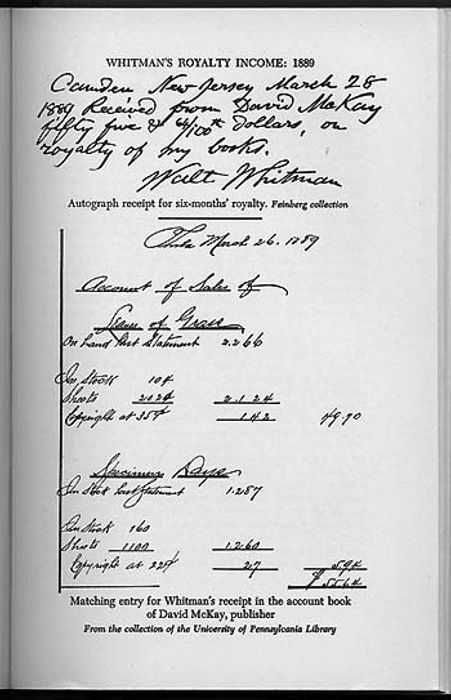 [Begin page 441]
fifty-five dollars—fifty-five for six months' settlement, royalties"—and after a little wait—"which is little enough: fifty-five dollars, a hundred and ten dollars a year for the two books: God save us from starvation!" Laughed.
"If that was the be-all of a man's income he'd fare badly, wouldn't he?" He had signed the picture for Dave, who took it away with him. "When I opened it I saw at once how different it is from our poor copy: how more decisive, virile: with the yellow age, too, to give it a verity, charm. All that is naturally gone from our reproduction—or most of it"—but, "I am quite well aware that this is unavoidable: it is not so palpable when the pictures are not seen together, contrasted"—and yet—"I am perfectly satisfied that we have a fairly good result in our copy: it is not what we could call a failure." I told W. that Brown was not willing to lose all the money on the rejected plate. "He says he is willing to make another try: if you won't let him do that then you should assume at least part of the loss." W. stubborn: "I will tell you what the thinking of a day or two will bring forth." As to bad blood: "I have never had the thought of it—not from the first: Brown has treated us beautifully."
[Begin page 441]
fifty-five dollars—fifty-five for six months' settlement, royalties"—and after a little wait—"which is little enough: fifty-five dollars, a hundred and ten dollars a year for the two books: God save us from starvation!" Laughed.
"If that was the be-all of a man's income he'd fare badly, wouldn't he?" He had signed the picture for Dave, who took it away with him. "When I opened it I saw at once how different it is from our poor copy: how more decisive, virile: with the yellow age, too, to give it a verity, charm. All that is naturally gone from our reproduction—or most of it"—but, "I am quite well aware that this is unavoidable: it is not so palpable when the pictures are not seen together, contrasted"—and yet—"I am perfectly satisfied that we have a fairly good result in our copy: it is not what we could call a failure." I told W. that Brown was not willing to lose all the money on the rejected plate. "He says he is willing to make another try: if you won't let him do that then you should assume at least part of the loss." W. stubborn: "I will tell you what the thinking of a day or two will bring forth." As to bad blood: "I have never had the thought of it—not from the first: Brown has treated us beautifully."
Bodenstedt's seventieth birthday is approaching. W. spoke of it. He asked me what I knew of B. Spelled the name out to see if he had it right. Asked what my father thought of him. Was he familiar with B.'s work? "Not at all: I read that paragraph in the papers somewhere: was it in The Critic? It aroused my curiosity: I suspect that he's a man I should know something about." He said again: "I miss a lot through not knowing German—but that might be said of not knowing other languages, also: the German, however, the Dutch, the northern, lethargic languages, the Scandinavian (Norwegian, Swedish, Finnish), somehow appeal directly to me—hit me where I'm heaviest, solidest"—here he laughed: "I don't think I've stated that very clearly, but you know what I mean: I am not a scintillator, I am not a fire-worksy man: I take better to quietude, to the inertia of large bodies: the German gives me the ground under my feet. That may be a prejudice, based upon nothing: still, that's the way I feel about it." Then he added: "The German literature, even in translation, is somehow my own: I am at home with it—readily adjust myself to its spirit. Now why do you suppose that is?"
[Begin page 442]I read W. a passage from James West's letter of the 26th from Boston to me. W. said: "He's the editor of The New Ideal, eh? Yes, read it: he's our ilk: God knows we're scarce enough: we need all who are willing to be quoted on our side."
"It will be worth while for you to call on Walt, just to tell him of the following: A half hour ago a gentleman called at the office here to leave his subscription—his home is Arlington, Mass.—and while we were talking of the new ideas of many things, we spoke of 'death,' and I quoted to him from Whitman, to this effect, 'There is nothing I am so much at peace about, as I am about death.' This led him to tell me that at the funeral services of his wife, about a month since, the consolatory and aspirational readings were not from the Bible, as of old, but almost wholly from Walt! And I said to the man, Amen! He made the selections himself, for he is a lover of and believer in our good old friend and helper, Walt. At the very moment his wife was dying, that line of Whitman's, 'We two together no more,' flashed over him: and the brightness and hope of our poet cheered him through all, and led him to make the funeral of such a character that, after it was over, the friends and neighbors all said, although they knew he loved his wife most dearly, 'Why, it was a party we have attended, and not a funeral!' He is a prominent man—by name Alfred Norton—and his wife was a girl-companion and life-long friend of Mrs. Mary A. Livermore, who spoke at the memorial services."
W. much moved. "That is the best, the most touching, testimony—a salutation from the unseen, unknown: it seems so close by, so immediate, so intimate." I said: "Clifford uses you and Bob at funeral services almost regularly: he often reads from your book: he don't say it's from so and so: he just reads: then people come up and ask him: 'Where did you get that beautiful scripture?' and he says, 'Oh, from Robert Ingersoll,' or 'Oh, from Walt Whitman'—which often flabbergasts 'em!" W. laughed. "Good for Clifford! we seem to be in good hands!"
I asked W. if Dave had said anything further about the big book. "No—nothing at all." He said again: "I am impressed with the fact [Begin page 443] that Dave is personally as well as commercially friendly to me: I don't know how far that goes, but I am inclined to trust myself to it." I said Dave appreciated W.'s inscription in the book. W. laughed. "Does he tell anyone that? They used to say—some of my friends—that all the babies of the land were Walt Whitman's babies: and the sweet babies—oh! they are my babies: I do take to them: they are like the first snow, the first blade of grass, the first anything—unstudied, unelaborated, untouched by rules." Again: "I am sure that is so—what you say of Dave. I have heard of a salesman, a big man, around at Porter and Coates': he spoke to Dave once of Leaves of Grass as 'the whore-house book': Dave was up in arms about it." W. grew serious: "But the man afterwards bought books from me—several of them—and, as the fellow said of his traducers in the story, I got my solace by charging him a damn good price for them."
W. has been looking up the pictures to be mounted. Tied what he has found together. "There will be three sets." I asked him what price he would put on the birthday book. Five dollars. "Yes, I have settled that: I shall not spare expense in producing it: then we may ask the five with good grace." Was he feeling any "financial twinges" re the big book? He laughed. "No financial twinges: none whatever: I am not dissatisfied now that we have about concluded that other matter: I am commencing to realize the fine points of the first cover: as to the money—well, let that come or not come: I don't see that worrying will bring any customers to us or drive any away." W. tried the paper sample I had left with him. "It looks as if this would do." Thinks he will not use the lines "Come, said my soul," for autographing, but will look up "something three or four lines long only" placing this on the title page.
8.05 P.M. Found W. looking over papers. "I have felt mighty well—for me—all day: I've kept myself busy right along doing one thing or another." He has been trying to get the unmounted photos together. "I've been rummaging into the nooks and corners." Would he have all he needed? "There are almost enough on the table now except in one of the bundles: I have more of them too, somewhere, but I can't just put my hands on them. In the other room there, while I was sick, Mrs. Mapes put things to rights, as she calls it, which means putting them where I can't find them: formerly I could [Begin page 444] go in there any time and reach my hand instanter to anything I wanted, but now—oh Lord!" He was good-natured enough over it.
W. said he liked Blake. "I was very strongly impressed with him." I referred to his light physical build. W. said: "I noticed it: and do you know—did you remark it?—he looks much like our Symonds: as we used to say on Long Island, favors Symonds—favors Symonds very much." He pointed to the big Symonds picture. "Not so much as Symonds is in that: more as he is in other pictures I have."
Discussed paper. I saw Hamilton, who had offered to drop to fourteen cents per pound. Found from Brown (at Ferguson's) that we needed precisely what Hamilton had—ten pounds. Dave told them at Ferguson's regarding the big book that he had not been consulted—that he might have given us a point or two on it if he had. W. said: "No doubt, but—," He smiled. Then: "When I look over the whole field myself, see how things seemed to hitch so naturally together—no snag anywhere—I consider that we have achieved a real success: I don't commiserate, I congratulate us—notwithstanding Dave." "It is very significant that we have made a hit—hit even with the cheap cover." "As you have well said, it is the characteristicality of that cover which appeals to me. It is interesting that Aldrich is well-pleased: Aldrich, who sees the book, must have one—Aldrich, so dainty as almost to be a Miss Nancy, though not that, but really a very manly fellow." "And there's Stedman, probably, though I don't know—have not heard from him." Then suddenly: "But how about our paper? How much does it make in dollars? Should we not get it at once?"
Photo-mounter wants thirty dollars per thousand. W. said: "This looks like robbery on the surface—but then we have no right to look on the surface. I suppose this will be another case of throwing good after bad money." More pocket edition talk. "It is a whim of mine to have it out by my birthday: only a whim, people will probably think: but I am much set, determined, upon it." I remarked: "And by that time I hope you will get out—at least in your chair—and around the corner"—and W.: "Yes—get a sniff of the great outside! Oh! the joy of that! And the greater joy after a while of getting to the ferry! And greatest joy of all, getting wheeled on the boat! Oh! that will so intoxicate me, I'll want to jump overboard!" His whole form dilated as he spoke of this. It was a fine evening: [Begin page 445] some of the recent days have been of extraordinary beauty: he is much pleased with the prospect of a spring rally.
I saw Wagner's The Valkyr last night. Gave W. impressions. He suspended his work—listened intently to what I had to say. I was of course warmly enthusiastic. At one point he exclaimed: "I know! I know! it must be so! must be. You tell it to me just as the Doctor did!" And again: "Have you a libretto? something quite good—full?" And: "Do you know of any good analysis of the opera—any thorough review, exposition, of it—of the music?" Had read the Press notice this morning but wished something more than that. Desired my libretto. "It's one of my regrets that the Wagner operas have never come my way—that I for my own part have not found it possible to indulge in them. I am quite well aware that they are my operas—belong to Leaves of Grass, to me, as we belong to them: they are an unmistakable entity of our treasure-box: your description of The Valkyr—do you call it that?—only serves to make my conviction more vehement."
W. gave me copies of big book for my sister Agnes and Anne Montgomerie. Wrote in the former: "Agnes Traubel—from her friend the author and her brother Horace March 28 1889." In the other book: "Anne Montgomerie, from the author W W and Horace Traubel March 28 1889." I suggested that W. should ask Bucke to send on the corrections B. said he wished to refer to W. for the new Leaves of Grass. I was to be down in the forenoon tomorrow to get portraits or anything else W. might have ready. Bucke wrote W. day before yesterday:
"We absolutely must not look for any but the worst kind of news from O'C. The only consolation in the case is that he does not suffer—at least not much. Some day (quite likely soon) he will have a series of fits that will end his life. It is bad, infernally bad, but we must stand it."
W. said "I am ready—and not ready: I am aware of what is impending—yet I throw up my hands: try to ward it off: I know we're in the presence of death—yet I want to think only of life: nothing that could happen would surprise me—even his complete return to life: yet I am frank with myself: I see that everything is drifting the other way—that we can't hold back the inevitable shadows."
Friday, March 29, 1889
10.30 A.M. Found W. running through the leaves of a big book of which he instantly spoke to me. "It is from Stedman: it is only one of seven: the rest are there in a box"—pointing towards Ed's room. The open box over there on a trunk by the door. Library of American Literature. "And there was a note, too—a big one"—reaching forward towards a pile of books between two of which (on the floor) his morning's mail was tucked. "Sit down there on the sofa and read it." Stedman letter covered twelve pages. W. said: "It's a whole essay." Again: "He likes the big book: I had the notion he would: he says a lot about this Library series: and so forth." In general: "It is a very good letter: very warm—I may say eulogistic: don't you think it is a little too much so? It is very scholarly: in spite of himself Stedman is in the shadow of the traditions, rules: he does not mean to be, but is."
W.'s pleasure in the books was undoubted. He ran through the volume in his hand, commenting as he went along. "I like the way he puts me there: look at these portraits, too—steels: one of Lowell—this; and another, Holmes—do you like it? I think the wood cuts fine"—turned to his own: "This certainly comes up as well as ours—I don't know but better." Hit upon the Thoreau plate which did not much impress him: then the Holland, at which he paused. "This is good but I know a better. Did you ever see Wyatt Eaton's beautiful head? I should say it was made four or five years ago: it was about so large"—measuring with his fingers—"it was noble." Then commenting on the book once more: "I like the make-up of it—the type." Portrait of Herman Melville: "I know little about him but they make much of him here." To Stedman's letter again, in which something was said of "a chap" who had been to see W. and reported him as saying of Stedman that S. would not take his hat off to Apollo if he appeared—at which S. was "consumedly" amused.
W. protested: "I am not guilty with the feeling of having said that: I know nothing about Stedman's chap—if possible, too, less than nothing of that remark." I said I had heard him speak of Stedman in all sorts of humors but never in that strain. Said W.: "Nor have I: but the 'chaps,' as he calls them, often come and [Begin page 447] report me so—put words into my mouth that I never uttered. They are not always liars: sometimes simply don't understand: come, hear something said, hear it badly—then carry off an impression positively the opposite of what I intended to impart." He fingered the book. "It's a scholar's book: it's also a man's book." Then: "Stedman is very generous—full of the milk of human kindness: he wants to do me justice: yet, in spite of all, Stedman has his peculiar limitations—is like the fellow at the feast, who must have the silver, china, finger bowls, napkins, fine company, if the meal's not to go wrong"—which was "the other pole" to which W. considered "that stronger type of manhood which when it had a bit of meat fresh killed and a good fire near and a pinch of salt was satisfied—spent no time yearning for the delicacies of rich pantries." W. adding: "Which might be said to be living in the backwoods: and so it is, with all that that implies."
W. was pleased with S.'s pleasure over the cover of the big book. "That fateful—to Dave hateful—cover!" He quoted Stedman's statement that he would rather know how his book "strikes" W. than any other living person. W. asked: "What does he mean? He certainly can't mean what his words signify." I took him a slip cut from the Home Journal of a letter Rhys had written the Transcript (Boston) about the German W.W. Had he seen it? "I never met with it before. I do get the Transcript: Kennedy sends it: that must have slipped me." I said: "You have a mysterious friend on the Home Journal." He thought so too. "I have no idea who it can be." I told W. I had an answer from the Chicago News. "An answer to what?" I said: "To my inquiry as to who wrote that fine piece there about you." W.: "Oh yes! Well—who was it? is the veil withdrawn?" I read him this note:
The Chicago Daily News Editorial Rooms, Chicago, March 26, 1889. Mr. H.L. Traubel— Dear Sir:The managing editor has handed me your note of the 23d instant. In reply permit me to say that as literary editor of the News I [Begin page 448] printed the notice of Walt Whitman's November Boughs to which you refer. My address is the Daily News office.
Truly yours, Francis M. Larned.W. thought it would be advisable to send a copy of the big book to Larned. W. said: "It's a modest quiet shrinking sort of note: it's a little vague, dubious too. What does he mean by 'I printed'? He means 'I wrote'—don't you think? The name is familiar: there's Augusta Larned: but I know nothing about Francis: anyway, our double-dyed curiosity is satisfied: now we can go about our normal business again." Jovially. "However, we must send him the book first." He nodded. "Yes—we will do that."
7.30 P.M. Took W. the book of The Valkyr. He put on his glasses and looked it over instantly. "I know it'll be a treat to me," he said. Has not yet found the pictures he's looking for. Ed came upstairs once yesterday and found W. in the little room mounted on a chair and in quite a stew over the orderly arrangement of things on his shelves. Ed said: "He was cursing and swearing to beat hell." W. said: "Mrs. Mapes has an enlarged bump of order: she arranged my things so I didn't know where a damn thing was: her heart is in the right place, though she has put everything in the next room in the wrong place."
W. said he had a letter from Burroughs. "I have just written him a postal: he has got back to his home again." I asked: "Do you think John will succeed in renting his house?" W. seemed to think my question amusing. "If he can find a fellow who bites, then he may do so—but where is the man who will bite?" Had he read Burroughs' article on Arnold in the Christian Union? "I cannot say that I have: I take an interest in John but I really take little interest in Arnold." Then W. said: "Here's John's letter itself: take it along." I sat there and read it.
West Park, N.Y., March 28, 1889. Dear Walt:A paper from you last night reminds me that it is time I again reported myself. We are back home and I am busy about my farm work. The spring is early, the robins are calling the old call about the place, the sparrows are singing the old songs, and nature seems [Begin page 449] as fresh and young as ever. My plough seems to find as much fat on the ribs of old mother earth as ever it did, and it looks just as sweet. I am very glad to be back again and to get at some real work. On the fifth of March I went to N.Y. for a week; stayed with Gilder and then with Johnston; had a pretty good time, saw some of the small literary fry, dined with Gilder at the Fellowcraft Club, of which he is president; met George Kennan, of whom I think highly, with Mrs. Custer and Mrs. Cleveland—both charming women. Charles DeKay is married and is stout and handsome. Gilder is very busy; goes out a good deal, but finds time to write some poetry still. He owns a house now in Clinton Place (Eighth Street). Walked down about City Hall and was astonished to see the Times building towering up and quite overshadowing the Tribune building. Its architecture is fine, and makes the spotted and clumsy character of the building of its rival look cheap enough.
I am to have a new book this spring—a collection of Indoor Essays; rather a piece of bookmaking business—not much worth.
I hope you are comfortable these spring days, and can really get a glimpse of the spring. I am well, but not very cheerful for some reason. Any news from O'Connor or yourself will be very welcome. With the old love
John Burroughs."Though John says he's not himself feeling cheerful," said W., "his letter somehow cheers me." Then: "He says: 'with the old love': I say 'with the old love' too: if you write him repeat that for me. John seems to get down to New York occasionally—among fellows there, the literati: I wonder if it does him any good? I wish he could prolong his journeys—come here: Washington, West Park, Camden, are so far apart!"
I ordered paper of Hamilton today. W. offered me a check for it. But we only pay on delivery. Ingram was in this evening just ahead of me. W. gave me Bucke's letter of 27th. "There is nothing in it—except some belated advice about the birthday book: we've anticipated his sage counsel in our own wisdom." Laughed. Gave me an old English (Eliot and Fry, London) photo of Carlyle which Morse had left here. Morse started a Carlyle in Camden. W. said: "I like it almost better than any other picture of the sour-sweet old man: [Begin page 450] it emphasizes the gentler side of his crotchety nature." W. also gave me an announcement card of his N.Y. Lincoln lecture, 1887. It reads this way: "Walt Whitman on Abraham Lincoln. Mayor Pond has the pleasure of announcing a Lecture on Abraham Lincoln, by Walt Whitman, to be delivered on the 22d Anniversary of the Assassination, Thursday, April 14th, at 4 o'clock P.M., in the Madison Square Theatre, New York. Reserved Seats, $1.50. Admission, $1.00. Tickets for sale at the Theatre. Orders may be sent to Maj. J.B. Pond, Everett House; E.C. Stedman, 66 Broadway, and 44 E. 26th Street, J.H. Johnston, Lotus Club; R.W. Gilder, 33 E. 17th St.; Brentano's, Union Square." The card also contained a J. Reich line drawing of Lincoln at the left.
W. said: "That card is worth while as a Whitman item, if such a thing has any value at all, as showing where we had arrived, who had welcomed us, all that, in 1887—thirty years, more than thirty, after the start of the voyage." I said: "Voyage—yes, it's that, Walt. That voyage is not yet over and never will be over." W. said: "You can say that but I can't say it." Then W. resumed gently: "Stoddard once said to Stedman—I think it was Stedman—about me: 'Whitman still keeps himself afloat, but it's by pure and unadulterated cheek: his brass won't last forever: he's destined for an ignominious disappearance in the end.'" I said: "The end is not yet." W. still in good humor: "But Dick would still say: 'Wait and see: give it time!'"
When I got up to go W. asked: "Where are you going?" I said: "Across the river for a long walk." He cried: "I quite enviges you!" I said: "Why should you envy me? you had all those walks before I was born." He assented. "That is true: I should not forget that: but when you said walk—when you not only said walk but said 'long' walk—something in my blood was stirred: oh! I am not ungrateful!" I kissed him good night. He asked: "Is the moon shining? is it colder?" As I was closing his bedroom door behind me he called out: "God bless you! have a good time: I know you will!"
Saturday, March 30, 1889
10.45 A.M. W. reading papers. I found him suffering from a bad cold. "It clogs up my head." The temperature had taken a big drop in the night. It snowed a little, and froze. The reaction from the weather of the last few days was violent. W. said: "I am eligible [Begin page 451] to catch cold: I seem to invite colds: my cold of a month ago had settled down in the quiet but was not scotched: it was always ready to crop up again. I am like Charles Lamb's celebrated roast pig: you know it? He would wander about, not yet killed, but with a knife and fork stuck in him inviting the world to dine off his corpus: I have the knife and fork in me: I too am a stalking invitation: so the cold seizes me in its grip." Further: "I am becoming a tenderfoot in this room: I am so reduced in general condition that I am open to assault no matter which way the wind blows." W. handed me a postal. "It's from Nelly: good news: read it."
Washington, March 29, 1889.William had the best night last night since a week ago and has sat up all day. Your card just here. He has read some today but says his head is very weak. Le Barnes in, and looking at your big book, for which we thank you, both William and I, each, for our copies. William sends love. I too.
Nelly.W. said: "They say no news is good news: well, here's some news that's good news." Who was Le Barnes? "I knew him: he knows me: he is a literary New Englander of considerable quality." Then he suddenly exclaimed: "Wouldn't it be grand to think of William as getting all over this—getting back on his feet again, out, around, there, here! getting strong, ruddy, virile, contentious, as of old!" Then he sort of soliloquized: "How old is he? do you know? I don't remember that I ever knew or asked." Bucke had told me fifty-five. W.: "I suppose that is about right, then: I should have set it, say, four years younger." I said: "When we left the house that day in Washington and crossed the street Doctor said: 'It's a damn shame a man so young with such genius should be sitting there waiting to die!'" W. said: "I know how natural it is for a fellow to feel that way: that is always the first emotion: it demands to be uttered: but after that, inevitably after that, comes the philosophic thought, the conviction, the vision, that there is after all no mystery in this or any other trouble—that there is always a new or distant good cause to explain it: a cause often in the man himself: if not there, then in the father and mother before him—or perhaps even back in their fathers and mothers: but whatever, always the best reason, the profoundest [Begin page 452] necessity, the supremest providence." He said he could "never forget" Epictetus where he says, "What is good for thee, O nature, is good for me!"—"it is so subtle, so finally inevitable." Then after a pause: "But all this has a long tail—a very long tail!" Here he got down on the earth again. "But this locomotor ataxia is a horrible venomous inexorable thing, too—a mysterious something or other that gets its nasty licks in in the dark!"
W. asked me: "Have you read much of Shelley or about him? There is a story Mrs. Shelley tells—or a character-study, rather—that makes me think of myself. You know they were both great believers in signs, portents: so it was Mrs. Shelley who said once: 'We always know when the bad things are about to happen: when we are perfectly well, when all is at peace, then we know that the clouds are gathering—that a blow is preparing.' I have some such superstition—it if may be called that—myself: when I am feeling best I get ready for the worst." "Meeting trouble more than half way?" I asked. He said no. "Rather getting ready to stand it off when it gets the whole way." I told W. another Shelley story (new to him) in which Byron figured. He said: "I have always felt the greatest interest in both men: I like to read all I can get about them. I have a weakness for biography anyhow." He asked me if I had any Shelley, Byron books. If so he'd like to see them. I said: "Biography is fundamental romance and fundamental history." He was quick to say: "I'd be willing to say that too." I said: "Any book is biographical—even autobiographical." He said: "Under the surface that's true: but what lying things, travesties, most all so-called histories, biographies, autobiographies, are! They make you sick—give you the bellyache! I suppose it can be said that the world still waits for its honest historian, biographer, autobiographer. Will he ever come?" I laughed and said: "I'll be the first!" He said, looking at me: "It would be a worthy ambition: it would be revolutionary." I read W. a postal I had from Clifford:
Friday, A.M.Please thank W.W. and yourself for me now in a provisional way, till I can do it better, for the precious Book. I shall parallel a passage of John Bright, of whom I speak Sunday A.M., with one of W. that [Begin page 453] is a grand antiphon. Surely W.W. will not object to the yoking so? Ever
J.H.C.W. said: "Surely not: but how about John Bright's objections? they have to be considered too, dead or alive!" Then further: "Antiphon: a sort of response: I shall not object." I said: "Bright has said some big things." W.: "Yes, so he has: for a man in politics, masterful things!" W. is still hunting the unmounted pictures. He's turning both rooms upside down. Has burnt up many old letters and papers. "The accumulation goes on accumulating: I get mad at the mess now and then—just pick up the bundles of stuff, God knows what, I don't care what, and poke it into the stove: I feel a sense of relief when I see it go up in smoke." Picked up Stedman's book again. "I am getting lots of fun out of this," he said. "Fun?" "I mean pleasure: this seventh volume: I even enjoy the make of it: the pictures—some of them—the print." Was he impressed with Stedman's selections? "Yes: I rank his judgment very high." He added: "The book is printerially fine: it is, I believe—which is quite an essential point to me—entirely free from errors: I did not see a single break: I am very thin-skinned about such things: I suppose all of us are. Years ago Osgood or Houghton used My Captain in one of their readers: it was a terrible affliction, almost a tragedy—the way they made it up: I cut a leaf from a book, sent them the correct version, intimating that I thought the only effective way to fix it would be by making a wholly new page: but I never heard of the matter again, either from them or in the book: I can't account for its appearance so except by the supposition that some one wrote it off from memory—and the hacks often do that, you know." But in Stedman's book "everything of that kind is scrupulously, immaculately taken care of." He said again: "I don't like the steel engravings: I do like the wood cuts: if I may say it, too, I like my own the best of all: the picture of Thoreau seems to be taken from a poor original."
Discussed birthday book. "I think I'll put seven or eight printed verse lines on the title page and autograph them." He keeps on having "humors," as he says. "I may change and change: finally I'll hit the nail on the head." As to the title page: "I like the old lettering of Leaves of Grass—it seems to me very adaptable—but if the printer [Begin page 454] had anything to suggest, as he did, did well, with November Boughs, we will receive his counsel hospitably, even gratefully." I said: "Doctor has discovered a cipher in November Boughs." He looked at me: "What?" I said: "N.B.!" He laughed. "Oh my! I never thought I was so subtle!" Then he said: "In a case like that a man can find anything he is determined to find: what he wants is always there—infallibly: it reminds me of the fellows who mine in the far West: what do they call it—sugaring? sugaring a mine? no—that is not the word for it, though there is a word." After vainly jogging his memory: "Well—I can't get the word I want: not sunk, sugared, broken: there's a good word: anyhow, the case is the same: it means, dream deposits: dream gold, silver, what not: not mines in the ground but in people's heads, in the paper of promoters, in the fancies of investors: dream values—sugaring the kettle!" Then he added: "There may be some such sugar-coatings in November Boughs: we may trust the Doctor to find them there or not there!"
7.30 P.M. W. had started another of the Stedman volumes. Had it on his knee. "It is a great mine," he said. He asked: "Any news of the book?" I said: "That was what I was going to ask you: the news now must come from this end: we are waiting for you." No progress. No pictures found, no lines chosen for the title page, not a word written on the prefatory note. "You must try to be patient with my snail-like processes," he said. W. picked up Bucke's note of the 28th and read me this: "I grieve much that you should be depressed and by me about O'C. but I am anxious that his possible death at any time should not take you unawares, for if it did I fear it would be a terrible shock to you." W. said: "Maurice's fears are remarkable: as if William's death could take us unawares when we are expecting it daily!" He added: "Doctor sometimes attaches extreme importance to phrases that I only intend to be taken offhand." W. said he had a letter from Kennedy. "Nothing in it." Again: "John's letter—the one I gave you—brought me real joy."
Ed came in for mail at this juncture but there was not a line. "This is unusual," W. exclaimed: "but it occurs sometimes"—adding: "I like to have something to make it worth while for Ed to go there." He said he had a new idea. "I think I'll write a message to O'Connor tomorrow on a sheet of paper—a letter that will do duty for Bucke [Begin page 455] as well—which O'Connor can pass along." I showed W. this, which I had taken from the Home Journal:
"The English relatives of Walt Whitman are, says the Pall Mall Gazette, making strenuous efforts to induce the 'good gray poet' to pay a visit to England this year. It seems hardly probable that they will succeed, for Walt Whitman's health and age are scarcely favorable to such an undertaking. But, should he come, there can be no manner of doubt as to the enthusiasm with which he will be received, although there is something incongruous enough in the thought of the author of Leaves of Grass figuring as a lion in London drawing rooms. And what will Mr. Swinburne say?"
"No, I never saw that," said W.: "some of us seem a good deal talked about—more talked about than we know or care to be: that is one of the penalties the literary calling entails: a man may be an ass, an idiot, an imbecile: still he's talked about." He laughed heartily at the phrase "figuring as a lion in London drawing rooms"—adding: "This surely would justify Herbert's picture of me." I referred to my Emerson address. I am to give it at the Ethical rooms next Tuesday. W. cried: "Where?" and then, "What?" Asked me then: "Run over your main lines," he said. I quoted a phrase from Darwin's life: "For books he had no respect but merely considered them as tools to be worked with." This did not first hit W. I repeated it. Then he caught on. "Oh! it is very direct, simple, magnificent!" Then of Emerson: "It seems to me that out of the cluster of his clusters of merits, greatness, Emerson could best be described by genuineness, absolute frankness, pristine intelligence: as I often say—he is filled with the qualities that go to redeem the whole bookish crew: yes, he redeems them: and we must remember that Emerson was not only spiritual—a creature of dreams, ideals—but knew a thing or two of the earth about him: though he was utterly without guile—utterly, utterly: the most absolutely pure, childlike, while the wisest, creature of our time." It was "a never-ending wonder" to him how "Emerson's personality" even to him "became ever more radiant—the more thought over the more thought of."
W. asked me: "So Clifford's sermon tomorrow is to be on John Bright? Oh! I hope he will do it right—indeed, know he will: Bright deserves much: I consider him a star of the first magnitude, a great [Begin page 456] leader, I was going to say knight—but that has a twang of aristocracy: a born defender of the faith, I should say—a people's advocate." He said Bright had stood by the North in wartime. "He was a friend at a time when we needed friends: if it had not been for him—for Victoria, too, for Albert—perhaps for a few others: if they had not sprung into the gap, as it were: God knows what would have become of us: it would have been a very dark problem indeed. But what did the fellows—the so-called leaders—over there know about us? They were all against—against: Carlyle, Tennyson, Gladstone—all the big fellows: Gladstone was not so well known then." He meant this "all" as applying to the official classes. "I know the people—the leaders of the people—of the lower orders, as they call them over there, were pretty nearly right: Victor Hugo, for instance, was neither for us nor against us—he knew nothing of affairs here, practically: but the people, both in England and on the Continent, were solid—had a clearer notion of conditions—were faithful to freedom." He said he would "never tire of acknowledging Victoria and Albert": that at a period "when there was every temptation for the 'high' classes to be adverse," they had been "steadfast in acknowledging the position of the North."
I said of someone I knew: "He is very cultured, very polite: I feel after I have been with him fifteen minutes as if I had been sucking candy." W., after his hearty laugh, said: "Well—isn't that just as it should be? Isn't that the tendency of our civilization? the teaching of the schools? the literary classes? to sugar us? to make us elegant, smooth, correct—to tittivate the ear? at the expense of all the native rude elements?"
The Ledger has never yet reviewed November Boughs. W. asked: "Is that so? Perhaps Dave never sent him a copy." But Dave had. Then said W.: "I am not surprised: I have told you about McKean: I don't think he has any room for me—he don't see, have time, for me." I said there had been a change in Ledger methods. More space was now given to book notices. "Yes—I have seen that: have now and then seen the Ledger recently: in fact, have more than once considered whether not to stop the Press and in place of it take the Ledger: I never take up the Press any more but there's something in it to make me mad." I put in: "The editorial page is surely bad"—at which W.: "I mean that—I mean the editorial page." [Begin page 457] Went on with vehemence talking of its "mean spirit"—ending in this way: "And the worst part of the editorial page is what they call the funny department—regard as such, rather: the short, so-called pithy, editorials: these, it seems to me, are the most utterly dirty, foul, flatulent, stupid, mephitic, things of all." I said: "I take exception to Bucke's claims for you in my Emerson paper." W. nodded: "I hope you do: it's only justice to me that you should do so: I too am entitled to be considered: Doctor certainly leans too far my way." I told him I had wanted to write a paper about his personality. He asked: "Will you do it?" Then answered his own question: "Yes—you will do it!" He shook his finger at me: "I guess you'll be making notes some day: then you'll be in a position to do what they ask." Further: "And if you do it be sure you do it right." What would he call doing it right? He cautioned me: "Whatever you do don't overdo me."
W. was in good humor, though he said his head hurt him. "Sidney has such notes," he said: "took some—perhaps many: would take them right down as he sat here: sometimes we would be talking: I would say something: then tell him: 'Put that down—put it down just as I have said it!' and he would whip out his paper or tablet or book and ask me to say it over again. 'Oh!' he would cry to me: 'if I could only get that down just as you said it, just as you said it, to the last word!'—and he would do very well: I have great confidence in Sidney—in his reports." I said: "These were the reports Kennedy wanted from him." W. did not quite hear me. "You mean Hartmann's damn lying stories?" I explained. He said: "Oh!"—and went on: "Did Morse give them to him?" "No." Then: "But Hartmann's! they were a great affliction: he had reports: damn fool reports: they all seem to have them: he wrote down things I never said at all—things entirely alien to me, letter and spirit: things that sounded like anybody else but me: worse than that, he often made me say directly the opposite of what I believed, of what I must have said: the whole construction of his reports—sentences, words, thoughts—was unlike, wholly unlike: you could detect the counterfeit at a glance. But that is what history is made up of: reports of reports, at second, third, fourth, removes: I suppose when I am gone there will be all sorts of stories set afloat by all sorts of liars."
Then W. regarded me affectionately: laid his hand on my arm: [Begin page 458] "And that's where you'll come in, Horace—to set the crooked straight: that'll be your time: you'll jump into the breach then." He asked: "Did I ever tell you about the drunken reporter who paragraphed me once?" Where was that? "He was on a paper over there in the city: was instructed to get opinions on cremation: went to all sorts of men: was told to come to me: never came near me, but gave me about so much on the subject anyhow"—indicating about an inch by his thumb and forefinger: "He had not had the time or the disposition to take a trip to Camden: he thought I ought to be represented—should not be slighted: so down I went. To make matters the worst possible, too, I was put down as saying exactly what I should not have said: I have no thoughts on cremation—no formulated thoughts—but such feeling as I have would be rather in the direction of endorsement: but here I was put on record as opposed." I said: "And people have pasted that opinion in scrapbooks as a piece of history!" He laughed. "That's the way history is made—much, most of it. The drunken loafer evidently believed that I would regard it as an honor to be quoted in such good society." I said: "You call him a drunken loafer? how do you know he is a drunken loafer?" He said: "You've got me again: I don't: he may be sober and industrious!" Then he laughingly added: "But I've got to call him something, so drunken loafer will do: I might say something much worse but I thought this as mild an epithet as would fit the case." "But," he said: "you haven't heard all: to cap his impertinence he wrote me a letter—think of it! the cheek of it!—saying he hoped I would not be angry: he had not found it convenient to come over: he had to have something from Walt Whitman: so he sat down and wrote out what he felt I would have said if he had seen me: something like that."
I told W. a story. "John Curley says that when Singerly's Temple Theatre was dedicated the Record man sent there to report it got so drunk he was helpless when he returned to the office and could do nothing." W. laughed: "You'll admit he was a drunken loafer, won't you, Mister Skeptic?" I said: "I'll admit he was drunk but I don't feel warranted in calling him a loafer." "There's your damn quibbling again!" W. cried. I went on: "The fellows in the Record, Johnny was one of them, seeing the scrape the man was in, shielded him by borrowing notes of the affair from the Press and writing up the story themselves, so that Singerly never knew anything had happened." [Begin page 459] W. exclaimed: "That's a fine story: I'm glad you told it to me: it's the other side of the shield: yes, I know John: I also know Tom: both the Curleys: John better than Tom. The newspaper business after all does breed some of the best stuff: a fellow must after all not be too wholesale—too personal."
W. reached to the table. "I laid this aside for you: if you're of the mind take it along." He handed me another of the O'Connor letters. "They turn up one by one: the chaos here even shocks me at times—and I am not easily shaken: I have dumped a heap of the papers, letters, desperately into the fire: some days I get mad at myself—just let my mania for destruction loose: then God help anything that falls into my revenging claws!" Was I to read the letter to him? Yes, if I would.
Providence, R.I., March 15, 1883. Dear Walt:I got continued proofs of the G.G.P. this morning, and your letter of the 14th this afternoon.
I found from this batch of proofs the necessity for a revise, which I hope you will have sent me, for I want the G.G.P. to appear as it was in the pamphlet, a form which always pleased us both, and you will see by my corrections, what a mess the poor printer has made of it. It is evidently not his fault, but Bucke's, and I really felt vexed at him. I furnished him with a carefully transcribed printer's copy of the pamphlet, and it is evident that the galoot has had my copy copied—his copy is of course omitting all the typographical directions and making paragraphs ad libitum. Hence, the mess! Why in thunder didn't Bucke send the copy I made for him! ["Yes, William!" W. broke in: "I don't wonder that you kicked: you're no fussier than I am in such things: even my commas are sacred to me: and you, Maurice—how could you? and you a damn literary fellow yourself, too!"]
However, spilt milk, &c. Send me revises of both documents. It will hardly delay matters, and there will be the consolation of accuracy.
My Good Gray reads really well in the new version. I had no idea it was so good!
[Begin page 460]I am glad you liked the Introductory. It is likely to make some very pretty fighting, before all is done.
After I sent it back to you, I remembered one typographical error I meant to correct, but forgot it after all. It is on the first slip where I speak of Paul Louis Courier's "arrows of lightning." This should be "arrows of lightnings" double plural. If I get a revise, I will correct: if not, you please have an "s" put on to my "lightning"—it is more effective, though a small matter.
Dr. Channing and all send love to you. Jeannie is very weak though her mind is bright and clear. If she weathers through this harsh spring, I shall have hopes of her. She has immense vitality, but injures her chances by ascetic notions—total abstinence, &c., and general desperate Hahnemannianism. It is bad when you don't do, in a general way, what other people do, and go back upon a fair allowance of victuals and drink. ["My God! that's true! the poor girl: she died: they lost both of their children: there was hell loose in the blood somewhere: we must have guts, blood—good blood: we can't live on any of the substitutes for food: nothing but vulgar grub will save our bodies—and souls!"]
I got the Man [sic] this afternoon with Parton's version of Hugo's magnificent oration on Voltaire; also the Tribune catalogue, which I have not yet had time to look into. Thanks.
Au revoir. Faithfully W.D. O'Connor.P.S. If the printer is puzzled show him a page of the pamphlet, which will show him how I want it set, with the short dashes following the periods, etc.
When I got up to leave I asked W.: "Is your head better?" He shook it dubiously: "On the contrary it is very bad: it has been in a whirl all the time we have talked." I said: "I should not have stayed too long." "Yes you should: I wished you to: you make me forget my woes."
Sunday, March 31, 1889
5.30 P.M. W. sitting by the open window. Spoke of his surprise to see snow (now all melted) on waking this morning. Sat so for the greater part of my half-hour's stay—closing the window finally himself. [Begin page 461] As to his cold: "It is at its worst—no doubt about that: I have been in a bad way all day over it." And yet he talked vigorously: his color was (for him) good: he seemed interested.
"Tom and Mrs. Harned were here—came in for a short visit—after church, I suppose!" Then he suddenly asked: "Did you have Stedman's letter? Tom asked to see it—I could not find its whereabouts—concluded you had it." But I had not. I showed him where he had put it yesterday after my reading. Said again: "I wrote to Stedman today: also a postal to Dr. Bucke: also a postal to O'Connor. But I have had no word from O'Connor—none since that the other day—or yesterday was it?" Was "more and more interested" in Stedman's book. Spoke of Swinburne's poem from Athenaeum in yesterday's Press beginning: "The wind wears roun', the day wears down"—no title being given it. Said W.: "I started it, intending to go straight through: something interrupted me: I dropped it." I spoke rather highly of some phases of S.'s work, but W. did not acquiesce. As to Atalanta—he admitted that he had read it and that "it had some power": but beyond that he would say nothing. "The new poem is Scotch: Swinburne himself is Scotch, isn't he?"
I referred to Frank Williams, whom I passed in Germantown today. W. responded: "I always like Frank and his wife: they are very generous, pleasant—cute too!" And as to Bucke's statement that Williams "amounted to little in the literary sense," W. asked: "What does that matter?—does not some critic say it is not the way the thing is written but the spirit in which it is produced?" I laughed and said: "Perhaps Williams wouldn't thank you to have you say that: most men would rather be called a damned knave than a damned fool." W. laughed, as Stedman says, "consumedly": "That is so: it is like saying to a woman: 'You are handsome but sour as the devil!'" But: "Frank knows me—knows what I think about him: he knows I don't share any such opinion as the Doctor's—that I assume no such contemptuous point of view: Frank has a great deal more guts than a lot of the bookish asses who are braying a big noise out into the world. To me personally he has been generous in the extreme: whatever may be true of his standing as an artist, his standing with me as a man is unqualifiable."
What had I been doing all day? I was just in from Germantown. "What of the Bright sermon? did Clifford do the thing right?" I [Begin page 462] quoted from it more or less—ideas, not words. W. listening and questioning meanwhile with great evident relish. "And how was I brought in in connection with it? tell me that." As I did—repeating Clifford's account of Gladstone's Commons speech greeting the newborn nation he had discovered in the Southern Confederacy, and Bright's reply: "I have a sweeter vision" or something of that tenor—"of an America from the Arctics to the Tropics, united, and over all Freedom." "As reinforcing this," I said: "he cites you: that's how and where you come in." W. was impressed. "That sounds wonderful, fine: see if I understand it right: Gladstone makes the anti-North speech: Bright gets up on the spur of the moment, combats it, warms into fiery eloquence and professes his faith in a continental America. Is that the purport of the story?" Then I gave him the details of C.'s touching references to W. in quoting it. W. exclaiming: "Oh! the grand good fellow!—the tender thought of me!"
Of the German and American fleets at Samoa—three vessels each—four were absolutely wrecked and destroyed and the other two stranded in a typhoon. This was in this morning's papers. W. spoke of it: "It was a dreadful disaster—dreadful!" Then, pursuing the subject: "It is a wonderful and curious spectacle anyhow—the United States having the vessels there at all: for my part I should say, let me go about my own business undisturbed: not a word shall I say or a step take till I am interfered with—till my freedom is invaded: and what I offer for the individual—to me as a person—I should apply to our government as well: let us stay at home—mind and mend our own affairs." And after further waiting: "I should not interfere by a sign even if a civilized power should take in tow the barbarous, the savage, far-away tribes, peoples." Alluded to the International Congress of American Governments, once proposed by Blaine, now revived—there is a story in today's news—by the new administration. W. asked: "I wonder if they can do anything without the Congressional sanction?" And he added: "I think there should be some way of referring such movements inviting serious changes of policy to the people." And he said: "We've got a hell of a lot to learn yet before we're a real democracy: we've gone beyond all the others, very far beyond some, but we're far from having yet achieved our dream: we'll do it, after a hell of a lot of bellyaching, [Begin page 463] retching—often making mistakes, committing crimes: we'll get there in the end: God knows we're not there yet."
Card photo of Sarah Bernhardt on table. I happened to pick it up to look at it. W. remarked: "Take it along to Aggie: I like to remember her: you should take something." As to Bernhardt's personal or professional power: "I know nothing of her—have never met her—never even seen her on the stage." He said: "You know I have soft side for actors: the stage appeals to me: I never happen to have seen this woman: she must be a masterful creature. I used to have all sorts of dreams: I was to lecture: you know how I planned lectures: I wanted to speak—to take to the rostrum: I thought I might get some things said that way that I could say in no other way." I put in: "If you had gone about the country reading your poems you'd protected yourself somewhat against the literary obstacles that were always set up against you: you'd have reached the people direct: the organs of public opinion have always stood between you and your natural audience." W. said: "I am glad to hear you say that: it confirms my own theory: I never lived out my idea: I let it slide: yet at one time I contemplated throwing everything else aside and taking to the road as a reader." I asked: "Don't you take easily to the platform?" "Yes: I don't seem to have any stage-fright: I am at home anywhere: they say a man who's his own lawyer has a fool for a client: it might be said that poet who's his own reader has a fool for a listener: anyway, almost embarked: I feel sure that my fondness for the stage in general would have seen me through the experiment."
He gave me a Burroughs letter: 1878. "There's a little bit of history in it," he said: "Walt Whitman history."
Esopus, N.Y., Feb. 3d, 1878. Dear Walt:Gilder suggests that a benefit be got up for you in N.Y., and that you be asked to lecture on Lincoln. He thinks it would go with a rush under proper management, and that lots of money might be made. The suggestion to me seems timely and just the thing, and we will set the ball agoing if you are willing, and have, or can have, the lecture ready. I saw Stedman when I passed through N.Y. and liked him. I think he would take hold and give the project a lift. Of [Begin page 464] course Swinton and many others would too. I think in fact we might have a big time and make it pay. Write me how you feel about it and if you favor it, how soon you could be on hand. As ever
John Burroughs.W. had blue-pencilled on the envelope: "John Burroughs Feb 3 '78 (first suggestion of lecture)." It was addressed to W. on Stevens Street. W. said "The event didn't really come off for nine years: this was the first declaration in the matter." W. also handed me out a Schmidt letter. "There's always something in these letters I can't make out: maybe you can do better with them: if you can get through this one I'd be glad to have you read it to me: try it any-how." I struck no terrible snags.
Copenhagen, January 26, 1874. Dear Walt Whitman.1. The address of K. Elster is, Mr. Kristian Elster, Strandgade 38, Trondhjem, Norway.
2. I wrote in the midst of March a long letter to you in a large yellow envelope; have you received it?
3. I should be glad if John Burroughs would send me his photography; tell him that I like his book very much.
4. I received in March or April with an interval of eight days both the Prayer of Columbus and The Redwood Tree in Harper's Magazine. Of The Redwood Tree I have had the greatest. It is your old great theme in a simple and powerful style, embracing the holy and original nation of the far West.
5. I am very glad to be furnished with new materials concerning the American humor. In these waggish gasconades lies the embryon of a comical poet greater than any of the old world's in present and past. But your humorists of the day I don't like. Mark Twain has been translated into Danish this year. He is a detestable fool.
6. Clemens Petersen's letter has amused me very much. His force is the psychological critic, the analysing power which he can't use in America, where the minds have too much to do to follow such subtle explorings. Therefore he has tried to be poetical traveller; but his fancy is impotent and he has no great turn of observation. In Sweden he never has had his foot. Touching is what he speaks of "a [Begin page 465] letter from your mother." His mother, which he shall never see more, is the only being in the world, which he loves. I should be glad to have the continuation of his letters.
7. I have sent you all the criticisms on your book, slang, chatter and earnest critic—all: the criticism in Dagstelegrafen is good, but the best is Elster's. I got the number of Aftenbladet here in Copenhagen, and sent it you for security's sake; probably it has also been sent you from Norway. It should interest me to know what impression all these variegated opinions have made on you? Particularly I long to hear if the criticism of Elster has been completely translated to you.
8. Has this translation of your book into Danish not been spoken of in the American papers?
May the lines meet you in good health and joyful. Do you understand my bad English?
Yours, Rudolph Schmidt.W. said: "You've done better with that than I ever did: his English itself is somewhat upside down—sort of cut bias, as William would say. Schmidt has been my friend now for years: I have every reason for feeling myself to be in good hands in Denmark. I am assured that Schmidt's translation is superb."
Monday, April 1, 1889
11 A.M. W. had taken Ed's room. Mrs. Davis and Mrs. Mapes were dusting and scrubbing W.'s room. He called it "going to the execution." Remarked to me of the books on the shelves in Ed's room: "That's Eddy's work: he caught the disease that afflicts the women." Bad day. Rain, chill. W.: "And I feel according—miserable, as the darkies say: oh! how often I have heard that—'my misery! my misery!'—down there in the South! It is so eloquent—direct, too: brushes aside all distractions"—swinging both hands—"goes straight to the point." No mail this morning—"at least, no letters at all, not one"—though there were papers: Transcripts from Kennedy and a copy of the Century. He called my attention at once (he was reading in the book when I entered) to an illustration in the magazine—in Kennan's article: a series of police photos of the exile for detective purposes. [Begin page 466] Had not read much yet. "I feel knocked out." Mrs. Davis brought in Press.
W. took from his inner vest pocket a written sheet of which he spoke: "Let me have a pencil: have you one?"—talking then as he went along, putting in commas, &c. "This is the little note for the title page which I am to sign: I think I shall let you take it to Ferguson today, if you choose: tell them there I like Leaves of Grass very well just as it is, but that if they know better, can make any suggestions, I'd be glad to listen to them as I did in the case of November Boughs: let them try it on." He said again: "Tomorrow or next day I will have ready for you the note for A Backward Glance." He had dated this note (prose: he at first thought he'd select verse) "May 31, 1889." Then asked: "If the paper has come get me a sheet of it, folded the size of our pages: bring it to me: I shall want to use it. Say to them that we propose a handsome volume: perhaps a shaved leaf: try to have them understand our purpose."
W. said: "I can't get over that Samoan affair: it has horrified me: yet underneath it all I'm asking myself all the time: what business had we to be there?" Again: "I've been reading a newspaper story about Colonel Bob: it was about somebody he befriended: I had it here for you: it has been spirited away: Bob always seems to be befriending someone or other: he's no Christian, thank God! but he's a saint—thank God!" I said: "Burroughs said to me when he was here that he thought you and Ingersoll were the only Christians left in America." W.: "Did John say anything as extreme as that? I'm willing he should say anything he pleases about Bob: Bob can stand it: but I warn him to be careful what he says about me: I am a tender plant: I am easily withered." W. again: "The largest part of our human tragedies are humanly avoidable: they come from greed, from carelessness, from causes not catastrophic, elemental: with more radical good heart most of our woes would disappear." I asked: "What about radical good head? wouldn't that help some? Don't you think the trouble is more ignorance than viciousness?" He said he was "not inclined against the amendment." He asked: "May it not be that I include radical good head with radical good heart?" I said: "You only can answer that: I hope you do."
I then asked him if he had never looked directly into the economic entanglements? how much so-called evil was economic pressure? He [Begin page 467] answered: "I've never gone into that particularly: I have realized suspicions of it—especially with you here at my elbow giving me perpetual reminders: but on the whole, taking it for all in all, I am not informed in that direction—though perhaps I should be." I said: "You'll have to leave that to us: only, you mustn't count yourself on the other side." "What do you call the other side?" "The money side." He smiled. "Never on that side: I try to be just to the money folks: they are, many of them, very lovable, very human: I can't refuse to see that: as for the residue—for their accumulations, their possessions, their estates, their stocks and bonds—well, I have no respect for that as such: not the slightest: it's no more to me than mere dirt." Then he added: "But you have theories about all that which I haven't got to yet: you have gone beyond me: it'll probably have to remain left just there so far as I am concerned: I've got past taking up new puzzles." He said again: "You and William could have had great times over all that: he is alive, wide awake, to all the things that interest you so much."
A Press reporter had got from Clifford yesterday an abstract of his Bright address. C. prepared it himself. But there was no sign of it in the paper this morning. W. said, "Sometimes we're lucky not to be reported." He said: "Go into the other room: warn the women: tell them I'm patient, very patient, but must not be tried too far—must not be trod upon!" Laughing. "I confess I look upon what they are doing with dismay: but what can I say?" I helped the two women myself. Was with them an hour. The confusion was great. Papers, manuscripts, books, clippings, everything, everywhere. He has prohibited their touching anything on or under the table against the east wall. W. said: "Mary says the time has come when the evil can be borne no longer." We even found stuff under the carpet: letters, sheets of written-over paper. God knows how they got there. The merely worthless paper was shoved into the stove. The letters, &c., were put into a big washbasket. In one corner we came upon a baby's shoe. We found a bunch of good postage stamps all stuck together—about three dollars' worth of one's and two's. Portraits. Some under our feet. Nowhere, however, the portraits we most wanted. "The idea of having my papers put to wrongs under the pretense of being put to rights appals me, but I must submit to my untoward fate." He could laugh over it. "I can be very stoical on occasion." [Begin page 468] Everything was dusty. But there was no other sort of dirt. The stuff was mostly paper—nothing but paper. I picked up at least half a dozen of his war diaries from the floor. I found his Lincoln Lecture in the mess. Pieces, too, of the early notes of Song of Myself.
7.50 P.M. Mary told me W. got tired sitting in the back room and they had to stop their cleaning before they were through. He sat in his usual place. He laughed. "Look," he said, sweeping arm around as if encircling the room: "Order, order, everywhere, and not a thing to be found! order in Warsaw, with everybody dead." I said: "It looks like a Sunday School: do you feel like a Sunday School teacher?" W. was resigned. "That's just what Tom asked me a few minutes ago when he was in: but it's all right: I do not object: it should have been done: something had to happen: it might have been something worse than this." He added: "The bother is, that I have felt like the devil all day: I have therefore done nothing—not even written my customary postals to William and the Doctor."
Ferguson has not yet received the paper. Hamilton telephoned F. as to our credit. When I got over and looked through my pockets for W.'s manuscript I found I had left it home on the bed. W. had pasted up a page to illustrate his theory as to the margin. "That may give them an idea—but I mainly leave it to them." I broke in. "What nonsense, Walt: you mainly leave it to nobody: you want it your way and you'll have it that way though the heavens fall." He broke into a big smile. "How did you find that out? you're damned cute—too damned cute to live!" I said: "Come off your horse: you know you mainly leave it to yourself and to no one else: to yourself, not to them or me." He said quietly: "I suppose that's mainly so, Horace, but its not enough so to hurt." I said: "I didn't say it would hurt: I only said it was so." Then he continued: "We want the margin the narrowest that comports with decency: say this to Brown: tell him to cut it as close as he chooses: not as broad as he chooses but as close as he chooses: like the hair on the head of a prize fighter: close enough to get rid of superfluities but not close enough to expose the scalp."
I told him of the stamps we had found. He took the tin box on his lap and examined it. Could not of course account for them. The two's were brown, indicating that they must have lain lost for several years. Said then: "It is wonderful how much of a man's income [Begin page 469] is cast forth, eliminated, in the course of a year, by postage: yet I don't believe anyone ever suffers with the sense of having been injured or swindled in postage expenses. I know of nothing which so satisfies us all: yet I see it is proposed now to reduce postage still more—letters to a penny. I do not believe in it myself: I was not in favor of reduction from the three—but now that we have two, I am not in favor of a further change: it don't quite pay as it is: they have to make a small appropriation to cover it. The South has been a great burden on the Department: it is slow there: business cuts only a minor figure in the South: but it's coming on." He added: "The penny would be all right if: that if is an acknowledgeable quantity: I should myself advise—as I advise in many other things—'be bold, be bold, be bold—be not too damned bold!'" Asked me if I thought the inevitable tendency of cheapening was "to enlarge use." He rather "felt" it "might be so." I said: "The theory of the post office is not that it should pay financially but morally and spiritually." W. said: "I suppose you are correct, but it might be made a burden for the people to carry." "Yes," I acknowledged: "but a burden like that might become a joy." He nodded. "Quite so: the newspapers are given privileges which they are supposed to return in educational results." I asked: "Do you imagine that people will eventually do a good many things for themselves in the communal way?" He was quiet. I waited for his answer. "I never heard it presented just in that way: I shouldn't be surprised: perhaps: is it your notion that the post office is only a forerunner? that there is much to follow." "Exactly." "Well—it's a point of view that must be gravely considered: I can see that." He went no farther.
W. asked me: "Have you seen The Critic, the last number—Saturday's? No? Ah! there was a bit in it about Wasson—a review, what-not, of his essays. I took it up today, intending to read it—for it seems to be worth reading,—but I felt like the devil: laid it down again. Do you get The Critic? The notice is favorable, on the whole: you will like it." He himself knew little of Wasson direct but "this seems to encourage my desire to know more." He added: "There's a group of men, writers, there in New England, of whom I should know far more than I do: I have been disposed in some ways to make less of them than is deserved: Emerson said to me once: 'You would find yourself much nearer them spiritually than you imagine': [Begin page 470] I had been throwing out some skepticisms: he acknowledged that some of them were warranted: he said that there was a certain amount of high-falutin went with the pose in some quarters, but he said I should not be alarmed or thrown off the scent by that: they were his words: 'alarmed or thrown off the scent': no doubt the gentle Emerson was right: I was not inclined then, I am not inclined now, to dispute him: when I read this piece about Wasson, who must have been an extraordinary man, my mind went back to the little incident with Emerson." After a pause: "I can see, too, how you and Clifford have lately been making inroads upon my prejudices."
W. asked me about Philadelphia. The architectural changes there. I described the new big buildings most of which he has never seen. The Drexel, Bullitt, Brown buildings. The new banks everywhere. Also more definitely the Girard building at Twelfth and Market.
W. said: "We seem to have entered an age, an atmosphere, of trusts, banks, stocks, capital—an overwhelming mass of it—but I am not clear what it all means: not at all clear." I described the great number of rooms in the Drexel building. "But the greatness of that building—of any of them—will not come till rents are cheap: till cheap rents make them accessible." Then: "All would seem to betoken that there is a good deal of money somewhere—somehow gained: the trusts—the trusts? Oh! they are here: the trusts! and yet it is all right: we must believe it is all right: at least, we must believe that it is—and a thing that is, is, anyhow! and therein lies the seriousness of it always. Success? No doubt of it—success as far as that is success: but it baffles me to declare what it all means." "But America cannot halt with this: this is the mere show of grandeur: grandeur must abide in fact in quite other evidences." W. said: "If I get out as the weather grows milder I'll want to see these wonders: I'll get across the river: we'll go together: I want to see these miracles—these financial marvels." He said again: "The piling up of money in fewer hands—it has an ominous look: don't you think so?" But before I could answer he added: "I know you think so: that's one of your pet corns." Then: "What you told me of these banks, these vast structures, these movings of money in great masses, implies a menace with which we may have serious trouble later on—may produce crises in which our democracy itself will tremble in the balance."
[Begin page 471]I was talking with some people last night. I spoke of protection as a humbug. A young fellow there said to me confidentially: "Between you and me I think so too, but I wouldn't dare say so to the boss." W. was hilarious when I told him about it. "Ha! ha! ha! 'but I wouldn't dare say so to the boss!'" He slapped the arm of his chair. "How good that is! how much it illustrates! not only as against protection—also against lots of other traditions: if the truth were told, if we dared say so, many things we acquiesce in now would be destroyed: we don't dare say so to the boss—to the priest, to the statesmen, to the man who employs us! oh! how wide a swath that cuts!" Then: "There are the political, as there are the literary, bosses—the insisters upon rules, codes, reputations." The young fellow had said further: "In the office last fall they would get on to politics: I was bilin', of course, but couldn't say a word—couldn't open my mouth." W. listened again with the same intentness. He said: "It's the best story in a long time: and bilin', too! haven't I been there? haven't we all gone through that? had to keep our mouths shut—say nothing? just bile, bile, bile? letting the swells talk out, blab away, with their cheap inanities while we were dumb? Yes, it's a story whose meaning goes way beyond itself."
Blake went home this morning. I sent Morse warm messages through him from W. and myself. W. said: "That was right: Sidney has a clear title to our utmost love." W. still immersed in the Stedman books. "I dip into them more or less every day." When they cleaned this morning all the books were put back in their box. This evening he already had three volumes out again. He complains of the cold in his head. "It has made me mentally sluggish."
Asked me what I had done in town—then of the weather. It has been very stormy all day—especially since noon—the rain falling briskly and with little let up. I of course had the wettest of wet feet. W. laughed over it: "Do you ever wear rubbers? have you developed to that yet?" I said no. He then said: "There are thin rubbers—as thin, as delicate, as silk: they are easy, soft: have you used them?" Had he? "Yes, I have worn them." "But," I inquired, "did you wear them in the old days?" "In the old days? I think not—I know not." I argued: "It is best not to study clothes or diet too closely—to go too far in studying them: we should adopt your phrase, be bold, &c." He was amused. "I see that—I see its truth: I was quite reckless in [Begin page 472] my earlier days. Whether that had anything to do with what came after—with my paralysis—I could not say." I said: "I don't believe it had anything whatever to do with it." W. then: "To tell the truth, neither do I. Without having any particular theory to account for the breaking-up, I can, I think, see pretty clearly what brought it about: my good Doctor—Doctor Drinkard—(oh! he was very good—I think the best Doctor that ever was!)—Doctor Drinkard seemed to understand me well: he charged it to the emotional disturbances to which I was subjected at that time: I do not know that he exactly formulated it that way—laid it down as indisputable—but he looked on that as the one sufficient explaining cause."
Talked of Washington. "Oh Horace, they were great, great years—tumultuous years! You could go now—get a glimpse of the truth still: not go as you did, that one day, but go for some days, for a week: go into the departments, with the people, go about everywhere. You might still take the pulse of that old thing: at that day Washington was the hotbed of intrigue: we were borne on and on—we would often ask, to what? wondering over the probabilities—what would finally come: full of dubious moods, upset by fears: the Government itself rocking with treason—honeycombed with villainy: the departments full of Secession: a sort of snickering venom on the one hand: infidelity, I may call it, on the other hand: the atmosphere was saturated with distrust: it radiated Confederatism. The expert clerks in the departments, the fellows along in the higher grades, the heads, the more necessary men, were most of them Southerners, or with proclivities that way." "These clerks were not removed: in fact, there was no desire to remove them: there was more cohesiveness (it is as much so today) among the clerks there in the departments than people knew or were willing to allow: then Lincoln was keen, circumspect, realized the dangers, pursued a conservative policy: temporized, as we would call it today: never did anything to aggravate feeling—to add to the already great enough acrimony."
I said interpolatively: "As was shown in the McClellan episode." He said: "Yes, in that and in thousands of other affairs: incidents the true inwardness of which the world never has known or can know: Lincoln, the sublime, patient, Lincoln: putting a calm face upon events when down below all he was mad as hell—his whole interior being up in arms." He referred to the draft riots in New York. [Begin page 473] "Congress passed the law: the people there, or some people there, resisted it: they were abetted by the Governor—oh! who was he?" I suggested: "Seymour?" and W.: "Yes—that's the man: he was worse than the enemies at the front. There was a time when a wrong turn of the hand might have altered the fate of the nation." But Lincoln "was adequate: he was ready for anything." We must "try to imagine the emotional psychical experience" of those who "threw themselves into this conflict of emotional forces." W. said: "I was one of them."
He doubted the story that Hawthorne was killed by the War. W.: "I don't know: I doubt if it fretted him much—or that much: not but that I respect Hawthorne." He said it was "in the Whitman breed" to take "these emotional entities hard." "My father was so before me: Jeff is the same—dear Jeff!" What were they in politics? "All Republicans, Jeff, George: all of us: we were originally Democrats but when the time came we went over with a vengeance: it was no role, no play, for us: we were at once what the church would call—what orthodox Democrats would call—deep-dyed heretics." I asked: "And at what time was it your father died?" "1855." "Just your entrance year?" "Yes." "Then he did not live to see any of your great work?" "No—and I don't suppose it would have made much difference if he had." "But," I pursued, "have none of your folks grown into an understanding of it?" "I hardly think so—surely not: they sort of accept me—do it as a matter of course—but with a feeling as though not knowing why or what I am: a feeling, a wish, that I might be more respectable, train more in accustomed lines—let myself be stitched in with the cluster of celebrities. Even today they look on me, I am sure, as untamed, stubborn, too much bent on my own ways—a curio of sort." He did not "expect of any of them anything in the way of enthusiasm or even reasonable acceptance." I asked: "Then there's not one in the bunch who can be regarded as being in touch with what you have written?" "Not one of them, from my dear mother down—not one of them: on the contrary, they are dead set against my book and what it stands for—or what they think it stands for. George could never overlook the Children of Adam poems: he has of course never understood them—I doubt if he ever really read them, though he says he did: he thinks them of 'the whore-house order,' as he has said to me: what mystifies him is the [Begin page 474] fact that I wrote the poems: he finds it impossible to realize them as mine: he don't believe evil of me—yet the poems seem to him to be evil poems: it's quite a puzzle which he has told me more than once he absolutely gives up."
W. gave me copy of etching by G.W. Waters, 1877. Also a photo. I took it away thinking it was a Sarony picture. When I got home I had some doubts. W. with folded arms.
Tuesday, April 2, 1889
11 A.M. W. looking rather pale and troubled. Reading papers. "No letters from anybody today." Stopped. "Yes, there's one letter: it was from an autograph hunter: oh these autographites! they are from everlasting to everlasting!" I showed him a card I had from Josephine Lazarus, who had come into my nurse fund. He asked me: "Do you think she can afford it? the noble woman!" As she had volunteered I supposed so. W. had not yet got his revisions for L. of G. together. Is waiting for Bucke's.
The Senate has rejected Mat Halstead's nomination. W. said: "That will make Mat a great man: it was just such a thing as that through which Van Buren was made President: Jackson nominated him as Minister to Great Britain: the Senate rejected him: it was a purely personal matter: everybody knew he was thoroughly fit—as fit a man as was likely anywhere to be hit upon: but he was refused." Had he ever seen Van Buren? "Oh yes—often: Van Buren was not an original man—a man of Lincolnian nature: not a man who would create new policies—anything like that: but he was a keen example, thoroughly adroit, a brilliant manager." Referred to Grant: "I have seen him, talked with him, a number of times: Grant's great feature was his entire reserve—his reserve behind reserve: his horse sense, I may say: he never set himself apart in an atmosphere of greatness: he always remained the same plain man—the unwavering democrat." I told W. how Grant came up to me on a Camden ferry boat one Monday morning on his way back to Washington and asked me for the time. He set his watch by mine. Later I found my watch wrong. I said to W.: "I felt as if I had set the United States of America wrong." He laughed. "That's a good boy story," he said: "I can appreciate your remorse!" Clifford's abstract was in today's Press. W. liked it. "His [Bright's] glowing words," the report said, [Begin page 475] "of love for our land and trust in her greatening future are only matched perhaps in the prophetic pages of the true American, Walt Whitman." W. said: "It is very good—beautiful: it is sufficient: I like it just as it is."
7.15 P.M. W. writing. "I am trying to eke out a postal," he said. For O'Connor. McKay told me today that he had an order for two copies of the big book on thicker paper. W.: "Somebody wants a special edition of two copies exclusively for himself! That is very funny: but I would say to Dave, stand on no ceremony about these books: present the matter about in this way: we would be glad to have you buy the books—would be glad to keep them ourselves: so decide as you may, we will be satisfied. I am disposed to be very deferential towards those who buy and pay for books—especially those who pay for them: but there is a point beyond which we cannot go—not a step."
Very cold still. W. sent a bundle of papers to O'Connor. My Emerson paper's on tonight. W. asked: "What is the nature of the meeting? in what way is it interested in Emerson? what Emerson features are you to take up? I suppose—in fact, I am sure—that after all is said, after the arguments are all in, it is pretty clearly seen that Emerson is in fact ahead of all the personalities of our time—our land and age." I had coupled W. with E. but W. shook his head: "No—don't do it: Emerson had something purely his own: the Yankee in him: the cunning, bright, cute, Yankee: he had a literary force, elegance, which struck in deep: no man more imbued: a quality which in spite of themselves made critics, quarrelers, admit his supremacy even on their own vaunted field." W. said he had said this in similar words to E. himself but that E. had sort of "got from under them with a gentle disavowal." Then he said: "Give my love to all inquiring friends—and, indeed, even to those who don't inquire (perhaps more to them)."
I brought over from Ferguson a sheet marked off to size of page. Had he found the missing pictures yet? "No: not a sign of 'em: but we are to hunt again: Ed says he will go over all the shelves in there once more." I looked questioningly towards the confused table at his elbow. "Would they be likely to be there?" He laughed: "It's not impossible: nothing is impossible with the Lord." When I asked: "You don't put that table on the Lord, surely"—he persisted: [Begin page 476] "Why not? there is a philosopher somewhere—oh! what is his name? let me see"—it would not come—"anyhow, a wise fellow once asserted something to the effect—I cannot give you his words—that the Lord is no concrete personage, but the essence—the idea back of ideas—through which conditions, events as they were, were justified."
We spoke of Winter's assault in the Tribune on Coquelin's assumption of Mathias in The Bells. W. said: "These fellows like Winter are bright, intellectual, know a good deal in a routine way, but at the last point fail wofully—are not themselves creative, or even able to appreciate creation: they are not philosophers, weighing this side and that, hitting a balance at last, alive to every argument, fact, illustration: they are not orbic but partisans, partisans, only and simply partisans: but there is always another side—every case has another side: it is the other side which the partisan always leaves out of his account: I remember William Leggett's saying, saying so wisely, that nothing, nothing in the whole range of thought, life—not a thing, sacred or profane, so-called—but what in the hands of a skilled controversialist, a cute lawyer, can be shown to have opposed sides, reasons for and against. It is profoundly true."
I asked W. if he had ever seen Davenport act. He said: "Yes, several times—and liked him well: but it was in my early days: I was almost a boy, when impressions are fleeting. But which Vandenhoff did you mean? you know there were two of them: I speak of the elder." I explained: "Not Vandenhoff at all—Davenport." He exclaimed: "Oh! I mistook the name: Davenport? oh my yes! I have seen him many times—I should say thirty or forty times: Davenport I liked very much: he was one of my giants: I saw him in the whole range of his characters: saw him, too, in my critical days, there in Washington, when I was not easily satisfied—but he satisfied me. Oh! his Hamlet! his Hamlet!" Was it so fine? "Oh! the best of them all!" Than Booth's? "The elder Booth's I never saw: but do you mean the younger:—Edwin?"—and on my assent: "Oh! it was infinitely better than Edwin's: I should not hesitate an instant to say that: so much better as to be beyond the same category." In my boyhood I had seen Davenport twice as Bill Sykes—then as Brutus. W. was much interested in knowing the effect he had left upon me. Hamlets he had seen in all directions. "I saw Rossi's too—oh yes!—but was not taken with it: it did not impress me. I cannot explain [Begin page 477] how that is: I set it down to my own fault—perhaps the mood of the moment, or some latent inability: I hardly know how to explain it: I realize that Rossi is given a high place by people whose judgment in such matters I have much reason for trusting or considering: the only thing I do know is, that my impression was not favorable: yet he had fine points even as I saw him." He discussed "schools" of art, drama, poetry, &c., vehemently. "Somewhere it is said—somewhere told—of an old Roman who exclaimed: 'Alas! Alas! Antony has a party, Brutus has a party, but the country—the country?—oh ye dullard fates! the country has no party at all!' And so with the poetry, the art, of our time: we are all partisans: few of us are orbic."
W. has at last got Bucke's leaf of corrections. "But," he said, "they amount to nothing or very little—are hardly more than we have found for ourselves." As to prefatory remarks: "I want you to have the MS tomorrow or next day": had felt "too stuffy in the head" to attempt it today, though intending to. He added: "There's not much to say: only a few things appropriate to the day, the book: I must be cautious—wary: I always like to do these little things just right: I find I must give myself time to do them in: you laugh at me—I don't wonder: you move so fast, so true, my snail-like procedure must seem very contemptible to you: I have always been lethargic—the Whitmans are so: they are a lumbering race—thorough, maybe, but of leisurely manners: I can't be hurried—am no good when prodded: I must be humored—set my own pace and not be expected to exceed it." Here he laughed. "You have listened to a lazy man's argument for his follies!"
W. handed me an O'Connor letter. "Another and still another," he said. He said: "William was a whirlwind when he had his health: what has he come to now? alas! No better news of him ever comes—really better: we know, as Doctor tells us, what is impending: we hope that the impossible will happen—that the miraculous will occur: we know it won't, but we stubbornly maintain that starry vision before our eyes. O God!" He stopped. I asked, "Do you wish me to read the letter aloud?" He nodded his yes.
Washington, D.C., March 7, 1885. Dear Walt:I sent you today by express the picture of Lord Bacon by [Begin page 478] Vandyke I mentioned some little time ago. I hope you will like it. It is the only picture of Bacon I ever saw without the hat. I felt surer than ever when I saw that Olympian forehead that this was the author of Shakespeare.
I wish the picture was a steel engraving, instead of wood, but it was the only one eligible. Give it a place on your wall.
The Manhattan is going to be revived shortly and is to print my paper, called Hamlet's Note-Book, the one giving R.G. White a going over, of which I wrote you some time ago. The editor writes me a letter so unqualified in panegyric of the article that I am astonished.
I am just having a temporary respite from the worst spell of work ever laid on me. Soon it will begin again.
Faithfully, W.D. O'Connor.I had with me, under my arm, Emerson's Conduct of Life. It was a first edition—Ticknor's. He asked: "What's that? what have you there?" I showed it to him. He handled it fondly. "I know it well—oh! I know it well! how often I have handled these books! and in the old, old, days, too! The print, paper, simple garb—all fine: none better, none so good, even today!" And then: "The wise and gentle Emerson! greatest of all the men of his time!"
Wednesday, April 3, 1889
11 A.M. Arrived just in time to find W. starting for the bathroom to get "a half wash" as he called it. I asked him: "Is your half wash any relation to your swallow and a half?" He laughed. "Oh! I remember: that swallow and a half mystified the Doctor so, didn't it?" He had thrown one of the windows open. He held his arm out for Ed to assist with. Advising me: "Sit down: take a book and read." Ed said: "You're quite a load." W.: "I shouldn't wonder: I feel like a load even to myself." Looked pale. I picked up an old blue scrapbook with gilt letters on. It was there on the table. It contained newspaper clippings—old ones—all about W. Some were as far back as 1860. One of that year, from the Springfield Republican, was very abusive. A Tribune letter from Burroughs there also. All new to me. Some were pinned in. Some were pasted.
I sat there half an hour. Absorbed. So much so I did not notice [Begin page 479] W.'s return till I heard him shuffling in the turn of the hallway. He was trying to come back alone. I of course hurried to him. He took his usual chair by the window, which he asked me to close. He sank down utterly exhausted. Paler than ever. Closed his eyes. Breathed heavily. Silence for five minutes. Then he wearily opened his eyes. "Such trips seem to be too much for me: you can now see how much I have lost." He felt chilled. "The window beyond: isn't it up a trifle?" Sure enough it was. "I am supersensitive," he said: "I am so easily exhausted: I took the half wash: it has about done me up." He saw that I had been looking into the scrapbook. I mentioned the Republican piece. He didn't say it was Holland's, but he said: "Holland was a very venomous enemy of mine." Then: "I wish you would take that book sometime, if it interests you: you can read it at your leisure: it should go probably among your records."
"I'm hungry for news from William," he said: "nothing has come." Read me a few lines from Bucke's letter of the 1st: "You will have lots of reading now with your seven volumes of Stedman's American Literature. I wish you a good appetite for it! No doubt, however, it will be well worth looking through. Want much to see what he says of you in it." W. said: "I have the appetite sure enough, Maurice: it's a very palatable work: I am finding it to be a great resource every day: it relieves the tedium of my imprisonment." W. started then to explain something he wished me to do with the photo-engraved plate, but ceased: "I cannot talk of that now: I feel like the devil: we will have that out by and by: you'll be back this afternoon or evening, won't you?" Woke feeling bad. Tried to brisk up with the bath. It worked the other way. "Before you go take this—put it into your pocket," he said. "It's an old letter: it's from Kennedy: he talks about producing The Poet as a Craftsman: it's a piece of history which we may properly include." Should I read it to him? "No: I can't listen: I'm done up: we'll talk about it maybe later on: I will expect you in again today." I left.
Belmont, Mass., Dec. 2, 1885. My dear Whitman:Maugre your wholesome advice (exc. that I put in a paper on you and Hugo—parallelism of your poetic technique, en-avant freshness, &c.) I have done gone and published my essay The Poet as a Craftsman. [Begin page 480] I set up every stick of it mesilf indade, and corrected my proofs, which, I'll have you know, were pronounced excellent by the other typos. You didn't know I had learned your boyhood's art, did you? Well, I have learned just enough to set up this and my poems (Heaven bless the mark—"poems" quotha—I wouldn't have you ever see 'em for a Scotch haggis, or a shining goldpiece—I published an edition of six copies of the poems!). Of this monograph I struck off three hundred copies. McKay (the publisher) (lucus a non) has two hundred twenty-five. You may tell him to let you have all you want at twelve and a half cents; retail price twenty-five.
I do hope you are feeling well, and pray fervently you may weather the winter very comfortably. How's the pony?
I am going to send copies of Poet as Craftsman to Bucke, Swineburne, Tennyson, Rossetti, O'Connor, Burroughs, Dowden (what's his address?), Gilder and O'Reilly. These of your personal friends I mention so you need not send duplicates. I am sick of the pamphlet by this time; but I believe in it still very thoroughly, and hope it will elicit new thoughts and better, and be a bugle-note for reform.
I read of the English gift of five hundred dollars with joy.
Affectionately, as ever W. S. Kennedy.7.45 P. M. Found W. having an animated talk with Harned. Harned said to me: "Walt is telling me our American literature is hodge-podge of hodge-podge!" W. laughed. "I suppose it's something like that: that's the amount of what I was saying: but remember, Tom, this is not to be given away!" Tom said: "Given away! why, you've been giving it away yourself in one style or another for twenty-five years and more!" W. said: "Is it as bad as that, Tom? have I been as quarrelsome as that? don't you think you're a little severe?" Harned kept on jollying him: "You're the one who's severe, Walt: you're the one who's been making all the accusations."
They had been talking of O'Connor. W. got back to the subject. He spoke of O'C.'s "literalness—genuineness"—and continued: "He is like a Baptist, a Methodist, preacher, who would go into the pulpit and insist upon the true Christ—the Christ as he was in the original story the long centuries ago: a sort of Savonarola, who would ask: 'But where is the Christian now? where is the Christian—is there one?—on the globe, anywhere, today?'" W. added: "That's [Begin page 481] my question, too: where is the Christian?" I said: "Bucke points to you, you point to Bob, I point to you and Bob." W. smiled. "It's very exclusive." I asked: "How about Tolstoy?" W. assented: "Perhaps Tolstoy: but apart from Tolstoy, who? I don't know of one other—not one. This may sound extreme: no matter: let it go: it has sound justification: I say it with malice aforethought." As to the communism of Jesus: "The true Jesus? who, what, was the true Jesus: I can't tell: can you? The story, what we know of it, is so faded, so pale, as well as so manufactured (almost theatrical), that we can form no definite idea, no plausible estimate, of what Jesus can have been like."
W. thought art had "falsified everything in connection with Jesus"—"a species of theological art." "The Jesus we have been led to accept is a man painted on a canvas: he is the result of paintings painted from paintings: of more paintings derived from more paintings without end: where, with what, it commenced, who can tell? It defies extrication. Who was it?—some cute fellow—who spoke of Jesus as 'that divine tramp'?" Harned said: "Walt, you are a splendid sermonizer, though I don't know what pulpit you'd fit into." W. said: "I don't know, either: no pulpit: why, Tom, I don't ever seem to fit in any place outside of the pulpit." Harned said: "Wait till you're dead, Walt: then they'll concede that you fit somewhere." W.: "Fit in a grave, Tom: yes: after I'm dead: that'll be my last and only fit!" Harned said: "I had no idea, Walt, that you'd give such a ghastly turn to my innocent remark."
W. dropped the jockeying here by saying: "Tom: tell me about the meter business: Doctor says everything would have been all right if you'd kept your engagements!" Harned cried: "Doctor be hanged! he's no sort of a business man: he's all right every other way, but as a promoter he's the deadest failure I ever came up against. My people refused to put up the money without adequate protection: I'd defy Bucke to go to New York or anywhere and raise money on the conditions he tried to exact here. Moreover, he had an imperfect machine: it needs a lot more done with it before it becomes mechanically negotiable: I don't know whether it's in Gurd to complete his invention—to make it trial-proof: there'll nothing ever come of the thing in God's world if those people don't change their notions of an organization and don't produce a better meter than they have [Begin page 482] today." W. said: "That sounds reasonable: tell me some more: is there more to tell?" Harned went more into detail. W. wound up with the remark: "Tom, I say frankly, having heard both sides, that I'm afraid the Doctor got going wrong this time."
I gave W. a slip from the Ledger containing an account of Winter's attack on Coquelin. W. then: "So this is Billy? and Billy on Coquelin? it is like the fly on the wheel of the locomotive planning to smash the locomotive!" But: "Leave it: I want to read it anyhow." Here was a bit from Wasson, in The Radical, 1867, out of a review of Emerson's May Day: "He is as aboriginal as Walt Whitman: nay, more so, for Walt has only taken the fig leaves, and in somewhat market manner, but the nakedness is here only that of a noble spirit, clothed upon with the grace of self-forgetfulness." I never saw this before today. W. went over it carefully. "It's a trifle vague: it is a thing to be lingered over, chewed upon—not dismissed hastily, in annoyance."
Harned asked W.: "How about the civil service? Did you see how it has come out that Cleveland was after all a great reformer in that line?" W. said: "When the new people went in last month they discovered that Cleveland's professions were backed up by his deeds: the departments were full of Republicans left over. One of the best illustrations I know of is William's own case—his department: Kimball, the head there, and O'Connor: both radical Republicans: and there is Arnold Wilkinson, too, in the lighthouse service: I knew him well—and a good fellow he was, too: and many others: holding over, all of them, as if there had been no change at all." And as to Republican sneers at Mugwumps: "It seems to me the Mugwump is now the hope of the nation." I said: "It's a mild hope: I welcome it: but it's got no red blood to spare." W. then: "There you are once more, Mister Skeptic, taking my wisdom to pieces!" Then: "I suppose you see how the Press handles the Mugwumps? Can you tell me why I read that damned paper? The Press: the most ignominious of all ignominious examples of what a decent newspaper should not be! I cannot account for the fact that I read it day after day except by the thought that I haven't the energy enough to stop it: the Press: the most venomous, the most trivial, of all the so-called organs of public opinion: an illustration par excellence of the evil possibilities of journalism: to me the ideal of the traitorous, the superficial, the [Begin page 483] gross, the low—yet with a certain almost impressive brazenness of demeanor."
W. had "skimmed through" Albert Shaw's tribute to John Bright in today's Press. Shaw quoted Bright's expression of regret that so many millionaires got into our Senate. W. said: "Yes, I read that paragraph—read it all: of course I liked it: but we may say of that, that we are as conscious of it as Bright was, and regret it as much or more: except that to us it does not present itself in the shape of a fear: we know what it threatens—but we also know that we will survive its terrors: we may have to go through some black darkness to get beyond to the light—but we'll get there." Harned said: "Walt, Mat Halstead was rejected." W. said: "Horace and I were talking about it yesterday: I said to Horace 'it makes Mat a great man.'" Had read the long Abe Lincoln story quoted by the Press from N. Y. Tribune. "It sounds all right: is undoubtedly authentic." A story of a widow for whom he got a pension. W. said: "Look it over, Tom: we want your opinion." While Harned read we said nothing. "You're right, Walt," H. said: "it sounds as if it had to be true." W. then: "I think, Tom, the crowning characteristic, the final glory, of our age is in this—that it is an age of inquiry: inquiry that enters everything—everything sacred or profane: with no spot anywhere but someone wants to explore it. I know every age is in some measure an age of inquiry, but I don't think there ever was an age that so daringly, so persistently, everywhere, insisted upon its right to investigate."
W. complained of the "almost remissness" of Nelly in not "writing us oftener about William." "I don't get nearly as much as I want from that quarter (I don't say, entitled to): have been ignored mostly this whole week." Asked me: "What have you done in town today in our interest? anything?" And when I said: "Nothing can be done—we are waiting for you"—he declared: "If that is so then I'll have to set promptly to work, put on the screws, all steam—get things into shape." Turned to Tom: "And now, Tom, how are all the rest of 'em?" T. said: "That was rather sudden, Walt: but all the rest of 'em are well." W. then: "That's good news, anyway: thank God for that: we have been getting so much bad news lately, we are ourselves such bad news, we're almost afraid of any good news when it comes!" He then asked: "Who has heard from Tom Donaldson lately? I sent him a big book more than three weeks ago: before the [Begin page 484] inauguration, in fact: I have never had a word from him with regard to it. I suppose he is head and ears in politics at Washington—in the double-double trouble-trouble down there."
Harned left. I stayed a few minutes longer. W. said: "I'm glad Tom told me what he did about the meter: it thoroughly enlightened me: it left me without any further question." I picked up a smeared sheet of paper off the floor written under the letter head of the Office of the Secretary of the Board of Managers, 40th Annual Exhibition American Institute. W. scanned it. "Yes: it's memoranda: take it." This:
New York, Sept. 11th, 1871. Walt Whitman, Esq.At a meeting of the Board of Managers of the Amer. Inst. Natl. Exhibition held this evening the following resolution was unanimously adopted:
Resolved, That the Board of Managers of the American Institute respectfully tender their earnest thanks to Walt Whitman for the magnificent original Poem with which he favored them at the opening of their National Industrial Exhibition in New York Sept 7th 1871.
Respectfully yours,
John W. Chambers Sec.W. said: "'Magnificent original poem' is putting it on pretty thick: sometimes we're just splashed with glory: then again we get mud for our pains."
Thursday, April 4, 1889
10.45 A.M. W. reading paper. Paused, invited me to the lounge, talked freely for a while. When I asked him how he was he said: "Well—I am here, I am up!" But looked rather pale. Is evidently still laboring with his cold. "I have not been able to write or do anything towards the book," he said, apologetically—"neither last night nor this morning have I written a word: but I shall try to get at it today: it should be done; we should not encourage delay: if we do not find the portraits, we must in some other way make up the three hundred: I have others, of another sort—enough of them." George's wife [Begin page 485] was in this morning. W. gave her for one of her friends (endorsing it) a copy of the Rossetti edition in red cover. W. spoke of Winter as "one of the intellectual aristocracy of the Sam Johnson order to whom smartness is above all things the truth."
Subject of Booth's sickness at Rochester (reported paralysis night before last) introduced. W. had read accounts in the papers. "But I wait for further reports: I know Booth is a notionate man—full of odd turns and twists: he must have felt very bad, dull, numb—and this it is, often, that the Doctors call paralysis." Barrett had "evidently" been "too greatly alarmed" at the moment, so that his speech to the audience "was overanxious and despairing." W. said: "I have seen Booth—the present Booth—and seen him often: he is a man of bright parts, interesting: you can enjoy him: but he is not a genius of the first class—not anywhere near first class, indeed: I have read the Press sketch this morning: it is right good, too. They say very clearly there, the public are agreed that Booth is a great actor—demand to have him—but that the critics are by no means so agreed, though in the end the public has had its way. That is pretty well stated: the public, perhaps, is justified in its position. Booth is a man who has had a great many troubles on his back: his first wife was a bad one—then there was the brother." "At that time, there in Washington, Booth was inclined to withdraw from the stage, but he wisely abstained—went on with his work."
What was W.'s impression of Wilkes Booth? "I saw him several times: he was a queer fellow: had strange ways: it would take some effort to get used, adjusted, to him: but now and then he would have flashes, passages, I thought, of real genius." Reference to Edwin's "intellectuality." Was it so marked in the father? "I should not say it was: Junius Brutus was intellectual enough, but was more, too—not intellectual in the conventional way, to be sure. The prime good point in the elder Booth was his all-aroundness: he was big, grand, in his style: he cohered well (can it be said that way?): all his parts were related: as an actor he always seemed to me to be consistent with himself. He had beautiful personal points: take his treatment of the niggers, of the lower orders so-called, everywhere: was quite noble—to me was wholly convincing. I know he would get drunk—get as drunk as the devil: but in spite of that he always appeared to be equal to his job: besides, I think he escaped that devil demon in [Begin page 486] his later years: it seemed rather to have connected itself with a certain period—burned itself out there." Then after one of his slow pauses: "It is very hard for the present generation anyhow to understand the drinkingness of those years—how the 'gentlemen' of the old school used liquor: it is quite incommunicable: but I am familiar with it: saw, understood, it all as a boy. At that time such things as prohibitions, pledges, abstinences, could hardly be said to have been known: a good deal of the difference consisted, I suppose, in the fact that the whiskey, rum, gin, of those days was genuine—thoroughly genuine: not adulterated, as it nearly all is in our time."
Professor MacAlister, when he came back from Glasgow a couple of years ago, described to me the terrible drunkenness, especially among the women, there. I asked W.: "Was that bad whiskey or bad economics?" W. said: "I guess the economics play a part: that's rather your cue than mine: I have heard about Glasgow: the women all over the British Isles—even on the continent—drink much more than our women." I put in my question again about economics. W. said: "I am willing to allow you your economic theory." I stuck to it. "You say bad whiskey: I say bad economics." W. said: "Say anything you please: I'll not deny you that joy, consolation." I asked W.: "How much have you looked into the subject of the economic origin of things we call vices, evils, sins?" He said: "I have done some thinking in that matter: I suppose I have not gone very far—or far enough: the more I have looked into these problems the more I find myself impelled in the direction you are so peremptory about." I said: "For a first lesson that'll do very well." He smiled. "You know how I shy at problems, duties, consciences: you seem to like to trip me with your pertinent impertinences."
7.30 P.M. W. reading one of the Stedman volumes. "It's getting to be my steady diet," he said. Did not look well or feel well. He said: "I feel weak: I've got a cold." "See," he said: "here is a letter from Doctor: see what he says: though there is nothing particular in it: he argues for the alcohol bath with which to baffle a cold." Would he take the whiskey bath? "No—neither inside nor outside: I think I shall fight it off as I am, in my own way." He had tried to work. "I have attempted to draw up a sketch of the title page." It was there on the table. "I have done nothing: what I've done I'll have to throw away." Then: "But, surely, I must gather myself together, make a [Begin page 487] spurt—a heroic effort: it will not do to tarry in this way with so little time left: bellyache or no bellyache, headache or no headache, anything or nothing, I should do this little job: I know it: May 31st is looming ominously close ahead!" He wrote two postals. One to O'Connor. One to Bucke. He said: "We were talking of inquiry—the habit of looking into traditions. Our age is the age of inquiry, de novo: no age in history transcends ours for such cuteness—may I not say integrity?" Cooler tonight. A comfortable little fire in the room. Strong odor of apple. W. pointed to the table. A couple of beauties there. "Don't they look luscious?" Odor of burning wood. Very warm but not close. "My sluggish blood forces me to appeal to outside fires." He said: "I sit by the open window every early evening for an hour or so to sniff in the fresh air." Ed says he sees in W. a growing indisposition to move about. "He is thinner, too." I got up to go. W. said: "Before you do that I want you to read a letter to me." I wondered if he could stand it. "Oh yes!" he said: "as I mean for you to take the letter away, depositing it in your archives, I thought I'd like to make a sort of mental note of what it contains." I read.
59 Cheyne Walk, Chelsea, London, April 28, 1887. Dear Walt Whitman,Your two postcards are to hand. I expect the printed slips to Preface and Additional Note have reached you ere this; I told the publishers to forward them. We have taken great pains to make the reprint correct—following the American spelling, &c., faithfully. It is all out of my hands now, and I do hope everything will turn out well. It has been rather a troubled time with me lately, with far too much work on hand to do everything with the ample margin for revisal that I like, but all's well that ends well. As there was some uncertainty about the process reproduction of that photo, for frontispiece or inserted plate, and having the unlucky experience of the portrait in L. of G. to go by, we decided to leave the portrait out altogether. Better none at all, as you say, than a bad one.
By this post I send a copy of the Pall Mall Gazette with a paragraph taken from the Additional Note to the new vol. The P.M.G. usually treats me rather cavalierly over my own things: the young [Begin page 488] fellows who do the literary part, and do it capitally too—Henry Norman, O. Wilde and so on—are most of them university men, with rather a contempt for unacademic outsiders. In the case of this paragraph I got young Horne to propose it to Norman, and so worked the oracle. In the same paper, notice the article, Some April Insects, by Richard Jefferies. I think you will like it. Jefferies is one of our best writers on Nature over here; his writing is at once true and subtle, and very natural and simple withal. ["Yes," said W.: "I liked it—the little of it that came my way: it was genuinely profound—and sympathetic, as all outdoor stuff has to be to be saved from statistical science!"] Did you ever read his Story of My Heart? ["No," said W.] A very passionate confession of faith and fear it was, with a sentiment in it that made some of the critics say it must be inspired by your L. of G. ["Did they say that? did they?"] If you have not yet seen it, I should like to send it on. Jefferies is editing the vol. to follow yours in the series—White's Selborne. He writes to tell me that he is an invalid, poor lover of all things bright and helpful. He lives down in Sussex, near the sea. ["I had not read the book when Rhys asked about it: I have seen it since: someone brought it here: was it Tom? I may say I still have not read it: I have looked it through: it contains great passages—is profoundly emotional, undisguisedly genuine: a little too much inside rather than outside to me. I should not criticize it: I have not studied it intimately."]
W.S. Kennedy sent over a fresh batch of addenda for his book. It is unfortunate—this delay through Wilson's illness; but Kennedy takes it very cheerily. He seems a fine impulsive fellow by his letters. ["By his life, too!" exclaimed W.] In the last one he proposes that I should try some other schemes for getting the book afloat. We shall see. This evening Herbert Gilchrist is coming down here to look through Kennedy's book, and something may suggest itself to us. We are going on afterwards to Costelloe's, as H.G. is anxious to know Mrs. C., who has been away in Surrey over Easter with her husband. I look forward with delight to seeing her again. She is truly a most noble and delightful nature. ["That—and more than that, too!"] She is a little afraid perhaps of your deterministic theories (further elaborated by Doctor Bucke) and non-moral apotheosis of evil; but that is natural enough. ["I shouldn't wonder: yes, it's natural enough: few can stomach me whole: I don't blame [Begin page 489] them!"] I, too, often doubt any absolute empire, even the most cosmic, over the human will: that is my feeling only, for I don't pretend to any philosophical complete creed.
I was glad to hear of the great success of your Lincoln lecture. Would that I had been there to hear it. I should like to have come over with H. Gilchrist, but cannot manage to leave so soon. He will be with you I expect in the course of a few weeks more.
Are you going up to Doctor Bucke's place for the summer?
Affectionately yours, Ernest Rhys.W. was greatly interested, "almost as if I heard it for the first time," he said. He said: "It's newsy, breezy, with pith and moment: it contains history, our history—valuable bits of it: shows a situation: charts some of the turns on our devious road."
Friday, April 5, 1889
11.15 A.M. W. reading papers—or had been. Talking to Ed, who sat on the sofa. A beautiful day. I said: "The day is very mild: you ought to be out in your chair wheeling along in the sun." W. said: "If I only had the chair! yes: I believe I should make the break, if only to go two or three hundred yards." He asked: "But how about the chair? Isn't there a wheel-chair that you can work with a handle, so and so?"—indicating. Referred to Booth. "Nothing much seems really the matter, after all: Barrett was uselessly alarmed." I asked if he had done anything with the title page. "Yes: I have done this: I guess it will do"—exhibiting a sketch of what he wished the page to be. He had written: "A Backward Glance at Travel'd Roads." I looked at it suspiciously. He asked: "What ails it?" When I showed it to him he laughed: "My forgetter has been very active lately." Asked me: "You haven't the copy with you—the prose to go in here?" I had not. It was in Ferguson's safe. W. then: "Anyhow, let it go: I like to see such a thing en bloc—see how it impresses me: now I can wait for the proof—correct things there if necessary." How about the other matter? "The two pages? oh! I must try to get them up today: I have already started them." Several written sheets on the book piles on his left. "The Epilogue, you may call it: I started with writing that word but dismissed it: it does not express my ideas of the fitness of things. I have finally decided to put A Backward [Begin page 490] Glance last—put it there in spite of Doctor Bucke's vehement protest. I know that what the Doctor says is true—that from time immemorial the preface has been written last and everybody knows it is, even if printed first in order: I cannot, of course, answer his argument: there is in fact nothing to be said against it: yet I must live out my own idea—my whim, it may be called—as I have always been accustomed to doing: it's too late in the day to change me now." As to the prefatory note: "I really don't know that I have anything to say, to add: everything is said in A Backward Glance: yet a word or two more may not hurt." As to title page: "Let Myrick follow his own taste: I can trust him far in that: we'll see what he brings forth: I have pretty well indicated the relative proportion of the letters." His imprint—"Portraits from Life. Autograph. special ed (200 copies only printed—$5 each)"—had caused him considerable labor.
I asked W. about the corrections of plates. "There are very few," he replied: "I have only one or two: Doctor's were few indeed—none of them amount to much: 'harpooneer' I shall not touch at all: Doctor wants it 'harpooner,' but that does not satisfy me: I have heard the word too often: it is one of my earliest recollections: it has its own sound: 'harpooner' never would give that. Oh! many and many and many's the time I have heard it used—have myself tried to use it: 'the harpooneer poised himself in the boat ready to throw': 'the cast of the harpooneer on the rough seas, skilled and sure': always in that sense: no, no: it would not do to alter that."
He joked a little about his own strange humors. "I delayed that long enough myself: now it is done I'm in a devil of a hurry to see it in type: yes, I would like it today if it can be done—if a man can be put on it at once: there should be a couple of proofs made so we may be sure to get the crooked thing straight." I put in: "You won't get the first proof anyway: the proof you get will be a clean one. Ferguson's man is a dandy." W.: "I believe you: our experience with him has been very comforting." He asked me questions about him. "And what a tribe the tribe of the proofreaders is! I think some men, some writers, owe a great part of their reputations to the excellence of their proofreaders—to their vigilance, their counsel. Who can do justice to the cute, keen intellects of men of this stamp—their considerate patience, far-seeingness? Little credit is done them: they are [Begin page 491] snubbed, quibbled over, made light of: for twenty years I have had it more or less in mind to say my say—tell what I know—about the proofreaders: it is a debt I should long ago have paid." I said: "Don't forget that Kennedy was, is, a proofreader." He said: "I don't forget it: I've had it in mind from the first: he must be a good one: he is wonderfully well equipped: but even Kennedy is not the typical man." He said: "Age in a man is the quality that gives value to old wine." He asked: "Who was it who spoke contemptuously of the Herald's literary quality before Walsh went over there? Was it Doctor? Anyhow, it's a false notion: Habberton is on the Herald: isn't he quite a fellow?"
Still no word from Washington. Gave me a letter from Garland, saying: "Harland writes me again." I protested: "You always drop down a letter with his name—make it Harland instead of Garland." He laughed. Talked of Harry Harland—"Sidney Luska." "I have met him: he came to the reception there in New York last year: was quite soft on me: evidently bright: rather young: a spectacled, German student sort of fellow." But W. had not read him. "I don't know his work at all: he had in some ways the journalistic manner." He said: "Robert Louis Stevenson is the man on top these days—most in vogue: popular, sellable, accepted." Did he read Stevenson? "The merest fragment of him here and there: I may say I don't read him at all." He said: "Read Garland's letter (I got it right then, didn't I?): read it to me."
Jamaica Plain, April 3, 1889. Dear Mr. Whitman:I saw lately that you were not so well, but hope it is a newspaper report merely and that you are continuing to gain. I saw Mrs. Dr. Spaulding recently. She is doing all she can for the acceptance of L. of G. By the way, I found a lover where I least expected it, in Hezekiah Butterworth, of the Youth's Companion, who said when I invited him to hear me lecture upon your work: "I shall come by all means. I think Whitman one of the greatest if not the greatest of our American poets." He is not afraid of your work, but wishes some of it were left out of it, for a popular volume. ["If the some of it he means was left out of it the thing for which the book was written would be discredited."] He would think it all right in itself, I [Begin page 492] presume. ["They always think it's the people who are afraid of you, Walt: the swells are more afraid of you than the people." W. cried: "That's gospel—every word of it!"]
Mrs. Moulton has gone south for a month. Returns in May. I hope she may be able to see you before she sails for England in June. Kennedy I never see now. Don't know what he is doing. I should like to see him very much. ["So should I! and Hamlin too!"] I am digging away in a fair way to earn a living.
I gave two evenings to your work before my class at the New England conservatory. My class is composed of about fifty bright young girls studying music. You see, I am not afraid to carry your word to anyone. To me there is not a line that has a downward tendency. ["I hope not! I hope not!"] Still, I recognize the fact ["There should be no 'still,' but no doubt there is!"] that to many people A Woman Waits for Me is wholly inadmissible ["Not only to many—to most people!"], and I know that the rest of the book is a sealed book to them; perhaps it would be anyway—there's consolation there. I shall have Specimen Days in my class during spring time. With greatest esteem
Hamlin Garland.Beautiful last night. Wonderful clarity of atmosphere. I spoke of it to W. Then he asked about it—more questions. I said: "The moon and stars were strangely near." I was down by the river, loafing some. Then went across on the boat. "Ah!" he exclaimed: "I know all that: it is the day after the storm: always the best time: the atmosphere is always fresh then—most delicate, propitiating: after two or three days of disturbance: it always comes round so: peace—such peace!" He asked further: "How is the moon? how far towards full is it?" I called it "a bit of a thumb-nail." He understood: "Yes—it's a sort of a virgin stage." Again: "It must have been a night to remember." Talked of Herschel. "He seems to have lived outdoors." I stood by his chair and read him this, the full text of Clifford's reference to him in Sunday's sermon, which C. had copied off for me. W. said: "Yes: read it while I listen at mine ease: you have no idea how much joy I get out of simply sitting in my chair here, folding my hands on my lap, and having you do my work! It's a selfish, though, I acknowledge, a profound, joy!" I read:
[Begin page 493]"Scarcely have our own sober prophets dared so much [as Bright] in trust and expectation for this land. Gladstone, whom now we so applaud, said in his haste that in the South 'a new nation had been born.' Bright answered him: 'The Chancellor of the Exchequer...believes the cause of the North to be hopeless, and that their enterprise cannot succeed....I have another and a far brighter vision before my gaze. It may be but a vision, but I will cherish it. I see one vast confederation stretching from the frozen North in unbroken line to the glowing South, and from the wild billows of the Atlantic westward to the calmer waters of the Pacific main; and I see one people and one language, and one law, and one faith; and, over all that wide continent, the home of freedom, and a refuge for the oppressed of every race and of every clime.' [Speech at Birmingham, Dec. 18, '62.]
"Among all the prophetic voices concerning America which have come from other lands, there is none to give us greater cheer than this. We may be proud to place beside these glowing words a passage from that Home Prophet (not without honor abroad) and Poet of our own, whom some seem half afraid to name, and some, perhaps, too much extol, but whose work done awaits its Judgment Day, while he himself is waiting as the shadows gather, yonder across the Delaware, severely patient and all-trusting still. In the new 'lands of the western shore' Walt Whitman sees '...certain to come, the promise of thousands of years, till now deferr'd,
imperial, In woman more, far more, than all your gold or vines, or even
vital air. Fresh come, to a new world indeed, yet long prepared, I see the genius of the modern, child of the real and ideal, Clearing the ground for broad humanity, the true America, heir
to the past so grand, To build a grander future.'"
Clifford had not copied the quote. He only indicated what it was. I hunted it up. W. was much moved. "It's so like the beautiful Clifford to go on in that way: I enter into its spirit: tell him, tell him for me, that I respond to it—every word of it: tell him he honors me— [Begin page 494] he does me rare honor: I consider no honor greater than this—that such a man includes me and considers my innocent verses fit for association with the noble words of Bright: for, Horace, they are noble words indeed—foreseeing, farseeing, glowing words: they are words that apply on the earth what I only said in the air: John Bright, immortal man, lover of freedom, comrade of people!" Here he paused. I said: "Bright means Canada and Mexico as well as the States: that we are to be welded into one nation." W. said: "Yes: why not? it is inevitable: Doctor sees it: every man of insight sees it: I would be inclined to distrust the subtlety of the man who came to any other conclusion." "No matter what the pro-Canadians are saying and all that?" He nodded: "Yes: no matter for them all: the thing is being taken care of in the nature of things, not by cabinets, on battlefields, in legislative halls." "You mean evolution is taking care of it?" W. then with great emphasis: "Yes, evolution: evolution is not the created but the creator of governments, systems." Did he think Canada and Mexico would be included in the United States of America eventually? "Nothing can stop it." I said; "Things don't seem to be going that way now." I wanted to get his definitive opinion. "I know: but appearances are deceptive: the underlying forces are at work: they can't be gainsaid: the end may be some distance off but nothing can thwart it."
He got back to Clifford again. "He has done it nobly—but we might have expected him to do that: it was worthy of him." The Bright thing was new to him. "It is a part of the man—it is a thing we ought to engrave here in letters of gold, everywhere—cherish, consider, adopt!" Bright had the universal soul. "The typical Englishman could not have said that: there is a sort of jealousy in some of them which cannot admit success: in America, for instance—territory, possessions, achievements, multifarious wonders: they would be damned rather than see them. And indeed, I do not so much wonder at it: there are reasons for it—some innate, some political: the anti habit is more or less active in all of it: it plays hell with the racial fraternities." As to Gladstone: "He has always been the spokesman for average things: he is not prophetic: he makes no real departures: he's the idol on a certain plane of current English life: in him the national dominates the universal."
7.20 P.M. W. sitting in the dark room with Ed, talking. A clear [Begin page 495] beautiful night—the stars unutterably bright, the moon off towards the west. W. asked of it all—was interested: I went to the window, north—but the merest edge of the moon visible. Ed rose, but before going lighted the gas. W. did not look well. Had not yet succeeded in finishing the copy for the printer. W. advised me: "I have here the Doctor's annual report: he says he has only a limited number—that you should take this if you cared to: show it to others if you think it worthwhile."
Asked me what I had done today. Myrick would not give me proof till tomorrow. Then talk of Ferguson's place—his questions (his hunger for details insatiable) leading me into a full description, so far as I could, of the establishment. I spoke of F.'s big edition of Ladies' Home Journal—over half a million copies per month. W.: "That shows how little a fellow knows of the affairs of the world: the Ladies Home Journal, new, a monthly, printing over half a million copies: yet I don't even know the name of it! So a fellow is passed by—absolutely passed by." Spoke of the big circulation of Youth's Companion. Had he been asked to write for it? "I have often been solicited: solicited at times when I did not feel disposed—was not in the mood: whether for this I could not tell, though I guess not. Isn't this the sheet from which Tennyson got his thousand dollars for a poem? I don't know who edits it: I have always supposed they would have none of me, had no room for me—that they are after big guns who will boost them." Yet this may be an error. How does Garland's letter bear on it? But W. only says again: "If so, then the old word comes in true again"—"more fellows know Tom Fool than Tom Fool knows" so often quoted by him. I referred to old copies of The Radical in which I had found a review (favorable) of Drum-Taps, and a Whitman poem. W.: "It has all slipped me—no doubt I saw them at the time: Morse, Tucker, those fellows up there—some of 'em: they knew me from the start—seem at once to have seen me as their own." Critic last week noted Richardson's unfavorable mention of W. W. said to me anent: "Yes, I saw it—read it: he seems to have given us a whack: but what do you know of Richardson? I know nothing—except that he's a professor of something or other." I spoke of my delight in looking over old magazines and papers and seeing early W.W. discussions: finding some who spoke well of him when most spoke ill. He said: "If that is so, then one or two of the [Begin page 496] things in that pocket will interest you." He had given me early in the evening, with the remark: "I came upon these in looking up something today"—a pamphlet vindicating Paine, by Ingersoll; two O'Connor letters (April and June, 1888); a slip of Going Somewhere; a letter from Ford as to a lecture trip abroad; some old Leaves of Grass loose sheets.
Referred to Bucke's report again. "It is anti-drink: very strong, all, for that—but from the professional standpoint, I have no doubt he is right—entirely right." W. asked me: "Who is this Sherman—is it Bucke's Sherman? Is it Bucke's Sherman? Is he a George man?" Then ensued his many old questions and my answers as to the personnel of the George movement.
W. had me read the Ford and O'Connor letters before I lit out. He interrupted me here and there over Ford but for the most part said nothing to O'Connor. Ford came first.
New York, April 13, 1888. Mr. Walt Whitman, Camden, New Jersey. My dear Sir:Would you be willing to entertain a proposition to cross this Autumn to England and deliver a course of lectures in a few of the larger cities?
From facts in my possession I am quite sure that you would be very successful ["I'd like to see some of his facts! I have my doubts about the facts!"] for the cultured class of Great Britain ["God save the mark! what are we coming to?"] have an abiding interest in you ["All the worse for me!"] and everything which concerns you. ["Oh you flatterer!"] I should be willing to guarantee you a stated sum ["How I'd enjoy seeing a 'stated sum' that was all my own!"] or if you would prefer it star you ["At last! at last! I have achieved the end of all flesh!"] on a percentage. My friend and yours, R. Macaulay Stevenson of Glasgow, perhaps better known to you as "Calamus," thinks that your reception throughout Scotland would partake of the character of an ovation. ["That certainly is piling it on! an ovation! why, Horace, we may after all ride our golden chariot before we are checked off for good—who knows?"]
[Begin page 497]Pray let me hear from you, and you believe me, with sentiments of the deepest respect,
Faithfully yours, Sheridan Ford.W said: "That sort of a proposition would horrify me under any conditions: Ford meant it well: it sounds half genuine—half and half real. Think of me as being courted by the lords and ladies of Great Britain!" I put in: "Not the lords and ladies, Walt: the cultured classes." He nodded: "It's all one: the lords and ladies of culture: they're as abhorrent to me as the lords and ladies of titles." Then he said: "Read William's letters: they're more refreshing."
Washington, D.C., April 14, 1888. Dear Walt:All echoes are delightful, especially such as this one: I was sitting at breakfast yesterday morning, when the lines came into my head which someone has written of Milton: "Chief of organic numbers, Old poet of the spheres—" And I thought how much more applicable they were to you than to Milton. Just then the postman rang and left me your letter of the 12th! This may have been an Irish echo, but all the same an echo.
I was very glad to hear from you. I have been longing to send you a word, but you can't imagine how hard it is for me to rouse myself to write, in my condition of lameness and lethargy. I have lately been undergoing massage, and it certainly was doing me good, but about the first of the month my poor massager, a sturdy young German, fell ill with typhoid fever, and I am now sliding backward.
Today is your day for talking about Mr. Lincoln, but I suppose you will not. ["Mr. Lincoln! how strange that sounds!"]
April 16.—I was interrupted here, and could not resume until now. I must certainly try to write to Dr. Bucke. His visit here en route to Florida was very pleasant. I am glad to hear that Kennedy's book is to come out. I tried to get him some subscribers here, but, alas! my wretched lameness prevents me from exerting myself as I want to. Stedman was here during the Authors' week, and told me he had [Begin page 498] subscribed, which was good of him. He spent an evening with us and spoke of you with enthusiasm. ["Enthusiasm? I have not associated enthusiasm with Stedman—especially enthusiasm for me!"] I read over lately, for the first time, his article on you as it appears in the book, and find he has greatly improved it, making many excisions and modifications. It gratified me to see that my talk with him after the magazine article came out had impressed him. His face is Zionward, and he will be a credit to the family yet. ["Welcome! thrice welcome, Edmund, to our bed and board!"] He gave me a beautiful account of your last reading of the Lincoln Memorial—the look at the theater, the magic scene of you on the stage inorbed by the light of the lamp on the table, the little girl coming up to you with the basket of flowers, &c., &c. It must all have been very charming.
I did not even know that you were writing little pieces for the Herald until some time after you had begun; then I got the back numbers as far as I could, and cut out the pieces, but could not get them all. So I shall be glad to see them in November Boughs. I should like to know what arrangement Bennett made with you, whether it still continues, &c. I am all in the dark about it. And what is the meaning of this onslaught that Tucker makes on you in Liberty—Tucker, who did such yeoman's service for us in the fight with Oliver Stevens and Company? I don't understand it at all. I hope you have not been writing anything in praise of that old dead werewolf, Emperor William. It would be an awful mistake. His was a black record. I cannot help thinking that Tucker has made some egregious blunder, but I have no light on the matter at all. ["And when he got light he was as mad as Tucker!" exclaimed W.]
Donnelly's book is announced for May, the printer's strike in Chicago having delayed it. All is booming for him. He is now in England, and there is a good deal of excitement about him. The delay in publication has enabled him to translate about fifty pages more of the cipher for his volume, which is a decided gain for the true believer. Despite my illness and inanition, I am all agog for the result. "O for the light of another sun, With my Bazra sword in my hand!" Donnelly has made lately a remarkable discovery—that the two folio [Begin page 499] editions of the plays following the edition of 1623, at intervals of nine and twelve years respectively, long after Bacon's death, are absolute facsimiles of the first, even the same number of words on each page being preserved. As stereotype did not then exist, these editions were manifestly in each case re-set, which could only have been done in this way with great painstaking: and it proves that somebody in the interest of Bacon was alive and busy in preserving carefully the form of the original folio! This is a swashing blow for the Shakespeareans!
What an idyl of your room you opened to me in your flash of description—you in the big chair, the window open to the sunset, the Easter lilies on the sill, and the little bird singing his furious carol! It was quite divine. How I wish you could get active and well!
If Nelly knew I were writing she would surely send you her love. She has not been very well this spring—colds being rampant with everyone.
Good-bye, dear Walt—that is, au revoir. I hope you will keep fairly well at any rate, and that I shall see you before long.
Always affectionately, W. D. O'Connor.W. was warmed up by W.'s letter. "That Baconian business becomes more and more plausible," he said: "the evidences accumulate: I have never been what you would call a Baconian, but I have gone as far as anti-Shakespeare: there I take my stand: yet I acknowledge that as the new evidences come along, one scholar after another adducing theirs, I am more or less shaken out of my negative attitude—there is a decided Bacon twist given to my thinking." I asked W.: "There was Nicholas Bacon: what part did he perform in the mystery of the plays?" He asked: "Have you the idea that Nicholas was somehow intimately, dynamically, a party to the production of the plays?" I said: "Yes—either as a star or a leading man." He asked on what I "based such a notion." I told him. He said: "You have opened my eyes." He then said: "There's William's other letter: do you intend to read that?" I did.
Washington, D. C., June 13, 1888. My dear Walt:I see in the papers, with agitation and alarm, the reports about [Begin page 500] your illness, which, however, are so vague that I can hope they are exaggerations, and that you are no worse than when you sent me the postal card of the 18th of May. You were bad enough then, God knows, and I felt downcast at your condition, though trusting that it was no more than an ill turn, which would pass. I would have written to you earlier, but have had several hideous days myself, and been unfit to write.
One paper speaks of Mr. Bucke as being with you. I hope this is Doctor Bucke, and that he may have come down to you from Canada.
I wait anxiously to hear how you are. If I were not so badly crippled—especially the last few days—I would try to come and hear for myself. But I should be in the way, considering my condition.
If Doctor Bucke is with you, I hope he will pencil me a word, if he can.
Hurriedly, but with fervent hopes and wishes, always affectionately W. D. O'Connor.W. said: "Doctor has been wrestling with Charles Brockden Brown, too: let me read you what he says about it." Put on his glasses. Picked Bucke's letter up from the table. "Doctor says: 'Am just finishing Wieland—Charles Brockden Brown: it's the first of his I ever read: got a set of his books from McKay more than a year ago but never looked at them till now: it is one of the most ghastly books conceivable—old (Castle of Otranto) style. No doubt you have read some of Brown's books if not all of them.'" "No," he said: "not all—though most all: Brown is not a center of interest to me: he only flourishes in reminiscence."
Saturday, April 6, 1889
10.30 A.M. W. reading Record. I had hardly got in, had my greeting, and heard him say, "I am a little eased today at least of my cold," when Ed followed me and said: "A Mister Something or other," with a name he did not catch, from Boston, wished to see W. a few minutes. W. said: "Send him up," but imposed it on Ed to say "it could really only be for a minute or two." As Ed went out W. said: "I have a postal from Nelly: it's not overbright: hopeful in the [Begin page 501] main, but with a black thread running through it all: it seems that after many hideous nights William has had a good night."
The visitor entered, books in hand. W. greeted him. Was a Harvard boy. Spoke as if he came down on no other mission but this. W. waved him to a seat on the sofa, then quietly talked with him for twelve to fifteen minutes. W. asked him how many students there were in the College. "There must be quite a crowd of young fellows up there." Later he asked: "You have a good deal to study? and do you find that it gets you anywhere?" and after the reply of the visitor: "Yes, I see: gets you ready to get there!" W. confessed the most curious lack of curiosity about Harvard. Asked some questions that he cared nothing about to keep the ball rolling. He said: "I always get Harvard and Yale mixed in my mind." Then he was asked about his health. "I am in a very poor way bodily: I can hardly get to the door there: and yet I keep up my hope, my cheer, I can almost say my buoyancy." He paused. The visitor said: "You are mostly confined to your room?" He said "Yes." Added: "Only when imprisoned in this way, as I have been for close to a year now, can anyone realize what happiness resides in the feet and knees—how much depends upon your locomotive powers." Again replying to a question W. said: "I started well—am built up bodily on a good base: I had a good father and mother, just as my father and mother again had good fathers and mothers."
The stranger asked about the pictures in the room below. "Ah! you saw them? they are my father and my dear mother: the picture of my father is very good: that of my mother is not nearly so striking—not so sweet, strong, benign, as she was in life." The stranger said: "Your life has been very various?" W. slowly: "Yes: in a sense I have had a varied life: if having very bitter enemies and friends very sweet—a good taste of both—is variety, then I have had it." The stranger had a couple of copies of L. of G. He asked W. to sign them. One of them was old. "I got it in a secondhand bookstore in Boston." W. said yes, he would put his name in them. I dipped his pen in ink and handed it to him. He asked the other fellow: "Where shall I sign?" After patient searches among his papers, turned up a loose copy of the title-page portrait, which he handed to the visitor: "I'll give you that"—then reaching for it again: "But let me put my [Begin page 502] name on it: I'll do that for you too"—writing with a red pencil. The visitor said: "There are many of the fellows up there who have the same feelings about you I do." He said: "They would like to see you: I am lucky." W. replied: "If I lived near and could, I have no doubt I should be glad to see them and perhaps they me"—adding then: "Give my regards to them all: I know what it is for one man to meet another man—what personal contact means: the magnetism of being present with your man. In the absence of that, in the presence of an impossibility, give them my love: we may never meet, but tell them how you found me here." The visitor expressed some liking for the portrait in Doctor Bucke's book. W. asked which one. "There is a frontispiece portrait, too." So their talk closed. The stranger expressed the usual pleasure. W. was as usual serene. The stranger young, with the New England accent. Slender, agile—complexion sallow. When he was gone W. said: "I rather like him—don't you? a modest, engaging fellow." I read W. the following note, which was handed to me at Ferguson's today:
Portland, Maine, April 3, 1889. Messrs. Ferguson Bros. Co. Gentlemen:I notice your imprint of the volume of Whitman's collected writings recently published and have to congratulate you on a handsome and unique work. I would like much to lay in my copy specimens of Whitman's MS and proofsheets. Can you oblige me with a specimen and if so I shall be much your debtor for the same.
Yours respectfully H. W. Bryant, Librarian Maine Historical Society.W. heard it with interest. "That is good—good"—and after a pause: "I'll think about that—perhaps give you a sheet or so after awhile for you to send on: it is modest—not merely curiosity, I judge: I have no rigid rules with regard to autographs: I mainly refuse them: but perhaps I should respond in this case. Anyhow, keep the letter and let me tell you by and by what I think." He laughed. "You notice he says 'handsome and unique work': think of it: such testimony from a bookman in the face of Dave's fear and trembling"—adding: "You should take this note over and show it to [Begin page 503] Dave." He spoke of it as "very significant—from a bookophite, a librarian, one who probably handles books of all nations and languages." He said: "Dave knows the common any sort of a book better than we do, but I flatter myself that in this sort of thing we leave Dave way behind: he simply don't know: we have, of course, deliberately violated publisherial manners in producing this book towards an end: from choice—yes, from choice: we did that which in our august judgment best served the requirements of the occasion."
W. made me out a check for forty-six dollars for Hamilton to pay for the paper for pocket edition. While he was laboriously doing so I sat on the sofa and read a couple of scraps which I picked out of the woodbox—old proofs of Proud Music of the Storm and the manuscript of Paumanok, in Sands at Seventy. Handed me check. "What have you got there?" I showed him the sheets. He said: "Keep them if you want them." Said: "I used to thrust papers, things, into my pockets: always had a lot of reading matter about my person somewhere: on ferries, cars, anywhere, I would read, read, read: it's a good habit to get into: have you ever noticed how most people absolutely waste most all their spare time?" As I took the check and bill he said: "I think I shall give you something for Brown too—the three dollars to make him even on the rejected picture: it is but right: I owe it to him." I said: "Then you've determined to pay that bill after all?" He smiled. "You never forget anything, do you? I confess I was a little resentful of Brown's stubbornness but in the end I came round to his way of thinking: it was only a question of right finally and I settled it Brown's way, as I was bound to." I laughed. "You think I weakened—eh? Maybe I did: still, I hardly think it was that: I didn't want to be trod on, walked over—that was all: Brown was a bit testy—he was a challenge: so I kicked: but after all Brown was right, I was wrong."
Reached towards table. "I have a letter here from Judge Garrison. He wants a dozen more copies of November Boughs: I have been thinking we would have to get out an extra edition of the book—a small extra edition—for my use." We debated the subject somewhat. W.'s ideas were these: "Whether to get out more on sumptuous paper with wide margins—whether on cheaper paper and with the usual [Begin page 504] margins: that is yet to be decided: I have not settled on any obstinate order of procedure: I think I shall let Dave's name remain on the title page: we commenced that way." He felt he had "done very well" with that little book "at home here."
Marked cut of figure to indicate how much he desired taken from each side. "But of course I leave this again mainly to the printer's judgment of what is correct: as it now is, it goes beyond the page—will therefore not do at all. In a larger book I should not object."
He touched the vol. on his chair: "I have read all the Doctor's part of the report: it is quite a collection of things." And if I wanted to take it now, "take it: I shall not want it for a week again, at least." I did not take it—but that "week again" is quite a current phrase with him. He'll never in the world again read that report.
In regard to The Critic's feeble protest: "We are inclined to think he does not credit Whitman with all the gifts which belong to him," W. said: "We could hardly expect more of them: they have to keep one eye on respectability." I said: "You don't feel nasty towards the respectables, do you, Walt?" He laughed: "Not at all: only—you can't be both respectable and the other thing: the two elements won't mix: respectability has no use for me: I suppose the distaste is mutual." And he added: "My friends, some of them, the more conservative of them (wishing me well as they did), were always saying to others, to me, in print, vocally, that if I would only tame myself a little I might, and so forth and so forth." I said: "But that if tells the whole story: that if makes you Walt Whitman." Then: "Yes, Horace: that's in substance what I used to say, if I said anything at all, which in most cases I did not."
W. handed me a couple of Bucke letters. He read me several sentences from the letter of the 30th March: "I have seen nothing about Tennyson's illness. Too bad such men must grow old and die. He is a grand fellow—ought to be immortal (will be, I hope)." I said: "Is, I say." W. "Yes: that's an improvement." Then he said: "Here's the reference to alcohol: Doctor's: the thing I tried to tell you the other day." Read: "Very sorry to hear such bad accounts of the cold but trust it will soon be better. Wish you could have a good alcohol bath. Real good sweat would help you very much. Can you not get some one in Camden to help you to arrange an alcohol bath? It is extremely simple."
[Begin page 505]7.30 P.M. W. reading papers. Seemed rather bright once more. I asked him about the "epilogue," as we call it. But he shook his head. "No: I have not done it yet: but, the Lord willing, I shall make a break before many days." He has scrawled notes for it, in pen and pencil, on sheets or slips of paper. They are pinned together. Spoke with surprise of Booth's "intemperance." I asked him what he meant. "Didn't you read it? the cause of his breakdown? his intemperance? not with drink but with tobacco." Added: "His twenty cigars per day stagger me." After a pause: "Yes: twenty cigars are twenty times too many." I asked him some questions. Janauschek was referred to. "Yes: I have seen her: she is a great force: I remember her in Marie Stuart, for one thing: she is elemental. And Ristori: "O yes! she was one of the old familiar stage figures to me."
I had proof of title page with me. Myrick made several tries at it. I could see at once that W. was not favorably impressed. As to the two subheads—Sands at Seventy, and A Backward Glance—he said: "I shall not like them: they are much too heavy." I asked of Sands at Seventy: "Why that at all? I thought that was now included in Leaves of Grass?" He answered: "In a sense it is, in a sense not"—but did not explain how. The line "Leaves of Grass" pleased him: "I like it well: I must look the whole thing over tomorrow." Went on to say: "I had a little note from Bucke today, but there's nothing in it: he says Gurd has gone off East: not here, but to New York, or up in New England—to make a gas meter." I said: "Water meter—not gas meter." W. laughed. "It's equally useless whether it's the one thing or the other," W. said. Then went on: "Doctor says there's nothing new with him: he is working very hard: gets ten hours' sleep out of each twenty-four"—stopped to chuckle a bit—"which should be enough for one man and a half if not two." Alluded to the young visitor of the morning. "I liked him very much: did you catch his name?" None of us had—not even Ed. W. said: "What do you make out of the college business? I confess I am still skeptical: no doubt they get a sort of technical knowledge in the schools—the technique, as they call it—but the real stuff, oh! that is to be found somewhere else: that is outside all institutions: that can only be won from life itself." He referred to my printer apprenticeship. "The benefits are inestimable: there you get your culture direct: not [Begin page 506] through borrowed sources—no: a century of college training could not confer such results on anyone." Then paused. "But this boy—I liked him: he had a good face: one of the books he had with him—the book I signed—was quite old, torn: he said he had found it in a secondhand store: one was from a friend in the college who asked him to bring it down and have me put my name in it." Then he added: "But you were here and heard it all."
I left the portrait plate with Bilstein for him to shave it off. "In this age," W. said: "our age, they seem to be able to do wonders in the engraving line—chiefly wood engraving: it is displayed everywhere, in wonderful results: it staggers me: then remember, this is only the beginning: it is a new art still—a baby art: wait till it grows up." He was tickled with the way the Lincoln picture showed up in the Stedman book. "There's life in the old cut yet!" he said. Returned me The Valkyr libretto. "How much I must have missed in not seeing the opera itself! I have read along through this pretty well: about half of it, the first half of it, very closely: no doubt Wagner is our man—the man for us." I said: "He has done for music what you have done for poetry; freed it, disclosed its unity with life, set aside its harassing traditions." To which W.: "Yes, I can conceive why you should see it so—why you should say that."
Showed W. in Harper's Bazar a double–page picture of Jules Breton's called Twilight. A peasant picture. W. studied it for a long time without a word. "It's our picture," he said: "isn't it in the line of our man—of Millet?" W. had written no letters or postals—made up no papers at all—this afternoon. Ed had nothing to take to the post office. He came back with a big white envelope containing the usual monthly announcement of the Contemporary meeting. W. said: "This properly goes to you, Horace: I am no longer a functioner." I had with me a copy of Society containing Harrison Morris' account of the birth of the Contemporary Club. W. looked the article and the magazine over. I said: "You are responsible for the Club, Walt." He asked: "How do you puzzle that out?" I then quoted Morris; "As might be expected, the venerable poet Walt Whitman is the center of the group." Meaning the Camden group in which I figured—I who was the founder of the Club. "So you see, Walt, you are the guilty party!" He said: "It's rather roundabout—the way you come to that conclusion—but I suppose there's [Begin page 507] nothing for me to do but admit the corn." I said: "We have Browning clubs, Emerson clubs; the Whitman clubs come next." W. then vehemently: "And that will be the windup: the story will stop right there." He "rather liked" the "bold brazen blazing red headline of the paper." But there "was nothing inside" to appeal to him. "Gossip, what not!" he called the contents. Then dismissed the subject. I said: "Morris is coming on." He asked. "What do you mean? coming on?" "Coming on towards you—warming up towards you." He asked: "Do you see signs of that?" Then genially: "Let him come: there's plently of room: he's welcome."
I showed McKay the Portland letter today. He handed it back while saying: "He ought to know better than to say that"—adding something about "the bookseller's point of view" from which the book would be regarded as being cheap and crude. But when I told him of Stedman's letter and of the Aldrich incident he was plainly astonished. "Is that so?"—his tone being one of great surprise. He admitted that the book was "characteristic" and that perhaps "its very imperfections would sell it" but "nothing else would."
The bookseller's point of view had no attractions for W. He exclaimed: "Oh! damn the booksellers!" And when I said: "I think Dave is a little put out that you have rather taken the reins in you own hands the last year," he replied: "I think it is partly that—partly something else: I care little how he regards it: as it is, so it must be: it is our deliberate choice: it is no chance humor, caprice." He laughed quietly: "So Dave is put out: well—give him a little time: we'll give him time to get put in again!" He called Dave's surprise re Stedman and Aldrich, "quite a little victory for our side: Dave is very funny sometimes in his fixednesses, unalterabilities—in his adamantine prejudices." W. said: "That is very funny: that is worth preserving." Then spoke of "our success with the big book" as "in one sense providential."
I asked W.: "Isn't it interesting to know that the thing we want most in a book's appearance—to have it characteristic—is the thing the publishers seem to object to?" He replied: "It is very curious indeed: but then they deal with the public, and cannot do as they please: they are tied: they have their orthodoxies to preserve." But I objected: "Of course we would not look for that in the ordinary book: the average book has as little character inside as in the cover [Begin page 508] the publisher puts on it." W.: "That is a fruitful thought—and true, too." I expressed a love for Emerson early editions, and W. acquiesced. "You are right to do so—they have never been excelled." He was good natured about it all, but emphatic: "We must have our way in some things: in some ways I say to everybody: Hands off! Even Dave, whom I greatly respect, must not be allowed to trespass too far: I am willing to allow him all sorts of liberties, but when he mistakes me, when he takes it for granted that he is to walk in and take possession of the house, then I must assert my priority." This made me laugh. "I don't believe Dave ever has wished or would wish to do that sort of thing, Walt." He laughed too as he cooled down and said: "I don't believe so either: I didn't say he had: I only said when, when: it's as if I said if he should attempt it—leaving you to infer what would happen in such a crisis." I said: "Walt, you're pretty slick: you almost got yourself in a hole: you just pulled yourself together in time."
Sunday, April 7, 1889
1.30 P.M. Stopped in on my way to catch train. To Primos. W. just finished writing his "day's postals." Bucke, Kennedy, O'Connor, Heyde. Said: "No: I don't feel wholly well: I am passing through a dull, sluggish mood, during which I'll not be able to do any work of consequence." Color good. "I have just had a few visitors," he said: "Tom, Mrs. Harned—with them, Mr. Moorhouse: Moorhouse looks a good deal like Gosse, don't you think?" I had not met him. W. then: "I don't know that he talks like Gosse—indeed, know that he does not: but in looks, manner, there is a great resemblance." He asked me about Boulanger. "The papers are full of him: he seems to be making a great noise: what it's all about—that I don't know." But he gave me a more interesting piece of news. "Did you see the baseball boys are home from their tour around the world? How I'd like to meet them—talk with them: maybe ask them some questions." I said: "Baseball is the hurrah game of the republic!" He was hilarious: "That's beautiful: the hurrah game! well—it's our game: that's the chief fact in connection with it: America's game: has the snap, go, fling, of the American atmosphere—belongs as much to our institutions, fits into them as significantly, as our constitutions, laws: is just as important in the sum total of our historic life."
[Begin page 509]W. was a little worried about the title page. "Myrick seems to have done his worst—his very worst—here: I confess that after the other work I have had from him I am greatly surprised at this." He was irritated and disturbed. "It is spread, sprawled, splashed, all over the page." I said: "But you must not forget your own gospel—that the good things don't come because we expect them but as surprises and because they should." This seemed to restore all his good humor. "That's so: I'm glad you stopped me right where I was: what you say I say should not be lost sight of." Then he added: "Well—tell him to try some more: tell Myrick to reshape the page, bringing the dissevered elements together: he may have an inspiration on the second try: we'll have to persevere till we get what we want." He produced a Burroughs letter. "See this," he said: "It's an old stager." A yellowed single sheet of paper without an envelope "which has floated up and down on the tides of this room for six years or so," he said. He took another tack with this letter. He didn't ask me to read it to him. He read it to me.
West Park, May 20, 1883. Dear Walt:We have been back from Roxbury some weeks, and thoroughly at ease again in our old shoes. I am thinking every day how much I should enjoy a visit from you and what good times we could have. What do you say? Can you not be persuaded to turn your face and steps this way? I could arrange it so you could spend the summer here if you would. We shall probably be away in July and August, but there is a family here in the other house with whom you could board as cheaply as you do in Camden. The young man is a good fellow and keeps our school, and the daughter is a sweet girl. The mother is a widow and a good beautiful woman. I think you would enjoy yourself here. If you preferred you could have your bed here in my shanty—a large comfortable room on the brink of the hill, fifty yards from the house, where my books and papers are, and where I spend most of my time. Drop me a line if you will come and when.
I am feeling pretty well. Julian grows finely. His mind runs much in strange channels. He has already got to the point where he wants to know who made God. One day he asked me who took care of the first pair of birds—"the first little birds what had no papa nor [Begin page 510] mama." Yesterday as he lay here on the sofa in a brown study, he said: "Papa, the Heaven-world owns this world."
My Carlyle article goes into the August Century. I am adding a page about Mrs. C. as revealed by her letters. How about Dr. Bucke's book? I hear nothing. How is Jenny O'Connor? Kindest remembrances to George and his wife. With much love
John Burroughs."There's something about John," said W., "which I greatly like: his total lack of effusion: he never slops over: I have every reason for believing his love for me to be fundamental: yet he is calm, composed, equable, in his tempered fraternities. I am afraid of the 'enthusiastikers,' as a German friend of mine in Washington called them: I shrink from them: I have spoken to you about Mrs. Moulton—good woman as she is: it is her defect—to gush: nothing so inevitably knocks me out. Some day you'll be saying things about me: say them—God bless you! But whatever you say or don't say I want you to testify for me that I was never an enthusiastiker: whatever I was I never was that: make that clear: say it so that it can't be misunderstood. John knows it: he observes the mandates of reticence in himself, he respects them in others."
I strolled up Second Street last night into the retail shopping district. The Saturday crowds were very interesting. W. asked me about it all. "I am an outdoors man serving an indoor sentence." Again: "A little breeze blows into the room and carries me away with it God knows where." He said: "Tell me about things—don't tell me theories. I have theories of my own." He also spoke of perfumes—"rose odors, the flavor of the strawberry"; "they are a great comfort: they give me dream-hours as I sit here alone." I said: "You will be an outdoor man to the end: being accidentally or incidentally tied up here makes no change in your temperament." He said: "That is so: I am conscious of it every minute: I am always grateful for the whiffs of fresh air you bring to me out of your very active experience: you are getting about for both of us these days."
W. has not yet found the lost photos. "They are about here somewhere: I know it: you see the confusion has been worse confounded since they cleaned up: I must manage to find the pictures within a day or two or provide something in their place." The work corner of his room is now as bad as ever. Things are weltered all [Begin page 511] about. Not a week since the sweeping up. W. himself said: "Our quarters would not satisfy an old maid, but we are clean in our persons." W. said: "Here's some jimcrack I've laid aside for you: I was for putting it into the fire when your protesting face appeared to me: it seems to be disconnected stuff—yet connected, too: there are figures in it for your records, too, if that is what you want: look them over." There were some sheets of manuscript pinned together and a little stained envelope with an enclosure. He had tied them together with a string. I looked them over. "I have sometimes autobiographized for the papers at their request: have done it time and again: these are some autobiographical notes." On the first sheet W. had written: "for Sunday paper of May 29. Send proof to 328 Mickle at Camden." He had headed the stuff: "A poet's 68th year." I started to read. He said: "As long as you're going to stop and read it now read it to me as well as to yourself." This I did. He interrupted me a few times only.
"Walt Whitman, 68th year is about completed, as he was born May 31, 1819. This article is intended to give a realistic, authentic, account of the period and the poet. He still lives in Mickle Street, Camden, in his little old wooden house, not far from the Delaware river; and Mrs. D., continues to cook and housekeep for him, as for some years past. ["The same Mickle Street and little house and the same Mary Davis still!" W. exclaimed: "and for how much longer I wonder?"] He is jolly in spirit as ever, and keeps up his usual mentality, giving out an occasional poem, and more frequently an essay or prose composition or reminiscence; but is a paralytic badly wrecked in body. The just concluded year of his life has not been an eventful one. He wrote the two-column piece, How I made a Book or Tried to, and sold it to the New York newspaper syndicate for $80 last June. A shorter companion piece, My Book and I, $50, appeared in Lippincott's Magazine lately. Together they lead into and explain much of his writings, peculiarity and intentions. ["Tried to! that's all it was—ever has been: a try to! Will it ever get beyond that? I used to say—I've said to you—so many pages of let-fly: I might amend that: so many pages of try to!"]
"We are permitted to extract from his journal or loose memorandum book for the past year.
"'June 16th—drove by myself down to Clementon to see Walter Borton (third time)—he is dying—consumption.
[Begin page 512]"'June 26th—paid back-taxes of 1884. $23.43.
"'July 3d to 7th—went down to Sea Isle City on the Jersey coast, 64 miles from Camden, at invitation of J.O. Bentley—had a good time.
"'July 26—sent Hospital article to Century magazine—accepted—p'd $150.
"'Aug. 3: sent Burns as Poet and Person to North American Review. Accepted and paid for ($70).'"
I said to W.: "There seems to be break in the dates here: did you notice it?" He: "Yes: there must be a sheet missing: I jostled about a little looking for it: it didn't turn up." I continued reading.
"'Jan. 12 '87—Cold—ground covered with snow. Good sleighing all about here. Went out a couple of hours midday yesterday, with horse and wagon; went to Brown Bros, bankers, Chestnut St. Phila., to cash the New Year's present £81:6:6 ($393.61) sent over to me so kindly by Pall Mall Gazette people, England; went to bank to deposit money and checks. Am very feeble, especially in walking power: don't go out doors to walk at all; pretty fair appetite; sit here in the little front room, well bundled up this weather; read and write rather aimlessly. How considerate, gentle and generous my British friends are! [I said: "Walt, sometimes your references to your British friends are so peculiar they and others get an idea that you have no friends on this side of the water at all." He asked: "Could they be induced to imply that?" "I have had people so construe it: yet you have had quite as powerful and devoted friends here as there." He assented: "So I have: I must not, do not, forget it!"]
"'Jan. 19: Still cold. Yesterday's papers' Congressional proceedings say Mr. Lovering, of Mass., introduced a bill for a pension to me, $25 a month. A month or so ago, I wrote to Sylvester Baxter, Boston, a friend of Lovering's, positively declining to apply for such a pension, and that I did not deserve it. (But it was very kind of Mr. L. and my New England friends. The Pension Committee U.S.H. of R. reported in favor of the bill, but it did not pass, and nothing at all came of it.)
"'Feb. 22: Went over to the Contemporary Club, Philadelphia; read the Mystic Trumpeter and (against my will) A Word Out of the Sea. Horace Traubel, Dr. Brinton, and the cab-driver, Mark Elder. I was paid $20.
"'24th: Sick today—brain like lump of heavy dough. Indeed half [Begin page 513] sick, or more than half most of this month. Bad, sulky weather; cold. O'C.'s illness and journey to Southern California; a gloomy affair.
"'Feb. 25: Am I not having a happy hour or as near an approximation to it (the suspicion of it) as allowed? See p. 92 Specimen Days. Is it not mainly a really good condition of the stomach, liver, and excretory apparatus? I was quite ill yesterday. How quickly the thermometer slides up or down.
"'Saturday afternoon: went over to Philad. to see Clito—Wilson Barrett and Miss Eastlake. Young Kersley and Danney came for me in a carriage at 1, and bro't me back at 5; enjoy'd the ride, the play, the acting, and everything. Mary Davis went with me.
"'March 8: sent MS preface to English ed'n. Specimen Days—two pages print.
"'April 13th, went on to New York city—R.P. Smith my convoyer and host—to Westminster Hotel, Irving Place. Evn'g. Stedman, Johnston, Gilder and John Burroughs. Next afternoon, April 14th, read my Death of Abraham Lincoln piece at Madison Square Theatre. Good audience. Next day, 15th, sat to G.C. Cox, photographer, and Dora Wheeler, portrait painter. Good time. Felt middling well; rather overwhelmed with friends and gadding about, and pulling and talk. R.P.S. very kind, faithful and liberal. Wm. Ducket with me. A grand ovation to me Thursday evn'g—two to three hundred friends call'd—Westminster Hotel. Parlors fill'd with them. Return'd to Camden, April 16th, every way satisfied. My lecture netted me over $600. Andrew Carnegie paid $350 for his seat.
"'April 22: to 1307 Arch St. Phila. to R.P. Smith's.
"'28th: To Wm. Thompson's Gloucester, N J., to a noble dinner of baked shad and good champagne galore. T.B. Harned. Drove over and back with Nettie. Here is a bit from an Italian poem about an old warrior:
'Age does not chill his valor—no; His helmet sets on locks of snow.'"I said: "I wish I had more extended records of this sort, Walt: they'd be very important data to me." He said: "You'll find many of them in the two big diaries I have kept for so long: these"—tapping two fat books lying one on top of the other on the table. "That New York jamboree was about the biggest you ever got into, wasn't it?" "The biggest with me as the first person—yes." "Did you enjoy being starred in that way?" "Up to a certain point—perhaps: [Begin page 514] it's pleasant to feel yourself to be among friends: yet I am the sort of man who, however stubborn, is yet never oversure of himself: I am still only on the edge of the world—the margin of its margin, so to speak: I haven't solidified myself: a little push and I would be over again: I do not feel that I have achieved what might be called a standing: far from that." I quoted John Swinton: "You have at last got foundations under your feet." W. was doubtful. "John may see them: I do not feel them." I turned my attention to the last of the things he had given me. The little old envelope. He watched me. He had written these words on the outside: "Mother's last lines." I took out the little sheet and read what was on it in trembling letters. I could not say anything. I put it back, holding it irresolutely in my hand: "Yes: I wished you to take it: it is safer in your hands than in mine." He was very grave. I still said nothing. "I was afraid you would ask me something about it," he said chokingly. I kissed him good night and left. This was his mother's message: "farewell my beloved sons farewell i have lived beyond all comfort in this world dont mourn for me my beloved sons and daughters farewell my dear beloved Walter"
 [Begin page 516]
 [Begin page 517]
 [Begin page 518]
 [Begin page 519]
 [Begin page 520]
 [Begin page 521]
 [Begin page 522]
 [Begin page 523]
 [Begin page 524]
 [Begin page 525]
 [Begin page 526]
 [Begin page 527]
 [Begin page 528]