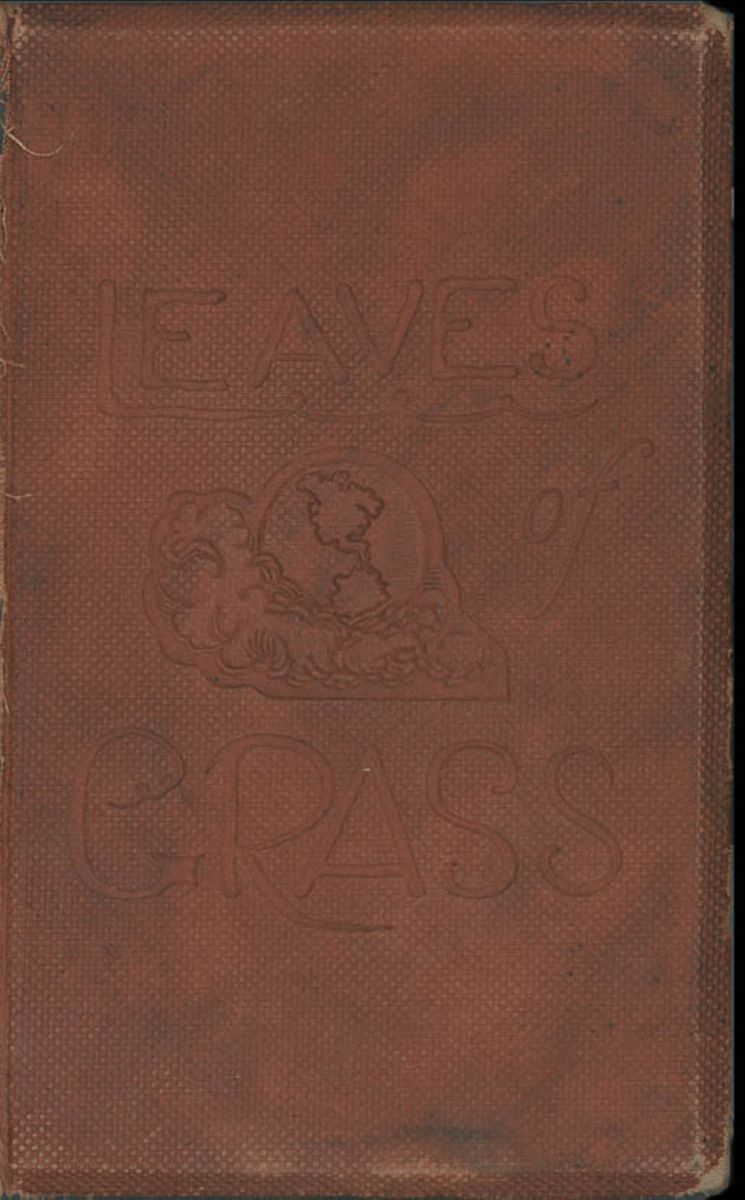
Leaves of Grass (1860–1861)
 ppp.01500.001.jpg
 ppp.01500.002.jpg
 ppp.01500.003.jpg
 ppp.01500.004.jpg
 ppp.01500.005.jpg
 ppp.01500.006.jpg
 ppp.01500.007.jpg
 ppp.01500.008.jpg
 ppp.01500.009.jpg
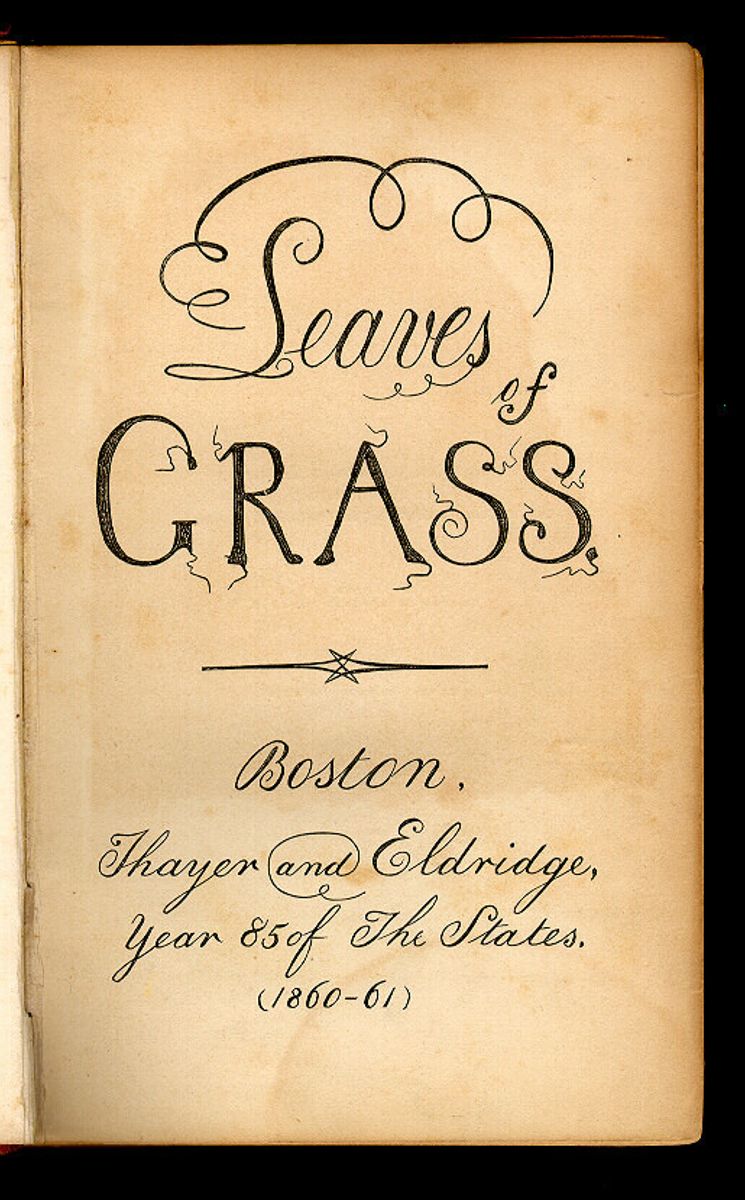
Leaves
ppp.01500.009.jpg
Leaves of
Grass. Boston, Thayer and Eldridge, Year 85 of The States. (1860-61)
 ppp.01500.010.jpg
Entered, according to Act of Congress, in the year 1860, BY WALT WHITMAN, In the Clerk's Office of the District Court of the District of Massachusetts.
ELECTROTYPED AT THE BOSTON STEREOTYPE FOUNDRY.
PRINTED BY GEORGE C. RAND & AVERY.
[ begin page iii ]
ppp.01500.010.jpg
Entered, according to Act of Congress, in the year 1860, BY WALT WHITMAN, In the Clerk's Office of the District Court of the District of Massachusetts.
ELECTROTYPED AT THE BOSTON STEREOTYPE FOUNDRY.
PRINTED BY GEORGE C. RAND & AVERY.
[ begin page iii ]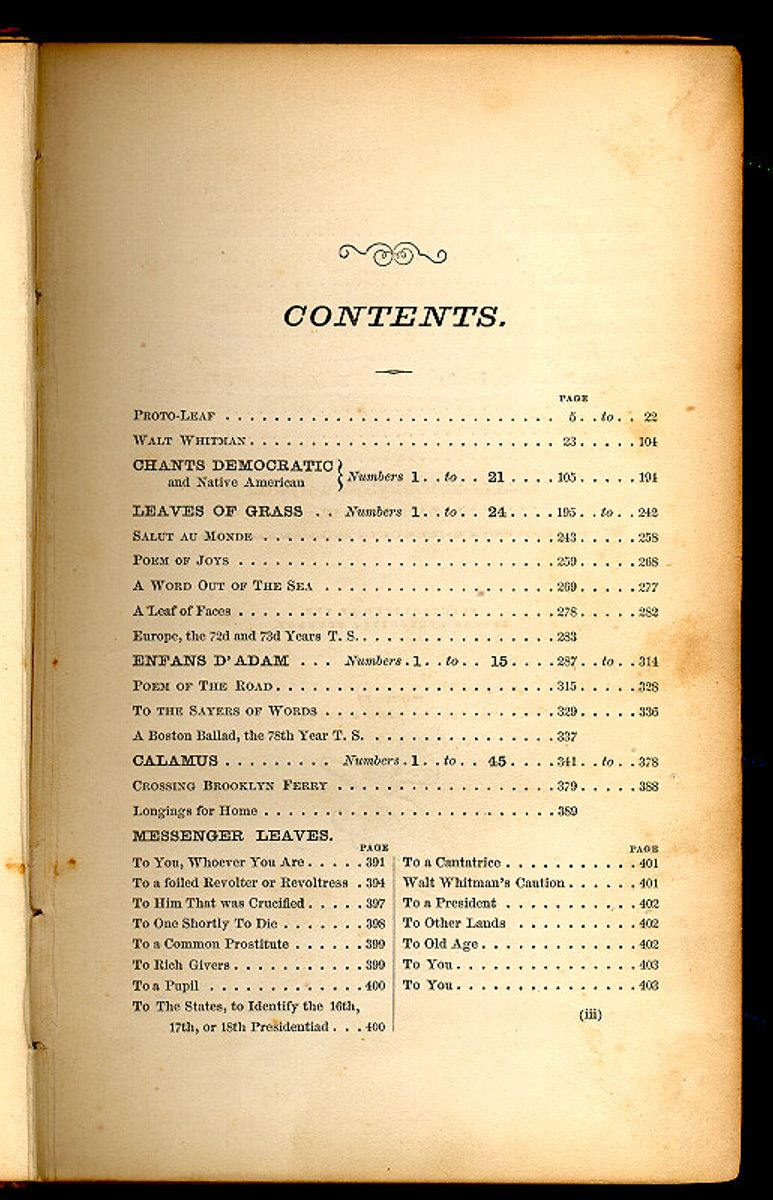 ppp.01500.011.jpg
CONTENTS.
| PAGE | |
| PROTO-LEAF . . . . . . . . . . . . . . . . . . . . . . . . . . . | 5 . . to . . 22 |
| WALT WHITMAN . . . . . . . . . . . . . . . . . . . . . . . . . | 23 . . . . . 104 |
| CHANTS DEMOCRATIC | |
| and Native American Numbers 1 . . to . . 21 . . . . | 105 . . . . . 194 |
| LEAVES OF GRASS . . Numbers 1 . . to . . 24 . . . . | 195 . . to . . 242 |
| SALUT AU MONDE . . . . . . . . . . . . . . . . . . . . . . . . | 243 . . . . . 258 |
| POEM OF JOYS . . . . . . . . . . . . . . . . . . . . . . . . . . | 259 . . . . . 268 |
| A WORD OUT OF THE SEA . . . . . . . . . . . . . . . . . . . | 269 . . . . . 277 |
| A Leaf of Faces . . . . . . . . . . . . . . . . . . . . . . . . . . | 278 . . . . . 282 |
| Europe, the 72d and 73d Years T. S. . . . . . . . . . . . . . . . . | 283 |
| ENFANS D'ADAM . . . Numbers . 1 . . to . . 15 . . . . | 287 . . to . . 314 |
| POEM OF THE ROAD . . . . . . . . . . . . . . . . . . . . . . . | 315 . . . . . 328 |
| TO THE SAYERS OF WORDS . . . . . . . . . . . . . . . . . . . | 329 . . . . . 336 |
| A Boston Ballad, the 78th Year T. S. . . . . . . . . . . . . . . . | 337 |
| CALAMUS . . . . . . . . . Numbers . 1 . . to . . 45 . . . . | 341 . . to . . 378 |
| CROSSING BROOKLYN FERRY . . . . . . . . . . . . . . . . . . | 379 . . . . . 388 |
| Longings for Home . . . . . . . . . . . . . . . . . . . . . . . . | 389 |
| MESSENGER LEAVES. | |||
| PAGE | PAGE | ||
| To You, Whoever You Are . . . . . | 391 | To a Cantatrice . . . . . . . . . . . | 401 |
| To a foiled Revolter or Revoltress . | 394 | Walt Whitman's Caution . . . . . . | 401 |
| To Him That was Crucified . . . . . | 397 | To a President . . . . . . . . . . . | 402 |
| To One Shortly To Die . . . . . . . | 398 | To Other Lands . . . . . . . . . . | 402 |
| To a Common Prostitute . . . . . . | 399 | To Old Age . . . . . . . . . . . . . | 402 |
| To Rich Givers . . . . . . . . . . . | 399 | To You . . . . . . . . . . . | 403 |
| To a Pupil . . . . . . . . . . . . . | 400 | To You . . . . . . . . . . . | 403 |
| To The States, to Identify the 16th, 17th, or 18th Presidentiad . . . | 400 |
 ppp.01500.012.jpg
| PAGE | |
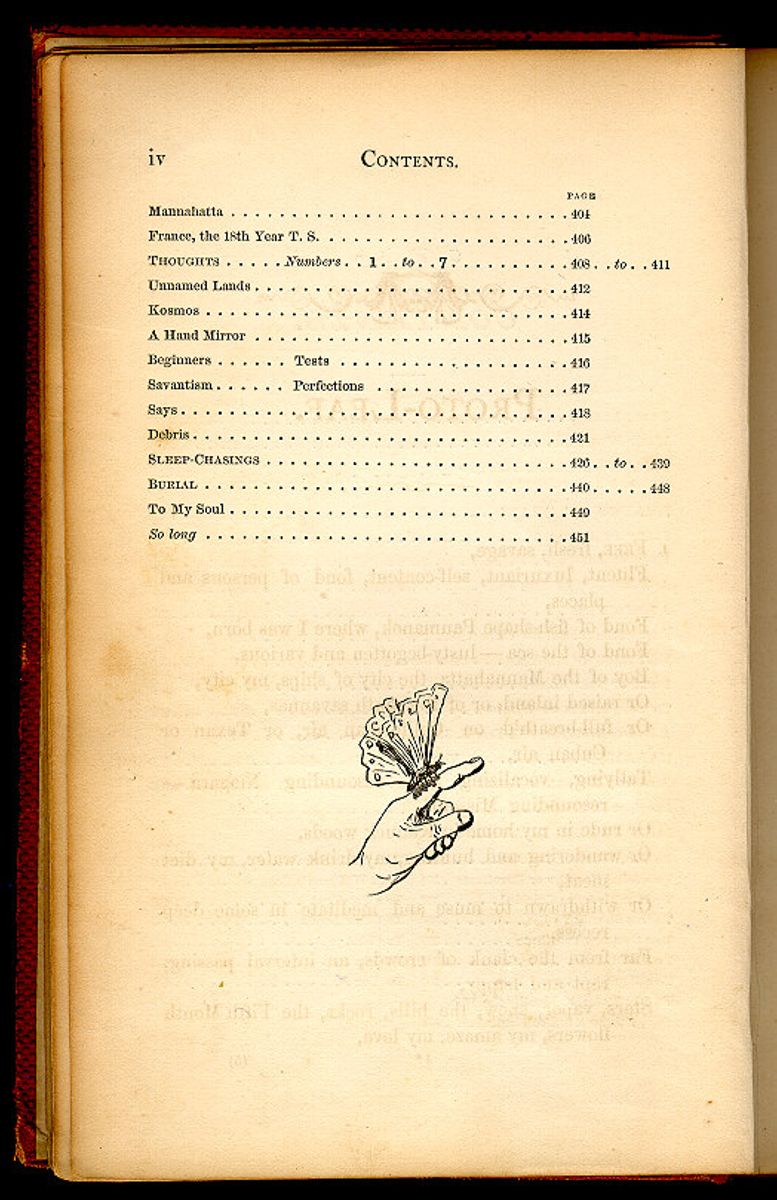
| Mannahatta . . . . . . . . . . . . . . . . . . . . . . . . . . . . | 404 |
| France, the 18th Year T. S. . . . . . . . . . . . . . . . . . . . . | 406 |
| THOUGHTS . . . . . Numbers . . 1 . . to . . 7 . . . . . . . . . . | 408 . . to . . 411 |
| Unnamed Lands . . . . . . . . . . . . . . . . . . . . . . . . . . | 412 |
| Kosmos . . . . . . . . . . . . . . . . . . . . . . . . . . . . . . | 414 |
| A Hand Mirror . . . . . . . . . . . . . . . . . . . . . . . . . . | 415 |
| Beginners . . . . . . Tests . . . . . . . . . . . . . . . . . . . | 416 |
| Savantism . . . . . . Perfections . . . . . . . . . . . . . . . . | 417 |
| Says . . . . . . . . . . . . . . . . . . . . . . . . . . . . . . . | 418 |
| Debris . . . . . . . . . . . . . . . . . . . . . . . . . . . . . . . | 421 |
| SLEEP-CHASINGS . . . . . . . . . . . . . . . . . . . . . . . . . . | 426 . . to . .439 |
| BURIAL . . . . . . . . . . . . . . . . . . . . . . . . . . . . . . | 440 . . . . . 448 |
| To My Soul . . . . . . . . . . . . . . . . . . . . . . . . . . . . | 449 |
| So long . . . . . . . . . . . . . . . . . . . . . . . . . . . . . . | 451 |
 ppp.01500.013.jpg
PROTO-LEAF.
1FREE, fresh, savage, Fluent, luxuriant, self-content, fond of persons andplaces, Fond of fish-shape Paumanok, where I was born, Fond of the sea—lusty-begotten and various, Boy of the Mannahatta, the city of ships, my city, Or raised inland, or of the south savannas, Or full-breath'd on Californian air, or Texan or
Cuban air, Tallying, vocalizing all—resounding Niagara—
resounding Missouri, Or rude in my home in Kanuck woods, Or wandering and hunting, my drink water, my diet
meat, Or withdrawn to muse and meditate in some deep
recess, Far from the clank of crowds, an interval passing,
rapt and happy, Stars, vapor, snow, the hills, rocks, the Fifth Month
flowers, my amaze, my love, 1* [ begin page 6 ]
 ppp.01500.014.jpg
Aware of the buffalo, the peace-herds, the bull,
ppp.01500.014.jpg
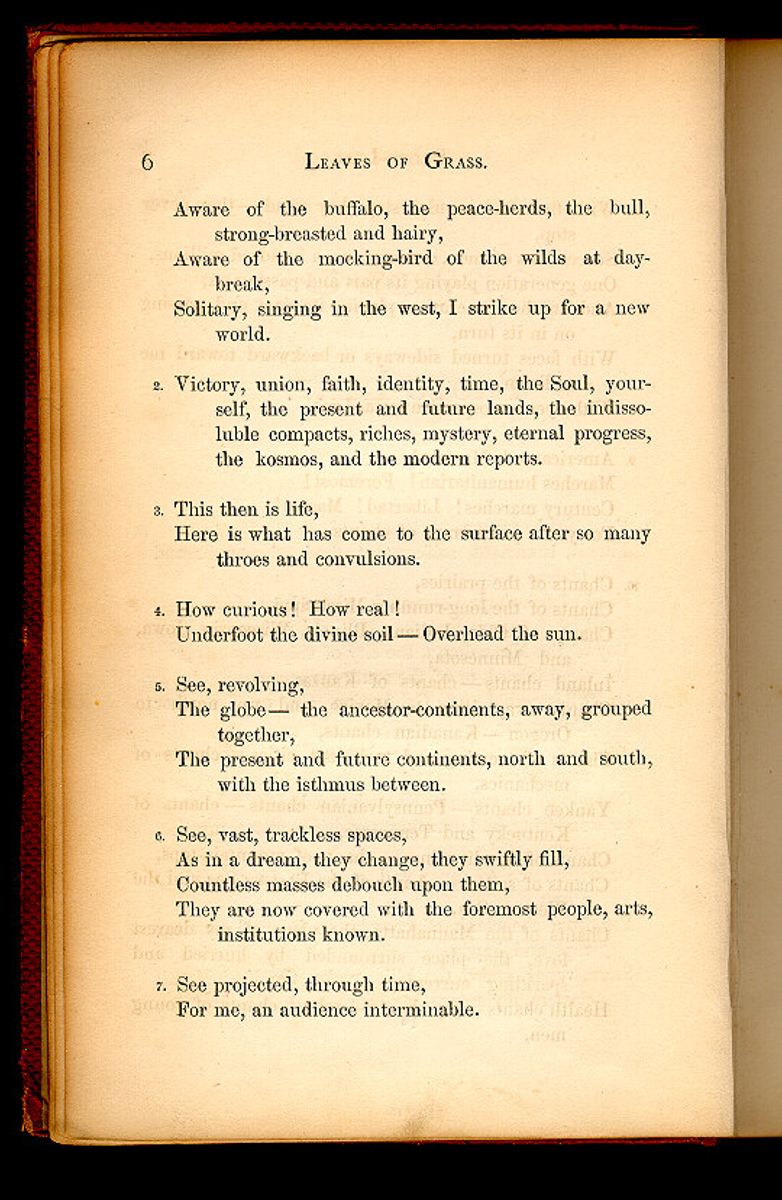
Aware of the buffalo, the peace-herds, the bull, strong-breasted and hairy, Aware of the mocking-bird of the wilds at day-
break, Solitary, singing in the west, I strike up for a new
world. 2Victory, union, faith, identity, time, the Soul, your-
self, the present and future lands, the indisso-
luble compacts, riches, mystery, eternal progress,
the kosmos, and the modern reports. 3This then is life, Here is what has come to the surface after so many
throes and convulsions. 4How curious! How real! Underfoot the divine soil—Overhead the sun. 5See, revolving, The globe—the ancestor-continents, away, grouped
together, The present and future continents, north and south,
with the isthmus between. 6See, vast, trackless spaces, As in a dream, they change, they swiftly fill, Countless masses debouch upon them, They are now covered with the foremost people, arts,
institutions known. 7See projected, through time, For me, an audience interminable. [ begin page 7 ]
 ppp.01500.015.jpg
8With firm and regular step they wend—they never
ppp.01500.015.jpg
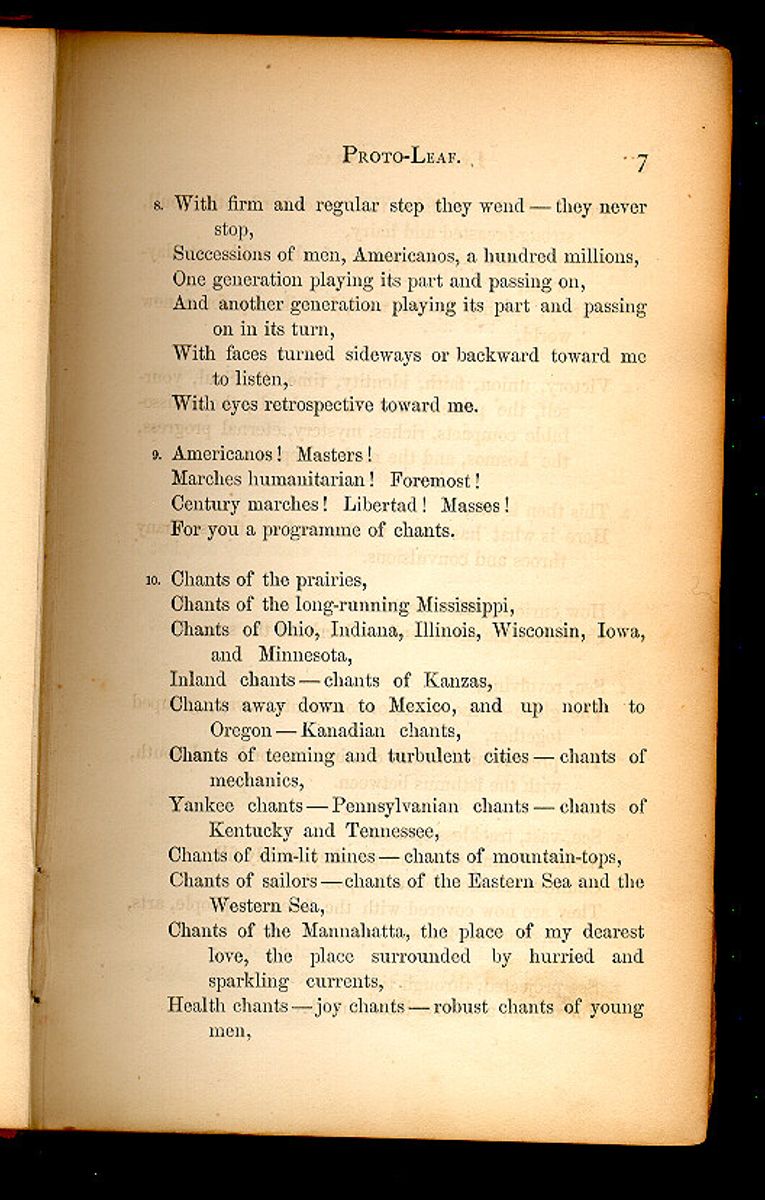
8With firm and regular step they wend—they never stop, Successions of men, Americanos, a hundred millions, One generation playing its part and passing on, And another generation playing its part and passing
on in its turn, With faces turned sideways or backward toward me
to listen, With eyes retrospective toward me. 9Americanos! Masters! Marches humanitarian! Foremost! Century marches! Libertad! Masses! For you a programme of chants. 10Chants of the prairies, Chants of the long-running Mississippi, Chants of Ohio, Indiana, Illinois, Wisconsin, Iowa,
and Minnesota, Inland chants—chants of Kanzas, Chants away down to Mexico, and up north to
Oregon—Kanadian chants, Chants of teeming and turbulent cities—chants of
mechanics, Yankee chants—Pennsylvanian chants—chants of
Kentucky and Tennessee, Chants of dim-lit mines—chants of mountain-tops, Chants of sailors—chants of the Eastern Sea and the
Western Sea, Chants of the Mannahatta, the place of my dearest
love, the place surrounded by hurried and
sparkling currents, Health chants—joy chants—robust chants of young
men, [ begin page 8 ]
 ppp.01500.016.jpg
Chants inclusive—wide reverberating chants,
Chants of the Many In One.
11In the Year 80 of The States,
My tongue, every atom of my blood, formed from
ppp.01500.016.jpg
Chants inclusive—wide reverberating chants,
Chants of the Many In One.
11In the Year 80 of The States,
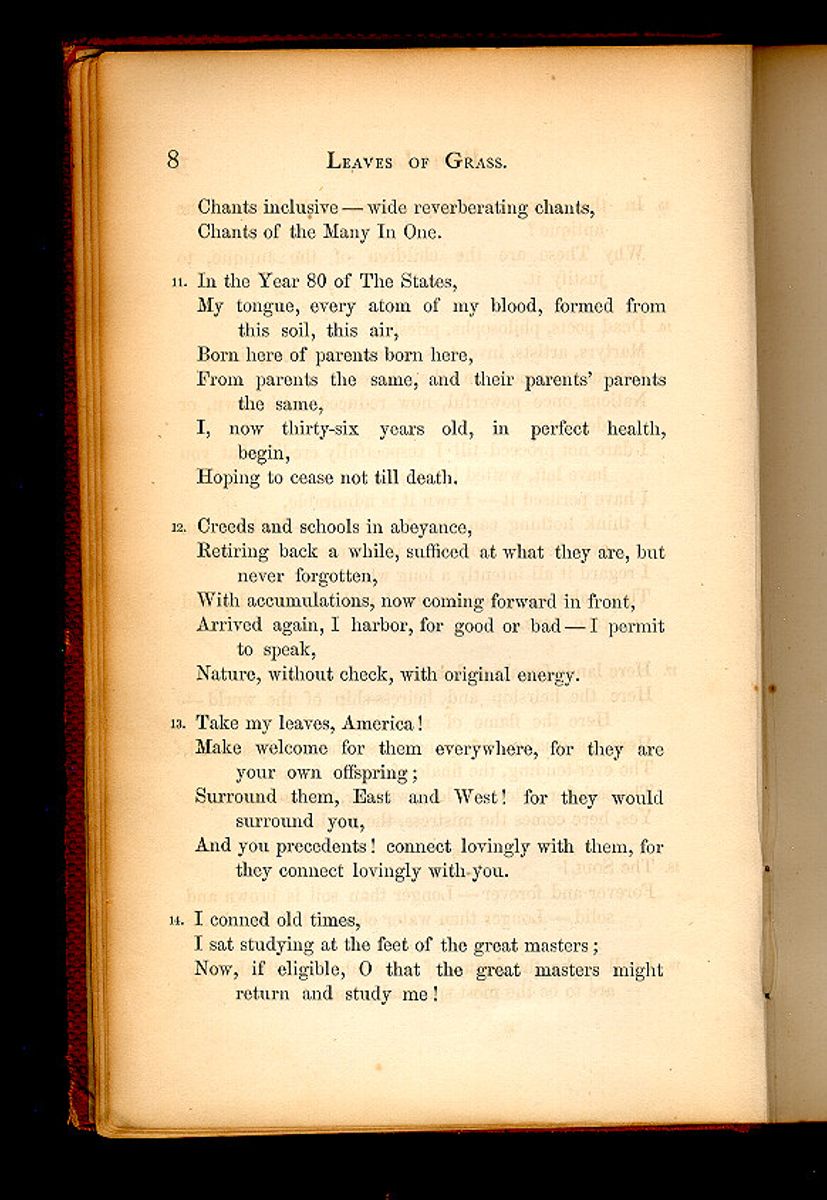
My tongue, every atom of my blood, formed from this soil, this air, Born here of parents born here, From parents the same, and their parents' parents
the same, I, now thirty-six years old, in perfect health,
begin, Hoping to cease not till death. 12Creeds and schools in abeyance, Retiring back a while, sufficed at what they are, but
never forgotten, With accumulations, now coming forward in front, Arrived again, I harbor, for good or bad—I permit
to speak, Nature, without check, with original energy. 13Take my leaves, America! Make welcome for them everywhere, for they are
your own offspring; Surround them, East and West! for they would
surround you, And you precedents! connect lovingly with them, for
they connect lovingly with you. 14I conned old times, I sat studying at the feet of the great masters; Now, if eligible, O that the great masters might
return and study me! [ begin page 9 ]
 ppp.01500.017.jpg
15In the name of These States, shall I scorn the
ppp.01500.017.jpg
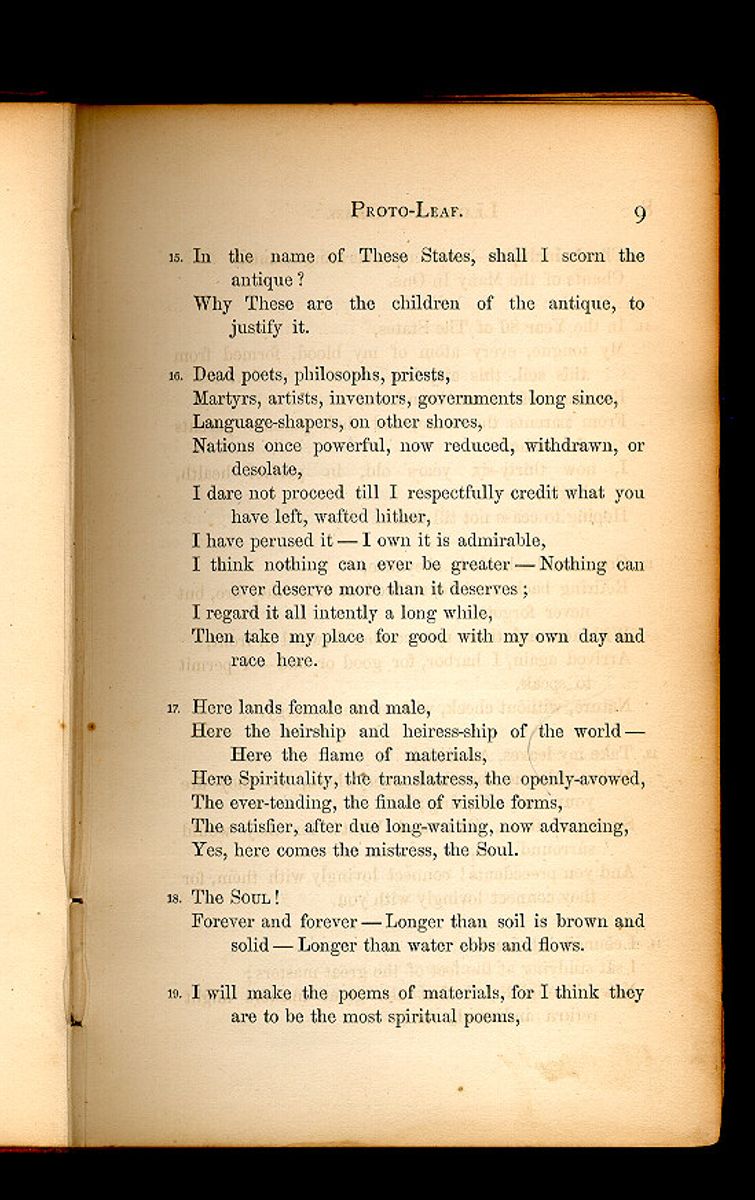
15In the name of These States, shall I scorn the antique? Why These are the children of the antique, to
justify it. 16Dead poets, philosophs, priests, Martyrs, artists, inventors, governments long since, Language-shapers, on other shores, Nations once powerful, now reduced, withdrawn, or
desolate, I dare not proceed till I respectfully credit what you
have left, wafted hither, I have perused it—I own it is admirable, I think nothing can ever be greater—Nothing can
ever deserve more than it deserves; I regard it all intently a long while, Then take my place for good with my own day and
race here. 17Here lands female and male, Here the heirship and heiress-ship of the world—
Here the flame of materials, Here Spirituality, the translatress, the openly-avowed, The ever-tending, the finale of visible forms, The satisfier, after due long-waiting, now advancing, Yes, here comes the mistress, the Soul. 18The SOUL! Forever and forever—Longer than soil is brown and
solid—Longer than water ebbs and flows. 19I will make the poems of materials, for I think they
are to be the most spiritual poems, [ begin page 10 ]
 ppp.01500.018.jpg
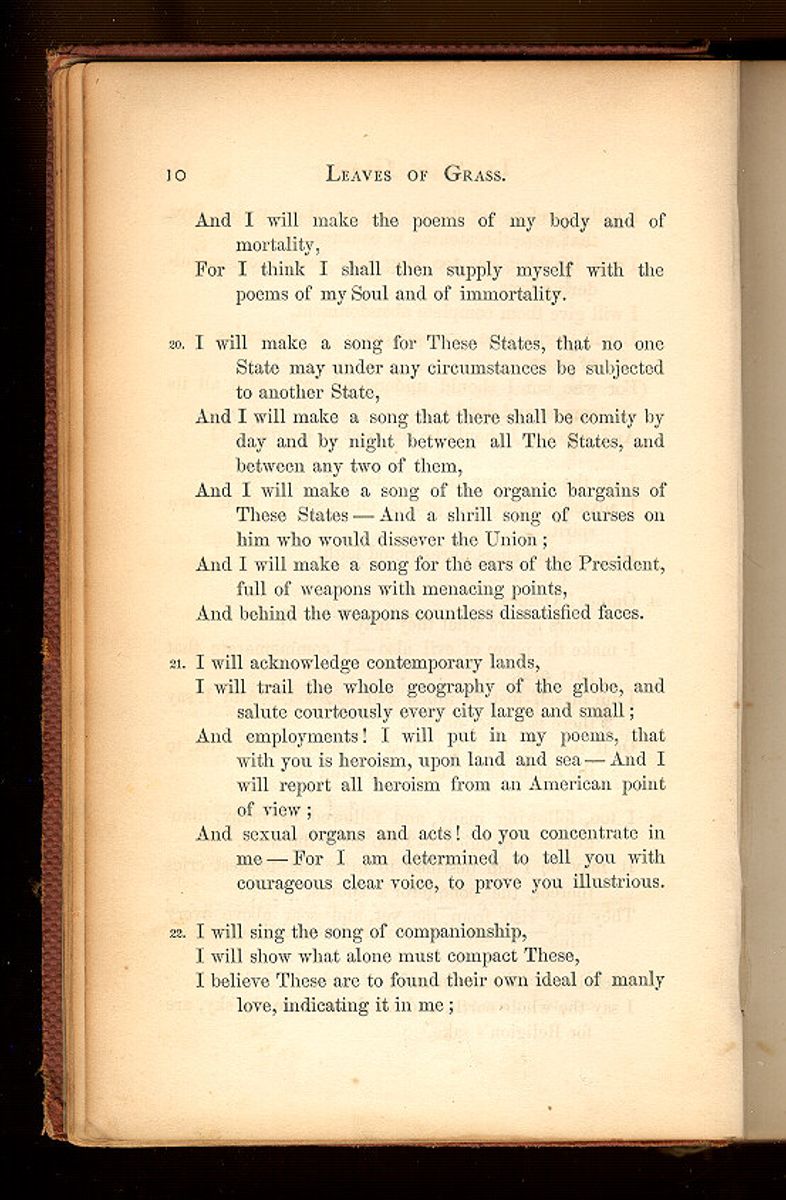
And I will make the poems of my body and of
ppp.01500.018.jpg
And I will make the poems of my body and of mortality, For I think I shall then supply myself with the
poems of my Soul and of immortality. 20I will make a song for These States, that no one
State may under any circumstances be subjected
to another State, And I will make a song that there shall be comity by
day and by night between all The States, and
between any two of them, And I will make a song of the organic bargains of
These States—And a shrill song of curses on
him who would dissever the Union; And I will make a song for the ears of the President,
full of weapons with menacing points, And behind the weapons countless dissatisfied faces. 21I will acknowledge contemporary lands, I will trail the whole geography of the globe, and
salute courteously every city large and small; And employments! I will put in my poems, that
with you is heroism, upon land and sea—And I
will report all heroism from an American point
of view; And sexual organs and acts! do you concentrate in
me—For I am determined to tell you with
courageous clear voice, to prove you illustrious. 22I will sing the song of companionship, I will show what alone must compact These, I believe These are to found their own ideal of manly
love, indicating it in me; [ begin page 11 ]
 ppp.01500.019.jpg
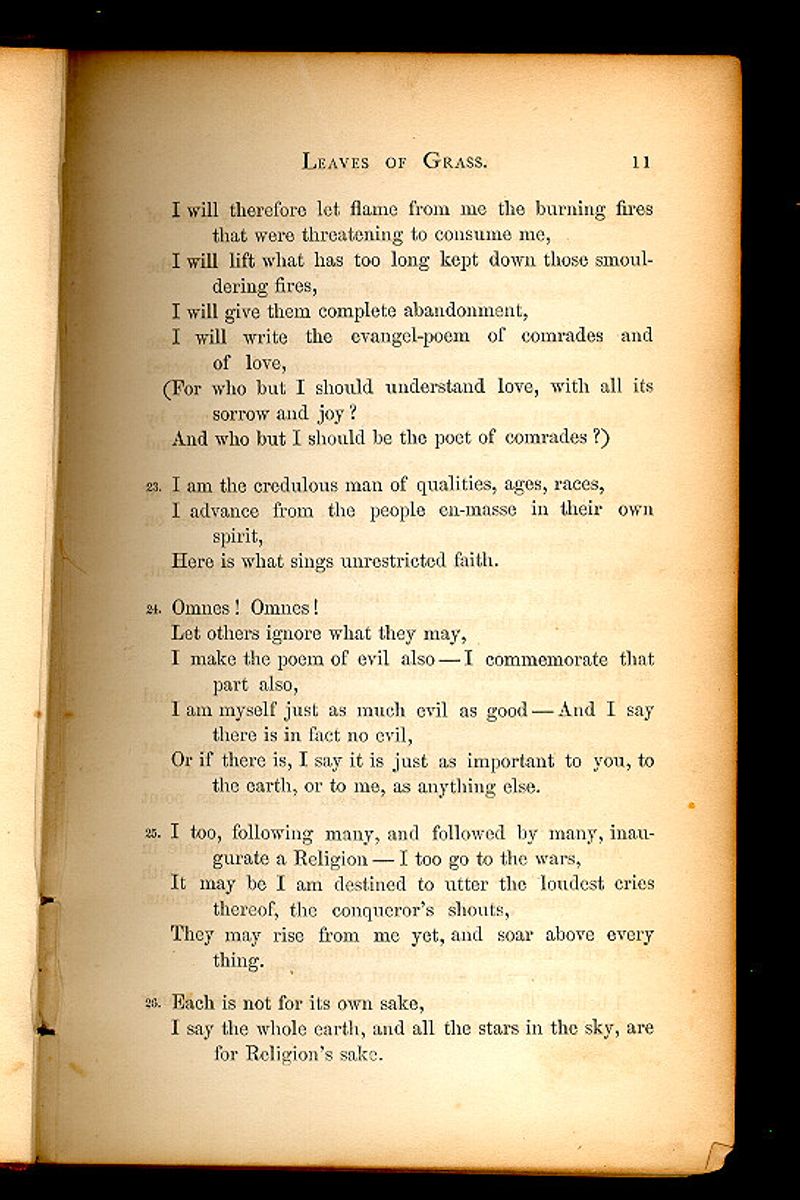
I will therefore let flame from me the burning fires
ppp.01500.019.jpg
I will therefore let flame from me the burning fires that were threatening to consume me, I will lift what has too long kept down those smoul-
dering fires, I will give them complete abandonment, I will write the evangel-poem of comrades and
of love, (For who but I should understand love, with all its
sorrow and joy? And who but I should be the poet of comrades?) 23I am the credulous man of qualities, ages, races, I advance from the people en-masse in their own
spirit, Here is what sings unrestricted faith. 24Omnes! Omnes! Let others ignore what they may, I make the poem of evil also—I commemorate that
part also, I am myself just as much evil as good—And I say
there is in fact no evil, Or if there is, I say it is just as important to you, to
the earth, or to me, as anything else. 25I too, following many, and followed by many, inau-
gurate a Religion—I too go to the wars, It may be I am destined to utter the loudest cries
thereof, the conqueror's shouts, They may rise from me yet, and soar above every
thing. 26Each is not for its own sake, I say the whole earth, and all the stars in the sky, are
for Religion's sake. [ begin page 12 ]
 ppp.01500.020.jpg
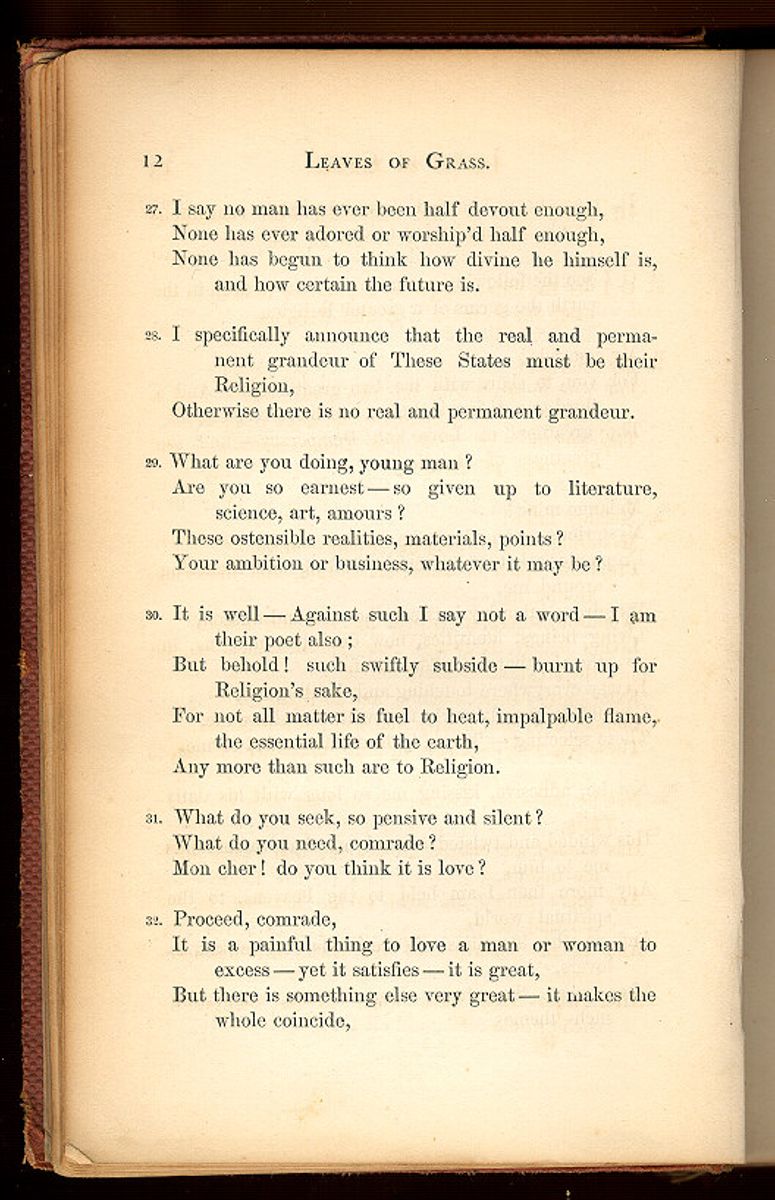
27I say no man has ever been half devout enough,
None has ever adored or worship'd half enough,
None has begun to think how divine he himself is,
ppp.01500.020.jpg
27I say no man has ever been half devout enough,
None has ever adored or worship'd half enough,
None has begun to think how divine he himself is, and how certain the future is. 28I specifically announce that the real and perma-
nent grandeur of These States must be their
Religion, Otherwise there is no real and permanent grandeur. 29What are you doing, young man? Are you so earnest—so given up to literature,
science, art, amours? These ostensible realities, materials, points? Your ambition or business, whatever it may be? 30It is well—Against such I say not a word—I am
their poet also; But behold! such swiftly subside—burnt up for
Religion's sake, For not all matter is fuel to heat, impalpable flame,
the essential life of the earth, Any more than such are to Religion. 31What do you seek, so pensive and silent? What do you need, comrade? Mon cher! do you think it is love? 32Proceed, comrade, It is a painful thing to love a man or woman to
excess—yet it satisfies—it is great, But there is something else very great—it makes the
whole coincide, [ begin page 13 ]
 ppp.01500.021.jpg
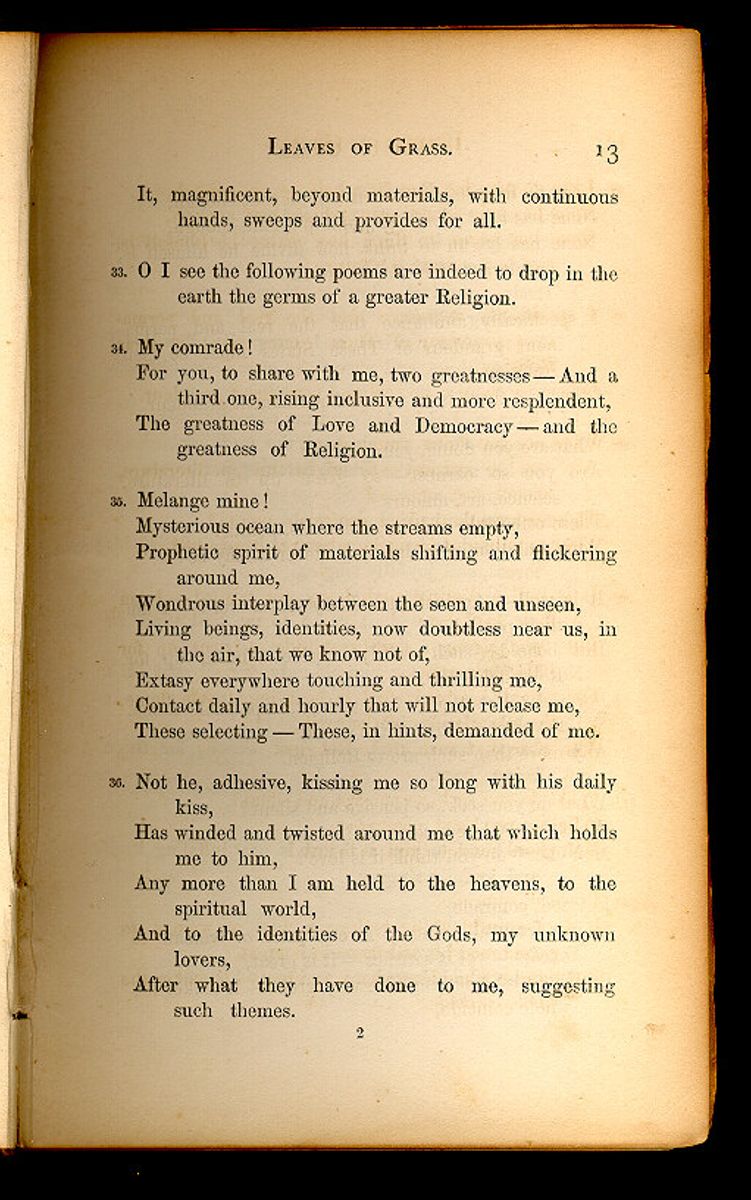
It, magnificent, beyond materials, with continuous
ppp.01500.021.jpg
It, magnificent, beyond materials, with continuous hands, sweeps and provides for all. 33O I see the following poems are indeed to drop in the
earth the germs of a greater Religion. 34My comrade! For you, to share with me, two greatnesses—And a
third one, rising inclusive and more resplendent, The greatness of Love and Democracy—and the
greatness of Religion. 35Melange mine! Mysterious ocean where the streams empty, Prophetic spirit of materials shifting and flickering
around me, Wondrous interplay between the seen and unseen, Living beings, identities, now doubtless near us, in
the air, that we know not of, Extasy everywhere touching and thrilling me, Contact daily and hourly that will not release me, These selecting—These, in hints, demanded of me. 36Not he, adhesive, kissing me so long with his daily
kiss, Has winded and twisted around me that which holds
me to him, Any more than I am held to the heavens, to the
spiritual world, And to the identities of the Gods, my unknown
lovers, After what they have done to me, suggesting
such themes. [ begin page 14 ]
 ppp.01500.022.jpg
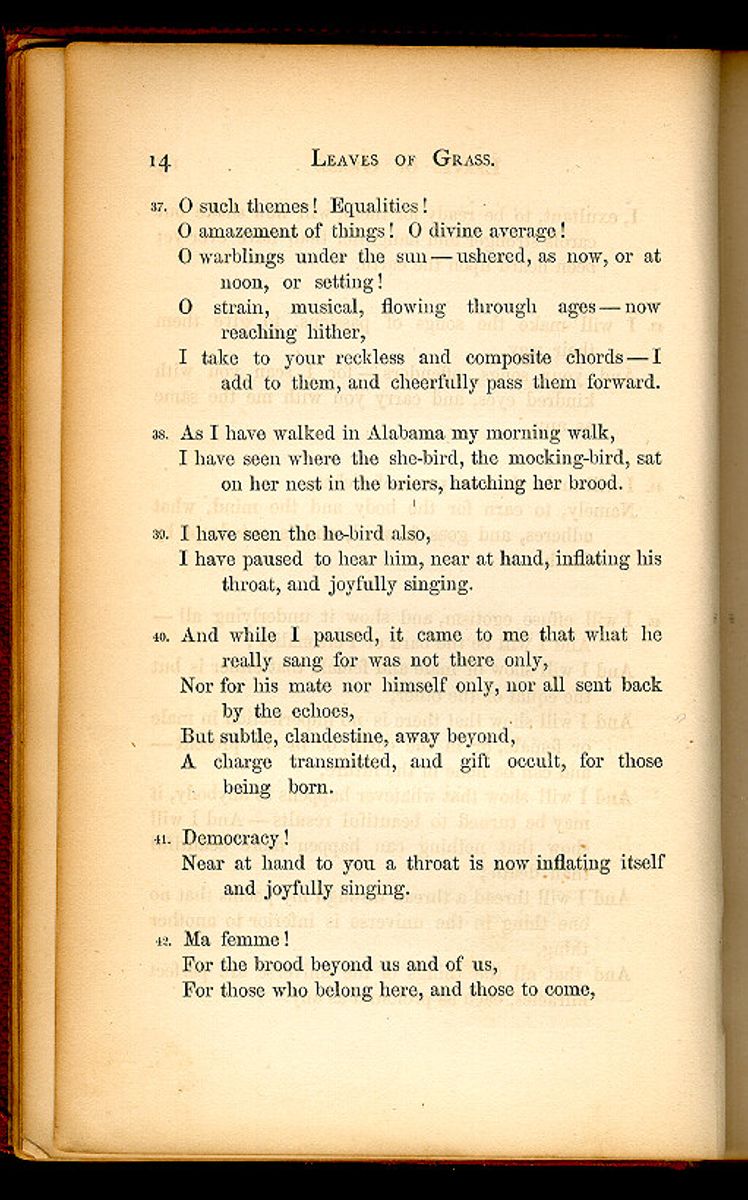
37O such themes! Equalities!
O amazement of things! O divine average!
O warblings under the sun—ushered, as now, or at
ppp.01500.022.jpg
37O such themes! Equalities!
O amazement of things! O divine average!
O warblings under the sun—ushered, as now, or at noon, or setting! O strain, musical, flowing through ages—now
reaching hither, I take to your reckless and composite chords—I
add to them, and cheerfully pass them forward. 38As I have walked in Alabama my morning walk, I have seen where the she-bird, the mocking-bird, sat
on her nest in the briers, hatching her brood. 39I have seen the he-bird also, I have paused to hear him, near at hand, inflating his
throat, and joyfully singing. 40And while I paused, it came to me that what he
really sang for was not there only, Nor for his mate nor himself only, nor all sent back
by the echoes, But subtle, clandestine, away beyond, A charge transmitted, and gift occult, for those
being born. 41Democracy! Near at hand to you a throat is now inflating itself
and joyfully singing. 42Ma femme! For the brood beyond us and of us, For those who belong here, and those to come, [ begin page 15 ]
 ppp.01500.023.jpg
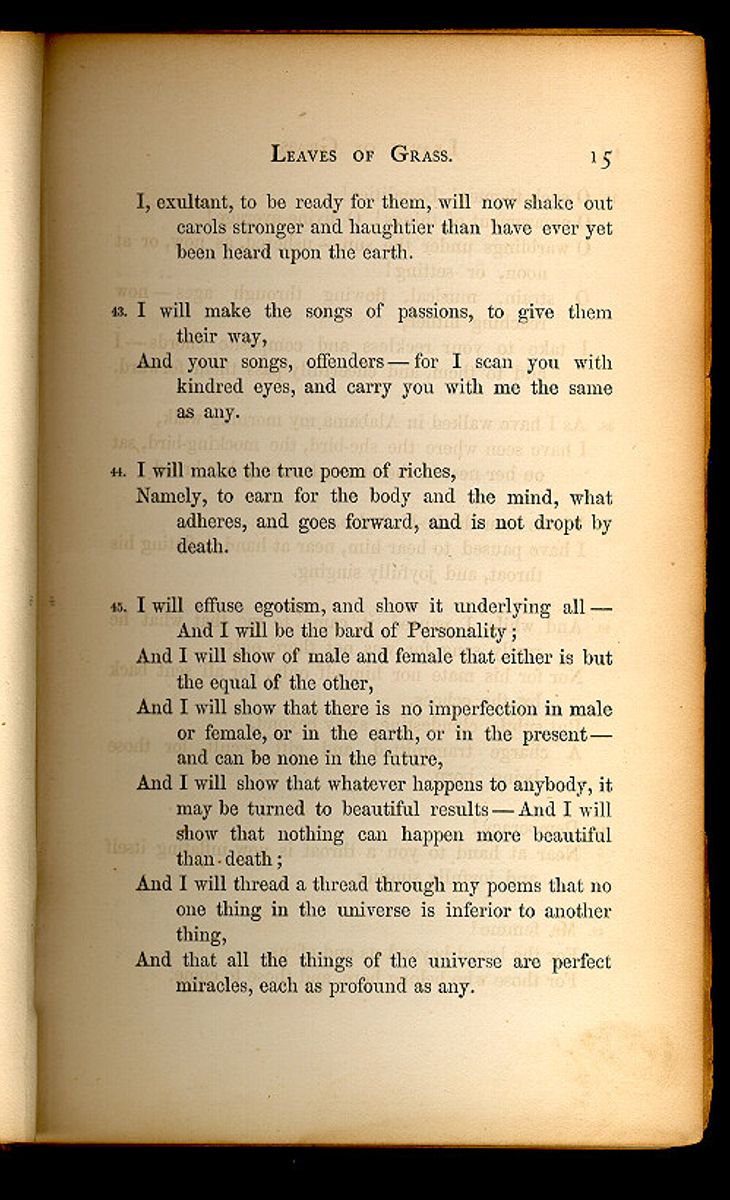
I, exultant, to be ready for them, will now shake out
ppp.01500.023.jpg
I, exultant, to be ready for them, will now shake out carols stronger and haughtier than have ever yet
been heard upon the earth. 43I will make the songs of passions, to give them
their way, And your songs, offenders—for I scan you with
kindred eyes, and carry you with me the same
as any. 44I will make the true poem of riches, Namely, to earn for the body and the mind, what
adheres, and goes forward, and is not dropt by
death. 45I will effuse egotism, and show it underlying all—
And I will be the bard of Personality; And I will show of male and female that either is but
the equal of the other, And I will show that there is no imperfection in male
or female, or in the earth, or in the present—
and can be none in the future, And I will show that whatever happens to anybody, it
may be turned to beautiful results—And I will
show that nothing can happen more beautiful
than death; And I will thread a thread through my poems that no
one thing in the universe is inferior to another
thing, And that all the things of the universe are perfect
miracles, each as profound as any. [ begin page 16 ]
 ppp.01500.024.jpg
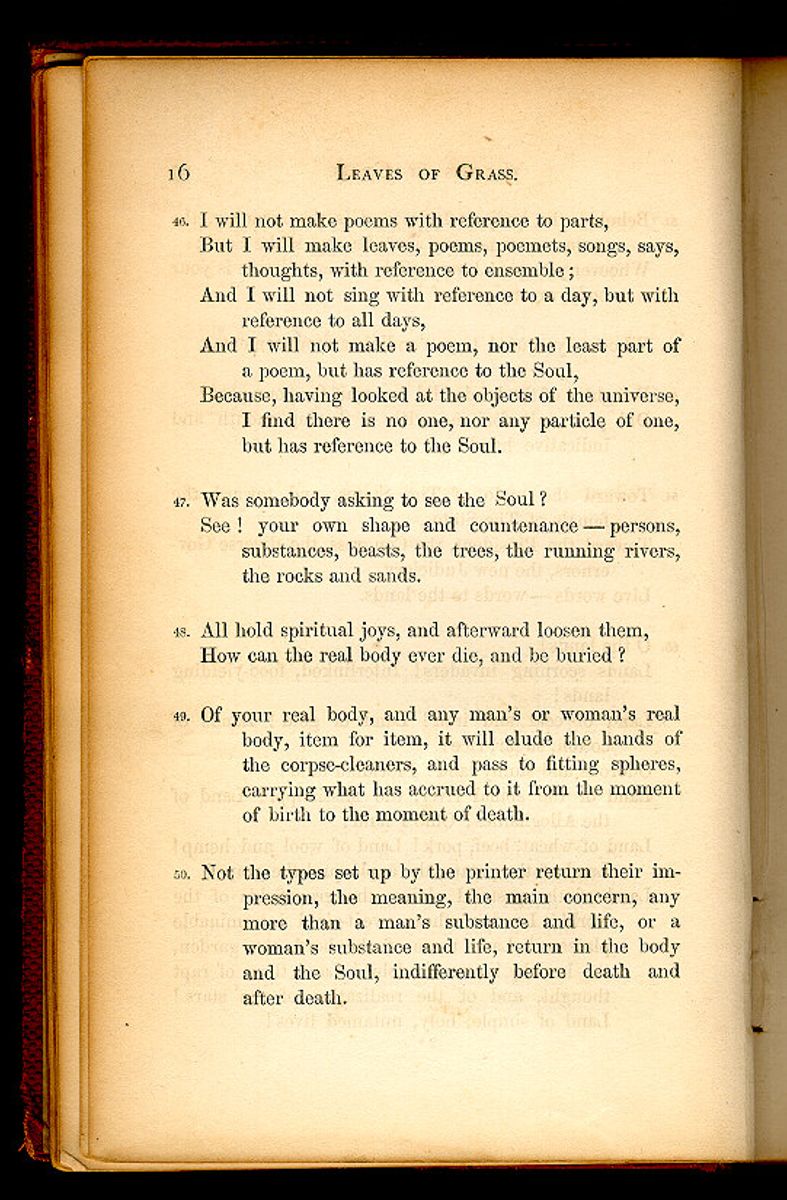
46I will not make poems with reference to parts,
But I will make leaves, poems, poemets, songs, says,
ppp.01500.024.jpg
46I will not make poems with reference to parts,
But I will make leaves, poems, poemets, songs, says, thoughts, with reference to ensemble; And I will not sing with reference to a day, but with
reference to all days, And I will not make a poem, nor the least part of
a poem, but has reference to the Soul, Because, having looked at the objects of the universe,
I find there is no one, nor any particle of one,
but has reference to the Soul. 47Was somebody asking to see the Soul? See! your own shape and countenance—persons,
substances, beasts, the trees, the running rivers,
the rocks and sands. 48All hold spiritual joys, and afterward loosen them, How can the real body ever die, and be buried? 49Of your real body, and any man's or woman's real
body, item for item, it will elude the hands of
the corpse-cleaners, and pass to fitting spheres,
carrying what has accrued to it from the moment
of birth to the moment of death. 50Not the types set up by the printer return their im-
pression, the meaning, the main concern, any
more than a man's substance and life, or a
woman's substance and life, return in the body
and the Soul, indifferently before death and
after death. [ begin page 17 ]
 ppp.01500.025.jpg
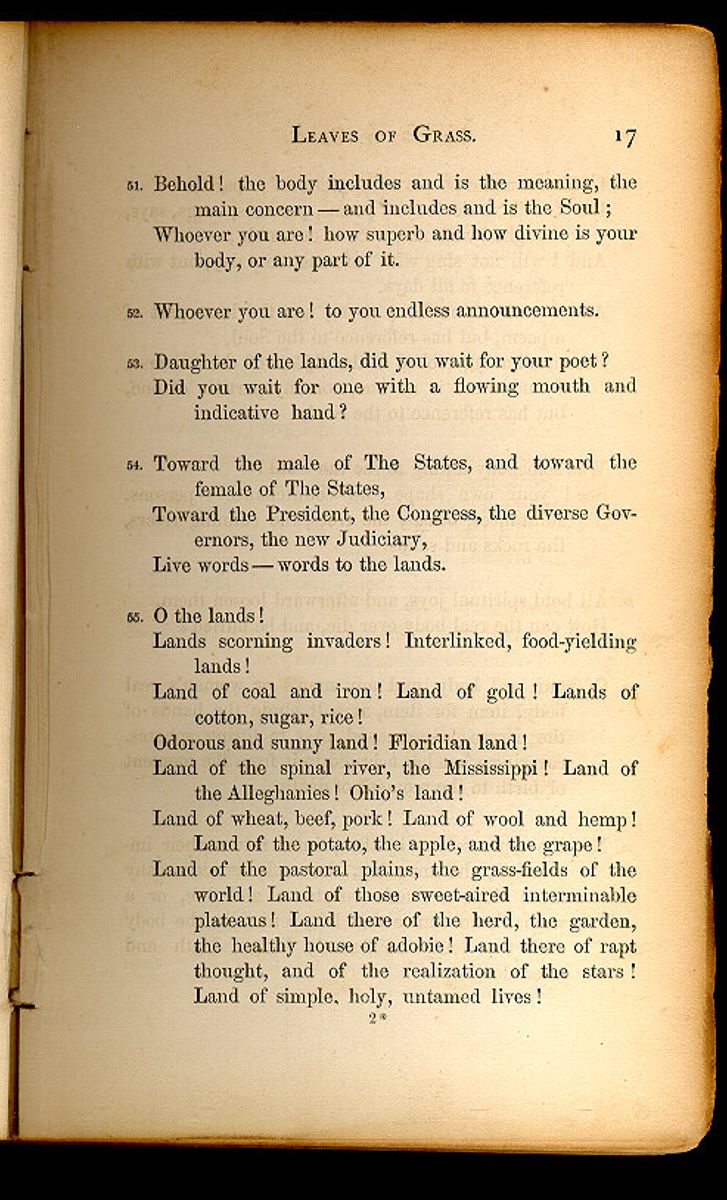
51Behold! the body includes and is the meaning, the
ppp.01500.025.jpg
51Behold! the body includes and is the meaning, the main concern—and includes and is the Soul; Whoever you are! how superb and how divine is your
body, or any part of it. 52Whoever you are! to you endless announcements. 53Daughter of the lands, did you wait for your poet? Did you wait for one with a flowing mouth and
indicative hand? 54Toward the male of The States, and toward the
female of The States, Toward the President, the Congress, the diverse Gov-
ernors, the new Judiciary, Live words—words to the lands. 55O the lands! Lands scorning invaders! Interlinked, food-yielding
lands! Land of coal and iron! Land of gold! Lands of
cotton, sugar, rice! Odorous and sunny land! Floridian land! Land of the spinal river, the Mississippi! Land of
the Alleghanies! Ohio's land! Land of wheat, beef, pork! Land of wool and hemp!
Land of the potato, the apple, and the grape! Land of the pastoral plains, the grass-fields of the
world! Land of those sweet-aired interminable
plateaus! Land there of the herd, the garden,
the healthy house of adobie! Land there of rapt
thought, and of the realization of the stars!
Land of simple, holy, untamed lives! 2* [ begin page 18 ]
 ppp.01500.026.jpg
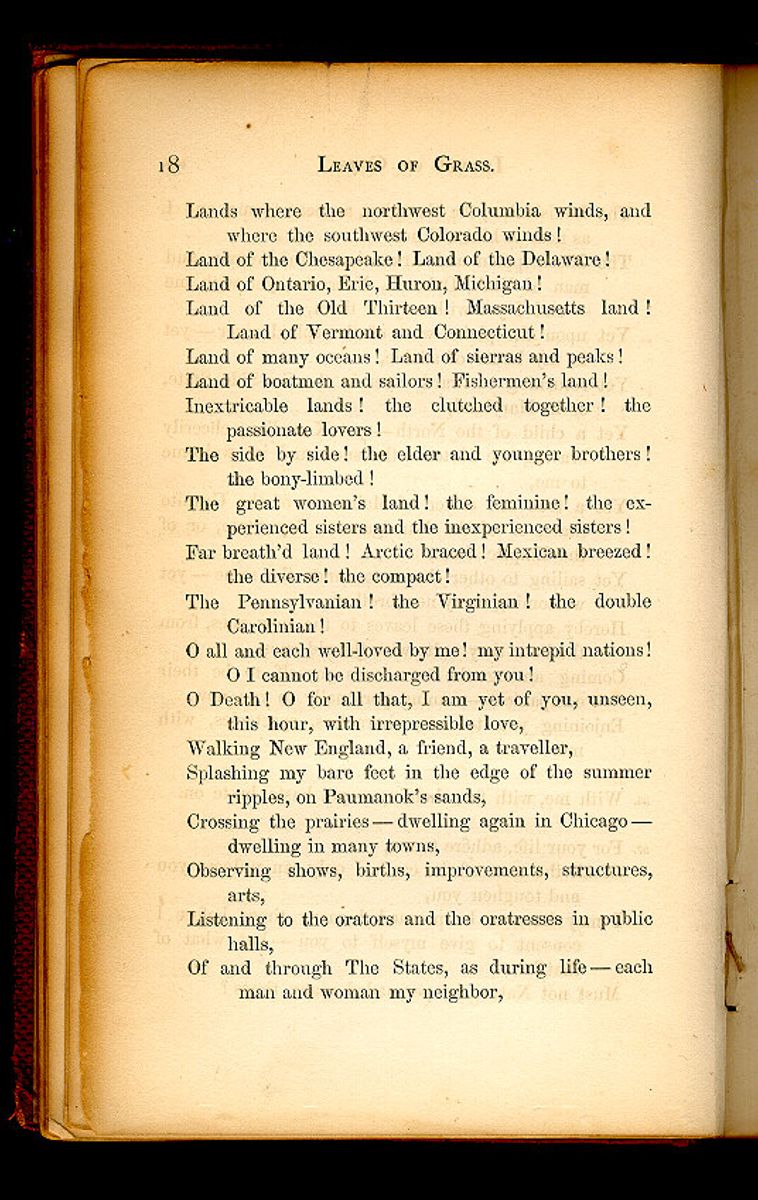
Lands where the northwest Columbia winds, and
ppp.01500.026.jpg
Lands where the northwest Columbia winds, and where the southwest Colorado winds! Land of the Chesapeake! Land of the Delaware! Land of Ontario, Erie, Huron, Michigan! Land of the Old Thirteen! Massachusetts land!
Land of Vermont and Connecticut! Land of many oceans! Land of sierras and peaks! Land of boatmen and sailors! Fishermen's land! Inextricable lands! the clutched together! the
passionate lovers! The side by side! the elder and younger brothers!
the bony-limbed! The great women's land! the feminine! the ex-
perienced sisters and the inexperienced sisters! Far breath'd land! Arctic braced! Mexican breezed!
the diverse! the compact! The Pennsylvanian! the Virginian! the double
Carolinian! O all and each well-loved by me! my intrepid nations!
O I cannot be discharged from you! O Death! O for all that, I am yet of you, unseen,
this hour, with irrepressible love, Walking New England, a friend, a traveller, Splashing my bare feet in the edge of the summer
ripples, on Paumanok's sands, Crossing the prairies—dwelling again in Chicago—
dwelling in many towns, Observing shows, births, improvements, structures,
arts, Listening to the orators and the oratresses in public
halls, Of and through The States, as during life—each
man and woman my neighbor, [ begin page 19 ]
 ppp.01500.027.jpg
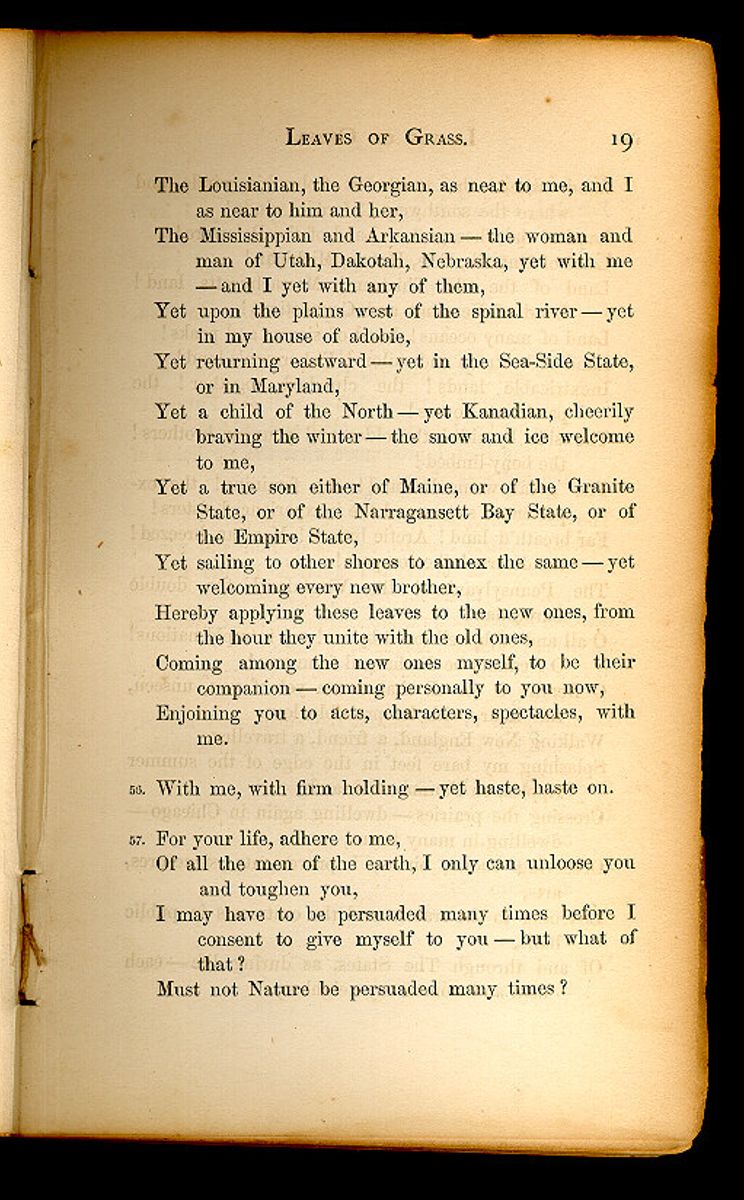
The Louisianian, the Georgian, as near to me, and I
ppp.01500.027.jpg
The Louisianian, the Georgian, as near to me, and I as near to him and her, The Mississippian and Arkansian—the woman and
man of Utah, Dakotah, Nebraska, yet with me
—and I yet with any of them, Yet upon the plains west of the spinal river—yet
in my house of adobie, Yet returning eastward—yet in the Sea-Side State,
or in Maryland, Yet a child of the North—yet Kanadian, cheerily
braving the winter—the snow and ice welcome
to me, Yet a true son either of Maine, or of the Granite
State, or of the Narragansett Bay State, or of
the Empire State, Yet sailing to other shores to annex the same—yet
welcoming every new brother, Hereby applying these leaves to the new ones, from
the hour they unite with the old ones, Coming among the new ones myself, to be their
companion—coming personally to you now, Enjoining you to acts, characters, spectacles, with
me. 56With me, with firm holding—yet haste, haste on. 57For your life, adhere to me, Of all the men of the earth, I only can unloose you
and toughen you, I may have to be persuaded many times before I
consent to give myself to you—but what of
that? Must not Nature be persuaded many times? [ begin page 20 ]
 ppp.01500.028.jpg
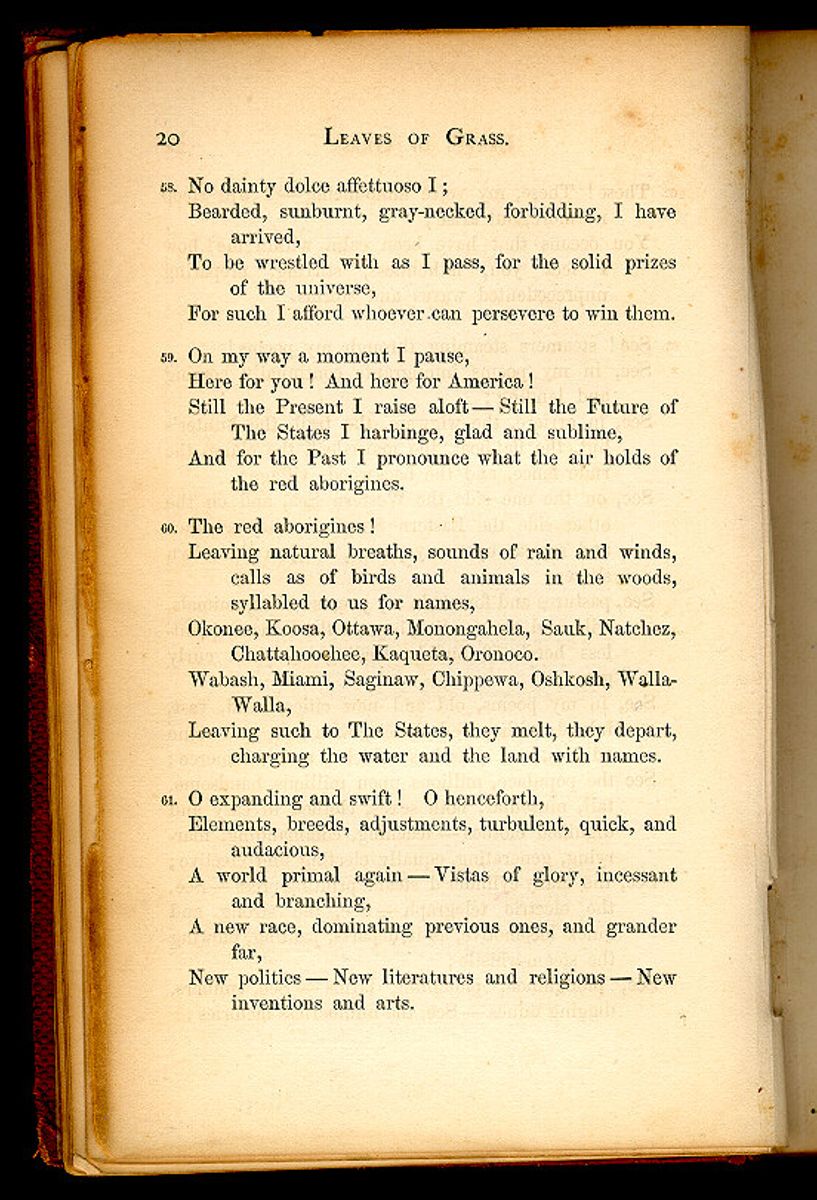
58No dainty dolce affettuoso I;
Bearded, sunburnt, gray-necked, forbidding, I have
ppp.01500.028.jpg
58No dainty dolce affettuoso I;
Bearded, sunburnt, gray-necked, forbidding, I have arrived, To be wrestled with as I pass, for the solid prizes
of the universe, For such I afford whoever can persevere to win them. 59On my way a moment I pause, Here for you! And here for America! Still the Present I raise aloft—Still the Future of
The States I harbinge, glad and sublime, And for the Past I pronounce what the air holds of
the red aborigines. 60The red aborigines! Leaving natural breaths, sounds of rain and winds,
calls as of birds and animals in the woods,
syllabled to us for names, Okonee, Koosa, Ottawa, Monongahela, Sauk, Natchez,
Chattahoochee, Kaqueta, Oronoco. Wabash, Miami, Saginaw, Chippewa, Oshkosh, Walla-
Walla, Leaving such to The States, they melt, they depart,
charging the water and the land with names. 61O expanding and swift! O henceforth, Elements, breeds, adjustments, turbulent, quick, and
audacious, A world primal again—Vistas of glory, incessant
and branching, A new race, dominating previous ones, and grander
far, New politics—New literatures and religions—New
inventions and arts. [ begin page 21 ]
 ppp.01500.029.jpg
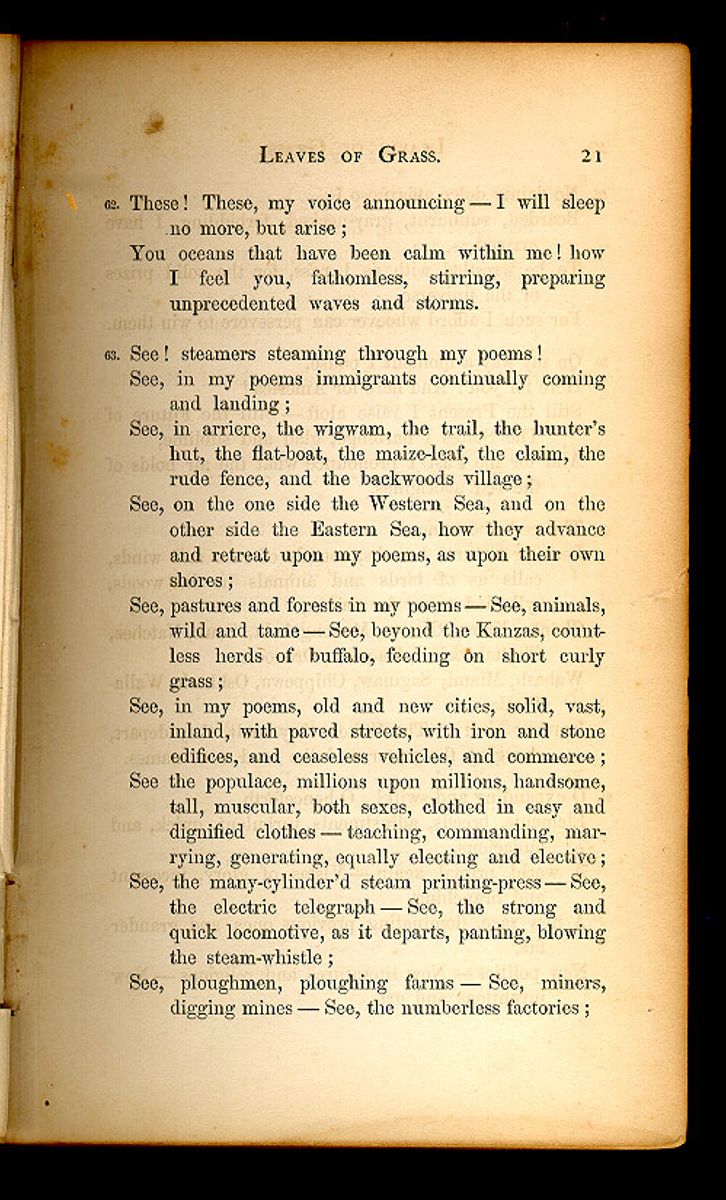
62These! These, my voice announcing—I will sleep
ppp.01500.029.jpg
62These! These, my voice announcing—I will sleep no more, but arise; You oceans that have been calm within me! how
I feel you, fathomless, stirring, preparing
unprecedented waves and storms. 63See! steamers steaming through my poems! See, in my poems immigrants continually coming
and landing; See, in arriere, the wigwam, the trail, the hunter's
hut, the flat-boat, the maize-leaf, the claim, the
rude fence, and the backwoods village; See, on the one side the Western Sea, and on the
other side the Eastern Sea, how they advance
and retreat upon my poems, as upon their own
shores; See, pastures and forests in my poems—See, animals,
wild and tame—See, beyond the Kanzas, count-
less herds of buffalo, feeding on short curly
grass; See, in my poems, old and new cities, solid, vast,
inland, with paved streets, with iron and stone
edifices, and ceaseless vehicles, and commerce; See the populace, millions upon millions, handsome,
tall, muscular, both sexes, clothed in easy and
dignified clothes—teaching, commanding, mar-
rying, generating, equally electing and elective; See, the many-cylinder'd steam printing-press—See,
the electric telegraph—See, the strong and
quick locomotive, as it departs, panting, blowing
the steam-whistle; See, ploughmen, ploughing farms—See, miners,
digging mines—See, the numberless factories; [ begin page 22 ]
 ppp.01500.030.jpg
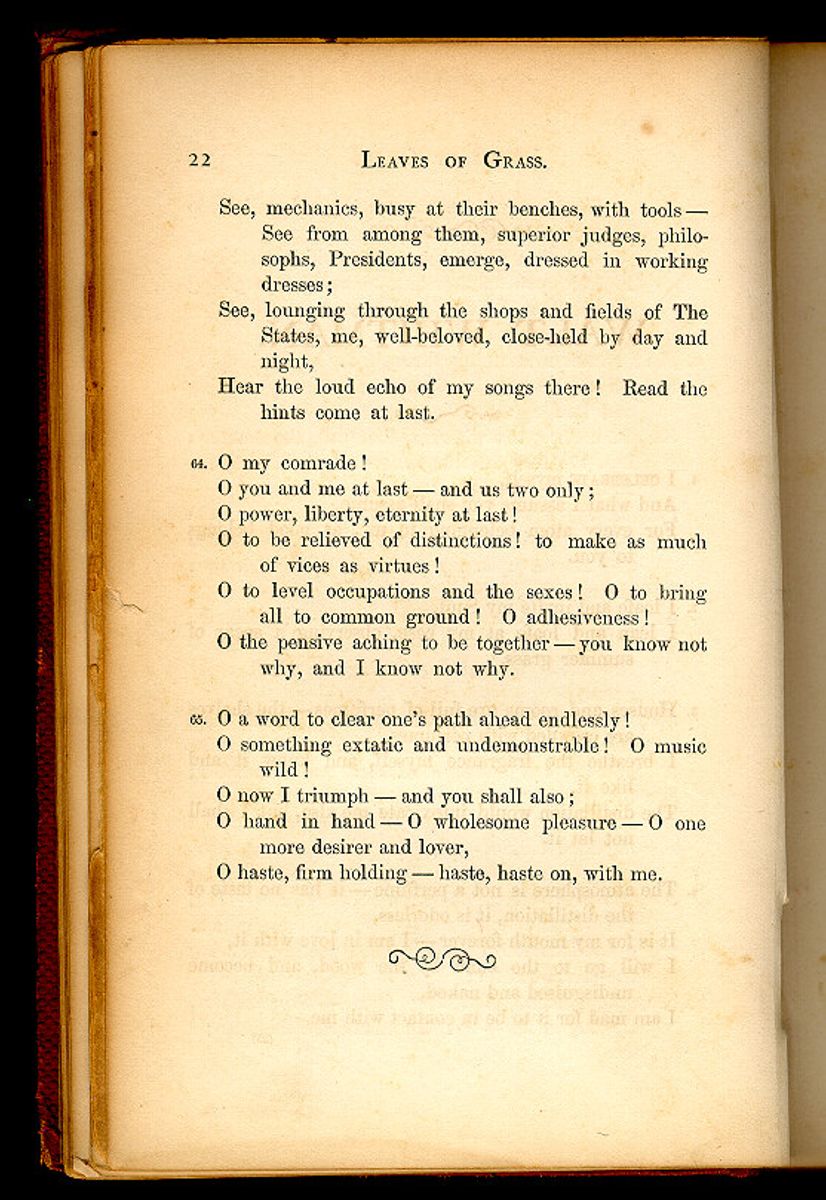
See, mechanics, busy at their benches, with tools—
ppp.01500.030.jpg
See, mechanics, busy at their benches, with tools— See from among them, superior judges, philo-
sophs, Presidents, emerge, dressed in working
dresses; See, lounging through the shops and fields of The
States, me, well-beloved, close-held by day and
night, Hear the loud echo of my songs there! Read the
hints come at last. 64O my comrade! O you and me at last—and us two only; O power, liberty, eternity at last! O to be relieved of distinctions! to make as much
of vices as virtues! O to level occupations and the sexes! O to bring
all to common ground! O adhesiveness! O the pensive aching to be together—you know not
why, and I know not why. 65O a word to clear one's path ahead endlessly! O something extatic and undemonstrable! O music
wild! O now I triumph—and you shall also; O hand in hand—O wholesome pleasure—O one
more desirer and lover, O haste, firm holding—haste, haste on, with me. [ begin page 23 ]
 ppp.01500.031.jpg
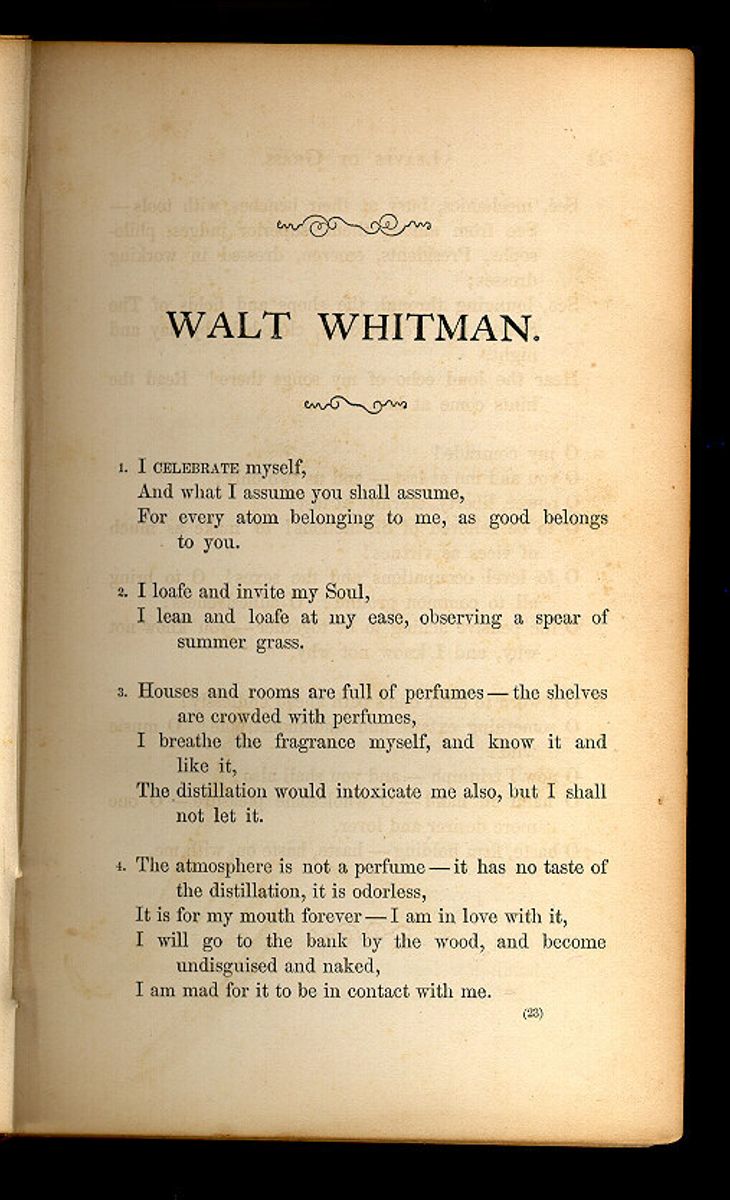
WALT WHITMAN.
1I CELEBRATE myself, And what I assume you shall assume, For every atom belonging to me, as good belongsto you. 2I loafe and invite my Soul, I lean and loafe at my ease, observing a spear of
summer grass. 3Houses and rooms are full of perfumes—the shelves
are crowded with perfumes, I breathe the fragrance myself, and know it and
like it, The distillation would intoxicate me also, but I shall
not let it. 4The atmosphere is not a perfume—it has no taste of
the distillation, it is odorless, It is for my mouth forever—I am in love with it, I will go to the bank by the wood, and become
undisguised and naked, I am mad for it to be in contact with me. [ begin page 24 ]
 ppp.01500.032.jpg
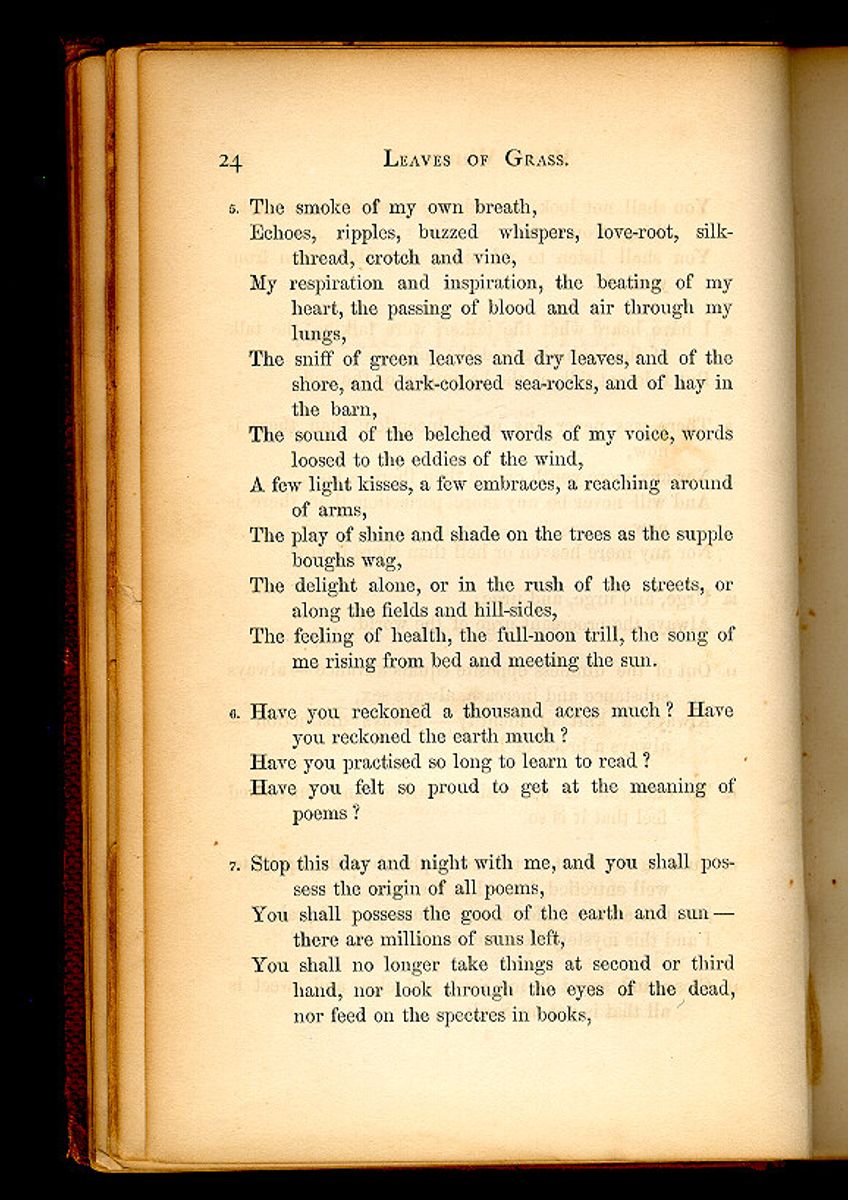
5The smoke of my own breath,
Echoes, ripples, buzzed whispers, love-root, silk-
ppp.01500.032.jpg
5The smoke of my own breath,
Echoes, ripples, buzzed whispers, love-root, silk- thread, crotch and vine, My respiration and inspiration, the beating of my
heart, the passing of blood and air through my
lungs, The sniff of green leaves and dry leaves, and of the
shore, and dark-colored sea-rocks, and of hay in
the barn, The sound of the belched words of my voice, words
loosed to the eddies of the wind, A few light kisses, a few embraces, a reaching around
of arms, The play of shine and shade on the trees as the supple
boughs wag, The delight alone, or in the rush of the streets, or
along the fields and hill-sides, The feeling of health, the full-noon trill, the song of
me rising from bed and meeting the sun. 6Have you reckoned a thousand acres much? Have
you reckoned the earth much? Have you practised so long to learn to read? Have you felt so proud to get at the meaning of
poems? 7Stop this day and night with me, and you shall pos-
sess the origin of all poems, You shall possess the good of the earth and sun—
there are millions of suns left, You shall no longer take things at second or third
hand, nor look through the eyes of the dead,
nor feed on the spectres in books. [ begin page 25 ]
 ppp.01500.033.jpg
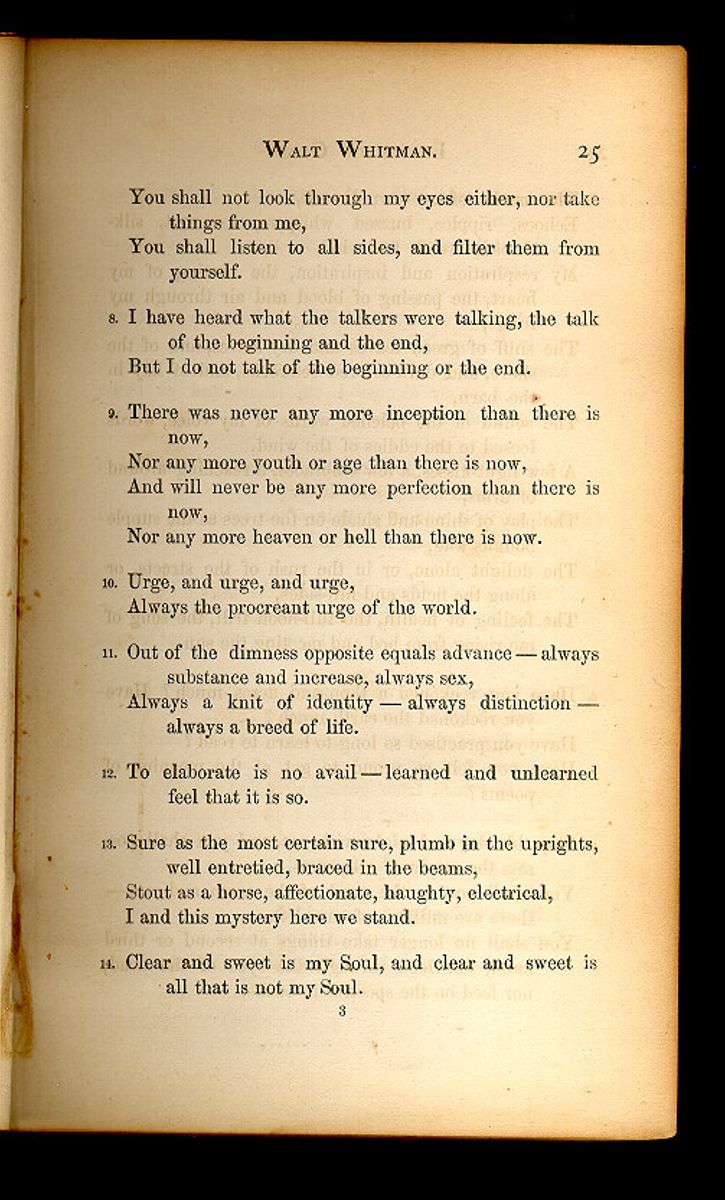
You shall not look through my eyes either, nor take
ppp.01500.033.jpg
You shall not look through my eyes either, nor take things from me, You shall listen to all sides, and filter them from
yourself. 8I have heard what the talkers were talking, the talk
of the beginning and the end, But I do not talk of the beginning or the end. 9There was never any more inception than there is
now, Nor any more youth or age than there is now, And will never be any more perfection than there is
now, Nor any more heaven or hell than there is now. 10Urge, and urge, and urge, Always the procreant urge of the world. 11Out of the dimness opposite equals advance—always
substance and increase, always sex, Always a knit of identity—always distinction—
always a breed of life. 12To elaborate is no avail—learned and unlearned
feel that it is so. 13Sure as the most certain sure, plumb in the uprights,
well entretied, braced in the beams, Stout as a horse, affectionate, haughty, electrical, I and this mystery here we stand. 14Clear and sweet is my Soul, and clear and sweet is
all that is not my Soul. [ begin page 26 ]
 ppp.01500.034.jpg
15Lack one lacks both, and the unseen is proved by the
ppp.01500.034.jpg
15Lack one lacks both, and the unseen is proved by the seen, Till that becomes unseen, and receives proof in its
turn. 16Showing the best, and dividing it from the worst, age
vexes age, Knowing the perfect fitness and equanimity of things,
while they discuss I am silent, and go bathe
and admire myself. 17Welcome is every organ and attribute of me, and of
any man hearty and clean, Not an inch, nor a particle of an inch, is vile, and
none shall be less familiar than the rest. 18I am satisfied—I see, dance, laugh, sing; As the hugging and loving Bed-fellow sleeps at my
side through the night, and withdraws at the
peep of the day, And leaves for me baskets covered with white towels,
swelling the house with their plenty, Shall I postpone my acceptation and realization, and
scream at my eyes, That they turn from gazing after and down the road, And forthwith cipher and show me to a cent, Exactly the contents of one, and exactly the contents
of two, and which is ahead? 19Trippers and askers surround me, People I meet—the effect upon me of my early life,
or the ward and city I live in, or the nation, [ begin page 27 ]
 ppp.01500.035.jpg
The latest news, discoveries, inventions, societies,
ppp.01500.035.jpg
The latest news, discoveries, inventions, societies, authors old and new, My dinner, dress, associates, looks, work, compliments,
dues, The real or fancied indifference of some man or
woman I love, The sickness of one of my folks, or of myself, or
ill-doing, or loss or lack of money, or depressions
or exaltations, These come to me days and nights, and go from me
again, But they are not the Me myself. 20Apart from the pulling and hauling stands what I am, Stands amused, complacent, compassionating, idle,
unitary, Looks down, is erect, or bends an arm on an
impalpable certain rest, Looking with side-curved head, curious what will
come next, Both in and out of the game, and watching and
wondering at it. 21Backward I see in my own days where I sweated
through fog with linguists and contenders, I have no mockings or arguments—I witness and
wait. 22I believe in you, my Soul—the other I am must
not abase itself to you, And you must not be abased to the other. 23Loafe with me on the grass—loose the stop from
your throat, [ begin page 28 ]
 ppp.01500.036.jpg
Not words, not music or rhyme I want—not custom
ppp.01500.036.jpg
Not words, not music or rhyme I want—not custom or lecture, not even the best, Only the lull I like, the hum of your valved voice. 24I mind how once we lay, such a transparent summer
morning, How you settled your head athwart my hips, and
gently turned over upon me, And parted the shirt from my bosom-bone, and
plunged your tongue to my bare-stript heart, And reached till you felt my beard, and reached till
you held my feet. 25Swiftly arose and spread around me the peace and
joy and knowledge that pass all the art and
argument of the earth, And I know that the hand of God is the promise of
my own, And I know that the spirit of God is the brother of
my own, And that all the men ever born are also my brothers,
and the women my sisters and lovers, And that a kelson of the creation is love, And limitless are leaves, stiff or drooping in the
fields, And brown ants in the little wells beneath them, And mossy scabs of the worm-fence, and heaped
stones, elder, mullen, and pokeweed. 26A child said, What is the grass? fetching it to me
with full hands; How could I answer the child? I do not know what
it is, any more than he. [ begin page 29 ]
 ppp.01500.037.jpg
27I guess it must be the flag of my disposition, out of
ppp.01500.037.jpg
27I guess it must be the flag of my disposition, out of hopeful green stuff woven. 28Or I guess it is the handkerchief of the Lord, A scented gift and remembrancer, designedly dropped, Bearing the owner's name someway in the corners,
that we may see and remark, and say Whose? 29Or I guess the grass is itself a child, the produced
babe of the vegetation. 30Or I guess it is a uniform hieroglyphic, And it means, Sprouting alike in broad zones and
narrow zones, Growing among black folks as among white, Kanuck, Tuckahoe, Congressman, Cuff, I give them
the same, I receive them the same. 31And now it seems to me the beautiful uncut hair of
graves. 32Tenderly will I use you, curling grass, It may be you transpire from the breasts of young
men, It may be if I had known them I would have loved
them, It may be you are from old people, and from women,
and from offspring taken soon out of their
mothers' laps, And here you are the mothers' laps. 33This grass is very dark to be from the white heads of
old mothers, Darker than the colorless beards of old men, 3* [ begin page 30 ]
 ppp.01500.038.jpg
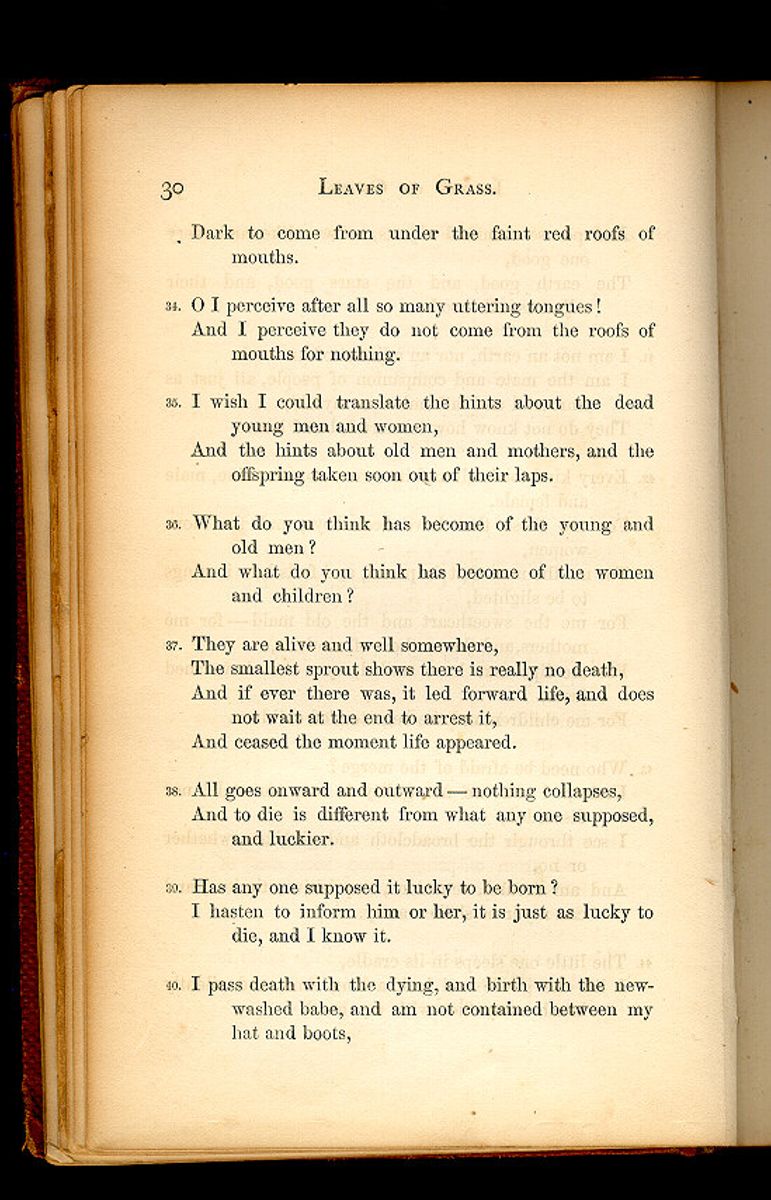
Dark to come from under the faint red roofs of
ppp.01500.038.jpg
Dark to come from under the faint red roofs of mouths. 34O I perceive after all so many uttering tongues! And I perceive they do not come from the roofs of
mouths for nothing. 35I wish I could translate the hints about the dead
young men and women, And the hints about old men and mothers, and the
offspring taken soon out of their laps. 36What do you think has become of the young and
old men? And what do you think has become of the women
and children? 37They are alive and well somewhere, The smallest sprout shows there is really no death, And if ever there was, it led forward life, and does
not wait at the end to arrest it, And ceased the moment life appeared. 38All goes onward and outward—nothing collapses, And to die is different from what any one supposed,
and luckier. 39Has any one supposed it lucky to be born? I hasten to inform him or her, it is just as lucky to
die, and I know it. 40I pass death with the dying, and birth with the new-
washed babe, and am not contained between my
hat and boots, [ begin page 31 ]
 ppp.01500.039.jpg
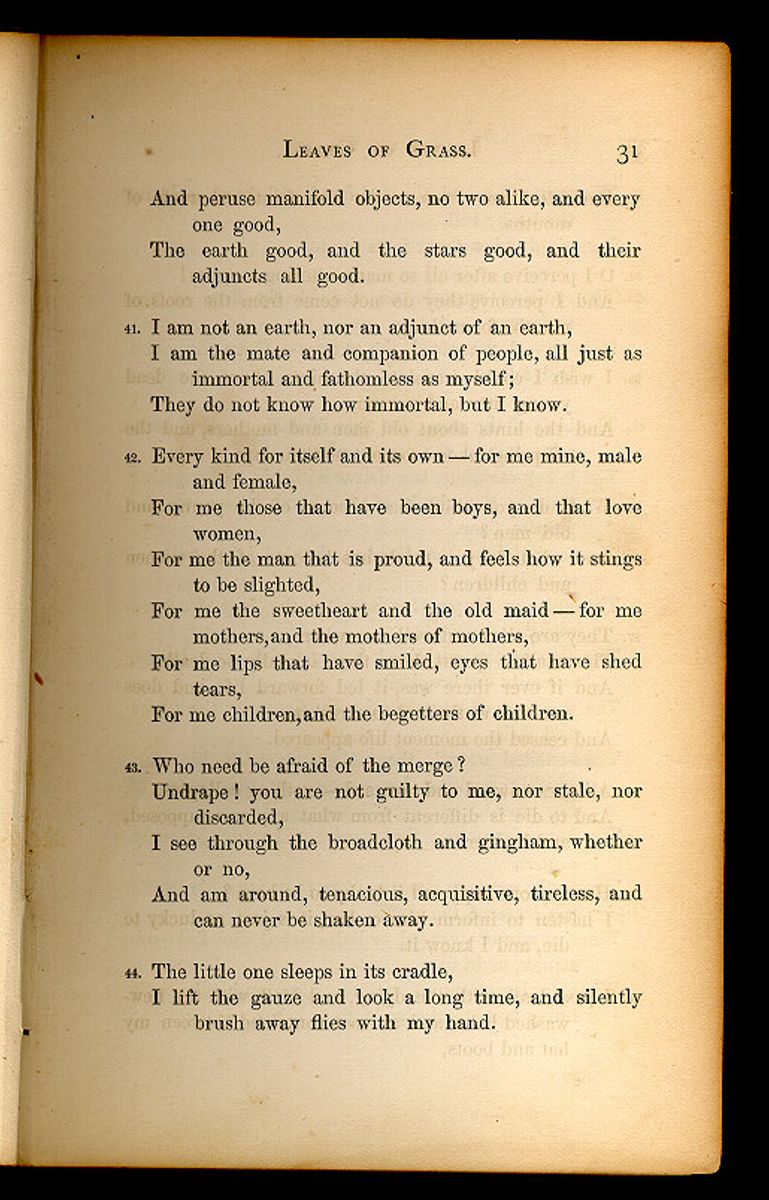
And peruse manifold objects, no two alike, and every
ppp.01500.039.jpg
And peruse manifold objects, no two alike, and every one good, The earth good, and the stars good, and their
adjuncts all good. 41I am not an earth, nor an adjunct of an earth, I am the mate and companion of people, all just as
immortal and fathomless as myself; They do not know how immortal, but I know. 42Every kind for itself and its own—for me mine, male
and female, For me those that have been boys, and that love
women, For me the man that is proud, and feels how it stings
to be slighted, For me the sweetheart and the old maid—for me
mothers, and the mothers of mothers, For me lips that have smiled, eyes that have shed
tears, For me children, and the begetters of children. 43Who need be afraid of the merge? Undrape! you are not guilty to me, nor stale, nor
discarded, I see through the broadcloth and gingham, whether
or no, And am around, tenacious, acquisitive, tireless, and
can never be shaken away. 44The little one sleeps in its cradle, I lift the gauze and look a long time, and silently
brush away flies with my hand. [ begin page 32 ]
 ppp.01500.040.jpg
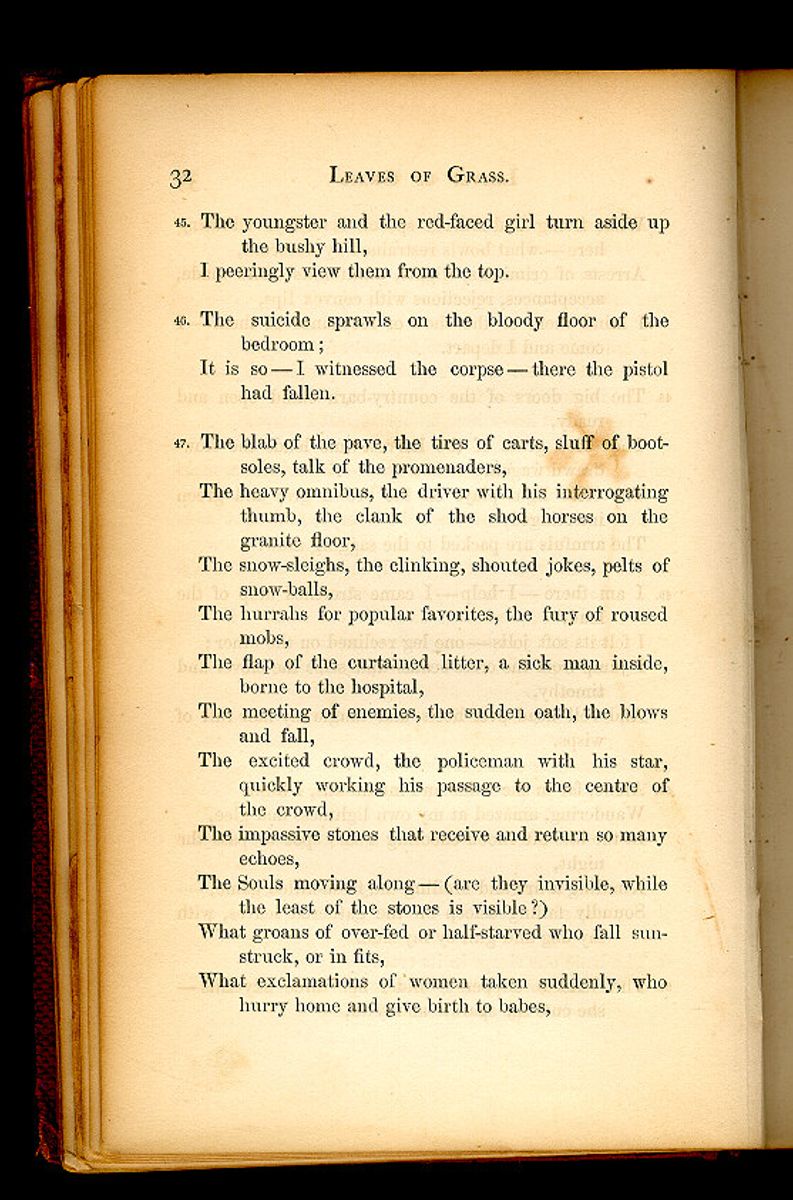
45The youngster and the red-faced girl turn aside up
ppp.01500.040.jpg
45The youngster and the red-faced girl turn aside up the bushy hill, I peeringly view them from the top. 46The suicide sprawls on the bloody floor of the
bedroom; It is so—I witnessed the corpse—there the pistol
had fallen. 47The blab of the pave, the tires of carts, sluff of boot-
soles, talk of the promenaders, The heavy omnibus, the driver with his interrogating
thumb, the clank of the shod horses on the
granite floor, The snow-sleighs, the clinking, shouted jokes, pelts of
snow-balls, The hurrahs for popular favorites, the fury of roused
mobs, The flap of the curtained litter, a sick man inside,
borne to the hospital, The meeting of enemies, the sudden oath, the blows
and fall, The excited crowd, the policeman with his star,
quickly working his passage to the centre of
the crowd, The impassive stones that receive and return so many
echoes, The Souls moving along—(are they invisible, while
the least of the stones is visible?) What groans of over-fed or half-starved who fall sun-
struck, or in fits, What exclamations of women taken suddenly, who
hurry home and give birth to babes, [ begin page 33 ]
 ppp.01500.041.jpg
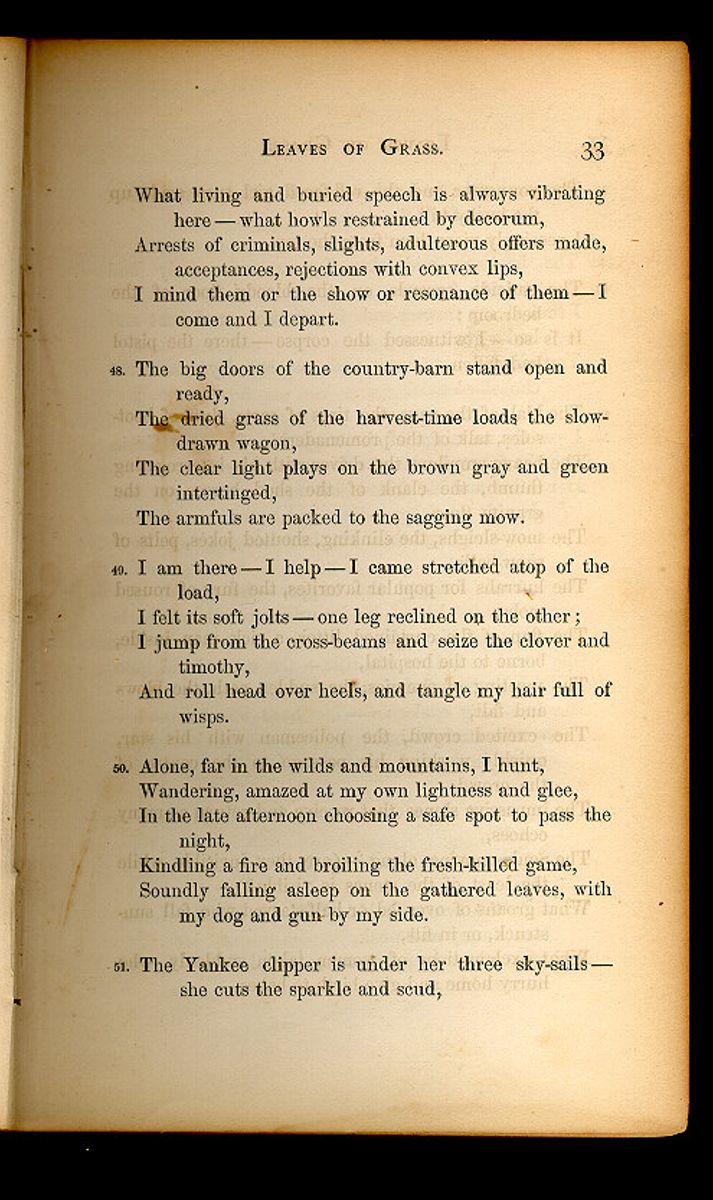
What living and buried speech is always vibrating
ppp.01500.041.jpg
What living and buried speech is always vibrating here—what howls restrained by decorum, Arrests of criminals, slights, adulterous offers made,
acceptances, rejections with convex lips, I mind them or the show or resonance of them—I
come and I depart. 48The big doors of the country-barn stand open and
ready, The dried grass of the harvest-time loads the slow-
drawn wagon, The clear light plays on the brown gray and green
intertinged, The armfuls are packed to the sagging mow. 49I am there—I help—I came stretched atop of the
load, I felt its soft jolts—one leg reclined on the other; I jump from the cross-beams and seize the clover and
timothy, And roll head over heels, and tangle my hair full of
wisps. 50Alone, far in the wilds and mountains, I hunt, Wandering, amazed at my own lightness and glee, In the late afternoon choosing a safe spot to pass the
night, Kindling a fire and broiling the fresh-killed game, Soundly falling asleep on the gathered leaves, with
my dog and gun by my side. 51The Yankee clipper is under her three sky-sails—
she cuts the sparkle and scud, [ begin page 34 ]
 ppp.01500.042.jpg
My eyes settle the land—I bend at her prow, or shout
ppp.01500.042.jpg
My eyes settle the land—I bend at her prow, or shout joyously from the deck. 52The boatmen and clam-diggers arose early and
stopped for me, I tucked my trowser-ends in my boots, and went and
had a good time; You should have been with us that day round the
chowder-kettle. 53I saw the marriage of the trapper in the open air in
the far-west—the bride was a red girl, Her father and his friends sat near, cross-legged and
dumbly smoking—they had moccasons to their
feet, and large thick blankets hanging from their
shoulders; On a bank lounged the trapper—he was dressed
mostly in skins—his luxuriant beard and curls
protected his neck, One hand rested on his rifle—the other hand held
firmly the wrist of the red girl, She had long eyelashes—her head was bare—her
coarse straight locks descended upon her volup-
tuous limbs and reached to her feet. 54The runaway slave came to my house and stopped
outside, I heard his motions crackling the twigs of the wood-
pile, Through the swung half-door of the kitchen I saw
him limpsy and weak, And went where he sat on a log, and led him in and
assured him, [ begin page 35 ]
 ppp.01500.043.jpg
And brought water, and filled a tub for his sweated
ppp.01500.043.jpg
And brought water, and filled a tub for his sweated body and bruised feet, And gave him a room that entered from my own, and
gave him some coarse clean clothes, And remember perfectly well his revolving eyes and
his awkwardness, And remember putting plasters on the galls of his
neck and ankles; He staid with me a week before he was recuperated
and passed north, I had him sit next me at table—my fire-lock leaned
in the corner. 55Twenty-eight young men bathe by the shore, Twenty-eight young men, and all so friendly; Twenty-eight years of womanly life, and all so
lonesome. 56She owns the fine house by the rise of the bank, She hides, handsome and richly drest, aft the blinds
of the window. 57Which of the young men does she like the best? Ah, the homeliest of them is beautiful to her. 58Where are you off to, lady? for I see you, You splash in the water there, yet stay stock still in
your room. 59Dancing and laughing along the beach came the
twenty-ninth bather, The rest did not see her, but she saw them and loved
them. [ begin page 36 ]
 ppp.01500.044.jpg
60The beards of the young men glistened with wet, it
ppp.01500.044.jpg
60The beards of the young men glistened with wet, it ran from their long hair, Little streams passed all over their bodies. 61An unseen hand also passed over their bodies, It descended tremblingly from their temples and
ribs. 62The young men float on their backs—their white
bellies bulge to the sun—they do not ask who
seizes fast to them, They do not know who puffs and declines with
pendant and bending arch, They do not think whom they souse with spray. 63The butcher-boy puts off his killing-clothes, or sharp-
ens his knife at the stall in the market, I loiter, enjoying his repartee and his shuffle and
break-down. 64Blacksmiths with grimed and hairy chests environ the
anvil, Each has his main-sledge—they are all out—there
is a great heat in the fire. 65From the cinder-strewed threshold I follow their
movements, The lithe sheer of their waists plays even with their
massive arms, Overhand the hammers roll—overhand so slow—
overhand so sure, They do not hasten—each man hits in his place. [ begin page 37 ]
 ppp.01500.045.jpg
66The negro holds firmly the reins of his four horses
ppp.01500.045.jpg
66The negro holds firmly the reins of his four horses —the blocks swags underneath on its tied-over
chain, The negro that drives the huge dray of the stone-yard
—steady and tall he stands, poised on one leg on
the string-piece, His blue shirt exposes his ample neck and breast, and
loosens over his hip-band, His glance is calm and commanding—he tosses the
slouch of his hat away from his forehead, The sun falls on his crispy hair and moustache—
falls on the black of his polished and perfect
limbs. 67I behold the picturesque giant and love him—and
I do not stop there, I go with the team also. 68In me the caresser of life wherever moving—back-
ward as well as forward slueing, To niches aside and junior bending. 69Oxen that rattle the yoke or halt in the shade! what
is that you express in your eyes? It seems to me more than all the print I have read in
my life. 70My tread scares the wood-drake and wood-duck, on
my distant and day-long ramble, They rise together—they slowly circle around. 71I believe in those winged purposes, And acknowledge red, yellow, white, playing within
me, [ begin page 38 ]
 ppp.01500.046.jpg
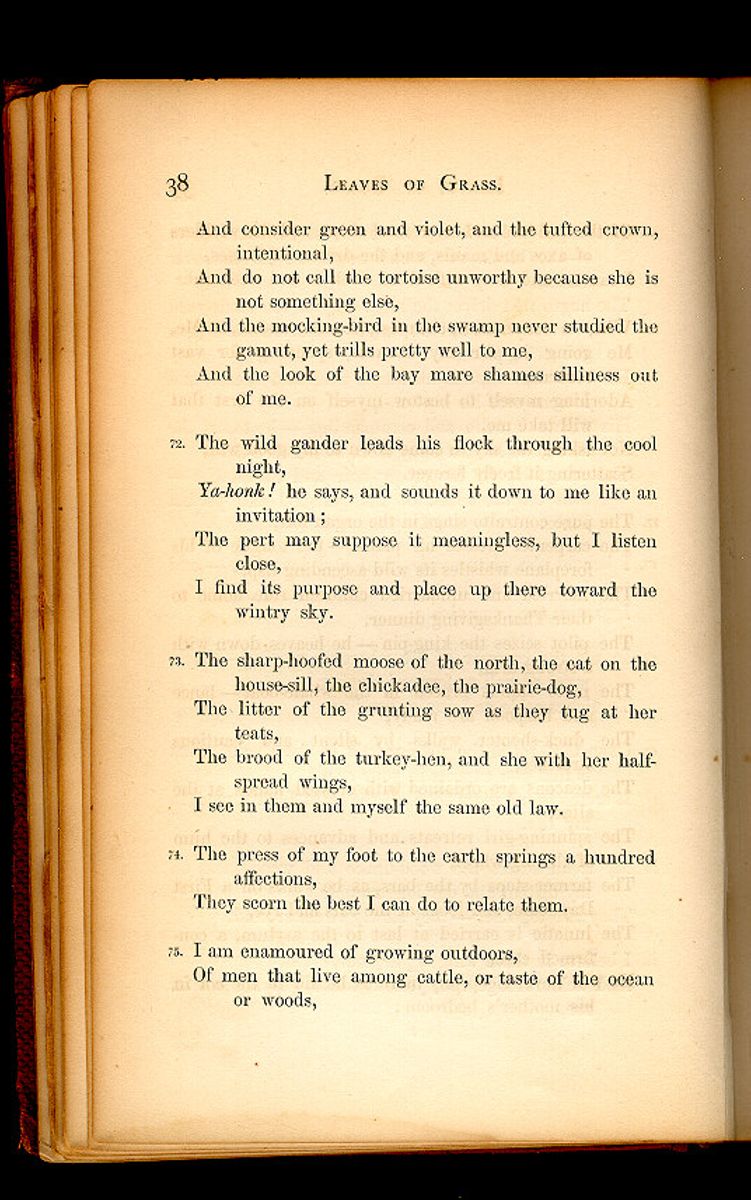
And consider green and violet, and the tufted crown,
ppp.01500.046.jpg
And consider green and violet, and the tufted crown, intentional, And do not call the tortoise unworthy because she is
not something else, And the mocking-bird in the swamp never studied the
gamut, yet trills pretty well to me, And the look of the bay mare shames silliness out
of me. 72The wild gander leads his flock through the cool
night, Ya-honk! he says, and sounds it down to me like an
invitation; The pert may suppose it meaningless, but I listen
close, I find its purpose and place up there toward the
wintry sky. 73The sharp-hoofed moose of the north, the cat on the
house-sill, the chickadee, the prairie-dog, The litter of the grunting sow as they tug at her
teats, The brood of the turkey-hen, and she with her half-
spread wings, I see in them and myself the same old law. 74The press of my foot to the earth springs a hundred
affections, They scorn the best I can do to relate them. 75I am enamoured of growing outdoors. Of men that live among cattle, or taste of the ocean
or woods, [ begin page 39 ]
 ppp.01500.047.jpg
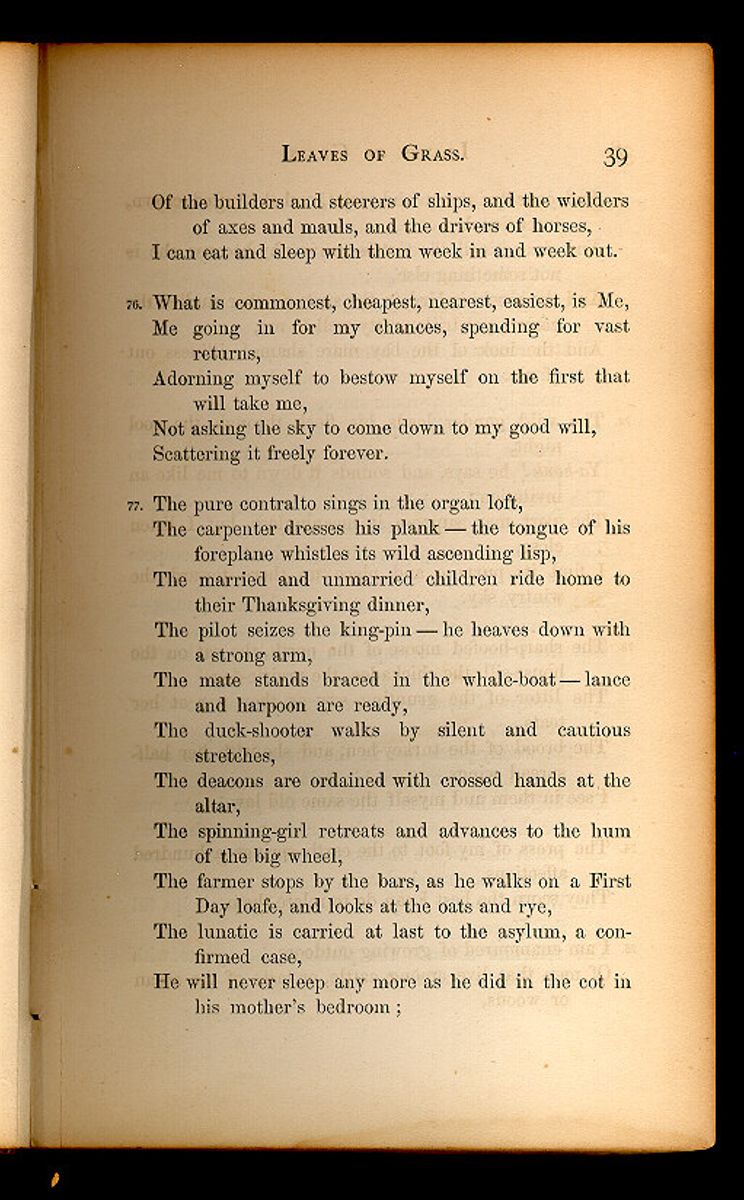
Of the builders and steerers of ships, and the wielders
ppp.01500.047.jpg
Of the builders and steerers of ships, and the wielders of axes and mauls, and the drivers of horses, I can eat and sleep with them week in and week out. 76What is commonest, cheapest, nearest, easiest, is Me, Me going in for my chances, spending for vast
returns, Adorning myself to bestow myself on the first that
will take me, Not asking the sky to come down to my good will, Scattering it freely forever. 77The pure contralto sings in the organ loft, The carpenter dresses his plank—the tongue of his
foreplane whistles its wild ascending lisp, The married and unmarried children ride home to
their Thanksgiving dinner, The pilot seizes the king-pin—he heaves down with
a strong arm, The mate stands braced in the whale-boat—lance
and harpoon are ready, The duck-shooter walks by silent and cautious
stretches, The deacons are ordained with crossed hands at the
altar, The spinning-girl retreats and advances to the hum
of the big wheel, The farmer stops by the bars, as he walks on a First
Day loafe, and looks at the oats and rye, The lunatic is carried at last to the asylum, a con-
firmed case, He will never sleep any more as he did in the cot in
his mother's bedroom; [ begin page 40 ]
 ppp.01500.048.jpg
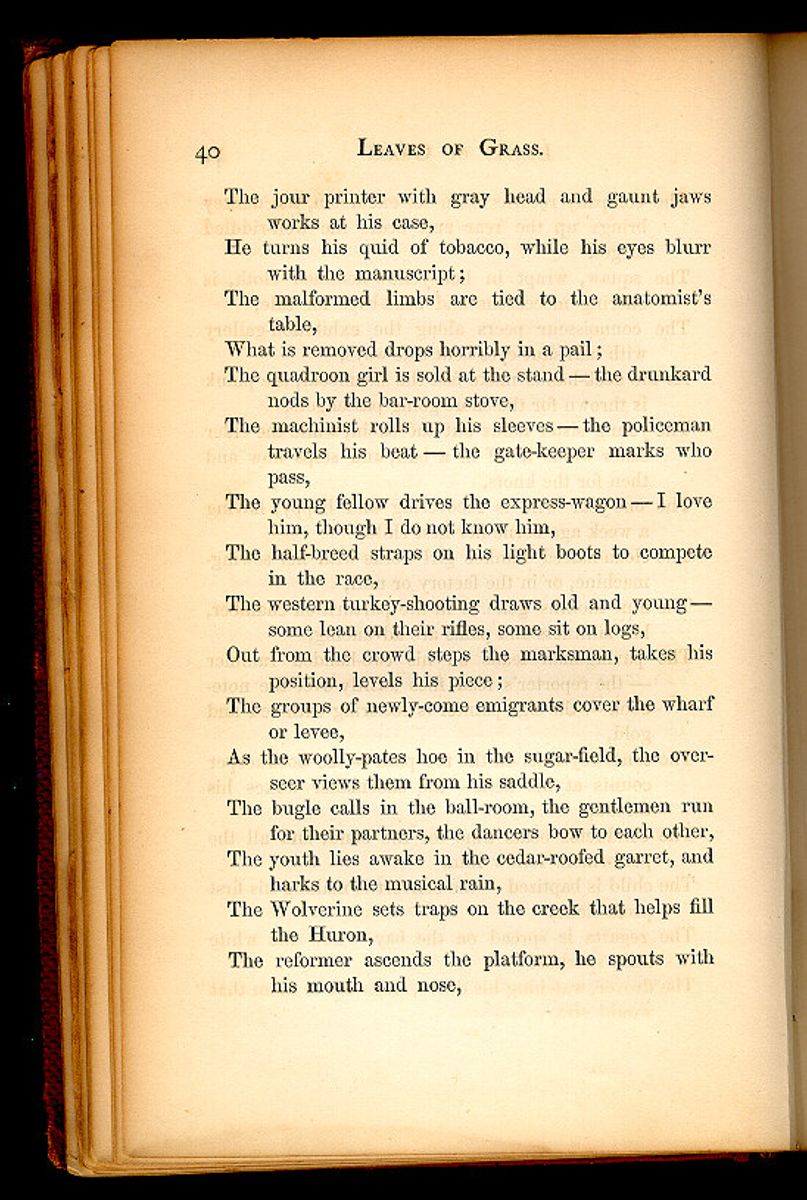
The jour printer with gray head and gaunt jaws
ppp.01500.048.jpg
The jour printer with gray head and gaunt jaws works at his case, He turns his quid of tobacco, while his eyes blurr
with the manuscript; The malformed limbs are tied to the anatomist's
table, What is removed drops horribly in a pail; The quadroon girl is sold at the stand—the drunkard
nods by the bar-room stove, The machinist rolls up his sleeves—the policeman
travels his beat—the gate-keeper marks who
pass, The young fellow drives the express-wagon—I love
him, though I do not know him, The half-breed straps on his light boots to compete
in the race, The western turkey-shooting draws old and young—
some lean on their rifles, some sit on logs, Out from the crowd steps the marksman, takes his
position, levels his piece; The groups of newly-come emigrants cover the wharf
or levee, As the woolly-pates hoe in the sugar-field, the over-
seer views them from his saddle, The bugle calls in the ball-room, the gentlemen run
for their partners, the dancers bow to each other, The youth lies awake in the cedar-roofed garret, and
harks to the musical rain, The Wolverine sets traps on the creek that helps fill
the Huron, The reformer ascends the platform, he spouts with
his mouth and nose, [ begin page 41 ]
 ppp.01500.049.jpg
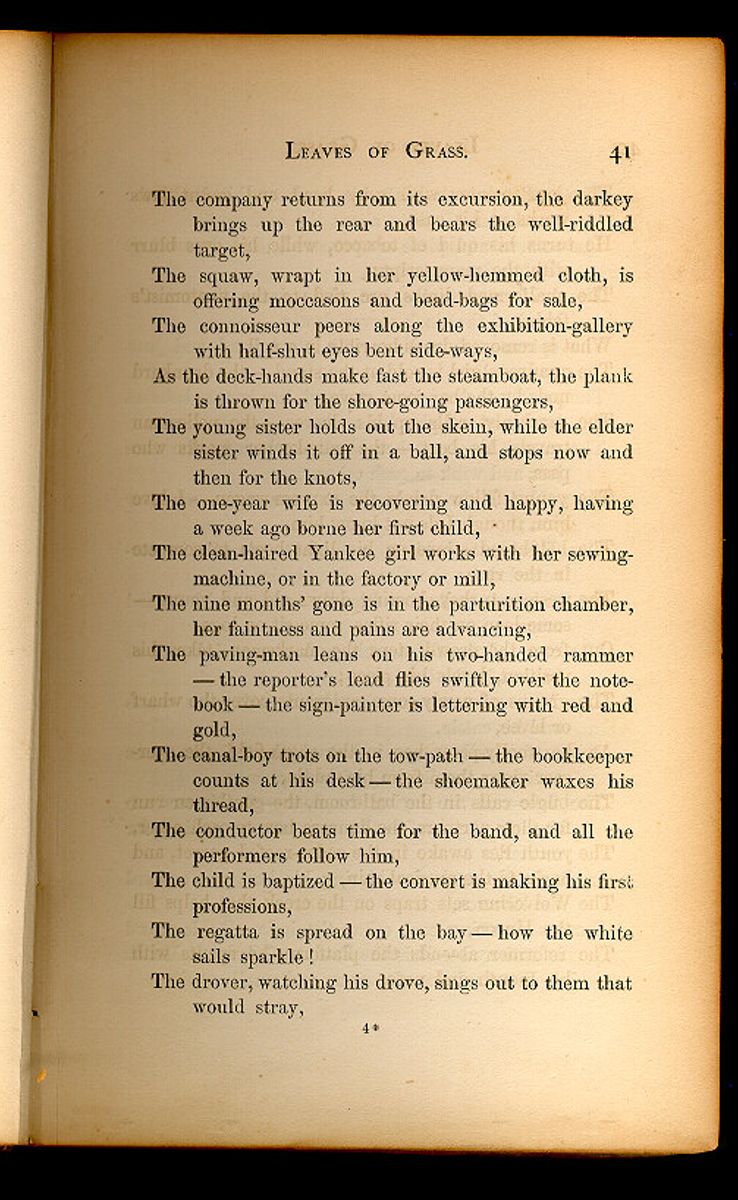
The company returns from its excursion, the darkey
ppp.01500.049.jpg
The company returns from its excursion, the darkey brings up the rear and bears the well-riddled
target, The squaw, wrapt in her yellow-hemmed cloth, is
offering moccasons and bead-bags for sale, The connoisseur peers along the exhibition-gallery
with half-shut eyes bent side-ways, As the deck-hands make fast the steamboat, the plank
is thrown for the shore-going passengers, The young sister holds out the skein, while the elder
sister winds it off in a ball, and stops now and
then for the knots, The one-year wife is recovering and happy, having
a week ago borne her first child, The clean-haired Yankee girl works with her sewing-
machine, or in the factory or mill, The nine months' gone is in the parturition chamber,
her faintness and pains are advancing, The paving-man leans on his two-handed rammer
—the reporter's lead flies swiftly over the note-
book—the sign-painter is lettering with red and
gold, The canal-boy trots on the tow-path—the bookkeeper
counts at his desk—the shoemaker waxes his
thread, The conductor beats time for the band, and all the
performers follow him, The child is baptized—the convert is making his first
professions, The regatta is spread on the bay—how the white
sails sparkle! The drover, watching his drove, sings out to them that
would stray, 4* [ begin page 42 ]
 ppp.01500.050.jpg
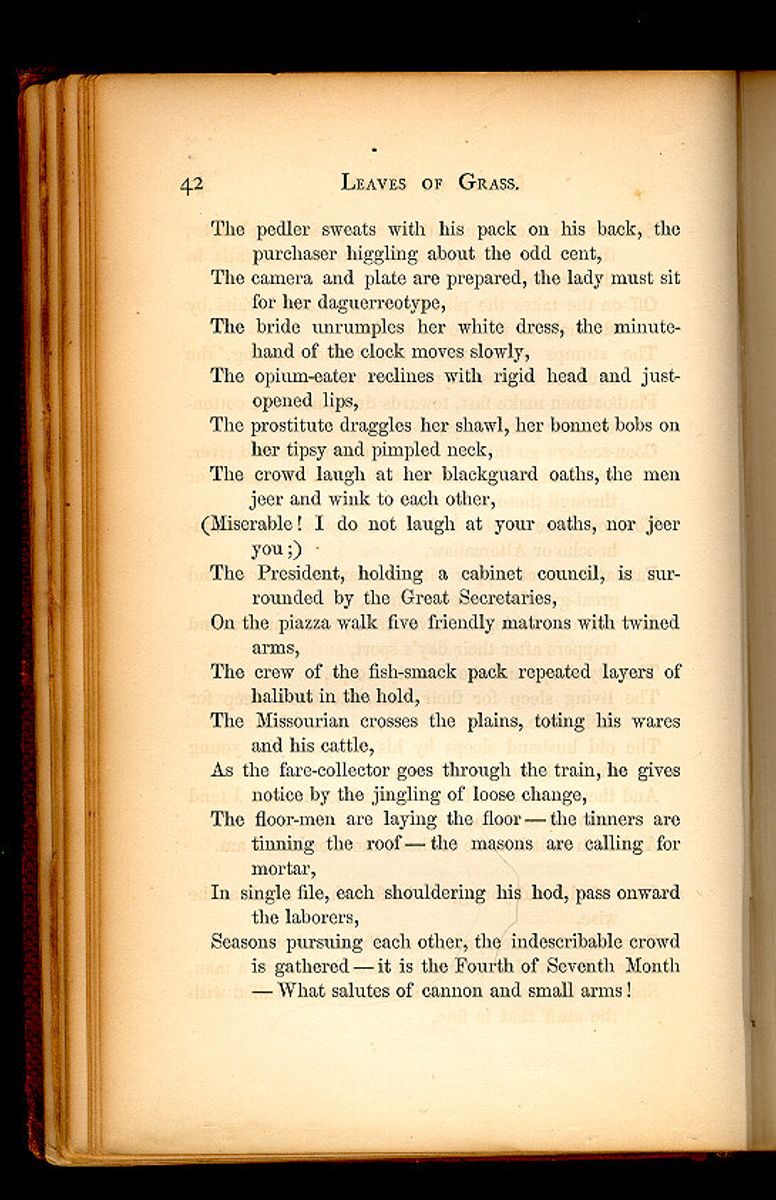
The pedler sweats with his pack on his back, the
ppp.01500.050.jpg
The pedler sweats with his pack on his back, the purchaser higgling about the odd cent, The camera and plate are prepared, the lady must sit
for her daguerreotype, The bride unrumples her white dress, the minute-
hand of the clock moves slowly, The opium-eater reclines with rigid head and just-
opened lips, The prostitute draggles her shawl, her bonnet bobs on
her tipsy and pimpled neck, The crowd laugh at her blackguard oaths, the men
jeer and wink to each other, (Miserable!-I do not laugh at your oaths, nor jeer
you;) The President, holding a cabinet council, is sur-
rounded by the Great Secretaries, On the piazza walk five friendly matrons with twined
arms, The crew of the fish-smack pack repeated layers of
halibut in the hold, The Missourian crosses the plains, toting his wares
and his cattle, As the fare-collector goes through the train, he gives
notice by the jingling of loose change, The floor-men are laying the floor—the tinners are
tinning the roof—the masons are calling for
mortar, In single file, each shouldering his hod, pass onward
the laborers, Seasons pursuing each other, the indescribable crowd
is gathered—it is the Fourth of Seventh Month
—What salutes of cannon and small arms! [ begin page 43 ]
 ppp.01500.051.jpg
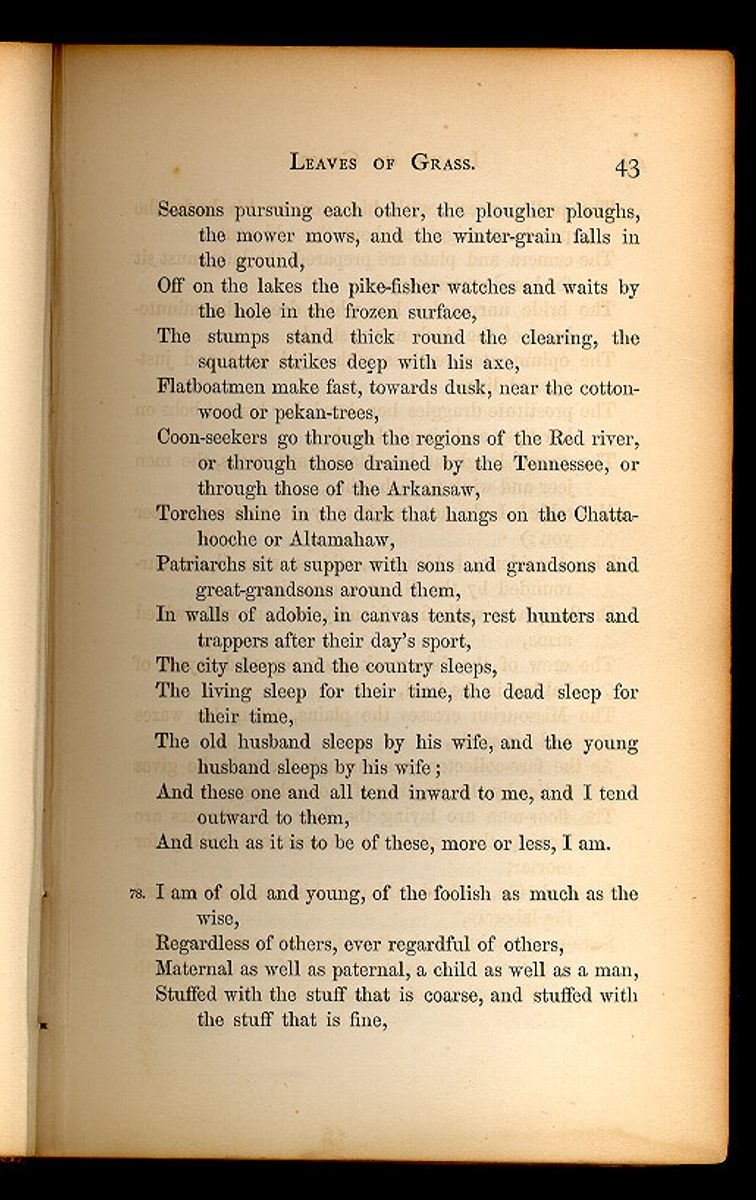
Seasons pursuing each other, the plougher ploughs,
ppp.01500.051.jpg
Seasons pursuing each other, the plougher ploughs, the mower mows, and the winter-grain falls in
the ground, Off on the lakes the pike-fisher watches and waits by
the hole in the frozen surface, The stumps stand thick round the clearing, the
squatter strikes deep with his axe, Flatboatmen make fast, towards dusk, near the cotton-
wood or pekan-trees, Coon-seekers go through the regions of the Red river,
or through those drained by the Tennessee, or
through those of the Arkansaw, Torches shine in the dark that hangs on the Chatta-
hooche or Altamahaw, Patriarchs sit at supper with sons and grandsons and
great-grandsons around them, In walls of adobie, in canvas tents, rest hunters and
trappers after their day's sport, The city sleeps and the country sleeps, The living sleep for their time, the dead sleep for
their time, The old husband sleeps by his wife, and the young
husband sleeps by his wife; And these one and all tend inward to me, and I tend
outward to them, And such as it is to be of these, more or less, I am. 78I am of old and young, of the foolish as much as the
wise, Regardless of others, ever regardful of others, Maternal as well as paternal, a child as well as a man, Stuffed with the stuff that is coarse, and stuffed with
the stuff that is fine, [ begin page 44 ]
 ppp.01500.052.jpg
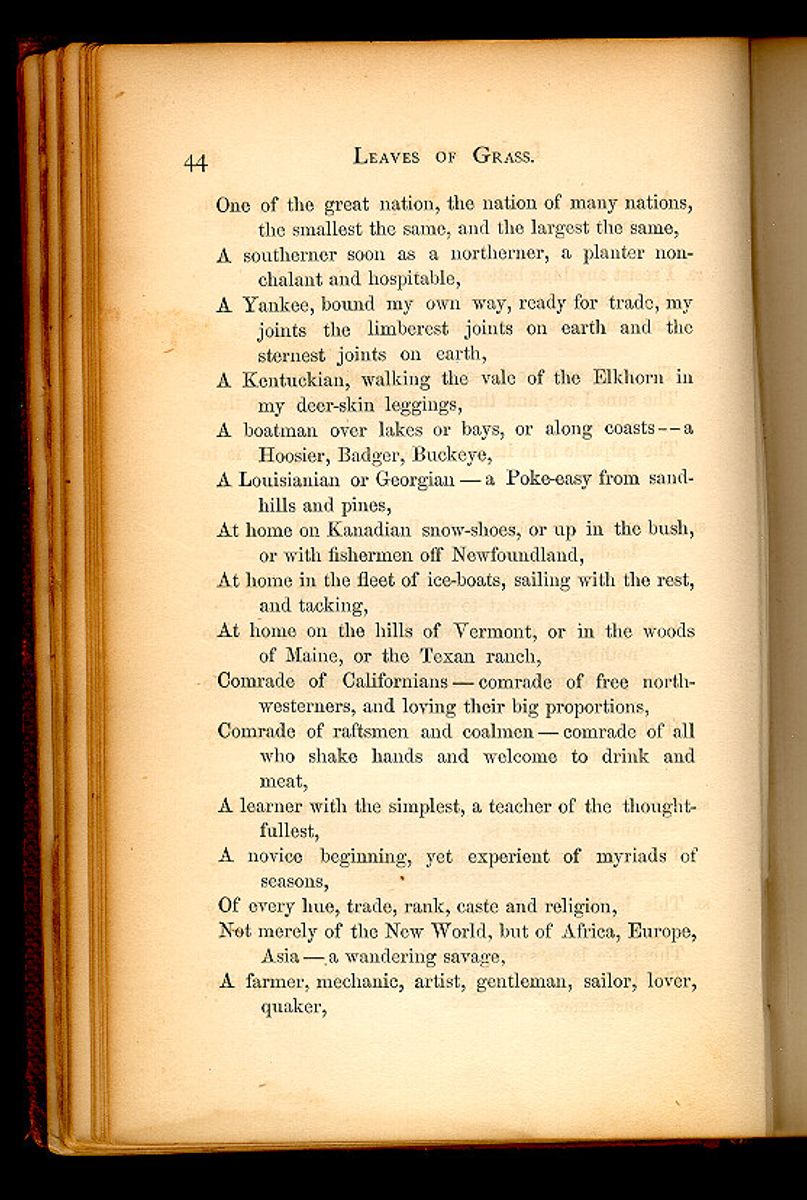
One of the great nation, the nation of many nations,
ppp.01500.052.jpg
One of the great nation, the nation of many nations, the smallest the same, and the largest the same, A southerner soon as a northerner, a planter non-
chalant and hospitable, A Yankee, bound my own way, ready for trade, my
joints the limberest joints on earth and the
sternest joints on earth, A Kentuckian, walking the vale of the Elkhorn in
my deer-skin leggings, A boatman over lakes or bays, or along coasts—a
Hoosier, Badger, Buckeye, A Louisianian or Georgian—a Poke-easy from sand-
hills and pines, At home on Kanadian snow-shoes, or up in the bush,
or with fishermen off Newfoundland, At home in the fleet of ice-boats, sailing with the rest,
and tacking, At home on the hills of Vermont, or in the woods
of Maine, or the Texan ranch, Comrade of Californians—comrade of free north-
westerners, and loving their big proportions, Comrade of raftsmen and coalmen—comrade of all
who shake hands and welcome to drink and
meat, A learner with the simplest, a teacher of the thought-
fullest, A novice beginning, yet experient of myriads of
seasons, Of every hue, trade, rank, caste and religion, Not merely of the New World, but of Africa, Europe,
Asia—a wandering savage, A farmer, mechanic, artist, gentleman, sailor, lover,
quaker, [ begin page 45 ]
 ppp.01500.053.jpg
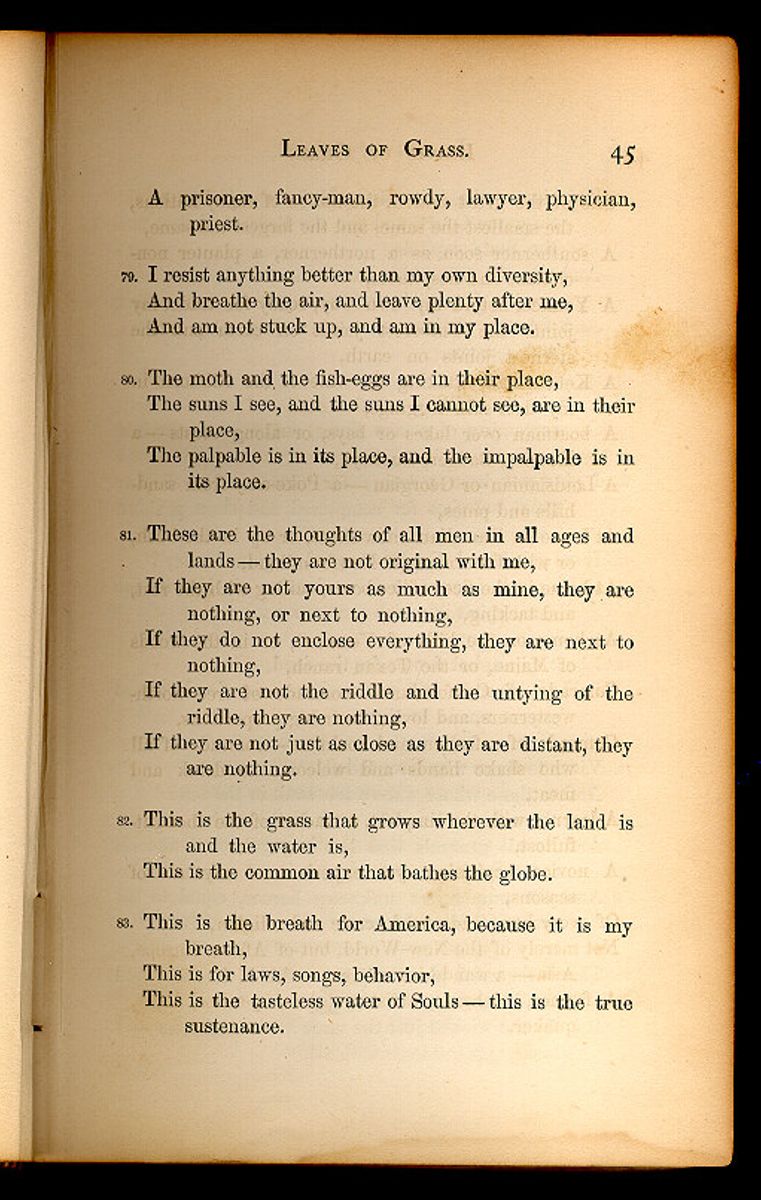
A prisoner, fancy-man, rowdy, lawyer, physician,
ppp.01500.053.jpg
A prisoner, fancy-man, rowdy, lawyer, physician, priest. 79I resist anything better than my own diversity, And breathe the air, and leave plenty after me, And am not stuck up, and am in my place. 80The moth and the fish-eggs are in their place, The suns I see, and the suns I cannot see, are in their
place, The palpable is in its place, and the impalpable is in
its place. 81These are the thoughts of all men in all ages and
lands—they are not original with me, If they are not yours as much as mine, they are
nothing, or next to nothing, If they do not enclose everything, they are next to
nothing, If they are not the riddle and the untying of the
riddle, they are nothing, If they are not just as close as they are distant, they
are nothing. 82This is the grass that grows wherever the land is
and the water is, This is the common air that bathes the globe. 83This is the breath for America, because it is my
breath, This is for laws, songs, behavior, This is the tasteless water of Souls—this is the true
sustenance. [ begin page 46 ]
 ppp.01500.054.jpg
84This is for the illiterate, and for the judges of the
ppp.01500.054.jpg
84This is for the illiterate, and for the judges of the Supreme Court, and for the Federal capitol and
the State capitols, And for the admirable communes of literats, com-
posers, singers, lecturers, engineers, and savans, And for the endless races of work-people, farmers,
and seamen. 85This is the trilling of thousands of clear cornets,
screaming of octave flutes, striking of triangles. 86I play not here marches for victors only—I play
great marches for conquered and slain persons. 87Have you heard that it was good to gain the day? I also say it is good to fall—battles are lost in the
same spirit in which they are won. 88I beat triumphal drums for the dead, I blow through my embouchures my loudest and
gayest music to them. 89Vivas to those who have failed! And to those whose war-vessels sank in the sea! And those themselves who sank in the sea! And to all generals that lost engagements! and all
overcome heroes! And the numberless unknown heroes, equal to the
greatest heroes known. 90This is the meal pleasantly set—this is the meat and
drink for natural hunger, It is for the wicked just the same as the righteous—I
make appointments with all, [ begin page 47 ]
 ppp.01500.055.jpg
I will not have a single person slighted or left away,
The kept-woman, sponger, thief, are hereby invited,
The heavy-lipped slave is invited—the venerealee is
ppp.01500.055.jpg
I will not have a single person slighted or left away,
The kept-woman, sponger, thief, are hereby invited,
The heavy-lipped slave is invited—the venerealee is invited, There shall be no difference between them and the
rest. 91This is the press of a bashful hand—this is the float
and odor of hair, This is the touch of my lips to yours—this is the
murmur of yearning, This is the far-off depth and height reflecting my
own face, This is the thoughtful merge of myself, and the outlet
again. 92Do you guess I have some intricate purpose? Well, I have—for the Fourth Month showers have,
and the mica on the side of a rock has. 93Do you take it I would astonish? Does the daylight astonish? Does the early redstart,
twittering through the woods? Do I astonish more than they? 94This hour I tell things in confidence, I might not tell everybody, but I will tell you. 95Who goes there! hankering, gross, mystical, nude? How is it I extract strength from the beef I eat? 96What is a man anyhow? What am I? What are
you? [ begin page 48 ]
 ppp.01500.056.jpg
97All I mark as my own, you shall offset it with your
ppp.01500.056.jpg
97All I mark as my own, you shall offset it with your own, Else it were time lost listening to me. 98I do not snivel that snivel the world over, That months are vacuums, and the ground but
wallow and filth, That life is a suck and a sell, and nothing remains at
the end but threadbare crape, and tears. 99Whimpering and truckling fold with powders for
invalids—conformity goes to the fourth-removed, I cock my hat as I please, indoors or out. 100Why should I pray? Why should I venerate and be
ceremonious? 101Having pried through the strata, analyzed to a hair,
counsell'd with doctors, and calculated close, I find no sweeter fat than sticks to my own bones. 102In all people I see myself—none more, and not one a
barleycorn less, And the good or bad I say of myself I say of them. 103And I know I am solid and sound, To me the converging objects of the universe per-
petually flow, All are written to me, and I must get what the
writing means. 104I know I am deathless,
I know this orbit of mine cannot be swept by a
carpenter's compass, [ begin page 49 ]
 ppp.01500.057.jpg
I know I shall not pass like a child's carlacue cut
ppp.01500.057.jpg
I know I shall not pass like a child's carlacue cut with a burnt stick at night. 105I know I am august, I do not trouble my spirit to vindicate itself or be
understood, I see that the elementary laws never apologize, I reckon I behave no prouder than the level I plant
my house by, after all. 106I exist as I am—that is enough, If no other in the world be aware, I sit content, And if each and all be aware, I sit content. 107One world is aware, and by far the largest to me, and
that is myself, And whether I come to my own to-day, or in ten
thousand or ten million years, I can cheerfully take it now, or with equal cheerful-
ness I can wait 108My foothold is tenoned and mortised in granite, I laugh at what you call dissolution, And I know the amplitude of time. 109I am the poet of the body, And I am the poet of the Soul. 110The pleasures of heaven are with me, and the pains
of hell are with me, The first I graft and increase upon myself—the latter
I translate into a new tongue. 5 [ begin page 50 ]
 ppp.01500.058.jpg
111I am the poet of the woman the same as the man,
And I say it is as great to be a woman as to be a
ppp.01500.058.jpg
111I am the poet of the woman the same as the man,
And I say it is as great to be a woman as to be a man, And I say there is nothing greater than the mother
of men. 112I chant the chant of dilation or pride, We have had ducking and deprecating about enough, I show that size is only development. 113Have you outstript the rest? Are you the President? It is a trifle—they will more than arrive there every
one, and still pass on. 114I am He that walks with the tender and growing
Night, I call to the earth and sea, half-held by the Night. 115Press close, bare-bosomed Night! Press close, mag-
netic, nourishing Night! Night of south winds! Night of the large few stars! Still, nodding night! Mad, naked, summer night. 116Smile, O voluptuous, cool-breathed Earth! Earth of the slumbering and liquid trees! Earth of departed sunset! Earth of the mountains,
misty-topt! Earth of the vitreous pour of the full moon, just
tinged with blue! Earth of shine and dark, mottling the tide of the
river! Earth of the limpid gray of clouds, brighter and
clearer for my sake! [ begin page 51 ]
 ppp.01500.059.jpg
Far-swooping elbowed Earth! Rich, apple-blossomed
ppp.01500.059.jpg
Far-swooping elbowed Earth! Rich, apple-blossomed Earth! Smile, for YOUR LOVER comes! 117Prodigal, you have given me love! Therefore I to
you give love! O unspeakable passionate love! 118Thruster holding me tight, and that I hold tight! We hurt each other as the bridegroom and the bride
hurt each other. 119You Sea! I resign myself to you also—I guess
what you mean, I behold from the beach your crooked inviting fingers, I believe you refuse to go back without feeling of me; We must have a turn together—I undress—hurry
me out of sight of the land, Cushion me soft, rock me in billowy drowse, Dash me with amorous wet—I can repay you. 120Sea of stretched ground-swells! Sea breathing broad and convulsive breaths! Sea of the brine of life! Sea of unshovelled and
always-ready graves! Howler and scooper of storms! Capricious and dainty
Sea! I am integral with you—I too am of one phase, and
of all phases. 121Partaker of influx and efflux—extoller of hate and
conciliation, Extoller of amies, and those that sleep in each others'
arms. [ begin page 52 ]
 ppp.01500.060.jpg
122I am he attesting sympathy,
Shall I make my list of things in the house, and skip
ppp.01500.060.jpg
122I am he attesting sympathy,
Shall I make my list of things in the house, and skip the house that supports them? 123I am the poet of common sense, and of the demon-
strable, and of immortality, And am not the poet of goodness only—I do not
decline to be the poet of wickedness also. 124Washes and razors for foofoos—for me freckles and
a bristling beard. 125What blurt is this about virtue and about vice? Evil propels me, and reform of evil propels me—I
stand indifferent, My gait is no fault-finder's or rejecter's gait, I moisten the roots of all that has grown. 126Did you fear some scrofula out of the unflagging
pregnancy? Did you guess the celestial laws are yet to be worked
over and rectified? 127I step up to say that what we do is right, and what
we affirm is right—and some is only the ore of
right, Witnesses of us—one side a balance, and the antip-
odal side a balance, Soft doctrine as steady help as stable doctrine, Thoughts and deeds of the present, our rouse and
early start. 128This minute that comes to me over the past decillions, There is no better than it and now. [ begin page 53 ]
 ppp.01500.061.jpg
129What behaved well in the past, or behaves well
ppp.01500.061.jpg
129What behaved well in the past, or behaves well to-day, is not such a wonder, The wonder is, always and always, how can there be
a mean man or an infidel. 130Endless unfolding of words of ages! And mine a word of the modern—a word en-masse. 131A word of the faith that never balks, One time as good as another time—here or hence-
forward, it is all the same to me. 132A word of reality—materialism first and last im-
buing. 133Hurrah for positive Science! long live exact demon-
stration! Fetch stonecrop, mixt with cedar and branches of
lilac, This is the lexicographer—this the chemist—this
made a grammar of the old cartouches, These mariners put the ship through dangerous un-
known seas, This is the geologist—this works with the scalpel—
and this is a mathematician. 134Gentlemen! I receive you, and attach and clasp
hands with you, The facts are useful and real—they are not my
dwelling—I enter by them to an area of the
dwelling. 135I am less the reminder of property or qualities, and
more the reminder of life, [ begin page 54 ]
 ppp.01500.062.jpg
And go on the square for my own sake and for others'
ppp.01500.062.jpg
And go on the square for my own sake and for others' sakes, And make short account of neuters and geldings, and
favor men and women fully equipped, And beat the gong of revolt, and stop with fugitives,
and them that plot and conspire. 136Walt Whitman, an American, one of the roughs, a
kosmos, Disorderly, fleshy, sensual, eating, drinking, breeding, No sentimentalist—no stander above men and wo-
men, or apart from them, No more modest than immodest. 137Unscrew the locks from the doors! Unscrew the doors themselves from their jambs! 138Whoever degrades another degrades me, And whatever is done or said returns at last to me, And whatever I do or say, I also return. 139Through me the afflatus surging and surging—
through me the current and index. 140I speak the pass-word primeval—I give the sign of
democracy, By God! I will accept nothing which all cannot have
their counterpart of on the same terms. 141Through me many long dumb voices, Voices of the interminable generations of slaves, Voices of prostitutes, and of deformed persons, Voices of the diseased and despairing, and of thieves
and dwarfs, [ begin page 55 ]
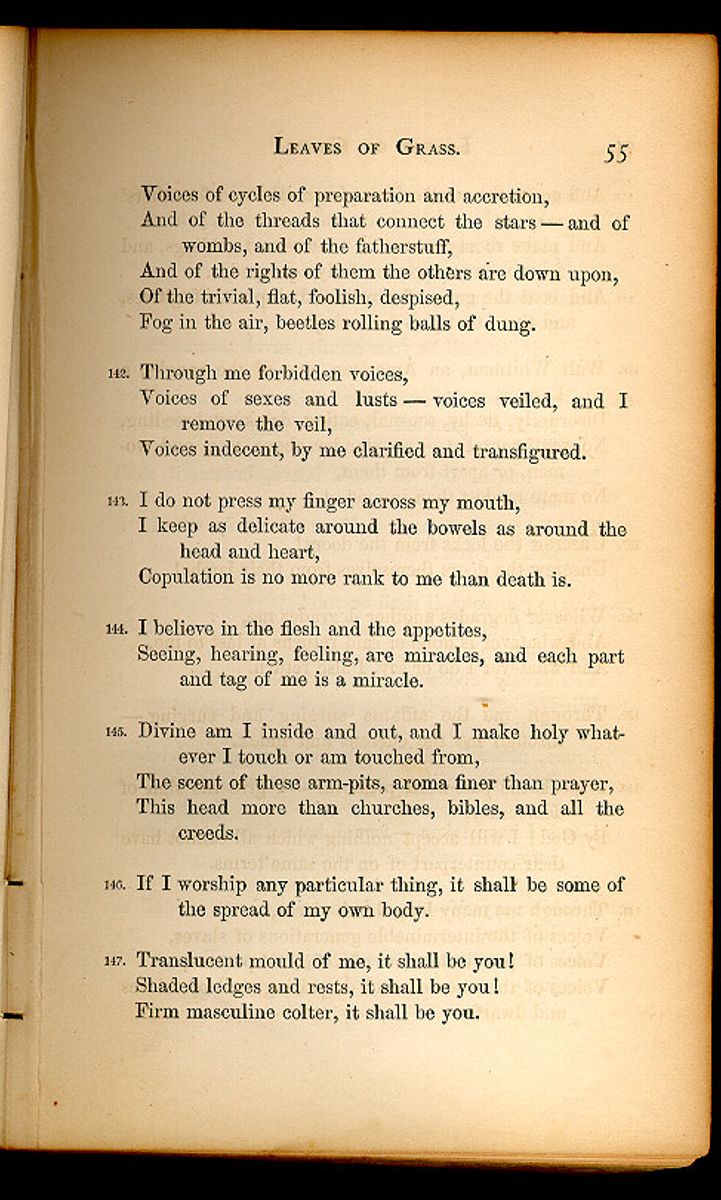 ppp.01500.063.jpg
Voices of cycles of preparation and accretion,
And of the threads that connect the stars—and of
ppp.01500.063.jpg
Voices of cycles of preparation and accretion,
And of the threads that connect the stars—and of wombs, and of the fatherstuff, And of the rights of them the others are down upon, Of the trivial, flat, foolish, despised, Fog in the air, beetles rolling balls of dung. 142Through me forbidden voices, Voices of sexes and lusts—voices veiled, and I
remove the veil, Voices indecent, by me clarified and transfigured. 143I do not press my finger across my mouth, I keep as delicate around the bowels as around the
head and heart, Copulation is no more rank to me than death is. 144I believe in the flesh and the appetites, Seeing, hearing, feeling, are miracles, and each part
and tag of me is a miracle. 145Divine am I inside and out, and I make holy what-
ever I touch or am touched from, The scent of these arm-pits, aroma finer than prayer, This head more than churches, bibles, and all the
creeds. 146If I worship any particular thing, it shall be some of
the spread of my own body. 147Translucent mould of me, it shall be you! Shaded ledges and rests, it shall be you! Firm masculine colter, it shall be you. [ begin page 56 ]
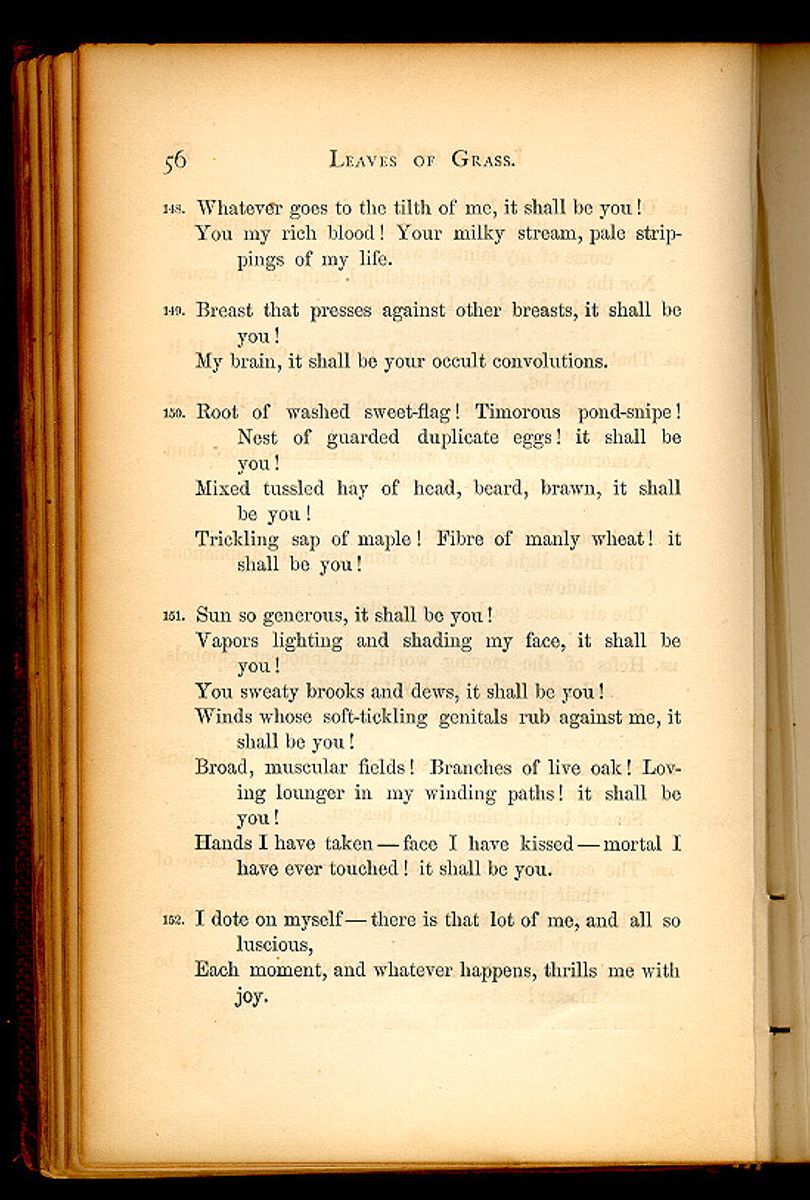 ppp.01500.064.jpg
148Whatever goes to the tilth of me, it shall be you!
You my rich blood! Your milky stream, pale strip-
ppp.01500.064.jpg
148Whatever goes to the tilth of me, it shall be you!
You my rich blood! Your milky stream, pale strip- pings of my life. 149Breast that presses against other breasts, it shall be
you! My brain, it shall be your occult convolutions. 150Root of washed sweet-flag! Timorous pond-snipe!
Nest of guarded duplicate eggs! it shall be
you! Mixed tussled hay of head, beard, brawn, it shall
be you! Trickling sap of maple! Fibre of manly wheat! it
shall be you! 151Sun so generous, it shall be you! Vapors lighting and shading my face, it shall be
you! You sweaty brooks and dews, it shall be you! Winds whose soft-tickling genitals rub against me, it
shall be you! Broad, muscular fields! Branches of live oak! Lov-
ing lounger in my winding paths! it shall be
you! Hands I have taken—face I have kissed—mortal I
have ever touched! it shall be you. 152I dote on myself—there is that lot of me, and all so
luscious, Each moment, and whatever happens, thrills me with
joy. [ begin page 57 ]
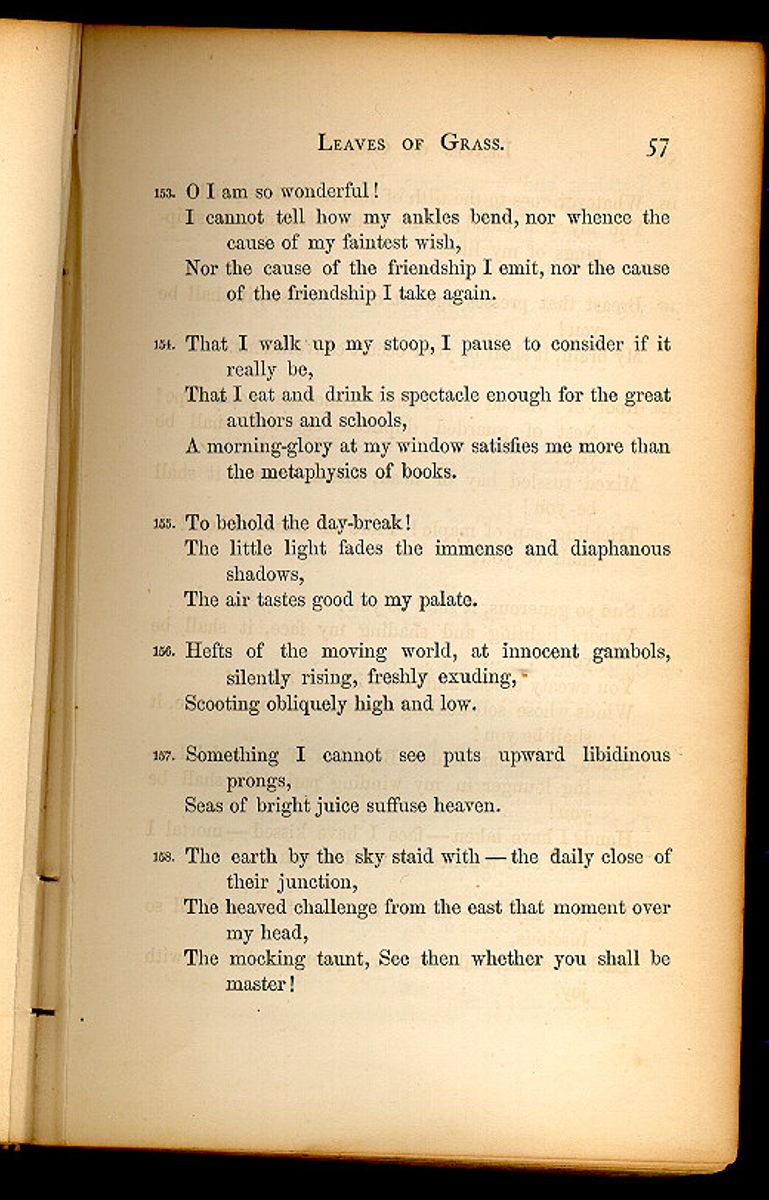 ppp.01500.065.jpg
153O I am so wonderful!
I cannot tell how my ankles bend, nor whence the
ppp.01500.065.jpg
153O I am so wonderful!
I cannot tell how my ankles bend, nor whence the cause of my faintest wish, Nor the cause of the friendship I emit, nor the cause
of the friendship I take again. 154That I walk up my stoop, I pause to consider if it
really be, That I eat and drink is spectacle enough for the great
authors and schools, A morning-glory at my window satisfies me more than
the metaphysics of books. 155To behold the day-break! The little light fades the immense and diaphanous
shadows, The air tastes good to my palate. 156Hefts of the moving world, at innocent gambols,
silently rising, freshly exuding, Scooting obliquely high and low. 157Something I cannot see puts upward libidinous
prongs, Seas of bright juice suffuse heaven. 158The earth by the sky staid with—the daily close of
their junction, The heaved challenge from the east that moment over
my head, The mocking taunt, See then whether you shall be
master! [ begin page 58 ]
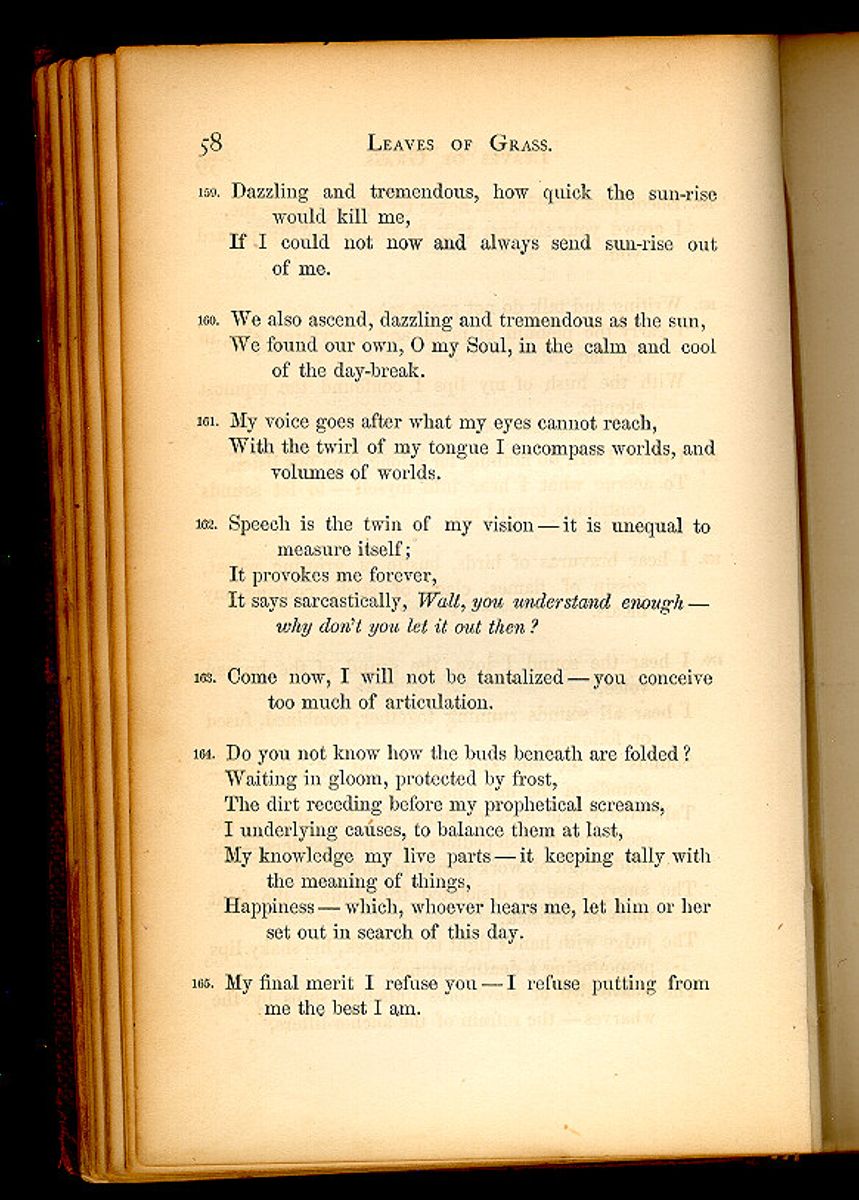 ppp.01500.066.jpg
159Dazzling and tremendous, how quick the sun-rise
ppp.01500.066.jpg
159Dazzling and tremendous, how quick the sun-rise would kill me, If I could not now and always send sun-rise out
of me. 160We also ascend, dazzling and tremendous as the sun, We found our own, O my Soul, in the calm and cool
of the day-break. 161My voice goes after what my eyes cannot reach, With the twirl of my tongue I encompass worlds, and
volumes of worlds. 162Speech is the twin of my vision—it is unequal to
measure itself; It provokes me forever, It says sarcastically, Walt, you understand enough—
why don't you let it out then? 163Come now, I will not be tantalized—you conceive
too much of articulation. 164Do you not know how the buds beneath are folded? Waiting in gloom, protected by frost, The dirt receding before my prophetical screams, I underlying causes, to balance them at last, My knowledge my live parts—it keeping tally with
the meaning of things, Happiness—which, whoever hears me, let him or her
set out in search of this day. 165My final merit I refuse you—I refuse putting from
me the best I am. [ begin page 59 ]
 ppp.01500.067.jpg
166Encompass worlds, but never try to encompass me,
I crowd your sleekest talk by simply looking toward
ppp.01500.067.jpg
166Encompass worlds, but never try to encompass me,
I crowd your sleekest talk by simply looking toward you. 167Writing and talk do not prove me, I carry the plenum of proof, and everything else, in
my face, With the hush of my lips I confound the topmost
skeptic. 168I think I will do nothing for a long time but listen, To accrue what I hear into myself—to let sounds
contribute toward me. 169I hear bravuras of birds, bustle of growing wheat,
gossip of flames, clack of sticks cooking my
meals. 170I hear the sound I love, the sound of the human
voice, I hear all sounds running together, combined, fused
or following, Sounds of the city and sounds out of the city—
sounds of the day and night, Talkative young ones to those that like them—the
recitative of fish-pedlers and fruit-pedlers—the
loud laugh of work-people at their meals, The angry base of disjointed friendship—the faint
tones of the sick, The judge with hands tight to the desk, his shaky lips
pronouncing a death-sentence, The heave'e'yo of stevedores unlading ships by the
wharves—the refrain of the anchor-lifters, [ begin page 60 ]
 ppp.01500.068.jpg
The ring of alarm-bells—the cry of fire—the whirr
ppp.01500.068.jpg
The ring of alarm-bells—the cry of fire—the whirr of swift-streaking engines and hose-carts, with
premonitory tinkles, and colored lights, The steam-whistle—the solid roll of the train of
approaching cars, The slow-march played at night at the head of the
association, marching two and two, (They go to guard some corpse—the flag-tops are
draped with black muslin.) 171I hear the violoncello, or man's heart's complaint; I hear the keyed cornet—it glides quickly in through
my ears, It shakes mad-sweet pangs through my belly and
breast. 172I hear the chorus—it is a grand-opera, Ah, this indeed is music! This suits me. 173A tenor large and fresh as the creation fills me, The orbic flex of his mouth is pouring and filling
me full. 174I hear the trained soprano—she convulses me like
the climax of my love-grip, The orchestra wrenches such ardors from me, I did
not know I possessed them, It throbs me to gulps of the farthest down horror, It sails me—I dab with bare feet—they are licked
by the indolent waves, I am exposed, cut by bitter and poisoned hail, Steeped amid honeyed morphine, my windpipe throt-
tled in fakes of death, [ begin page 61 ]
 ppp.01500.069.jpg
At length let up again to feel the puzzle of puzzles,
And that we call BEING.
175To be in any form—what is that?
(Round and round we go, all of us, and ever come
ppp.01500.069.jpg
At length let up again to feel the puzzle of puzzles,
And that we call BEING.
175To be in any form—what is that?
(Round and round we go, all of us, and ever come back thither,) If nothing lay more developed, the quahaug in its
callous shell were enough. 176Mine is no callous shell, I have instant conductors all over me, whether I pass
or stop, They seize every object, and lead it harmlessly
through me. 177I merely stir, press, feel with my fingers, and am
happy, To touch my person to some one else's is about as
much as I can stand. 178Is this then a touch? quivering me to a new identity, Flames and ether making a rush for my veins, Treacherous tip of me reaching and crowding to
help them, My flesh and blood playing out lightning to strike
what is hardly different from myself, On all sides prurient provokers stiffening my limbs, Straining the udder of my heart for its withheld
drip, Behaving licentious toward me, taking no denial, Depriving me of my best, as for a purpose, Unbuttoning my clothes, holding me by the bare
waist, 6 [ begin page 62 ]
 ppp.01500.070.jpg
Deluding my confusion with the calm of the sun-light
ppp.01500.070.jpg
Deluding my confusion with the calm of the sun-light and pasture-fields, Immodestly sliding the fellow-senses away, They bribed to swap off with touch, and go and graze
at the edges of me, No consideration, no regard for my draining strength
or my anger, Fetching the rest of the herd around to enjoy them
a while, Then all uniting to stand on a headland and worry
me. 179The sentries desert every other part of me, They have left me helpless to a red marauder, They all come to the headland, to witness and assist
against me. 180I am given up by traitors, I talk wildly—I have lost my wits—I and nobody
else am the greatest traitor, I went myself first to the headland—my own hands
carried me there. 181You villain touch! what are you doing? My breath
is tight in its throat, Unclench your floodgates! you are too much for me. 182Blind, loving, wrestling touch! sheathed, hooded,
sharp-toothed touch! Did it make you ache so, leaving me? 183Parting, tracked by arriving—perpetual payment of
perpetual loan, [ begin page 63 ]
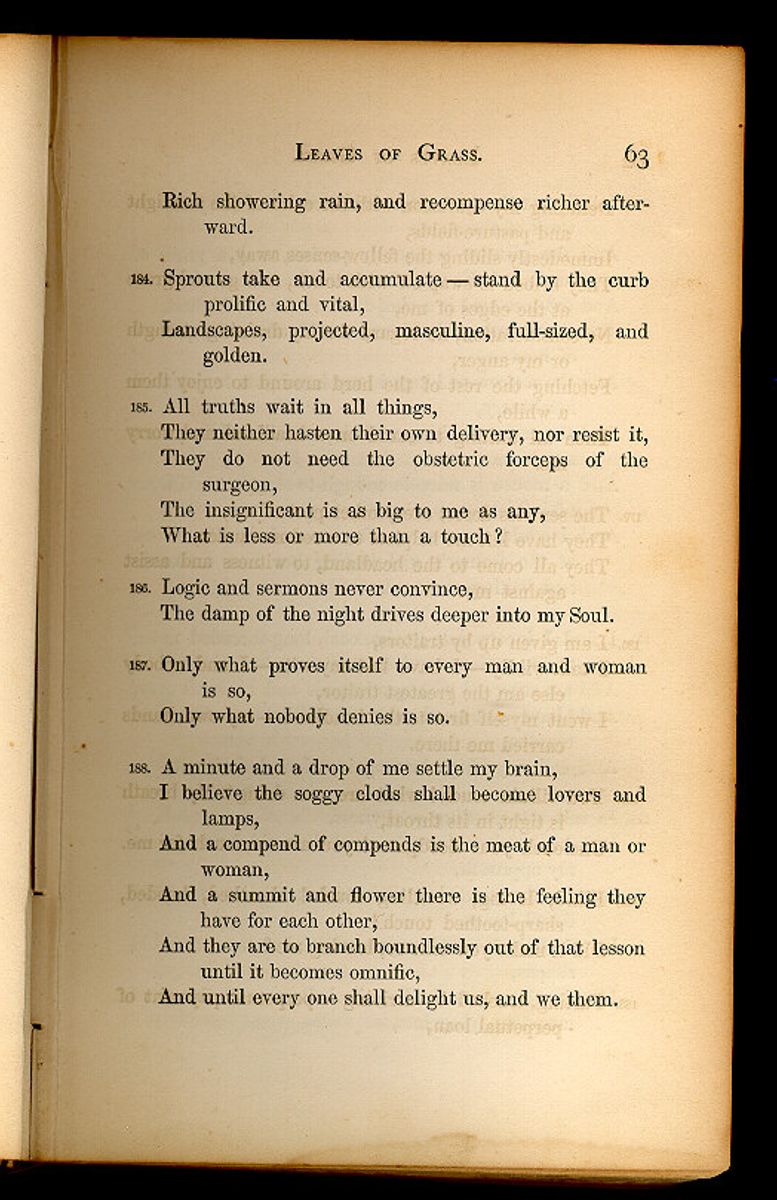 ppp.01500.071.jpg
Rich showering rain, and recompense richer after-
ppp.01500.071.jpg
Rich showering rain, and recompense richer after- ward. 184Sprouts take and accumulate—stand by the curb
prolific and vital, Landscapes, projected, masculine, full-sized, and
golden. 185All truths wait in all things, They neither hasten their own delivery, nor resist it, They do not need the obstetric forceps of the
surgeon, The insignificant is as big to me as any, What is less or more than a touch? 186Logic and sermons never convince, The damp of the night drives deeper into my Soul. 187Only what proves itself to every man and woman
is so, Only what nobody denies is so. 188A minute and a drop of me settle my brain, I believe the soggy clods shall become lovers and
lamps, And a compend of compends is the meat of a man or
woman, And a summit and flower there is the feeling they
have for each other, And they are to branch boundlessly out of that lesson
until it becomes omnific, And until every one shall delight us, and we them. [ begin page 64 ]
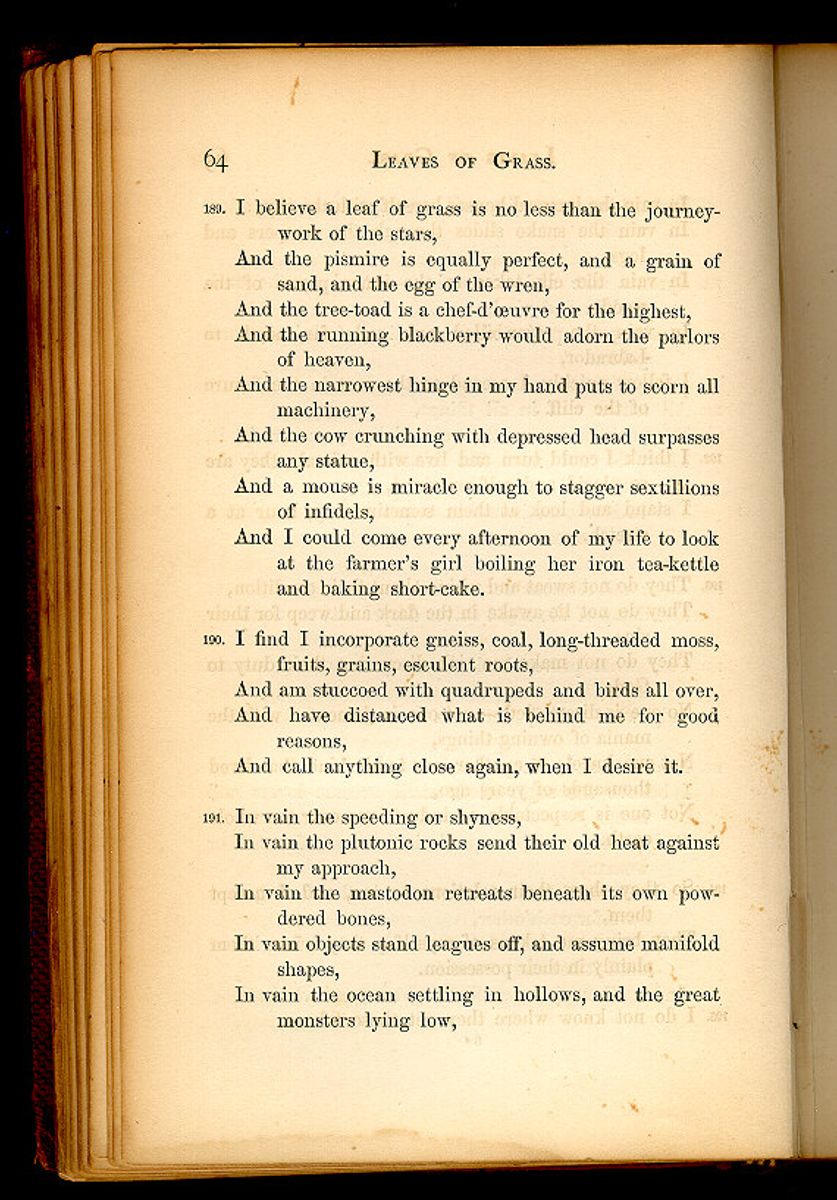 ppp.01500.072.jpg
189I believe a leaf of grass is no less than the journey-
ppp.01500.072.jpg
189I believe a leaf of grass is no less than the journey- work of the stars, And the pismire is equally perfect, and a grain of
sand, and the egg of the wren, And the tree-toad is a chef-d'œuvre for the highest, And the running blackberry would adorn the parlors
of heaven, And the narrowest hinge in my hand puts to scorn all
machinery, And the cow crunching with depressed head surpasses
any statue, And a mouse is miracle enough to stagger sextillions
of infidels, And I could come every afternoon of my life to look
at the farmer's girl boiling her iron tea-kettle
and baking short-cake. 190I find I incorporate gneiss, coal, long-threaded moss,
fruits, grains, esculent roots, And am stuccoed with quadrupeds and birds all over, And have distanced what is behind me for good
reasons, And call anything close again, when I desire it. 191In vain the speeding or shyness, In vain the plutonic rocks send their old heat against
my approach, In vain the mastodon retreats beneath its own pow-
dered bones, In vain objects stand leagues off, and assume manifold
shapes, In vain the ocean settling in hollows, and the great
monsters lying low, [ begin page 65 ]
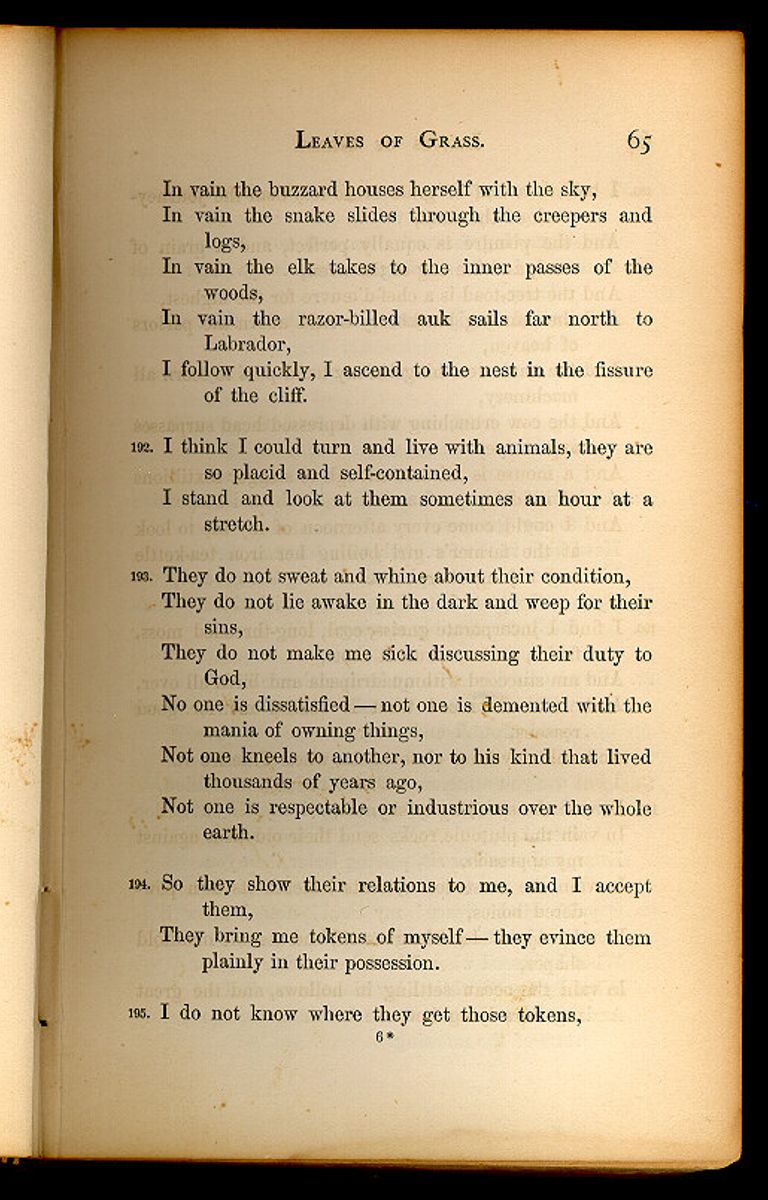 ppp.01500.073.jpg
In vain the buzzard houses herself with the sky,
In vain the snake slides through the creepers and
ppp.01500.073.jpg
In vain the buzzard houses herself with the sky,
In vain the snake slides through the creepers and logs, In vain the elk takes to the inner passes of the
woods, In vain the razor-billed auk sails far north to
Labrador, I follow quickly, I ascend to the nest in the fissure
of the cliff. 192I think I could turn and live with animals, they are
so placid and self-contained, I stand and look at them sometimes an hour at a
stretch. 193They do not sweat and whine about their condition, They do not lie awake in the dark and weep for their
sins, They do not make me sick discussing their duty to
God, No one is dissatisfied—not one is demented with the
mania of owning things, Not one kneels to another, nor to his kind that lived
thousands of years ago, Not one is respectable or industrious over the whole
earth. 194So they show their relations to me, and I accept
them, They bring me tokens of myself—they evince them
plainly in their possession. 195I do not know where they get those tokens, 6* [ begin page 66 ]
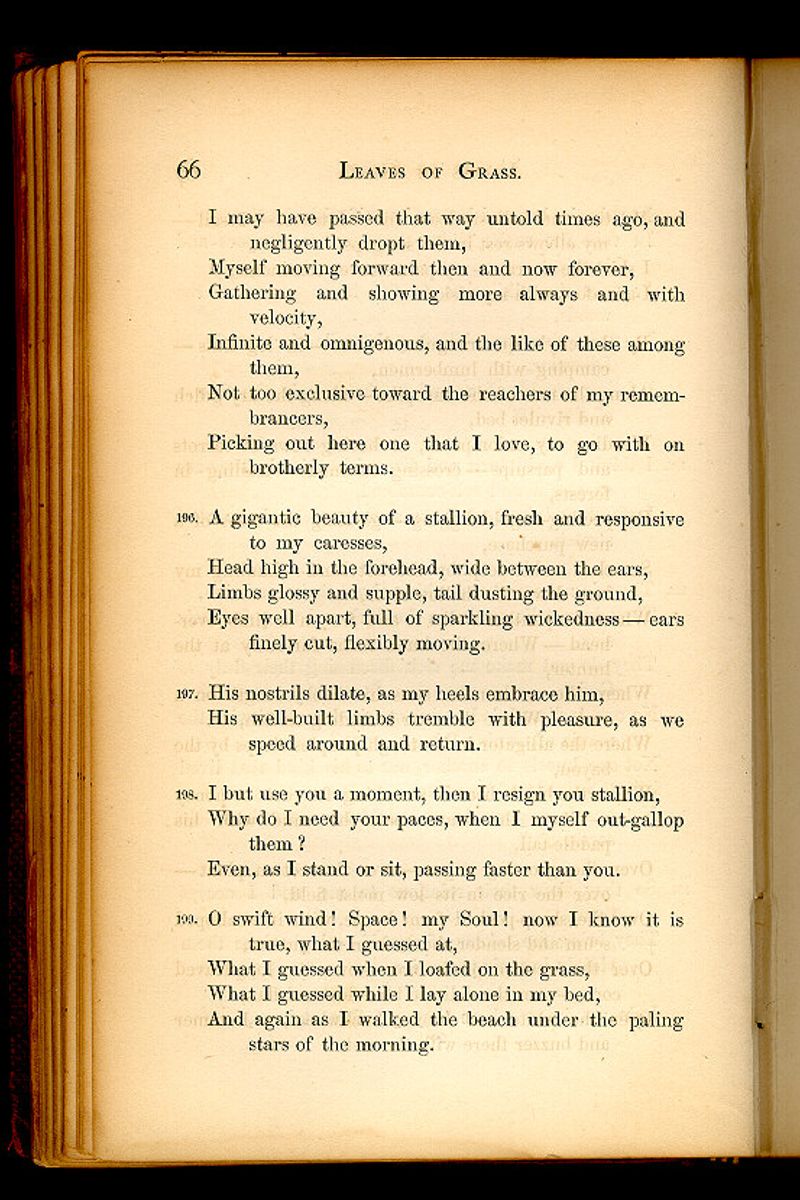 ppp.01500.074.jpg
I may have passed that way untold times ago, and
ppp.01500.074.jpg
I may have passed that way untold times ago, and negligently dropt them, Myself moving forward then and now forever, Gathering and showing more always and with
velocity, Infinite and omnigenous, and the like of these among
them, Not too exclusive toward the reachers of my remem-
brancers, Picking out here one that I love, to go with on
brotherly terms. 196A gigantic beauty of a stallion, fresh and responsive
to my caresses, Head high in the forehead, wide between the ears, Limbs glossy and supple, tail dusting the ground, Eyes well apart, full of sparkling wickedness—ears
finely cut, flexibly moving. 197His nostrils dilate, as my heels embrace him, His well-built limbs tremble with pleasure, as we
speed around and return. 198I but use you a moment, then I resign you stallion, Why do I need your paces, when I myself out-gallop
them? Even, as I stand or sit, passing faster than you. 199O swift wind! Space! my Soul! now I know it is
true, what I guessed at, What I guessed when I loafed on the grass, What I guessed while I lay alone in my bed, And again as I walked the beach under the paling
stars of the morning. [ begin page 67 ]
 ppp.01500.075.jpg
200My ties and ballasts leave me—I travel—I sail—
ppp.01500.075.jpg
200My ties and ballasts leave me—I travel—I sail— my elbows rest in the sea-gaps, I skirt the sierras—my palms cover continents, I am afoot with my vision. 201By the city's quadrangular houses—in log huts—
camping with lumbermen, Along the ruts of the turnpike—along the dry gulch
and rivulet bed, Weeding my onion-patch, or hoeing rows of carrots
and parsnips—crossing savannas—trailing in
forests, Prospecting—gold-digging—girdling the trees of a
new purchase, Scorched ankle-deep by the hot sand—hauling my
boat down the shallow river, Where the panther walks to and fro on a limb over-
head—Where the buck turns furiously at the
hunter, Where the rattlesnake suns his flabby length on a
rock—Where the otter is feeding on fish, Where the alligator in his tough pimples sleeps by the
bayou, Where the black bear is searching for roots or honey
—Where the beaver pats the mud with his
paddle-tail, Over the growing sugar—over the cotton plant—
over the rice in its low moist field, Over the sharp-peaked farm house, with its scalloped
scum and slender shoots from the gutters, Over the western persimmon—over the long-leaved
corn—over the delicate blue-flowered flax, Over the white and brown buckwheat, a hummer
and buzzer there with the rest, [ begin page 68 ]
 ppp.01500.076.jpg
Over the dusky green of the rye as it ripples and
ppp.01500.076.jpg
Over the dusky green of the rye as it ripples and shades in the breeze, Scaling mountains, pulling myself cautiously up,
holding on by low scragged limbs, Walking the path worn in the grass and beat through
the leaves of the brush, Where the quail is whistling betwixt the woods and
the wheat-lot, Where the bat flies in the Seventh Month eve— Where the great gold-bug drops through the
dark, Where the flails keep time on the barn floor, Where the brook puts out of the roots of the old tree
and flows to the meadow, Where cattle stand and shake away flies with the
tremulous shuddering of their hides, Where the cheese-cloth hangs in the kitchen—Where
andirons straddle the hearth-slab—Where cob-
webs fall in festoons from the rafters, Where trip-hammers crash—Where the press is
whirling its cylinders, Wherever the human heart beats with terrible throes
out of its ribs, Where the pear-shaped balloon is floating aloft, float-
ing in it myself and looking composedly down, Where the life-car is drawn on the slip-noose—Where
the heat hatches pale-green eggs in the dented
sand, Where the she-whale swims with her calf, and never
forsakes it, Where the steam-ship trails hind-ways its long pen-
nant of smoke, Where the fin of the shark cuts like a black chip out
of the water, [ begin page 69 ]
 ppp.01500.077.jpg
Where the half-burned brig is riding on unknown
ppp.01500.077.jpg
Where the half-burned brig is riding on unknown currents, Where shells grow to her slimy deck—Where the
dead are corrupting below, Where the striped and starred flag is borne at the
head of the regiments, Approaching Manhattan, up by the long-stretching
island, Under Niagara, the cataract falling like a veil over
my countenance, Upon a door-step—upon the horse-block of hard
wood outside, Upon the race-course, or enjoying picnics or jigs, or
a good game of base-ball, At he-festivals, with blackguard gibes, ironical license,
bull-dances, drinking, laughter, At the cider-mill, tasting the sweet of the brown
sqush, sucking the juice through a straw, At apple-peelings, wanting kisses for all the red fruit
I find, At musters, beach-parties, friendly bees, huskings,
house-raisings; Where the mocking-bird sounds his delicious gur-
gles, cackles, screams, weeps, Where the hay-rick stands in the barn-yard—Where
the dry-stalks are scattered—Where the brood
cow waits in the hovel, Where the bull advances to do his masculine work—
Where the stud to the mare—Where the cock
is treading the hen, Where heifers browse—Where geese nip their food
with short jerks, Where sun-down shadows lengthen over the limitless
and lonesome prairie, [ begin page 70 ]
 ppp.01500.078.jpg
Where herds of buffalo make a crawling spread of
ppp.01500.078.jpg
Where herds of buffalo make a crawling spread of the square miles far and near, Where the humming-bird shimmers—Where the
neck of the long-lived swan is curving and
winding, Where the laughing-gull scoots by the shore, where
she laughs her near-human laugh, Where bee-hives range on a gray bench in the garden,
half hid by the high weeds, Where band-necked partridges roost in a ring on the
ground with their heads out, Where burial coaches enter the arched gates of a
cemetery, Where winter wolves bark amid wastes of snow and
icicled trees, Where the yellow-crowned heron comes to the edge of
the marsh at night and feeds upon small crabs, Where the splash of swimmers and divers cools the
warm noon, Where the katy-did works her chromatic reed on the
walnut-tree over the well, Through patches of citrons and cucumbers with
silver-wired leaves, Through the salt-lick or orange glade, or under con-
ical firs, Through the gymnasium—through the curtained
saloon—through the office or public hall, Pleased with the native, and pleased with the foreign
—pleased with the new and old, Pleased with women, the homely as well as the
handsome, Pleased with the quakeress as she puts off her bonnet
and talks melodiously, [ begin page 71 ]
 ppp.01500.079.jpg
Pleased with the tunes of the choir of the white-
ppp.01500.079.jpg
Pleased with the tunes of the choir of the white- washed church, Pleased with the earnest words of the sweating
Methodist preacher, or any preacher—Impressed
seriously at the camp-meeting, Looking in at the shop-windows of Broadway the
whole forenoon—flatting the flesh of my nose
on the thick plate-glass, Wandering the same afternoon with my face turned
up to the clouds, My right and left arms round the sides of two
friends, and I in the middle; Coming home with the silent and dark-cheeked
bush-boy—riding behind him at the drape of
the day, Far from the settlements, studying the print of ani-
mals' feet, or the moccason print, By the cot in the hospital, reaching lemonade to a
feverish patient, By the coffined corpse when all is still, examining
with a candle, Voyaging to every port, to dicker and adventure, Hurrying with the modern crowd, as eager and fickle
as any, Hot toward one I hate, ready in my madness to knife
him, Solitary at midnight in my back yard, my thoughts
gone from me a long while, Walking the old hills of Judea, with the beautiful
gentle God by my side, Speeding through space—speeding through heaven
and the stars, [ begin page 72 ]
 ppp.01500.080.jpg
Speeding amid the seven satellites, and the broad
ppp.01500.080.jpg
Speeding amid the seven satellites, and the broad ring, and the diameter of eighty thousand miles, Speeding with tailed meteors—throwing fire-balls
like the rest, Carrying the crescent child that carries its own full
mother in its belly, Storming, enjoying, planning, loving, cautioning, Backing and filling, appearing and disappearing, I tread day and night such roads. 202I visit the orchards of spheres, and look at the product, And look at quintillions ripened, and look at quin-
tillions green. 203I fly the flight of the fluid and swallowing soul, My course runs below the soundings of plummets. 204I help myself to material and immaterial, No guard can shut me off, nor law prevent me. 205I anchor my ship for a little while only, My messengers continually cruise away, or bring their
returns to me. 206I go hunting polar furs and the seal—Leaping
chasms with a pike-pointed staff—Clinging to
topples of brittle and blue. 207I ascend to the foretruck, I take my place late at night in the crow's-nest, We sail the arctic sea—it is plenty light enough, Through the clear atmosphere I stretch around on
the wonderful beauty, [ begin page 73 ]
 ppp.01500.081.jpg
The enormous masses of ice pass me, and I pass them
ppp.01500.081.jpg
The enormous masses of ice pass me, and I pass them —the scenery is plain in all directions, The white-topped mountains show in the distance—
I fling out my fancies toward them, We are approaching some great battle-field in which
we are soon to be engaged, We pass the colossal out-posts of the encampment—
we pass with still feet and caution, Or we are entering by the suburbs some vast and
ruined city, The blocks and fallen architecture more than all the
living cities of the globe. 208I am a free companion—I bivouac by invading
watchfires. 209I turn the bridegroom out of bed, and stay with the
bride myself, I tighten her all night to my thighs and lips. 210My voice is the wife's voice, the screech by the rail
of the stairs, They fetch my man's body up, dripping and drowned. 211I understand the large hearts of heroes, The courage of present times and all times, How the skipper saw the crowded and rudderless
wreck of the steam-ship, and Death chasing it up
and down the storm, How he knuckled tight, and gave not back one inch,
and was faithful of days and faithful of nights, And chalked in large letters, on a board, Be of good
cheer, We will not desert you, 7 [ begin page 74 ]
 ppp.01500.082.jpg
How he followed with them, and tacked with them—
ppp.01500.082.jpg
How he followed with them, and tacked with them— and would not give it up, How he saved the drifting company at last, How the lank loose-gowned women looked when
boated from the side of their prepared graves, How the silent old-faced infants, and the lifted sick,
and the sharp-lipped unshaved men, All this I swallow—it tastes good—I like it well—
it becomes mine, I am the man—I suffered—I was there. 212The disdain and calmness of martyrs, The mother, condemned for a witch, burnt with dry
wood, her children gazing on, The hounded slave that flags in the race, leans by the
the fence, blowing, covered with sweat, The twinges that sting like needles his legs and neck
—the murderous buck-shot and the bullets, All these I feel or am. 213I am the hounded slave, I wince at the bite of the
dogs, Hell and despair are upon me, crack and again crack
the marksmen, I clutch the rails of the fence, my gore dribs, thinned
with the ooze of my skin, I fall on the weeds and stones, The riders spur their unwilling horses, haul close, Taunt my dizzy ears, and beat me violently over the
head with whip-stocks. 214Agonies are one of my changes of garments, I do not ask the wounded person how he feels—I
myself become the wounded person, [ begin page 75 ]
 ppp.01500.083.jpg
My hurt turns livid upon me as I lean on a cane and
ppp.01500.083.jpg
My hurt turns livid upon me as I lean on a cane and observe. 215I am the mashed fireman with breastbone broken, Tumbling walls buried me in their debris, Heat and smoke I inspired—I heard the yelling
shouts of my comrades, I heard the distant click of their picks and shovels, They have cleared the beams away—they tenderly
lift me forth. 216I lie in the night air in my red shirt—the pervading
hush is for my sake, Painless after all I lie, exhausted but not so unhappy, White and beautiful are the faces around me—the
heads are bared of their fire-caps, The kneeling crowd fades with the light of the
torches. 217Distant and dead resuscitate, They show as the dial or move as the hands of me—
I am the clock myself. 218I am an old artillerist—I tell of my fort's bombard-
ment, I am there again. 219Again the reveille of drummers, Again the attacking cannon, mortars, howitzers, Again the attacked send cannon responsive. 220I take part—I see and hear the whole, The cries, curses, roar—the plaudits for well-aimed
shots, [ begin page 76 ]
 ppp.01500.084.jpg
The ambulanza slowly passing, trailing its red drip,
Workmen searching after damages, making indis-
ppp.01500.084.jpg
The ambulanza slowly passing, trailing its red drip,
Workmen searching after damages, making indis- pensable repairs, The fall of grenades through the rent roof—the
fan-shaped explosion, The whizz of limbs, heads, stone, wood, iron, high in
the air. 221Again gurgles the mouth of my dying general—he
furiously waves with his hand, He gasps through the clot, Mind not me—mind—
the entrenchments. 222I tell not the fall of Alamo, Not one escaped to tell the fall of Alamo, The hundred and fifty are dumb yet at Alamo. 223Hear now the tale of the murder in cold blood of four
hundred and twelve young men. 224Retreating, they had formed in a hollow square, with
their baggage for breastworks, Nine hundred lives out of the surrounding enemy's,
nine times their number, was the price they took
in advance, Their colonel was wounded and their ammunition
gone, They treated for an honorable capitulation, received
writing and seal, gave up their arms, and
marched back prisoners of war. 225They were the glory of the race of rangers, Matchless with horse, rifle, song, supper, courtship, [ begin page 77 ]
 ppp.01500.085.jpg
Large, turbulent, generous, brave, handsome, proud,
ppp.01500.085.jpg
Large, turbulent, generous, brave, handsome, proud, and affectionate, Bearded, sunburnt, dressed in the free costume of
hunters, Not a single one over thirty years of age. 226The second First Day morning they were brought out
in squads and massacred—it was beautiful early
summer, The work commenced about five o'clock, and was over
by eight. 227None obeyed the command to kneel, Some made a mad and helpless rush—some stood
stark and straight, A few fell at once, shot in the temple or heart—the
living and dead lay together, The maimed and mangled dug in the dirt—the new-
comers saw them there, Some, half-killed, attempted to crawl away, These were despatched with bayonets, or battered with
the blunts of muskets, A youth not seventeen years old seized his assassin till
two more came to release him, The three were all torn, and covered with the boy's
blood. 228At eleven o'clock began the burning of the bodies: That is the tale of the murder of the four hundred
and twelve young men. 229Did you read in the sea-books of the old-fashioned
frigate-fight? 7* [ begin page 78 ]
 ppp.01500.086.jpg
Did you learn who won by the light of the moon and
ppp.01500.086.jpg
Did you learn who won by the light of the moon and stars? 230Our foe was no skulk in his ship, I tell you, His was the English pluck—and there is no tougher
or truer, and never was, and never will be; Along the lowered eve he came, horribly raking us. 231We closed with him—the yards entangled—the
cannon touched, My captain lashed fast with his own hands. 232We had received some eighteen-pound shots under
the water, On our lower-gun-deck two large pieces had burst at
the first fire, killing all around, and blowing up
overhead. 233Ten o'clock at night, and the full moon shining, and
the leaks on the gain, and five feet of water
reported, The master-at-arms loosing the prisoners confined in
the after-hold, to give them a chance for them-
selves. 234The transit to and from the magazine was now
stopped by the sentinels, They saw so many strange faces, they did not know
whom to trust. 235Our frigate was afire, The other asked if we demanded quarter? If our colors were struck, and the fighting done? [ begin page 79 ]
 ppp.01500.087.jpg
236I laughed content when I heard the voice of my little
ppp.01500.087.jpg
236I laughed content when I heard the voice of my little captain, We have not struck, he composedly cried, We have
just begun our part of the fighting. 237Only three guns were in use, One was directed by the captain himself against the
enemy's main-mast, Two, well served with grape and canister, silenced his
musketry and cleared his decks. 238The tops alone seconded the fire of this little battery,
especially the main-top, They all held out bravely during the whole of the
action. 239Not a moment's cease, The leaks gained fast on the pumps—the fire eat
toward the powder-magazine, One of the pumps was shot away—it was generally
thought we were sinking. 240Serene stood the little captain, He was not hurried—his voice was neither high
nor low, His eyes gave more light to us than our battle-
lanterns. 241Toward twelve at night, there in the beams of the
moon, they surrendered to us. 242Stretched and still lay the midnight, Two great hulls motionless on the breast of the
darkness, [ begin page 80 ]
 ppp.01500.088.jpg
Our vessel riddled and slowly sinking—preparations
ppp.01500.088.jpg
Our vessel riddled and slowly sinking—preparations to pass to the one we had conquered, The captain on the quarter-deck coldly giving his
orders through a countenance white as a sheet, Near by, the corpse of the child that served in the
cabin, The dead face of an old salt with long white hair and
carefully curled whiskers, The flames, spite of all that could be done, flickering
aloft and below, The husky voices of the two or three officers yet fit
for duty, Formless stacks of bodies, and bodies by themselves
—dabs of flesh upon the masts and spars, Cut of cordage, dangle of rigging, slight shock of the
soothe of waves, Black and impassive guns, litter of powder-parcels,
strong scent, Delicate sniffs of sea-breeze, smells of sedgy grass and
fields by the shore, death-messages given in
charge to survivors, The hiss of the surgeon's knife, the gnawing teeth of
his saw, Wheeze, cluck, swash of falling blood, short wild
scream, and long dull tapering groan, These so—these irretrievable. 243O Christ! This is mastering me! Through the conquered doors they crowd. I am
possessed. 244What the rebel said, gayly adjusting his throat to the
rope-noose, [ begin page 81 ]
 ppp.01500.089.jpg
What the savage at the stump, his eye-sockets empty,
ppp.01500.089.jpg
What the savage at the stump, his eye-sockets empty, his mouth spirting whoops and defiance, What stills the traveller come to the vault at Mount
Vernon, What sobers the Brooklyn boy as he looks down the
shores of the Wallabout and remembers the
Prison Ships, What burnt the gums of the red-coat at Saratoga
when he surrendered his brigades, These become mine and me every one—and they are
but little, I become as much more as I like. 245I become any presence or truth of humanity here, See myself in prison shaped like another man, And feel the dull unintermitted pain. 246For me the keepers of convicts shoulder their
carbines and keep watch, It is I let out in the morning and barred at night. 247Not a mutineer walks hand-cuffed to the jail, but I
am hand-cuffed to him and walk by his side, I am less the jolly one there, and more the silent one,
with sweat on my twitching lips. 248Not a youngster is taken for larceny, but I go up too,
and am tried and sentenced. 249Not a cholera patient lies at the last gasp, but I also
lie at the last gasp, My face is ash-colored—my sinews gnarl—away
from me people retreat. [ begin page 82 ]
 ppp.01500.090.jpg
250Askers embody themselves in me, and I am embodied
ppp.01500.090.jpg
250Askers embody themselves in me, and I am embodied in them, I project my hat, sit shame-faced, and beg. 251Enough—I bring such to a close, Rise extatic through all, sweep with the true gravita-
tion, The whirling and whirling elemental within me. 252Somehow I have been stunned. Stand back! Give me a little time beyond my cuffed head, slum-
bers, dreams, gaping, I discover myself on the verge of a usual mistake. 253That I could forget the mockers and insults! That I could forget the trickling tears, and the blows
of the bludgeons and hammers! That I could look with a separate look on my own
crucifixion and bloody crowning. 254I remember now, I resume the overstaid fraction, The grave of rock multiplies what has been confided
to it, or to any graves, Corpses rise, gashes heal, fastenings roll from me. 255I troop forth replenished with supreme power, one of
an average unending procession, We walk the roads of the six North Eastern States,
and of Virginia, Wisconsin, Manhattan Island,
Philadelphia, New Orleans, Texas, Charleston,
Havana, Mexico, Inland and by the sea-coast and boundary lines, and
we pass all boundary lines. [ begin page 83 ]
 ppp.01500.091.jpg
256Our swift ordinances are on their way over the whole
ppp.01500.091.jpg
256Our swift ordinances are on their way over the whole earth, The blossoms we wear in our hats are the growth of
two thousand years. 257Élèves, I salute you! I see the approach of your numberless gangs—I see
you understand yourselves and me, And know that they who have eyes and can walk are
divine, and the blind and lame are equally divine, And that my steps drag behind yours, yet go before
them, And are aware how I am with you no more than I am
with everybody. 258The friendly and flowing savage, Who is he? Is he waiting for civilization, or past it and master-
ing it? 259Is he some south-westerner, raised out-doors? Is he
Kanadian? Is he from the Mississippi country? Iowa, Oregon,
California? the mountains? prairie-life, bush-
life? or from the sea? 260Wherever he goes men and women accept and desire
him, They desire he should like them, touch them, speak
to them, stay with them. 261Behavior lawless as snow-flakes, words simple as
grass, uncombed head, laughter, and näveté, Slow-stepping feet, common features, common modes
and emanations, [ begin page 84 ]
 ppp.01500.092.jpg
They descend in new forms from the tips of his
ppp.01500.092.jpg
They descend in new forms from the tips of his fingers, They are wafted with the odor of his body or breath
—they fly out of the glance of his eyes. 262Flaunt of the sunshine, I need not your bask,—lie
over! You light surfaces only—I force surfaces and depths
also. Earth! you seem to look for something at my hands, Say, old Top-knot! what do you want? 263Man or woman! I might tell how I like you, but
cannot, And might tell what it is in me, and what it is in
you, but cannot, And might tell that pining I have—that pulse of my
nights and days. 264Behold! I do not give lectures or a little charity, What I give, I give out of myself. 265You there, impotent, loose in the knees, Open your scarfed chops till I blow grit within you, Spread your palms, and lift the flaps of your pockets; I am not to be denied—I compel—I have stores
plenty and to spare, And anything I have I bestow. 266I do not ask who you are—that is not important to
me, You can do nothing, and be nothing, but what I will
infold you. [ begin page 85 ]
 ppp.01500.093.jpg
267To a drudge of the cotton-fields or cleaner of privies
ppp.01500.093.jpg
267To a drudge of the cotton-fields or cleaner of privies I lean, On his right cheek I put the family kiss, And in my soul I swear, I never will deny him. 268On women fit for conception I start bigger and nim-
bler babes, This day I am jetting the stuff of far more arrogant
republics. 269To any one dying—thither I speed, and twist the
knob of the door, Turn the bed-clothes toward the foot of the bed, Let the physician and the priest go home. 270I seize the descending man, and raise him with resist-
less will. 271O despairer, here is my neck, By God! you shall not go down! Hang your whole
weight upon me. 272I dilate you with tremendous breath—I buoy you up, Every room of the house do I fill with an armed force, Lovers of me, bafflers of graves. 273Sleep! I and they keep guard all night, Not doubt—not decease shall dare to lay finger upon
you, I have embraced you, and henceforth possess you to
myself, And when you rise in the morning you will find what
I tell you is so. 8 [ begin page 86 ]
 ppp.01500.094.jpg
274I am he bringing help for the sick as they pant on
ppp.01500.094.jpg
274I am he bringing help for the sick as they pant on their backs, And for strong upright men I bring yet more needed
help. 275I heard what was said of the universe, Heard it and heard it of several thousand years; It is middling well as far as it goes,—But is that all? 276Magnifying and applying come I, Outbidding at the start the old cautious hucksters, The most they offer for mankind and eternity less
than a spirt of my own seminal wet, Taking myself the exact dimensions of Jehovah, Lithographing Kronos, Zeus his son, and Hercules
his grandson, Buying drafts of Osiris, Isis, Belus, Brahma, Buddha, In my portfolio placing Manito loose, Allah on a leaf,
the crucifix engraved, With Odin, and the hideous-faced Mexitli, and every
idol and image, Taking them all for what they are worth, and not a
cent more, Admitting they were alive and did the work of their
day, Admitting they bore mites, as for unfledged birds,
who have now to rise and fly and sing for them-
selves, Accepting the rough deific sketches to fill out better
in myself—bestowing them freely on each man
and woman I see, Discovering as much, or more, in a framer framing a
house, [ begin page 87 ]
 ppp.01500.095.jpg
Putting higher claims for him there with his rolled-
ppp.01500.095.jpg
Putting higher claims for him there with his rolled- up sleeves, driving the mallet and chisel, Not objecting to special revelations—considering a
curl of smoke or a hair on the back of my hand
just as curious as any revelation, Those ahold of fire engines and hook-and-ladder ropes
no less to me than the Gods of the antique wars, Minding their voices peal through the crash of
destruction, Their brawny limbs passing safe over charred laths—
their white foreheads whole and unhurt out of
the flames; By the mechanic's wife with her babe at her nipple
interceding for every person born, Three scythes at harvest whizzing in a row from
three lusty angels with shirts bagged out at
their waists, The snag-toothed hostler with red hair redeeming sins
past and to come, Selling all he possesses, travelling on foot to fee
lawyers for his brother, and sit by him while he
is tried for forgery; What was strewn in the amplest strewing the square
rod about me, and not filling the square rod
then, The bull and the bug never worshipped half enough, Dung and dirt more admirable than was dreamed, The supernatural of no account—myself waiting my
time to be one of the Supremes, The day getting ready for me when I shall do as
much good as the best, and be as prodigious, Guessing when I am it will not tickle me much to
receive puffs out of pulpit or print; [ begin page 88 ]
 ppp.01500.096.jpg
By my life-lumps! becoming already a creator,
Putting myself here and now to the ambushed womb
ppp.01500.096.jpg
By my life-lumps! becoming already a creator,
Putting myself here and now to the ambushed womb of the shadows. 277A call in the midst of the crowd, My own voice, orotund, sweeping, final. 278Come my children, Come my boys and girls, my women, household,
and intimates, Now the performer launches his nerve—he has
passed his prelude on the reeds within. 279Easily written, loose-fingered chords! I feel the thrum
of their climax and close. 280My head slues round on my neck, Music rolls, but not from the organ, Folks are around me, but they are no household of
mine. 281Ever the hard unsunk ground, Ever the eaters and drinkers—Ever the upward
and downward sun—Ever the air and the cease-
less tides, Ever myself and my neighbors, refreshing, wicked,
real, Ever the old inexplicable query—Ever that thorned
thumb—that breath of itches and thirsts, Ever the vexer's hoot! hoot! till we find where the
sly one hides, and bring him forth; Ever love—Ever the sobbing liquid of life, Ever the bandage under the chin—Ever the tressels
of death. [ begin page 89 ]
 ppp.01500.097.jpg
282Here and there, with dimes on the eyes walking,
To feed the greed of the belly, the brains liberally
ppp.01500.097.jpg
282Here and there, with dimes on the eyes walking,
To feed the greed of the belly, the brains liberally spooning, Tickets buying, taking, selling, but in to the feast
never once going, Many sweating, ploughing, thrashing, and then the
chaff for payment receiving, A few idly owning, and they the wheat continually
claiming. 283This is the city, and I am one of the citizens, Whatever interests the rest interests me—politics,
markets, newspapers, schools, Benevolent societies, improvements, banks, tariffs,
steamships, factories, stocks, stores, real estate,
and personal estate. 284They who piddle and patter here in collars and tailed
coats—I am aware who they are—they are not
worms or fleas. 285I acknowledge the duplicates of myself—the weakest
and shallowest is deathless with me, What I do and say, the same waits for them, Every thought that flounders in me, the same floun-
ders in them. 286I know perfectly well my own egotism, I know my omnivorous words, and cannot say any
less, And would fetch you, whoever you are, flush with
myself. 8* [ begin page 90 ]
 ppp.01500.098.jpg
287My words are words of a questioning, and to indicate
ppp.01500.098.jpg
287My words are words of a questioning, and to indicate reality and motive power: This printed and bound book—but the printer, and
the printing-office boy? The well-taken photographs—but your wife or friend
close and solid in your arms? The fleet of ships of the line, and all the modern
improvements—but the craft and pluck of the
admiral? The dishes and fare and furniture—but the host and
hostess, and the look out of their eyes? The sky up there—yet here, or next door, or across
the way? The saints and sages in history—but you yourself? Sermons, creeds, theology—but the human brain,
and what is reason? and what is love? and what
is life? 288I do not despise you, priests, My faith is the greatest of faiths, and the least of
faiths, Enclosing all worship ancient and modern, and all
between ancient and modern, Believing I shall come again upon the earth after
five thousand years, Waiting responses from oracles, honoring the Gods,
saluting the sun, Making a fetish of the first rock or stump, powwowing
with sticks in the circle of obis, Helping the lama or brahmin as he trims the lamps
of the idols, Dancing yet through the streets in a phallic pro-
cession—rapt and austere in the woods, a
gymnosophist, [ begin page 91 ]
 ppp.01500.099.jpg
Drinking mead from the skull-cup—to Shastas and
ppp.01500.099.jpg
Drinking mead from the skull-cup—to Shastas and Vedas admirant—minding the Koran, Walking the teokallis, spotted with gore from the
stone and knife, beating the serpent-skin drum, Accepting the Gospels—accepting him that was
crucified, knowing assuredly that he is divine, To the mass kneeling, or the puritan's prayer rising,
or sitting patiently in a pew, Ranting and frothing in my insane crisis, or waiting
dead-like till my spirit arouses me, Looking forth on pavement and land, or outside of
pavement and land, Belonging to the winders of the circuit of circuits. 289One of that centripetal and centrifugal gang, I turn
and talk like a man leaving charges before a
journey. 290Down-hearted doubters, dull and excluded, Frivolous, sullen, moping, angry, affected, disheart-
ened, atheistical, I know every one of you—I know the unspoken
interrogatories, By experience I know them. 291How the flukes splash! How they contort, rapid as lightning, with spasms,
and spouts of blood! 292Be at peace, bloody flukes of doubters and sullen
mopers, I take my place among you as much as among any, The past is the push of you, me, all, precisely the
same, [ begin page 92 ]
 ppp.01500.100.jpg
Day and night are for you, me, all,
And what is yet untried and afterward is for you,
ppp.01500.100.jpg
Day and night are for you, me, all,
And what is yet untried and afterward is for you, me, all, precisely the same. 293I do not know what is untried and afterward, But I know it is sure, alive, sufficient. 294Each who passes is considered—Each who stops is
considered—Not a single one can it fail. 295It cannot fail the young man who died and was
buried, Nor the young woman who died and was put by his
side, Nor the little child that peeped in at the door, and
then drew back, and was never seen again, Nor the old man who has lived without purpose, and
feels it with bitterness worse than gall, Nor him in the poor-house, tubercled by rum and
the bad disorder, Nor the numberless slaughtered and wrecked—nor
the brutish koboo called the ordure of humanity, Nor the sacs merely floating with open mouths for
food to slip in, Nor anything in the earth, or down in the oldest
graves of the earth, Nor anything in the myriads of spheres—nor one of
the myriads of myriads that inhabit them, Nor the present—nor the least wisp that is known. 296It is time to explain myself—Let us stand up. 297What is known I strip away, I launch all men and women forward with me into
THE UNKNOWN. [ begin page 93 ]
 ppp.01500.101.jpg
298The clock indicates the moment—but what does
ppp.01500.101.jpg
298The clock indicates the moment—but what does eternity indicate? 299We have thus far exhausted trillions of winters and
summers, There are trillions ahead, and trillions ahead of them. 300Births have brought us richness and variety, And other births will bring us richness and variety. 301I do not call one greater and one smaller, That which fills its period and place is equal to any. 302Were mankind murderous or jealous upon you, my
brother, my sister? I am sorry for you—they are not murderous or jeal-
ous upon me, All has been gentle with me—I keep no account
with lamentation, (What have I to do with lamentation?) 303I am an acme of things accomplished, and I an
encloser of things to be. 304My feet strike an apex of the apices of the stairs, On every step bunches of ages, and larger bunches
between the steps, All below duly travelled, and still I mount and mount. 305Rise after rise bow the phantoms behind me, Afar down I see the huge first Nothing—I know I
was even there, I waited unseen and always, and slept through the
lethargic mist, [ begin page 94 ]
 ppp.01500.102.jpg
And took my time, and took no hurt from the fetid
ppp.01500.102.jpg
And took my time, and took no hurt from the fetid carbon. 306Long I was hugged close—long and long. 307Immense have been the preparations for me, Faithful and friendly the arms that have helped me. 308Cycles ferried my cradle, rowing and rowing like
cheerful boatmen, For room to me stars kept aside in their own rings, They sent influences to look after what was to
hold me. 309Before I was born out of my mother, generations
guided me, My embryo has never been torpid—nothing could
overlay it. 310For it the nebula cohered to an orb, The long slow strata piled to rest it on, Vast vegetables gave it sustenance, Monstrous sauroids transported it in their mouths,
and deposited it with care. 311All forces have been steadily employed to complete
and delight me, Now I stand on this spot with my Soul. 312O span of youth! Ever-pushed elasticity! O manhood, balanced, florid, and full. 313My lovers suffocate me! Crowding my lips, thick in the pores of my skin, Jostling me through streets and public halls—
coming naked to me at night, [ begin page 95 ]
 ppp.01500.103.jpg
Crying by day Ahoy! from the rocks of the river
ppp.01500.103.jpg
Crying by day Ahoy! from the rocks of the river —swinging and chirping over my head, Calling my name from flower-beds, vines, tangled
under-brush, Or while I swim in the bath, or drink from the pump
at the corner—or the curtain is down at the
opera, or I glimpse at a woman's face in the
railroad car, Lighting on every moment of my life, Bussing my body with soft balsamic busses, Noiselessly passing handfuls out of their hearts, and
giving them to be mine. 314Old age superbly rising! O welcome, ineffable grace
of dying days! 315Every condition promulges not only itself—it pro-
mulges what grows after and out of itself, And the dark hush promulges as much as any. 316I open my scuttle at night and see the far-sprinkled
systems, And all I see, multiplied as high as I can cipher, edge
but the rim of the farther systems. 317Wider and wider they spread, expanding, always
expanding, Outward, outward, and forever outward. 318My sun has his sun, and round him obediently
wheels, He joins with his partners a group of superior circuit, And greater sets follow, making specks of the greatest
inside them. [ begin page 96 ]
 ppp.01500.104.jpg
319There is no stoppage, and never can be stoppage,
If I, you, the worlds, all beneath or upon their sur-
ppp.01500.104.jpg
319There is no stoppage, and never can be stoppage,
If I, you, the worlds, all beneath or upon their sur- faces, and all the palpable life, were this moment
reduced back to a pallid float, it would not avail
in the long run, We should surely bring up again where we now
stand, And as surely go as much farther—and then farther
and farther. 320A few quadrillions of eras, a few octillions of cubic
leagues, do not hazard the span, or make it
impatient, They are but parts—anything is but a part. 321See ever so far, there is limitless space outside
of that, Count ever so much, there is limitless time around
that. 322My rendezvous is appointed, The Lord will be there, and wait till I come on per-
fect terms. 323I know I have the best of time and space, and was
never measured, and never will be measured. 324I tramp a perpetual journey, My signs are a rain-proof coat, good shoes, and a staff
cut from the woods, No friend of mine takes his ease in my chair, I have no chair, no church, no philosophy, I lead no man to a dinner-table, library, or exchange, [ begin page 97 ]
 ppp.01500.105.jpg
But each man and each woman of you I lead upon
ppp.01500.105.jpg
But each man and each woman of you I lead upon a knoll, My left hand hooking you round the waist, My right hand pointing to landscapes of continents,
and a plain public road. 325Not I—not any one else, can travel that road for
you, You must travel it for yourself. 326It is not far—it is within reach, Perhaps you have been on it since you were born,
and did not know, Perhaps it is every where on water and on land. 327Shoulder your duds, and I will mine, and let us
hasten forth, Wonderful cities and free nations we shall fetch as
we go. 328If you tire, give me both burdens, and rest the chuff
of your hand on my hip, And in due time you shall repay the same service
to me, For after we start we never lie by again. 329This day before dawn I ascended a hill, and looked
at the crowded heaven, And I said to my Spirit, When we become the
enfolders of those orbs, and the pleasure and
knowledge of everything in them, shall we be
filled and satisfied then? And my Spirit said No, we level that lift, to pass and
continue beyond. 9 [ begin page 98 ]
 ppp.01500.106.jpg
330You are also asking me questions, and I hear you,
I answer that I cannot answer—you must find out
ppp.01500.106.jpg
330You are also asking me questions, and I hear you,
I answer that I cannot answer—you must find out for yourself. 331Sit a while, wayfarer, Here are biscuits to eat, and here is milk to drink, But as soon as you sleep, and renew yourself in
sweet clothes, I will certainly kiss you with my
good-bye kiss, and open the gate for your egress
hence. 332Long enough have you dreamed contemptible dreams, Now I wash the gum from your eyes, You must habit yourself to the dazzle of the light,
and of every moment of your life. 333Long have you timidly waded, holding a plank by
the shore, Now I will you to be a bold swimmer, To jump off in the midst of the sea, rise again, nod
to me, shout, and laughingly dash with your hair. 334I am the teacher of athletes, He that by me spreads a wider breast than my own,
proves the width of my own, He most honors my style who learns under it to
destroy the teacher. 335The boy I love, the same becomes a man, not through
derived power, but in his own right, Wicked, rather than virtuous out of conformity or
fear, Fond of his sweetheart, relishing well his steak, [ begin page 99 ]
 ppp.01500.107.jpg
Unrequited love, or a slight, cutting him worse than
ppp.01500.107.jpg
Unrequited love, or a slight, cutting him worse than a wound cuts, First rate to ride, to fight, to hit the bull's-eye, to
sail a skiff, to sing a song, or play on the banjo, Preferring scars, and faces pitted with small-pox, over
all latherers, and those that keep out of the sun. 336I teach straying from me—yet who can stray from
me? I follow you, whoever you are, from the present
hour, My words itch at your ears till you understand
them. 337I do not say these things for a dollar, or to fill up
the time while I wait for a boat, It is you talking just as much as myself—I act as
the tongue of you, Tied in your mouth, in mine it begins to be loosened. 338I swear I will never again mention love or death
inside a house, And I swear I will never translate myself at all, only
to him or her who privately stays with me in
the open air. 339If you would understand me, go to the heights or
water-shore, The nearest gnat is an explanation, and a drop or
motion of waves a key, The maul, the oar, the hand-saw, second my words. 340No shuttered room or school can commune with me, But roughs and little children better than they. [ begin page 100 ]
 ppp.01500.108.jpg
341The young mechanic is closest to me—he knows me
ppp.01500.108.jpg
341The young mechanic is closest to me—he knows me pretty well, The woodman, that takes his axe and jug with him,
shall take me with him all day, The farm-boy, ploughing in the field, feels good at the
sound of my voice, In vessels that sail, my words sail—I go with fisher-
men and seamen, and love them. 342My face rubs to the hunter's face, when he lies down
alone in his blanket, The driver, thinking of me, does not mind the jolt
of his wagon, The young mother and old mother comprehend me, The girl and the wife rest the needle a moment, and
forget where they are, They and all would resume what I have told them. 343I have said that the Soul is not more than the
body, And I have said that the body is not more than
the Soul, And nothing, not God, is greater to one than one's
self is. And whoever walks a furlong without sympathy,
walks to his own funeral, dressed in his shroud, And I or you, pocketless of a dime, may purchase
the pick of the earth, And to glance with an eye, or show a bean in its
pod, confounds the learning of all times, And there is no trade or employment but the young
man following it may become a hero, [ begin page 101 ]
 ppp.01500.109.jpg
And there is no object so soft but it makes a hub
ppp.01500.109.jpg
And there is no object so soft but it makes a hub for the wheeled universe, And any man or woman shall stand cool and
supercilious before a million universes. 344And I call to mankind, Be not curious about God, For I, who am curious about each, am not curious
about God, No array of terms can say how much I am at peace
about God, and about death. 345I hear and behold God in every object, yet under-
stand God not in the least, Nor do I understand who there can be more won-
derful than myself. 346Why should I wish to see God better than this day? I see something of God each hour of the twenty-four,
and each moment then, In the faces of men and women I see God, and in
my own face in the glass, I find letters from God dropped in the street—and
every one is signed by God's name, And I leave them where they are, for I know that
others will punctually come forever and ever. 347And as to you Death, and you bitter hug of mortality,
it is idle to try to alarm me. 348To his work without flinching the accoucheur comes, I see the elder-hand, pressing, receiving, supporting, I recline by the sills of the exquisite flexible doors,
and mark the outlet, and mark the relief and
escape. 9* [ begin page 102 ]
 ppp.01500.110.jpg
349And as to you corpse, I think you are good manure,
ppp.01500.110.jpg
349And as to you corpse, I think you are good manure, but that does not offend me, I smell the white roses sweet-scented and growing, I reach to the leafy lips—I reach to the polished
breasts of melons. 350And as to you life, I reckon you are the leavings of
many deaths, No doubt I have died myself ten thousand times
before. 351I hear you whispering there, O stars of heaven, O suns! O grass of graves! O perpetual transfers and
promotions! If you do not say anything, how can I say anything? 352Of the turbid pool that lies in the autumn forest, Of the moon that descends the steeps of the soughing
twilight, Toss, sparkles of day and dusk! toss on the black
stems that decay in the muck! Toss to the moaning gibberish of the dry limbs. 353I ascend from the moon, I ascend from the night, I perceive of the ghastly glimmer the sunbeams re-
flected, And debouch to the steady and central from the
offspring great or small. 354There is that in me—I do not know what it is—but
I know it is in me. 355Wrenched and sweaty—calm and cool then my body
becomes, I sleep—I sleep long. [ begin page 103 ]
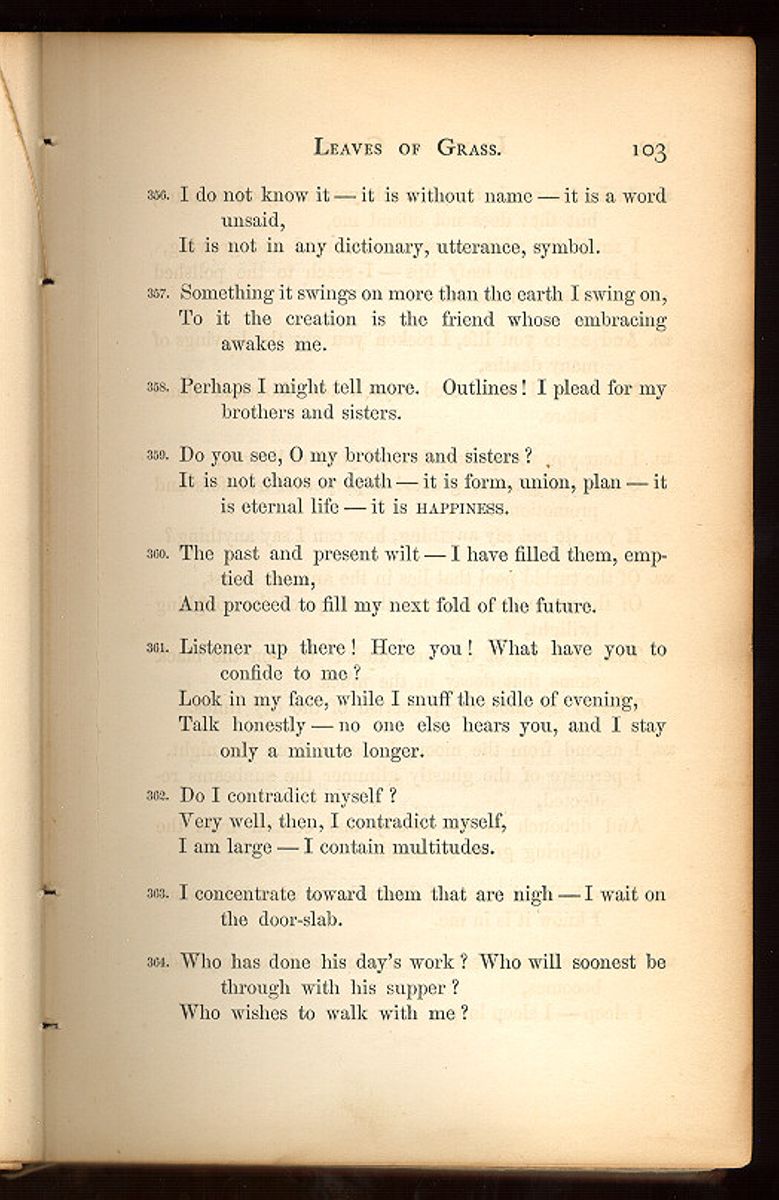 ppp.01500.111.jpg
356I do not know it—it is without name—it is a word
ppp.01500.111.jpg
356I do not know it—it is without name—it is a word unsaid, It is not in any dictionary, utterance, symbol. 357Something it swings on more than the earth I swing on, To it the creation is the friend whose embracing
awakes me. 358Perhaps I might tell more. Outlines! I plead for my
brothers and sisters. 359Do you see, O my brothers and sisters? It is not chaos or death—it is form, union, plan—it
is eternal life—it is HAPPINESS. 360The past and present wilt—I have filled them, emp-
tied them, And proceed to fill my next fold of the future. 361Listener up there! Here you! What have you to
confide to me? Look in my face, while I snuff the sidle of evening, Talk honestly—no one else hears you, and I stay
only a minute longer. 362Do I contradict myself? Very well, then, I contradict myself, I am large—I contain multitudes. 363I concentrate toward them that are nigh—I wait on
the door-slab. 364Who has done his day's work? Who will soonest be
through with his supper? Who wishes to walk with me? [ begin page 104 ]
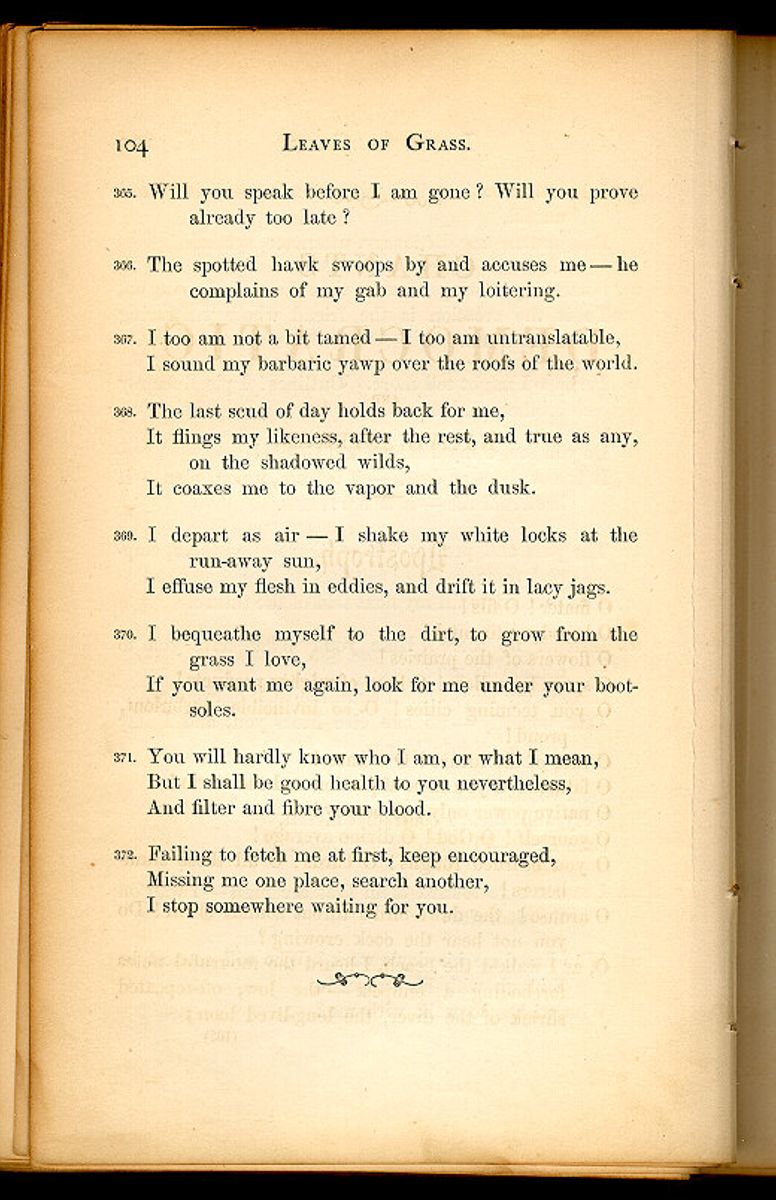 ppp.01500.112.jpg
365Will you speak before I am gone? Will you prove
ppp.01500.112.jpg
365Will you speak before I am gone? Will you prove already too late? 366The spotted hawk swoops by and accuses me—he
complains of my gab and my loitering. 367I too am not a bit tamed—I too am untranslatable, I sound my barbaric yawp over the roofs of the world. 368The last scud of day holds back for me, It flings my likeness, after the rest, and true as any,
on the shadowed wilds, It coaxes me to the vapor and the dusk. 369I depart as air—I shake my white locks at the
run-away sun, I effuse my flesh in eddies, and drift it in lacy jags. 370I bequeathe myself to the dirt, to grow from the
grass I love, If you want me again, look for me under your boot-
soles. 371You will hardly know who I am, or what I mean, But I shall be good health to you nevertheless, And filter and fibre your blood. 372Failing to fetch me at first, keep encouraged, Missing me one place, search another, I stop somewhere waiting for you. [ begin page 105 ]
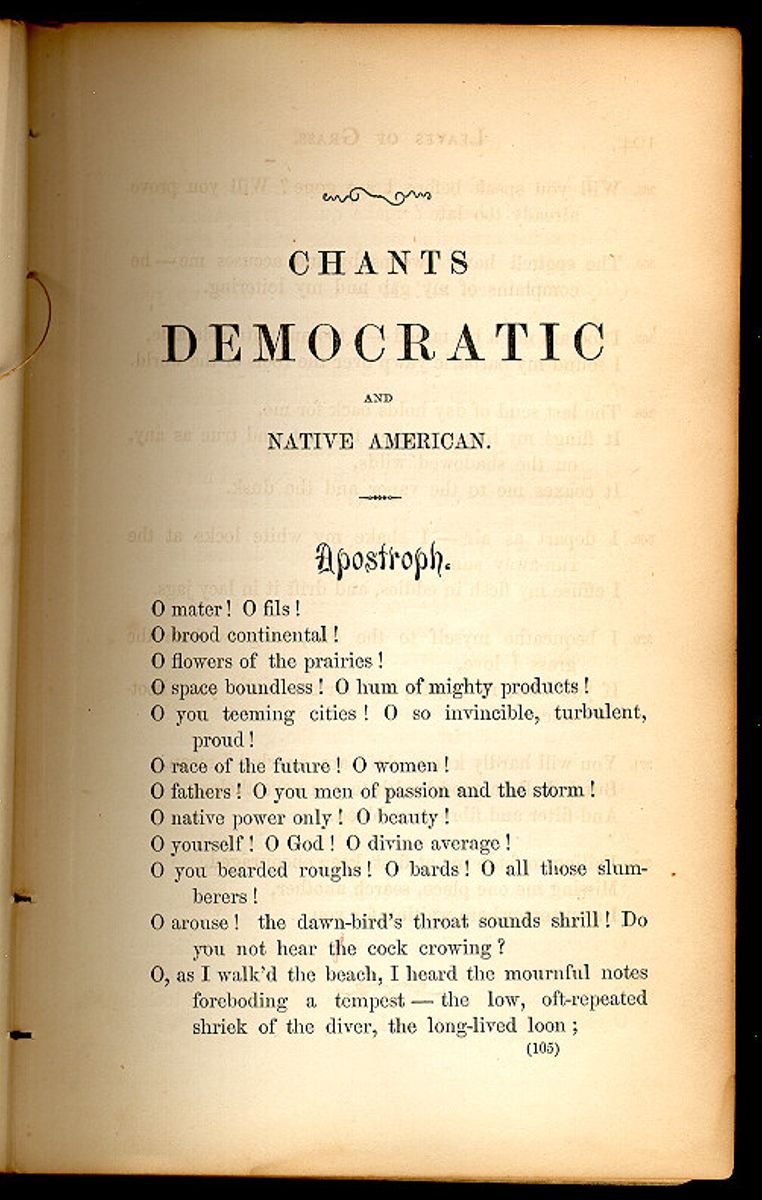 ppp.01500.113.jpg
CHANTS DEMOCRATIC AND NATIVE AMERICAN.
Apostroph.
O mater! O fils! O brood continental! O flowers of the prairies! O space boundless! O hum of mighty products! O you teeming cities! O so invincible, turbulent,proud! O race of the future! O women! O fathers! O you men of passion and the storm! O native power only! O beauty! O yourself! O God! O divine average! O you bearded roughs! O bards! O all those slum-
berers! O arouse! the dawn-bird's throat sounds shrill! Do
you not hear the cock crowing? O, as I walk'd the beach, I heard the mournful notes
foreboding a tempest—the low, oft-repeated
shriek of the diver, the long-lived loon; [ begin page 106 ]
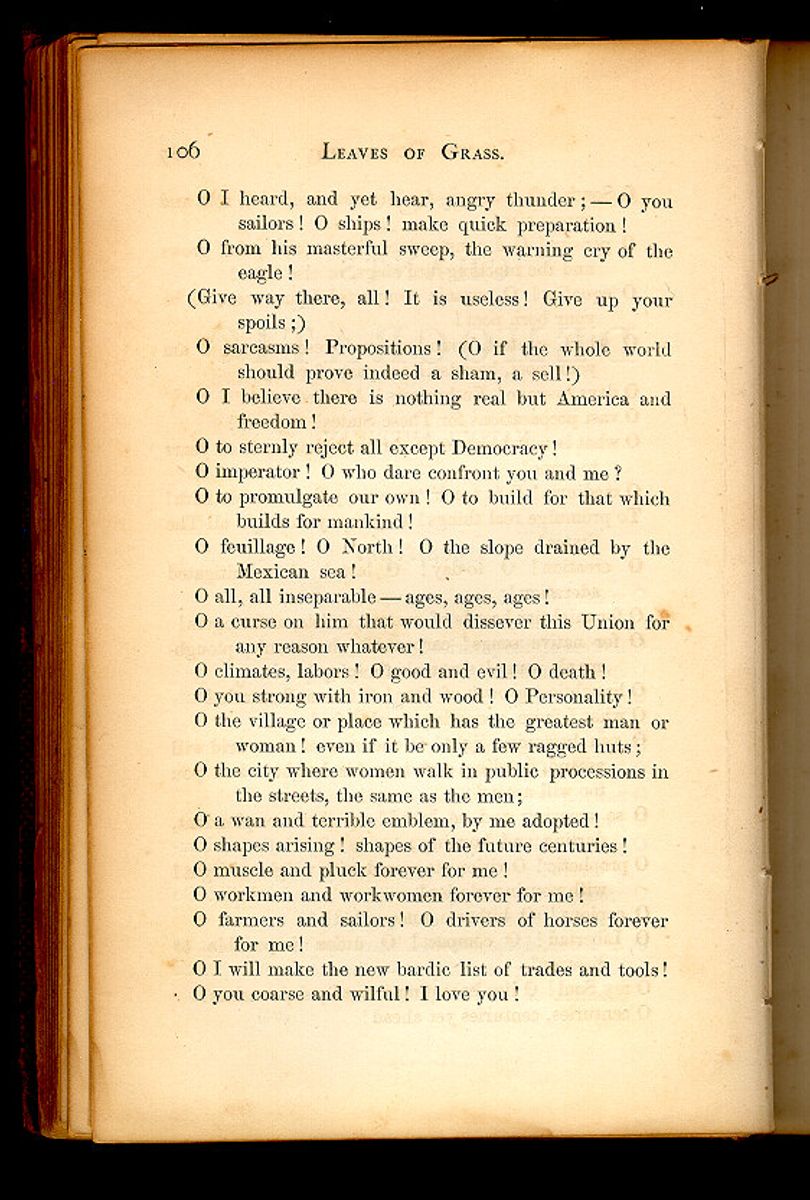 ppp.01500.114.jpg
O I heard, and yet hear, angry thunder;—O you
ppp.01500.114.jpg
O I heard, and yet hear, angry thunder;—O you sailors! O ships! make quick preparation! O from his masterful sweep, the warning cry of the
eagle! (Give way there, all! It is useless! Give up your
spoils;) O sarcasms! Propositions! (O if the whole world
should prove indeed a sham, a sell!) O I believe there is nothing real but America and
freedom! O to sternly reject all except Democracy! O imperator! O who dare confront you and me? O to promulgate our own! O to build for that which
builds for mankind! O feuillage! O North! O the slope drained by the
Mexican sea! O all, all inseparable—ages, ages, ages! O a curse on him that would dissever this Union for
any reason whatever! O climates, labors! O good and evil! O death! O you strong with iron and wood! O Personality! O the village or place which has the greatest man or
woman! even if it be only a few ragged huts; O the city where women walk in public processions in
the streets, the same as the men; O a wan and terrible emblem, by me adopted! O shapes arising! shapes of the future centuries! O muscle and pluck forever for me! O workmen and workwomen forever for me! O farmers and sailors! O drivers of horses forever
for me! O I will make the new bardic list of trades and tools! O you coarse and wilful! I love you! [ begin page 107 ]
 ppp.01500.115.jpg
O South! O longings for my dear home! O soft and
ppp.01500.115.jpg
O South! O longings for my dear home! O soft and sunny airs! O pensive! O I must return where the palm grows
and the mocking-bird sings, or else I die! O equality! O organic compacts! I am come to be
your born poet! O whirl, contest, sounding and resounding! I am
your poet, because I am part of you; O days by-gone! Enthusiasts! Antecedents! O vast preparations for These States! O years! O what is now being sent forward thousands of years
to come! O mediums! O to teach! to convey the invisible faith! To promulge real things! to journey through all The
States! O creation! O to-day! O laws! O unmitigated
adoration! O for mightier broods of orators, artists, and singers! O for native songs! carpenter's, boatman's, plough-
man's songs! shoemaker's songs! O haughtiest growth of time! O free and extatic! O what I, here, preparing, warble for! O you hastening light! O the sun of the world will
ascend, dazzling, and take his height—and you
too will ascend; O so amazing and so broad! up there resplendent,
darting and burning; O prophetic! O vision staggered with weight of light!
with pouring glories! O copious! O hitherto unequalled! O Libertad! O compact! O union impossible to
dissever! O my Soul! O lips becoming tremulous, powerless! O centuries, centuries yet ahead! [ begin page 108 ]
 ppp.01500.116.jpg
O voices of greater orators! I pause—I listen for
ppp.01500.116.jpg
O voices of greater orators! I pause—I listen for you! O you States! Cities! defiant of all outside authority!
I spring at once into your arms! you I most
love! O you grand Presidentiads! I wait for you! New history! New heroes! I project you! Visions of poets! only you really last! O sweep on!
sweep on! O Death! O you striding there! O I cannot yet! O heights! O infinitely too swift and dizzy yet! O purged lumine! you threaten me more than I can
stand! O present! I return while yet I may to you! O poets to come, I depend upon you!
1.
1A NATION announcing itself, (many in one,) I myself make the only growth by which I can beappreciated, I reject none, accept all, reproduce all in my own
forms. 2A breed whose testimony is behavior, What we are WE ARE—nativity is answer enough
to objections; We wield ourselves as a weapon is wielded, [ begin page 109 ]
 ppp.01500.117.jpg
We are powerful and tremendous in ourselves,
We are executive in ourselves—We are sufficient
ppp.01500.117.jpg
We are powerful and tremendous in ourselves,
We are executive in ourselves—We are sufficient in the variety of ourselves, We are the most beautiful to ourselves, and in our-
selves, Nothing is sinful to us outside of ourselves, Whatever appears, whatever does not appear, we are
beautiful or sinful in ourselves only. 3Have you thought there could be but a single
Supreme? There can be any number of Supremes—One does
not countervail another, any more than one eye-
sight countervails another, or one life counter-
vails another. 4All is eligible to all, All is for individuals—All is for you, No condition is prohibited, not God's or any, If one is lost, you are inevitably lost. 5All comes by the body—only health puts you rapport
with the universe. 6Produce great persons, the rest follows. 7How dare a sick man, or an obedient man, write
poems for These States? Which is the theory or book that, for our purposes, is
not diseased? 8Piety and conformity to them that like! Peace, obesity, allegiance, to them that like! 10 [ begin page 110 ]
 ppp.01500.118.jpg
I am he who tauntingly compels men, women,
ppp.01500.118.jpg
I am he who tauntingly compels men, women, nations, to leap from their seats and contend
for their lives. 9I am he who goes through the streets with a barbed
tongue, questioning every one I meet—ques-
tioning you up there now: Who are you, that wanted only to be told what you
knew before? Who are you, that wanted only a book to join you in
your nonsense? 10Are you, or would you be, better than all that has
ever been before? If you would be better than all that has ever been
before, come listen to me, and not otherwise. 11Fear grace—Fear delicatesse, Fear the mellow sweet, the sucking of honey-juice, Beware the advancing mortal ripening of nature, Beware what precedes the decay of the ruggedness of
states and men. 12Ages, precedents, poems, have long been accumu-
lating undirected materials, America brings builders, and brings its own styles. 13Mighty bards have done their work, and passed to
other spheres, One work forever remains, the work of surpassing all
they have done. 14America, curious toward foreign characters, stands by
its own at all hazards, [ begin page 111 ]
 ppp.01500.119.jpg
Stands removed, spacious, composite, sound,
Sees itself promulger of men and women, initiates
ppp.01500.119.jpg
Stands removed, spacious, composite, sound,
Sees itself promulger of men and women, initiates the true use of precedents, Does not repel them or the past, or what they have
produced under their forms, or amid other pol-
itics, or amid the idea of castes, or the old
religions, Takes the lesson with calmness, perceives the corpse
slowly borne from the eating and sleeping rooms
of the house, Perceives that it waits a little while in the door—
that it was fittest for its days, That its life has descended to the stalwart and well-
shaped heir who approaches, And that he shall be fittest for his days. 15Any period, one nation must lead, One land must be the promise and reliance of the
future. 16These States are the amplest poem, Here is not merely a nation, but a teeming nation of
nations, Here the doings of men correspond with the broad-
cast doings of the day and night, Here is what moves in magnificent masses, carelessly
faithful of particulars, Here are the roughs, beards, friendliness, combative-
ness, the Soul loves, Here the flowing trains—here the crowds, equality,
diversity, the Soul loves. 17Race of races, and bards to corroborate! [ begin page 112 ]
 ppp.01500.120.jpg
Of them, standing among them, one lifts to the light
ppp.01500.120.jpg
Of them, standing among them, one lifts to the light his west-bred face, To him the hereditary countenance bequeathed, both
mother's and father's, His first parts substances, earth, water, animals, trees, Built of the common stock, having room for far and
near, Used to dispense with other lands, incarnating this
land, Attracting it body and Soul to himself, hanging on its
neck with incomparable love, Plunging his semitic muscle into its merits and
demerits, Making its geography, cities, beginnings, events,
glories, defections, diversities, vocal in him, Making its rivers, lakes, bays, embouchure in him, Mississippi with yearly freshets and changing chutes
—Missouri, Columbia, Ohio, Niagara, Hudson,
spending themselves lovingly in him, If the Atlantic coast stretch, or the Pacific coast
stretch, he stretching with them north or south, Spanning between them east and west, and touching
whatever is between them, Growths growing from him to offset the growth of
pine, cedar, hemlock, live-oak, locust, chest-
nut, cypress, hickory, lime-tree, cotton-wood,
tulip-tree, cactus, tamarind, orange, magnolia,
persimmon, Tangles as tangled in him as any cane-brake or
swamp, He likening sides and peaks of mountains, forests
coated with transparent ice, and icicles hanging
from the boughs, [ begin page 113 ]
 ppp.01500.121.jpg
Off him pasturage sweet and natural as savanna,
ppp.01500.121.jpg
Off him pasturage sweet and natural as savanna, upland, prairie, Through him flights, songs, screams, answering those
of the wild-pigeon, coot, fish-hawk, qua-bird,
mocking-bird, condor, night-heron, eagle; His spirit surrounding his country's spirit, unclosed
to good and evil, Surrounding the essences of real things, old times
and present times, Surrounding just found shores, islands, tribes of red
aborigines, Weather-beaten vessels, landings, settlements, the
rapid stature and muscle, The haughty defiance of the Year 1—war, peace,
the formation of the Constitution, The separate States, the simple, elastic scheme, the
immigrants, The Union, always swarming with blatherers, and
always calm and impregnable, The unsurveyed interior, log-houses, clearings, wild
animals, hunters, trappers; Surrounding the multiform agriculture, mines, tem-
perature, the gestation of new States, Congress convening every Twelfth Month, the mem-
bers duly coming up from the uttermost parts; Surrounding the noble character of mechanics and
farmers, especially the young men, Responding their manners, speech, dress, friendships
—the gait they have of persons who never knew
how it felt to stand in the presence of superiors, The freshness and candor of their physiognomy, the
copiousness and decision of their phrenology, 10* [ begin page 114 ]
 ppp.01500.122.jpg
The picturesque looseness of their carriage, their
ppp.01500.122.jpg
The picturesque looseness of their carriage, their deathless attachment to freedom, their fierceness
when wronged, The fluency of their speech, their delight in music,
their curiosity, good temper, and open-handed-
ness—the whole composite make, The prevailing ardor and enterprise, the large am-
ativeness, The perfect equality of the female with the male, the
fluid movement of the population, The superior marine, free commerce, fisheries,
whaling, gold-digging, Wharf-hemmed cities, railroad and steamboat lines,
intersecting all points, Factories, mercantile life, labor-saving machinery, the
north-east, north-west, south-west, Manhattan firemen, the Yankee swap, southern plan-
tation life, Slavery, the tremulous spreading of hands to shelter
it—the stern opposition to it, which ceases only
when it ceases. 18For these and the like, their own voices! For these,
space ahead! Others take finish, but the Republic is ever con-
structive, and ever keeps vista; Others adorn the past—but you, O, days of the
present, I adorn you! O days of the future, I believe in you! O America, because you build for mankind, I build
for you! O well-beloved stone-cutters! I lead them who plan
with decision and science, [ begin page 115 ]
 ppp.01500.123.jpg
I lead the present with friendly hand toward the
ppp.01500.123.jpg
I lead the present with friendly hand toward the future. 19Bravas to States whose semitic impulses send whole-
some children to the next age! But damn that which spends itself on flaunters and
dalliers, with no thought of the stain, pains,
dismay, feebleness, it is bequeathing. 20By great bards only can series of peoples and States
be fused into the compact organism of one
nation. 21To hold men together by paper and seal, or by com-
pulsion, is no account, That only holds men together which is living prin-
ciples, as the hold of the limbs of the body, or
the fibres of plants. 22Of all races and eras, These States, with veins full
of poetical stuff, most need poets, and are to have
the greatest, and use them the greatest, Their Presidents shall not be their common referee
so much as their poets shall. 23Of mankind, the poet is the equable man, Not in him, but off from him, things are grotesque,
eccentric, fail of their full returns, Nothing out of its place is good, nothing in its place
is bad, He bestows on every object or quality its fit propor-
tions, neither more nor less, He is the arbiter of the diverse, he is the key, [ begin page 116 ]
 ppp.01500.124.jpg
He is the equalizer of his age and land,
He supplies what wants supplying—he checks what
ppp.01500.124.jpg
He is the equalizer of his age and land,
He supplies what wants supplying—he checks what wants checking, In peace, out of him speaks the spirit of peace, large,
rich, thrifty, building populous towns, encour-
aging agriculture, arts, commerce, lighting the
study of man, the Soul, health, immortality,
government, In war, he is the best backer of the war—he fetches
artillery as good as the engineer's—he can make
every word he speaks draw blood; The years straying toward infidelity, he withholds by
his steady faith, He is no arguer, he is judgment, He judges not as the judge judges, but as the sun
falling round a helpless thing; As he sees the farthest he has the most faith, His thoughts are the hymns of the praise of things, In the dispute on God and eternity he is silent, He sees eternity less like a play with a prologue and
denouement, He sees eternity in men and women—he does not
see men and women as dreams or dots. 24Of the idea of perfect and free individuals, the idea
of These States, the bard walks in advance,
leader of leaders, The attitude of him cheers up slaves, and horrifies
foreign despots. 25Without extinction is Liberty! Without retrograde
is Equality! They live in the feelings of young men, and the
best women, [ begin page 117 ]
 ppp.01500.125.jpg
Not for nothing have the indomitable heads of the
ppp.01500.125.jpg
Not for nothing have the indomitable heads of the earth been always ready to fall for Liberty! 26Are YOU indeed for Liberty? Are you a man who would assume a place to teach
here, or lead here, or be a poet here? The place is august—the terms obdurate. 27Who would assume to teach here, may well prepare
himself, body and mind, He may well survey, ponder, arm, fortify, harden,
make lithe, himself, He shall surely be questioned beforehand by me with
many and stern questions. 28Who are you, indeed, who would talk or sing in
America? Have you studied out MY LAND, its idioms and
men? Have you learned the physiology, phrenology, poli-
tics, geography, pride, freedom, friendship, of
my land? its substratums and objects? Have you considered the organic compact of the first
day of the first year of the independence of The
States, signed by the Commissioners, ratified by
The States, and read by Washington at the head
of the army? Have you possessed yourself of the Federal Constitu-
tion? Do you acknowledge Liberty with audible and abso-
lute acknowledgment, and set slavery at nought
for life and death? Do you see who have left described processes and
poems behind them, and assumed new ones? [ begin page 118 ]
 ppp.01500.126.jpg
Are you faithful to things? Do you teach whatever
ppp.01500.126.jpg
Are you faithful to things? Do you teach whatever the land and sea, the bodies of men, womanhood,
amativeness, angers, excesses, crimes, teach? Have you sped through customs, laws, popularities? Can you hold your hand against all seductions, follies,
whirls, fierce contentions? Are you very strong?
Are you of the whole people? Are you not of some coterie? some school or religion? Are you done with reviews and criticisms of life? ani-
mating to life itself? Have you vivified yourself from the maternity of
These States? Have you sucked the nipples of the breasts of the
mother of many children? Have you too the old, ever-fresh, forbearance and
impartiality? Do you hold the like love for those hardening to
maturity? for the last-born? little and big?
and for the errant? 29What is this you bring my America? Is it uniform with my country? Is it not something that has been better told or done
before? Have you not imported this, or the spirit of it, in
some ship? Is it a mere tale? a rhyme? a prettiness? Has it never dangled at the heels of the poets, poli-
ticians, literats, of enemies' lands? Does it not assume that what is notoriously gone is
still here? Does it answer universal needs? Will it improve
manners? [ begin page 119 ]
 ppp.01500.127.jpg
Can your performance face the open fields and the
ppp.01500.127.jpg
Can your performance face the open fields and the sea-side? Will it absorb into me as I absorb food, air, nobility,
meanness—to appear again in my strength, gait,
face? Have real employments contributed to it? original
makers—not amanuenses? Does it meet modern discoveries, calibers, facts, face
to face? Does it respect me? Democracy? the Soul? to-day? What does it mean to me? to American persons,
progresses, cities? Chicago, Kanada, Arkansas?
the planter, Yankee, Georgian, native, immi-
grant, sailors, squatters, old States, new States? Does it encompass all The States, and the unexcep-
tional rights of all the men and women of the
earth, the genital impulse of These States? Does it see behind the apparent custodians, the
real custodians, standing, menacing, silent, the
mechanics, Manhattanese, western men, south-
erners, significant alike in their apathy and in
the promptness of their love? Does it see what befalls and has always befallen
each temporizer, patcher, outsider, partialist,
alarmist, infidel, who has ever asked anything
of America? What mocking and scornful negligence? The track strewed with the dust of skeletons? By the roadside others disdainfully tossed? 30Rhymes and rhymers pass away—poems distilled
from other poems pass away, The swarms of reflectors and the polite pass, and
leave ashes; [ begin page 120 ]
 ppp.01500.128.jpg
Admirers, importers, obedient persons, make the soil
ppp.01500.128.jpg
Admirers, importers, obedient persons, make the soil of literature; America justifies itself, give it time—no disguise can
deceive it, or conceal from it—it is impassive
enough, Only toward the likes of itself will it advance to meet
them, If its poets appear, it will advance to meet them—
there is no fear of mistake, The proof of a poet shall be sternly deferred, till his
country absorbs him as affectionately as he has
absorbed it. 31He masters whose spirit masters—he tastes sweetest
who results sweetest in the long run, The blood of the brawn beloved of time is uncon-
straint, In the need of poems, philosophy, politics, manners,
engineering, an appropriate native grand-opera,
shipcraft, any craft, he or she is greatest who
contributes the greatest original practical ex-
ample. 32Already a nonchalant breed, silently emerging, fills
the houses and streets, People's lips salute only doers, lovers, satisfiers,
positive knowers; There will shortly be no more priests—I say their
work is done, Death is without emergencies here, but life is per-
petual emergencies here, Are your body, days, manners, superb? after death
you shall be superb; [ begin page 121 ]
 ppp.01500.129.jpg
Friendship, self-esteem, justice, health, clear the way
ppp.01500.129.jpg
Friendship, self-esteem, justice, health, clear the way with irresistible power; How dare you place anything before a man? 33Fall behind me, States! A man, before all—myself, typical, before all. 34Give me the pay I have served for! Give me to speak beautiful words! take all the
rest; I have loved the earth, sun, animals—I have despised
riches, I have given alms to every one that asked, stood up
for the stupid and crazy, devoted my income
and labor to others, I have hated tyrants, argued not concerning God,
had patience and indulgence toward the people,
taken off my hat to nothing known or unknown, I have gone freely with powerful uneducated persons,
and with the young, and with the mothers of
families, I have read these leaves to myself in the open air—
I have tried them by trees, stars, rivers, I have dismissed whatever insulted my own Soul or
defiled my body, I have claimed nothing to myself which I have not
carefully claimed for others on the same terms. I have studied my land, its idioms and men, I am willing to wait to be understood by the growth
of the taste of myself, I reject none, I permit all, Whom I have staid with once I have found longing
for me ever afterward. 11 [ begin page 122 ]
 ppp.01500.130.jpg
34I swear I begin to see the meaning of these things!
It is not the earth, it is not America, who is so great,
It is I who am great, or to be great—it is you, or
ppp.01500.130.jpg
34I swear I begin to see the meaning of these things!
It is not the earth, it is not America, who is so great,
It is I who am great, or to be great—it is you, or any one, It is to walk rapidly through civilizations, govern-
ments, theories, nature, poems, shows, to indi-
viduals. 35Underneath all are individuals, I swear nothing is good to me now that ignores
individuals! The American compact is altogether with individuals, The only government is that which makes minute of
individuals, The whole theory of the universe is directed to one
single individual—namely, to You. 36Underneath all is nativity, I swear I will stand by my own nativity—pious or
impious, so be it; I swear I am charmed with nothing except nativity, Men, women, cities, nations, are only beautiful from
nativity. 37Underneath all is the need of the expression of love
for men and women, I swear I have had enough of mean and impotent
modes of expressing love for men and women, After this day I take my own modes of expressing
love for men and women. 38I swear I will have each quality of my race in
myself, [ begin page 123 ]
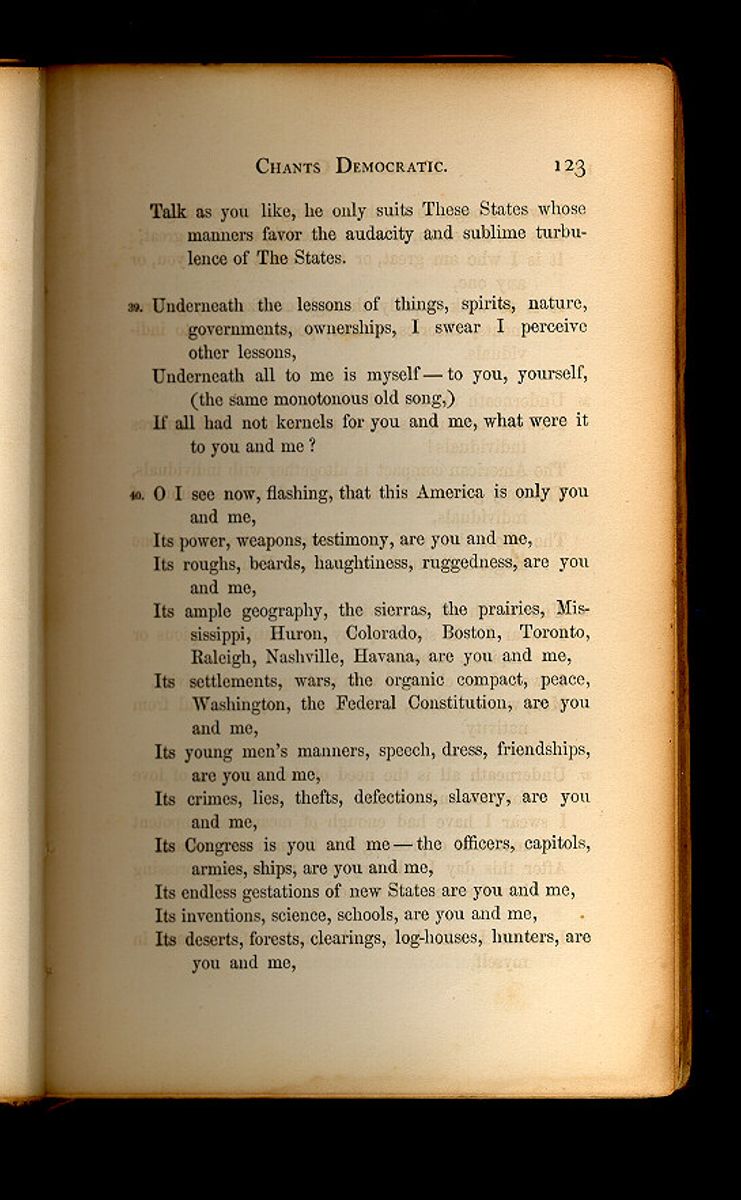 ppp.01500.131.jpg
Talk as you like, he only suits These States whose
ppp.01500.131.jpg
Talk as you like, he only suits These States whose manners favor the audacity and sublime turbu-
lence of The States. 39Underneath the lessons of things, spirits, nature,
governments, ownerships, I swear I perceive
other lessons, Underneath all to me is myself—to you, yourself,
(the same monotonous old song,) If all had not kernels for you and me, what were it
to you and me? 40O I see now, flashing, that this America is only you
and me, Its power, weapons, testimony, are you and me, Its roughs, beards, haughtiness, ruggedness, are you
and me, Its ample geography, the sierras, the prairies, Mis-
sissippi, Huron, Colorado, Boston, Toronto,
Raleigh, Nashville, Havana, are you and me, Its settlements, wars, the organic compact, peace,
Washington, the Federal Constitution, are you
and me, Its young men's manners, speech, dress, friendships,
are you and me, Its crimes, lies, thefts, defections, slavery, are you
and me, Its Congress is you and me—the officers, capitols,
armies, ships, are you and me, Its endless gestations of new States are you and me, Its inventions, science, schools, are you and me, Its deserts, forests, clearings, log-houses, hunters, are
you and me, [ begin page 124 ]
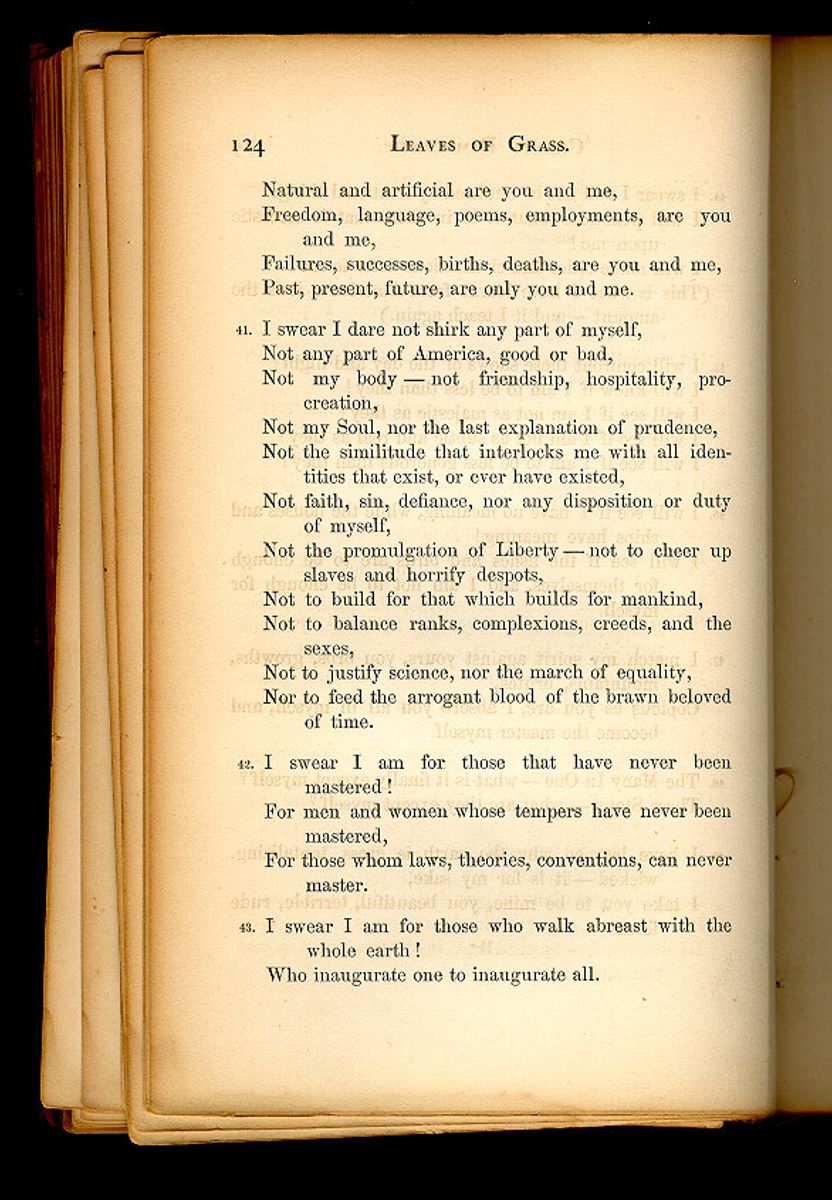 ppp.01500.132.jpg
Natural and artificial are you and me,
Freedom, language, poems, employments, are you
ppp.01500.132.jpg
Natural and artificial are you and me,
Freedom, language, poems, employments, are you and me, Failures, successes, births, deaths, are you and me, Past, present, future, are only you and me. 41I swear I dare not shirk any part of myself, Not any part of America, good or bad, Not my body—not friendship, hospitality, pro-
creation, Not my Soul, nor the last explanation of prudence, Not the similitude that interlocks me with all iden-
tities that exist, or ever have existed, Not faith, sin, defiance, nor any disposition or duty
of myself, Not the promulgation of Liberty—not to cheer up
slaves and horrify despots, Not to build for that which builds for mankind, Not to balance ranks, complexions, creeds, and the
sexes, Not to justify science, nor the march of equality, Nor to feed the arrogant blood of the brawn beloved
of time. 42I swear I am for those that have never been
mastered! For men and women whose tempers have never been
mastered, For those whom laws, theories, conventions, can never
master. 43I swear I am for those who walk abreast with the
whole earth! Who inaugurate one to inaugurate all. [ begin page 125 ]
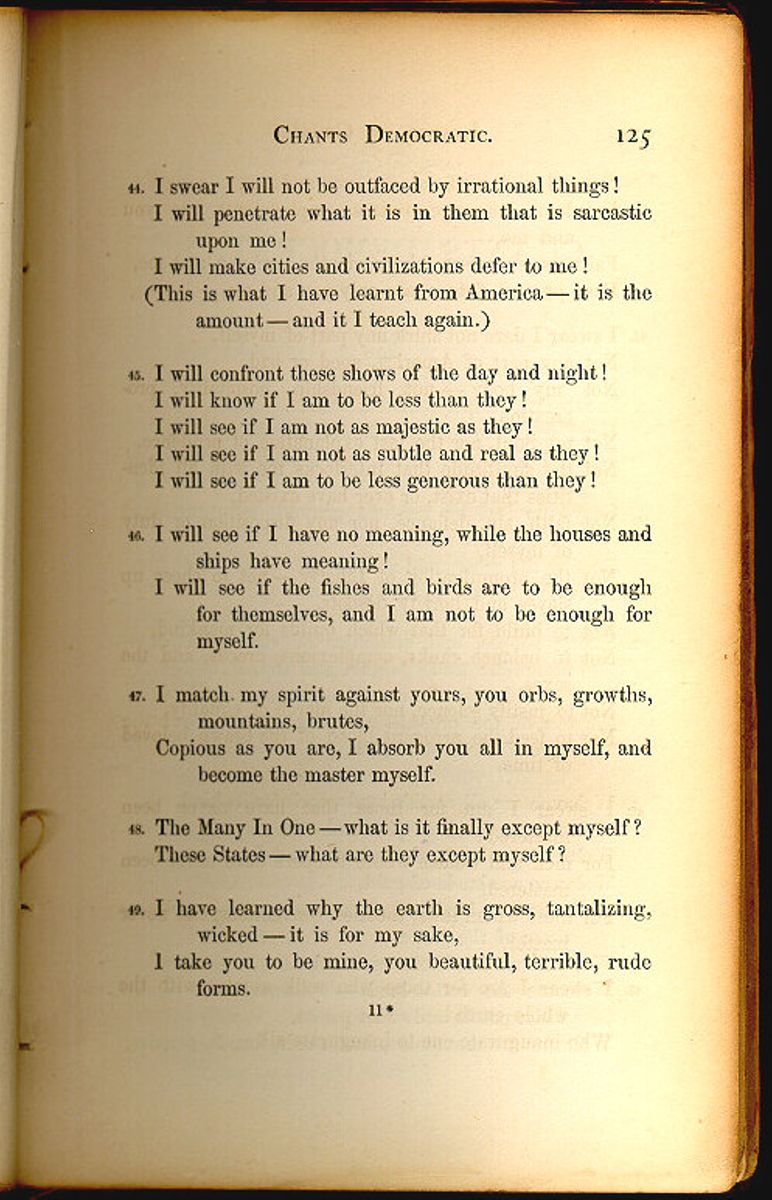 ppp.01500.133.jpg
44I swear I will not be outfaced by irrational things!
I will penetrate what it is in them that is sarcastic
ppp.01500.133.jpg
44I swear I will not be outfaced by irrational things!
I will penetrate what it is in them that is sarcastic upon me! I will make cities and civilizations defer to me! (This is what I have learnt from America—it is the
amount—and it I teach again.) 45I will confront these shows of the day and night! I will know if I am to be less than they! I will see if I am not as majestic as they! I will see if I am not as subtle and real as they! I will see if I am to be less generous than they! 46I will see if I have no meaning, while the houses and
ships have meaning! I will see if the fishes and birds are to be enough
for themselves, and I am not to be enough for
myself. 47I match my spirit against yours, you orbs, growths,
mountains, brutes, Copious as you are, I absorb you all in myself, and
become the master myself. 48The Many In One—what is it finally except myself? These States—what are they except myself? 49I have learned why the earth is gross, tantalizing,
wicked—it is for my sake, I take you to be mine, you beautiful, terrible, rude
forms. 11* [ begin page 126 ]
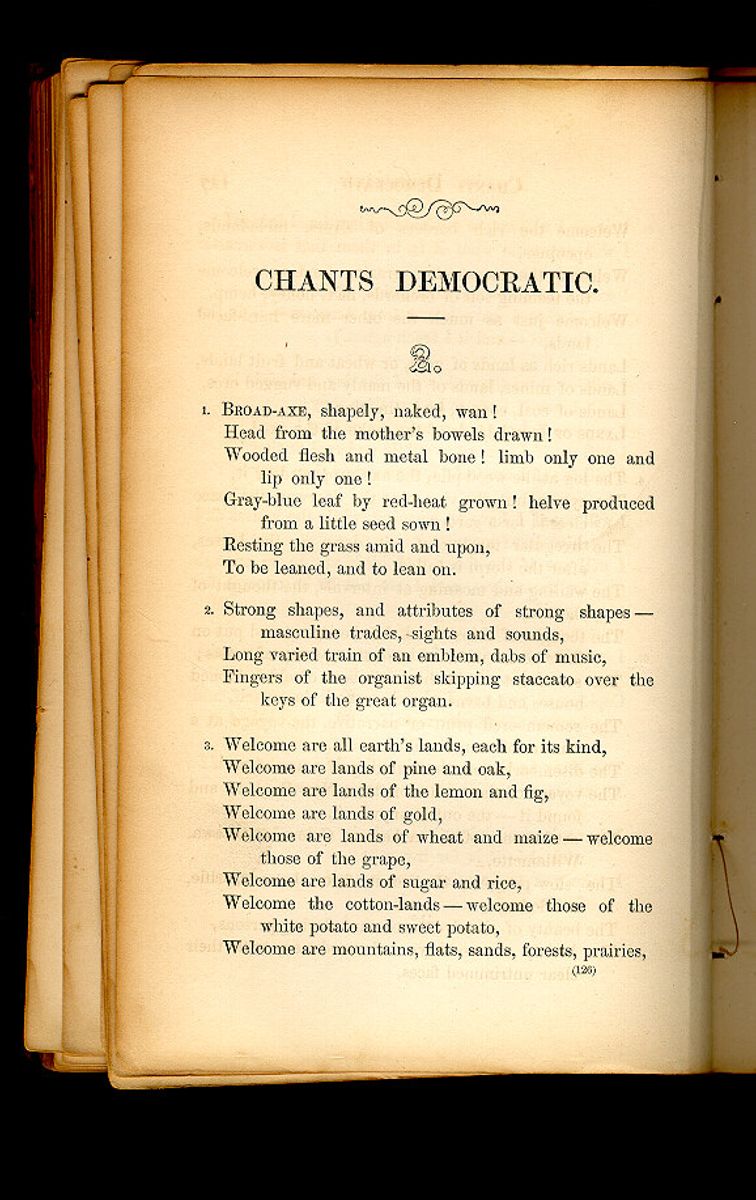 ppp.01500.134.jpg
CHANTS DEMOCRATIC.
2.
1BROAD-AXE, shapely, naked, wan! Head from the mother's bowels drawn! Wooded flesh and metal bone! limb only one andlip only one! Gray-blue leaf by red-heat grown! helve produced
from a little seed sown! Resting the grass amid and upon, To be leaned, and to lean on. 2Strong shapes, and attributes of strong shapes—
masculine trades, sights and sounds, Long varied train of an emblem, dabs of music, Fingers of the organist skipping staccato over the
keys of the great organ. 3Welcome are all earth's lands, each for its kind, Welcome are lands of pine and oak, Welcome are lands of the lemon and fig, Welcome are lands of gold, Welcome are lands of wheat and maize—welcome
those of the grape, Welcome are lands of sugar and rice, Welcome the cotton-lands—welcome those of the
white potato and sweet potato, Welcome are mountains, flats, sands, forests, prairies, [ begin page 127 ]
 ppp.01500.135.jpg
Welcome the rich borders of rivers, table-lands,
ppp.01500.135.jpg
Welcome the rich borders of rivers, table-lands, openings, Welcome the measureless grazing lands—welcome
the teeming soil of orchards, flax, honey, hemp, Welcome just as much the other more hard-faced
lands, Lands rich as lands of gold, or wheat and fruit lands, Lands of mines, lands of the manly and rugged ores, Lands of coal, copper, lead, tin, zinc, LANDS OF IRON! lands of the make of the axe! 4The log at the wood-pile, the axe supported by it, The sylvan hut, the vine over the doorway, the space
cleared for a garden, The irregular tapping of rain down on the leaves,
after the storm is lulled, The wailing and moaning at intervals, the thought of
the sea, The thought of ships struck in the storm, and put on
their beam-ends, and the cutting away of masts; The sentiment of the huge timbers of old-fashioned
houses and barns; The remembered print or narrative, the voyage at a
venture of men, families, goods, The disembarkation, the founding of a new city, The voyage of those who sought a New England and
found it—the outset anywhere, The settlements of the Arkansas, Colorado, Ottawa,
Willamette, The slow progress, the scant fare, the axe, rifle,
saddle-bags; The beauty of all adventurous and daring persons, The beauty of wood-boys and wood-men, with their
clear untrimmed faces, [ begin page 128 ]
 ppp.01500.136.jpg
The beauty of independence, departure, actions that
ppp.01500.136.jpg
The beauty of independence, departure, actions that rely on themselves, The American contempt for statutes and ceremonies,
the boundless impatience of restraint, The loose drift of character, the inkling through
random types, the solidification; The butcher in the slaughter-house, the hands aboard
schooners and sloops, the raftsman, the pioneer, Lumbermen in their winter camp, daybreak in the
woods, stripes of snow on the limbs of trees, the
occasional snapping, The glad clear sound of one's own voice, the merry
song, the natural life of the woods, the strong
day's work, The blazing fire at night, the sweet taste of supper,
the talk, the bed of hemlock boughs, and the
bear-skin; The house-builder at work in cities or anywhere, The preparatory jointing, squaring, sawing, mor-
tising, The hoist-up of beams, the push of them in their
places, laying them regular, Setting the studs by their tenons in the mortises,
according as they were prepared, The blows of mallets and hammers, the attitudes of
the men, their curved limbs, Bending, standing, astride the beams, driving in pins,
holding on by posts and braces, The hooked arm over the plate, the other arm
wielding the axe, The floor-men forcing the planks close, to be nailed, Their postures bringing their weapons downward on
the bearers, [ begin page 129 ]
 ppp.01500.137.jpg
The echoes resounding through the vacant building;
The huge store-house carried up in the city, well
ppp.01500.137.jpg
The echoes resounding through the vacant building;
The huge store-house carried up in the city, well under way, The six framing-men, two in the middle and two at
each end, carefully bearing on their shoulders a
heavy stick for a cross-beam, The crowded line of masons with trowels in their
right hands, rapidly laying the long side-wall,
two hundred feet from front to rear, The flexible rise and fall of backs, the continual click
of the trowels striking the bricks, The bricks, one after another, each laid so workman-
like in its place, and set with a knock of the
trowel-handle, The piles of materials, the mortar on the mortar-
boards, and the steady replenishing by the hod-
men; Spar-makers in the spar-yard, the swarming row of
well-grown apprentices, The swing of their axes on the square-hewed log,
shaping it toward the shape of a mast, The brisk short crackle of the steel driven slantingly
into the pine, The butter-colored chips flying off in great flakes and
slivers, The limber motion of brawny young arms and hips
in easy costumes; The constructor of wharves, bridges, piers, bulk-heads,
floats, stays against the sea; The city fireman—the fire that suddenly bursts forth
in the close-packed square, The arriving engines, the hoarse shouts, the nimble
stepping and daring, [ begin page 130 ]
 ppp.01500.138.jpg
The strong command through the fire-trumpets, the
ppp.01500.138.jpg
The strong command through the fire-trumpets, the falling in line, the rise and fall of the arms
forcing the water, The slender, spasmic blue-white jets—the bringing
to bear of the hooks and ladders, and their
execution, The crash and cut away of connecting wood-work, or
through floors, if the fire smoulders under them, The crowd with their lit faces, watching—the glare
and dense shadows; The forger at his forge-furnace, and the user of iron
after him, The maker of the axe large and small, and the
welder and temperer, The chooser breathing his breath on the cold steel,
and trying the edge with his thumb, The one who clean-shapes the handle and sets it
firmly in the socket, The shadowy processions of the portraits of the past
users also, The primal patient mechanics, the architects and
engineers, The far-off Assyrian edifice and Mizra edifice, The Roman lictors preceding the consuls, The antique European warrior with his axe in
combat, The uplifted arm, the clatter, of blows on the
helmeted head, The death-howl, the limpsey tumbling body, the rush
of friend and foe thither, The siege of revolted lieges determined for liberty, The summons to surrender, the battering at castle
gates, the truce and parley, [ begin page 131 ]
 ppp.01500.139.jpg
The sack of an old city in its time,
The bursting in of mercenaries and bigots tumul-
ppp.01500.139.jpg
The sack of an old city in its time,
The bursting in of mercenaries and bigots tumul- tuously and disorderly, Roar, flames, blood, drunkenness, madness, Goods freely rifled from houses and temples, screams
of women in the gripe of brigands, Craft and thievery of camp-followers, men running,
old persons despairing, The hell of war, the cruelties of creeds, The list of all executive deeds and words, just or
unjust, The power of personality, just or unjust. 5Muscle and pluck forever! What invigorates life, invigorates death, And the dead advance as much as the living advance, And the future is no more uncertain than the present, And the roughness of the earth and of man encloses
as much as the delicatesse of the earth and of
man, And nothing endures but personal qualities. 6What do you think endures? Do you think the greatest city endures? Or a teeming manufacturing state? or a prepared
constitution? or the best built steamships? Or hotels of granite and iron? or any chef-d'œuvres
of engineering, forts, armaments? 7Away! These are not to be cherished for themselves, They fill their hour, the dancers dance, the musicians
play for them, The show passes, all does well enough of course, All does very well till one flash of defiance. [ begin page 132 ]
 ppp.01500.140.jpg
8The greatest city is that which has the greatest man
ppp.01500.140.jpg
8The greatest city is that which has the greatest man or woman, If it be a few ragged huts, it is still the greatest city
in the whole world. 9The place where the greatest city stands is not the
place of stretched wharves, docks, manufactures,
deposits of produce, Nor the place of ceaseless salutes of new comers, or
the anchor-lifters of the departing, Nor the place of the tallest and costliest buildings,
or shops selling goods from the rest of the earth, Nor the place of the best libraries and schools—nor
the place where money is plentiest, Nor the place of the most numerous population. 10Where the city stands with the brawniest breed of
orators and bards, Where the city stands that is beloved by these, and
loves them in return, and understands them, Where these may be seen going every day in the
streets, with their arms familiar to the shoulders
of their friends, Where no monuments exist to heroes, but in the
common words and deeds, Where thrift is in its place, and prudence is in its
place, Where behavior is the finest of the fine arts, Where the men and women think lightly of the
laws, Where the slave ceases, and the master of slaves
ceases, Where the populace rise at once against the never-
ending audacity of elected persons, [ begin page 133 ]
 ppp.01500.141.jpg
Where fierce men and women pour forth, as the sea
ppp.01500.141.jpg
Where fierce men and women pour forth, as the sea to the whistle of death pours its sweeping and
unript waves, Where outside authority enters always after the
precedence of inside authority, Where the citizen is always the head and ideal—and
President, Mayor, Governor, and what not, are
agents for pay, Where children are taught from the jump that they
are to be laws to themselves, and to depend on
themselves, Where equanimity is illustrated in affairs, Where speculations on the Soul are encouraged, Where women walk in public processions in the
streets, the same as the men, Where they enter the public assembly and take
places the same as the men, and are appealed
to by the orators, the same as the men, Where the city of the faithfulest friends stands, Where the city of the cleanliness of the sexes stands, Where the city of the healthiest fathers stands, Where the city of the best-bodied mothers stands, There the greatest city stands. 11How beggarly appear poems, arguments, orations,
before an electric deed! How the floridness of the materials of cities shrivels
before a man's or woman's look! 12All waits, or goes by default, till a strong being
appears; A strong being is the proof of the race, and of the
ability of the universe, 12 [ begin page 134 ]
 ppp.01500.142.jpg
When he or she appears, materials are overawed,
The dispute on the Soul stops,
The old customs and phrases are confronted, turned
ppp.01500.142.jpg
When he or she appears, materials are overawed,
The dispute on the Soul stops,
The old customs and phrases are confronted, turned back, or laid away. 13What is your money-making now? What can it do
now? What is your respectability now? What are your theology, tuition, society, traditions,
statute-books now? Where are your jibes of being now? Where are your cavils about the Soul now? 14Was that your best? Were those your vast and
solid? Riches, opinions, politics, institutions, to part obe-
diently from the path of one man or woman! The centuries, and all authority, to be trod under
the foot-soles of one man or woman! 15—A sterile landscape covers the ore—there is as
good as the best, for all the forbidding appear-
ance, There is the mine, there are the miners, The forge-furnace is there, the melt is accomplished,
the hammers-men are at hand with their tongs
and hammers, What always served and always serves, is at hand. 16Than this nothing has better served—it has served
all, Served the fluent-tongued and subtle-sensed Greek,
and long ere the Greek, [ begin page 135 ]
 ppp.01500.143.jpg
Served in building the buildings that last longer
ppp.01500.143.jpg
Served in building the buildings that last longer than any, Served the Hebrew, the Persian, the most ancient
Hindostanee, Served the mound-raiser on the Mississippi—served
those whose relics remain in Central America, Served Albic temples in woods or on plains, with
unhewn pillars, and the druids, and the bloody
body laid in the hollow of the great stone, Served the artificial clefts, vast, high, silent, on the
snow-covered hills of Scandinavia, Served those who, time out of mind, made on the
granite walls rough sketches of the sun, moon,
stars, ships, ocean-waves, Served the paths of the irruptions of the Goths—
served the pastoral tribes and nomads, Served the incalculably distant Kelt—served the
hardy pirates of the Baltic, Served before any of those, the venerable and harm-
less men of Ethiopia, Served the making of helms for the galleys of
pleasure, and the making of those for war, Served all great works on land, and all great works
on the sea, For the mediæval ages, and before the mediæval
ages, Served not the living only, then as now, but served
the dead. 17I see the European headsman, He stands masked, clothed in red, with huge legs,
and strong naked arms, And leans on a ponderous axe. [ begin page 136 ]
 ppp.01500.144.jpg
18Whom have you slaughtered lately, European heads-
ppp.01500.144.jpg
18Whom have you slaughtered lately, European heads- man? Whose is that blood upon you, so wet and sticky? 19I see the clear sunsets of the martyrs, I see from the scaffolds the descending ghosts, Ghosts of dead lords, uncrowned ladies, impeached
ministers, rejected kings, Rivals, traitors, poisoners, disgraced chieftains, and
the rest. 20I see those who in any land have died for the good
cause, The seed is spare, nevertheless the crop shall never
run out, (Mind you, O foreign kings, O priests, the crop shall
never run out.) 21I see the blood washed entirely away from the axe, Both blade and helve are clean, They spirt no more the blood of European nobles—
they clasp no more the necks of queens. 22I see the headsman withdraw and become useless, I see the scaffold untrodden and mouldy—I see no
longer any axe upon it, I see the mighty and friendly emblem of the power of
my own race, the newest largest race. 23America! I do not vaunt my love for you, I have what I have. 24The axe leaps! The solid forest gives fluid utterances, [ begin page 137 ]
 ppp.01500.145.jpg
They tumble forth, they rise and form,
Hut, tent, landing, survey,
Flail, plough, pick, crowbar, spade,
Shingle, rail, prop, wainscot, jamb, lath, panel, gable,
Citadel, ceiling, saloon, academy, organ, exhibition-
ppp.01500.145.jpg
They tumble forth, they rise and form,
Hut, tent, landing, survey,
Flail, plough, pick, crowbar, spade,
Shingle, rail, prop, wainscot, jamb, lath, panel, gable,
Citadel, ceiling, saloon, academy, organ, exhibition- house, library, Cornice, trellis, pilaster, balcony, window, shutter,
turret, porch, Hoe, rake, pitch-fork, pencil, wagon, staff, saw, jack-
plane, mallet, wedge, rounce, Chair, tub, hoop, table, wicket, vane, sash, floor, Work-box, chest, stringed instrument, boat, frame,
and what not, Capitols of States, and capitol of the nation of States, Long stately rows in avenues, hospitals for orphans or
for the poor or sick, Manhattan steamboats and clippers, taking the meas-
ure of all seas. 25The shapes arise! Shapes of the using of axes anyhow, and the users,
and all that neighbors them, Cutters down of wood, and haulers of it to the Pe-
nobscot, or Kennebec, Dwellers in cabins among the Californian mountains,
or by the little lakes, or on the Columbia, Dwellers south on the banks of the Gila or Rio
Grande—friendly gatherings, the characters and
fun, Dwellers up north in Minnesota and by the Yellow-
stone river—dwellers on coasts and off coasts, Seal-fishers, whalers, arctic seamen breaking passages
through the ice. 12* [ begin page 138 ]
 ppp.01500.146.jpg
26The shapes arise!
Shapes of factories, arsenals, foundries, markets,
Shapes of the two-threaded tracks of railroads,
Shapes of the sleepers of bridges, vast frameworks,
ppp.01500.146.jpg
26The shapes arise!
Shapes of factories, arsenals, foundries, markets,
Shapes of the two-threaded tracks of railroads,
Shapes of the sleepers of bridges, vast frameworks, girders, arches, Shapes of the fleets of barges, tows, lake craft, river
craft. 27The shapes arise! Ship-yards and dry-docks along the Eastern and
Western Seas, and in many a bay and by-place, The live-oak kelsons, the pine planks, the spars, the
hackmatack-roots for knees, The ships themselves on their ways, the tiers of
scaffolds, the workmen busy outside and inside, The tools lying around, the great auger and little
auger, the adze, bolt, line, square, gouge, and
bead-plane. 28The shapes arise! The shape measured, sawed, jacked, joined, stained, The coffin-shape for the dead to lie within in his
shroud; The shape got out in posts, in the bedstead posts, in
the posts of the bride's bed, The shape of the little trough, the shape of the
rockers beneath, the shape of the babe's cradle, The shape of the floor-planks, the floor-planks for
dancers' feet, The shape of the planks of the family home, the
home of the friendly parents and children, The shape of the roof of the home of the happy
young man and woman, the roof over the well-
married young man and woman, [ begin page 139 ]
 ppp.01500.147.jpg
The roof over the supper joyously cooked by the
ppp.01500.147.jpg
The roof over the supper joyously cooked by the chaste wife, and joyously eaten by the chaste
husband, content after his day's work. 29The shapes arise! The shape of the prisoner's place in the court-room,
and of him or her seated in the place, The shape of the pill-box, the disgraceful ointment-
box, the nauseous application, and him or her
applying it, The shape of the liquor-bar leaned against by the
young rum-drinker and the old rum-drinker, The shape of the shamed and angry stairs, trod by
sneaking footsteps, The shape of the sly settee, and the adulterous
unwholesome couple, The shape of the gambling-board with its devilish
winnings and losings, The shape of the slats of the bed of a corrupted body,
the bed of the corruption of gluttony or alcoholic
drinks, The shape of the step-ladder for the convicted and
sentenced murderer, the murderer with haggard
face and pinioned arms, The sheriff at hand with his deputies, the silent and
white-lipped crowd, the sickening dangling of
the rope. 30The shapes arise! Shapes of doors giving so many exits and en-
trances, The door passing the dissevered friend, flushed, and
in haste, [ begin page 140 ]
 ppp.01500.148.jpg
The door that admits good news and bad news,
The door whence the son left home, confident and
ppp.01500.148.jpg
The door that admits good news and bad news,
The door whence the son left home, confident and puffed up, The door he entered again from a long and scan-
dalous absence, diseased, broken down, without
innocence, without means. 31Their shapes arise, above all the rest—the shapes of
full-sized men, Men taciturn yet loving, used to the open air, and the
manners of the open air, Saying their ardor in native forms, saying the old
response, Take what I have then, (saying fain,) take the pay
you approached for, Take the white tears of my blood, if that is what you
are after. 32Her shape arises, She, less guarded than ever, yet more guarded than
ever, The gross and soiled she moves among do not make
her gross and soiled, She knows the thoughts as she passes—nothing is
concealed from her, She is none the less considerate or friendly therefore, She is the best-beloved—it is without exception—
she has no reason to fear, and she does not fear, Oaths, quarrels, hiccupped songs, proposals, smutty
expressions, are idle to her as she passes, She is silent—she is possessed of herself—they do
not offend her, [ begin page 141 ]
 ppp.01500.149.jpg
She receives them as the laws of nature receive them
ppp.01500.149.jpg
She receives them as the laws of nature receive them —she is strong, She too is a law of nature—there is no law stronger
than she is. 33His shape arises, Arrogant, masculine, näive, rowdyish, Laugher, weeper, worker, idler, citizen, countryman, Saunterer of woods, stander upon hills, summer
swimmer in rivers or by the sea, Of pure American breed, of reckless health, his body
perfect, free from taint from top to toe, free
forever from headache and dyspepsia, clean-
breathed, Ample-limbed, a good feeder, weight a hundred and
eighty pounds, full-blooded, six feet high, forty
inches round the breast and back, Countenance sun-burnt, bearded, calm, unrefined, Reminder of animals, meeter of savage and gentleman
on equal terms, Attitudes lithe and erect, costume free, neck gray
and open, of slow movement on foot, Passer of his right arm round the shoulders of his
friends, companion of the street, Persuader always of people to give him their sweetest
touches, and never their meanest, A Manhattanese bred, fond of Brooklyn, fond of
Broadway, fond of the life of the wharves and
the great ferries, Enterer everywhere, welcomed everywhere, easily
understood after all, Never offering others, always offering himself, corrob-
orating his phrenology, [ begin page 142 ]
 ppp.01500.150.jpg
Voluptuous, inhabitive, combative, conscientious,
ppp.01500.150.jpg
Voluptuous, inhabitive, combative, conscientious, alimentive, intuitive, of copious friendship,
sublimity, firmness, self-esteem, comparison,
individuality, form, locality, eventuality, Avowing by life, manners, works, to contribute illus-
trations of results of The States, Teacher of the unquenchable creed, namely, egotism, Inviter of others continually henceforth to try their
strength against his. 34The main shapes arise! Shapes of Democracy, final—result of centuries, Shapes of those that do not joke with life, but are
in earnest with life, Shapes, ever projecting other shapes, Shapes of a hundred Free States, begetting another
hundred north and south, Shapes of turbulent manly cities, Shapes of an untamed breed of young men, and
natural persons, Shapes of the women fit for These States, Shapes of the composition of all the varieties of the
earth, Shapes of the friends and home-givers of the whole
earth, Shapes bracing the whole earth, and braced with the
whole earth. [ begin page 143 ]
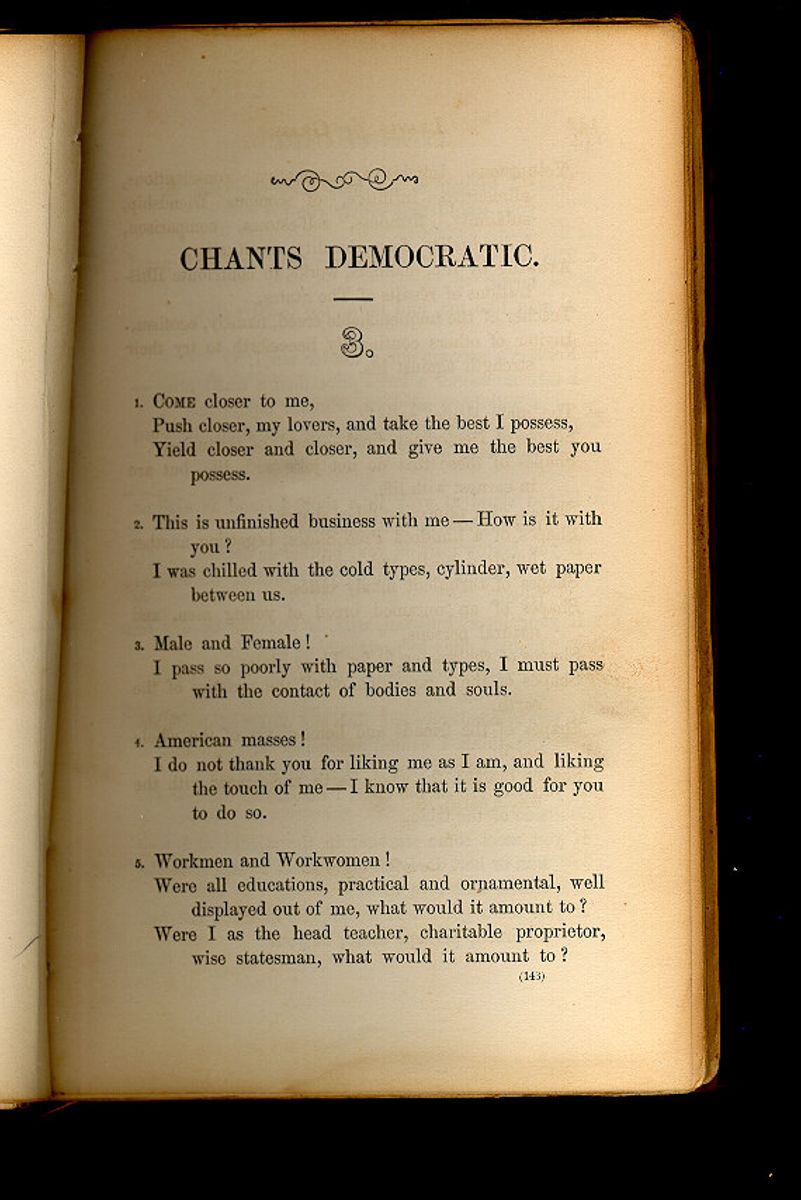 ppp.01500.151.jpg
CHANTS DEMOCRATIC.
3.
1COME closer to me, Push closer, my lovers, and take the best I possess, Yield closer and closer, and give me the best you possess. 2This is unfinished business with me—How is it withyou? I was chilled with the cold types, cylinder, wet paper
between us. 3Male and Female! I pass so poorly with paper and types, I must pass
with the contact of bodies and souls. 4American masses! I do not thank you for liking me as I am, and liking
the touch of me—I know that it is good for you
to do so. 5Workmen and Workwomen! Were all educations, practical and ornamental, well
displayed out of me, what would it amount to? Were I as the head teacher, charitable proprietor,
wise statesman, what would it amount to? [ begin page 144 ]
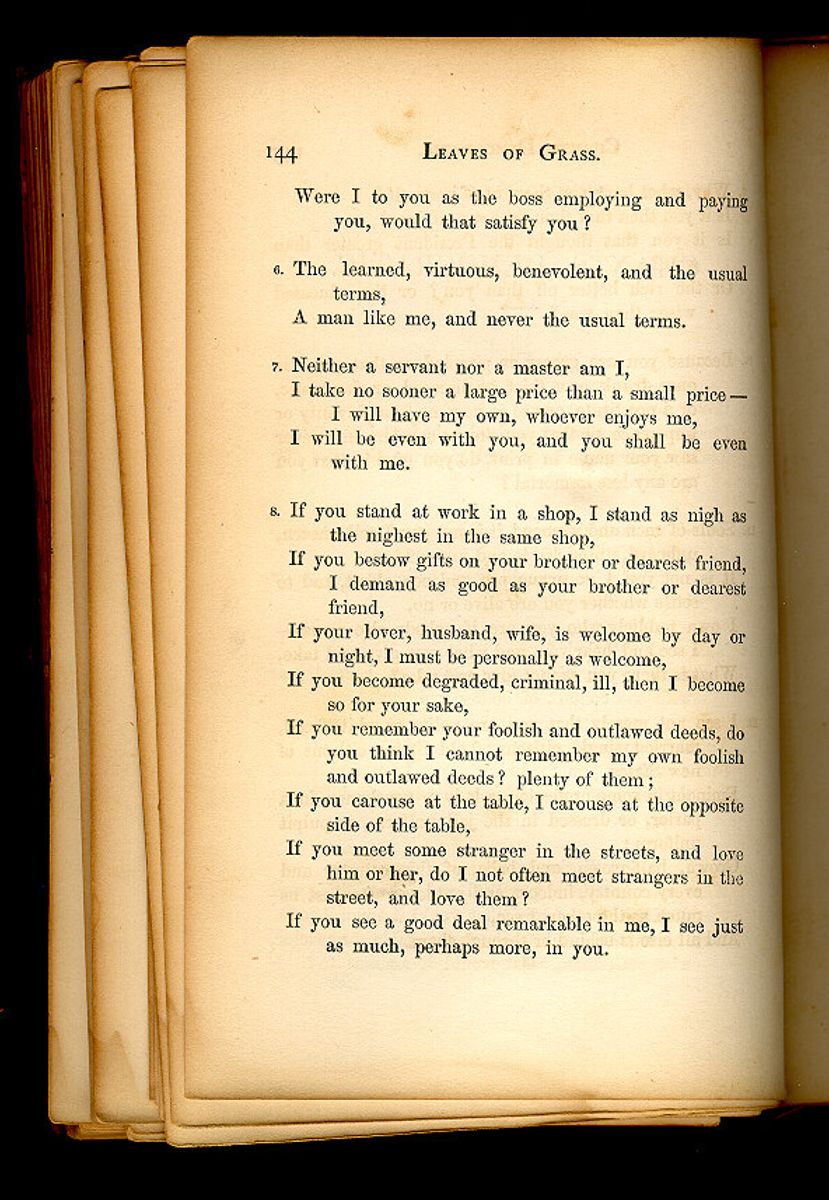 ppp.01500.152.jpg
Were I to you as the boss employing and paying
ppp.01500.152.jpg
Were I to you as the boss employing and paying you, would that satisfy you? 6The learned, virtuous, benevolent, and the usual
terms, A man like me, and never the usual terms. 7Neither a servant nor a master am I, I take no sooner a large price than a small price—
I will have my own, whoever enjoys me, I will be even with you, and you shall be even
with me. 8If you stand at work in a shop, I stand as nigh as
the nighest in the same shop, If you bestow gifts on your brother or dearest friend,
I demand as good as your brother or dearest
friend, If your lover, husband, wife, is welcome by day or
night, I must be personally as welcome, If you become degraded, criminal, ill, then I become
so for your sake, If you remember your foolish and outlawed deeds, do
you think I cannot remember my own foolish
and outlawed deeds? plenty of them; If you carouse at the table, I carouse at the opposite
side of the table, If you meet some stranger in the streets, and love
him or her, do I not often meet strangers in the
street, and love them? If you see a good deal remarkable in me, I see just
as much, perhaps more, in you. [ begin page 145 ]
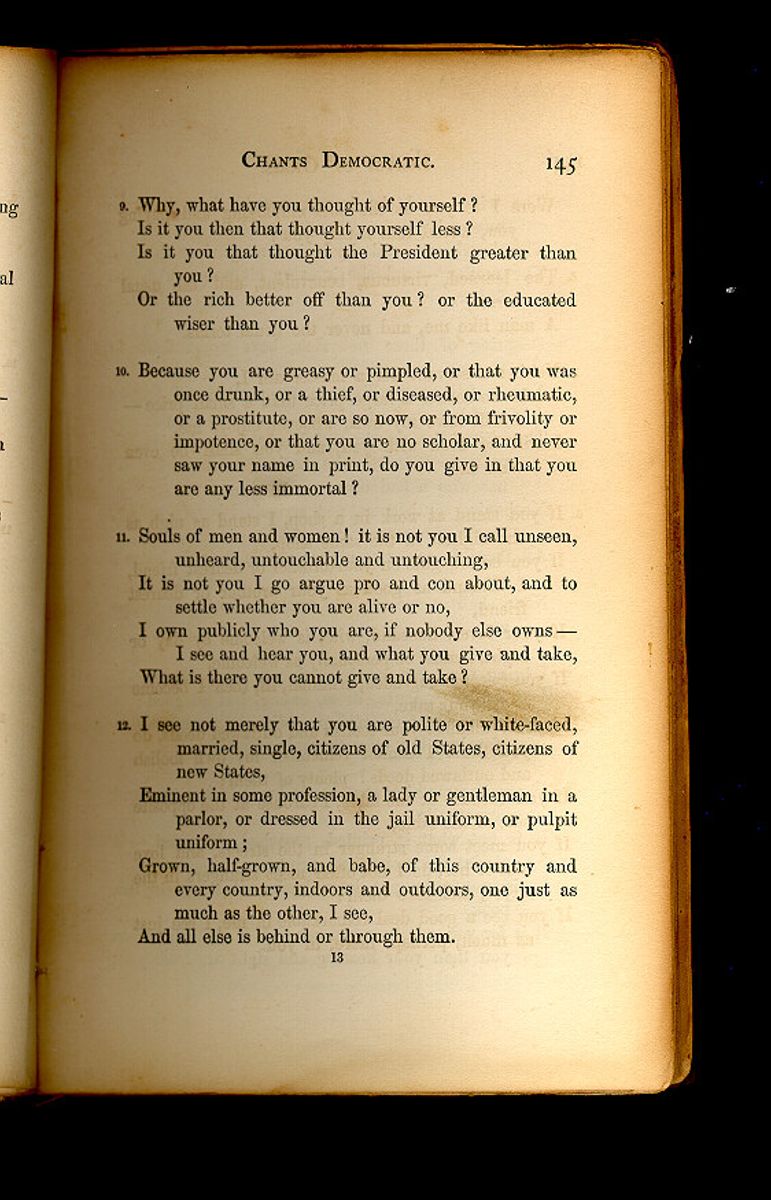 ppp.01500.153.jpg
9Why, what have you thought of yourself?
Is it you then that thought yourself less?
Is it you that thought the President greater than
ppp.01500.153.jpg
9Why, what have you thought of yourself?
Is it you then that thought yourself less?
Is it you that thought the President greater than you? Or the rich better off than you? or the educated
wiser than you? 10Because you are greasy or pimpled, or that you was
once drunk, or a thief, or diseased, or rheumatic,
or a prostitute, or are so now, or from frivolity or
impotence, or that you are no scholar, and never
saw your name in print, do you give in that you
are any less immortal? 11Souls of men and women! it is not you I call unseen,
unheard, untouchable and untouching, It is not you I go argue pro and con about, and to
settle whether you are alive or no, I own publicly who you are, if nobody else owns—
I see and hear you, and what you give and take, What is there you cannot give and take? 12I see not merely that you are polite or white-faced,
married, single, citizens of old States, citizens of
new States, Eminent in some profession, a lady or gentleman in a
parlor, or dressed in the jail uniform, or pulpit
uniform; Grown, half-grown, and babe, of this country and
every country, indoors and outdoors, one just as
much as the other, I see, And all else is behind or through them. 13 [ begin page 146 ]
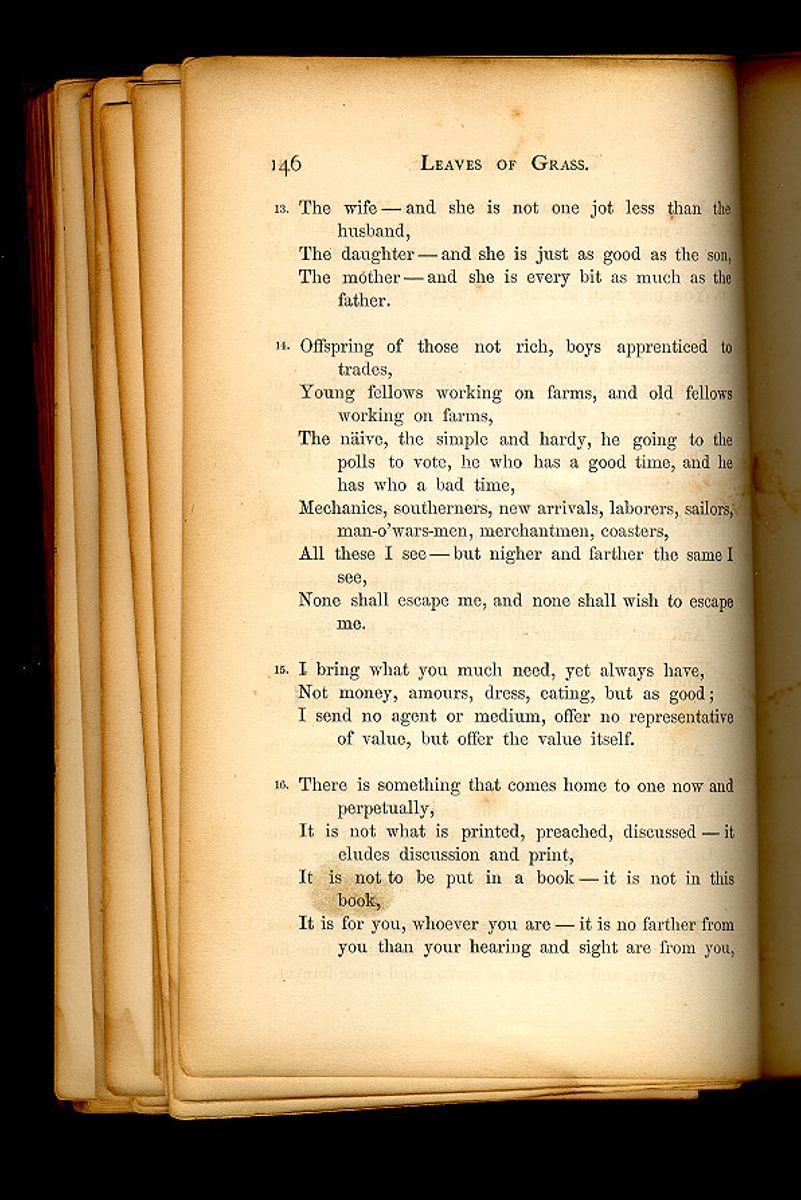 ppp.01500.154.jpg
13The wife—and she is not one jot less than the
ppp.01500.154.jpg
13The wife—and she is not one jot less than the husband, The daughter—and she is just as good as the son, The mother—and she is every bit as much as the
father. 14Offspring of those not rich, boys apprenticed to
trades, Young fellows working on farms, and old fellows
working on farms, The näive, the simple and hardy, he going to the
polls to vote, he who has a good time, and he
has who a bad time, Mechanics, southerners, new arrivals, laborers, sailors,
man-o'wars-men, merchantmen, coasters, All these I see—but nigher and farther the same I
see, None shall escape me, and none shall wish to escape
me. 15I bring what you much need, yet always have, Not money, amours, dress, eating, but as good; I send no agent or medium, offer no representative
of value, but offer the value itself. 16There is something that comes home to one now and
perpetually, It is not what is printed, preached, discussed—it
eludes discussion and print, It is not to be put in a book—it is not in this
book, It is for you, whoever you are—it is no farther from
you than your hearing and sight are from you, [ begin page 147 ]
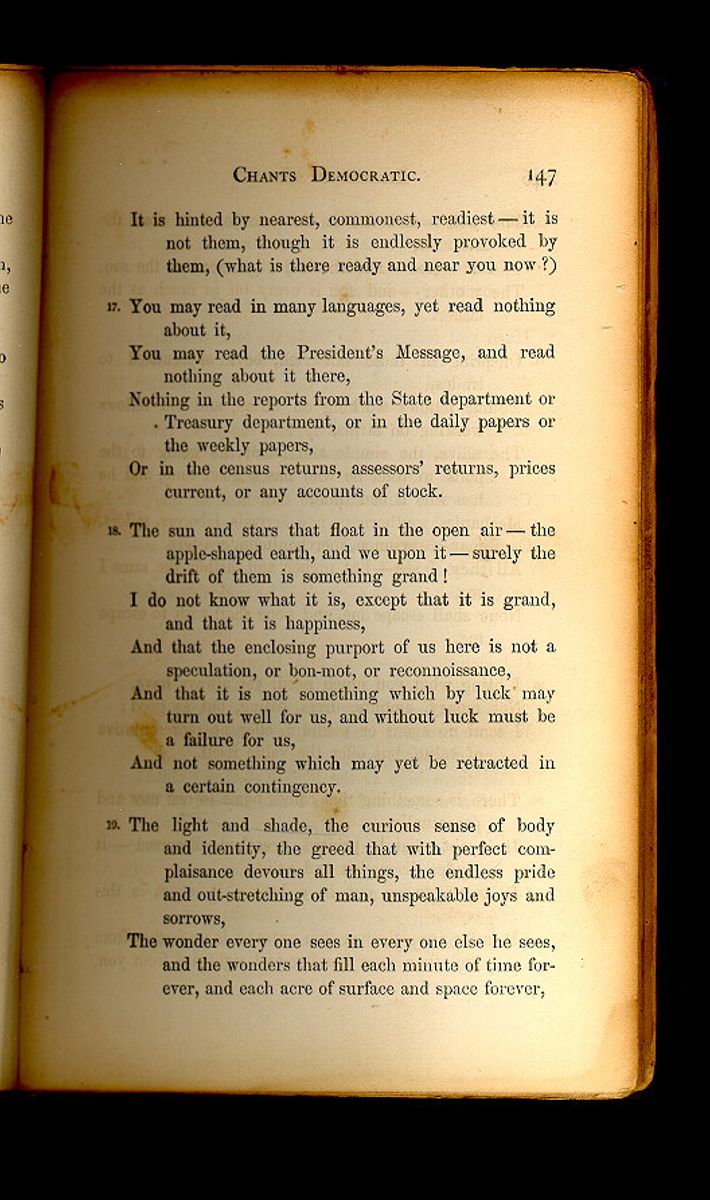 ppp.01500.155.jpg
It is hinted by nearest, commonest, readiest—it is
ppp.01500.155.jpg
It is hinted by nearest, commonest, readiest—it is not them, though it is endlessly provoked by
them, (what is there ready and near you now?) 17You may read in many languages, yet read nothing
about it, You may read the President's Message, and read
nothing about it there, Nothing in the reports from the State department or
Treasury department, or in the daily papers or
the weekly papers, Or in the census returns, assessors' returns, prices
current, or any accounts of stock. 18The sun and stars that float in the open air—the
apple-shaped earth, and we upon it—surely the
drift of them is something grand! I do not know what it is, except that it is grand,
and that it is happiness, And that the enclosing purport of us here is not a
speculation, or bon-mot, or reconnoissance, And that it is not something which by luck may
turn out well for us, and without luck must be
a failure for us, And not something which may yet be retracted in
a certain contingency. 19The light and shade, the curious sense of body
and identity, the greed that with perfect com-
plaisance devours all things, the endless pride
and out-stretching of man, unspeakable joys and
sorrows, The wonder every one sees in every one else he sees,
and the wonders that fill each minute of time for-
ever, and each acre of surface and space forever, [ begin page 148 ]
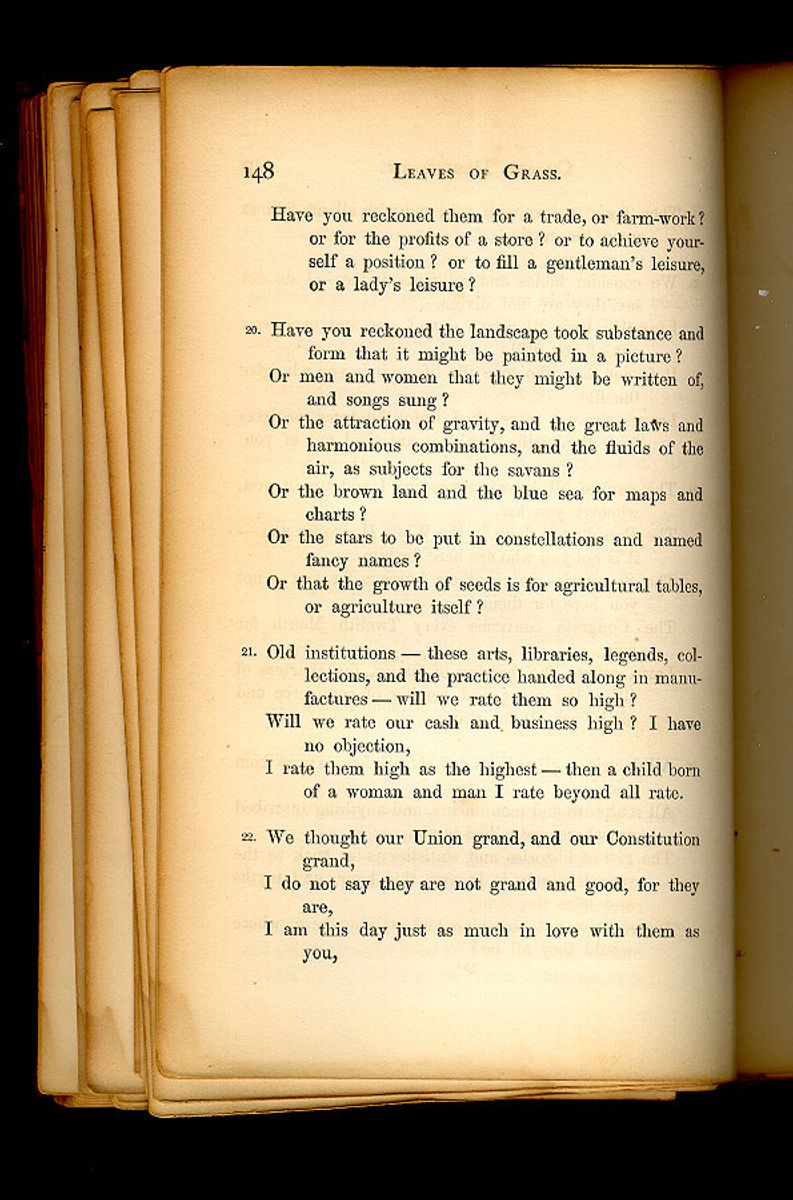 ppp.01500.156.jpg
Have you reckoned them for a trade, or farm-work?
ppp.01500.156.jpg
Have you reckoned them for a trade, or farm-work? or for the profits of a store? or to achieve your-
self a position? or to fill a gentleman's leisure,
or a lady's leisure? 20Have you reckoned the landscape took substance and
form that it might be painted in a picture? Or men and women that they might be written of,
and songs sung? Or the attraction of gravity, and the great laws and
harmonious combinations, and the fluids of the
air, as subjects for the savans? Or the brown land and the blue sea for maps and
charts? Or the stars to be put in constellations and named
fancy names? Or that the growth of seeds is for agricultural tables,
or agriculture itself? 21Old institutions—these arts, libraries, legends, col-
lections, and the practice handed along in manu-
factures—will we rate them so high? Will we rate our cash and business high? I have
no objection, I rate them high as the highest—then a child born
of a woman and man I rate beyond all rate. 22We thought our Union grand, and our Constitution
grand, I do not say they are not grand and good, for they
are, I am this day just as much in love with them as
you, [ begin page 149 ]
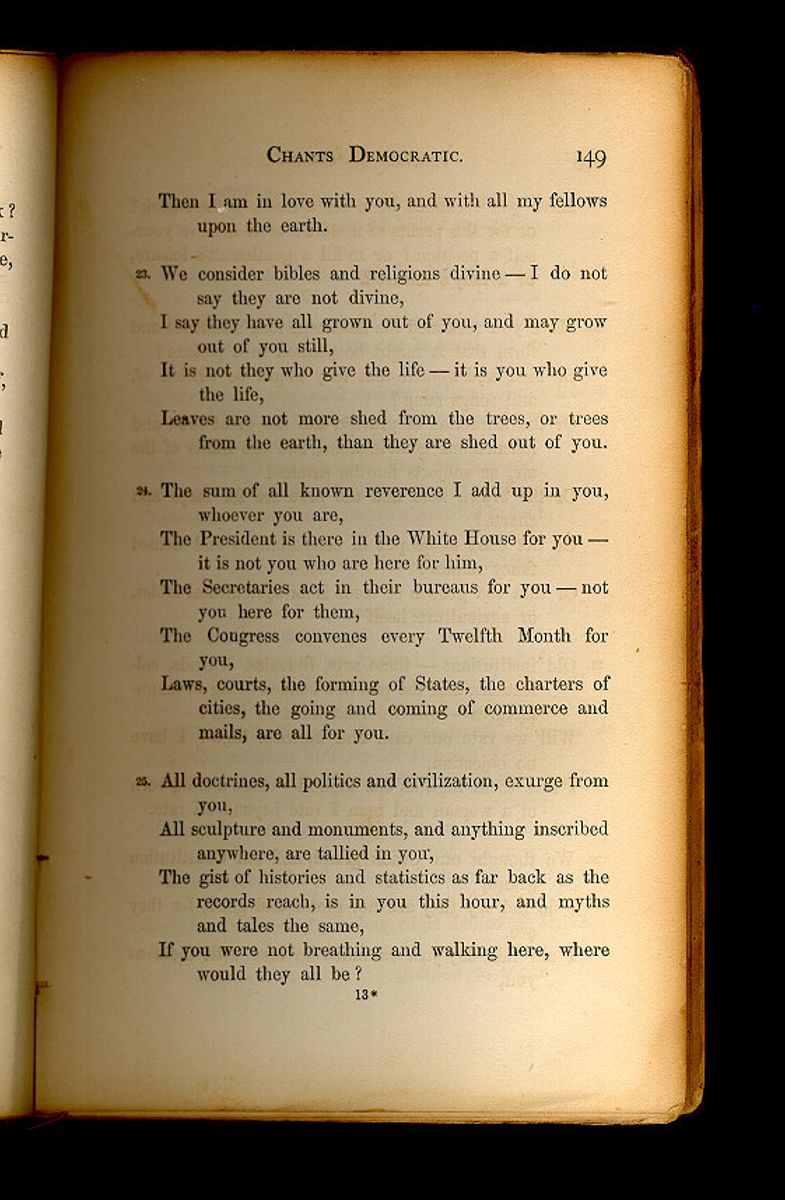 ppp.01500.157.jpg
Then I am in love with you, and with all my fellows
ppp.01500.157.jpg
Then I am in love with you, and with all my fellows upon the earth. 23We consider bibles and religions divine—I do not
say they are not divine, I say they have all grown out of you, and may grow
out of you still, It is not they who give the life—it is you who give
the life, Leaves are not more shed from the trees, or trees
from the earth, than they are shed out of you. 24The sum of all known reverence I add up in you,
whoever you are, The President is there in the White House for you—
it is not you who are here for him, The Secretaries act in their bureaus for you—not
you here for them, The Congress convenes every Twelfth Month for
you, Laws, courts, the forming of States, the charters of
cities, the going and coming of commerce and
mails, are all for you. 25All doctrines, all politics and civilization, exurge from
you, All sculpture and monuments, and anything inscribed
anywhere, are tallied in you, The gist of histories and statistics as far back as the
records reach, is in you this hour, and myths
and tales the same, If you were not breathing and walking here, where
would they all be? 13* [ begin page 150 ]
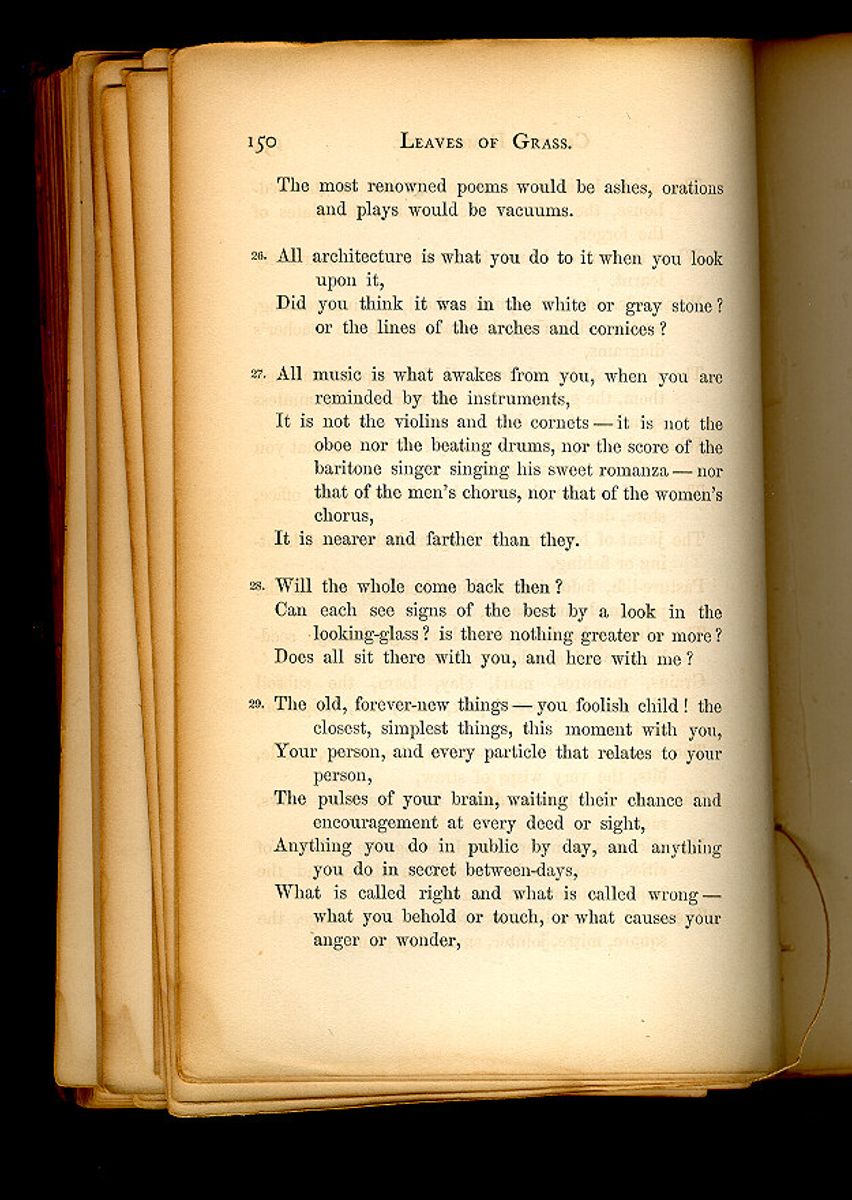 ppp.01500.158.jpg
The most renowned poems would be ashes, orations
ppp.01500.158.jpg
The most renowned poems would be ashes, orations and plays would be vacuums. 26All architecture is what you do to it when you look
upon it, Did you think it was in the white or gray stone?
or the lines of the arches and cornices? 27All music is what awakes from you, when you are
reminded by the instruments, It is not the violins and the cornets—it is not the
oboe nor the beating drums, nor the score of the
baritone singer singing his sweet romanza—nor
that of the men's chorus, nor that of the women's
chorus, It is nearer and farther than they. 28Will the whole come back then? Can each see signs of the best by a look in the
looking-glass? is there nothing greater or more? Does all sit there with you, and here with me? 29The old, forever-new things—you foolish child! the
closest, simplest things, this moment with you, Your person, and every particle that relates to your
person, The pulses of your brain, waiting their chance and
encouragement at every deed or sight, Anything you do in public by day, and anything
you do in secret between-days, What is called right and what is called wrong—
what you behold or touch, or what causes your
anger or wonder, [ begin page 151 ]
 ppp.01500.159.jpg
The ankle-chain of the slave, the bed of the bed-
ppp.01500.159.jpg
The ankle-chain of the slave, the bed of the bed- house, the cards of the gambler, the plates of
the forger, What is seen or learnt in the street, or intuitively
learnt, What is learnt in the public school, spelling, reading,
writing, ciphering, the black-board, the teacher's
diagrams, The panes of the windows, all that appears through
them, the going forth in the morning, the aimless
spending of the day, (What is it that you made money? What is it that you
got what you wanted?) The usual routine, the work-shop, factory, yard, office,
store, desk, The jaunt of hunting or fishing, and the life of hunt-
ing or fishing, Pasture-life, foddering, milking, herding, and all the
personnel and usages, The plum-orchard, apple-orchard, gardening, seed-
lings, cuttings, flowers, vines, Grains, manures, marl, clay, loam, the subsoil
plough, the shovel, pick, rake, hoe, irrigation,
draining, The curry-comb, the horse-cloth, the halter, bridle,
bits, the very wisps of straw, The barn and barn-yard, the bins, mangers, mows,
racks, Manufactures, commerce, engineering, the building of
cities, every trade carried on there, and the
implements of every trade, The anvil, tongs, hammer, the axe and wedge, the
square, mitre, jointer, smoothing-plane, [ begin page 152 ]
 ppp.01500.160.jpg
The plumbob, trowel, level, the wall-scaffold, the
ppp.01500.160.jpg
The plumbob, trowel, level, the wall-scaffold, the work of walls and ceilings, or any mason-work, The steam-engine, lever, crank, axle, piston, shaft,
air-pump, boiler, beam, pulley, hinge, flange,
band, bolt, throttle, governors, up and down
rods, The ship's compass, the sailor's tarpaulin, the stays
and lanyards, the ground tackle for anchoring or
mooring, the life-boat for wrecks, The sloop's tiller, the pilot's wheel and bell, the yacht
or fish-smack—the great gay-pennanted three-
hundred-foot steamboat, under full headway, with
her proud fat breasts, and her delicate swift-
flashing paddles, The trail, line, hooks, sinkers, and the seine, and
hauling the seine, The arsenal, small-arms, rifles, gunpowder, shot, caps,
wadding, ordnance for war, and carriages; Every-day objects, house-chairs, carpet, bed, coun-
terpane of the bed, him or her sleeping at night,
wind blowing, indefinite noises, The snow-storm or rain-storm, the tow-trowsers, the
lodge-hut in the woods, the still-hunt, City and country, fire-place, candle, gas-light, heater,
aqueduct, The message of the Governor, Mayor, Chief of Police
—the dishes of breakfast, dinner, supper, The bunk-room, the fire-engine, the string-team, the
car or truck behind, The paper I write on or you write on, every word we
write, every cross and twirl of the pen, and the
curious way we write what we think, yet very
faintly, [ begin page 153 ]
 ppp.01500.161.jpg
The directory, the detector, the ledger, the books in
ppp.01500.161.jpg
The directory, the detector, the ledger, the books in ranks on the book-shelves, the clock attached to
the wall, The ring on your finger, the lady's wristlet, the scent-
powder, the druggist's vials and jars, the draught
of lager-beer, The etui of surgical instruments, the etui of oculist's
or aurist's instruments, or dentist's instruments, The permutating lock that can be turned and locked
as many different ways as there are minutes in a
year, Glass-blowing, nail-making, salt-making, tin-roofing,
shingle-dressing, candle-making, lock-making and
hanging, Ship-carpentering, dock-building, fish-curing, ferrying,
stone-breaking, flagging of side-walks by flaggers, The pump, the pile-driver, the great derrick, the coal-
kiln and brick-kiln, Coal-mines, all that is down there, the lamps in the
darkness, echoes, songs, what meditations, what
vast native thoughts looking through smutch'd
faces, Iron-works, forge-fires in the mountains, or by river-
banks, men around feeling the melt with huge
crowbars—lumps of ore, the due combining of
ore, limestone, coal—the blast-furnace and the
puddling-furnace, the loup-lump at the bottom of
the melt at last—the rolling-mill, the stumpy
bars of pig-iron, the strong clean-shaped T rail
for railroads, Oil-works, silk-works, white-lead-works, the sugar-
house, steam-saws, the great mills and factories, Lead-mines, and all that is done in lead-mines, or
with the lead afterward, [ begin page 154 ]
 ppp.01500.162.jpg
Copper-mines, the sheets of copper, and what is
ppp.01500.162.jpg
Copper-mines, the sheets of copper, and what is formed out of the sheets, and all the work in
forming it, Stone-cutting, shapely trimmings for façades, or win-
dow or door lintels—the mallet, the tooth-chisel,
the jib to protect the thumb, Oakum, the oakum-chisel, the caulking-iron—the
kettle of boiling vault-cement, and the fire under
the kettle, The cotton-bale, the stevedore's hook, the saw and
buck of the sawyer, the screen of the coal-
screener, the mould of the moulder, the work-
ing-knife of the butcher, the ice-saw, and all the
work with ice, The four-double cylinder press, the hand-press, the
frisket and tympan, the compositor's stick and
rule, type-setting, making up the forms, all the
work of newspaper counters, folders, carriers,
news-men, The implements for daguerreotyping—the tools of
the rigger, grappler, sail-maker, block-maker, Goods of gutta-percha, papier-mache, colors, brushes,
brush-making, glazier's implements, The veneer and glue-pot, the confectioner's orna-
ments, the decanter and glasses, the shears and
flat-iron, The awl and knee-strap, the pint measure and quart
measure, the counter and stool, the writing-pen
of quill or metal—the making of all sorts of
edged tools, The ladders and hanging-ropes of the gymnasium,
manly exercises, the game of base-ball, running,
leaping, pitching quoits, [ begin page 155 ]
 ppp.01500.163.jpg
The designs for wall-papers, oil-cloths, carpets, the
ppp.01500.163.jpg
The designs for wall-papers, oil-cloths, carpets, the fancies for goods for women, the book-binder's
stamps, The brewery, brewing, the malt, the vats, every
thing that is done by brewers, also by wine-
makers, also vinegar-makers, Leather-dressing, coach-making, boiler-making, rope-
twisting, distilling, sign-painting, lime-burning,
coopering, cotton-picking—electro-plating, elec-
trotyping, stereotyping, Stave-machines, planing-machines, reaping-machines,
ploughing-machines, thrashing-machines, steam-
wagons, The cart of the carman, the omnibus, the ponderous
dray, The wires of the electric telegraph stretched on land,
or laid at the bottom of the sea, and then the
message in an instant from a thousand miles off, The snow-plough, and two engines pushing it—the
ride in the express-train of only one car, the
swift go through a howling storm—the locomo-
tive, and all that is done about a locomotive, The bear-hunt or coon-hunt—the bonfire of shavings
in the open lot in the city, and the crowd of
children watching, The blows of the fighting-man, the upper-cut, and
one-two-three, Pyrotechny, letting off colored fire-works at night,
fancy figures and jets, Shop-windows, coffins in the sexton's ware-room, fruit
on the fruit-stand—beef in the butcher's stall,
the slaughter-house of the butcher, the butcher
in his killing-clothes, [ begin page 156 ]
 ppp.01500.164.jpg
The area of pens of live pork, the killing-hammer, the
ppp.01500.164.jpg
The area of pens of live pork, the killing-hammer, the hog-hook, the scalder's tub, gutting, the cutter's
cleaver, the packer's maul, and the plenteous
winter-work of pork-packing, Flour-works, grinding of wheat, rye, maize, rice—
the barrels and the half and quarter barrels, the
loaded barges, the high piles on wharves and
levees, Bread and cakes in the bakery, the milliner's rib-
bons, the dress-maker's patterns, the tea-table,
the home-made sweetmeats; Cheap literature, maps, charts, lithographs, daily and
weekly newspapers, The column of wants in the one-cent paper, the news
by telegraph, amusements, operas, shows, The business parts of a city, the trottoirs of a city
when thousands of well-dressed people walk up
and down, The cotton, woollen, linen you wear, the money you
make and spend, Your room and bed-room, your piano-forte, the stove
and cook-pans, The house you live in, the rent, the other tenants, the
deposit in the savings-bank, the trade at the
grocery, The pay on Seventh Day night, the going home, and
the purchases; In them the heft of the heaviest—in them far more
than you estimated, and far less also, In them realities for you and me—in them poems for
you and me, In them, not yourself—you and your Soul enclose all
things, regardless of estimation, [ begin page 157 ]
 ppp.01500.165.jpg
In them themes, hints, provokers—if not, the whole
ppp.01500.165.jpg
In them themes, hints, provokers—if not, the whole earth has no themes, hints, provokers, and never
had. 30I do not affirm what you see beyond is futile—I do
not advise you to stop, I do not say leadings you thought great are not great, But I say that none lead to greater, sadder, happier,
than those lead to. 31Will you seek afar off? You surely come back at last, In things best known to you, finding the best, or as
good as the best, In folks nearest to you finding also the sweetest,
strongest, lovingest, Happiness, knowledge, not in another place, but this
place—not for another hour, but this hour, Man in the first you see or touch—always in your
friend, brother, nighest neighbor—Woman in
your mother, lover, wife, The popular tastes and occupations taking precedence
in poems or any where, You workwomen and workmen of These States having
your own divine and strong life, Looking the President always sternly in the face,
unbending, nonchalant, Understanding that he is to be kept by you to short
and sharp account of himself, And all else thus far giving place to men and women
like you. 32O you robust, sacred! I cannot tell you how I love you; 14 [ begin page 158 ]
 ppp.01500.166.jpg
All I love America for, is contained in men and
ppp.01500.166.jpg
All I love America for, is contained in men and women like you. 33When the psalm sings instead of the singer, When the script preaches instead of the preacher, When the pulpit descends and goes instead of the
carver that carved the supporting-desk, When I can touch the body of books, by night or by
day, and when they touch my body back again, When the holy vessels, or the bits of the eucharist,
or the lath and plast, procreate as effectually as
the young silver-smiths or bakers, or the masons
in their over-alls, When a university course convinces like a slumbering
woman and child convince, When the minted gold in the vault smiles like the
night-watchman's daughter, When warrantee deeds loafe in chairs opposite, and
are my friendly companions, I intend to reach them my hand, and make as much
of them as I do of men and women like you. [ begin page 159 ]
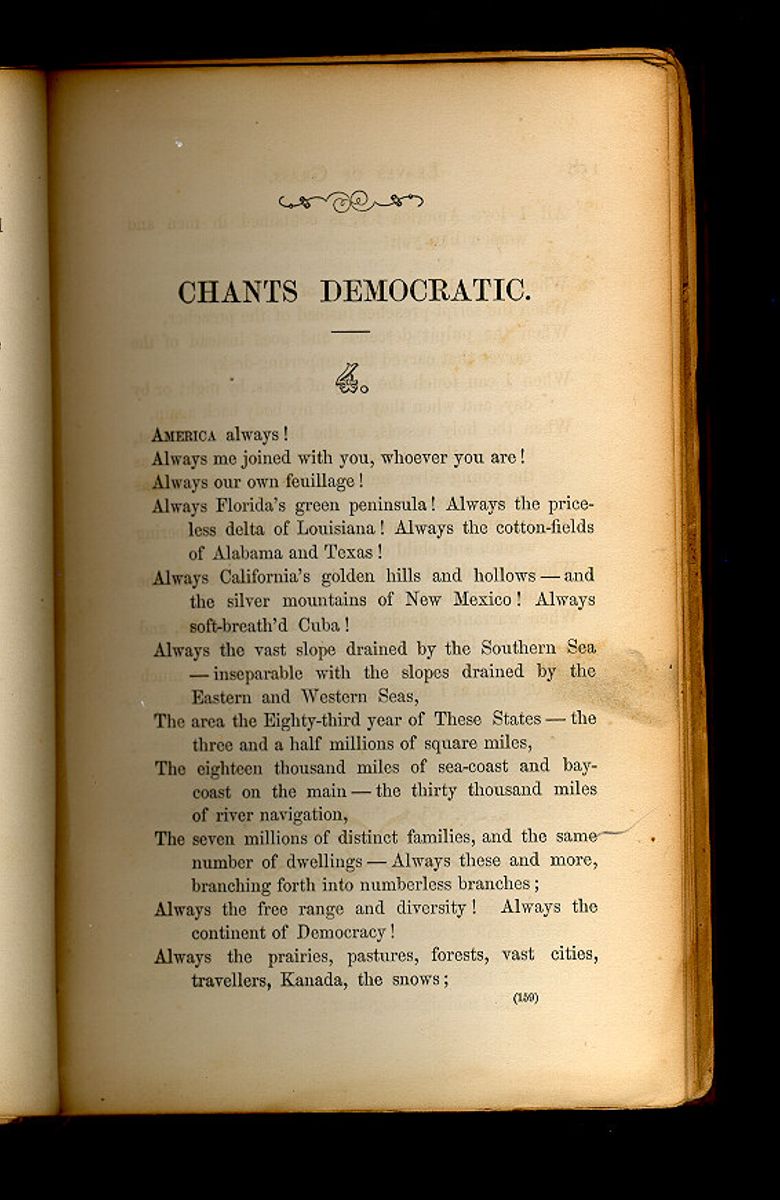 ppp.01500.167.jpg
CHANTS DEMOCRATIC.
4.
AMERICA always! Always me joined with you, whoever you are! Always our own feuillage! Always Florida's green peninsula! Always the price-less delta of Louisiana! Always the cotton-fields
of Alabama and Texas! Always California's golden hills and hollows—and
the silver mountains of New Mexico! Always
soft-breath'd Cuba! Always the vast slope drained by the Southern Sea
—inseparable with the slopes drained by the
Eastern and Western Seas, The area the Eighty-third year of These States—the
three and a half millions of square miles, The eighteen thousand miles of sea-coast and bay-
coast on the main—the thirty thousand miles
of river navigation, The seven millions of distinct families, and the same
number of dwellings—Always these and more,
branching forth into numberless branches; Always the free range and diversity! Always the
continent of Democracy! Always the prairies, pastures, forests, vast cities,
travellers, Kanada, the snows; [ begin page 160 ]
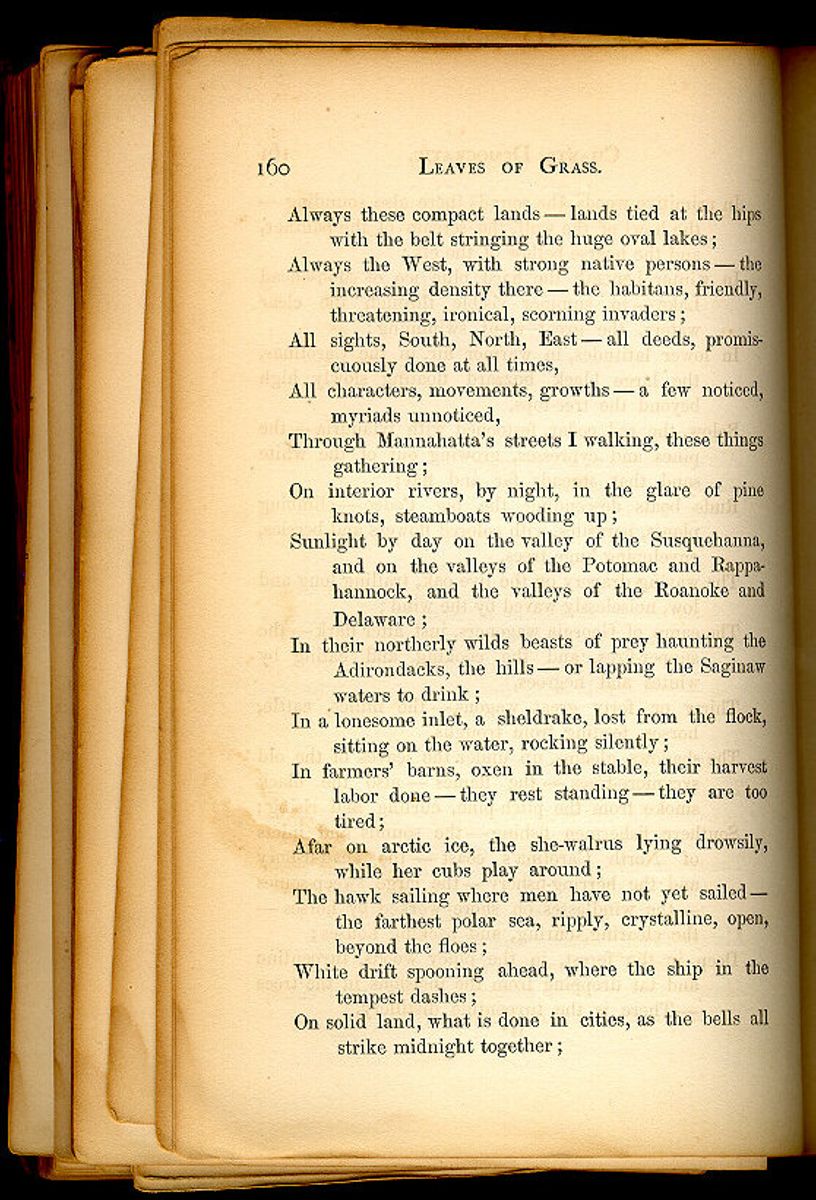 ppp.01500.168.jpg
Always these compact lands—lands tied at the hips
ppp.01500.168.jpg
Always these compact lands—lands tied at the hips with the belt stringing the huge oval lakes; Always the West, with strong native persons—the
increasing density there—the habitans, friendly,
threatening, ironical, scorning invaders; All sights, South, North, East—all deeds, promis-
cuously done at all times, All characters, movements, growths—a few noticed,
myriads unnoticed, Through Mannahatta's streets I walking, these things
gathering; On interior rivers, by night, in the glare of pine
knots, steamboats wooding up; Sunlight by day on the valley of the Susquehanna,
and on the valleys of the Potomac and Rappa-
hannock, and the valleys of the Roanoke and
Delaware; In their northerly wilds beasts of prey haunting the
Adirondacks, the hills—or lapping the Saginaw
waters to drink; In a lonesome inlet, a sheldrake, lost from the flock,
sitting on the water, rocking silently; In farmers' barns, oxen in the stable, their harvest
labor done—they rest standing—they are too
tired; Afar on arctic ice, the she-walrus lying drowsily,
while her cubs play around; The hawk sailing where men have not yet sailed—
the farthest polar sea, ripply, crystalline, open,
beyond the floes; White drift spooning ahead, where the ship in the
tempest dashes; On solid land, what is done in cities, as the bells all
strike midnight together; [ begin page 161 ]
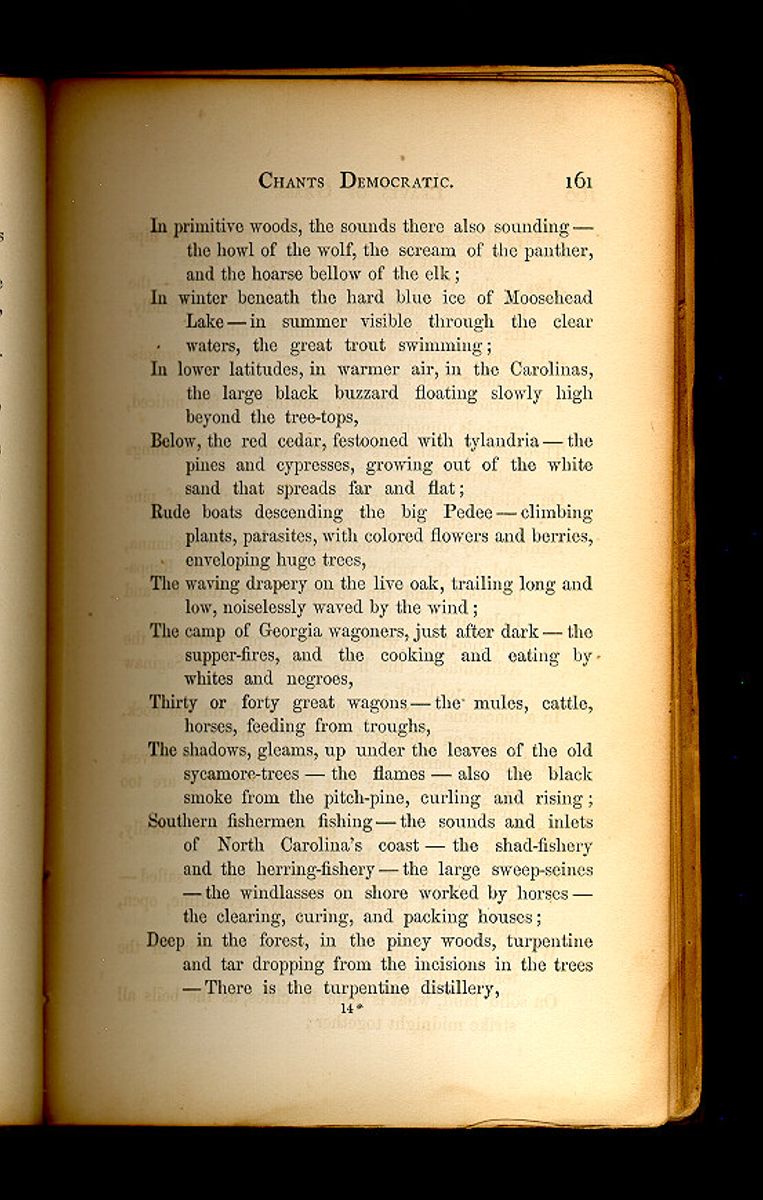 ppp.01500.169.jpg
In primitive woods, the sounds there also sounding—
ppp.01500.169.jpg
In primitive woods, the sounds there also sounding— the howl of the wolf, the scream of the panther,
and the hoarse bellow of the elk; In winter beneath the hard blue ice of Moosehead
Lake—in summer visible through the clear
waters, the great trout swimming; In lower latitudes, in warmer air, in the Carolinas,
the large black buzzard floating slowly high
beyond the tree-tops, Below, the red cedar, festooned with tylandria—the
pines and cypresses, growing out of the white
sand that spreads far and flat; Rude boats descending the big Pedee—climbing
plants, parasites, with colored flowers and berries,
enveloping huge trees, The waving drapery on the live oak, trailing long and
low, noiselessly waved by the wind; The camp of Georgia wagoners, just after dark—the
supper-fires, and the cooking and eating by
whites and negroes, Thirty or forty great wagons—the mules, cattle,
horses, feeding from troughs, The shadows, gleams, up under the leaves of the old
sycamore-trees—the flames—also the black
smoke from the pitch-pine, curling and rising; Southern fishermen fishing—the sounds and inlets
of North Carolina's coast—the shad-fishery
and the herring-fishery—the large sweep-seines
—the windlasses on shore worked by horses—
the clearing, curing, and packing houses; Deep in the forest, in the piney woods, turpentine
and tar dropping from the incisions in the trees
—There is the turpentine distillery, 14* [ begin page 162 ]
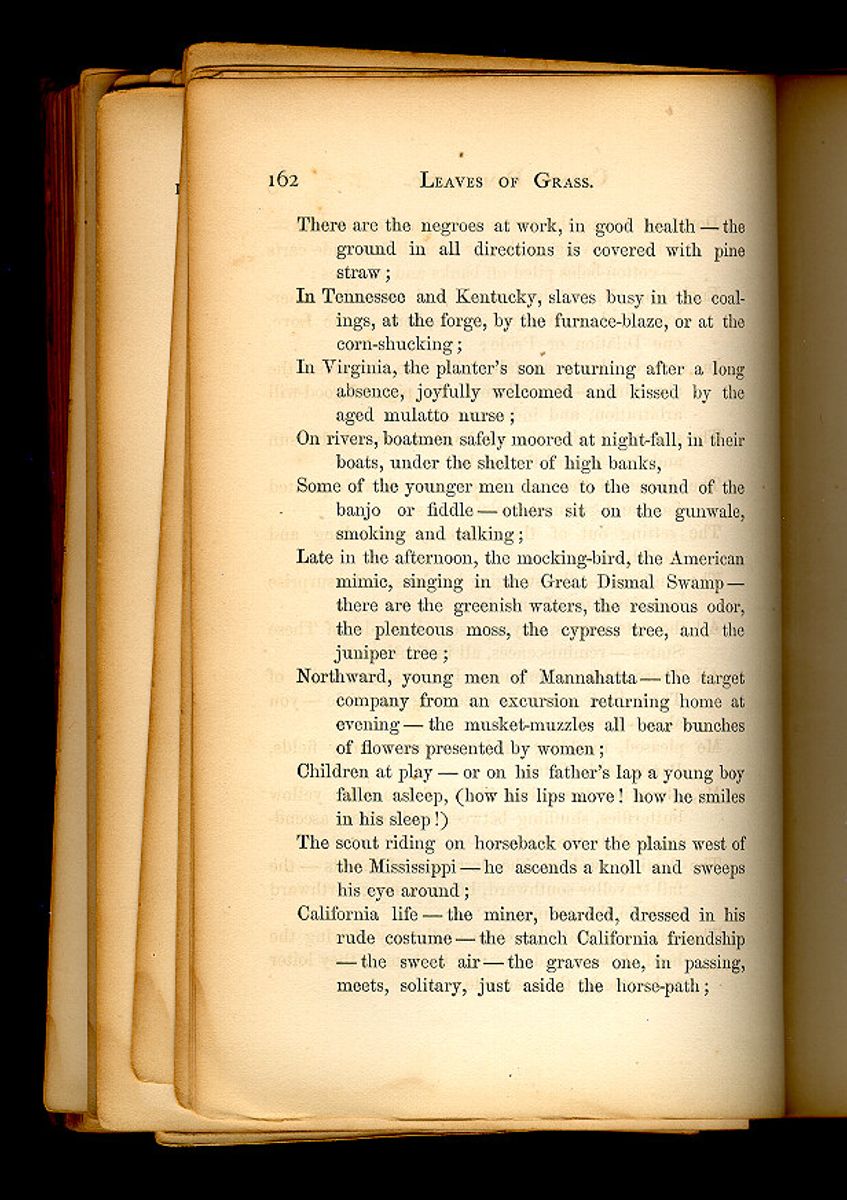 ppp.01500.170.jpg
There are the negroes at work, in good health—the
ppp.01500.170.jpg
There are the negroes at work, in good health—the ground in all directions is covered with pine
straw; In Tennessee and Kentucky, slaves busy in the coal-
ings, at the forge, by the furnace-blaze, or at the
corn-shucking; In Virginia, the planter's son returning after a long
absence, joyfully welcomed and kissed by the
aged mulatto nurse; On rivers, boatmen safely moored at night-fall, in their
boats, under the shelter of high banks, Some of the younger men dance to the sound of the
banjo or fiddle—others sit on the gunwale,
smoking and talking; Late in the afternoon, the mocking-bird, the American
mimic, singing in the Great Dismal Swamp—
there are the greenish waters, the resinous odor,
the plenteous moss, the cypress tree, and the
juniper tree; Northward, young men of Mannahatta—the target
company from an excursion returning home at
evening—the musket-muzzles all bear bunches
of flowers presented by women; Children at play—or on his father's lap a young boy
fallen asleep, (how his lips move! how he smiles
in his sleep!) The scout riding on horseback over the plains west of
the Mississippi—he ascends a knoll and sweeps
his eye around; California life—the miner, bearded, dressed in his
rude costume—the stanch California friendship
—the sweet air—the graves one, in passing,
meets, solitary, just aside the horse-path; [ begin page 163 ]
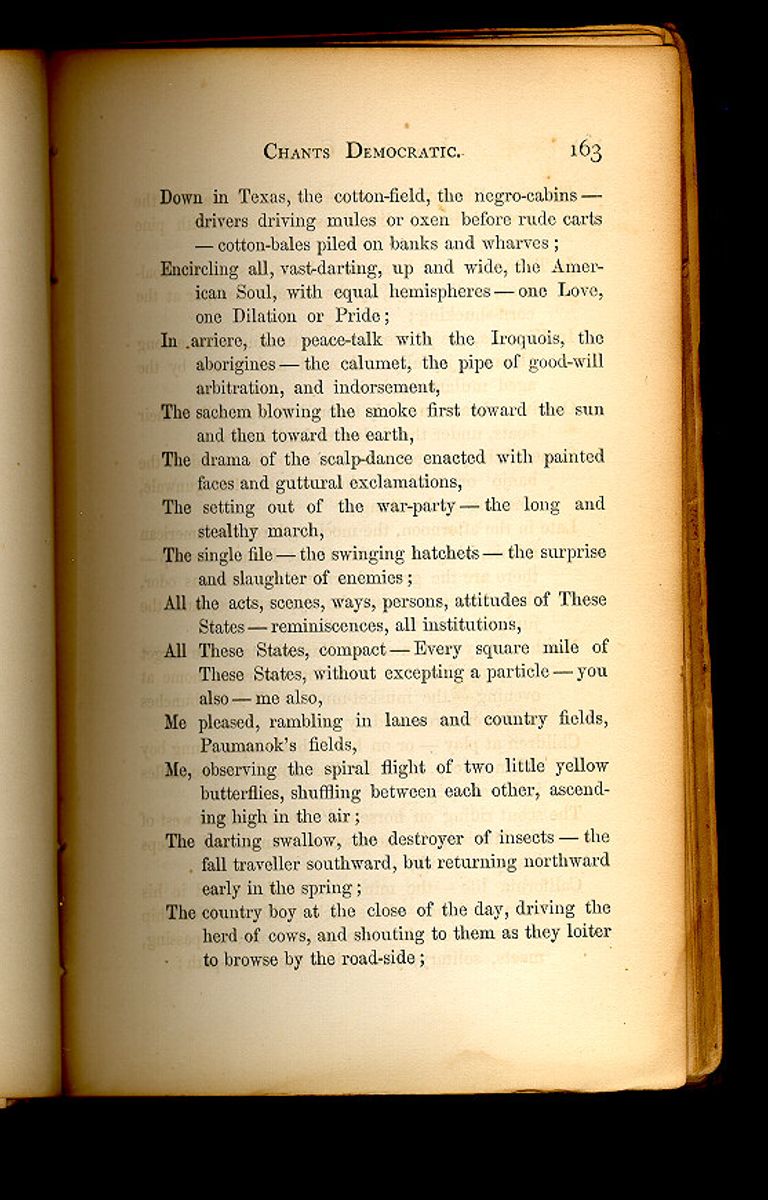 ppp.01500.171.jpg
Down in Texas, the cotton-field, the negro-cabins—
ppp.01500.171.jpg
Down in Texas, the cotton-field, the negro-cabins— drivers driving mules or oxen before rude carts
—cotton-bales piled on banks and wharves; Encircling all, vast-darting, up and wide, the Amer-
ican Soul, with equal hemispheres—one Love,
one Dilation or Pride; In arriere, the peace-talk with the Iroquois, the
aborigines—the calumet, the pipe of good-will
arbitration, and indorsement, The sachem blowing the smoke first toward the sun
and then toward the earth, The drama of the scalp-dance enacted with painted
faces and guttural exclamations, The setting out of the war-party—the long and
stealthy march, The single file—the swinging hatchets—the surprise
and slaughter of enemies; All the acts, scenes, ways, persons, attitudes of These
States—reminiscences, all institutions, All These States, compact—Every square mile of
These States, without excepting a particle—you
also—me also, Me pleased, rambling in lanes and country fields,
Paumanok's fields, Me, observing the spiral flight of two little yellow
butterflies, shuffling between each other, ascend-
ing high in the air; The darting swallow, the destroyer of insects—the
fall traveller southward, but returning northward
early in the spring; The country boy at the close of the day, driving the
herd of cows, and shouting to them as they loiter
to browse by the road-side; [ begin page 164 ]
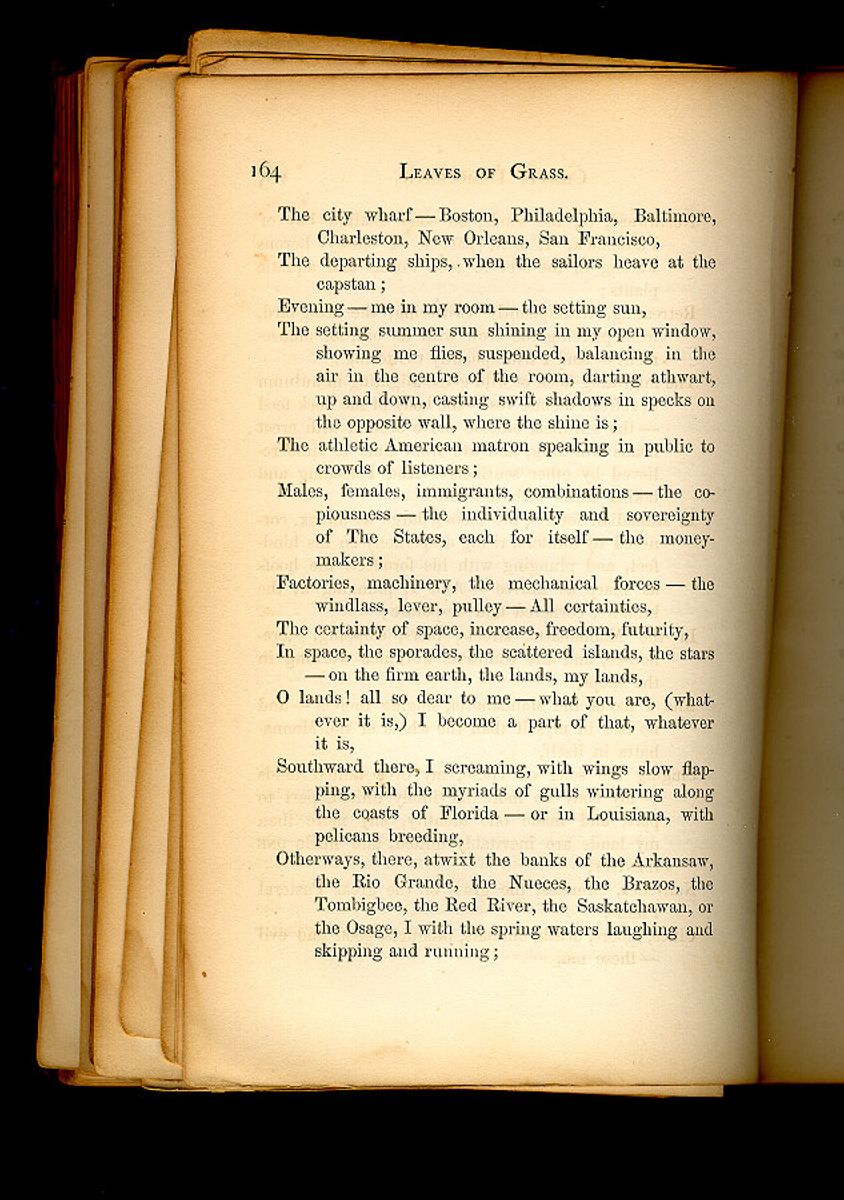 ppp.01500.172.jpg
The city wharf—Boston, Philadelphia, Baltimore,
ppp.01500.172.jpg
The city wharf—Boston, Philadelphia, Baltimore, Charleston, New Orleans, San Francisco, The departing ships, when the sailors heave at the
capstan; Evening—me in my room—the setting sun, The setting summer sun shining in my open window,
showing me flies, suspended, balancing in the
air in the centre of the room, darting athwart,
up and down, casting swift shadows in specks on
the opposite wall, where the shine is; The athletic American matron speaking in public to
crowds of listeners; Males, females, immigrants, combinations—the co-
piousness—the individuality and sovereignty
of The States, each for itself—the money-
makers; Factories, machinery, the mechanical forces—the
windlass, lever, pulley—All certainties, The certainty of space, increase, freedom, futurity, In space, the sporades, the scattered islands, the stars
—on the firm earth, the lands, my lands, O lands! all so dear to me—what you are, (what-
ever it is,) I become a part of that, whatever
it is, Southward there, I screaming, with wings slow flap-
ping, with the myriads of gulls wintering along
the coasts of Florida—or in Louisiana, with
pelicans breeding, Otherways, there, atwixt the banks of the Arkansaw,
the Rio Grande, the Nueces, the Brazos, the
Tombigbee, the Red River, the Saskatchawan, or
the Osage, I with the spring waters laughing and
skipping and running; [ begin page 165 ]
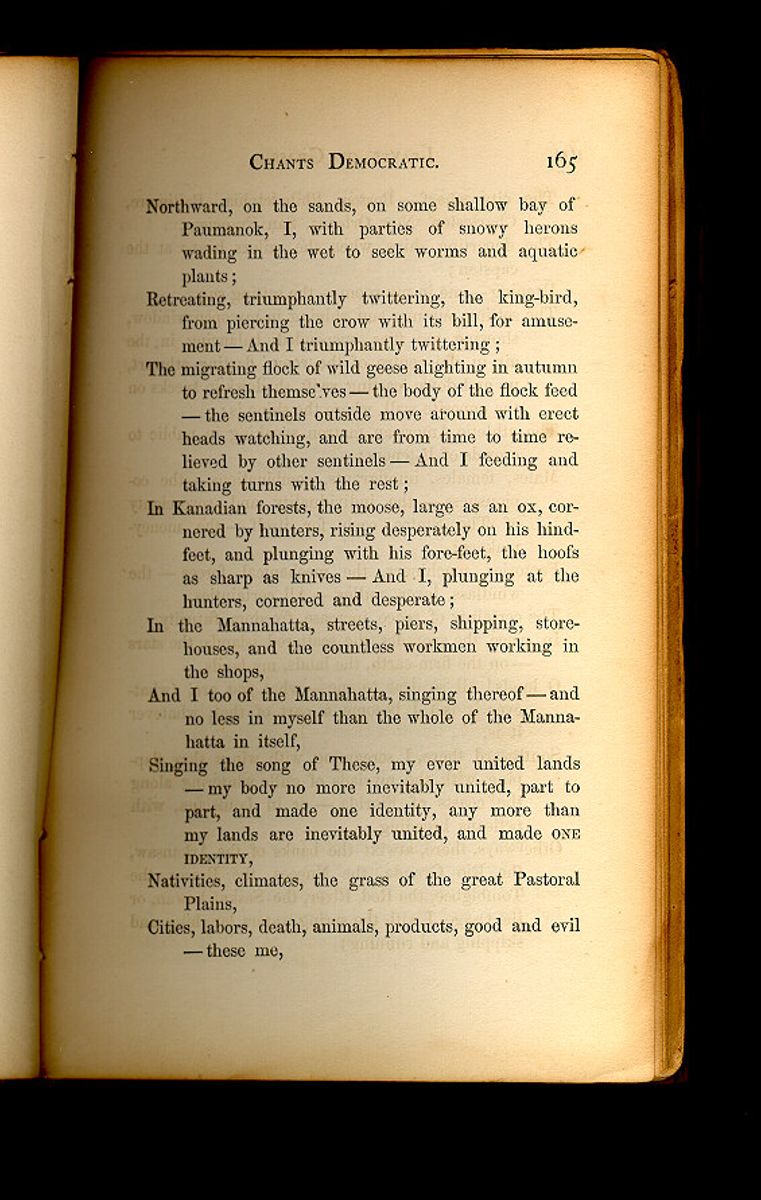 ppp.01500.173.jpg
Northward, on the sands, on some shallow bay of
ppp.01500.173.jpg
Northward, on the sands, on some shallow bay of Paumanok, I, with parties of snowy herons
wading in the wet to seek worms and aquatic
plants; Retreating, triumphantly twittering, the king-bird,
from piercing the crow with its bill, for amuse-
ment—And I triumphantly twittering; The migrating flock of wild geese alighting in autumn
to refresh themselves—the body of the flock feed
—the sentinels outside move around with erect
heads watching, and are from time to time re-
lieved by other sentinels—And I feeding and
taking turns with the rest; In Kanadian forests, the moose, large as an ox, cor-
nered by hunters, rising desperately on his hind-
feet, and plunging with his fore-feet, the hoofs
as sharp as knives—And I, plunging at the
hunters, cornered and desperate; In the Mannahatta, streets, piers, shipping, store-
houses, and the countless workmen working in
the shops, And I too of the Mannahatta, singing thereof—and
no less in myself than the whole of the Manna-
hatta in itself, Singing the song of These, my ever united lands
—my body no more inevitably united, part to
part, and made one identity, any more than
my lands are inevitably united, and made ONE
IDENTITY, Nativities, climates, the grass of the great Pastoral
Plains, Cities, labors, death, animals, products, good and evil
—these me, [ begin page 166 ]
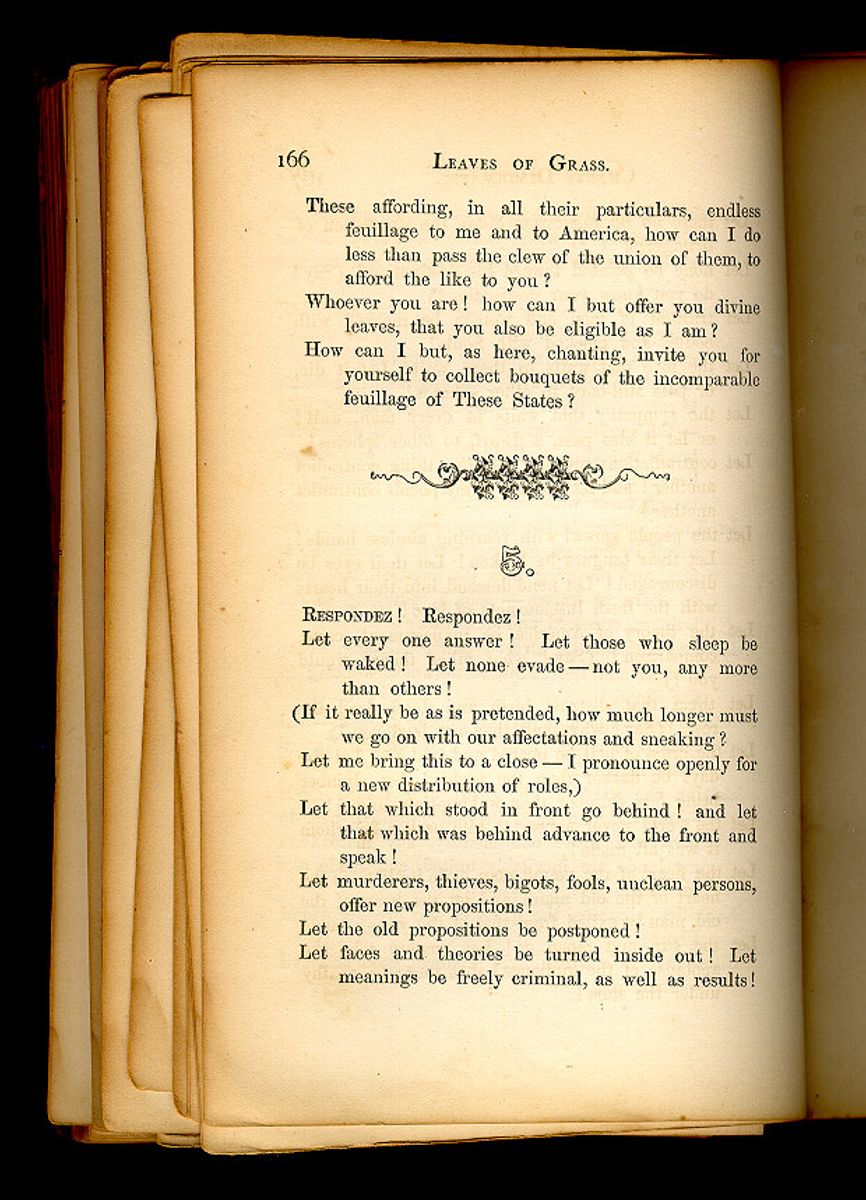 ppp.01500.174.jpg
These affording, in all their particulars, endless
ppp.01500.174.jpg
These affording, in all their particulars, endless feuillage to me and to America, how can I do
less than pass the clew of the union of them, to
afford the like to you? Whoever you are! how can I but offer you divine
leaves, that you also be eligible as I am? How can I but, as here, chanting, invite you for
yourself to collect bouquets of the incomparable
feuillage of These States?
5.
RESPONDEZ! Respondez! Let every one answer! Let those who sleep bewaked! Let none evade—not you, any more
than others! (If it really be as is pretended, how much longer must
we go on with our affectations and sneaking? Let me bring this to a close—I pronounce openly for
a new distribution of roles,) Let that which stood in front go behind! and let
that which was behind advance to the front and
speak! Let murderers, thieves, bigots, fools, unclean persons,
offer new propositions! Let the old propositions be postponed! Let faces and theories be turned inside out! Let
meanings be freely criminal, as well as results! [ begin page 167 ]
 ppp.01500.175.jpg
Let there be no suggestion above the suggestion of
ppp.01500.175.jpg
Let there be no suggestion above the suggestion of drudgery! Let none be pointed toward his destination! (Say!
do you know your destination?) Let trillions of men and women be mocked with
bodies and mocked with Souls! Let the love that waits in them, wait! Let it die,
or pass still-born to other spheres! Let the sympathy that waits in every man, wait!
or let it also pass, a dwarf, to other spheres! Let contradictions prevail! Let one thing contradict
another! and let one line of my poems contradict
another! Let the people sprawl with yearning aimless hands!
Let their tongues be broken! Let their eyes be
discouraged! Let none descend into their hearts
with the fresh lusciousness of love! Let the theory of America be management, caste,
comparison! (Say! what other theory would
you?) Let them that distrust birth and death lead the
rest! (Say! why shall they not lead you?) Let the crust of hell be neared and trod on! Let the
days be darker than the nights! Let slumber
bring less slumber than waking-time brings! Let the world never appear to him or her for whom
it was all made! Let the heart of the young man exile itself from the
heart of the old man! and let the heart of the
old man be exiled from that of the young man! Let the sun and moon go! Let scenery take the
applause of the audience! Let there be apathy
under the stars! [ begin page 168 ]
 ppp.01500.176.jpg
Let freedom prove no man's inalienable right! Every
ppp.01500.176.jpg
Let freedom prove no man's inalienable right! Every one who can tyrannize, let him tyrannize to his
satisfaction! Let none but infidels be countenanced! Let the eminence of meanness, treachery, sarcasm,
hate, greed, indecency, impotence, lust, be taken
for granted above all! Let writers, judges, gov-
ernments, households, religions, philosophies, take
such for granted above all! Let the worst men beget children out of the worst
women! Let priests still play at immortality! Let Death be inaugurated! Let nothing remain upon the earth except the ashes of
teachers, artists, moralists, lawyers, and learned
and polite persons! Let him who is without my poems be assassinated! Let the cow, the horse, the camel, the garden-bee—
Let the mud-fish, the lobster, the mussel, eel, the
sting-ray, and the grunting pig-fish—Let these,
and the like of these, be put on a perfect equality
with man and woman! Let churches accommodate serpents, vermin, and the
corpses of those who have died of the most filthy
of diseases! Let marriage slip down among fools, and be for none
but fools! Let men among themselves talk and think obscenely
of women! and let women among themselves
talk and think obscenely of men! Let every man doubt every woman! and let every
woman trick every man! [ begin page 169 ]
 ppp.01500.177.jpg
Let us all, without missing one, be exposed in public,
ppp.01500.177.jpg
Let us all, without missing one, be exposed in public, naked, monthly, at the peril of our lives! Let
our bodies be freely handled and examined by
whoever chooses! Let nothing but copies, pictures, statues, reminis-
cences, elegant works, be permitted to exist
upon the earth! Let the earth desert God, nor let there ever hence-
forth be mentioned the name of God! Let there be no God! Let there be money, business, imports, exports, cus-
tom, authority, precedents, pallor, dyspepsia,
smut, ignorance, unbelief! Let judges and criminals be transposed! Let the
prison-keepers be put in prison! Let those that
were prisoners take the keys! (Say! why might
they not just as well be transposed?) Let the slaves be masters! Let the masters become
slaves! Let the reformers descend from the stands where
they are forever bawling! Let an idiot or insane
person appear on each of the stands! Let the Asiatic, the African, the European, the
American and the Australian, go armed against
the murderous stealthiness of each other! Let
them sleep armed! Let none believe in good-will! Let there be no unfashionable wisdom! Let such be
scorned and derided off from the earth! Let a floating cloud in the sky—Let a wave of the
sea—Let one glimpse of your eye-sight upon the
landscape or grass—Let growing mint, spinach,
onions, tomatoes—Let these be exhibited as
shows at a great price for admission! 15 [ begin page 170 ]
 ppp.01500.178.jpg
Let all the men of These States stand aside for a
ppp.01500.178.jpg
Let all the men of These States stand aside for a few smouchers! Let the few seize on what they
choose! Let the rest gawk, giggle, starve, obey! Let shadows be furnished with genitals! Let sub-
stances be deprived of their genitals! Let there be wealthy and immense cities—but
through any of them, not a single poet, saviour,
knower, lover! Let the infidels of These States laugh all faith away!
If one man be found who has faith, let the rest
set upon him! Let them affright faith! Let
them destroy the power of breeding faith! Let the she-harlots and the he-harlots be prudent!
Let them dance on, while seeming lasts! (O
seeming! seeming! seeming!) Let the preachers recite creeds! Let them teach only
what they have been taught! Let the preachers of creeds never dare to go meditate
candidly upon the hills, alone, by day or by
night! (If one ever once dare, he is lost!) Let insanity have charge of sanity! Let books take the place of trees, animals, rivers,
clouds! Let the daubed portraits of heroes supersede heroes! Let the manhood of man never take steps after itself!
Let it take steps after eunuchs, and after con-
sumptive and genteel persons! Let the white person tread the black person under his
heel! (Say! which is trodden under heel, after
all ?) Let the reflections of the things of the world be studied
in mirrors! Let the things themselves continue
unstudied! [ begin page 171 ]
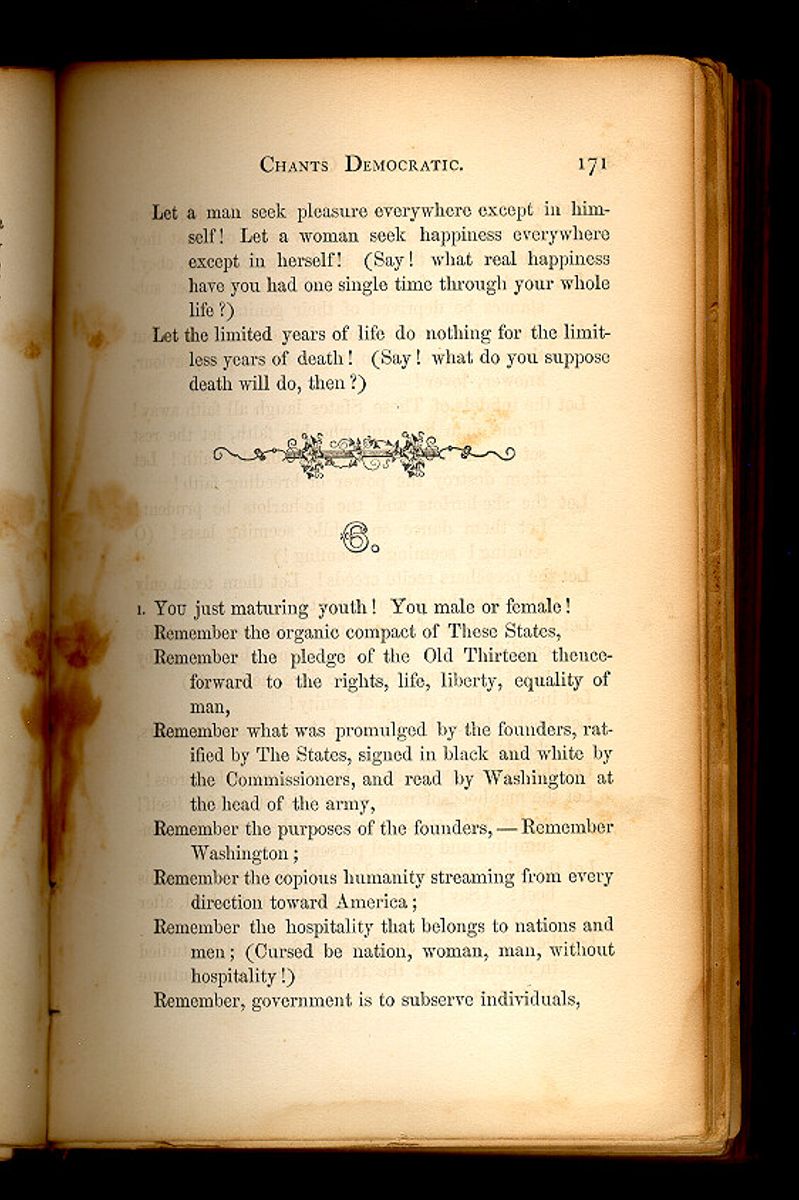 ppp.01500.179.jpg
Let a man seek pleasure everywhere except in him-
ppp.01500.179.jpg
Let a man seek pleasure everywhere except in him- self! Let a woman seek happiness everywhere
except in herself! (Say! what real happiness
have you had one single time through your whole
life ?) Let the limited years of life do nothing for the limit-
less years of death! (Say! what do you suppose
death will do, then ?)
6.
1YOU just maturing youth! You male or female! Remember the organic compact of These States, Remember the pledge of the Old Thirteen thence-forward to the rights, life, liberty, equality of
man, Remember what was promulged by the founders, rat-
ified by The States, signed in black and white by
the Commissioners, and read by Washington at
the head of the army, Remember the purpose of the founders,—Remember
Washington; Remember the copious humanity streaming from every
direction toward America; Remember the hospitality that belongs to nations and
men; (Cursed be nation, woman, man, without
hospitality!) Remember, government is to subserve individuals, [ begin page 172 ]
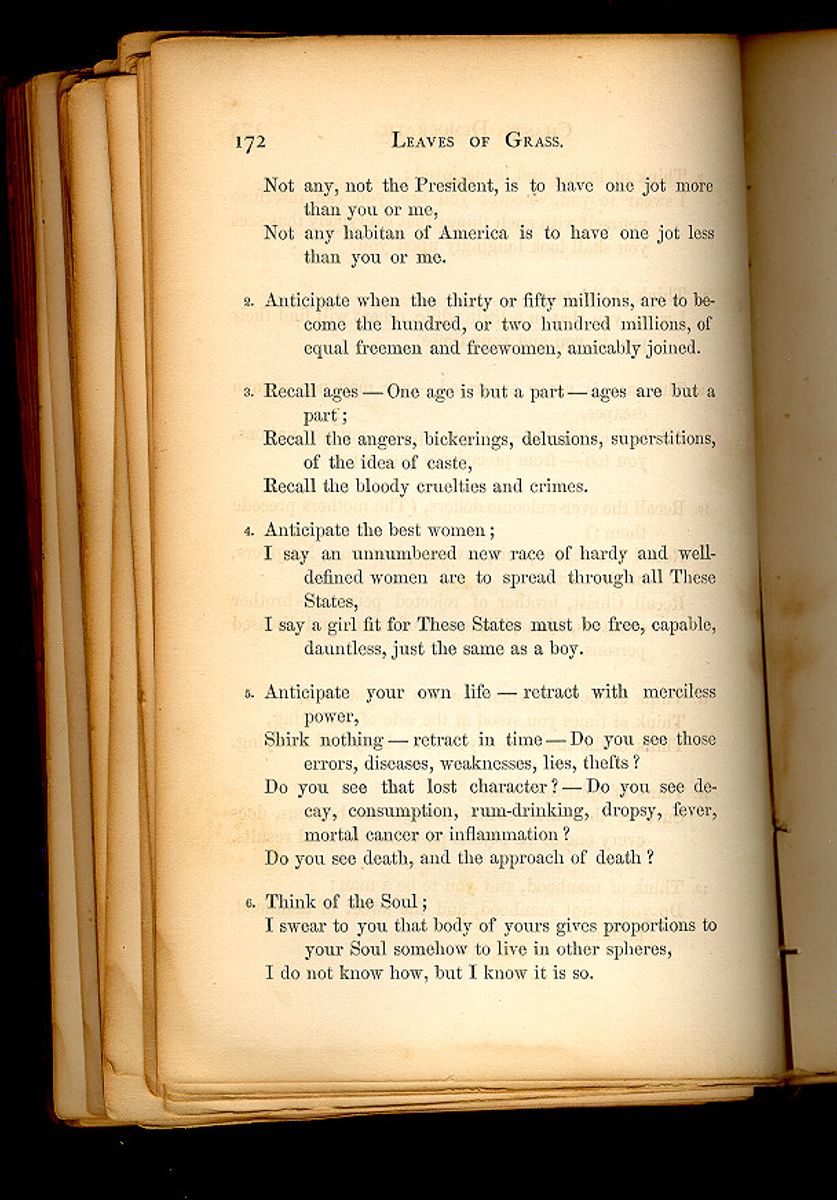 ppp.01500.180.jpg
Not any, not the President, is to have one jot more
ppp.01500.180.jpg
Not any, not the President, is to have one jot more than you or me, Not any habitan of America is to have one jot less
than you or me. 2Anticipate when the thirty or fifty millions, are to be-
come the hundred, or two hundred millions, of
equal freemen and freewomen, amicably joined. 3Recall ages—One age is but a part—ages are but a
part; Recall the angers, bickerings, delusions, superstitions,
of the idea of caste, Recall the bloody cruelties and crimes. 4Anticipate the best women; I say an unnumbered new race of hardy and well-
defined women are to spread through all These
States, I say a girl fit for These States must be free, capable,
dauntless, just the same as a boy. 5Anticipate your own life—retract with merciless
power, Shirk nothing—retract in time—Do you see those
errors, diseases, weaknesses, lies, thefts? Do you see that lost character?—Do you see de-
cay, consumption, rum-drinking, dropsy, fever,
mortal cancer or inflammation? Do you see death, and the approach of death? 6Think of the Soul; I swear to you that body of yours gives proportions to
your Soul somehow to live in other spheres, I do not know how, but I know it is so. [ begin page 173 ]
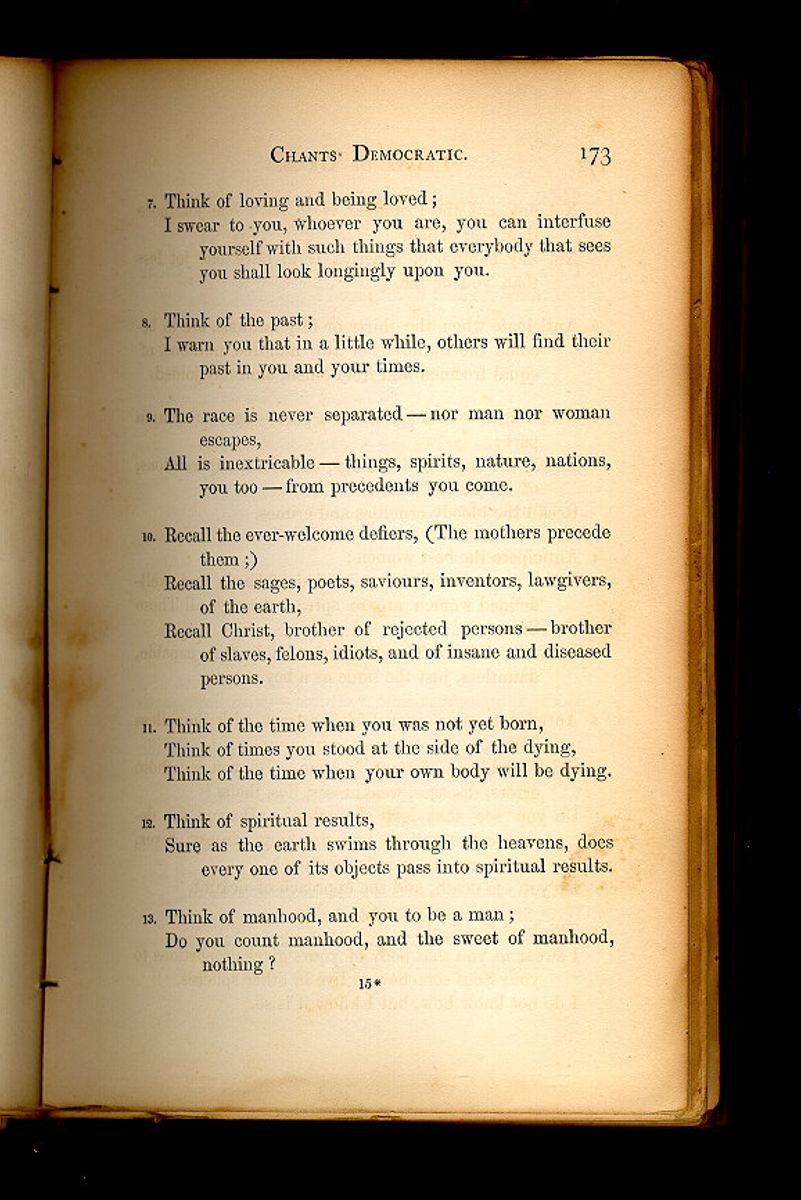 ppp.01500.181.jpg
7Think of loving and being loved;
I swear to you, whoever you are, you can interfuse
ppp.01500.181.jpg
7Think of loving and being loved;
I swear to you, whoever you are, you can interfuse yourself with such things that everybody that sees
you shall look longingly upon you. 8Think of the past; I warn you that in a little while, others will find their
past in you and your times. 9The race is never separated—nor man nor woman
escapes, All is inextricable—things, spirits, nature, nations,
you too—from precedents you come. 10Recall the ever-welcome defiers, (The mothers precede
them;) Recall the sages, poets, saviours, inventors, lawgivers,
of the earth, Recall Christ, brother of rejected persons—brother
of slaves, felons, idiots, and of insane and diseased
persons. 11Think of the time when you was not yet born, Think of times you stood at the side of the dying, Think of the time when your own body will be dying. 12Think of spiritual results, Sure as the earth swims through the heavens, does
every one of its objects pass into spiritual results. 13Think of manhood, and you to be a man; Do you count manhood, and the sweet of manhood,
nothing? 15* [ begin page 174 ]
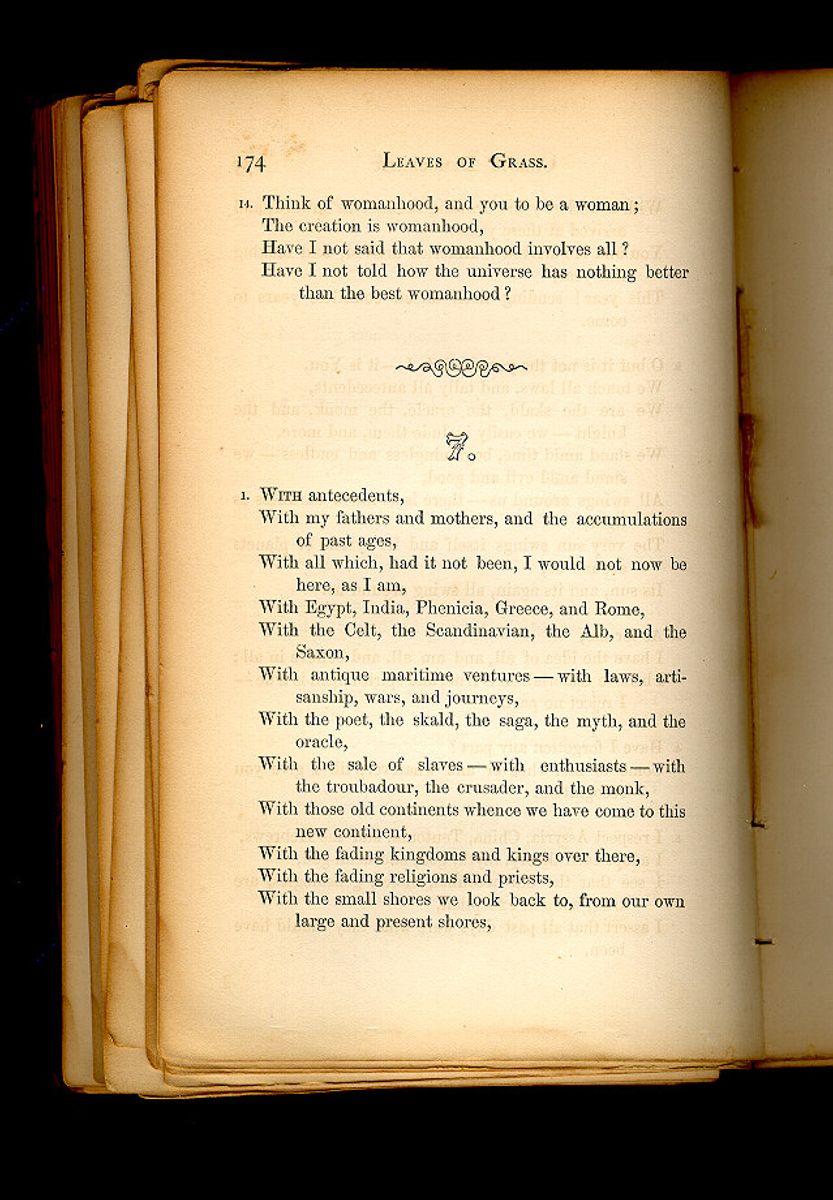 ppp.01500.182.jpg
14Think of womanhood, and you to be a woman;
The creation is womanhood,
Have I not said that womanhood involves all?
Have I not told how the universe has nothing better
ppp.01500.182.jpg
14Think of womanhood, and you to be a woman;
The creation is womanhood,
Have I not said that womanhood involves all?
Have I not told how the universe has nothing better than the best womanhood?
7.
1WITH antecedents, With my fathers and mothers, and the accumulationsof past ages, With all which, had it not been, I would not now be
here, as I am, With Egypt, India, Phenicia, Greece, and Rome, With the Celt, the Scandinavian, the Alb, and the
Saxon, With antique maritime ventures—with laws, arti-
sanship, wars, and journeys, With the poet, the skald, the saga, the myth, and the
oracle, With the sale of slaves—with enthusiasts—with
the troubadour, the crusader, and the monk, With those old continents whence we have come to this
new continent, With the fading kingdoms and kings over there, With the fading religions and priests, With the small shores we look back to, from our own
large and present shores, [ begin page 175 ]
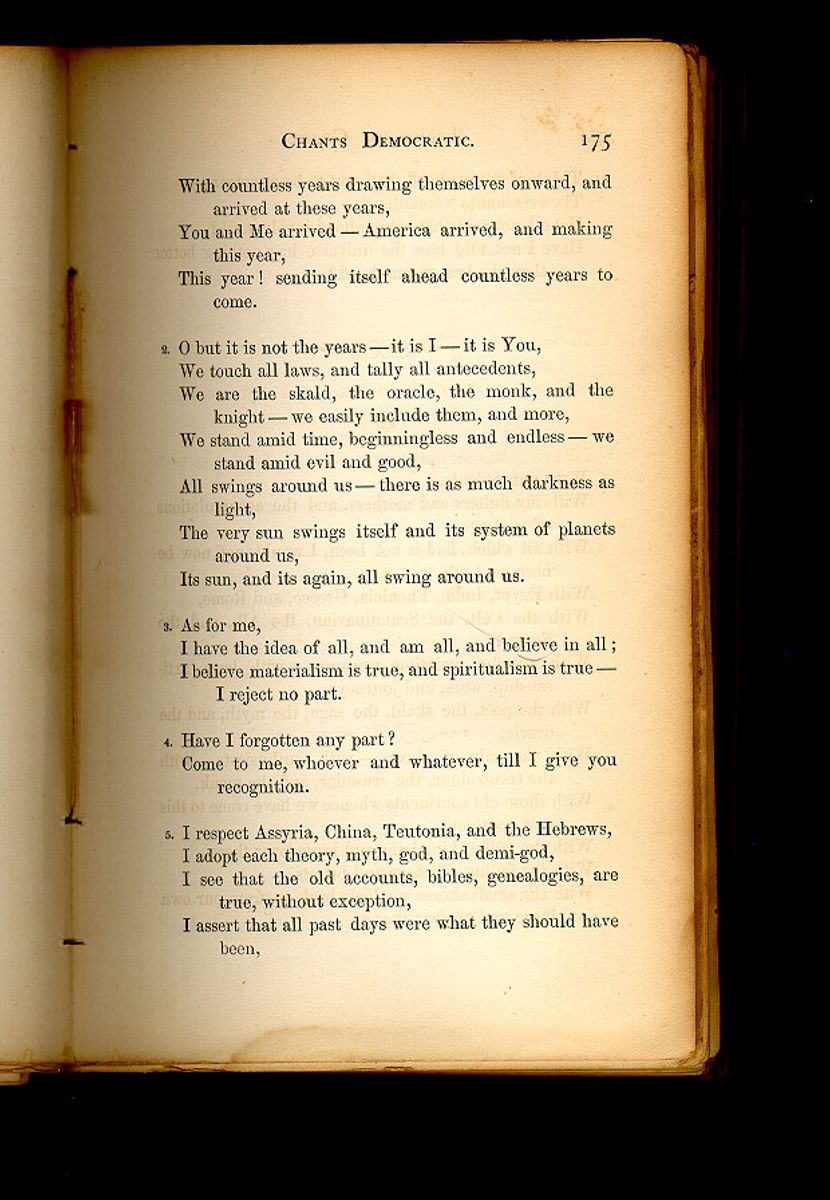 ppp.01500.183.jpg
With countless years drawing themselves onward, and
ppp.01500.183.jpg
With countless years drawing themselves onward, and arrived at these years, You and Me arrived—America arrived, and making
this year, This year! sending itself ahead countless years to
come. 2O but it is not the years—it is I—it is You, We touch all laws, and tally all antecedents, We are the skald, the oracle, the monk, and the
knight—we easily include them, and more, We stand amid time, beginningless and endless—we
stand amid evil and good, All swings around us—there is as much darkness as
light, The very sun swings itself and its system of planets
around us, Its sun, and its again, all swing around us. 3As for me, I have the idea of all, and an all, and believe in all; I believe materialism is true, and spiritualism is true—
I reject no part. 4Have I forgotten any part? Come to me, whoever and whatever, till I give you
recognition. 5I respect Assyria, China, Teutonia, and the Hebrews, I adopt each theory, myth, god, and demi-god, I see that the old accounts, bibles, genealogies, are
true, without exception, I assert that all past days were what they should have
been, [ begin page 176 ]
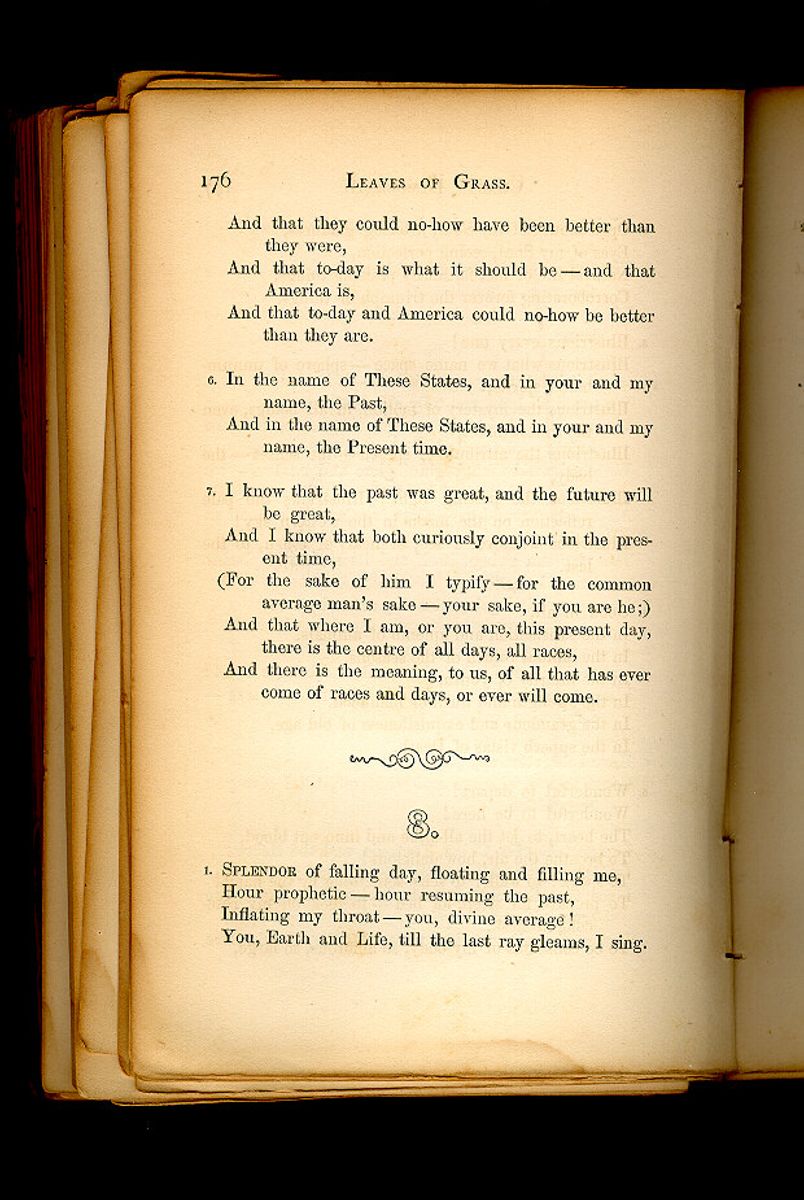 ppp.01500.184.jpg
And that they could no-how have been better than
ppp.01500.184.jpg
And that they could no-how have been better than they were, And that to-day is what it should be—and that
America is, And that to-day and America could no-how be better
than they are. 6In the name of These States, and in your and my
name, the Past, And in the name of These States, and in your and my
name, the Present time. 7I know that the past was great, and the future will
be great, And I know that both curiously conjoint in the pres-
ent time, (For the sake of him I typify—for the common
average man's sake—your sake, if you are he;) And that where I am, or you are, this present day,
there is the centre of all days, all races, And there is the meaning, to us, of all that has ever
come of races and days, or ever will come.
8.
1SPLENDOR of falling day, floating and filling me, Hour prophetic—hour resuming the past, Inflating my throat—you, divine average! You, Earth and Life, till the last ray gleams, I sing. [ begin page 177 ]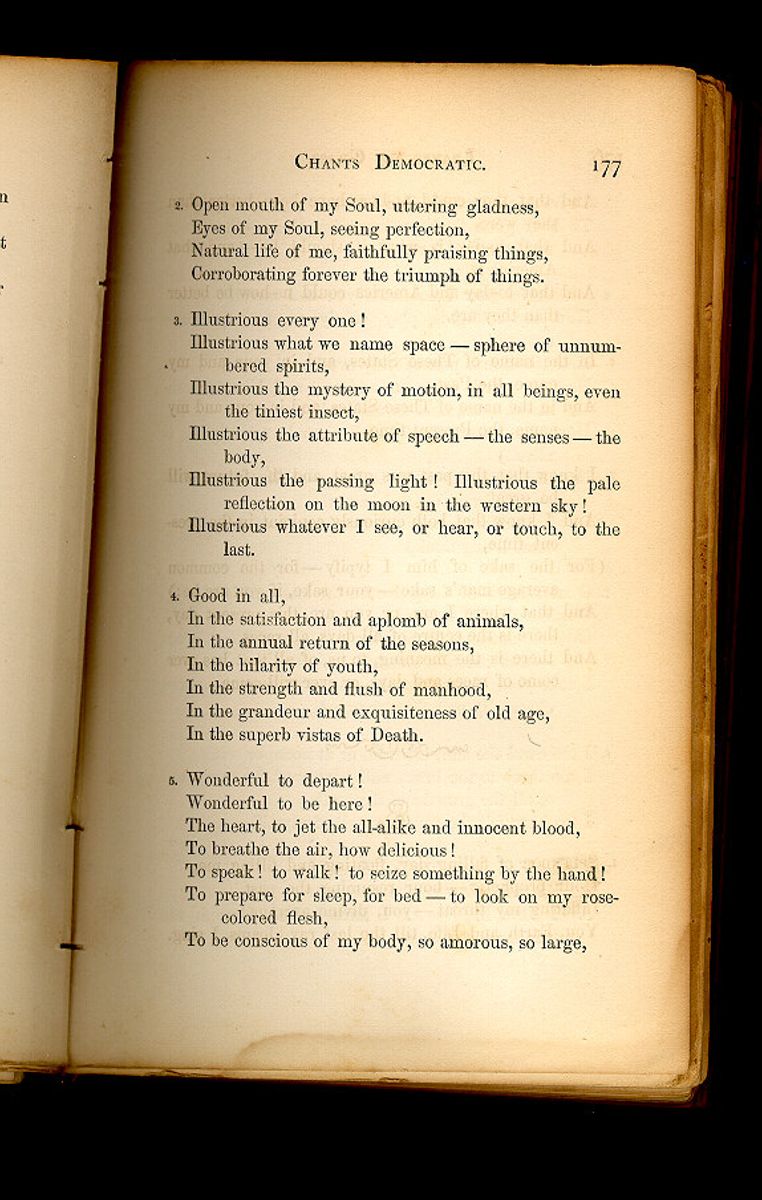 ppp.01500.185.jpg
2Open mouth of my Soul, uttering gladness,
Eyes of my Soul, seeing perfection,
Natural life of me, faithfully praising things,
Corroborating forever the triumph of things.
3Illustrious every one!
Illustrious what we name space—sphere of unnum-
ppp.01500.185.jpg
2Open mouth of my Soul, uttering gladness,
Eyes of my Soul, seeing perfection,
Natural life of me, faithfully praising things,
Corroborating forever the triumph of things.
3Illustrious every one!
Illustrious what we name space—sphere of unnum- bered spirits, Illustrious the mystery of motion, in all beings, even
the tiniest insect, Illustrious the attribute of speech—the senses—the
body, Illustrious the passing light! Illustrious the pale
reflection on the moon in the western sky! Illustrious whatever I see, or hear, or touch, to the
last. 4Good in all, In the satisfaction and aplomb of animals, In the annual return of the seasons, In the hilarity of youth, In the strength and flush of manhood, In the grandeur and exquisiteness of old age, In the superb vistas of Death. 5Wonderful to depart! Wonderful to be here! The heart, to jet the all-alike and innocent blood, To breathe the air, how delicious! To speak! to walk! to seize something by the hand! To prepare for sleep, for bed—to look on my rose-
colored flesh, To be conscious of my body, so amorous, so large, [ begin page 178 ]
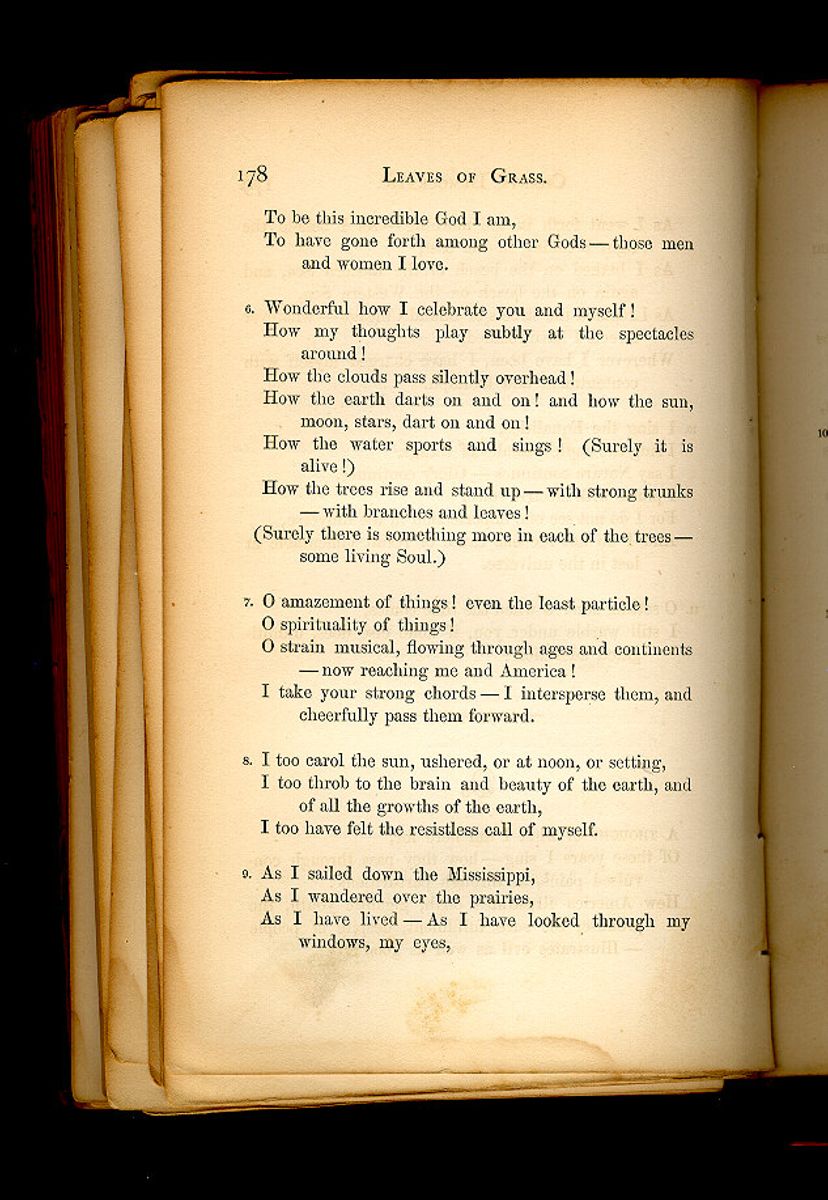 ppp.01500.186.jpg
To be this incredible God I am,
To have gone forth among other Gods—those men
ppp.01500.186.jpg
To be this incredible God I am,
To have gone forth among other Gods—those men and women I love. 6Wonderful how I celebrate you and myself! How my thoughts play subtly at the spectacles
around! How the clouds pass silently overhead! How the earth darts on and on! and how the sun,
moon, stars, dart on and on! How the water sports and sings! (Surely it is
alive!) How the trees rise and stand up—with strong trunks
—with branches and leaves! (Surely there is something more in each of the trees—
some living Soul.) 7O amazement of things! even the least particle! O spirituality of things! O strain musical, flowing through ages and continents
—now reaching me and America! I take your strong chords—I intersperse them, and
cheerfully pass them forward. 8I too carol the sun, ushered, or at noon, or setting, I too throb to the brain and beauty of the earth, and
of all the growths of the earth, I too have felt the resistless call of myself. 9As I sailed down the Mississippi, As I wandered over the prairies, As I have lived—As I have looked through my
windows, my eyes, [ begin page 179 ]
 ppp.01500.187.jpg
As I went forth in the morning—As I beheld the
ppp.01500.187.jpg
As I went forth in the morning—As I beheld the light breaking in the east, As I bathed on the beach of the Eastern Sea, and
again on the beach on the Western Sea, As I roamed the streets of inland Chicago—whatever
streets I have roamed, Wherever I have been, I have charged myself with
contentment and triumph. 10I sing the Equalities, I sing the endless finales of things, I say Nature continues—Glory continues, I praise with electric voice, For I do not see one imperfection in the universe, And I do not see one cause or result lamentable at
last in the universe. 11O setting sun! O when the time comes, I still warble under you, if none else does, unmiti-
gated adoration!
9.
A THOUGHT of what I am here for, Of these years I sing—how they pass through con-vulsed pains, as through parturitions; How America illustrates birth, gigantic youth, the
promise, the sure fulfilment, despite of people
—Illustrates evil as well as good; [ begin page 180 ]
 ppp.01500.188.jpg
Of how many hold despairingly yet to the models
ppp.01500.188.jpg
Of how many hold despairingly yet to the models departed, caste, myths, obedience, compulsion,
and to infidelity; How few see the arrived models, the Athletes, The
States—or see freedom or spirituality—or hold
any faith in results, (But I see the Athletes—and I see the results
glorious and inevitable—and they again leading
to other results;) How the great cities appear—How the Democratic
masses, turbulent, wilful, as I love them, How the whirl, the contest, the wrestle of evil with
good, the sounding and resounding, keep on
and on; How society waits unformed, and is between things
ended and things begun; How America is the continent of glories, and of the
triumph of freedom, and of the Democracies, and
of the fruits of society, and of all that is begun; And how The States are complete in themselves—
And how all triumphs and glories are complete
in themselves, to lead onward, And how these of mine, and of The States, will in
their turn be convulsed, and serve other par-
turitions and transitions, And how all people, sights, combinations, the Demo-
cratic masses too, serve—and how every fact
serves, And how now, or at any time, each serves the
exquisite transition of Death. [ begin page 181 ]
 ppp.01500.189.jpg
10.
HISTORIAN! you who celebrate bygones! You have explored the outward, the surface of theraces—the life that has exhibited itself, You have treated man as the creature of politics,
aggregates, rulers, and priests; But now I also, arriving, contribute something: I, an habitué of the Alleghanies, treat man as he is in
the influences of Nature, in himself, in his own
inalienable rights, Advancing, to give the spirit and the traits of new
Democratic ages, myself, personally, (Let the future behold them all in me—Me, so
puzzling and contradictory—Me, a Manhattan-
ese, the most loving and arrogant of men;) I do not tell the usual facts, proved by records and
documents, What I tell, (talking to every born American,)
requires no further proof than he or she who
will hear me, will furnish, by silently meditating
alone; I press the pulse of the life that has hitherto seldom
exhibited itself, but has generally sought con-
cealment, (the great pride of man, in himself,) I illuminate feelings, faults, yearnings, hopes—I
have come at last, no more ashamed nor afraid; Chanter of Personality, outlining a history yet to be, I project the ideal man, the American of the future. 16 [ begin page 182 ]
 ppp.01500.190.jpg
11.
THE thought of fruitage, Of Death, (the life greater)—of seeds dropping intothe ground—of birth, Of the steady concentration of America, inland,
upward, to impregnable and swarming places, Of what Indiana, Kentucky, Ohio and the rest, are
to be, Of what a few years will show there in Missouri,
Kansas, Iowa, Wisconsin, Minnesota and the
rest, Of what the feuillage of America is the preparation
for—and of what all the sights, North, South,
East and West, are; Of the temporary use of materials for identity's
sake, Of departing—of the growth of a mightier race
than any yet, Of myself, soon, perhaps, closing up my songs by
these shores, Of California—of Oregon—and of me journeying
hence to live and sing there; Of the Western Sea—of the spread inland between
it and the spinal river, Of the great pastoral area, athletic and feminine, Of all sloping down there where the fresh free-
giver, the mother, the Mississippi flows—and
Westward still; [ begin page 183 ]
 ppp.01500.191.jpg
Of future men and women there—of happiness in
ppp.01500.191.jpg
Of future men and women there—of happiness in those high plateaus, ranging three thousand
miles, warm and cold, Of cities yet unsurveyed and unsuspected, (as I am
also, and as it must be,) Of the new and good names—of the strong develop-
ments—of the inalienable homesteads, Of a free original life there—of simple diet, and
clean and sweet blood, Of litheness, majestic faces, clear eyes, and perfect
physique there, Of immense spiritual results, future years, inland,
spread there each side of the Anahuacs, Of these Leaves well-understood there, (being made
for that area,) Of the native scorn of grossness and gain there, (O it lurks in me night and day—What is gain,
after all, to savageness and freedom?)
12.
1TO oratists—to male or female, Vocalism, breath, measure, concentration, determina-tion, and the divine power to use words. 2Are you eligible? Are you full-lung'd and limber-lipp'd from long trial?
from vigorous practice? from physique? [ begin page 184 ]
 ppp.01500.192.jpg
Do you move in these broad lands as broad as they?
Remembering inland America, the high plateaus,
ppp.01500.192.jpg
Do you move in these broad lands as broad as they?
Remembering inland America, the high plateaus, stretching long? Remembering Kanada—Remembering what edges
the vast round edge of the Mexican Sea? Come duly to the divine power to use words? 3For only at last, after many years—after chastity,
friendship, procreation, prudence, and nakedness, After treading ground and breasting river and lake, After a loosened throat—after absorbing eras, tem-
peraments, races—after knowledge, freedom,
crimes, After complete faith—after clarifyings, elevations,
and removing obstructions, After these, and more, it is just possible there comes
to a man, a woman, the divine power to use
words. 4Then toward that man or that woman swiftly hasten
all—None refuse, all attend, Armies, ships, antiquities, the dead, libraries, paint-
ings, machines, cities, hate, despair, amity, pain,
theft, murder, aspiration, form in close ranks, They debouch as they are wanted to march obediently
through the mouth of that man, or that woman. 5O now I see arise orators fit for inland America, And I see it is as slow to become an orator as to
become a man, And I see that power is folded in a great vocalism. 6Of a great vocalism, when you hear it, the merciless
light shall pour, and the storm rage around, [ begin page 185 ]
 ppp.01500.193.jpg
Every flash shall be a revelation, an insult,
The glaring flame turned on depths, on heights, on
ppp.01500.193.jpg
Every flash shall be a revelation, an insult,
The glaring flame turned on depths, on heights, on suns, on stars, On the interior and exterior of man or woman, On the laws of Nature—on passive materials, On what you called death—and what to you there-
fore was death, As far as there can be death.
13.
1LAWS for Creations, For strong artists and leaders—for fresh broods ofteachers, and perfect literats for America, For diverse savans, and coming musicians. 2There shall be no subject but it shall be treated with
reference to the ensemble of the world, and the
compact truth of the world—And no coward or
copyist shall be allowed; There shall be no subject too pronounced—All works
shall illustrate the divine law of indirections; There they stand—I see them already, each poised
and in its place, Statements, models, censuses, poems, dictionaries,
biographies, essays, theories—How complete!
How relative and interfused! No one super-
sedes another; They do not seem to me like the old specimens, 16* [ begin page 186 ]
 ppp.01500.194.jpg
They seem to me like Nature at last, (America has
ppp.01500.194.jpg
They seem to me like Nature at last, (America has given birth to them, and I have also;) They seem to me at last as perfect as the animals,
and as the rocks and weeds—fitted to them, Fitted to the sky, to float with floating clouds—to
rustle among the trees with rustling leaves, To stretch with stretched and level waters, where
ships silently sail in the distance. 3What do you suppose Creation is? What do you suppose will satisfy the Soul, except to
walk free and own no superior? What do you suppose I have intimated to you in a
hundred ways, but that man or woman is as good
as God? And that there is no God any more divine than
Yourself? And that that is what the oldest and newest myths
finally mean? And that you or any one must approach Creations
through such laws?
14.
1POETS to come! Not to-day is to justify me, and Democracy, andwhat we are for, But you, a new brood, native, athletic, continental,
greater than before known, You must justify me. [ begin page 187 ]
 ppp.01500.195.jpg
2Indeed, if it were not for you, what would I be?
What is the little I have done, except to arouse you?
3I depend on being realized, long hence, where the
ppp.01500.195.jpg
2Indeed, if it were not for you, what would I be?
What is the little I have done, except to arouse you?
3I depend on being realized, long hence, where the broad fat prairies spread, and thence to Oregon
and California inclusive, I expect that the Texan and the Arizonian, ages
hence, will understand me, I expect that the future Carolinian and Georgian will
understand me and love me, I expect that Kanadians, a hundred, and perhaps
many hundred years from now, in winter, in the
splendor of the snow and woods, or on the icy
lakes, will take me with them, and permanently
enjoy themselves with me. 4Of to-day I know I am momentary, untouched—I
am the bard of the future, I but write one or two indicative words for the future, I but advance a moment, only to wheel and hurry
back in the darkness. 5I am a man who, sauntering along, without fully
stopping, turns a casual look upon you, and then
averts his face, Leaving it to you to prove and define it, Expecting the main things from you. [ begin page 188 ]
 ppp.01500.196.jpg
15.
WHO has gone farthest? For I swear I will gofarther; And who has been just? For I would be the most
just person of the earth; And who most cautious? For I would be more
cautious; And who has been happiest? O I think it is I! I
think no one was ever happier than I; And who has lavished all? For I lavish constantly
the best I have; And who has been firmest? For I would be firmer; And who proudest? For I think I have reason to be
the proudest son alive—for I am the son of the
brawny and tall-topt city; And who has been bold and true? For I would be
the boldest and truest being of the universe; And who benevolent? For I would show more be-
nevolence than all the rest; And who has projected beautiful words through the
longest time? By God! I will outvie him! I
will say such words, they shall stretch through
longer time! And who has received the love of the most friends?
For I know what it is to receive the passionate
love of many friends; And to whom has been given the sweetest from
women, and paid them in kind? For I will
take the like sweets and pay them in kind; [ begin page 189 ]
 ppp.01500.197.jpg
And who possesses a perfect and enamoured body?
ppp.01500.197.jpg
And who possesses a perfect and enamoured body? For I do not believe any one possesses a more
perfect or enamoured body than mine; And who thinks the amplest thoughts? For I will
surround those thoughts; And who has made hymns fit for the earth? For I
am mad with devouring extacy to make joyous
hymns for the whole earth!
16.
THEY shall arise in the States—mediums shall, They shall report Nature, laws, physiology, andhappiness, They shall illustrate Democracy and the kosmos, They shall be alimentive, amative, perceptive, They shall be complete women and men—their pose
brawny and supple, their drink water, their blood
clean and clear, They shall enjoy materialism and the sight of prod-
ucts—they shall enjoy the sight of the beef,
lumber, bread-stuffs, of Chicago, the great city, They shall train themselves to go in public to become
oratists, (orators and oratresses,) Strong and sweet shall their tongues be—poems and
materials of poems shall come from their lives—
they shall be makers and finders, Of them, and of their works, shall emerge divine
conveyers, to convey gospels, [ begin page 190 ]
 ppp.01500.198.jpg
Characters, events, retrospections, shall be conveyed
ppp.01500.198.jpg
Characters, events, retrospections, shall be conveyed in gospels—Trees, animals, waters, shall be
conveyed, Death, the future, the invisible faith, shall all be
conveyed.
17.
1NOW we start hence, I with the rest, on our jour-neys through The States, We willing learners of all, teachers of all, and lovers
of all. 2I have watched the seasons dispensing themselves,
and passing on, And I have said, Why should not a man or woman
do as much as the seasons, and effuse as much? 3We dwell a while in every city and town, We pass through Kanada, the north-east, the vast
valley of the Mississippi, and the Southern
States, We confer on equal terms with each of The States, We make trial of ourselves, and invite men and
women to hear, We say to ourselves, Remember, fear not, be candid,
promulge the body and the Soul, Promulge real things—Never forget the equality of
humankind, and never forget immortality; [ begin page 191 ]
 ppp.01500.199.jpg
Dwell a while, and pass on—Be copious, temperate,
ppp.01500.199.jpg
Dwell a while, and pass on—Be copious, temperate, chaste, magnetic, And what you effuse may then return as the seasons
return, And may be just as much as the seasons.
18.
ME imperturbe, Me standing at ease in Nature, Master of all, or mistress of all—aplomb in themidst of irrational things, Imbued as they—passive, receptive, silent as they, Finding my occupation, poverty, notoriety, foibles,
crimes, less important than I thought; Me private, or public, or menial, or solitary—all
these subordinate, (I am eternally equal with
the best—I am not subordinate;) Me toward the Mexican Sea, or in the Mannahatta,
or the Tennessee, or far north, or inland, A river-man, or a man of the woods, or of any farm-
life of These States, or of the coast, or the lakes,
or Kanada, Me, wherever my life is to be lived, O to be self-bal-
anced for contingencies! O to confront night, storms, hunger, ridicule, acci-
dents, rebuffs, as the trees and animals do. [ begin page 192 ]
 ppp.01500.200.jpg
19.
I WAS looking a long while for the history of thepast for myself, and for these Chants—and now
I have found it, It is not in those paged fables in the libraries, (them
I neither accept nor reject,) It is no more in the legends than in all else, It is in the present—it is this earth to-day, It is in Democracy—in this America—the old world
also, It is the life of one man or one woman to-day, the
average man of to-day; It is languages, social customs, literatures, arts, It is the broad show of artificial things, ships, ma-
chinery, politics, creeds, modern improvements,
and the interchanges of nations, All for the average man of to-day.
20.
1AMERICAN mouth-songs! Those of mechanics—each one singing, his, as itshould be, blithe and strong, The carpenter singing his, as he measures his plank
or beam, [ begin page 193 ]
 ppp.01500.201.jpg
The mason singing his, as he makes ready for work,
ppp.01500.201.jpg
The mason singing his, as he makes ready for work, or leaves off work, The boatman singing what belongs to him in his boat
—the deck-hand singing on the steamboat deck, The shoemaker singing as he sits on his bench—the
hatter singing as he stands, The wood-cutter's song—the ploughboy's, on his way
in the morning, or at the noon intermission, or at
sundown; The delicious singing of the mother—or of the
young wife at work—or of the girl sewing or
washing—Each singing what belongs to her,
and to none else, The day what belongs to the day—At night, the
party, of young fellows, robust, friendly, clean-
blooded, singing with melodious voices, melo-
dious thoughts. 2Come! some of you! still be flooding The States
with hundreds and thousands of mouth-songs,
fit for The States only.
21.
1As I walk, solitary, unattended, Around me I hear that eclat of the world—politics,produce, The announcements of recognized things—science, The approved growth of cities, and the spread of
inventions. 17 [ begin page 194 ]
 ppp.01500.202.jpg
2I see the ships, (they will last a few years,)
The vast factories with their foremen and workmen,
And hear the indorsement of all, and do not object
ppp.01500.202.jpg
2I see the ships, (they will last a few years,)
The vast factories with their foremen and workmen,
And hear the indorsement of all, and do not object to it. 3But we too announce solid things, Science, ships, politics, cities, factories, are not noth-
ing—they serve, They stand for realities—all is as it should be. 4Then my realities, What else is so real as mine? Libertad, and the divine average—Freedom to every
slave on the face of the earth, The rapt promises and lumine of seers—the spir-
itual world—these centuries-lasting songs, And our visions, the visions of poets, the most solid
announcements of any. 5For we support all, After the rest is done and gone, we remain, There is no final reliance but upon us, Democracy rests finally upon us, (I, my brethren,
begin it,) And our visions sweep through eternity. [ begin page 195 ]
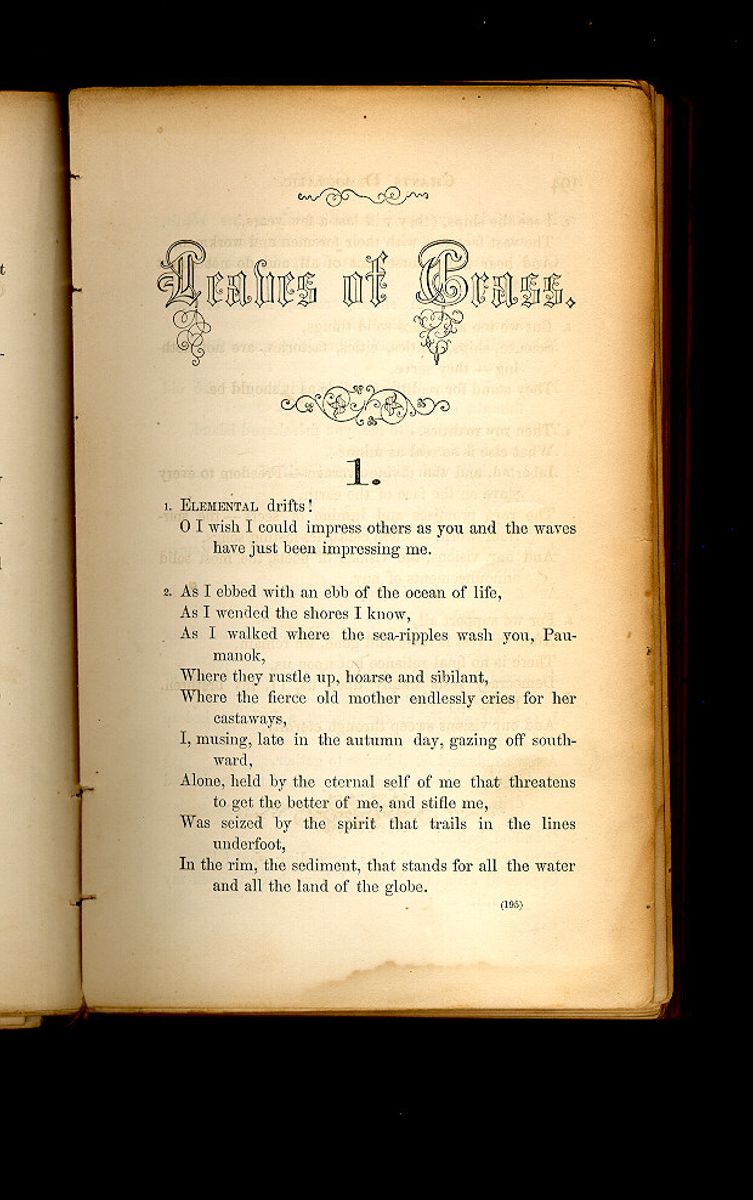 ppp.01500.203.jpg
LEAVES OF GRASS.
1.
1ELEMENTAL drifts! O I wish I could impress others as you and the waveshave just been impressing me. 2As I ebbed with an ebb of the ocean of life, As I wended the shores I know, As I walked where the sea-ripples wash you, Pau-
manok, Where they rustle up, hoarse and sibilant, Where the fierce old mother endlessly cries for her
castaways, I, musing, late in the autumn day, gazing off south-
ward, Alone, held by the eternal self of me that threatens
to get the better of me, and stifle me, Was seized by the spirit that trails in the lines
underfoot, In the rim, the sediment, that stands for all the water
and all the land of the globe. [ begin page 196 ]
 ppp.01500.204.jpg
3Fascinated, my eyes, reverting from the south,
ppp.01500.204.jpg
3Fascinated, my eyes, reverting from the south, dropped, to follow those slender winrows, Chaff, straw, splinters of wood, weeds, and the sea-
gluten, Scum, scales from shining rocks, leaves of salt-
lettuce, left by the tide; Miles walking, the sound of breaking waves the other
side of me, Paumanok, there and then, as I thought the old
thought of likenesses, These you presented to me, you fish-shaped island, As I wended the shores I know, As I walked with that eternal self of me, seeking
types. 4As I wend the shores I know not, As I listen to the dirge, the voices of men and women
wrecked, As I inhale the impalpable breezes that set in
upon me, As the ocean so mysterious rolls toward me closer
and closer, At once I find, the least thing that belongs to me, or
that I see or touch, I know not; I, too, but signify, at the utmost, a little washed-up
drift, A few sands and dead leaves to gather, Gather, and merge myself as part of the sands and
drift. 5O baffled, balked, Bent to the very earth, here preceding what follows, Oppressed with myself that I have dared to open my
mouth, [ begin page 197 ]
 ppp.01500.205.jpg
Aware now, that, amid all the blab whose echoes
ppp.01500.205.jpg
Aware now, that, amid all the blab whose echoes recoil upon me, I have not once had the least
idea who or what I am, But that before all my insolent poems the real ME
still stands untouched, untold, altogether un-
reached, Withdrawn far, mocking me with mock-congrat-
ulatory signs and bows, With peals of distant ironical laughter at every word
I have written or shall write, Striking me with insults till I fall helpless upon the
sand. 6O I perceive I have not understood anything—not a
single object—and that no man ever can. 7I perceive Nature here, in sight of the sea, is taking
advantage of me, to dart upon me, and sting me, Because I was assuming so much, And because I have dared to open my mouth to sing
at all. 8You oceans both! You tangible land! Nature! Be not too rough with me—I submit—I close with
you, These little shreds shall, indeed, stand for all. 9You friable shore, with trails of debris! You fish-shaped island! I take what is underfoot; What is yours is mine, my father. 10I too Paumanok, I too have bubbled up, floated the measureless float,
and been washed on your shores; 17* [ begin page 198 ]
 ppp.01500.206.jpg
I too am but a trail of drift and debris,
I too leave little wrecks upon you, you fish-shaped
ppp.01500.206.jpg
I too am but a trail of drift and debris,
I too leave little wrecks upon you, you fish-shaped island. 11I throw myself upon your breast, my father, I cling to you so that you cannot unloose me, I hold you so firm, till you answer me something. 12Kiss me, my father, Touch me with your lips, as I touch those I love, Breathe to me, while I hold you close, the secret of
the wondrous murmuring I envy, For I fear I shall become crazed, if I cannot emulate
it, and utter myself as well as it. 13Sea-raff! Crook-tongued waves! O, I will yet sing, some day, what you have said
to me. 14Ebb, ocean of life, (the flow will return,) Cease not your moaning, you fierce old mother, Endlessly cry for your castaways—but fear not,
deny not me, Rustle not up so hoarse and angry against my feet, as
I touch you, or gather from you. 15I mean tenderly by you, I gather for myself, and for this phantom, looking
down where we lead, and following me and
mine. 16Me and mine! We, loose winrows, little corpses, Froth, snowy white, and bubbles, [ begin page 199 ]
 ppp.01500.207.jpg
(See! from my dead lips the ooze exuding at last!
See—the prismatic colors, glistening and rolling!)
Tufts of straw, sands, fragments,
Buoyed hither from many moods, one contradicting
ppp.01500.207.jpg
(See! from my dead lips the ooze exuding at last!
See—the prismatic colors, glistening and rolling!)
Tufts of straw, sands, fragments,
Buoyed hither from many moods, one contradicting another, From the storm, the long calm, the darkness, the
swell, Musing, pondering, a breath, a briny tear, a dab of
liquid or soil, Up just as much out of fathomless workings fer-
mented and thrown, A limp blossom or two, torn, just as much over waves
floating, drifted at random, Just as much for us that sobbing dirge of Nature, Just as much, whence we come, that blare of the
cloud-trumpets; We, capricious, brought hither, we know not whence,
spread out before You, up there, walking or
sitting, Whoever you are—we too lie in drifts at your feet.
2.
1GREAT are the myths—I too delight in them, Great are Adam and Eve—I too look back andaccept them, Great the risen and fallen nations, and their poets,
women, sages, inventors, rulers, warriors, and
priests. [ begin page 200 ]
 ppp.01500.208.jpg
2Great is Liberty! great is Equality! I am their fol-
ppp.01500.208.jpg
2Great is Liberty! great is Equality! I am their fol- lower, Helmsmen of nations, choose your craft! where you
sail, I sail, Yours is the muscle of life or death—yours is the
perfect science—in you I have absolute faith. 3Great is To-day, and beautiful, It is good to live in this age—there never was any
better. 4Great are the plunges, throes, triumphs, downfalls of
Democracy, Great the reformers, with their lapses and screams, Great the daring and venture of sailors, on new ex-
plorations. 5Great are Yourself and Myself, We are just as good and bad as the oldest and young-
est or any, What the best and worst did, we could do, What they felt, do not we feel it in ourselves? What they wished, do we not wish the same? 6Great is Youth—equally great is Old Age—great
are the Day and Night, Great is Wealth—great is Poverty—great is Ex-
pression—great is Silence. 7Youth, large, lusty, loving—Youth, full of grace,
force, fascination, Do you know that Old Age may come after you, with
equal grace, force, fascination? [ begin page 201 ]
 ppp.01500.209.jpg
8Day, full-blown and splendid—Day of the immense
ppp.01500.209.jpg
8Day, full-blown and splendid—Day of the immense sun, action, ambition, laughter, The Night follows close, with millions of suns, and
sleep, and restoring darkness. 9Wealth with the flush hand, fine clothes, hospitality, But then the Soul's wealth, which is candor, knowl-
edge, pride, enfolding love; (Who goes for men and women showing Poverty
richer than wealth?) 10Expression of speech! in what is written or said, for-
get not that Silence is also expressive, That anguish as hot as the hottest, and contempt as
cold as the coldest, may be without words, That the true adoration is likewise without words,
and without kneeling. 11Great is the greatest Nation—the nation of clusters
of equal nations. 12Great is the Earth, and the way it became what it is; Do you imagine it is stopped at this? the increase
abandoned? Understand then that it goes as far onward from
this, as this is from the times when it lay in
covering waters and gases, before man had ap-
peared. 13Great is the quality of Truth in man, The quality of truth in man supports itself through
all changes, [ begin page 202 ]
 ppp.01500.210.jpg
It is inevitably in the man—he and it are in love,
ppp.01500.210.jpg
It is inevitably in the man—he and it are in love, and never leave each other. 14The truth in man is no dictum, it is vital as eye-
sight, If there be any Soul, there is truth—if there be man
or woman, there is truth—if there be physical
or moral, there is truth, If there be equilibrium or volition, there is truth—
if there be things at all upon the earth, there
is truth. 15O truth of the earth! O truth of things! I am de-
termined to press my way toward you, Sound your voice! I scale mountains, or dive in the
sea after you. 16Great is Language—it is the mightiest of the sci-
ences, It is the fulness, color, form, diversity of the earth,
and of men and women, and of all qualities
and processes, It is greater than wealth—it is greater than build-
ings, ships, religions, paintings, music. 17Great is the English speech—what speech is so
great as the English? Great is the English brood—what brood has so vast
a destiny as the English? It is the mother of the brood that must rule the earth
with the new rule, The new rule shall rule as the Soul rules, and as the
love, justice, equality in the Soul, rule. [ begin page 203 ]
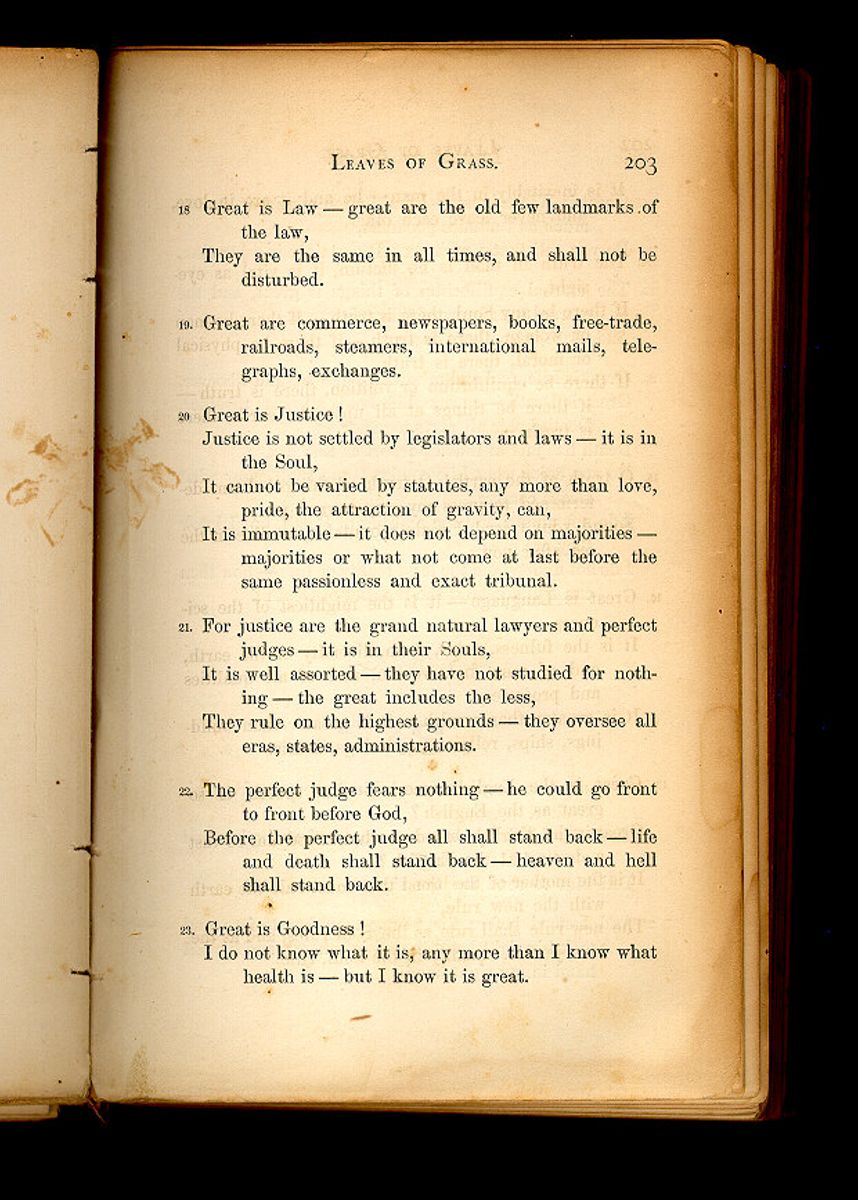 ppp.01500.211.jpg
18Great is Law—great are the old few landmarks of
ppp.01500.211.jpg
18Great is Law—great are the old few landmarks of the law, They are the same in all times, and shall not be
disturbed. 19Great are commerce, newspapers, books, free-trade,
railroads, steamers, international mails, tele-
graphs, exchanges. 20Great is Justice! Justice is not settled by legislators and laws—it is in
the Soul, It cannot be varied by statues, any more than love,
pride, the attraction of gravity, can, It is immutable—it does not depend on majorities—
majorities or what not come at last before the
same passionless and exact tribunal. 21For justice are the grand natural lawyers and perfect
judges—it is in their Souls, It is well assorted—they have not studied for noth-
ing—the great includes the less, They rule on the highest grounds—they oversee all
eras, states, administrations. 22The perfect judge fears nothing—he could go front
to front before God, Before the perfect judge all shall stand back—life
and death shall stand back—heaven and hell
shall stand back. 23Great is Goodness! I do not know what it is, any more than I know what
health is—but I know it is great. [ begin page 204 ]
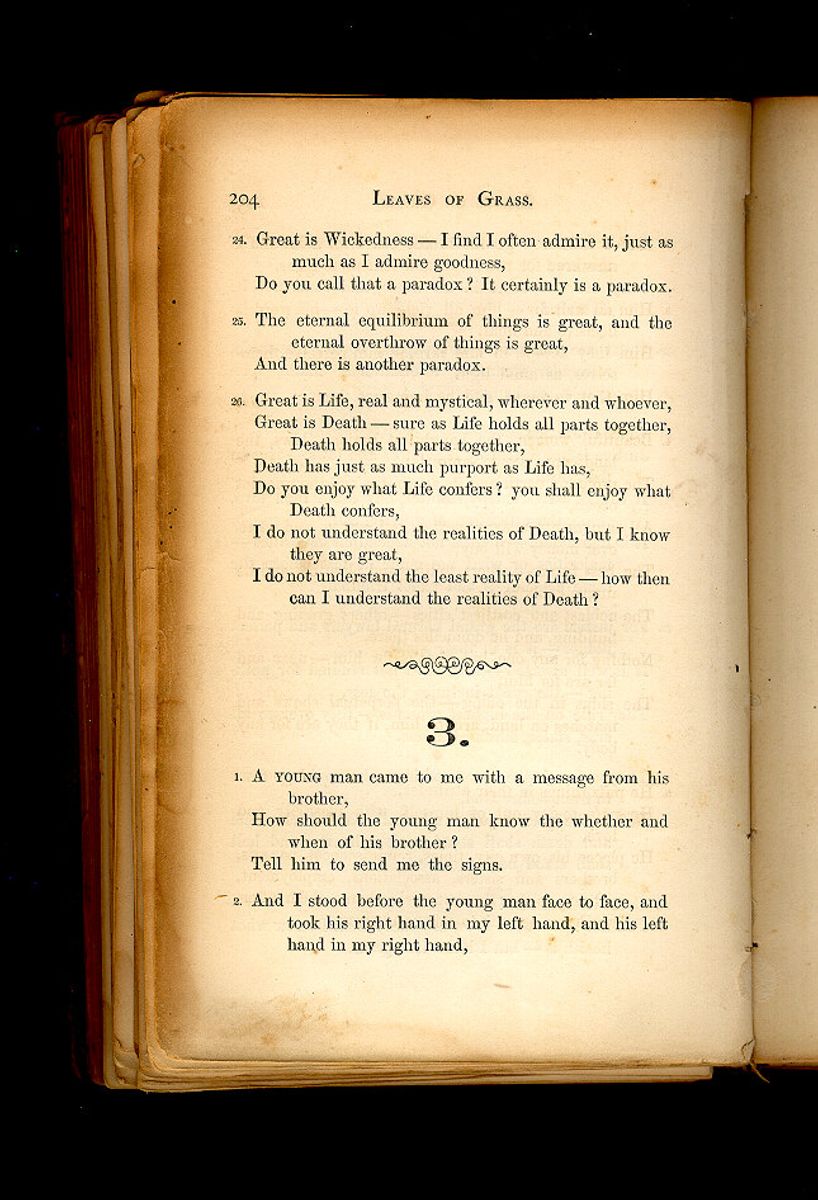 ppp.01500.212.jpg
24Great is Wickedness—I find I often admire it, just as
ppp.01500.212.jpg
24Great is Wickedness—I find I often admire it, just as much as I admire goodness, Do you call that a paradox? It certainly is a paradox. 25The eternal equilibrium of things is great, and the
eternal overthrow of things is great, And there is another paradox. 26Great is Life, real and mystical, wherever and whoever, Great is Death—sure as Life holds all parts together,
Death holds all parts together, Death has just as much purport as Life has, Do you enjoy what Life confers? you shall enjoy what
Death confers, I do not understand the realities of Death, but I know
they are great, I do not understand the least reality of Life—how then
can I understand the realities of Death?
3.
1A YOUNG man came to me with a message from hisbrother, How should the young man know the whether and
when of his brother? Tell him to send me the signs. 2And I stood before the young man face to face, and
took his right hand in my left hand, and his left
hand in my right hand, [ begin page 205 ]
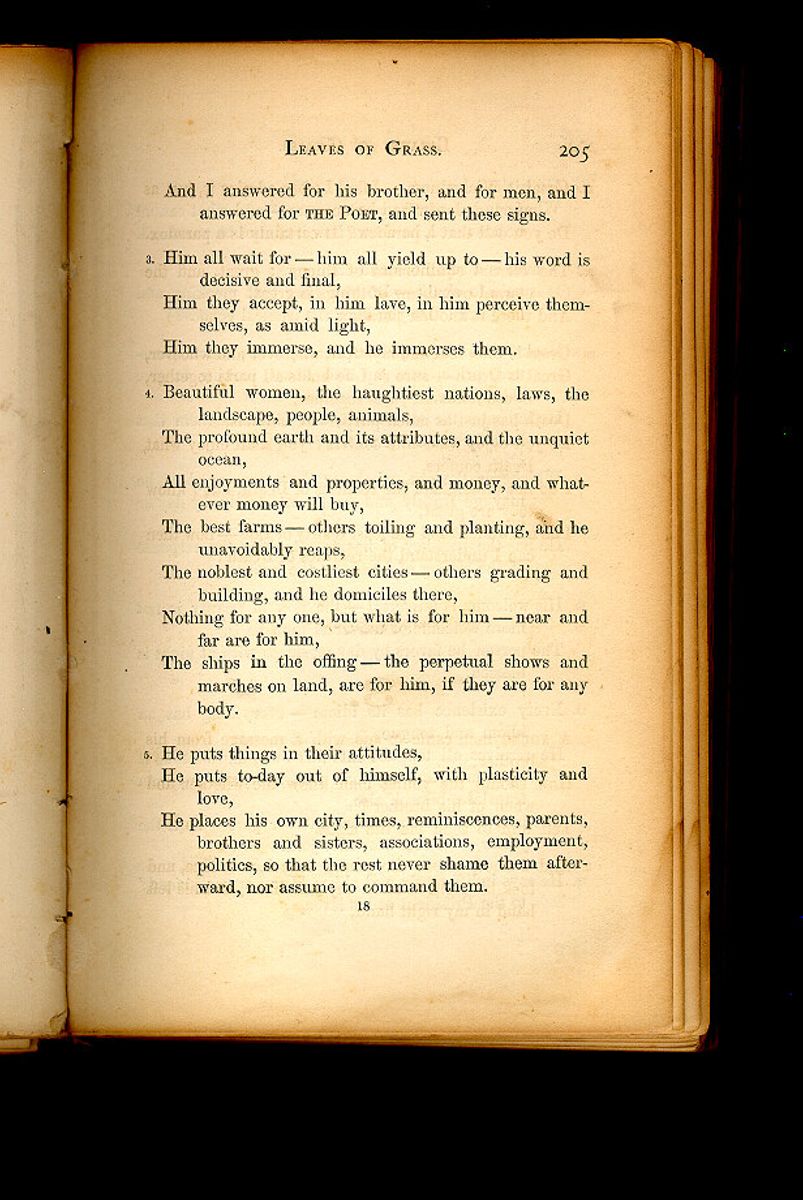 ppp.01500.213.jpg
And I answered for his brother, and for men, and I
ppp.01500.213.jpg
And I answered for his brother, and for men, and I answered for THE POET, and sent these signs. 3Him all wait for—him all yield up to—his word is
decisive and final, Him they accept, in him lave, in him perceive them-
selves, as amid light, Him they immerse, and he immerses them. 4Beautiful women, the haughtiest nations, laws, the
landscape, people, animals, The profound earth and its attributes, and the unquiet
ocean, All enjoyments and properties, and money, and what-
ever money will buy, The best farms—others toiling and planting, and he
unavoidably reaps, The noblest and costliest cities—others grading and
building, and he domiciles there, Nothing for any one, but what is for him—near and
far are for him, The ships in the offing—the perpetual shows and
marches on land, are for him, if they are for any
body. 5He puts things in their attitudes, He puts to-day out of himself, with plasticity and
love, He places his own city, times, reminiscences, parents,
brothers and sisters, associations, employment,
politics, so that the rest never shame them after-
ward, nor assume to command them. 18 [ begin page 206 ]
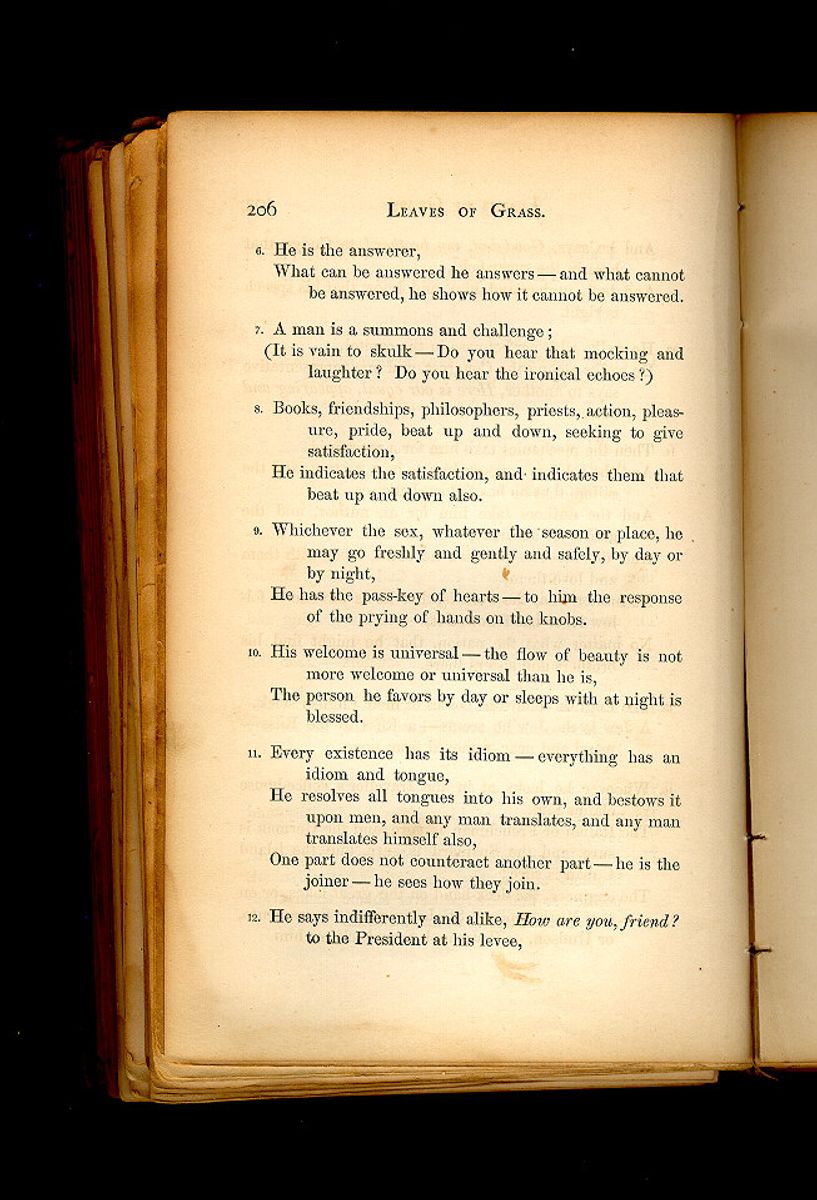 ppp.01500.214.jpg
6He is the answerer,
What can be answered he answers—and what cannot
ppp.01500.214.jpg
6He is the answerer,
What can be answered he answers—and what cannot be answered, he shows how it cannot be answered. 7A man is a summons and challenge; (It is vain to skulk—Do you hear that mocking and
laughter? Do you hear the ironical echoes?) 8Books, friendships, philosophers, priests, action, pleas-
ure, pride, beat up and down, seeking to give
satisfaction, He indicates the satisfaction, and indicates them that
beat up and down also. 9Whichever the sex, whatever the season or place, he
may go freshly and gently and safely, by day or
by night, He has the pass-key of hearts—to him the response
of the prying of hands on the knobs. 10His welcome is universal—the flow of beauty is not
more welcome or universal than he is, The person he favors by day or sleeps with at night is
blessed. 11Every existence has its idiom—everything has an
idiom and tongue, He resolves all tongues into his own, and bestows it
upon men, and any man translates, and any man
translates himself also, One part does not counteract another part—he is the
joiner—he sees how they join. 12He says indifferently and alike, How are you, friend?
to the President at his levee, [ begin page 207 ]
 ppp.01500.215.jpg
And he says, Good-day, my brother! to Cudge that
ppp.01500.215.jpg
And he says, Good-day, my brother! to Cudge that hoes in the sugar-field, And both understand him, and know that his speech
is right. 13He walks with perfect ease in the capitol, He walks among the Congress, and one representative
says to another, Here is our equal, appearing and
new. 14Then the mechanics take him for a mechanic, And the soldiers suppose him to be a captain, and the
sailors that he has followed the sea, And the authors take him for an author, and the
artists for an artist, And the laborers perceive he could labor with them
and love them, No matter what the work is, that he is the one to fol-
low it, or has followed it, No matter what the nation, that he might find his
brothers and sisters there. 15The English believe he comes of their English stock, A Jew to the Jew he seems—a Russ to the Russ—
usual and near, removed from none. 16Whoever he looks at in the traveller's coffee-house
claims him, The Italian or Frenchman is sure, and the German is
sure, and the Spaniard is sure, and the island
Cuban is sure; The engineer, the deck-hand on the great lakes, or on
the Mississippi, or St. Lawrence, or Sacramento,
or Hudson, or Paumanok Sound, claims him. [ begin page 208 ]
 ppp.01500.216.jpg
17The gentleman of perfect blood acknowledges his per-
ppp.01500.216.jpg
17The gentleman of perfect blood acknowledges his per- fect blood, The insulter, the prostitute, the angry person, the
beggar, see themselves in the ways of him—he
strangely transmutes them, They are not vile any more—they hardly know them-
selves, they are so grown. 18Do you think it would be good to be the writer of
melodious verses? Well, it would be good to be the writer of melodious
verses; But what are verses beyond the flowing character you
could have? or beyond beautiful manners and
behavior? Or beyond one manly or affectionate deed of an ap-
prentice-boy? or old woman? or man that has
been in prison, or is likely to be in prison?
4.
1SOMETHING startles me where I thought I was safest, I withdraw from the still woods I loved, I will not go now on the pastures to walk, I will not strip the clothes from my body to meet mylover the sea, I will not touch my flesh to the earth, as to other
flesh, to renew me. [ begin page 209 ]
 ppp.01500.217.jpg
2O Earth!
O how can the ground of you not sicken?
How can you be alive, you growths of spring?
How can you furnish health, you blood of herbs, roots,
ppp.01500.217.jpg
2O Earth!
O how can the ground of you not sicken?
How can you be alive, you growths of spring?
How can you furnish health, you blood of herbs, roots, orchards, grain? Are they not continually putting distempered corpses
in you? Is not every continent worked over and over with sour
dead? 3Where have you disposed of those carcasses of the
drunkards and gluttons of so many generations? Where have you drawn off all the foul liquid and meat? I do not see any of it upon you to-day—or perhaps
I am deceived, I will run a furrow with my plough—I will press
my spade through the sod, and turn it up un-
derneath, I am sure I shall expose some of the foul meat. 4Behold! This is the compost of billions of premature corpses, Perhaps every mite has once formed part of a sick
person—Yet behold! The grass covers the prairies, The bean bursts noiselessly through the mould in the
garden, The delicate spear of the onion pierces upward, The apple-buds cluster together on the apple-branches, The resurrection of the wheat appears with pale visage
out of its graves, The tinge awakes over the willow-tree and the mul-
berry-tree, 18* [ begin page 210 ]
 ppp.01500.218.jpg
The he-birds carol mornings and evenings, while the
ppp.01500.218.jpg
The he-birds carol mornings and evenings, while the she-birds sit on their nests, The young of poultry break through the hatched eggs, The new-born of animals appear—the calf is dropt
from the cow, the colt from the mare, Out of its little hill faithfully rise the potato's dark
green leaves, Out of its hill rises the yellow maize-stalk; The summer growth is innocent and disdainful above
all those strata of sour dead. 5What chemistry! That the winds are really not infectious, That this is no cheat, this transparent green-wash of
the sea, which is so amorous after me, That it is safe to allow it to lick my naked body all
over with its tongues, That it will not endanger me with the fevers that
have deposited themselves in it, That all is clean, forever and forever, That the cool drink from the well tastes so good, That blackberries are so flavorous and juicy, That the fruits of the apple-orchard, and of the
orange-orchard—that melons, grapes, peaches,
plums, will none of them poison me, That when I recline on the grass I do not catch any
disease, Though probably every spear of grass rises out of
what was once a catching disease. 6Now I am terrified at the Earth! it is that calm and
patient, It grows such sweet things out of such corruptions, [ begin page 211 ]
 ppp.01500.219.jpg
It turns harmless and stainless on its axis, with such
ppp.01500.219.jpg
It turns harmless and stainless on its axis, with such endless successions of diseased corpses, It distils such exquisite winds out of such infused
fetor, It renews, with such unwitting looks, its prodigal,
annual, sumptuous crops, It gives such divine materials to men, and accepts
such leavings from them at last.
5.
1ALL day I have walked the city, and talked with myfriends, and thought of prudence, Of time, space, reality—of such as these, and abreast
with them, prudence. 2After all, the last explanation remains to be made
about prudence, Little and large alike drop quietly aside from the
prudence that suits immortality. 3The Soul is of itself, All verges to it—all has reference to what ensues, All that a person does, says, thinks, is of conse-
quence, Not a move can a man or woman make, that affects
him or her in a day, month, any part of the
direct life-time, or the hour of death, but the
same affects him or her onward afterward
through the indirect life-time. [ begin page 212 ]
 ppp.01500.220.jpg
4The indirect is more than the direct,
The spirit receives from the body just as much as it
ppp.01500.220.jpg
4The indirect is more than the direct,
The spirit receives from the body just as much as it gives to the body, if not more. 5Not one word or deed—not venereal sore, discolor-
ation, privacy of the onanist, putridity of gluttons
or rum-drinkers, peculation, cunning, betrayal,
murder, seduction, prostitution, but has results
beyond death, as really as before death. 6Charity and personal force are the only investments
worth anything. 7No specification is necessary—all that a male or
female does, that is vigorous, benevolent, clean,
is so much profit to him or her, in the unshakable
order of the universe, and through the whole
scope of it forever. 8Who has been wise, receives interest, Savage, felon, President, judge, farmer, sailor, me-
chanic, young, old, it is the same, The interest will come round—all will come round. 9Singly, wholly, to affect now, affected their time, will
forever affect, all of the past, and all of the
present, and all of the future, All the brave actions of war and peace, All help given to relatives, strangers, the poor, old,
sorrowful, young children, widows, the sick, and
to shunned persons, All furtherance of fugitives, and of the escape of
slaves, [ begin page 213 ]
 ppp.01500.221.jpg
All self-denial that stood steady and aloof on wrecks,
ppp.01500.221.jpg
All self-denial that stood steady and aloof on wrecks, and saw others fill the seats of the boats, All offering of substance or life for the good old cause,
or for a friend's sake, or opinion's sake, All pains of enthusiasts, scoffed at by their neighbors, All the limitless sweet love and precious suffering of
mothers, All honest men baffled in strifes recorded or unre-
corded, All the grandeur and good of ancient nations whose
fragments we inherit, All the good of the hundreds of ancient nations un-
known to us by name, date, location, All that was ever manfully begun, whether it suc-
ceeded or no, All suggestions of the divine mind of man, or the
divinity of his mouth, or the shaping of his great
hands; All that is well thought or said this day on any part
of the globe—or on any of the wandering stars,
or on any of the fixed stars, by those there as we
are here, All that is henceforth to be thought or done by you,
whoever you are, or by any one, These inure, have inured, shall inure, to the identities
from which they sprang, or shall spring. 10Did you guess anything lived only its moment? The world does not so exist—no parts palpable or
impalpable so exist, No consummation exists without being from some
long previous consummation—and that from
some other, [ begin page 214 ]
 ppp.01500.222.jpg
Without the farthest conceivable one coming a bit
ppp.01500.222.jpg
Without the farthest conceivable one coming a bit nearer the beginning than any. 11Whatever satisfies Souls is true, Prudence entirely satisfies the craving and glut of
Souls, Itself finally satisfies the Soul, The Soul has that measureless pride which revolts
from every lesson but its own. 12Now I give you an inkling, Now I breathe the word of the prudence that walks
abreast with time, space, reality, That answers the pride which refuses every lesson but
its own. 13What is prudence, is indivisible, Declines to separate one part of life from every part, Divides not the righteous from the unrighteous, or
the living from the dead, Matches every thought or act by its correlative, Knows no possible forgiveness or deputed atonement, Knows that the young man who composedly perilled
his life and lost it, has done exceeding well for
himself, without doubt, That he who never perilled his life, but retains it to
old age in riches and ease, has probably achieved
nothing for himself worth mentioning; Knows that only the person has really learned, who
has learned to prefer results, Who favors body and Soul the same, Who perceives the indirect assuredly following the
direct, Who in his spirit in any emergency whatever neither
hurries or avoids death. [ begin page 215 ]
 ppp.01500.223.jpg
6.
1PERFECT sanity shows the master among philosophs, Time, always without flaw, indicates itself in parts, What always indicates the poet, is the crowd of thepleasant company of singers, and their words, The words of the singers are the hours or minutes of
the light or dark—but the words of the maker
of poems are the general light and dark, The maker of poems settles justice, reality, immor-
tality, His insight and power encircle things and the human
race, He is the glory and extract, thus far, of things, and
of the human race. 2The singers do not beget—only THE POET begets, The singers are welcomed, understood, appear often
enough—but rare has the day been, likewise the
spot, of the birth of the maker of poems, Not every century, or every five centuries, has con-
tained such a day, for all its names. 3The singers of successive hours of centuries may have
ostensible names, but the name of each of them
is one of the singers, The name of each is, a heart-singer, eye-singer, hymn-
singer, law-singer, ear-singer, head-singer, sweet-
singer, wise-singer, droll-singer, thrift-singer, sea-
singer, wit-singer, echo-singer, parlor-singer, love-
singer, passion-singer, mystic-singer, fable-singer,
item-singer, weeping-singer, or something else. [ begin page 216 ]
 ppp.01500.224.jpg
4All this time, and at all times, wait the words of
ppp.01500.224.jpg
4All this time, and at all times, wait the words of poems; The greatness of sons is the exuding of the greatness
of mothers and fathers, The words of poems are the tuft and final applause of
science. 5Divine instinct, breadth of vision, the law of reason,
health, rudeness of body, withdrawnness, gayety,
sun-tan, air-sweetness—such are some of the
words of poems. 6The sailor and traveller underlie the maker of poems, The builder, geometer, mathematician, astronomer,
melodist, chemist, anatomist, spiritualist, lan-
guage-searcher, geologist, phrenologist, artist—
all these underlie the maker of poems. 7The words of poems give you more than poems, They give you to form for yourself poems, religions,
politics, war, peace, behavior, histories, essays,
romances, and everything else, They balance ranks, colors, races, creeds, and the
sexes, They do not seek beauty—they are sought, Forever touching them, or close upon them, follows
beauty, longing, fain, love-sick. 8They prepare for death—yet are they not the finish,
but rather the outset, They bring none to his or her terminus, or to be con-
tent and full; [ begin page 217 ]
 ppp.01500.225.jpg
Whom they take, they take into space, to behold the
ppp.01500.225.jpg
Whom they take, they take into space, to behold the birth of stars, to learn one of the meanings, To launch off with absolute faith—to sweep through
the ceaseless rings, and never be quiet again.
7.
I NEED no assurances—I am a man who is pre-occupied, of his own Soul; I do not doubt that whatever I know at a given time,
there waits for me more, which I do not know; I do not doubt that from under the feet, and beside
the hands and face I am cognizant of, are now
looking faces I am not cognizant of—calm and
actual faces; I do not doubt but the majesty and beauty of the
world are latent in any iota of the world; I do not doubt there are realizations I have no idea of,
waiting for me through time, and through the
universes—also upon this earth; I do not doubt I am limitless, and that the universes
are limitless—in vain I try to think how
limitless; I do not doubt that the orbs, and the systems of orbs,
play their swift sports through the air on purpose
—and that I shall one day be eligible to do as
much as they, and more than they; I do not doubt there is far more in trivialities, insects,
vulgar persons, slaves, dwarfs, weeds, rejected
refuse, than I have supposed; 19 [ begin page 218 ]
 ppp.01500.226.jpg
I do not doubt there is more in myself than I have
ppp.01500.226.jpg
I do not doubt there is more in myself than I have supposed—and more in all men and women—
and more in my poems than I have supposed; I do not doubt that temporary affairs keep on and on,
millions of years; I do not doubt interiors have their interiors, and
exteriors have their exteriors—and that the
eye-sight has another eye-sight, and the hearing
another hearing, and the voice another voice; I do not doubt that the passionately-wept deaths of
young men are provided for—and that the
deaths of young women, and the deaths of little
children, are provided for; I do not doubt that wrecks at sea, no matter what the
horrors of them—no matter whose wife, child,
husband, father, lover, has gone down—are pro-
vided for, to the minutest point; I do not doubt that shallowness, meanness, malig-
nance, are provided for; I do not doubt that cities, you, America, the re-
mainder of the earth, politics, freedom, degra-
dations, are carefully provided for; I do not doubt that whatever can possibly happen,
any where, at any time, is provided for, in the
inherences of things. [ begin page 219 ]
 ppp.01500.227.jpg
8.
1WHAT shall I give? and which are my miracles? 2Realism is mine—my miracles—Take freely, Take without end—I offer them to you whereveryour feet can carry you, or your eyes reach. 3Why! who makes much of a miracle? As to me, I know of nothing else but miracles, Whether I walk the streets of Manhattan, Or dart my sight over the roofs of houses toward the
sky, Or wade with naked feet along the beach, just in the
edge of the water, Or stand under trees in the woods, Or talk by day with any one I love—or sleep in the
bed at night with any one I love, Or sit at the table at dinner with my mother, Or look at strangers opposite me riding in the car, Or watch honey-bees busy around the hive, of a sum-
mer forenoon, Or animals feeding in the fields, Or birds—or the wonderfulness of insects in the air, Or the wonderfulness of the sun-down—or of stars
shining so quiet and bright, Or the exquisite, delicate, thin curve of the new-moon
in spring; Or whether I go among those I like best, and that like
me best—mechanics, boatmen, farmers, [ begin page 220 ]
 ppp.01500.228.jpg
Or among the savans—or to the soiree—or to the
ppp.01500.228.jpg
Or among the savans—or to the soiree—or to the opera, Or stand a long while looking at the movements of
machinery, Or behold children at their sports, Or the admirable sight of the perfect old man, or the
perfect old woman, Or the sick in hospitals, or the dead carried to burial, Or my own eyes and figure in the glass, These, with the rest, one and all, are to me miracles, The whole referring—yet each distinct and in its
place. 4To me, every hour of the light and dark is miracle, Every inch of space is a miracle, Every square yard of the surface of the earth is spread
with the same, Every cubic foot of the interior swarms with the same; Every spear of grass—the frames, limbs, organs, of
men and women, and all that concerns them, All these to me are unspeakably perfect miracles. 5To me the sea is a continual miracle, The fishes that swim—the rocks—the motion of the
waves—the ships, with men in them, What stranger miracles are there? [ begin page 221 ]
 ppp.01500.229.jpg
9.
1THERE was a child went forth every day, And the first object he looked upon and receivedwith wonder, pity, love, or dread, that object he
became, And that object became part of him for the day, or a
certain part of the day, or for many years, or
stretching cycles of years. 2The early lilacs became part of this child, And grass, and white and red morning-glories, and
white and red clover, and the song of the phœbe-
bird, And the Third Month lambs, and the sow's pink-faint
litter, and the mare's foal, and the cow's calf, And the noisy brood of the barn-yard, or by the mire
of the pond-side, And the fish suspending themselves so curiously below
there—and the beautiful curious liquid, And the water-plants with their graceful flat heads—
all became part of him. 3The field-sprouts of Fourth Month and Fifth Month
became part of him, Winter-grain sprouts, and those of the light-yellow
corn, and the esculent roots of the garden, And the apple-trees covered with blossoms, and the
fruit afterward, and wood-berries, and the com-
monest weeds by the road; 19* [ begin page 222 ]
 ppp.01500.230.jpg
And the old drunkard staggering home from the out-
ppp.01500.230.jpg
And the old drunkard staggering home from the out- house of the tavern, whence he had lately risen, And the school-mistress that passed on her way to the
school, And the friendly boys that passed—and the quarrel-
some boys, And the tidy and fresh-cheeked girls—and the bare-
foot negro boy and girl, And all the changes of city and country, wherever he
went. 4His own parents, He that had fathered him, and she that conceived him
in her womb, and birthed him, They gave this child more of themselves than that, They gave him afterward every day—they and of
them became part of him. 5The mother at home, quietly placing the dishes on the
supper-table, The mother with mild words—clean her cap and
gown, a wholesome odor falling off her person
and clothes as she walks by; The father, strong, self-sufficient, manly, mean, an-
gered, unjust, The blow, the quick loud word, the tight bargain, the
crafty lure, The family usages, the language, the company, the
furniture—the yearning and swelling heart, Affection that will not be gainsayed—the sense of
what is real—the thought if, after all, it should
prove unreal, The doubts of day-time and the doubts of night-time—
the curious whether and how, [ begin page 223 ]
 ppp.01500.231.jpg
Whether that which appears so is so, or is it all flashes
ppp.01500.231.jpg
Whether that which appears so is so, or is it all flashes and specks? Men and women crowding fast in the streets—if they
are not flashes and specks, what are they? The streets themselves, and the façades of houses, and
goods in the windows, Vehicles, teams, the heavy-planked wharves—the
huge crossing at the ferries, The village on the highland, seen from afar at sunset—
the river between, Shadows, aureola and mist, light falling on roofs and
gables of white or brown, three miles off, The schooner near by, sleepily dropping down the
tide—the little boat slack-towed astern, The hurrying tumbling waves, quick-broken crests,
slapping, The strata of colored clouds, the long bar of maroon-
tint, away solitary by itself—the spread of purity
it lies motionless in, The horizon's edge, the flying sea-crow, the fragrance
of salt-marsh and shore-mud; These became part of that child who went forth every
day, and who now goes, and will always go forth
every day, And these become part of him or her that peruses
them here. [ begin page 224 ]
 ppp.01500.232.jpg
10.
1IT is ended—I dally no more, After to-day I inure myself to run, leap, swim,wrestle, fight, To stand the cold or heat—to take good aim with a
gun—to sail a boat—to manage horses—to
beget superb children, To speak readily and clearly—to feel at home among
common people, And to hold my own in terrible positions, on land
and sea. 2Not for an embroiderer, (There will always be plenty of embroiderers—I
welcome them also;) But for the fibre of things, and for inherent men and
women. 3Not to chisel ornaments, But to chisel with free stroke the heads and limbs of
plenteous Supreme Gods, that The States may
realize them, walking and talking. 4Let me have my own way, Let others promulge the laws—I will make no ac-
count of the laws, Let others praise eminent men and hold up peace—
I hold up agitation and conflict, I praise no eminent man—I rebuke to his face the
one that was thought most worthy. [ begin page 225 ]
 ppp.01500.233.jpg
5(Who are you? you mean devil! And what are you
ppp.01500.233.jpg
5(Who are you? you mean devil! And what are you secretly guilty of, all your life? Will you turn aside all your life? Will you grub
and chatter all your life?) 6(And who are you—blabbing by rote, years, pages,
languages, reminiscences, Unwitting to-day that you do not know how to speak
a single word?) 7Let others finish specimens—I never finish specimens, I shower them by exhaustless laws, as nature does,
fresh and modern continually. 8I give nothing as duties, What others give as duties, I give as living impulses; (Shall I give the heart's action as a duty?) 9Let others dispose of questions—I dispose of noth-
ing—I arouse unanswerable questions; Who are they I see and touch, and what about them? What about these likes of myself, that draw me so
close by tender directions and indirections? 10Let others deny the evil their enemies charge against
them—but how can I the like? Nothing ever has been, or ever can be, charged against
me, half as bad as the evil I really am; I call to the world to distrust the accounts of my
friends, but listen to my enemies—as I my-
self do; I charge you, too, forever, reject those who would
expound me—for I cannot expound myself, [ begin page 226 ]
 ppp.01500.234.jpg
I charge that there be no theory or school founded out
ppp.01500.234.jpg
I charge that there be no theory or school founded out of me, I charge you to leave all free, as I have left all free. 11After me, vista! O, I see life is not short, but immeasurably long, I henceforth tread the world, chaste, temperate, an
early riser, a gymnast, a steady grower, Every hour the semen of centuries—and still of cen-
turies. 12I will follow up these continual lessons of the air,
water, earth, I perceive I have no time to lose.
11.
1WHO learns my lesson complete? Boss, journeyman, apprentice—churchman and athe-ist, The stupid and the wise thinker—parents and off-
spring—merchant, clerk, porter, and customer, Editor, author, artist, and schoolboy—Draw nigh and
commence; It is no lesson — it lets down the bars to a good
lesson, And that to another, and every one to another still. 2The great laws take and effuse without argument, I am of the same style, for I am their friend, [ begin page 227 ]
 ppp.01500.235.jpg
I love them quits and quits—I do not halt and make
ppp.01500.235.jpg
I love them quits and quits—I do not halt and make salaams. 3I lie abstracted, and hear beautiful tales of things,
and the reasons of things, They are so beautiful, I nudge myself to listen. 4I cannot say to any person what I hear—I cannot
say it to myself—it is very wonderful. 5It is no small matter, this round and delicious globe,
moving so exactly in its orbit forever and ever,
without one jolt, or the untruth of a single
second, I do not think it was made in six days, nor in ten
thousand years, nor ten billions of years, Nor planned and built one thing after another, as an
architect plans and builds a house. 6I do not think seventy years is the time of a man or
woman, Nor that seventy millions of years is the time of a
man or woman, Nor that years will ever stop the existence of me, or
any one else. 7Is it wonderful that I should be immortal? as every
one is immortal, I know it is wonderful—but my eye-sight is equally
wonderful, and how I was conceived in my moth-
er's womb is equally wonderful; [ begin page 228 ]
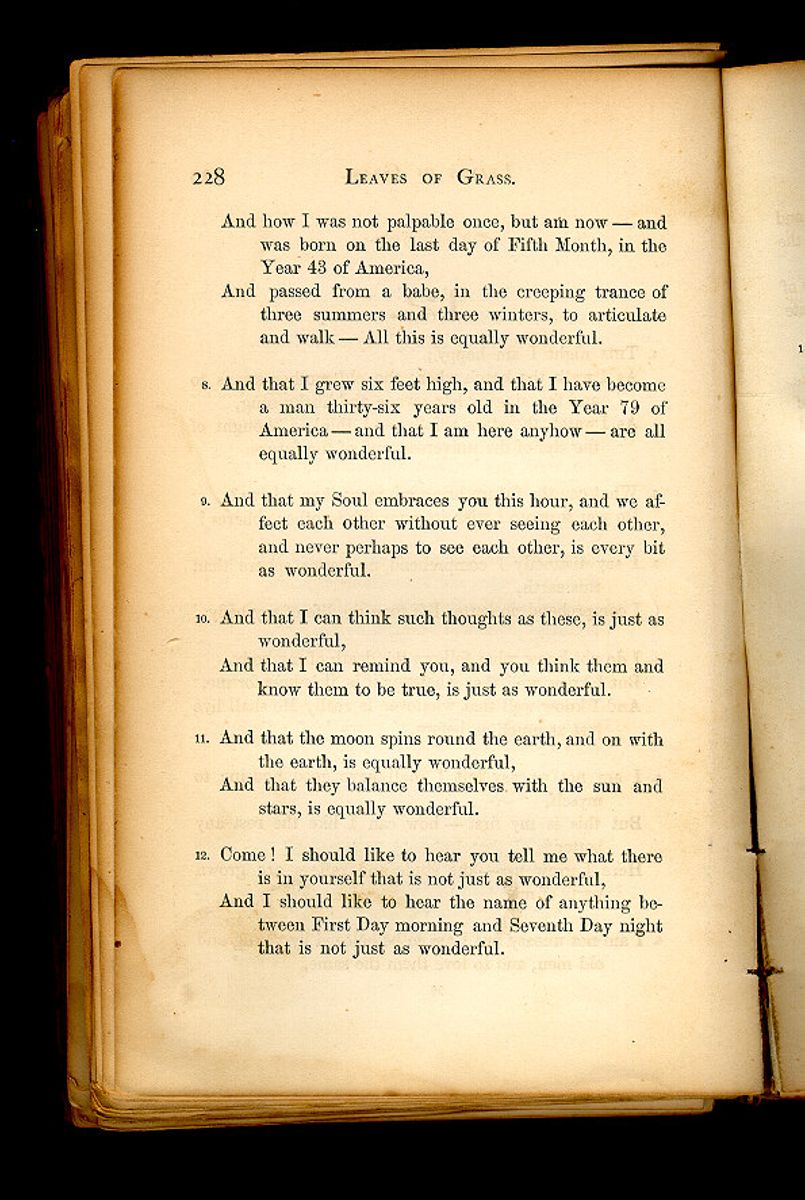 ppp.01500.236.jpg
And how I was not palpable once, but am now—and
ppp.01500.236.jpg
And how I was not palpable once, but am now—and was born on the last day of Fifth Month, in the
Year 43 of America, And passed from a babe, in the creeping trance of
three summers and three winters, to articulate
and walk—All this is equally wonderful. 8And that I grew six feet high, and that I have become
a man thirty-six years old in the Year 79 of
America—and that I am here anyhow—are all
equally wonderful. 9And that my Soul embraces you this hour, and we af-
fect each other without ever seeing each other,
and never perhaps to see each other, is every bit
as wonderful. 10And that I can think such thoughts as these, is just as
wonderful, And that I can remind you, and you think them and
know them to be true, is just as wonderful. 11And that the moon spins round the earth, and on with
the earth, is equally wonderful, And that they balance themselves with the sun and
stars, is equally wonderful. 12Come! I should like to hear you tell me what there
is in yourself that is not just as wonderful, And I should like to hear the name of anything be-
tween First Day morning and Seventh Day night
that is not just as wonderful. [ begin page 229 ]
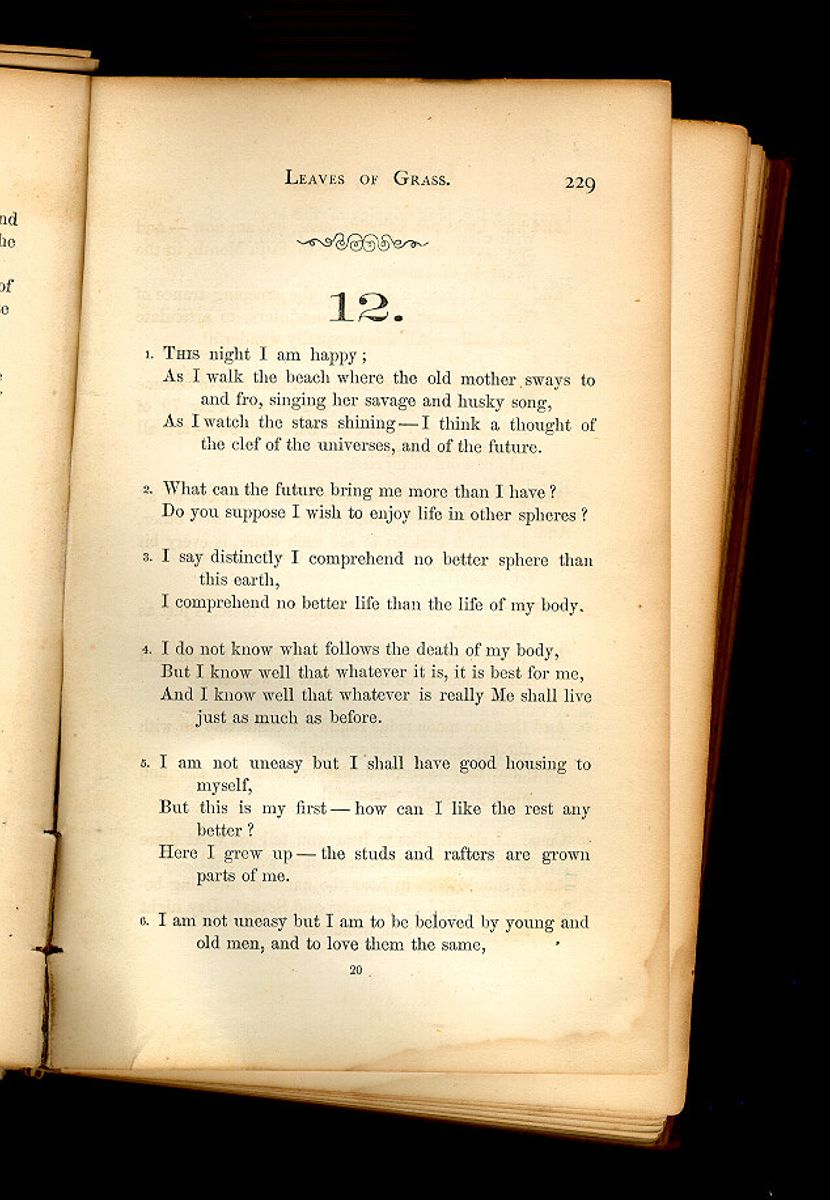 ppp.01500.237.jpg
12.
1THIS night I am happy; As I walk the beach where the old mother sways toand fro, singing her savage and husky song, As I watch the stars shining—I think a thought of
the clef of the universes, and of the future. 2What can the future bring me more than I have? Do you suppose I wish to enjoy life in other spheres? 3I say distinctly I comprehend no better sphere than
this earth, I comprehend no better life than the life of my body. 4I do not know what follows the death of my body, But I know well that whatever it is, it is best for me, And I know well that whatever is really Me shall live
just as much as before. 5I am not uneasy but I shall have good housing to
myself, But this is my first—how can I like the rest any
better? Here I grew up—the studs and rafters are grown
parts of me. 6I am not uneasy but I am to be beloved by young and
old men, and to love them the same, 20 [ begin page 230 ]
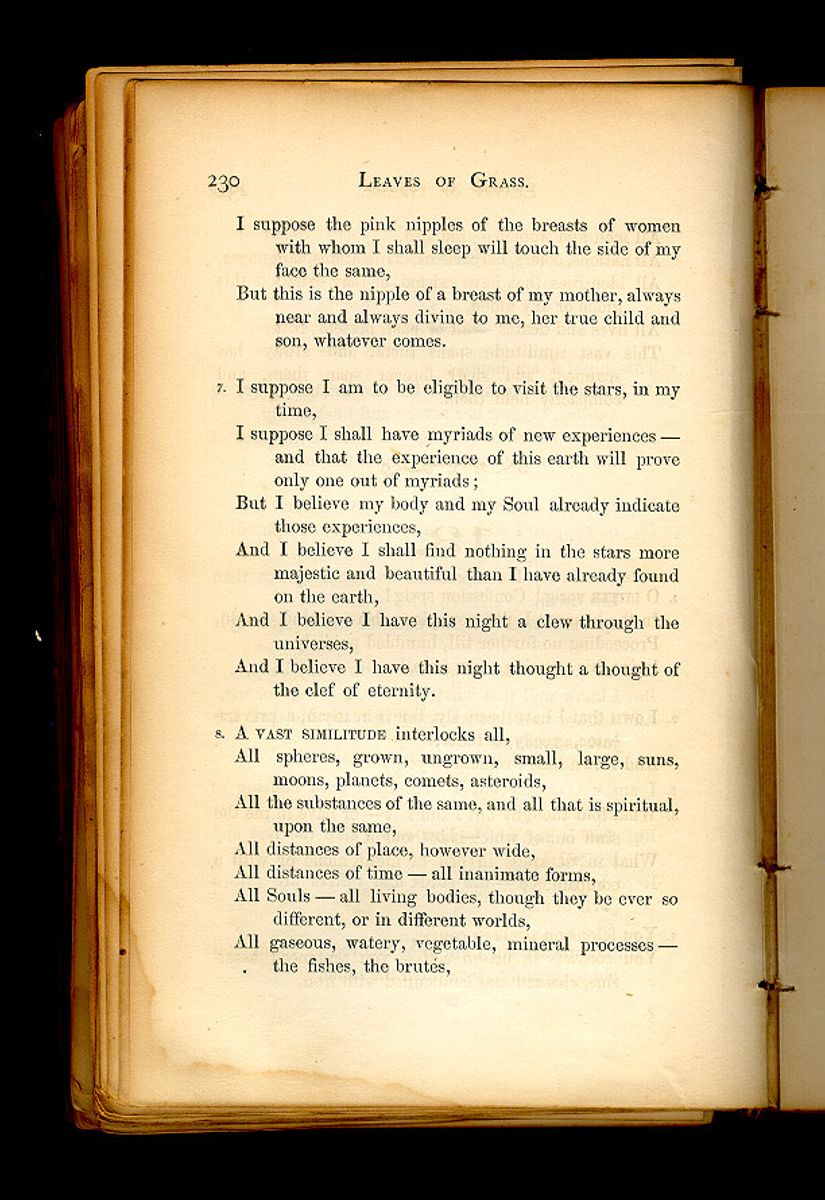 ppp.01500.238.jpg
I suppose the pink nipples of the breasts of women
ppp.01500.238.jpg
I suppose the pink nipples of the breasts of women with whom I shall sleep will touch the side of my
face the same, But this is the nipple of a breast of my mother, always
near and always divine to me, her true child and
son, whatever comes. 7I suppose I am to be eligible to visit the stars, in my
time, I suppose I shall have myriads of new experiences—
and that the experience of this earth will prove
only one out of myriads; But I believe my body and my Soul already indicate
those experiences, And I believe I shall find nothing in the stars more
majestic and beautiful than I have already found
on the earth, And I believe I have this night a clew through the
universes, And I believe I have this night thought a thought of
the clef of eternity. 8A VAST SIMILITUDE interlocks all, All spheres, grown, ungrown, small, large, suns,
moons, planets, comets, asteroids, All the substances of the same, and all that is spiritual,
upon the same, All distances of place, however wide, All distances of time—all inanimate forms, All Souls—all living bodies, though they be ever so
different, or in different worlds, All gaseous, watery, vegetable, mineral processes—
the fishes, the brutes, [ begin page 231 ]
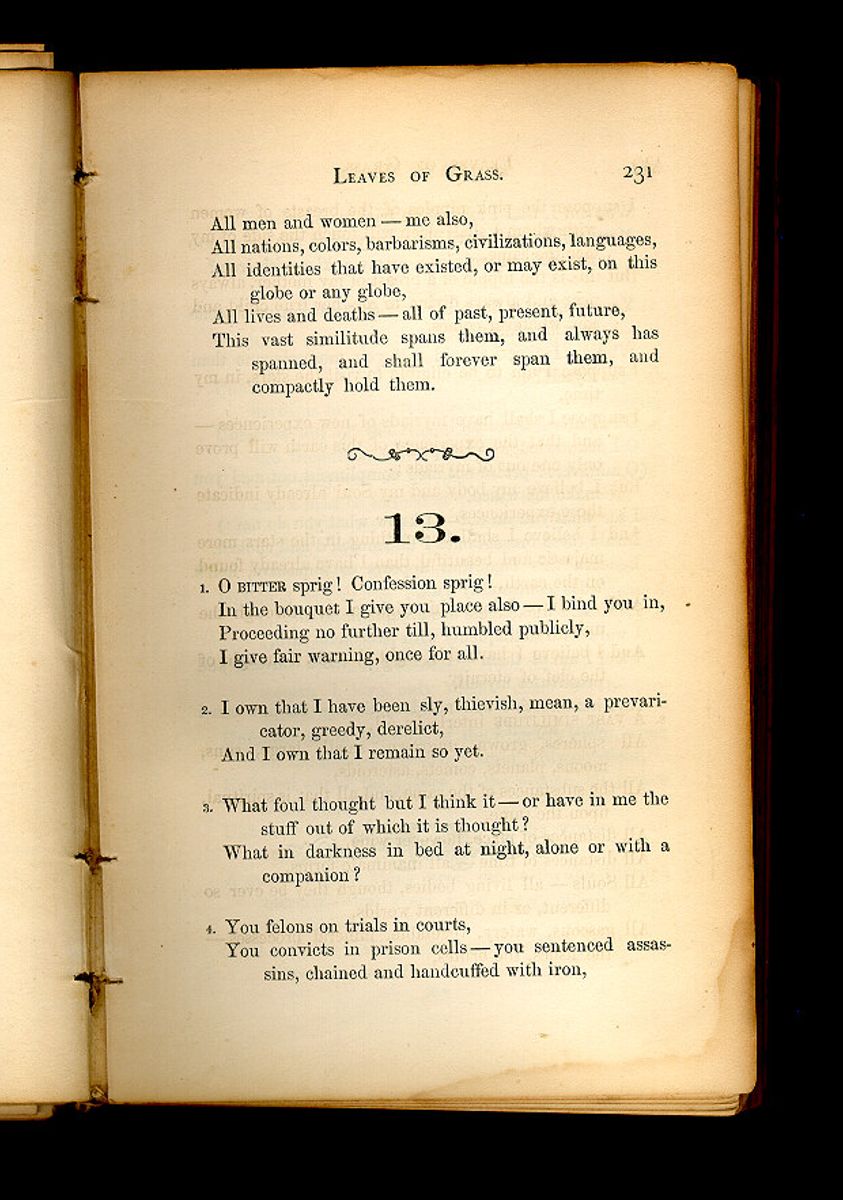 ppp.01500.239.jpg
All men and women—me also,
All nations, colors, barbarisms, civilizations, languages,
All identities that have existed, or may exist, on this
ppp.01500.239.jpg
All men and women—me also,
All nations, colors, barbarisms, civilizations, languages,
All identities that have existed, or may exist, on this globe or any globe, All lives and deaths—all of past, present, future, This vast similitude spans them, and always has
spanned, and shall forever span them, and
compactly hold them.
13.
1O BITTER sprig! Confession sprig! In the bouquet I give you place also—I bind you in, Proceeding no further till, humbled publicly, I give fair warning, once for all. 2I own that I have been sly, thievish, mean, a prevari-cator, greedy, derelict, And I own that I remain so yet. 3What foul thought but I think it—or have in me the
stuff out of which it is thought? What in darkness in bed at night, alone or with a
companion? 4You felons on trials in courts, You convicts in prison cells—you sentenced assas-
sins, chained and handcuffed with iron, [ begin page 232 ]
 ppp.01500.240.jpg
Who am I, that I am not on trial, or in prison?
Me, ruthless and devilish as any, that my wrists are
ppp.01500.240.jpg
Who am I, that I am not on trial, or in prison?
Me, ruthless and devilish as any, that my wrists are not chained with iron, or my ankles with iron? 5You prostitutes flaunting over the trottoirs, or obscene
in your rooms, Who am I, that I should call you more obscene than
myself? 6O culpable! O traitor! O I acknowledge—I exposé! (O admirers! praise not me! compliment not me! you
make me wince, I see what you do not—I know what you do not;) Inside these breast-bones I lie smutch'd and choked, Beneath this face that appears so impassive, hell's
tides continually run, Lusts and wickedness are acceptable to me, I walk with delinquents with passionate love, I feel I am of them—I belong to those convicts and
prostitutes myself, And henceforth I will not deny them—for how can I
deny myself? [ begin page 233 ]
 ppp.01500.241.jpg
14.
UNFOLDED out of the folds of the woman, man comesunfolded, as is always to come unfolded, Unfolded only out of the superbest woman of the
earth, is to come the superbest man of the earth, Unfolded out of the friendliest woman, is to come
the friendliest man, Unfolded only out of the perfect body of a woman,
can a man be formed of perfect body, Unfolded only out of the inimitable poem of the
woman, can come the poems of man—only
thence have my poems come, Unfolded out of the strong and arrogant woman I
love, only thence can appear the strong and
arrogant man I love, Unfolded by brawny embraces from the well-muscled
woman I love, only thence come the brawny
embraces of the man, Unfolded out of the folds of the woman's brain, come
all the folds of the man's brain, duly obedient, Unfolded out of the justice of the woman, all justice
is unfolded, Unfolded out of the sympathy of the woman is all
sympathy; A man is a great thing upon the earth, and through
eternity—but every jot of the greatness of man
is unfolded out of woman, First the man is shaped in the woman, he can then be
shaped in himself. 20* [ begin page 234 ]
 ppp.01500.242.jpg
15.
1NIGHT on the Prairies; I walk by myself—I stand and look at the stars,which I think now I never realized before. 2Now I absorb immortality and peace, I admire death and test propositions. 3How plenteous! How spiritual! How resumé! The same Old Man and Soul—the same old aspi-
rations, and the same content. 4I was thinking the day most splendid, till I saw what
the not-day exhibited, I was thinking this globe enough, till there tumbled
upon me myriads of other globes. 5Now while the great thoughts of space and eternity
fill me, I will measure myself by them, And now, touched with the lives of other globes,
arrived as far along as those of the earth, Or waiting to arrive, or passed on farther than those
of the earth, I henceforth no more ignore them than I ignore my
own life, Or the lives on the earth arrived as far as mine, or
waiting to arrive. 6O how plainly I see now that life cannot exhibit all to
me—as the day cannot, O I see that I am to wait for what will be exhibited
by death. [ begin page 235 ]
 ppp.01500.243.jpg
16.
SEA-WATER, and all living below it, Forests at the bottom of the sea—the branches andleaves, Sea-lettuce, vast lichens, strange flowers and seeds—
the thick tangle, the openings, and the pink turf, Different colors, pale gray and green, purple, white,
and gold—the play of light through the water, Dumb swimmers there among the rocks—coral,
gluten, grass, rushes—and the aliment of the
swimmers, Sluggish existences grazing there, suspended, or
slowly crawling close to the bottom, The sperm-whale at the surface, blowing air and
spray, or disporting with his flukes, The leaden-eyed shark, the walrus, the turtle, the
hairy sea-leopard, and the sting-ray; Passions there—wars, pursuits, tribes—sight in
those ocean-depths—breathing that thick-breath-
ing air, as so many do, The change thence to the sight here, and to the subtle
air breathed by beings like us, who walk this
sphere; The change onward from ours to that of beings who
walk other spheres. [ begin page 236 ]
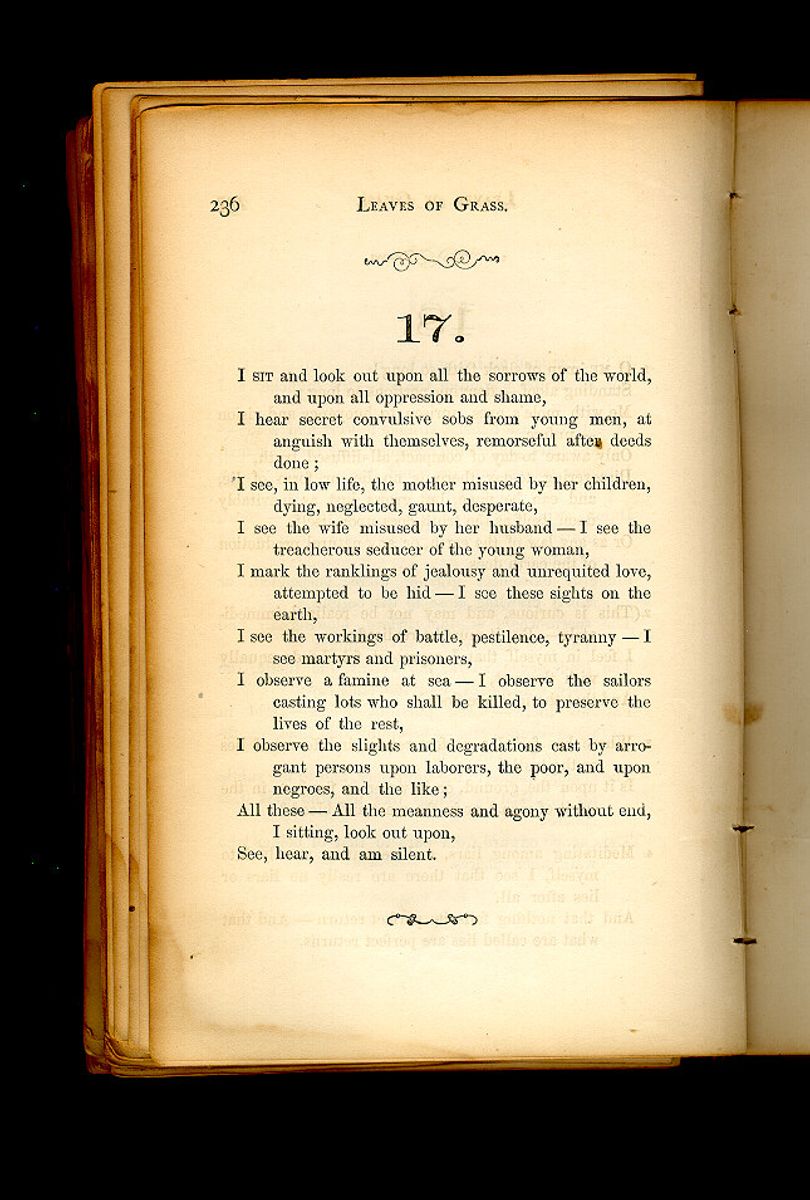 ppp.01500.244.jpg
17.
I SIT and look out upon all the sorrows of the world,and upon all oppression and shame, I hear secret convulsive sobs from young men, at
anguish with themselves, remorseful after deeds
done; I see, in low life, the mother misused by her children,
dying, neglected, gaunt, desperate, I see the wife misused by her husband—I see the
treacherous seducer of the young woman, I mark the ranklings of jealousy and unrequited love,
attempted to be hid—I see these sights on the
earth, I see the workings of battle, pestilence, tyranny—I
see martyrs and prisoners, I observe a famine at sea—I observe the sailors
casting lots who shall be killed, to preserve the
lives of the rest, I observe the slights and degradations cast by arro-
gant persons upon laborers, the poor, and upon
negroes, and the like; All these—All the meanness and agony without end,
I sitting, look out upon, See, hear, and am silent. [ begin page 237 ]
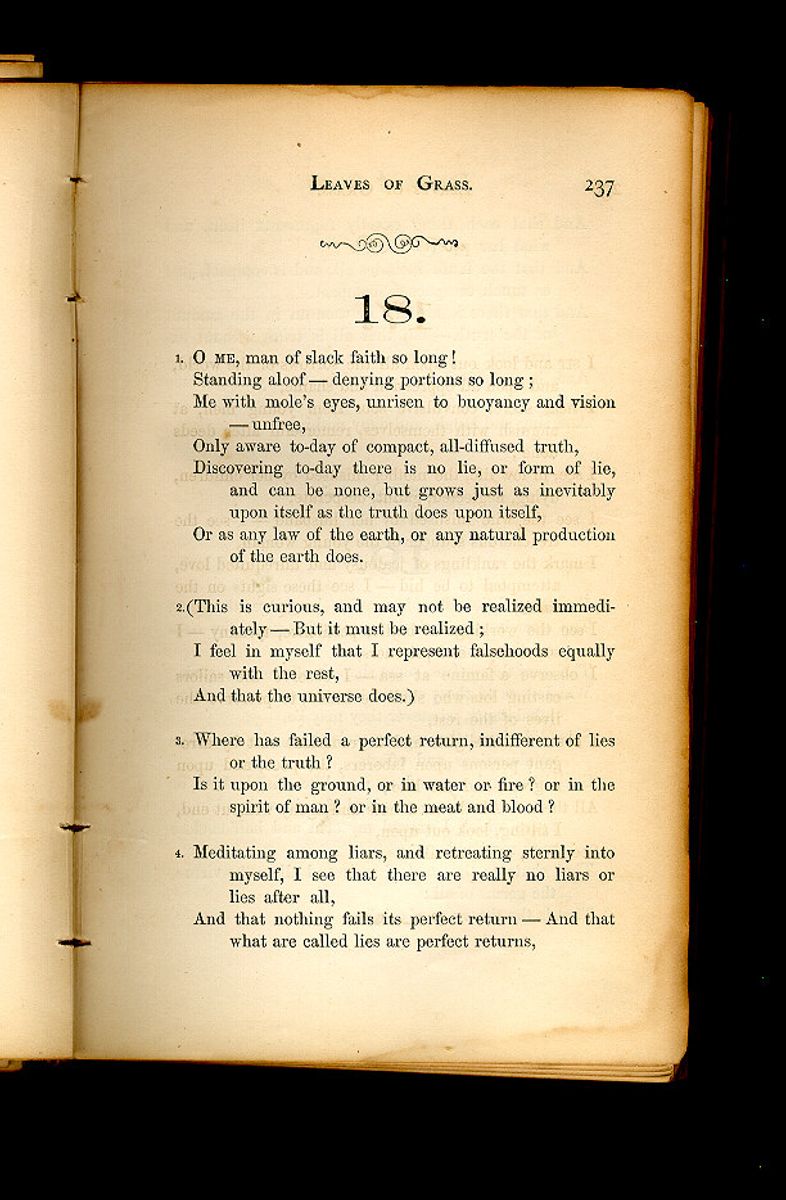 ppp.01500.245.jpg
18.
1O ME, man of slack faith so long! Standing aloof—denying portions so long; Me with mole's eyes, unrisen to buoyancy and vision—unfree, Only aware to-day of compact, all-diffused truth, Discovering to-day there is no lie, or form of lie,
and can be none, but grows just as inevitably
upon itself as the truth does upon itself, Or as any law of the earth, or any natural production
of the earth does. 2(This is curious, and may not be realized immedi-
ately—But it must be realized; I feel in myself that I represent falsehoods equally
with the rest, And that the universe does.) 3Where has failed a perfect return, indifferent of lies
or the truth? Is it upon the ground, or in water or fire? or in the
spirit of man? or in the meat and blood? 4Meditating among liars, and retreating sternly into
myself, I see that there are really no liars or
lies after all, And that nothing fails its perfect return—And that
what are called lies are perfect returns, [ begin page 238 ]
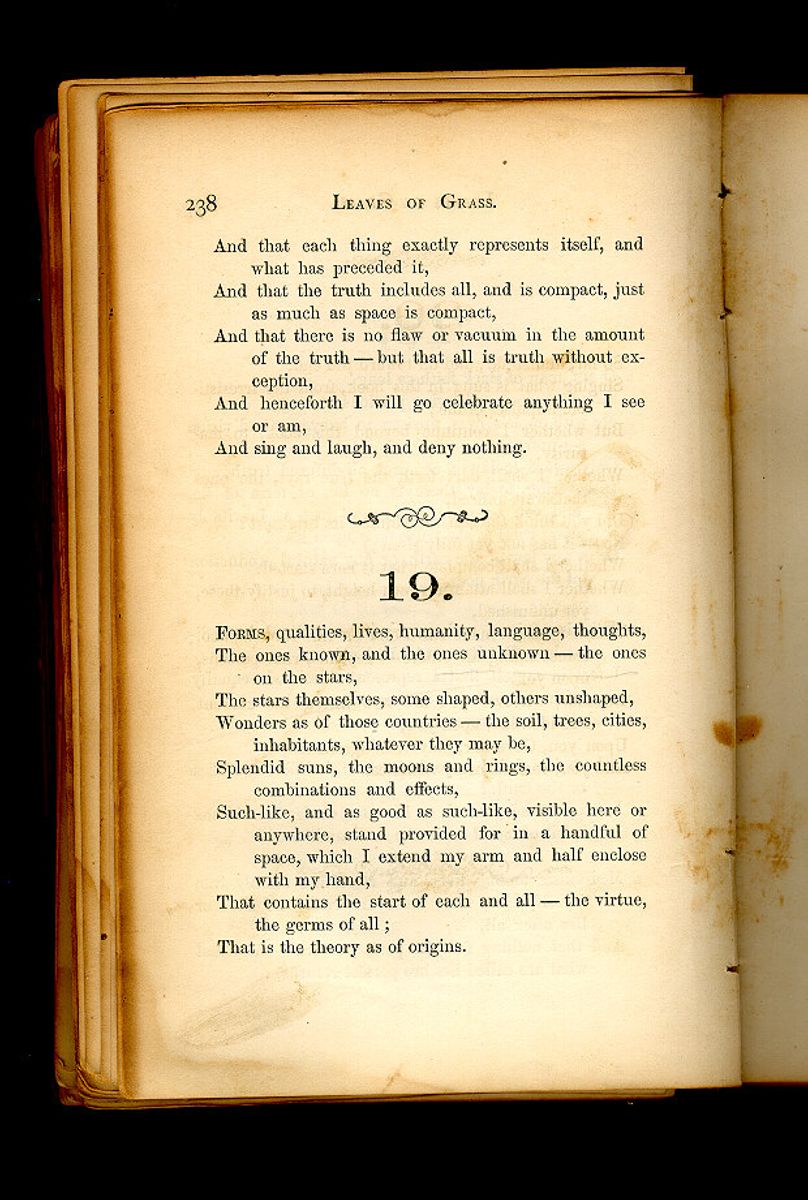 ppp.01500.246.jpg
And that each thing exactly represents itself, and
ppp.01500.246.jpg
And that each thing exactly represents itself, and what has preceded it, And that the truth includes all, and is compact, just
as much as space is compact, And that there is no flaw or vacuum in the amount
of the truth—but that all is truth without ex-
ception, And henceforth I will go celebrate anything I see
or am, And sing and laugh, and deny nothing.
19.
FORMS, qualities, lives, humanity, language, thoughts, The ones known, and the ones unknown—the oneson the stars, The stars themselves, some shaped, others unshaped, Wonders as of those countries—the soil, trees, cities,
inhabitants, whatever they may be, Splendid suns, the moons and rings, the countless
combinations and effects, Such-like, and as good as such-like, visible here or
anywhere, stand provided for in a handful of
space, which I extend my arm and half enclose
with my hand, That contains the start of each and all—the virtue,
the germs of all; That is the theory as of origins. [ begin page 239 ]
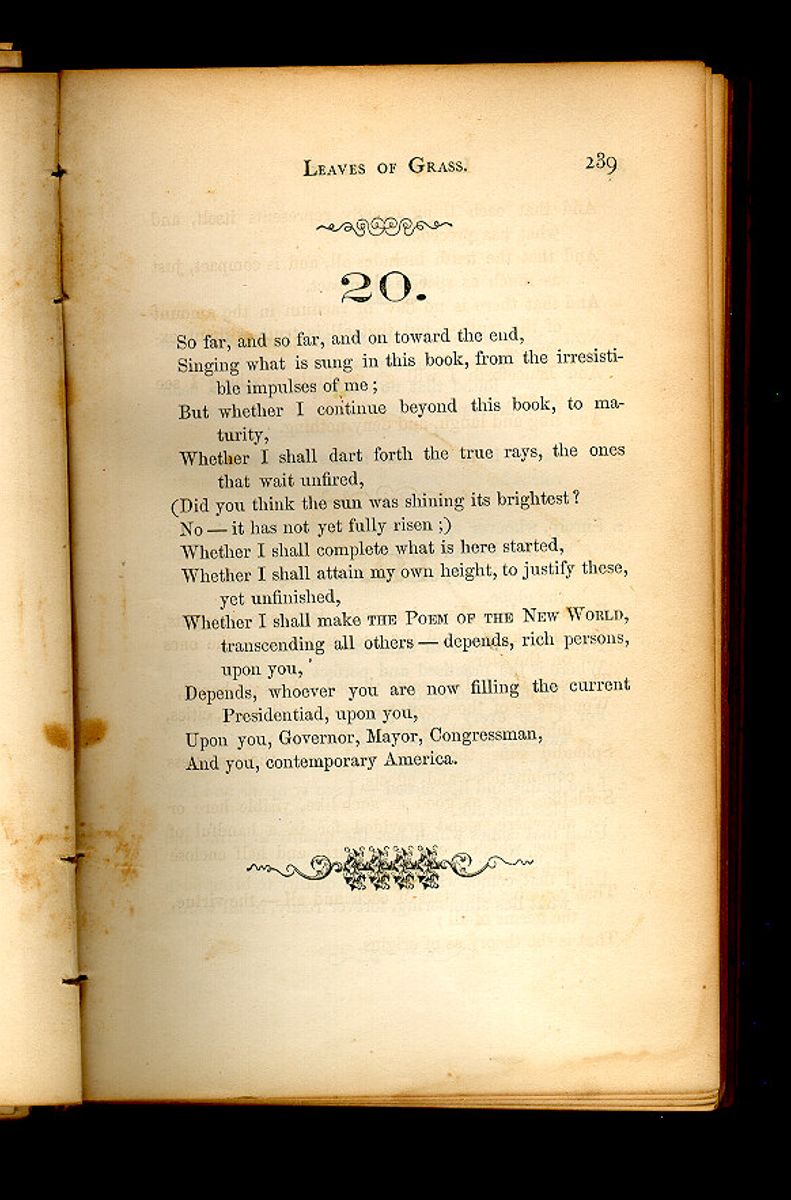 ppp.01500.247.jpg
20.
SO far, and so far, and on toward the end, Singing what is sung in this book, from the irresisti-ble impulses of me; But whether I continue beyond this book, to ma-
turity, Whether I shall dart forth the true rays, the ones
that wait unfired, (Did you think the sun was shining its brightest? No—it has not yet fully risen ;) Whether I shall complete what is here started, Whether I shall attain my own height, to justify these,
yet unfinished, Whether I shall make THE POEM OF THE NEW WORLD,
transcending all others—depends, rich persons,
upon you, Depends, whoever you are now filling the current Presidentiad, upon you, Upon you, Governor, Mayor, Congressman, And you, contemporary America. [ begin page 240 ]
 ppp.01500.248.jpg
21.
1NOW I make a leaf of Voices—for I have found noth-ing mightier than they are, And I have found that no word spoken, but is beau-
tiful, in its place. 2O what is it in me that makes me tremble so at
voices? 3Surely, whoever speaks to me in the right voice, him
or her I shall follow, as the waters follow the
moon, silently, with fluid steps, any where around
the globe. 4Now I believe that all waits for the right voices; Where is the practised and perfect organ? Where is
the developed Soul? For I see every word uttered thence has deeper,
sweeter, new sounds, impossible on less terms. 5I see brains and lips closed—I see tympans and tem-
ples unstruck, Until that comes which has the quality to strike and
to unclose, Until that comes which has the quality to bring forth
what lies slumbering, forever ready, in all words. [ begin page 241 ]
 ppp.01500.249.jpg
22.
1WHAT am I, after all, but a child, pleased with thesound of my own name? repeating it over and
over, I cannot tell why it affects me so much, when I hear
it from women's voices, and from men's voices,
or from my own voice, I stand apart to hear—it never tires me. 2To you, your name also, Did you think there was nothing but two or three
pronunciations in the sound of your name?
23.
LOCATIONS and times—what is it in me that meetsthem all, whenever and wherever, and makes me
at home? Forms, colors, densities, odors—what is it in me that
corresponds with them? What is the relation between me and them? 21 [ begin page 242 ]
 ppp.01500.250.jpg
24.
LIFT me close to your face till I whisper, What you are holding is in reality no book, nor partof a book, It is a man, flushed and full-blooded—it is I—So
long! We must separate—Here! take from my lips this
kiss, Whoever you are, I give it especially to you; So long—and I hope we shall meet again. [ begin page 243 ]
 ppp.01500.251.jpg
Salut au Monde!
1O TAKE my hand, Walt Whitman! Such gliding wonders! Such sights and sounds! Such joined unended links, each hooked to the next! Each answering all—each sharing the earth with all. 2What widens within you, Walt Whitman? What waves and soils exuding? What climes? What persons and lands are here? Who are the infants? Some playing, some slum-bering? Who are the girls? Who are the married women? Who are the three old men going slowly with their
arms about each others' necks? What rivers are these? What forests and fruits are
these? What are the mountains called that rise so high in
the mists? What myriads of dwellings are they, filled with
dwellers? 3Within me latitude widens, longitude lengthens, Asia, Africa, Europe, are to the east—America is
provided for in the west, [ begin page 244 ]
 ppp.01500.252.jpg
Banding the bulge of the earth winds the hot equator,
Curiously north and south turn the axis-ends;
Within me is the longest day—the sun wheels in
ppp.01500.252.jpg
Banding the bulge of the earth winds the hot equator,
Curiously north and south turn the axis-ends;
Within me is the longest day—the sun wheels in slanting rings—it does not set for months, Stretched in due time within me the midnight sun
just rises above the horizon, and sinks again, Within me zones, seas, cataracts, plains, volcanoes,
groups, Oceanica, Australasia, Polynesia, and the great West
Indian islands. 4What do you hear, Walt Whitman? 5I hear the workman singing, and the farmer's wife
singing, I hear in the distance the sounds of children, and of
animals early in the day, I hear quick rifle-cracks from the riflemen of East
Tennessee and Kentucky, hunting on hills, I hear emulous shouts of Australians, pursuing the
wild horse, I hear the Spanish dance, with castanets, in the chest-
nut shade, to the rebeck and guitar, I hear continual echoes from the Thames, I hear fierce French liberty songs, I hear of the Italian boat-sculler the musical recitative
of old poems, I hear the Virginia plantation chorus of negroes, of
a harvest night, in the glare of pine knots, I hear the strong baritone of the 'long-shore-men of
Manhatta, I hear the stevedores unlading the cargoes, and
singing, [ begin page 245 ]
 ppp.01500.253.jpg
I hear the screams of the water-fowl of solitary north-
ppp.01500.253.jpg
I hear the screams of the water-fowl of solitary north- west lakes, I hear the rustling pattering of locusts, as they strike
the grain and grass with the showers of their
terrible clouds, I hear the Coptic refrain, toward sundown, pensively
falling on the breast of the black venerable vast
mother, the Nile, I hear the bugles of raft-tenders on the streams of
Kanada, I hear the chirp of the Mexican muleteer, and the
bells of the mule, I hear the Arab muezzin, calling from the top of the
mosque, I hear Christian priests at the altars of their churches
—I hear the responsive base and soprano, I hear the wail of utter despair of the white-haired
Irish grand-parents, when they learn the death
of their grand-son, I hear the cry of the Cossack, and the sailor's voice,
putting to sea at Okotsk, I hear the wheeze of the slave-coffle, as the slaves
march on—as the husky gangs pass on by twos
and threes, fastened together with wrist-chains
and ankle-chains, I hear the entreaties of women tied up for punishment
—I hear the sibilant whisk of thongs through
the air; I hear the Hebrew reading his records and psalms, I hear the rhythmic myths of the Greeks, and the
strong legends of the Romans, I hear the tale of the divine life and bloody death
of the beautiful God, the Christ, 21* [ begin page 246 ]
 ppp.01500.254.jpg
I hear the Hindoo teaching his favorite pupil the
ppp.01500.254.jpg
I hear the Hindoo teaching his favorite pupil the loves, wars, adages, transmitted safely to this
day from poets who wrote three thousand years
ago. 6What do you see, Walt Whitman? Who are they who salute, and that one after another
salute you? 7I see a great round wonder rolling through the air, I see diminute farms, hamlets, ruins, grave-yards, jails,
factories, palaces, hovels, huts of barbarians, tents
of nomads, upon the surface, I see the shaded part on one side, where the sleepers
are sleeping—and the sun-lit part on the other
side, I see the curious silent change of the light and shade, I see distant lands, as real and near to the inhabitants
of them, as my land is to me. 8I see plenteous waters, I see mountain peaks—I see the sierras of Andes and
Alleghanies, where they range, I see plainly the Himmalehs, Chian Shahs, Altays,
Gauts, I see the Rocky Mountains, and the Peak of Winds, I see the Styrian Alps, and the Karnac Alps, I see the Pyrenees, Balks, Carpathians—and to the
north the Dofrafields, and off at sea Mount Hecla, I see Vesuvius and Etna—I see the Anahuacs, I see the Mountains of the Moon, and the Snow Moun-
tains, and the Red Mountains of Madagascar, I see the Vermont hills, and the long string of Cor-
dilleras; [ begin page 247 ]
 ppp.01500.255.jpg
I see the vast deserts of Western America,
I see the Libyan, Arabian, and Asiatic deserts;
I see huge dreadful Arctic and Antarctic icebergs,
I see the superior oceans and the inferior ones—the
ppp.01500.255.jpg
I see the vast deserts of Western America,
I see the Libyan, Arabian, and Asiatic deserts;
I see huge dreadful Arctic and Antarctic icebergs,
I see the superior oceans and the inferior ones—the Atlantic and Pacific, the sea of Mexico, the Bra-
zilian sea, and the sea of Peru, The Japan waters, those of Hindostan, the China Sea,
and the Gulf of Guinea, The spread of the Baltic, Caspian, Bothnia, the British
shores, and the Bay of Biscay, The clear-sunned Mediterranean, and from one to an-
other of its islands, The inland fresh-tasted seas of North America, The White Sea, and the sea around Greenland. 9I behold the mariners of the world, Some are in storms—some in the night, with the
watch on the look-out, Some drifting helplessly—some with contagious dis-
eases. 10I behold the steam-ships of the world, Some double the Cape of Storms—some Cape Verde
—others Cape Guardafui, Bon, or Bajadore, Others Dondra Head—others pass the Straits of Sun-
da—others Cape Lopatka—others Behring's
Straits, Others Cape Horn—others the Gulf of Mexico, or
along Cuba or Hayti—others Hudson's Bay or
Baffin's Bay, Others pass the Straits of Dover—others enter the
Wash—others the Firth of Solway—others round
Cape Clear—others the Land's End, [ begin page 248 ]
 ppp.01500.256.jpg
Others traverse the Zuyder Zee, or the Scheld,
Others add to the exits and entrances at Sandy Hook,
Others to the comers and goers at Gibraltar, or the
ppp.01500.256.jpg
Others traverse the Zuyder Zee, or the Scheld,
Others add to the exits and entrances at Sandy Hook,
Others to the comers and goers at Gibraltar, or the Dardanelles, Others sternly push their way through the northern
winter-packs, Others descend or ascend the Obi or the Lena, Others the Niger or the Congo—others the Indus,
the Burampooter and Cambodia, Others wait at the wharves of Manahatta, steamed up,
ready to start, Wait, swift and swarthy, in the ports of Australia, Wait at Liverpool, Glasgow, Dublin, Marseilles, Lis-
bon, Naples, Hamburg, Bremen, Bourdeaux, the
Hague, Copenhagen, Wait at Valparaiso, Rio Janeiro, Panama, Wait at their moorings at Boston, Philadelphia, Balti-
more, Charleston, New Orleans, Galveston, San
Francisco. 11I see the tracks of the rail-roads of the earth, I see them welding State to State, city to city, through
North America; I see them in Great Britain, I see them in Europe, I see them in Asia and in Africa. 12I see the electric telegraphs of the earth, I see the filaments of the news of the wars, deaths,
losses, gains, passions, of my race. 13I see the long river-stripes of the earth, I see where the Mississippi flows—I see where the.
Columbia flows, [ begin page 249 ]
 ppp.01500.257.jpg
I see the Great River, and the Falls of Niagara,
I see the Amazon and the Paraguay,
I see the four great rivers of China, the Amour, the
ppp.01500.257.jpg
I see the Great River, and the Falls of Niagara,
I see the Amazon and the Paraguay,
I see the four great rivers of China, the Amour, the Yellow River, the Yiang-tse, and the Pearl; I see where the Seine flows, and where the Loire, the
Rhone, and the Guadalquiver flow, I see the windings of the Volga, the Dnieper, the
Oder, I see the Tuscan going down the Arno, and the Vene-
tian along the Po, I see the Greek seaman sailing out of Egina bay. 14I see the site of the old empire of Assyria, and that
of Persia, and that of India, I see the falling of the Ganges over the high rim of
Saukara. 15I see the place of the idea of the Deity incarnated by
avatars in human forms, I see the spots of the successions of priests on the earth
—oracles, sacrificers, brahmins, sabians, lamas,
monks, muftis, exhorters; I see where druids walked the groves of Mona—I see
the mistletoe and vervain, I see the temples of the deaths of the bodies of Gods—
I see the old signifiers. 16I see Christ once more eating the bread of his last sup-
per, in the midst of youths and old persons, I see where the strong divine young man, the Hercules,
toiled faithfully and long, and then died, I see the place of the innocent rich life and hapless
fate of the beautiful nocturnal son, the full-limbed
Bacchus, [ begin page 250 ]
 ppp.01500.258.jpg
I see Kneph, blooming, dressed in blue, with the crown
ppp.01500.258.jpg
I see Kneph, blooming, dressed in blue, with the crown of feathers on his head, I see Hermes, unsuspected, dying, well-beloved, saying
to the people, Do not weep for me, This is not my true country, I have lived banished from
my true country—I now go back there, I return to the celestial sphere, where every one goes
in his turn. 17I see the battle-fields of the earth—grass grows upon
them, and blossoms and corn, I see the tracks of ancient and modern expeditions. 18I see the nameless masonries, venerable messages of
the unknown events, heroes, records of the earth. 19I see the places of the sagas, I see pine-trees and fir-trees torn by northern blasts, I see granite boulders and cliffs—I see green meadows
and lakes, I see the burial-cairns of Scandinavian warriors, I see them raised high with stones, by the marge of
restless oceans, that the dead men's spirits, when
they wearied of their quiet graves, might rise up
through the mounds, and gaze on the tossing
billows, and be refreshed by storms, immensity,
liberty, action. 20I see the steppes of Asia, I see the tumuli of Mongolia—I see the tents of Kal-
mucks and Baskirs, I see the nomadic tribes, with herds of oxen and cows, I see the table-lands notched with ravines—I see the
jungles and deserts, [ begin page 251 ]
 ppp.01500.259.jpg
I see the camel, the wild steed, the bustard, the fat-
ppp.01500.259.jpg
I see the camel, the wild steed, the bustard, the fat- tailed sheep, the antelope, and the burrowing
wolf. 21I see the high-lands of Abyssinia, I see flocks of goats feeding, and see the fig-tree,
tamarind, date, And see fields of teff-wheat, and see the places of
verdure and gold. 22I see the Brazilian vaquero, I see the Bolivian ascending Mount Sorata, I see the Wacho crossing the plains—I see the
incomparable rider of horses with his lasso on
his arm, I see over the pampas the pursuit of wild cattle for
their hides. 23I see little and large sea-dots, some inhabited, some
uninhabited; I see two boats with nets, lying off the shore of Pau-
manok, quite still, I see ten fishermen waiting—they discover now a
thick school of mossbonkers—they drop the
joined seine-ends in the water, The boats separate—they diverge and row off, each
on its rounding course to the beach, enclosing
the mossbonkers, The net is drawn in by a windlass by those who stop
ashore, Some of the fishermen lounge in the boats—others
stand negligently ankle-deep in the water, poised
on strong legs, [ begin page 252 ]
 ppp.01500.260.jpg
The boats are partly drawn up—the water slaps
ppp.01500.260.jpg
The boats are partly drawn up—the water slaps against them, On the sand, in heaps and winrows, well out from the
water, lie the green-backed spotted mossbonkers. 24I see the despondent red man in the west, lingering
about the banks of Moingo, and about Lake
Pepin, He has heard the quail and beheld the honey-bee, and
sadly prepared to depart. 25I see the regions of snow and ice, I see the sharp-eyed Samoiede and the Finn, I see the seal-seeker in his boat, poising his lance, I see the Siberian on his slight-built sledge, drawn by
dogs, I see the porpoise-hunters—I see the whale-crews of
the South Pacific and the North Atlantic, I see the cliffs, glaciers, torrents, valleys, of Switzer-
land—I mark the long winters, and the
isolation. 26I see the cities of the earth, and make myself at ran-
dom a part of them, I am a real Parisian, I am a habitan of Vienna, St. Petersburg, Berlin,
Constantinople, I am of Adelaide, Sidney, Melbourne, I am of London, Manchester, Bristol, Edinburgh,
Limerick, I am of Madrid, Cadiz, Barcelona, Oporto, Lyons,
Brussels, Berne, Frankfort, Stuttgart, Turin,
Florence, [ begin page 253 ]
 ppp.01500.261.jpg
I belong in Moscow, Cracow, Warsaw—or northward
ppp.01500.261.jpg
I belong in Moscow, Cracow, Warsaw—or northward in Christiania or Stockholm—or in Siberian
Irkutsk—or in some street in Iceland; I descend upon all those cities, and rise from them
again. 27I see vapors exhaling from unexplored countries, I see the savage types, the bow and arrow, the
poisoned splint, the fetish, and the obi. 28I see African and Asiatic towns, I see Algiers, Tripoli, Derne, Mogadore, Timbuctoo,
Monrovia, I see the swarms of Pekin, Canton, Benares, Delhi,
Calcutta, Yedo, I see the Kruman in his hut, and the Dahoman and
Ashantee-man in their huts, I see the Turk smoking opium in Aleppo, I see the picturesque crowds at the fairs of Khiva, and
those of Herat, I see Teheran—I see Muscat and Medina, and the
intervening sands—I see the caravans toiling
onward; I see Egypt and the Egyptians—I see the pyramids
and obelisks, I look on chiselled histories, songs, philosophies, cut
in slabs of sand-stone, or on granite blocks, I see at Memphis mummy-pits, containing mummies,
embalmed, swathed in linen cloth, lying there
many centuries, I look on the fall'n Theban, the large-ball'd eyes, the
side-drooping neck, the hands folded across the
breast. 22 [ begin page 254 ]
 ppp.01500.262.jpg
29I see the menials of the earth, laboring,
I see the prisoners in the prisons,
I see the defective human bodies of the earth,
I see the blind, the deaf and dumb, idiots, hunch-
ppp.01500.262.jpg
29I see the menials of the earth, laboring,
I see the prisoners in the prisons,
I see the defective human bodies of the earth,
I see the blind, the deaf and dumb, idiots, hunch- backs, lunatics, I see the pirates, thieves, betrayers, murderers, slave-
makers of the earth, I see the helpless infants, and the helpless old men
and women. 30I see male and female everywhere, I see the serene brotherhood of philosophs, I see the constructiveness of my race, I see the results of the perseverance and industry of
my race, I see ranks, colors, barbarisms, civilizations—I go
among them—I mix indiscriminately, And I salute all the inhabitants of the earth. 31You, where you are! You daughter or son of England! You of the mighty Slavic tribes and empires! you
Russ in Russia! You dim-descended, black, divine-souled African,
large, fine-headed, nobly-formed, superbly des-
tined, on equal terms with me! You Norwegian! Swede! Dane! Icelander! you
Prussian! You Spaniard of Spain! you Portuguese! You Frenchwoman and Frenchman of France! You Belge! you liberty-lover of the Netherlands! You sturdy Austrian! you Lombard! Hun! Bohe-
mian! farmer of Styria! [ begin page 255 ]
 ppp.01500.263.jpg
You neighbor of the Danube!
You working-man of the Rhine, the Elbe, or the
ppp.01500.263.jpg
You neighbor of the Danube!
You working-man of the Rhine, the Elbe, or the Weser! you working-woman too! You Sardinian! you Bavarian! you Swabian! Saxon!
Wallachian! Bulgarian! You citizen of Prague! you Roman! Neapolitan!
Greek! You lithe matador in the arena at Seville! You mountaineer living lawlessly on the Taurus or
Caucasus! You Bokh horse-herd, watching your mares and stal-
lions feeding! You beautiful-bodied Persian, at full speed in the
saddle, shooting arrows to the mark! You Chinaman and Chinawoman of China! you Tar-
tar of Tartary! You women of the earth subordinated at your tasks! You Jew journeying in your old age through every
risk, to stand once on Syrian ground! You other Jews waiting in all lands for your Messiah! You thoughtful Armenian, pondering by some stream
of the Euphrates! you peering amid the ruins of
Nineveh! you ascending Mount Ararat! You foot-worn pilgrim welcoming the far-away sparkle
of the minarets of Mecca! You sheiks along the stretch from Suez to Babel-
mandel, ruling your families and tribes! You olive-grower tending your fruit on fields of Naz-
areth, Damascus, or Lake Tiberias! You Thibet trader on the wide inland, or bargaining
in the shops of Lassa! You Japanese man or woman! you liver in Madagas-
car, Ceylon, Sumatra, Borneo! [ begin page 256 ]
 ppp.01500.264.jpg
All you continentals of Asia, Africa, Europe, Aus-
ppp.01500.264.jpg
All you continentals of Asia, Africa, Europe, Aus- tralia, indifferent of place! All you on the numberless islands of the archipelagoes
of the sea! And you of centuries hence, when you listen to me! And you, each and everywhere, whom I specify not,
but include just the same! Health to you! Good will to you all—from me and
America sent, For we acknowledge you all and each. 31Each of us inevitable, Each of us limitless—each of us with his or her
right upon the earth, Each of us allowed the eternal purport of the earth, Each of us here as divinely as any is here. 32You Hottentot with clicking palate! You woolly-haired hordes! you white or black owners
of slaves! You owned persons, dropping sweat-drops or blood-
drops! You human forms with the fathomless ever-impressive
countenances of brutes! You poor koboo whom the meanest of the rest look
down upon, for all your glimmering language
and spirituality! You low expiring aborigines of the hills of Utah,
Oregon, California! You dwarfed Kamtschatkan, Greenlander, Lapp! You Austral negro, naked, red, sooty, with protrusive
lip, grovelling, seeking your food! You Caffre, Berber, Soudanese! [ begin page 257 ]
 ppp.01500.265.jpg
You haggard, uncouth, untutored Bedowee!
You plague-swarms in Madras, Nankin, Kaubul,
ppp.01500.265.jpg
You haggard, uncouth, untutored Bedowee!
You plague-swarms in Madras, Nankin, Kaubul, Cairo! You bather bathing in the Ganges! You benighted roamer of Amazonia! you Patagonian!
you Fegee-man! You peon of Mexico! you Russian serf! you slave of
Carolina, Texas, Tennessee! I do not prefer others so very much before you either, I do not say one word against you, away back there,
where you stand, (You will come forward in due time to my side.) 33My spirit has passed in compassion and determination
around the whole earth, I have looked for equals and lovers, and found them
ready for me in all lands; I think some divine rapport has equalized me with
them. 34O vapors! I think I have risen with you, and moved
away to distant continents, and fallen down
there, for reasons, I think I have blown with you, O winds, O waters, I have fingered every shore with you. 35I have run through what any river or strait of the
globe has run through, I have taken my stand on the bases of peninsulas, and
on the highest embedded rocks, to cry thence. 36 Salut au Monde! What cities the light or warmth penetrates, I pen-
etrate those cities myself, 22* [ begin page 258 ]
 ppp.01500.266.jpg
All islands to which birds wing their way, I wing my
ppp.01500.266.jpg
All islands to which birds wing their way, I wing my way myself. 37Toward all, I raise high the perpendicular hand—I make the
signal, To remain after me in sight forever, For all the haunts and homes of men. [ begin page 259 ]
 ppp.01500.267.jpg
POEM OF JOYS.
1O TO make a most jubilant poem! O full of music! Full of manhood, womanhood,infancy! O full of common employments! Full of grain and
trees. 2O for the voices of animals! O for the swiftness and
balance of fishes! O for the dropping of rain-drops in a poem! O for the sunshine and motion of waves in a poem. 3O to be on the sea! the wind, the wide waters
around; O to sail in a ship under full sail at sea. 4O the joy of my spirit! It is uncaged! It darts like
lightning! It is not enough to have this globe, or a certain time
—I will have thousands of globes, and all time. 5O the engineer's joys! To go with a locomotive! [ begin page 260 ]
 ppp.01500.268.jpg
To hear the hiss of steam—the merry shriek—the
ppp.01500.268.jpg
To hear the hiss of steam—the merry shriek—the steam-whistle—the laughing locomotive! To push with resistless way, and speed off in the
distance. 6O the horseman's and horsewoman's joys! The saddle—the gallop—the pressure upon the seat
—the cool gurgling by the ears and hair. 7O the fireman's joys! I hear the alarm at dead of night, I hear bells—shouts!—I pass the crowd—I run! The sight of the flames maddens me with pleasure. 8O the joy of the strong-brawned fighter, towering
in the arena, in perfect condition, conscious of
power, thirsting to meet his opponent. 9O the joy of that vast elemental sympathy which only
the human Soul is capable of generating and
emitting in steady and limitless floods. 10O the mother's joys! The watching—the endurance—the precious love—
the anguish—the patiently yielded life. 11O the joy of increase, growth, recuperation, The joy of soothing and pacifying—the joy of
concord and harmony. 12O to go back to the place where I was born! O to hear the birds sing once more! To ramble about the house and barn, and over the
fields, once more, [ begin page 261 ]
 ppp.01500.269.jpg
And through the orchard and along the old lanes
ppp.01500.269.jpg
And through the orchard and along the old lanes once more. 13O male and female! O the presence of women! (I swear, nothing is more
exquisite to me than the presence of women;) O for the girl, my mate! O for happiness with my
mate! O the young man as I pass! O I am sick after the
friendship of him who, I fear, is indifferent
to me. 14O the streets of cities! The flitting faces—the expressions, eyes, feet, cos-
tumes! O I cannot tell how welcome they are
to me; O of men—of women toward me as I pass—The
memory of only one look—the boy lingering
and waiting. 15O to have been brought up on bays, lagoons, creeks,
or along the coast! O to continue and be employed there all my life! O the briny and damp smell—the shore—the salt
weeds exposed at low water, The work of fishermen—the work of the eel-fisher
and clam-fisher. 16O it is I! I come with my clam-rake and spade! I come with
my eel-spear; Is the tide out? I join the group of clam-diggers on
the flats, [ begin page 262 ]
 ppp.01500.270.jpg
I laugh and work with them—I joke at my work,
ppp.01500.270.jpg
I laugh and work with them—I joke at my work, like a mettlesome young man. 17In winter I take my eel-basket and eel-spear and travel
out on foot on the ice—I have a small axe to cut
holes in the ice; Behold me, well-clothed, going gayly, or returning in
the afternoon—my brood of tough boys accom-
panying me, My brood of grown and part-grown boys, who love
to be with none else so well as they love to be
with me, By day to work with me, and by night to sleep with
me. 18Or, another time, in warm weather, out in a boat, to
lift the lobster-pots, where they are sunk with
heavy stones, (I know the buoys;) O the sweetness of the Fifth Month morning upon the
water, as I row, just before sunrise, toward the
buoys; I pull the wicker pots up slantingly—the dark green
lobsters are desperate with their claws, as I take
them out—I insert wooden pegs in the joints of
their pincers, I go to all the places, one after another, and then row
back to the shore, There, in a huge kettle of boiling water, the lobsters
shall be boiled till their color becomes scarlet. 19Or, another time, mackerel-taking, Voracious, mad for the hook, near the surface, they
seem to fill the water for miles; [ begin page 263 ]
 ppp.01500.271.jpg
Or, another time, fishing for rock-fish in Chesapeake
ppp.01500.271.jpg
Or, another time, fishing for rock-fish in Chesapeake Bay—I one of the brown-faced crew; Or, another time, trailing for blue-fish off Paumanok,
I stand with braced body, My left foot is on the gunwale—my right arm throws
the coils of slender rope, In sight around me the quick veering and darting of
fifty skiffs, my companions. 20O boating on the rivers! The voyage down the Niagara, (the St. Lawrence,)—
the superb scenery—the steamers, The ships sailing—the Thousand Islands—the occa-
sional timber-raft, and the raftsmen with long-
reaching sweep-oars, The little huts on the rafts, and the stream of smoke
when they cook supper at evening. 21O something pernicious and dread! Something far away from a puny and pious life! Something unproved! Something in a trance! Something escaped from the anchorage, and driving
free. 22O to work in mines, or forging iron! Foundry casting—the foundry itself—the rude high
roof—the ample and shadowed space, The furnace—the hot liquid poured out and running. 23O the joys of the soldier! To feel the presence of a brave general! to feel his
sympathy! To behold his calmness! to be warmed in the rays of
his smile! [ begin page 264 ]
 ppp.01500.272.jpg
To go to battle! to hear the bugles play, and the drums
ppp.01500.272.jpg
To go to battle! to hear the bugles play, and the drums beat! To hear the artillery! to see the glittering of the bay-
onets and musket-barrels in the sun! To see men fall and die and not complain! To taste the savage taste of blood! to be so devilish! To gloat so over the wounds and deaths of the enemy. 24O the whaleman's joys! O I cruise my old cruise
again! I feel the ship's motion under me—I feel the Atlantic
breezes fanning me, I hear the cry again sent down from the mast-head,
There she blows, Again I spring up the rigging, to look with the rest—
We see—we descend, wild with excitement, I leap in the lowered boat—We row toward our prey,
where he lies, We approach, stealthy and silent—I see the moun-
tainous mass, lethargic, basking, I see the harpooner standing up—I see the weapon
dart from his vigorous arm; O swift, again, now, far out in the ocean, the wounded
whale, settling, running to windward, tows me, Again I see him rise to breathe—We row close
again, I see a lance driven through his side, pressed deep,
turned in the wound, Again we back off—I see him settle again—the life
is leaving him fast, As he rises, he spouts blood—I see him swim in cir-
cles narrower and narrower, swiftly cutting the
water—I see him die, [ begin page 265 ]
 ppp.01500.273.jpg
He gives one convulsive leap in the centre of the cir-
ppp.01500.273.jpg
He gives one convulsive leap in the centre of the cir- cle, and then falls flat and still in the bloody
foam. 25O the old manhood of me, my joy! My children and grand-children—my white hair and
beard, My largeness, calmness, majesty, out of the long
stretch of my life. 26O the ripened joy of womanhood! O perfect happiness at last! I am more than eighty years of age—my hair, too, is
pure white—I am the most venerable mother; How clear is my mind! how all people draw nigh to
me! What attractions are these, beyond any before? what
bloom, more than the bloom of youth? What beauty is this that descends upon me, and rises
out of me? 27O the joy of my Soul leaning poised on itself—receiv-
ing identity through materials, and loving them
—observing characters, and absorbing them; O my Soul, vibrated back to me, from them—from
facts, sight, hearing, touch, my phrenology,
reason, articulation, comparison, memory, and
the like; O the real life of my senses and flesh, transcending
my senses and flesh; O my body, done with materials—my sight, done
with my material eyes; O what is proved to me this day, beyond cavil, that it
is not my material eyes which finally see, 23 [ begin page 266 ]
 ppp.01500.274.jpg
Nor my material body which finally loves, walks,
ppp.01500.274.jpg
Nor my material body which finally loves, walks, laughs, shouts, embraces, procreates. 28O the farmer's joys! Ohioan's, Illinoisian's, Wisconsinese', Kanadian's, Io-
wan's, Kansian's, Missourian's, Oregonese' joys, To rise at peep of day, and pass forth nimbly to work, To plough land in the fall for winter-sown crops, To plough land in the spring for maize, To train orchards—to graft the trees—to gather
apples in the fall. 29O the pleasure with trees! The orchard—the forest—the oak, cedar, pine,
pekan-tree, The honey-locust, black-walnut, cottonwood, and mag-
nolia. 30O Death! O the beautiful touch of Death, soothing and benumb-
ing a few moments, for reasons; O that of myself, discharging my excrementitious
body, to be burned, or rendered to powder, or
buried, My real body doubtless left to me for other spheres, My voided body, nothing more to me, returning to the
purifications, further offices, eternal uses of the
earth. 31O to bathe in the swimming-bath, or in a good place
along shore! To splash the water! to walk ankle-deep; to race
naked along the shore. [ begin page 267 ]
 ppp.01500.275.jpg
32O to realize space!
The plenteousness of all—that there are no bounds;
To emerge, and be of the sky—of the sun and moon,
ppp.01500.275.jpg
32O to realize space!
The plenteousness of all—that there are no bounds;
To emerge, and be of the sky—of the sun and moon, and the flying clouds, as one with them. 33O, while I live, to be the ruler of life—not a slave, To meet life as a powerful conqueror, No fumes—no ennui—no more complaints or scorn-
ful criticisms. 34O me repellent and ugly! O to these proud laws of the air, the water, and
the ground, proving my interior Soul impreg-
nable, And nothing exterior shall ever take command of me. 35O to attract by more than attraction! How it is I know not—yet behold! the something
which obeys none of the rest, It is offensive, never defensive—yet how magnetic
it draws. 36O the joy of suffering! To struggle against great odds! to meet enemies un-
daunted! To be entirely alone with them! to find how much I
can stand! To look strife, torture, prison, popular odium, death,
face to face! To mount the scaffold! to advance to the muzzles of
guns with perfect nonchalance! To be indeed a God! [ begin page 268 ]
 ppp.01500.276.jpg
37O the gleesome saunter over fields and hill-sides!
The leaves and flowers of the commonest weeds—the
ppp.01500.276.jpg
37O the gleesome saunter over fields and hill-sides!
The leaves and flowers of the commonest weeds—the moist fresh stillness of the woods, The exquisite smell of the earth at day-break, and all
through the forenoon. 38O love-branches! love-root! love-apples! O chaste and electric torrents! O mad-sweet drops. 39O the orator's joys! To inflate the chest—to roll the thunder of the voice
out from the ribs and throat, To make the people rage, weep, hate, desire, with
yourself, To lead America—to quell America with a great
tongue. 40O the joy of a manly self-hood! Personality—to be servile to none—to defer to none
—not to any tyrant, known or unknown, To walk with erect carriage, a step springy and
elastic, To look with calm gaze, or with a flashing eye, To speak with a full and sonorous voice, out of a
broad chest, To confront with your personality all the other per-
sonalities of the earth. 41O to have my life henceforth my poem of joys! To dance, clap hands, exult, shout, skip, leap, roll on,
float on, An athlete—full of rich words—full of joys. [ begin page 269 ]
 ppp.01500.277.jpg
A WORD OUT OF THE SEA.
OUT of the rocked cradle, Out of the mocking-bird's throat, the musical shuttle, Out of the boy's mother's womb, and from the nipplesof her breasts, Out of the Ninth Month midnight, Over the sterile sands, and the fields beyond, where
the child, leaving his bed, wandered alone, bare-
headed, barefoot, Down from the showered halo, Up from the mystic play of shadows, twining and
twisting as if they were alive, Out from the patches of briers and blackberries, From the memories of the bird that chanted to me, From your memories, sad brother—from the fitful
risings and fallings I heard, From under that yellow half-moon, late-risen, and
swollen as if with tears, From those beginning notes of sickness and love,
there in the transparent mist, From the thousand responses of my heart, never to
cease, 23* [ begin page 270 ]
 ppp.01500.278.jpg
From the myriad thence-aroused words,
From the word stronger and more delicious than any,
From such, as now they start, the scene revisiting,
As a flock, twittering, rising, or overhead passing,
Borne hither—ere all eludes me, hurriedly,
A man—yet by these tears a little boy again,
Throwing myself on the sand, confronting the waves,
I, chanter of pains and joys, uniter of here and here-
ppp.01500.278.jpg
From the myriad thence-aroused words,
From the word stronger and more delicious than any,
From such, as now they start, the scene revisiting,
As a flock, twittering, rising, or overhead passing,
Borne hither—ere all eludes me, hurriedly,
A man—yet by these tears a little boy again,
Throwing myself on the sand, confronting the waves,
I, chanter of pains and joys, uniter of here and here- after, Taking all hints to use them—but swiftly leaping
beyond them, A reminiscence sing.
REMINISCENCE.
1ONCE, Paumanok, When the snows had melted, and the Fifth Monthgrass was growing, Up this sea-shore, in some briers, Two guests from Alabama—two together, And their nest, and four light-green eggs, spotted with
brown, And every day the he-bird, to and fro, near at hand, And every day the she-bird, crouched on her nest,
silent, with bright eyes, And every day I, a curious boy, never too close, never
disturbing them, Cautiously peering, absorbing, translating. 2 Shine! Shine! Pour down your warmth, great Sun! While we bask—we two together. [ begin page 271 ]
 ppp.01500.279.jpg
3
Two together!
Winds blow South, or winds blow North,
Day come white, or night come black,
Home, or rivers and mountains from home,
Singing all time, minding no time,
If we two but keep together.
4Till of a sudden,
May-be killed, unknown to her mate,
One forenoon the she-bird crouched not on the nest,
Nor returned that afternoon, nor the next,
Nor ever appeared again.
5And thenceforward, all summer, in the sound of the
ppp.01500.279.jpg
3
Two together!
Winds blow South, or winds blow North,
Day come white, or night come black,
Home, or rivers and mountains from home,
Singing all time, minding no time,
If we two but keep together.
4Till of a sudden,
May-be killed, unknown to her mate,
One forenoon the she-bird crouched not on the nest,
Nor returned that afternoon, nor the next,
Nor ever appeared again.
5And thenceforward, all summer, in the sound of the sea, And at night, under the full of the moon, in calmer
weather, Over the hoarse surging of the sea, Or flitting from brier to brier by day, I saw, I heard at intervals, the remaining one, the
he-bird, The solitary guest from Alabama. 6 Blow! Blow! Blow up sea-winds along Paumanok's shore; I wait and I wait, till you blow my mate to me. 7Yes, when the stars glistened, All night long, on the prong of a moss-scallop'd stake, Down, almost amid the slapping waves, Sat the lone singer, wonderful, causing tears. 8He called on his mate, He poured forth the meanings which I, of all men,
know. [ begin page 272 ]
 ppp.01500.280.jpg
9Yes, my brother, I know,
The rest might not—but I have treasured every note,
For once, and more than once, dimly, down to the
ppp.01500.280.jpg
9Yes, my brother, I know,
The rest might not—but I have treasured every note,
For once, and more than once, dimly, down to the beach gliding, Silent, avoiding the moonbeams, blending myself with
the shadows, Recalling now the obscure shapes, the echoes, the
sounds and sights after their sorts, The white arms out in the breakers tirelessly tossing, I, with bare feet, a child, the wind wafting my hair, Listened long and long. 10Listened, to keep, to sing—now translating the
notes, Following you, my brother. 11 Soothe! Soothe! Close on its wave soothes the wave behind, And again another behind, embracing and lapping,
every one close, But my love soothes not me. 12 Low hangs the moon—it rose late, O it is lagging—O I think it is heavy with love. 13 O madly the sea pushes upon the land, With love—with love. 14 O night! O do I not see my love fluttering out there among the
breakers? What is that little black thing I see there in the
white? [ begin page 273 ]
 ppp.01500.281.jpg
15
Loud! Loud!
Loud I call to you my love!
High and clear I shoot my voice over the waves,
Surely you must know who is here,
You must know who I am, my love.
16
Low-hanging moon!
What is that dusky spot in your brown yellow?
O it is the shape of my mate!
O moon, do not keep her from me any longer.
17
Land! O land!
Whichever way I turn, O I think you could give me
ppp.01500.281.jpg
15
Loud! Loud!
Loud I call to you my love!
High and clear I shoot my voice over the waves,
Surely you must know who is here,
You must know who I am, my love.
16
Low-hanging moon!
What is that dusky spot in your brown yellow?
O it is the shape of my mate!
O moon, do not keep her from me any longer.
17
Land! O land!
Whichever way I turn, O I think you could give me
my mate back again, if you would, For I am almost sure I see her dimly whichever way
I look. 18 O rising stars! Perhaps the one I want so much will rise with some
of you. 19 O throat! Sound clearer through the atmosphere! Pierce the woods, the earth, Somewhere listening to catch you must be the one I
want. 20 Shake out, carols! Solitary here—the night's carols! Carols of lonesome love! Death's carols! Carols under that lagging, yellow, waning moon! O, under that moon, where she droops almost down
into the sea! O reckless, despairing carols. [ begin page 274 ]
 ppp.01500.282.jpg
21
But soft!
Sink low — soft!
Soft! Let me just murmur,
And do you wait a moment, you husky-noised sea,
For somewhere I believe I heard my mate responding
ppp.01500.282.jpg
21
But soft!
Sink low — soft!
Soft! Let me just murmur,
And do you wait a moment, you husky-noised sea,
For somewhere I believe I heard my mate responding
to me, So faint—I must be still to listen, But not altogether still, for then she might not come
immediately to me. 22 Hither, my love! Here I am! Here! With this just-sustained note I announce myself to
you, This gentle call is for you, my love. 23 Do not be decoyed elsewhere! That is the whistle of the wind—it is not my voice, That is the fluttering of the spray, Those are the shadows of leaves. 24 O darkness! O in vain! O I am very sick and sorrowful. 25 O brown halo in the sky, near the moon, drooping
upon the sea! O troubled reflection in the sea! O throat! O throbbing heart! O all—and I singing uselessly all the night. 26 Murmur! Murmur on! O murmurs—you yourselves make me continue to
sing, I know not why. [ begin page 275 ]
 ppp.01500.283.jpg
27
O past! O joy!
In the air—in the woods—over fields,
Loved! Loved! Loved! Loved! Loved!
Loved—but no more with me,
We two together no more.
28The aria sinking,
All else continuing—the stars shining,
The winds blowing—the notes of the wondrous bird
ppp.01500.283.jpg
27
O past! O joy!
In the air—in the woods—over fields,
Loved! Loved! Loved! Loved! Loved!
Loved—but no more with me,
We two together no more.
28The aria sinking,
All else continuing—the stars shining,
The winds blowing—the notes of the wondrous bird echoing, With angry moans the fierce old mother yet, as ever,
incessantly moaning, On the sands of Paumanok's shore gray and rustling, The yellow half-moon, enlarged, sagging down, droop-
ing, the face of the sea almost touching, The boy extatic—with his bare feet the waves, with
his hair the atmosphere dallying, The love in the heart pent, now loose, now at last
tumultuously bursting, The aria's meaning, the ears, the Soul, swiftly depos-
iting, The strange tears down the cheeks coursing, The colloquy there—the trio—each uttering, The undertone—the savage old mother, incessantly
crying, To the boy's Soul's questions sullenly timing—some
drowned secret hissing, To the outsetting bard of love. 29Bird! (then said the boy's Soul,) Is it indeed toward your mate you sing? or is it
mostly to me? For I that was a child, my tongue's use sleeping, Now that I have heard you, [ begin page 276 ]
 ppp.01500.284.jpg
Now in a moment I know what I am for—I awake,
And already a thousand singers—a thousand songs,
ppp.01500.284.jpg
Now in a moment I know what I am for—I awake,
And already a thousand singers—a thousand songs, clearer, louder, more sorrowful than yours, A thousand warbling echoes have started to life
within me, Never to die. 30O throes! O you demon, singing by yourself—projecting me, O solitary me, listening—never more shall I cease
imitating, perpetuating you, Never more shall I escape, Never more shall the reverberations, Never more the cries of unsatisfied love be absent
from me, Never again leave me to be the peaceful child I was
before what there, in the night, By the sea, under the yellow and sagging moon, The dusky demon aroused—the fire, the sweet hell
within, The unknown want, the destiny of me. 31O give me some clew! O if I am to have so much, let me have more! O a word! O what is my destination? O I fear it is henceforth chaos! O how joys, dreads, convolutions, human shapes, and
all shapes, spring as from graves around me! O phantoms! you cover all the land, and all the sea! O I cannot see in the dimness whether you smile or
frown upon me; O vapor, a look, a word! O well-beloved! O you dear women's and men's phantoms! [ begin page 277 ]
 ppp.01500.285.jpg
32A word then, (for I will conquer it,)
The word final, superior to all,
Subtle, sent up—what is it?—I listen;
Are you whispering it, and have been all the time,
ppp.01500.285.jpg
32A word then, (for I will conquer it,)
The word final, superior to all,
Subtle, sent up—what is it?—I listen;
Are you whispering it, and have been all the time, you sea-waves? Is that it from your liquid rims and wet sands? 33Answering, the sea, Delaying not, hurrying not, Whispered me through the night, and very plainly
before daybreak, Lisped to me constantly the low and delicious word
DEATH, And again Death—ever Death, Death, Death, Hissing melodious, neither like the bird, nor like my
aroused child's heart, But edging near, as privately for me, rustling at
my feet, And creeping thence steadily up to my ears, Death, Death, Death, Death, Death. 34Which I do not forget, But fuse the song of two together, That was sung to me in the moonlight on Paumanok's
gray beach, With the thousand responsive songs, at random, My own songs, awaked from that hour, And with them the key, the word up from the waves, The word of the sweetest song, and all songs, That strong and delicious word which, creeping to
my feet, The sea whispered me. 24 [ begin page 278 ]
 ppp.01500.286.jpg
LEAF OF FACES.
1SAUNTERING the pavement, or riding the country by-road, here then are faces! Faces of friendship, precision, caution, suavity, ide-
ality, The spiritual prescient face—the always welcome,
common, benevolent face, The face of the singing of music—the grand faces of
natural lawyers and judges, broad at the back-
top, The faces of hunters and fishers, bulged at the brows
—the shaved blanched faces of orthodox citizens, The pure, extravagant, yearning, questioning artist's
face, The ugly face of some beautiful Soul, the handsome
detested or despised face, The sacred faces of infants, the illuminated face of the
mother of many children, The face of an amour, the face of veneration, The face as of a dream, the face of an immobile rock, The face withdrawn of its good and bad, a castrated
face, A wild hawk, his wings clipped by the clipper, A stallion that yielded at last to the thongs and knife
of the gelder. [ begin page 279 ]
 ppp.01500.287.jpg
2Sauntering the pavement, or crossing the ceaseless
ppp.01500.287.jpg
2Sauntering the pavement, or crossing the ceaseless ferry, here then are faces, I see them and complain not, and am content with
all. 3Do you suppose I could be content with all; if I
thought them their own finale? 4This now is too lamentable a face for a man, Some abject louse, asking leave to be—cringing for it, Some milk-nosed maggot, blessing what lets it wrig to
its hole. 5This face is a dog's snout sniffling for garbage; Snakes nest in that mouth—I hear the sibilant threat. 6This face is a haze more chill than the arctic sea, Its sleepy and wobbling icebergs crunch as they go. 7This is a face of bitter herbs—this an emetic—they
need no label, And more of the drug-shelf, laudanum, caoutchouc,
or hog's-lard. 8This face is an epilepsy, its wordless tongue gives out
the unearthly cry, Its veins down the neck distend, its eyes roll till they
show nothing but their whites, Its teeth grit, the palms of the hands are cut by the
turned-in nails, The man falls struggling and foaming to the ground
while he speculates well. 9This face is bitten by vermin and worms, And this is some murderer's knife with a half-pulled
scabbard. [ begin page 280 ]
 ppp.01500.288.jpg
10This face owes to the sexton his dismalest fee,
In unceasing death-bell tolls there.
11Those then are really men—the bosses and tufts of
ppp.01500.288.jpg
10This face owes to the sexton his dismalest fee,
In unceasing death-bell tolls there.
11Those then are really men—the bosses and tufts of the great round globe! 12Features of my equals, would you trick me with your
creased and cadaverous march? Well, you cannot trick me. 13I see your rounded never-erased flow, I see neath the rims of your haggard and mean dis-
guises. 14Splay and twist as you like—poke with the tangling
fores of fishes or rats, You'll be unmuzzled, you certainly will. 15I saw the face of the most smeared and slobbering
idiot they had at the asylum, And I knew for my consolation what they knew not, And I knew of the agents that emptied and broke my
brother, The same wait to clear the rubbish from the fallen
tenement, And I shall look again in a score or two of ages, And I shall meet the real landlord, perfect and un-
harmed, every inch as good as myself. 16The Lord advances, and yet advances, Always the shadow in front—always the reached
hand bringing up the laggards. 17Out of this face emerge banners and horses—O
superb! I see what is coming, [ begin page 281 ]
 ppp.01500.289.jpg
I see the high pioneer-caps—I see the staves of
ppp.01500.289.jpg
I see the high pioneer-caps—I see the staves of runners clearing the way, I hear victorious drums. 18This face is a life-boat, This is the face commanding and bearded, it asks no
odds of the rest, This face is flavored fruit, ready for eating, This face of a healthy honest boy is the programme of
all good. 19These faces bear testimony slumbering or awake, They show their descent from the Master himself. 20Off the word I have spoken I except not one—red,
white, black, are all deific, In each house is the ovum—it comes forth after a
thousand years. 21Spots or cracks at the windows do not disturb me, Tall and sufficient stand behind, and make signs to
me, I read the promise, and patiently wait. 22This is a full-grown lily's face, She speaks to the limber-hipp'd man near the garden
pickets, Come here, she blushingly cries—Come nigh to me,
limber-hipp'd man, and give me your finger and
thumb, Stand at my side till I lean as high as I can upon you, Fill me with albescent honey, bend down to me, Rub to me with your chafing beard, rub to my breast
and shoulders. 24* [ begin page 282 ]
 ppp.01500.290.jpg
23The old face of the mother of many children!
Whist! I am fully content.
24Lulled and late is the smoke of the First Day
ppp.01500.290.jpg
23The old face of the mother of many children!
Whist! I am fully content.
24Lulled and late is the smoke of the First Day morning, It hangs low over the rows of trees by the fences, It hangs thin by the sassafras, the wild-cherry, and
the cat-brier under them. 25I saw the rich ladies in full dress at the soiree, I heard what the singers were singing so long, Heard who sprang in crimson youth from the white
froth and the water-blue. 26Behold a woman! She looks out from her quaker cap—her face is
clearer and more beautiful than the sky. 27She sits in an arm-chair, under the shaded porch of
the farm-house, The sun just shines on her old white head. 28Her ample gown is of cream-hued linen, Her grand-sons raised the flax, and her grand-
daughters spun it with the distaff and the
wheel. 29The melodious character of the earth, The finish beyond which philosophy cannot go, and
does not wish to go, The justified mother of men. [ begin page 283 ]
 ppp.01500.291.jpg
EUROPE, The 72d and 73d Years of These States.
1SUDDENLY out of its stale and drowsy lair, the lair ofslaves, Like lightning it le'pt forth, half startled at itself, Its feet upon the ashes and the rags—its hands tight
to the throats of kings. 2O hope and faith! O aching close of exiled patriots' lives! O many a sickened heart! Turn back unto this day, and make yourselves
afresh. 3And you, paid to defile the People! you liars, mark! Not for numberless agonies, murders, lusts, For court thieving in its manifold mean forms, worm-
ing from his simplicity the poor man's wages, For many a promise sworn by royal lips, and broken,
and laughed at in the breaking, Then in their power, not for all these did the blows
strike revenge, or the heads of the nobles fall; The People scorned the ferocity of kings. 4But the sweetness of mercy brewed bitter destruction,
and the frightened rulers come back, [ begin page 284 ]
 ppp.01500.292.jpg
Each comes in state with his train—hangman, priest,
ppp.01500.292.jpg
Each comes in state with his train—hangman, priest, tax-gatherer, Soldier, lawyer, lords, jailers, and sycophants. 5Yet behind all, hovering, stealing—lo, a Shape, Vague as the night, draped interminably, head front
and form, in scarlet folds, Whose face and eyes none may see, Out of its robes only this—the red robes, lifted by
the arm, One finger crook'd, pointed high over the top, like
the head of a snake appears. 6Meanwhile, corpses lie in new-made graves—bloody
corpses of young men; The rope of the gibbet hangs heavily, the bullets of
princes are flying, the creatures of power laugh
aloud, And all these things bear fruits—and they are good. 7Those corpses of young men, Those martyrs that hang from the gibbets—those
hearts pierced by the gray lead, Cold and motionless as they seem, live elsewhere with
unslaughter'd vitality. 8They live in other young men, O kings! They live in brothers, again ready to defy you! They were purified by death—they were taught and
exalted. 9Not a grave of the murdered for freedom, but grows
seed for freedom, in its turn to bear seed, Which the winds carry afar and re-sow, and the rains
and the snows nourish. [ begin page 285 ]
 ppp.01500.293.jpg
10Not a disembodied spirit can the weapons of tyrants
ppp.01500.293.jpg
10Not a disembodied spirit can the weapons of tyrants let loose, But it stalks invisibly over the earth, whispering,
counselling, cautioning. 11Liberty! let others despair of you! I never despair
of you. 12Is the house shut? Is the master away? Nevertheless be ready—be not weary of watching, He will soon return—his messengers come anon. [ begin page 286 ]
 ppp.01500.294.jpg
THOUGHT.
OF Public Opinion, Of a calm and cool fiat, sooner or later, (How im-passive! How certain and final!) Of the President with pale face asking secretly to
himself, What will the people say at last? Of the frivolous Judge—Of the corrupt Congressman,
Governor, Mayor—Of such as these, standing
helpless and exposed; Of the mumbling and screaming priest—(soon, soon
deserted;) Of the lessening, year by year, of venerableness, and
of the dicta of officers, statutes, pulpits, schools, Of the rising forever taller and stronger and broader,
of the intuitions of men and women, and of self-
esteem, and of personality; Of the New World—Of the Democracies, resplendent,
en-masse, Of the conformity of politics, armies, navies, to them
and to me, Of the shining sun by them—Of the inherent light,
greater than the rest, Of the envelopment of all by them, and of the effusion
of all from them. [ begin page 287 ]
 ppp.01500.295.jpg
Enfans d'Adam.
1.
TO the garden, the world, anew ascending, Potent mates, daughters, sons, preluding, The love, the life of their bodies, meaning and being, Curious, here behold my resurrection, after slumber, The revolving cycles, in their wide sweep, havingbrought me again, Amorous, mature—all beautiful to me—all won-
drous, My limbs, and the quivering fire that ever plays through them, for reasons, most wondrous; Existing, I peer and penetrate still, Content with the present—content with the past, By my side, or back of me, Eve following, Or in front, and I following her just the same. [ begin page 288 ]
 ppp.01500.296.jpg
2.
FROM that of myself, without which I were nothing, From what I am determined to make illustrious, evenif I stand sole among men, From my own voice resonant—singing the phallus, Singing the song of procreation, Singing the need of superb children, and therein
superb grown people, Singing the muscular urge and the blending, Singing the bedfellow's song, (O resistless yearning! O for any and each, the body correlative attracting! O for you, whoever you are, your correlative body!
O it, more than all else, you delighting!) From the pent up rivers of myself, From the hungry gnaw that eats me night and day, From native moments—from bashful pains—sing-
ing them, Singing something yet unfound, though I have dili-
gently sought it, ten thousand years, Singing the true song of the Soul, fitful, at random, Singing what, to the Soul, entirely redeemed her, the
faithful one, the prostitute, who detained me when
I went to the city, Singing the song of prostitutes; Renascent with grossest Nature, or among animals, Of that—of them, and what goes with them, my
poems informing, Of the smell of apples and lemons—of the pairing
of birds, Of the wet of woods—of the lapping of waves, [ begin page 289 ]
 ppp.01500.297.jpg
Of the mad pushes of waves upon the land—I them
ppp.01500.297.jpg
Of the mad pushes of waves upon the land—I them chanting, The overture lightly sounding—the strain antici-
pating, The welcome nearness—the sight of the perfect
body, The swimmer swimming naked in the bath, or mo-
tionless on his back lying and floating, The female form approaching—I, pensive, love-flesh
tremulous, aching; The slave's body for sale—I, sternly, with harsh
voice, auctioneering, The divine list, for myself or you, or for any one,
making, The face—the limbs—the index from head to foot,
and what it arouses, The mystic deliria—the madness amorous—the utter
abandonment, (Hark, close and still, what I now whisper to you, I love you—O you entirely possess me, O I wish that you and I escape from the rest, and go
utterly off—O free and lawless, Two hawks in the air—two fishes swimming in the
sea not more lawless than we;) The furious storm through me careering—I passion-
ately trembling, The oath of the inseparableness of two together—of
the woman that loves me, and whom I love more
than my life—That oath swearing, (O I willingly stake all, for you! O let me be lost, if it must be so! O you and I—what is it to us what the rest do or
think? 25 [ begin page 290 ]
 ppp.01500.298.jpg
What is all else to us? only that we enjoy each other,
ppp.01500.298.jpg
What is all else to us? only that we enjoy each other, and exhaust each other, if it must be so;) From the master—the pilot I yield the vessel to, The general commanding me, commanding all—from
him permission taking, From time the programme hastening, (I have loitered
too long, as it is;) From sex—From the warp and from the woof, (To talk to the perfect girl who understands me—the
girl of The States, To waft to her these from my own lips—to effuse
them from my own body;) From privacy—From frequent repinings alone, From plenty of persons near, and yet the right person
not near, From the soft sliding of hands over me, and thrusting
of fingers through my hair and beard, From the long-sustained kiss upon the mouth or
bosom, From the close pressure that makes me or any man
drunk, fainting with excess, From what the divine husband knows—from the
work of fatherhood, From exultation, victory, and relief—from the bed-
fellow's embrace in the night, From the act-poems of eyes, hands, hips, and bosoms, From the cling of the trembling arm, From the bending curve and the clinch, From side by side, the pliant coverlid off throwing, From the one so unwilling to have me leave—and
me just as unwilling to leave, (Yet a moment, O tender waiter, and I return,) From the hour of shining stars and dropping dews, [ begin page 291 ]
 ppp.01500.299.jpg
From the night, a moment, I, emerging, flitting out,
Celebrate you, enfans prepared for,
And you, stalwart loins.
ppp.01500.299.jpg
From the night, a moment, I, emerging, flitting out,
Celebrate you, enfans prepared for,
And you, stalwart loins.
3.
1O MY children! O mates! O the bodies of you, and of all men and women,engirth me, and I engirth them, O they will not let me off, nor I them, till I go with
them, respond to them, And respond to the contact of them, and discorrupt
them, and charge them with the charge of the
Soul. 2Was it doubted if those who corrupt their own bodies
conceal themselves? And if those who defile the living are as bad as they
who defile the dead? And if the body does not do as much as the Soul? And if the body were not the Soul, what is the Soul? 3The love of the body of man or woman balks account
—the body itself balks account, That of the male is perfect, and that of the female is
perfect. 4The expression of the face balks account, But the expression of a well made man appears not
only in his face, [ begin page 292 ]
 ppp.01500.300.jpg
It is in his limbs and joints also, it is curiously in the
ppp.01500.300.jpg
It is in his limbs and joints also, it is curiously in the joints of his hips and wrists, It is in his walk, the carriage of his neck, the flex
of his waist and knees—dress does not hide
him, The strong, sweet, supple quality he has, strikes
through the cotton and flannel, To see him pass conveys as much as the best poem,
perhaps more, You linger to see his back, and the back of his neck
and shoulder-side. 5The sprawl and fulness of babes, the bosoms and
heads of women, the folds of their dress, their
style as we pass in the street, the contour of their
shape downwards, The swimmer naked in the swimming bath, seen as
he swims through the transparent green-shine, or
lies with his face up, and rolls silently to and fro
in the heave of the water, The bending forward and backward of rowers in row-
boats—the horseman in his saddle, Girls, mothers, house-keepers, in all their perform-
ances, The group of laborers seated at noon-time with their
open dinner-kettles, and their wives waiting, The female soothing a child—the farmer's daughter
in the garden or cow-yard, The young fellow hoeing corn—the sleigh-driver
guiding his six horses through the crowd, The wrestle of wrestlers, two apprentice-boys, quite
grown, lusty, good-natured, native-born, out on
the vacant lot at sun-down, after work, [ begin page 293 ]
 ppp.01500.301.jpg
The coats and caps thrown down, the embrace of love
ppp.01500.301.jpg
The coats and caps thrown down, the embrace of love and resistance, The upper-hold and under-hold, the hair rumpled
over and blinding the eyes; The march of firemen in their own costumes, the
play of masculine muscle through clean-setting
trousers and waist-straps, The slow return from the fire, the pause when the
bell strikes suddenly again, and the listening on
the alert, The natural, perfect, varied attitudes—the bent head,
the curved neck, and the counting, Such-like I love—I loosen myself, pass freely, am at
the mother's breast with the little child, Swim with the swimmers, wrestle with wrestlers,
march in line with the firemen, and pause, listen,
and count. 6I knew a man, He was a common farmer—he was the father of five
sons, And in them were the fathers of sons—and in them
were the fathers of sons. 7This man was of wonderful vigor, calmness, beauty
of person, The shape of his head, the richness and breadth of
his manners, the pale yellow and white of his
hair and beard, and the immeasurable meaning
of his black eyes, These I used to go and visit him to see—he was wise
also, 25* [ begin page 294 ]
 ppp.01500.302.jpg
He was six feet tall, he was over eighty years old—
ppp.01500.302.jpg
He was six feet tall, he was over eighty years old— his sons were massive, clean, bearded, tan-faced,
handsome, They and his daughters loved him—all who saw him
loved him, They did not love him by allowance—they loved him
with personal love; He drank water only—the blood showed like scarlet
through the clear-brown skin of his face, He was a frequent gunner and fisher—he sailed
his boat himself—he had a fine one presented
to him by a ship-joiner—he had fowling-
pieces, presented to him by men that loved
him; When he went with his five sons and many grand-
sons to hunt or fish, you would pick him out
as the most beautiful and vigorous of the
gang, You would wish long and long to be with him—you
would wish to sit by him in the boat, that you
and he might touch each other. 8I have perceived that to be with those I like is
enough, To stop in company with the rest at evening is
enough, To be surrounded by beautiful, curious, breathing,
laughing flesh is enough, To pass among them, or touch any one, or rest my
arm ever so lightly round his or her neck for a
moment—what is this, then? I do not ask any more delight—I swim in it, as in
a sea. [ begin page 295 ]
 ppp.01500.303.jpg
9There is something in staying close to men and
ppp.01500.303.jpg
9There is something in staying close to men and women, and looking on them, and in the contact
and odor of them, that pleases the Soul well, All things please the Soul—but these please the
Soul well. 10This is the female form, A divine nimbus exhales from it from head to foot, It attracts with fierce undeniable attraction, I am drawn by its breath as if I were no more than
a helpless vapor—all falls aside but myself
and it, Books, art, religion, time, the visible and solid earth,
the atmosphere and the clouds, and what was
expected of heaven or feared of hell, are now
consumed, Mad filaments, ungovernable shoots play out of it, the
response likewise ungovernable, Hair, bosom, hips, bend of legs, negligent falling
hands, all diffused—mine too diffused, Ebb stung by the flow, and flow stung by the ebb—
love-flesh swelling and deliciously aching, Limitless limpid jets of love hot and enormous,
quivering jelly of love, white-blow and delirious
juice, Bridegroom-night of love, working surely and softly
into the prostrate dawn, Undulating into the willing and yielding day, Lost in the cleave of the clasping and sweet-fleshed
day. 11This is the nucleus—after the child is born of
woman, the man is born of woman, [ begin page 296 ]
 ppp.01500.304.jpg
This is the bath of birth—this is the merge of small
ppp.01500.304.jpg
This is the bath of birth—this is the merge of small and large, and the outlet again. 12Be not ashamed, women—your privilege encloses
the rest, and is the exit of the rest, You are the gates of the body, and you are the gates
of the Soul. 13The female contains all qualities, and tempers them
—she is in her place, and moves with perfect
balance, She is all things duly veiled—she is both passive and
active, She is to conceive daughters as well as sons, and sons
as well as daughters. 14As I see my Soul reflected in nature, As I see through a mist, one with inexpressible com-
pleteness and beauty, See the bent head and arms folded over the breast—
the female I see. 15The male is not less the Soul, nor more—he too is in
his place, He too is all qualities—he is action and power, The flush of the known universe is in him, Scorn becomes him well, and appetite and defiance
become him well, The wildest largest passions, bliss that is utmost,
sorrow that is utmost, become him well—pride
is for him, The full-spread pride of man is calming and excellent
to the Soul; [ begin page 297 ]
 ppp.01500.305.jpg
Knowledge becomes him—he likes it always—he
ppp.01500.305.jpg
Knowledge becomes him—he likes it always—he brings everything to the test of himself, Whatever the survey, whatever the sea and the sail,
he strikes soundings at last only here, Where else does he strike soundings, except here? 16The man's body is sacred, and the woman's body is
sacred, No matter who it is, it is sacred; Is it a slave? Is it one of the dull-faced immigrants
just landed on the wharf? Each belongs here or anywhere just as much as the
well-off—just as much as you, Each has his or her place in the procession. 17All is a procession, The universe is a procession, with measured and
beautiful motion. 18Do you know so much yourself, that you call the slave
or the dull-face ignorant? Do you suppose you have a right to a good sight, and
he or she has no right to a sight? Do you think matter has cohered together from its
diffused float—and the soil is on the surface,
and water runs, and vegetation sprouts, For you only, and not for him and her? 19A man's body at auction! I help the auctioneer—the sloven does not half know
his business. 20Gentlemen, look on this wonder! Whatever the bids of the bidders, they cannot be high
enough for it, [ begin page 298 ]
 ppp.01500.306.jpg
For it the globe lay preparing quintillions of years,
ppp.01500.306.jpg
For it the globe lay preparing quintillions of years, without one animal or plant, For it the revolving cycles truly and steadily rolled. 21In this head the all-baffling brain, In it and below it, the making of the attributes of
heroes. 22Examine these limbs, red, black, or white—they are
so cunning in tendon and nerve, They shall be stript, that you may see them. 23Exquisite senses, life-lit eyes, pluck, volition, Flakes of breast-muscle, pliant back-bone and neck,
flesh not flabby, good-sized arms and legs, And wonders within there yet. 24Within there runs blood, The same old blood! The same red-running blood! There swells and jets a heart—there all passions,
desires, reachings, aspirations, Do you think they are not there because they are not
expressed in parlors and lecture-rooms? 25This is not only one man—this is the father of those
who shall be fathers in their turns, In him the start of populous states and rich republics, Of him countless immortal lives, with countless em-
bodiments and enjoyments. 26How do you know who shall come from the offspring
of his offspring through the centuries? [ begin page 299 ]
 ppp.01500.307.jpg
Who might you find you have come from yourself, if
ppp.01500.307.jpg
Who might you find you have come from yourself, if you could trace back through the centuries? 27A woman's body at auction! She too is not only herself—she is the teeming
mother of mothers, She is the bearer of them that shall grow and be
mates to the mothers. 28Her daughters, or their daughters' daughters—who
knows who shall mate with them? Who knows through the centuries what heroes may
come from them? 29In them, and of them, natal love—in them that
divine mystery, the same old beautiful mystery. 30Have you ever loved the body of a woman? Have you ever loved the body of a man? Your father—where is your father? Your mother—is she living? have you been much
with her? and has she been much with you? Do you not see that these are exactly the same to all,
in all nations and times, all over the earth? 31If any thing is sacred, the human body is sacred, And the glory and sweet of a man, is the token of
manhood untainted, And in man or woman, a clean, strong, firm-fibred
body, is beautiful as the most beautiful face. 32Have you seen the fool that corrupted his own live
body? or the fool that corrupted her own live
body? [ begin page 300 ]
 ppp.01500.308.jpg
For they do not conceal themselves, and cannot con-
ppp.01500.308.jpg
For they do not conceal themselves, and cannot con- ceal themselves. 33O my body! I dare not desert the likes of you in
other men and women, nor the likes of the parts
of you; I believe the likes of you are to stand or fall with the
likes of the Soul, (and that they are the Soul,)
I believe the likes of you shall stand or fall with my
poems—and that they are poems, Man's, woman's, child's, youth's, wife's, husband's,
mother's, father's, young man's, young woman's
poems, Head, neck, hair, ears, drop and tympan of the ears, Eyes, eye-fringes, iris of the eye, eye-brows, and the
waking or sleeping of the lids, Mouth, tongue, lips, teeth, roof of the mouth, jaws,
and the jaw-hinges, Nose, nostrils of the nose, and the partition, Cheeks, temples, forehead, chin, throat, back of the
neck, neck-slue, Strong shoulders, manly beard, scapula, hind-shoul-
ders, and the ample side-round of the chest, Upper-arm, arm-pit, elbow-socket, lower-arm, arm-
sinews, arm-bones, Wrist and wrist-joints, hand, palm, knuckles, thumb,
fore-finger, finger-balls, finger-joints, finger-nails, Broad breast-front, curling hair of the breast, breast-
bone, breast-side, Ribs, belly, back-bone, joints of the back-bone, Hips, hip-sockets, hip-strength, inward and outward
round, man-balls, man-root, Strong set of thighs, well carrying the trunk above, [ begin page 301 ]
 ppp.01500.309.jpg
Leg-fibres, knee, knee-pan, upper-leg, under-leg,
Ankles, instep, foot-ball, toes, toe-joints, the heel,
All attitudes, all the shapeliness, all the belongings of
ppp.01500.309.jpg
Leg-fibres, knee, knee-pan, upper-leg, under-leg,
Ankles, instep, foot-ball, toes, toe-joints, the heel,
All attitudes, all the shapeliness, all the belongings of my or your body, or of any one's body, male or
female, The lung-sponges, the stomach-sac, the bowels sweet
and clean, The brain in its folds inside the skull-frame, Sympathies, heart-valves, palate-valves, sexuality, ma-
ternity, Womanhood, and all that is a woman—and the man
that comes from woman, The womb, the teats, nipples, breast-milk, tears, laugh-
ter, weeping, love-looks, love-perturbations and
risings, The voice, articulation, language, whispering, shout-
ing aloud, Food, drink, pulse, digestion, sweat, sleep, walking,
swimming, Poise on the hips, leaping, reclining, embracing, arm-
curving, and tightening, The continual changes of the flex of the mouth, and
around the eyes, The skin, the sun-burnt shade, freckles, hair, The curious sympathy one feels, when feeling with
the hand the naked meat of his own body, or
another person's body, The circling rivers, the breath, and breathing it in
and out, The beauty of the waist, and thence of the hips, and
thence downward toward the knees, The thin red jellies within you, or within me—the
bones, and the marrow in the bones, 26 [ begin page 302 ]
 ppp.01500.310.jpg
The exquisite realization of health,
O I say now these are not the parts and poems of the
ppp.01500.310.jpg
The exquisite realization of health,
O I say now these are not the parts and poems of the body only, but of the Soul, O I say these are the Soul!
4.
1A WOMAN waits for me—she contains all, nothing islacking, Yet all were lacking, if sex were lacking, or if the
moisture of the right man were lacking. 2Sex contains all, Bodies, Souls, meanings, proofs, purities, delicacies,
results, promulgations, Songs, commands, health, pride, the maternal mystery,
the semitic milk, All hopes, benefactions, bestowals, All the passions, loves, beauties, delights of the
earth, All the governments, judges, gods, followed persons
of the earth, These are contained in sex, as parts of itself, and jus-
tifications of itself. 3Without shame the man I like knows and avows the
deliciousness of his sex, Without shame the woman I like knows and avows
hers. [ begin page 303 ]
 ppp.01500.311.jpg
4O I will fetch bully breeds of children yet!
I will dismiss myself from impassive women,
I will go stay with her who waits for me, and with
ppp.01500.311.jpg
4O I will fetch bully breeds of children yet!
I will dismiss myself from impassive women,
I will go stay with her who waits for me, and with those women that are warm-blooded and suffi-
cient for me; I see that they understand me, and do not deny me, I see that they are worthy of me—I will be the robust
husband of those women. 5They are not one jot less than I am, They are tanned in the face by shining suns and blow-
ing winds, Their flesh has the old divine suppleness and strength, They know how to swim, row, ride, wrestle, shoot,
run, strike, retreat, advance, resist, defend them-
selves, They are ultimate in their own right—they are calm,
clear, well-possessed of themselves. 6I draw you close to me, you women! I cannot let you go, I would do you good, I am for you, and you are for me, not only for our
own sake, but for others' sakes; Enveloped in you sleep greater heroes and bards, They refuse to awake at the touch of any man but me. 7It is I, you women—I make my way, I am stern, acrid, large, undissuadable—but I love
you, I do not hurt you any more than is necessary for you, I pour the stuff to start sons and daughters fit for These
States—I press with slow rude muscle, I brace myself effectually—I listen to no entreaties, [ begin page 304 ]
 ppp.01500.312.jpg
I dare not withdraw till I deposit what has so long
ppp.01500.312.jpg
I dare not withdraw till I deposit what has so long accumulated within me. 8Through you I drain the pent-up rivers of myself, In you I wrap a thousand onward years, On you I graft the grafts of the best-beloved of me and
of America, The drops I distil upon you shall grow fierce and
athletic girls, new artists, musicians, and singers, The babes I beget upon you are to beget babes in
their turn, I shall demand perfect men and women out of my
love-spendings, I shall expect them to interpenetrate with others, as I
and you interpenetrate now, I shall count on the fruits of the gushing showers of
them, as I count on the fruits of the gushing
showers I give now, I shall look for loving crops from the birth, life, death,
immortality, I plant so lovingly now.
5.
SPONTANEOUS me, Nature, The loving day, the friend I am happy with, The arm of my friend hanging idly over my shoulder, The hill-side whitened with blossoms of the mountainash, The same, late in autumn—the gorgeous hues of red,
yellow, drab, purple, and light and dark green, [ begin page 305 ]
 ppp.01500.313.jpg
The rich coverlid of the grass—animals and birds—
ppp.01500.313.jpg
The rich coverlid of the grass—animals and birds— the private untrimmed bank—the primitive apples
—the pebble-stones, Beautiful dripping fragments—the negligent list of
one after another, as I happen to call them to me,
or think of them, The real poems, (what we call poems being merely
pictures,) The poems of the privacy of the night, and of men
like me, This poem, drooping shy and unseen, that I always
carry, and that all men carry, (Know, once for all, avowed on purpose, wherever are
men like me, are our lusty, lurking, masculine,
poems,) Love-thoughts, love-juice, love-odor, love-yielding, love-
climbers, and the climbing sap, Arms and hands of love—lips of love—phallic thumb
of love—breasts of love—bellies pressed and
glued together with love, Earth of chaste love—life that is only life after
love, The body of my love—the body of the woman I
love—the body of the man—the body of the
earth, Soft forenoon airs that blow from the south-west, The hairy wild-bee that murmurs and hankers up and
down—that gripes the full-grown lady-flower,
curves upon her with amorous firm legs, takes
his will of her, and holds himself tremulous and
tight upon her till he is satisfied, The wet of woods through the early hours, 26* [ begin page 306 ]
 ppp.01500.314.jpg
Two sleepers at night lying close together as they sleep,
ppp.01500.314.jpg
Two sleepers at night lying close together as they sleep, one with an arm slanting down across and below
the waist of the other, The smell of apples, aromas from crushed sage-plant,
mint, birch-bark, The boy's longings, the glow and pressure as he con-
fides to me what he was dreaming, The dead leaf whirling its spiral whirl, and falling still
and content to the ground, The no-formed stings that sights, people, objects, sting
me with, The hubbed sting of myself, stinging me as much as it
ever can any one, The sensitive, orbic, underlapped brothers, that only
privileged feelers may be intimate where they
are, The curious roamer, the hand, roaming all over the
body—the bashful withdrawing of flesh where
the fingers soothingly pause and edge themselves, The limpid liquid within the young man, The vexed corrosion, so pensive and so painful, The torment—the irritable tide that will not be at
rest, The like of the same I feel—the like of the same in
others, The young woman that flushes and flushes, and the
young man that flushes and flushes, The young man that wakes, deep at night, the hot
hand seeking to repress what would master him
—the strange half-welcome pangs, visions, sweats, The pulse pounding through palms and trembling
encircling fingers—the young man all colored,
red, ashamed, angry; [ begin page 307 ]
 ppp.01500.315.jpg
The souse upon me of my lover the sea, as I lie willing
ppp.01500.315.jpg
The souse upon me of my lover the sea, as I lie willing and naked, The merriment of the twin-babes that crawl over the
grass in the sun, the mother never turning her
vigilant eyes from them, The walnut-trunk, the walnut-husks, and the ripening
or ripened long-round walnuts, The continence of vegetables, birds, animals, The consequent meanness of me should I skulk or find
myself indecent, while birds and animals never
once skulk or find themselves indecent, The great chastity of paternity, to match the great
chastity of maternity, The oath of procreation I have sworn—my Adamic
and fresh daughters, The greed that eats me day and night with hungry
gnaw, till I saturate what shall produce boys to
fill my place when I am through, The wholesome relief, repose, content, And this bunch plucked at random from myself, It has done its work—I toss it carelessly to fall
where it may.
6.
1O FURIOUS! O confine me not! (What is this that frees me so in storms? What do my shouts amid lightnings and raging windsmean?) [ begin page 308 ]
 ppp.01500.316.jpg
2O to drink the mystic deliria deeper than any other
ppp.01500.316.jpg
2O to drink the mystic deliria deeper than any other man! O savage and tender achings! (I bequeath them to you, my children, I tell them to you, for reasons, O bridegroom and
bride.) 3O to be yielded to you, whoever you are, and you to
be yielded me, in defiance of the world! (Know, I am a man, attracting, at any time, her I but
look upon, or touch with the tips of my fingers, Or that touches my face, or leans against me.) 4O to return to Paradise! O to draw you to me—to plant on you, for the first
time, the lips of a determined man! O rich and feminine! O to show you to realize the
blood of life for yourself, whoever you are—and
no matter when and where you live. 5O the puzzle—the thrice-tied knot—the deep and
dark pool! O all untied and illumined! O to speed where there is space enough and air
enough at last! O to be absolved from previous follies and degrada-
tions—I from mine, and you from yours! O to find a new unthought-of nonchalance with the
best of nature! O to have the gag removed from one's mouth! O to have the feeling, to-day or any day, I am suffi-
cient as I am! 6O something unproved! something in a trance! O madness amorous! O trembling! [ begin page 309 ]
 ppp.01500.317.jpg
O to escape utterly from others' anchors and holds!
To drive free! to love free! to dash reckless and
ppp.01500.317.jpg
O to escape utterly from others' anchors and holds!
To drive free! to love free! to dash reckless and dangerous! To court destruction with taunts—with invitations! To ascend—to leap to the heavens of the love
indicated to me! To rise thither with my inebriate Soul! To be lost, if it must be so! To feed the remainder of life with one hour of ful-
ness and freedom! With one brief hour of madness and joy.
7.
YOU and I—what the earth is, we are, We two—how long we were fooled! Now delicious, transmuted, swiftly we escape, asNature escapes, We are Nature—long have we been absent, but now
we return, We become plants, leaves, foliage, roots, bark, We are bedded in the ground—we are rocks, We are oaks—we grow in the openings side by side, We browse—we are two among the wild herds,
spontaneous as any, We are two fishes swimming in the sea together, We are what the locust blossoms are—we drop scent around the lanes, mornings and evenings, We are also the coarse smut of beasts, vegetables,
minerals, [ begin page 310 ]
 ppp.01500.318.jpg
We are what the flowing wet of the Tennessee is—
ppp.01500.318.jpg
We are what the flowing wet of the Tennessee is— we are two peaks of the Blue Mountains, rising
up in Virginia, We are two predatory hawks—we soar above and
look down, We are two resplendent suns—we it is who balance
ourselves orbic and stellar—we are as two
comets; We prowl fanged and four-footed in the woods—we
spring on prey; We are two clouds, forenoons and afternoons, driving
overhead, We are seas mingling—we are two of those cheerful
waves, rolling over each other, and interwetting
each other, We are what the atmosphere is, transparent, receptive,
pervious, impervious, We are snow, rain, cold, darkness—we are each
product and influence of the globe, We have circled and circled till we have arrived
home again—we two have, We have voided all but freedom, and all but our
own joy.
8.
NATIVE moments! when you come upon me—Ahyou are here now! Give me now libidinous joys only! Give me the drench of my passions! Give me life
coarse and rank! To-day, I go consort with nature's darlings—to-night
too, [ begin page 311 ]
 ppp.01500.319.jpg
I am for those who believe in loose delights—I share
ppp.01500.319.jpg
I am for those who believe in loose delights—I share the midnight orgies of young men, I dance with the dancers, and drink with the drink-
ers, The echoes ring with our indecent calls, I take for my love some prostitute—I pick out some
low person for my dearest friend, He shall be lawless, rude, illiterate—he shall be one
condemned by others for deeds done; I will play a part no longer—Why should I exile
myself from my companions? O you shunned persons! I at least do not shun you, I come forthwith in your midst—I will be your poet, I will be more to you than to any of the rest.
9.
ONCE I passed through a populous city, imprintingmy brain, for future use, with its shows, architec-
ture, customs, and traditions; Yet now, of all that city, I remember only a woman
I casually met there, who detained me for love
of me, Day by day and night by night we were together,—
All else has long been forgotten by me, I remember I say only that woman who passionately
clung to me, Again we wander—we love—we separate again, Again she holds me by the hand—I must not go! I see her close beside me, with silent lips, sad and
tremulous. [ begin page 312 ]
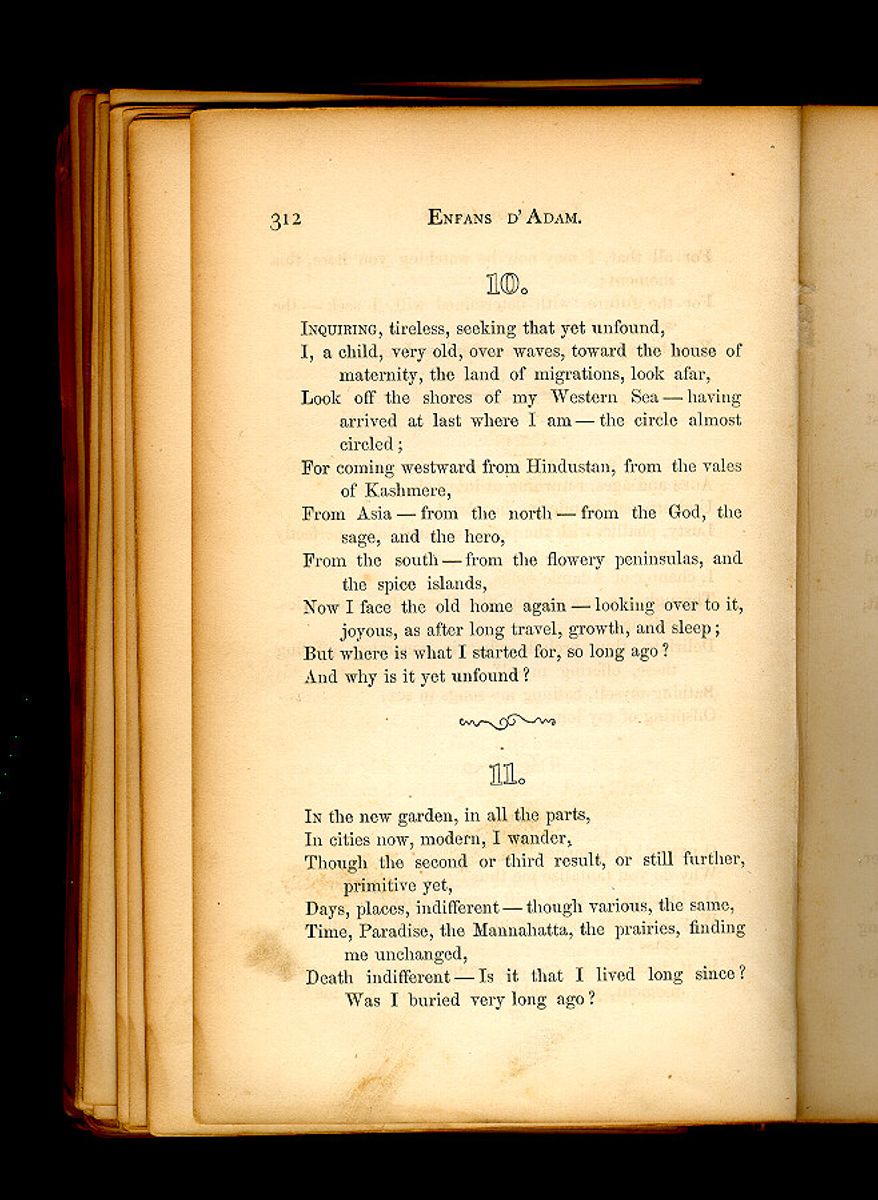 ppp.01500.320.jpg
10.
INQUIRING, tireless, seeking that yet unfound, I, a child, very old, over waves, toward the house ofmaternity, the land of migrations, look afar, Look off the shores of my Western Sea—having
arrived at last where I am—the circle almost
circled; For coming westward from Hindustan, from the vales
of Kashmere, From Asia—from the north—from the God, the
sage, and the hero, From the south—from the flowery peninsulas, and
the spice islands, Now I face the old home again—looking over to it,
joyous, as after long travel, growth, and sleep; But where is what I started for, so long ago? And why is it yet unfound?
11.
IN the new garden, in all the parts, In cities now, modern, I wander, Though the second or third result, or still further,primitive yet, Days, places, indifferent—though various, the same, Time, Paradise, the Mannahatta, the prairies, finding
me unchanged, Death indifferent—Is it that I lived long since?
Was I buried very long ago? [ begin page 313 ]
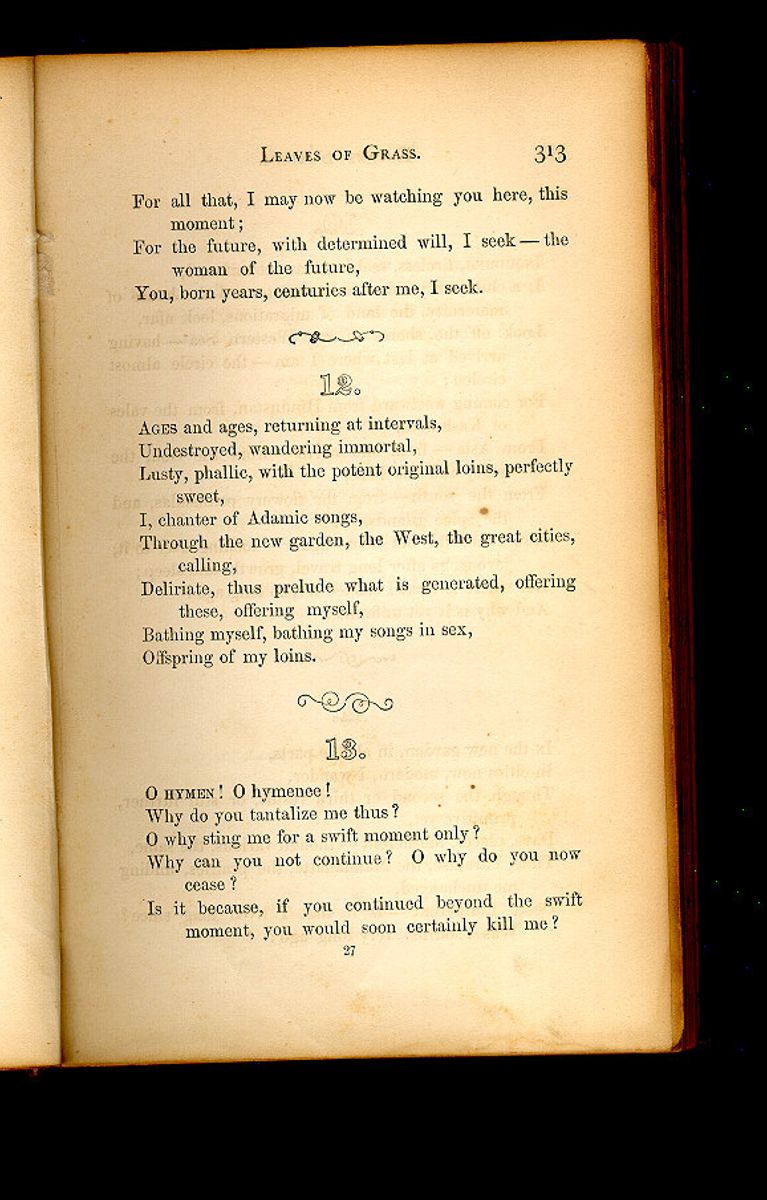 ppp.01500.321.jpg
For all that, I may now be watching you here, this
ppp.01500.321.jpg
For all that, I may now be watching you here, this moment; For the future, with determined will, I seek—the
woman of the future, You, born years, centuries after me, I seek.
12.
AGES and ages, returning at intervals, Undestroyed, wandering immortal, Lusty, phallic, with the potent original loins, perfectlysweet, I, chanter of Adamic songs, Through the new garden, the West, the great cities,
calling, Deliriate, thus prelude what is generated, offering
these, offering myself, Bathing myself, bathing my songs in sex, Offspring of my loins.
13.
O HYMEN! O hymenee! Why do you tantalize me thus? O why sting me for a swift moment only? Why can you not continue? O why do you nowcease? Is it because, if you continued beyond the swift
moment, you would soon certainly kill me? 27 [ begin page 314 ]
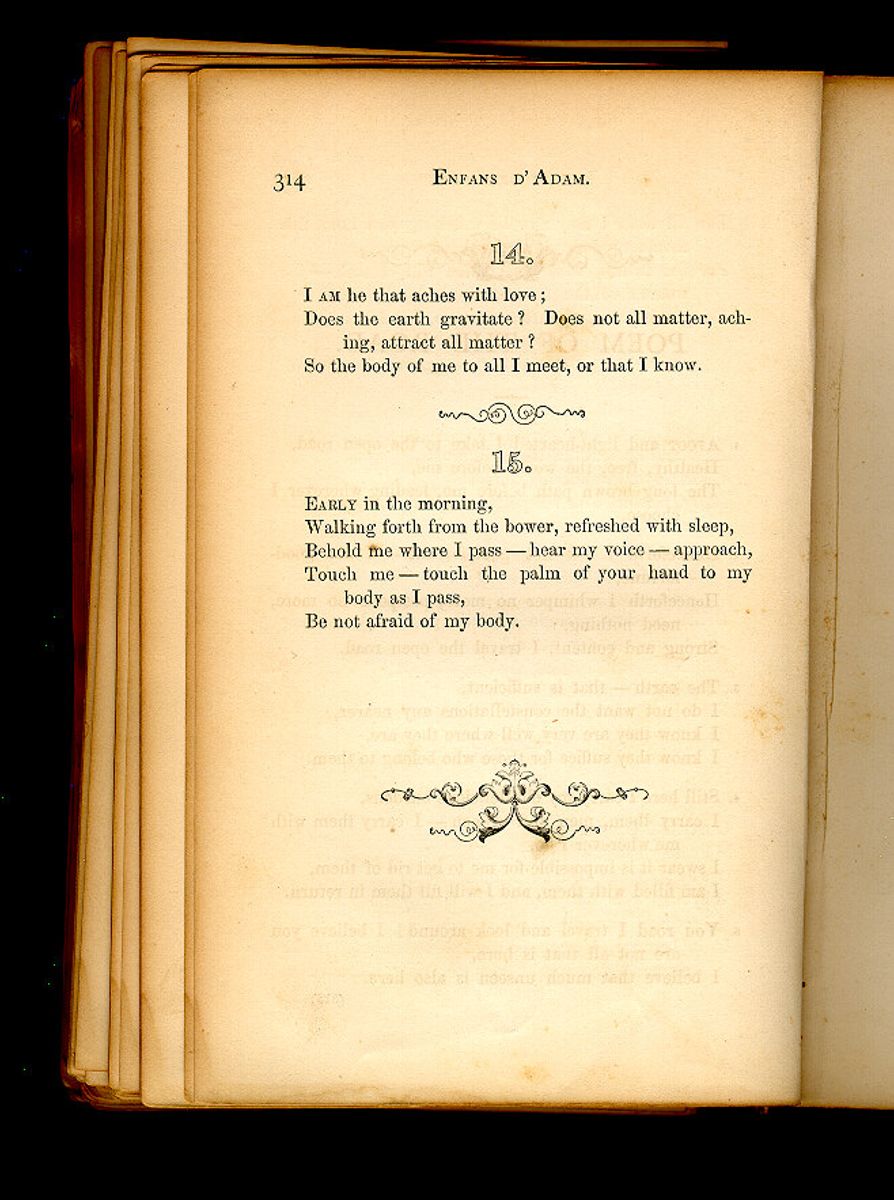 ppp.01500.322.jpg
14.
I AM he that aches with love; Does the earth gravitate? Does not all matter, ach-ing, attract all matter? So the body of me to all I meet, or that I know.
15.
EARLY in the morning, Walking forth from the bower, refreshed with sleep, Behold me where I pass—hear my voice—approach, Touch me—touch the palm of your hand to mybody as I pass, Be not afraid of my body. [ begin page 315 ]
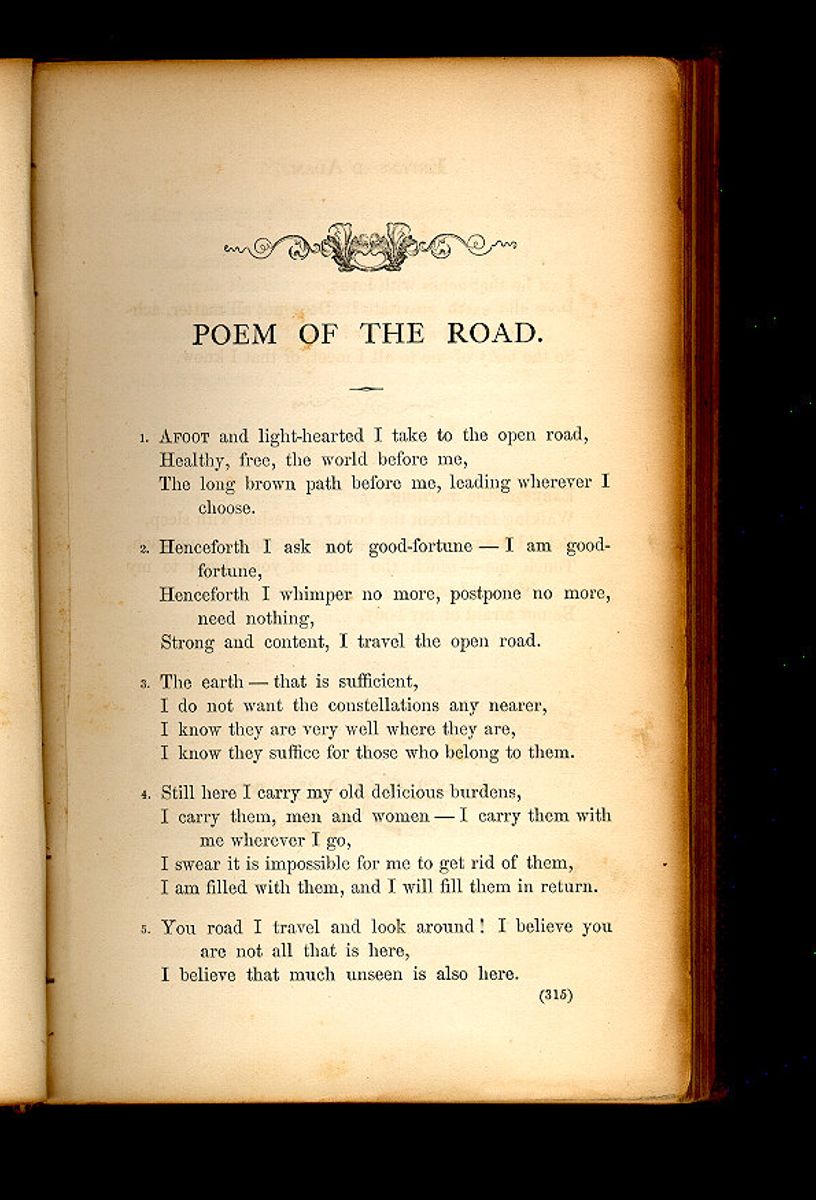 ppp.01500.323.jpg
POEM OF THE ROAD.
1AFOOT and light-hearted I take to the open road, Healthy, free, the world before me, The long brown path before me, leading wherever Ichoose. 2Henceforth I ask not good-fortune—I am good-
fortune, Henceforth I whimper no more, postpone no more,
need nothing, Strong and content, I travel the open road. 3The earth—that is sufficient, I do not want the constellations any nearer, I know they are very well where they are, I know they suffice for those who belong to them. 4Still here I carry my old delicious burdens, I carry them, men and women—I carry them with
me wherever I go, I swear it is impossible for me to get rid of them, I am filled with them, and I will fill them in return. 5You road I travel and look around! I believe you
are not all that is here, I believe that much unseen is also here. [ begin page 316 ]
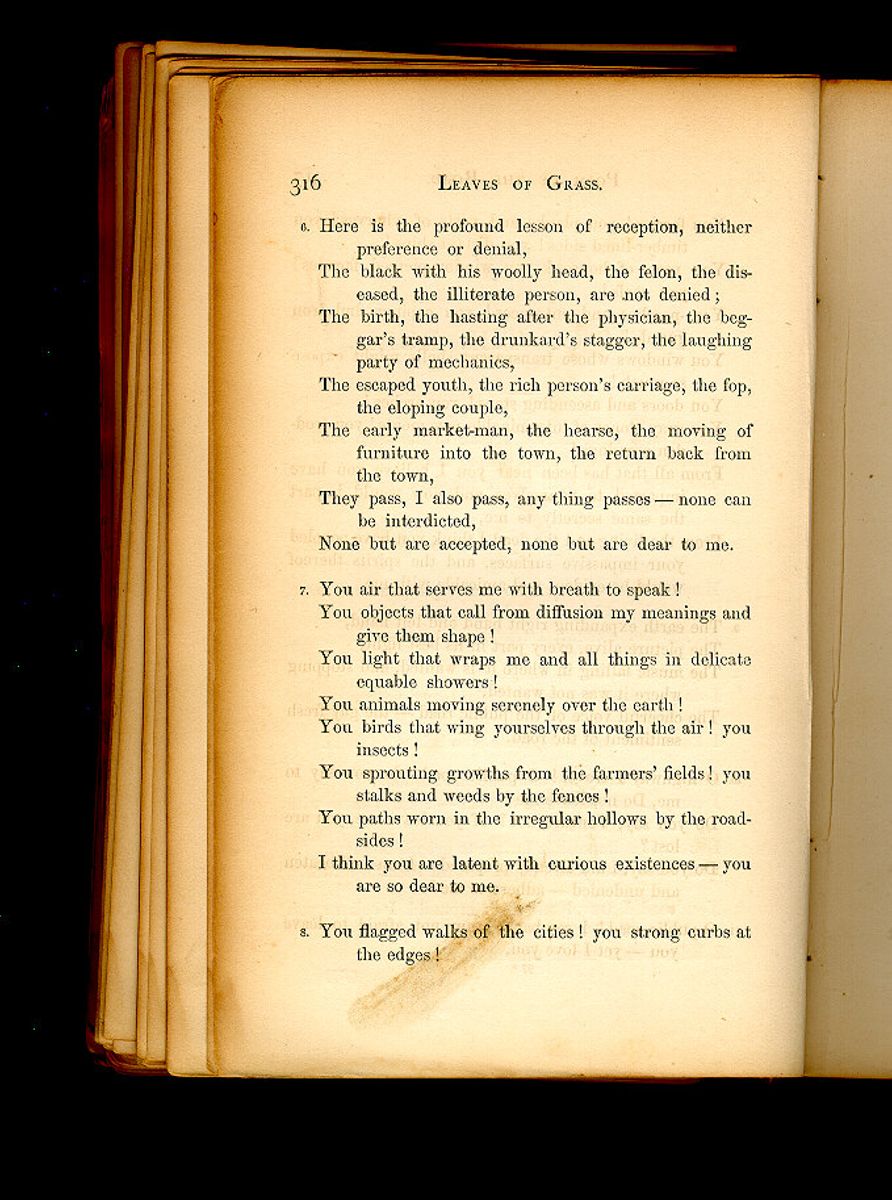 ppp.01500.324.jpg
6Here is the profound lesson of reception, neither
ppp.01500.324.jpg
6Here is the profound lesson of reception, neither preference or denial, The black with his woolly head, the felon, the dis-
eased, the illiterate person, are not denied; The birth, the hasting after the physician, the beg-
gar's tramp, the drunkard's stagger, the laughing
party of mechanics, The escaped youth, the rich person's carriage, the fop,
the eloping couple, The early market-man, the hearse, the moving of
furniture into the town, the return back from
the town, They pass, I also pass, any thing passes—none can
be interdicted, None but are accepted, none but are dear to me. 7You air that serves me with breath to speak! You objects that call from diffusion my meanings and
give them shape! You light that wraps me and all things in delicate
equable showers! You animals moving serenely over the earth! You birds that wing yourselves through the air! you
insects! You sprouting growths from the farmers' fields! you
stalks and weeds by the fences! You paths worn in the irregular hollows by the road-
sides! I think you are latent with curious existences—you
are so dear to me. 8You flagged walks of the cities! you strong curbs at
the edges! [ begin page 317 ]
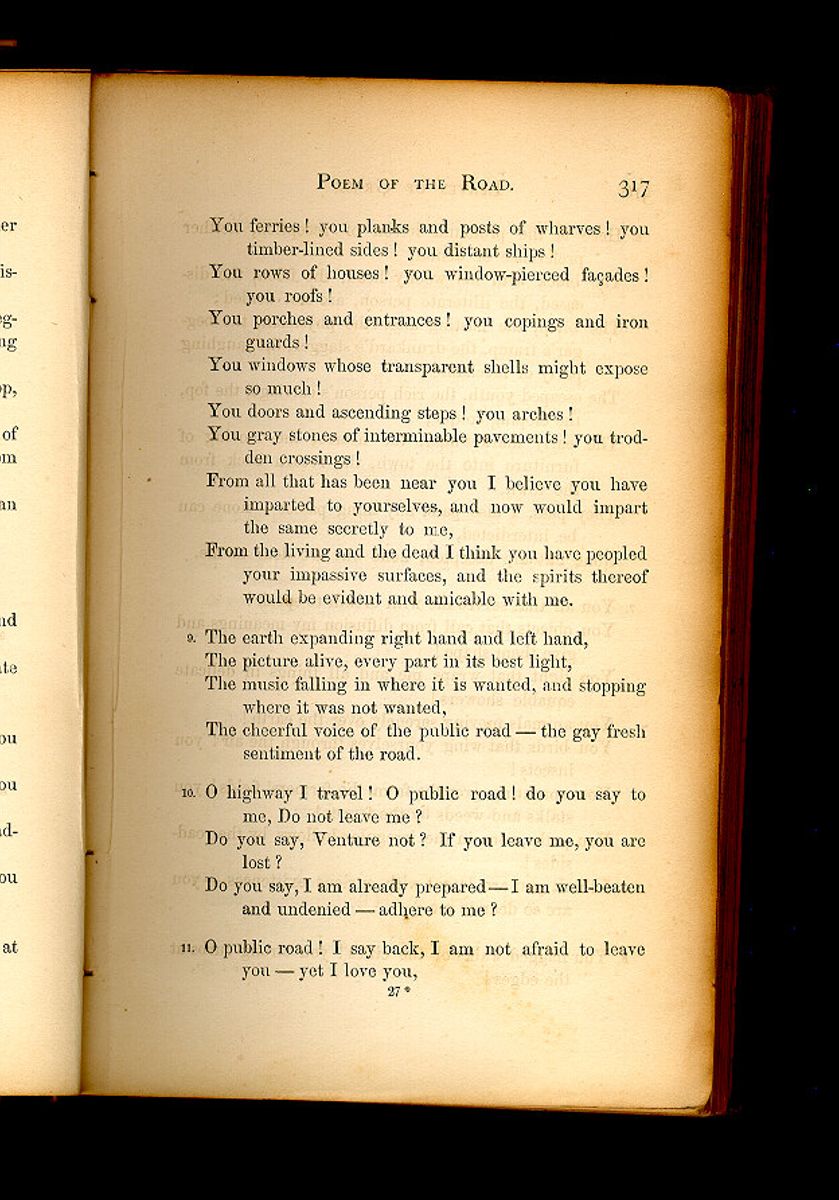 ppp.01500.325.jpg
You ferries! you planks and posts of wharves! you
ppp.01500.325.jpg
You ferries! you planks and posts of wharves! you timber-lined sides! you distant ships! You rows of houses! you window-pierced façades!
you roofs! You porches and entrances! you copings and iron
guards! You windows whose transparent shells might expose
so much! You doors and ascending steps! you arches! You gray stones of interminable pavements! you trod-
den crossings! From all that has been near you I believe you have
imparted to yourselves, and now would impart
the same secretly to me, From the living and the dead I think you have peopled
your impassive surfaces, and the spirits thereof
would be evident and amicable with me. 9The earth expanding right hand and left hand, The picture alive, every part in its best light, The music falling in where it is wanted, and stopping
where it was not wanted, The cheerful voice of the public road—the gay fresh
sentiment of the road. 10O highway I travel! O public road! do you say to
me, Do not leave me? Do you say, Venture not? If you leave me, you are
lost? Do you say, I am already prepared—I am well-beaten
and undenied—adhere to me? 11O public road! I say back, I am not afraid to leave
you—yet I love you, 27* [ begin page 318 ]
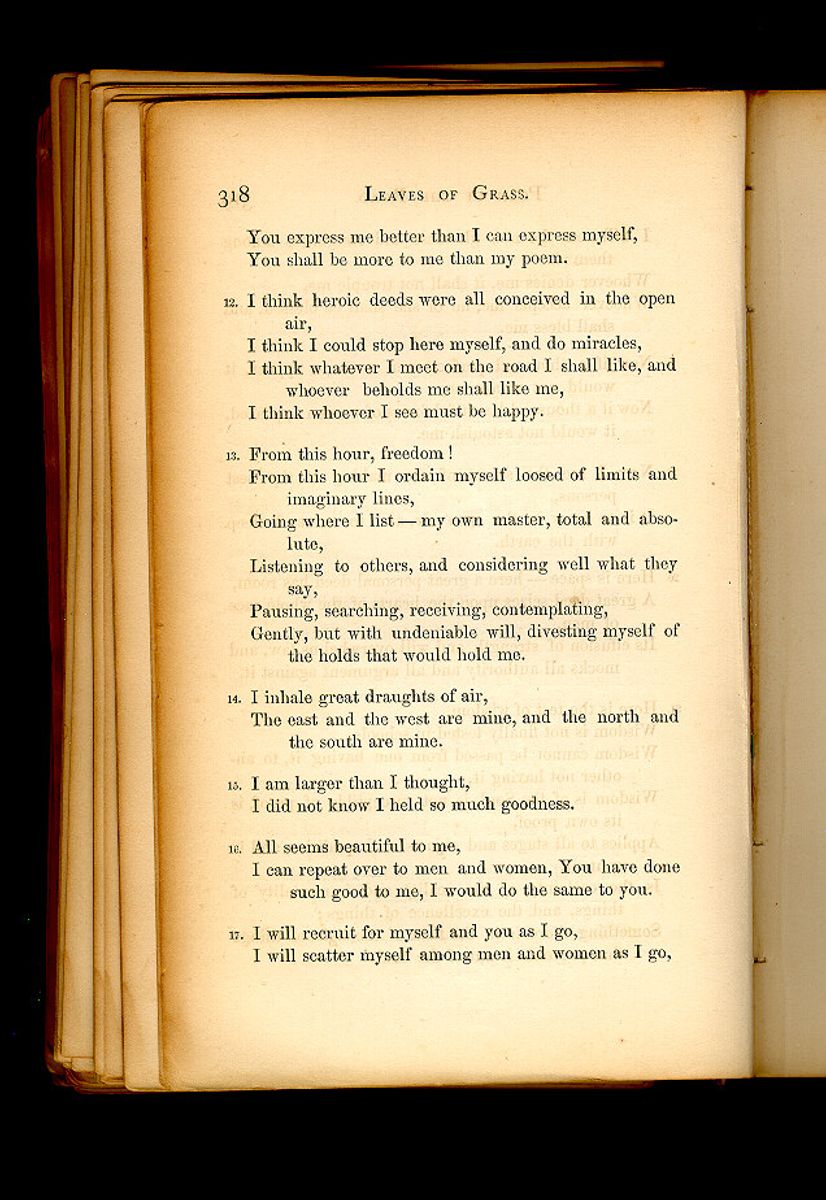 ppp.01500.326.jpg
You express me better than I can express myself,
You shall be more to me than my poem.
12I think heroic deeds were all conceived in the open
ppp.01500.326.jpg
You express me better than I can express myself,
You shall be more to me than my poem.
12I think heroic deeds were all conceived in the open air, I think I could stop here myself, and do miracles, I think whatever I meet on the road I shall like, and
whoever beholds me shall like me, I think whoever I see must be happy. 13From this hour, freedom! From this hour I ordain myself loosed of limits and
imaginary lines, Going where I list—my own master, total and abso-
lute, Listening to others, and considering well what they
say, Pausing, searching, receiving, contemplating, Gently, but with undeniable will, divesting myself of
the holds that would hold me. 14I inhale great draughts of air, The east and the west are mine, and the north and
the south are mine. 15I am larger than I thought, I did not know I held so much goodness. 16All seems beautiful to me, I can repeat over to men and women, You have done
such good to me, I would do the same to you. 17I will recruit for myself and you as I go, I will scatter myself among men and women as I go, [ begin page 319 ]
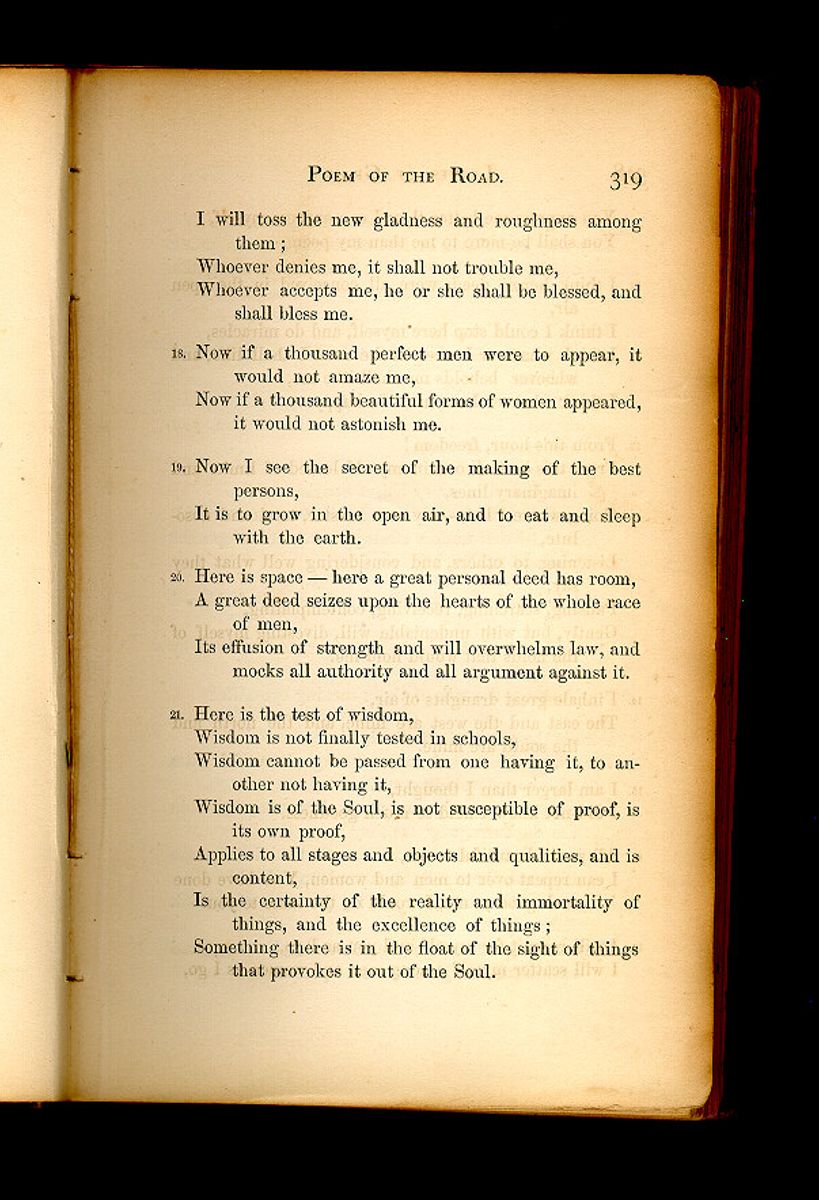 ppp.01500.327.jpg
I will toss the new gladness and roughness among
ppp.01500.327.jpg
I will toss the new gladness and roughness among them; Whoever denies me, it shall not trouble me, Whoever accepts me, he or she shall be blessed, and
shall bless me. 18Now if a thousand perfect men were to appear, it
would not amaze me, Now if a thousand beautiful forms of women appeared,
it would not astonish me. 19Now I see the secret of the making of the best
persons, It is to grow in the open air, and to eat and sleep
with the earth. 20Here is space—here a great personal deed has room, A great deed seizes upon the hearts of the whole race
of men, Its effusion of strength and will overwhelms law, and
mocks all authority and all argument against it. 21Here is the test of wisdom, Wisdom is not finally tested in schools, Wisdom cannot be passed from one having it, to an-
other not having it, Wisdom is of the Soul, is not susceptible of proof, is
its own proof, Applies to all stages and objects and qualities, and is
content, Is the certainty of the reality and immortality of
things, and the excellence of things; Something there is in the float of the sight of things
that provokes it out of the Soul. [ begin page 320 ]
 ppp.01500.328.jpg
22Now I reëxamine philosophies and religions,
They may prove well in lecture-rooms, yet not prove
ppp.01500.328.jpg
22Now I reëxamine philosophies and religions,
They may prove well in lecture-rooms, yet not prove at all under the spacious clouds, and along the
landscape and flowing currents. 23Here is realization, Here is a man tallied—he realizes here what he has
in him, The animals, the past, the future, light, space,
majesty, love, if they are vacant of you, you
are vacant of them. 24Only the kernel of every object nourishes; Where is he who tears off the husks for you and me? Where is he that undoes stratagems and envelopes for
you and me? 25Here is adhesiveness—it is not previously fashioned
—it is apropos; Do you know what it is, as you pass, to be loved by
strangers? Do you know the talk of those turning eye-balls? 26Here is the efflux of the Soul, The efflux of the Soul comes through beautiful gates
of laws, provoking questions; These yearnings, why are they? These thoughts in
the darkness, why are they? Why are there men and women that while they are
nigh me, the sun-light expands my blood? Why, when they leave me, do my pennants of joy sink
flat and lank? Why are there trees I never walk under, but large and
melodious thoughts descend upon me? [ begin page 321 ]
 ppp.01500.329.jpg
(I think they hang there winter and summer on those
ppp.01500.329.jpg
(I think they hang there winter and summer on those trees, and always drop fruit as I pass;) What is it I interchange so suddenly with strangers? What with some driver, as I ride on the seat by his
side? What with some fisherman, drawing his seine by the
shore, as I walk by and pause? What gives me to be free to a woman's or man's good-
will? What gives them to be free to mine? 27The efflux of the Soul is happiness—here is
happiness, I think it pervades the air, waiting at all times, Now it flows into us—we are rightly charged. 28Here rises the fluid and attaching character; The fluid and attaching character is the freshness and
sweetness of man and woman, The herbs of the morning sprout no fresher and
sweeter every day out of the roots of them-
selves, than it sprouts fresh and sweet contin-
ually out of itself. 29Toward the fluid and attaching character exudes the
sweat of the love of young and old, From it falls distilled the charm that mocks beauty
and attainments, Toward it heaves the shuddering longing ache of
contact. 30Allons! Whoever you are, come travel with me! Travelling with me, you find what never tires. [ begin page 322 ]
 ppp.01500.330.jpg
31The earth never tires,
The earth is rude, silent, incomprehensible at first—
ppp.01500.330.jpg
31The earth never tires,
The earth is rude, silent, incomprehensible at first— Nature is rude and incomprehensible at first; Be not discouraged—keep on—there are divine
things, well enveloped, I swear to you there are divine things more beautiful
than words can tell. 32Allons! We must not stop here! However sweet these laid-up stores—however con-
venient this dwelling, we cannot remain here, However sheltered this port, and however calm these
waters, we must not anchor here, However welcome the hospitality that surrounds us,
we are permitted to receive it but a little while. 33Allons! The inducements shall be great to you; We will sail pathless and wild seas; We will go where winds blow, waves dash, and the
Yankee clipper speeds by under full sail. 34Allons! With power, liberty, the earth, the elements! Health, defiance, gayety, self-esteem, curiosity; Allons! from all formules! From your formules, O bat-eyed and materialistic
priests! 35The stale cadaver blocks up the passage—the burial
waits no longer. 36Allons! Yet take warning! He travelling with me needs the best blood, thews,
endurance, [ begin page 323 ]
 ppp.01500.331.jpg
None may come to the trial, till he or she bring
ppp.01500.331.jpg
None may come to the trial, till he or she bring courage and health. 37Come not here if you have already spent the best of
yourself; Only those may come, who come in sweet and deter-
mined bodies, No diseased person—no rum-drinker or venereal
taint is permitted here. 38I and mine do not convince by arguments, similes,
rhymes, We convince by our presence. 39Listen! I will be honest with you, I do not offer the old smooth prizes, but offer rough
new prizes, These are the days that must happen to you: 40You shall not heap up what is called riches, You shall scatter with lavish hand all that you earn
or achieve, You but arrive at the city to which you were des-
tined—you hardly settle yourself to satisfaction,
before you are called by an irresistible call to
depart, You shall be treated to the ironical smiles and mock-
ings of those who remain behind you, What beckonings of love you receive, you shall only
answer with passionate kisses of parting, You shall not allow the hold of those who spread
their reached hands toward you. 41Allons! After the GREAT COMPANIONS! and to belong
to them! [ begin page 324 ]
 ppp.01500.332.jpg
They too are on the road! they are the swift and
ppp.01500.332.jpg
They too are on the road! they are the swift and majestic men! they are the greatest women. 42Over that which hindered them—over that which
retarded—passing impediments large or small, Committers of crimes, committers of many beautiful
virtues, Enjoyers of calms of seas, and storms of seas, Sailors of many a ship, walkers of many a mile of
land, Habitues of many different countries, habitues of far-
distant dwellings, Trusters of men and women, observers of cities, soli-
tary toilers, Pausers and contemplaters of tufts, blossoms, shells of
the shore, Dancers at wedding-dances, kissers of brides, tender
helpers of children, bearers of children, Soldiers of revolts, standers by gaping graves, lower-
ers down of coffins, Journeyers over consecutive seasons, over the years—
the curious years, each emerging from that which
preceded it, Journeyers as with companions, namely, their own
diverse phases, Forth-steppers from the latent unrealized baby-days, Journeyers gayly with their own youth—journeyers
with their bearded and well-grained manhood, Journeyers with their womanhood, ample, unsur-
passed, content, Journeyers with their sublime old age of manhood or
womanhood, Old age, calm, expanded, broad with the haughty
breadth of the universe, [ begin page 325 ]
 ppp.01500.333.jpg
Old age, flowing free with the delicious near-by free-
ppp.01500.333.jpg
Old age, flowing free with the delicious near-by free- dom of death. 43Allons! To that which is endless, as it was beginning-
less, To undergo much, tramps of days, rests of nights, To merge all in the travel they tend to, and the days
and nights they tend to, Again to merge them in the start of superior jour-
neys; To see nothing anywhere but what you may reach it
and pass it, To conceive no time, however distant, but what you
may reach it and pass it, To look up or down no road but it stretches and waits
for you—however long, but it stretches and waits
for you; To see no being, not God's or any, but you also go
thither, To see no possession but you may possess it—enjoy-
ing all without labor or purchase—abstracting
the feast, yet not abstracting one particle of it; To take the best of the farmer's farm and the rich
man's elegant villa, and the chaste blessings of
the well-married couple, and the fruits of or-
chards and flowers of gardens, To take to your use out of the compact cities as you
pass through, To carry buildings and streets with you afterward
wherever you go, To gather the minds of men out of their brains as you
encounter them—to gather the love out of their
hearts, 28 [ begin page 326 ]
 ppp.01500.334.jpg
To take your own lovers on the road with you, for all
ppp.01500.334.jpg
To take your own lovers on the road with you, for all that you leave them behind you, To know the universe itself as a road—as many
roads—as roads for travelling Souls. 44The Soul travels, The body does not travel as much as the Soul, The body has just as great a work as the Soul, and
parts away at last for the journeys of the Soul. 45All parts away for the progress of Souls, All religion, all solid things, arts, governments—all
that was or is apparent upon this globe or any
globe, falls into niches and corners before the
procession of Souls along the grand roads of the
universe. 46Of the progress of the Souls of men and women along
the grand roads of the universe, all other prog-
ress is the needed emblem and sustenance. 47Forever alive, forever forward, Stately, solemn, sad, withdrawn, baffled, mad, turbu-
lent, feeble, dissatisfied, Desperate, proud, fond, sick, accepted by men, re-
jected by men, They go! they go! I know that they go, but I know
not where they go, But I know that they go toward the best—toward
something great. 48Allons! Whoever you are! come forth! You must not stay sleeping and dallying there in the
house, though you built it, or though it has been
built for you. [ begin page 327 ]
 ppp.01500.335.jpg
49Allons! out of the dark confinement!
It is useless to protest—I know all, and expose it.
50Behold, through you as bad as the rest,
Through the laughter, dancing, dining, supping, of
ppp.01500.335.jpg
49Allons! out of the dark confinement!
It is useless to protest—I know all, and expose it.
50Behold, through you as bad as the rest,
Through the laughter, dancing, dining, supping, of people, Inside of dresses and ornaments, inside of those
washed and trimmed faces, Behold a secret silent loathing and despair. 51No husband, no wife, no friend, no lover, so trusted
as to hear the confession, Another self, a duplicate of every one, skulking
and hiding it goes, open and above board it
goes, Formless and wordless through the streets of the
cities, polite and bland in the parlors, In the cars of rail-roads, in steam-boats, in the public
assembly, Home to the houses of men and women, among their
families, at the table, in the bed-room, every-
where, Smartly attired, countenance smiling, form upright,
death under the breast-bones, hell under the
skull-bones, Under the broadcloth and gloves, under the ribbons
and artificial flowers, Keeping fair with the customs, speaking not a syllable
of itself, Speaking of anything else, but never of itself. 52Allons! Through struggles and wars! The goal that was named cannot be countermanded. [ begin page 328 ]
 ppp.01500.336.jpg
53Have the past struggles succeeded?
What has succeeded? Yourself? Your nation?
ppp.01500.336.jpg
53Have the past struggles succeeded?
What has succeeded? Yourself? Your nation? Nature? Now understand me well—It is provided in the
essence of things, that from any fruition of suc-
cess, no matter what, shall come forth something
to make a greater struggle necessary. 54My call is the call of battle—I nourish active re-
bellion, He going with me must go well armed, He going with me goes often with spare diet, poverty,
angry enemies, desertions. 55Allons! The road is before us! It is safe—I have tried it—my own feet have tried
it well. 56Allons! Be not detained! Let the paper remain on the desk unwritten, and the
book on the shelf unopened! Let the tools remain in the workshop! let the money
remain unearned! Let the school stand! mind not the cry of the teacher! Let the preacher preach in his pulpit! let the lawyer
plead in the court, and the judge expound the
law. 57Mon enfant! I give you my hand! I give you my love, more precious than money, I give you myself, before preaching or law; Will you give me yourself? Will you come travel
with me? Shall we stick by each other as long as we live? [ begin page 329 ]
 ppp.01500.337.jpg
TO THE SAYERS OF WORDS.
1EARTH, round, rolling, compact —suns, moons, ani-mals—all these are words to be said, Watery, vegetable, sauroid advances—beings, pre-
monitions, lispings of the future, Behold! these are vast words to be said. 2Were you thinking that those were the words—those
upright lines? those curves, angles, dots? No, those are not the words—the substantial words
are in the ground and sea, They are in the air—they are in you. 3Were you thinking that those were the words—
those delicious sounds out of your friends'
mouths? No, the real words are more delicious than they. 4Human bodies are words, myriads of words, In the best poems re-appears the body, man's or
woman's, well-shaped, natural, gay, Every part able, active, receptive, without shame or
the need of shame. 28* [ begin page 330 ]
 ppp.01500.338.jpg
5Air, soil, water, fire, these are words,
I myself am a word with them—my qualities inter-
ppp.01500.338.jpg
5Air, soil, water, fire, these are words,
I myself am a word with them—my qualities inter- penetrate with theirs—my name is nothing to
them, Though it were told in the three thousand languages,
what would air, soil, water, fire, know of my
name? 6A healthy presence, a friendly or commanding ges-
ture, are words, sayings, meanings, The charms that go with the mere looks of some men
and women, are sayings and meanings also. 7The workmanship of Souls is by the inaudible words
of the earth, The great masters, the sayers, know the earth's words,
and use them more than the audible words. 8Amelioration is one of the earth's words, The earth neither lags nor hastens, It has all attributes, growths, effects, latent in itself
from the jump, It is not half beautiful only—defects and excres-
cences show just as much as perfections show. 9The earth does not withhold, it is generous enough, The truths of the earth continually wait, they are
not so concealed either, They are calm, subtle, untransmissible by print, They are imbued through all things, conveying them-
selves willingly, Conveying a sentiment and invitation of the earth—
I utter and utter, [ begin page 331 ]
 ppp.01500.339.jpg
I speak not, yet if you hear me not, of what avail am
ppp.01500.339.jpg
I speak not, yet if you hear me not, of what avail am I to you? To bear—to better—lacking these, of what avail
am I? 10Accouche! Accouchez! Will you rot your own fruit in yourself there? Will you squat and stifle there? 11The earth does not argue, Is not pathetic, has no arrangements, Does not scream, haste, persuade, threaten, promise, Makes no discriminations, has no conceivable fail-
ures, Closes nothing, refuses nothing, shuts none out, Of all the powers, objects, states, it notifies, shuts
none out. 12The earth does not exhibit itself, nor refuse to exhibit
itself—possesses still underneath, Underneath the ostensible sounds, the august chorus
of heroes, the wail of slaves, Persuasions of lovers, curses, gasps of the dying,
laughter of young people, accents of bargainers, Underneath these, possessing the words that never
fail. 13To her children, the words of the eloquent dumb
great mother never fail, The true words do not fail, for motion does not fail,
and reflection does not fail, Also the day and night do not fail, and the voyage
we pursue does not fail. [ begin page 332 ]
 ppp.01500.340.jpg
14Of the interminable sisters,
Of the ceaseless cotillions of sisters,
Of the centripetal and centrifugal sisters, the elder
ppp.01500.340.jpg
14Of the interminable sisters,
Of the ceaseless cotillions of sisters,
Of the centripetal and centrifugal sisters, the elder and younger sisters, The beautiful sister we know dances on with the rest. 15With her ample back toward every beholder, With the fascinations of youth, and the equal fascina-
tions of age, Sits she whom I too love like the rest—sits undis-
turbed, Holding up in her hand what has the character of a
mirror, while her eyes glance back from it, Glance as she sits, inviting none, denying none, Holding a mirror day and night tirelessly before her
own face. 16Seen at hand, or seen at a distance, Duly the twenty-four appear in public every day, Duly approach and pass with their companions, or
a companion, Looking from no countenances of their own, but from
the countenances of those who are with them, From the countenances of children or women, or the
manly countenance, From the open countenances of animals, or from
inanimate things, From the landscape or waters, or from the exquisite
apparition of the sky, From our countenances, mine and yours, faithfully
returning them, Every day in public appearing without fail, but never
twice with the same companions. [ begin page 333 ]
 ppp.01500.341.jpg
17Embracing man, embracing all, proceed the three
ppp.01500.341.jpg
17Embracing man, embracing all, proceed the three hundred and sixty-five resistlessly round the sun, Embracing all, soothing, supporting, follow close three
hundred and sixty-five offsets of the first, sure
and necessary as they. 18Tumbling on steadily, nothing dreading, Sunshine, storm, cold, heat, forever withstanding,
passing, carrying, The Soul's realization and determination still inherit-
ing, The fluid vacuum around and ahead still entering
and dividing, No balk retarding, no anchor anchoring, on no rock
striking, Swift, glad, content, unbereaved, nothing losing, Of all able and ready at any time to give strict
account, The divine ship sails the divine sea. 19Whoever you are! motion and reflection are espe-
cially for you, The divine ship sails the divine sea for you. 20Whoever you are! you are he or she for whom the
earth is solid and liquid, You are he or she for whom the sun and moon hang
in the sky, For none more than you are the present and the past, For none more than you is immortality. 21Each man to himself, and each woman to herself, is
the word of the past and present, and the word
of immortality, [ begin page 334 ]
 ppp.01500.342.jpg
No one can acquire for another—not one!
Not one can grow for another—not one!
22The song is to the singer, and comes back most to
ppp.01500.342.jpg
No one can acquire for another—not one!
Not one can grow for another—not one!
22The song is to the singer, and comes back most to him, The teaching is to the teacher, and comes back most
to him, The murder is to the murderer, and comes back most
to him, The theft is to the thief, and comes back most to him, The love is to the lover, and comes back most to him, The gift is to the giver, and comes back most to him
—it cannot fail, The oration is to the orator, and the acting is to the
actor and actress, not to the audience, And no man understands any greatness or goodness
but his own, or the indication of his own. 23I swear the earth shall surely be complete to him or
her who shall be complete! I swear the earth remains broken and jagged only to
him or her who remains broken and jagged! 24I swear there is no greatness or power that does not
emulate those of the earth! I swear there can be no theory of any account, unless
it corroborate the theory of the earth! No politics, art, religion, behavior, or what not, is of
account, unless it compare with the amplitude of
the earth, Unless it face the exactness, vitality, impartiality,
rectitude of the earth. 25I swear I begin to see love with sweeter spasms than
that which responds love! [ begin page 335 ]
 ppp.01500.343.jpg
It is that which contains itself, which never invites
ppp.01500.343.jpg
It is that which contains itself, which never invites and never refuses. 26I swear I begin to see little or nothing in audible
words! I swear I think all merges toward the presentation of
the unspoken meanings of the earth! Toward him who sings the songs of the body, and of
the truths of the earth, Toward him who makes the dictionaries of the words
that print cannot touch. 27I swear I see what is better than to tell the best, It is always to leave the best untold. 28When I undertake to tell the best, I find I cannot, My tongue is ineffectual on its pivots, My breath will not be obedient to its organs, I become a dumb man. 29The best of the earth cannot be told anyhow—all or
any is best, It is not what you anticipated—it is cheaper, easier,
nearer, Things are not dismissed from the places they held
before, The earth is just as positive and direct as it was
before, Facts, religions, improvements, politics, trades, are as
real as before, But the Soul is also real,—it too is positive and
direct, No reasoning, no proof has established it, Undeniable growth has established it. [ begin page 336 ]
 ppp.01500.344.jpg
30This is a poem for the sayers of words—these are
ppp.01500.344.jpg
30This is a poem for the sayers of words—these are hints of meanings, These are they that echo the tones of Souls, and the
phrases of Souls; If they did not echo the phrases of Souls, what were
they then? If they had not reference to you in especial, what were
they then? 31I swear I will never henceforth have to do with the
faith that tells the best! I will have to do with that faith only that leaves the
best untold. 32Say on, sayers! Delve! mould! pile the words of the earth! Work on—it is materials you bring, not breaths; Work on, age after age! nothing is to be lost, It may have to wait long, but it will certainly come
in use, When the materials are all prepared, the architects
shall appear. 33I swear to you the architects shall appear without fail!
I announce them and lead them, I swear to you they will understand you and justify
you, I swear to you the greatest among them shall be he
who best knows you, and encloses all, and is
faithful to all, I swear to you, he and the rest shall not forget you
—they shall perceive that you are not an iota
less than they, I swear to you, you shall be glorified in them. [ begin page 337 ]
 ppp.01500.345.jpg
A BOSTON BALLAD,
The 78th Year of These States.
1CLEAR the way there, Jonathan!
Way for the President's marshal! Way for the gov- ernment cannon! Way for the federal foot and dragoons—and the appa-
ritions copiously tumbling. 2I rose this morning early, to get betimes in Boston
town, Here's a good place at the corner, I must stand and
see the show. 3I love to look on the stars and stripes, I hope the fifes
will play Yankee Doodle. 4How bright shine the cutlasses of the foremost troops! Every man holds his revolver, marching stiff through
Boston town. 5A fog follows—antiques of the same come limping, Some appear wooden-legged, and some appear ban-
daged and bloodless. 29 [ begin page 338 ]
 ppp.01500.346.jpg
6Why this is a show! It has called the dead out of
ppp.01500.346.jpg
6Why this is a show! It has called the dead out of the earth! The old grave-yards of the hills have hurried to
see! Uncountable phantoms gather by flank and rear
of it! Cocked hats of mothy mould! crutches made of
mist! Arms in slings! old men leaning on young men's
shoulders! 7What troubles you, Yankee phantoms? What is all
this chattering of bare gums? Does the ague convulse your limbs? Do you mis-
take your crutches for fire-locks, and level
them? 8If you blind your eyes with tears, you will not see
the President's marshal, If you groan such groans you might balk the govern-
ment cannon. 9For shame, old maniacs! Bring down those tossed
arms, and let your white hair be, Here gape your smart grand-sons—their wives gaze
at them from the windows, See how well-dressed—see how orderly they conduct
themselves. 10Worse and worse! Can't you stand it! Are you
retreating! Is this hour with the living too dead for you? [ begin page 339 ]
 ppp.01500.347.jpg
11Retreat then! Pell-mell!
Back to your graves! Back to the hills, old
ppp.01500.347.jpg
11Retreat then! Pell-mell!
Back to your graves! Back to the hills, old limpers! I do not think you belong here, anyhow. 12But there is one thing that belongs here—shall I tell
you what it is, gentlemen of Boston? 13I will whisper it to the Mayor—he shall send a com-
mittee to England, They shall get a grant from the Parliament, go with a
cart to the royal vault—haste! Dig out King George's coffin, unwrap him quick
from the grave-clothes, box up his bones for a
journey, Find a swift Yankee clipper—here is freight for you,
black-bellied clipper, Up with your anchor! shake out your sails! steer
straight toward Boston bay. 14Now call for the President's marshal again, bring out
the government cannon, Fetch home the roarers from Congress, make an-
other procession, guard it with foot and dra-
goons. 15This centre-piece for them: Look! all orderly citizens—look from the windows,
women! 16The committee open the box, set up the regal ribs,
glue those that will not stay, [ begin page 340 ]
 ppp.01500.348.jpg
Clap the skull on top of the ribs, and clap a crown on
ppp.01500.348.jpg
Clap the skull on top of the ribs, and clap a crown on top of the skull. 17You have got your revenge, old buster! The crown is
come to its own, and more than its own. 18Stick your hands in your pockets, Jonathan—you
are a made man from this day, You are mighty cute—and here is one of your
bargains. [ begin page 341 ]
 ppp.01500.349.jpg
CALAMUS.
1.
IN paths untrodden, In the growth by margins of pond-waters, Escaped from the life that exhibits itself, From all the standards hitherto published—fromthe pleasures, profits, conformities, Which too long I was offering to feed to my Soul Clear to me now, standards not yet published—
clear to me that my Soul, That the Soul of the man I speak for, feeds, rejoices
only in comrades; Here, by myself, away from the clank of the world, Tallying and talked to here by tongues aromatic, No longer abashed—for in this secluded spot I can
respond as I would not dare elsewhere, Strong upon me the life that does not exhibit itself,
yet contains all the rest, Resolved to sing no songs to-day but those of manly
attachment, Projecting them along that substantial life, Bequeathing, hence, types of athletic love, 29* [ begin page 342 ]
 ppp.01500.350.jpg
Afternoon, this delicious Ninth Month, in my forty-
ppp.01500.350.jpg
Afternoon, this delicious Ninth Month, in my forty- first year, I proceed, for all who are, or have been, young
men, To tell the secret of my nights and days, To celebrate the need of comrades.
2.
SCENTED herbage of my breast, Leaves from you I yield, I write, to be perused bestafterwards, Tomb-leaves, body-leaves, growing up above me, above
death, Perennial roots, tall leaves—O the winter shall not
freeze you, delicate leaves, Every year shall you bloom again—Out from where
you retired, you shall emerge again; O I do not know whether many, passing by, will dis-
cover you, or inhale your faint odor—but I
believe a few will; O slender leaves! O blossoms of my blood! I permit
you to tell, in your own way, of the heart that is
under you, O burning and throbbing—surely all will one day be
accomplished; O I do not know what you mean, there underneath
yourselves—you are not happiness, You are often more bitter than I can bear—you burn
and sting me, [ begin page 343 ]
 ppp.01500.351.jpg
Yet you are very beautiful to me, you faint-tinged
ppp.01500.351.jpg
Yet you are very beautiful to me, you faint-tinged roots—you make me think of Death, Death is beautiful from you—(what indeed is beau-
tiful, except Death and Love?) O I think it is not for life I am chanting here my
chant of lovers—I think it must be for Death, For how calm, how solemn it grows, to ascend to the
atmosphere of lovers, Death or life I am then indifferent—my Soul de-
clines to prefer, I am not sure but the high Soul of lovers welcomes
death most; Indeed, O Death, I think now these leaves mean pre-
cisely the same as you mean; Grow up taller, sweet leaves, that I may see! Grow
up out of my breast! Spring away from the concealed heart there! Do not fold yourselves so in your pink-tinged roots,
timid leaves! Do not remain down there so ashamed, herbage of my
breast! Come, I am determined to unbare this broad breast of
mine—I have long enough stifled and choked; Emblematic and capricious blades, I leave you—now
you serve me not, Away! I will say what I have to say, by itself, I will escape from the sham that was proposed to me, I will sound myself and comrades only—I will never
again utter a call, only their call, I will raise, with it, immortal reverberations through
The States, I will give an example to lovers, to take permanent
shape and will through The States; [ begin page 344 ]
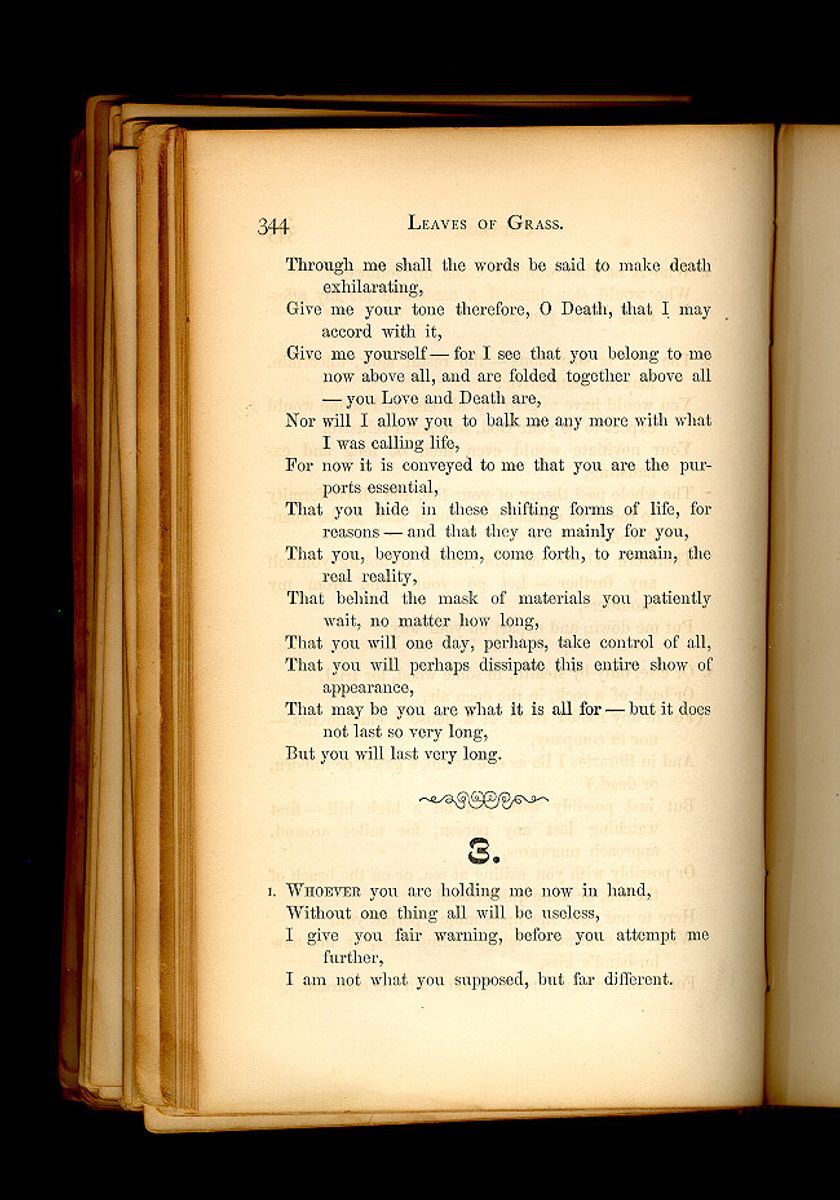 ppp.01500.352.jpg
Through me shall the words be said to make death
ppp.01500.352.jpg
Through me shall the words be said to make death exhilarating, Give me your tone therefore, O Death, that I may
accord with it, Give me yourself—for I see that you belong to me
now above all, and are folded together above all
—you Love and Death are, Nor will I allow you to balk me any more with what
I was calling life, For now it is conveyed to me that you are the pur-
ports essential, That you hide in these shifting forms of life, for
reasons—and that they are mainly for you, That you, beyond them, come forth, to remain, the
real reality, That behind the mask of materials you patiently
wait, no matter how long, That you will one day, perhaps, take control of all, That you will perhaps dissipate this entire show of
appearance, That may be you are what it is all for—but it does
not last so very long, But you will last very long.
3.
1WHOEVER you are holding me now in hand, Without one thing all will be useless, I give you fair warning, before you attempt mefurther, I am not what you supposed, but far different. [ begin page 345 ]
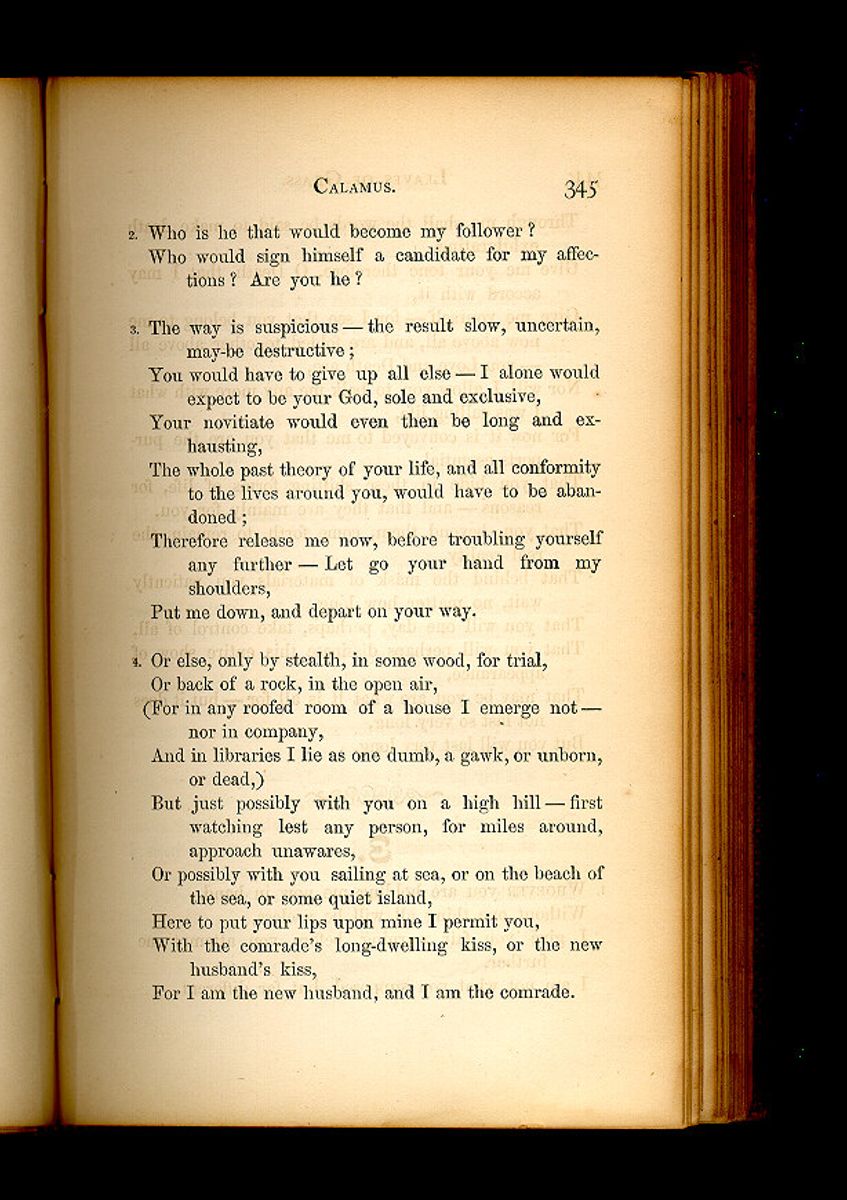 ppp.01500.353.jpg
2Who is he that would become my follower?
Who would sign himself a candidate for my affec-
ppp.01500.353.jpg
2Who is he that would become my follower?
Who would sign himself a candidate for my affec- tions? Are you he? 3The way is suspicious—the result slow, uncertain,
may-be destructive; You would have to give up all else—I alone would
expect to be your God, sole and exclusive, Your novitiate would even then be long and ex-
hausting, The whole past theory of your life, and all conformity
to the lives around you, would have to be aban-
doned; Therefore release me now, before troubling yourself
any further—Let go your hand from my
shoulders, Put me down, and depart on your way. 4Or else, only by stealth, in some wood, for trial, Or back of a rock, in the open air, (For in any roofed room of a house I emerge not—
nor in company, And in libraries I lie as one dumb, a gawk, or unborn,
or dead,) But just possibly with you on a high hill—first
watching lest any person, for miles around,
approach unawares, Or possibly with you sailing at sea, or on the beach of
the sea, or some quiet island, Here to put your lips upon mine I permit you, With the comrade's long-dwelling kiss, or the new
husband's kiss, For I am the new husband, and I am the comrade. [ begin page 346 ]
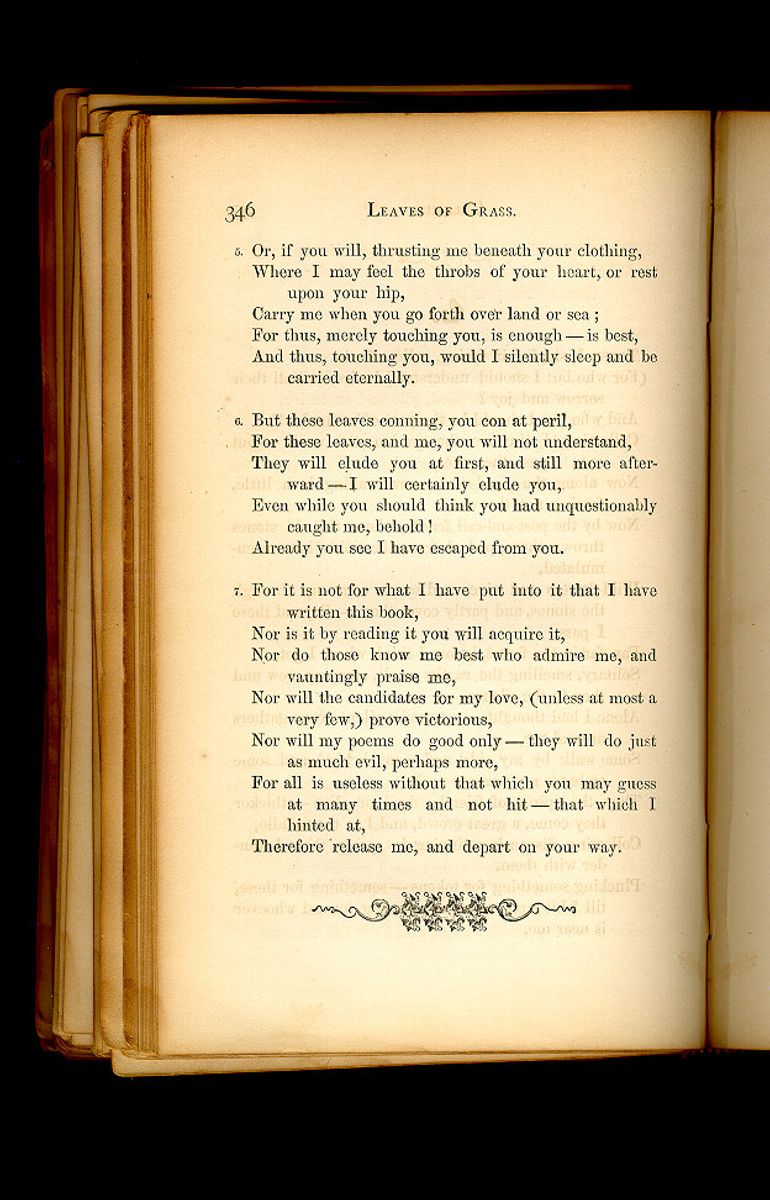 ppp.01500.354.jpg
5Or, if you will, thrusting me beneath your clothing,
Where I may feel the throbs of your heart, or rest
ppp.01500.354.jpg
5Or, if you will, thrusting me beneath your clothing,
Where I may feel the throbs of your heart, or rest upon your hip, Carry me when you go forth over land or sea; For thus, merely touching you, is enough—is best, And thus, touching you, would I silently sleep and be
carried eternally. 6But these leaves conning, you con at peril, For these leaves, and me, you will not understand, They will elude you at first, and still more after-
ward—I will certainly elude you, Even while you should think you had unquestionably
caught me, behold! Already you see I have escaped from you. 7For it is not for what I have put into it that I have
written this book, Nor is it by reading it you will acquire it, Nor do those know me best who admire me, and
vauntingly praise me, Nor will the candidates for my love, (unless at most a
very few,) prove victorious, Nor will my poems do good only—they will do just
as much evil, perhaps more, For all is useless without that which you may guess
at many times and not hit—that which I
hinted at, Therefore release me, and depart on your way. [ begin page 347 ]
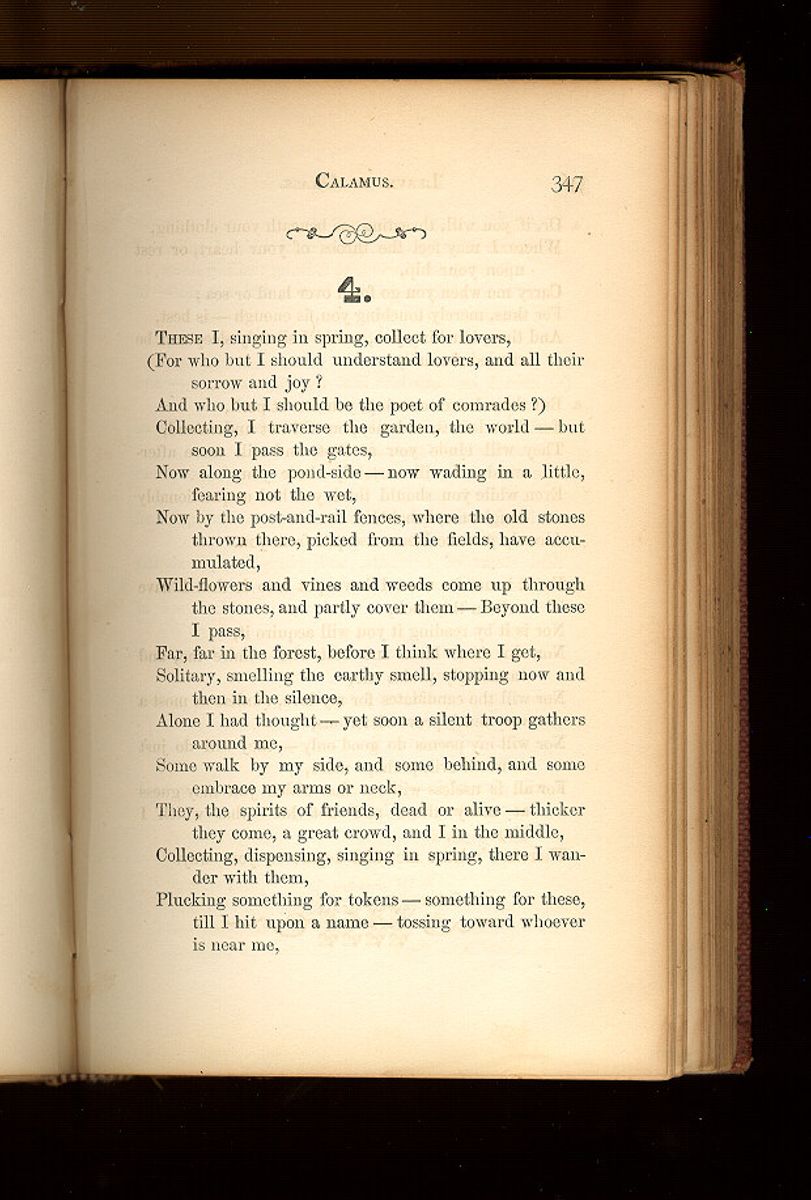 ppp.01500.355.jpg
4.
THESE I, singing in spring, collect for lovers, (For who but I should understand lovers, and all theirsorrow and joy? And who but I should be the poet of comrades?) Collecting, I traverse the garden, the world—but
soon I pass the gates, Now along the pond-side—now wading in a little,
fearing not the wet, Now by the post-and-rail fences, where the old stones
thrown there, picked from the fields, have accu-
mulated, Wild-flowers and vines and weeds come up through
the stones, and partly cover them—Beyond these
I pass, Far, far in the forest, before I think where I get, Solitary, smelling the earthy smell, stopping now and
then in the silence, Alone I had thought—yet soon a silent troop gathers
around me, Some walk by my side, and some behind, and some
embrace my arms or neck, They, the spirits of friends, dead or alive—thicker
they come, a great crowd, and I in the middle, Collecting, dispensing, singing in spring, there I wan-
der with them, Plucking something for tokens—something for these,
till I hit upon a name—tossing toward whoever
is near me, [ begin page 348 ]
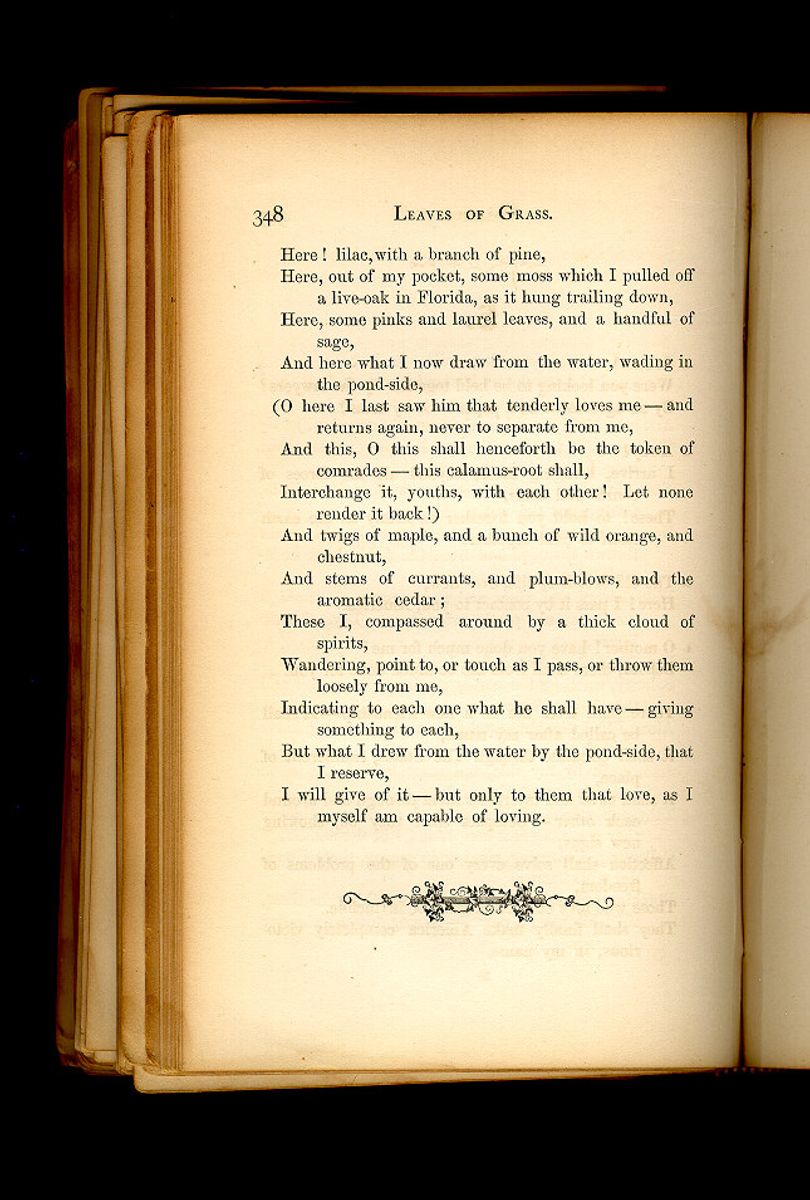 ppp.01500.356.jpg
Here! lilac, with a branch of pine,
Here, out of my pocket, some moss which I pulled off
ppp.01500.356.jpg
Here! lilac, with a branch of pine,
Here, out of my pocket, some moss which I pulled off a live-oak in Florida, as it hung trailing down, Here, some pinks and laurel leaves, and a handful of
sage, And here what I now draw from the water, wading in
the pond-side, (O here I last saw him that tenderly loves me—and
returns again, never to separate from me, And this, O this shall henceforth be the token of
comrades—this calamus-root shall, Interchange it, youths, with each other! Let none
render it back!) And twigs of maple, and a bunch of wild orange, and
chestnut, And stems of currants, and plum-blows, and the
aromatic cedar; These I, compassed around by a thick cloud of
spirits, Wandering, point to, or touch as I pass, or throw them
loosely from me, Indicating to each one what he shall have—giving
something to each, But what I drew from the water by the pond-side, that
I reserve, I will give of it—but only to them that love, as I
myself am capable of loving. [ begin page 349 ]
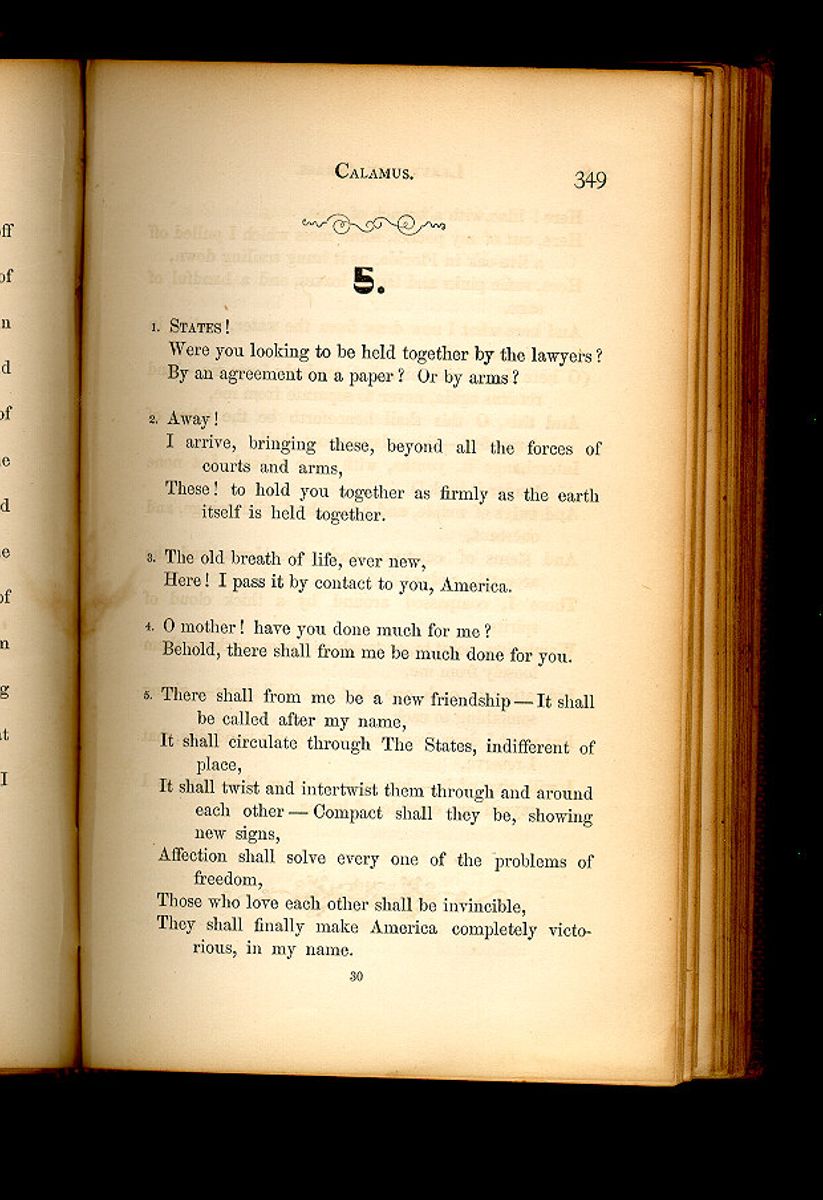 ppp.01500.357.jpg
5.
1STATES! Were you looking to be held together by the lawyers? By an agreement on a paper? Or by arms? 2Away! I arrive, bringing these, beyond all the forces ofcourts and arms, These! to hold you together as firmly as the earth
itself is held together. 3The old breath of life, ever new, Here! I pass it by contact to you, America. 4O mother! have you done much for me? Behold, there shall from me be much done for you. 5There shall from me be a new friendship—It shall
be called after my name, It shall circulate through The States, indifferent of
place, It shall twist and intertwist them through and around
each other—Compact shall they be, showing
new signs, Affection shall solve every one of the problems of
freedom, Those who love each other shall be invincible, They shall finally make America completely victo-
rious, in my name. 30 [ begin page 350 ]
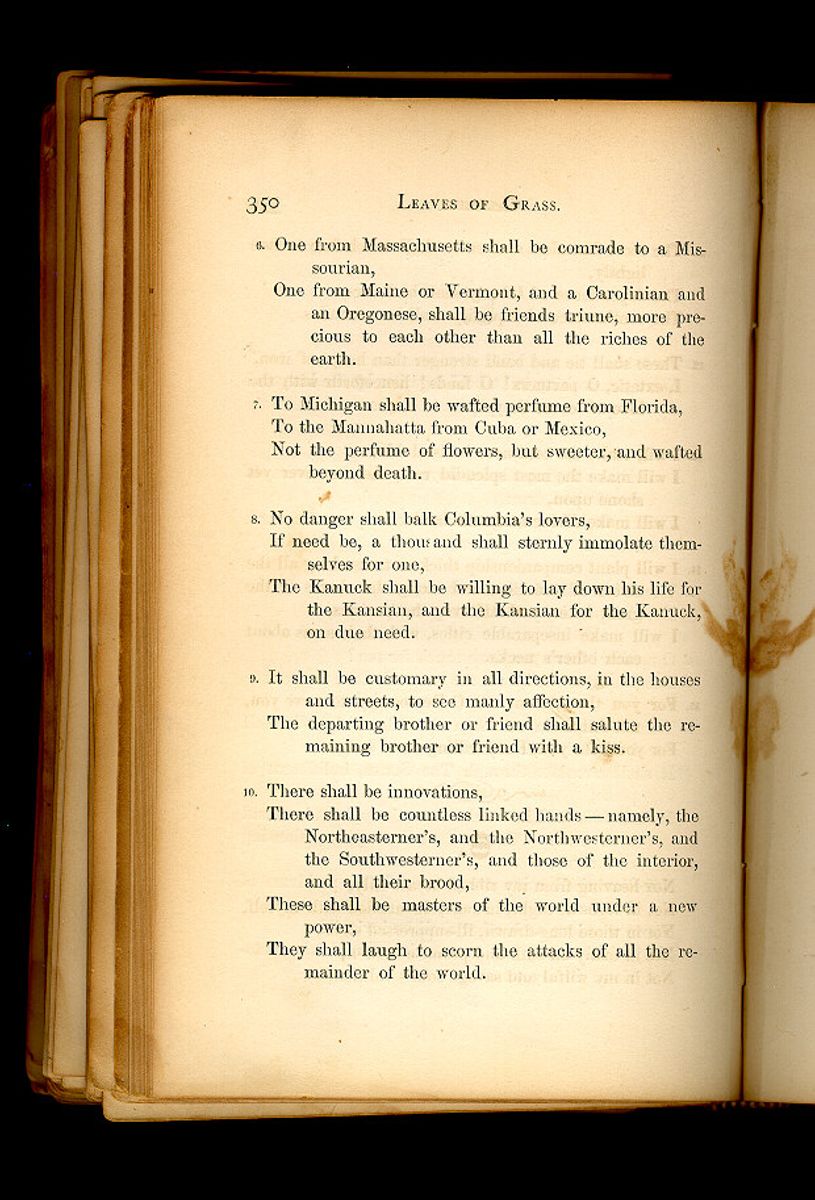 ppp.01500.358.jpg
6One from Massachusetts shall be comrade to a Mis-
ppp.01500.358.jpg
6One from Massachusetts shall be comrade to a Mis- sourian, One from Maine or Vermont, and a Carolinian and
an Oregonese, shall be friends triune, more pre-
cious to each other than all the riches of the
earth. 7To Michigan shall be wafted perfume from Florida, To the Mannahatta from Cuba or Mexico, Not the perfume of flowers, but sweeter, and wafted
beyond death. 8No danger shall balk Columbia's lovers, If need be, a thousand shall sternly immolate them-
selves for one, The Kanuck shall be willing to lay down his life for
the Kansian, and the Kansian for the Kanuck,
on due need. 9It shall be customary in all directions, in the houses
and streets, to see manly affection, The departing brother or friend shall salute the re-
maining brother or friend with a kiss. 10There shall be innovations, There shall be countless linked hands—namely, the
Northeasterner's, and the Northwesterner's, and
the Southwesterner's, and those of the interior,
and all their brood, These shall be masters of the world under a new
power, They shall laugh to scorn the attacks of all the re-
mainder of the world. [ begin page 351 ]
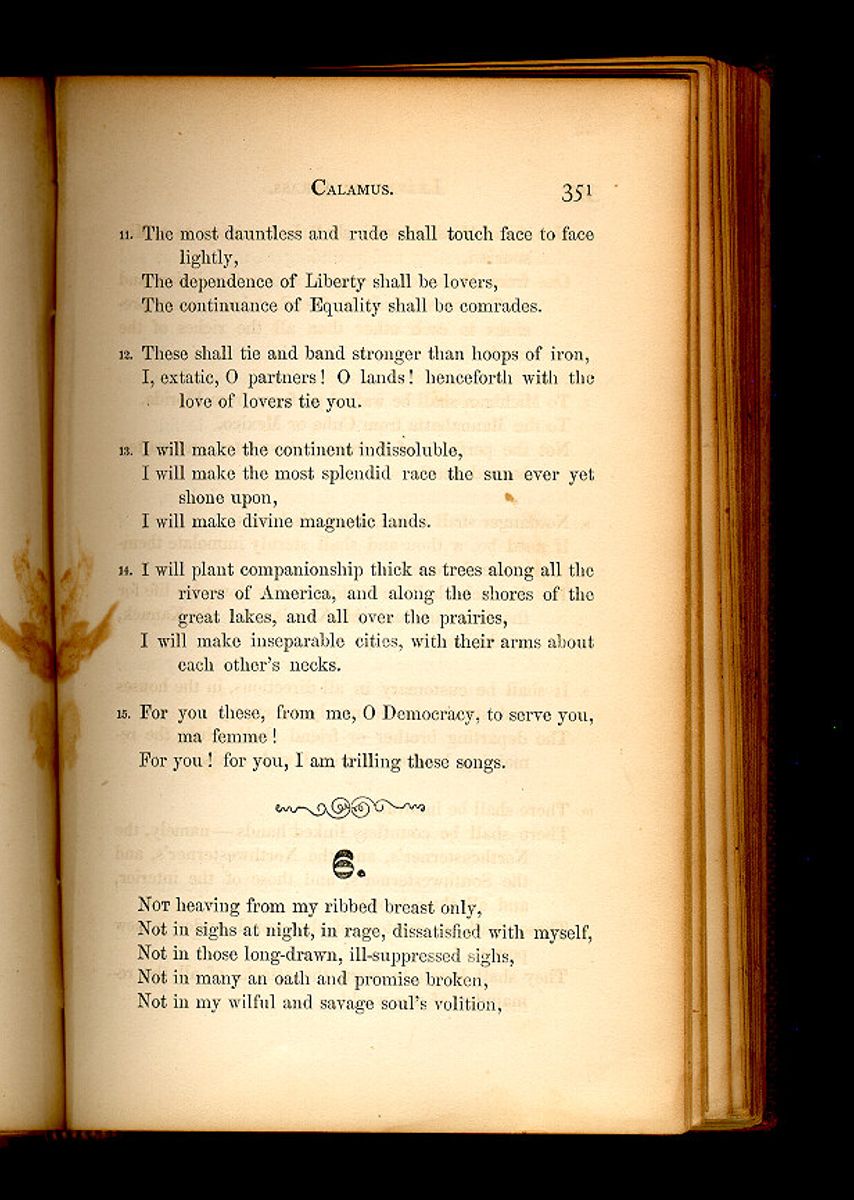 ppp.01500.359.jpg
11The most dauntless and rude shall touch face to face
ppp.01500.359.jpg
11The most dauntless and rude shall touch face to face lightly, The dependence of Liberty shall be lovers, The continuance of Equality shall be comrades. 12These shall tie and band stronger than hoops of iron, I, extatic, O partners! O lands! henceforth with the
love of lovers tie you. 13I will make the continent indissoluble, I will make the most splendid race the sun ever yet
shone upon, I will make divine magnetic lands. 14I will plant companionship thick as trees along all the
rivers of America, and along the shores of the
great lakes, and all over the prairies, I will make inseparable cities, with their arms about
each other's necks. 15For you these, from me, O Democracy, to serve you,
ma femme! For you! for you, I am trilling these songs.
6.
NOT heaving from my ribbed breast only, Not in sighs at night, in rage, dissatisfied with myself, Not in those long-drawn, ill-suppressed sighs, Not in many an oath and promise broken, Not in my wilful and savage soul's volition, [ begin page 352 ] ppp.01500.360.jpg
Not in the subtle nourishment of the air,
Not in this beating and pounding at my temples and
ppp.01500.360.jpg
Not in the subtle nourishment of the air,
Not in this beating and pounding at my temples and wrists, Not in the curious systole and diastole within, which
will one day cease, Not in many a hungry wish, told to the skies only, Not in cries, laughter, defiances, thrown from me
when alone, far in the wilds, Not in husky pantings through clenched teeth, Not in sounded and resounded words—chattering
words, echoes, dead words, Not in the murmurs of my dreams while I sleep, Nor the other murmurs of these incredible dreams of
every day, Nor in the limbs and senses of my body, that take you
and dismiss you continually—Not there, Not in any or all of them, O adhesiveness! O pulse
of my life! Need I that you exist and show yourself, any more
than in these songs.
7.
OF the terrible question of appearances, Of the doubts, the uncertainties after all, That may-be reliance and hope are but speculationsafter all, That may-be identity beyond the grave is a beautiful
fable only, May-be the things I perceive—the animals, plants,
men, hills, shining and flowing waters, [ begin page 353 ]
 ppp.01500.361.jpg
The skies of day and night—colors, densities, forms
ppp.01500.361.jpg
The skies of day and night—colors, densities, forms —May-be these are, (as doubtless they are,) only
apparitions, and the real something has yet to be
known, (How often they dart out of themselves, as if to con-
found me and mock me! How often I think neither I know, nor any man
knows, aught of them;) May-be they only seem to me what they are, (as
doubtless they indeed but seem,) as from my
present point of view—And might prove, (as of
course they would,) naught of what they appear,
or naught any how, from entirely changed points
of view; To me, these, and the like of these, are curiously
answered by my lovers, my dear friends; When he whom I love travels with me, or sits a long
while holding me by the hand, When the subtle air, the impalpable, the sense that
words and reason hold not, surround us and
pervade us, Then I am charged with untold and untellable wis-
dom—I am silent—I require nothing further, I cannot answer the question of appearances, or that
of identity beyond the grave, But I walk or sit indifferent—I am satisfied, He ahold of my hand has completely satisfied me. [ begin page 354 ]
 ppp.01500.362.jpg
8.
LONG I thought that knowledge alone would sufficeme—O if I could but obtain knowledge! Then my lands engrossed me—Lands of the prairies,
Ohio's land, the southern savannas, engrossed
me—For them I would live—I would be their
orator; Then I met the examples of old and new heroes—I
heard of warriors, sailors, and all dauntless per-
sons—And it seemed to me that I too had it
in me to be as dauntless as any—and would
be so; And then, to enclose all, it came to me to strike up
the songs of the New World—And then I be-
lieved my life must be spent in singing; But now take notice, land of the prairies, land of
the south savannas, Ohio's land, Take notice, you Kanuck woods—and you Lake
Huron—and all that with you roll toward
Niagara—and you Niagara also, And you, Californian mountains—That you each
and all find somebody else to be your singer of
songs, For I can be your singer of songs no longer—One
who loves me is jealous of me, and withdraws me
from all but love, With the rest I dispense—I sever from what I
thought would suffice me, for it does not—it is
now empty and tasteless to me, I heed knowledge, and the grandeur of The States,
and the example of heroes, no more, [ begin page 355 ]
 ppp.01500.363.jpg
I am indifferent to my own songs—I will go with
ppp.01500.363.jpg
I am indifferent to my own songs—I will go with him I love, It is to be enough for us that we are together—We
never separate again.
9.
HOURS continuing long, sore and heavy-hearted, Hours of the dusk, when I withdraw to a lonesomeand unfrequented spot, seating myself, leaning
my face in my hands; Hours sleepless, deep in the night, when I go forth,
speeding swiftly the country roads, or through
the city streets, or pacing miles and miles, sti-
fling plaintive cries; Hours discouraged, distracted—for the one I cannot
content myself without, soon I saw him content
himself without me; Hours when I am forgotten, (O weeks and months are
passing, but I believe I am never to forget!) Sullen and suffering hours! (I am ashamed—but it
is useless—I am what I am;) Hours of my torment—I wonder if other men ever
have the like, out of the like feelings? Is there even one other like me—distracted—his
friend, his lover, lost to him? Is he too as I am now? Does he still rise in the morn-
ing, dejected, thinking who is lost to him? and
at night, awaking, think who is lost? [ begin page 356 ]
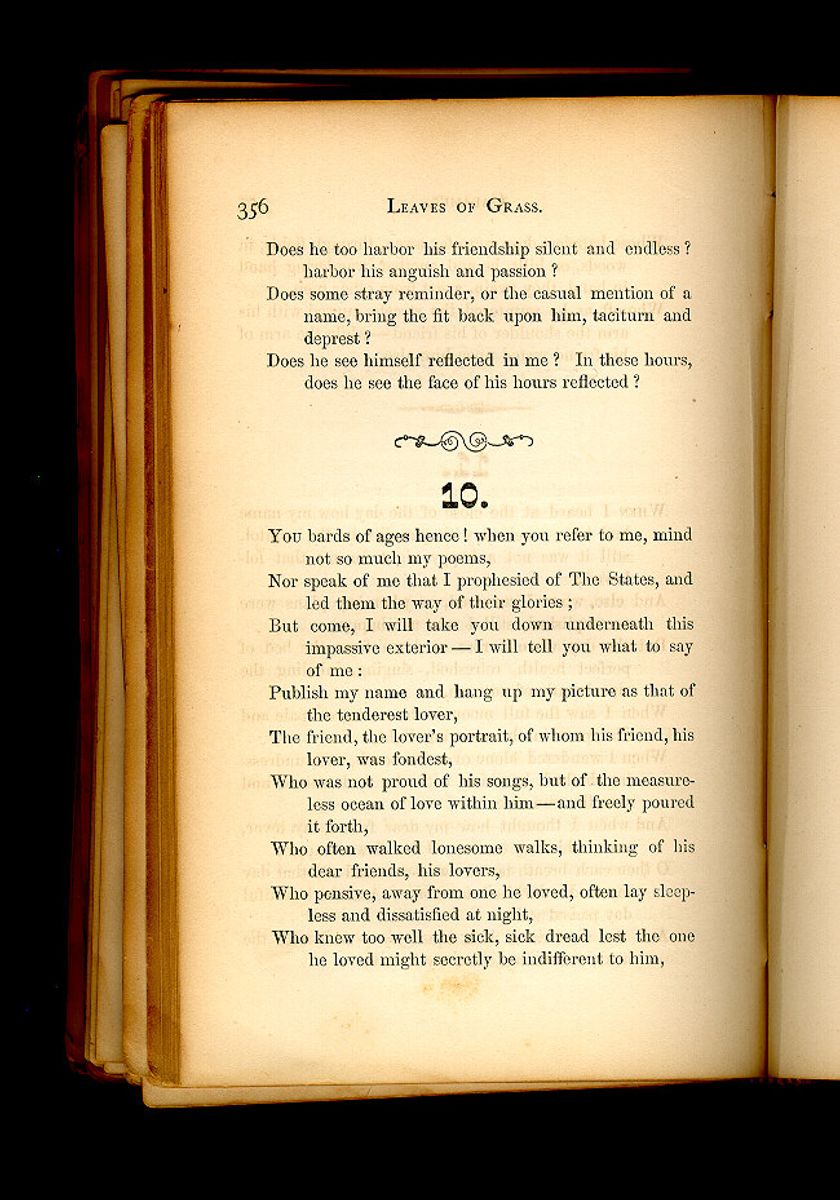 ppp.01500.364.jpg
Does he too harbor his friendship silent and endless?
ppp.01500.364.jpg
Does he too harbor his friendship silent and endless? harbor his anguish and passion? Does some stray reminder, or the casual mention of a
name, bring the fit back upon him, taciturn and
deprest? Does he see himself reflected in me? In these hours,
does he see the face of his hours reflected?
10.
YOU bards of ages hence! when you refer to me, mindnot so much my poems, Nor speak of me that I prophesied of The States, and
led them the way of their glories; But come, I will take you down underneath this
impassive exterior—I will tell you what to say
of me: Publish my name and hang up my picture as that of
the tenderest lover, The friend, the lover's portrait, of whom his friend, his
lover, was fondest, Who was not proud of his songs, but of the measure-
less ocean of love within him—and freely poured
it forth, Who often walked lonesome walks, thinking of his
dear friends, his lovers, Who pensive, away from one he loved, often lay sleep-
less and dissatisfied at night, Who knew too well the sick, sick dread lest the one
he loved might secretly be indifferent to him, [ begin page 357 ]
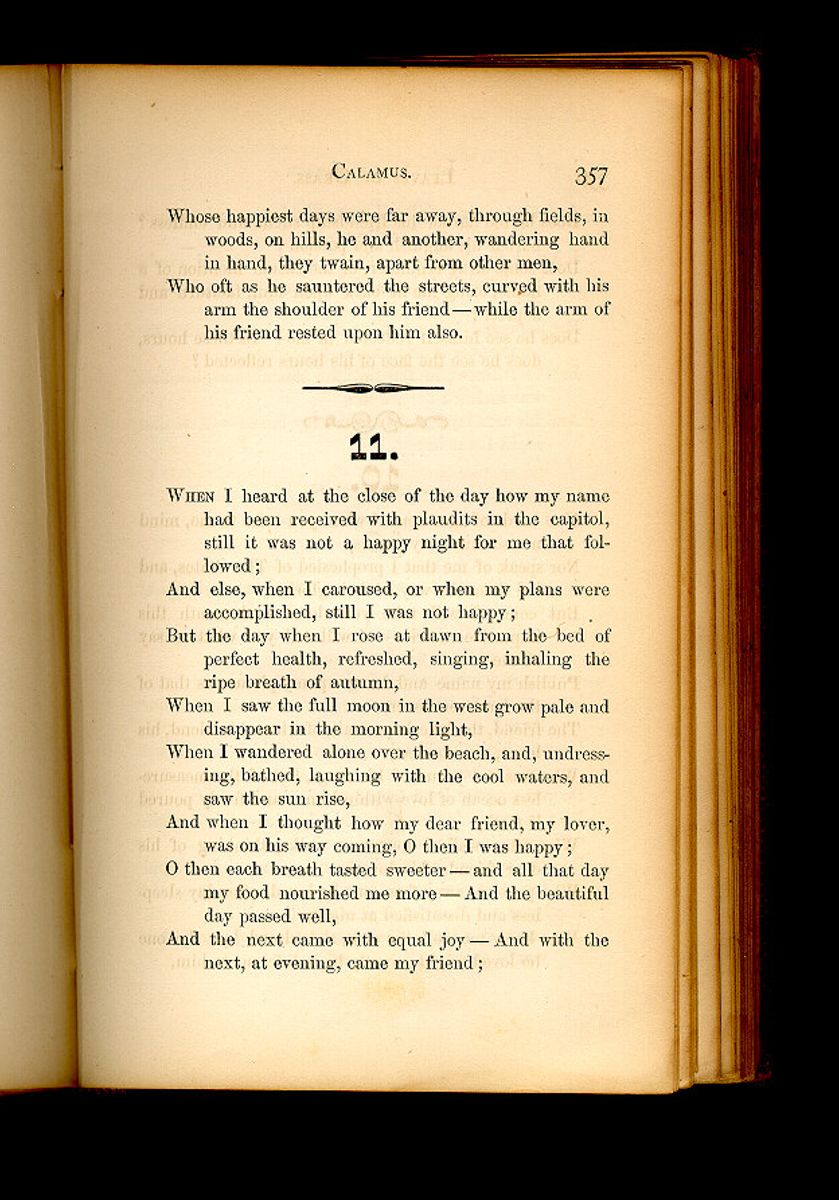 ppp.01500.365.jpg
Whose happiest days were far away, through fields, in
ppp.01500.365.jpg
Whose happiest days were far away, through fields, in woods, on hills, he and another, wandering hand
in hand, they twain, apart from other men, Who oft as he sauntered the streets, curved with his
arm the shoulder of his friend—while the arm of
his friend rested upon him also.
11.
WHEN I heard at the close of the day how my namehad been received with plaudits in the capitol,
still it was not a happy night for me that fol-
lowed; And else, when I caroused, or when my plans were
accomplished, still I was not happy; But the day when I rose at dawn from the bed of
perfect health, refreshed, singing, inhaling the
ripe breath of autumn, When I saw the full moon in the west grow pale and
disappear in the morning light, When I wandered alone over the beach, and, undress-
ing, bathed, laughing with the cool waters, and
saw the sun rise, And when I thought how my dear friend, my lover,
was on his way coming, O then I was happy; O then each breath tasted sweeter—and all that day
my food nourished me more—And the beautiful
day passed well, And the next came with equal joy—And with the
next, at evening, came my friend; [ begin page 358 ]
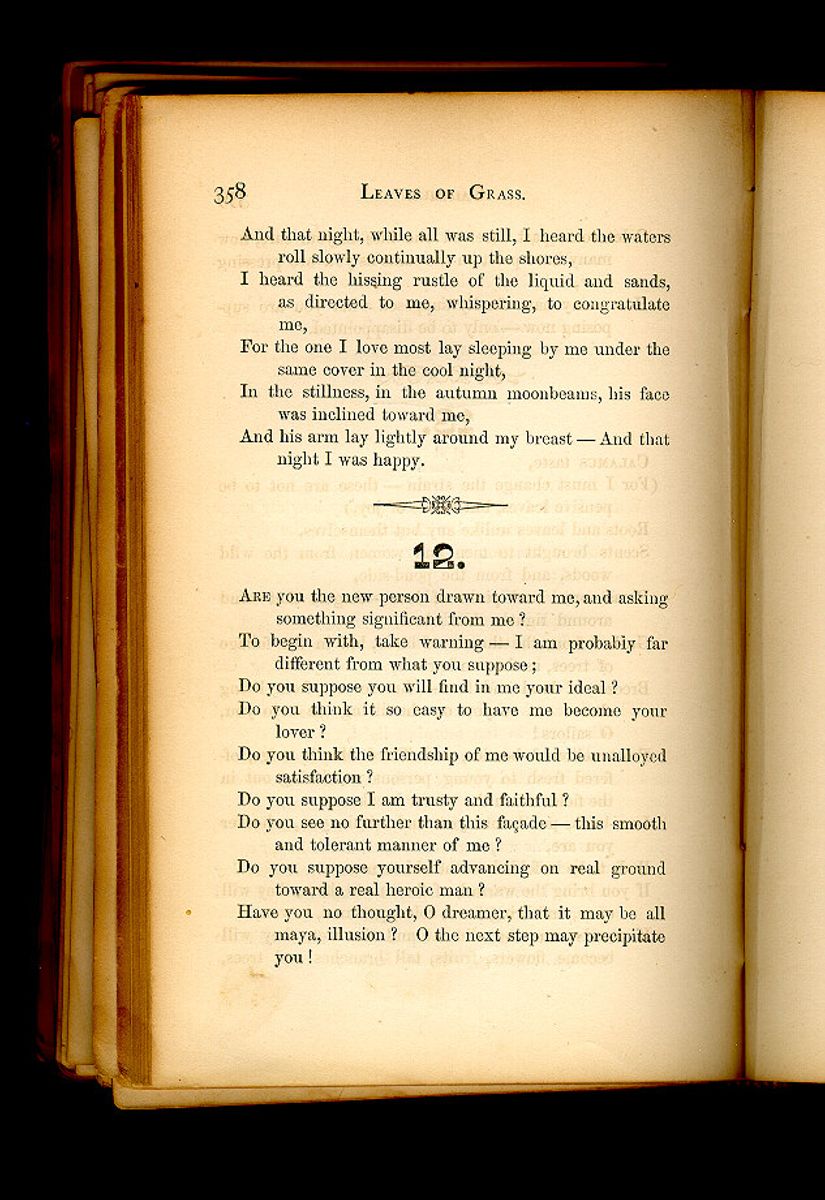 ppp.01500.366.jpg
And that night, while all was still, I heard the waters
ppp.01500.366.jpg
And that night, while all was still, I heard the waters roll slowly continually up the shores, I heard the hissing rustle of the liquid and sands,
as directed to me, whispering, to congratulate
me, For the one I love most lay sleeping by me under the
same cover in the cool night, In the stillness, in the autumn moonbeams, his face
was inclined toward me, And his arm lay lightly around my breast—And that
night I was happy.
12.
ARE you the new person drawn toward me, and askingsomething significant from me? To begin with, take warning—I am probably far
different from what you suppose; Do you suppose you will find in me your ideal? Do you think it so easy to have me become your
lover? Do you think the friendship of me would be unalloyed
satisfaction? Do you suppose I am trusty and faithful? Do you see no further than this façade—this smooth
and tolerant manner of me? Do you suppose yourself advancing on real ground
toward a real heroic man? Have you no thought, O dreamer, that it may be all
maya, illusion? O the next step may precipitate
you! [ begin page 359 ]
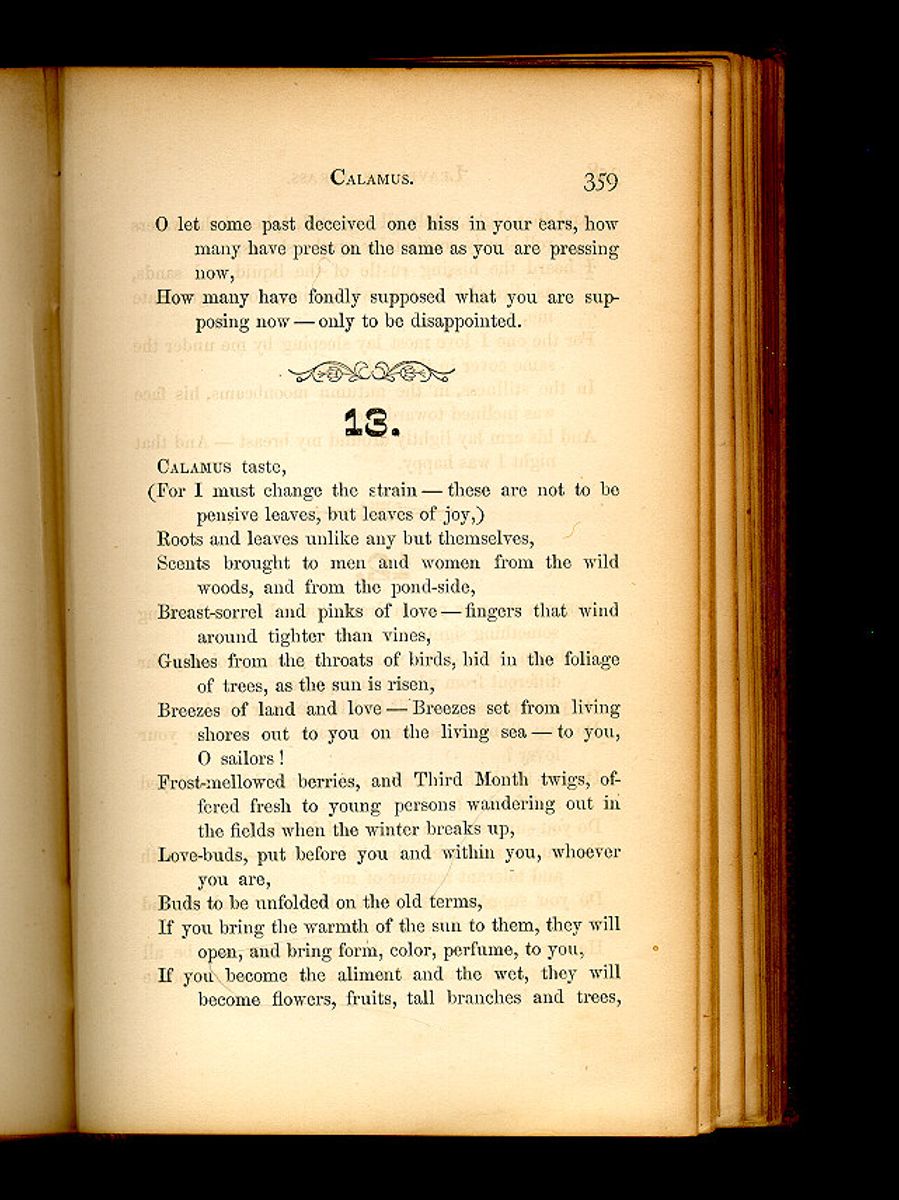 ppp.01500.367.jpg
O let some past deceived one hiss in your ears, how
ppp.01500.367.jpg
O let some past deceived one hiss in your ears, how many have prest on the same as you are pressing
now, How many have fondly supposed what you are sup-
posing now—only to be disappointed.
13.
CALAMUS taste, (For I must change the strain—these are not to bepensive leaves, but leaves of joy,) Roots and leaves unlike any but themselves, Scents brought to men and women from the wild
woods, and from the pond-side, Breast-sorrel and pinks of love—fingers that wind
around tighter than vines, Gushes from the throats of birds, hid in the foliage
of trees, as the sun is risen, Breezes of land and love—Breezes set from living
shores out to you on the living sea—to you,
O sailors! Frost-mellowed berries, and Third Month twigs, of-
fered fresh to young persons wandering out in
the fields when the winter breaks up, Love-buds, put before you and within you, whoever
you are, Buds to be unfolded on the old terms, If you bring the warmth of the sun to them, they will
open, and bring form, color, perfume, to you, If you become the aliment and the wet, they will
become flowers, fruits, tall branches and trees, [ begin page 360 ]
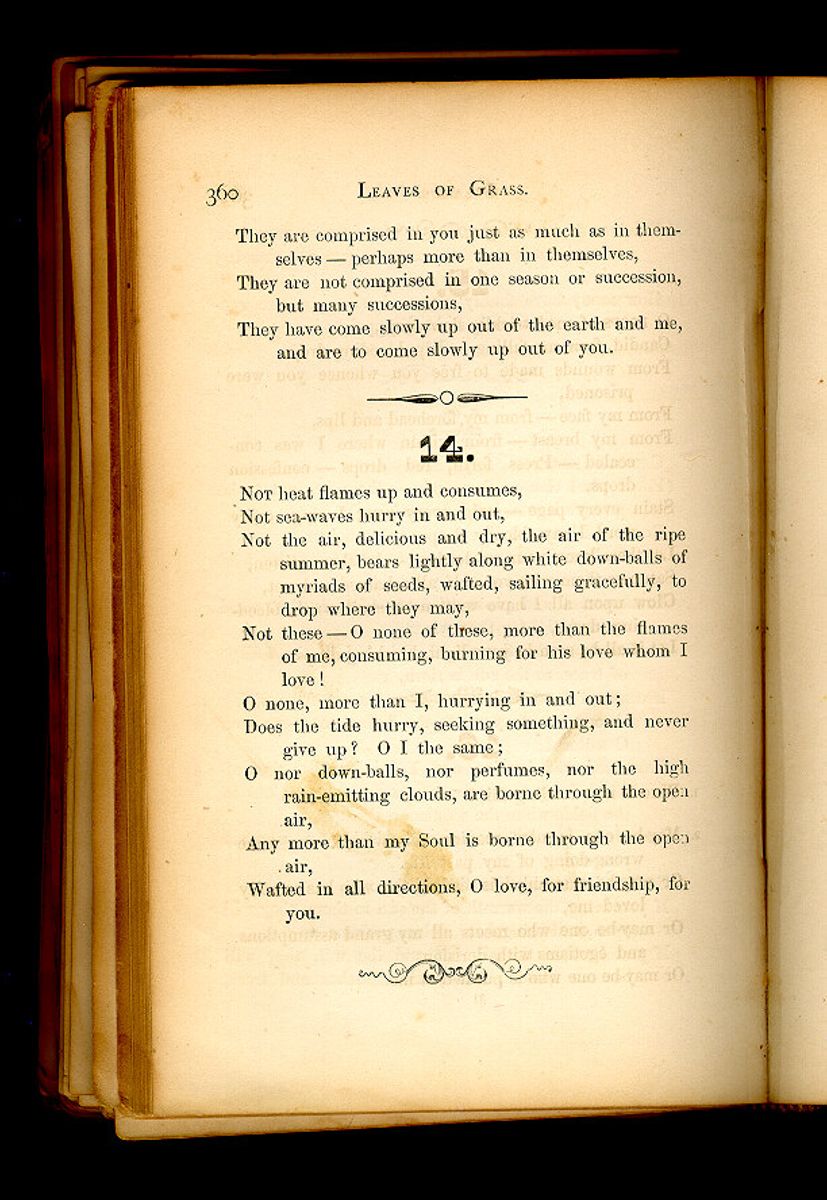 ppp.01500.368.jpg
They are comprised in you just as much as in them-
ppp.01500.368.jpg
They are comprised in you just as much as in them- selves—perhaps more than in themselves, They are not comprised in one season or succession,
but many successions, They have come slowly up out of the earth and me,
and are to come slowly up out of you.
14.
NOT heat flames up and consumes, Not sea-waves hurry in and out, Not the air, delicious and dry, the air of the ripesummer, bears lightly along white down-balls of
myriads of seeds, wafted, sailing gracefully, to
drop where they may, Not these—O none of these, more than the flames
of me, consuming, burning for his love whom I
love! O none, more than I, hurrying in and out; Does the tide hurry, seeking something, and never
give up? O I the same; O nor down-balls, nor perfumes, nor the high
rain-emitting clouds, are borne through the open
air, Any more than my Soul is borne through the open
air, Wafted in all directions, O love, for friendship, for
you. [ begin page 361 ]
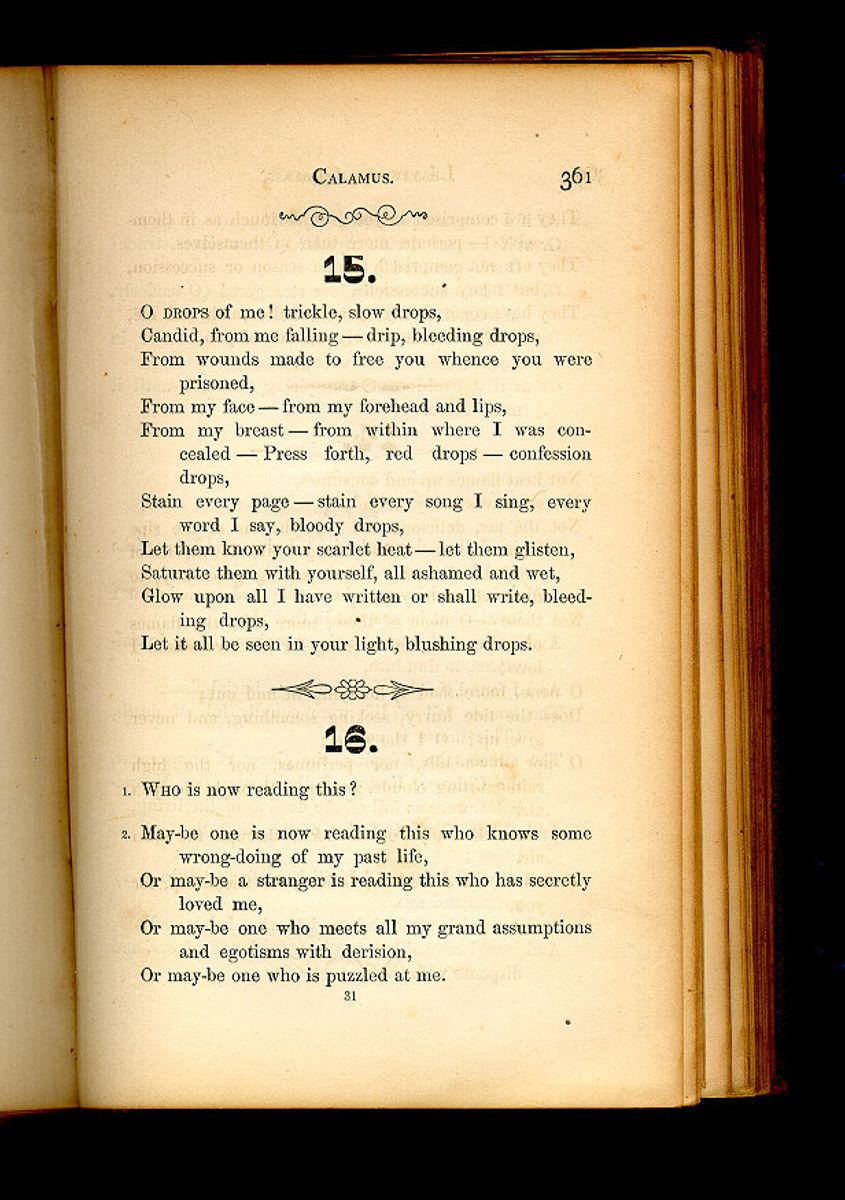 ppp.01500.369.jpg
15.
O DROPS of me! trickle, slow drops, Candid, from me falling—drip, bleeding drops, From wounds made to free you whence you wereprisoned, From my face—from my forehead and lips, From my breast—from within where I was con-
cealed—Press forth, red drops—confession
drops, Stain every page—stain every song I sing, every
word I say, bloody drops, Let them know your scarlet heat—let them glisten, Saturate them with yourself, all ashamed and wet, Glow upon all I have written or shall write, bleed-
ing drops, Let it all be seen in your light, blushing drops.
16.
1WHO is now reading this? 2May-be one is now reading this who knows somewrong-doing of my past life, Or may-be a stranger is reading this who has secretly
loved me, Or may-be one who meets all my grand assumptions
and egotisms with derision, Or may-be one who is puzzled at me. 31 [ begin page 362 ]
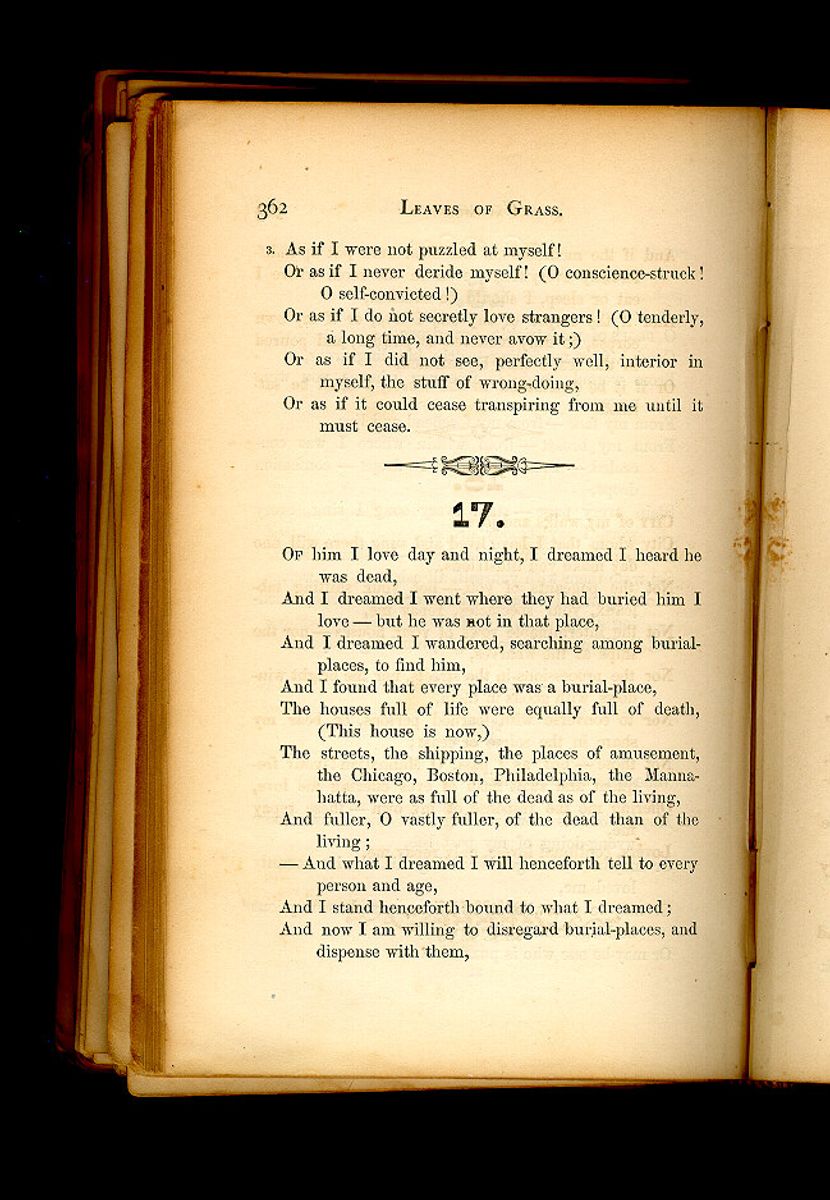 ppp.01500.370.jpg
3As if I were not puzzled at myself!
Or as if I never deride myself! (O conscience-struck!
ppp.01500.370.jpg
3As if I were not puzzled at myself!
Or as if I never deride myself! (O conscience-struck! O self-convicted!) Or as if I do not secretly love strangers! (O tenderly,
a long time, and never avow it;) Or as if I did not see, perfectly well, interior in
myself, the stuff of wrong-doing, Or as if it could cease transpiring from me until it
must cease.
17.
OF him I love day and night, I dreamed I heard hewas dead, And I dreamed I went where they had buried him I
love—but he was not in that place, And I dreamed I wandered, searching among burial-
places, to find him, And I found that every place was a burial-place, The houses full of life were equally full of death,
(This house is now,) The streets, the shipping, the places of amusement,
the Chicago, Boston, Philadelphia, the Manna-
hatta, were as full of the dead as of the living, And fuller, O vastly fuller, of the dead than of the
living; —And what I dreamed I will henceforth tell to every
person and age, And I stand henceforth bound to what I dreamed; And now I am willing to disregard burial-places, and
dispense with them, [ begin page 363 ]
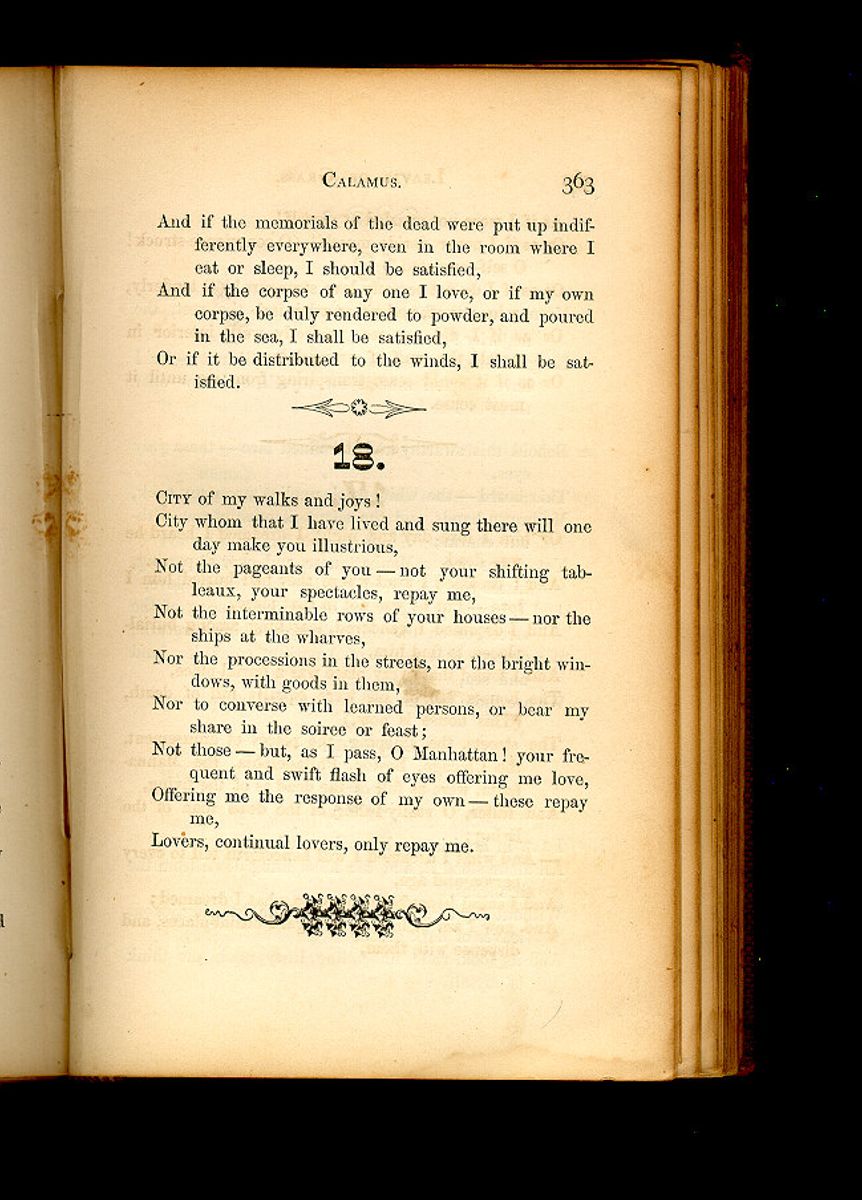 ppp.01500.371.jpg
And if the memorials of the dead were put up indif-
ppp.01500.371.jpg
And if the memorials of the dead were put up indif- ferently everywhere, even in the room where I
eat or sleep, I should be satisfied, And if the corpse of any one I love, or if my own
corpse, be duly rendered to powder, and poured
in the sea, I shall be satisfied, Or if it be distributed to the winds, I shall be sat-
isfied.
18.
CITY of my walks and joys! City whom that I have lived and sung there will oneday make you illustrious, Not the pageants of you—not your shifting tab-
leaux, your spectacles, repay me, Not the interminable rows of your houses—nor the
ships at the wharves, Nor the processions in the streets, nor the bright win-
dows, with goods in them, Nor to converse with learned persons, or bear my
share in the soiree or feast; Not those—but, as I pass, O Manhattan! your fre-
quent and swift flash of eyes offering me love, Offering me the response of my own—these repay
me, Lovers, continual lovers, only repay me. [ begin page 364 ]
 ppp.01500.372.jpg
19.
1MIND you the timid models of the rest, themajority? Long I minded them, but hence I will not—for I
have adopted models for myself, and now offer
them to The Lands. 2Behold this swarthy and unrefined face—these gray
eyes, This beard—the white wool, unclipt upon my neck, My brown hands, and the silent manner of me, with-
out charm; Yet comes one, a Manhattanese, and ever at parting,
kisses me lightly on the lips with robust love, And I, in the public room, or on the crossing of the
street, or on the ship's deck, kiss him in return; We observe that salute of American comrades, land
and sea, We are those two natural and nonchalant persons.
20.
I SAW in Louisiana a live-oak growing, All alone stood it, and the moss hung down from thebranches, Without any companion it grew there, uttering joyous
leaves of dark green, And its look, rude, unbending, lusty, made me think
of myself, [ begin page 365 ]
 ppp.01500.373.jpg
But I wondered how it could utter joyous leaves,
ppp.01500.373.jpg
But I wondered how it could utter joyous leaves, standing alone there, without its friend, its
lover near—for I knew I could not, And I broke off a twig with a certain number of
leaves upon it, and twined around it a little
moss, And brought it away—and I have placed it in sight
in my room, It is not needed to remind me as of my own dear
friends, (For I believe lately I think of little else than of
them,) Yet it remains to me a curious token—it makes me
think of manly love; For all that, and though the live-oak glistens there in
Louisiana, solitary, in a wide flat space, Uttering joyous leaves all its life, without a friend, a
lover, near, I know very well I could not.
21.
MUSIC always round me, unceasing, unbeginning—yet long untaught I did not hear, But now the chorus I hear, and am elated, A tenor, strong, ascending, with power and health,
with glad notes of day-break I hear, A soprano, at intervals, sailing buoyantly over the
tops of immense waves, A transparent base, shuddering lusciously under and
through the universe, 31* [ begin page 366 ]
 ppp.01500.374.jpg
The triumphant tutti—the funeral wailings, with
ppp.01500.374.jpg
The triumphant tutti—the funeral wailings, with sweet flutes and violins—All these I fill myself
with; I hear not the volumes of sound merely—I am
moved by the exquisite meanings, I listen to the different voices winding in and out,
striving, contending with fiery vehemence to
excel each other in emotion, I do not think the performers know themselves—But
now I think I begin to know them.
22.
PASSING stranger! you do not know how longingly Ilook upon you, You must be he I was seeking, or she I was seeking,
(It comes to me, as of a dream,) I have somewhere surely lived a life of joy with
you, All is recalled as we flit by each other, fluid, affec-
tionate, chaste, matured, You grew up with me, were a boy with me, or a girl
with me, I ate with you, and slept with you—your body has
become not yours only, nor left my body mine
only, You give me the pleasure of your eyes, face, flesh, as
we pass—you take of my beard, breast, hands,
in return, I am not to speak to you—I am to think of you
when I sit alone, or wake at night alone, [ begin page 367 ]
 ppp.01500.375.jpg
I am to wait—I do not doubt I am to meet you
ppp.01500.375.jpg
I am to wait—I do not doubt I am to meet you again, I am to see to it that I do not lose you.
23.
THIS moment as I sit alone, yearning and thoughtful,it seems to me there are other men in other
lands, yearning and thoughtful; It seems to me I can look over and behold them,
in Germany, Italy, France, Spain—Or far, far
away, in China, or in Russia or India—talking
other dialects; And it seems to me if I could know those men better,
I should become attached to them, as I do to men
in my own lands, It seems to me they are as wise, beautiful, benevolent,
as any in my own lands; O I know we should be brethren and lovers, I know I should be happy with them.
24.
I HEAR it is charged against me that I seek to destroyinstitutions; But really I am neither for nor against institutions, (What indeed have I in common with them?—Or
what with the destruction of them?) [ begin page 368 ]
 ppp.01500.376.jpg
Only I will establish in the Mannahatta, and in every
ppp.01500.376.jpg
Only I will establish in the Mannahatta, and in every city of These States, inland and seaboard, And in the fields and woods, and above every keel
little or large, that dents the water, Without edifices, or rules, or trustees, or any ar-
gument, The institution of the dear love of comrades.
25.
THE prairie-grass dividing—its own odor breathing, I demand of it the spiritual corresponding, Demand the most copious and close companionshipof men, Demand the blades to rise of words, acts, beings, Those of the open atmosphere, coarse, sunlit, fresh,
nutritious, Those that go their own gait, erect, stepping with
freedom and command—leading, not following, Those with a never-quell'd audacity—those with
sweet and lusty flesh, clear of taint, choice and
chary of its love-power, Those that look carelessly in the faces of Presidents
and Governors, as to say, Who are you? Those of earth-born passion, simple, never constrained,
never obedient, Those of inland America. [ begin page 369 ]
 ppp.01500.377.jpg
26.
WE two boys together clinging, One the other never leaving, Up and down the roads going—North and Southexcursions making, Power enjoying—elbows stretching—fingers clutch-
ing, Armed and fearless—eating, drinking, sleeping, lov-
ing, No law less than ourselves owning—sailing, soldier-
ing, thieving, threatening, Misers, menials, priests alarming—air breathing,
water drinking, on the turf or the sea-beach
dancing, With birds singing—With fishes swimming—With
trees branching and leafing, Cities wrenching, ease scorning, statutes mocking,
feebleness chasing, Fulfilling our foray.
27.
O LOVE! O dying—always dying! O the burials of me, past and present! O me, while I stride ahead, material, visible, imperi-ous as ever! [ begin page 370 ]
 ppp.01500.378.jpg
O me, what I was for years, now dead, (I lament not
ppp.01500.378.jpg
O me, what I was for years, now dead, (I lament not —I am content;), O to disengage myself from those corpses of me,
which I turn and look at, where I cast them! To pass on, (O living! always living!) and leave the
corpses behind!
28.
WHEN I peruse the conquered fame of heroes, and thevictories of mighty generals, I do not envy the
generals, Nor the President in his Presidency, nor the rich in
his great house; But when I read of the brotherhood of lovers, how it
was with them, How through life, through dangers, odium, un-
changing, long and long, Through youth, and through middle and old age, how
unfaltering, how affectionate and faithful they
were, Then I am pensive—I hastily put down the book,
and walk away, filled with the bitterest envy. [ begin page 371 ]
 ppp.01500.379.jpg
29.
ONE flitting glimpse, caught through an interstice, Of a crowd of workmen and drivers in a bar-room,around the stove, late of a winter night—And
I unremarked, seated in a corner; Of a youth who loves me, and whom I love, silently
approaching, and seating himself near, that he
may hold me by the hand; A long while, amid the noises of coming and going
—of drinking and oath and smutty jest, There we two, content, happy in being together,
speaking little, perhaps not a word.
30.
A PROMISE and gift to California, Also to the great Pastoral Plains, and for Oregon: Sojourning east a while longer, soon I travel to you,to remain, to teach robust American love; For I know very well that I and robust love belong
among you, inland, and along the Western
Sea, For These States tend inland, and toward the Western
Sea—and I will also. [ begin page 372 ]
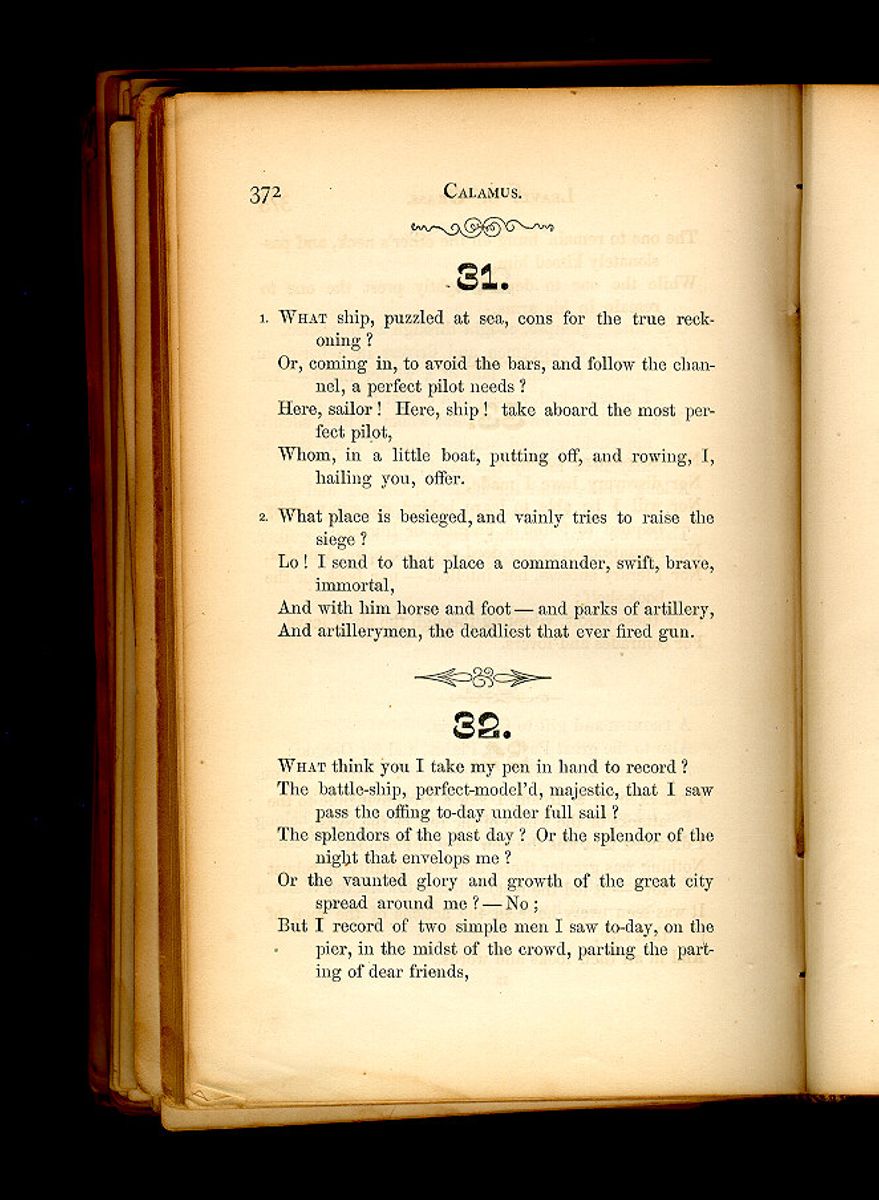 ppp.01500.380.jpg
31.
1WHAT ship, puzzled at sea, cons for the true reck-oning? Or, coming in, to avoid the bars, and follow the chan-
nel, a perfect pilot needs? Here, sailor! Here, ship! take aboard the most per-
fect pilot, Whom, in a little boat, putting off, and rowing, I,
hailing you, offer. 2What place is besieged, and vainly tries to raise the
siege? Lo! I send to that place a commander, swift, brave,
immortal, And with him horse and foot—and parks of artillery, And artillerymen, the deadliest that ever fired gun.
32.
WHAT think you I take my pen in hand to record? The battle-ship, perfect-model'd, majestic, that I sawpass the offing to-day under full sail? The splendors of the past day? Or the splendor of the
night that envelops me? Or the vaunted glory and growth of the great city
spread around me?—No; But I record of two simple men I saw to-day, on the
pier, in the midst of the crowd, parting the part-
ing of dear friends, [ begin page 373 ]
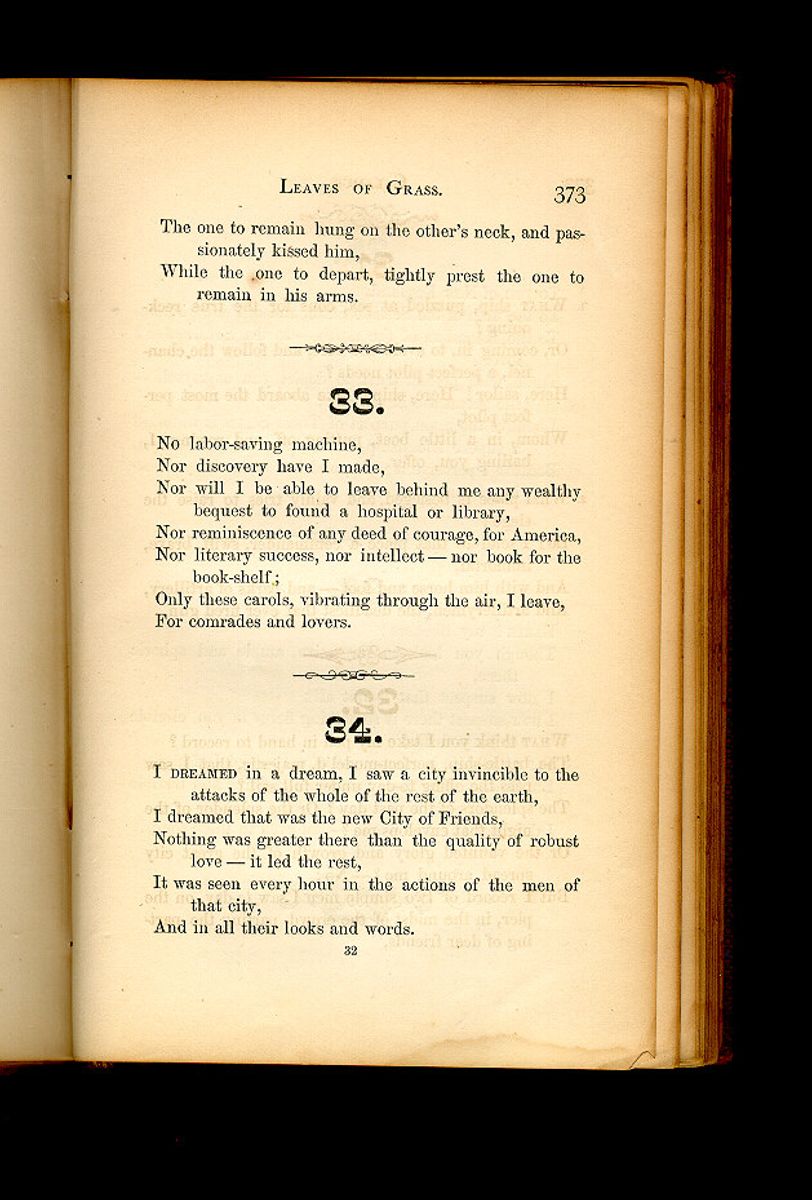 ppp.01500.381.jpg
The one to remain hung on the other's neck, and pas-
ppp.01500.381.jpg
The one to remain hung on the other's neck, and pas- sionately kissed him, While the one to depart, tightly prest the one to
remain in his arms.
33.
NO labor-saving machine, Nor discovery have I made, Nor will I be able to leave behind me any wealthybequest to found a hospital or library, Nor reminiscence of any deed of courage, for America, Nor literary success, nor intellect—nor book for the
book-shelf; Only these carols, vibrating through the air, I leave, For comrades and lovers.
34.
I DREAMED in a dream, I saw a city invincible to theattacks of the whole of the rest of the earth, I dreamed that was the new City of Friends, Nothing was greater there than the quality of robust
love—it led the rest, It was seen every hour in the actions of the men of
that city, And in all their looks and words. 32 [ begin page 374 ]
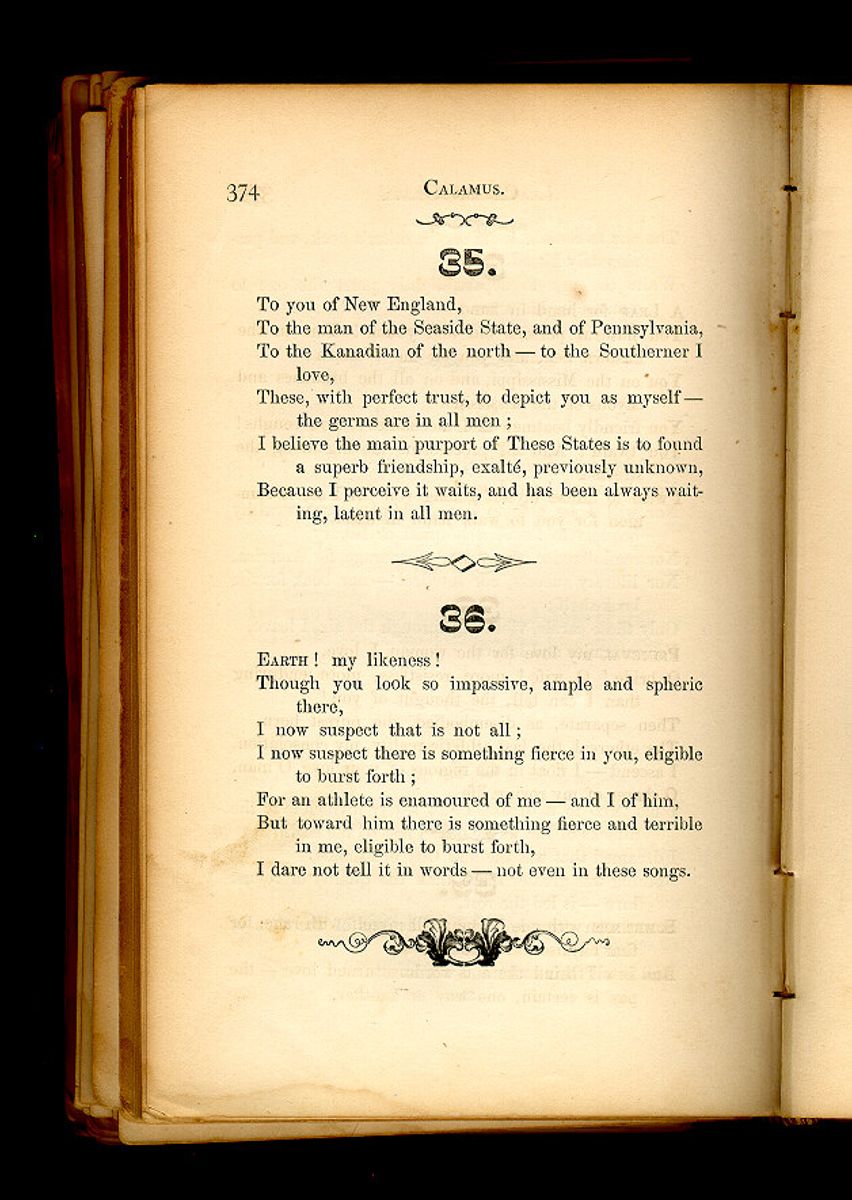 ppp.01500.382.jpg
35.
TO you of New England, To the man of the Seaside State, and of Pennsylvania, To the Kanadian of the north—to the Southerner Ilove, These, with perfect trust, to depict you as myself—
the germs are in all men; I believe the main purport of These States is to found
a superb friendship, exalté, previously unknown, Because I perceive it waits, and has been always wait-
ing, latent in all men.
36.
EARTH! my likeness! Though you look so impassive, ample and sphericthere, I now suspect that is not all; I now suspect there is something fierce in you, eligible
to burst forth; For an athlete is enamoured of me—and I of him, But toward him there is something fierce and terrible
in me, eligible to burst forth, I dare not tell it in words—not even in these songs. [ begin page 375 ]
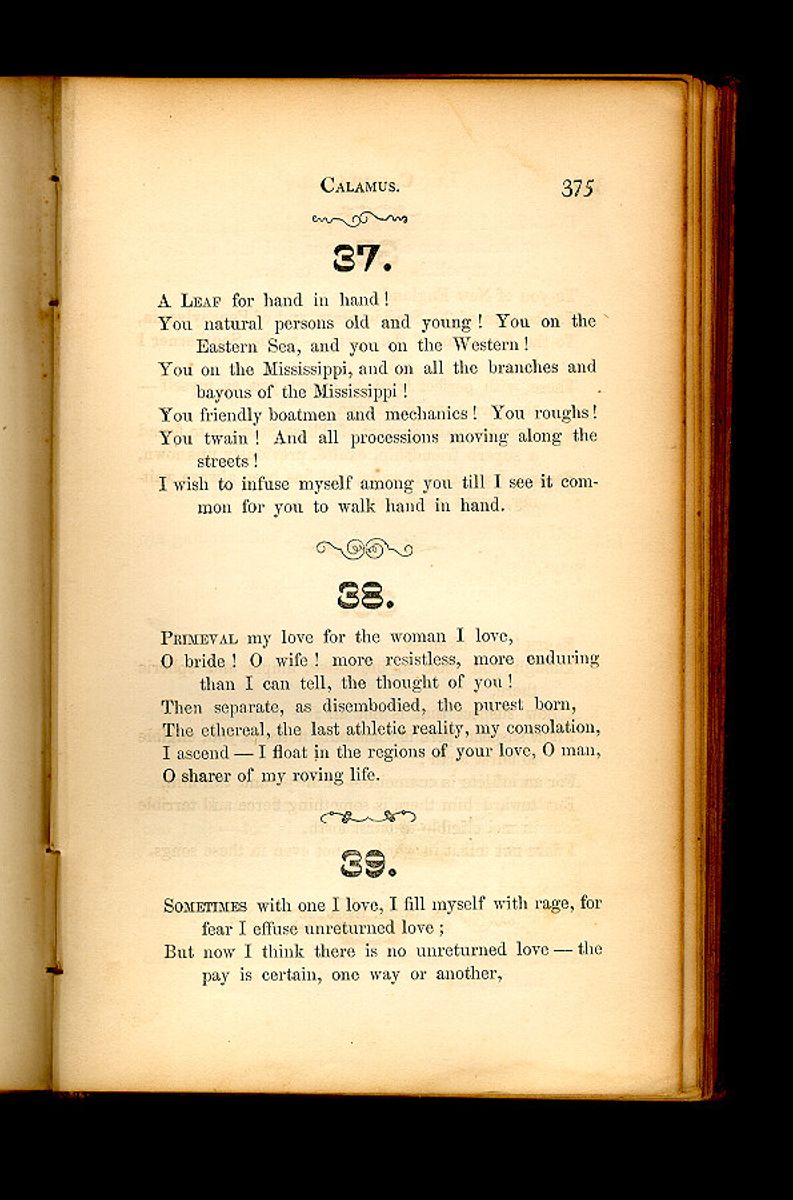 ppp.01500.383.jpg
37.
A LEAF for hand in hand! You natural persons old and young! You on theEastern Sea, and you on the Western! You on the Mississippi, and on all the branches and
bayous of the Mississippi! You friendly boatmen and mechanics! You roughs! You twain! And all processions moving along the
streets! I wish to infuse myself among you till I see it com-
mon for you to walk hand in hand.
38.
PRIMEVAL my love for the woman I love, O bride ! O wife ! more resistless, more enduringthan I can tell, the thought of you ! Then separate, as disembodied, the purest born, The ethereal, the last athletic reality, my consolation, I ascend—I float in the regions of your love, O man, O sharer of my roving life.
39.
SOMETIMES with one I love, I fill myself with rage, forfear I effuse unreturned love; But now I think there is no unreturned love—the
pay is certain, one way or another, [ begin page 376 ]
 ppp.01500.384.jpg
Doubtless I could not have perceived the universe,
ppp.01500.384.jpg
Doubtless I could not have perceived the universe, or written one of my poems, if I had not freely
given myself to comrades, to love.
40.
THAT shadow, my likeness, that goes to and fro, seek-ing a livelihood, chattering, chaffering, How often I find myself standing and looking at it
where it flits, How often I question and doubt whether that is really
me; But in these, and among my lovers, and carolling my
songs, O I never doubt whether that is really me.
41.
1AMONG the men and women, the multitude, I per-ceive one picking me out by secret and divine
signs, Acknowledging none else—not parent, wife, hus-
band, brother, child, any nearer than I am; Some are baffled—But that one is not—that one
knows me. 2Lover and perfect equal! I meant that you should discover me so, by my faint
indirections, And I, when I meet you, mean to discover you by the
like in you. [ begin page 377 ]
 ppp.01500.385.jpg
42.
TO the young man, many things to absorb, to engraft,to develop, I teach, to help him become élève of
mine, But if blood like mine circle not in his veins, If he be not silently selected by lovers, and do not
silently select lovers, Of what use is it that he seek to become élève of
mine?
43.
O YOU whom I often and silently come where youare, that I may be with you, As I walk by your side, or sit near, or remain in the
same room with you, Little you know the subtle electric fire that for your
sake is playing within me.
44.
HERE my last words, and the most baffling, Here the frailest leaves of me, and yet my strongest-lasting, Here I shade down and hide my thoughts—I do not
expose them, And yet they expose me more than all my other
poems. 32* [ begin page 378 ]
 ppp.01500.386.jpg
45.
1FULL of life, sweet-blooded, compact, visible, I, forty years old the Eighty-third Year of The States, To one a century hence, or any number of centurieshence, To you, yet unborn, these, seeking you. 2When you read these, I, that was visible, am become
invisible; Now it is you, compact, visible, realizing my poems,
seeking me, Fancying how happy you were, if I could be with
you, and become your lover; Be it as if I were with you. Be not too certain but I
am now with you. [ begin page 379 ]
 ppp.01500.387.jpg
CROSSING BROOKLYN FERRY.
1FLOOD-TIDE below me! I watch you, face to face; Clouds of the west! sun there half an hour high! Isee you also face to face. 2Crowds of men and women attired in the usual cos-
tumes! how curious you are to me! On the ferry-boats, the hundreds and hundreds that
cross, returning home, are more curious to me
than you suppose, And you that shall cross from shore to shore years
hence, are more to me, and more in my med-
itations, than you might suppose. 3The impalpable sustenance of me from all things, at
all hours of the day, The simple, compact, well-joined scheme—myself
disintegrated, every one disintegrated, yet part
of the scheme, The similitudes of the past, and those of the future, The glories strung like beads on my smallest sights
and hearings—on the walk in the street, and
the passage over the river, [ begin page 380 ]
 ppp.01500.388.jpg
The current rushing so swiftly, and swimming with
ppp.01500.388.jpg
The current rushing so swiftly, and swimming with me far away, The others that are to follow me, the ties between me
and them, The certainty of others—the life, love, sight, hear-
ing of others. 4Others will enter the gates of the ferry, and cross
from shore to shore, Others will watch the run of the flood-tide, Others will see the shipping of Manhattan north and
west, and the heights of Brooklyn to the south
and east, Others will see the islands large and small, Fifty years hence, others will see them as they cross,
the sun half an hour high, A hundred years hence, or ever so many hundred
years hence, others will see them, Will enjoy the sunset, the pouring in of the flood-
tide, the falling back to the sea of the ebb-tide. 5It avails not, neither time or place—distance avails
not, I am with you, you men and women of a generation,
or ever so many generations hence, I project myself—also I return—I am with you, and
know how it is. 6Just as you feel when you look on the river and sky,
so I felt, Just as any of you is one of a living crowd, I was one
of a crowd, Just as you are refreshed by the gladness of the river,
and the bright flow, I was refreshed, [ begin page 381 ]
 ppp.01500.389.jpg
Just as you stand and lean on the rail, yet hurry with
ppp.01500.389.jpg
Just as you stand and lean on the rail, yet hurry with the swift current, I stood, yet was hurried, Just as you look on the numberless masts of ships,
and the thick-stemmed pipes of steamboats, I
looked. 7I too many and many a time crossed the river, the
sun half an hour high, I watched the Twelfth Month sea-gulls—I saw them
high in the air, floating with motionless wings,
oscillating their bodies, I saw how the glistening yellow lit up parts of their
bodies, and left the rest in strong shadow, I saw the slow-wheeling circles, and the gradual
edging toward the south. 8I too saw the reflection of the summer sky in the
water, Had my eyes dazzled by the shimmering track of
beams, Looked at the fine centrifugal spokes of light round
the shape of my head in the sun-lit water, Looked on the haze on the hills southward and south-
westward, Looked on the vapor as it flew in fleeces tinged with
violet, Looked toward the lower bay to notice the arriving
ships, Saw their approach, saw aboard those that were near
me, Saw the white sails of schooners and sloops, saw the
ships at anchor, The sailors at work in the rigging, or out astride the
spars, [ begin page 382 ]
 ppp.01500.390.jpg
The round masts, the swinging motion of the hulls,
ppp.01500.390.jpg
The round masts, the swinging motion of the hulls, the slender serpentine pennants, The large and small steamers in motion, the pilots in
their pilot-houses, The white wake left by the passage, the quick trem-
ulous whirl of the wheels, The flags of all nations, the falling of them at sun-set, The scallop-edged waves in the twilight, the ladled
cups, the frolicsome crests and glistening, The stretch afar growing dimmer and dimmer, the
gray walls of the granite store-houses by the
docks, On the river the shadowy group, the big steam-tug
closely flanked on each side by the barges—the
hay-boat, the belated lighter, On the neighboring shore, the fires from the foundry
chimneys burning high and glaringly into the
night, Casting, their flicker of black, contrasted with wild
red and yellow light, over the tops of houses,
and down into the clefts of streets. 9These, and all else, were to me the same as they are
to you, I project myself a moment to tell you—also I
return. 10I loved well those cities, I loved well the stately and rapid river, The men and women I saw were all near to me, Others the same—others who look back on me,
because I looked forward to them, (The time will come, though I stop here to-day and
to-night.) [ begin page 383 ]
 ppp.01500.391.jpg
11What is it, then, between us?
What is the count of the scores or hundreds of years
ppp.01500.391.jpg
11What is it, then, between us?
What is the count of the scores or hundreds of years between us? 12Whatever it is, it avails not—distance avails not, and
place avails not. 13I too lived, (I was of old Brooklyn,) I too walked the streets of Manhattan Island, and
bathed in the waters around it, I too felt the curious abrupt questionings stir within
me, In the day, among crowds of people, sometimes they
came upon me, In my walks home late at night, or as I lay in my
bed, they came upon me. 14I too had been struck from the float forever held in
solution, I too had received identity by my body, That I was, I knew was of my body—and what I
should be, I knew I should be of my body. 15It is not upon you alone the dark patches fall, The dark threw patches down upon me also, The best I had done seemed to me blank and sus-
picious, My great thoughts, as I supposed them, were they not
in reality meagre? would not people laugh
at me? 16It is not you alone who know what it is to be evil, I am he who knew what it was to be evil, [ begin page 384 ]
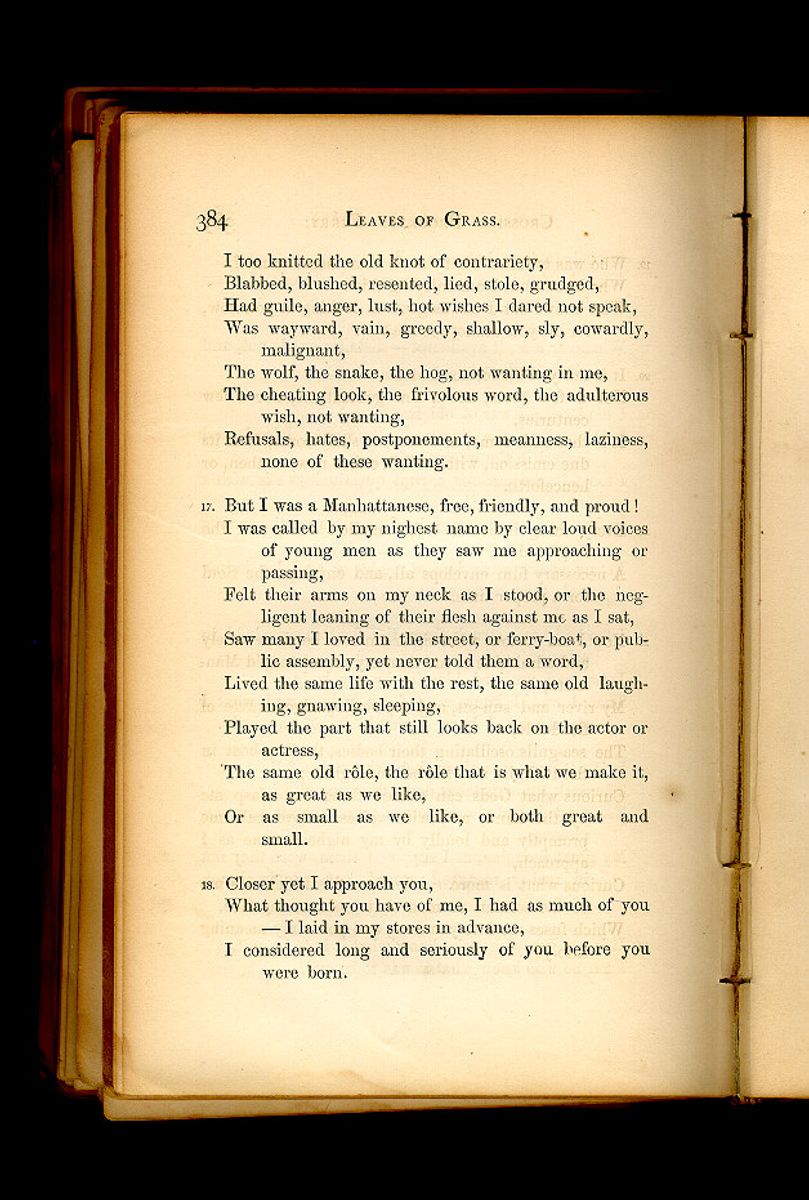 ppp.01500.392.jpg
I too knitted the old knot of contrariety,
Blabbed, blushed, resented, lied, stole, grudged,
Had guile, anger, lust, hot wishes I dared not speak,
Was wayward, vain, greedy, shallow, sly, cowardly,
ppp.01500.392.jpg
I too knitted the old knot of contrariety,
Blabbed, blushed, resented, lied, stole, grudged,
Had guile, anger, lust, hot wishes I dared not speak,
Was wayward, vain, greedy, shallow, sly, cowardly, malignant, The wolf, the snake, the hog, not wanting in me, The cheating look, the frivolous word, the adulterous
wish, not wanting, Refusals, hates, postponements, meanness, laziness,
none of these wanting. 17But I was a Manhattanese, free, friendly, and proud I was called by my nighest name by clear loud voices
of young men as they saw me approaching or
passing, Felt their arms on my neck as I stood, or the neg-
ligent leaning of their flesh against me as I sat, Saw many I loved in the street, or ferry-boat, or pub-
lic assembly, yet never told them a word, Lived the same life with the rest, the same old laugh-
ing, gnawing, sleeping, Played the part that still looks back on the actor or
actress, The same old rôle, the rôle that is what we make it,
as great as we like, Or as small as we like, or both great and
small. 18Closer yet I approach you, What thought you have of me, I had as much of you
—I laid in my stores in advance, I considered long and seriously of you before you
were born. [ begin page 385 ]
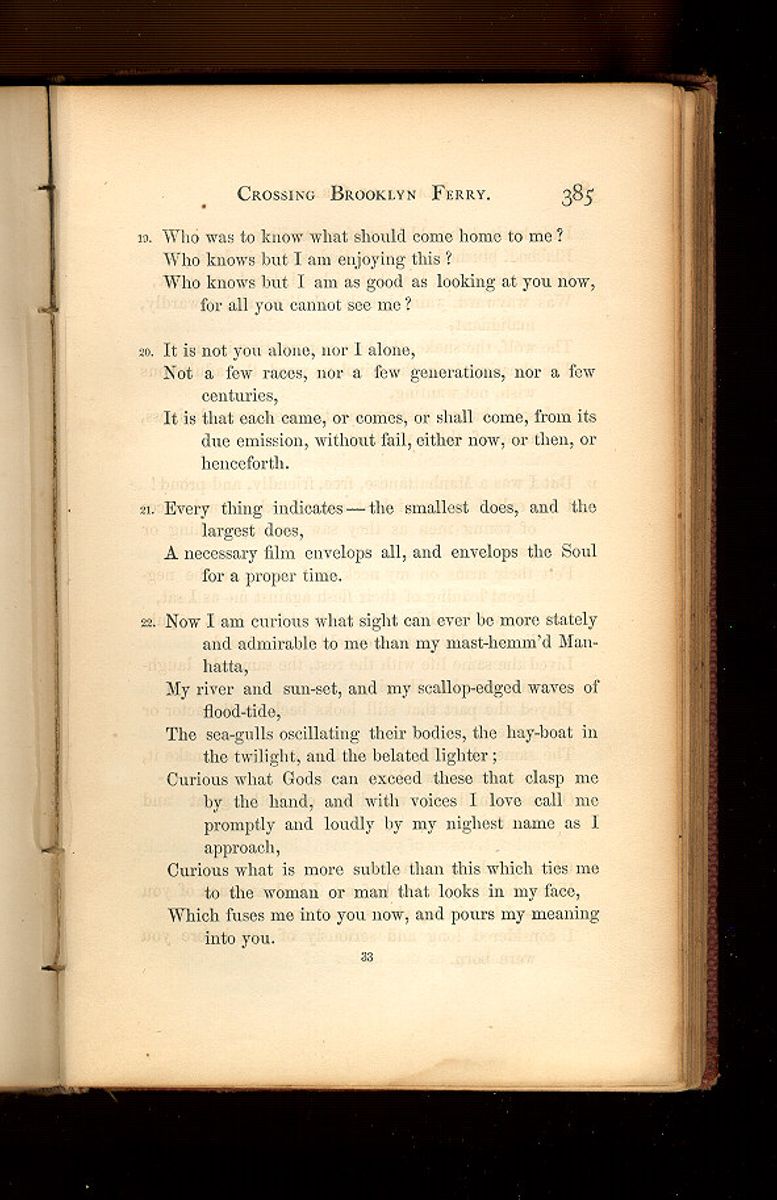 ppp.01500.393.jpg
19Who was to know what should come home to me?
Who knows but I am enjoying this?
Who knows but I am as good as looking at you now,
ppp.01500.393.jpg
19Who was to know what should come home to me?
Who knows but I am enjoying this?
Who knows but I am as good as looking at you now, for all you cannot see me? 20It is not you alone, nor I alone, Not a few races, nor a few generations, nor a few
centuries, It is that each came, or comes, or shall come, from its
due emission, without fail, either now, or then, or
henceforth. 21Every thing indicates—the smallest does, and the
largest does, A necessary film envelops all, and envelops the Soul
for a proper time. 22Now I am curious what sight can ever be more stately
and admirable to me than my mast-hemm'd Man-
hatta, My river and sun-set, and my scallop-edged waves of
flood-tide, The sea-gulls oscillating their bodies, the hay-boat in
the twilight, and the belated lighter; Curious what Gods can exceed these that clasp me
by the hand, and with voices I love call me
promptly and loudly by my nighest name as I
approach, Curious what is more subtle than this which ties me
to the woman or man that looks in my face, Which fuses me into you now, and pours my meaning
into you. 33 [ begin page 386 ]
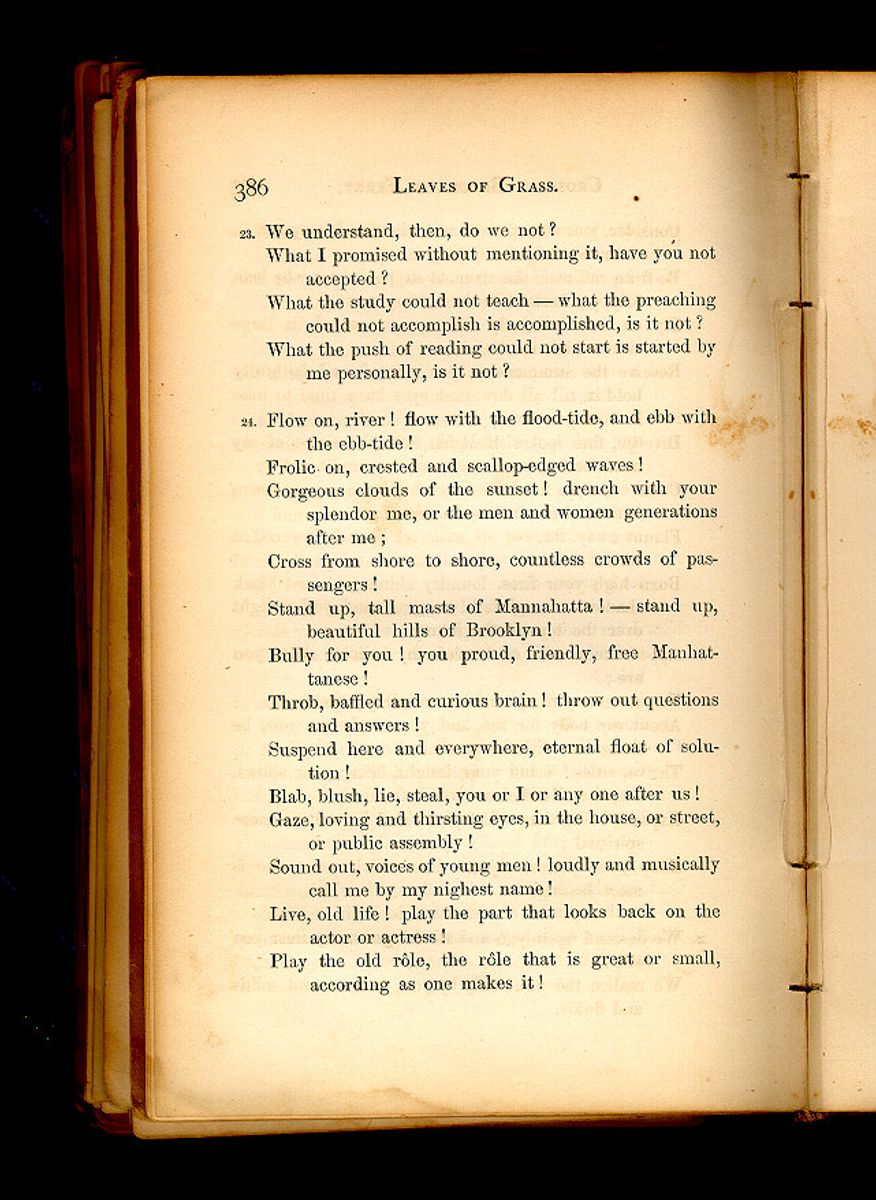 ppp.01500.394.jpg
23We understand, then, do we not?
What I promised without mentioning it, have you not
ppp.01500.394.jpg
23We understand, then, do we not?
What I promised without mentioning it, have you not accepted? What the study could not teach—what the preaching
could not accomplish is accomplished, is it not? What the push of reading could not start is started by
me personally, is it not? 24Flow on, river! flow with the flood-tide, and ebb with
the ebb-tide! Frolic on, crested and scallop-edged waves! Gorgeous clouds of the sunset! drench with your
splendor me, or the men and women generations
after me; Cross from shore to shore, countless crowds of pas-
sengers! Stand up, tall masts of Mannahatta!—stand up,
beautiful hills of Brooklyn! Bully for you! you proud, friendly, free Manhat-
tanese! Throb, baffled and curious brain! throw out questions
and answers! Suspend here and everywhere, eternal float of solu-
tion! Blab, blush, lie, steal, you or I or any one after us! Gaze, loving and thirsting eyes, in the house, or street,
or public assembly! Sound out, voices of young men! loudly and musically
call me by my nighest name! Live, old life! play the part that looks back on the
actor or actress! Play the old rôle, the rôle that is great or small,
according as one makes it! [ begin page 387 ]
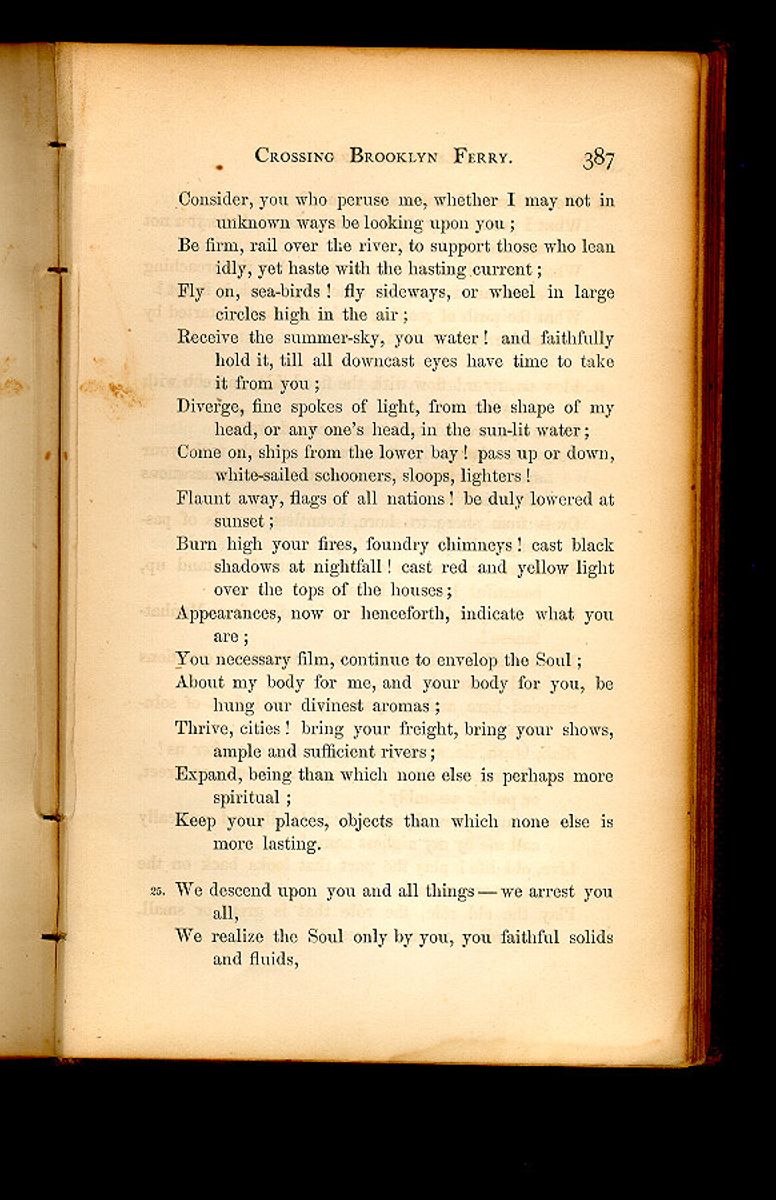 ppp.01500.395.jpg
Consider, you who peruse me, whether I may not in
ppp.01500.395.jpg
Consider, you who peruse me, whether I may not in unknown ways be looking upon you; Be firm, rail over the river, to support those who lean
idly, yet haste with the hasting current; Fly on, sea-birds! fly sideways, or wheel in large
circles high in the air; Receive the summer-sky, you water! and faithfully
hold it, till all downcast eyes have time to take
it from you; Diverge, fine spokes of light, from the shape of my
head, or any one's head, in the sun-lit water; Come on, ships from the lower bay! pass up or down,
white-sailed schooners, sloops, lighters! Flaunt away, flags of all nations! be duly lowered at
sunset; Burn high your fires, foundry chimneys! cast black
shadows at nightfall! cast red and yellow light
over the tops of the houses; Appearances, now or henceforth, indicate what you
are; You necessary film, continue to envelop the Soul; About my body for me, and your body for you, be
hung our divinest aromas; Thrive, cities! bring your freight, bring your shows,
ample and sufficient rivers; Expand, being than which none else is perhaps more
spiritual; Keep your places, objects than which none else is
more lasting. 25We descend upon you and all things—we arrest you
all, We realize the Soul only by you, you faithful solids
and fluids, [ begin page 388 ]
 ppp.01500.396.jpg
Through you color, form, location, sublimity, ideality,
Through you every proof, comparison, and all the
ppp.01500.396.jpg
Through you color, form, location, sublimity, ideality,
Through you every proof, comparison, and all the suggestions and determinations of ourselves. 26You have waited, you always wait, you dumb, beauti-
ful ministers! you novices! We receive you with free sense at last, and are
insatiate henceforward, Not you any more shall be able to foil us, or with-
hold yourselves from us, We use you, and do not cast you aside—we plant
you permanently within us, We fathom you not—we love you—there is per-
fection in you also, You furnish your parts toward eternity, Great or small, you furnish your parts toward the
Soul. [ begin page 389 ]
 ppp.01500.397.jpg
LONGINGS FOR HOME.
O MAGNET-SOUTH! O glistening, perfumed South! MySouth! O quick mettle, rich blood, impulse, and love! Good
and evil! O all dear to me! O dear to me my birth-things—All moving things,
and the trees where I was born—the grains,
plants, rivers; Dear to me my own slow sluggish rivers where they
flow, distant, over flats of silvery sands, or
through swamps, Dear to me the Roanoke, the Savannah, the Altama-
haw, the Pedee, the Tombigbee, the Santee, the
Coosa, and the Sabine; O pensive, far away wandering, I return with my Soul
to haunt their banks again, Again in Florida I float on transparent lakes—I float
on the Okeechobee—I cross the hummock land,
or through pleasant openings, or dense forests, I see the parrots in the woods—I see the papaw tree
and the blossoming titi; Again, sailing in my coaster, on deck, I coast off
Georgia—I coast up the Carolinas, I see where the live-oak is growing—I see where the
yellow-pine, the scented bay-tree, the lemon and
orange, the cypress, the graceful palmetto; I pass rude sea-headlands and enter Pamlico Sound
through an inlet, and dart my vision inland, 33* [ begin page 390 ]
 ppp.01500.398.jpg
O the cotton plant! the growing fields of rice, sugar,
ppp.01500.398.jpg
O the cotton plant! the growing fields of rice, sugar, hemp! The cactus, guarded with thorns—the laurel-tree,
with large white flowers, The range afar—the richness and barrenness—the
old woods charged with mistletoe and trailing
moss, The piney odor and the gloom—the awful natural
stillness, (Here in these dense swamps the free-
booter carries his gun, and the fugitive slave has
his concealed hut;) O the strange fascination of these half-known, half-
impassable swamps, infested by reptiles, resound-
ing with the bellow of the alligator, the sad noises
of the night-owl and the wild-cat, and the whirr
of the rattlesnake; The mocking-bird, the American mimic, singing all
the forenoon—singing through the moon-lit
night, The humming-bird, the wild-turkey, the raccoon, the
opossum; A Tennessee corn-field—the tall, graceful, long-leaved
corn—slender, flapping, bright green, with tas-
sels—with beautiful ears, each well-sheathed in
its husk, An Arkansas prairie—a sleeping lake, or still bayou; O my heart! O tender and fierce pangs—I can stand
them not—I will depart; O to be a Virginian, where I grew up! O to be a
Carolinian! O longings irrepressible! O I will go back to old Ten-
nessee, and never wander more! [ begin page 391 ]
 ppp.01500.399.jpg
MESSENGER LEAVES.
To You, Whoever You Are.
WHOEVER you are, I fear you are walking the walks ofdreams, I fear those realities are to melt from under your feet
and hands; Even now, your features, joys, speech, house, trade,
manners, troubles, follies, costume, crimes, dis-
sipate away from you, Your true Soul and body appear before me, They stand forth out of affairs—out of commerce,
shops, law, science, work, farms, clothes, the
house, medicine, print, buying, selling, eating,
drinking, suffering, dying. 2Whoever you are, now I place my hand upon you,
that you be my poem, I whisper with my lips close to your ear, I have loved many women and men, but I love none
better than you. 3O I have been dilatory and dumb, I should have made my way straight to you long ago, I should have blabbed nothing but you, I should have
chanted nothing but you. [ begin page 392 ]
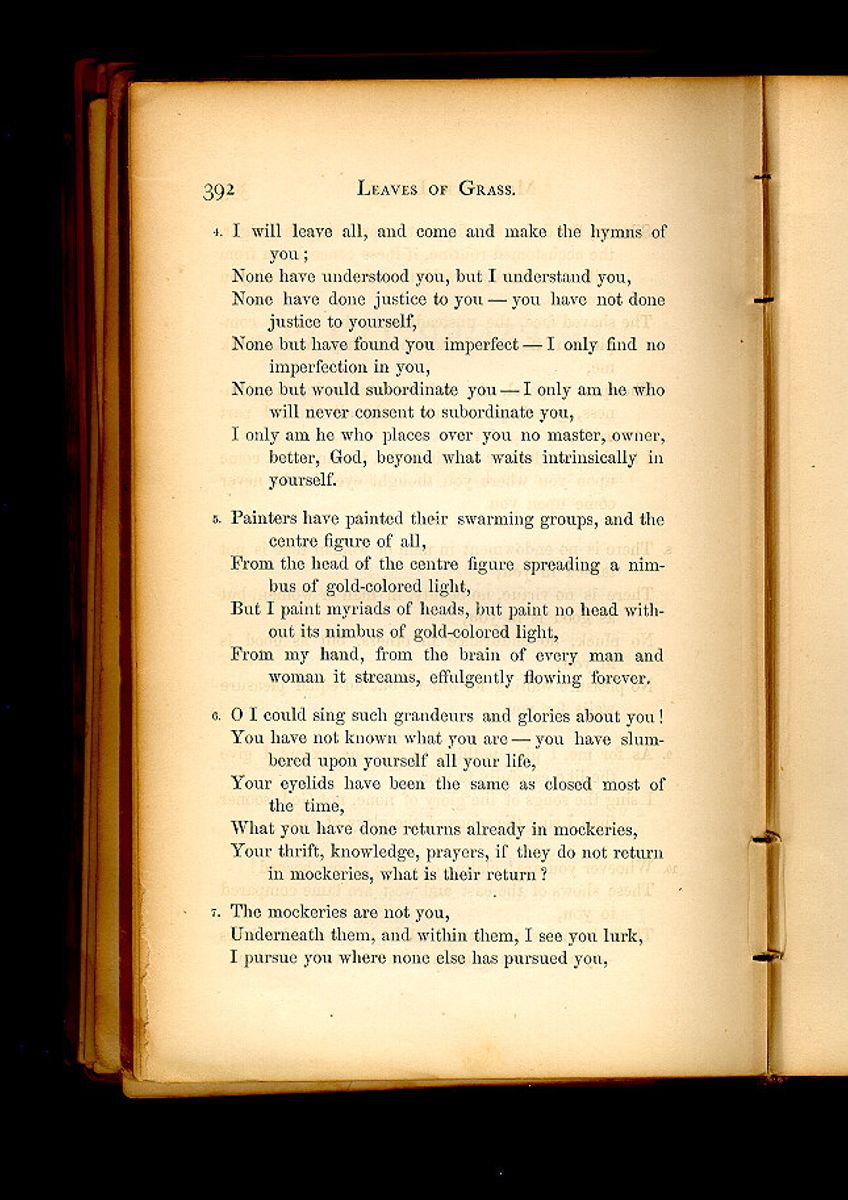 ppp.01500.400.jpg
4I will leave all, and come and make the hymns of
ppp.01500.400.jpg
4I will leave all, and come and make the hymns of you; None have understood you, but I understand you, None have done justice to you—you have not done
justice to yourself, None but have found you imperfect—I only find no
imperfection in you, None but would subordinate you—I only am he who
will never consent to subordinate you, I only am he who places over you no master, owner,
better, God, beyond what waits intrinsically in
yourself. 5Painters have painted their swarming groups, and the
centre figure of all, From the head of the centre figure spreading a nim-
bus of gold-colored light, But I paint myriads of heads, but paint no head with-
out its nimbus of gold-colored light, From my hand, from the brain of every man and
woman it streams, effulgently flowing forever. 6O I could sing such grandeurs and glories about you! You have not known what you are—you have slum-
bered upon yourself all your life, Your eyelids have been the same as closed most of
the time, What you have done returns already in mockeries, Your thrift, knowledge, prayers, if they do not return
in mockeries, what is their return? 7The mockeries are not you, Underneath them, and within them, I see you lurk, I pursue you where none else has pursued you, [ begin page 393 ]
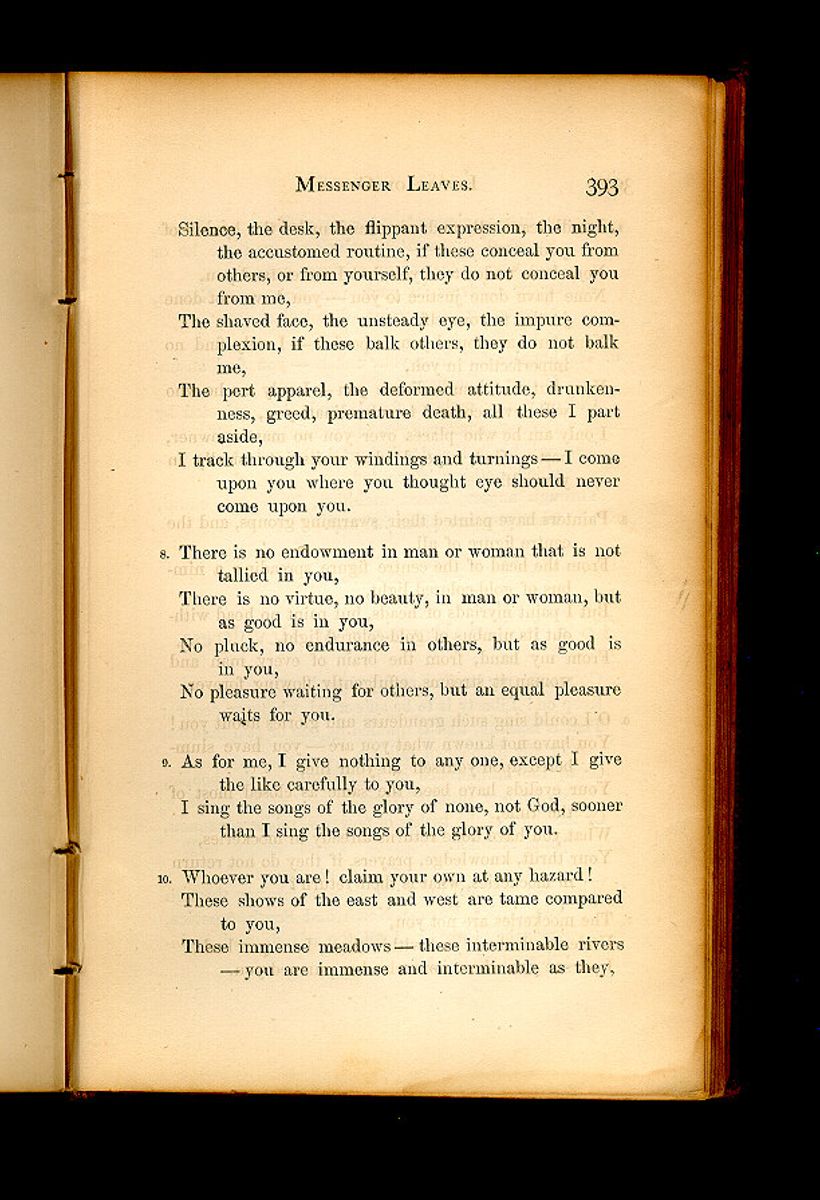 ppp.01500.401.jpg
Silence, the desk, the flippant expression, the night,
ppp.01500.401.jpg
Silence, the desk, the flippant expression, the night, the accustomed routine, if these conceal you from
others, or from yourself, they do not conceal you
from me, The shaved face, the unsteady eye, the impure com-
plexion, if these balk others, they do not balk
me, The pert apparel, the deformed attitude, drunken-
ness, greed, premature death, all these I part
aside, I track through your windings and turnings—I come
upon you where you thought eye should never
come upon you. 8There is no endowment in man or woman that is not
tallied in you, There is no virtue, no beauty, in man or woman, but
as good is in you, No pluck, no endurance in others, but as good is
in you, No pleasure waiting for others, but an equal pleasure
waits for you. 9As for me, I give nothing to any one, except I give
the like carefully to you, I sing the songs of the glory of none, not God, sooner
than I sing the songs of the glory of you. 10Whoever you are! claim your own at any hazard! These shows of the east and west are tame compared
to you, These immense meadows—these interminable rivers
—you are immense and interminable as they, [ begin page 394 ]
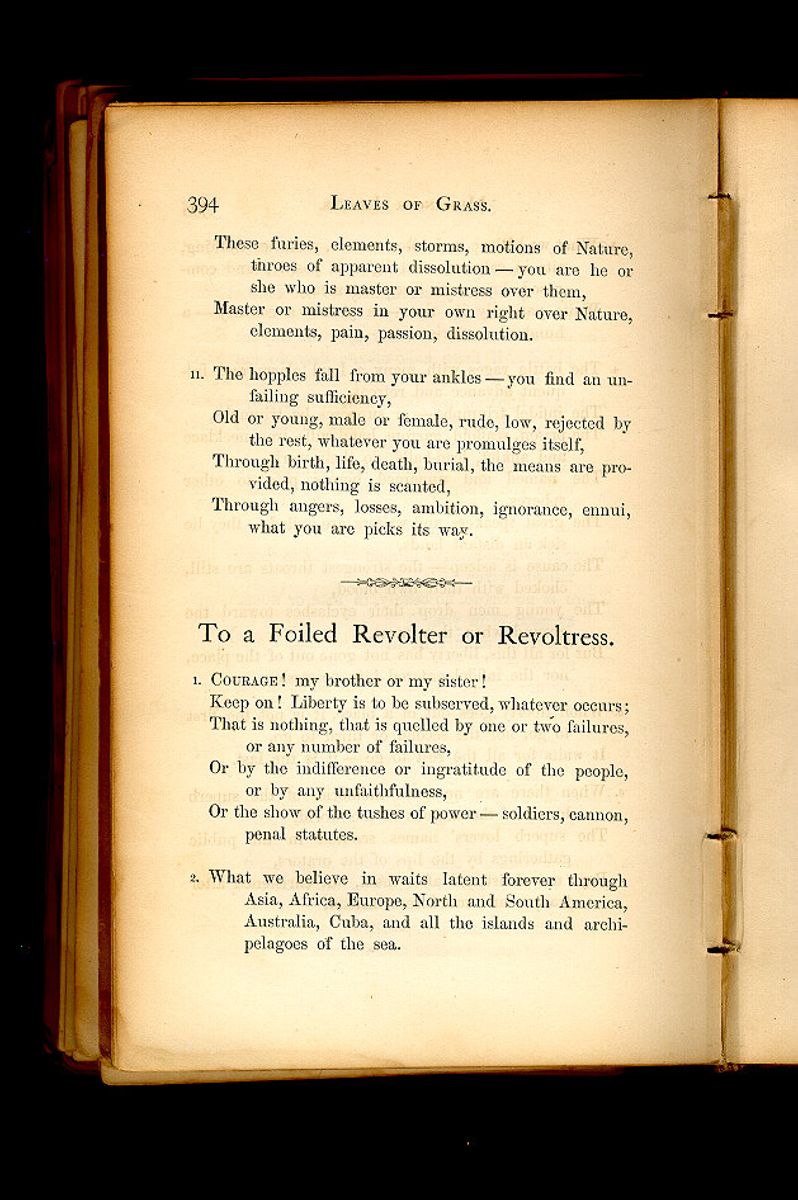 ppp.01500.402.jpg
These furies, elements, storms, motions of Nature,
ppp.01500.402.jpg
These furies, elements, storms, motions of Nature, throes of apparent dissolution—you are he or
she who is master or mistress over them, Master or mistress in your own right over Nature,
elements, pain, passion, dissolution. 11The hopples fall from your ankles—you find an un-
failing sufficiency, Old or young, male or female, rude, low, rejected by
the rest, whatever you are promulges itself, Through birth, life, death, burial, the means are pro-
vided, nothing is scanted, Through angers, losses, ambition, ignorance, ennui,
what you are picks its way.
To a Foiled Revolter or Revoltress.
1COURAGE! my brother or my sister! Keep on! Liberty is to be subserved, whatever occurs; That is nothing, that is quelled by one or two failures,or any number of failures, Or by the indifference or ingratitude of the people,
or by any unfaithfulness, Or the show of the tushes of power—soldiers, cannon,
penal statutes. 2What we believe in waits latent forever through
Asia, Africa, Europe, North and South America,
Australia, Cuba, and all the islands and archi-
pelagoes of the sea. [ begin page 395 ]
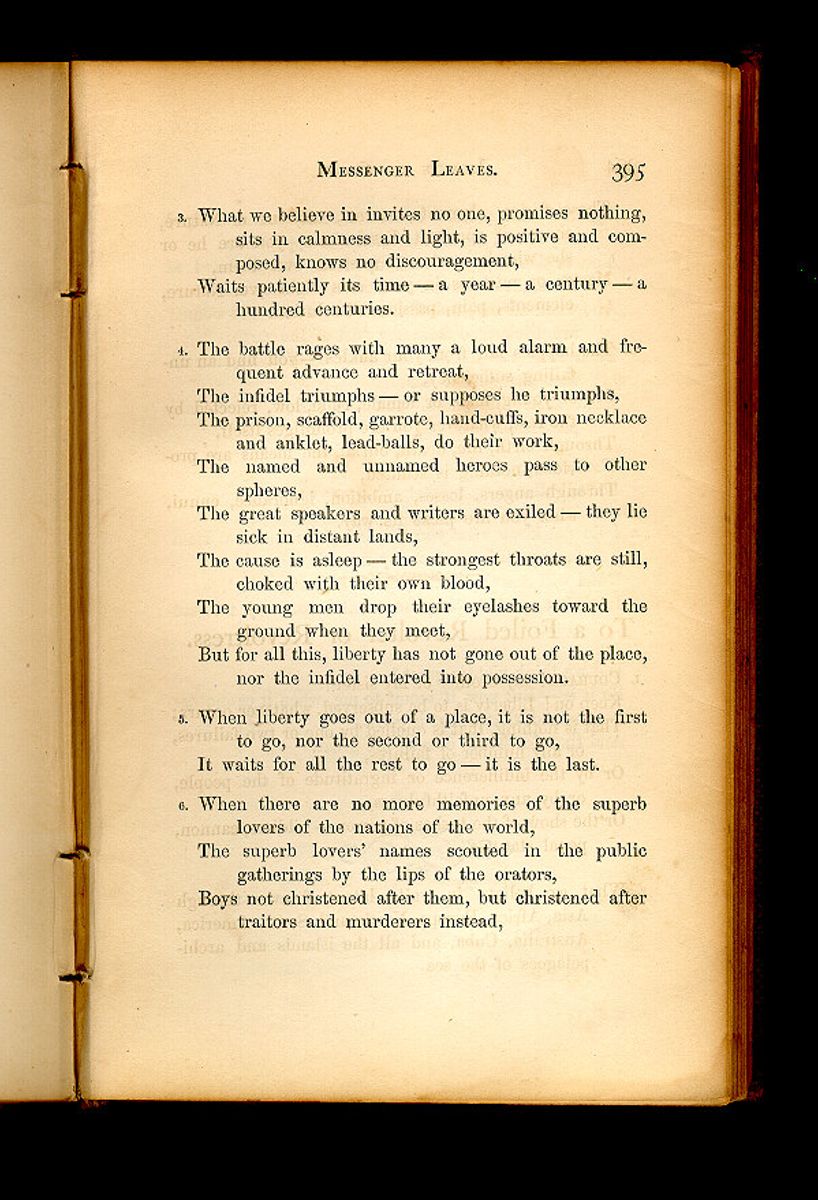 ppp.01500.403.jpg
3What we believe in invites no one, promises nothing,
ppp.01500.403.jpg
3What we believe in invites no one, promises nothing, sits in calmness and light, is positive and com-
posed, knows no discouragement, Waits patiently its time—a year—a century—a
hundred centuries. 4The battle rages with many a loud alarm and fre-
quent advance and retreat, The infidel triumphs—or supposes he triumphs, The prison, scaffold, garrote, hand-cuffs, iron necklace
and anklet, lead-balls, do their work, The named and unnamed heroes pass to other
spheres, The great speakers and writers are exiled—they lie
sick in distant lands, The cause is asleep—the strongest throats are still,
choked with their own blood, The young men drop their eyelashes toward the
ground when they meet, But for all this, liberty has not gone out of the place,
nor the infidel entered into possession. 5When liberty goes out of a place, it is not the first
to go, nor the second or third to go, It waits for all the rest to go—it is the last. 6When there are no more memories of the superb
lovers of the nations of the world, The superb lovers' names scouted in the public
gatherings by the lips of the orators, Boys not christened after them, but christened after
traitors and murderers instead, [ begin page 396 ]
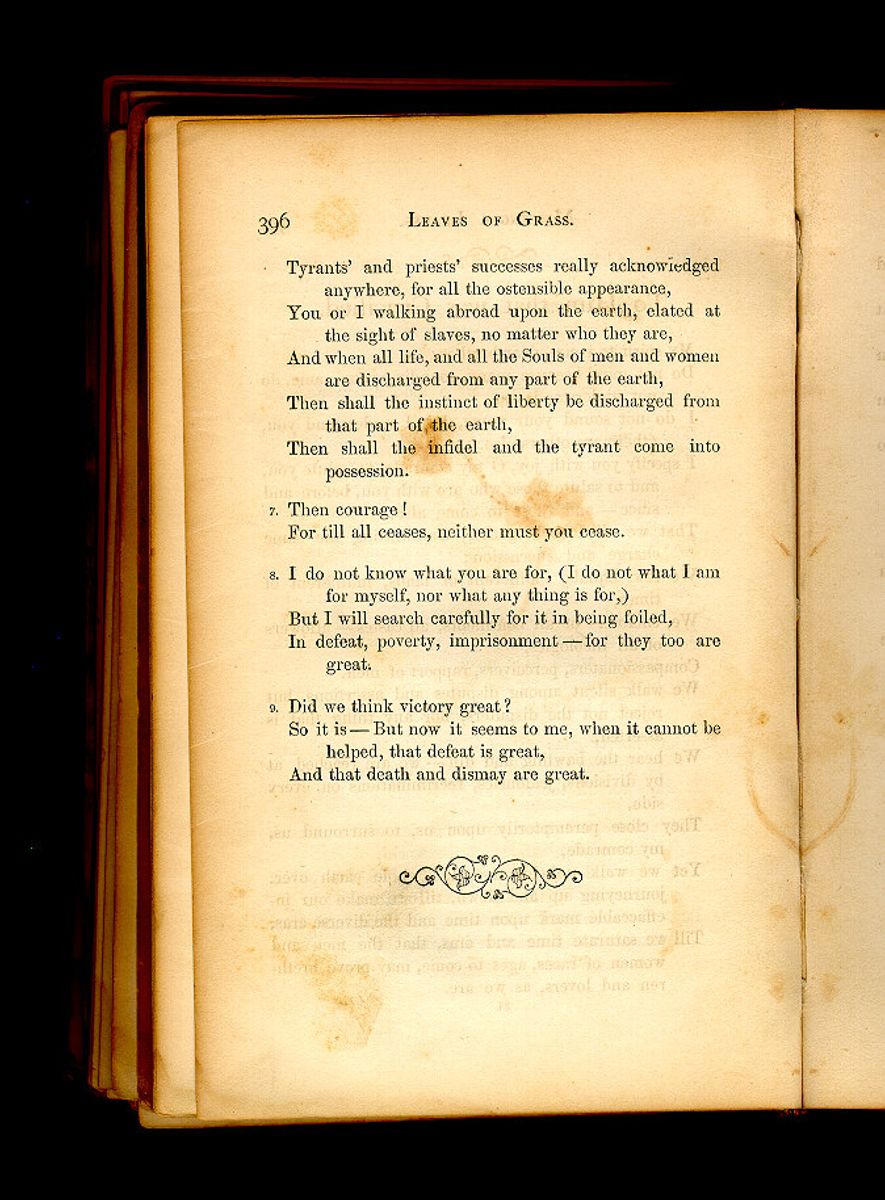 ppp.01500.404.jpg
Tyrants' and priests' successes really acknowledged
ppp.01500.404.jpg
Tyrants' and priests' successes really acknowledged anywhere, for all the ostensible appearance, You or I walking abroad upon the earth, elated at
the sight of slaves, no matter who they are, And when all life, and all the Souls of men and women
are discharged from any part of the earth, Then shall the instinct of liberty be discharged from
that part of the earth, Then shall the infidel and the tyrant come into
possession. 7Then courage! For till all ceases, neither must you cease. 8I do not know what you are for, (I do not what I am
for myself, nor what any thing is for,) But I will search carefully for it in being foiled, In defeat, poverty, imprisonment—for they too are
great. 9Did we think victory great? So it is—But now it seems to me, when it cannot be
helped, that defeat is great, And that death and dismay are great. [ begin page 397 ]
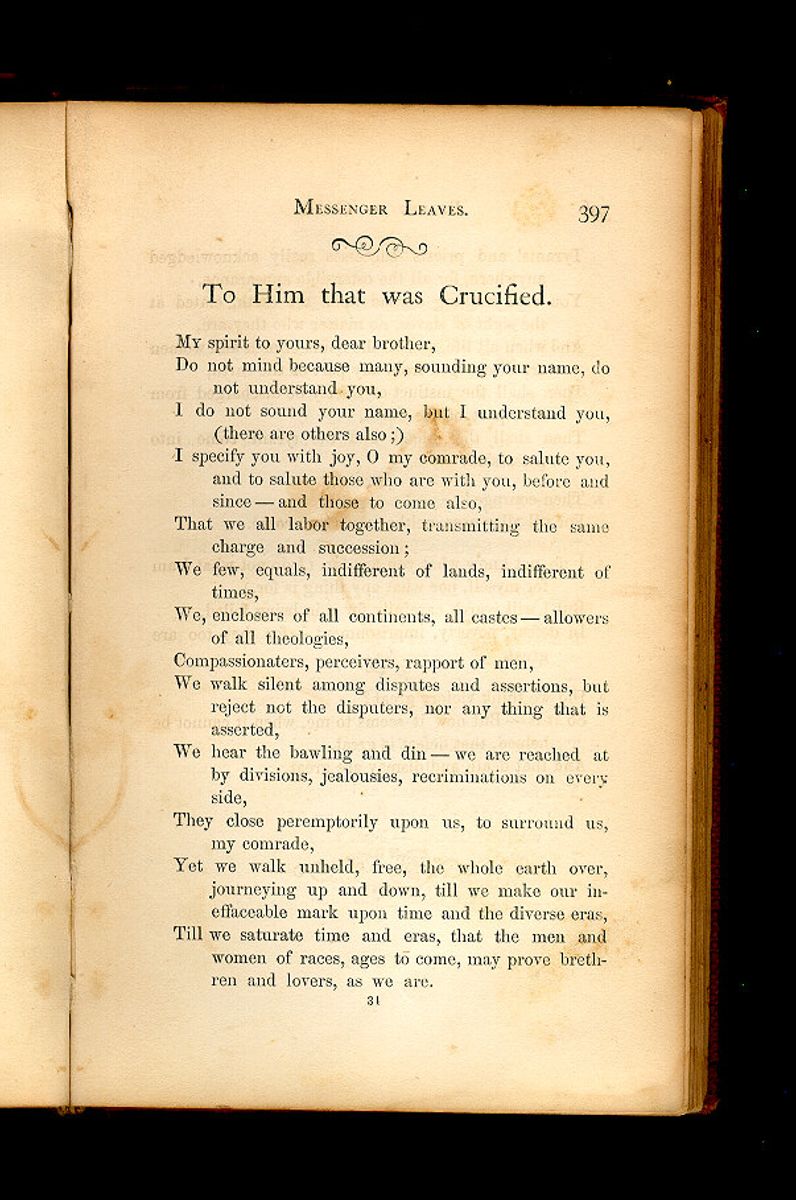 ppp.01500.405.jpg
To Him that was Crucified.
MY spirit to yours, dear brother, Do not mind because many, sounding your name, donot understand you, I do not sound your name, but I understand you,
(there are others also;) I specify you with joy, O my comrade, to salute you,
and to salute those who are with you, before and
since—and those to come also, That we all labor together, transmitting the same
charge and succession; We few, equals, indifferent of lands, indifferent of
times, We, enclosers of all continents, all castes—allowers
of all theologies, Compassionaters, perceivers, rapport of men, We walk silent among disputes and assertions, but
reject not the disputers, nor any thing that is
asserted, We hear the bawling and din—we are reached at
by divisions, jealousies, recriminations on every
side, They close peremptorily upon us, to surround us,
my comrade, Yet we walk unheld, free, the whole earth over,
journeying up and down, till we make our in-
effaceable mark upon time and the diverse eras, Till we saturate time and eras, that the men and
women of races, ages to come, may prove breth-
ren and lovers, as we are. 34 [ begin page 398 ]
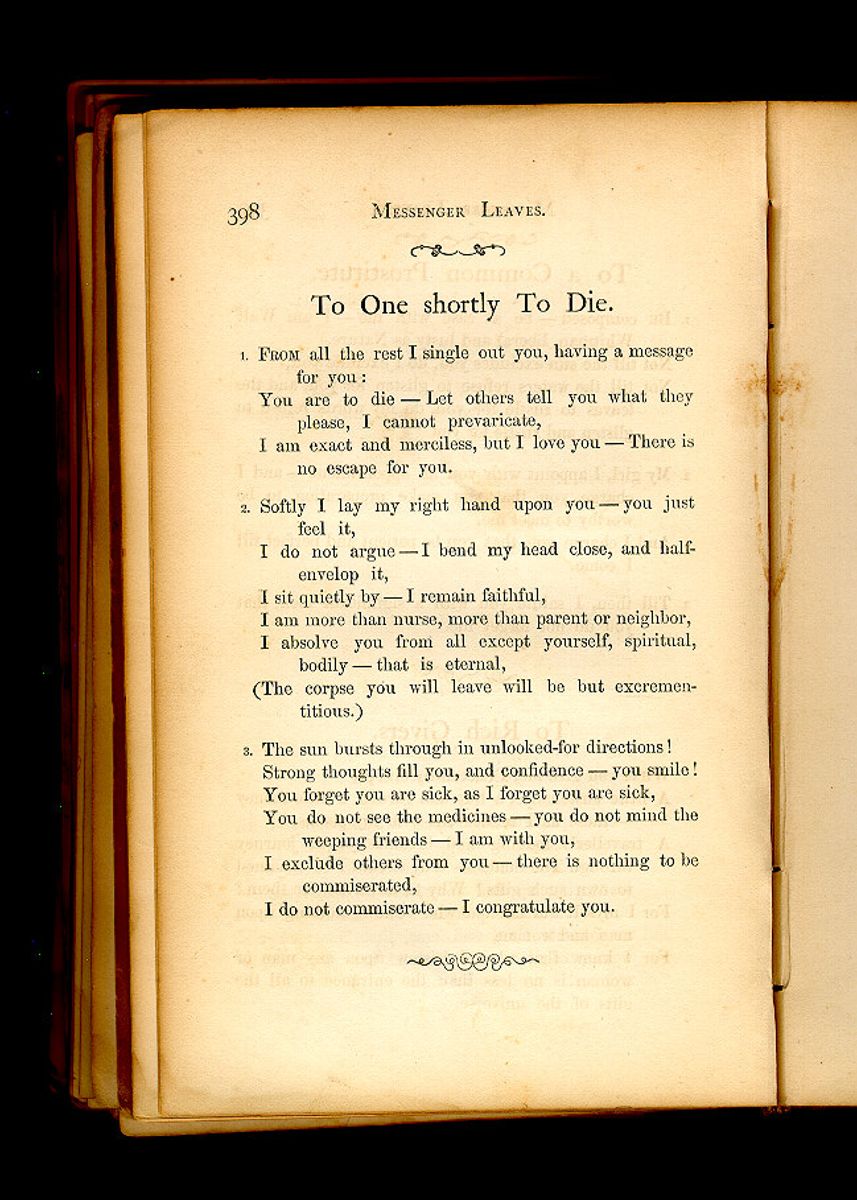 ppp.01500.406.jpg
To One shortly To Die.
1FROM all the rest I single out you, having a messagefor you: You are to die—Let others tell you what they
please, I cannot prevaricate, I am exact and merciless, but I love you—There is
no escape for you. 2Softly I lay my right hand upon you—you just
feel it, I do not argue—I bend my head close, and half-
envelop it, I sit quietly by—I remain faithful, I am more than nurse, more than parent or neighbor, I absolve you from all except yourself, spiritual,
bodily—that is eternal, (The corpse you will leave will be but excremen-
titious.) 3The sun bursts through in unlooked-for directions! Strong thoughts fill you, and confidence—you smile! You forget you are sick, as I forget you are sick, You do not see the medicines—you do not mind the
weeping friends—I am with you, I exclude others from you—there is nothing to be
commiserated, I do not commiserate—I congratulate you. [ begin page 399 ]
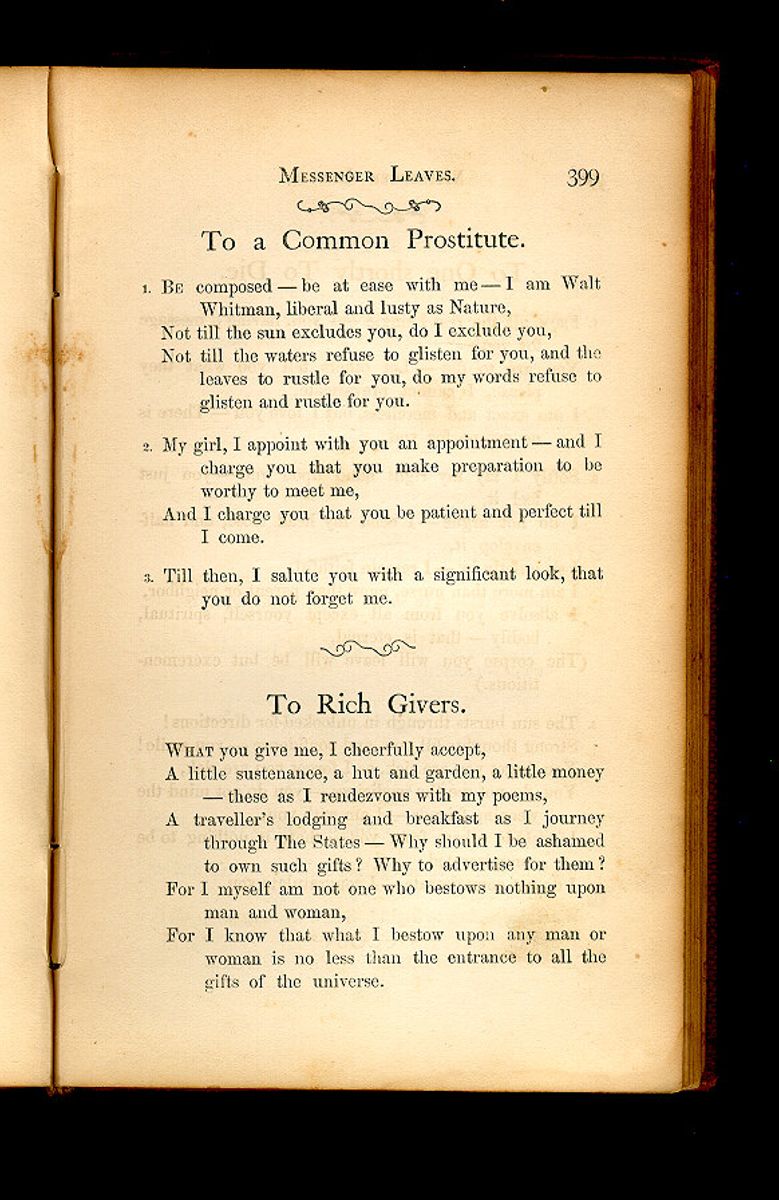 ppp.01500.407.jpg
To a Common Prostitute.
1BE composed—be at ease with me—I am WaltWhitman, liberal and lusty as Nature, Not till the sun excludes you, do I exclude you, Not till the waters refuse to glisten for you, and the
leaves to rustle for you, do my words refuse to
glisten and rustle for you. 2My girl, I appoint with you an appointment—and I
charge you that you make preparation to be
worthy to meet me, And I charge you that you be patient and perfect till
I come. 3Till then, I salute you with a significant look, that
you do not forget me.
To Rich Givers.
WHAT you give me, I cheerfully accept, A little sustenance, a hut and garden, a little money—these as I rendezvous with my poems, A traveller's lodging and breakfast as I journey
through The States—Why should I be ashamed
to own such gifts? Why to advertise for them? For I myself am not one who bestows nothing upon
man and woman, For I know that what I bestow upon any man or
woman is no less than the entrance to all the
gifts of the universe. [ begin page 400 ]
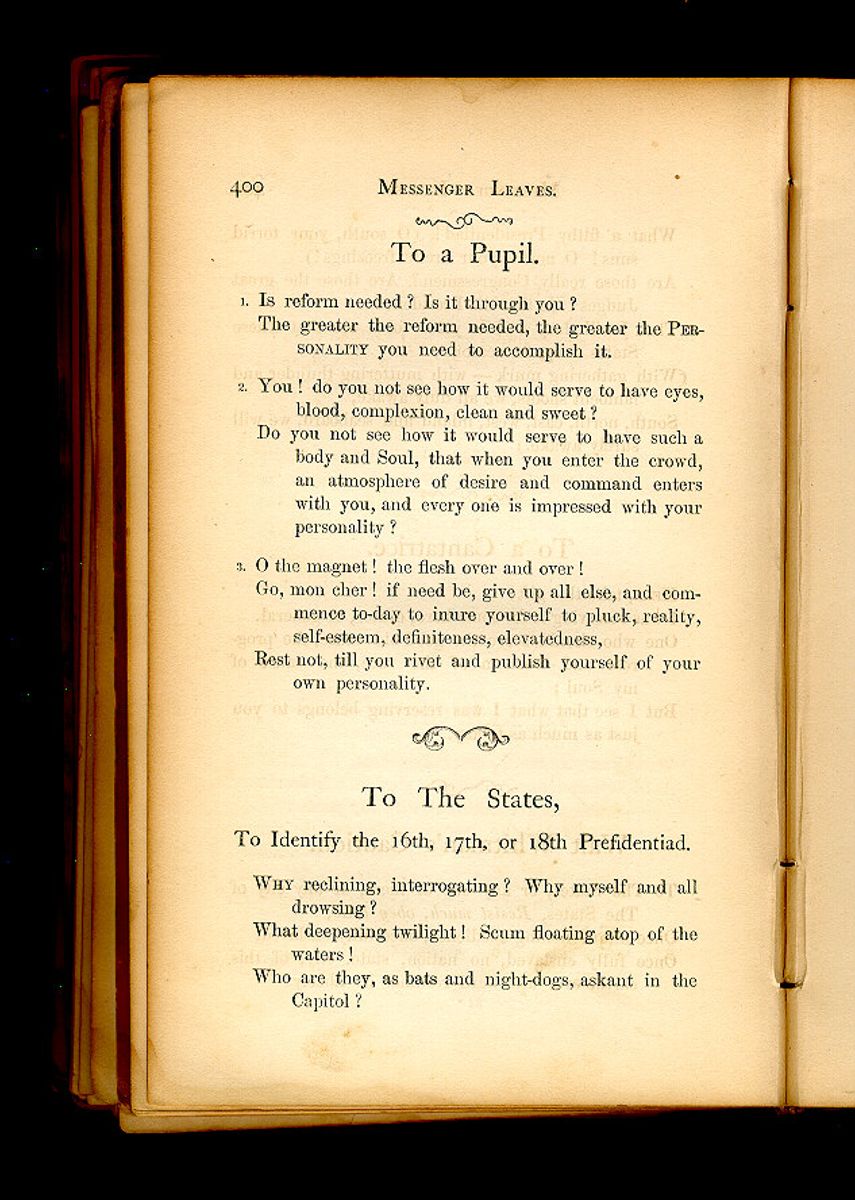 ppp.01500.408.jpg
To a Pupil.
1IS reform needed? Is it through you? The greater the reform needed, the greater the PER-SONALITY you need to accomplish it. 2You! do you not see how it would serve to have eyes,
blood, complexion, clean and sweet? Do you not see how it would serve to have such a
body and Soul, that when you enter the crowd,
an atmosphere of desire and command enters
with you, and every one is impressed with your
personality? 3O the magnet! the flesh over and over! Go, mon cher! if need be, give up all else, and com-
mence to-day to inure yourself to pluck, reality,
self-esteem, definiteness, elevatedness, Rest not, till you rivet and publish yourself of your
own personality.
To The States,
To Identify the 16th, 17th, or 18th Presidentiad.
WHY reclining, interrogating? Why myself and all drowsing? What deepening twilight! Scum floating atop of the
waters! Who are they, as bats and night-dogs, askant in the
Capitol? [ begin page 401 ]
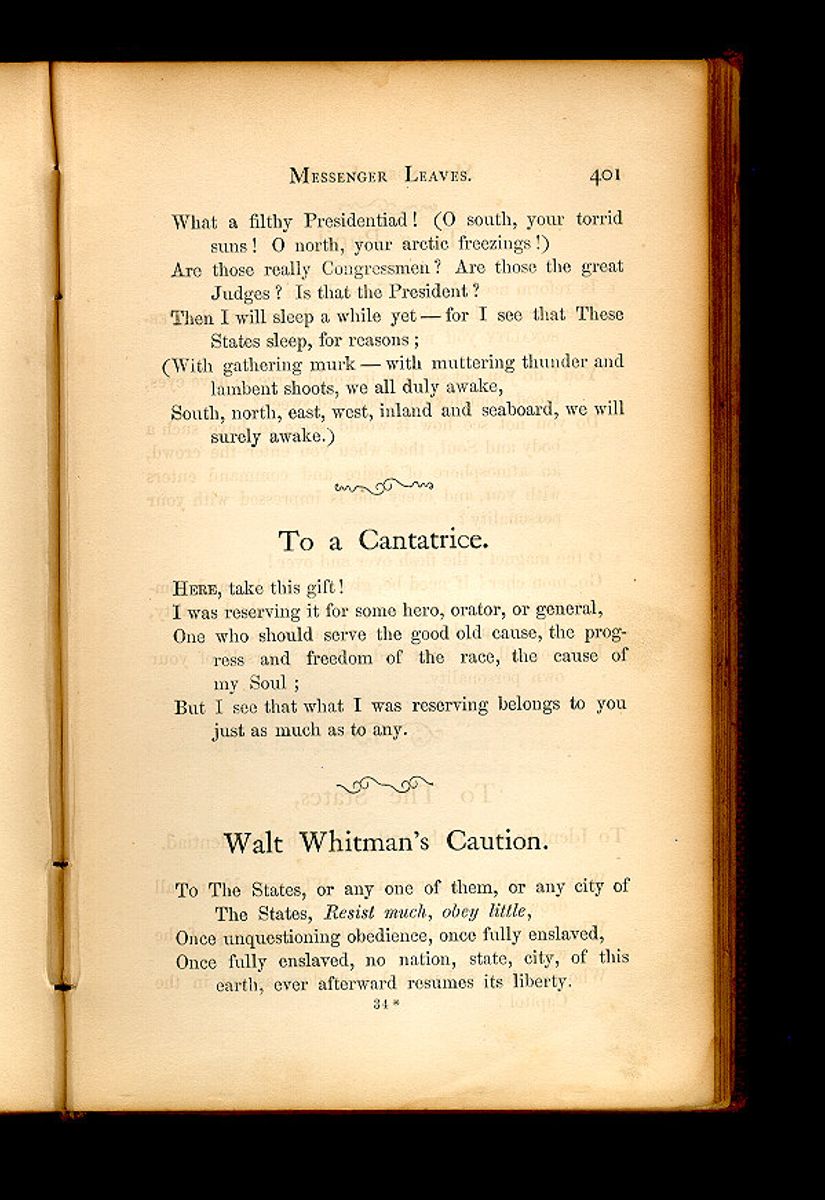 ppp.01500.409.jpg
What a filthy Presidentiad! (O south, your torrid
ppp.01500.409.jpg
What a filthy Presidentiad! (O south, your torrid suns! O north, your arctic freezings!) Are those really Congressmen? Are those the great
Judges? Is that the President? Then I will sleep a while yet—for I see that These
States sleep, for reasons; (With gathering murk—with muttering thunder and
lambent shoots, we all duly awake, South, north, east, west, inland and seaboard, we will
surely awake.)
To a Cantatrice.
HERE, take this gift! I was reserving it for some hero, orator, or general, One who should serve the good old cause, the prog-ress and freedom of the race, the cause of
my Soul; But I see that what I was reserving belongs to you
just as much as to any.
Walt Whitman's Caution.
TO The States, or any one of them, or any city ofThe States, Resist much, obey little, Once unquestioning obedience, once fully enslaved, Once fully enslaved, no nation, state, city, of this
earth, ever afterward resumes its liberty. 34* [ begin page 402 ]
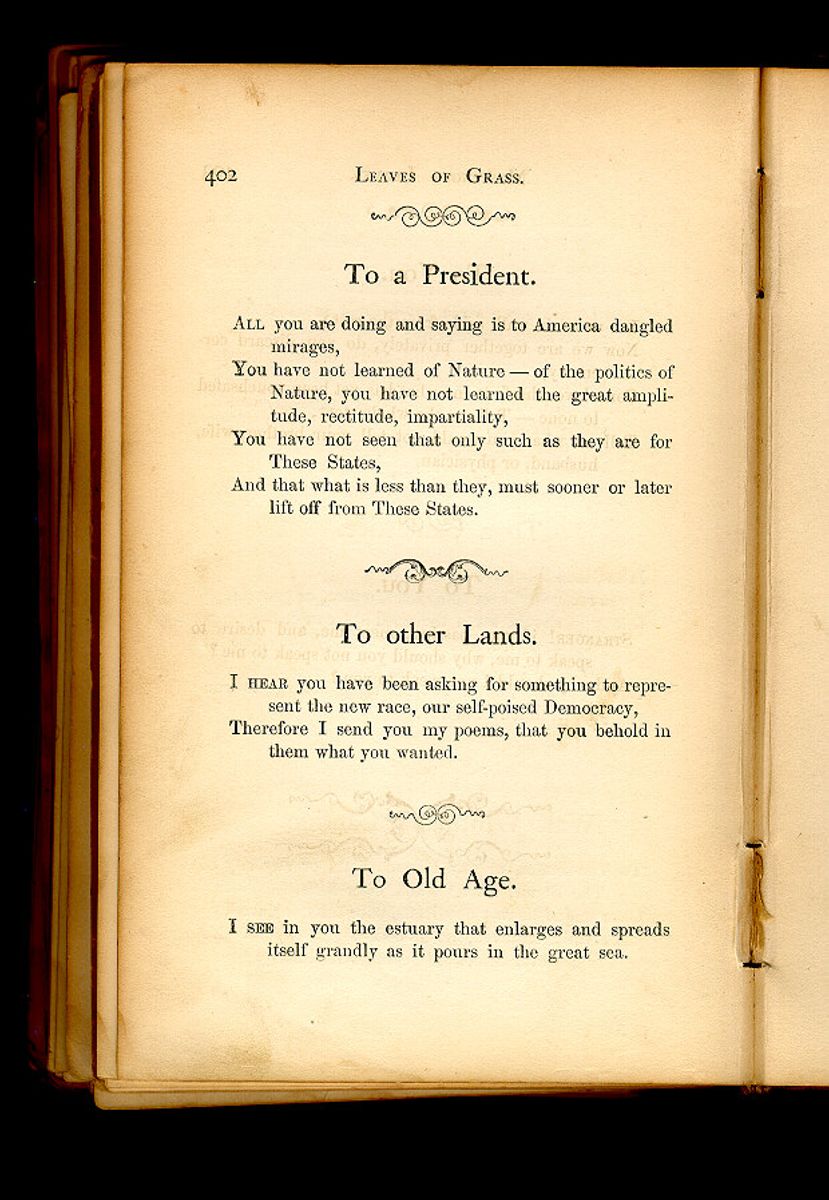 ppp.01500.410.jpg
To a President.
ALL you are doing and saying is to America dangledmirages, You have not learned of Nature—of the politics of
Nature, you have not learned the great ampli-
tude, rectitude, impartiality, You have not seen that only such as they are for
These States, And that what is less than they, must sooner or later
lift off from These States.
To other Lands.
I HEAR you have been asking for something to repre-sent the new race, our self-poised Democracy, Therefore I send you my poems, that you behold in
them what you wanted.
To Old Age.
I SEE in you the estuary that enlarges and spreadsitself grandly as it pours in the great sea. [ begin page 403 ]
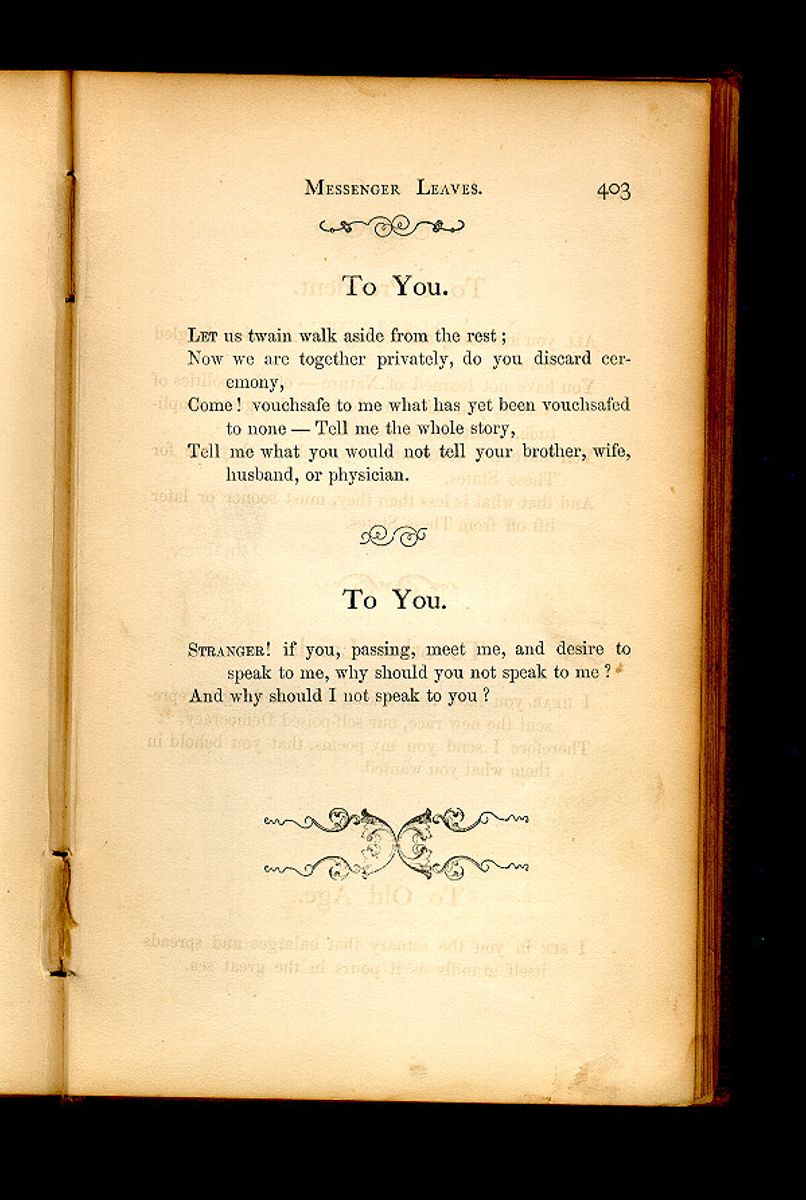 ppp.01500.411.jpg
To You.
LET us twain walk aside from the rest; Now we are together privately, do you discard cer-emony, Come! vouchsafe to me what has yet been vouchsafed
to none—Tell me the whole story, Tell me what you would not tell your brother, wife,
husband, or physician.
To You.
STRANGER! if you, passing, meet me, and desire tospeak to me, why should you not speak to me? And why should I not speak to you? [ begin page 404 ]
 ppp.01500.412.jpg
MANNAHATTA.
I WAS asking for something specific and perfect formy city, and behold! here is the aboriginal
name! Now I see what there is in a name, a word, liquid,
sane, unruly, musical, self-sufficient, I see that the word of my city, is that word up there, Because I see that word nested in nests of water-bays,
superb, with tall and wonderful spires, Rich, hemmed thick all around with sailships and
steamships—an island sixteen miles long, solid-
founded, Numberless crowded streets—high growths of iron,
slender, strong, light, splendidly uprising toward
clear skies; Tides swift and ample, well-loved by me, toward sun-
down, The flowing sea-currents, the little islands, the larger
adjoining islands, the heights, the villas, The countless masts, the white shore-steamers, the
lighters, the ferry-boats, the black sea-steamers,
well-model'd; The down-town streets, the jobbers' houses of business
—the houses of business of the ship-merchants,
and money-brokers—the river-streets, [ begin page 405 ]
 ppp.01500.413.jpg
Immigrants arriving, fifteen or twenty thousand in a
ppp.01500.413.jpg
Immigrants arriving, fifteen or twenty thousand in a week, The carts hauling goods—the manly race of drivers
of horses—the brown-faced sailors, The summer-air, the bright sun shining, and the sail-
ing clouds aloft, The winter snows, the sleigh-bells—the broken ice in
the river, passing along, up or down, with the
flood-tide or ebb-tide; The mechanics of the city, the masters, well-formed,
beautiful-faced, looking you straight in the eyes; Trottoirs thronged—vehicles—Broadway—the wo-
men—the shops and shows, The parades, processions, bugles playing, flags flying,
drums beating; A million people—manners free and superb—open
voices—hospitality—the most courageous and
friendly young men; The free city! no slaves! no owners of slaves! The beautiful city! the city of hurried and sparkling
waters! the city of spires and masts! The city nested in bays! my city! The city of such women, I am mad to be with them!
I will return after death to be with them! The city of such young men, I swear I cannot live
happy, without I often go talk, walk, eat, drink,
sleep, with them! [ begin page 406 ]
 ppp.01500.414.jpg
FRANCE,
The 18th Year of These States.
1A GREAT year and place,
A harsh, discordant, natal scream rising, to touch the mother's heart closer than any yet. 2I walked the shores of my Eastern Sea, Heard over the waves the little voice, Saw the divine infant, where she woke, mournfully
wailing, amid the roar of cannon, curses, shouts,
crash of falling buildings, Was not so sick from the blood in the gutters running
—nor from the single corpses, nor those in heaps,
nor those borne away in the tumbrils, Was not so desperate at the battues of death—was
not so shocked at the repeated fusillades of the
guns. 3Pale, silent, stern, what could I say to that long-
accrued retribution? Could I wish humanity different? Could I wish the people made of wood and stone? Or that there be no justice in destiny or time? [ begin page 407 ]
 ppp.01500.415.jpg
4O Liberty! O mate for me!
Here too keeps the blaze, the bullet and the axe, in
ppp.01500.415.jpg
4O Liberty! O mate for me!
Here too keeps the blaze, the bullet and the axe, in reserve, to fetch them out in case of need, Here too, though long deprest, still is not destroyed, Here too could rise at last, murdering and extatic, Here too would demand full arrears of vengeance. 5Hence I sign this salute over the sea, And I do not deny that terrible red birth and baptism, But remember the little voice that I heard wailing—
and wait with perfect trust, no matter how long, And from to-day, sad and cogent, I maintain the
bequeath'd cause, as for all lands, And I send these words to Paris, with my love, And I guess some chansonniers there will understand
them, For I guess there is latent music yet in France—
floods of it, O I hear already the bustle of instruments—they
will soon be drowning all that would interrupt
them, O I think the east wind brings a triumphal and free
march, It reaches hither—it swells me to joyful madness, I will run transpose it in words, to justify it, I will yet sing a song for you, ma femme. [ begin page 408 ]
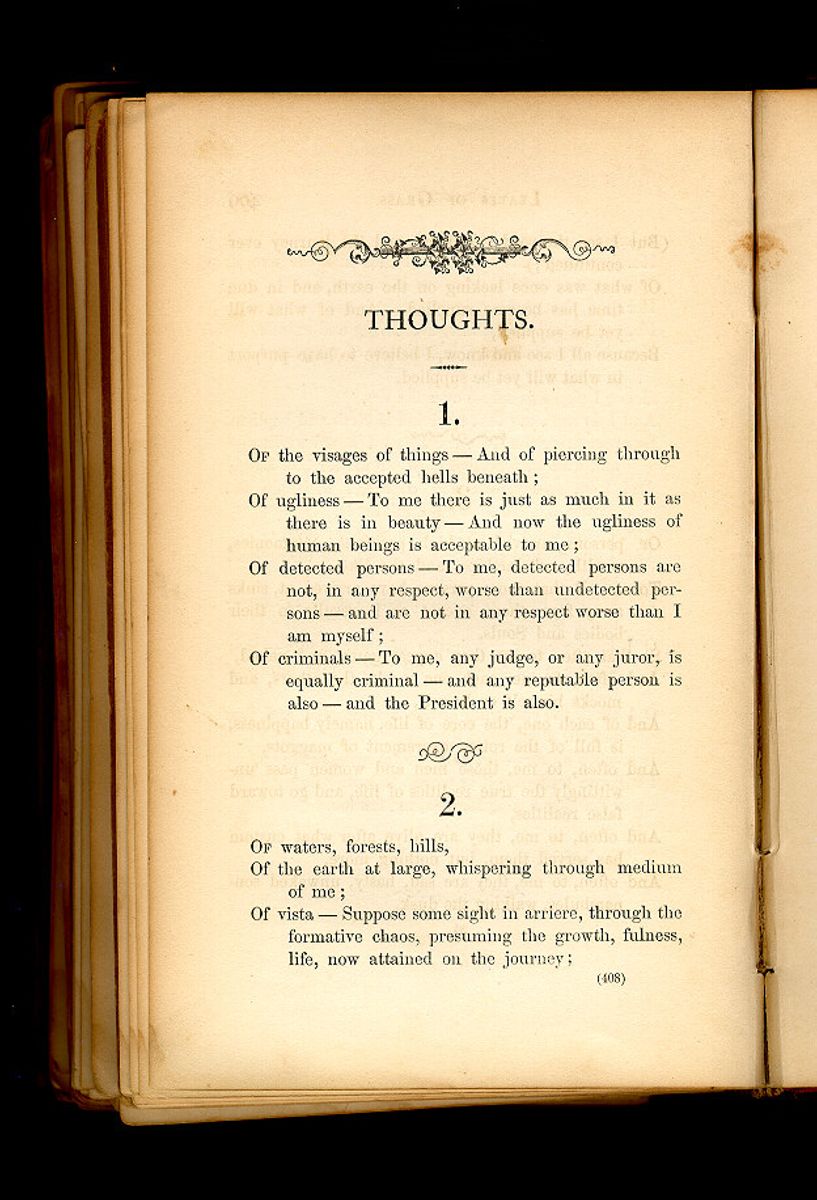 ppp.01500.416.jpg
THOUGHTS.
1.
OF the visages of things—And of piercing throughto the accepted hells beneath; Of ugliness—To me there is just as much in it as
there is in beauty—And now the ugliness of
human beings is acceptable to me; Of detected persons—To me, detected persons are
not, in any respect, worse than undetected per-
sons—and are not in any respect worse than I
am myself; Of criminals—To me, any judge, or any juror, is
equally criminal—and any reputable person is
also—and the President is also.
2.
OF waters, forests, hills, Of the earth at large, whispering through mediumof me; Of vista—Suppose some sight in arriere, through the
formative chaos, presuming the growth, fulness,
life, now attained on the journey; [ begin page 409 ]
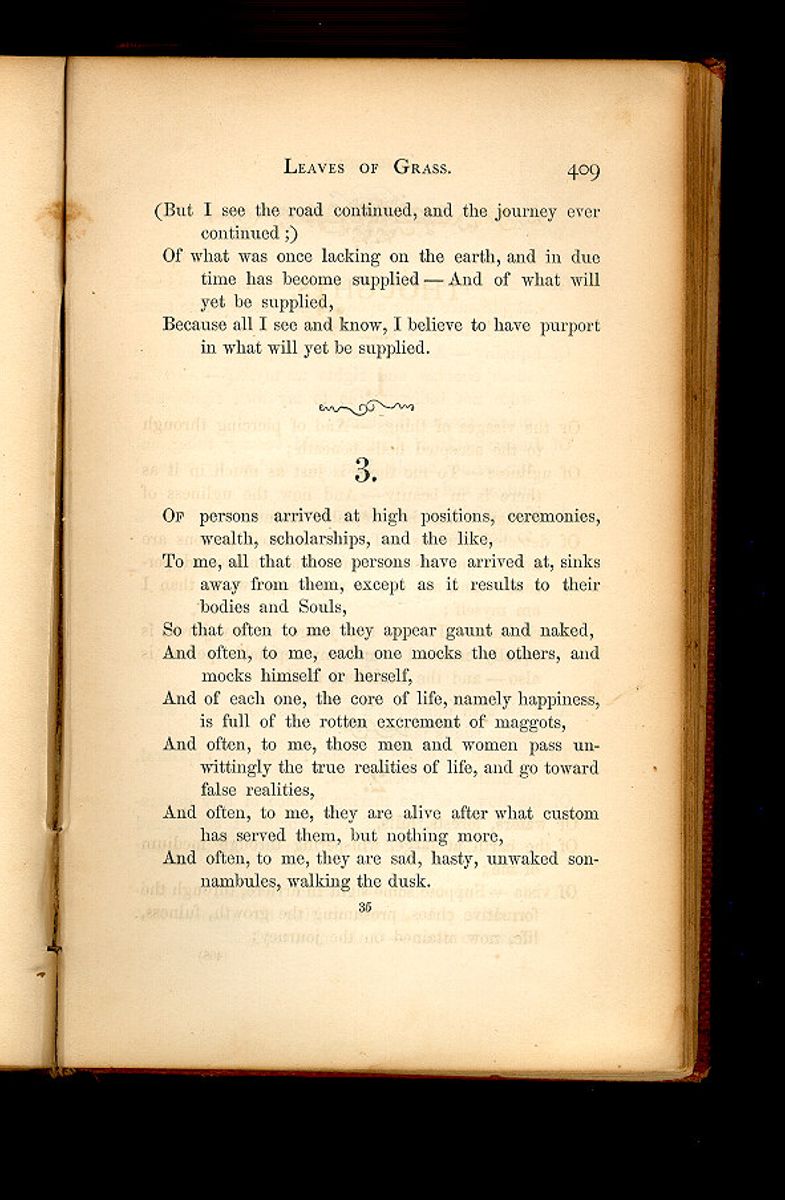 ppp.01500.417.jpg
(But I see the road continued, and the journey ever
ppp.01500.417.jpg
(But I see the road continued, and the journey ever continued;) Of what was once lacking on the earth, and in due
time has become supplied—And of what will
yet be supplied, Because all I see and know, I believe to have purport
in what will yet be supplied.
3.
OF persons arrived at high positions, ceremonies,wealth, scholarships, and the like, To me, all that those persons have arrived at, sinks
away from them, except as it results to their
bodies and Souls, So that often to me they appear gaunt and naked, And often, to me, each one mocks the others, and
mocks himself or herself, And of each one, the core of life, namely happiness,
is full of the rotten excrement of maggots, And often, to me, those men and women pass un-
wittingly the true realities of life, and go toward
false realities, And often, to me, they are alive after what custom
has served them, but nothing more, And often, to me, they are sad, hasty, unwaked son-
nambules, walking the dusk. 35 [ begin page 410 ]
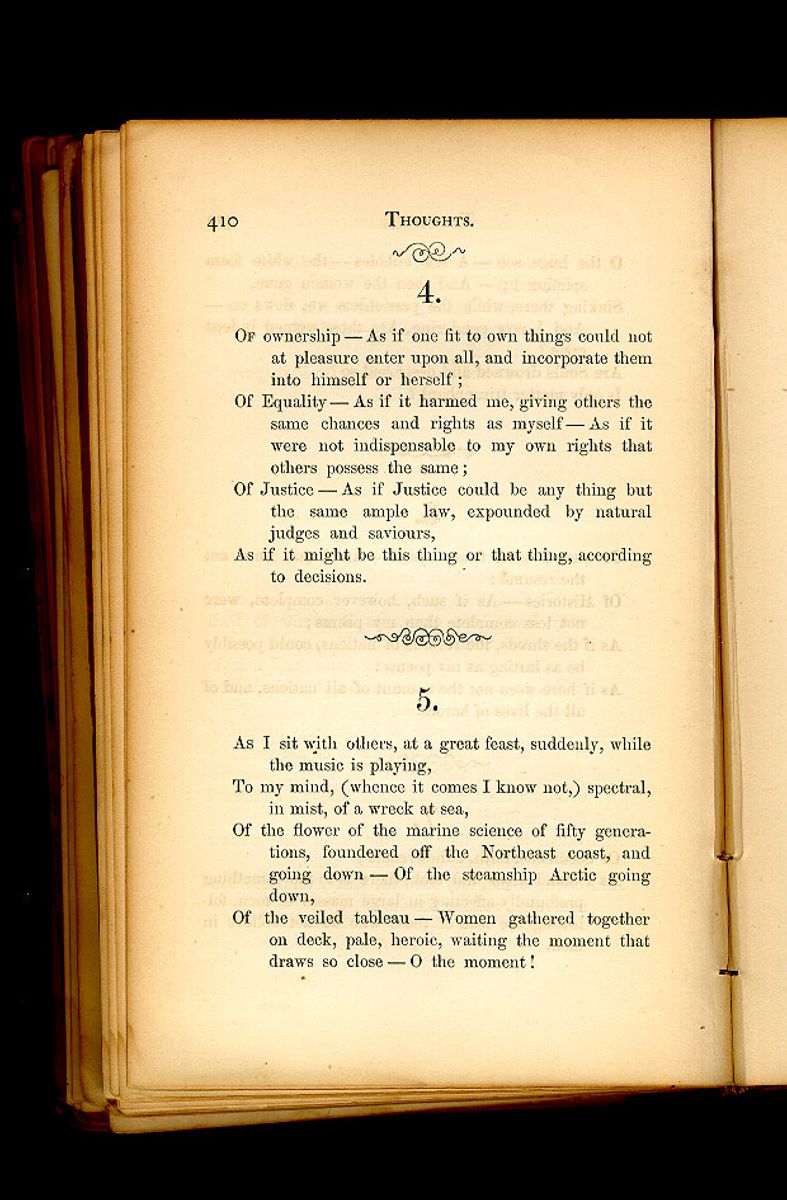 ppp.01500.418.jpg
4.
OF ownership—As if one fit to own things could notat pleasure enter upon all, and incorporate them
into himself or herself; Of Equality—As if it harmed me, giving others the
same chances and rights as myself—As if it
were not indispensable to my own rights that
others possess the same; Of Justice—As if Justice could be any thing but
the same ample law, expounded by natural
judges and saviours, As if it might be this thing or that thing, according
to decisions.
5.
AS I sit with others, at a great feast, suddenly, whilethe music is playing, To my mind, (whence it comes I know not,) spectral,
in mist, of a wreck at sea, Of the flower of the marine science of fifty genera-
tions, foundered off the Northeast coast, and
going down—Of the steamship Arctic going
down, Of the veiled tableau—Women gathered together
on deck, pale, heroic, waiting the moment that
draws so close—O the moment! [ begin page 411 ]
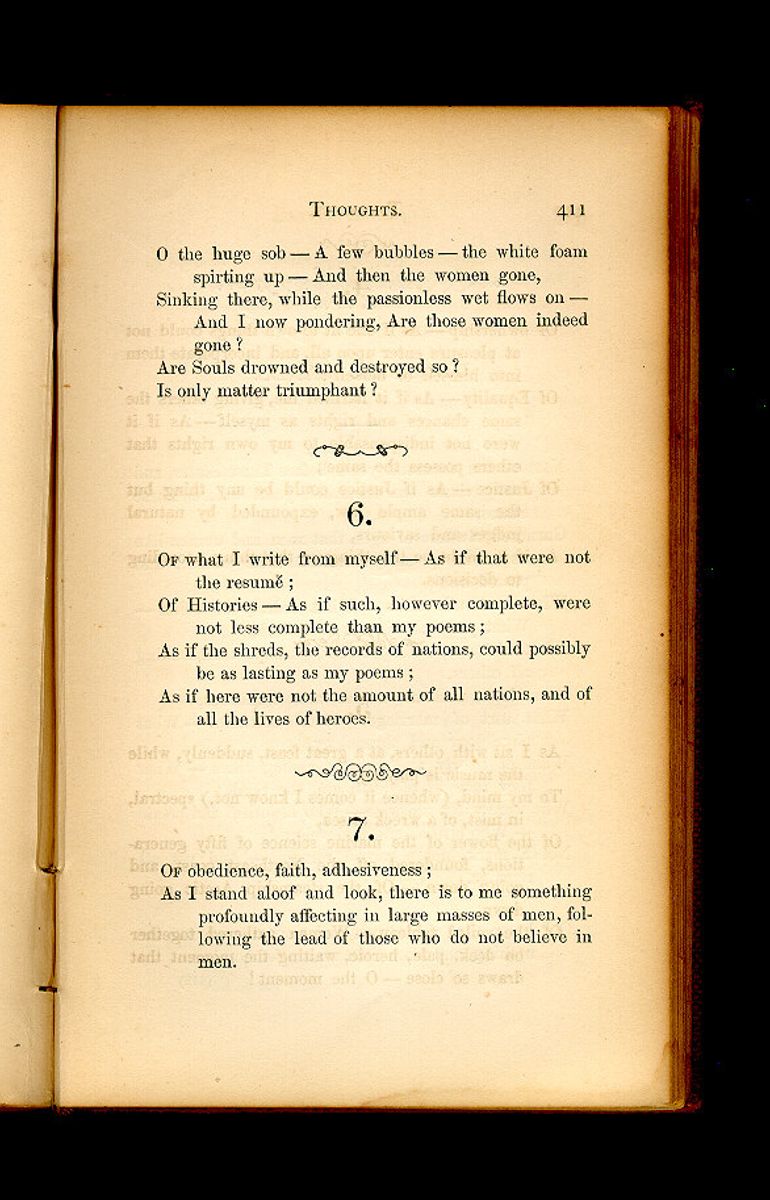 ppp.01500.419.jpg
O the huge sob—A few bubbles—the white foam
ppp.01500.419.jpg
O the huge sob—A few bubbles—the white foam spirting up—And then the women gone, Sinking there, while the passionless wet flows on—
And I now pondering, Are those women indeed
gone? Are Souls drowned and destroyed so? Is only matter triumphant?
6.
OF what I write from myself—As if that were notthe resumé; Of Histories—As if such, however complete, were
not less complete than my poems; As if the shreds, the records of nations, could possibly
be as lasting as my poems; As if here were not the amount of all nations, and of
all the lives of heroes.
7.
OF obedience, faith, adhesiveness; As I stand aloof and look, there is to me somethingprofoundly affecting in large masses of men, fol-
lowing the lead of those who do not believe in
men. [ begin page 412 ]
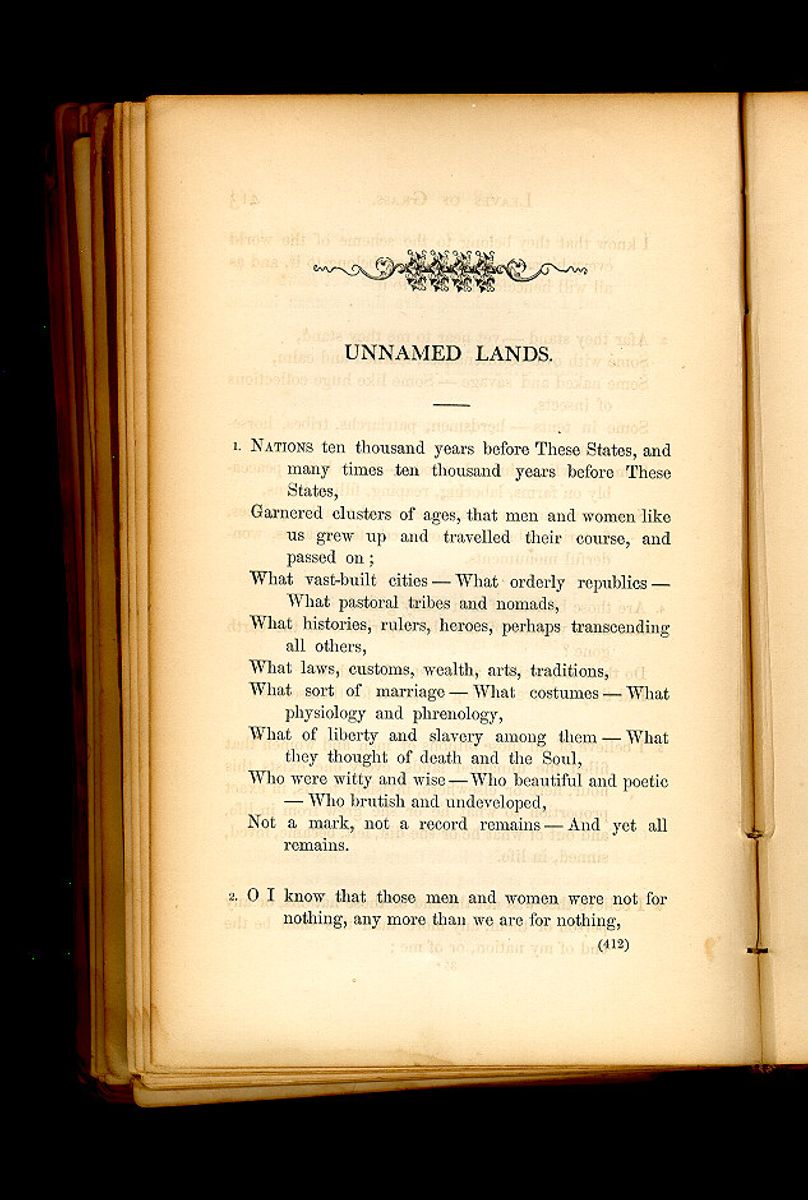 ppp.01500.420.jpg
UNNAMED LANDS.
1NATIONS ten thousand years before These States, andmany times ten thousand years before These
States, Garnered clusters of ages, that men and women like
us grew up and travelled their course, and
passed on; What vast-built cities—What orderly republics—
What pastoral tribes and nomads, What histories, rulers, heroes, perhaps transcending
all others, What laws, customs, wealth, arts, traditions, What sort of marriage—What costumes—What
physiology and phrenology, What of liberty and slavery among them—What
they thought of death and the Soul, Who were witty and wise—Who beautiful and poetic
—Who brutish and undeveloped, Not a mark, not a record remains—And yet all
remains. 2O I know that those men and women were not for
nothing, any more than we are for nothing, [ begin page 413 ]
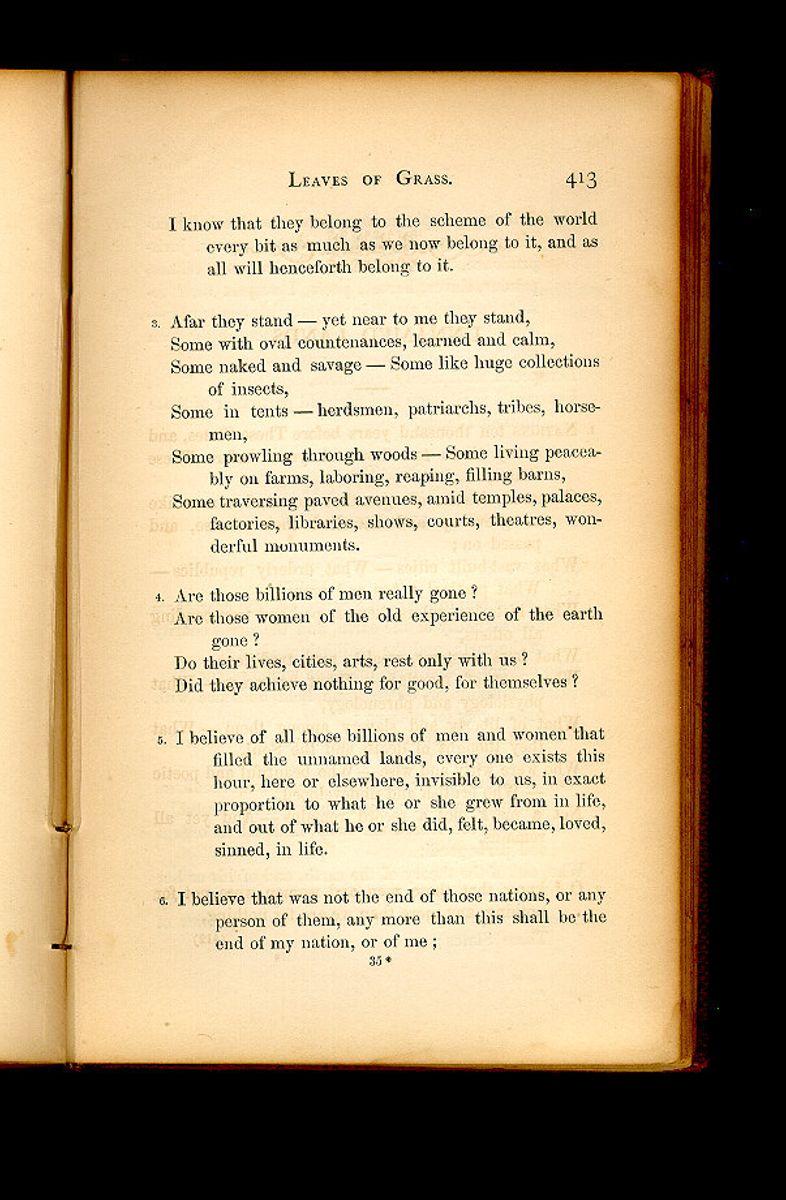 ppp.01500.421.jpg
I know that they belong to the scheme of the world
ppp.01500.421.jpg
I know that they belong to the scheme of the world every bit as much as we now belong to it, and as
all will henceforth belong to it. 3Afar they stand—yet near to me they stand, Some with oval countenances, learned and calm, Some naked and savage—Some like huge collections
of insects, Some in tents—herdsmen, patriarchs, tribes, horse-
men, Some prowling through woods—Some living peacea-
bly on farms, laboring, reaping, filling barns, Some traversing paved avenues, amid temples, palaces,
factories, libraries, shows, courts, theatres, won-
derful monuments. 4Are those billions of men really gone? Are those women of the old experience of the earth
gone? Do their lives, cities, arts, rest only with us? Did they achieve nothing for good, for themselves? 5I believe of all those billions of men and women that
filled the unnamed lands, every one exists this
hour, here or elsewhere, invisible to us, in exact
proportion to what he or she grew from in life,
and out of what he or she did, felt, became, loved,
sinned, in life. 6I believe that was not the end of those nations, or any
person of them, any more than this shall be the
end of my nation, or of me; 35* [ begin page 414 ]
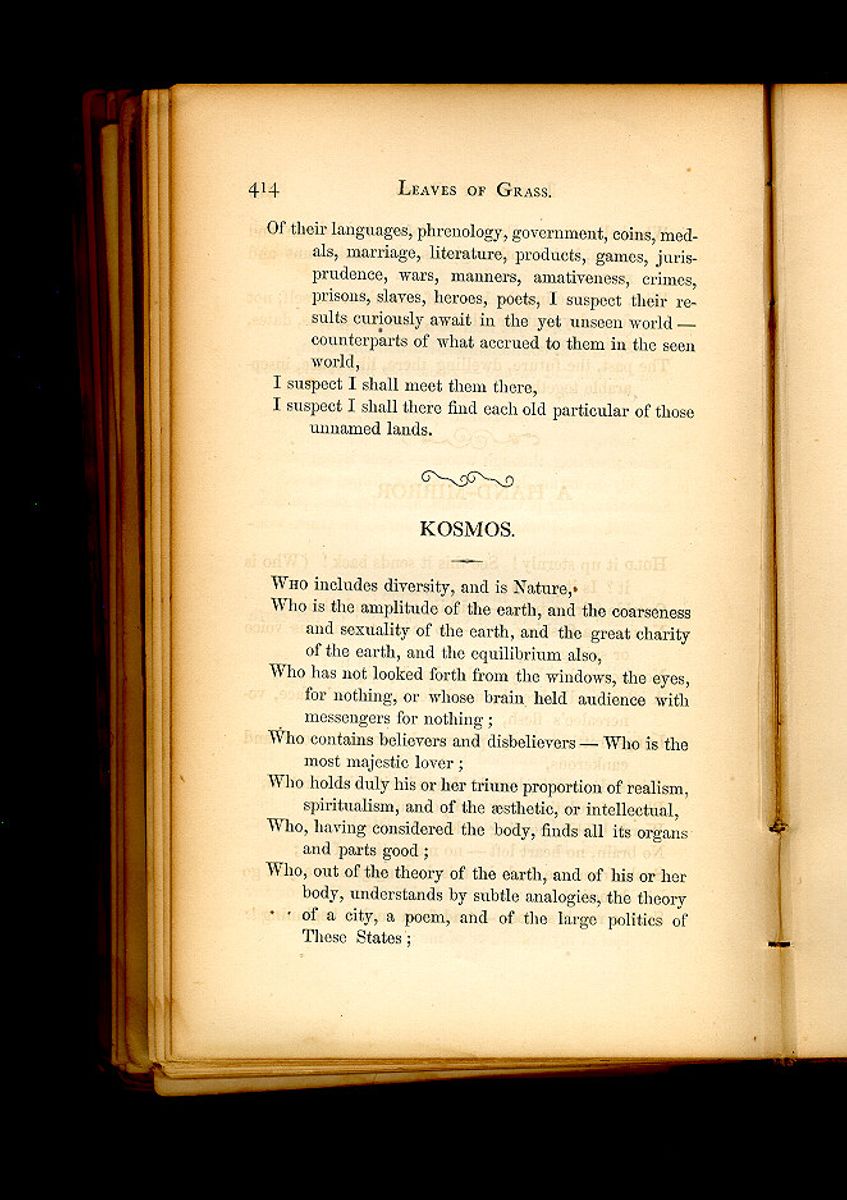 ppp.01500.422.jpg
Of their languages, phrenology, government, coins, med-
ppp.01500.422.jpg
Of their languages, phrenology, government, coins, med- als, marriage, literature, products, games, juris-
prudence, wars, manners, amativeness, crimes,
prisons, slaves, heroes, poets, I suspect their re-
sults curiously await in the yet unseen world —
counterparts of what accrued to them in the seen
world, I suspect I shall meet them there, I suspect I shall there find each old particular of those
unnamed lands.
KOSMOS.
WHO includes diversity, and is Nature, Who is the amplitude of the earth, and the coarsenessand sexuality of the earth, and the great charity
of the earth, and the equilibrium also, Who has not looked forth from the windows, the eyes,
for nothing, or whose brain held audience with
messengers for nothing; Who contains believers and disbelievers—Who is the
most majestic lover; Who holds duly his or her triune proportion of realism,
spiritualism, and of the æsthetic, or intellectual, Who, having considered the body, finds all its organs
and parts good; Who, out of the theory of the earth, and of his or her
body, understands by subtle analogies, the theory
of a city, a poem, and of the large politics of
These States; [ begin page 415 ]
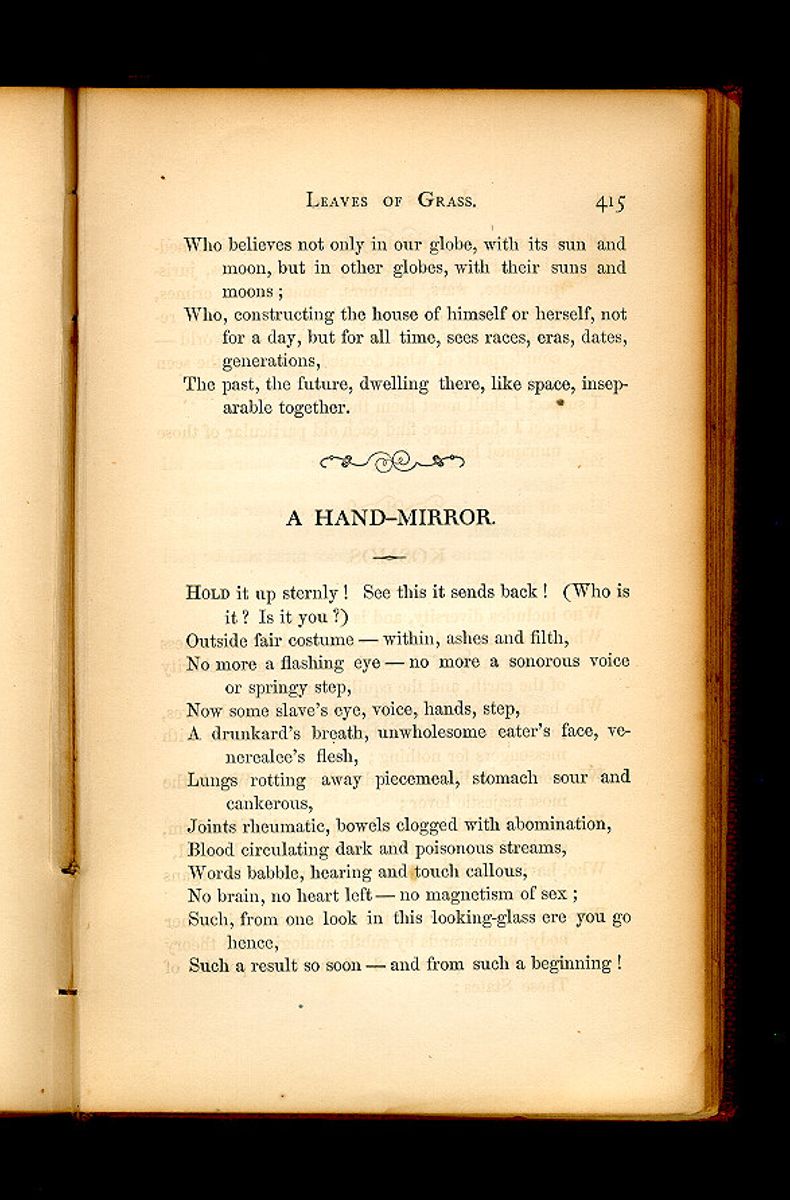 ppp.01500.423.jpg
Who believes not only in our globe, with its sun and
ppp.01500.423.jpg
Who believes not only in our globe, with its sun and moon, but in other globes, with their suns and
moons; Who, constructing the house of himself or herself, not
for a day, but for all time, sees races, eras, dates,
generations, The past, the future, dwelling there, like space, insep-
arable together.
A HAND-MIRROR.
HOLD it up sternly! See this it sends back! (Who isit? Is it you?) Outside fair costume—within, ashes and filth, No more a flashing eye—no more a sonorous voice
or springy step, Now some slave's eye, voice, hands, step, A drunkard's breath, unwholesome eater's face, ve-
nerealee's flesh, Lungs rotting away piecemeal, stomach sour and
cankerous, Joints rheumatic, bowels clogged with abomination, Blood circulating dark and poisonous streams, Words babble, hearing and touch callous, No brain, no heart left—no magnetism of sex; Such, from one look in this looking-glass ere you go
hence, Such a result so soon—and from such a beginning! [ begin page 416 ]
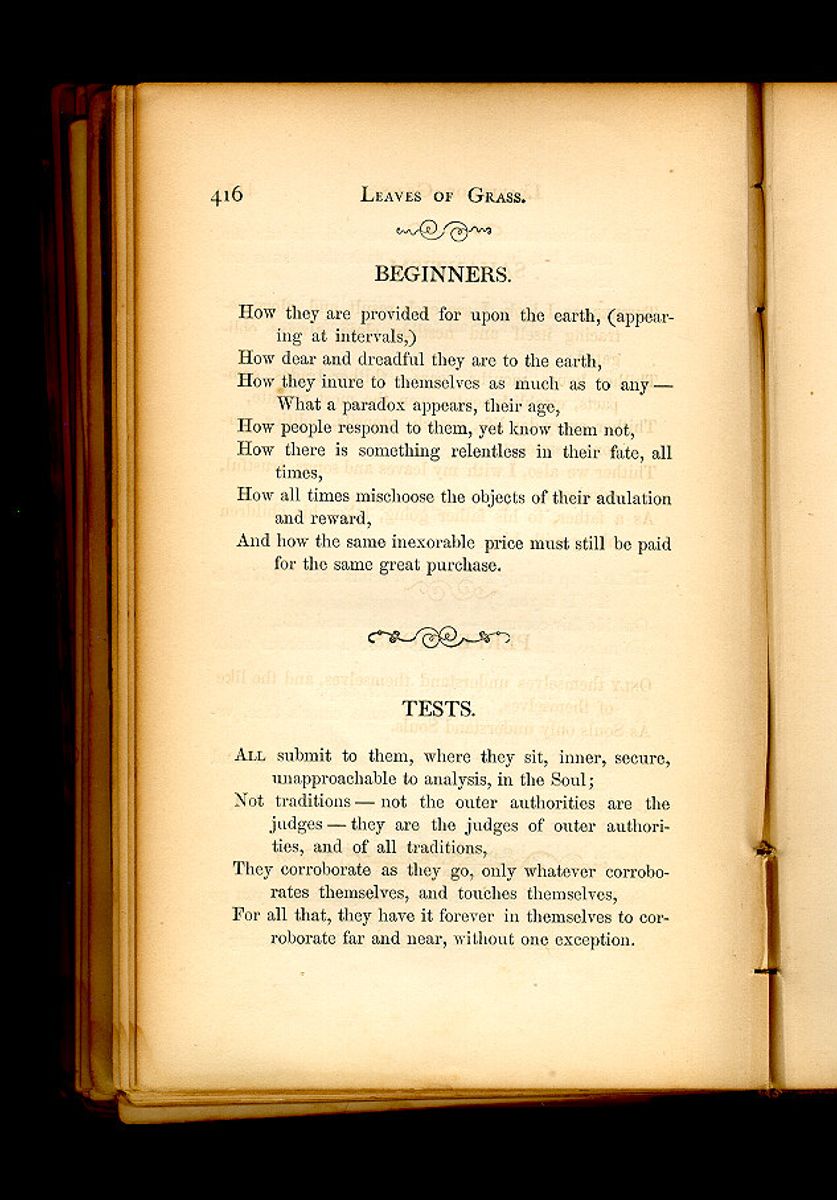 ppp.01500.424.jpg
BEGINNERS.
HOW they are provided for upon the earth, (appear-ing at intervals,) How dear and dreadful they are to the earth, How they inure to themselves as much as to any—
What a paradox appears, their age, How people respond to them, yet know them not, How there is something relentless in their fate, all
times, How all times mischoose the objects of their adulation
and reward, And how the same inexorable price must still be paid
for the same great purchase.
TESTS.
ALL submit to them, where they sit, inner, secure,unapproachable to analysis, in the Soul; Not traditions—not the outer authorities are the
judges—they are the judges of outer authori-
ties, and of all traditions, They corroborate as they go, only whatever corrobo-
rates themselves, and touches themselves, For all that, they have it forever in themselves to cor-
roborate far and near, without one exception. [ begin page 417 ]
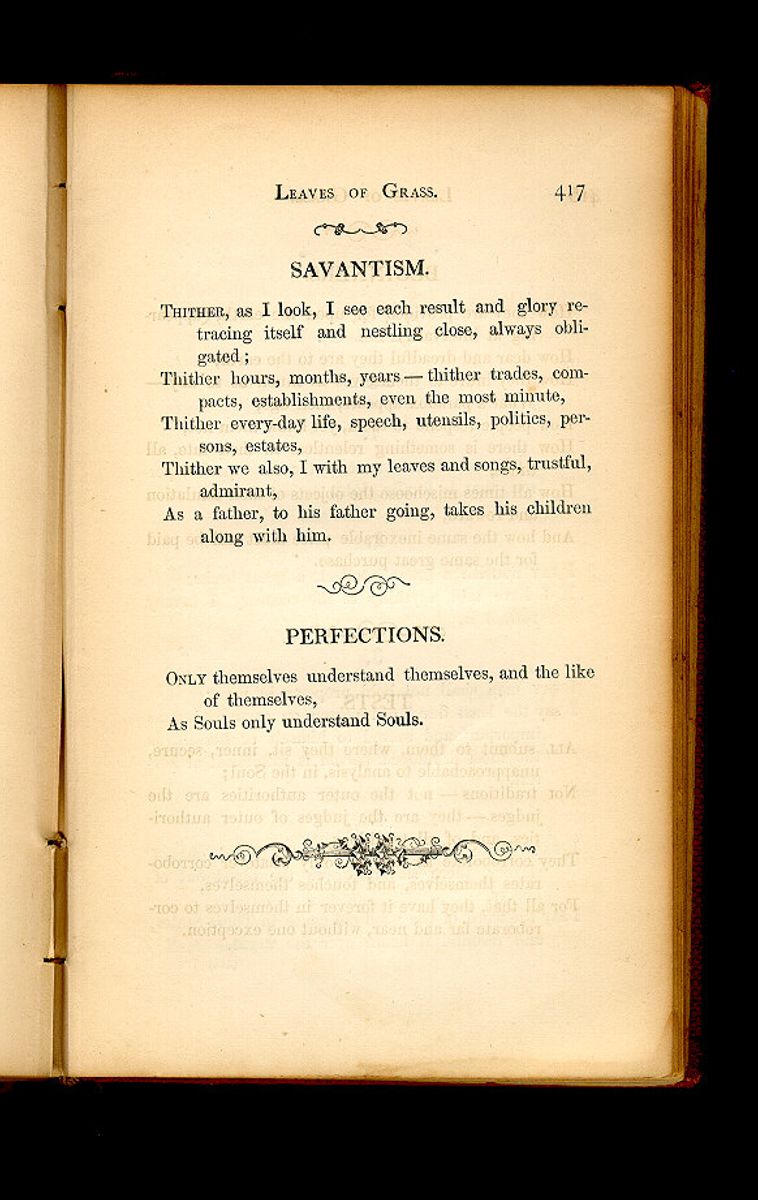 ppp.01500.425.jpg
SAVANTISM.
THITHER, as I look, I see each result and glory re-tracing itself and nestling close, always obli-
gated; Thither hours, months, years—thither trades, com-
pacts, establishments, even the most minute, Thither every-day life, speech, utensils, politics, per-
sons, estates, Thither we also, I with my leaves and songs, trustful,
admirant, As a father, to his father going, takes his children
along with him.
PERFECTIONS.
ONLY themselves understand themselves, and the likeof themselves, As Souls only understand Souls. [ begin page 418 ]
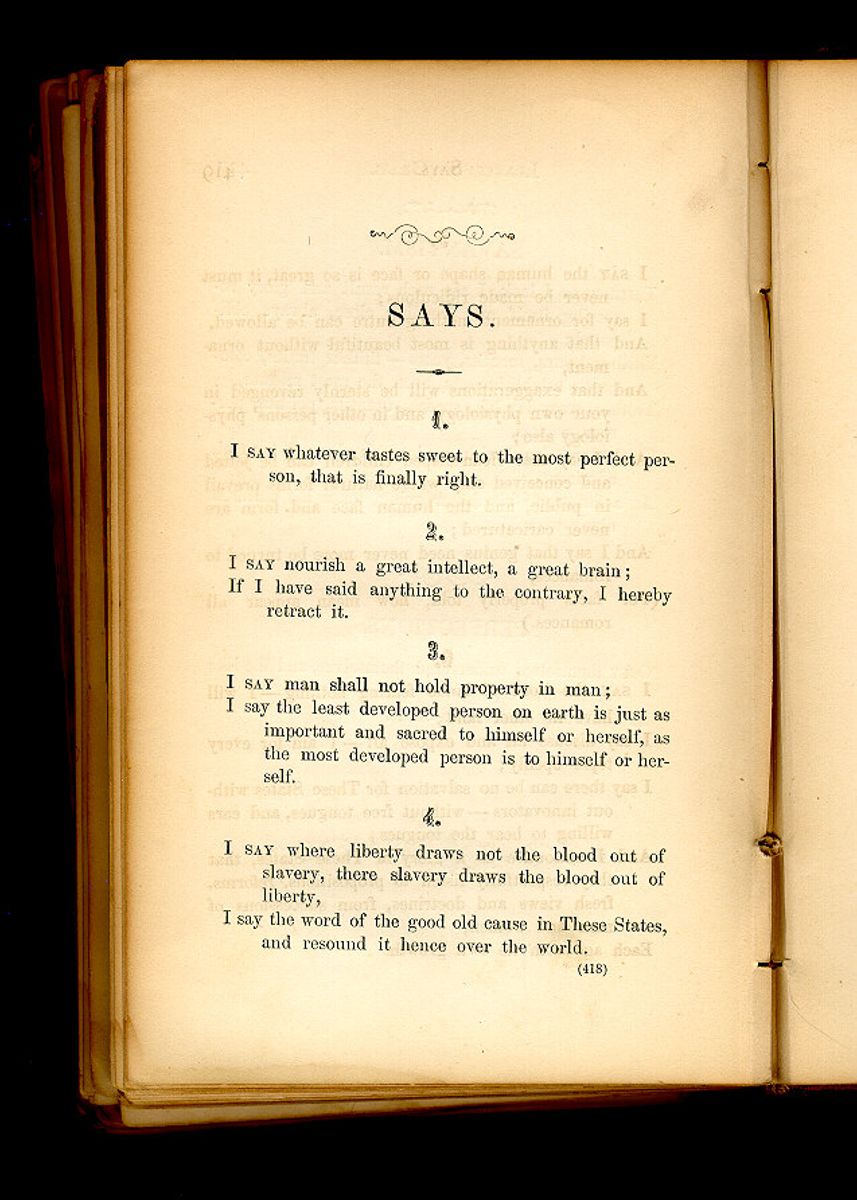 ppp.01500.426.jpg
SAYS.
1.
I SAY whatever tastes sweet to the most perfect per-son, that is finally right.
2.
I SAY nourish a great intellect, a great brain; If I have said anything to the contrary, I herebyretract it.
3.
I SAY man shall not hold property in man; I say the least developed person on earth is just asimportant and sacred to himself or herself, as
the most developed person is to himself or her-
self.
4.
I SAY where liberty draws not the blood out ofslavery, there slavery draws the blood out of
liberty, I say the word of the good old cause in These States,
and resound it hence over the world. [ begin page 419 ]
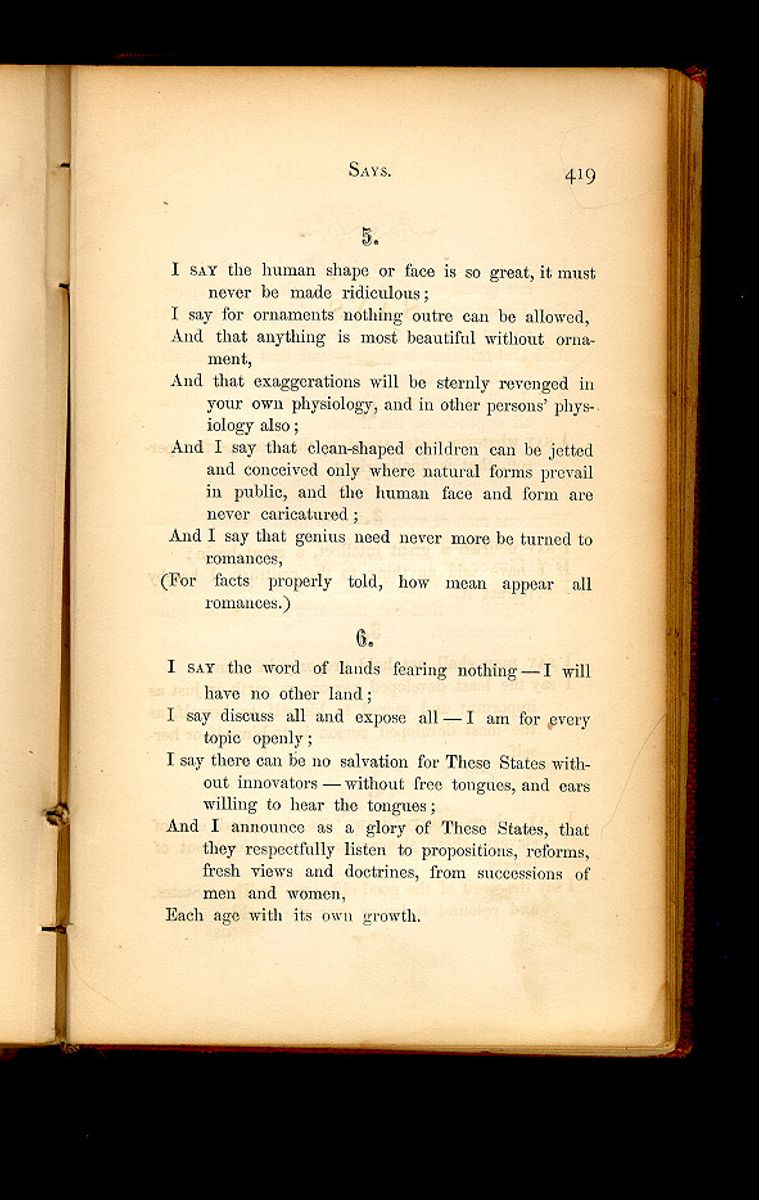 ppp.01500.427.jpg
5.
I SAY the human shape or face is so great, it mustnever be made ridiculous; I say for ornaments nothing outre can be allowed, And that anything is most beautiful without orna-
ment, And that exaggerations will be sternly revenged in
your own physiology, and in other persons' phys-
iology also; And I say that clean-shaped children can be jetted
and conceived only where natural forms prevail
in public, and the human face and form are
never caricatured; And I say that genius need never more be turned to
romances, (For facts properly told, how mean appear all
romances.)
6.
I SAY the word of lands fearing nothing—I willhave no other land; I say discuss all and expose all—I am for every
topic openly; I say there can be no salvation for These States with-
out innovators—without free tongues, and ears
willing to hear the tongues; And I announce as a glory of These States, that
they respectfully listen to propositions, reforms,
fresh views and doctrines, from successions of
men and women, Each age with its own growth. [ begin page 420 ]
 ppp.01500.428.jpg
7.
I HAVE said many times that materials and the Soulare great, and that all depends on physique; Now I reverse what I said, and affirm that all depends
on the æsthetic or intellectual, And that criticism is great—and that refinement is
greatest of all; And I affirm now that the mind governs—and that
all depends on the mind.
8.
WITH one man or woman—(no matter which one—I even pick out the lowest,) With him or her I now illustrate the whole law; I say that every right, in politics or what-not, shall be
eligible to that one man or woman, on the same
terms as any. [ begin page 421 ]
 ppp.01500.429.jpg
DEBRIS.
HE is wisest who has the most caution, He only wins who goes far enough. ANY thing is as good as established, when that isestablished that will produce it and continue it. WHAT General has a good army in himself, has a
good army; He happy in himself, or she happy in herself, is
happy, But I tell you you cannot be happy by others, any
more than you can beget or conceive a child by
others. HAVE you learned lessons only of those who admired
you, and were tender with you, and stood aside
for you? Have you not learned the great lessons of those who
rejected you, and braced themselves against you?
or who treated you with contempt, or disputed
the passage with you? Have you had no practice to receive opponents when
they come? 36 [ begin page 422 ]
 ppp.01500.430.jpg
DESPAIRING cries float ceaselessly toward me, day and
ppp.01500.430.jpg
DESPAIRING cries float ceaselessly toward me, day and night, The sad voice of Death—the call of my nearest
lover, putting forth, alarmed, uncertain, This sea I am quickly to sail, come tell me, Come tell me where I am speeding—tell me my
destination. I UNDERSTAND your anguish, but I cannot help you, I approach, hear, behold—the sad mouth, the look
out of the eyes, your mute inquiry, Whither I go from the bed I now recline on, come
tell me; Old age, alarmed, uncertain—A young woman's
voice appealing to me, for comfort, A young man's voice, Shall I not escape? A THOUSAND perfect men and women appear, Around each gathers a cluster of friends, and gay
children and youths, with offerings. A MASK—a perpetual natural disguiser of herself, Concealing her face, concealing her form, Changes and transformations every hour, every mo-
ment, Falling upon her even when she sleeps. [ begin page 423 ]
 ppp.01500.431.jpg
ONE sweeps by, attended by an immense train,
All emblematic of peace—not a soldier or menial
ppp.01500.431.jpg
ONE sweeps by, attended by an immense train,
All emblematic of peace—not a soldier or menial among them. ONE sweeps by, old, with black eyes, and profuse
white hair, He has the simple magnificence of health and
strength, His face strikes as with flashes of lightning whoever
it turns toward. THREE old men slowly pass, followed by three others,
and they by three others, They are beautiful—the one in the middle of each
group holds his companions by the hand, As they walk, they give out perfume wherever they
walk. WOMEN sit, or move to and fro—some old, some
young, The young are beautiful—but the old are more
beautiful than the young. WHAT weeping face is that looking from the window? Why does it stream those sorrowful tears? Is it for some burial place, vast and dry? Is it to wet the soil of graves? [ begin page 424 ]
 ppp.01500.432.jpg
I WILL take an egg out of the robin's nest in the
ppp.01500.432.jpg
I WILL take an egg out of the robin's nest in the orchard, I will take a branch of gooseberries from the old bush
in the garden, and go and preach to the world; You shall see I will not meet a single heretic or
scorner, You shall see how I stump clergymen, and confound
them, You shall see me showing a scarlet tomato, and a
white pebble from the beach. BEHAVIOR—fresh, native, copious, each one for him-
self or herself, Nature and the Soul expressed—America and free-
dom expressed—In it the finest art, In it pride, cleanliness, sympathy, to have their
chance, In it physique, intellect, faith—in it just as much as
to manage an army or a city, or to write a book
—perhaps more, The youth, the laboring person, the poor person,
rivalling all the rest—perhaps outdoing the
rest, The effects of the universe no greater than its; For there is nothing in the whole universe that can
be more effective than a man's or woman's daily
behavior can be, In any position, in any one of These States. [ begin page 425 ]
 ppp.01500.433.jpg
NOT the pilot has charged himself to bring his ship
ppp.01500.433.jpg
NOT the pilot has charged himself to bring his ship into port, though beaten back, and many times
baffled, Not the path-finder, penetrating inland, weary and
long, By deserts parched, snows chilled, rivers wet, per-
severes till he reaches his destination, More than I have charged myself, heeded or un-
heeded, to compose a free march for These
States, To be exhilarating music to them, years, centuries
hence. I THOUGHT I was not alone, walking here by the shore, But the one I thought was with me, as now I walk by
the shore, As I lean and look through the glimmering light—
that one has utterly disappeared, And those appear that perplex me. 36* [ begin page 426 ]
 ppp.01500.434.jpg
SLEEP-CHASINGS.
1I WANDER all night in my vision, Stepping with light feet, swiftly and noiselessly step-ping and stopping, Bending with open eyes over the shut eyes of
sleepers, Wandering and confused, lost to myself, ill-assorted,
contradictory, Pausing, gazing, bending, and stopping. 2How solemn they look there, stretched and still! How quiet they breathe, the little children in their
cradles! 3The wretched features of ennuyés, the white features
of corpses, the livid faces of drunkards, the sick-
gray faces of onanists, The gashed bodies on battle-fields, the insane in their
strong-doored rooms, the sacred idiots, the new-
born emerging from gates, and the dying emer-
ging from gates, The night pervades them and infolds them. 4The married couple sleep calmly in their bed—he
with his palm on the hip of the wife, and she
with her palm on the hip of the husband, [ begin page 427 ]
 ppp.01500.435.jpg
The sisters sleep lovingly side by side in their bed,
The men sleep lovingly side by side in theirs,
And the mother sleeps, with her little child carefully
ppp.01500.435.jpg
The sisters sleep lovingly side by side in their bed,
The men sleep lovingly side by side in theirs,
And the mother sleeps, with her little child carefully wrapped. 5The blind sleep, and the deaf and dumb sleep, The prisoner sleeps well in the prison—the run-
away son sleeps, The murderer that is to be hung next day—how
does he sleep? And the murdered person—how does he sleep? 6The female that loves unrequited sleeps, And the male that loves unrequited sleeps, The head of the money-maker that plotted all day
sleeps, And the enraged and treacherous dispositions—
all, all sleep. 7I stand in the dark with drooping eyes by the worst-
suffering and the most restless, I pass my hands soothingly to and fro a few inches
from them, The restless sink in their beds—they fitfully sleep. 8Now I pierce the darkness—new beings appear, The earth recedes from me into the night, I saw that it was beautiful, and I see that what is not
the earth is beautiful. 9I go from bedside to bedside—I sleep close with
the other sleepers, each in turn, I dream in my dream all the dreams of the other
dreamers, And I become the other dreamers. [ begin page 428 ]
 ppp.01500.436.jpg
10I am a dance—Play up, there! the fit is whirling
ppp.01500.436.jpg
10I am a dance—Play up, there! the fit is whirling me fast! 11I am the ever-laughing—it is new moon and twilight, I see the hiding of douceurs—I see nimble ghosts
whichever way I look, Cache, and cache again, deep in the ground and sea,
and where it is neither ground or sea. 12Well do they do their jobs, those journeymen divine, Only from me can they hide nothing, and would not
if they could, I reckon I am their boss, and they make me a pet
besides, And surround me and lead me, and run ahead when
I walk, To lift their cunning covers, to signify me with
stretched arms, and resume the way; Onward we move! a gay gang of blackguards! with
mirth-shouting music and wild-flapping pennants
of joy! 13I am the actor, the actress, the voter, the politician, The emigrant and the exile, the criminal that stood
in the box, He who has been famous, and he who shall be famous
after to-day, The stammerer, the well-formed person, the wasted
or feeble person. 14I am she who adorned herself and folded her hair
expectantly, My truant lover has come, and it is dark. [ begin page 429 ]
 ppp.01500.437.jpg
15Double yourself and receive me, darkness!
Receive me and my lover too—he will not let me go
ppp.01500.437.jpg
15Double yourself and receive me, darkness!
Receive me and my lover too—he will not let me go without him. 16I roll myself upon you, as upon a bed—I resign
myself to the dusk. 17He whom I call answers me and takes the place of
my lover, He rises with me silently from the bed. 18Darkness! you are gentler than my lover—his flesh
was sweaty and panting, I feel the hot moisture yet that he left me. 19My hands are spread forth, I pass them in all
directions, I would sound up the shadowy shore to which you
are journeying. 20Be careful, darkness! already, what was it touched
me? I thought my lover had gone, else darkness and he
are one, I hear the heart-beat—I follow, I fade away. 21O hot-cheeked and blushing! O foolish hectic! O for pity's sake, no one must see me now! my
clothes were stolen while I was abed, Now I am thrust forth, where shall I run? 22Pier that I saw dimly last night, when I looked from
the windows! [ begin page 430 ]
 ppp.01500.438.jpg
Pier out from the main, let me catch myself with you
ppp.01500.438.jpg
Pier out from the main, let me catch myself with you and stay—I will not chafe you, I feel ashamed to go naked about the world. 23I am curious to know where my feet stand—and
what this is flooding me, childhood or manhood
—and the hunger that crosses the bridge
between. 24The cloth laps a first sweet eating and drinking, Laps life-swelling yolks—laps ear of rose-corn, milky
and just ripened; The white teeth stay, and the boss-tooth advances in
darkness, And liquor is spilled on lips and bosoms by touching
glasses, and the best liquor afterward. 25I descend my western course, my sinews are flaccid, Perfume and youth course through me, and I am
their wake. 26It is my face yellow and wrinkled, instead of the
old woman's, I sit low in a straw-bottom chair, and carefully darn
my grandson's stockings. 27It is I too, the sleepless widow looking out on the
winter midnight, I see the sparkles of starshine on the icy and pallid
earth. 28A shroud I see, and I am the shroud—I wrap a body
and lie in the coffin, [ begin page 431 ]
 ppp.01500.439.jpg
It is dark here under ground—it is not evil or pain
ppp.01500.439.jpg
It is dark here under ground—it is not evil or pain here—it is blank here, for reasons. 29It seems to me that everything in the light and air
ought to be happy, Whoever is not in his coffin and the dark grave, let
him know he has enough. 30I see a beautiful gigantic swimmer swimming naked
through the eddies of the sea, His brown hair lies close and even to his head—
he strikes out with courageous arms—he urges
himself with his legs, I see his white body—I see his undaunted eyes, I hate the swift-running eddies that would dash him
head-foremost on the rocks. 31What are you doing, you ruffianly red-trickled waves? Will you kill the courageous giant? Will you kill
him in the prime of his middle age? 32Steady and long he struggles, He is baffled, banged, bruised—he holds out while
his strength holds out, The slapping eddies are spotted with his blood—
they bear him away—they roll him, swing him,
turn him, His beautiful body is borne in the circling eddies,
it is continually bruised on rocks, Swiftly and out of sight is borne the brave corpse. 33I turn, but do not extricate myself, Confused, a past-reading, another, but with darkness
yet. [ begin page 432 ]
 ppp.01500.440.jpg
34The beach is cut by the razory ice-wind—the wreck-
ppp.01500.440.jpg
34The beach is cut by the razory ice-wind—the wreck- guns sound, The tempest lulls—the moon comes floundering
through the drifts. 35I look where the ship helplessly heads end on—I
hear the burst as she strikes—I hear the howls
of dismay—they grow fainter and fainter. 36I cannot aid with my wringing fingers, I can but rush to the surf, and let it drench me and
freeze upon me. 37I search with the crowd—not one of the company is
washed to us alive; In the morning I help pick up the dead and lay them
in rows in a barn. 38Now of the old war-days, the defeat at Brooklyn, Washington stands inside the lines—he stands on the
intrenched hills, amid a crowd of officers, His face is cold and damp—he cannot repress the
weeping drops, He lifts the glass perpetually to his eyes—the color
is blanched from his cheeks, He sees the slaughter of the southern braves confided
to him by their parents. 39The same, at last and at last, when peace is declared, He stands in the room of the old tavern—the well-
beloved soldiers all pass through, The officers speechless and slow draw near in their
turns, [ begin page 433 ]
 ppp.01500.441.jpg
The chief encircles their necks with his arm, and
ppp.01500.441.jpg
The chief encircles their necks with his arm, and kisses them on the cheek, He kisses lightly the wet cheeks one after another—
he shakes hands, and bids good-by to the army. 40Now I tell what my mother told me to-day as we sat
at dinner together, Of when she was a nearly grown girl, living home
with her parents on the old homestead. 41A red squaw came one breakfast-time to the old
homestead, On her back she carried a bundle of rushes for
rush-bottoming chairs, Her hair, straight, shiny, coarse, black, profuse, half-
enveloped her face, Her step was free and elastic, and her voice sounded
exquisitely as she spoke. 42My mother looked in delight and amazement at the
stranger, She looked at the freshness of her tall-borne face, and
full and pliant limbs, The more she looked upon her she loved her, Never before had she seen such wonderful beauty and
purity, She made her sit on a bench by the jamb of the fire-
place—she cooked food for her, She had no work to give her, but she gave her
remembrance and fondness. 43The red squaw staid all the forenoon, and toward the
middle of the afternoon she went away, 37 [ begin page 434 ]
 ppp.01500.442.jpg
O my mother was loth to have her go away!
All the week she thought of her—she watched for
ppp.01500.442.jpg
O my mother was loth to have her go away!
All the week she thought of her—she watched for her many a month, She remembered her many a winter and many a
summer, But the red squaw never came, nor was heard of
there again. 44Now Lucifer was not dead—or if he was, I am his
sorrowful terrible heir, I have been wronged—I am oppressed—I hate him
that oppresses me, I will either destroy him, or he shall release me. 45Damn him! how he does defile me! How he informs against my brother and sister, and
takes pay for their blood! How he laughs when I look down the bend, after the
steamboat that carries away my woman! 46Now the vast dusk bulk that is the whale's bulk, it
seems mine, Warily, sportsman! though I lie so sleepy and slug-
gish, my tap is death. 47A show of the summer softness! a contact of some-
thing unseen! an amour of the light and air! I am jealous, and overwhelmed with friendliness, And will go gallivant with the light and air myself, And have an unseen something to be in contact with
them also. 48O love and summer! you are in the dreams, and
in me! [ begin page 435 ]
 ppp.01500.443.jpg
Autumn and winter are in the dreams—the farmer
ppp.01500.443.jpg
Autumn and winter are in the dreams—the farmer goes with his thrift, The droves and crops increase, and the barns are well-
filled. 49Elements merge in the night—ships make tacks in
the dreams, The sailor sails—the exile returns home, The fugitive returns unharmed—the immigrant is
back beyond months and years, The poor Irishman lives in the simple house of his
childhood, with the well-known neighbors and
faces, They warmly welcome him—he is barefoot again, he
forgets he is well off; The Dutchman voyages home, and the Scotchman
and Welshman voyage home, and the native of
the Mediterranean voyages home, To every port of England, France, Spain, enter well-
filled ships, The Swiss foots it toward his hills—the Prussian goes
his way, the Hungarian his way, and the Pole
his way, The Swede returns, and the Dane and Norwegian
return. 50The homeward bound, and the outward bound, The beautiful lost swimmer, the ennuyé, the onanist,
the female that loves unrequited, the money-
maker, The actor and actress, those through with their parts,
and those waiting to commence, [ begin page 436 ]
 ppp.01500.444.jpg
The affectionate boy, the husband and wife, the voter,
ppp.01500.444.jpg
The affectionate boy, the husband and wife, the voter, the nominee that is chosen, and the nominee that
has failed, The great already known, and the great any time
after to-day, The stammerer, the sick, the perfect-formed, the
homely, The criminal that stood in the box, the judge that
sat and sentenced him, the fluent lawyers, the
jury, the audience, The laugher and weeper, the dancer, the midnight
widow, the red squaw, The consumptive, the erysipelite, the idiot, he that
is wronged, The antipodes, and every one between this and them
in the dark, I swear they are averaged now—one is no better
than the other, The night and sleep have likened them and restored
them. 51I swear they are all beautiful! Every one that sleeps is beautiful—everything in
the dim light is beautiful, The wildest and bloodiest is over, and all is peace. 52Peace is always beautiful, The myth of heaven indicates peace and night. 53The myth of heaven indicates the Soul; The Soul is always beautiful—it appears more or it
appears less—it comes, or it lags behind, [ begin page 437 ]
 ppp.01500.445.jpg
It comes from its embowered garden, and looks
ppp.01500.445.jpg
It comes from its embowered garden, and looks pleasantly on itself, and encloses the world, Perfect and clean the genitals previously jetting, and
perfect and clean the womb cohering, The head well-grown, proportioned and plumb, and
the bowels and joints proportioned and plumb. 54The Soul is always beautiful, The universe is duly in order, everything is in its
place, What is arrived is in its place, and what waits is
in its place; The twisted skull waits, the watery or rotten blood
waits, The child of the glutton or venerealee waits long, and
the child of the drunkard waits long, and the
drunkard himself waits long, The sleepers that lived and died wait—the far
advanced are to go on in their turns, and the
far behind are to go on in their turns, The diverse shall be no less diverse, but they shall
flow and unite—they unite now. 55The sleepers are very beautiful as they lie unclothed, They flow hand in hand over the whole earth, from
east to west, as they lie unclothed, The Asiatic and African are hand in hand—the
European and American are hand in hand, Learned and unlearned are hand in hand, and male
and female are hand in hand, The bare arm of the girl crosses the bare breast of
her lover—they press close without lust—his
lips press her neck, 37* [ begin page 438 ]
 ppp.01500.446.jpg
The father holds his grown or ungrown son in his
ppp.01500.446.jpg
The father holds his grown or ungrown son in his arms with measureless love, and the son holds
the father in his arms with measureless love, The white hair of the mother shines on the white
wrist of the daughter, The breath of the boy goes with the breath of the
man, friend is inarmed by friend, The scholar kisses the teacher, and the teacher kisses
the scholar—the wronged is made right, The call of the slave is one with the master's call, and
the master salutes the slave, The felon steps forth from the prison—the insane
becomes sane—the suffering of sick persons is
relieved, The sweatings and fevers stop—the throat that was
unsound is sound—the lungs of the consumptive
are resumed—the poor distressed head is free, The joints of the rheumatic move as smoothly as ever,
and smoother than ever, Stiflings and passages open—the paralyzed become
supple, The swelled and convulsed and congested awake to
themselves in condition, They pass the invigoration of the night, and the
chemistry of the night, and awake. 56I too pass from the night, I stay a while away O night, but I return to you
again, and love you. 57Why should I be afraid to trust myself to you? I am not afraid—I have been well brought forward
by you, [ begin page 439 ]
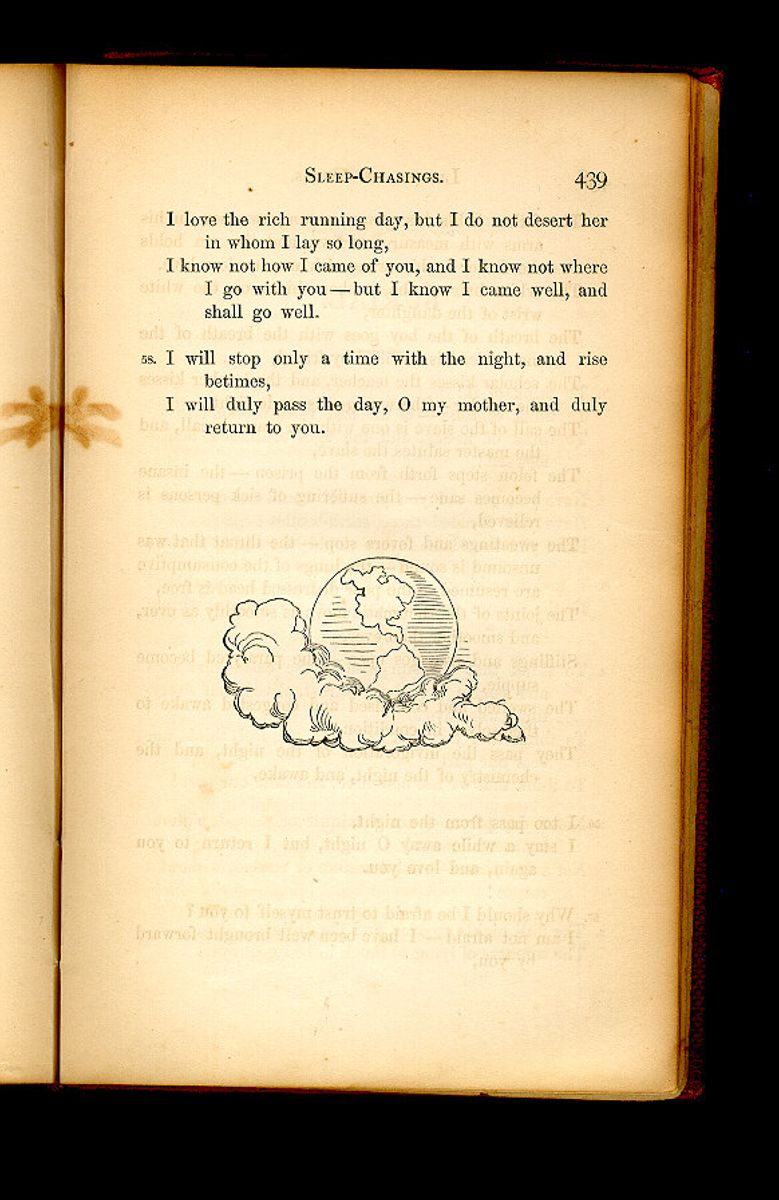 ppp.01500.447.jpg
I love the rich running day, but I do not desert her
ppp.01500.447.jpg
I love the rich running day, but I do not desert her in whom I lay so long, I know not how I came of you, and I know not where
I go with you—but I know I came well, and
shall go well. 58I will stop only a time with the night, and rise
betimes, I will duly pass the day, O my mother, and duly
return to you. [ begin page 440 ]
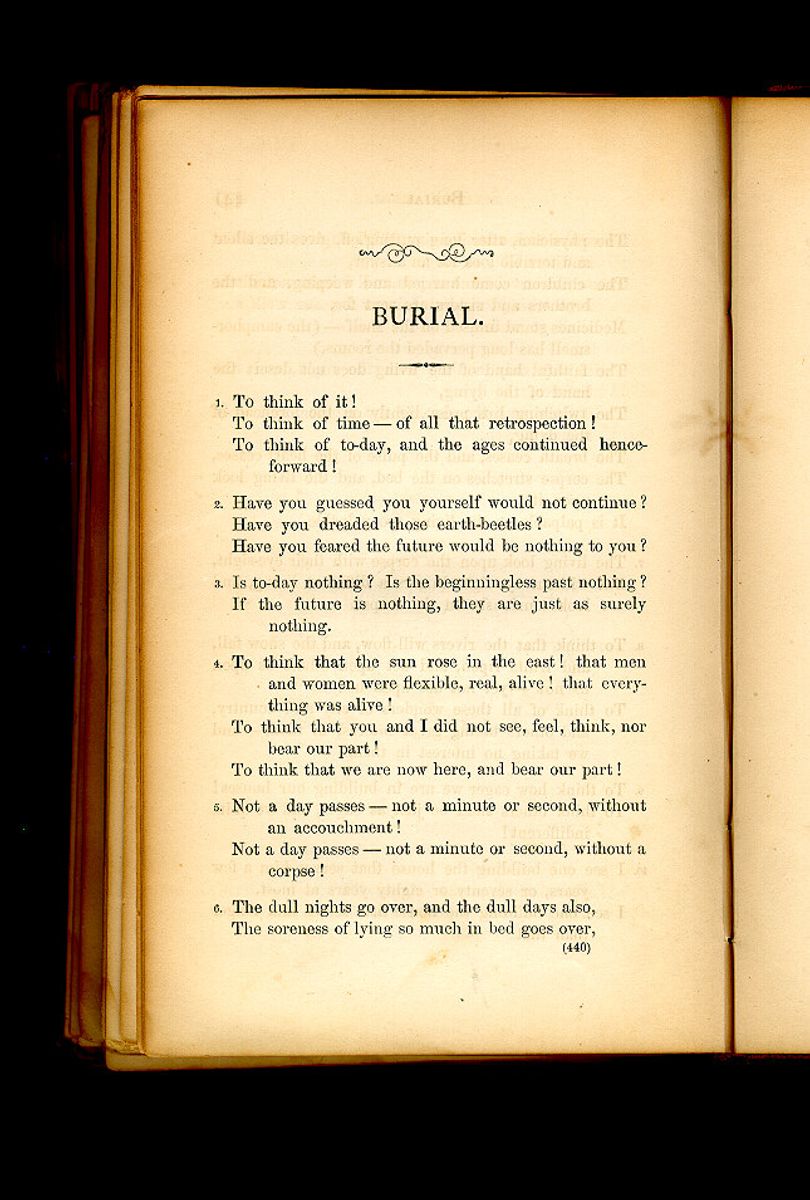 ppp.01500.448.jpg
BURIAL.
1TO think of it! To think of time—of all that retrospection! To think of to-day, and the ages continued hence-forward! 2Have you guessed you yourself would not continue? Have you dreaded those earth-beetles? Have you feared the future would be nothing to you? 3Is to-day nothing? Is the beginningless past nothing? If the future is nothing, they are just as surely
nothing. 4To think that the sun rose in the east! that men
and women were flexible, real, alive! that every-
thing was alive! To think that you and I did not see, feel, think, nor
bear our part! To think that we are now here, and bear our part! 5Not a day passes—not a minute or second, without
an accouchment! Not a day passes—not a minute or second, without a
corpse! 6The dull nights go over, and the dull days also, The soreness of lying so much in bed goes over, [ begin page 441 ]
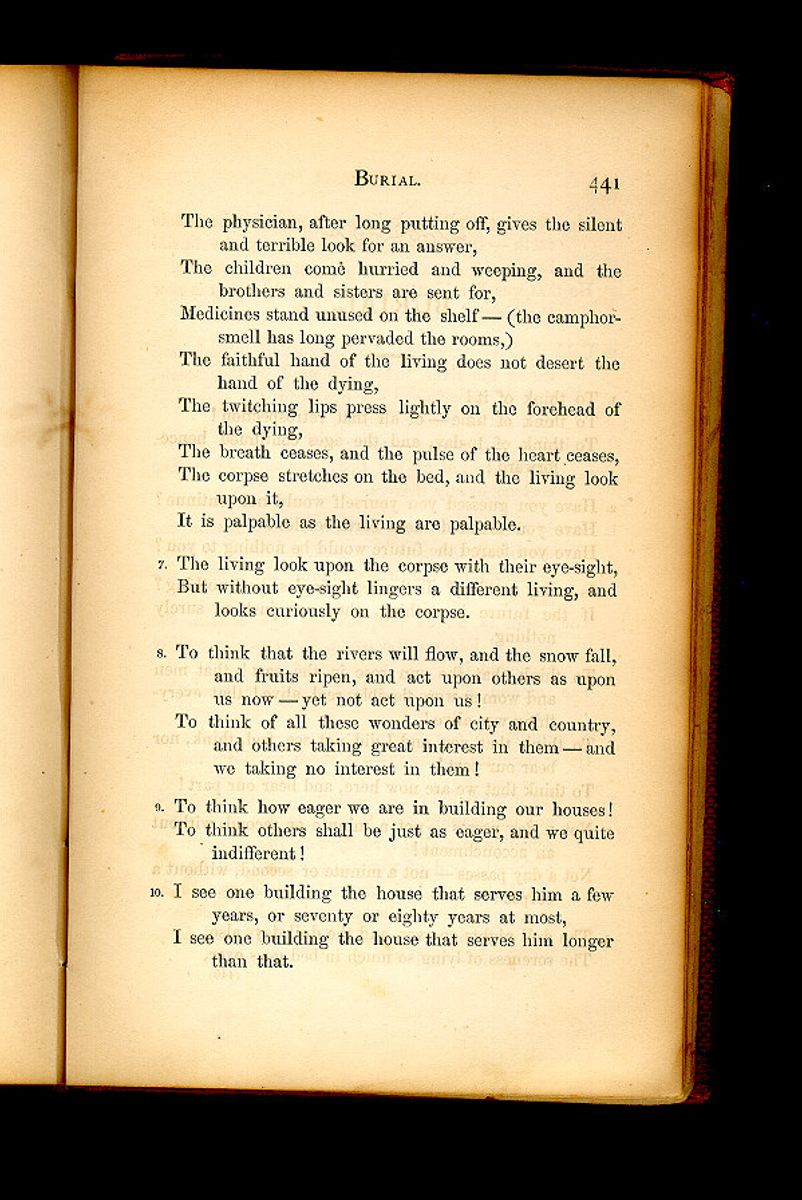 ppp.01500.449.jpg
The physician, after long putting off, gives the silent
ppp.01500.449.jpg
The physician, after long putting off, gives the silent and terrible look for an answer, The children come hurried and weeping, and the
brothers and sisters are sent for, Medicines stand unused on the shelf—(the camphor-
smell has long pervaded the rooms,) The faithful hand of the living does not desert the
hand of the dying, The twitching lips press lightly on the forehead of
the dying, The breath ceases, and the pulse of the heart ceases, The corpse stretches on the bed, and the living look
upon it, It is palpable as the living are palpable. 7The living look upon the corpse with their eye-sight, But without eye-sight lingers a different living, and
looks curiously on the corpse. 8To think that the rivers will flow, and the snow fall,
and fruits ripen, and act upon others as upon
us now—yet not act upon us! To think of all these wonders of city and country,
and others taking great interest in them—and
we taking no interest in them! 9To think how eager we are in building our houses! To think others shall be just as eager, and we quite
indifferent! 10I see one building the house that serves him a few
years, or seventy or eighty years at most, I see one building the house that serves him longer
than that. [ begin page 442 ]
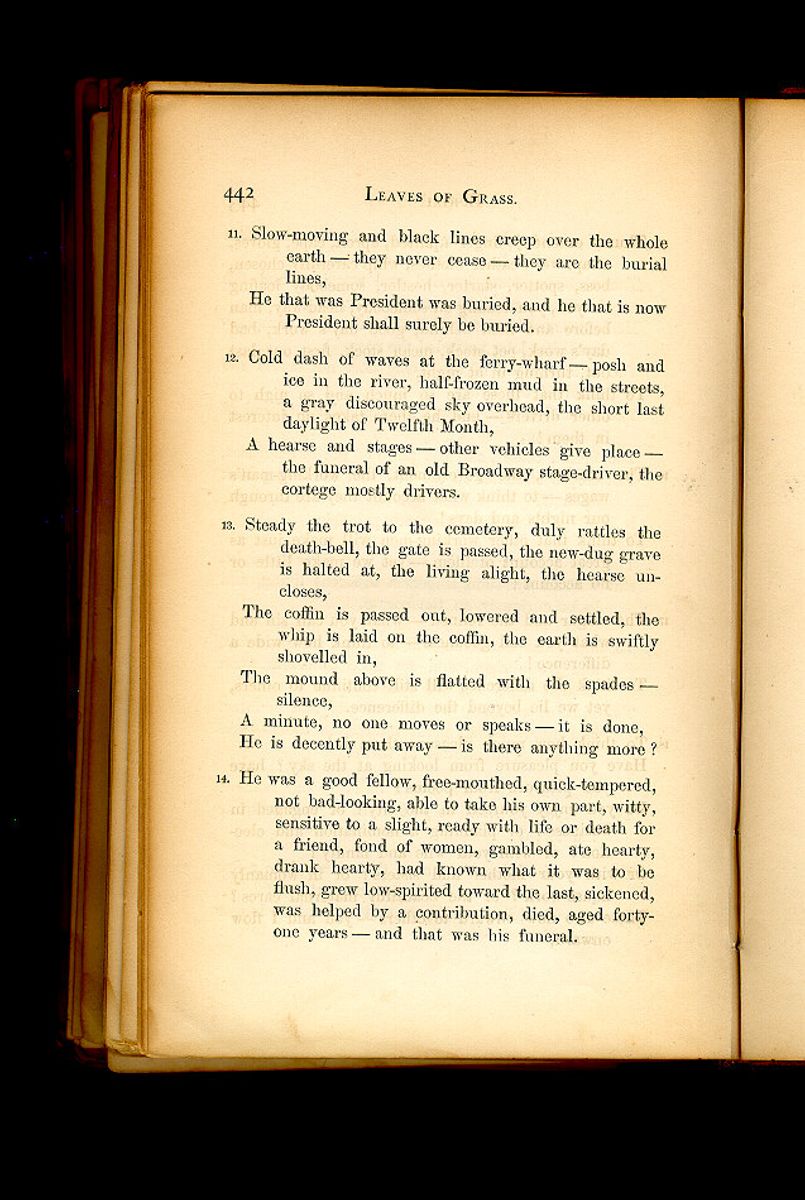 ppp.01500.450.jpg
11Slow-moving and black lines creep over the whole
ppp.01500.450.jpg
11Slow-moving and black lines creep over the whole earth—they never cease—they are the burial
lines, He that was President was buried, and he that is now
President shall surely be buried. 12Cold dash of waves at the ferry-wharf—posh and
ice in the river, half-frozen mud in the streets,
a gray discouraged sky overhead, the short last
daylight of Twelfth Month, A hearse and stages—other vehicles give place—
the funeral of an old Broadway stage-driver, the
cortege mostly drivers. 13Steady the trot to the cemetery, duly rattles the
death-bell, the gate is passed, the new-dug grave
is halted at, the living alight, the hearse un-
closes, The coffin is passed out, lowered and settled, the
whip is laid on the coffin, the earth is swiftly
shovelled in, The mound above is flatted with the spades—
silence, A minute, no one moves or speaks—it is done, He is decently put away—is there anything more? 14He was a good fellow, free-mouthed, quick-tempered,
not bad-looking, able to take his own part, witty,
sensitive to a slight, ready with life or death for
a friend, fond of women, gambled, ate hearty,
drank hearty, had known what it was to be
flush, grew low-spirited toward the last, sickened,
was helped by a contribution, died, aged forty-
one years—and that was his funeral. [ begin page 443 ]
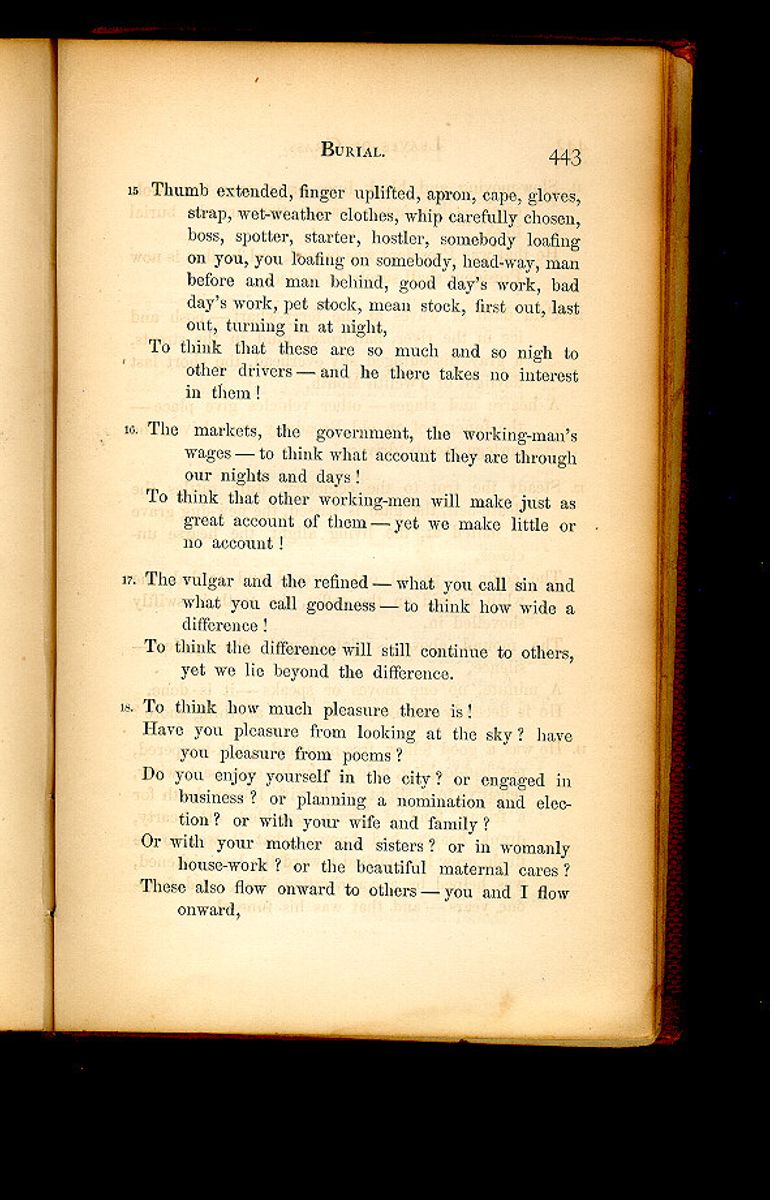 ppp.01500.451.jpg
15Thumb extended, finger uplifted, apron, cape, gloves,
ppp.01500.451.jpg
15Thumb extended, finger uplifted, apron, cape, gloves, strap, wet-weather clothes, whip carefully chosen,
boss, spotter, starter, hostler, somebody loafing
on you, you loafing on somebody, head-way, man
before and man behind, good day's work, bad
day's work, pet stock, mean stock, first out, last
out, turning in at night, To think that these are so much and so nigh to
other drivers—and he there takes no interest
in them! 16The markets, the government, the working-man's
wages—to think what account they are through
our nights and days! To think that other working-men will make just as
great account of them—yet we make little or
no account! 17The vulgar and the refined—what you call sin and
what you call goodness—to think how wide a
difference! To think the difference will still continue to others,
yet we lie beyond the difference. 18To think how much pleasure there is! Have you pleasure from looking at the sky? have
you pleasure from poems? Do you enjoy yourself in the city? or engaged in
business? or planning a nomination and elec-
tion? or with your wife and family? Or with your mother and sisters? or in womanly
house-work? or the beautiful maternal cares? These also flow onward to others—you and I flow
onward, [ begin page 444 ]
 ppp.01500.452.jpg
But in due time you and I shall take less interest
ppp.01500.452.jpg
But in due time you and I shall take less interest in them. 19Your farm, profits, crops,—to think how engrossed
you are! To think there will still be farms, profits, crops—yet
for you, of what avail? 20What will be, will be well—for what is, is well, To take interest is well, and not to take interest shall
be well. 21The sky continues beautiful, The pleasure of men with women shall never be sated,
nor the pleasure of women with men, nor the
pleasure from poems, The domestic joys, the daily house-work or business,
the building of houses—these are not phan-
tasms—they have weight, form, location; Farms, profits, crops, markets, wages, government,
are none of them phantasms, The difference between sin and goodness is no
delusion, The earth is not an echo—man and his life, and all
the things of his life, are well-considered. 22You are not thrown to the winds—you gather cer-
tainly and safely around yourself, Yourself! Yourself! Yourself, forever and ever! 23It is not to diffuse you that you were born of your
mother and father—it is to identify you,
It is not that you should be undecided, but that you
should be decided; [ begin page 445 ]
 ppp.01500.453.jpg
Something long preparing and formless is arrived and
ppp.01500.453.jpg
Something long preparing and formless is arrived and formed in you, You are thenceforth secure, whatever comes or goes. 24The threads that were spun are gathered, the weft
crosses the warp, the pattern is systematic. 25The preparations have every one been justified, The orchestra have sufficiently tuned their instru-
ments, the baton has given the signal. 26The guest that was coming—he waited long, for
reasons—he is now housed, He is one of those who are beautiful and happy—
he is one of those that to look upon and be
with is enough. 27The law of the past cannot be eluded, The law of the present and future cannot be eluded, The law of the living cannot be eluded—it is eter-
nal, The law of promotion and transformation cannot be
eluded, The law of heroes and good-doers cannot be eluded, Thee law of drunkards, informers, mean persons—
not one iota of it can be eluded. 28Slow-moving and black lines go ceaselessly over the
earth, Northerner goes carried, and southerner goes carried,
and they on the Atlantic side, and they on the
Pacific, and they between, and all through the
Mississippi country, and all over the earth. 38 [ begin page 446 ]
 ppp.01500.454.jpg
29The great masters and kosmos are well as they go—
ppp.01500.454.jpg
29The great masters and kosmos are well as they go— the heroes and good-doers are well, The known leaders and inventors, and the rich owners
and pious and distinguished, may be well, But there is more account than that—there is strict
account of all. 30The interminable hordes of the ignorant and wicked
are not nothing, The barbarians of Africa and Asia are not nothing, The common people of Europe are not nothing—the
American aborigines are not nothing, The infected in the immigrant hospital are not
nothing—the murderer or mean person is not
nothing, The perpetual successions of shallow people are not
nothing as they go, The lowest prostitute is not nothing—the mocker of
religion is not nothing as he goes. 31I shall go with the rest—we have satisfaction, I have dreamed that we are not to be changed so
much, nor the law of us changed, I have dreamed that heroes and good-doers shall
be under the present and past law, And that murderers, drunkards, liars, shall be under
the present and past law, For I have dreamed that the law they are under now
is enough. 32And I have dreamed that the satisfaction is not so
much changed, and that there is no life with-
out satisfaction; What is the earth? what are body and Soul, without
satisfaction? [ begin page 447 ]
 ppp.01500.455.jpg
33I shall go with the rest,
We cannot be stopped at a given point—that is no
ppp.01500.455.jpg
33I shall go with the rest,
We cannot be stopped at a given point—that is no satisfaction, To show us a good thing, or a few good things, for a
space of time—that is no satisfaction, We must have the indestructible breed of the best,
regardless of time. 34If otherwise, all these things came but to ashes of
dung, If maggots and rats ended us, then alarm! for we are
betrayed! Then indeed suspicion of death. 35Do you suspect death? If I were to suspect death, I
should die now, Do you think I could walk pleasantly and well-suited
toward annihilation? 36Pleasantly and well-suited I walk, Whither I walk I cannot define, but I know it is good, The whole universe indicates that it is good, The past and the present indicate that it is good. 37How beautiful and perfect are the animals! How
perfect is my Soul! How perfect the earth, and the minutest thing upon
it! What is called good is perfect, and what is called bad
is just as perfect, The vegetables and minerals are all perfect, and the
imponderable fluids are perfect; Slowly and surely they have passed on to this, and
slowly and surely they yet pass on. [ begin page 448 ]
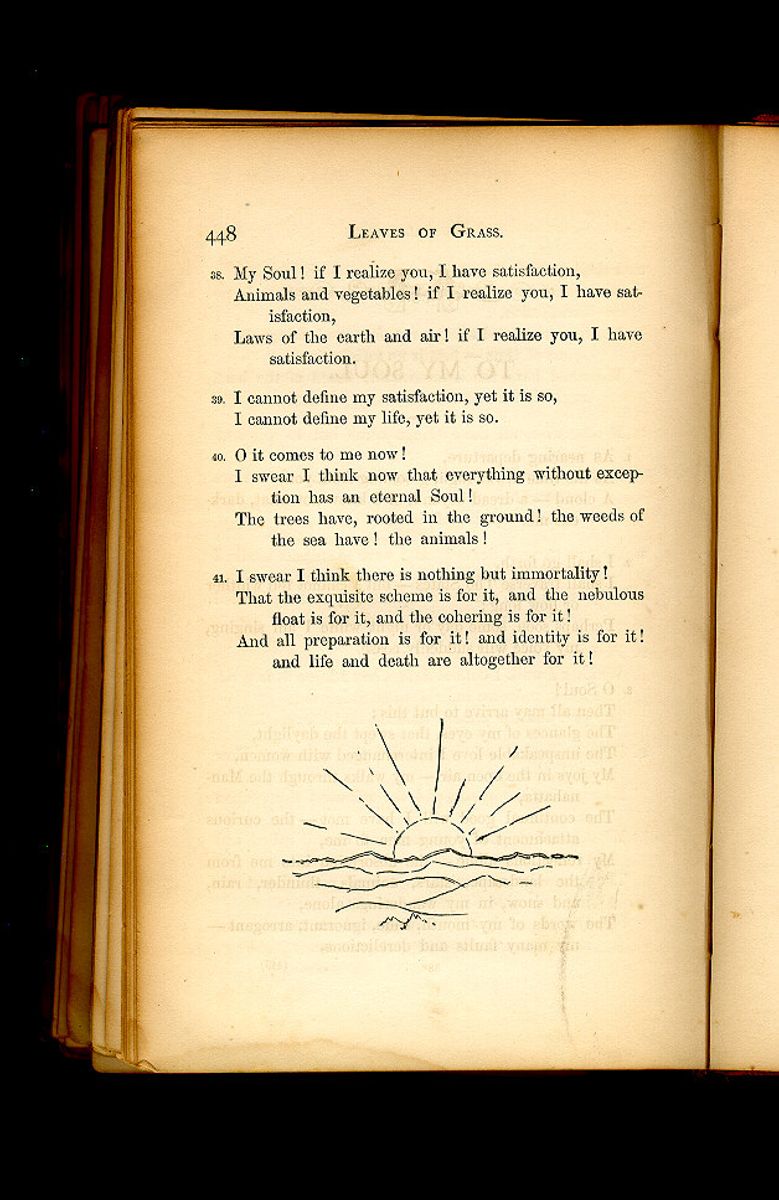 ppp.01500.456.jpg
38My Soul! if I realize you, I have satisfaction,
Animals and vegetables! if I realize you, I have sat-
ppp.01500.456.jpg
38My Soul! if I realize you, I have satisfaction,
Animals and vegetables! if I realize you, I have sat- isfaction, Laws of the earth and air! if I realize you, I have
satisfaction. 39I cannot define my satisfaction, yet it is so, I cannot define my life, yet it is so. 40O it comes to me now! I swear I think now that everything without excep-
tion has an eternal Soul! The trees have, rooted in the ground! the weeds of
the sea have! the animals! 41I swear I think there is nothing but immortality! That the exquisite scheme is for it, and the nebulous
float is for it, and the cohering is for it! And all preparation is for it! and identity is for it!
and life and death are altogether for it! [ begin page 449 ]
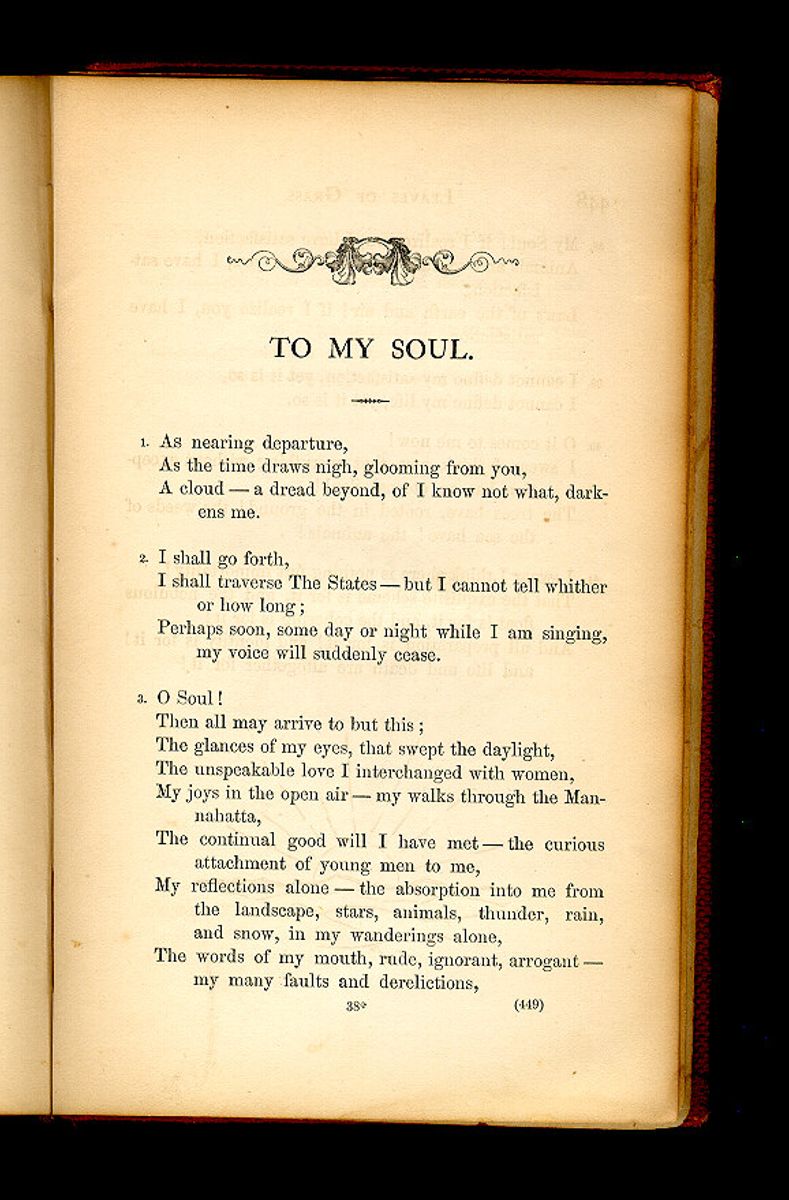 ppp.01500.457.jpg
TO MY SOUL.
1AS nearing departure, As the time draws nigh, glooming from you, A cloud—a dread beyond, of I know not what, dark-ens me. 2I shall go forth, I shall traverse The States—but I cannot tell whither
or how long; Perhaps soon, some day or night while I am singing,
my voice will suddenly cease. 3O Soul! Then all may arrive to but this; The glances of my eyes, that swept the daylight, The unspeakable love I interchanged with women, My joys in the open air—my walks through the Man-
nahatta, The continual good will I have met—the curious
attachment of young men to me, My reflections alone—the absorption into me from
the landscape, stars, animals, thunder, rain,
and snow, in my wanderings alone, The words of my mouth, rude, ignorant, arrogant—
my many faults and derelictions, 38* [ begin page 450 ]
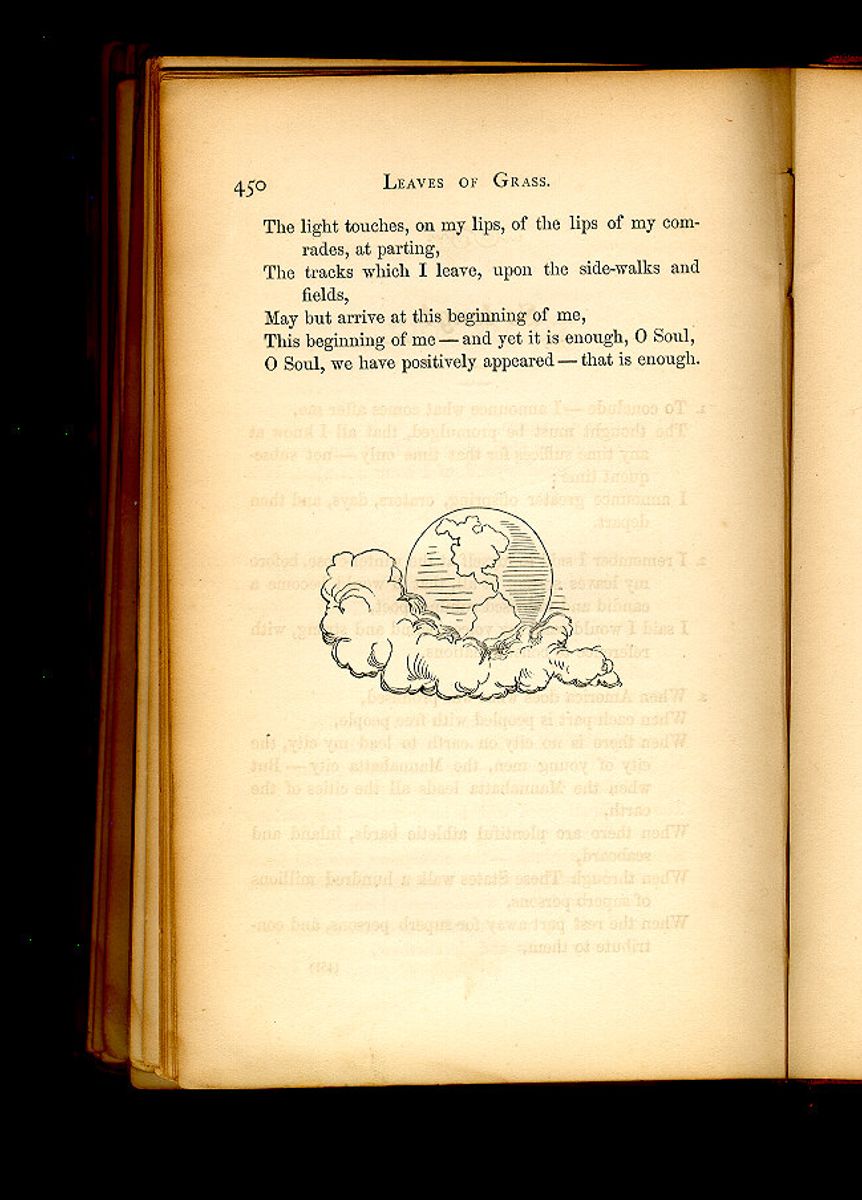 ppp.01500.458.jpg
The light touches, on my lips, of the lips of my com-
ppp.01500.458.jpg
The light touches, on my lips, of the lips of my com- rades, at parting, The tracks which I leave, upon the side-walks and
fields, May but arrive at this beginning of me, This beginning of me—and yet it is enough, O Soul, O Soul, we have positively appeared—that is enough. [ begin page 451 ]
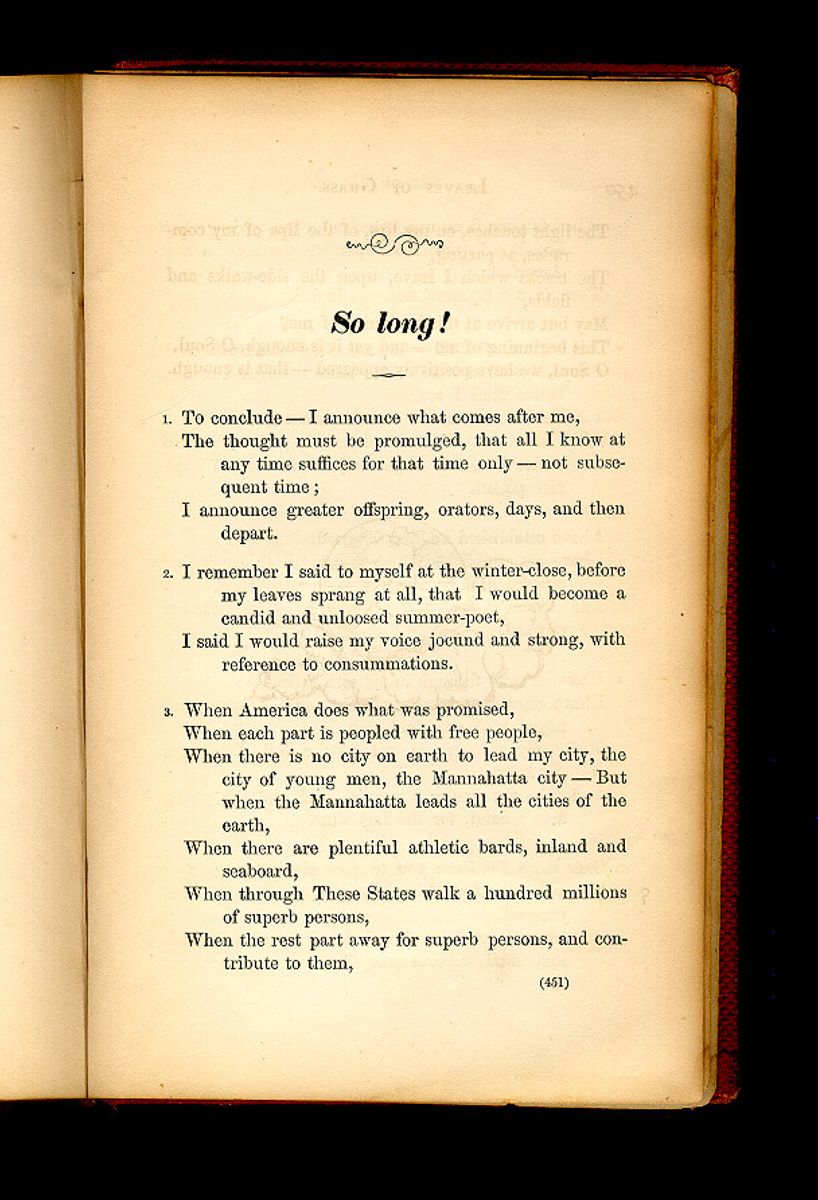 ppp.01500.459.jpg
So long!
1TO conclude—I announce what comes after me, The thought must be promulged, that all I know atany time suffices for that time only—not subse-
quent time; I announce greater offspring, orators, days, and then
depart. 2I remember I said to myself at the winter-close, before
my leaves sprang at all, that I would become a
candid and unloosed summer-poet, I said I would raise my voice jocund and strong, with
reference to consummations. 3When America does what was promised, When each part is peopled with free people, When there is no city on earth to lead my city, the
city of young men, the Mannahatta city—But
when the Mannahatta leads all the cities of the
earth, When there are plentiful athletic bards, inland and
seaboard, When through These States walk a hundred millions
of superb persons, When the rest part away for superb persons, and con-
tribute to them, [ begin page 452 ]
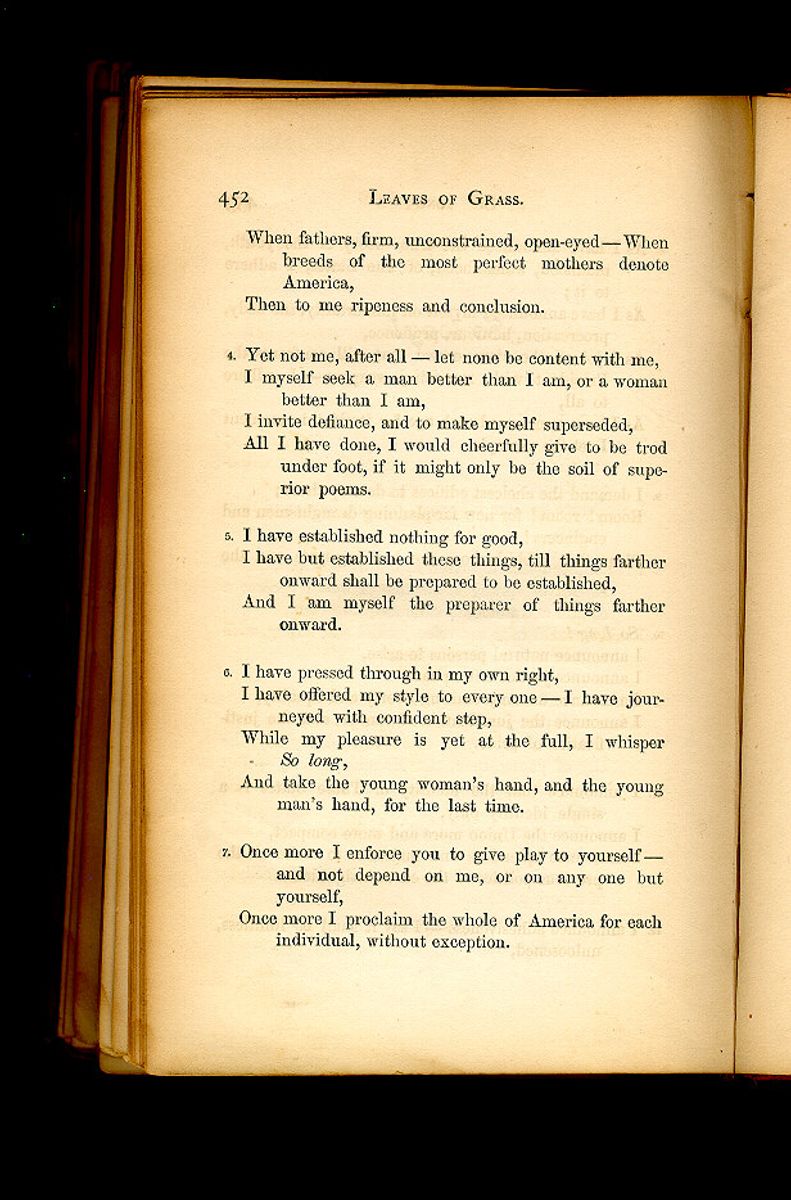 ppp.01500.460.jpg
When fathers, firm, unconstrained, open-eyed—When
ppp.01500.460.jpg
When fathers, firm, unconstrained, open-eyed—When breeds of the most perfect mothers denote
America, Then to me ripeness and conclusion. 4Yet not me, after all—let none be content with me, I myself seek a man better than I am, or a woman
better than I am, I invite defiance, and to make myself superseded, All I have done, I would cheerfully give to be trod
under foot, if it might only be the soil of supe-
rior poems. 5I have established nothing for good, I have but established these things, till things farther
onward shall be prepared to be established, And I am myself the preparer of things farther
onward. 6I have pressed through in my own right, I have offered my style to every one—I have jour-
neyed with confident step, While my pleasure is yet at the full, I whisper
So long, And take the young woman's hand, and the young
man's hand, for the last time. 7Once more I enforce you to give play to yourself—
and not depend on me, or on any one but
yourself, Once more I proclaim the whole of America for each
individual, without exception. [ begin page 453 ]
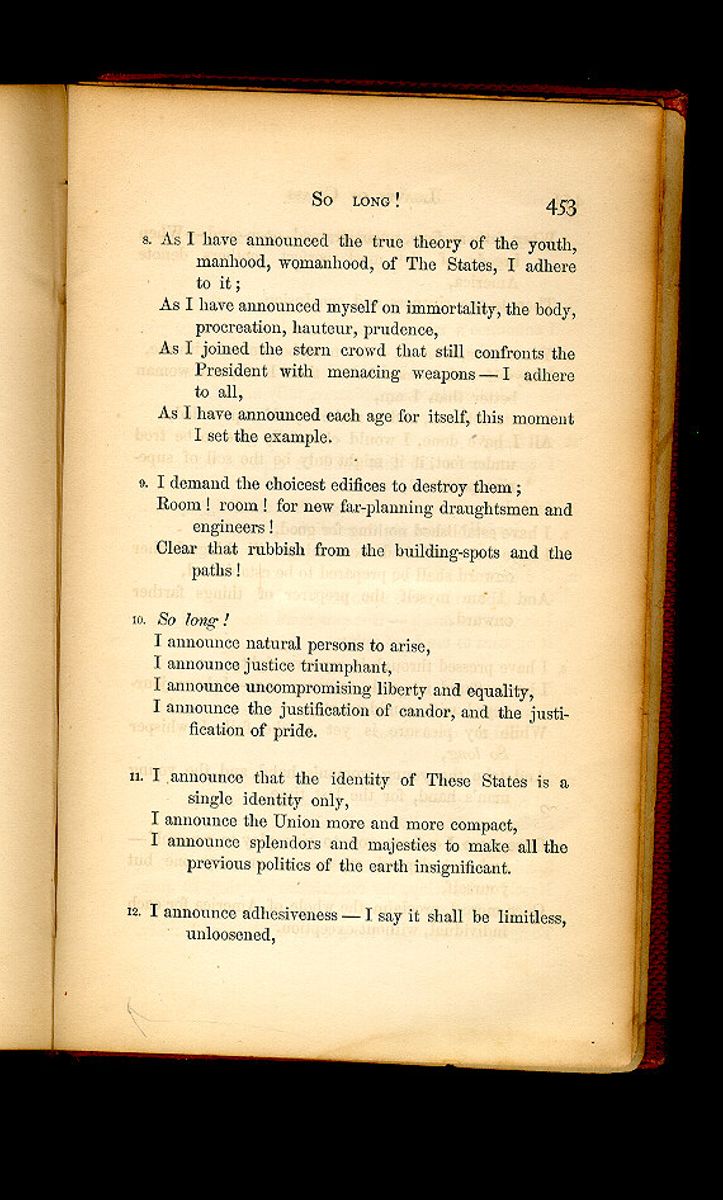 ppp.01500.461.jpg
8As I have announced the true theory of the youth,
ppp.01500.461.jpg
8As I have announced the true theory of the youth, manhood, womanhood, of The States, I adhere
to it; As I have announced myself on immortality, the body,
procreation, hauteur, prudence, As I joined the stern crowd that still confronts the
President with menacing weapons—I adhere
to all, As I have announced each age for itself, this moment
I set the example. 9I demand the choicest edifices to destroy them; Room! room! for new far-planning draughtsmen and
engineers! Clear that rubbish from the building-spots and the
paths! 10 So long! I announce natural persons to arise, I announce justice triumphant, I announce uncompromising liberty and equality, I announce the justification of candor, and the justi-
fication of pride. 11I announce that the identity of These States is a
single identity only, I announce the Union more and more compact, I announce splendors and majesties to make all the
previous politics of the earth insignificant. 12I announce adhesiveness—I say it shall be limitless,
unloosened, [ begin page 454 ]
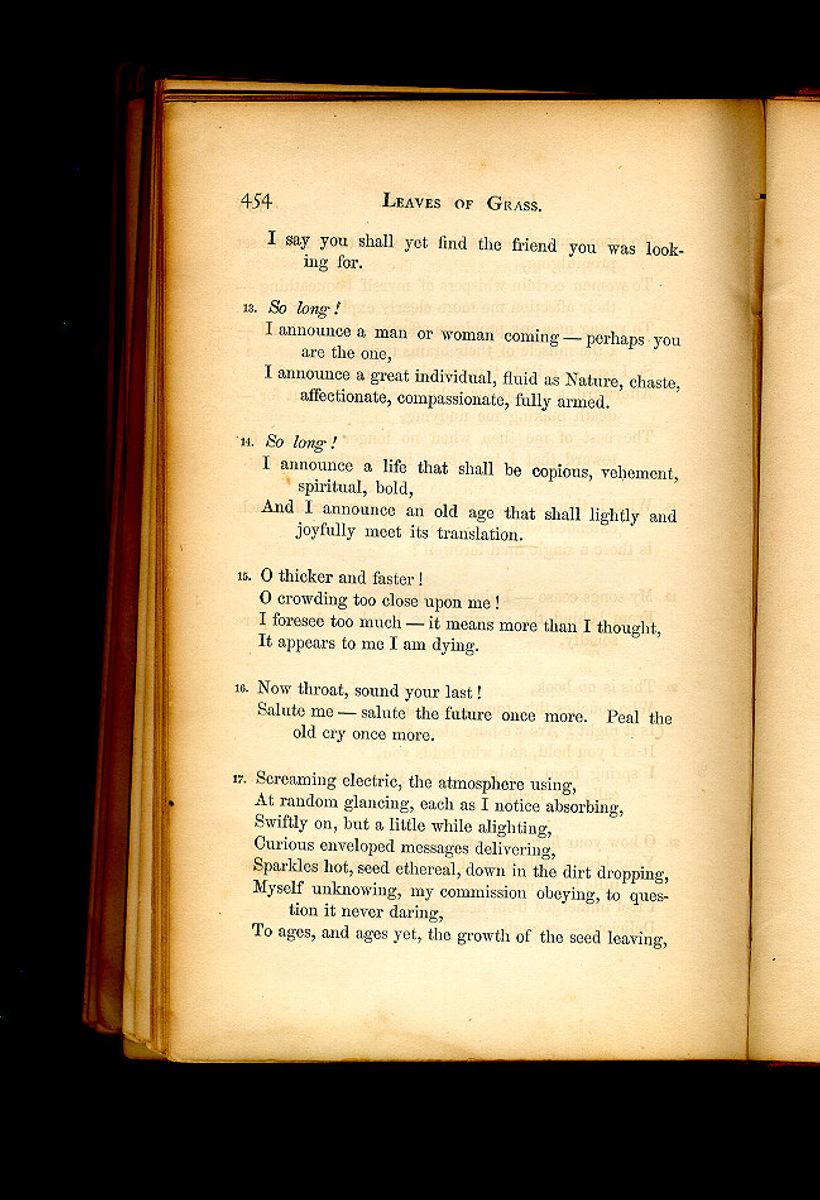 ppp.01500.462.jpg
I say you shall yet find the friend you was look-
ppp.01500.462.jpg
I say you shall yet find the friend you was look- ing for. 13 So long! I announce a man or woman coming—perhaps you
are the one, I announce a great individual, fluid as Nature, chaste,
affectionate, compassionate, fully armed. 14 So long! I announce a life that shall be copious, vehement,
spiritual, bold, And I announce an old age that shall lightly and
joyfully meet its translation. 15O thicker and faster! O crowding too close upon me! I foresee too much—it means more than I thought, It appears to me I am dying. 16Now throat, sound your last! Salute me—salute the future once more. Peal the
old cry once more. 17Screaming electric, the atmosphere using, At random glancing, each as I notice absorbing, Swiftly on, but a little while alighting, Curious enveloped messages delivering, Sparkles hot, seed ethereal, down in the dirt dropping, Myself unknowing, my commission obeying, to ques-
tion it never daring, To ages, and ages yet, the growth of the seed leaving, [ begin page 455 ]
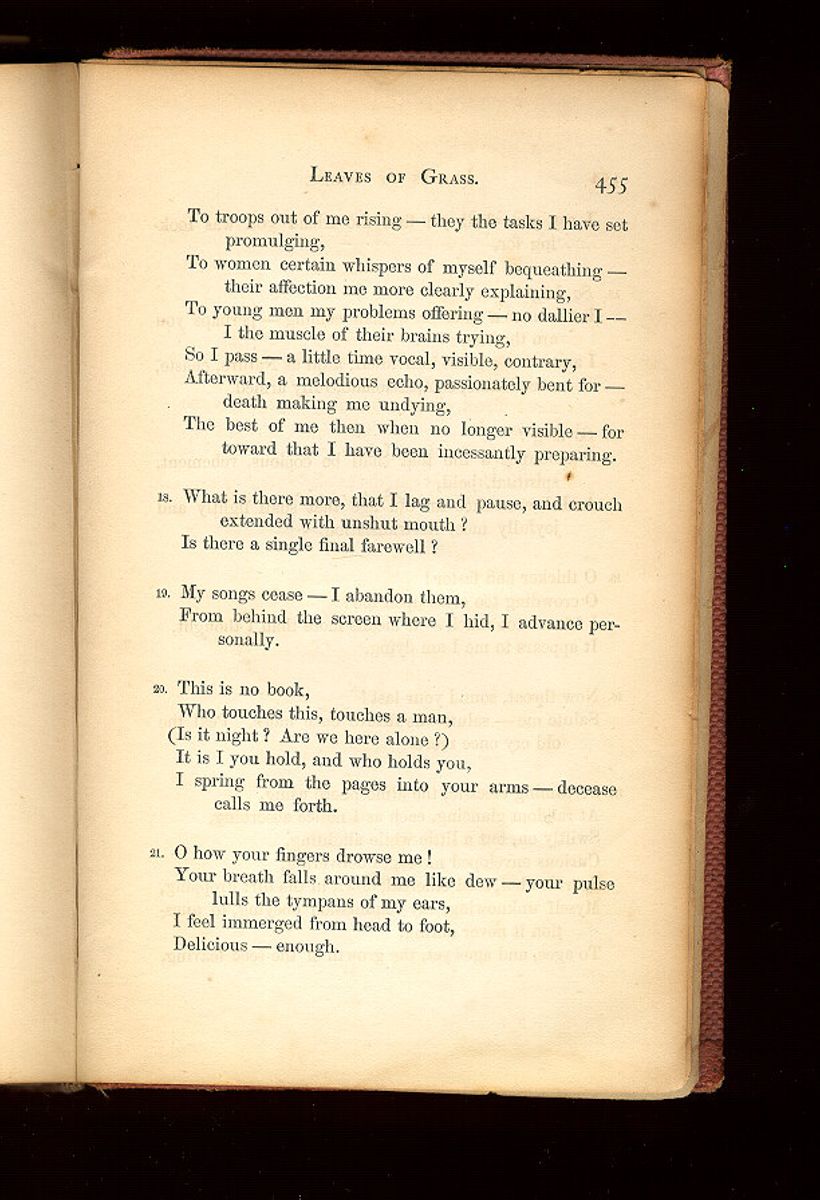 ppp.01500.463.jpg
To troops out of me rising—they the tasks I have set
ppp.01500.463.jpg
To troops out of me rising—they the tasks I have set promulging, To women certain whispers of myself bequeathing—
their affection me more clearly explaining, To young men my problems offering—no dallier I—
I the muscle of their brains trying, So I pass—a little time vocal, visible, contrary, Afterward, a melodious echo, passionately bent for—
death making me undying, The best of me then when no longer visible—for
toward that I have been incessantly preparing. 18What is there more, that I lag and pause, and crouch
extended with unshut mouth? Is there a single final farewell? 19My songs cease—I abandon them, From behind the screen where I hid, I advance per-
sonally. 20This is no book, Who touches this, touches a man, (Is it night? Are we here alone?) It is I you hold, and who holds you, I spring from the pages into your arms—decease
calls me forth. 21O how your fingers drowse me! Your breath falls around me like dew—your pulse
lulls the tympans of my ears, I feel immerged from head to foot, Delicious—enough. [ begin page 456 ]
 ppp.01500.464.jpg
22Enough, O deed impromptu and secret!
Enough, O gliding present! Enough, O summed-up
ppp.01500.464.jpg
22Enough, O deed impromptu and secret!
Enough, O gliding present! Enough, O summed-up past! 23Dear friend, whoever you are, here, take this kiss, I give it especially to you—Do not forget me, I feel like one who has done his work—I progress on, The unknown sphere, more real than I dreamed,
more direct, darts awakening rays about me—
So long! Remember my words—I love you—I depart from
materials, I am as one disembodied, triumphant, dead.