Dr. John Johnston to Walt Whitman, 2–3 August 1891
 loc.02506.001_large.jpg
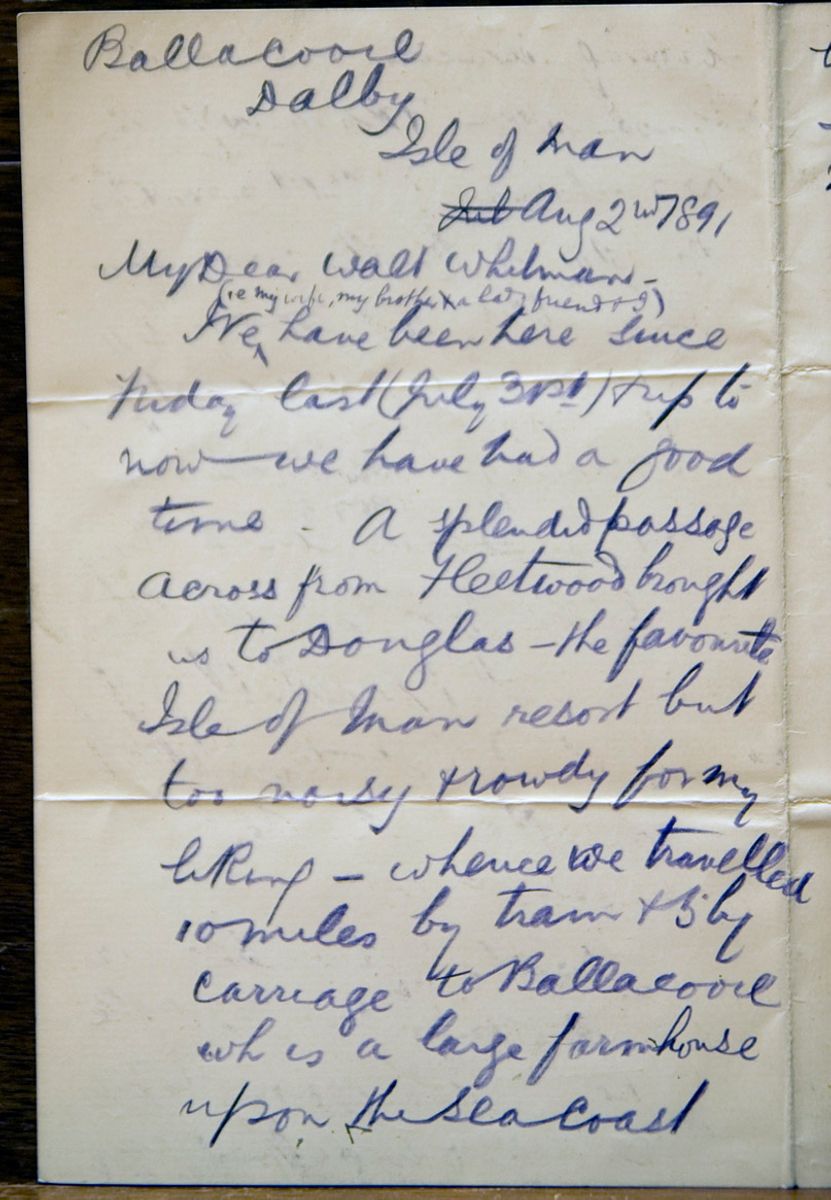
Ballacooil
Dalby1
Isle of Man
Aug 2nd 1891
My Dear Walt Whitman—
loc.02506.001_large.jpg
Ballacooil
Dalby1
Isle of Man
Aug 2nd 1891
My Dear Walt Whitman—
We (i.e. my wife,2 my brother3 a [illegible] friend & I) have been here since
Friday last (July 31st) & up to now we have had a good time. A splendid
passage across from Fleetwood brought us to Douglas—the favourite Isle
of Man resort but now too noisy & rowdy for my liking—whence we
travelled 10 miles by tram & 5 by carriage to Ballacooil
wh. is a large farmhouse upon the sea coast
 loc.02506.002_large.jpg
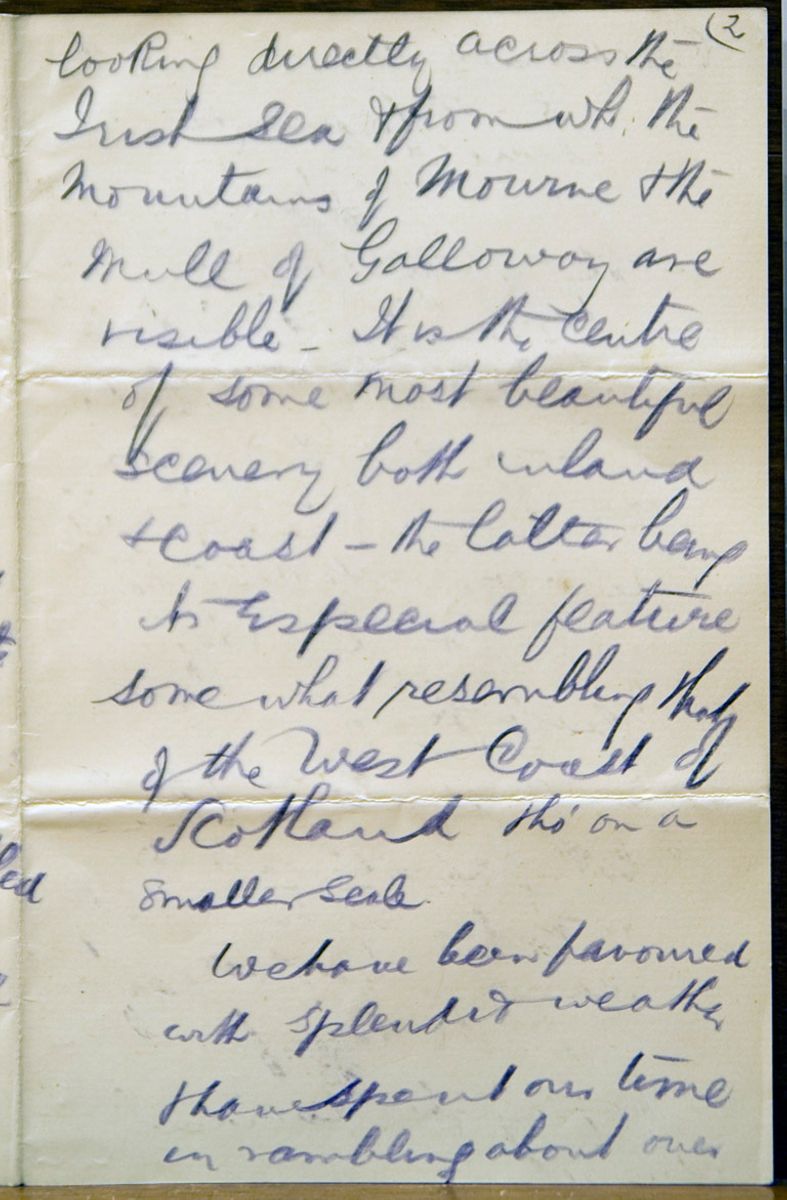
looking directly across the Irish Sea & from wh. the Mountains of Mourne &
the Mull of Galloway are visible—it is the centre of some most
beautiful scenery both inland & coast—the latter being
an especial feature somewhat resembling that of the West Coast of
Scotland tho' on a smaller scale.
loc.02506.002_large.jpg
looking directly across the Irish Sea & from wh. the Mountains of Mourne &
the Mull of Galloway are visible—it is the centre of some most
beautiful scenery both inland & coast—the latter being
an especial feature somewhat resembling that of the West Coast of
Scotland tho' on a smaller scale.
We have been favoured with splendid weather & have spent our time
in rambling about over
 loc.02506.003_large.jpg
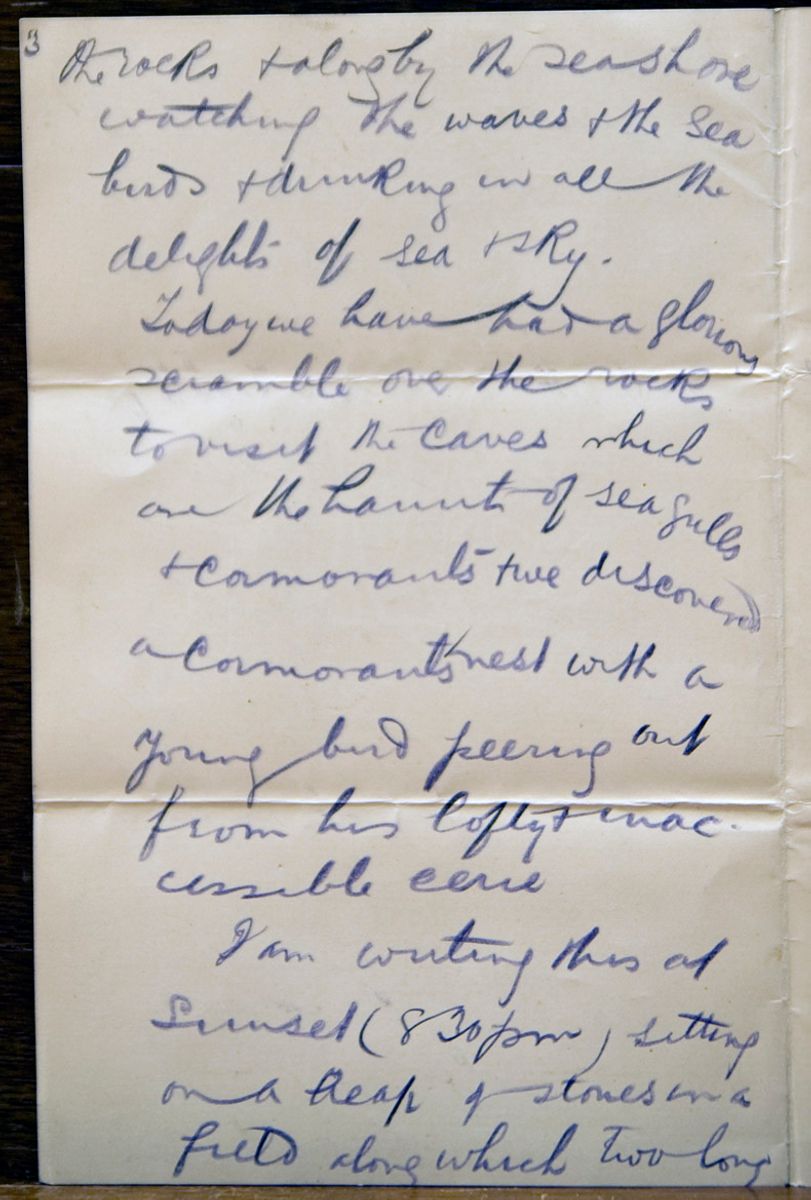
the rocks & along by the seashore watching the waves & the sea
birds & drinking in all the delights of the sea & sky.
loc.02506.003_large.jpg
the rocks & along by the seashore watching the waves & the sea
birds & drinking in all the delights of the sea & sky.
Today we have had a glorious scramble over the rocks to visit the caves which are the haunts of seagulls & cormorants & we discovered a cormorants' nest with a young bird peering out from his lofty & inaccessible cave
I am writing this at sunset (830pm) sitting on a heap of stones in a
field along which two long
 loc.02506.004_large.jpg
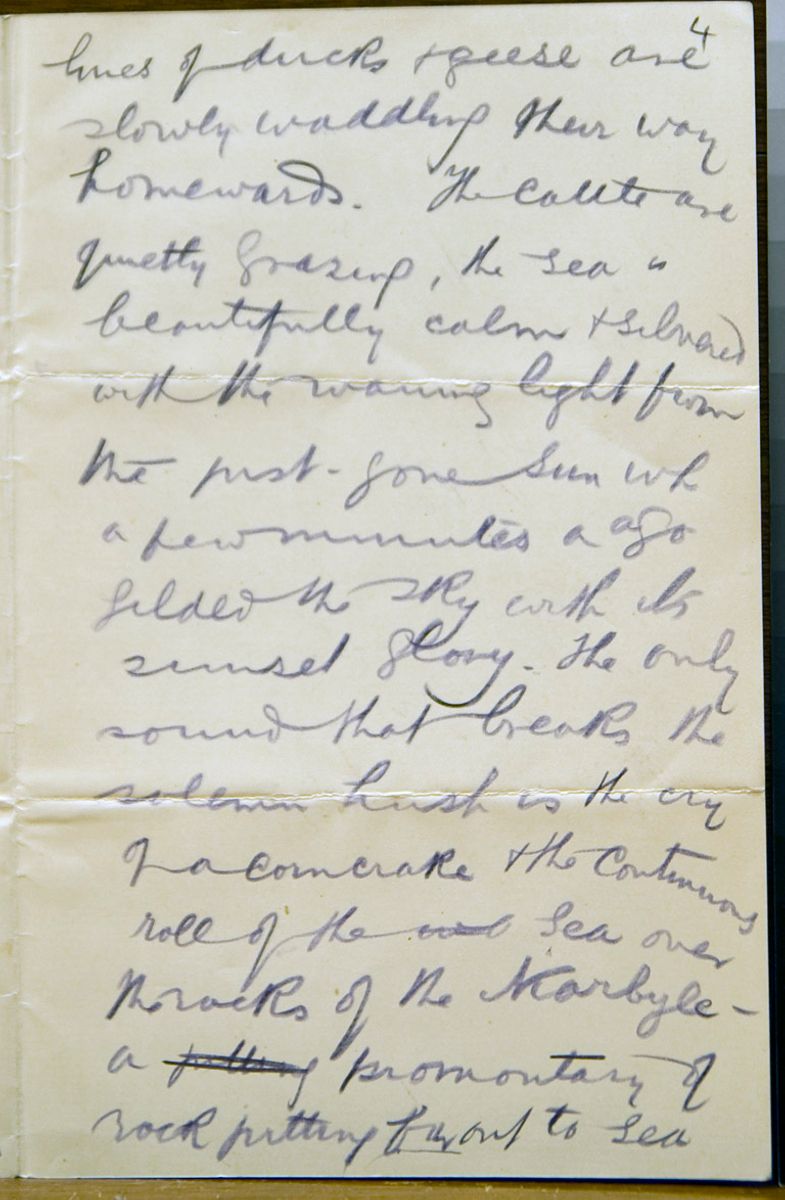
lines of ducks & geese are slowly waddling their way homeward. The
cattle are quietly grazing, the sea is beautifully calm & silvered
with the waning light from the just-gone sun wh. a few minutes a ago
gilded the sky with its
sunset glory. The only sound that breaks the solemn hush is the cry of
of a corncrake & the continuous roll of the sea over the rocks
of the Niarbyle—a promontory of rock jutting far out to sea
loc.02506.004_large.jpg
lines of ducks & geese are slowly waddling their way homeward. The
cattle are quietly grazing, the sea is beautifully calm & silvered
with the waning light from the just-gone sun wh. a few minutes a ago
gilded the sky with its
sunset glory. The only sound that breaks the solemn hush is the cry of
of a corncrake & the continuous roll of the sea over the rocks
of the Niarbyle—a promontory of rock jutting far out to sea
 loc.02506.005_large.jpg
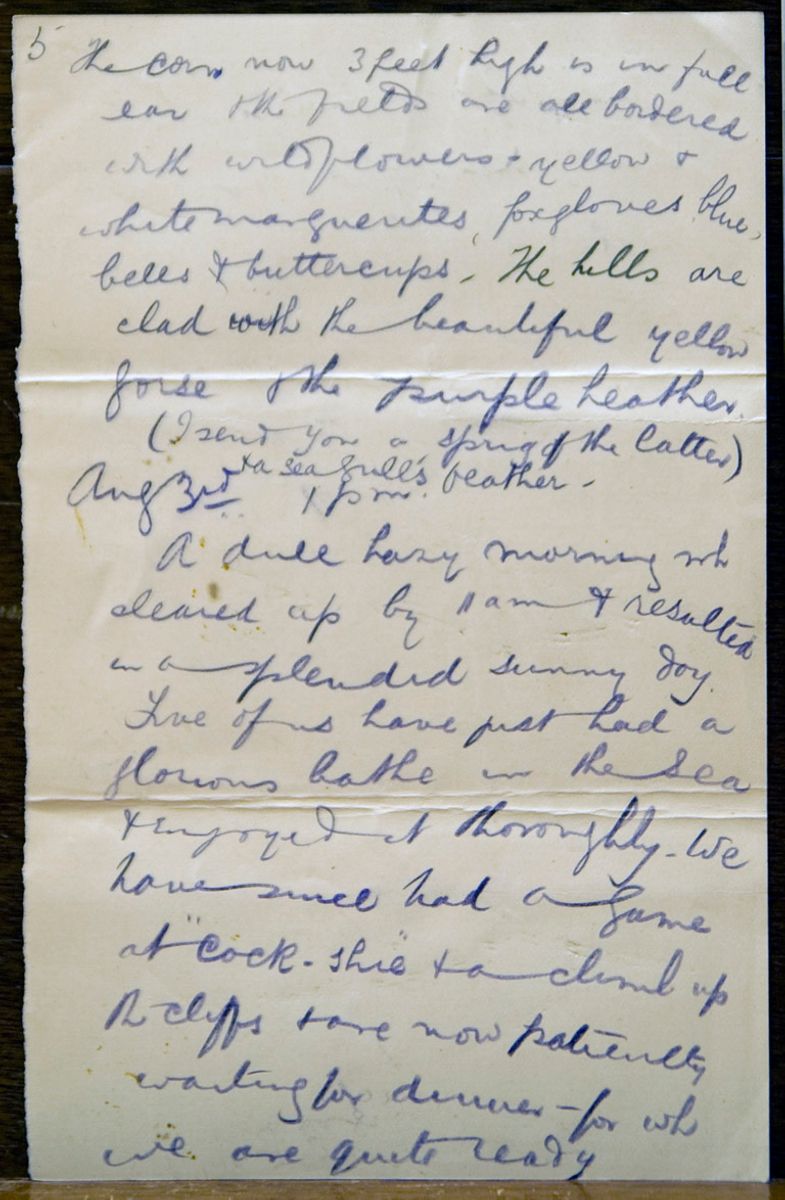
The corn now 3 feet high is in full ear the fields are all bordered with wildflowers—yellow & white marguerites, foxgloves bluebelles & buttercups. The hills are clad with the beautiful yellow gorse & the purple heather. (I send you a sprig of the latter & a seagull's feather—)
Aug 3rd 1pm.
A dull hazy morning wh. cleared up by 11am & resulted in a splendid sunny day. Five of us have just had a glorious bathe in the Sea & enjoyed it thoroughly. We have since had a game at "cock-shie" & a climb up the cliffs & are now patiently waiting for dinner—for wh. we are quite ready
 loc.02506.006_large.jpg
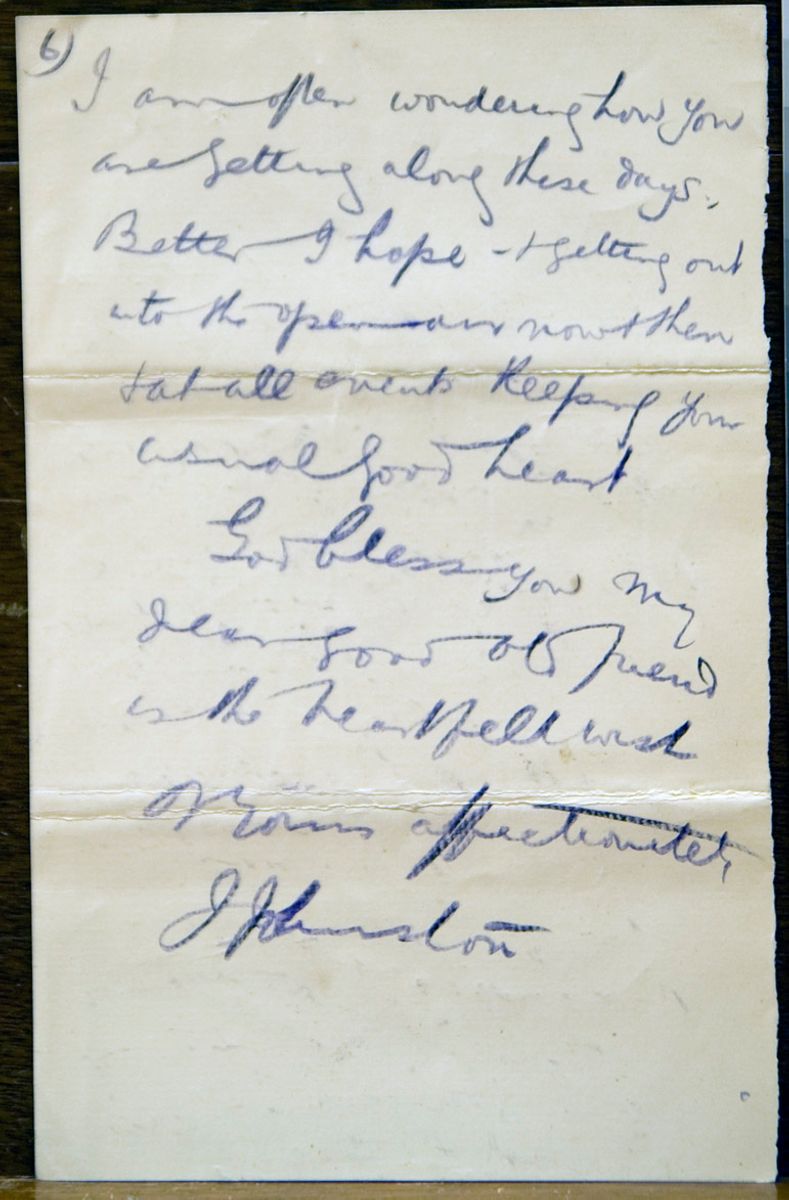
I am often wondering how you are getting along these days. Better I hope—& geting out into the open air now & then & at all events keeping your usual good heart
God bless you my dear good old friend is the heartfelt wish of yours affectionately
J Johnston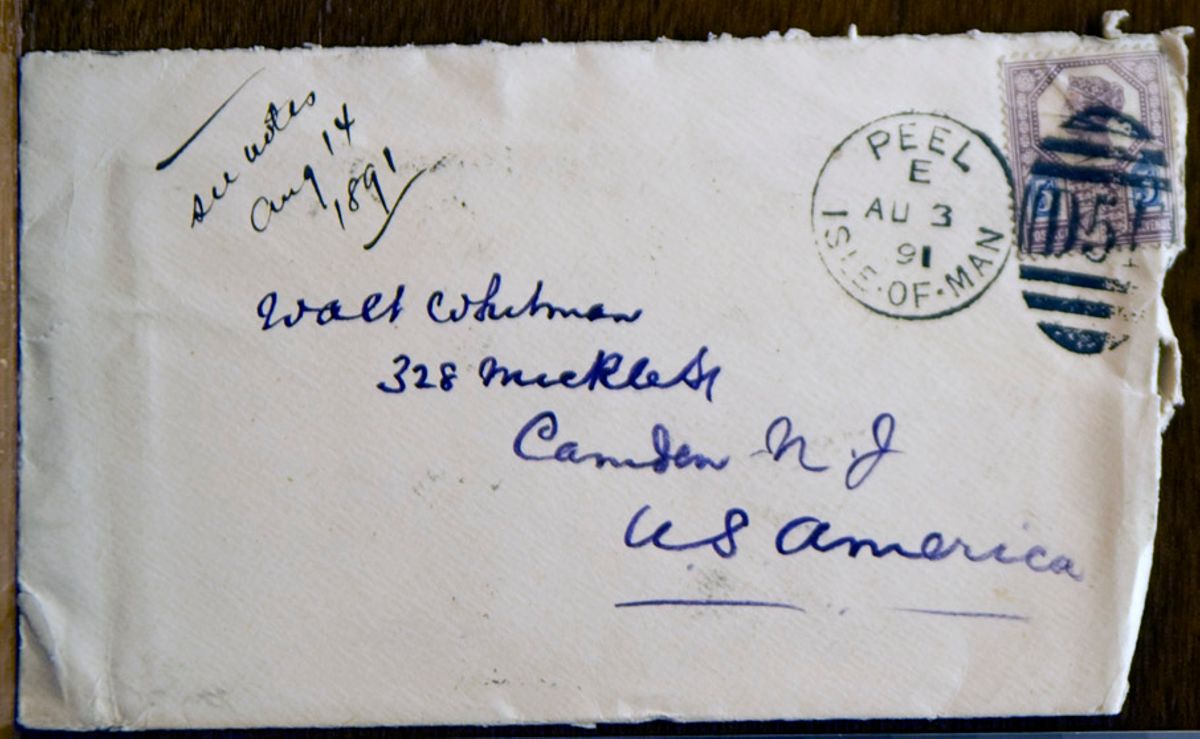 loc.02506.007_large.jpg
see note Aug 14 1891
loc.02506.007_large.jpg
see note Aug 14 1891
 loc.02506.008_large.jpg
Correspondent:
Dr. John Johnston (1852–1927)
of Annan, Dumfriesshire, Scotland, was a physician, photographer, and avid
cyclist. Johnston was trained in Edinburgh and served as a hospital surgeon in
West Bromwich for two years before moving to Bolton, England, in 1876. Johnston
worked as a general practitioner in Bolton and as an instructor of ambulance
classes for the Lancashire and Yorkshire Railways. He served at Whalley Military
Hospital during World War I and became Medical Superintendent of Townley's
Hospital in 1917 (John Anson, "Bolton's Illustrious Doctor Johnston—a man
of many talents," Bolton News [March 28, 2021]; Paul
Salveson, Moorlands, Memories, and Reflections: A Centenary
Celebration of Allen Clarke's Moorlands and Memories [Lancashire
Loominary, 2020]). Johnston, along with the architect James W. Wallace, founded
the "Bolton College" of English admirers of the poet. Johnston and Wallace
corresponded with Whitman and with Horace Traubel and other members of the
Whitman circle in the United States, and they separately visited the poet and
published memoirs of their trips in John Johnston and James William Wallace, Visits to Walt Whitman in 1890–1891 by Two Lancashire
Friends (London: Allen and Unwin, 1917). For more information on
Johnston, see Larry D. Griffin, "Johnston, Dr. John (1852–1927)," Walt
Whitman: An Encyclopedia, ed. J.R. LeMaster and Donald D. Kummings (New
York: Garland Publishing, 1998).
Notes
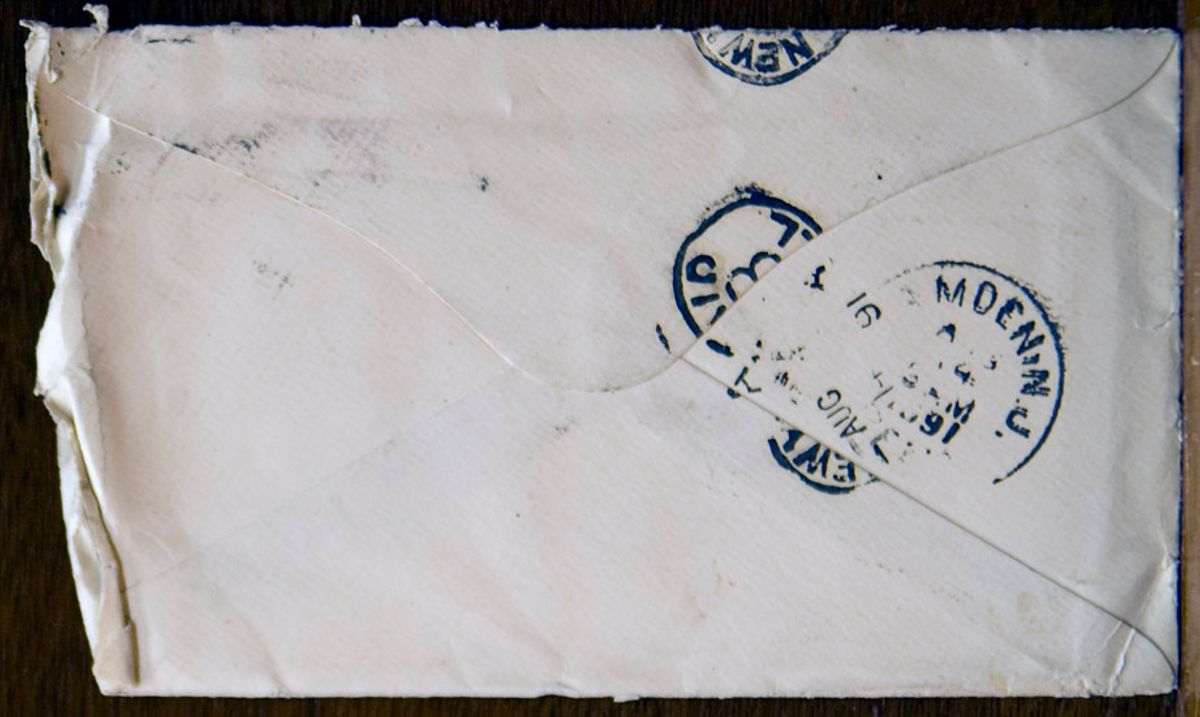
- 1. This letter is addressed: Walt Whitman | 328 Mickle St | Camden N.J. | US America It is postmarked: Peel E | Au 3 | 91 | Isle of Man; Paid B All; A | 91; Camden, N.J. AUG | 14 | [illegible]AM; 1891; Rec'd. There are two New York postmarks that are illegible except for the city name. [back]
- 2. Margaret Beddows Johnston (ca. 1854–1932?) of Bolton, England, was the daughter of Thomas Beddows—a wheelwright—and his wife Mary. Margaret was a millinery worker and a dressmaker; she married Dr. John Johnston in Bolton in 1878. The couple did not have any children. [back]
- 3. William Joseph Johnston (1863–1935), the younger brother of Dr. John Johnston, was a solicitor in Annan, Dumfriesshire, Scotland. [back]