Edmund Spenser: born about 1553—died 1599.
Key
| Textual Feature | Appearance |
|---|---|
| Whitman's hand | blue double overline and underline |
| Highlighting | yellow background with top and bottom border |
| Paste-on | gray box with black borders |
| Laid in | white box with black borders |
| Erasure | white text with dark gray background |
| Overwritten | brown with strikethrough |
[begin surface 1]
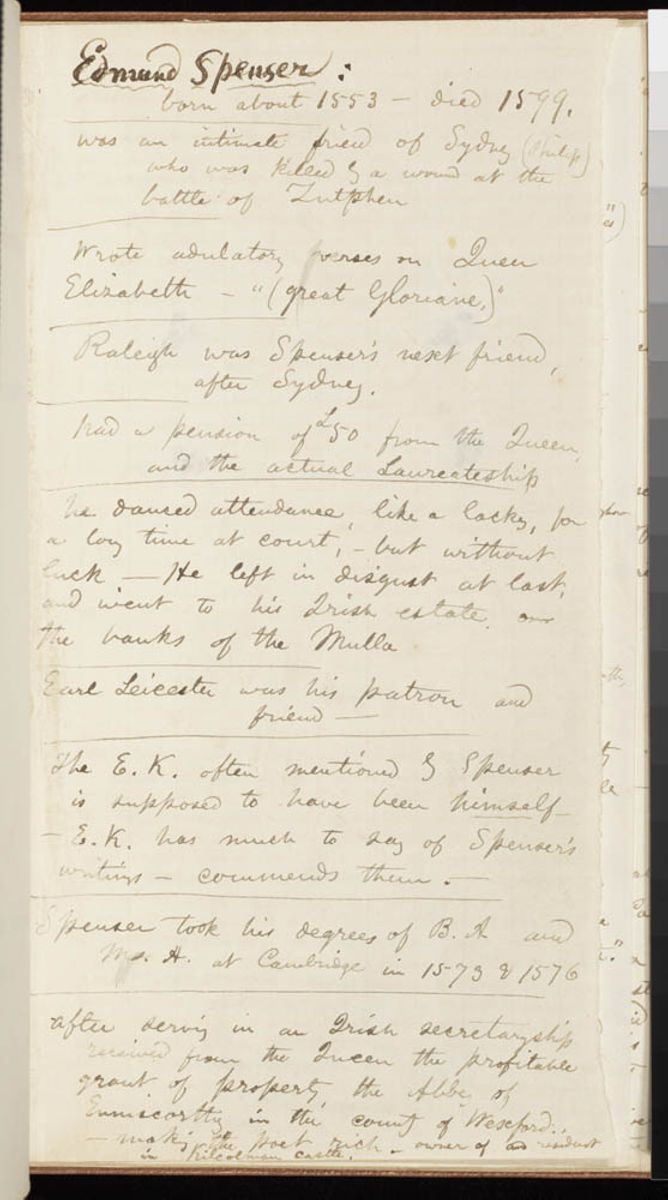
born about 1553—died 1599.
was an intimate friend of Sydney (Philip)
who was killed by a wound at the
battle of Zutphen
Wrote adulatory verses on Queen
Elizabeth—"(great Gloriane,)"
Raleigh was Spenser's next friend,
after Sydney.
had a pension of £50 from the Queen,
and the actual Laureateship
he danced attendance, like a lackey, for
a long time at court,—but without
luck.—He left in disgust at last,
and went to his Irish estate, on
the banks of the Mulla
Earl Leicester was his patron and
friend—
The E.K. often mentioned by Spenser
is supposed to have been himself
—E.K. has much to say of Spenser's
writings—commends them.—
Spenser took his degrees of B.A. and
Ma.A. at Cambridge in 1573 & 1576
after serving in an Irish secretaryship
received from the Queen the profitable
grant of property, the Abbey of
Enniscorthy in the county of Wexford,
—making the poet rich—owner of and resident
in Kilcolman castle.
[begin surface 2] There in his castle he must
have written ^or finished in 1588-9—the
Fairy Queen—it was published
in 1590—("twelve books fashioning twelve ^moral virtues")
was married when 40 (or over)
Kilcoman castle attacked by insurgents.—
Spenser and his family fled—one of
his children burned to death—the
castle being fired.—
A flight from Ireland—
Poverty ensued.—comparative poverty anyhow
Lived a year in London
Died—was buried in Westminster Abbey.
—a monument erected, 30 years after death,
by Anne, Countess of Dorset.
In his poems, reverence for
There in his castle he must
have written ^or finished in 1588-9—the
Fairy Queen—it was published
in 1590—("twelve books fashioning twelve ^moral virtues")
was married when 40 (or over)
Kilcoman castle attacked by insurgents.—
Spenser and his family fled—one of
his children burned to death—the
castle being fired.—
A flight from Ireland—
Poverty ensued.—comparative poverty anyhow
Lived a year in London
Died—was buried in Westminster Abbey.
—a monument erected, 30 years after death,
by Anne, Countess of Dorset.
In his poems, reverence for a purity
and goodness, is paramount to all
the rest.—
In person Spenser was small
and delicate, and in costume
precise, "as became a man of taste."
His face had sweetness & refinement
—mild almond‑shaped eyes,—forehead
lofty, but not very wide—was
well beloved by contemporaries
—who all exempted him from
satire
[begin surface 3] Tone of Spenser's poetry is unworldly,
abstracted, contemplative in the
highest degree—loving high themes—
princeliness, purity, white garments,
—rather averse to reality—his
personages being only half‑real—
—He is haunted by a morbid refinement
of beauty—beauty three times washed
and strained—
No doubt but he was very learned.—
Even at the time of writing them, Spenser's
words, in his poems, were many of
them unusual, obsolete, or considered
affected and strained.
Tone of Spenser's poetry is unworldly,
abstracted, contemplative in the
highest degree—loving high themes—
princeliness, purity, white garments,
—rather averse to reality—his
personages being only half‑real—
—He is haunted by a morbid refinement
of beauty—beauty three times washed
and strained—
No doubt but he was very learned.—
Even at the time of writing them, Spenser's
words, in his poems, were many of
them unusual, obsolete, or considered
affected and strained.
todevouring the country, and is
now after them—The knight sets
forth, encounters a monster, an
enchanter, kills the dragon, delivers
the king & queen, marries the daughter.—
[begin surface 4]
EdmundEdmund SpenserSpenser:
born about 1553—died 1599.
was an intimate friend of Sydney (Philip)
who was killed by a wound at the
battle of Zutphen
Wrote adulatory verses on Queen
Elizabeth—"(great Gloriane,)"
Raleigh was Spenser's next friend,
after Sydney.
had a pension of £50 from the Queen,
and the actual Laureateship
he danced attendance, like a lackey, for
a long time at court,—but without
luck.—He left in disgust at last,
and went to his Irish estate, 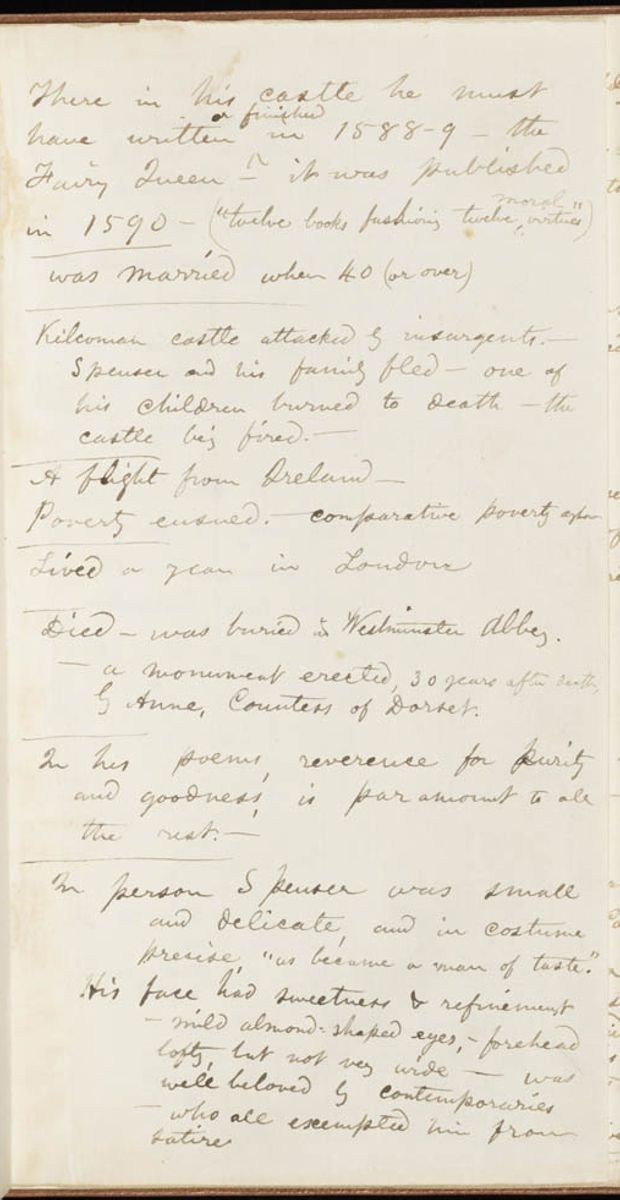 There in his castle he must
have written ^or finished in 1588-9—the
Fairy Queen—it was published
in 1590—("twelve books fashioning twelve ^moral virtues")
was married when 40 (or over)
Kilcoman castle attacked by insurgents.—
Spenser and his family fled—one of
his children burned to death—the
castle being fired.—
A flight from Ireland—
Poverty ensued.—comparative poverty anyhow
Lived a year in London
Died—was buried in Westminster Abbey.
—a monument erected, 30 years after death,
by Anne, Countess of Dorset.
In his poems, reverence for
There in his castle he must
have written ^or finished in 1588-9—the
Fairy Queen—it was published
in 1590—("twelve books fashioning twelve ^moral virtues")
was married when 40 (or over)
Kilcoman castle attacked by insurgents.—
Spenser and his family fled—one of
his children burned to death—the
castle being fired.—
A flight from Ireland—
Poverty ensued.—comparative poverty anyhow
Lived a year in London
Died—was buried in Westminster Abbey.
—a monument erected, 30 years after death,
by Anne, Countess of Dorset.
In his poems, reverence for 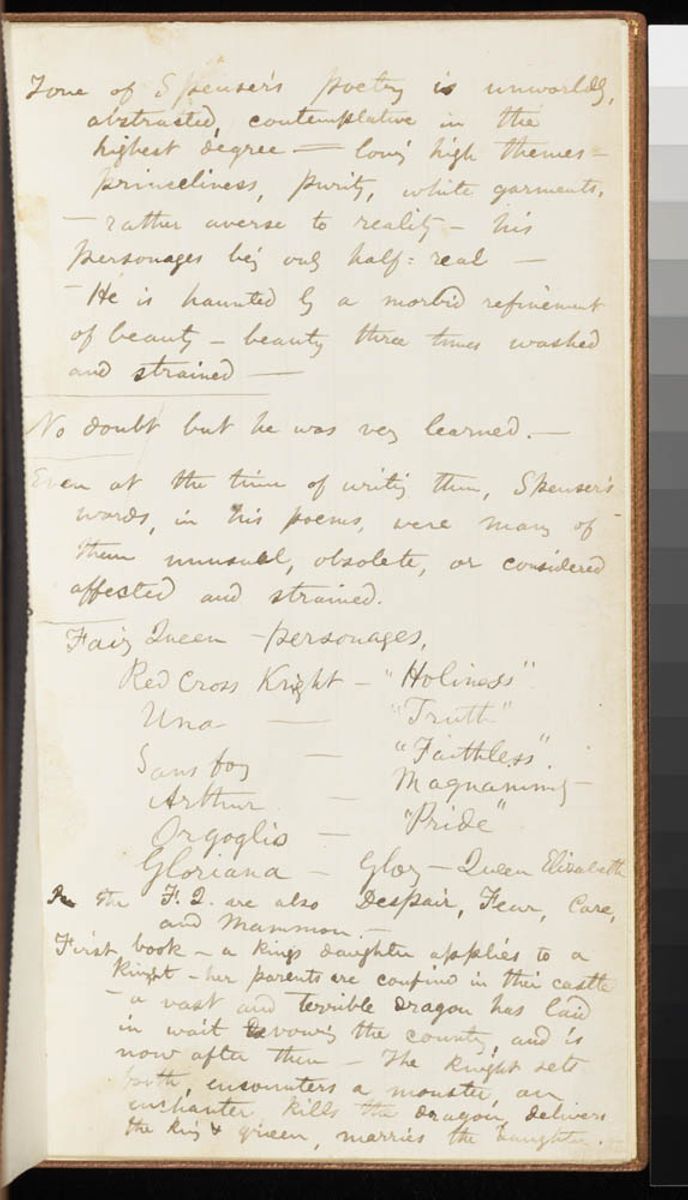 Tone of Spenser's poetry is unworldly,
abstracted, contemplative in the
highest degree—loving high themes—
princeliness, purity, white garments,
—rather averse to reality—his
personages being only half‑real—
—He is haunted by a morbid refinement
of beauty—beauty three times washed
and strained—
No doubt but he was very learned.—
Even at the time of writing them, Spenser's
words, in his poems, were many of
them unusual, obsolete, or considered
affected and strained.
Tone of Spenser's poetry is unworldly,
abstracted, contemplative in the
highest degree—loving high themes—
princeliness, purity, white garments,
—rather averse to reality—his
personages being only half‑real—
—He is haunted by a morbid refinement
of beauty—beauty three times washed
and strained—
No doubt but he was very learned.—
Even at the time of writing them, Spenser's
words, in his poems, were many of
them unusual, obsolete, or considered
affected and strained.
Fairy Queen—personages,
- Red Cross Knight—"Holiness"
- Una—"Truth"
- Sans foy—"Faithless"
- Arthur—Magnanimity—
- Orgoglio—"Pride"
- Gloriana—Glory—Queen Elizabeth