Richard Maurice Bucke to Walt Whitman, 29 June 1891
 loc_zs.00514.jpg
Medical Superintendent's
Office.
INSANE ASYLUM
LONDON ONTARIO
29 June 18911
loc_zs.00514.jpg
Medical Superintendent's
Office.
INSANE ASYLUM
LONDON ONTARIO
29 June 18911
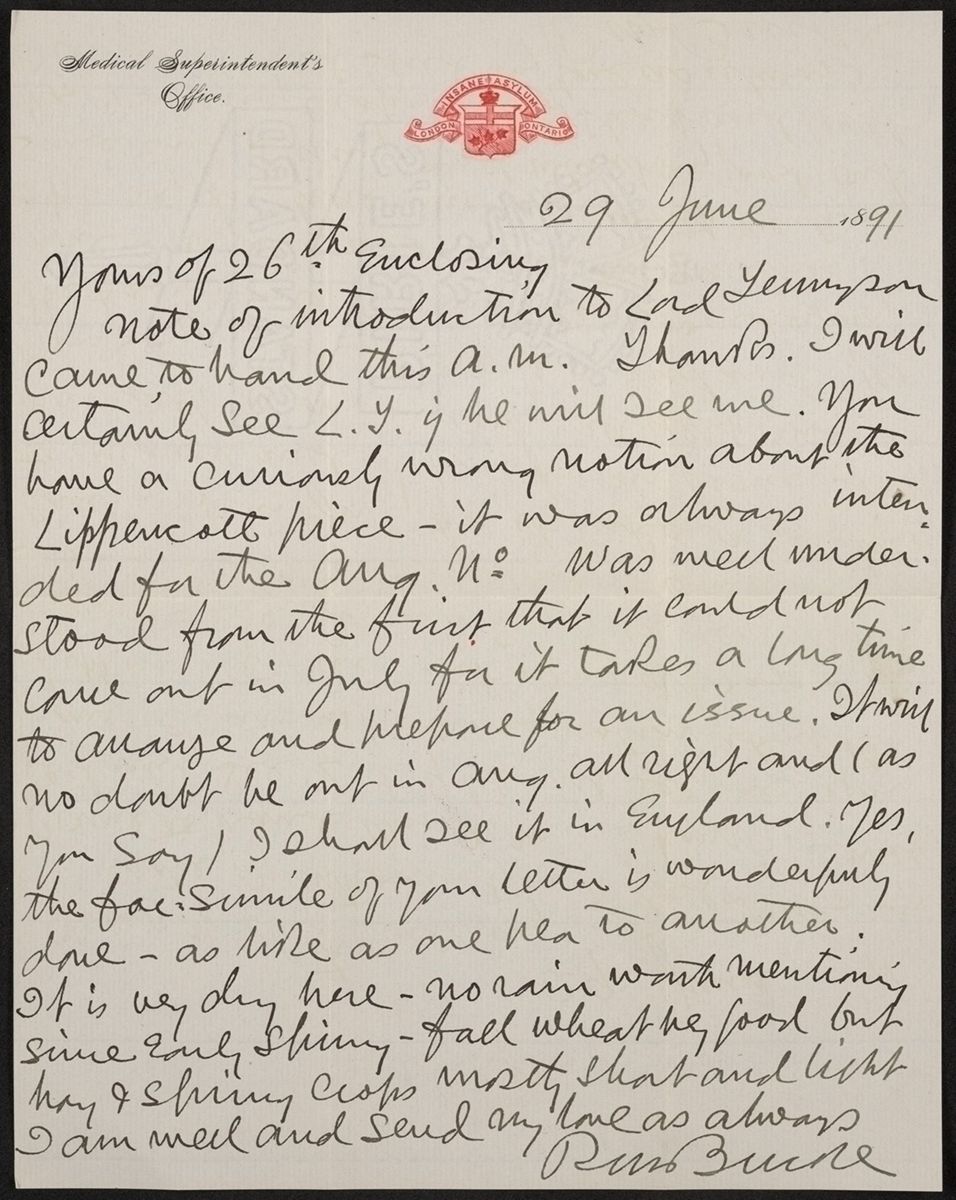
Yours of 26th2 enclosing note of introduction3 to Lord Tennyson4 came to hand this a.m. Thanks. I will certainly see L.T. if he will see me. You have a curiously wrong notion about the Lippencott piece5—it was always intended for the Aug. No Was well understood from the first that it could not come out in July for it takes a long time to arrange and prepare for an issue. It will no doubt be out in Aug. all right and (as you say) I shall see it in England.6 Yes, the fac-simile of your letter7 is wonderfully done—as like as one pea to another. It is very dry here—no rain worth mentioning since early Spring—fall wheat very good but hay & spring crops mostly short and light I am well and send my love as always
R M Bucke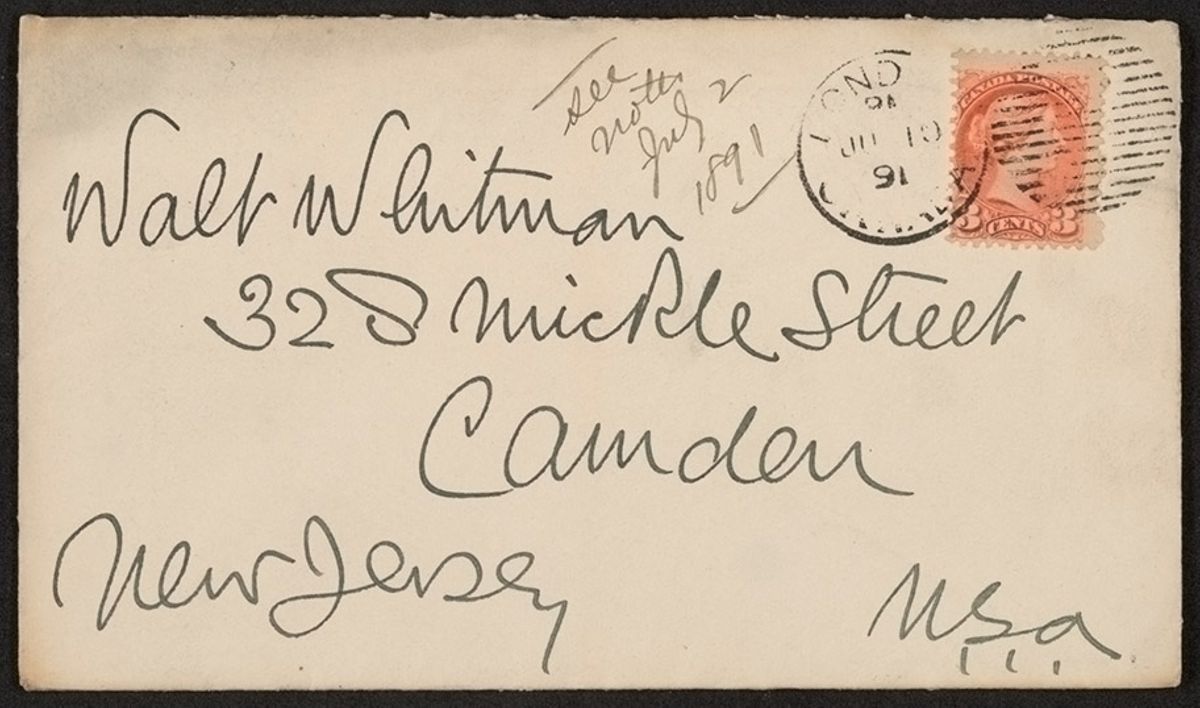 loc_zs.00515.jpg
see notes July 2 1891
loc_zs.00515.jpg
see notes July 2 1891
 loc_zs.00516.jpg
Correspondent:
Richard Maurice Bucke (1837–1902) was a
Canadian physician and psychiatrist who grew close to Whitman after reading Leaves of Grass in 1867 (and later memorizing it) and
meeting the poet in Camden a decade later. Even before meeting Whitman, Bucke
claimed in 1872 that a reading of Leaves of Grass led him
to experience "cosmic consciousness" and an overwhelming sense of epiphany.
Bucke became the poet's first biographer with Walt
Whitman (Philadelphia: David McKay, 1883), and he later served as one
of his medical advisors and literary executors. For more on the relationship of
Bucke and Whitman, see Howard Nelson, "Bucke, Richard Maurice," Walt Whitman: An
Encyclopedia, ed. J.R. LeMaster and Donald D. Kummings (New York:
Garland Publishing, 1998).
Notes
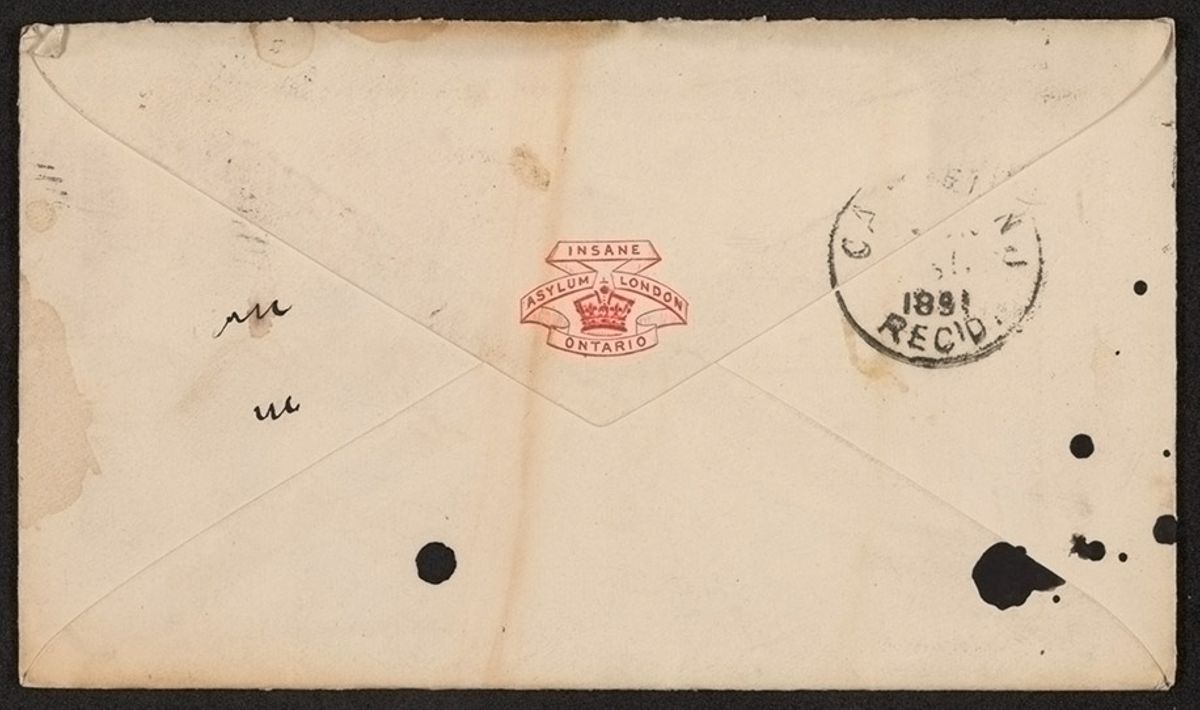
- 1. This letter is addressed: Walt Whitman | 328 Mickle Street | Camden | New Jersey | U.S.A. It is postmarked: LONDON | PM | JU 29 | 91 | CANADA; CAMDEN, N.J. | JUL | 1 | 1PM | 1891 | REC'D. [back]
- 2. See Whitman's letter to Bucke of June 26, 1891. [back]
- 3. The manuscript letter of introduction that Whitman addressed to Tennyson and dated June 26, 1891, may not be extant. The only known copy of this letter is a transcription made by Bucke. Whitman enclosed the letter of introduction in his June 26, 1891, letter to Bucke. [back]
- 4. Alfred, Lord Tennyson (1809–1892) succeeded William Wordsworth as poet laureate of Great Britain in 1850. The intense male friendship described in In Memoriam, which Tennyson wrote after the death of his friend Arthur Henry Hallam, possibly influenced Whitman's poetry. Whitman wrote to Tennyson in 1871 or late 1870, probably shortly after the visit of Cyril Flower in December, 1870, but the letter is not extant (see Thomas Donaldson, Walt Whitman the Man [New York: F. P. Harper, 1896], 223). Tennyson's first letter to Whitman is dated July 12, 1871. Although Tennyson extended an invitation for Whitman to visit England, Whitman never acted on the offer. [back]
- 5. Horace Traubel's article "Walt Whitman's Birthday, May 31, 1891," was published in Lippincott's Monthly Magazine in August 1891. It was a detailed account of Whitman's seventy-second (and last) birthday, which was celebrated with friends at the poet's home on Mickle Street. [back]
- 6. As Bucke's letters in May and June 1891 both to Whitman and Horace Traubel make clear, he was going abroad to establish a foreign market for his gas and fluid meter, a subject to which he referred constantly in his communications but which the poet studiously ignored. [back]
- 7. Bucke had recently received a facsimile of Whitman's June 1, 1891, letter to Dr. John Johnston of Bolton, England, a co-founder with the architect James William Wallace, of the Bolton College of Whitman admirers. The letter included Whitman's description of his birthday dinner. Bucke notes the receipt of the facsimile from Wallace of in his June 28, 1891, letter to Whitman. [back]