George Routledge & Sons to Walt Whitman, 28 December 1867
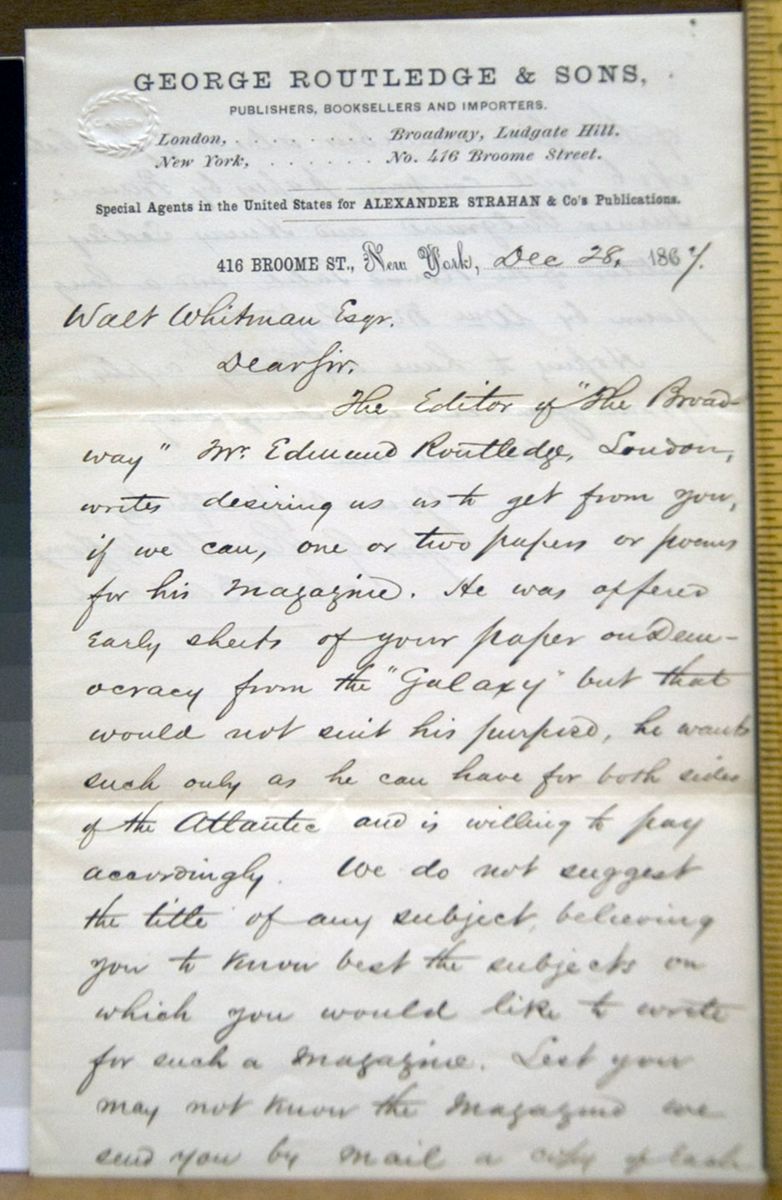 loc.02855.001_large.jpg
GEORGE ROUTLEDGE &
SONS,
PUBLISHERS, BOOKSELLERS AND
IMPORTERS.
London, . . . .
. . . . Broadway, Ludgate Hill.
New York, . . .
. . . No. 416 Broome Street.
Special Agents in the United
States for ALEXANDER STRAHAN & Co's Publications.
416 BROOME ST., New York,
Dec 28, 1867.1
Walt Whitman Esqr.
Dear Sir,
loc.02855.001_large.jpg
GEORGE ROUTLEDGE &
SONS,
PUBLISHERS, BOOKSELLERS AND
IMPORTERS.
London, . . . .
. . . . Broadway, Ludgate Hill.
New York, . . .
. . . No. 416 Broome Street.
Special Agents in the United
States for ALEXANDER STRAHAN & Co's Publications.
416 BROOME ST., New York,
Dec 28, 1867.1
Walt Whitman Esqr.
Dear Sir,
The Editor of "The Broadway"2 Mr. Edmund Routledge,3 London, writes desiring us as to get from you, if we can, one
or two papers or poems for his magazine. He was offered
early sheets of your paper on Democracy4 from the
"Galaxy"5 but that would not suit his purpose, he wants such
only as he can have for both sides of the Atlantic and is willing to pay
accordingly. We do not suggest the title of any subject, believing you to know best
the subjects on which you would like to write for such a magazine. Lest you may not
know the magazine we send you by mail a copy of each 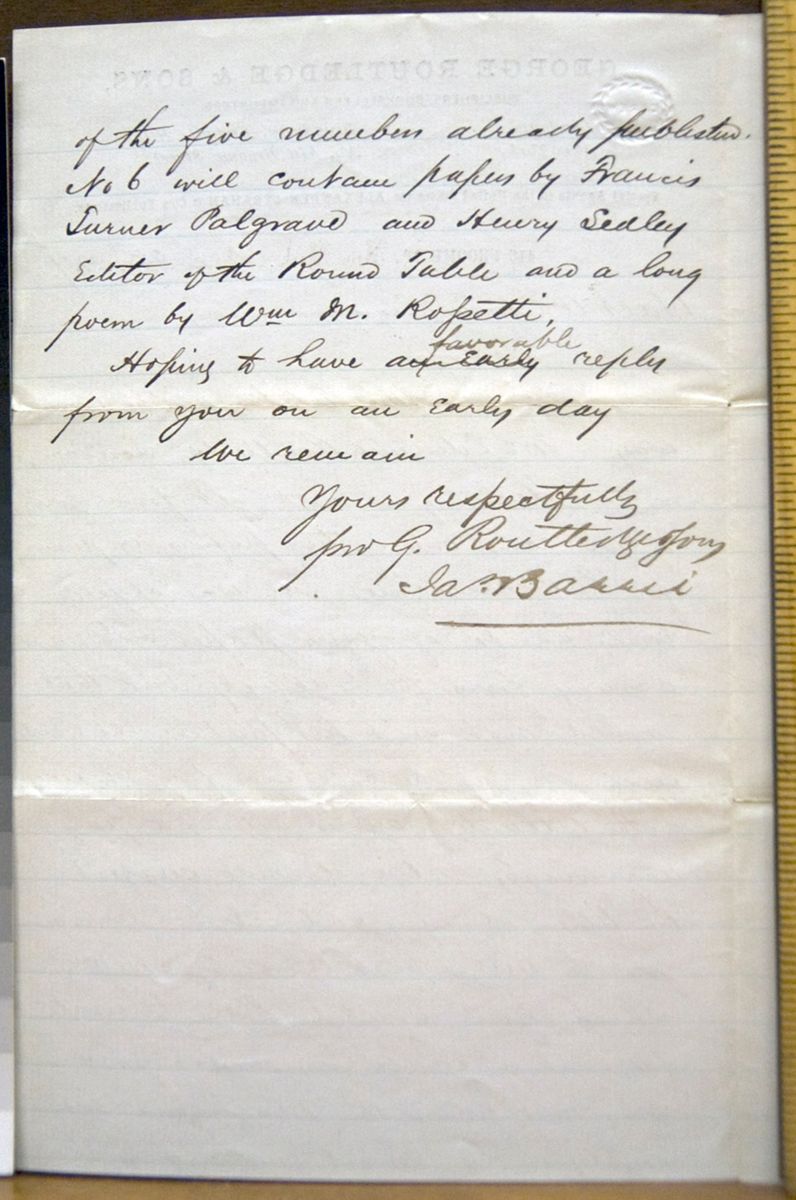 loc.02855.002_large.jpg of the five numbers already
published. No 6 will contain papers by Francis Turner Palgrave6
and Henry Sedley7 Editor of the Round Table and a long poem by Wm M.
Rossetti.8
loc.02855.002_large.jpg of the five numbers already
published. No 6 will contain papers by Francis Turner Palgrave6
and Henry Sedley7 Editor of the Round Table and a long poem by Wm M.
Rossetti.8
Hoping to have a favorable reply9 from you on an early day
We remain Yours respectfully fm G. Routledge & Sons. Jas. Barris loc.02855.003_large.jpg
 loc.02855.004_large.jpg
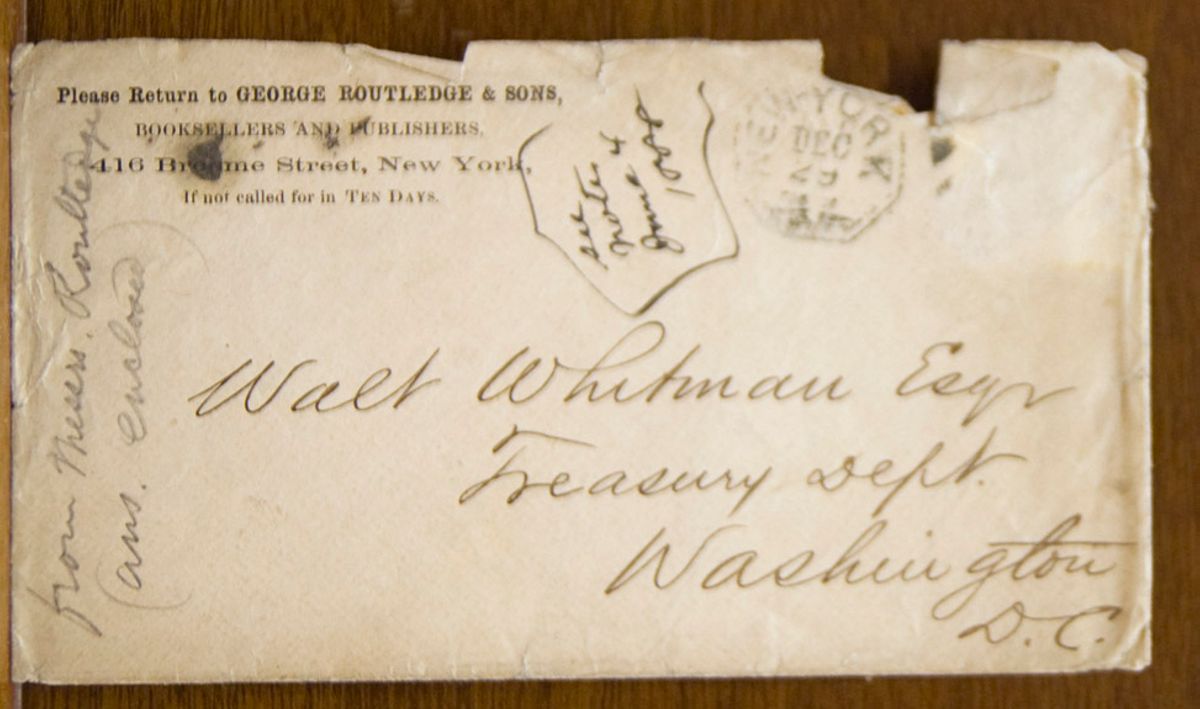 loc.02855.005_large.jpg
see notes June 4 1888
from Messrs. Routledge (ans.
enclosed)
loc.02855.005_large.jpg
see notes June 4 1888
from Messrs. Routledge (ans.
enclosed)
 loc.02855.006_large.jpg
Correspondent:
George Routledge & Sons were the publishers of
the London Broadway Annual (1867–1872). In 1867,
they printed two sympathetic accounts of Whitman. The novelist W.
Clark Russell termed Whitman one of America's eminent poets, and Robert Buchanan
devoted an entire article to Whitman; see Horace Traubel, With Walt Whitman in Camden, Tuesday, April 17, 1888 and
Tuesday, May 22, 1888. On
December 28, 1867, the New York office of the firm requested that Whitman
contribute "one or two papers or poems." Whitman sent "Whispers of Heavenly Death" in February 1868, and received
$50 in compensation, which he accepted in his February 19, 1868, letter to
Routledge & Sons. The poem, however,
did not appear in the Broadway Annual until October
1868.
Notes
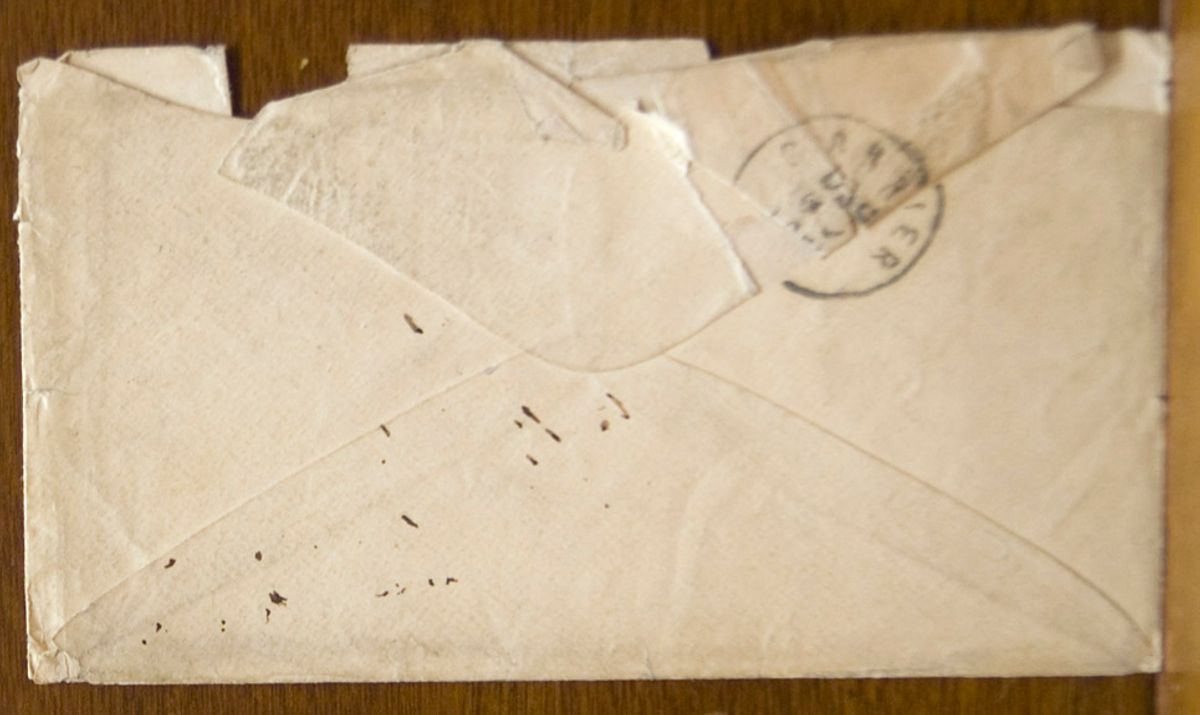
- 1. This letter is addressed: Walt Whitman Esqr | Treasury Dept. | Washington | D.C. It is postmarked: NEW YORK | DEC | 29 | [illegible] see notes June 4 1888 from Messrs. Roultedge (ans. enclosed) ; CARRIER | DEC | [illegible] [back]
- 2. The Broadway (subtitled "A London Magazine") was a British literary magazine founded by George Routledge (1812–1888) and published between 1867 and 1872. The magazine printed Robert Buchanan's glowing review of the 1867 edition of Leaves of Grass in the November 1867 issue. The Broadway also printed Whitman's poem "Whispers of Heavenly Death" in the October 1868 issue. [back]
- 3. Edmund Routledge was the son of George Routledge (1812–1888), founder of the London publishing firm George Routledge & Sons. [back]
- 4. Whitman's essays "Democracy" and "Personalism" were published in the Galaxy in December 1867 and May 1868. The poet also planned to publish a third essay, "Orbic Literature," in this journal, but the piece was rejected. These three essays were later combined in Democratic Vistas, which was first published in 1871 in New York by J.S. Redfield. [back]
- 5. Francis Pharcellus Church (1839–1906) established the Galaxy in 1866 with his brother William Conant Church (1836–1917). Financial control of the Galaxy passed to Sheldon & Company in 1868, and the magazine was absorbed by the Atlantic Monthly in 1878. [back]
- 6. Francis Turner Palgrave (1824–1897) was a British poet and art critic known for his interpretations of poetry and for his Golden Treasury of English Songs and Lyrics (first published in 1861), which anthologized what Palgrave believed to be the best in English poetry—excluding, however, any poet still living at the time of publication. [back]
- 7. Henry Sedley (1829–1899) was an actor-turned-journalist who worked as drama critic for the New York Times and later the Evening Post. From 1866 to 1869, Sedley served as editor of the Round Table, a New York opinions journal which published political, religious, and literary commentary. See also Frank Luther Mott, A History of American Magazines, 1865–1885 (Cambridge: Harvard University Press), 3:319–324. [back]
- 8. William Michael Rossetti (1829–1915), brother of Dante Gabriel and Christina Rossetti, was an English editor and a champion of Whitman's work. In 1868, Rossetti edited Whitman's Poems, selected from the 1867 Leaves of Grass. Whitman referred to Rossetti's edition as a "horrible dismemberment of my book" in his August 12, 1871, letter to Frederick S. Ellis. Nonetheless, the edition provided a major boost to Whitman's reputation, and Rossetti would remain a staunch supporter for the rest of Whitman's life, drawing in subscribers to the 1876 Leaves of Grass and fundraising for Whitman in England. For more on Whitman's relationship with Rossetti, see Sherwood Smith, "Rossetti, William Michael (1829–1915)," Walt Whitman: An Encyclopedia, ed. J.R. LeMaster and Donald D. Kummings (New York: Garland Publishing, 1998). [back]
- 9. See Whitman's draft letter of December 30, 1867 to George Routledge & Sons. [back]